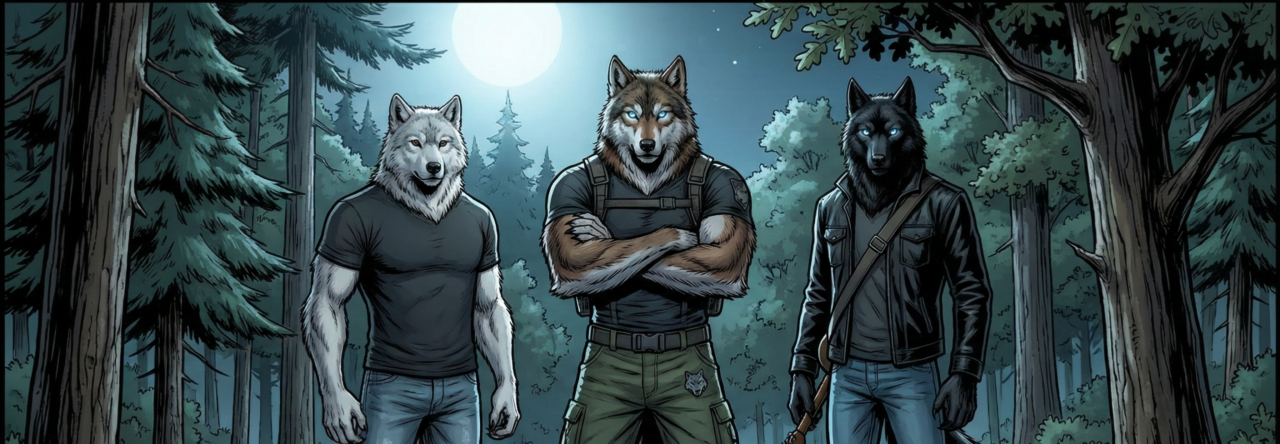
The truck idled at the edge of the square, rattling quietly in the soft spring morning.
Tarrik stood beside it, hands hooked in the strap of his pack, looking more like someone about to leave for work than a wolf who had once led a pack that terrified half this valley. The air smelled of damp earth, coffee, and the faint sweetness of fresh bread from the diner. A breeze pushed at the loose flyers on the notice board, rattling them like nervous fingers.
Mia, Lucas, and Darren were the first to reach him.
Mia stepped in without hesitation and wrapped her arms around him as far as they would go. For a heartbeat he froze, then his hands came up, careful and gentle on her back.
“Thank you,” she said into his chest. “For pulling that sled. For coming at all.”
He huffed a soft breath that might have been a laugh. “Wasn’t heavy sled,” he said. “But you three… worth weight.”
Lucas grinned. “Next time we’ll bring wheels.”
“No next time,” Darren said. “You already got us once. That’s enough heroism for one world.”
Tarrik pulled back, looking at each of them. There were lines in his face that hadn’t been there when he ruled Iron Ridge, new grooves carved by different kinds of work. Watching gates in Eureka. Walking fields. Standing on walls with Tom and planning patrols instead of raids.
“Eureka good town,” he told them. “If you come someday, ask for me. I show you around. Make sure nobody… remember wrong stories first.”
“We will,” Mia said.
Thane and the rest of the Libby pack waited a short distance away—Kade easy and still, Varro with his hands hooked in his belt, Rime shifting his weight from paw to paw, tail swaying. Marta stood with them, coat open in the mild air, Hank at her side, thumbs hooked in his vest.
Thane stepped forward when the kids moved aside. For a moment he and Tarrik simply looked at each other, two wolves measuring something that no longer needed to be measured.
“Tom’s expecting you?” Thane asked.
“Yes,” Tarrik said. “Truck meet me halfway. We trade driver. Tom say I should not walk whole way again unless I bring back three people on door.”
Mark chuckled. “He would say that.”
Thane’s expression softened at the corners. “You did good work, Tarrik,” he said. “Not just on the sled. Here. In town. Being seen.”
Warmth flared behind Tarrik’s ribs. Compliments still sat strange on him, like a cloak he hadn’t quite learned to wear, but coming from Thane they carried weight. He dipped his head slightly.
“Feels… good,” he admitted. “People here. They look at me and do not see only old Alpha. They see…” He searched for the word, then found it. “Neighbor.”
Marta stepped up, extending her hand. He took it carefully.
“You made a lot of friends this week,” she said. “You’re welcome in Libby any time.”
“Try to come back when we’re not dragging death out of the forest,” Hank added. “We do have calm days now and then.”
Tarrik’s mouth curved. “I will try,” he said.
Rime padded forward at the last second and bumped his forehead lightly against Tarrik’s. “You run good,” he said simply. “Come hunt sometime. I show you new deer trails.”
“Would like that,” Tarrik said. “Maybe next snow.”
The driver called softly from the cab. Tarrik slung his pack properly, moved toward the passenger door, then stopped and looked back one last time.
People waved. The newcomers. The pack. Marta. Hank. A couple of townsfolk standing in the doorway of the diner, one woman lifting her mug in salute.
For the first time in his life, the sight of a crowd looking at him didn’t feel like judgement or fear. It felt like warmth.
He climbed in, shut the door carefully so his claws wouldn’t catch the handle, and a moment later the truck rolled away down the street, engine fading into the spring hum of the town.
Thane watched until it turned a corner and disappeared.
“Feels strange,” Varro murmured. “Seeing him go and not… worry.”
“Good strange,” Kade said.
“Come on,” Marta said, clapping her hands lightly once. “We’ve got a market to set up, and children to keep from climbing the lampposts. Again.”
The group started to thin as people drifted back toward their morning tasks. Mia and Lucas headed toward the schoolhouse with Rime padding at their heels. Darren limped toward the clinic, determined to convince Dr. Wade to let him help with inventory.
Thane had just started toward the cabin when a bit of conversation floated across the square — casual, unhurried, the kind of talk people slipped into now that life wasn’t all fear and fire.
“…Saturdays used to mean something,” a woman said with a wistful smile in her voice. “Remember that?”
“Oh, yeah,” another answered. “We’d get dinner, then head to the Dome. Didn’t matter what was playing. Half the fun was just sitting in those big comfortable seats and pretending the world made sense.”
A soft laugh. “God, the sound in that place. You could feel it in your teeth.”
“Mm-hmm. And the popcorn? I still swear they used some secret butter the rest of us never figured out.”
“Wouldn’t mind tasting that again,” the first woman said. “Wouldn’t mind feeling those speakers shake the floorboards either.”
They kept walking as they talked, weaving through the little knots of people setting up tables for the market, their voices drifting behind them in gentle scraps of nostalgia.
Thane slowed.
Not because they were speaking to him — they weren’t.
Not because they were hinting — they weren’t.
Just because the name rang a bell he hadn’t realized he’d been ignoring.
He stepped a little closer. “Sorry,” he said, keeping his voice easy. “Did you say the Dome Theater?”
Three women turned toward him with mild surprise, the kind people wore when a stranger caught a bit of their conversation.
One nodded. “Sure did. Mineral Avenue. Can’t miss it. Big curved front, old marquee.” She gave a fond sigh. “Pretty thing. Been dark since the family passed from the virus.”
“They renovated it right before the Fall,” another added. “Brand-new everything. Sound, seats, digital projector… the works.”
“No one left who knows how to run it,” the third said, shaking her head. “Place has just been sitting there. Shame, really.”
They moved on, the conversation sliding naturally back to recipes, weather, errands — the hundred tiny threads of normal life made possible again.
But Thane stood there for a moment longer, something warm and bright blooming under his ribs.
A theater.
A projector.
A building full of stories waiting in the dark.
He didn’t smile often just for himself.
But he did then.
His claws flexed against the pavement.
“Mark,” he called.
Mark looked up from where he’d been talking with a trader about batteries. “Yeah?”
“Gabriel,” Thane added.
Gabriel poked his head out of City Hall’s doorway, headphones around his neck. “What’d I do this time?”
“Come on,” Thane said. “We’re going to see a building.”
They found Hank in his office, wrestling with a filing cabinet that had decided to resist reopening after a decade of loyal service. He grunted, yanked, and finally coaxed the drawer out with a screech of protest.
“You look like a man about to make my morning more complicated,” Hank said without turning around.
“I’m about to make everyone’s Saturday nights less boring,” Thane said. “You have the keys to the Dome?”
Hank stopped, hand hovering over a stack of papers. “Huh,” he said. “Haven’t heard anyone ask that in a while.”
“You do have them, right?” Mark asked.
“Of course I have them,” Hank said. “When the owners died, their nephew handed everything to the town. Figured we’d either find another projectionist or turn it into a feed store.” He rummaged in a drawer, emerged with a key ring large enough to anchor a boat. “Pretty sure it’s on here somewhere.”
Gabriel’s eyes widened. “You have this many doors in town?”
“Some of these don’t belong to anything that exists anymore,” Hank said. “Makes me sentimental.” He sifted through the keys, then plucked one out—a worn brass tag stamped DOME. “There. Break anything and you’re rebuilding it yourself.”
“Fair,” Thane said, taking the ring.
They walked down Mineral Avenue together, claws clicking on sun-warmed pavement. Spring had stripped winter’s harshness from the town; flower boxes someone had cobbled together from old crates hung under a few windows, stubborn green shoots poking up through soil. The Dome’s facade rose ahead—curving, dignified, the old marquee letters long gone but the bones of the sign still reaching out over the sidewalk like an empty hand.
The doors were latched but not boarded. Dust filmed the glass. A faded poster for some pre-Fall action spectacle clung to one display case, edges curled.
Gabriel pressed his face to the glass for a second. “This feels like breaking into holy ground,” he murmured.
“Then we’re going to do it respectfully,” Thane said. He slid the key into the lock, turned. The mechanism resisted, then yielded with a click that sounded too loud.
The lobby smelled like dust, stale syrup, and a ghost of popcorn that had soaked into the carpet years ago and never quite left. Sunlight speared in through the front windows in soft beams, catching dust motes that swirled as they stepped inside.
For a moment, no one spoke.
The concession stand sat ready, plexiglass clean but dulled, popcorn machine standing like a quiet red shrine behind the counter. Menu boards still listed prices in dry erase marker. A paper cup towered silently next to a row of syrup-stained soda taps. A framed photo of the family who had run the place sat near the register—smiling, unaware of what was coming.
“Looks like they could open in an hour,” Mark said softly.
“Feels wrong that they never did,” Gabriel said.
“Feels like they waited for us,” Thane murmured.
He moved behind the counter, fingers brushing the popcorn machine’s controls. “We’ll need to check if anything spoiled,” he said, slipping into a practical cadence that steadied his chest. “Oil goes rancid. Syrup can separate. But if the storeroom’s cool enough…”
“Let’s see the real heart,” Mark said. “Projector.”
“Upstairs,” Thane said immediately, without needing to think.
The stairs to the booth were in the same place every theater put them—tucked near one side, narrow enough that two people had to turn sideways to pass. His body remembered the shape of them before his mind did. Years ago—another life, another small town, long before he was an Alpha—he’d climbed stairs just like this to thread film through projectors, timing cues to light a screen in the dark.
He let his claws drift along the rail, careful not to gouge the wood.
The projection booth door opened with another reluctant creak. Inside, the air was cooler, tinged with the smell of electronics and metal. A digital projector sat on its pedestal, sleek and slightly dusty but clearly expensive—a black, angular animal waiting for a handler. A server rack hummed faintly below it, still plugged in, little status lights dark but ready.
“Look at you,” Thane said under his breath, affection in it.
Mark let out a low whistle. “That’s not cheap,” he said. “Or wasn’t.”
“Digital cinema package setup,” Thane said, moving closer without touching anything yet. “Server pulls encrypted films from the drive. Projector just listens. They probably got a big upgrade loan to do this. Small houses like this don’t pull one of these out of thin air.”
“You sound like you’ve done this before,” Gabriel said.
“Long time ago,” Thane said. “Different name on the ticket booth. But once you learn how to talk to a projector, they all speak about the same.”
He found the power switch by feel, hand sliding under the lip of the rack. The toggle clicked. For a heartbeat nothing happened, and then the server woke up with a rising whine, fans spinning. Status lights winked to life—red, then amber, then a steady, promising green.
Gabriel grinned like a kid. “That is a good sound.”
The projector followed a moment later, internal ballast cycling, a soft thump and then a low, steady hum. Thane watched the indicators, waiting for any error codes. None came.
“God, I missed that,” he said quietly.
Mark peered at the small touchpanel mounted on an arm. “Can you get into the library?” he asked.
Thane tapped through menus with a familiarity that surprised even him. There it was: a list of titles scrolling up, each with a little icon and runtime.
“Looks like the last year’s worth of bookings,” he said. “They must’ve pulled everything in and held it on the drive. No one ever wiped it when the world went sideways.”
Gabriel leaned over his shoulder, reading.
“Starfall: Ascendant,” he read aloud. “That’s the big space thing that everyone in Spokane kept going on about.”
“Skyline Drift Nine,” Mark said. “Cars on buildings. Completely ridiculous. I saw the trailer once, felt my brain get dumber.”
“Neon Frontier,” Gabriel added. “Sci-fi western. I wanted to see that.”
Thane scrolled. “Iron Vow: Legacy. Eclipse Protocol. Ghost Harbor. Deep Blue Silence. That one’s a submarine thriller, I think. Kingdoms of Glass… fantasy epic. Last Light Rising. Rogue Circuit. Broken Crown. Song of the Ember Sea.”
He stopped at the last one, mouth quirking. “That’s the animated one. Dragons and singing. Probably safe for kids.”
“More safe than cars driving up skyscrapers, yeah,” Mark said.
“There’s a Blu-Ray player too,” Gabriel said, pointing to a component under the monitor. “If we find discs, we can spin anything with a logo on it.”
“Libby Video still has most of its shelves intact,” Mark said. “They locked the place up and never went back. We get the lights on in there and… yeah. We could go wild.”
Thane straightened, letting it all settle in. The hum of the equipment. The list of stories on the screen. The booth’s small window looking out over the empty seats below.
“You’re thinking what I’m thinking, right?” Gabriel said.
“Probably,” Thane said. “You say it first.”
“Saturday Night Movie,” Gabriel said. “Every week. Like church, but with better snacks.”
Mark laughed. “You’re going to make Mrs. Renner cry happy tears.”
“Whole valley will tune in to hear about it,” Thane said. “Spokane, Thompson Falls, Eureka… half of them have theaters that’ll never turn on again. If they know Libby’s running a screen…”
“It’ll make the world feel… bigger,” Mark said softly. “Not just our valley. Something reachable.”
Thane nodded. “We start small,” he said. “One showing. See if the sound still thumps, if the picture holds. Make sure nobody gets sick from the snacks. But if it works…”
Gabriel’s eyes shone. “If it works, we bring back Saturday night.”
They spent the next hour testing. Mark traced the power line back to the panel, confirmed it was connected properly. Thane ran a short test pattern, watching the beam cut through the dark and splash against the ivory curve of the screen. The image snapped into focus with only a few minor adjustments. Gabriel walked the aisles, listening for dead spots in the surround speakers; the sound seemed to embrace every seat evenly.
In the storeroom behind the concession stand, they found boxes of popcorn kernels in sealed bags, syrup in unopened metal canisters, stacks of paper cups and napkins. The huckleberry candies sat in plastic tubs, sugar still crisp and hard when Thane bit one experimentally.
“Still good?” Mark asked.
He let it dissolve on his tongue, tasting memory and artificial berry. “Dangerously so,” he said.
By the time they stepped back out into the spring light, they were all a little dustier, a little more wired, as if the theater’s slumbering energy had jumped into their blood.
“Lock it up,” Thane said, turning the key in the door. “Last thing we need is Holt breaking in tonight and eating half the popcorn stock before we even start.”
“You’re going to have to explain ‘movie theater etiquette’ to the wolves,” Mark said. “Rime’s going to want to pace the aisles just because he can.”
“We’ll make a wolf row,” Gabriel said. “Back seats, left side. Claw-friendly.”
They headed back toward the square. The town was busier now, afternoon settling in. Children chased each other around the fountain. Rime and Kade stood near the schoolhouse, going over a map with Varro between calls from Mrs. Renner about who needed to go straight home and who could be trusted to stop by the market first.
Marta spotted them as they stepped onto the square. “You three look like you just found the last box of chocolate on earth,” she said. “What’d you break?”
“Nothing,” Thane said. “Yet.”
Mark nudged him. “Just tell her. You’ll explode if you stretch it out.”
Thane looked at Marta, then at the cluster of people within earshot—Hank, Dr. Wade, a couple of traders, Mrs. Carley again. He lifted his voice just enough to carry.
“We turned on the Dome,” he said. “Projector. Sound. Everything. It all still works.”
For a heartbeat there was silence, as if the words bounced off everyone’s ears and needed a second to sink in.
Then Marta’s mouth fell open. “You’re serious?” she asked.
“Yes,” Thane said. “Digital setup. Full library from the year before the Fall still on the server. Popcorn machine, candy, seats. All of it. Looks like time just… stopped in there.”
Mrs. Carley clapped a hand over her mouth. Hank let out a low whistle. Dr. Wade actually smiled, the small, tired expression of a man who’d just been told a patient was doing better than expected.
Gabriel stepped in. “We were thinking,” he said. “Saturday Night Movie. Every week. One show, early evening. Something family-friendly to start. Get everyone in without giving them nightmares.”
“Song of the Ember Sea,” Mark said. “Animated. Dragons. No one gets disemboweled in the trailer, at least.”
“Kids would lose their minds,” Mrs. Carley said. “Adults too.”
Marta’s eyes shone, and for a moment she had to look away, blinking hard. When she turned back, her jaw was set in the particular way that meant an idea had wrapped itself around her and was not letting go.
“We do it,” she said. “Weekly. I’ll put it to the council for formal approval, but I’m not waiting to start getting people excited.”
She pivoted, scanning the square. “Where’s Jana?”
Jana—the same woman who led painting lessons at the schoolhouse and covered more than one boarded-up window with flowers and wolves and suns—looked up from a conversation near the library.
“Yes, Mayor?” she called.
“Feel like painting a movie poster?” Marta called back. “Big one. For the square. And one for the Dome. ‘Saturday Night at the Dome Theater.’ First show this coming weekend, if Thane can get his wolf army in line.”
Jana’s grin answered that question before her words did. “I’ve been waiting for something like this since the world ended,” she said.
Kids, already keyed up from a morning of running, began buzzing louder.
“Movies?” one said. “Real ones? Not just Gabriel telling stories on the radio?”
“Popcorn?” another demanded.
“Huckleberry candy?” Mrs. Carley added.
“We need to pace this,” Dr. Wade murmured. “If we give everyone that much sugar and excitement at once, I’ll be stitching up sprained ankles all week.”
Hank chuckled. “Good problem to have, Doc.”
Rime trotted over, ears pricked. “What happen?” he asked. “Everyone smell like happy.”
“Big pictures on wall,” Kade said. “Stories that move. Lots of sound. Many people in same room watching together.”
Rime blinked. “Like radio, but eyes too?”
“Exactly,” Gabriel said. “We’ll bring you. The back row, so you don’t pace a hole in the floor.”
“Floor strong,” Rime said, offended. “But okay. Back row fine.”
“What about claws on seats?” Varro asked, practical as ever. “Fabric will not like us.”
“We’ll pick a section and put boards over the arms,” Mark said. “Wolf section. Make it official. If anyone without claws sits there, that’s on them.”
Marta looked at Thane. “Think your pack can handle sitting still for two hours in the dark?” she asked.
Thane considered his wolves—the restless energy, the long memories of running under open sky, the way Holt always needed something in his hands or mouth.
“We’ll make it part of training,” he said. “Endurance. Focus. No chewing the armrests.”
“That last part was aimed at Holt,” Gabriel said.
“Mostly,” Thane admitted.
They spent the rest of the afternoon planning in gentle spirals. Jana sketched poster designs on a scrap of cardboard—bold letters, a rough dome shape, little silhouettes of wolves and humans sitting side by side in rows. Mark made a list of what the projection system would need to stay healthy: filters, occasional cleaning, someone to check the server logs. Gabriel started jotting down on-air announcements in his notebook.
That night, back at the cabin, the wolves sprawled in their usual chaos—Rime near the hearth, Holt on his back with all four paws in the air, Kade and Varro at the table with maps, Gabriel tuning his guitar on the couch. The smell of stew mingled with woodsmoke and the last hints of the day’s rain drying off fur and clothes.
Thane stirred the pot one more time, then leaned against the counter, feeling the simple weight of a good day.
“So,” Gabriel said, plucking a few notes. “You going to tell them, or should I?”
“Tell us what?” Holt asked, rolling awkwardly onto his side, ears perked.
“Saturday,” Kade said. “We’re going to the Dome Theater. Movies are back.”
Holt’s eyes went comically wide. “Big pictures place?” he said. “With smell of corn and sugar?”
“You remember it?” Thane asked.
“Smell only,” Holt said. “We hunted near town once. Before Fall. Could smell butter and candy from trees. Was torture.”
Rime’s tail thumped. “We go in?” he said. “Sit with humans? Watch big story?”
“Yes,” Thane said. “We sit. We watch. We do not break anything.”
Holt glanced at his hands, flexed his claws. “I be careful,” he said. “Maybe sit on floor.”
“We’ll make space,” Thane said. “Wolf row.”
Varro looked thoughtful. “Many people in one room,” he said. “Lights off. Loud sound. Some panic, maybe.”
“We’ll station a couple of us near the exits,” Thane said. “Quiet, not looming. Make sure anyone who gets overwhelmed can leave without feeling trapped. This is supposed to help people, not scare them.”
“Humans used to do this every week?” Kade asked.
“Every day,” Thane said. “But Saturday nights were special. You worked through a week, you got to sit in the dark with people you didn’t know and feel them react to the same story. It made you feel less alone.”
Gabriel strummed a chord that hung warm in the air. “Feels like the valley’s ready for that,” he said. “Being less alone.”
Thane thought of Tarrik in the truck that morning, looking back at a town that no longer feared him. Of Mia’s face lighting up in the schoolyard. Of Mark’s eyes shining in the dim projection booth as the projector hummed to life. Of Marta’s barely-contained joy in the square.
“Yeah,” he said. “It is.”
Outside, the wind moved gently through the trees on the slope above town, carrying the sounds of Libby at night—the soft thrum of power, distant voices, the faint hum of KTNY’s transmitter. Somewhere in the square, Jana was probably still painting, working on big letters that would mean more than the words themselves.
The First Picture Show.
For the first time since the Fall, Saturday night in Libby had plans.