Sunday arrived like the valley had finally remembered how to breathe.
Not in silence — Libby was too alive for that now — but in the easy, ordinary way that only came when a town didn’t wake up braced for bad news. The sun climbed cleanly over the mountains, warming the roofs and the storefronts on Mineral Avenue. Somewhere down the street a pickup started with a familiar cough and steadied into a purr. A screen door slapped shut. A dog barked twice and then stopped, as if even it had decided the morning wasn’t worth fussing over.
Power was simply there. No humming generators. No careful rationing. No lanterns hung on hooks out of habit. Streetlamps still glowed faintly under the shade of trees that had begun to leaf out again, and the lines of electricity ran exactly where they had run before the Fall, carrying that invisible certainty from the dam like it had never stopped.
Thane crossed the square with a paper cup of coffee in one clawed hand and a folded note in the other — a list Marta had handed him the day before, half joking and half serious.
If you have time, could you have the pack help move the produce tables again? Also, someone needs to fix the second speaker because it crackles.
He could hear the crackle already. A speaker mounted high on the courthouse wall was playing music into the open air — not loud, just enough to fill the space between conversations. It was one of Gabriel’s recordings, mellow guitar and a steady beat under it. The kind of tune that made you want to linger.
A different sound cut through the music: a phone ringing from somewhere down the block, sharp and bright. Someone answered it with a laugh that carried out of an open window.
“Libby City Hall, yeah, we’re open—no, you don’t need an appointment, you just walk in—”
Thane smiled into his coffee and kept walking.
The square was already waking into market day. Tables were being unfolded with practiced hands. Awnings went up, their canvas snapping once in the breeze like sails. Someone had strung the white bulb lights again — long lines from building to pole, pole to building, crossing the open space overhead in lazy arcs. They weren’t needed in the morning sun, but they were on anyway, glowing softly just because they could.
Normal had turned into a habit again.
“Alpha!”
Two small bodies hit his legs like happy missiles.
Mason grabbed his left thigh. Ellie latched onto the right, cheek pressed against his jeans as if he were a favorite piece of furniture.
Thane paused and looked down, feigning sternness. “You two are going to knock me over.”
Mason looked up with a grin too big for his face. “Dad says you can’t fall.”
“That’s a lie,” Thane said. “I fall all the time. I just don’t do it in public.”
Ellie giggled. “We saw the dragon again!” she blurted, as if the movie had somehow continued in her dreams. “And the song—”
Mason cut in, loud and excited. “And the part where it dove into the waves and the water turned orange like fire!”
Thane’s ears tipped forward. “So you’re telling me,” he said slowly, “that the movie was good.”
They both nodded so hard their hair bounced.
“Good,” Thane said, and let his expression soften. “That means we did something right.”
Ellie hugged harder and then, as if remembering manners, released him and skipped backward with a little bow. “Okay. We’re going to climb Rime now.”
“Of course you are,” Thane muttered.
He turned, coffee still in hand, and found Rime already seated at the fountain like he’d been appointed as an official attraction. Three kids were climbing over him, one perched on his broad shoulder, another braiding a ribbon into the fur at the end of his tail with intense concentration. Rime’s eyes were half-lidded in patient resignation, but his tail flicked in slow, content swishes.
“Rime,” Thane called. “You ok?”
“Yes,” Rime answered without looking up. “I have become… mountain.”
One of the kids leaned over his shoulder and whispered conspiratorially, “He’s warm.”
“Yes, I am,” Rime said.
The kid smiled wide and hugged his neck.
Thane shook his head, laughing under his breath, and moved on.
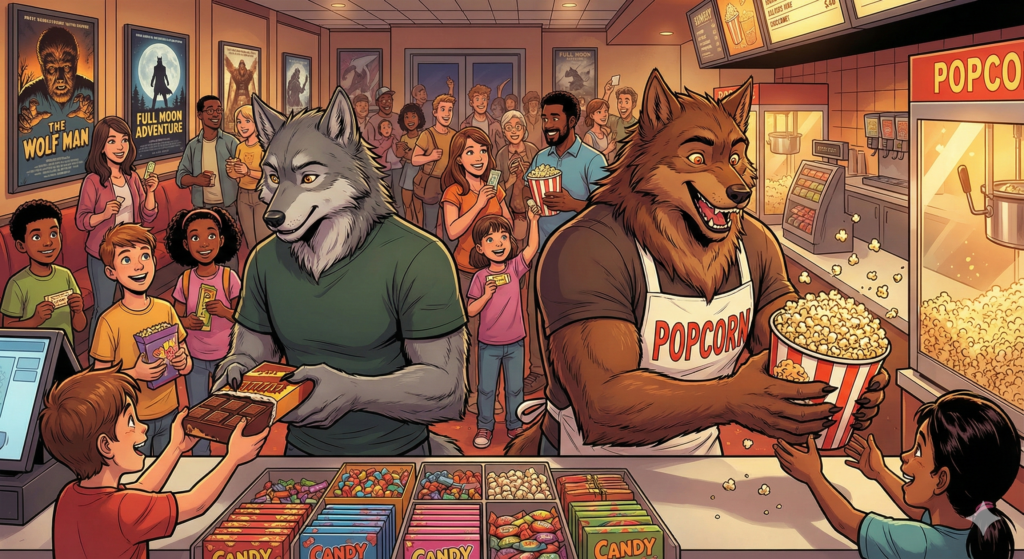
The smell of the market hit him next — bread, coffee, smoked meat, spring herbs crushed under boots and paws. And popcorn, faint but unmistakable, like the Dome had imprinted itself on the town overnight.
Mrs. Carley stood at a table near the bakery with a basket of muffins, passing them out to anyone who walked by. She spotted Thane and lifted one in salute.
“Movie staff deserves pastries,” she called.
“We weren’t the only staff,” Thane called back. “Half the town volunteered by showing up and smiling.”
“That’s not work,” Mrs. Carley said. “That’s living. Take a muffin.”
Thane took one with a nod and continued toward the bank steps, where Mark was leaning with his own coffee, watching the square the way a man watched a machine he’d finally gotten to run without grinding.
Glacier Bank’s doors were open behind him, and the marble lobby inside looked absurdly clean now, as if the building had been waiting its whole life to be useful again. A temporary market desk had been set outside beneath a canopy, with a sign propped on the edge:
CASH ACCEPTED HERE
CHANGE AVAILABLE
A woman from Marta’s staff was stationed there with a tin cash box and a stack of small bills. She was laughing with a teenager who kept trying to pay with a hundred.
“You do not have to use the biggest bill you own,” she told him, still smiling. “It’s not a contest.”
“It kind of is,” the teen said, grinning. “I found it in my dad’s safe. I wanna see if it’s still magic.”
“It’s still paper,” she said. “Give me a ten.”
Thane stepped up beside Mark. “Feels strange seeing money again.”
Mark nodded slowly, eyes on the exchange. “It does,” he said. “But it also feels… like the world clicked back into place. Like putting a book back on the right shelf.”
A man approached the canopy with a jar of honey and a small bag of dried apples. He pulled bills from his pocket with care, smoothing them flat before handing them over.
“Feels like I’m doing something illegal,” he joked.
The woman behind the tin box snorted. “It’s only illegal if you try to eat it.”
Thane watched the man take his change and tuck it into his pocket with a quiet kind of gratitude. Not because the money mattered, but because what it represented did — order. Trust. A shared agreement that the world could be predictable.
A landline rang somewhere nearby — two rings, then cut off as someone picked up. Another voice floated out from the bank doorway.
“Glacier Bank, yes, we’re open—no, you don’t need to be a resident of Libby—yes, Thompson Falls can open accounts too—”
Mark’s mouth quirked. “Remember when phones ringing was annoying?”
Thane huffed. “I’d take annoying.”
“Same.”
Gabriel appeared like he belonged wherever there was sound. He had his guitar slung over his back and a short length of cable in his hand. He nodded toward the crackling speaker overhead.
“That one’s annoyed,” he said. “I’m gonna fix it before it starts sounding like a dying goose.”
“Do you need help?” Mark asked automatically.
Gabriel grinned. “Nope. I’m doing a normal job. Let me have this.”
Mark laughed and held up his hands in surrender. Gabriel headed toward the courthouse wall, climbing a ladder with practiced confidence and the casual grace of someone who’d climbed towers and rooftops for far more serious reasons.
Thane’s gaze drifted across the square.
Marta was moving from table to table with her clipboard, but she wasn’t tense today. She stopped to talk to people, to laugh. Hank stood near the sheriff’s office doors with a cup of coffee, arms crossed, watching the crowd like a man who’d spent too long guarding an empty world and was still getting used to this one being full again.
When Marta reached the center of the square and saw Thane, she lifted her hand and waved him over.
“Morning,” she said. “You sleep at all?”
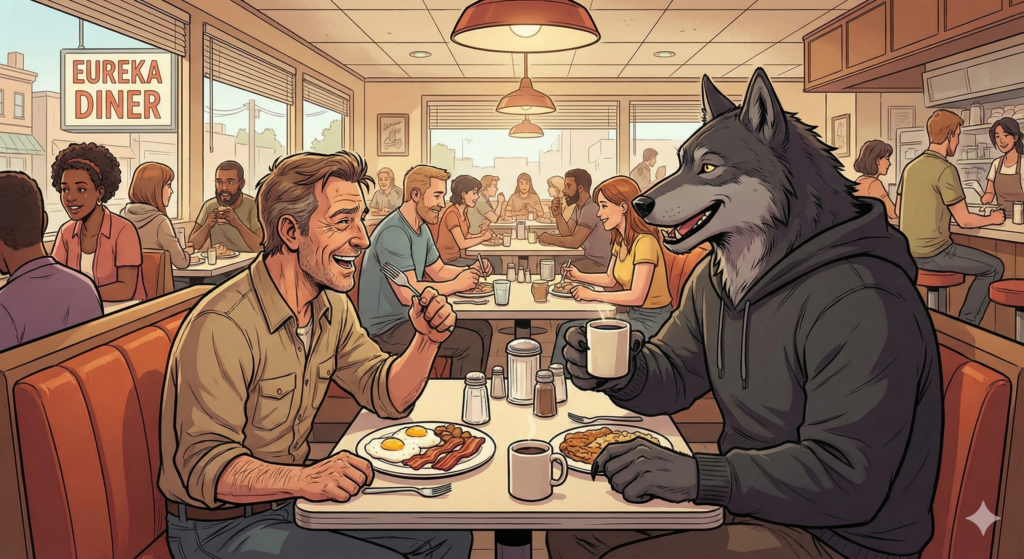
“Some,” Thane said. “Holt tried to tell everyone the entire plot of the movie at breakfast.”
Holt, as if summoned by his name, was at the smoked meat table with two men from Spokane, speaking with grand, sweeping gestures.
“And then,” Holt was saying, voice full of wonder, “dragon chooses mercy. Not fire. Mercy. Big lesson.”
One of the Spokane men chuckled. “You’re a movie critic now?”
Holt looked offended. “No. I am wolf. But movie… makes heart feel bigger.”
The other man wiped at his eyes with a knuckle, pretending it was nothing. “Yeah,” he muttered. “Same.”
Marta followed Thane’s gaze and smiled faintly. “I’ve seen Holt hug three people this morning.”
Thane’s eyebrows lifted. “Is that a record?”
“By lunchtime he’ll be running for mayor.”
Hank wandered closer, snorting. “Don’t joke like that.”
“Why?” Marta asked, amused. “Afraid he’ll win?”
Hank looked out over the square at Holt’s towering presence, his apron still on from last night because he’d refused to take it off, the word POPCORN stamped across his chest like a badge of honor.
Hank’s lips twitched. “I’m afraid he’ll enforce the rules.”
“Fear travels farther than paperwork,” Thane said dryly.
Marta laughed, then her expression softened. “Last night,” she said quietly, “I stood in that lobby and I swear I forgot the Fall happened for five straight minutes.”
Thane nodded once. “I felt it too.”
Hank’s gaze went distant for a second. “My wife loved that theater,” he said, voice rougher than usual. “We used to sit in the back row and talk through the whole movie. Drove everyone else crazy.”
Marta’s smile turned warmer. “What would she say about werewolves running concessions?”
Hank’s mouth curved. “She’d tell me to stop being grumpy and buy them candy.”
Thane glanced across the square again, letting his eyes rest on the small details: string lights glowing in daylight, kids running with paper dragon masks, a couple arguing gently about whether to show an action movie next week or a comedy.
And then he noticed Varro.
Varro stood near the fountain, not far from Rime’s “I am mountain” post. A little boy had collided with him at full speed — the kind of accident that would have ended in tears a year ago. Instead, the boy bounced off Varro’s leg, laughed, and immediately wrapped his arms around Varro’s thigh like it was the most natural thing in the world.
Varro froze.
His hands hovered, uncertain.
Then, slowly, carefully, he placed one hand on the child’s back. His touch was gentler than anyone would have expected from a wolf who had lived under Tarrik’s old rule.
“It is… okay,” Varro said quietly.
The boy looked up. “You’re big.”
“Yes,” Varro agreed, and there was something like a smile in his eyes. “You are… fast.”
Kade stood a step behind Varro, watching, his posture easy. When another child ran up and hugged him without warning, Kade didn’t even flinch. He simply rested a hand on the kid’s head, steady and calm.
“Your fur is like a blanket,” the child declared.
Kade’s voice was perfectly even. “I am not a blanket.”
The child hugged harder.
Thane’s mouth twitched. Some truths didn’t matter when kids were involved.
Gabriel climbed down from the ladder and jogged across the square, wiping his hands on his jeans. The music overhead smoothed out immediately — no more crackle, just warm sound drifting on the air like it belonged there.
Gabriel nodded once, satisfied. “Better.”
Marta pointed at him. “You’re broadcasting later today.”
Gabriel groaned theatrically. “Can’t I just be a normal guy for one day?”
“You have a tail,” Hank said.
Gabriel pointed at his own black fur, deadpan. “Rude.”
They all laughed.
The market swelled toward midday, the square filling until it felt like the whole town was here — and maybe it was. Libby wasn’t big. Three hundred seats at the Dome was basically a town-wide invitation, and it had turned into a town-wide habit in the span of a week.
People talked about the movie like it was something they’d survived together.
“That ocean scene,” a woman said near the bread stand, voice full of wonder. “I forgot water could look like that.”
“My kid tried to sing the Ember Song all night,” her husband replied. “I threatened to lock him in the barn.”
A teenager piped up from behind them. “You can’t. It’s stuck in our heads too.”
A man with a Spokane accent laughed and held up his hands. “I’m not ashamed. I cried. Right there in the theater. In public.”
Mrs. Carley patted his arm. “Good. It means your heart still works.”
Dr. Donovan Wade emerged from the clinic down the street and stepped into the square like a man stepping into sunlight after too long indoors. He wore his usual practical clothes, sleeves rolled, vest pockets full. His expression was calm, but his eyes softened as he watched the crowd.
Thane waved him over. “Morning, Doc.”
Wade’s gaze flicked to Thane, then to the kids climbing on Rime, then to Holt still wearing his POPCORN apron in public like a proud idiot.
He cleared his throat. “I have seen stranger medical phenomena,” he said. “But not many.”
Marta grinned. “You come to the movie last night?”
Wade’s mouth quirked. “I sat in the back. So I could leave if the crowd became… too much.”
“And?” Thane asked.
Wade looked away, pretending to study a vendor’s apples. “The dragon song was… tolerable,” he said dryly.
Gabriel laughed. “That’s the highest praise you’ve ever given anything.”
Wade’s eyes narrowed. “Don’t push it.”
Hank angled his head toward the bank canopy. “Doc, you ever think you’d see people paying for honey with cash again?”
Wade followed his gaze. “I thought we might see a lot of things again,” he said, voice quieter. “but I did not know if I’d be alive for them.”
That landed softly but firmly between them.
Thane didn’t answer with words. He simply nodded once, a silent agreement that the weight of that statement deserved.
Then a small voice cut in, bright and impatient. “Doctor Wade!”
Wade turned just in time to be nearly bowled over by Darren, moving faster than he should have with his brace. The man looked healthier already, cheeks less hollow, eyes brighter.
“I’m walking,” Darren announced, triumphant.
“You are limping,” Wade corrected immediately.
Darren grinned. “But I’m limping to the market. That counts.”
Wade’s lips twitched. “It counts as progress,” he allowed. “And as you disobeying me.”
Darren looked guilty for exactly half a second and then shrugged. “The movie warmed my soul. I had to come out.”
Wade sighed like a man who had lost this battle before it began. “Fine. But if you fall, I’m charging you double.”
Darren blinked. “With cash?”
Wade looked him dead in the eye. “With labor.”
Darren laughed and moved off, still limping but stubbornly joyful.
Thane watched him go, then looked back at the square. The string lights swayed gently overhead. The music drifted. The phones rang and rang and rang, answered by voices that sounded like they had plans.
Kade stepped close enough for Thane to hear him over the crowd. “This is good,” he said simply.
Thane nodded. “Yeah.”
Varro’s gaze swept the square, scanning out of habit, then settled on a small child who had climbed onto Holt’s knee like Holt was a living chair. Holt held the child steady with enormous careful hands, looking mildly terrified that he might accidentally crush joy itself.
Varro’s voice was low, thoughtful. “Hard to believe,” he said, “that we live in same world as before.”
“We don’t,” Thane said. “But we’re building one worth living in.”
Varro looked at him, amber eyes steady. “Yes,” he said. “We are.”
As afternoon settled in, the market eased into a slower rhythm — people lingering, talking longer, sitting on benches beneath the string lights even though the sun was still high. The Dome poster fluttered on the notice board, bright paint catching light.
Saturday at the Dome had become more than a movie night.
It had become proof.
Proof that the world could come back in pieces. That joy could be rebuilt like a bridge. That normal wasn’t gone — it was waiting, like the theater had been waiting, dark and silent until someone remembered how to turn the lights on.
Thane stood near the center of the square, coffee gone cold in his hand, and watched children run through sunlight with paper dragons on their faces.
He couldn’t hear the Ember Song anymore, but he could feel it in the town — in the hum of power, in the ring of phones, in the laughter.
And for once, he let himself believe that this might last.