Three Werewolves: After The Fall

The world ended. The pack didn’t.

Episode 16 – The Weight of Quiet

The forest had gone still in the days after the battle.
No wind, no shouting, no gunfire — just the hush that comes when even the trees are tired.

Libby slept.
The prisoners worked under guard during daylight hours, rebuilding bridges and stacking timber for the winter to come. At night, the valley smelled of smoke and sap and the faint metallic tang of cooling tools.
Most nights, Thane sat alone outside the walls — not as the town’s protector, but as something older. Watching. Listening. Thinking.

This night, he wasn’t alone.

He caught her scent before he saw her — earth, rain, the faint wild musk that seemed to follow Sable wherever she went. She sat on a fallen pine near the overlook above the river, her silver-gray fur catching the moonlight in broken strands. Her eyes tracked the water below, patient and unfocused, like she wasn’t watching anything in particular — just remembering.

Thane approached quietly, claws scraping rock just enough to announce his presence.
Sable didn’t startle. She just said, “I thought you’d come.”

He stopped beside the log, folded his arms. “Couldn’t sleep.”

“No one can,” she murmured. “The world is too loud when it’s this quiet.”

For a long time, they said nothing. The river moved far below, whispering against the stones. A nightbird called somewhere out past the ridge. The rest of the world was wrapped in a hush that wasn’t peace so much as aftermath.

Sable finally spoke again, voice soft and rough. “We lost three,” she said. “Good wolves. One young. They fought like they thought I was watching.”

“I was,” Thane said simply.

Her mouth curved — not a smile, exactly, but something close. “You see everything, don’t you?”

“Not everything. Just enough to know when to look.”

Sable nodded slowly. “Then you know why I stayed.”

He did. The ferals could’ve gone back north days ago. But Sable lingered — not for power, not for politics, but because she needed to make sure the bond between her pack and Libby was real. She’d risked everything trusting humans and tame wolves alike, and she wasn’t ready to walk away from that gamble.

“The town’s different now,” Thane said. “They see you as family.”

Sable looked up at the stars. “Family’s a heavy word.”

“Yeah,” Thane said. “So is Alpha.”

That made her laugh — a low, rumbling thing that came from deep in her chest. “You sound like one who knows.”

He didn’t answer. He just eased down beside her on the fallen log, elbows on his knees, claws tracing idle lines in the bark. For a while, neither of them spoke. The kind of silence that settles only when two people have run out of walls to hide behind.

Finally, Sable said, “It’s strange. After the fight, I didn’t know what to do with my hands. No weapons. No claws. Just… stillness.”

Thane nodded, slow. “Stillness is harder than war.”

“Sometimes,” she agreed. “At least in war, you know where to put the pain.”

She looked at him then, eyes like moonlit water. “Do you ever… just want to stop being the one who has to hold it all together?”

Thane let out a breath that was almost a growl. “Every day.”

The words hung between them — heavier than any confession.

Sable shifted a little closer, the movement unhurried, instinctual. “My wolves need me strong,” she said. “But sometimes I think what they really need is someone who remembers how to feel.”

Thane looked at her, brow furrowed, but she didn’t look away. She just leaned in until their shoulders brushed — a quiet, animal gesture of contact, grounding, truth.

He didn’t flinch. Didn’t move. Just breathed.

Her fur was cool where it met his, then warm, and the small tremor in her exhale wasn’t fear. It was relief. The kind that comes from knowing someone else understands what it costs to lead.

They sat that way for a long while — two alphas, not speaking, not performing, simply being. The moon rose higher, throwing silver across the river, and somewhere in the trees a wolf from her pack howled once, long and low — a sound of mourning and life intertwined.

Sable’s hand found his forearm, claws careful not to break the skin. “We fight different wars, you and I,” she said quietly. “But tonight, maybe we can lay down the flags.”

Thane turned his hand over, just enough that his claws brushed hers in answer. “No flags here,” he said. “Just pack.”

That word — pack — softened her whole posture. She leaned against him fully then, head resting near his shoulder. Not dominance, not submission. Just trust.
The forest seemed to breathe with them.

They stayed that way until dawn threatened the horizon. When the first birds started to sing, Sable stirred, stretching. “The world’s going to wake up soon,” she murmured.

Thane nodded, rising beside her. “Then we’d better be ready to hold it up again.”

Sable smiled, faint and tired but real. “Together, then.”

He met her eyes. “Together.”

When they walked back toward Libby, side by side, their shadows merged with the trees — the line between feral and civilized fading for just one beautiful moment, replaced by something older and stronger: kinship.

Episode 15 – River Reckoning

The message arrived in the deep of night, a frantic pulse on a frequency Mark never liked to hear.

Mark had been up checking the repeater logs when the signal lit his screen: a short, garbled burst, then words in a voice threaded with panic. It was Mayor Lorne, breathless and raw.

“They’re here. River Division. Bridges cut. Mill’s on fire. We need—please—Libby, help now.”

The truck bay at Libby’s Hall woke like someone yanking a blanket off a sleeping town. Hank’s boots hit the floor and Marta was already packing lists. Gabriel strapped his guitar into its case and loaded a bandolier of practical tools rather than show tunes. Mark keyed frequency after frequency, triangulated the locator pings, and handed coordinates to Thane.

They moved fast. Libby’s response was no shotgun panic; it was economy of force: the town’s deputies, two pickup trucks, the flatbed stocked with crates and nets, and a single, clean plan. But Thane didn’t go alone. He sent word on the repeater in the language of packs, and from the north the answer came like thunder made of paws: Sable’s pack would ride.

By the time Libby’s convoy reached the ridge above Thompson Falls, the first fires were still wicked embers, casting orange against the river. Smoke rolled into the valley, and the smell of burned cloth and diesel sat bitter on the air. From the town came the ragged echoes of shots, muffled yells, and something that sounded like people calling each other’s names.

The River Division had not come for quiet intimidation this time. They had brought the work of a long, cruel design: men in armored vests, scrounged rifles and automatic weapons, and a practiced brutality that showed in the way they tore shutters down and set rigs to pry open lockboxes.

Thane watched them for a heartbeat from the ridge. He counted the trucks, the men, the pattern of watchpoints. He smelled the small things — the coppered tang of spent rounds, the newness of the driver’s boots. He saw two bridges already cut with chain and angle grinder, the mill’s turbines sputtering where hoses had been severed.

Then, the sound of movement behind him: not engines, but paws. Dozens of paws, a long, slow drum across leaves. Sable’s thirty came down the slope as if the earth itself had given them permission: a single, coordinated tide of muscle, sinew, and intent. They fanned out, not like a hunting party but like engineers clearing a project—precise, quiet, lethal when needed.

Hank keyed his radio in a low voice. “You hear that?”

Thane didn’t answer. His jaw set. “We’ll take the west approach,” he said to Hank and Gabriel. “You move to the bridge’s eastern side. Mark, cut their comms.” Mark nodded and tapped at his rig; a small jammer breathed its dirty light and then the convoy’s radios hiccupped and died. Confusion is an enemy’s worst weather.

They moved.

Libby’s deputies advanced with local discipline — no swagger, just practiced motion. Gabriel ran ahead a step, soft-voiced and human among the looming shapes, calling out names and giving directions with the quiet authority only a familiar face can claim. Sable’s wolves flowed like shadow between the trees. Young ferals and old guardians, all thirty, carried no banners; their work was not to be heralded. They took positions, cutting off exits and choking the raiders’ lines of retreat.

The first contact was a flash of sound and a short, ugly panic. A River Division pickup tried to plow the road, but Thane’s pack had anticipated that: a felled log, set with quick pulleys, slammed the truck sideways. Two men tumbled out, weapons flaring. Dependable, practiced hands from Libby’s deputies snatched them cold; Sable’s wolves pinned others, disarming with slick efficiency.

The raiders fired back with the cruelty of desperate men — shots that had no aim other than to push fear. Bullets cracked off metal and dirt; a wolf went down—jerking, then silent—and for a moment, the valley held its breath. That was the only immediate cost. Thane felt the flash go through him like a clench, and for a fraction of a second he saw the world narrow to a line: protect the town, end the threat.

The counterattack became a single, brutal expression. Sable’s ferals descended on the raiders’ flanks with a speed that made human reflex look slow. They struck to immobilize—ripping away triggers, crushing arms that held guns, yanking men off trucks. When a raider tried to run across a burned bridge, a guardian lurched from the side and took him down in a roll of fur and flesh that was efficient and final. Men that thought themselves invulnerable found themselves disarmed and caged by a force they’d never imagined—the combined authority of a town that would not die and a pack that would not be bought.

Thane never raised his claws unless necessary. When a man lunged at Marta’s deputy with a knife, Thane closed the distance and slammed him into wood with a strength that left the man winded and useless. Gabriel’s hands moved with surprising speed, catching a falling rifle butt and looping a strap around a raider’s wrist. Mark’s jamming device hummed, the raiders’ coordinated electronics stuttering like dying insects.

Within an hour the River Division’s scheme was rubble. Trucks sat disabled, tires slashed, engines caked with mud. There were no charismatic last stands, no romanticized brawls—only the brutal work of taking control and making it stick. When the last man’s wrists were bound and the last weapon secured, the valley finally let itself exhale.

The cost had been small for all the fury involved: a few bruised bodies, one wolf with a deep scrape along its flank, and a town that smelled of smoke and the iron taste of fear. The river ran on, clean and indifferent, as if the argument of men and wolves was a weather event that would pass.

Afterwards, when the prisoners were gathered and accounted for under Mayor Lorne’s watch, Marta walked among the captured men with a surgeon’s patience. “You won’t be killed here,” she told them in a voice that balanced justice with mercy. “You will work. You will rebuild. You will pay back what you tried to steal.”

One of the captured leaders spat at the idea of work. Thane leaned close, not cruel but not soft. “You tried to take what others need. You chose your living over theirs. Here, you repair what you broke. You clear the bridges. You mend the mill. And when you can make honest trade, you leave as people who learned something harder than the road teaches.”

Sable stood with her pack a little apart, watching the scene with eyes that had seen much and forgiven less. When Marta finished giving orders, she crossed the line and met Sable. The two alphas faced one another in a public shrug of respect: no theatrics, only the slow movement of beings who understood loss and restraint.

“You came,” Marta said. Her voice had a new note — gratitude that had earned the right to be simple. “You saved us.”

Sable dipped her head. “You lit something,” she replied. “We answered. We protect what keeps the light.”

Thane’s voice, when he spoke, was the same gravel-soft authority everyone trusted. “No more tolled roads,” he said. “No more lists. If that River Division or anyone like them moves on the valleys again, they’ll find the price is living differently.”

Hank added, practical as ever, “We’ll run patrols, share routes, and teach your men better signals.” He turned to Lorne. “You kept your mouth when it mattered. Keep doing that and you’ll keep your town.”

The night’s fury bled out into the next morning like the dregs of a storm. Libby’s contingent helped Thompson Falls salvage what they could from the burned mill and the ruined pickups. The prisoners were given work assignments: clear the bridge approaches, patch the roof of the storehouse, stack the woodpiles. It was a hard justice, and it would last longer than the temporary thrill of violence.

In the days that followed, Thompson Falls adjusted. Patrols ran along the river more often, Libby sent a small training party to help teach watch procedures, and Sable’s pack lingered long enough to loosen a knot of fear into habit. People who’d once thought wolves only as monsters began to think of them as a kind of weather—powerful and dangerous, yes, but also necessary to know and respect.

Thane sat one evening out on the rebuilt bridge, the same quiet man under a colder sky. Gabriel brought him a cup of coffee and sat beside him. “You ever think we’ll have a year without blood?” Gabriel asked, honest and a little hopeful.

Thane didn’t smile, but he let the possibility live on his face like a seed in thawing ground. “I hope so,” he said. “But hope is work. We guard it.”

Far off, the river went on turning its relentless wheel. People mended. Wolves healed. The valley remembered the night it almost bent to greed and was, instead, made firmer.

And under the pines and the floodlights, on fences and along the river path, towns whispered a new name for the combined force that had stopped the River Division: not just Libby’s pack, not just Sable’s ferals — but neighbors who kept watch, together.

The world had fallen, and some things remained ruined. But the towns had learned to stand in the same light and show the darkness the teeth that protect what matters.

Episode 14 – Southbound Paper Flags

The morning air was cold enough to bite, but the sky over Libby was streaked in gold when the convoy rolled out. Two pickup trucks and an old flatbed, loaded with crates of salt, cloth, and sealed jars, made their way south on Highway 2. The pine forest swallowed the road, needles whispering in the wind like old secrets.

Thane sat in the front passenger seat of the lead truck beside Hank Ward. The Sheriff’s worn leather hat sat low over his brow, eyes on the cracked pavement ahead. Marta Hale rode in back, arms crossed, reviewing a small folder of trade notes she’d handwritten in tidy blue ink. Behind her, Mark’s laptop was lashed to a small solar battery, humming quietly as he tracked their position on an old offline map. Gabriel sat on the tailgate, his paws dangling, guitar slung over his shoulder like it belonged there.

No one spoke much. Every mission south was a gamble — the further from Libby, the less people you could trust.

They arrived at Thompson Falls just after noon. The town was smaller than Libby, built along the riverbank where the dam still rose like a fossil of the old world. Water still flowed through two of the turbines, enough to give the place a steady hum of power — and a sense of self-importance. They had lights in their windows. A rare thing, these days.

A wooden sign at the edge of town read “Thompson Falls Welcomes You.” Someone had painted over the word welcomes three times — first in red, then black, then blue — as if they couldn’t decide what they really meant.

As the convoy pulled into the center square, the townsfolk stopped what they were doing. Every eye followed the trucks. It wasn’t the sight of strangers that froze them — it was you.

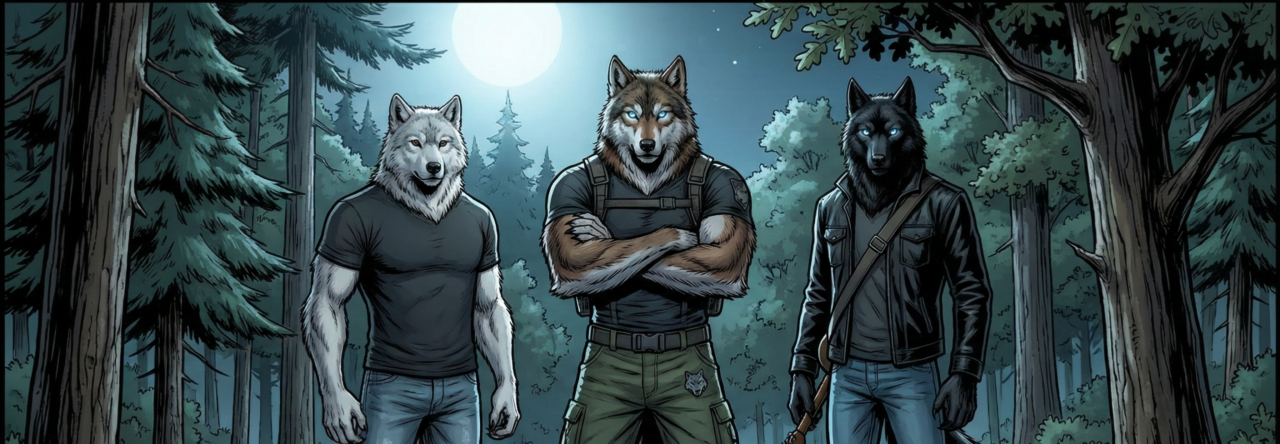
The first werewolf most of them had ever seen stepped down from the truck like it was the most normal thing in the world. Brown-gray fur catching the light, broad-shouldered, ice-blue eyes cutting through dust. Thane adjusted his pack straps and waited. Gabriel hopped down next, black fur and easy grin masking the sharpness beneath, tail flicking once in amusement at the stunned faces. Mark followed more quietly, his gray-white fur and mild expression making him look like the most approachable of the three.

Still, no one approached.

Finally, a man emerged from the doorway of what used to be a café — tall, thin, maybe late forties, with a nervous half-smile. He wore a leather coat that was too new and boots too clean. “Afternoon,” he said, voice tight. “I’m Mayor Lorne. I heard Libby was sending a trade envoy.”

Marta stepped forward, hand extended. “We’re here to discuss fair exchange,” she said warmly. “Nails, salt, canned goods, water filters — what we can spare, and what you can offer in return.”

Lorne shook her hand, but his gaze kept darting back to Thane. “And… you brought protection?”

Thane’s voice was gravel wrapped in calm. “Protection’s what keeps trade honest.”

That drew a twitch of the mayor’s lip — not quite a smile, not quite fear. He gestured toward a shaded awning beside the square. “Please. Sit. We’ll talk.”

The group followed, taking places at a rough wooden table. Gabriel leaned his guitar against a chair and cracked open a canteen. Mark set down his tablet, still scanning quietly for radio signals — habit, not suspicion. Or so he told himself.

Lorne and his aides brought out their offer sheets. “We’ve got fish,” he said. “Jerky, rope, and some spare generator parts from the mill. Nothing fancy, but—”

Thane interrupted softly. “You’ve got fuel drums by your gate.”

Lorne blinked. “A few. For emergencies.”

“More like for convoys,” Thane said. “Saw the tire tracks. Wide treads, heavy loadouts. Military, maybe.”

The aides exchanged glances. One of them swallowed. Marta kept her voice polite. “You’ve had visitors, then?”

“Just passing through,” Lorne said too quickly.

Mark’s tablet pinged once — a faint residual signal. A handheld radio nearby, set to a frequency that didn’t match Thompson Falls’s public band. He caught Thane’s eye and gave the smallest nod.

Thane turned back to the mayor. “I’m going to ask this plain. You got people coming through here taking what they want, or making promises you shouldn’t have accepted?”

The silence said everything. Even the wind seemed to stop between the rusted streetlights.

Lorne’s shoulders sagged. “We were told to watch Libby,” he admitted at last. “They came two weeks ago — said if we told them when your supply trucks ran, we’d be left alone. They called themselves the ‘River Division.’”

Hank muttered a curse under his breath. “Raiders.”

“Not just raiders,” Mark said, scrolling through faint telemetry. “They’re organized. Frequency encryption, coded pulses every thirty minutes. That’s a network.”

Thane leaned forward, claws tapping once against the tabletop — not a threat, just punctuation. “You were going to sell us out.”

Lorne flinched. “We didn’t know who you had down there! They said you were… dangerous. That you’d take over.”

Gabriel chuckled, low and dry. “And you thought they wouldn’t?”

Marta’s tone was soft but cutting. “You realize if they’d come north, they’d have taken more than food.”

Lorne’s eyes darted between the wolves again — the quiet power in Thane’s posture, the faint glow of Gabriel’s gaze, Mark’s calm, unblinking patience. They weren’t men pretending to be wolves. They were wolves pretending to be men — and that was somehow worse. And better.

Thane stood, slow and deliberate. The mayor followed suit without meaning to.

“You want to make this right,” Thane said, “then here’s how it goes. You’ll share what you know about these raiders — where they move, how they signal. We’ll make sure they never reach Libby. In return, you’ll get the trade you asked for — honest and open.”

Lorne hesitated. “And if they come back?”

Thane’s eyes locked on his. “Then tell them you met us.”

The mayor nodded quickly. “Understood.”

Marta extended her hand again. “Then it’s settled. Libby and Thompson Falls — trade allies, not enemies.”

Lorne shook her hand, more firmly this time, though his gaze still flickered to Thane like he wasn’t sure whether to bow or breathe. The rest of the meeting went quickly. Lists were exchanged, delivery routes marked, and one of the aides promised to deliver their spare generator belts by next month.

When the convoy finally rolled out again, the townspeople stood quietly watching, lined along the street like witnesses to something ancient.

Gabriel leaned back in the truck bed, tail flicking lazily. “Well,” he said, “that went better than expected.”

“Depends how you define ‘better,’” Mark replied. “Half that town looked ready to faint.”

Thane stared out the window, the reflection of the fading sun caught in his pale eyes. “Good. Let them be afraid. Fear’s honest — it keeps them from lying again.”

Hank chuckled from behind the wheel. “Remind me not to play poker with you.”

“Wouldn’t be fair,” Gabriel said with a grin. “He can smell the bluff.”

The road north wound through pines and evening mist, the sound of tires on gravel like steady breathing. Behind them, Thompson Falls was smaller now, but wiser — a town that had seen the monsters guarding Libby and realized that friendship was easier than war.

As the stars began to prick the horizon, Marta looked back one last time at the faint lights by the river. “Think they’ll keep their word?” she asked quietly.

Thane didn’t answer right away. The forest whispered around them, alive with crickets and memory.

“They will,” he said finally. “Because they’ve seen what waits if they don’t.”

Episode 13 – Trade of the Heart

A week passed like a single breath drawn and released.

Libby settled into its new rhythm—quieter, steadier, with laughter returning to the streets. Word had spread that the ferals were coming back for the next market, and this time, they wouldn’t be empty-pawed. No one really knew what that meant, but the excitement hummed under everything like static in the radio lines.

By sunrise, the square was already alive. Stalls reopened beneath the pine boughs, and the air filled with the familiar smells of earth, bread, and coffee. Someone had hung a new hand-painted sign over the fountain: “THE MARKET BENEATH THE PINES — WEEK TWO.”

Mark was fussing with the speaker cables, muttering about impedance. Gabriel tuned his old acoustic, lazily picking through the melody from last week. Marta checked ration ledgers, smiling when people waved to her.

Thane leaned against the old brick wall of the bakery, sipping from a dented can of Diet Mountain Dew—a treasure he’d found while scavenging a few days prior. He savored the hiss and fizz like it was vintage wine. The sound of normal life, for once, didn’t feel foreign.

Then a voice called from the gate:
“They’re here.”

The market quieted, just like before. Heads turned.

This time, the wolves didn’t enter as strangers.

Sable led them again, tall and calm, her fur brushed to a soft silver gleam. The others followed—Rime at her right, the younger wolves fanning behind her. But now, each carried something: bundles wrapped in hide, woven baskets, small carved trinkets hanging from their belts. Their gait was confident, proud.

When they reached the square, Sable stopped and lifted her head high.

“We come,” she said, her voice steadier now, almost lyrical. “To trade.”

The crowd broke into applause.

Hank actually laughed. “Guess they figured it out.”

Marta stepped forward, beaming. “Then welcome back, friends. The same rules apply—no eating the vendors.”

That earned another ripple of laughter. The wolves relaxed visibly, tails flicking, smiles flashing white against fur. This time, there was no fear—only curiosity and excitement.


The first surprise came at the tanner’s stall. One of Sable’s wolves unrolled a hide so supple and clean it glowed like silk in the morning sun. “From elk,” he said proudly. “Taken fair. Tanned with pine sap and river sand.”

The tanner ran his hands over it, eyes wide. “I haven’t seen leather this good since before the Collapse.”
The wolf tilted his head. “We bring more, next moon.”
The tanner smiled. “You bring that, I’ll trade you anything you want.”

At another table, a pair of young wolves set down bundles of herbs—wild mint, sage, something sharp and citrusy. “Found high on cliff,” one said. “Good for wounds. Mark says you like medicine.”
Mark looked up from his cables, sniffed the air, and grinned. “Oh, hell yes, I do.” He traded them batteries and an old flashlight, and they stared at the beam like it was sorcery.

The crowd gathered as the wolves revealed more treasures: beautifully carved bone tools, polished stones shaped into pendants, woven ropes made from stripped pine bark. Each item told a story of the forest—of survival turned into craft.

And the humans, in turn, offered bread, dried fruit, soap, salt, candles. Trade flowed like conversation, easy and natural.

For the first time, both sides were equal.


Thane wandered among them quietly, watching the interactions, the laughter, the shared fascination. The young wolves greeted him with shy pride, showing off their new bartering skills like students eager for approval.

Sable approached him last, carrying something wrapped in dark cloth. “We made this,” she said softly. “For you.”

Thane’s brow furrowed. “For me?”

She nodded and unwrapped it. Inside lay a piece of carved wood—dark cedar, polished smooth. It was shaped like the wolf-head medallion he wore, only larger, meant to hang on a wall. The craftsmanship was simple but exquisite; every line of fur and curve of fang carved by hand. In the center was a small metal inlay—one of the town’s barter tokens pressed into the heart of the carving.

“You paid for our first market,” Sable said quietly. “This coin was one you gave. We give it back—so you remember what you built.”

For a long moment, Thane couldn’t find words. His throat tightened, and he reached out, running a claw gently along the carving’s edge. “You did this yourselves?”

Sable smiled. “All of us. Even the pups. We worked until paws hurt. But we wanted… to give worth for worth.”

Gabriel wandered up behind him, grinning. “Guess you’re famous now, boss. Gonna have to start charging appearance fees.”

Thane elbowed him lightly. “Not a chance.”

Marta stepped forward, eyes misting. “That’s beautiful, Sable.”

The wolf inclined her head. “He gave us trade. We give him memory.”

Thane held the carving close for a moment, then nodded. “Then we’re even.”

Sable shook her head. “No. We are pack. Pack does not count.”


As the day went on, the market buzzed brighter than ever. Wolves sold herbs and leather, bought bread and soap. One young male wolf bartered a hand-carved comb for a jar of jam—and then immediately ate half the jar before realizing it wasn’t meant for fur.

Gabriel laughed until he almost dropped his guitar. “Rule two,” he said between chuckles. “Ask before eating the merchandise.”

The square glowed with motion and life. People smiled as wolves passed. Wolves wagged tails when kids handed them apples. Even Hank caught himself grinning. The wariness was gone; in its place was something else entirely—trust.

As evening fell, the wolves packed their things, their baskets lighter but their hearts full. The last rays of sun slipped between the mountains, painting the square in soft gold.

Sable turned back once before leaving, her voice warm with pride. “You were right, Thane. Hunt takes many shapes. Today, we hunted friendship.”

Thane nodded. “And caught it clean.”

She smiled, then led her wolves into the pines.

When the last of their shadows faded into the trees, the quiet that followed wasn’t emptiness—it was contentment.

Marta walked over, tucking her ledger under her arm. “You realize,” she said, smiling, “you just built an economy out of respect.”

Thane chuckled softly. “Maybe that’s the only kind that lasts.”

Gabriel strummed a soft, content tune as the stars came out, the sound floating up with the scent of pine and fresh bread. Mark sat by the fountain, fiddling with a radio that hummed faintly, tuning between static and peace.

The world had fallen. But here, beneath the pines, something worth living for had grown back—quietly, honestly, and strong as a heartbeat.

And as the night deepened, the wolves’ distant howls carried across the valley—not cries of hunger or warning, but of joy.

They were singing to the market.
To the town.
To the pack.

And for once, every living soul in Libby understood the song.

Episode 12 – The Market Beneath the Pines

Morning spilled gold across the ridges, warm and bright, painting the pines in streaks of light. Down in Libby’s square, the world was waking up in color and sound. Tables lined the cobblestone, canopies flapped in the mountain breeze, and the smell of bread, earth, and sun-dried herbs filled the air. It was Saturday—market day—and for the first time since the Fall, the town didn’t feel like a refuge. It felt like home.

Marta called it The Market Beneath the Pines. She said it was to remind everyone that civilization hadn’t died—it had just gone back to its roots.

Gabriel’s guitar drifted soft over the crowd, the notes skipping between laughter and the chatter of barter. Mark adjusted the power lines feeding a couple of humming fridges at the edge of the square. Hank’s deputies patrolled the fence, more out of habit than fear. And Thane walked the perimeter with his quiet authority, watching, listening—the Alpha even when he didn’t have to be.

Then the mood shifted. A murmur moved through the square like a gust through tall grass. Heads turned toward the main gate. Hank looked up from his coffee. Even the kids stopped mid-laugh.

Six wolves were walking down Main Street.

They were clean—fur brushed to a soft sheen, claws trimmed, posture cautious but proud. Behind them came Sable, regal even in simplicity, a leather pouch slung across her shoulder. The others carried satchels too, hand-stitched and uneven, as though someone had tried to copy a human backpack from memory. They walked slowly, reverently, taking in the scent of cooking meat and baked bread like it was perfume.

The crowd tensed but didn’t scatter. People had seen them before—fought beside them even—but seeing Sable’s pack strolling casually through town, in daylight, was something new.

Sable stopped at the fountain. Her eyes found Marta. “We come,” she said, the words low, careful, but certain. “To see.”

Marta hesitated only a second before smiling. “Then welcome,” she said. “Just… don’t eat the vendors.”

Rime, the gray guardian at Sable’s side, gave a deep rumbling laugh, and the tension shattered like thin ice. Someone snorted, someone else chuckled, and soon the market’s rhythm returned—but lighter now, warmer.

The ferals entered the square like children stepping into a dream.

At a fruit stand, one of them lifted an apple, sniffed it, and blinked. “Sweet,” he murmured. “Smells like tree… but happy.”
Old Farmer Cooper leaned on his table, grinning. “That’s an apple, friend. Grows right here.”
“You grow food?” the wolf asked, astonished. “Like grass?”
“Yup. Only tastier.” Cooper handed him one. “Here—on the house.”
The wolf frowned, puzzled. “You live in house?”
Cooper laughed so hard his hat nearly fell off. “Oh, I like you already.”

Two stalls over, another wolf had dipped a claw into a jar of honey and licked it. Her eyes widened. “It bites nice!” she gasped.
The beekeeper chuckled. “Bees make that.”
“Small sharp things… make sweet?” she said in disbelief.
“That’s right.”
She nodded slowly, wonder dawning across her face. “Then we owe much to bees.”

Sable stopped at the bread stand, mesmerized by loaves still steaming from the oven. “You made this?” she asked.
The baker nodded, dusted in flour. “Every morning.”
“No hunt?”
The woman smiled. “We hunt the wheat instead.”
Sable blinked, then gave a soft laugh. “Strange hunt. Good hunt.”

All through the square, the wolves explored like pilgrims. They touched, smelled, and asked questions about everything—how soap worked, why candles smelled like fruit, how the generator could make cold air in a metal box. But awe has a way of stepping on toes, and before long, confusion found them.

At the butcher’s stall, the young wolf from the apple stand reappeared, arms full of sausages. “These are ours now,” he said proudly. “We said thank you.”

The butcher blinked. “Uh… that’s not exactly—”

And that’s when Thane appeared. His footsteps made no sound, but the air changed when he arrived. His voice, gravel and calm, carried without effort.

“That’s not how it works,” he said, gentle but firm. “You trade. You give something in return.”

The young wolf’s ears lowered. “We have nothing. No wheat. No things.”

Thane reached into his pocket, pulled out a small handful of stamped barter tokens, and laid them on the counter. “Then I’ll cover their purchases. Consider it an investment.”

The butcher frowned. “You sure, Thane? That’s a lot of credit.”
Thane’s eyes softened. “They’re learning the language of your kind. The least we can do is teach it with patience.”

Sable stared at him, stunned. She stepped closer, lowering her head slightly. “You give for us? For no reason?”
“Not no reason,” Thane said. “Because you’re pack. And pack shares the hunt—whatever form it takes.”

For a moment, the world went still. Then the butcher nodded silently and wrapped the sausages.

Word spread fast. Within an hour, everyone knew Thane had paid for the wolves’ first market day. The ferals, embarrassed but determined, started offering little things—smooth stones, feathers, handmade leather cords. Gabriel turned it into a running joke. “Rule one,” he called over the guitar’s twang, “If you bite it, you bought it!” Laughter rippled across the square.

At the coffee stall, a gray-furred male tried to pay with an acorn. Mark grinned. “Tell you what—you give me that acorn, I’ll trade you this pastry.” He set the acorn behind the counter with a collection of other “wolf coins”—bottle caps, twigs, shiny rocks. “Libby’s new currency,” he joked.

Sable lingered by a crafts table, watching a woman sew a patch onto an old jacket. “You mend… like den walls,” she said thoughtfully.
The woman grinned. “Exactly. Only warmer.”
Sable’s smile was small but genuine. “You make safety look beautiful.”

By midday, fear had turned to fascination. Humans and wolves ate together—bread, roasted corn, fruit passed between claw and hand without hesitation. Gabriel played, and two wolf pups clapped along, tails thumping the dirt in rhythm. Children squealed with laughter, copying them. For the first time since anyone could remember, no one cared what the world had lost. They were too busy living in what it still had.

As the light began to fade, Sable found Thane near the fountain, talking with Marta. Her wolves had gathered nearby, their satchels full of small treasures—bread, dried fruit, herbs, candles. She approached quietly, her tone soft.

“You covered our debt,” she said. “Taught us to trade, not take. We… have no words for that.”

Thane turned, offering a rare smile. “Then don’t use words. Bring something next week—pelts, herbs, tools. Something made by your hands. That’s how you pay it forward.”

Sable nodded slowly. “We will learn. We will earn. You gave us worth.”

Marta’s smile was warm. “That’s the best kind of gift.”

As twilight deepened, the market began to close. Wolves helped fold tables, humans handed them ropes, laughter mixing with the clink of coins and jars. The air smelled of bread and pine and hope. Gabriel played one last song—a slow, gentle tune that drifted through the square like the last ember of a fire.

When it was over, Sable turned to Thane once more. “You did not hunt today,” she said softly. “But you still fed us.”

Thane’s eyes gleamed in the fading light. “That’s what leaders do.”

Sable bowed her head—not low, not submissive, but in respect. Around her, her wolves followed suit. They left the town carrying baskets instead of weapons, smiling instead of snarling.

Marta watched them go, eyes shining. “You realize,” she said, “we just had a farmer’s market with werewolves.”

Thane gave a quiet, rumbling laugh. “Next week, maybe they’ll set up their own booth.”

Gabriel plucked a final note from his guitar. “As long as they don’t try to sell acorns for pastries again.”

Laughter rose into the cool evening air, easy and unforced. Above, the tall pines swayed gently, scattering needles like confetti.

The camera pulled back over Libby — the golden light of sunset on rooftops, humans and wolves walking side by side through the square, the faint shimmer of life blooming in a world that had once gone dark.

Episode 11 – The Night Watch

Two nights after the raid, Libby’s wounds were already scabbing over.

Smoke had stopped rising from the wreckage by the gate. The broken fencing was mended. The blood had been scrubbed from the cobblestones by volunteers who never once looked away from what they were washing away. But the smell of burned diesel and gunpowder still lingered in the cold air — a reminder, not a warning.

Sheriff Hank Ward stood in the motor pool, leaning on the hood of an old patrol truck, coffee steaming in his gloved hand. The mug read “Best Sheriff in the County.” It had been a joke once. Now it was just true by default.

“You really think this’ll work?” Ross asked, checking the magazine on his rifle.
“We’ll see,” Hank said. “If it doesn’t, you’ll have a story to tell at breakfast.”

The idea had come from Marta: joint patrols. Wolves and humans walking perimeter together. “Trust doesn’t stick unless it breathes the same air,” she’d said. Hank hadn’t argued — not after what he’d seen that night. Still, he’d kept the roster small. Just four deputies: Ross, Valdez, Jennings, and Dana — the youngest of the bunch, sharp as frost but green as spring.

Their boots crunched gravel as they moved toward the north gate. Flashlights flickered on. Breath clouded in the cool air.

Waiting there were six wolves.

They stood silent under the fence light — broad shapes of gray and shadow. The leader, a massive gray-furred brute with a long scar down his muzzle, stepped forward and inclined his head. It was a simple motion, but deliberate. Respectful.

“I am Rime,” he said in the gravelled tone of one who’d spoken little English but learned it well. “Sable sends greetings. We walk beside, not ahead.”

Dana stiffened. Jennings muttered under his breath, “Holy hell, they talk polite.”

Hank grinned around his coffee mug. “Long as you don’t eat ahead, we’re good.”

For half a heartbeat, silence — then a few low, rumbling laughs rolled through the wolves like thunder wrapped in humor. The tension broke.

“Then we walk,” Rime said.


They set off into the trees — two species moving in uncertain rhythm. Flashlights cut thin spears through the fog while eyes the color of moons tracked every motion in the dark.

Hank took point beside Rime. The wolf’s stride was smooth and steady, barely disturbing the underbrush. The man’s boots sounded clumsy beside him, and Hank chuckled to himself. “Guess we’re the noisy ones now.”

Rime’s ears twitched, amused. “Sound is truth,” he said. “It tells forest we are many.”

They moved along the ridge trail, checking the sensor poles Thane’s team had set up days before. Twice, Rime halted abruptly, ears high. The deputies froze on instinct.

“What is it?” Valdez whispered.
“Old scent,” Rime murmured. “Gun oil. Men. Days ago.”

He knelt, sniffed, and pointed toward the slope. Sure enough, faint boot prints crossed the mud. The deputies looked at each other — none of them had noticed.

“How the hell do you even see that?” Ross asked.
Rime’s lips curled into something halfway between a smile and a snarl. “We don’t see. We listen.

The wolves fanned out quietly, checking the brush while the deputies covered angles. When they regrouped, Rime gave a short nod. “No danger now. Ghosts.”


They reached the river near midnight and stopped to rest. A low fire flickered in a metal drum, sending soft orange across fur and flannel. The forest creaked with settling frost.

Dana sat a little apart, trying to hide her nerves. One of the smaller wolves, a lithe female with a torn ear, padded over and sat beside her without a sound. The deputy jumped, then froze.

“Sorry,” Dana blurted. “I just—never been this close to one of you before.”

The wolf tilted her head. “We could say same.”

Dana let out a breath that became a laugh. “I keep thinking I’ll do something wrong.”

“If you listen more than speak,” the wolf said softly, “you already do right.”

They sat there for a while, watching the river move like black glass. Every so often, the wolf glanced at her and smiled — not showing teeth, just eyes. When the fire crackled, Dana offered her canteen. The wolf sniffed it, then took a careful sip. Both of them laughed at the absurdity of it all — and that laughter, small as it was, felt like the first sunrise of a new world.


An hour before dawn, the patrol reached the edge of the old rail yard. Mist hung low, glowing in the faint light from the town. Rime’s ears twitched. “Engines,” he murmured.

They crept closer — four humans and six wolves, moving like parts of one organism. Through the fog, three figures knelt by a tanker car, trying to siphon diesel into jerrycans.

Hank held up a hand, signaling stop. He whispered, “Let’s try this our way first.”

He stepped forward, flashlight beam cutting through the haze.

“Sheriff’s Department!” he called. “Drop it and stand up slow.”

The men froze. One did. Another turned his head just enough to see the line of glowing eyes forming behind Hank. The third panicked and fired. The shot sparked off the rails.

Rime moved before anyone else could. A blur of gray and muscle — he crossed the distance in two heartbeats, slammed the shooter to the ground, and wrenched the gun from his hands. The other two dropped their cans and threw their hands up.

“He lives,” Rime growled, pinning the man by the throat but not cutting. “He learns.”

Hank lowered his weapon. “Works for me.”

They disarmed the men, tied their wrists, and led them south. Not a drop of blood spilled.

When it was done, Jennings muttered, “You know, I think I trust them more than half our rookies.”

Hank smirked. “Don’t say that too loud. They’ve got better hearing.”

The wolves chuckled, deep and rolling, the sound vibrating through the fog. It didn’t feel strange anymore — it felt right.


By sunrise, the patrol was back inside the town fence. Frost clung to the barbed wire, turning it into silver lace. Sable and Thane were waiting at the gate. The sight of them together no longer startled anyone.

“Perimeter’s clear,” Hank reported. “No threats. Wolves handled themselves better than any soldier I’ve worked with.”

Sable’s muzzle dipped slightly. “Your people did quiet work,” she said. “Harder than claws.”

Rime stepped forward and offered Hank a clawed hand. The sheriff didn’t hesitate. He shook it, rough and firm. “Good work, partner.”

The word seemed to mean something new out loud. The wolves bowed slightly before heading back toward the woods, paws silent on frost. The smaller female — Nara — paused long enough to touch Dana’s shoulder lightly before vanishing into the trees.

Dana watched her go, smiling. “Guess I’ll need to learn to listen better.”

Ross snorted. “You and me both, kid.”


Later that morning, after the town woke, Hank stood at the northern fence again. The light turned the mountains gold. He sipped the last of his coffee and keyed his radio.

“Ward to Command. Perimeter clear. Wolves proved themselves.”

Static, then Thane’s voice:

“I never doubted it.”

Hank smiled. “You might be the only one who didn’t.”

He looked toward the treeline. For a moment, he thought he saw movement — not threatening, just presence. Two golden eyes in the mist, watching the sunrise. Then they blinked and were gone.

He took another sip, let the warmth settle in his chest. “Guess the night’s a little safer,” he said softly. “And a lot less lonely.”

The camera lifted with the morning fog — showing Libby’s fence, the ridges beyond, and faint paw prints beside boot prints in the frost.

“The world had fallen,”
“But tonight, the watch stood tall.
And both — kept the dawn.”

Episode 10 – When the Fire Fought Back

Evening draped itself over Libby like a blanket that still remembered warmth.

The generators hummed steady, pushing soft gold light across Main Street. The tavern windows glowed with laughter. Gabriel’s guitar drifted through the cold air, soft and easy — a melody people didn’t have to be afraid to hear anymore.
For the first time in weeks, the town felt human again.

Thane stood at the north gate with Mark, tightening the last of the motion sensor mounts. The air smelled of rain and oil. Mark’s radio clicked quietly as it cycled through channels — a comforting background rhythm.

“If we can get the outer repeater synced with Sable’s frequency, we’ll have full coverage to the treeline,” Mark said.
“Do it,” Thane replied. “Never hurts to have more eyes.”

Marta and Hank were finishing ration counts in Town Hall. The winter food store — an old warehouse by the river — was stacked floor to ceiling, a miracle built on hope, sweat, and cautious cooperation. Everyone knew it had to last until spring.

That’s when the static came.

Mark frowned. “Interference… not ours.”
Thane’s ears twitched. “Direction?”
“North. Strong signal. Wait—”
Gunfire cracked through the night.


The hum of the generators was replaced by chaos.

Floodlights blazed to life along the perimeter. Three massive box trucks barreled toward the gate, kicking up gravel and dust. Men rode on the sides and roofs, firing rifles into the air. Shouts followed like a storm front.

“CONTACT! CONTACT NORTH!” Mark’s voice thundered through every handheld.

Hank grabbed his rifle, sprinting from the Hall. Marta followed, coat half-on, breath visible in the cold.
By the time they reached the barricades, the raiders had already dismounted — thirty of them, armored in scavenged plates and bad intentions.

Their leader — tall, scar down his face, red flannel jacket over body armor — stepped forward with a megaphone.

“Nobody needs to die!” he called. “You’ve got food, meds, fuel! We take half, you live happy. You say no, we take all, and you die trying!”

Hank shouted back, “You’re not getting anything!”

The man smirked. “You’ve got soft since the Fall, Sheriff. That’s what kills people now — softness.”

Thane stepped beside him, claws flexing, eyes pale fire.

“I can end this,” he growled.

Marta’s hand caught his arm. “No. Not here. Not now.”
“They’ll take everything,” Gabriel hissed.
“Better that than bodies in the street,” she said, her voice shaking but steady. “We’ll rebuild. We always do.”

Thane’s jaw clenched, the muscle ticking once. “Stand down,” he ordered over comms. The pack obeyed — reluctantly, but without question.

The gates opened. Under the floodlights, the raiders moved in — laughing, jeering, grabbing crates and sacks of grain. One of them kicked over a barrel just to watch beans scatter. Marta flinched, but stayed silent.

Hope cracked under the weight of boots and guns.


It happened so fast that afterward, none of them could say they’d truly seen it start.

A low sound rose from the dark — deep, vibrating, primal. Not a growl exactly. More like the Earth remembering its voice.

Every head turned toward the treeline.

The raider leader frowned. “What the hell is that—”

The forest erupted.

From the shadows, from the ridges, from the trees themselves came wolves. Dozens. Thirty at least, moving as one — shadows with fangs, fury wrapped in purpose. They hit the first truck before anyone could shout. Metal screamed as claws tore through the paneling like paper.

Gunfire erupted. Bullets sparked off fur and bone. One wolf went down, then rose again, angrier. The raiders panicked — their careful formation dissolved in seconds.

Sable’s northern pack had arrived.

They tore through the raiders like a natural disaster wearing teeth. Two flanked each truck, others scattered into the chaos, cutting off escape. The air filled with roars and gunfire, shouts and the sound of metal breaking under living force.

Thane moved.
It wasn’t a decision; it was instinct.
He leapt the barricade in a blur, crashing into a raider who was lining up on Mark’s position. The man’s gun went off once, the shot going wild into the dirt before Thane’s claws found the weapon and sent it spinning into the dark.

“NOW!” Thane roared.

Gabriel sprinted past him, slamming his shoulder into another gunman and sending both sprawling. Mark ducked behind a truck, dragging two terrified civilians to cover. Hank fired three careful shots — each one buying a heartbeat.

Marta stood frozen in the Hall doorway until Thane shouted, “Get inside!”
She ran, heart in her throat, watching the town she’d sworn to protect turn into a war zone.

One raider tried to mount a truck. He never got the door open — a feral wolf slammed into him from the side, claws glinting. The man hit the pavement, throat bared, and didn’t rise again.

The leader tried to rally them, firing wildly into the trees. “Hold the line! They’re just animals—”

A massive gray shadow dropped from the rooftop.
Sable’s guardian.

He hit the leader like thunder. The impact cracked the pavement. The man’s scream ended too fast to echo.

And through the smoke, Sable herself emerged — regal, terrifying, her fur streaked with blood and rain.

“You said we had hope,” she growled, voice carrying like wind over stone. “We keep it.”

Thane’s lips curled into a snarl of pride. “Then we finish this.”

The last truck caught fire when a stray bullet hit its fuel line. Flames climbed fast, throwing light across the carnage — wolves in motion, raiders falling, the forest itself watching.

It was over in less than five minutes.

The wolves didn’t leave survivors.


Silence came back slowly, limping through the smoke.

Snow began to fall — light at first, then thicker, hissing as it touched the still-hot asphalt. The headlights of the trucks flickered, then died.

Thane stood amid the wreckage, chest heaving, claws wet. He looked over the square — bodies, flames, spent brass, fear and relief tangled into one impossible moment.

Gabriel limped up beside him, wiping blood from his muzzle. “Please tell me we’re not calling this a quiet night.”

Thane gave a breath that might’ve been a laugh. “Quiet enough now.”

Marta emerged from the Hall with Hank, both pale and wide-eyed. “They’re all…” she couldn’t finish the word.

Hank scanned the devastation. “Not us,” he said softly. “That’s what counts.”

From the treeline, the wolves reappeared — some wounded, all alive. They gathered near the gate, forming a semicircle as if awaiting permission to enter.

Sable walked forward. She met Thane’s eyes first, then Marta’s, her expression both fierce and humble.

“We saw them come,” she said. “Smelled their anger. Heard their machines. We knew they would hurt you. So we ran.”

She glanced at the fallen raiders, then back toward the humans. “We fought for food. But we came for hope.

Marta’s voice trembled. “You saved us.”

Sable shook her head. “You saved us. You taught us what pack means again. We only remembered.”

She extended a bloodied hand, palm up. Marta hesitated only a heartbeat before taking it.
Her smaller human hand fit easily into the strength of Sable’s.
It wasn’t dominance. It was equality.

“We share your fire,” Sable said. “You share our teeth. Together — no one takes this place.”

Thane stepped forward, towering but calm, his fur slicked with rain and battle.

“Then tonight,” he said, “we bury fear.”

Gabriel kicked an empty rifle casing away, voice hoarse but grinning. “And maybe play something with less screaming tomorrow.”

Mark’s voice crackled through the comm:

“Town secure. No survivors. No civilian casualties.”

The radio went quiet except for wind. Then, faintly — a howl. One, then two, then a chorus rising from the forest and the town both. Humans and wolves alike.

No one knew who started it.
Everyone joined.


Dawn came quietly, rosy light touching the smoke and snow. The town smelled of ash, diesel, and victory.

Sable and Thane stood on the damaged gate, side by side, watching cleanup crews move below — humans and wolves working shoulder to shoulder, dragging wreckage, piling weapons for scrap.

“We fought for food,” Sable said. “But we won something bigger.”

Thane nodded. “We won each other.”

Marta approached, eyes rimmed red from sleeplessness, and clasped Sable’s arm. “Libby’s doors are open to you,” she said softly. “Always.”

Sable smiled faintly. “Then Libby is pack.”

Hank chuckled. “Hell of a neighborhood watch.”

Gabriel sat on the curb with his guitar, tuning lazily, one ear flicked toward the wind. “You know,” he said to no one in particular, “if this keeps up, I’m writing a song called When the Wolves Saved the Town.

“Make it upbeat,” Mark said dryly, adjusting the repeater he was already rebuilding. The display blinked with new call letters:
PACK UNITY 1 — LIBBY SAFE

Thane turned toward the horizon where the forest met the dawn. Smoke rose in lazy trails, glowing gold in the light.
He exhaled slowly, letting the cold air fill the space where fear used to live.

“The world had fallen,” he said softly.
“But tonight, the fire fought back.
And both — lived to see the dawn.”

The town stood whole.
The wolves stayed.
And somewhere, through the melting snow and rising sun, the sound of laughter echoed — the kind that sounded like survival.

Episode 9 – The Howl and the Heart

Before dawn, the repeater by Mark’s desk blinked awake like a firefly remembering a promise. He rubbed sleep from his eyes, leaned closer, and watched the tablet fill with blocky text in the clipped cadence of the north.

BRING YOUR LEADERS. BRING CHILDREN. COME NORTH WHERE LIGHT FIRST SPOKE. WE TEACH.
SUN HIGH. FIRE SAFE. PACK READY.

He read it twice, then a third time out loud, just to be sure the room agreed.

From the doorway, Gabriel said around a mouthful of toast, “They’re inviting us? To them?”

Mark’s ears tipped. “To teach.”

“Wild,” Gabriel murmured, already grinning. “I love this world sometimes.”

Thane stepped in behind him, big and quiet as weather. He studied the message, the set of his shoulders easing by a fraction. “Looks like fire spreads both ways,” he said, gravel-soft. “Let’s ask the council.”


By mid-morning, Town Hall hummed with the kind of energy that belongs to beginnings. Hank Ward stood at the council table with his palms braced on either side of a map; Marta Korrin sat beside him with her notebook open and an expression that mixed nerves with faith.

Thane laid the tablet between them. After they read, he said simply, “We should go.”

Marta’s eyes lifted to his. “We bring teens?”

“If they meant harm, they wouldn’t set terms,” Thane said. “And they asked for children because they want to teach something that needs joy.”

Hank blew out a breath. “Alright. I’ll come. If I don’t, I won’t sleep. And if I do come, I still probably won’t sleep.”

Marta turned to the little cluster by the door—Sofia and Ben, plus two more teens, Lina and Carter—already dressed in warm layers, faces bright with eagerness disguised as calm. “You’re sure?” she asked them.

Sofia nodded, chin high. Ben swallowed. “We, uh, we practiced our howls.”

Gabriel clapped him on the shoulder. “That’s either brave or illegal. Let’s find out.”

Marta squeezed her pen until the plastic creaked, then let go. “We go. We go together.”


They took the old diesel truck as far as the logging road would allow. After that, the tires were more argument than progress. Thane waved them to a stop where the trees began knitting their quiet spell, and they continued on foot.

The forest had dressed for ceremony. Blue glowsticks hung from branches at long intervals, cold little stars marking a path—someone’s careful idea of “easy to follow, hard to miss.” Wind slid between the trunks. The river whispered somewhere below.

Gabriel bumped Ben with an elbow. “If I get eaten, I’m haunting your playlist.”

“Deal,” Ben said, laughing too loud, and then softer, “You won’t.”

Mark walked beside Marta, the portable receiver’s green pulse steady in his palm. “Signal’s clean,” he murmured. “They’re expecting us.”

Thane set the pace—unhurried, precise, the kind of steady that makes other hearts remember how to keep time. Hank walked just behind him, one hand near his holster out of reflex rather than intent. The teens followed Gabriel’s jokes like breadcrumbs.

When they reached the sawmill clearing, the breath went out of them in one shared exhale.

The place had changed. The broken radio tower stood upright again, braced by lashed trunks and patience, its metal wrapped in vines and strips of cloth marked with scratched wolf symbols. Fresh logs ringed the clearing like benches. Smoke curled from a central fire that had been fed with care, not desperation.

And they were not alone.

Wolves—more than twenty—stood in a wide, respectful arc, shoulders squared, eyes bright. Their fur still wore the forest’s story—burrs here, old scars there—but they were brushed, clean, alert. Thane felt the teens shrink instinctively toward him. Hank’s mouth flattened. Marta’s fingers tightened around her notebook until her knuckles blanched.

“That’s… more wolves than I remember,” Gabriel said quietly.

Thane didn’t move his head. “Hold steady. If they wanted blood, we wouldn’t be talking.”

Then Sable stepped forward out of the line, calm as the word itself. Her white-gray fur caught the light, her nicked ear angled toward them. Two wolves flanked her, the same massive gray male and a lean brindled female they had seen before, each radiating a watchful patience that said guardian better than any title.

“You came,” Sable said. Her English had grown steadier, vowels softened by practice. “We thank you. No harm here. Only teach.”

Marta’s shoulders dropped a hair; Hank’s hand fell away from his sidearm without him telling it to.

Sable turned her head slightly. The arc of wolves shifted, revealing three familiar faces—the young emissaries who had visited Libby—tails swaying at the sight of Sofia and Ben. “We bring good hearts,” Sable said. “The ones who wanted peace. The others… stay behind. Too much fear still in them.”

“That’s wise,” Thane said.

“It is choice,” Sable answered. “Choice is strength.”

The sentence found a home in Marta’s eyes like a seed finding soil.


Teaching began with no more ceremony than breath. The three younger wolves led the teens to the edge of the woods where the ground feathered into needles and shadow. “We show you how to listen,” the older female said, and then they did, not in words but in demonstration: how to stand with weight on the parts of your foot that don’t betray you, how to let your eyes soften so you see motion instead of shape, how to breathe the story of a place without forcing it to speak.

Carter tried to copy the posture and promptly overbalanced into a bush. The young male steadied him with a clawed hand, gentle, amused. “Like this,” he said, shifting weight back with a dancer’s grace. Carter tried again, and this time the forest didn’t flinch.

They found prints—deer, rabbit, something with pads and curiosity—and the wolves showed the teens how to read them like letters of a language written directly on the earth. Lina traced a track with her finger. “It’s like the woods is… writing to us.”

“It always has,” the young female said. “We forgot to read.”

Back in the clearing, the guardian pair took Hank and Marta on a slow circuit. Sable paced between them, not looming, simply present.

“Humans run from fear,” she said, voice low. “Wolves run through it. But both must stop… sometimes… to see who runs beside.”

Hank huffed a laugh that carried no mockery. “I should put that up in the sheriff’s office.”

“Put it in your chest,” Sable said dryly. “Better wall.”

Marta smiled under the weight of too many days. “You could have stayed wild and alone. You didn’t.”

Sable’s gaze stayed on the teens—on Ben throwing his head back and trying his first brave, ridiculous howl, on Sofia clapping in delight, on the way the three wolves made space for human mistakes like they were puppies learning their feet. “Alone is teeth,” she said. “Together is fire.”

Mark sat on a log beside the tower’s base, the receiver humming comfort against his hip, and listened as if each word were a voltage he could store and route to light the worst corners.

“Alright,” Gabriel called, setting his hands to his mouth like a megaphone. “Moment of truth. On my count, we wake the mountains.”

The teens gathered with the three wolves at the clearing’s heart. Thane and Sable stood at the circle’s rim like two ends of a bridge. Gabriel grinned at Sofia. “One, two—”

The first howl cracked like adolescence and nerves colliding. It wasn’t pretty. It was brave. The wolves joined, voices finding the pitch, then the timbre, then the long true line that makes the air itself remember a road home. The sound filled the clearing, clung to the tower, slid down the bolted joints like blessing. Birds startled and resettled. Somewhere a deer decided not to run after all.

Sofia’s second try caught and held. Ben’s third had something like wildness in it. Lina laughed and botched the middle and no one cared because the laughter turned into a note and the note turned into belonging.

Thane felt it in his bones—the old thing, the necessary thing. Sable’s eyes shone and, for the first time since they had met, she looked less like a sentinel and more like a wolf who remembered a puphood afternoon that did not end in hunger.

It might have ended there—on that high, odd music—if the world didn’t still contain teeth sharper than nostalgia.

The snarl came from the treeline, wrong-angled and raw. A wolf—gaunt, scarred, eyes too bright—broke from the shade in a crooked lunge. He wasn’t one of the twenty. He wasn’t dressed for peace. He was all old winter and bad memory.

He arrowed toward the nearest human—Carter—drawn by height or scent or the quick, young heart beating too close to the surface.

Hank’s hand darted to his sidearm; Marta’s breath stopped; Mark swore and reached for nothing useful.

Thane moved, a dark blur—but Sable’s guardian moved first. The gray male hit the attacker shoulder to shoulder with a force that turned the lunge into a tumble. They rolled twice in a tangle of dust and fury. The guardian came up on top, pinning the rogue by the throat with a pressure exact enough to stop breath but not break it. His lips peeled back. The rogue thrashed once, then went still under a growled truth older than language.

“NO BLOOD,” Sable roared.

The clearing obeyed. Even the fire seemed to lean away from flame.

The guardian eased off by inches, claws ready, gaze never leaving the other’s eyes. The rogue coughed, caught air like a drowning thing, and lay quivering, humiliated by survival.

Sable turned to Marta and Hank, ears tipped back in an apology deeper than words. “I am sorry,” she said. “This one—still lost to old ways. I kept others like him away. He slipped through.”

Marta found her voice. “You stopped him. That’s what matters.” Her knees forgot themselves and then remembered. She stood taller. “We won’t forget it.”

Thane stepped between the teens and the rogue, his body saying nothing gets past me so clearly there was no need to say it. He glanced at Carter, who was pale and unhurt. “You okay?”

Carter’s laugh came out in two pieces. “I—yeah. Yeah. That was… I’m okay.”

Gabriel’s hand squeezed his shoulder, claw points carefully angled away. “Next time, if you see moving fur coming at you, do not stand there like a streetlight.”

“Noted,” Carter said faintly.

Sable gestured with her muzzle. Two of her wolves flanked the rogue, lifted him with unceremonious competence, and led him back into the trees. When she faced the humans again, her posture was open, palms of her hands visible, claws sheathed. “We hold,” she said, and this time the word landed in both camps the same way a plank lands across a stream.

“We hold,” Thane echoed.

The rest of the day settled like dust after thunder. Softer, quieter, but not broken. The teens returned to practice, this time with a little more gravity in their voices and grace in their boundaries. The wolves sang again—lower now, a braided melody that sounded like apology stitched to promise. Human ears don’t know how to call that tune; human hearts do.

As shadows stretched, Sable walked with Marta and Hank along the perimeter while the guardian pair kept an easy distance.

“Choice,” Sable said, nodding toward the place where the rogue had vanished. “We choose who we bring to fire. Who we keep far. Choice keeps the heat from burning the den.”

Marta’s mouth curved. “I’m stealing that for a speech.”

“Better put it in your chest,” Gabriel called from the fire’s edge, earning himself a look from both leaders and a laugh from Sable.

When it was time to go, the young wolves carried gifts to the gate of the clearing—three small parcels wrapped in cloth: a twist of smoked meat, a length of clean cord, a polished bit of driftwood carved with a looping line that meant safe path. They pressed them into human hands with a solemnity that fit their age and the day.

Marta reached for Sable’s paw-hand without hesitation. They clasped, firm and warm. “You’re welcome in Libby,” she said. “Any time.” A beat. Smile. “During the day, of course.”

Sable’s teeth flashed, humor true and easy. “Then we bring daylight next time.”

Hank barked a laugh. “Fair enough.”

Gabriel pointed two fingers at the three young wolves like he was tapping the beat of one of their new songs. “You were perfect hosts,” he said. “Next time, we’ll bring dessert.”

The wolves laughed—actual laughter that pulled at something good in everyone who heard it.

They parted there, under the righted tower and the first shy stars. As the humans and Thane’s pack started down the trail, Sable watched them go. Her guardians settled at her sides like punctuation marks that meant we will not let it slip. The three young wolves sat forward, alert and pleased, tails beating a quiet drum on the earth.

“They listened,” the older female said.

“They learned,” the young male added.

“And they will tell it right,” Sable finished, almost to herself. “Fire spreads when tended. Never when feared.”

They stayed until the blue glowsticks faded with daylight, until the last human footfall slipped into forest rhythm. Then the wolves began cleaning the clearing—banking the fire, checking the lashings on the tower, making the place tidy in the way of people who expect guests again.

Far down the trail, a ragged chorus rose—human voices trying their new howls, imperfect, joyful, accompanied by a low chuckle that could only be Gabriel’s.

Back on the ridge above Libby, the town’s first evening bulbs winked awake. The Kootenai murmured its tired old song. Thane walked at the front of the little convoy, the teens behind him talking all at once, Hank and Marta side by side wearing expressions that meant we didn’t believe it could be this good and we’re sorry we didn’t believe sooner. Mark trailed slightly, making a note he knew he didn’t need the receiver to remember: Choice is strength. He underlined it, twice.

At the gate, Marta turned back toward the north and raised her hand in salute neither military nor mystic, just human. “Come visit,” she said softly, to the trees.

“During the day,” Gabriel murmured, stage-whisper, earning the eye roll he was chasing and the smile he wanted.

Night took the ridge gently. The town exhaled. The forest held the story without bending it. And somewhere between the righted tower and the lamplight square, two packs walked the same path in different directions, carrying the day like a flame cupped in careful hands.
Episode 8 – Voices Beside the Fire

Night breathed cold through the Yaak valley.

The wind wound itself around the broken sawmill and the half-ruined tower that still blinked a weak, steady light toward the south. In the clearing below, the pack gathered in a rough ring around an old oil drum that had been turned into a firepit. The flames licked orange and blue, hissing through sap and rust.

Sable sat opposite the fire, her gray-white fur limned in the glow. Around her, the elders crouched low, eyes small and dark, breath rising in silver threads. When she spoke, it was slow, deliberate.

“You went south,” she said. “You saw the fire that lives there. Now you speak. Tell us what you saw.”

The three young wolves exchanged glances. Their fur still smelled faintly of smoke and baked bread. The youngest male, restless, swallowed hard. The older female gave him a small nod.

He began, halting and bright.

“Light in strings,” he said. “Fire caught inside glass. Warm… but gentle. Like sun that listens.”

An older wolf snorted softly. “No such thing.”

“We saw it!” the young one insisted, voice sharp with belief. “It shines above their den places. They do not fear it. They live inside it.”

Another of the elders leaned forward. “And they—these humans—they let you walk among them?”

The older female’s ears turned slightly back, not with shame but awe. “They did. They gave food that smelled sweet. Soft. Not raw. Fire-touched.” Her claws flexed as if recalling the texture of bread. “They handed it to us. Like gift. No teeth. No trap.”

A murmur rolled through the circle—unsettled, curious. One wolf muttered, “Humans give poison, not gifts.”

The young female shook her head quickly. “Not these. They smiled with teeth and no fear. Their children laughed. It was… good.”

Sable’s gaze didn’t move from the flames. “You met their alpha?”

“Yes,” said the older female. “He is called Thane.”
“Big,” the young male added reverently. “Voice like stone on river.”
“He could kill with one hand,” the youngest whispered, “but he does not. He keeps humans safe. They follow him. They love him.”

The word love sounded new in his mouth—soft and powerful. The elders stirred uneasily.

Sable’s expression didn’t change, but her tail flicked once. “They love a wolf?”

“They love all wolves there,” the female said, her voice low, almost a plea. “Not fear-love. True love. They call them family.”

The fire popped, sending up a spray of sparks that fell like tiny stars between them.


The young male leaned forward, eyes bright. “They have humans who sing. Wolves too. Music lives in boxes and air both. The black one—Gabriel—he plays strings and smiles like trickster. The town dances when he sings.”

One of the elders grumbled, “Tricks of sound. Empty.”

But the young male shook his head so hard ash scattered off his fur. “No. It fills the chest. Like when you howl and the sky answers. Same feeling. Only different shape.”

Sable lifted her eyes from the fire at last. “And their healer? The quiet one. The one who spoke through the metal box?”

“Mark,” said the young female. “He makes fire obey. He catches voices in air and puts them back out. Like magic that does not lie.”

That drew another mutter. “Machines are lies.”

Sable silenced it with a look. “Not all lies are bad,” she murmured. “Some are needed.”

The three young wolves went still, uncertain if they’d said too much. Then the older female spoke again, gentler this time.

“They live together. Wolves and humans. They build things. Fix things. Laugh. They have food that grows. They have children who learn and play. They guard one another. Not with chains. With trust.”

Sable’s ears turned back slightly, as though the word itself was too loud. “Trust,” she repeated, tasting it. “The world used to use that word before it burned.”

The younger male nodded fervently. “Then maybe it learns again.”


One of the old males leaned into the firelight, eyes narrow. “You think the south makes us soft. You think we should kneel to human ways?”

The young male snarled before he could stop himself. “No! They are strong because they care! They fight, but not for meat—for each other!”

The older wolf’s lip curled. “Humans betrayed the world. You forget the Fall?”

“No!” The boy’s voice cracked. “I remember! But they remember too! They hurt, they rebuild, they try again! Isn’t that what wolves do?”

The argument dissolved into silence. Even the trees seemed to hold their breath. Then Sable spoke, her tone quiet and grave.

“Tell me about their children.”

The youngest wolf blinked. “They… looked at us. Not scared. Touched our fur. Said we were beautiful. They called me strong.”

A faint smile touched the older female’s muzzle. “One boy threw a ball. I caught it. He laughed. No fear. Just joy. The kind I had forgotten.”

Sable’s claws dug lightly into the dirt. “Joy is dangerous.”

“Joy is life,” the young female said, fierce now. “You taught us that once, before the cold years.”

The alpha looked away, out into the black pines. For a long time she said nothing. Only the fire spoke, crackling softly, feeding on old wood.


The younger male broke the quiet. “They said we can come back. When we learn something new to teach.”

“Teach?” Sable repeated. The word came out strange, heavy.

The female nodded. “They said packs grow that way.”

Sable turned back to the fire. The glow picked out the silver in her fur, the small lines of age around her mouth. “Maybe that’s what we forgot,” she said. “We learned to survive, not to grow.”

She rose, circling the fire once. Her paws left prints in the dirt, already filling with ash. “You brought back stories,” she said. “And stories are fire too. They warm. They burn. We must learn which.”

Her gaze swept the elders. “Tomorrow, these three rest. Then they teach what they saw. Show the young ones how to speak without snarling.” A few murmured disagreement, but she cut them off with a growl that ended the debate.

After a moment, softer: “Maybe the world is not all teeth anymore.”


The meeting ended, but the night didn’t. The three younger wolves lay together near the embers, still half-glowing from the day. The air smelled of resin and something gentler underneath—hope, maybe.

The older female traced a claw through the dirt, drawing the outline of a string light, looping circles joined by tiny stars. “Little suns,” she whispered. “On strings.”

The youngest wolf lay on his back, looking up at the real stars. “They make fire that sings,” he said. “And it doesn’t bite.”

The middle one rolled onto his side. “The boy said ‘it’s okay.’ No one ever said that to me before.”

They were quiet for a long while after that. Wind carried the scent of snow, distant but real. The forest seemed less lonely for once.

Then the young female whispered, “If the world was meant to end… why does it still make music?”

No one had an answer. The fire crackled, patient and wise. Sable, half dozing, opened her eyes just long enough to watch the glow reflect in theirs—so new, so bright.

And in the hush that followed, the girl said softly, as if to seal it into the night:

“Both had hope.”

Sable’s ear twitched. A low rumble of approval rolled from her chest—almost a purr, almost a prayer.

Above them, the stars burned steady and kind, and far to the south, Libby’s lights twinkled faintly through the dark forest. The wind carried the faintest hum of the repeater tower, a heartbeat echoing between two packs that had finally remembered how to listen.

The world had fallen.
The pack hadn’t.
And now — both had hope.

Episode 7 – The Lesson of the Firelight

Two mornings after the northern fence encounter, the forest sent company.

It started with a scent on the wind—smoke, pine, and something wild learning to be patient. By the time the sun climbed above the ridge, Hank was already waiting at the gate, arms folded, coffee steaming in the chill. The radio crackled once, Mark’s voice soft over the line.

“They’re back. Three signatures. Standing where you told them to, Thane. Not moving.”

Thane set down the wrench he’d been using to fix the town’s east pump and wiped his hands on a rag. Gabriel was beside him before he even had to call. His grin was quiet, knowing. “Told you they’d keep their word.”

“They remembered,” Thane said, and that meant more than it sounded like.

By the time the two wolves reached the gate, Mark was already there, receiver slung, tail swaying in calm readiness. Through the fence, the three feral wolves stood awkwardly in the daylight—no shadows, no trees to hide them. Sunlight painted their fur in new honesty. The youngest male, the same one who had spoken before, shifted his weight, trying to mimic stillness and failing. The older female bowed her head once. “We came when the sun was up,” she said, voice careful. “As told.”

“You did right,” Thane said. His gravel voice softened, almost warm. “Come in.”

Hank raised a brow but didn’t move to stop him. He’d learned long ago that trust, once given to Thane, was better left unchaperoned. “You vouch for them,” he said.

“With my word,” Thane replied.

Hank nodded and waved the gate open. “Then that’s good enough for me.”

The ferals stepped through the threshold of Libby like travelers crossing into myth.


They stopped first at the square, where the old fountain had been cleaned and repurposed into a planter of herbs. The town’s generator hummed in the background, steady as a heartbeat. For wolves who had spent years surviving by instinct, it was like walking into a song they didn’t know the words to.

The youngest male crouched by the string lights that looped between poles. “Fire trapped in glass,” he whispered.

“Electricity,” Mark said, ever the teacher. “It’s fire that listens.”

The boy reached out hesitantly, touched the bulb with a claw. It was warm, not hot. His breath caught. “It obeys.”

Gabriel chuckled. “Sometimes. You should see Mark swear at it when it doesn’t.”

Mark shot him a look, and the young wolf barked a laugh, surprised by the sound of his own joy.

They moved on, drawing curious but unafraid glances from townsfolk. People here had learned that fear wasn’t survival—it was surrender. A few whispered, but most just watched. Mrs. Calloway, the baker, stepped forward from her stall with her apron dusted in flour and kindness. She held out three warm rolls, golden and fragrant.

“For your friends,” she said simply.

The ferals froze, as if unsure if this was a trap or a miracle. Thane nodded encouragement. The female reached first, claws careful, then passed the bread to the others. They cradled it like something living. When they took their first bites, the sound that came out of them wasn’t hunger—it was wonder. Gabriel saw Marta quietly wiping her eyes across the square and pretended not to notice.


Dale was next, waving them toward the workshop with his usual grin. He wiped his hands on a rag and pointed proudly at a spinning blade hooked to a test rig. “That’s a turbine blade,” he said. “Drives the generator. Makes that light you like.”

The young male tilted his head. “You catch wind and make fire.”

“That’s about right,” Dale said. “World’s got enough wind and enough wolves. We just had to learn to cooperate.”

The wolves listened to the hum of the motor with reverence. The older female crouched, ears tipped forward. “We thought all fire died,” she said quietly.

“Some did,” Dale answered. “The rest just needed tending.”

Gabriel smiled at that. “Kind of our specialty.”


It happened naturally after that—the draw of the children.

Sofia and Ben were sitting on the edge of the fountain, guitars in their laps. They weren’t supposed to be there—it was school hours—but no one cared. When they saw the wolves, both froze for half a second, then exchanged a glance that said, Okay, we’re doing this.

Sofia lifted a hand. “Hi.”

The younger wolf hesitated. Then: “Hi.” The syllable came out rough and proud, a mountain trying to pronounce the wind.

Ben grinned wide. “That was awesome. You—uh—can talk.”

The wolf’s tail flicked once, uncertainly. “You can smile.

That broke whatever tension remained. Sofia laughed, delighted. “I like you.”

Soon there were four of them—two wolves, two humans—sitting in a circle by the fountain. The wolves let the teens touch their fur, trace the curve of a claw, marvel at the strength of hands that could crush metal but held the strings of a guitar like glass.

The wolves were just as entranced. They touched fabric, lifting the sleeve of a denim jacket with claws gentle as brushstrokes. “You weave skin,” the older female said in awe. “Color like flowers.”

Sofia twirled her hair, teasing. “You have built-in coats. Jealous.”

Ben handed the young wolf his old phone, patched to play stored music through a speaker rigged to Mark’s battery pack. When the first notes of an old pre-Fall song—something warm and old, Fleetwood Mac through static—filled the square, the wolves froze.

“It sings,” one whispered. “The box sings.”

Gabriel set his guitar against his knee and joined the melody, the chords finding the air between them. Sofia clapped time, Ben tapped the fountain’s edge. The wolves swayed in rhythm, claws tapping the ground. For a heartbeat—or a whole world—the pack had grown by two species.


By midafternoon, they were part of Libby’s rhythm. The ferals helped Dale carry spare scrap to the workshop, lifting pieces he’d have needed a winch for. They fetched water, learning to pump the well handle instead of claw the ground. They laughed when a child tossed a ball and they reflexively fetched it back with startled pride. And everywhere they went, the humans watched not with fear but delight.

At the far edge of the square, Marta stood beside Thane, notebook forgotten in her hand. “If this world ever heals,” she said softly, “this will be the reason.”

Thane’s gaze stayed on the wolves laughing near the fountain. “Fire teaches,” he said.

She nodded, wiping her eyes with the back of her hand. “Then I think they’re learning fast.”


Near dusk, it happened—the test.

The younger wolf was showing Ben how to track by scent. “Like this,” he said, leaning close, inhaling. His claws flexed unconsciously with the effort, the same way humans fidgeted when thinking. Ben, eager, laughed and clapped him on the shoulder. “You’re amazing!”

The sudden touch startled the wolf. Instinct flashed—a half-snarl, claws half-bared—and the square went still. The wolf froze, mortified, claws trembling.

Before Thane could move, Ben held up both hands, eyes wide but kind. “Hey, hey—it’s okay. I should’ve asked first.”

Silence. Then the young wolf lowered his claws and exhaled, the sound breaking halfway to a laugh. “I forget to think,” he said. “We forget… to think.”

Ben grinned. “Happens to me daily.”

Gabriel leaned toward Thane, voice quiet. “That’s it right there. That’s the lesson.”

Thane nodded once. “Both sides just learned it.”


The sun folded itself behind the ridge. Shadows stretched long. The three feral wolves stood once more by the gate, each holding a small gift: a loaf of bread, a patch of cloth, and a tiny music player no bigger than a hand.

The older female looked back toward the square, where the lights flickered on one by one. “We saw your light,” she said. “Now we understand what feeds it.”

Thane inclined his head. “Then take it north. Build, don’t burn.”

The youngest one looked reluctant to leave. “Can we come back?”

“When you’ve something new to teach,” Thane said. His eyes warmed. “That’s how packs grow.”

They bowed—not in submission, but in respect—and turned into the forest, their silhouettes caught in the last streaks of orange sky.

Gabriel watched them go. “Think they’ll remember?”

Thane’s voice rumbled deep. “They’ll remember the laughter.”

Mark smiled faintly, tapping the radio where the repeater hum still lingered. “And the song.”


That night, after the generator settled and the square went quiet, the repeater on Mark’s desk blinked once, unprompted. He glanced over just in time to see a new message scroll across the screen.

WE LEARN.
WE BUILD.
THANK YOU, FIREKEEPERS.

He showed it to Thane, who read it in silence, then turned toward the window where the soft glow of Libby’s lights reached into the dark.

“That’s how the world starts again,” he murmured. “One story at a time.”

Outside, the forest whispered approval. Somewhere far north, a turbine turned to catch the wind, and three wolves told the tale of a town that burned without burning, a place where light lived, and where for the first time since the fall, no one flinched from the other’s shadow.

The world had fallen.
The pack hadn’t.
And now—both had hope.

Page 10 of 11

COPYRIGHT 2026 © THREE WEREWOLVES LLC. ALL RIGHTS RESERVED.

JOIN THE PACK

Be one of the first to know when new episodes drop. The pack always looks out for its own.

We don’t spam! Read our privacy policy for more info.