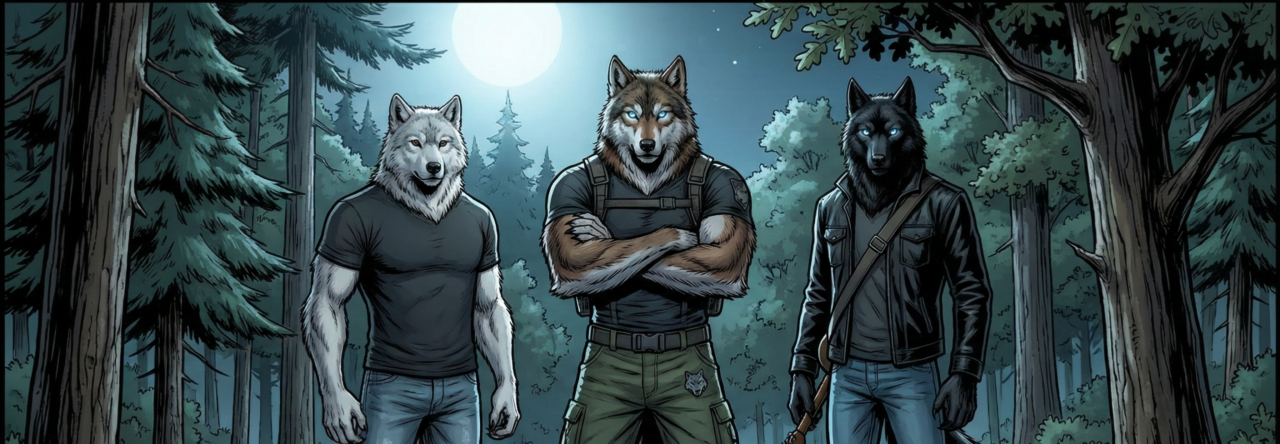
Three Werewolves: After The Fall

The world ended. The pack didn’t.

Episode 56 – The Hunters Who Came Home

The last of the storm melted slow in the morning sun, dripping from the pines like a long sigh. Snow still clung to the streets in pale banks, but here and there shingles peeked through, roofs once again remembering their old shapes. Smoke curled from chimneys. Snowmen leaned. Someone had finally put a scarf around the statue in the square, and no one knew whether it was Holt, a kid, or one of the night owls from the tavern.

It was a day for chores. A day for digging paths and clearing the solar panels. Thane’s breath made soft fog as he walked down Main Street, nodding to a handful of early risers already at work: Hank and Marta patching a fence, Gabriel lugging cables out of the radio station, Mark kneeling near a junction box in the snow, cheeks rosy and muttering cheerful profanity about “moisture-induced voltage loss.”

Then the figures appeared — first shadows, then forms.

Three humans, heads down, trudging through what had been sled-packed paths the day before. A fourth shape, smaller, was being carried — slumped over the tallest man’s back. The wind tugged at their clothes, peeling edges, rattling them like lost scarecrows.

Thane stopped mid-step. Eyes narrowed, not in suspicion but in recognition — recognition of the weary rhythm of people who’d been walking too long without hope. Not raiders. Not scouts. Survivors. And close to collapsing.

Marta saw them next. Her breath caught, just for a moment. She lifted a hand.

“Hold up. Don’t run yet.”

Gabriel stepped beside Thane, arms folded, watching the strangers close the gap into town.

The tall man dropped to his knees first. The girl slid off his back, landing awkwardly in a drift but was gently pulled upright by the woman beside him — older, with a lined face and eyes that were clear and direct. She raised a cloth as a flag. Not surrender. Not plea. Just presence.

“We saw the lights,” she said quietly, breath fogged in the cold. “We weren’t sure it was real.”

Thane took one slow step forward, arms to his sides. The rest of the pack fanned out behind him in practiced calm — Holt, Rime, Gabriel, Mark — silent, steady, visible because trust was something you prove.

“You’re in Libby,” Thane said. No challenge. Just fact.

The tall man, still on his knees, scowled at the wolves. His eyes hit Holt first — massive, flannel-wrapped, paws as big as plates. The man recoiled.

“You’ve got wolves walking around with people?” he asked, voice cracking from exhaustion and something deeper — fear, or maybe anger wearing fear’s coat for now.

Thane’s answer came slow, sure, ancient.

“We’re not walking around with people,” he said. “We’re home.”

They were taken to the old church basement for assessment. The heat was good there — gas stove still ran clean off the tank they’d salvaged months back, and the concrete walls held warmth in ways that made huddled humans sigh with gratitude.

The woman introduced herself as Sara Halliday. Biologist. Former wildlife captain. “Used to track wolves,” she said lightly to Thane. “Didn’t expect to meet them like this.”

Her niece, Mimi, sat beside her with a shivering blanket-wrapped kind of quiet. Seventeen. Eyes ringed, hair tangled. Every so often, she pressed an old cassette player to her ear — a cracked walkman. Music leaking through blown speakers. She didn’t speak much.

The tall man didn’t give a name for a long time. When he finally did, it came like something pried loose.

“Brent,” he said. Just Brent.

His gaze never left Holt.

That night, the pack gathered privately in the cabin. Snow lit by moonlight outside the windows. Sable leaned in a corner, shirt sleeves rolled to the elbows, arms folded — watching, calculating. Rime sat cross-legged on the floor, sharpening a blade with slow, meditative strokes. Holt lay on his stomach, tail slack but eyes troubled.

Thane stirred a pot absently, testing the broth.

Gabriel lounged by the woodstove, guitar on his lap even when he wasn’t playing. “Brent looked at Holt like Holt was gonna tear the town apart,” he said. “And Holt hasn’t torn anything apart in… what, a week?”

Holt grumbled. “Was table. Was accident.”

“Still haven’t fixed the leg,” Mark added. Then, gently, “There’s something else in him. Something old. And it’s tied to wolves.”

“Fear scratches the door,” Thane said. “Anger breaks it.”

The next day came crisp as dry paper. Blue sky stretched wide, bright enough to blind. Brent and Sara stayed close to town hall, helping sort tools in silence. Mimi met Gabriel, finally, after he noticed her old cassette player and called across the room: “You got tunes?”

She blinked, nodded, and played her favorite tape through little headphones. It was grainy — the sort of mixtape dads made for daughters in a world that no longer existed. Gabriel just nodded, respectful. “You wanna go on the radio with that later?” he asked. Mimi didn’t answer, but the ghost of a smile passed her lips.

Near midday, kids hollered in the square. Wolves sprinted. Snow packed under paws. The “snow scavenger hunt” was happening — a leftover idea from last night’s final council chat. Sable was managing the route. Holt played “treat hider” with gusto. Rime played overseer, keeping little ones from burying their mittens too deep.

Kids adored it. Wolves thrived in it. Humans watched with the same stunned fondness they’d had during the blizzard.

And then Brent saw it.

Little Tommy Westbrook — red hat, lopsided grin — had climbed onto Holt’s back, hands buried in Holt’s ruff, while Holt shuffled through the snow on all fours, gently growling and pretending to be a “snow bear.” Tommy howled. Holt howled. The sky howled.

Something inside Brent cracked like thaw ice.

He stormed toward them, drawing a knife from his belt — quick, practiced, reflex. “Get that THING away from him!” he screamed. “Wolves tear, they KILL—”

Sable moved first, then Thane — but neither made it before Holt flinched back, tail tucked, eyes wide in apology he didn’t even have words for. The kid slid off Holt’s back and into the snow, confused.

Brent shoved past. Grabbed Tommy’s coat and yanked him back. The knife flashed.

Rime stepped forward.

No snarl. No speed. Just presence.

He walked directly into Brent’s line of sight. Then — he sat down. Big paws on frozen ground. Back straight. Ears neutral. Tail still.

Brent’s eyes shook. His hand trembled. Knife quivered.

And then it fell — clattering onto the ice-crusted snow between them.

Brent didn’t back away. His knees simply… gave out.

“I buried my son,” he said — not to Rime, not to Thane, not to God or ghosts — just into the cold. “He was ten. We were tracking. Wolves came out of the trees. I— I couldn’t—”

He broke.

Winter quiet held every word.

Holt looked at Thane, tears forming at the edges of his fur — Holt, who could carry a motorcycle, felt too heavy to move.

Rime reached out his paw. Just one. Slow. Stopped a foot away.

Did not touch. Only offered.

Brent bowed his head.

Brent stayed there for a long time, kneeling in the snow with the cold brushing his lungs and the truth finally too heavy to hold alone. Nobody moved until he did — not Thane, not Sable, not Rime, not even Holt. If Brent had lashed out again, if the pain had folded back into fear, the pack would’ve reacted as one. But instead, he just… breathed. His hand found the space over his chest like he wasn’t sure his heart was still there.

When he finally stood, he didn’t look at Holt, or the kid, or the knife on the ground. He looked at Thane — and for the first time, his eyes asked a question instead of delivering a threat.

Thane nodded once. Not approval. Not absolution. Just a quiet promise: You’re still in this town. You still matter. We don’t finish on the worst moment.

Sable got the boy moving again, calm and quiet. Holt got to his feet by inches, the way gentle giants do when they’re afraid they’ll crush the wrong thing. Rime flicked his tail once, just to reassure himself that this was real — that presence had done more than teeth ever could.

Mark arrived from the edge of the square, toolbox still in hand, and looked between Brent and Thane. He didn’t ask. He just fell in behind Sara as she led Brent away from the frost and toward shelter.

Thane watched them go, arms still loose at his sides. He didn’t speak for a long time. He just let the wind blow through the gap between what happened and what still could happen.

Only once the door of the church shut behind the three survivors did Thane finally turn, catching every eye that had seen. Gabriel’s. Rime’s. Holt’s still-wet ones.

“We handle it tonight,” Thane said quietly. “Nobody carries this alone.”

The pack nodded. One by one, the square eased back into motion — not the same motion as before, but a slower, steadier one. Because the work wasn’t just digging out from storms anymore. It was digging out from each other.

That night, things moved slow. Sara held Brent’s hand in the basement room. Mimi clutched her cassette player like a lifeline. Rime went back to the cabin, sat by the fire, and sharpened nothing.

Thane found him there.

“He does not see us. Only teeth. Thinks we took his cub.” Rime said, eyes fixed on the coals.

“You sat with him,” Thane said softly.

Rime blinked once. “Pain talks. Needs ears. Wolves… know that.”

The next morning, Brent walked up to Holt by the sawmill. Sunlight sharp on the frost. Holt froze mid-step, holding a toolbox.

Brent didn’t speak at first. Just… held out the knife. Not like a threat. Not like a test. Hilt first.

Holt blinked. Massive chest rising slow.

“For a long time,” Brent said, voice low, “this was for things I didn’t want to understand. Things I thought I needed to fight.” He paused. “I’m sorry I pointed it at you.”

Holt placed his paw — not on the blade, but on Brent’s hand — and closed it back up.

“Keep,” he said. “Use right. Not wrong.”

Brent nodded — eyes wet, jaw set. He put the knife away. This time, not like armor. More like remembering.

Sara found Thane at the river. Snowmelt ran under a sheet of glass, slow and sure. She stood beside him, hands in pockets.

“You know what’s strange about all this?” she said. “Back when the world was alive, I spent my career trying to convince people wolves were worth trusting. Now I get to learn the same lesson all over again.” She smiled faintly. “Maybe I wasn’t teaching anything. Maybe I was practicing.”

Thane gave her the same look he’d given people across battle lines and firelight, when they finally started to see.

“Trust isn’t a thing you build once,” he said. “It’s a tool you sharpen.”

Mimi kept her headphones off that afternoon. Instead, Gabriel invited her onto KTNY. Together, they queued up her father’s mixtape — crackles and all.

They played the tape through the airwaves into the valley.

Soft guitar. Old world voice. Scratch of plastic. The recorded words:
“To my girl—don’t stop loving the loud things. They mean you’re alive.”

Mimi cried.

Gabriel sat beside her and played quietly along. No applause. No chatter. Just letting the ghosts sing.

Thane didn’t want Brent alone with that much pain, not after what the day had held. So he sent Rime to the church, to sit quiet watch without staring.

Rime slipped out onto the steps, leaning against a pillar, quiet as earth.

Brent joined him a while later — not scared this time. Just tired.

They stood like that in silence until Brent said, “What do you do when your head won’t let go?”

Rime’s ears flicked once. He exhaled, slow.

“Breathe. Let pass through. If stays, make room.”

Brent nodded.

A wolf and a hunter. Standing side by side, not understanding each other—and not needing to, right then.

Sara and Mimi stayed. Brent stayed, too — though he still stepped around Sable like she was fire in wolf skin.

But he said Thane’s name without shaking. And walked unarmed in the square.

And once — just once — he reached up and clapped Holt’s shoulder as he passed.

Holt didn’t look back. Just smiled into the wind.

Episode 55 – Snow Day

Snow swallowed sound the way sleep swallows a long night. For a while, the whole valley just breathed—no engines, no axes, no boots on gravel—only drift and hush and the soft tick of heat.

Thane woke to coffee and quiet laughter.

Gabriel was already at the stove with a kettle, humming nonsense to the steam. Mark sat cross-legged by the woodbox, sharpening a hatchet with careful, even strokes. Holt sprawled belly-down on the braided rug, chin on his crossed paws like an obedient bear forcing himself not to leap up and sprint into the yard. The tip of his tail gave him away; it thumped the floor in steady, helpless pulses.

Rime was the window silhouette again: still, alert, wearing the flannel pajama pants he had fallen asleep in, because once he decided something was comfortable, civilization could not pry it off him.

Sable slept on the couch under the “vintage grandma-core” quilt. She had shifted sometime in the night so her back rested against the armrest and one knee hung over the edge like she had never once apologized for taking space. Frost melt had dried from her fur; she looked less like a blade and more like a living thing that had finally remembered the luxury of warmth.

Thane eased up from his spot by the hearth and stretched until joints popped in a satisfyingly honest way. Gabriel poured coffee into chipped mugs and slid Thane’s across the table with a grin.

“Morning, Alpha. Forecast calls for sledding, terrible singing, and an 80% chance of Holt eating his own body weight in waffles.”

Holt didn’t lift his head. “I do ninety percent.”

Mark inspected the edge on the hatchet and set it aside. “We’ll need to sweep the porch every hour just to get out the door. Snow’s waist-deep. Pretty as a postcard. Useless as a doorstop.”

Sable’s eyes opened, yellow and calm. She listened for a beat before speaking, voice low.

“Storm rests. Day for joy.”

Her cadence did something to the room—like someone set a stake through the center and everything steadied around it. Thane nodded.

“Joy it is.”

They ate like a pack that had earned it: waffles, bacon, fruit that Gabriel had somehow tucked away like a magician, toast (Holt clutched the plate like holy relics), and enough coffee to convince even the snow to move aside.

Outside, the valley glittered under fresh sun. The town below was a collection of sugar-dust roofs and tiny drifting figures already arranging sleds and shovels and improvised snow games. Smoke climbed straight up from chimneys into air so cold it was glass. On a nearby pine bough, a pair of chickadees argued about something important and tiny.

They stepped into it as a unit—Thane first to test the steps, Gabriel behind him with a coil of rope and a battered plastic sled, Mark shouldering a shovel, Rime silent and attentive, Holt practically vibrating with stored thunder, and Sable closing the door with a sure, gentle motion that said the cabin was safe and would be there when the day ended.

On the hill behind Main Street, Libby had become a festival.

Kids whooped down the slope on saucers and trash-can lids. Wolves belly-slid after them, long and sleek and laughing, if laughter had ever worn fangs. A rope tow did not exist, but a long line of willing hands did: humans and wolves both hauling each other back up like a living pulley system. Someone had dragged an old grill into a snow-cleared half-circle and was cooking pancakes outdoors, flipping them with a flourish that drew cheers. The piano that had appeared last night reappeared at the edge of the square; its top was dusted with frost and its owner wore two scarves and determination.

Marta stood near the base of the hill, hat pulled down to her eyebrows, shouting for order and getting exactly none. When she saw Thane, she lifted an arm and waved him over through the sea of winter chaos.

“Thane!” she called, cheeks flushed with cold and victory. “We’ve got cocoa at City Hall, soup in the church basement, pancakes and coffee here, and Hank swears he can build a jump if you say it’s legal.”

Hank, a few yards away, was packing snow with a sled and the raw joy of a ten-year-old in a sixty-year-old body. He looked up hopefully.

Thane laughed. “If the jump stands, let it stand.”

“Mayor says it’s legal!” Hank yelled, as if Thane were the mayor and not the Alpha. Then he went back to compressing snow like his pension depended on it.

Sable paused beside Thane, taking it in: wolves tangled playfully with children, humans tugging on wolves’ paws to teach them how to lace borrowed skates, a teenager trying to explain snowball rules to a feral who insisted everything was hunting if you believed hard enough.

“Good,” Sable said softly. “World could be this more.”

Thane angled her a look. “We’re making it so.”

Holt had already found the line for the hill and inserted himself behind two eight-year-olds who accepted him with the solemn authority of children hosting a dignitary. “You gotta tuck, big guy,” one of them said, patting Holt’s shoulder. “Like a burrito.”

Holt nodded vigorously. “I will be burrito.”

Rime drifted to the edge of the crowd like a shadow and crouched to watch a toddler stamp wolf-prints into drift after drift, then carefully stamp his tiny boot beside each one to compare sizes. The toddler looked up, dazzled. Rime obligingly set his paw in fresh snow so the kid could make another comparison, then—without ceremony—held out a thermos cup. The toddler took it two-handed and slurped cocoa with the reverence due a sacred rite.

Mark, who rarely missed a chance to fix something, made a slow lap and returned with a tray of mugs. “Stove’s holding. Panels are sipping sun through the glare. If we keep the town’s loads low, we can keep lights on tonight without touching the generator.”

Marta tipped her mug toward him. “You’re my favorite kind of wizard, Mark.”

Gabriel had found the piano. Of course he had. He brushed frost off the keys with one sleeve and played a cheery, clumsy march until circulation returned to his fingertips. Then he shifted into something warmer, a run of chords that sounded like sun slanting through window glass. A few wolves gathered, heads tilted. A couple of humans hummed along. Holt, halfway up the hill, heard the first bars and threw both arms up like a stadium crowd, nearly wiping out the trio behind him. Sable watched Gabriel with that curious, careful look she saved for things she had decided to respect.

“Music travels far,” she said. “Like howl. Less teeth, same truth.”

Gabriel grinned. “House specialty.”

The jump—such as it was—stood. Hank got a test pilot in the form of a feral named Pike, all white fur and reckless optimism. Pike howled down the slope, hit the lip, and flew. He landed in a spray of powder and a peel of laughter so big the trees shook. Two humans followed, then three wolves together, then a cluster of teenagers who biffed it so spectacularly that half the hill tumbled down after them like dominoes, cackling.

Sable’s mouth twitched. “Fools,” she said, and her tone made it a blessing.

The day became a parade of small scenes that stacked together like warm quilts.

At the grill, a woman named Ellie discovered that wolves preferred their pancakes barely cooked on the inside and crisped hard on the outside. “Charred moons,” Holt called them, mouth full. Ellie snorted and gave him two more.

Inside City Hall, a posse of knitters armed an entire battalion of wolves with scarves, hats, and mismatched mittens. The sight of a gray-muzzled feral named Bracken looking at his own reflection in a window—blue scarf wrapped three times around his neck, eyes shining like someone had crowned him—put a lump in Thane’s throat he didn’t bother to swallow.

In the church basement, soup kettles took turns on the big burners, and someone discovered wolves could chop vegetables faster than anyone had ever seen if you put a wooden cutting board under their claws and promised them the first bowl.

On Main Street, two teenage girls attempted a “howl clinic.” The wolves were patient. The result was catastrophic. Everyone adored it.

Midday, KTNY-FM came alive with a bright guitar riff that slid over the square like sunlight. The generator at the station had been tested last week; Mark’s patchwork wiring still held. Thane glanced toward the distant roof line where their antenna poked up like a stubborn reed and felt the old familiar spark in his chest.

Gabriel leaned toward the microphone they’d rigged on the piano. “To anyone listening beyond our valley,” he said, voice warm and amused, “today is a snow day. If you can hear us, know we’re safe and ridiculous out here. And if you can’t hear us… well, then we’re just talking to ourselves, which we’re very good at.”

Laughter rolled. Sable looked at the speaker hung by the door, then at Thane.

“Radio still miracle,” she said. “Howl that never tires.”

“Perfect description,” Thane said. “You may have a show.”

“Will not,” she said dryly.

Holt finally got his turn with the sled. The two eight-year-old coaches had appointed themselves handlers. They tucked him like a burrito, counted down, and shoved. Holt shot forward with a roar, hit the jump, and for one breathtaking moment looked like a flying house. He landed with shocking grace, skidded to a dramatic stop, stood up, and raised the sled over his head.

“Burrito flies!” he bellowed.

The crowd lost its mind.

He trotted back up the hill and gifted the sled to one of the kids with ceremony. “For courage,” he said softly, serious now. The boy blinked hard to keep from exploding.

Rime, who had avoided every invitation to slide or jump, allowed one of the knitters to adjust his scarf and then let a little girl paint his claws with glittery blue polish using a brush the size of a twig. He stared at the snow while she worked, stoic, and did not flinch. When she held up his hand to admire her art, he nodded once and said, “Good work.” She beamed like sunrise.

Marta drifted over to Thane with a clipboard she didn’t actually need. “You know,” she said, “when I said open your homes, I didn’t plan on opening my freezer and discovering a wolf defrosting a bag of peas by sitting on it.”

Thane kept his face straight. “Efficient.”

“Delightful,” she corrected, and bumped her shoulder against his arm. “Thank you for trusting us with your family.”

Thane met her eyes. “Thank you for claiming them as yours.”

She swallowed, then looked away to watch a cluster of seniors teaching a feral how to knit with oversized needles. “They make us brave, the wolves,” she said. “We make them soft. It is a good trade.”

Sable passed by then, and Marta stopped her with a touch to the forearm. Sable stilled—wariness, habit—but Marta only lifted the end of Sable’s scarf (cream, with a single red stripe; someone had chosen well) and adjusted it like a grandmother.

“There,” Marta said, satisfied. “Fits.”

Sable held her stillness a fraction too long, then inclined her head. “Thanks,” she said. One word. It landed like a stone thrown in a pond—ripples that would keep moving for hours.

Afternoon light leaned toward gold. Shadows lengthened. The hill, packed into a polished track by a hundred passes, gleamed like a silver chute. Breath fog thickened. Hands sought pockets. Wolves sought other wolves and began to cluster toward their own.

Thane found a moment with Sable at the top of the slope where the view ran from the first row of pines all the way to the river, now smothered under white.

“You heading back tonight?” he asked.

She weighed the air. Snow hissed softly, a whisper of new flakes. “Yes. Camp waits. Food there. Some shelter rebuild. We go slow.”

“I’ll send you with what we can spare,” Thane said. “Blankets, dried meat, hand warmers, a radio if you finally admit you like them.”

“Not like,” Sable said. “Respect.” Her mouth ticked. “Will not carry radio. Rime will just teach birds to answer it.”

Thane watched Rime below, surrounded by small humans, looking both imprisoned and deeply content. “He would.”

They began to make rounds—goodbyes that didn’t feel like endings.

At the grill, Ellie stuffed three paper-wrapped charred moons into a wool backpack and pointed a spatula at Sable. “You bring this bag back next time. I’ll know if you don’t.”

Sable looked down at the bundle like someone had handed her a crown. “Will bring back clean,” she said. “Promise.”

In the church basement, the soup crew handed out jars. In City Hall, the knitting posse gifted two more scarves and a pair of mittens that would only fit Holt’s thumbs, which made him so happy he announced he was going to wear them on his ears. The knitters nearly fainted from delight.

By the piano, Gabriel finished a bright little tune and leaned the mic toward Thane. Thane kept it short, voice steady over the square and the radio both.

“Libby,” he said, “thank you for the day. For the warmth. For showing the valley what it looks like when a town becomes a den. We’ll be on air through the evening while our friends travel, in case anyone needs a voice to follow home.”

Applause moved through the crowd, not loud—nothing was loud in this much snow—but sincere, like clap-clap-clap traveling hand to hand.

Hank and two deputies had already broken trail north with shovels and old cross-country skis, marking hazards with bright cloth strips tied to willow branches. The route out of town wasn’t easy, but it was clear enough now: along the ridge, past the frozen aspen grove, then into the narrow cut the river had left over years of patient insistence.

At the edge of town, the Northern Ferals gathered—thirty wolves in mismatched scarves, borrowed mittens, and woven hats that would be recounted with laughter for years. Packs were shouldered, paths were checked, and farewells began.

Rime and Holt stood together beside Thane, Gabriel, and Mark. They weren’t part of the departing line. They weren’t wearing packs. They belonged here—home. Holt held a mug of cocoa and a half-eaten waffle like the world’s most content boulder; Rime stood upright in his glittered claw-wraps, scarf neat and composed.

Sable paused before them. She scanned the group, then turned to her two former guardians.

“You stay,” she said simply.

It wasn’t question or command. It was acknowledgment.

Holt straightened and placed a paw over his chest. “Den is here,” he rumbled.

Rime inclined his head slowly. “Will honor both packs.”

Sable pressed her brow briefly to Holt’s, then Rime’s, in the oldest sign of feral respect—no words, just presence, breath, and memory.

Thane stepped closer. “They’re family,” he said. “This den will always shelter yours too.”

Sable’s eyes softened for a heartbeat. “Know that,” she said. “Carry peace into storms.”

Then she turned, and her pack followed.

Sable stepped forward and raised her chin. Her voice carried without strain.

“Libby. We came because storm bigger than pride. Found… more.” She searched for the words that fit tight to bone. “Found welcome. Learned heat of houses. Learned taste of charred moon. Learned… being seen.” She looked at Marta, then at Thane. “Will not forget. Pack remembers warmth longer than cold.”

Marta blinked too fast. “Come back for no reason at all,” she said. “You don’t need a storm.”

Sable’s mouth softened. “Will do.”

They set off as dusk settled in like steady breath over the snow. The first stretch was full of quiet reassurances, nudged packs, calls to keep formation. Then the trail found rhythm — footsteps hush, breath becoming cloud, the soft whisper of snow against fur.

Thane, Gabriel, and Mark stood with Holt and Rime, watching in silence until the figures vanished into the white — until color and motion and wild memory turned into the soft shimmer of snowpack beneath a muted sky.

Marta sighed beside them, hands in her coat. “Feels like sending cousins home after the holidays.”

Holt chuckled. “Except we get stay with cool side.”

Rime nodded once, the faintest smile at the edge of his eyes. “We keep the den standing.”

Thane clapped Rime’s shoulder softly and said, “Always.”

They walked back into town together. Lights were snapping on behind frosted windows. Someone dragged the piano inside at last. The grill hissed its final hiss and slept. The jump sagged under its own legend.

In the cabin, they shook off snow and made a last run of cocoa. Holt’s mittens-on-ears did not survive the doorjamb, which sent him into a five-minute eulogy that ended only when Gabriel made him laugh by playing the saddest funeral dirge ever written for a pair of wool lumps.

Rime—home again—picked up a broom without a word and swept melted snow into a neat line for Mark to scoop with a dustpan. Sable’s scarf was folded and set by the door for next time. Thane hung the extra blankets near the stove to dry and stood a moment with his hands on the back of the chair, head bowed in the kind of gratitude that does not need to be spoken to be true.

Later, when the light had thinned to cobalt and the valley held its breath again, Gabriel turned the radio down to a murmur and flicked the string of lanterns around the room. Warm amber halos pooled on the floor and walls.

“Tomorrow will be chores,” Mark said, practical as ever. “Plowing, roof checks, maybe a run to the generator to chip ice.”

“Tomorrow will be that,” Thane agreed. “Tonight was this.”

Holt, already half asleep on the rug, mumbled, “Burrito flies,” and snored like distant thunder.

Rime tugged his blanket into neat lines around his shoulders and gave Thane a long, small look that said I saw everything; I filed it where it matters.

The wind moved across the ridge like a hand smoothing a bedspread. Somewhere far off, a wolf made a single call and then fell silent, as if to check the valley’s pulse. It beat steady.

Thane closed his eyes and listened to the house breathe, to the town breathe, to the long, slow inhale of a winter that had decided, just for now, to be kind.

The day would end with the ferals threading the last pines, with scarves catching moonlight, with birds settling on cold branches and tucking their heads under wings. It would end with Sable stepping into the clearing above her camp and smelling a home remade by hands that had learned something in Libby—about blankets and kettles and the patience to build again.

It would end with a radio fading into static and with a valley full of people and wolves who, when they woke tomorrow, would reach for shovels and brooms and each other because that was the way forward.

But before all that, in the comfortable hush after laughter, Thane spoke into the quiet without turning, like a promise more than a statement.

“Any storm,” he said, “and they know where to run.”

“Here,” Gabriel answered, soft and sure.

“Here,” Mark agreed.

The stove ticked as it cooled. Snow slid in slow sheets from the roof. Somewhere, unseen, the river under its white skin kept moving.

The night held. The den did too. And for once, the world outside matched the one within: cold, bright, honest, and full.

Episode 54 – Stormfront

The air tasted strange before the storm.

Not just cold. Not just the usual brittle bite of winter. There was something heavy in it—thick, electric, like a string wound too tight and waiting to snap. Even the pines whispered it in their needles as the wind brushed by: danger.

Thane stood outside the cabin on the ridge, fur bristling as he scanned the north. The sky—once a quiet silver—had turned a mottled bruise. Low, swollen clouds dragged their bellies across the treeline. Snow began as nothing more than a soft drift, but already the flakes were large, wet, too eager. The kind that meant business.

Behind him, inside the warmth of the cabin, the fire crackled and the light danced across wooden walls that told stories of a thousand quiet moments between pack and people. Mark’s voice drifted from the back room where he was checking the charge on the deep-cycle batteries, his methodical hum the counterpoint to Gale Force Nine brewing outside.

Gabriel strummed the same four chords on the couch, mind elsewhere, hand running slowly through his salt-black hair as if coaxing the melody loose from something stuck just under the skin.

Rime stood sentinel at the window—his quiet silhouette a familiar one these days. He was still new to “indoor life,” but he’d taken to protecting even the mundane rhythms of the den like a religion.

And Holt… well, Holt was flat on his back by the wood stove, all paws and contented sighs, enjoying “the art of thawing.” That was what he called it. The big goof had no idea how to do anything halfway.

Thane stepped back inside and shut the door with a firm motion of his paw. Gabriel stopped playing and looked over.

“You feel it too?”

Thane nodded slowly. “It’s not a storm. It’s a message.”

Mark emerged carrying the portable solar monitor, headset around his neck, flannel shirt sleeves rolled up. “Forecast said minor flurries. But I get the feeling Mother Nature forgot to read the forecast.”

Rime’s ears flicked, nose turning to the wind. He didn’t speak, but his shoulders tensed in the way they did when something was wrong.

Holt, ever the late arrival, blinked up at the window just in time for the world to disappear in a sudden white blast. Snow hit like someone had turned on a firehose.

“Whoa…” he said breathlessly. “That’s not snow. That’s a trap.”

Within seconds, visibility dropped to almost nothing.

And then—the knock.

Not gentle. Not polite.

It was a pounding of paw against wood, forceful, determined. A rhythm that said we’re here, let us in, no time for words.

Thane was at the door in two strides and threw it open without caution.

Sable stood there, more storm than wolf. Her fur was packed with windblown ice and her shoulders carried snow like armor. Behind her, through the swirling wall of blizzard, came more shapes—shadow-wolves emerging from white nothing, one after another until the cabin porch and surrounding yard were teeming with Northern Ferals.

They didn’t whine. They didn’t plead. They didn’t explain.

Sable simply met Thane’s eyes.

“We come,” she said. “Storm took everything.”

Thane didn’t move for a heartbeat. He didn’t need to. His voice, casual but iron-solid, was already ahead of the moment.

“The cabin is yours,” he said. “We stand together.”

Rime was there first, already guiding the first few ferals inside, clearing them space by the stove, fetching extra quilts, helping them shake the ice from their paws. Holt went full big-brother mode, dragging armfuls of blankets and letting wolves bigger than him lean against his shoulder like exhausted pups.

Gabriel lit up like someone just handed him a gift. “Snow day with thirty wolves?” he said brightly. “Hell. Yes.”

Mark ducked into the pantry and came out with powdered cocoa, cans of chili, jars of honey, and three loaves of bread. “Gonna need a bigger pot,” he muttered, already mentally scaling up recipes.

And Sable…

Sable finally took one long inhale. For the first time, her posture faltered—not from weakness, but from permission. For once in this world, she didn’t have to stay standing. She could rest.

“Sit,” Thane said softly, holding out a mug.

She hesitated, then did just that.


It didn’t take long for word to reach Libby.

Between the storm, the frequency of Northern pack sightings, and the shared instinct of care woven deep into every human who’d stayed since the Fall—the arrival of the Ferals was less of a surprise and more of a moment already waiting to happen.

By dusk, Mayor Marta was outside in the gale, soaked coat and all, rallying townsfolk with the same fire she used to manage food distribution and road repairs.

“Every house with heat—open your door! Blankets, clothing, stew—get it moving! NO ONE sleeps cold in Libby tonight!”

Deputies fanned out through the streets, shouting the news through cupped hands. Hank waved people toward his own house without even glancing back (his wife was already pushing furniture aside to set blankets on the floor). Kids poured outside in mismatched boots, pointing and cheering as the wolves staggered down Main Street like living storms who’d surrendered their fierceness at the sight of a warm porch.

Humans didn’t ask ANY questions. They just acted.

“Hey, big fella, you got claws, but do you drink tea?”

“Hold still, let me get the ice out of your tail, you’re freezing!”

Before long, the homes of Libby—little post-war cabins and patched-up craftsman houses alike—were filled floor-to-attic with wolves. Wolves by the kitchen counters. Wolves by the firesides. Wolves using couches as dens. Wolves wrapped in mismatched, oversized flannel pajamas from long-forgotten closets.

The storm… just became background noise.

Inside, there was LIFE.


The cabin itself transformed into a sanctuary inside a sanctuary.

While Libby’s streets glowed from candles and makeshift lanterns, the ridge cabin roared with heat from the wood stove. Sable, Rime, and Holt joined Thane, Gabriel, and Mark in what might as well have been the most unexpected holiday family gathering in the history of wolves—or humanity.

Gabriel taught Holt how to play blackjack with a deck of cards they found under the couch cushions. Every time Holt lost, he slammed the table dramatically and insisted the deck had sabotaged him. Every time he won, he strutted like a viking who’d just conquered Canada.

When Rime lost his round, he just arched an eyebrow with quiet disdain, then took three mugs of cocoa, climbed onto the armchair, and watched the chaos like it was dinner theater.

Sable, meanwhile, had commandeered one end of the couch and—only after some heavy persuasion—wrapped herself in a quilt Mark described as “vintage grandma-core.” She tolerated it for approximately twelve minutes before one of the corners slipped down her shoulder, and Holt nearly shrieked with joy.

“We got her to wear a BLANKET-COAT,” Holt announced. “Write it down. HISTORY. Someone carve this on a tree.”

Sable growled… half-heartedly.

And Thane?

He floated.

Not that he’d admit it, but seeing his cabin alive, packed with wolves safe from the cold, sawdust on the floor, laughter in the rafters, the faint tinkling of Mark’s tools on the workbench and sugary scent of Gabriel’s mystery cocoa concoction—it was like watching the bones of his pack finally warm again. Every fracture, every bruise from battles past, every moment of exhaustion—they all got a little lighter.

The blizzard roared on the roof.

Nobody cared.

After dinner (which was more like a food riot), the cabin settled.

Thane sat by the fire with Sable beside him, sharing quiet in the way only leaders knew how—no words, just warmth and survival well-earned. Holt curled up at their clawed feet like a massive, slightly humming pillow. Rime sprawled on his back in front of the stove, flannel-covered legs sticking straight up like an overturned beetle. That didn’t stop him from sipping cocoa.

Mark fell asleep in his chair surrounded by blankets, solar schematics still on his lap.

Gabriel leaned against the table, guitar in his hands, playing soft chords, half-lullaby, half-wolf-song.

And for the first time in a long time, the den didn’t feel like a place holding back the world.

It felt like the world.


Meanwhile, in Libby…

Two wolves learned how to use a toaster. It didn’t go well. Or rather—it went too well.

Once they figured out how to drop the bread in and push the lever, toast became the most celebrated invention since fire. Wolves made toast for everyone. They buttered it. They put it in their pockets. They stacked it. They debated the ideal crunchy-to-soft ratio.

Mayor Marta nearly cried from laughing when Deputy Glenn tried to explain that they didn’t actually need to butter both sides or toast each piece six times. (He lost that argument. Wolves love commitment.)

Elsewhere, a group of older ferals gathered around a space heater that made a soft ticking noise when it cycled. They tapped it experimentally. They tapped each other. They started a rhythm. That rhythm spread—thumps, claws on wood, quiet howls in rising harmony. The humans joined in by tapping mugs and rocking chairs.

By the time the storm hit its peak, somebody had rolled out the town piano, and two wolves were trying to learn how to duet. A toddler followed one of them into the hallway, tugging a tail with reverence and laughter.

Nobody was scared. Nobody was alone.

It turned out that being trapped indoors—together—was less about healing trauma and more about making a fort out of every pillow in sight and singing until your lungs hurt.

The snow kept falling. Hard enough to bury trucks and build temporary igloos. Hard enough to shut down the trails and freeze the river solid.

But within every house, windows fogged and hearts thudded with more warmth than the entire power grid of western Montana used to hold.


Morning brought quiet.

The kind where snowdrifts stretch like unbroken quilts across the land, and sound is only what you make yourself.

Wolves stretched. Humans yawned. Coffee brewed. Someone found waffles. More toast was made.

And when Gabriel and Holt stumbled to the porch, arms full of snow gear to go “sledding like maniacs,” what followed looked like an oil painting your grandmother might have owned if she believed in werewolves:

Wolves belly-sliding down the hill behind Main Street, howling with glee.

An elderly woman sipping tea from her porch, watching like she’d waited her whole life for this.

Two teenagers debating whether Holt was heavier than the sled.

Kids buried in wolf fur as they built misshapen snowmen.

And outside the cabin, Rime showed Sable how to make snow angels—then calmly walked away before she could gnash her teeth at the adorable indignity.

Thane watched from the ridge. Fur brushed with powder, arms crossed loosely. Gabriel sidled up and took in the sight.

“You ever think we’d get this?” Gabriel said softly.

Thane pulled in a long breath—filled with pine, quiet, and something sweeter underneath.

“No,” he admitted. “But I hoped.”

The storm would fade.

The snow would melt.

The wolves would go home.

But something had lodged deeper now—like a spark that refused to die just because the night did.

The humans of Libby, hearth-lit and fearless, had done more than offer shelter.

They’d said, without a single word of ceremony:

You are family here.

And the wolves? They hadn’t just sought shelter.

They’d brought joy.

They’d brought warmth.

They’d brought life.

For the rest of their lives, when the wind rose in this valley, someone would remember the sound not of fear—

—but of laughter echoing through the storm.

The wind howled at the valley, but the valley didn’t howl back—not because it was afraid, but because it was full.

Episode 53 – The Christmas Crate Run

The Humvee’s engine talked low to itself, a steady bass under the winter morning, while the square yawned awake into colorless light. Frost had drawn fine white veins across the windshield; when Thane dragged a claw over the glass, it squeaked like a bird in a far tree. He stood with his paw on the open door, breath fogging, looking at the way the machine sat like an animal waiting for a command. A year ago, he would have called this a dream—a ridiculous one at that. Today it was a tool, and the day felt ready to be used.

Gabriel trotted across the square with his guitar case banging his hip, hair salted with powder-fine snow. “Gorgeous,” he said, like the Humvee had made itself pretty to be admired.

“Ugly,” Thane said, fondly. “Honest about it.”

Mark came at a brisk walk, backpack slung and tablet wedged into a side pocket, muttering to himself. “If we find anything with windings, I’m adopting it,” he said by way of hello. “Don’t let Holt lick the battery terminals.”

“I not lick,” Holt announced, materializing a step behind Gabriel. “Maybe tap.”

Rime followed him through the cold with the quiet of a shadow. He cocked his head at the Humvee and then at Thane. “You happy,” he said, matter-of-fact.

“Close enough,” Thane said. He tipped his muzzle toward the road. “Mount up.”

Marta intercepted them before they climbed in, scarf tucked under her chin, eyes sharp with the kind of worry that likes to pretend it’s just business. “Half-day out, half-day back?” she asked.

“If we don’t get curious,” Thane said.

“You will,” she said, and then she smiled, unhelpfully. “Bring me something I can call a miracle at a town hall. And bring yourselves back with it.”

Thane dipped his head, then slid into the driver’s seat. The engine thumped when he turned the key and settled into a purr. Gabriel clambered into the back and immediately popped the latches on the guitar case; Holt folded himself beside him with reverence, pillow across his knees like a ceremonial offering. Rime took the other rear seat and glanced out the window for a long beat, cataloguing the morning. Mark shut his door with the clean satisfaction of a man who appreciates a piece of metal that does exactly what it says it will do.

They rolled out under a sky the color of pewter. Pines shouldered the road like quiet sentries; drifts stacked themselves in unhelpful places. The Humvee hulked over them with the patience of a big animal that knows it can go wherever it wants so long as it keeps its heart slow. Inside the cab, the heater breathed, and Gabriel began to teach Holt a warm-up pattern that sounded suspiciously like the backbone of a carol if you squinted your ears.

“Thumb keeps pulse,” Gabriel said. “Down-up, soft. Fingers do the words on top. Don’t overthink it.”

“Overthink?” Holt frowned down at his paws. “Think… medium.”

“That’s the sweet spot,” Gabriel said. “Less bear, more breeze.”

Rime watched them for a while and then angled his gaze back out to the trees. “Road good,” he said to Thane, to the day, to himself.

“For now,” Thane said, and when Holt nailed a clean change between chords a few minutes later, he allowed himself the smallest smile. “Breeze,” he said.

Holt brightened so hard it was a wonder he didn’t fog the windows alone.

By noon they found the place Thane remembered from the old maps: a low, recessed shape in the pine roots, half-buried in winter and bureaucracy. The bunker door had paint that used to be green and a keypad that used to matter. Mark breathed on his fingers, rolled his shoulders, and made short work of the lock with a piece of wire and a laugh that sounded like a man asked to do his favorite trick.

“After you,” he said, like a maître d’.

The air inside was cold in its bones. Their breath made little planets in front of their mouths. The light from their headlamps walked out across stamped concrete and rows of crates with labels that had been confident once. Holt padded abreast of Thane, nostrils flaring; Rime moved a step off the line, eyes bouncing between shadows, unconcerned but unwilling to be surprised just to keep the day interesting. Somewhere far back, something small skittered and then reconsidered its priorities.

They opened the first crates like patient thieves. It was the ordinary gold of survival: gauze, alcohol, IV tubing in sealed plastic that cracked a little at the edges but held true; MREs in brown packets that made Holt’s ears perk with a fascination he knew he should be ashamed of. Mark found a generator frame under a tarp and knelt with delighted profanity, hands already mapping its failures. “Brushes we can replace,” he said. “Stator’s sound. The governor will need a prayer and a shim. I can make this hum if I give it a reason to live.”

“Doc Frankenstein,” Gabriel said, crouching beside him to rub dust away from a plate. “Bring it back, maestro.”

Rime crouched at a crate full of coats that had never known a child’s back. He touched a sleeve with two fingers, the way you touch something asleep. “Small,” he murmured. “Warm.”

Thane’s beam caught a stenciled warning across a long, wide lid, the kind of aggression only paperwork could love: FOR INCINERATION. OPERATION: BRIGHTER WINTER. PRIORITY CODE: BURN. NO RELEASE. He said nothing for a beat, listening to the way those words felt in his chest, and then put his paw to the pry bar anyway.

The lid went up with a long, reluctant sigh.

Inside, the smell hit: wood, cardboard, paper glue, new fabric with that tiny sweetness old stores used to put in the air in December. Everything was tucked and wrapped and labeled for hands that had never gotten the chance to undo them. A plush wolf with stitched eyes looked up at Thane as if to ask what took so long. There were puzzles and picture books. Trucks with bright wheels. Dolls with hair so smooth it seemed to shine in the beam of his lamp. Coats with tags that promised warmth and sizes printed in cheerful circles. Little, necessary things that said we remembered you.

“They were going to burn it,” Gabriel said, voice thin around the edges, as if it didn’t quite fit in his throat.

“Not today,” Thane answered.

Rime reached in and lifted a small box like it might break from the memory of being touched. He turned it in his paws with enormous care; it was a music box in painted tin, with winter stamped into its sides—a tiny cabin, a handful of stars, a tree that wore its own light. He wound it two clicks and then stopped, as if fearful of using up the song all at once.

Holt picked up a bright toy helicopter by its tail and blinked at its rotors. “Metal bug,” he said with absolute certainty. “For fly?”

“For pretend,” Gabriel said, a smile fighting its way into his voice. “You spin it like this. Makes a sound. That sound is joy.”

“Joy loud?” Holt asked.

“Louder than snow,” Gabriel said.

“Two more,” Rime said, pointing his chin deeper into the row. They opened the crate beside it and watched a room with no heat warm itself: glass ornaments cushioned in tissue like eggs waiting for a spring they didn’t believe in; tinsel and garland that made Holt’s eyes go wide with greedy disbelief until he lifted a loop and promptly got half of himself wrapped in silver. A spool of cord with plugs. A coil of lights with bulbs still intact, daring time to make them fail and time failing back. At the bottom, rolled in careful brown paper, a banner in gold letters that read WINTER BRIGHT: LET THE LIGHT REMIND US.

Gabriel eased a snow globe out of its nest and shook it gently. Flake went white over a tiny church and a little hill. The globe made a sound that wasn’t a sound when the glitter settled. “I can hear it,” he said, as if embarrassed. “Even if it’s not—listen.”

They did. It was just silence in a jar. But it felt like something small standing on its toes.

“Load it,” Thane said. “All of it.”

They did. The Humvee swallowed hope with a good appetite, boxes passed paw to paw. At the door, Mark paused with the banner tube tucked into his armpit and said, “We could do something stupid with this.”

“Like remember,” Thane said.

“Exactly that,” Mark said, and grinned.

On the way back, the road looked like it had been set out just to be driven by something wide and patient. The Humvee rode a little lower and felt more like a promise than a truck. Holt leaned against the window and breathed cloud onto the glass, then drew a star with one claw. Rime took the wheel for a stretch and drove like a wolf listening through his paws to a story told by a steering column. Gabriel put the music box on his knee and wound it only when Holm’s tail thumped and the back seat needed that little thread of sound to tie its two wolves to the rest of the world.

They crested the ridge above Libby with the sun folding itself into the mountain, and the town looked like a painting that a careful hand had left unfinished so that the last light could complete it. The Humvee rumbled into the square and shut off with a sigh. People turned because machines are still a novelty you don’t get used to, and then people stayed because they saw the way Thane climbed down holding something that wasn’t a weapon and was heavier than any gun he could have brought.

Marta took three steps forward and stopped, the snow globe cupped in both hands before Thane even thought about offering it. “What… is… all of this?” she asked around the ache in her voice.

“Christmas,” Mark said. “And a little revenge. On despair.”

Holt lifted a crate like a hero in a mural. “Shiny rope,” he announced with priestly authority. “Not food. For tree.”

“You found decorations,” someone breathed. “You found — toys?”

“We found what they meant to give,” Thane said. “We’re going to hand it out like we were meant to all along.”

Marta looked down at the snow globe, shook it once, and watched the white fall. “Tonight,” she said. It wasn’t a question. “Lights tonight.”

“Tonight,” Thane agreed.

The square turned into a beehive that knew exactly how to build honey. Ladders went up. Nails were found in cans that had been hiding them for the moment that deserved them. Wire was stretched and checked and stretched again until Mark nodded like a man who has made a deal with electricity and didn’t want to offend. Wolves climbed what humans couldn’t without ropes, claws sure on cold bark, garland looped over shoulders like captured serpents. Holt got tinsel on his muzzle and refused to accept it wasn’t a crown regardless of the evidence. “Alpha,” he told Thane solemnly, with an extra loop around one ear, “you look,” and Thane looked and said, “Regal,” because Holt was and because the word would make him twice as careful with little hands around him.

Rime took a coil of lights and disappeared up the courthouse spruce, moving with a caution that had nothing to do with fear and everything to do with being watched by a dozen kids with their hearts in their throats. When he clawed his way back down, soft applause erupted, instantaneous and honest. He dipped his muzzle and allowed it to hit him. A little girl with an oversized knitted hat stood very straight and asked, “Can I thank you?” He crouched so he could hear her and endured a hug that glued glitter to his fur with the calm of a mountain accepting the weather.

Gabriel tuned the guitar on the courthouse steps and played the skeleton of a song people recognized from before, just the bones and the warmth. When a kid shouted, “Play the snow one!” he laughed. “I don’t know the snow one,” he said. “I know the light one.” He played that, and somehow it sounded like a street under lanterns, and Holt kept time soft on the wood with one claw, so proud of his restraint that he had to look away to keep from spoiling it by smiling too much.

Marta moved like the wind through all of it, issuing directions that sounded like favors and being obeyed as if she had insisted. Hank supervised the placement of fire pits like they were building an outpost, which they were, just against cold instead of men. Someone invented hot cider again with cloves that had survived in a jar under a grandmother’s bed for a decade; someone else had hoarded sugar for a day that felt like this and now burned it into a sweetness that made the air remember holidays even if your bones didn’t.

By the time the light truly went, the square glowed with an expectancy that made people straighten their coats, comb their hair with their fingers, stare upward as if the stars were shy and needed coaxing. Marta stood on the city hall steps with the snow globe in her hand. She didn’t make a speech. She let the quiet lay down first like a blanket so no noise would shiver. “We did good,” she said simply, voice steady. “A hard year. A real one. We made it together. Tonight we get a little of it back.” She looked at Thane, did not nod, did not need to. He stepped to the breakers they had wired into something Mark swore was safe because it had to be, and he put his paw to the handle. For a breath, all you could hear was the sound of people holding breath. Then he threw the switch.

Light stitched itself across the eaves and leaped into the branches and ran the length of garland and found every glass bulb and set it alight. The building wore gold; the trees wore colors that made ordinary adjectives feel embarrassed. A sound rose out of the crowd that started as a gasp and turned without instruction into laughter. Somewhere, someone clapped twice and then couldn’t stop, and the whole square found hands to use. Children made the noise of a small flock being let out of a coop. The wolves stood like they were being sung to.

Thane stood with the pack at the foot of the steps and let his chest loosen around a feeling he’d forgotten the shape of. He looked sideways and caught Rime’s profile, calm as always but with a softness at the mouth that would have passed for something else if you didn’t know him. Holt stared up, mouth open, tail measuring the moment without his permission. Gabriel closed his eyes and let the guitar hum under his palm as if it had a purr.

“Now,” Marta called, not loudly but with the voice of a bell that knows it will be answered. “Make our town small again.”

They opened the first toy crate like a ritual and lined little people up in something that felt like fairness even before it was enforced. No elbows, no tears. Names said out loud. Things placed in hands. A boy palmed a red truck and forgot to breathe. A girl looked at a doll with hair the color of a summer fruit and asked, “For me?” and Marta said, “Yes,” and that was the only word required. Gloves and hats went around necks and into sleeves. Picture books found laps. A tin top spun on the courthouse steps and made a sound like a cricket remembering a warm field.

Holt found himself hip-deep in children without anyone having to direct them there. He held garland ends while very serious six-year-olds arranged it and then allowed himself to be tugged obligingly two inches left and three inches back until the geometry satisfied their new committee. “Not food,” he told a small boy who was gnawing on tinsel, and the boy nodded solemnly and removed it from his mouth and then immediately tried to feed it to Holt as a test of spiritual consistency. Holt accepted the offering, pretended to eat it, and returned it with a conspiratorial wink. “Sparkle string,” he said. “Tree proud.”

Rime sat on a low stone wall with a cup of cider in his paws and allowed a rotation of gratitude to affix itself to him. Children hugged him around the middle and the knee. A grandmother pressed his paw between both of hers and said “Thank you,” in a voice that suggested she was thanking him for living more than for climbing. He did not flinch. The decorations chimed in his tail where someone had placed a tiny bell on purpose; every time he shifted, it rang one small note, and a toddler laughed like the world cracked just to let the sound out.

Gabriel played with the restraint of a man who knows the song is not about him tonight. He let carols be bones and left all the meat to the voices of people who remembered enough words to pretend. When Holt tried to harmonize and failed spectacularly with joy, Gabriel interpolated a counterline that turned the failure into a joke musical enough to pass for a plan. He did not refuse the second cup of cider, but he did not forget which packmate should not be offered any if they wanted the garlands to remain in their proper dimension.

Mark, who had done unromantic mathematics all afternoon and then asked electricity to please be kind, stood by the breakers and watched the way the lights held. He looked tired. He also looked like a man who had given a gift with his hands and received something unaccountably bigger back.

Thane moved through it all the way a river moves through its bed: not owning any of it, shaping it by being there. He took time with a boy who had lost his father last spring and was now holding a book like it had come from that man’s pocket. He lifted a girl onto his shoulder so she could hang an ornament higher than anyone else could reach. He touched Holt’s shoulder once, passing, and Holt turned his head quickly so that only Thane could see the wet at the corner of his eye, then looked away. Rime met Thane’s eyes when they both happened to turn at the same time and, without words, acknowledged the miracle of seeing human joy up close without it flinching from fangs.

At some point, someone from Spokane on the other end of the line called City Hall because there were wires for that now, and Marta stood with the handset under her chin, laughing. “Yes,” she said into the old world, “they’re beautiful. We used your coffee as fuel. Yes, yes, send more beans. Trade you for cookies if you don’t burn them.” She walked out into the square with the phone still to her ear and the cord trailing like an umbilical and waved it around so Whitefish and Kalispell could hear the shrieks and clamoring. “It sounds like life,” she told whatever mayor had claimed the line. “You should come see.”

Later, as the cold bit kinder and stone held heat from the fires, as the last toy found the last small hand that had not expected it and the last cup of cider steamed into a grateful mouth, Gabriel elbowed Thane lightly and tipped his head at the Humvee parked like a beast that had brought back prey. “You realize I’m calling this Santa Claws and the North Pack Express on air,” he said.

“Of course you are,” Thane said.

“Don’t fight it,” Gabriel said. “Let it be destiny.”

“Fine,” Thane said. “Destiny can have one stupid name.”

“Says the wolf with a humvee,” Gabriel said, and grinned such that Thane had to pretend he wasn’t smiling back.

Holt relaxed on the stones near the biggest fire and put his pillow under his head with ceremonial respect. “Good run,” he declared to the stars, which were out now in handfuls behind the light. “Good day. World… brighter.” His eyelids drooped; he rallied, set his claws gently on the guitar body where Gabriel leaned it, and whispered, “I keep watch,” and was asleep before anyone could remind him that watches are usually done with eyes.

Rime set his cup down and moved to stand beside Thane. The bell on his tail chimed once. He didn’t look at Thane when he spoke. “We do this again,” he said. “Next cold. Next year.”

“Every year,” Thane said, low, as if trying not to wake the part of the night that wants to keep promises straight. “We carve it in.”

“Carve in light,” Rime said, testing the words, liking them.

Thane looked out over the square. The banner—WINTER BRIGHT: LET THE LIGHT REMIND US—hung over the courthouse doors and breathed a little in the barely-there wind. Children chased each other with ribbons tied to their wrists, and an elder from Eureka sang a verse of something old in a voice that knew exactly where it had been all its life. The wolves had found their places outside the circles and kept the edges safe, which is to say they were allowed to be at the center without effort. People’s faces flushed from heat and relief and the simple act of being seen as someone worth giving a toy to.

In the spaces between the lights, in the parts of the night the bulbs didn’t reach, you could hear the sound of the river under the ice. You could hear the radio towers ticking as they cooled against the sky. You could hear, if you were built for it, the small heartbeat of a town that had learned how to live again in the middle of a winter that once promised only survival.

Thane placed his paw on Rime’s shoulder and left it there a second longer than custom. Rime didn’t move away. “We keep them warm,” Thane said.

“We keep them,” Rime answered.

They stood there like that while Holt dreamed loud little snoring noises into his pillow and Gabriel quietly retuned a string by ear and Mark took a long breath that pushed the tired out of his bones and Marta, on a whim, reached up and added a single glass star to the arch above the door because there was room for one more.

Snow began to fall—fine, gentle, as if the sky approved and didn’t want to disturb the scene it had come to bless. The flakes caught the light and fell through color, gold to red to green to blue, and for a long time no one felt the cold on their fur or their faces because what they had built was warmer than any fire.

When Thane finally took his paw from Rime’s shoulder and moved toward the steps to help bank the fires, he felt it—the tiny weight at the bottom of his chest that sometimes came when the pack had done something good enough to last. He thought, not for the first time, that if there were any justice in the world, this was the world that would have come first. Since it hadn’t, they were building it now, with garland and wire and a truck someone had tried to use for fear and they had made into a sleigh.

On the edge of the square, the Humvee ticked as its metal cooled, making a sound like laughter had learned to be shy. A child, not yet ready for sleep, pattered up to it and put a mittened hand on its door as if to thank it personally. “Good truck,” the child announced to no one and everyone, then sprinted back to the light.

The banner breathed again, and the town breathed with it, and the wolves and the people were a single shape under winter, and the light did what it promised and reminded them—of before, of now, of after—until the firebeds went to ember and the last carol faded into something even quieter, and the night, satisfied, let them keep what they had made.

Episode 52 – The Wolves Who Would Not Bow

The cabin breathed like a sleeping animal, warm and even, the kind of quiet that happens when snow has argued the world into slowing down. Thane woke to the crack of expanding timber and the gentle clatter of Gabriel testing strings; a handful of notes wandered the hallway like curious ghosts. From the room beside Thane’s, a deep contented groan and the whisper of a pillow being adopted as a sacred object said Holt had discovered comfort. Then a snort, a grumble, and Rime’s steady voice, patient as a river: “Pillow stays. Head here. Not whole wolf.”

“Is good,” Holt muttered, mouth muffled by cotton. “Cloud for face.”

“Bed for body,” Rime countered, unbudging. “Use bed.”

“Bed too soft,” Holt said, resolute. “Turn muscles to cheese.”

Rime’s sigh had seasons in it. “Soft not weak. Smart.” The mattress creaked as he adjusted, a quiet declaration that he would be the wolf who understood furniture for both of them.

Thane padded into the kitchen, claws soft against wood, and found Mark at the table with a battered tablet, stylus hovering while he frowned at notes only he could love. Backup power figures, wire routing, margin scribbles that looked like a cross between music and engineering. The coffee pot burbled like a friendly swamp monster. Next to it sat the abandoned guitar case; Gabriel had already tuned up and moved on, playing in the open space by the map wall where they sometimes put pins and sometimes put memories.

“You’re up early,” Thane said.

Mark didn’t look up. “Power budget says if we add one more thing to the City Hall array, we need to add a panel in the south group or else we’ll brown-out the Sheriff’s Office.”

Gabriel strummed a quick, wicked riff and then slid into something Holt could follow. Holt, who had taken to guitar like a bear to honey and was only slightly less sticky about it, shuffled in moments later carrying his pillow like a trophy. He dropped to the floor beside Gabriel with the gravitas of a knight kneeling for instruction.

“Okay,” Gabriel said. “Same pattern. Count it in.”

Holt’s tongue poked out as he concentrated. “One… two… three… go.” His big paws worked the strings with surprising grace, striking the rhythm Gabriel had drilled into him over weeks of laughter and scolding. The notes were simple, and that made them perfect. He looked up, bright-eyed, when he nailed a change.

“Nice,” Gabriel said. “Again, and then we’ll add the tag.”

They played the pattern twice through, Gabriel layering a soft melody in the measure breaks like he was sewing confidence into the seams of Holt’s hands. Rime leaned in the doorway with his arms crossed, not smiling but very obviously smiling. Thane poured coffee for himself and for Gabriel and had the unwise thought of leaving the pot within Holt’s reach.

Holt noticed the steam. The pillow was immediately demoted from religious artifact to foot-wrangling tool. “Is coffee time?” he asked.

“Uh—” Gabriel began.

“Yes,” Thane said, because the universe gets bored if you don’t give it a chance to be funny. “One cup.”

Holt took “one cup” the way a river takes a bend: quickly and with committed enthusiasm. He sipped, blinked, then made a noise that was not entirely legal. “Strong,” he said reverently, and then, very fast, “More?”

“One cup,” Rime repeated, stern.

“Maybe… cup and half,” Holt negotiated.

Mark, without looking up: “If he gets a cup and a half, I’m sleeping in the truck.”

They compromised on one cup and a smell, which turned out to be worse, because Holt inhaled the steam like a prayer and then began to hum, and then to chatter, and then to discover that his claws could tap a remarkably tight rhythm on the table edge. Gabriel matched him for two bars and then surrendered, laughing. Rime slid into the chair beside Thane, content to watch caffeinated chaos like an art installation.

The handheld radio on the shelf snapped to life with a crackle and the gate guard’s voice, crisp through static. “City Hall to cabin, copy? We need you at south gate. Repeat, south gate. Situation… unusual.”

Thane was already standing. “Copy. En route.” He clicked the radio off, met three sets of eyes—two wired, one calm. “South gate. Something odd.”

“Odd like raider odd, or odd like someone gifted us a dead deer?” Mark asked, already packing the tablet into its sleeve.

“Odd like the voice didn’t want to say it on an open channel,” Thane said.

Holt was at the door before anyone else, tail high, pillow forgotten on the floor like a molted skin. Rime touched Thane’s shoulder as they moved, a wordless check: ready? Always. Gabriel tucked the guitar into its stand and pulled on his coat, eyes already gone flinty. The pack stepped into the morning and left the cabin steaming gently behind them like it had just told them a secret.

Snow squeaked underfoot as they crossed the town. People moved out of their way with nods that said both we’re safe and be careful, two sentiments that used to fight and now held hands. By the time they reached the south gate, Hank’s deputies had already formed a quiet line on the inside, rifles at low ready. The guards on the wall looked like men who’d forgotten how to blink.

Outside the gate, three green Humvees idled in a neat row on the frozen road, paint sun-faded but still the color of authority. Twelve men in camouflage stood beside them in formation, boots planted, rifles slung. Not scavenger-chic—uniforms. The lead man wore a staff sergeant’s rank on his sleeve and an expression like someone who had practiced being obeyed in a mirror.

“Looks official,” Gabriel murmured. He didn’t mean it as praise.

The gate opened partway. Thane stepped out with Rime and Holt flanking, Gabriel and Mark just behind. The cold made the Humvee exhaust hang in the air like a boundary. The twelve men tracked the wolves with their eyes, and the wolves watched their hands.

The staff sergeant stepped forward, hand lifted to a brow in a sharp salute. “Staff Sergeant Patrick Tully,” he said. “United States Air Force. We’re from the recommissioned Malmstrom base in Great Falls, representing the reconstituted United States government. We’re here to inspect this community, assess compliance, and restore you to federal order.” His voice was practiced. His boots were too clean.

Thane let him finish. Then: “You’re not Air Force.”

A ripple went down the line of uniforms. Tully’s jaw twitched. “Excuse me?”

“You heard me,” Thane said. His voice wasn’t loud. It didn’t have to be. “You raided a dead base for clothes and vehicles. You’re wearing a story you think people want to believe.”

Tully gave a short laugh with too many edges. “We’re bringing the United States back online, son. You going to stand in the way of your own country?”

“Show me your comms,” Thane said. “Your base station. Your secure frequencies. Your chain of command. Show me a single working credential that isn’t sewn to your shirt. Or—” he tilted his head “—tell me the truth.”

Tully’s eyes slid for just a second. Rime saw the lie the way a wolf sees a rabbit that thinks it is grass. Holt rocked slightly forward on his clawed toes, energy gathering like a storm. Mark stood with his hands in his coat pockets and the patience of a bomb tech.

Tully tried again. “We’re the authority here. Open the gates. We’ll speak to your mayor. We’ll get your little town registered and compliant.”

“Registered with what?” Gabriel asked, tone flat as a lake under ice. “Your imagination?”

“Son—” Tully started.

“Don’t,” Gabriel said. The single syllable carried a promise that had nothing to do with mercy.

Thane didn’t move closer, but somehow the space shortened anyway. “This town is under our protection,” he said. “We trade with four cities. We’ve rebuilt a phone network across the valley. We are not a ‘little town’ and we don’t kneel to your costumes. So—one more time. Truth, or leave.”

Something in Tully snapped. Maybe it was the way the wolves didn’t blink. Maybe it was how nobody on the wall scrambled to obey him. Maybe it was the bone-deep insult of power meeting the one thing it couldn’t digest: indifference.

“You’re obstructing a federal operation,” he said, raising his rifle.

Holt’s growl came out of the earth.

“Put that down,” Mark said, voice neutral. “You don’t have the right. That kind of thinking is what ruined the old world.”

Tully flipped the selector with a practiced thumb and fired a three-round burst into Thane’s chest at point-blank range.

The sound slammed the air. Snow jumped in place. Thane rocked back a half step, more from the kinetic shock than pain. Heat flared under his fur; three bright bullet wounds scorched through his jacket and into his chest—but the fire of impact faded almost as fast as it came. His body knitted itself back together in seconds, sealing torn skin and expelling flattened lead slugs with a slow, huffing exhale. A faint smoke curled from the holes in his shirt as he stood up straighter, expression unreadable. He inhaled once. Exhaled. Lifted his gaze, steady and unbroken.

Holt arrived before the echo did.

He hit Tully like a landslide wearing a body, jaws clamping the sergeant’s throat with surgical restraint that only looked like murder if you didn’t understand love. Tully’s rifle clattered onto the ice and skidded under a Humvee. The other eleven men froze. The ones closest to Holt didn’t even breathe.

“Next one that moves,” Gabriel said, not shouting, barely speaking, “dies.” —and every word came with a flash of fangs and the flex of claws at his side, ready to tear through the next threat without hesitation. The air around him seemed to grow sharper, colder, like winter itself had picked a side and was glaring from behind his eyes. His voice held the same calm finality as a locked door.

Rime was already there, one paw on Thane’s shoulder, the other steady at his elbow. He didn’t ask if Thane was fine; he set him back onto his heels with a certainty that said he had never doubted it. His gaze flicked to Holt, gauging tension, measuring the exact second a whisper would matter more than a shout.

On the wall above, Hank’s men had their rifles trained but didn’t fire. Hank’s voice carried from the gate, controlled and ready. “Hold the line.”

Tully tried to swallow and found his windpipe owned by another creature. Holt’s teeth pressed enough to promise an ending. Tully’s hands trembled like he wanted to push the jaws away and knew how that story would end.

Thane stepped past Rime. He put a paw on Holt’s shoulder, weight there, warmth there. “I’m fine, Holt,” he said softly, close enough that only Holt could really hear. “I’m okay.”

Holt’s whole body vibrated with the need to rip and the need to obey. He cut a glance at Thane’s chest, saw the torn fabric and the unbroken breath, and a muffled sound came out of him that had too many vowels to be language. “He—shot,” he said, each word separate, like stones. “Not again.”

“I know,” Thane said. “I know. Let him up.”

Holt didn’t move for a heartbeat. Then, like releasing a held earthquake, he backed off the offender and stepped away, every muscle still coiled, every molecule still a threat. Tully coughed and dragged air into a throat that had just met the shortlist of its future.

Thane faced him. He didn’t raise his voice; his canines did that for him. “Care to try again,” he said, each word precise, “but with the truth?” He let a sliver of tooth show. A small one. The kind that makes men remember they are meat.

Tully’s composure cracked down the middle. He looked left at his line and saw in their eyes exactly how much faith they had left. The youngest of them—barely more than a kid, with a private’s single stripe hung on by hope—looked sick. His rifle hung low and wrong, like he’d never wanted to lift it in the first place.

“We—” Tully started. He stopped. Tried again. “Malmstrom’s dead. The whole base. We… we found the motor pool. The armory was picked clean ten winters ago. We took what was left. People listen when you say ‘United States.’ They open doors. They give. They don’t shoot.”

“They also don’t ask questions,” Mark said, mild as math. “You forged the uniform and expected to inherit obedience. That’s not law. That’s theft—of trust.”

“We kept order,” Tully said weakly.

“You kept fear,” Gabriel said. “Different animal.”

The young private swallowed. “I thought it was real,” he blurted, as if confession might save the part of him that still believed. “I wanted it to be real. My dad—he was—he always said if the flag flew again, we’d be okay.”

Thane looked at him. The kid’s hands shook so hard the rifle barrel shivered. He seemed smaller inside the uniform now that it had been named a costume. “The flag can fly,” Thane said, gentler than anyone expected. “But you don’t get to raise it over lies.”

Marta had arrived at the gate, breath frosting, eyes taking in every angle. Hank stepped out with her, posture of a man who would like this to end without graves.

Tully saw the mayor and latched onto an old instinct. “Ma’am,” he started, “we—”

“Stop,” Marta said. She didn’t shout. She didn’t need to. Her voice had municipal gravity. “You came here dressed in the last good story people remember and tried to make it a leash. That won’t fly in this valley.”

“We can leave,” Tully said quickly. “We’ll leave. No trouble.”

“You’ll drop your weapons,” Hank said like a stone hitting clay.

The eleven rifles hit the ice with a clatter like hail. The hum of the Humvees idled on, oblivious.

Thane studied Tully. He considered the road that had brought them all to this place—the dead base, the stitched patches, the long hunger for order, the cheap trick of wearing it. He considered Holt’s tremble, Rime’s stillness, Gabriel’s claws, Mark’s unflinching logic, the kid’s eyes that had never learned how to counterfeit.

“You should be ashamed,” he said softly, which landed harder than any roar. “You took the shape of hope and tried to bend it into fear. People are building something here. You don’t get to break it just because you scavenged a uniform.”

Tully’s shoulders sagged. “We’ll go,” he said.

“You’ll go now,” Thane said. “All of you. Slowly. No sudden moves.”

They began to back toward the Humvees, hands raised. The young private lingered a second, met Thane’s eyes, and in his face was a thank you he didn’t have the language for. Then he followed the others.

Thane let them get almost to the vehicles. Then: “One thing.”

They froze. Holt’s head snapped up, delighted at the possibility of complications. Rime made a tiny sound between a chuckle and a warning that only Thane could hear.

“I’ve always wanted a Humvee,” Thane said, as calm as a breeze. “One of those is now mine.”

Every face turned to him with the same expression—Is he serious?—and then realized of course he was, just in the exact way that meant nobody had to die.

Tully swallowed. “Take the last one,” he said, voice small. “Keys are in it.”

Holt’s grin could have lit a runway. “We get truck,” he whispered to Rime, joy trying very hard to be a secret.

“Alpha gets truck,” Rime corrected, but his eyes warmed.

Mark stepped forward, practical to the end. “Spare tires, tool kit, the jack, and any fuel cans in the back,” he said. “You don’t get to leave with the good bits after scaring a town.”

Tully nodded quickly. “Take them. Take all of it.”

Gabriel stood easy. “And your radio,” he added. “If it’s just a shell, fine. If it’s not, we’ll find out.”

They stripped the last Humvee with clinical efficiency, but without cruelty. Holt lifted two fuel cans in one paw and did not pretend not to enjoy it. Rime took the radio set and handed it to Mark, who cradled it like a newborn he fully intended to take apart. Thane climbed into the driver’s seat and turned the key; the engine rolled and settled into a bass note that felt like success.

Tully and his men clambered into the remaining vehicles, smaller now in their green skins. The young private paused, looked back once more, and then climbed into the passenger seat like a person getting into a story that would not be his forever.

“Drive slow,” Hank said. “And don’t come back dressed as anything else.”

They left at a speed that honored the fact that some wolves can run faster than cars. The snow swallowed their sound. The road took their tires like the world was erasing them.

Silence gathered at the gate, then broke into the small sounds of breath and relief. Gabriel exhaled slowly, the last inch of winter leaving his shoulders. He turned to Thane. “So. You going to let Holt drive it or make him beg for a month?”

Holt’s eyes got very large. “Drive?”

“No,” Rime said instantly, with the authority of someone who has seen the future and chosen mercy.

Marta stepped to Thane, looked at the three torn holes in his jacket, then up into his face. “You keep getting harder to kill,” she said.

“Or people keep getting worse at it,” Thane replied, which made Hank snort despite himself.

Mark thumped the radio against his palm, already thinking in circuits. “If this has any life, I’ll get it talking to City Hall,” he said.

Holt drifted in close, eyes searching Thane’s chest again like reassurance needed a second round. “You good?” he asked, low, almost shy around the edges.

Thane set his paw on Holt’s forearm. “I’m good,” he said. “You did right.”

Holt beamed. “I hold throat very gentle,” he said, proud as if he’d written a poem.

“You did,” Thane said, letting himself smile. “It was… perfect.”

Rime gave Holt a single approving nod, which for Rime might as well have been fireworks. “Next time,” he added, “less coffee.”

Holt looked offended. “Coffee make me strong.”

“Coffee make you hurricane,” Rime corrected. “Town not need storm every morning.”

Gabriel slung an arm around Holt’s shoulders, steering him back toward the gate. “C’mon, hurricane. You owe me ten minutes of clean strums without vibrating.”

“I can do,” Holt said, instantly solemn. Then, unable to help himself, “Maybe coffee first.”

“No,” three voices said at once—Rime, Mark, Thane—and Holt laughed so hard he had to lean on Gabriel for balance.

They brought the Humvee inside to a scatter of cheers from people who pretended they weren’t cheering for a vehicle and absolutely were. Children swarmed it like it was a dinosaur that agreed to be petted. Hank took charge of disarming and cataloging the surrendered rifles with the care he reserved for things that could ruin a good day. Marta put a hand on the hood and looked almost mischievous. “I’m not riding in the back,” she said.

“You can have shotgun,” Thane said. “Holt can… not drive.”

“Alpha cruel,” Holt lamented, to general delight.

By the time the gate closed, the morning had stepped into afternoon. The world hadn’t ended. It had been reminded what it was becoming. The cabin would be warm when they got back. The guitar would be waiting. The pillow would be exactly where Holt left it, which meant on the kitchen floor for someone to step on and swear about.

Thane stood for a moment at the gate, breathing the cold, letting his heart find its slow pace again. Rime took his usual place at Thane’s shoulder without asking. They watched the empty road together, not suspicious, just attentive.

“You saw it,” Thane said quietly.

“Yes,” Rime said. He didn’t mean the bullets.

“They’ll come again,” Thane said. He didn’t mean those men.

“Yes,” Rime said again. “Different costumes.”

Thane nodded. “We’ll be here.”

Rime tipped his muzzle up slightly, scenting the air. “Pack strong,” he said. “Town strong. Not bow.”

“Never,” Thane said.

They turned back toward home. Behind them, the Humvee’s engine ticked as it cooled, sounding for all the world like laughter finally remembering how to be easy. The snow gave under their claws the way it always did, and the town breathed around them, and inside the breathing was a certainty that had nothing to do with uniforms and everything to do with the way a door opens when you knock like you belong.

At the cabin, Gabriel would scratch out a new riff for the day, and Holt would try to play it and succeed on the third attempt and claim it was the first, and Rime would pretend not to care while caring more than anyone, and Mark would find a way to make a dead radio talk in a language older than wires. Thane would hang his torn jacket in the same place he always did and stitch the holes no one was watching. And in the space between breath and laughter, they would all understand the lesson without anyone having to speak it:

The world can dress up as power and try to make you kneel.

But a real pack?

It stands.

It teaches.

It does not bow.

Episode 51 – The Day the World Came to Glendive

The morning they left for Glendive, Libby woke colder than it had all winter, but the cold felt right — sharp, purposeful, ready. The convoy lined up outside the east gate in a formation nobody had commanded, but everyone seemed to understand. Trucks loaded with goods — sacks of flour from Kalispell, preserved fruit from Spokane, jerky and smoked meat from Whitefish, medical supplies from Libby, and handmade cloth from Eureka — all arranged like gifts instead of spoils.

Thirty-three wolves walked among the humans. Libby’s pack. Sable’s northern ferals. They moved with an easy, unimaginable quiet — all calm muscle and intent, their breath ghosting in white plumes that vanished in morning light. The townsfolk hardly looked twice anymore. Wolves belonged here.

Thane stood beside the first truck as Hank did his final checks, the same way he would before leading a group of deputies out of town back when “civilization” still meant lights on at every house. Beside Thane were Holt and Rime, both standing straight and serious, ready, flanking him like sentinels carved from fur and frost.

Marta came up to them with a rolled map tucked under her arm and that soft steel in her eyes. “I’ve seen a lot of plans in my life,” she said, “but I don’t think even the old world ever dreamed of something like this.”

Thane nodded once. “You don’t conquer the world by force,” he said. “You shock it by being better.”

Marta smiled, small and real. “Ready?”

He didn’t have to answer. Across the snow, the convoy of five human-driven trucks, one wagon pulled by horses from Eureka, and an entire pack of wolves on foot began to move as though one heart beat in all of them. They weren’t marching. They were arriving.


News traveled fast in the ruins. Before the convoy even reached Glendive’s outskirts, the town already knew something was coming. Children were pulled inside. Doors shut. Guns were loaded. From atop the walls, frightened faces stared as the column drew closer — humans, wolves, carts and trucks, white breath and bright colors, a moving circle of life instead of death.

Thane watched the town gates as they came into view — no guards on the ground, only trembling rifles up high. No one shouted warnings. Nobody opened fire. Because they remembered. They remembered the wolves in the dark. They remembered not dying.

The convoy stopped fifty yards from the gate. The quiet roar of idling engines fell to silence. Even the wind seemed to hold still.

Thane stepped forward. Holt and Rime flanked him — closer than ever before. They didn’t growl. Didn’t snarl. They simply stood with him — unshakable, like they had been born for this moment.

Then the gates cracked. Slowly. Uneasily.

A man stepped out — older than Thane remembered Voss looked, hair thinner, fear cutting the angle of his shoulders. Beside him were a handful of townsfolk, half trying to look brave, half looking like they’d rather dissolve into ghost stories.

“You’ve… come back,” the man said.

Thane nodded. “Not to do what you’re afraid of,” he replied. “To show you what’s possible.”

Nobody moved.

Marta came around the first truck then, coat buttoned up tight, hands visible at her sides, face free of any threat but full of authority. “Mayor,” she said calmly. “You’re the one they chose?”

“They… we… voted him in,” one of the other townsfolk said quietly.

Thane’s voice didn’t shift. “Garrick Voss, town caretaker and orchestrator of Black Winter.”

Voss blinked, confused at the absence of blood. “You’re not here to—”

“We’re here to trade,” Thane said. “And to extend a promise. This is not a cleansing. It’s a chance.”

Behind him, the truck tarps came down in a wave — revealing the goods. Clean, good things. Things nobody takes from the weak anymore, because the weak don’t stand alone.

Whitefish’s mayor raised a jar. “Sugar beets,” he said. “You’ve never tasted anything like this.”

Kalispell raised a sack. “Flour. Soft as pre-fall. And enough to feed fifty families.”

Eureka’s cloth workers held up bolts of dyed fabric. “Colors,” they said, smiling. “You get tired of brown and gray.”

Spokane’s envoy stepped forward last, a crate of sealed cans and a ceramic jar in hand. “Coffee,” he said. “Hard to make. Impossible to fake.”

Everything was visible. Everything offered. No chains. No threats. No deception.

Voss stared at the food. At the wolves. At the quiet, endless strength standing in snowdrift and wind. “Why… why are you doing this?” he asked, voice cracked.

“Because what you take,” Thane said, stepping closer, “dies. What you trade — stays alive.”

Voss’s jaw tightened. “I threatened your town. Sent raiders. Shot you! And now you want to sell me sugar?”

Thane’s voice never shifted. “No. We don’t sell you anything.” He stepped aside, motioned to the goods. “You trade us something you can spare. You get something you truly need. The valley grows because we stop acting like hunger is power.”

Silence. Voss’s hands shook. “And if we… don’t?”

Thane didn’t raise his voice. He just looked at him — steady and unblinking. “Look behind me,” he said.

Voss did.

Hundreds of eyes met his — human and wolf and everything in between. Not hostile. Not hungry. Just there. Unmoved. Unafraid.

“No one wants to meet the thing that ends them,” Thane said. “But I’d rather meet the thing that saves us instead.”

Holt shifted beside him, slow and easy, like a mountain reminding people it is still there. Rime’s gaze narrowed, not dangerous, but final. Voss understood.

Slowly, he raised a hand and gestured to the townsfolk behind him. “Bring… what we have,” he said.

And for the first time in years — Glendive walked out of its own fear.


The next three hours didn’t feel real.

Glendive’s people came forward with bundles of leather straps and simple tools. Clay jars of early winter honey. Salvaged steel parts. Things they had — things nobody else did — and the trade began in careful, trembling handfuls.

No one cheated.

No one schemed.

And townsfolk who hid in their houses at the first sight of a wolf… now stood in front of one and watched in awe as a young feral from Sable’s pack spun a bolt of cloth in the snow, delighted by the color. A group of children approached Gabriel to pet his tail, and he let them — laughing when they gasped at the thickness of his fur. Rime stood completely still as a blacksmith compared the edge of a claw to the sharpness of forged iron. Sable herself walked the quiet margin of the square, neither smiling nor scowling — just observing, like a queen deciding if the place before her would survive the winter.

And Holt? He found a crate of grain spirit, shook it once, and shouted, “Marta! This true trade! Make city happy!”

Marta burst into laughter so forceful she scared a pigeon off the roof of the old library.

Even Voss, though wary, couldn’t pretend he wasn’t stunned. Every few minutes, he glanced at Thane. Not with hatred.

With shock.

With a kind of newborn respect.

At sunset, Grendell, the oldest woman in Glendive, stood up on a crate and addressed the whole gathering in a voice made of years and iron: “I should be afraid. But I’m not. Because this…” — she gestured at the shared crowd — “…is what we were supposed to be before we forgot how.”

And the valley — for one long minute — believed her.


As dusk thinned into blue ice, the convoy loaded up again, lighter in goods but denser in something that couldn’t be carried — change. Glendive watched from its gates, still unsure, but no longer frozen in fear. For the first time in a long time, a town that survived by taking… was now willing to build by giving.

Thane looked at Voss one last time before stepping into the truck. “You trade with respect,” he said softly. “You stay alive. And if the past comes back?”

He jerks his chin toward Rime, who looks at Voss without blinking.

“Then the wolves come walking again.”

Voss didn’t argue. Only nodded.

“Understood.”

And with that — the convoy pulled away.

Wolves and humans.

Side by side.

A new kind of army.

One built on food, mercy, and steel that knows when not to cut.


In the truck, as the snowy highway pulled away behind them, Marta exhaled, long and slow.

“We really did it,” she said. “One more town. One less wound.”

Thane stared out at the dark road, eyes catching the reflection of stars. “Little by little,” he murmured.

From the back of the truck, Holt raised his arm in triumph. “We teach trade!” he shouted.

Rime, quiet behind him, nodded once. “And we teach fear,” he added.

Thane smiled at that.

“Both are useful.”

The convoy howled — some in voice, some in spirit — and the sound carried on the cold night air, rolling past fence posts and empty highway signs, sweeping over abandoned farmland and frozen riverbanks.

Somewhere behind them — in the stillness of Glendive — a child repeated the sound from a rooftop and smiled.

Because no matter who you were, or where you stood — every soul who heard it understood exactly what it meant:

There is a new world now.

And it travels in packs.

Episode 50 – The Festival of Four Towns

Eureka woke slowly into a day that felt like it had been promised long before anyone dared to name it. Frost held to the edges of every roof, bright as ground glass, and the square steamed with early cooking fires and breath. A dozen canvas awnings went up along the brick lanes—some new, some stitched from old tarps, some quilted from blanket scraps. People strung bunting made of torn shirts and ribbon, a pale carnival in a world that had learned to love whatever color it could find. Music stumbled into existence as someone tried a fiddle, laughing when the bow squeaked, then finding the note again and holding it.

The convoy from Libby rolled in just as the sun hit the courthouse clock, trucks emptying into a ripple of greetings and waving hands. Thane climbed down first. The brick under his claws felt familiar; Eureka always smelled faintly like sawdust and hearth smoke, a town that used wood to mean home. Gabriel hopped out with his guitar already slung and picked three warm notes to say hello. Holt was right behind him, tail going like a metronome rescued from a fire, and Rime shadowed Thane’s left shoulder with the same calm, contained focus he carried into patrols, only softened now by the sight of so many unguarded faces.

Marta stepped from the cab, cheeks bright in the cold, and the Eureka mayor—Franklin with the clean coat and the comfortable laugh—came forward to hug her like siblings.
“You brought the spark,” he said, grinning over her shoulder at the arriving column.

“We brought the flame,” Marta said. “You lit the field.”

“Flatterer,” Franklin replied, but his eyes shone. He clapped Thane’s arm with the ease of a man who’d learned the right place to touch a wolf. “You too. We saved you a spot.”

Thane’s mouth tipped into a small smile. “I don’t sit much.”

“Then stand where the soup is thickest,” Franklin said. “You look like you eat like a bear.”

“Only when Holt cooks,” Gabriel said.

Holt overheard and barked a laugh. “I cook good. Burn little.”

“Little?” Rime said, deadpan.

“Medium little,” Holt corrected gravely, which got two nearby kids to giggle until they fell against each other.

Whitefish rolled up a few minutes later, Henry Braddock waving out a window like a man trying to greet the entire town at once. Kalispell came in more quietly—a long-bed truck with sides built from reclaimed picket fences, loaded high with burlap sacks that smelled like grain and something sweeter. A handful of Spokane folk arrived near noon, late on purpose and sheepish about it, carrying a crate stenciled with a tidy black coffee cup that made Gabriel look like he had discovered a religion.

“Diplomatic tribute,” their driver said, shivering and proud. “From the mayor. He says to consider it a sin tax on his jokes.”

“Paid in full,” Marta said, and the man looked relieved in a way that said his humor didn’t travel as far as the coffee.

Before long the square felt full without feeling crowded. Tables appeared with the logic of real community—no one directed, but everything found place. Kalispell’s baker, a woman with ringlets falling out of a scarf, started kneading dough in a big wooden trough with the quiet satisfaction of someone who could turn hunger into bread by pure force of will. She glanced up at Holt, who watched with intense concentration, head tilted like a dog listening to an unfamiliar instrument.

“You want to try, big fella?” she asked.

Holt considered the dough, then his own paws. “I… try gentle.”

“Gentle is the trick,” she said, stepping aside. “No punching.”

He set his hands into the dough with monstrous care, shoulders tight with the effort of not being what his body wanted to be—strong, fast, decisive. The dough dimpled. He pressed, folded, pressed, tongue poking from the corner of his mouth in absolute focus. The baker watched. “Good. Now pull, and fold again.”

Holt pulled. He folded. He succeeded. He grinned over his shoulder at Rime as if he’d just lifted a car. Then, carried by joy, he forgot himself and put too much shoulder into the next push. Flour rose like a blizzard, white dust fountaining up to coat Holt head to toe. The baker got hit in the face. Two kids shrieked with laughter. Gabriel choked on air and fell to a knee, cackling.

Holt froze, a statue of a wolf made of baking mistakes. “I ruin bread,” he said, horrified.

“You made it exciting,” the baker coughed, eyes watering as she wiped her face with the back of her wrist. “We’ll call it… mountain bread.”

Rime leaned in close and blew at Holt’s muzzle, sending a fresh cloud into the air. “Better,” he said, perfectly straight.

Holt sneezed, then started laughing too, huge and relieved. “I knead good. Gentle good. Sometimes storm.”

“Sometimes storm,” Rime agreed.

Sable arrived without fanfare, because of course she did. One moment she wasn’t there, and the next she sat like a white piece of winter on a bench near the fire. People had begun to recognize the shape of her presence in a place—less a body than a gravity. Children drifted toward her like things pulled by a planet; their parents watched with the mingled fear and wonder of a world still learning new physics.

The first brave kid, a girl with a hat too big for her head and a pom on top like a signal flare, held out a hand full of something. “Do you want a… uh… cran-raisins?”

“Dried fruit,” her brother stage-whispered.

Sable eyed the offering as if it were a creature barely worth the hunt. Still, she took one, placed it in her mouth, and chewed. She blinked once.
“Very small,” she said.

The girl nodded solemnly. “We made them in our oven.”

Sable nodded back, thoughtful in a way that made the other wolves lean closer. “Small food should not need so much chewing,” she said. “Too many teeth for that little.”

Two more kids found their courage and sat at her feet, telling her stories about wolves they had drawn—wolves with capes, wolves with schoolbooks, wolves riding bicycles with training wheels because in their minds there was no such thing as a wolf who couldn’t be trained if it wanted. Sable listened with the attention she reserved for threats and the hunt, head cocked. Sometimes she smiled without moving her mouth; you could see it in the way her eyes warmed like an ember under ash.

At the square’s center, someone had hoisted a banner between two lamp poles that read FESTIVAL in letters cut out from a dozen different fabrics, some of them glittering in ways the pre-Fall world would have called tacky and the post-Fall world called miracle. Above it, like a crown, a string of tin stars made from old cans turned in the fire so they caught light like they wanted to be something more precious and, in their way, were.

Music tried a few approaches and then found itself. A street player from Eureka brought a fiddle and set a tune running like a clean creek; Gabriel found him with a grin and slid a counter-melody under it, picking with his left hand while his right kept a rhythm on the guitar body, claws rattling wood like a train. Where the fiddle went high, Gabriel went low; where the guitar wanted to be pretty, the fiddle steered it into something with dirt under its nails. A Kalispell boy with a drum made from an old bucket and a deerhide tried to join, and after three bars of chaos, they fell into each other like they’d practiced for years. People clapped without being led. Rime’s ear flicked in time, the smallest tell, and Thane watched a smile touch the corner of his mouth like a secret.

Marta moved through it all with the ease of the person everyone expects to have a plan and the humor to let that plan be interrupted by seventeen better ideas. She accepted a wreath of woven grasses from a Whitefish grandmother and put it over her own scarf like royalty with a sense of humor. She got cornered by a choir of three teenagers who had been practicing harmonies in a root cellar and decided now, right now, was the time to debut a song about the phone lines; the rhymes landed like a drunk on a porch, but the joy was right on pitch, and when they ended with a three-part “thank you,” Marta bowed to them with the seriousness of an audience in a grand hall.

Hank worked like a man off duty, which meant he supervised the potato fire with the intensity of a smuggler and spent twenty minutes in a heated argument with two small boys about whether a stick was a sword or a fishing pole. He compromised by awarding it the rank of a “sword that can fish,” which created a new problem he refused to own.

Mark found the century-old dynamo the Eureka tinkers used to run the string of lights over the square and spent a happy half-hour elbow-deep in it with two new friends, muttering about brushes and bearings like other people mutter about soup recipes. When the lights fluttered and then steadied into a brighter glow—just enough to paint the crowd in a soft, even warmth—a cheer rose as if someone had just told the world it could stay up late.

Rime stood near Thane’s shoulder, relaxed but vigilant in the way only a wolf can be when the scent of laughter sits on top of the old scent of danger. A pack of children crept up on him, torn between wanting to touch and wanting to not be caught touching. The bravest reached out and dangled a small string of tin stars, the same kind that hung over the banner.

“For tail?” she asked, eyes huge.

Rime looked down at her, then at the stars, then at Thane.

“Up to you,” Thane said, voice low.

Rime crouched, a slow lowering that brought him level with the child. “Gentle,” he said.

She tied the string to a tuft high on his tail with fingers that shook from excitement. Another child added a ribbon that might once have been part of a dress. A third tucked a feather in, trembling solemnly. Rime stood carefully, testing the weight. The decorations chimed softly when he moved.

“You look like a holiday,” Gabriel said around a grin.

Rime blinked with the calm of someone who has crossed too many rivers to worry about getting his feet wet. “I am festival,” he said.

“Yes,” Thane said, warmth in his voice. “You are.”

A phone rang somewhere inside City Hall, the soft, insistent tone of a life regained. Heads turned. The ring was picked up, and a moment later Franklin’s assistant stepped to the doorway and shouted with theatrical glee, “Spokane says they want next year’s festival!”

A cheer went up—Eureka loved being a host, but loving it meant knowing you could hand it away like a gift and still keep the joy. “Tell Spokane we’ll bring flour,” the baker yelled, holding up her hands, white to the elbow.

“Tell Spokane I bring… calm kneading,” Holt added, without convincing anyone.

“Tell Spokane we bring wolves,” a Whitefish boy shouted, like he was announcing a parade.

“Tell Spokane we bring jokes,” a man from Spokane called from the edge of the square, lifting the coffee crate and shrugging. “But we’ll pay the fine again.”

Marta laughed. “Tell Spokane we heard you,” she said, and the assistant went to the phone to pass it along, a human relay in a chain that felt unbroken for the first time in living memory.

The afternoon fattened into something golden. Games started without anyone deciding to start them. Arm-wrestling happened on a barrel between Hank and a Kalispell mechanic with forearms like braided cable; the match went long enough to draw a crowd and end in a draw when a small child climbed into Hank’s lap and declared herself the referee who had to go pee now. Rime explained, with profound seriousness, the difference between a road and a trail to a group of Whitefish teens who nodded like acolytes. Sable let a toddler touch her muzzle and didn’t even flick an ear when the child announced to everyone in the exact tone of revelation, “She warm.”

As the sun slid down and the lamps gave the square a theatrical glow, Gabriel took the center with the fiddle player. He started a melody that felt like walking home and watching your breath in front of you; the fiddle answered with a rope of notes that sounded like a hill at dusk. Holt, perched on a barrel to keep from knocking anyone over, kept time with one claw on wood, expression so serious you’d think he was holding the whole song together by will.

“Sing something,” someone called, and Gabriel did—not a showoff song, but a small one, the kind that fits between conversations and holds them instead of drowning them. He sang about good trouble and honest work, about copper that remembered, about claws that didn’t always need to be sharp. People hummed along where they could, clapped where they couldn’t, and when he finished, no one shouted or whooped. They just breathed out like a room being right-sized.

Thane drifted to the edge of the square, where the light faded into the comfortable dark. Rime followed. They watched together, saying nothing, the two of them stitched to the scene by threads that had nothing to do with duty and everything to do with belonging. After a while, Thane said, “This is what it was for.”

Rime nodded, slow. “We learn,” he said. “They learn. All pack.”

“All pack,” Thane echoed.

Sable joined them without sound. She stood with her hands behind her back, eyes on the crowd, jaw set in that familiar line that meant she was happy and would never admit it. “You make noise,” she said softly.

“Good noise,” Thane said.

“Good,” Sable agreed. “Not fear.”

“No fear,” Rime said, and the way he said it made Thane’s chest loosen, a knot finally undone.

Holt barreled into them then, caught by momentum he had no desire to resist, flour still in creases of his fur like accidental war paint. “I win bread,” he announced, which was not precisely true, but close enough that the baker across the square gave him a thumbs-up that he took to be a medal.

“You win patience,” Rime said, deadpan.

“Harder,” Holt agreed.

Franklin climbed onto a crate and clapped until the nearest conversations hit pause. “Friends,” he called, voice warm with cider and something sweeter. “I don’t have speeches. I have soup. But I want to say this: when the world fell, I thought we’d spend the rest of our lives alone. I thought we’d talk in small rooms and pretend that was enough. And now look.”

He swept a hand at the square. “Look at us. Wolves and humans, laughing like it’s legal. Whitefish, Kalispell, Spokane, Libby, Eureka—five towns if you count my mother-in-law’s opinion, which you should not. We did this. Not by force. By food. By wire. By will.”

He raised a mug. “To the world. May it keep getting bigger. And to our wolves—may you always eat first and never have to eat alone.”

Mugs rose. Hands lifted. A howl started from the far side of the square—one of Sable’s younger wolves, unable to help himself—and another joined, and then Holt, of course, and then Rime, and then without deciding to do it, Thane tipped his head and let a note out that carried clean across the square and into the edges of the dark, the kind of sound that turns a crowd into a single thing. The humans didn’t howl—they laughed, they clapped, they stood under it like a warm rain. Sable didn’t look at anyone, but her throat moved with the shape of it, and for a heartbeat the entire valley seemed to align on one long breath out.

Later, after the light had gone soft and the fires had burned down to beds of bright coals, after the last coffee had been poured and the last loaf torn apart by a dozen careful hands, after a Spokane envoy promised to send up more beans because Gabriel had convinced them that coffee could be a foreign policy, the square settled into the kind of tired that means contentment. People packed what needed packing and left what could be left for morning. Children slept on shoulders. A teen leaned against a lamppost, listening to nothing like it was a soundtrack.

Thane walked a slow circle, because he always did, not out of suspicion but habit honed into care. Rime paced the counterpoint. They met by the courthouse steps, where the town’s single working clock ticked into the new hour with quiet dignity.

“Good day,” Rime said.

“Good day,” Thane agreed. He looked back over the square—Sable sitting with a cluster of elders, Holt now earnestly guarding the last loaf like a knight, Marta taking a final phone call on the long line to tell someone in Whitefish that yes, everyone was fed and yes, we will bring you the recipe, and no, you cannot patent the word ‘wolfbread.’ “We should do this again.”

“We will,” Rime said, unblinking certainty.

“You two always working?” Sable asked, appearing at Thane’s elbow without moving through space like other people.

“We’re resting,” Thane said.

“You two ever stop?” Sable asked, appearing at Thane’s elbow like she’d stepped out of the air.

“We’re resting,” Thane said.

“You make rest look like plan,” she said, mouth twitching just a little.

“We leave for Glendive soon,” Thane answered, voice low — not breaking the quiet, just marking what’s ahead.

“They’ll think it’s an army,” Rime said.

“It is,” Sable said. “Army of trade.” After a beat, she added, “Bring coffee.”

“We will,” Thane said.

They stood there a little longer, three silhouettes at the edge of a square that had decided to belong to joy tonight. When they finally peeled off toward their bedrolls and borrowed blankets, the last thing they heard before the soft churn of sleep was a phone ringing in the City Hall office—one ring only, then a voice, soft and laughing, answering across a line that used to mean nothing and now meant everything.

Somewhere, in a place where voices get kept when they are done being flesh for the day, the valley spoke back to itself. And it was enough.

Episode 49 – The Fire Between Packs

The trail north was still soft with snow, packed only by wolf paws and the occasional truck tire. The forest had grown quiet with winter—branches bowed low under their weight, the sky a silver lid over the endless white. Libby was far behind now, its steady hum and warmth fading into memory as Thane’s truck wound up the ridge road toward the Northern Ferals’ camp.

Marta sat bundled in the passenger seat, chin on her gloved hand, watching frost etch the corners of the glass. “You know,” she said, “I’ve had a lot of invitations in my life. Not many written in claw marks on birch bark.”

Thane smirked. “Sable has a way with stationery.”

Hank’s voice crackled from the truck behind them over the CB handset wedged in the dash. “You sure this road’s meant for vehicles, Thane? I just heard my suspension cry for help.”

“She built that road herself,” Thane said, pressing the talk button. “Don’t insult her engineering.”

“Noted,” Hank said, though his voice came through with a good-natured huff. “Wouldn’t want to get on the lady’s bad side.”

“She doesn’t have a bad side,” Marta murmured. “She is the side.”

Thane grinned. “That’s accurate.”

The trees broke open into a clearing ringed with snow-coated pines. Smoke curled from a cluster of lean-to cabins and one long fire pit that burned steady even in the cold. Wolves moved through the light like living shadows, fur flashing white, gray, or brown in the flicker. Sable stood at the edge of the firelight, white fur ghost-bright against the dusk. She waited without moving, the way only she could—stillness that wasn’t stiffness, power without noise.

Rime’s eyes moved across the camp, watching, then back to Sable. “She wait.”

“She always does,” Thane said, and walked forward between them. The wolves parted to let him through, curious eyes following the human guests but no hostility behind them—just the quiet wonder of familiarity grown from battle, from shared blood and trust.

Sable’s gaze flicked over Holt and Rime’s protective stances. “You bring guards now?” she asked, her tone even, a hint of humor hidden under the frost.

“They came with the truck,” Thane chuckled.

Her eyes softened by a fraction. “It appears they came for you.”

“Old habits,” he said.

Her muzzle tilted slightly, the faintest smirk pulling at one corner of her mouth—a rare sight. “Holt. Rime.”

Both straightened instinctively.

She looked them over, head tilting. “You forget who you guard?”

They froze. Holt blinked, caught between confusion and horror. “We—no—”

Rime’s ears flattened halfway. “We protect—Libby Alpha,” he said carefully, but it sounded defensive even to him.

Sable’s gaze lingered. Then, unexpectedly, she chuckled—an actual sound, light and low, the kind of laugh no one had ever heard from her before. Every wolf in the clearing went still.

Sable stepped closer to Thane and folded her arms. “You two like pups who swallowed rocks.” Her voice carried a note of dry amusement now. “It suits you. Perhaps I give you as gift.”

Rime’s head snapped up, startled. Holt blinked, then grinned wide. “Gift? We gift?”

“Given,” Sable corrected, almost indulgent.

Thane tried not to laugh. “That’s a dangerous thing to offer.”

“Then take good care,” Sable said. “They are strong wolves. Loyal. Slightly stupid.”

Rime gave a quiet exhale somewhere between relief and embarrassment. Holt nudged him with an elbow. “Told you she like us.”

“She tolerate us,” Rime said.

“Close enough.”

The laughter that rolled through the wolves around them wasn’t cruel—it was warm, alive, the kind that could only exist when a pack was whole.

Marta stepped forward with Hank beside her. “Mayor Sable,” she said, inclining her head in respectful imitation of wolf custom.

Sable gave a shallow bow. “Mayor Marta.”

Hank grinned. “Nice to formally meet the infamous northern Alpha.”

“You live,” she said. “Then rumors fail.”

He blinked. “I—well, yes, ma’am, I live.”

“Then rumor says you talk too much,” she said, tone bone-dry.

Marta’s laugh rang clear as the firelight flickered higher. “She’s got you pegged already, Hank.”

Sable’s faintest smile returned, and she gestured to the long pit fire. “Come. Warm. Eat.”

The evening opened slowly, like old friends easing back into conversation after a long silence. Logs cracked and sent sparks up to join the stars. The ferals had laid out their meal on a line of flat stones—thick cuts of elk, venison, and mountain goat sizzling near the edges of the fire, all served rare as instinct demanded. The smell was wild and rich, smoke and blood and pine resin.

Marta accepted her portion with polite hesitation before giving in completely. “I’ve had worse,” she said through a smile, wiping her mouth.

Hank nodded appreciatively. “Tastes better than the MREs we used to get on patrol.”

Gabriel chuckled. “That’s because it’s not freeze-dried death.”

Rime tore into his cut of meat beside Thane, then looked over. “Not death,” he said, serious. “Life.”

“Exactly,” Thane said. “You understand.”

Sable sat across the fire, quiet as always, but her gaze softened as she watched the circle—wolves and humans eating together, no walls, no ranks, no tension. Even the hardest of her pack, the ones who had once hissed at Libby’s name, seemed at peace.

She finally spoke, low and even. “Strange night. No fear. No walls. Packs share fire.”

“That’s how it should be,” Marta said gently.

“Was not always,” Sable said. “But now… maybe always again.”

Thane nodded slowly. “You’ve built something worth keeping. So have we.” He poked at the fire with a stick, the sparks dancing up like copper stars. “And maybe now we build together.”

Rime leaned close, voice just above the fire’s crackle. “She trust you more now.”

“I trust her too,” Thane said.

After they ate, the fire settled into its low, rhythmic pulse, painting every muzzle in shades of amber and gold. The wolves stretched out, comfortable, bellies full. Marta sat wrapped in a blanket that one of the ferals had wordlessly draped around her shoulders. She looked at Thane. “You mentioned wanting to talk to her about something?”

Thane nodded, eyes catching the flames. “A phone line.”

Sable’s ears turned toward him. “Explain.”

“We’ve reconnected the valley,” Thane said. “Libby to Spokane, Eureka, Kalispell, Whitefish. I want to put a line up here, too. For safety. If anything ever happens, or if you ever need help.”

She considered that, silent long enough for the fire to snap twice. “Phones. Your wires. Human talk in metal.”

“Yes. But this one’s for wolves too.”

Sable tilted her head, measuring the words. “How?”

“I’ll bring a small system,” Thane said. “Powered by solar, like the others. Just one phone. It doesn’t have to ring often. But when it does, it will mean something important. A way to reach us—no runners, no days of waiting.”

Sable’s eyes reflected the firelight like molten glass. “Good idea,” she said simply. “Do it.”

Marta smiled. “You’ll be part of the network, Sable. Part of the valley’s voice.”

Sable’s gaze softened slightly. “We already voice,” she said. “Now we also listen.”

Hank raised his mug. “Cheers to that.”

Even Sable gave a small nod of amusement at the strange human ritual, though she didn’t imitate it.

Thane stood after a moment, brushing snow from his fur. Around the fire, twenty-three wolves turned their eyes toward him, each one a survivor of something that should’ve ended them. “I wanted to say something,” he said, his voice carrying easily through the night. “Libby is alive because of you. The people there, my pack, my friends—they breathe today because you fought beside us. You didn’t have to. You could’ve stayed hidden. But you came.”

He looked around at them—faces he knew, some he didn’t, all part of the same pulse. “You bled with us, hunted with us, and trusted us. There’s no greater gift than that. You’ve earned your peace, every one of you.”

The silence that followed wasn’t empty. It was reverent. Even the fire seemed to quiet itself.

Thane tipped his muzzle up and howled. It wasn’t a battle cry this time—it was gratitude, pride, belonging. The note carried across the camp, low and rising, until it caught in the throats of every wolf there. Sable joined in second, her tone fierce and clear. Holt followed, then Rime, then the rest.

The sound rolled through the trees and across the frozen river, deep enough to shake snow from the branches. Marta and Hank stood close together, eyes wide at the sheer power of it. The howl wasn’t just noise; it was language, pure and ancient, spoken by something older than words.

When it faded, the forest listened for a long time afterward, as if it had been waiting for that sound all along.

Sable looked at Thane through the settling quiet. “World hears that,” she said softly. “Knows peace again.”

He nodded. “That’s the point.”

The night stretched easy from there, the conversation flowing like a slow river. Wolves traded stories of hunts and strange finds in the old world’s ruins. Gabriel laughed until he choked when Holt tried to explain the human concept of “movie popcorn” based entirely on a bag he’d once seen explode in a store’s microwave section before the Fall.

Marta and Sable sat together near the fire, talking about leadership. “You lead from instinct,” Marta said. “I lead from reason. But maybe they’re the same thing, if you listen hard enough.”

Sable’s eyes glimmered faintly. “Different roads. Same hunt.”

Rime lay near Thane, silent but content. His eyes half-closed, his breathing deep and slow. Holt, sprawled across a log like a bear cub, muttered something about needing “bigger logs for big wolves,” earning a snort of laughter from nearby ferals.

By the time the moon lifted over the treeline, the camp had gone quiet again. The fire burned low, its coals red as heartbeats. Thane looked around the circle—Sable’s wolves resting in peace, his own pack beside him, humans asleep near the warmth.

The world wasn’t fixed. It never would be. But for one night, it didn’t need fixing. It just needed to exist exactly as it was—whole, scarred, alive, and together.

Sable caught his gaze from across the fire. She didn’t smile, not exactly, but her eyes said everything words couldn’t.

For once, Thane didn’t need to answer aloud.

The night carried the sound of steady breath and distant embers cracking—small, ordinary miracles that meant survival.

Tomorrow would bring roads to patch, wires to test, food to gather. But tonight, the fire between packs burned bright enough for them all.

And in that light, the valley finally felt like home.

Episode 48 – The Sound That Carries

Snow clung to the seams of the roofs like the last pages of a calendar that wouldn’t quite tear free. The convoy rolled into Libby under a pale sky, engines ticking down as they cooled, the breath of wolves and trucks alike fogging in the brittle air. When the gates closed, the town exhaled—two bell chimes from the tower, the sound of doors opening, boots scuffing brick, voices calling, “They’re back!”

Thane killed the ignition and sat for a heartbeat with his paws on the wheel, letting the familiar sounds soak in. The square looked like home—the radio tower in the distance, the warm windows of City Hall, the line of children pretending not to stare at the wolves as they tumbled off the truck bed like it was the first step of a stage they’d memorized.

Marta sat beside him in the passenger seat, watching her town through the windshield. For a long moment she didn’t move—just stared, eyes bright, lips pressed tight in a way that said she was holding back tears.

They stepped out together, side by side, into the swirl of cold air and laughter.

“Home,” Gabriel said, grinning as he shouldered his guitar and hopped down.

“Home,” Mark echoed, stretching until his back popped.

Holt jumped to the cobbles and spun once, tail thumping a crate, nearly taking out a stack of folded sawhorses. “We back,” he announced to no one in particular, then to everyone, as if the town itself required the confirmation.

Rime slid down more quietly, landing with the soft tap of claws on stone. He rolled his shoulders, gave the square a measuring look, and then nodded once, as if Libby had passed an inspection he’d never admit to performing.

Marta crossed the square with Thane, scarf tucked in, hair lifted by a thin, steady wind. She reached the steps first, took his forearm in both hands, and smiled with that tired, private pride that always made people feel taller when she aimed it at them.

“Feels like we never left,” Thane said. “Except for all the miles on the axles.”

“Those miles gave us a valley that can speak to itself,” she said. “Tonight, let it sing.”

Thane cocked an ear. “You have something in mind.”

“I do,” Marta said, eyes bright in the cold. “A night of gratitude. The towns on one call. Speakerphone. The whole square listening. If we’re going to remember what this feels like, we should do it together.”

Gabriel’s tail swished. “I can play something between calls—keep people warm.”

“Please,” Marta said. “But first we’ll need that long phone cord you threatened to throw away last year.”

Thane laughed. “I keep everything. Even the ugly things that save nights like this.”

“Good,” she said. “Bring your ugly cord.”

They got to work before the afternoon could think about slipping away. The utility closet at City Hall still smelled like dust and warm plastic; the Definity’s lights pulsed in even rhythm, calm as a metronome. Thane rummaged in a labeled tote, pulled out a coiled umbilical of flat beige cable that seemed to go on forever, and fed it through the window with Mark’s help while Holt carefully, carefully, didn’t step on it.

“Gentle,” Thane said.

“Gentle,” Holt repeated, eyes exaggeratedly wide. He lifted his paws high and picked his way across like the cord was a sleeping snake.

Rime stood at the sill and fed the coil steadily, the line snaking down to the square where Gabriel and two townsfolk ran it along the edge of the steps and up to a sturdy desk phone they’d set on a stout table. The phone’s speaker grille faced the square. Marta looked at the arrangement with her hands on her hips and nodded once. “Perfect. Old world meets open air.”

“Conference works like this,” Thane said, running through it again with her the way flight crews rehearse. “Press Line 1, then Conference, then Line 2, Conference, then Line 3—repeat as needed. Libby will call Spokane first—Line 2—bring them in. Then Eureka—Line 3—bring them in. Then Whitefish—Line 4 if we want it, but we’re using three tonight. Keep your voice steady; give each town a beat to answer so the switches can stay in step.”

Marta smiled. “Mayor or not, I can push buttons.”

“I’ve seen people with less pressure melt at a copier,” Thane said, but the grin took any bite out of the words.

The square began to fill with that special kind of noise that comes from people who want to be close to a good moment: a shuffle of boots, low laughter, someone telling a story that grew a little every time it was retold. Lanterns blinked alive along the eaves as the sky went lilac, and the breath from a dozen small fires made soft braids into the air. Someone brought a tin of cider; someone else brought a battered aluminum pot of stew that smelled like two extra hours over the flame and a good hand with salt. The phone sat on its table like an altar to the ordinary miracle no one would have noticed twenty years ago.

Hank arrived with his hat shoved back on his head, took one look at the cord draped across the steps, and grinned. “This what progress looks like? Extension cords and hope?”

“Exactly,” Thane said.

“Then I’ll stand where the cord isn’t,” Hank said, and did.

When the first star started to show and the lamps along the square threw warm pools onto the brick, Marta stepped up to the table, rested a hand on the phone, and raised her other to ask for quiet. The crowd’s voices ebbed without being told to hush. She held Thane’s eyes for a heartbeat—ready?—and he nodded. She pressed Line 2—Spokane—lifted the speaker button, and waited.

Ring… ring…

It sounded small, at first, in the cold air. Then the room behind them—the entire town—leaned into it with their listening, and the sound grew.

“Spokane here,” came Mason’s voice, clear and warm. “Libby?”

“Libby,” Marta said, her voice carrying as if the phone had chosen her. “Stand by for Eureka.”

She pressed Conference, then Line 3—Eureka—and the ring marched over the ridge lines and down into windows thrown open on a small square that had learned to love echoes. On the second cycle Franklin’s voice answered, breathless already. “Eureka here.”

“Hold, we’re adding Spokane,” Marta said, and the faint tick-and-chatter of relays somewhere in a world of racks and panels did their quiet ballet. The line came back with a subtle softening that meant the bridge had locked. “Spokane, you’re live with Eureka.”

“Evening, neighbors,” Mason said, and the grin traveled with the words.

“Evening,” Franklin answered, and the smile traveled back.

Marta pressed Conference again, then Line 1—Libby’s own internal line—just for ceremony, adding the home voice in so the phone’s logic stayed neat. The square seemed to lean forward as if what had been three was suddenly three plus the sound of its own listening. “This is Libby, Spokane, and Eureka,” she said, then turned to Thane. “Whitefish?”

“Let’s go big,” he said softly.

Marta nodded, pressed Conference, then Line 4—Whitefish—and the ring skipped across new copper that wasn’t new at all. Dawes came on with the tone of a man who’d been standing by a phone waiting for exactly this. “Whitefish here.”

“Welcome to the call,” Marta said, and the square clapped itself into a low rolling cheer that sounded like water running where it should.

For a minute, no one said anything. The silence didn’t feel empty. It felt full—the good kind—like a room just before music starts, all the notes in a pocket waiting their turn. Then voices overlapped in the immemorial way of families who’ve been apart too long. They talked over one another and then laughed, and then someone from Spokane said “You first” and someone from Eureka said “No, you,” and then they all laughed again, and then it sorted itself out the way these things always do.

Mason thanked Libby for the diesel filters they’d sent down the last trade. Franklin said the flour had made his whole town smell like bread and safety. Dawes said his son had taken the first call from Kalispell that morning and then spent an hour drawing the lines on a sheet of paper like they were rivers he wanted to memorize. In between, Gabriel stood to one side with his guitar and played a soft figure you could hum while you listened; it threaded around the voices without getting in their way.

When the night got a little colder, people edged closer together. Kids sat on the steps and looked up like they were watching a story drawn on the underside of the sky. Holt stood a little to the right of the phone with his arms folded, the way big dogs do when they think they are part of the security plan. Every time the conference dipped quiet, he looked offended on its behalf until someone spoke again and his tail beat once, twice, satisfied.

Thane stood with one shoulder to the lintel of the City Hall door, where he could watch the square and the faces and the line running into the building, all at once. A hand brushed his arm. Rime, slipping into his space with that silent way he had. He didn’t speak; he didn’t have to. His eyes went to the cord, to the phone, to the people, and then back to Thane. He gave a short nod that said: this is good.

“You kept Holt out of the stew,” Thane murmured, amusement in the corner of his mouth.

“Was hard,” Rime said, almost deadpan. “He hungry always.”

Thane huffed a laugh. “I noticed.”

Rime’s gaze went back to the crowd, the speaker, the edges of the square where darkness began. “Whole town safe,” he said, his voice low and even. “Feels… quiet inside.” He touched his chest with two claws. “Quiet here.”

Thane glanced sideways at him. “You earned that quiet.” He let the line on the phone carry its polyphony for a few breaths more, then added, softer, “You don’t get enough credit for how much of this is you.”

Rime didn’t look at him. Sometimes it was easier for the words to land if you didn’t make eye contact while you said them. “I do job,” he said.

“You do more than the job.” Thane’s voice gentled. “You watch the edges before anyone else sees them. You feel when a moment will go sideways and you straighten it. You kept pressure off me when I needed to look like I wasn’t feeling it. And you keep Holt from breaking the world in half when he gets happy.”

Rime’s mouth twitched, not quite a smile. “Is big job. He very happy.”

“Exactly.” Thane turned fully then and, without ceremony, slid an arm around Rime’s shoulders and pulled him in, a firm side hug that asked nothing and gave everything. Rime had flinched at that the first months, muscles coiled like a spring under fur. Now he leaned into it, a weight shared back. His breath came out slow, a long ribbon that made a cloud in the cold.

“Thank you,” Thane said, not for the first time, but this time all at once.

Rime’s eyes closed, just for a heartbeat. “You see me,” he said. The words were simple, and they were the richest thing he owned.

“Always,” Thane said.

They stood like that for a beat more, two wolves at the edge of a square that had chosen to be more than a place to pass through. Then Rime straightened, rolled his shoulders once like a man resetting pieces on a board, and nodded toward Holt, who had in fact begun a negotiation with a boy about whether patting the phone would make it ring more. “He need stopping.”

“I defer to your expertise,” Thane said.

Rime went.

On the table, the conference carried on. Marta moved from the microphone to the people and back again the way she always did, bridging and binding, her voice the rope that made the raft strong. She brought someone from Whitefish onto the line who wanted to thank the woman from Libby who’d put a note in a crate of winter coats that read, KEEP WARM, WE ARE THINKING OF YOU; she brought a man from Spokane who told a joke so bad even the phone paused to consider whether it would dignify it with bandwidth. The square laughed anyway. The valley had learned to like the sound of its own joy.

At some point, someone fitted a second long cord so the phone could shift a few feet closer to the cluster of elders who didn’t want to stand so long. Thane watched Holt hovering with proprietary concern while Rime guided him by degrees into merely looking protective from a distance instead of stepping on the cord. Gabriel slipped a chorus into the space between one town’s hello and another’s story. Mark stood with his hands in his pockets and his mouth relaxed into the small, pleased shape it took when a machine did what it ought.

And there it was: four towns on one call, copper warmed by hands and breath, a square full of people who wanted to be exactly where they were. The sound of it all drifted up and over the roofs and into the pines and out to the river and up the valley road, where somewhere a phone that hadn’t rung in years might lift its head and listen, just for a second, the way an animal does when it hears its name.

They let it run for an hour, maybe more. Time got soft around the edges. Eventually Marta pressed Conference again and thanked each town in turn, and one by one the bridges eased open and the ring went back to a single tone waiting for tomorrow. The square applauded itself, not out of vanity but because gratitude always sounds better when it has hands.

People lingered. Food emptied. Firewood took its last good orange crackle and turned to a curl of gray. The phone sat quiet on the table, the long cord lying across the steps like a pale vein returning to the heart.

Hank clapped Thane’s shoulder once. “You keep doing this,” he said, which was the closest he got to speeches.

“Only because you don’t want to,” Thane said.

“Correct,” Hank said, and wandered off toward the cleanup, whistling the two notes that meant “someone carry those benches before I have to.”

They coiled the long cord back through the window with the kind of care that means you intend to use a thing again. Thane rested his palm on the Definity’s cabinet, listening to the soft insect hum of power moving through it. “You good?” he asked the machine, quietly enough that only the copper would be offended if it had an opinion.

“She good,” Rime said, matter-of-fact, moving past him with the table tucked under one arm.

“Mayor says we done?” Holt asked, appearing at Thane’s elbow like a large weather event with good intentions.

“Done for tonight,” Thane said. “No breaking.”

“No breaking,” Holt said solemnly. “No promises,” he added, and grinned, then ducked when Rime swatted the back of his head and told him, “Promises.”

They closed City Hall with that particular clicking of latches that sounds like a town tucking itself in. Outside, the square had quieted to the small noises that mean safety—chairs scraping, a broom, muffled laughter from the last cluster heading home. The sky had gone to ink; the stars felt closer, like the world invited them down. Breath made ghosts and then didn’t.

Thane and Rime walked the last loop of the square together. No hurry, no edge. Just habit and the good weight of it. On the far side, where the lamps fell off and the bricks cooled faster, Thane stopped and looked at the tower, at the wire, at the shape the town made against the dark. “We taught the world to talk again,” he said.

Rime stood with him, steady as a post, gaze fixed the way his always was when he was listening to things you could not hear with your ears. “Now we teach it to listen,” he said. The cadence was still his—simple, precise, a little feral around the edges—but the words were dead center.

Thane smiled. “You always were the smart one.”

Rime considered that, then let it be true without making a fuss about it. “Go home,” he said. “Sleep. Tomorrow—more talking.”

“Tomorrow, more listening,” Thane agreed.

They crossed back toward the trucks where Gabriel picked out a last quiet melody and Mark argued fondly with Holt about whether a bench can be both “up” and “done” at the same time. The phone inside City Hall rang once—just once—an engineer in Spokane trying a button before bed, a human impulse as old as switches.

The sound drifted through the window and into the square and rose on a breath of cold air until it seemed to hang in the night like a chime caught on a long thread. Rime tilted his head the way he always did when a distant animal called. Thane listened with him, the two of them standing easy in the dark like a thing learned and a thing remembered had finally become the same thing.

The ring faded. The night held. The town breathed. The sound carried.

Episode 47 – The Whitefish Line

Snow clung stubbornly to the shade of the pines as the convoy wound down the last hill into Whitefish. The afternoon sun was weak, barely a smear of gold through a sky gone pale with cold. Thane eased the lead truck onto Main Street, tires crunching through crusted frost. The small town opened up before them — neat blocks, a clock tower, and the old City Hall with its faded red brick and green copper trim.

Marta leaned forward in her seat, eyes scanning the storefronts. “Quieter than Eureka.”

Gabriel tapped the half-open window glass lightly with one claw. “Smells like coffee and sawdust. That’s a good sign.”

Behind them, Mark’s truck rumbled up, Holt and Rime perched in the back among crates of cables and tool cases. Townsfolk stepped out from doorways, cautious but curious. No one ran, and that alone spoke to how far the world had come.

Thane parked in front of the City Hall steps. “Alright,” he said, cutting the engine. “Let’s see if they’ve still got a heartbeat.”

A man in a thick wool coat emerged from the double doors, gray beard flecked with snow. His posture said he wasn’t afraid, just careful. “Afternoon,” he called, voice carrying easily. “You folks from Libby?”

Marta smiled and offered her hand as they met at the steps. “Marta Hale, Mayor of Libby. This is Thane, and my crew — Gabriel, Mark, Holt, and Rime.”

The man shook her hand and nodded to Thane, eyes flicking briefly over the claws, the fur, the weight of him. “Henry Dawes,” he said. “I sit on what’s left of the Whitefish council. Heard about what you did in Eureka. Thought maybe it was just a story.”

Thane smiled. “Then you’re about to get the sequel.”

Dawes chuckled at that. “Come on in. You’ll want to see what we’ve still got running.”

The City Hall was warmer than most they’d visited, heated by a big wood stove near the main hallway. The walls carried old photos — fishing contests, parades, grinning faces from a quieter century. Inside an office behind the reception counter, a row of beige phones sat waiting on desks like patient old dogs.

Thane crouched to look under the counter and grinned. “AT&T Partner 208,” he said. “Eight extensions, four lines. Good shape.”

Mark whistled low. “These things were workhorses.”

Dawes rubbed his neck, half-apologetic. “We kept ‘em plugged in even after the power went out for good. Habit, I guess. Never could bring myself to toss them.”

Marta glanced around. “And now they’ll finally earn their keep again.”

Thane ran a claw along the power cord. “We’ll give her a sip of solar and see if she remembers how to hum.”

The equipment closet smelled of dust and cold metal. Inside, the Partner 208’s small plastic cabinet hung on the wall, its once-cream color gone soft with age. He connected it to a battery inverter and flipped the switch.

The red LEDs blinked once, then steadied. From the outer office came a sharp series of beeps as the phones powered up.

“Tone,” Thane said softly, half to himself. “Good girl.”

Mark crouched beside him, holding a worn binder of wiring diagrams. “System’s still tied into the old CO trunks through that wall conduit. I can almost guarantee those pairs are still running back to the switch.”

“Then we’re halfway done,” Thane said. “We’ll just have to find the right lines.”

Dawes blinked, trying to follow. “The right lines?”

Thane gestured toward the back of the building. “The cables that go to Libby, Spokane, and Kalispell. Each town still has its own connection through the central office. We don’t need to string anything new — just wake the old lines up.”

“You can do that?”

Thane smiled. “I used to work for the phone company before the world went to hell. Trust me, those copper pairs are tougher than cockroaches.”

Holt, waiting near the hall, puffed out his chest. “Cockroach strong. Good.”

Gabriel grinned. “We’ll put that on your business card.”

Rime cocked his head. “What is business card?”

“Never mind,” Gabriel said, laughing.

Thane slung his tool bag over one shoulder. “Let’s visit the CO.”


The Whitefish central office sat two blocks away, a squat concrete building half-buried under ivy and time. The front door creaked open with a reluctant groan. Inside, the smell of cold metal and old oil hit immediately — familiar, nostalgic.

Rows of equipment lined the room like sleeping giants: tall racks of relay frames, cross-connect panels, and cable runs vanishing through the floor. Dust lay thick, but the bones were all there.

Thane stood still for a moment, listening. “You hear that?”

Mark frowned. “I don’t hear anything.”

“Exactly,” Thane said. “Means it’s waiting.”

He crossed to the main punch block, brushing away a decade of cobwebs with one hand. The labels were faded, but still readable in ghostly ink. LIBBY TRUNK. SPOKANE TRUNK. KALISPELL TRUNK.

Thane traced the pair with a gentle touch. “We’ll use these.”

He pulled a small hand tester from his pocket and clipped the leads. The tone probe gave a low chirp, soft but definite.

“Libby line’s still alive,” he said. “There’s your first heartbeat.”

“Holy hell,” Mark whispered. “After all this time.”

“Copper remembers,” Thane said again. “Always does.”

Rime stood near the door, tail flicking. “Feels like church.”

“Same reverence,” Gabriel said, smiling faintly.

They patched the lines carefully, bridging Libby’s trunk into Line 1 of the Partner system, Spokane into Line 2, and Kalispell into Line 3. When Thane finished the last punch, he stepped back and wiped a streak of dust off his muzzle.

“That’ll do,” he said. “Let’s go wake the council.”


Back in City Hall, a small crowd had gathered in the hall — maybe thirty townsfolk, some sitting on the benches, others standing near the door. Word had traveled fast. Even Dawes’s teenage son had shown up, holding a notebook like he might need to take notes on a miracle.

Thane picked up the phone on the front desk, pressed Line 1 and handed the phone to mator Dawes. The ring tone pulsed clear and clean, echoing softly off the tile floor.

Hank’s voice came faint and bright through the handset. “Libby PD here.”

Dawes’s breath caught audibly. “This is Whitefish,” he said, half-disbelieving. “Can you hear me?”

“Loud and clear,” he said. “Welcome to the network.”

The crowd outside the office began to cheer, clapping and laughing. Thane motioned for Dawes to keep going.

“Hold on,” Thane said. “Try Line 2.”

He pressed the second button, and the ring started again. A few seconds later, a different voice answered.

“Spokane here. Is that Whitefish?”

“It is,” Dawes said, grinning now. “Good to meet you!”

“You too. Damn fine to have another light on the board.”

Thane hit Line 3, testing Kalispell. After a long pause, the ring tripped and a woman’s voice came through, breathless with surprise.

“This is Kalispell Council. Who’s calling?”

“Whitefish,” Dawes said. “And Libby and Spokane are listening too. You’re not alone anymore.”

Marta’s voice joined in. “Three towns connected. Four, now. You’ve made the network whole.”

Applause filled the room. Holt wagged his tail so hard it thumped the wall. Rime blinked slowly, ears tipped forward in something close to wonder.

Outside, the noise spilled through the open doors. People in the street craned to hear the voices echoing faintly from the hall — three towns speaking across the valley, alive again.

Gabriel grinned. “Sounds like the world’s breathing again.”

Dawes handed the phone to his son, who held it carefully, reverently, as if it might bite. “Say hello,” he urged.

The boy swallowed and said softly, “Hi, Kalispell.”

A laugh came through the line. “Hello there. You sound young for a councilman.”

“Not yet,” the boy said. “But maybe someday.”


By evening, City Hall had become a small celebration. Someone brought soup. Someone else found a bottle of homemade cider and passed it around. The phones on each desk sat glowing gently, all lines lit.

Marta leaned against the counter, talking quietly with Dawes about trade routes and coordination times. Gabriel plucked a soft melody on his guitar while Holt pretended to guard the phones, wagging his tail every time one of them rang.

Rime, perched near the window, listened with a faint smile. “World loud again,” he said.

“Yeah,” Thane answered. “But it’s the good kind of loud.”

Marta looked around the room — the people, the wolves, the faint hum of old technology alive again. “That’s the sound of civilization,” she said.

They camped behind City Hall that night, the air sharp and quiet except for distant laughter from the square. Marta had her small tent with a cot; the wolves shared one big canvas beside the trucks. Holt and Rime argued softly about blanket space until Gabriel muttered something about “furry toddlers” and pulled his own over his head.

At some point, one of them broke wind loud enough to shake the fabric.

“Not me,” Holt said instantly.

“Was you,” Rime replied.

“Wind.”

“Inside tent?”

Thane groaned. “Every. Single. Trip.”

From her tent, Marta’s voice floated across the cold. “If that tent collapses, you’re rebuilding it before sunrise!”

“Understood,” Thane called.

The laughter carried long into the night.


Morning broke clean and cold. Frost rimed the windows of City Hall. Dawes and his son were already inside when Thane came in to test the lines. The boy was on the phone again, talking to someone in Libby about the weather.

“All three lines check out,” Thane said. “You’re officially online.”

Dawes turned, smiling. “How can we ever repay you?”

Thane shook his head. “Just keep the lines open. Talk often. Don’t let the silence come back.”

Marta joined him, scarf wrapped tight around her neck. “That’s what this is all about — not the wires, the people on the other end.”

Gabriel grinned from the doorway. “And maybe a little about showing off our engineering skills.”

“Mostly that,” Thane said dryly.

They loaded the trucks, said their goodbyes, and rolled out of town as the sun cleared the trees. Behind them, the windows of City Hall caught the light, glowing gold.

Half a mile out, Thane looked in the side mirror and saw a man in the doorway of city hall, phone pressed to his ear, waving as he talked.

“Who’s he calling?” Gabriel asked.

Thane smiled faintly. “Doesn’t matter. Somebody who’s listening.”

The convoy turned east toward Libby, the valley behind them humming with new life.

For the first time since the world fell apart, four towns could reach each other by name.

And for the wolves heading home, that was more than enough.

Page 6 of 11

COPYRIGHT 2026 © THREE WEREWOLVES LLC. ALL RIGHTS RESERVED.

JOIN THE PACK

Be one of the first to know when new episodes drop. The pack always looks out for its own.

We don’t spam! Read our privacy policy for more info.