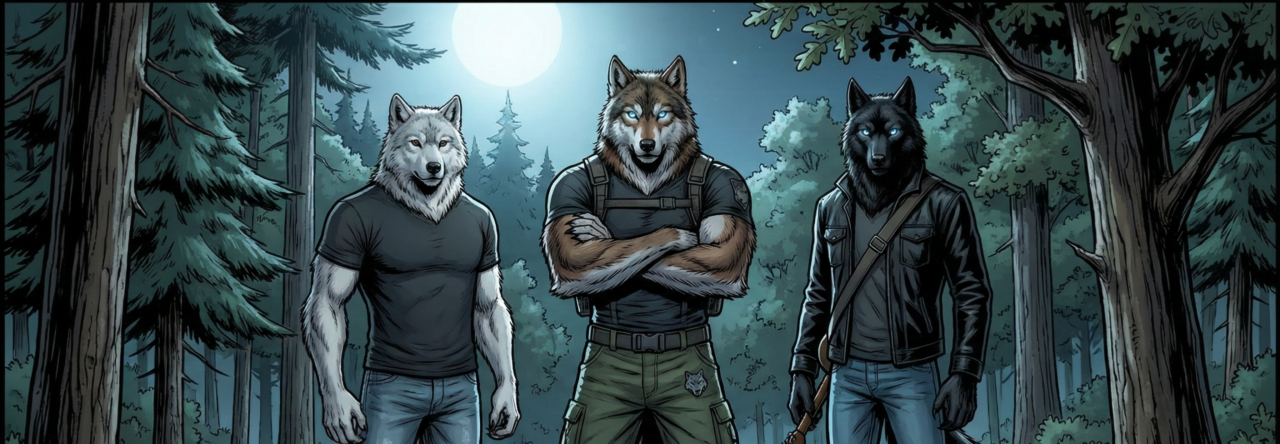
Three Werewolves: After The Fall

The world ended. The pack didn’t.

Episode 46 – Eureka’s Echo

The hum of wires filled the air inside Eureka City Hall, soft and steady like the world itself was exhaling for the first time in years. The place had once been a library before the Fall—sturdy brick walls, old oak beams, windows large enough to let in the morning sun. Dust motes floated in the light as Thane crouched near a gray steel cabinet marked Avaya Merlin 820, running his claw carefully along the faded logo like an archaeologist brushing off history.

“She’s still solid,” he murmured. “Some of these ran for thirty years before they even needed a reboot.”

Mark grinned from across the room where he was unpacking a tangle of handsets and modular cords. “Back when phones had real bones in them.”

Marta leaned against the doorframe, sipping from a mug of coffee as she watched the two wolves move with practiced precision. “You’re certain this can talk to Libby and Spokane?”

Thane nodded without looking up. “As long as the copper remembers its tune, yes. Each line gets its own connection—no party line nonsense. Line one goes to Libby, two to Spokane, three to Kalispell.”

Rime knelt beside him, eyes intent on the colored pairs of wire. “All these… talk to others?”

“Each one carries a voice,” Thane said. “You just have to wake them up the right way.”

Holt handed over a spool of blue-white cable as carefully as if it were sacred thread. “Line one?”

“Libby,” Thane confirmed, threading it into the first terminal block. “Then Spokane. Then Kalispell.”

Gabriel crouched near the solar inverter, connecting the leads. “You sure this system can run off your little panel rig?”

“It doesn’t need much,” Thane said. “That’s why I love it. Back in the day, these were bulletproof.” He paused, checked the final connections, and flipped the breaker.

The old Merlin gave a slow series of clicks and relays. Then—one by one—every desk phone in the building chirped to life. Small red lights glowed above each line key.

“Tone,” Thane whispered, lifting the receiver. He smiled wide enough that his fangs caught the light. “She lives.”

Marta exhaled, the relief audible in her voice. “That’s the sound of civilization.”

Outside, townsfolk were already gathering. The word had spread like lightning: Eureka was about to join the new phone network linking Libby and Spokane. The square filled with people bundled in coats, children perched on window sills, and laughter echoing down the street.

Mark checked the voltage readout on the inverter. “We’re good,” he said. “Solid power. No brownouts.”

Thane nodded, motioning for Franklin—the local mayor—to step forward. The old man’s face was lined but bright, the eyes of someone who’d kept hope alive by sheer stubbornness.

“Each town has its own line,” Thane explained. He pointed to the phone on the desk. “Line one is Libby, two is Spokane, three is Kalispell. Pick one and press it—like pushing a doorbell across the world.”

Franklin’s hand hovered above the button. “You’re sure?”

Thane chuckled. “Trust me. I used to do this before the world fell apart.”

Marta smiled softly. “He means it.”

Franklin pressed Line 1 and lifted the handset. The rhythmic ring filled the air—clear, alive, echoing through the open windows into the crowd outside. Everyone fell silent as if the sound itself was sacred.

Inside Libby’s City Hall, the clerk on duty nearly dropped her pencil before patching the line through to Spokane. The mechanical relays inside both switches clicked and clattered like applause.

“Libby here,” came the distant voice. “Spokane standing by.”

Thane handed the phone to Franklin and nodded. “Go ahead. Say hello.”

Franklin leaned toward the open window, his voice shaking with emotion. “This is Eureka calling Libby and Spokane. Do you hear us?”

The reply came crisp and clear, almost too loud. “Loud and clear, Eureka! This is Spokane. Welcome to the network!”

The square erupted—laughter, clapping, even tears. People hugged in the street, and a dozen children shouted, “We can talk again!” while bells rang from the church tower down the block.

Marta’s eyes glistened as she took the phone. “This is Mayor Marta Korrin of Libby. Congratulations, Eureka—you’re officially connected.”

“Thank you,” Franklin said, voice breaking. “You’ve given us back more than words.”

“Then keep them alive,” Marta said softly.

The windows carried the voices outward, spilling the sound of reunion into the waiting crowd. The cheers that followed rolled through the town like thunder.

The network had spoken—and the world answered.


By afternoon, City Hall’s front steps had turned into a stage. The workbenches and tools were cleared away, replaced with long tables piled high with food. Someone unearthed a crate of Christmas lights and strung them across the windows, powering them from Thane’s inverter. Children darted between the wolves’ legs, giggling.

Gabriel sat on the steps with his guitar, tuning lazily while Holt watched, fascinated. “You make it sing,” Holt said.

Rime sniffed suspiciously at the glowing string of lights. “Smell like lightning.”

“That’s electricity,” Gabriel said.

“Still lightning.”

“If lightning made the world this pretty, I’d let it hit me twice.”

Marta, seated near the door, laughed into her mug. “Let’s hope it doesn’t come to that.”

The phones inside City Hall still hummed gently. Every few minutes, someone would press a button and grin as the familiar tone came through. It wasn’t just a system—it was life made audible again.

As dusk settled, the crowd gathered outside for what had become an impromptu celebration. Gabriel stood on the steps and began to play, voice carrying across the square.

We found the lines that never died,
Woke the hum that slept inside.
From hand to claw, from town to flame,
The world remembered its name.

The crowd clapped along; some cried. Even the wolves joined in, howling in perfect harmony with the final chord.

Thane watched from the doorway, arms folded, face lit by the glow from the open windows. Marta came to stand beside him, her expression soft. “They adore you,” she said.

He shook his head. “They adore the hope. I just gave it a dial tone.”

“That’s the same thing,” she said quietly.

He looked back at the glowing lamps and smiling faces. “Maybe so. But this—this is theirs now.”


Night deepened, cold and clear. The square burned with small fires, laughter echoing long into the dark. The wolves set up camp beside the trucks on the edge of the square. Marta’s smaller tent stood a few yards away, a lantern glowing softly inside.

Inside the larger canvas tent, chaos reigned. Holt had claimed the middle spot, leaving Rime to curl up near the flap. Gabriel was still trying to unroll his blanket when Holt shifted, flattening it.

“Hey! I need that,” Gabriel said.

“Warm floor,” Holt replied calmly.

“It’s my blanket, not a rug.”

“Rug now.”

Rime sighed. “Every trip.”

Thane ducked inside, shaking his head. “Everyone still alive?”

“For now,” Gabriel said.

“Good enough.” Thane laid back. The canvas sagged slightly from the combined weight and heat.

After a few moments of peace, an unmistakable sound filled the tent.

Every head turned.

Holt blinked. “Not me.”

“Was you,” Rime said flatly.

“Wind.”

“Inside tent?”

Gabriel snorted so hard he nearly choked laughing. Thane groaned, rubbing his face. “Every damn trip.”

From her tent, Marta’s voice rang out. “If you blow that tent apart, you’re all fixing it before breakfast!”

“Understood,” Thane called.

“Mayor scarier than Alpha,” Holt whispered.

“Truth,” Rime said solemnly.

“Go to sleep,” Thane said.

They did—eventually.


Morning came bright and gold. The air smelled of woodsmoke and fresh bread.

Franklin met them on the steps as the convoy packed up. His eyes were bright with pride. “We called Libby and Spokane at dawn. Both lines are perfect. Even tried Kalispell. Got a clean ring.”

Thane’s ears perked slightly. “That’s good news.”

“You’ve done more than connect towns,” Franklin said. “You’ve rebuilt faith.”

Marta smiled. “Then keep it alive. Keep calling. Keep listening.”

The handshake they shared was long and firm, both of them knowing it meant more than words could say.

As the trucks rumbled to life, the townsfolk gathered again, waving from porches and rooftops. Children shouted goodbyes, chasing after the departing convoy until their voices faded behind the rise.

Gabriel leaned out the passenger window, waving his guitar pick like a flag. “Next stop—Whitefish!”

Mark chuckled from the driver’s seat. “Think they’re ready for this kind of noise?”

Thane smiled, eyes on the shining road ahead. “They’d better be. The world finally remembered how to speak.”

The convoy climbed the ridge, engines humming steady as the valley opened below them. The copper lines caught the morning sun and glimmered gold all the way back to Eureka, carrying the faintest pulse of electricity and laughter between towns.

Somewhere inside City Hall, a phone began to ring—a sound that once meant nothing and now meant everything. Franklin lifted it, smiling as a familiar voice came through.

“Libby here.”

“Eureka, loud and clear,” he said.

And through the open window, the whole town heard it again—the sound of life echoing back through the wires, bright and unbroken.

Eureka’s echo rolled out over the valley, a song of copper and courage, proof that the silence had finally ended. The world didn’t whisper anymore.

It answered.
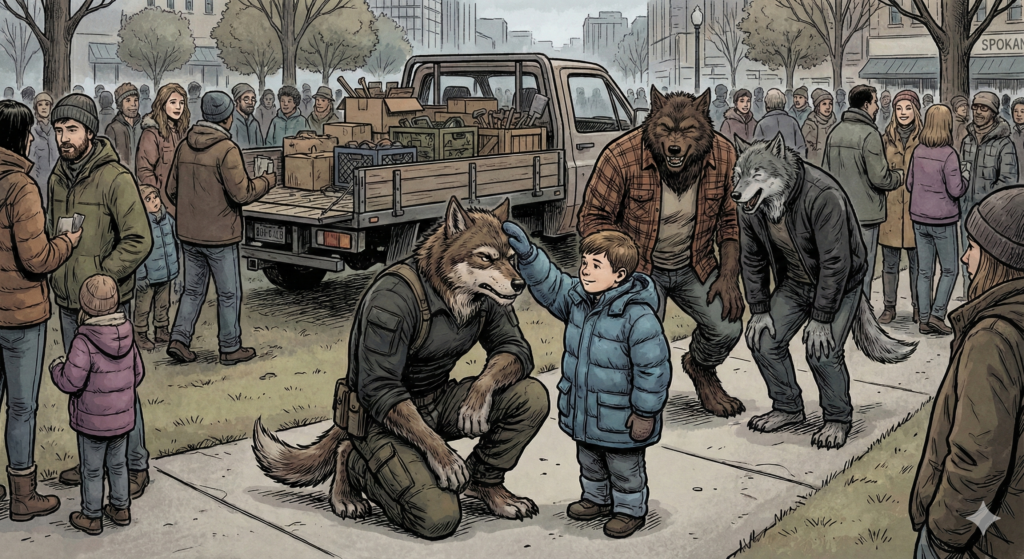
Episode 45 – The Message on the Wire

The morning fog clung to the pines like a blanket, heavy and still. The convoy crept north out of Eureka with exhaust puffing small ghosts into the air. The road was clear but soft from meltwater, the sky bruised with early spring color.

Inside the lead truck, Thane drove while Gabriel fiddled with a coiled handset he’d scavenged from one of Eureka’s storage rooms.

“You know,” Gabriel said, holding it up, “these things have personality. Like little voices trapped in plastic.”

“They do,” Thane agreed. “They just needed someone to listen again.”

Gabriel grinned. “And here I thought I was the sentimental one.”

“Give it time,” Thane said. “You’ll see poetry in copper, too.”

From the back seat, Marta chuckled. “He’s not wrong. You two have been talking about wires like they’re living things for three days.”

“They are living,” Thane said without missing a beat. “They hum.”

“Yeah,” Gabriel added. “If you put your ear close enough, you can hear them purr.”

Marta rolled her eyes. “I’m traveling with poets disguised as electricians.”

“Wolves who fix the world,” Gabriel said with a wink. “We’re trendsetters.”


They reached Kalispell by midday. The town was smaller than Marta remembered — quieter, too. But there was life: smoke from chimneys, laughter near the square, and the rhythmic chop of someone splitting wood. A few wary faces turned as the convoy rolled in, curiosity outweighing fear when they saw the Libby banner on the truck.

An older woman stepped forward, bundled in a long wool coat. “Travelers?”

“Friends,” Marta called out. “From Libby.”

That name carried weight now. The tension eased immediately. People stepped closer, smiling hesitantly. A few whispered, “The wolves,” with a mix of awe and disbelief.

The woman introduced herself as Nadine Carver, Kalispell’s de facto mayor. Her handshake was firm, her eyes bright. “I’ve heard stories about you,” she said to Thane. “Didn’t believe most of them.”

Thane grinned. “Most of them are true.”

She laughed. “Then maybe we can add one more. What brings you here?”

“Connection,” Marta said simply. “We’ve re-established landline communication between Libby and Spokane. We’re offering the same to your town.”

For a moment, Nadine just stared — then smiled, slow and genuine. “Phones again,” she whispered. “My mother used to run the switchboard in this town. She’d cry if she could hear one ring.”

“Then let’s make that happen,” Thane said.


The Kalispell town hall had been converted from a church — tall windows, a bell tower half-collapsed, sunlight streaking through dust. Thane walked through the echoing space with reverence, setting down his toolbox near an old steel cabinet that still bore a yellowing sticker: Property of Mountain West Bell.

He opened it, half-expecting dust and rust — and instead found a tidy bundle of preserved wiring, coiled and taped with care. Whoever had run the system here had known what they were doing.

He turned to Mark, who was already setting up the battery inverter. “Hook the negative to the junction plate,” Thane said. “We’ll test continuity first.”

Holt crouched nearby, fascinated by the neat rows of terminals. “All tiny bones,” he said. “Each one talk?”

“Each one could,” Thane said. “You just have to wake them right.”

Gabriel plucked an imaginary chord. “Like strings on a guitar.”

Thane smiled. “Exactly.”


Within an hour, they had the first tone ringing through a single phone. The sound echoed through the old hall, startling a flock of doves from the rafters. The crowd that had gathered outside broke into spontaneous applause.

Marta lifted the handset, grinning. “Libby, this is Kalispell,” she said softly, just for herself. “And we’re alive.”

Nadine’s eyes glimmered. “What do we owe you for this?”

“Nothing,” Marta said. “But if you ever have word from another town… tell us. We’ll come running.”

Nadine nodded. “You’ll have it.”


As the sun dipped low, the crew lingered to test the remaining lines. Thane moved from cabinet to cabinet, tracing cables, listening to faint tones and measuring voltage. Each successful test felt like finding a heartbeat.

Then his tester beeped — a faint, irregular chirp on an unused pair of wires near the back panel.

Thane frowned and leaned in, twisting the probe. The sound steadied — a whisper of current, soft but undeniable. The line should have been dead, but the signal was there. Weak. Old. Still alive.

“Mark,” he called quietly. “Come here.”

Mark crouched beside him. “You’ve got a live one?”

“Yeah. Barely. But it’s carrying something.”

They checked the label beside the terminal block — faded print, still legible beneath a smear of grime:
TROY – TRUNK 2.

Mark blinked. “Troy? That’s south of here.”

“About sixty miles,” Thane said softly. “Never thought there’d be anything left there.”

Marta approached. “What is it?”

Thane handed her the tone probe. “That’s power. Weak, but consistent. Somebody’s still got juice down there.”

Gabriel leaned over his shoulder, eyes wide. “You mean there’s another town still wired up?”

Thane nodded slowly. “Or someone trying to be.”

The group went silent, the faint hum filling the gap. It was more than just sound — it was proof. Proof that beyond the hills, beyond what they could see, someone else had survived and was still fighting to connect.

Thane smiled faintly. “The line’s old, but copper doesn’t forget. If that signal’s there, there’s still hope.”

Marta’s voice was soft. “Then we’ll find them.”


That night, the convoy camped outside Kalispell’s northern edge. The stars burned cold above, and the air smelled like pine and woodsmoke. The wolves’ tent was already in comedic disarray — again.

Gabriel zipped the flap open to chaos. “Why does it look like a wrestling match in here?”

“Because it was,” Holt said, deadpan, sitting triumphantly on Rime’s tail.

“Not fair,” Rime muttered. “He heavy.”

“I champion,” Holt replied proudly.

Mark groaned. “Every time we travel, it’s like camping with toddlers.”

Thane chuckled from outside, stirring a pot over the fire. “Toddlers with claws.”

Marta’s voice came from her neatly arranged tent nearby. “If anyone breaks anything — tent, paw, or bone — you’re explaining it to me at breakfast.”

“Understood,” Thane called.

Rime muttered from inside. “Mayor scarier than Alpha.”

“True,” Holt said solemnly. “She no need teeth.”

Gabriel nearly choked laughing.


Later, as the others settled and the campfire burned low, Thane sat with Marta and Mark by the embers. The copper line coil sat in his lap, his claws brushing the insulation absentmindedly.

Marta sipped her coffee. “Still thinking about that signal?”

Thane nodded. “I can’t stop. That line shouldn’t be live. Not unless someone down there’s still got a working switch or a generator.”

Mark looked thoughtful. “Could be an old hydro site. Troy’s near the river.”

Thane’s ears tipped forward. “If they have power, they might have people.”

“Or a system like yours,” Gabriel added softly. “Someone else who remembered how.”

“Maybe,” Thane said, eyes distant. “I’d like to find out.”

Marta smiled. “Then we will. But one thing at a time. Tomorrow we head for Whitefish. The world doesn’t rebuild in a day.”

Thane nodded. “No,” he said quietly. “But it starts with a hum.”


Sometime after midnight, a soft rustle came from the wolves’ tent, followed by a groggy voice.

“Holt, your paw on my face.”

“Is pillow now.”

“Not pillow. Move.”

“Pillow soft.”

“Pillow bite.

A pause. Then muffled laughter.
The tent shook as one of them thumped another with a blanket.

Gabriel sighed into his arm from the campfire, whispering to no one in particular. “How the hell did the world end and this still happens?”

Thane smiled faintly, his gaze drifting up to the stars. “Because this,” he murmured, “is the world trying again.”


The next morning dawned bright and clear. The convoy loaded up once more, sunlight glinting off the coils of copper wire piled in the truck bed. Before they left, Thane made one last stop at the Kalispell junction.

He clipped his tester to the Troy pair again — the faint tone still sang through. Weak. Persistent. Alive.

He whispered to it under his breath. “We hear you.”

Then he packed up his tools and climbed into the truck.

Marta leaned from the passenger seat. “Anything?”

Thane smiled. “Someone out there’s still talking. We just have to listen.”

As they rolled out, the rising sun caught the wires stretched between poles, making them flash gold for a moment — like threads of light connecting one heart to another across the valley.

And the hum of the line carried on, whispering the same word between towns and wolves alike.

Hope.

Episode 44 – The Wires of the World

The phone on Marta’s desk had rung three times that morning.
That was still a novelty in itself.

Every ring felt like proof that the world was coming back to life — an invisible bridge humming between Libby and Spokane. The mayor’s voice on the other end always came through warm, proud, and still a little stunned.

“I swear, Thane, every time I pick this thing up it feels like talking to a ghost that learned manners,” he said that morning, chuckling through the line.

Thane grinned, leaning over Marta’s desk as she poured coffee for both of them. “You’re not wrong. Half the time, I still catch myself staring at it like it’s going to bite.”

“If it does,” the mayor laughed, “make sure you patent it.”

Marta smiled faintly, jotting notes about their latest trade schedule. “Alright, gentlemen. Spokane will send diesel and spare medical supplies by next week. Libby will ship flour and solar cells the week after.”

“Agreed,” the mayor said. “And please tell your people we’ve decided to paint a red line around the phone. Nobody’s allowed to touch it but me and the engineers. It’s like a holy relic.”

Thane chuckled. “After what it took to make it work, that’s fair.”

“Until next time,” the mayor said, his voice softening with genuine warmth. “Libby, thank you again. You gave us our voice back.”

The line clicked off with that satisfying analog thunk that no one had heard in twenty years. Marta leaned back, eyes gleaming. “It really is a miracle, isn’t it?”

Thane shrugged, though pride glimmered beneath the surface. “Just copper, current, and patience.”

“Don’t downplay it,” she said. “You’ve brought towns together faster than any government ever did.”

Thane smiled faintly. “Then let’s keep going.”


That afternoon’s town-hall meeting drew more people than any in recent memory. Word of the functioning hotline had spread fast, and Libby’s citizens — humans and wolves alike — filled the benches shoulder to shoulder.

Marta stood at the front, gesturing toward the map pinned behind her. “We’ve re-established communication with Spokane,” she said, her voice steady but excited. “And we’ve proven the system works. So… what’s next?”

A murmur of anticipation rippled through the crowd.

Marta pointed toward the east side of the map. “Eureka. They were hit hard during the raids last year. We know survivors held the town, but they’ve been isolated. If we can link them up, we’ll have a three-city network.”

Gabriel raised a hand. “You’re talking about the same Eureka that sent us those letters by courier last winter?”

“Exactly,” Marta said. “They were trying to re-open trade routes, but without comms, it’s all guesswork. If we can connect them, they’ll finally have a lifeline.”

Thane nodded thoughtfully. “They’re on the same trunk line that runs through Libby. I could patch them easily once we’re there.”

Marta turned to him. “Then we’ll go — if you’re willing.”

Thane smirked. “When have I ever said no to a good field trip?”

The room laughed, and even Sable — who was visiting for council talks — gave a faint approving nod from the back. Marta outlined the plan: a multi-day road trip to visit friendly towns, reconnect them, and offer lines to the network. Thane would handle the technical work; Mark, Gabriel, and several ferals would assist; Marta would manage the diplomacy.

“Travel will be slow,” she said. “But if we succeed, every friendly town will be able to call for help — or for hope.”

The cheer that followed nearly shook the rafters.


The next morning dawned bright and cold.
The square buzzed with organized chaos — supplies being loaded, tools packed, and one stubborn coffee machine being debated over.

“Marta’s not leaving without her espresso setup,” Gabriel muttered, strapping it down beside the crates of wire spools.

Marta rolled her eyes. “It’s instant coffee, Gabriel. I’m not a diva.”

Thane smirked. “We know. That’s why you get your own tent.”

She blinked. “My own tent?”

Thane’s tone was matter-of-fact. “You’re our mayor. You get comfort. We’ll rough it.”

“Thane, that’s not necessary—”

“Respect thing,” Holt interrupted with a grin. “Mayor get bed. Wolves get dirt.”

Rime nodded solemnly. “Fair.”

Marta sighed in mock defeat. “Fine. But only if you all promise not to argue about who sleeps where.”

Thane snorted. “No promises.”


By noon, the convoy rolled out — two trucks and a supply trailer.
Their route would take them southwest first, toward Eureka, then on to Kalispell and Whitefish, two small towns that had weathered the worst of the Black Winter but still traded sporadically.

The road was half-frozen and bumpy, but laughter filled the cab. Gabriel rode shotgun with Thane, sketching notes for a future song titled “The Wolves Who Wired the World.”

“Catchy,” Thane said.

“Needs a verse about you swearing at a cable splice,” Gabriel replied.

“Already too realistic.”

Behind them, the second truck carried Mark, Marta, and four ferals — Holt, Rime, and two of Sable’s younger wolves, Tern and Lio. It didn’t take long before the younger ones started arguing about tent space, leading to the inevitable.

“I get corner spot!” Tern barked.

“Corner drafty,” Lio countered. “You take it.”

“Corner mine.”

“Not now it isn’t.”

Mark sighed from the driver’s seat. “I swear, you lot are worse than my kids were.”

Holt grinned. “We big kids.”

Marta just rubbed her temples. “I’m starting to understand why Thane gets that look sometimes.”


They reached Eureka by dusk.
The town sat quiet and wary — a handful of old brick buildings surrounded by pine. The smell of smoke and cooking fire hung on the air. When the trucks rolled in, heads turned; people stepped from doorways with curiosity and caution.

Thane climbed down first, his massive frame outlined by the last light of the sun. Marta followed, calm and steady, her presence grounding the moment. “We’re here in peace,” she called. “From Libby.”

An older man approached — lean, grizzled, wearing a patchwork coat and the cautious posture of someone who’d spent years keeping people alive. “Name’s Franklin,” he said. “I run what’s left of the council here.”

Marta extended a hand. “Marta Korrin, Mayor of Libby. This is Thane.”

Franklin’s eyes flicked up to Thane’s towering, fur-covered figure. “The… wolf I’ve heard about.”

Thane offered a polite nod. “Depends on the story.”

Franklin chuckled nervously. “Most of them end well. You’re the one who got phones talking again?”

“That’s me.”

“Well,” Franklin said, rubbing the back of his neck. “We could sure use one.”


Eureka’s town hall had once been a post office — brick walls, high windows, and a faded mural of mountains and mailmen. Thane unpacked his tools while the townsfolk gathered around in fascination.

“Just a few simple hookups,” he said, setting down a small inverter and battery bank. “This will power your phones even through the night.”

A young woman leaned close. “Phones? Like… dial phones?”

Thane grinned. “Exactly. Hear that hum?”
He twisted two copper pairs together, and a faint tone filled the handset. “That’s the sound of connection.”

Gasps rippled through the crowd. Marta smiled softly, watching the wonder spread.

Within an hour, Thane had the first line patched from the Eureka central cabinet to the trunk line that ran north toward Libby. “You’ll have a direct connection to City Hall,” he said, tightening a terminal screw. “Pick this one up, and Marta can hear you clear as day.”

Franklin looked almost overwhelmed. “You mean… just pick it up, and Libby answers?”

“Exactly.”

Thane hesitated, then added quietly, “And I wired a second line — dormant for now. If Spokane ever wants to connect you directly, they can. Just one patch in their office.”

Franklin stared at him for a long moment, then clapped his shoulder. “You wolves… you’re giving us the world back.”

Thane smiled. “Just the quiet parts first.”


That night, they camped outside town by the river.
Marta’s tent looked almost luxurious — a small cot, an electric lantern, and even a travel kettle powered by one of the battery packs.

The wolves’ tent beside it looked… less so.
It sagged slightly in the middle, smelled vaguely of pine and wet fur, and already contained more elbows, tails, and arguments than any structure should.

Holt shoved Rime’s leg. “You move paw.”

“Paw already move.”

“Move more.”

“Then no tent left.”

“Then I win.”

Mark poked his head through the flap. “You two done?”

“Almost,” Rime said flatly, as Holt pretended to snore loudly.

Gabriel laughed from his sleeping bag. “This is better than radio.”

Marta’s muffled voice came from her tent. “If you all tear that down in the middle of the night, you’re rebuilding it before breakfast!

“Understood,” Thane called.

An hour later, as the fire burned low, one long, unmistakable sound echoed from the wolves’ tent.

Holt muttered, “Not me.”

“Was you,” Rime said immediately.

“Was wind.”

“Inside tent?”

“Wind sneaky.”

Gabriel groaned, laughing into his blanket. “There it is. First wolf fart of the mission.”

Thane just rolled over with a sigh. “I swear, if this tent smells any worse, I’m making all of you sleep in the dirt.”


Morning brought laughter instead of argument.
The townsfolk of Eureka stopped by to deliver fresh bread and coffee in thanks. Franklin shook Marta’s hand firmly. “The line works. We called Libby at dawn. I don’t think we’ll ever stop hearing that tone.”

Marta smiled. “Don’t. It’s the sound of life.”

Thane packed up the tools and stretched. “One town down,” he said. “Two more to go.”

Gabriel strummed a lazy chord on his guitar, already composing lyrics under his breath. “Wires hum like rivers, and wolves sing the spark… Yeah. That’s a keeper.”

Mark grinned. “Just don’t make it rhyme with ‘fart.’”

“Too late,” Gabriel said, still smiling.

As they loaded the trucks, the townspeople waved — some cautiously, most warmly — and children shouted goodbye from rooftops.

Marta turned to Thane as the engines started. “You realize this might become history, don’t you?”

Thane smiled, glancing back at the rising town. “Then let’s make sure it’s a good story.”

And with that, the convoy rolled on — toward Kalispell, Whitefish, and the growing hum of a world learning how to speak again.

Episode 43 – The First Call

Morning sunlight spilled across the rooftops of Libby, the air sharp with frost but full of purpose. The whole town was humming again — hammering, laughter, and the low purr of generators. For once, it wasn’t just survival. It was progress.

Inside City Hall, Marta was already poring over maps when Thane stepped through the door with a small toolbox under his arm and a spark in his eye.

“Morning,” she said, looking up. “You’re up early. Don’t tell me you’re already working on the phone project.”

“Wouldn’t dream of it,” Thane said, though the grin on his muzzle gave him away. “Just wanted to check something in your utility closet.”

“That’s what you said before you rewired half the grid.”

“Yeah,” Thane replied. “Worked, didn’t it?”

Marta sighed but smiled, motioning toward the hallway. “Go. But if something explodes, I’m blaming you.”

“Fair,” Thane said, and disappeared down the hall.


The utility closet still smelled like dust and old carpet glue. Rows of metal cabinets lined the wall, each filled with neatly labeled cables and blinking indicator lights. One rack in particular caught Thane’s attention — a gray metal chassis with AT&T embossed on the side and a small brass label that read: DEFINITY 25.

He crouched, running a claw along the edge of the cabinet. “Well I’ll be damned,” he murmured. “You’re still here.”

It was like finding an old friend.

The Definity 25 was a hardy little system — a private branch exchange used by office complexes and city halls all over the country. It was built for uptime, not convenience. It didn’t need much power, and it could survive just about anything short of a meteor strike.

He cracked the cover open and whistled softly. The cards were all in place, the wiring blocks still intact. “You old beast,” he said fondly. “You just needed a nap.”

With careful precision, he ran a pair of leads from one of Libby’s solar-fed power banks through the wall conduit and into the backplane. The system clicked softly — once, twice — then a low hum filled the air as LEDs blinked in perfect, steady rhythm.

In the offices beyond, every desk phone suddenly sprang to life — 35 of them, across City Hall, the police department, and the fire station. Lights blinked, handsets came alive with dial tones that hadn’t been heard since the fall.

Marta’s voice echoed from her office. “What did you do?!”

Thane grinned. “Just woke up your phone system.”

He could hear her laugh, half disbelieving, half amazed. “Every light in this place just came on!”

Thane closed the panel, his tail flicking. “Told you — still here, waiting for someone to care.”


From City Hall, he made his way down Main Street to the old central office — the brick building with a faded Northwest Telecommunications plaque over the door. Inside, the air was cool and dry, carrying the faint metallic scent of copper.

He walked through the aisles of ancient switching racks until he found the distribution frame — the towering grid of wires where every line in town once converged. Each row was labeled in faded ink: “Hospital,” “Sheriff,” “City Hall,” “Library.”

He found the block marked C.Hall – P.D. – F.D. and traced the twelve-pair cable leading out of it. “Twelve lines,” he said aloud. “Twelve possible links.”

Thane crouched beside the row, his claws delicately parting the bundles of color-coded wire until he found what he needed: the white-blue pair — line one. He smiled to himself, a low, satisfied rumble. “Line one’s about to get a long-distance upgrade.”

He pulled out his punch tool and tapped the wire neatly into place on the outgoing trunk labeled TRUNK–SPOKANE. The old insulation crackled faintly as it seated, like it approved of being useful again.

Standing, he brushed the dust off his hands and grinned. “Line One… Spokane.”


By midmorning, the plan was in motion. Mark and Rime waited by the truck as Thane loaded up a small bag of tools — splicers, wire strippers, a tone generator, and a multimeter so old it still had a Bell logo.

Mark leaned against the fender, arms folded. “So, we’re really gonna make a landline call in 2040?”

Thane chuckled. “Let’s just say I’m done relying on luck and short-range radios.”

Rime tilted his head. “Phones carry words in wire?”

Thane nodded. “They always did. It’s like a song made of electricity.”

Rime considered this. “Then you… wire singer.”

Thane laughed. “Sure. Let’s go with that.”


The drive to Spokane felt lighter this time. The roads were clear, the sky a soft pale blue that promised spring. Word of Libby’s growing legend had spread fast; people waved from porches and crossroads as the truck passed.

When they pulled into Spokane, the response was immediate. The crowd that gathered near the gate wasn’t fearful this time — they were cheering. Someone actually had a banner that read WELCOME BACK WOLVES! in hand-painted letters.

Mayor Mason met them in the square, flanked by his son Eli and the city engineer, a wiry man named Dennis with thick glasses and a grin to match his curiosity. “Thane!” the mayor called. “I was hoping you’d come back soon. Word got around fast about your plans.”

“Couldn’t wait,” Thane said, shaking his hand. “You still have your phone system in City Hall?”

Mason laughed. “We’ve been using the phones as paperweights since the Fall. Dennis knows where everything is.”

Dennis adjusted his glasses. “Nortel Meridian. Twenty-four lines. Old-school solid.”

Thane’s grin widened. “Perfect. Let’s make some history.”


Inside Spokane City Hall, the lights were dim, but the air felt alive with potential. The Meridian system sat tucked in a corner of the records room, cables draped neatly to the ceiling conduit. Thane crouched down and popped the cover open, inspecting the cards.

“Not bad,” he said approvingly. “These things were built to run forever. They’d outlive us if we let them.”

Rime hovered nearby, tail twitching. “All this metal… talk?”

Thane chuckled. “Yeah. All of this used to connect voices across miles.”

“Like radio,” Rime said.

“Sort of,” Thane said. “But quieter. More private.”

Mark squatted beside him, handing over a bundle of power cables. “I’ve got juice coming in from the solar inverter outside.”

Thane nodded. “Good. Let’s wake her up.”

He clipped the leads, flipped a switch, and the system gave a low hum — steady, smooth. LEDs came alive one by one, green and solid.

Dennis’ eyes widened. “She’s live! I never thought I’d see this again.”

“Let’s see what she remembers,” Thane said, pressing the line test button.

Every phone in the building beeped in chorus. Light after light blinked alive. Dennis laughed in disbelief. “She’s routing internally!”

“Good girl,” Thane murmured, patting the side panel. “Now let’s give her something to talk to.”


They crossed the street to Spokane’s own central office — an older but sturdier building. Inside, it looked like Libby’s twin, right down to the rows of aging switch racks and the faint smell of ozone.

Thane found the trunk labeled LIBBY – TRUNK 4 and tested it with the tone generator. A faint, steady hum answered back. His grin widened. “Beautiful. Signal’s clean.”

He pulled the white-blue pair from the conduit and patched it neatly into Line 1 on the City Hall trunk.

Dennis leaned close, eyes wide. “That’s it?”

“That’s it,” Thane said. “Simple is good.”

Mark smirked. “So theoretically, someone could pick up a phone right now and—”

Thane held up a claw. “Not yet. Let’s make it official.”


They returned to the mayor’s office, where Mayor Mason and Eli were waiting by a polished desk with a single beige office phone sitting like a relic from another time.

Thane gestured toward it. “Alright, Mayor. Pick up the receiver and hit Line One.”

Mason hesitated, smiling nervously. “Feels strange, doesn’t it? Like waking up a ghost.”

Thane grinned. “A friendly one.”

The mayor pressed the Line 1 button.

The phone clicked, then emitted a soft, pure tone — followed by ringing.

Not static, not noise — ringing.

Everyone froze.

Over a hundred miles away in Libby City Hall, Marta was working through ledgers when a sound stopped her cold. A phone was ringing. On her desk. Line One.

Her eyes went wide. She lifted the handset slowly. “Hello?”

From hundreds of miles away came the ecstatic shout:

“THIS IS SPOKANE!”

Laughter exploded in both towns at once. Cheers went up outside the mayor’s office; in Libby, people poured into the hallways as the news spread. “It’s them! We’re talking to Spokane!”

Marta pressed a hand to her chest, still laughing. “You magnificent wolf, you did it!”

Thane took the handset from the mayor, smiling as his deep voice carried across the line. “We told you the lines still worked.”

Marta’s laughter softened into something that almost sounded like tears. “You just changed everything, Thane. You just gave the world its voice back.”


The celebration in Spokane was instant. People cheered in the streets; others ran to old offices, dusting off long-dead phones just to see if they’d ring too. The sound of laughter and hope mingled in a strange, beautiful harmony that hadn’t existed since before the Fall.

Outside, Thane and his pack prepared to head home. The crowd followed them to the gate, clapping, shouting, waving.

As Thane tightened the straps on the truck bed, he noticed a cluster of children approaching. They were hesitant at first — until one small girl darted forward and hugged Rime’s leg.

Rime froze, eyes wide, his muscles tensing.

Another child hugged him. Then another.

Rime’s lips twitched upward instinctively, teeth glinting in surprise — halfway to a snarl before Thane stepped forward and laid a paw on his shoulder.

“They love you,” Thane said softly. “You are a hero to them. No harm, Rime. Just hearts.”

Rime’s breathing slowed. He looked down at the cluster of small arms wrapped around him, then let out a slow, rumbling sigh. One clawed hand rose awkwardly — and gently patted a child’s shoulder.

The crowd melted with warmth.

As they climbed into the truck, a cheer rose behind them — hundreds of voices shouting, “THANK YOU, LIBBY!” and “THANK YOU, WOLVES!”

About an hour away from Spokane, Gabriel’s voice crackled over the radio from home. “I can hear the cheering from the cabin,” he said, laughing. “You really did it.”

Thane smiled, watching the city recede in the mirror. “Yeah,” he said quietly. “We did.”

Mark glanced over. “How’s it feel?”

Thane looked out across the snow-covered highway stretching between the mountains — the invisible line that now carried voices, laughter, and hope.

“It feels,” he said, “like the world just got smaller… and a lot more alive.”


As they disappeared into the woods on the drive back to Libby, Rime looked toward the horizon where the radio towers gleamed faintly in the setting sun.

He spoke softly, almost to himself. “World talk again.”

Thane smiled. “Yeah, Rime. The world talks again.”

And this time, everyone could hear it.

Episode 42 – The Lines Between

The town hall felt different these days. The air didn’t hum with tension anymore — it hummed with life. The seats were full, the stove was warm, and laughter had started to replace the sound of caution. For the first time since anyone could remember, they were planning something for the future, not just for survival.

Marta stood at the front, gesturing to a map spread across the wall. “—so the west stockpiles are full, the grain stores are ahead of schedule, and the hydro wheel is back to ninety percent efficiency thanks to Sable’s team.”

Polite applause broke out. A few ferals lounging near the door flicked their ears at the sound, unsure if they were supposed to join in.

Marta smiled. “Now, there’s one other thing we need to talk about. Communication between towns.”

That word — communication — quieted the room a bit. It was a constant sore spot. Too many times they’d gone blind waiting for word from trade partners or scouts.

Marta looked toward Thane. “Right now, we’re still limited to handhelds and the shortwave relays Mark maintains. The repeaters barely reach halfway to Kalispell. There’s no way they’ll touch Spokane.”

A few murmurs circled the table. Hank scratched his chin. “Two-way’s good for a day’s drive, tops. After that, we’re yelling into mountains.”

Gabriel raised a hand. “Could try carrier pigeons. You know, with Holt handling the training. What could go wrong?”

Holt, sitting two seats down, looked deeply offended. “Birds stupid. Drop letters.”

“See?” Gabriel said. “Already pessimistic.”

The room chuckled. Even Marta smiled. “I think we’ll pass on the birds.”

That’s when Thane leaned back, tail giving one lazy sweep across the floor. “You know,” he said, “I might have an idea.”

Marta tilted her head. “Oh?”

Thane folded his arms, voice casual but steady. “Before the fall… I worked for the phone company.”

The room blinked at him. Even Holt looked confused. “Phone… what?”

“The old landline system,” Thane said, half-smiling. “Wires. Switchboards. Central offices. The whole thing.”

Silence.

Marta blinked twice. “You’re serious?”

Thane nodded. “Indiana Bell. I ran a central office for years before everything went sideways.”

Gabriel choked on a laugh. “Hold on. You mean to tell me you—big, scary Alpha of the forest—used to work in a cubicle with a tie?”

Thane shot him a look. “It was a collared shirt, not a tie.”

That broke the room open. Even Rime’s quiet laugh rumbled low and brief.

When it settled, Thane continued, tone a little more serious. “The point is… those lines are still there. The cables in the ground. The junctions, the trunk lines—they’re all buried deep and shielded. The copper doesn’t rot, and the switches are mechanical. They don’t need an internet; they need power. That’s it.”

Hank frowned. “Even after all these years?”

“Absolutely,” Thane said. “They were built to last through nuclear winters and lightning strikes. We could power a small section—say, here to Spokane—with a few solar panels and batteries on each end.”

Mark leaned forward, interest lighting his eyes. “You could really do that?”

Thane nodded once. “If we can find the old phone office here and the one there, yeah. I could wire up enough lines for emergencies and trade coordination. Wouldn’t be fancy, but it’d work.”

The room went quiet again—but this time it was the kind of quiet that meant everyone was thinking the same thing.

Then Holt said softly, “Alpha make phones talk?”

Thane grinned. “That’s the idea.”

Gabriel burst out laughing. “Of course you can! You’ve been fixing everything else since day one—why not resurrect Ma Bell while you’re at it?”

Marta’s laughter came next, shaking her head in disbelief. “You never cease to amaze me, Thane.”

Thane shrugged. “What? I may be wolf, but I did have a regular job back when the world wasn’t dead.”

That brought another ripple of laughter, but underneath it was excitement—the kind they hadn’t felt since the first lights came back on in Libby.

Marta finally said, “Alright. Let’s plan it. We’ll take a trip to Spokane and discuss it with their mayor. If you can pull this off, Thane… it could change everything.”


Three days later, the truck rolled into Spokane again.

This time the gates opened the moment they saw the wolves. Word had traveled fast after the envoy’s visit, and now the guards waved eagerly, smiling as if greeting old friends.

Mayor Mason himself waited in the square, coat flapping in the wind, Eli standing proudly beside him with a carved wooden wolf in hand.

“Thane!” the mayor called, grinning wide. “Back so soon?”

“Couldn’t stay away,” Thane said with a grin. “We’ve got an idea.”

“I was hoping you would,” Mason said. “Eli’s been asking every day when the wolves would visit again.”

Eli stepped forward shyly. “Hi, Mister Thane.”

Thane crouched. “Hi, Eli. You keeping your dad out of trouble?”

Eli giggled. “Trying.”

That earned laughter from everyone, breaking the last of the old fear. Marta stepped forward, shaking hands with the mayor. “We’ve come about communications. Thane thinks he can link our towns through the old landline system.”

The mayor’s brow lifted. “Landlines? You mean telephones?”

Thane nodded. “Exactly. I used to run a central office back before everything fell apart. I know what to look for.”

“Well, you’re in luck,” the mayor said, gesturing for them to follow. “Ours is still standing. We’ve been using it as storage for years.”


The Spokane central office sat on the corner of what had once been 2nd and Pine. The brick façade was weathered but intact, its glass doors scuffed but unbroken. A faded sign above the entry read Northwest Telecommunications Exchange.

Thane’s breath caught for a moment as he stepped inside. The air smelled faintly of dust and insulation — home to a man who hadn’t been inside one of these in decades.

He ran a claw along a rusted rack of circuit cards. “Looks like an old 5ESS system,” he murmured. “Solid gear. You could drop a tank on this thing and it’d still ring through.”

Marta looked around, awed by the rows of silent equipment. “This used to connect every phone in the city?”

“Every one,” Thane said, voice softer now. “All that noise and conversation, moving through here in a heartbeat.”

He found the stairwell and descended, claws clicking lightly on metal. The others followed, flashlights cutting through the dark. The basement opened into a concrete vault — a tangle of cables as thick as tree trunks feeding through the wall in neat, ordered bundles.

“Here it is,” Thane said quietly. “The cable vault.”

Even Holt fell silent. The sight was almost holy in its complexity.

Thane knelt by one of the massive conduits, brushing dust away from an embossed label: LIBBY – TRUNK LINE 4.

Marta gasped. “You’re kidding.”

Thane smiled faintly. “Told you it’s all still here.”

Mayor Mason stared, half laughing in disbelief. “And you think you can bring this back?”

“Not all of it,” Thane said. “Just enough. A few lines. I can build a small solar-fed mini-switch, splice into this trunk, and do the same in Libby. Once it’s powered, it’ll carry voice like it used to. Quiet, secure, invisible.”

Marta was already nodding. “That would give us a private line no raider could jam or intercept.”

The mayor grinned wide. “You’ve just made my week. What do you need?”

Thane looked thoughtful. “Copper wire, a few rotary phones, relays, and batteries. I can build the rest from scrap.”

Mayor Mason slapped him on the back. “You’ll have whatever you need. You’ve already given us peace — now you’re giving us a voice.”

Eli tugged Thane’s hand. “Can I help?”

Thane chuckled. “You just did, kid. You found the line.”


Upstairs, as they left, a crowd had gathered — word spreading again like wildfire that the wolves had returned.

Children ran ahead of their parents, giggling and waving. Several called out, “The wolves are back!” and “It’s the big one!” Holt, who had been quietly inspecting a phone booth outside, looked up in alarm.

“They talk about me?” he asked, tail wagging in confusion.

“Yep,” Gabriel said. “You’re famous, big guy.”

Holt looked genuinely pleased. “Good famous?”

“The best kind,” Thane said, smiling.

When they reached the trucks, a half-dozen children darted up, all trying to touch fur or claws. One small boy—a bundle of energy in a too-big coat—jumped right in front of Holt and looked up with fearless eyes. “Can I ride on your shoulders?”

Holt blinked. “Ride?”

Thane laughed. “Go ahead.”

Holt hesitated, then gently lifted the boy up, settling him on his broad shoulders. The child squealed in delight, clutching Holt’s ears like reins.

“Careful,” Holt warned. “No steer fast.”

The kids following behind shrieked with laughter, and Holt started walking proudly through the crowd while the boy waved like a king on parade.

Marta whispered to Thane, smiling. “You do realize you’ve started a new legend in Spokane, right?”

Thane grinned. “Good. Let them remember the day the wolves brought the phones back to life.”

Gabriel snorted. “That’ll be the first song with a dial tone solo.”


By the time they reached the trucks, the crowd was still waving. The mayor shook Thane’s hand again. “You’ve got our full support. I’ll have a team gather parts from every old exchange we can find. You’ll have what you need.”

“Then we’ll be back soon,” Thane said. “When the line rings… answer it.”

The mayor laughed. “You’ve got a deal.”

As the engines rumbled to life and the convoy turned toward home, Holt lifted the small boy off his shoulders and set him down gently. The child hugged his leg and ran back toward his parents, waving until they were out of sight.

Gabriel leaned out the passenger window, grinning. “You’re really gonna make the phones ring again, huh?”

Thane smiled at the snowy road ahead. “One line at a time.”

Marta looked over from the map she was folding. “You realize what this means? When it works, we’ll have the first long-distance connection since the fall.”

Thane nodded. “A voice between cities. A line between worlds.”

Holt rumbled softly from the back seat. “Good name.”

Thane glanced back. “For what?”

A song, “The line between us.”

Thane smiled. “Yeah,” he said quietly. “The lines between.”

Episode 41 – The Envoys of Spokane

It began with the sound of engines.

Not one or two, like a normal supply run, but a rumble that rolled down the west road in a steady, growing chorus. From the radio tower, Gabriel leaned out the window and squinted toward the treeline.

“Uh… boss?” he said into the handheld. “We’ve either got visitors or someone’s trying to invade politely.”

Thane, sitting near the square with Holt and Rime, lifted his head. “How many?”

“Six vehicles,” Gabriel answered. “Big ones. Looks like a convoy.”

Thane’s ears tipped forward. “That’s… too many for trade.”

“Maybe heard stew was good,” Holt offered.

“Or come for Holt singing,” Rime added dryly.

“Ha!” Holt barked. “They come for wolves, stay for voice.”

Thane smirked. “You sound confident.”

“I sound true.”

Thane’s comm crackled again. “Hank’s on the wall,” Gabriel said. “He’s flagging you.”


By the time Thane reached the west gate, the sound was unmistakable: engines idling, crunching snow, the metallic hiss of exhaust in the cold. Hank stood atop the barricade, binoculars in hand, scarf snapping in the breeze. He looked down at Thane and muttered, “You’re not gonna believe this.”

“Try me.”

Hank pointed. “Spokane.”

Thane’s brow furrowed. “Already?”

“They sure didn’t pack light,” Hank said. “Six trucks, maybe thirty-five people. I count at least three with clipboards, and—uh—one waving.”

Thane squinted. “That’s the mayor.”

“Yep. And his kid’s with him.”

Thane couldn’t help the grin that tugged his muzzle. “Open the gate.”

“You sure?”

“I’m sure,” Thane said. “If they came to fight, they wouldn’t have brought children.”

Hank chuckled. “Fair point.” He signaled the guards. The heavy wooden gates creaked open, hinges groaning. Snow dusted down from the tops as the convoy rolled to a careful stop.


The lead truck door opened, and out stepped Mayor Hal Mason — bundled in a long brown coat, face red from the cold, grin wide as the valley. Beside him, the small figure of his son Eli hopped down, his hat slipping sideways.

Thane didn’t wait for introductions; he waved them forward. “Mayor Mason. Eli.”

The mayor broke into a huge smile. “Thane, I’ll be damned! I told you we’d visit!”

Eli grinned up at him. “You remember me!”

“I’d have to be struck deaf and blind to forget you,” Thane said warmly. “You’re the bravest human I’ve met.”

Eli puffed his chest. “I told everyone about you! Half the city didn’t believe me, so they came too!”

That earned laughter from the crowd of bundled figures behind the mayor — Spokane townsfolk, traders, engineers, and curious citizens all trying to look casual about standing in front of real wolves.

Marta appeared at Thane’s shoulder, coat dusted with snow, clipboard in hand. “Now this is a surprise.”

Mayor Mason stepped forward, shaking her hand with both of his. “We hope it’s a good one. We brought fuel, food, and goodwill… though mostly curiosity, I’ll admit.”

Marta raised an eyebrow. “And thirty-five volunteers?”

He laughed. “Everyone wanted to meet the wolves. I couldn’t exactly stop them.”

Thane chuckled. “Then let’s meet the wolves.”

He tilted his head back and let out a howl — long, clear, carrying over the rooftops and through the frozen forest.

The sound echoed, hung a moment, and answered.

A ripple of movement stirred in the trees — white against gray, motion against stillness. Fifteen ferals, led by Sable herself, emerged from the snow-shadowed pines. Their fur caught the sunlight like silver thread. The Spokane visitors froze as the wolves descended the slope, moving not like beasts but like a formation — steady, composed, eyes bright with recognition.

Sable reached the gate first, her gaze flicking between Thane and the humans. “Call bring us quick,” she said. “All well?”

“All well,” Thane said. “We have guests.”

She looked the convoy over. “Many.”

“Volunteers,” Marta said dryly.

The mayor found his voice. “My word… they’re magnificent.”

Sable tilted her head. “He speak strange.”

Thane smirked. “All humans do.”


Inside the walls, the convoy parked along the main road. People spilled from the trucks, chattering and laughing nervously, trying not to stare. Libby’s residents came out of their homes, cautious at first, then smiling as greetings began to ripple back and forth. Someone shouted, “Spokane!” and applause broke out, awkward but sincere.

Mayor Mason extended his hands in apology. “I swear we didn’t mean to overrun you. It’s just… after word got around, I had more volunteers than sense. Everyone wanted to see for themselves.”

Thane’s grin widened. “You’re welcome here. And if they came to see wolves—” he gestured to the square “—let’s make it worth the trip.”

Within minutes, the town transformed. Tables were dragged into the square, tarps stretched into awnings, and the big kettle from the town hall basement found its way to the fire pit. Holt hauled barrels of water while Rime helped the merchants unload their trade goods, moving with the quiet precision that fascinated the onlookers. Children peeked from behind their parents, giggling when a wolf glanced their way.

Gabriel appeared with a guitar slung over his back, grinning. “Guess it’s a party now.”

Thane raised an eyebrow. “You volunteering for entertainment duty?”

“Already tuning,” Gabriel said. “Holt, you’re up.”

Holt looked scandalized. “Up where?”

“Second guitar.”

“Oh.” He brightened immediately. “Music. Yes. Play good.”

Rime muttered, “Maybe.”


By midday, the square was alive. Smoke curled from cookfires; laughter spilled between buildings. The scent of roasting vegetables mingled with cured meat and coffee strong enough to wake the dead. Sable and her ferals mingled easily among humans, the older ones trading goods, the younger ones letting curious Spokane kids pet their fur with careful, delighted hands.

Marta coordinated trades with the mayor’s aides — diesel for flour, textiles for metal parts, spare radio components for medical stock. She did it all with her calm precision, balancing warmth and shrewdness. “We’re all rebuilding,” she said at one point. “Might as well do it together.”

Mayor Mason smiled. “I couldn’t agree more.”

Holt and Gabriel took the stage — which was, technically, two stacked crates by the well. Gabriel strummed a lazy rhythm, voice low and smooth. “Alright, Spokane,” he said, “this one’s about peace, fur, and questionable decisions.”

Holt grinned and jumped in, voice rough but steady. “We come from trees and mountain stones, / Found new pack, made it home…”

The crowd clapped along, hesitant at first, then louder. Someone produced a harmonica. Someone else started dancing, boots skidding on the icy stones. Even Sable cracked a faint, rare smile.

Rime leaned on a post beside Thane and muttered, “They loud.”

“Good loud,” Thane said.

“Still loud,” Rime replied, but his tail flicked once, betraying amusement.


Near the fire, Eli had gathered a small group of Spokane kids and two feral adolescents. They sat cross-legged in the snow, comparing claw sizes and laughing over whose footprints were bigger.

One little girl gasped as a young gray wolf traced a pawprint next to her mitten. “It’s bigger than my whole hand!”

“Strong paws,” the wolf said shyly.

“Fast paws,” Eli added.

“Clumsy paws,” the gray admitted, earning laughter all around.

Hank wandered past with a mug in hand and shook his head, smiling. “Never thought I’d see the day.”

Marta walked by beside him. “Which part? Wolves teaching, or humans trusting them?”

“Both.”


As the afternoon stretched on, trading gave way to stories. Spokane merchants spoke of rebuilding old markets and radio stations. Libby’s residents told tales of how the wolves helped defend the town during the Black Winter raids. Someone roasted chestnuts. Someone else discovered that Holt had never eaten popcorn and promptly fixed that.

“Pops in mouth!” Holt exclaimed, eyes wide as the kernel cracked. “Magic food!”

Gabriel laughed so hard he nearly dropped his guitar. “That’s it. I’m writing a song called ‘Magic Food.’

Rime muttered, “Do not.”

“Too late,” Gabriel said. “It’s happening.”

The mayor’s wife approached Thane near the fire, smiling shyly. “You’ve given our city hope,” she said. “They’ve been telling stories since the day you left. Real ones this time. Not fear, not rumor. Just… wonder.”

Thane inclined his head. “Then we’re even. Spokane gave us fuel and faith that humans can still laugh.”

“Seems fair trade,” she said warmly.


By sunset, the sky burned gold over the frozen treetops. The square was still full — humans and wolves side by side, laughter carrying into the cold air. Someone began humming The Road to Spokane, and soon Gabriel picked it up, the melody wrapping around the square like a memory made real.

When the last verse faded, Mayor Mason clapped his hands. “Alright, friends, before the roads get dark, we’d better roll back. Spokane’s going to think we got kidnapped by kindness.”

Marta laughed. “You’d have eaten too well for ransom.”

Holt grinned, wiping soup from his chin. “Come back soon. Bring more popcorn.”

Eli threw his arms around Thane’s leg. “You’ll visit again?”

Thane crouched, voice gentle. “Count on it. You tell your dad we still owe him coffee.”

Eli giggled. “I’ll remind him!”

The mayor extended a hand. Thane took it — clawed, massive, steady. “Until next time,” Mason said.

“Until next time,” Thane echoed.

The convoy loaded up slowly, waving goodbyes. Libby’s people lined the road, lanterns flickering, breath steaming in the orange twilight. As the engines rumbled to life, Holt raised his muzzle and howled — not warning or challenge, but farewell. The sound carried long and low, and to everyone’s surprise, several Spokane voices joined in laughter and imitation.

Thane watched them disappear down the road until the sound of tires faded. Then he looked around the square — empty plates, melting snow prints, and the faint red glow of coals. The quiet afterward was warm, not hollow.

Marta came to stand beside him. “That went better than I dared hope.”

Thane nodded. “This is how it starts. People showing up, not to fight… but to see.”

Holt padded over, holding a half-empty bag of popcorn. “I keep this.”

“You earned it,” Thane said.

Rime looked toward the forest edge where Sable’s ferals were vanishing back into the trees. “Good day.”

Thane watched the last taillight vanish into dusk. “A very good day,” he agreed. “A better world.”

The night fell soft, full of echoes — laughter, music, and the memory of a hundred humans waving at a pack of wolves like neighbors who’d known them forever.

Episode 40 – Fixing the Lines

The storm had come out of nowhere.

A warm front from the valley slammed into a wall of mountain cold, and by dusk Libby looked dipped in glass. Branches bowed under clear ice, eaves glittered like sugar, and every gust turned the town into a windchime. By midnight the radio sputtered, the east line sagged, and one of the new relay poles folded like a paper straw. When morning laid a pale blue over the hills, the damage was honest and everywhere.

Gabriel stood at the station window with a dented mug in both hands, squinting through the rime. “That explains why the forecast cut off at ‘chance of—’ and then sounded like a drowning kazoo.”

Thane tugged on his jacket, claws careful with the zipper. “Mark’s got the truck warming. We fix what we can before the next freeze glues it all in place.”

Holt’s tail thumped the wall with a hollow thud. “Fix lines! Good day for work.”

Rime tilted his head, eyes tracking a skating sheet of ice sliding off the roof. “Lines thin. Break easy.”

“Exactly why you are not allowed to yank on anything,” Gabriel said, pointing at him. “Especially anything that hums, buzzes, or looks important.”

Rime blinked. “Not yank. Pull careful.”

“That’s what you said last time,” Gabriel muttered. “You nearly turned the antenna into a javelin.”

The truck groaned up the forest road with chains clinking, tires chewing packed snow. Mark drove, jaw tucked into his collar; Thane rode shotgun. Holt, Rime, and Gabriel braced in the bed with rope slings, breath streaming like smoke. The trees glittered with ice, every twig crusted, trunks wearing clear sleeves of winter. When they rounded the cut above the east ridge, the problem waved hello: a relay pole listing hard at forty-five degrees, feed drooping into the drift like dead tinsel. One guy wire lay snapped and curled in the snow.

Mark climbed down, kicked at the frozen anchor, and hissed. “Plate bolts sheared. We’ll have to reset the footing and tie new guys.”

“I hold pole,” Holt announced proudly.

“No,” Thane and Gabriel said in the same breath.

“Why not? Strong.”

“Because we want it upright,” Gabriel said, “not in the next county.”

Holt frowned, insulted and earnest at once. “I gentle now.”

Rime crouched by the base, tapping the anchor with a claw. “Ground frozen. Need dig.”

“Right,” Thane said. “Holt, with me—start a hole. Rime, help Mark on the bolts. Gabriel, you’re on the box. And if it sparks, do not lick it.”

Gabriel shouldered the ladder, deadpan. “There goes my whole plan.”

Fifteen minutes later, the frozen ground had become a crater. Holt dug like an avalanche with opinions. Snow and dirt clods flew in heroic arcs. Mark dove aside as a chunk the size of a watermelon sailed past his head.

“Hey!” Mark yelped. “Hole. Not quarry.”

Holt leaned on his shovel, satisfied. “Hole big enough for two poles. In case first gets lonely.”

“Great,” Gabriel said from halfway up the ladder. “We can marry them in the spring.”

Thane pinched the bridge of his nose. “Next time, smaller hole.”

Rime, still quiet at the anchor, grunted. “Told him. He dig like bear.”

“I am bear-size,” Holt replied, offended and pleased in equal measure.

They worked the chaos into order. Mark wrestled fresh plates into the trench. Thane slid a shoulder under the leaning pole and lifted with that controlled, unmoving strength the town had learned to trust. Holt stepped in to steady, and the ground trembled every time he reset his feet. Rime threaded new guy wire through his claws like rope through a pulley, movements neat and deliberate. Gabriel popped the frozen face off the relay box with a screwdriver and started swearing like a sailor in love with his ship.

“Coupling line,” he called, not looking.

Thane tossed the coil up without shifting the weight of the pole. Gabriel snatched it one-handed, tail flicking. “Nice throw, quarterback.”

Ice cracked in a long, clear run up the pines. The pole came true. Guys sang faintly with tension. Gabriel snugged the coupling and breathed on his fingers. “Okay, give me a test.” He twisted the dial. A crackle answered down the line, a shy little pop, then silence that felt too final.

“Tell me that wasn’t our splice,” he said.

Rime lifted his muzzle. The faintest thread of smoke tugged skyward from the next ridge. He pointed. “There.”

“Oh, come on,” Mark groaned.

They slogged upslope through knee-deep powder, breaking the crust with a squeak every step. The second relay looked punched. Ice had overloaded the span; a snapped strand had kissed the mast and cooked the ground lead to charcoal. The access hinge had seized under a rind of clear ice.

Gabriel wedged his screwdriver under the seam and levered. “Frozen solid.”

“Let me,” Rime said. He set his claws precisely, pressed in, and the metal gave with a crisp crack that sounded like a knuckle popping the size of a door.

Gabriel stared. “You could do that the whole time?”

“Was waiting,” Rime said. “Looked fun for you.”

Holt barked a laugh so big it scared three crows off a branch. “Rime funny now.”

“This is how the world ends,” Gabriel said. “Rime develops a sense of humor.”

Mark peered at the burnt wire and grimaced. “Ground lead’s toast. We’ll cut it back to clean and crimp a new eye.”

“I fix,” Holt announced, and reached for the blackened cable.

“Holt, wait—” Thane started.

The cable kissed his paw with leftover bite. Holt yelped. Every hair on his forearm stood out, making him look like a shocked dandelion.

For two beats no one moved. Then Gabriel bent double, howling laughter into his sleeve. “You—” he wheezed, trying to breathe, “—you just tased yourself to prove you’re helpful.”

Holt blinked at his paw, smoke wisping. “Felt tingly.”

“Congratulations,” Mark said, equal parts relieved and amused. “You’re grounded. Literally grounded.”

Rime shook his head with solemn pity. “Alpha’s headache.”

Thane exhaled, the kind of breath that keeps a chuckle out by force. “You’re chopping firewood for a week.”

“Worth it,” Holt said, extremely proud. “Now cable dead. Safe.”

“By the power of Holt,” Gabriel whispered, wiping tears. “Patron saint of short circuits.”

They replaced the lead and reseated the clamps, careful of hidden ice. Sun edged through ragged cloud and turned the ridge to glitter. Back at the box, Gabriel tuned the relay, tongue peeking at the corner of his mouth in concentration.

“Beacon’s back,” he said. “We should be good—” He paused, listening. “Okay, we are good. One more check at the river bend and I’ll play a victory song so sweet you’ll think you’re on hold with a nice dentist.”

“That is not incentive,” Mark said.

They dropped to the old logging road that snaked toward the river. The bank there kept its own climate: colder, slicker, the air with a knife’s edge. The last relay clung to a post near the water’s curve, half-lacquered in hoarfrost. The access box had frozen shut; the hinges looked encased, like a bug in amber.

“Frozen solid,” Gabriel said, frowning.

Rime stepped up again. He set both hands, felt for the stress line, and snapped the hinge with a little twist. The door swung open as if the cold had been a rumor.

Gabriel stared at him a second time. “You’re just—okay. We’re going to have a chat about your secret toolbox later.”

“Paws,” Rime said simply, and set about separating spaghetti into neat, obedient lines.

Thane checked the span while Mark hammered an anchor wedge back into snug, working carefully around ice that wanted to shatter into treacherous confetti. Holt, chastened by electricity and stern looks, carried tools like sacred objects and set them down with exaggerated delicacy.

“Careful,” Mark said as Holt’s elbow brushed the mast. The pole shivered a fraction. Holt froze in a statue of innocence, eyes wide, hand hovering.

“Pole lean first,” he said.

“You lean first,” Rime murmured.

“Do not.”

“Do.”

“Children,” Gabriel said under his breath, smiling.

By late afternoon the last connection seated with a satisfying click. Sunlight reached through thinning cloud, caught ice, and scattered it like powdered glass. They tested the line; it sang. They listened for pops and got none. The forest made its winter quiet again.

On the trudge back to the truck, Holt looped a leftover coil of wire around his neck like a scarf. “Good look?”

“Very runway,” Gabriel said. “Winter, by Clumsy Feral.”

“Better than city coat,” Holt said. “Too tight.”

Marta’s voice crackled over the handheld clipped to Thane’s belt. “How’s my favorite chaos team?”

“All fixed,” Thane said. “Power clean. Relays good. Holt discovered electricity.”

A pause. “Do I want details?”

“No,” Gabriel called. “File under ‘things that worked out.’”

Dusk had just pushed the sky from pewter to deep blue when they rolled back into town. The square glowed with lanterns. Kids chased each other around the bakery steps; the air smelled like stew and bread and woodsmoke. From the station, a clean signal spilled into the street.

Gabriel sprinted inside, hands flying over the board, and stuck his head back out. “Signal’s rock solid. We are officially a radio station again.”

Mark patted the rack like a loyal dog. “That’s my girl.”

Outside, Holt and Rime stacked tools in a neat pyramid, trading a low, pleased rumble—the wolf equivalent of applause. Thane brushed frost off his sleeves and listened. The little outdoor speaker by the door carried the sound of a familiar voice from a night that felt a lifetime away:

“To anyone listening… we are still here.”

The words hung in the cold a second. Holt’s tail thumped. “Still here,” he echoed, grinning. “Still loud.”

“The best kind of still,” Gabriel said, clapping him on the shoulder.

“Good sound,” Rime added, aiming his face at the sky like he could taste it.

“The best kind,” Thane agreed.

People drifted to the bonfire as night settled. Mark brought a pot that smelled like pepper and beef; Marta arrived with bread; someone scrounged an old speaker and coaxed quiet rock through it from the newly repaired line. Laughter rose and fell. The signal held.

Holt sprawled near the flames, steam rising from his fur. “I like fixing lines,” he said around a mouthful of bread. “Fun.”

“You got shocked, fell in a hole, and almost knocked a pole over,” Gabriel said, ladling stew into bowls.

“Still fun.”

Rime cupped tea with both hands. The mug looked comically small in his claws. “Holt like anything with breaking.”

“True,” Thane said. “But he is learning to break the right things.”

That got a circle of chuckles, the tired, satisfied kind that come after good work. For a while they ate in companionable quiet, listening to the song drift over the square. Stars pricked through the haze. Snow whispered down from overloaded limbs in slow releases, soft and steady as breath.

When the pot scraped empty and the fire sank to coals, Holt stretched and nodded toward the ridge. The relay’s tiny red marker blinked through the branches like a patient heart.

“Look,” he said, voice softer. “Still shining.”

Thane followed his gaze. “Yeah,” he said. “Still shining.”

Gabriel raised his dented mug in a mock toast. “To Holt, the world’s first electrically-charged wolf.”

Rime added, with the faintest hint of pride, “To Alpha. Pole not fall this time.”

Mark lifted his cup. “To Libby—miracles and wire and dumb luck.”

Holt’s grin spread like sunrise. “And strong claws.”

Warm laughter rolled out and up, mingling with the steady hum in the wires above them. The repaired line stamped its faint rhythm on the night, a pulse connecting cabin to cabin, den to den, all the small stubborn lives stitched under the winter sky. It sounded like survival. It sounded like home.

Later, when the crowd thinned and the speaker ran to static, Thane stood a moment alone by the station door. The cold nipped clean at his nose; the square shone with hoof and boot and pad prints frozen into a temporary map of a day that had gone right. Behind him, Gabriel hummed under his breath, tidying dials. Down the street, Holt and Rime lumbered toward the cabin with a coil of spare cable between them, arguing in low voices about which one of them had the better “gentle.”

“Not yank,” Rime insisted.

“Gentle,” Holt replied solemnly, and then tripped over his own spare cable and caught himself with both hands like a gymnast sticking a landing. He glanced around. No one saw—except Thane, who chose not to smile until Holt had disappeared into the dark.

The Alpha turned his face to the ridge one more time, watched the little red blink wink and return, steady as a heartbeat. He let a breath out and felt the world give one back. Still here. Still loud. And for tonight, blessedly ordinary.

Episode 39 – The Road to Spokane

Winter settled over Libby like a soft, forgiving blanket. The sky stayed low and pale, and every roof wore its own crown of snow. Smoke rose from chimneys in neat gray ribbons. The radio in the square hummed quietly with music; the wolves kept watch from the tree line while the townsfolk went about their days. After months of fire, it finally smelled like home again — pine, ash, bread, and cold.

But peace never stayed perfect for long. One morning, Marta stood in the square with a ledger in hand, frowning at the numbers.
“Fuel’s dropping faster than we planned,” she said. “If the winter stays this long, we’ll run dry before spring.”

Thane leaned against the truck, arms folded, steam curling from his breath. “How far short?”

“Three, maybe four weeks of full power,” Marta said. “We can ration, but I’d rather not. We need another source.”

Rime rumbled from where he sat, massive paws folded. “We trade.”

“That’s the idea,” Marta said, tapping her pencil against the page. “Closest big city still standing is Spokane. Bigger population, more storage. Worth a try.”

Holt grinned, teeth flashing. “Road trip.”

Marta looked between them and sighed with the faint amusement of someone used to chaos. “Alright then. You, Rime, Thane, and I. We take the truck, bring some furs, cured hides, spare tools — trade goods. Gabriel, you and Mark are on radio and tech watch until we’re back.”

Gabriel gave a mock salute from behind the console. “I’ll keep the airways warm.”

The next morning, the truck roared to life in the cold — diesel coughing white clouds into the gray sky. Marta took the passenger seat with her ledger; Thane drove, claws gentle on the wheel. Holt and Rime rode in the open flatbed, tails flicking in the wind, massive and content.

The road wound north, snow thick on the shoulders. The mountains fell away to low valleys where the world looked half-asleep. Holt leaned over the cab roof to shout above the engine, “Civilization better have coffee!”

Marta laughed. “You’ll settle for gasoline.”

Rime said nothing. He watched the trees pass, expression unreadable. But when they crossed the long stretch of frozen highway that once carried freight trucks, he muttered, “Too quiet. World forget how breathe without noise.”

Thane nodded. “Let it rest. It’s earned it.”


By midday, Spokane appeared — a cluster of high-rises scarred by fire but still standing, ringed by barricades and guard towers. The smell of human life reached them first: wood smoke, diesel, old metal. It was a city still alive, stitched together by stubbornness.

At the first checkpoint, armed guards stepped out, hands half-raised — ready but wary. Their eyes darted between Marta and the wolves.

“Easy,” Marta said, window rolled halfway down. “We’re traders out of Libby. We’ve got goods and we’re looking for fuel.”

One guard, a woman with a parka two sizes too big, stared openly at Thane.

“Werewolves,” Marta said simply. “Don’t worry. They’re polite.”

That earned her a bewildered look. “You’re serious.”

Thane met the woman’s eyes and inclined his head. “We don’t bite traders.”

The second guard snorted, nervous and half-amused. “Well, that’s new.”

After a long pause and a radio check, the gate lifted. “You cause no trouble, we got no problem,” the first guard said. “Mayor’ll want to see this.”

“Understood,” Marta said, and the truck rolled through.


Inside the walls, Spokane was a humming patchwork of humanity. Rows of stalls lined the streets, steam curling from cookpots. People wore layers of patched clothing and carried themselves with the casual alertness of survivors who’d seen too much. But when the truck came down Main Street — a woman and three wolves riding in — the crowd stopped moving.

Hundreds of eyes followed.
A child gasped.
Someone dropped a tool.
And then the whispers started.

“Are those—?”
“They’re real.”
“God, look at the size of them.”

Thane parked in an open market square. Marta climbed out first, waving in greeting to a cluster of merchants who stared like she’d stepped off a different planet. “We’re here to trade,” she said cheerfully. “Furs, hides, tools, some dried meat.”

The merchants blinked. Then, slowly, commerce overcame fear. One man approached with a cautious smile. “You’re from Libby? Heard of it. You got diesel?”

“Looking for it,” Marta said. “You got any to spare?”

The man nodded toward a rust-streaked drum. “A few barrels left. Price depends on what you’ve got.”

Thane and Rime unloaded furs while Holt kept a lazy eye on the growing crowd. The trades went smooth — furs for fuel, knives for salt, canned fruit for wire spools. Marta’s sharp bartering matched the city merchants move for move until everyone seemed satisfied.

But as the deals wrapped up, curiosity spread like wildfire. People gathered at a distance, forming a wide ring around the square. The air filled with whispers. Children climbed onto benches for a better look.

“Never seen one up close,” someone murmured.
“They smell like pine and smoke.”
“Look at their eyes…”

Holt shifted, muttering under his breath, “Next one who pokes loses finger.”

Rime’s ear flicked. “You talk too much.”

“And you never talk,” Holt shot back, grinning.

Thane ignored them, helping Marta secure the last trade strap. “We square?”

“All square,” she said, closing the ledger. “And stocked enough to keep us warm through spring.”


They were preparing to leave when it happened. A small voice piped up from the edge of the crowd.
“Can I touch your claws?”

The crowd hushed. A boy — maybe six years old, bundled in a coat too big — had slipped past the line of adults and stood staring up at Thane with wide, fearless eyes.

Thane blinked, then crouched slowly. “You can,” he said gently. “They’re sharp, though.”

The boy giggled. “I’ll be careful.”

He reached out, tiny fingers brushing over Thane’s curved claws. His smile widened in awe. Then, emboldened, he reached up and patted Thane on the head like he was a very large, very patient dog.

The crowd collectively gasped.
Holt and Rime froze, then burst into twin, rumbling laughter.

“Oh no,” Holt said between laughs. “He petted Alpha.”

Rime’s tail flicked once. “Brave pup.”

Thane couldn’t help it — he laughed too, a low, rolling sound that warmed the air. “You’ve got courage,” he said to the boy. “Hold onto that.”

A shout cut through the square. “Eli!”

A man came sprinting from the crowd — older, coat thrown half on, panic written all over him. He skidded to a stop, eyes wild. “Get away from—” He froze when he saw the scene: his son laughing, three wolves grinning, and no one bleeding.

The man blinked. “He—he’s okay?”

“He’s fine,” Thane said, standing tall again. “He’s got a good instinct for people.”

The man swallowed hard. “You—You’re one of them… from Libby?”

Marta stepped forward, smiling warmly. “We all are — just trying to make it through the winter. You’re the mayor, aren’t you?”

He hesitated, then nodded. “Mayor Hal Mason. And that’s my boy, Eli.”

“Well, Mayor Mason,” Marta said, “you’re looking at Libby’s head wolf, Thane. We came to trade, not to scare anyone.”

The mayor managed a small, incredulous laugh. “You’ve… succeeded at both.”

Holt chuckled behind them. “Happens.”

Marta introduced them one by one, explaining who they were and what Libby had become — a cooperative town, human and wolf, rebuilding instead of fighting. As she spoke, the tension in the crowd eased. People stepped closer, murmuring, curious instead of fearful.

Mayor Mason’s expression softened. “We thought we were alone up here. Guess not.”

“None of us are,” Marta said. “We’re building again. You’re welcome to visit, trade, see for yourself.”

He nodded slowly. “You’ve got a deal. And… thank you for not eating my son.”

Holt snorted. “Wasn’t on menu.”

That earned the first laugh from the gathered crowd — nervous, then genuine. The tension broke like thin ice.


When the truck finally rumbled back toward the gate, nearly a thousand people had gathered along the street to watch. Some waved. A few clapped. It looked, Thane thought, like a festival pretending it wasn’t one.

Marta leaned out the window, waving. “Be sure to keep that promise, Mayor Mason. We’ll bring coffee next time!”

The mayor smiled wide. “You bring those big guys again, you won’t have to pay for it!”

Holt barked a laugh. “You hear that? Free coffee!”

Rime’s voice was quiet but smug. “Worth trip.”

As they rolled out through the gate, a gust of snow swirled around the truck, catching in the morning sun. Thane glanced in the side mirror — the city behind them glowing faint gold, hundreds of faces watching as if the world had grown a little larger.

Marta sat back, arms crossed, a faint smile on her lips. “That,” she said, “was diplomacy.”

Holt tilted his head toward Thane. “So… how feel being pet like dog, Alpha?”

Thane gave him a sidelong look. “If it gets us fuel and peace, I’ll take the pat.”

Rime’s low chuckle rumbled through the cab.

The road stretched ahead, snow glinting. Behind them, Spokane buzzed with the kind of story that spreads hope — a story about wolves and humans trading like old friends, and a fearless child who saw no monsters at all.

Thane’s claws tapped lightly on the wheel. “Maybe,” he said softly, “this is how it starts.”

Marta looked over. “How what starts?”

“Something better.”

The truck rolled on through the white silence, engine humming steady, the road home waiting beneath the endless winter sky.

Episode 38 – The Lesson

By the time the last nails were hammered and the final boards replaced, Libby looked almost untouched by war. The square smelled of soap and smoke; roofs gleamed under a clean dusting of snow. No scorch marks, no wreckage. Even the gouges in the dirt road had been filled in. It was the kind of normal that people build after chaos—thin, maybe, but determined.

Marta called a town-hall meeting that afternoon.
The benches were full, and the mood felt different now—tired but proud. Hank’s deputies leaned along the back wall, rifles slung. Thane came in last, the two massive ferals trailing him like thunderclouds. Holt and Rime didn’t speak; they didn’t need to. The chuckles from the benches came easy and nervous—Libby had gotten used to its Alpha having two shadows.

Marta tapped her clipboard. “Alright. Libby’s standing again. But we need to talk about Glendive.”

The room went still.

Hank cleared his throat. “They’ll think we’re weak if we just patch the walls and sit here. Voss sent those men. He’s still breathing.”

“We could send a message,” one farmer said carefully. “Not revenge. Just… a reminder.”

A few heads nodded. “Make them think twice next time.”

Eyes turned to Thane. He leaned back against the wall, arms folded, listening. Everyone expected him to end the idea before it started. Mercy had been his banner since the day he’d walked into Libby.

Instead, he said, “A message sounds right.”

Marta blinked. “You’re agreeing?”

“I am,” Thane said. “No fire, no killing. Just fear. Enough to keep them home.”

That pulled a murmur through the room—half surprise, half relief.

Sable sat near the window, white fur silver in the late light. Her voice carried clear and calm. “We move night. Only Voss. No others. He wake small. We leave before sun.”

Mark gave a low whistle. “We can handle power and comms. Gabriel and I’ll make sure their whole town blinks out like someone pulled the plug.”

Gabriel smirked. “Just long enough to get everyone jumpy. They’ll have no idea what hit ‘em.”

“Good,” Thane said. “Do it clean. Leave no trace.”


The days leading up to the mission were quiet and precise. Holt and Rime took night runs, learning the edges of Glendive’s defenses. Mark and Gabriel mapped power lines and radio towers, whispering back and forth in easy conversation—joking one minute, engineering the next. “We kill the juice at 0200, get a full blackout for twenty,” Mark said, tracing an invisible line in the air.
“Plenty,” Gabriel replied. “They’ll think it’s the end of the world… again.”

When the moon came thin and bright, they moved.

Libby stayed lit, its fires steady, while the pack vanished into the forest. Pads pressed snow; claws ticked on frozen grit. Sable’s northern ferals joined silently—ghosts among trees. Mark and Gabriel worked in the dark like men tuning a guitar: steady hands, quiet voices, perfect timing. A quick twist of wire, a single pull, and Glendive’s lights went out all at once. Radios sighed into silence. Pumps stopped. The town slept inside its own heartbeat.

Thane and the wolves crossed into Glendive’s edge. They entered only one house—the one with the warmest chimney, where Garrick Voss, self-proclaimed commander of the Black Winter, slept heavy and sure. A black bag went over his head, ropes followed, and within moments he was dragged into the dark without a single alarm.

No one in Libby saw a thing.
No one in Glendive knew—yet.


They tied him between four young pines at the camp just outside town. The ropes were thick, the knots expert. When the hood came off, he was staring into firelight and a circle of faces that made the night feel small.

Thane stood in front of him, arms loose at his sides.
Sable watched with that steady, predator’s calm.
Holt and Rime loomed like carved figures at the fire’s edge, silent and waiting.

Voss tried to snarl, but his voice cracked. “You can’t do this—”

Thane’s gaze never wavered. “You sent men to raid Libby. They died. So did some of ours. You built Black Winter on fear. Tonight, you learn it.”

“You think I’m scared of a few mutts?” he spat, forcing a smirk that didn’t reach his eyes.

Holt moved in one step, no words—just a growl low in his chest. He gripped the rope at Voss’s wrist and pulled until it strained. Rime mirrored the motion at the opposite arm, slow and deliberate, stretching the man’s frame tight. Voss grunted, legs trembling.

Thane’s voice was soft, but it carried the weight of command. “You feel that? That’s how easy you were to take. Your men slept while we walked into your town.”

Voss tried a laugh, desperate and hollow. “You’re bluffing.”

“Try me,” Thane said.

Holt leaned close, breath hot against the man’s face. “You want know how hard we pull?” His tone wasn’t mocking—it was measured, dangerous. “We find out.”

Rime’s claws pressed against the rope, tightening it just enough to make the man gasp. The campfire hissed.

Voss broke. “Wait—please! I’ll stop the raids! I’ll—”

Thane didn’t move. “You’ll trade. Fairly. You’ll leave Libby alone. You’ll tell your people to leave every other town alone. You’ll stop pretending you’re building something when you’re just stealing.”

Voss’s head jerked in frantic nods. “Yes! I swear it!”

Thane tilted his head slightly. “Louder.”

“I SWEAR IT!” His voice tore the quiet forest.

Sable’s expression didn’t change. “Good,” she said softly. “He mean it now.”

Holt gave one last deliberate jerk on the rope, hard enough to make Voss yelp—a punctuation mark. Then he looked over his shoulder at Thane.

Thane stepped forward until his shadow swallowed the man. “Go home. Tell them we came once. If they try again, we won’t stop at lessons.”

He gave Holt and Rime a subtle nod. The ropes went slack. Voss collapsed onto the snow, chest heaving. Holt hauled him upright by the collar and shoved him toward the dark line of trees.

“Run,” Holt said.

Voss stumbled, then ran—bare feet slipping, half-falling into the dark until the night swallowed him whole.

The wolves stood still until even the sound of his panic faded.
Then Holt exhaled, rolled his shoulders, and let out a deep, rumbling laugh.

“Did you see eyes?!” he said.

Rime grunted, a dry noise that might’ve been approval.

Gabriel appeared from the shadows, brushing snow off his sleeves. “We’re good. Power and comms will come back on in half an hour. They’ll wake up confused as hell.”

Mark smirked. “Perfect. By the time he makes it home, they’ll be wondering why he looks like he saw ghosts.”

Thane nodded once. “Good work.”


By dawn, Glendive’s lights blinked back on, street by street. Radios hissed to life, pumps groaned awake. The people found their leader stumbling back through the snow, trembling, eyes wide. He didn’t speak of what had happened, only barked orders that no one should ever go near Libby again. No one argued.

Back home, Libby’s morning began like any other.
The smell of baking bread.
A pair of kids racing through the square.
Holt and Rime sitting outside the café, mugs of coffee steaming in their paws. Holt nudged Rime. “Could done it,” he muttered with a grin. “Messy, though.”

Rime’s ear flicked. “Next time maybe.”

Thane overheard them as he passed and shook his head, smiling faintly. “You two are hopeless.”

They both laughed, low and rumbling, and went back to their mugs.

Marta found Thane near the well. “It’s done?”

“It’s done,” he said simply.

She studied him. “And?”

“And they’ll stay put,” Thane said. “Fear travels fast.”

Her nod was quiet approval. “Then we can breathe again.”

That night, Thane sat in the radio station with Sable standing beside him. The faint hum of the old console filled the silence.

“You think he remember?” she asked.

“Oh, he’ll remember,” Thane said. “Every time the lights flicker, he’ll wonder if we’re coming back.”

Sable huffed softly—maybe amusement, maybe respect. “You bent branch,” she said. “Did not break.”

Thane let the words settle. “Let’s hope it stays bent.”

Outside, Libby slept in peace.
Inside, the wolves watched over the lights they’d kept burning.
And far to the east, Garrick Voss sat awake in a warm room, hearing phantom sounds in the wind, certain that somewhere in the dark, claws were waiting.

Episode 37 – Ash and Snow

The town of Libby smelled of smoke and iron. The kind of scent that clung deep in fur and memory, the kind that didn’t wash out for weeks. The snow had stopped falling, but flakes still drifted from the trees, shaken loose by the wind or the quiet tread of wolves moving among the ruins. Everywhere, steam rose where blood met the cold. The battlefield was turning to silence.

Thane stood near the southern barricade, a blackened rifle slung across his shoulder and a half-healed gash under one arm. He looked like a statue carved from stormcloud and grit, watching humans and wolves alike move through the wreckage. The raider trucks were burnt-out husks now, their twisted frames already crusted with frost. Crows circled overhead, waiting for the living to finish tending the dead.

He let out a breath that turned white in the air. Beside him, Gabriel limped slightly, one arm bound and singed but still carrying his guitar case like a relic. Mark was crouched near a shattered inverter bank, running his fingers along the bent metal as if taking inventory of what could be saved. Holt was there too — huge, scarred, and bandaged from ribs to shoulder — grinning despite it all, holding a steaming mug of something that smelled like burnt tea. “No coffee,” Gabriel had warned him, and for once Holt hadn’t argued.

“You did it, Alpha,” Holt said hoarsely. “We held the line.”

Thane didn’t smile, but something softened in his eyes. “We did.”

He started walking, slow and deliberate, pads pressing the crusted snow, claws ticking softly against frozen grit.

“Twenty-three wounded,” she said quietly. “Six dead. Could’ve been the whole damn town.”

Thane’s gaze swept across the square. Wolves carried planks, humans patched walls. One of Sable’s northern ferals was gently hauling a beam off a trapped mechanic. Another knelt by an old woman, brushing snow from her shoulders. “Could’ve been,” he said. “But it wasn’t.”

From behind them, a low, resonant throat-note rolled through the air — the kind only a wolf could shape, breath and chest humming in one steady line. Rime stood atop the town well, wind tugging his pale fur, letting the sound drift long and low like a wordless prayer. One by one the wolves answered, and the square filled with a quiet chorus — a mourning howl, low and beautiful, rising over the town like smoke.

Thane closed his eyes for a moment and let the sound wash through him. We are still here. That’s what it meant. Always had.

Sable approached from the northern street, her white fur stained with soot, one ear torn. She carried her spear like a staff now, using it for balance. A handful of her pack trailed behind her, limping but alive. She stopped beside Thane and stood in silence for a long while, both of them watching the wolves howl over the dead.

“You were right.”

Thane didn’t turn. “About what?”

“Mercy,” she said. “And strength. I once thought they could not live in same den. But I saw it today.” She looked around at the square — wolves and humans working side by side. “Your kind of hard saved lives. Mine would have burned all.”

Thane gave a small nod. “Your kind of hard kept us alive long enough to make mercy matter. We needed both.”

Sable’s muzzle twitched, a ghost of a smile. “Then both right, maybe. Both still breathing.”

He extended a hand — claws blunt but steady — and after a pause, she clasped it. Her paw was rough, the grip iron. The moment lasted longer than a handshake; it was an oath, spoken without words. When they released, there was no doubt left between them.

Gabriel’s voice cut through the cold air. “Hey! Holt’s claiming he single-handedly scared off a truckload of raiders by flexing.”

Thane turned, one brow raised. Holt puffed out his chest, mock-serious. “Wasn’t a flex. Just breathed real big.”

Rime chuckled, a rare, deep sound that shook frost from his whiskers. “They fled the scent alone.”

Even Sable laughed — a short bark, but it carried real warmth. The tension cracked like ice under sunlight. For a moment, Libby felt alive again.

Mark straightened from his work beside the power lines and came over, rubbing his palms together. “I can patch this whole southern grid in two days,” he said, nodding toward the cables. “Maybe one, if we don’t sleep.”

“You won’t,” Gabriel muttered.

Mark ignored him. “After that, we’ll run the generator for the clinic first. Then water pumps. Once we’ve got enough juice, we can bring the radio back up.”

“The radio’s alive,” Gabriel said with a grin. “Barely. She’s purring under a blanket of duct tape and prayer.”

Thane’s mouth twitched. “Then we’ll let her purr.”

For the next few hours, the work continued — slow, steady, and strangely peaceful. The wolves cleared debris with their strength, hauling twisted metal and lumber into piles while the humans sorted salvageable parts. Marta set up soup pots near the fire pits. Holt stationed himself beside one of them, “supervising” in the loosest possible sense, making the children laugh with exaggerated stories of how he “caught a truck” midair. Every now and then, Rime would mutter a quiet correction, which Holt dramatically ignored.

By midafternoon, the snow had started again — light, clean flakes this time, not ash-laden. The world softened. Burnt wood turned to gray velvet. Thane walked through it all, silent, checking in with each group. Every nod, every whispered “Alpha” or “sir” was met with the same calm look. He carried his pain quietly; the bandage under his coat was spotted with red again, but he didn’t slow.

Sable joined him on the walk. “You could rest,” she said.

“So could you.”

She huffed a faint breath that might’ve been a laugh. “Fair trade.” Her eyes moved over the rebuilding effort. “You build more than walls here. They follow because you see them — all of them. Few leaders do.”

He glanced her way, expression unreadable. “Seeing is the easy part. Keeping them fed through winter — that’s the real trick.”

She gave a small, tired smile. “You will manage. You have wolves, humans… and one giant who thinks himself made of stone.”

At that, Holt sneezed loudly enough to startle two pigeons off the roof.

When dusk fell, the survivors gathered in the square. Fires burned low in barrels, the flames reflected in tired eyes. Marta stepped forward first, holding a small metal plate. She set it down near the base of the old flagpole, which now flew a tattered white cloth — neutral, peace-born. One by one, people followed, placing tokens — a spent casing, a scrap of fur, a wrench, a ribbon. A memorial, improvised but real.

Thane waited until the last had stepped back. Then he approached the pile and placed one thing: a bent radio knob, burned and cracked. The room control dial from the KTNY console. He rested his paw on it for a heartbeat. “They fought as pack,” he said quietly. “And that’s how we remember them.”

No one spoke. The only sound was the snow whispering against roofs.

Finally, Marta turned toward him. “You should say something.”

Thane’s gaze lingered on the small pile of mementos. Then he faced the gathered crowd. “The storm came,” he said simply, voice rough but steady. “And found us standing together.”

He let it hang there — no grand speech, no rally cry. Just truth. The wolves bowed their heads. The humans stood straighter. The fire cracked and hissed.

Later, when the crowd began to disperse, Gabriel touched his arm. “You should do the sign-off.”

Thane gave a slow nod. Together, they walked through the quiet streets to the rebuilt radio shack. The door creaked open, letting in the faint hum of the old analog board. Mark had managed to patch it together again — one channel humming, the red light half-broken but still glowing faintly. Rime and Holt followed them inside, watching curiously.

Thane sat, adjusting the cracked headphones, claws brushing dials like old friends. The smell of dust and warm circuitry filled the air. He cleared his throat, and the mic crackled.

“KTNY-FM,” he said softly, “broadcasting from Libby.”

Static hissed in reply, then steadied.

He leaned closer, his voice dropping to a near whisper that carried the weight of the day. “To anyone listening… we are still here.”

Gabriel reached out and turned the music fader just enough to let a slow instrumental roll in — something soft, clean, full of light. The notes drifted out into the cold night, over the mountains and through the trees, carried on invisible airwaves.

Outside, Sable’s wolves heard it first. They stopped their patrols and lifted their heads, ears turning toward the sound. In homes and cabins, humans stilled, listening to the faint echo through battered transistor radios. The signal wasn’t strong, but it was enough.

The howl rose again — dozens of voices, north and south, meeting in harmony over the snow. Wolves and humans stood together, faces to the wind, the music and the howls merging until it was impossible to tell where one ended and the other began.

Thane sat back, eyes closed, letting the sound wrap around him. Holt leaned against the wall with a tired smile. Rime bowed his head. Gabriel exhaled, shoulders finally dropping.

For the first time in days, there was peace.

Outside, the fires burned low, casting soft orange halos against the snow. The ash that had choked the sky was gone now, washed clean by the storm’s end. Above, the moon hung pale and perfect, and the world — what was left of it — seemed to breathe again.

And in the quiet heart of the town, the Alpha of Libby whispered to himself, a promise carried only by the wind.

“Little by little,” he said. “The world gets better.”

Page 7 of 11

COPYRIGHT 2026 © THREE WEREWOLVES LLC. ALL RIGHTS RESERVED.

JOIN THE PACK

Be one of the first to know when new episodes drop. The pack always looks out for its own.

We don’t spam! Read our privacy policy for more info.