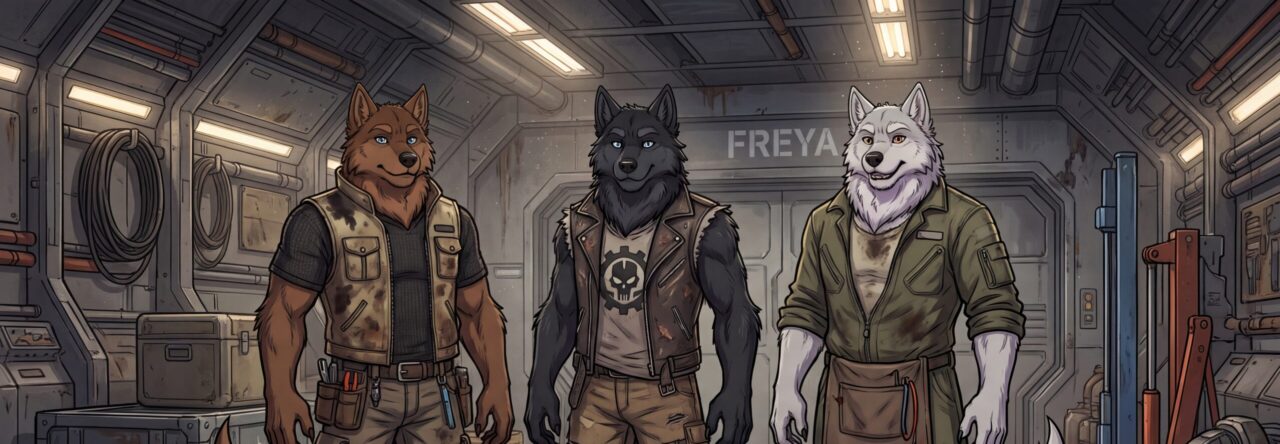
The first thing Gabriel said when he walked onto Freya’s bridge the following morning was, “I have an announcement.”
Thane didn’t look up from his coffee.
“No.”
“You haven’t heard it yet.”
“Don’t need to.”
Gabriel stopped beside the captain’s chair, his black-furred ears angled forward in indignation.
“I am instituting a formal protest.”
“Good for you.”
“Against the outrageous restrictions imposed upon my culinary freedom.”
From the engineering console, Mark chuckled.
“Good morning, Gabriel.”
“Don’t you start.”
Tavin, comfortably curled into the auxiliary station with a mug of something hot, raised one rust-red hand.
“I second the captain’s motion.”
Gabriel turned.
“What motion?”
“The one where you shut up.”
Thane snorted into his coffee.
Gabriel looked toward the ceiling.
“It’s eight in the morning. Eight. In. The. Morning. And already I’m surrounded by hostility.”
Mark smiled.
“Actually, it’s seven forty-three.”
“THANK YOU, MARK.”
“You’re welcome.”
Gabriel dropped into the navigation chair with a theatrical sigh.
Thane finally looked over.
“Did you sleep well?”
“Wonderfully. Until I remembered I live aboard a vessel where perfectly delicious food is treated like hazardous waste.”
“It made the entire common room smell like a dead engine room,” Tavin observed.
Gabriel pointed at him.
“You ate three servings.”
“On a ship with proper ventilation.”
“Traitor.”
Thane smiled and returned his attention to the forward display.
Outside, the Hesper Belt stretched across the darkness like an enormous, uneven river of stone.
They had arrived at the outer approaches less than an hour earlier.
The belt wasn’t the tightly packed obstacle course depicted in cheap entertainment broadcasts. Most of its objects were separated by enormous distances. The larger concentrations were clustered around gravitational resonances, commercial extraction zones, and pockets where centuries of mining activity had redistributed smaller debris.
At their current distance, the belt looked almost delicate.
Thousands of faint reflections shimmered across the sensor display.
Beyond them, Hesper’s distant primary star burned steadily against black space.
Thane had seen plenty of asteroid fields in his lifetime.
He still found them beautiful.
“What’s our contact situation?” he asked.
Gabriel straightened, finally putting aside his culinary grievances.
“Client’s tracking buoy is about thirty-six thousand kilometers ahead. Their recovery zone is inside a restricted industrial traffic corridor designated Hesper Four-Two. I’ve already requested entry authorization.”
“Response?”
“Approved. We’re clear to proceed under independent salvage registration. Local traffic control wants us to maintain active transponder and debris-tracking broadcasts.”
“Fair enough.”
Mark brought up the engineering status.
“Grapple assemblies checked. Port crane is good. Starboard crane is good. Cargo-bay containment systems tested. Fabrication equipment standing by.”
Thane glanced at him.
“Anything you’re worried about?”
“Not particularly.”
“That’s encouraging.”
“I’m always worried about something.”
Gabriel grinned.
“There’s the Mark we know and love.”
Mark shrugged.
“Somebody has to be.”
Tavin looked toward the forward display.
“So what exactly are we recovering?”
Gabriel brought up the contract.
“External cargo-handling equipment from a materials carrier called the Borealis Reach. Commercial bulk transport. Three days ago, it was maneuvering through the extraction corridor when one of its external loading assemblies suffered a structural mounting failure.”
Tavin frowned.
“Loading assembly?”
“Think of a large automated cargo-transfer rig,” Mark explained. “Designed to move ore containers between mining platforms and transport vessels.”
“How large?”
Gabriel expanded the schematic.
The display showed an enormous articulated mechanical assembly, with several telescoping arms and a central transfer platform.
“Twenty-two meters long in its stowed configuration. Just under forty tonnes, according to the manifest.”
Tavin whistled.
“That’s a big chunk of machinery.”
“Expensive chunk of machinery,” Gabriel corrected. “Replacement cost is estimated at about six hundred thousand credits.”
Thane nodded toward the contract.
“And they’re paying us forty-two thousand to retrieve it.”
“Correct.”
“What happened to the mounting?”
“Preliminary report says a structural retaining assembly fractured during a cargo-transfer maneuver. Emergency isolation released the rig before the failure could damage the carrier’s main hull.”
“Anyone injured?”
“No. Crew was inside the ship. The loading assembly was operating remotely.”
“Good.”
Mark studied the drawing.
“Did they recover the detached mounting hardware?”
“Some of it. The rest is presumably still attached to the rig.”
“Hmm.”
Tavin looked at Mark.
“What’s the ‘hmm’?”
“Nothing yet.”
“You always say that when it’s something.”
Mark grinned.
“Learning already.”
The recovery zone occupied a broad stretch of space near a cluster of industrially worked asteroids.
Mining companies had spent nearly a century extracting metals and rare minerals from the region. The larger rocks bore the unmistakable signatures of commercial activity: geometric excavation pits, abandoned anchor points, machinery platforms, and long scarred trenches across their surfaces.
Freya passed a dormant ore-processing station mounted to the side of a tumbling asteroid nearly four kilometers across.
Tavin leaned toward the viewport.
“Look at that thing.”
Thane glanced over.
“Old processing facility.”
“It’s enormous.”
“Used to be a major operation here. Shut down about twenty years ago when the richest deposits ran out.”
“Why’d they leave everything?”
“Because removing it would’ve cost more than leaving it.”
Tavin considered that.
“Seems wasteful.”
“It is,” Mark said. “But sometimes that’s how commercial extraction works.”
Gabriel checked the navigation display.
“And sometimes it creates wonderful opportunities for handsome, independently wealthy salvage operators.”
Thane raised an eyebrow.
“Independently wealthy?”
“I’m speaking aspirationally.”
“Ah.”
Tavin nodded.
“Very aspirationally.”
Gabriel ignored him.
A few minutes later, the tracking buoy appeared on sensors.
It was a small cylindrical device, barely two meters long, fitted with a high-powered beacon and a short-range debris-monitoring array.
Gabriel established contact.
“Tracking data received. The rig’s last confirmed position was approximately eight thousand kilometers deeper into the corridor.”
“Current position?”
“Unknown. The client deployed the buoy after the incident, so we’ve got a partial trajectory and several intermittent radar returns.”
Thane frowned.
“Intermittent?”
“Yeah. There’s a fair amount of metallic debris in this region. Old mining equipment, loose structural material, a few discarded cargo pods. They haven’t been able to isolate the rig reliably.”
Mark leaned forward.
“Did the rig retain power?”
“According to the report, its emergency battery should’ve survived the separation. But the tracking transponder stopped responding about forty minutes afterward.”
“Interesting.”
Tavin turned.
“Why?”
“If the battery lasted forty minutes, something happened after the separation. Could be damaged wiring, could be an automatic shutdown, could be the battery itself.”
“Could it still be powered?”
“Possibly.”
Gabriel looked over.
“Any particular reason you’re asking?”
Mark tapped the schematic.
“Forty tonnes of machinery with several articulated arms. I’d rather know whether those arms can move before we put our own equipment around it.”
Thane nodded.
“Agreed.”
He looked toward the sensor display.
“All right, gentlemen. Let’s find our missing hardware.”
Finding a twenty-two-meter cargo-handling rig in an asteroid belt sounded easier than it was.
The object wasn’t broadcasting.
It had no active navigation lights.
Its surface was coated in a dull, radar-absorbing industrial finish intended to reduce interference with sensitive mining equipment.
And it was surrounded by countless other pieces of machinery, metal-rich rocks, and abandoned industrial debris.
Freya’s long-range sensors could identify large masses and characterize their motion, but distinguishing the missing rig from unrelated objects required more detailed scans.
Gabriel established a search volume using the last known trajectory.
Mark configured a series of active radar sweeps, while Thane maintained a slow approach through the designated corridor.
Tavin watched the sensor display with growing interest.
“How do you know which return is the right one?”
“Shape, mass estimate, movement, material signature,” Mark explained. “And probability.”
“Probability?”
“We know approximately where it started, what direction it was moving, and how fast. We use that to narrow down where it might be now.”
Tavin studied the display.
“But there are gravitational influences from the asteroids.”
“Yep.”
“And the rig might’ve hit something.”
“Yep.”
“And if it had any residual thrust or moving parts—”
“Could’ve changed its trajectory.”
Tavin frowned.
“So we’re looking for something that might not be where the math says it should be.”
Mark smiled.
“Welcome to salvage.”
Gabriel leaned toward the display.
“And that’s why we charge forty-two thousand credits instead of twelve.”
For nearly an hour, they worked through the search volume.
Most returns were quickly eliminated.
An old mining platform.
Several disconnected conveyor sections.
A discarded pressure vessel.
A metallic asteroid fragment that briefly looked promising until its mass estimate came back at nearly eleven thousand tonnes.
Gabriel stared at that one.
“Well, if that’s our rig, somebody forgot to mention the upgrades.”
Thane chuckled.
“Keep looking.”
Tavin was studying the trajectory plot when something caught his attention.
“Mark?”
“Hmm?”
“Can I ask something?”
“Sure.”
“The client said the rig separated during a transfer maneuver, right?”
“Right.”
“So it would’ve been moving relative to the carrier when the retaining assembly failed.”
Mark turned slightly.
“Go on.”
“And if it was extended when it broke free, the center of mass wouldn’t necessarily have been aligned with the mounting point.”
Mark’s ears lifted.
“Correct.”
“Wouldn’t that make it tumble?”
“Very likely.”
Tavin pointed at the display.
“Then why are we using the trajectory model that assumes a stable attitude?”
Gabriel stopped typing.
Mark looked at the screen.
Thane glanced over.
There was a moment of silence.
Then Mark smiled.
“Well, that’s a very good question.”
Tavin blinked.
“It is?”
“Absolutely.”
Mark brought up the initial incident data.
“The model includes a generalized tumble estimate, but it assumes the rig remained mechanically fixed after separation.”
Tavin frowned.
“But if the arms were moving—”
“Then its moment of inertia could’ve changed considerably.”
Mark studied the engineering schematic.
“And depending on how the safety system reacted, the emergency retractors might’ve moved the arms after separation.”
Gabriel opened the incident report again.
“Hang on.”
He scrolled through the maintenance notes.
“There’s a line here. ‘Emergency stow command issued automatically upon loss of mounting continuity.’”
Mark grinned.
“There we go.”
Tavin looked between them.
“So it might’ve retracted?”
“Or tried to,” Mark said. “Which could’ve changed its rotation and altered how it reflected radar.”
Gabriel revised the search parameters.
“Let’s stop looking for a twenty-two-meter object and include the dimensions of a partially folded rig.”
A few minutes later, the sensor system flagged a return near the edge of their search volume.
It was irregular.
Approximately fourteen meters across.
Its rotation was slow but complex.
Its estimated mass fell within fifteen percent of the missing equipment.
Mark studied the return.
“Well, hello there.”
Tavin leaned forward.
“Is that it?”
“Could be.”
Gabriel checked the coordinates.
“Sixteen hundred kilometers away. Relative velocity about thirty meters per second.”
Thane smiled.
“Let’s go have a look.”
The object came into view against the dark face of a small, heavily cratered asteroid.
At first it resembled a twisted framework of metal.
Then Freya’s forward lights swept across it, revealing the unmistakable geometry of a cargo-transfer assembly.
Two enormous articulated arms were partially folded against a central platform.
A third arm extended outward at an awkward angle.
Several long structural members were bent.
One corner of the platform had been crushed inward.
The entire assembly rotated slowly, completing an irregular tumble approximately every forty seconds.
Tavin stared through the viewport.
“Holy hell.”
Gabriel smiled.
“Found our missing toy.”
Thane studied the object.
“What’s the damage?”
Mark was already examining the close-range scan.
“Primary structure appears mostly intact. One articulated boom is bent, but the central transfer frame is still there. Mounting brackets are torn away along the portside interface.”
“Any sign of active power?”
“Not yet.”
Gabriel checked the contract.
“Recovery condition requires the main frame and at least two intact articulating assemblies. Looks like we’re within specification.”
“Good.”
Thane brought Freya into a stable position approximately four hundred meters from the rotating equipment.
The salvage vessel’s maneuvering thrusters fired in short, precise bursts.
“Let’s not rush this,” he said.
Mark nodded.
“Wasn’t planning to.”
Gabriel looked toward the rig.
“Forty tonnes of badly behaved machinery. What’s the plan?”
“First,” Mark said, “we figure out exactly what it’s doing.”
They spent the next forty minutes examining the rig from a safe distance.
Freya’s radar and optical systems built a detailed three-dimensional model of the rotating assembly.
The model revealed more damage than the initial scan suggested.
One boom had suffered a partial fracture near its hinge.
Several hydraulic lines had torn free.
A motorized guide track was bent badly enough that its carriage had jammed midway through retraction.
The rig’s emergency battery housing remained attached, but its main power bus showed no activity.
Mark examined the thermal images.
“Looks like she’s been dead for a while.”
Tavin studied the damaged boom.
“Would it be dangerous to grab?”
“Yes,” Mark said immediately.
Tavin looked at him.
“Because of the rotation?”
“Partly. Mostly because of the stored mechanical energy.”
He highlighted the fractured boom.
“See this?”
“Yeah.”
“That arm was designed to support a considerable load. It’s bent and partially fractured, but the hinge and actuator assembly are still under stress. If we grab the wrong section or pull in the wrong direction, it could release suddenly.”
Tavin nodded.
“Like a spring.”
“Exactly. A very large, very heavy spring.”
Gabriel looked over.
“One that could put a substantial dent in my very expensive spaceship.”
“Our spaceship,” Thane corrected.
“Fine. Our very expensive spaceship.”
Mark brought up the structural model.
“We need to secure the central frame first. Then immobilize the articulating booms before applying significant towing loads.”
Thane nodded.
“Can we do it with the grapple arms?”
“Mostly. But I want to use the remote work pod to attach two restraint cables to the intact lifting hardpoints.”
Tavin perked up.
“The work pod?”
Mark smiled.
“Ever operated one?”
“No.”
“Want to?”
Tavin stared.
“Seriously?”
“Sure.”
Gabriel turned around.
“Shouldn’t we have him practice on something that doesn’t cost six hundred thousand credits?”
Mark shrugged.
“He’ll be operating under direct supervision.”
“That’s not reassuring.”
“Why not?”
“Because your definition of supervision sometimes involves saying ‘that’s interesting’ immediately before something catches fire.”
Mark laughed.
Thane stood.
“All right. Mark, you and Tavin handle the pod. I’ll operate the primary grapple system. Gabriel, you’ve got navigation and relative-position monitoring.”
Gabriel sighed.
“Everyone gets to play with the expensive toys except me.”
Tavin grinned.
“You can watch.”
“I can also revoke your dessert privileges.”
“You don’t control dessert.”
“I control purchasing.”
Thane looked toward the door.
“Gentlemen?”
Both younger wolves stopped.
“Let’s get to work.”
Freya’s remote work pod was a compact, heavily reinforced machine designed for inspection, manipulation, and small-scale repair work outside the ship.
It wasn’t intended to carry passengers.
Instead, an operator controlled it from an engineering station using high-resolution cameras, tactile feedback controls, and a set of articulated manipulators.
Mark settled into the primary operator’s chair.
Tavin took the adjacent station.
“Okay,” Mark said. “First lesson. Before you move anything, understand what you’re looking at.”
The young wolf nodded.
Mark brought up the pod’s camera feeds.
“Forward camera. Two side cameras. Manipulator camera. Rangefinder. Attitude reference. And the most important display—”
He tapped the lower-right screen.
“Relative motion.”
Tavin examined it.
“Because we’re moving relative to the target.”
“Right. Even if it looks stationary on one camera, it may still be rotating or translating relative to us.”
Mark activated the pod’s maneuvering system.
“I’m going to take us over to the rig. You watch what I do.”
The pod detached from Freya and moved slowly toward the rotating assembly.
Its tiny maneuvering thrusters fired in carefully measured pulses.
On the bridge, Thane watched the operation through the external cameras.
Mark maintained a conservative approach.
The rig’s rotation was slow enough to follow visually, but its protruding booms created a changing hazard envelope.
After several minutes, Mark brought the pod into a stable position alongside one of the central lifting hardpoints.
“See how I’m matching the local motion instead of trying to stop the entire object?”
Tavin nodded.
“Yeah.”
“Good. Now I want you to operate the right manipulator.”
Tavin’s ears shot upright.
“Me?”
“You.”
The young wolf reached for the controls.
His first movement was slightly too aggressive.
The manipulator arm swung toward the hardpoint.
Mark immediately pressed the motion-hold control.
“Easy.”
Tavin froze.
“Sorry.”
“Nothing to apologize for. That’s why we start with low-speed limits.”
Mark adjusted the sensitivity.
“Try again.”
This time, Tavin moved the manipulator carefully.
The mechanical hand extended toward a folded restraint strap secured to the pod’s tool rack.
He grasped the strap.
Or tried to.
The first attempt missed.
The second pushed it sideways.
The third finally caught the reinforced loop.
Tavin grinned.
“Got it.”
“Good. Now don’t celebrate until you’ve actually secured it.”
From the bridge, Gabriel’s voice came over the intercom.
“Mark, are we sure the kid’s qualified to operate equipment that costs more than my entire wardrobe?”
Tavin keyed the microphone without taking his eyes off the display.
“Considering your wardrobe, that’s not a high bar.”
Thane laughed.
Gabriel made an offended noise.
Mark smiled.
“Focus, Tavin.”
“Right.”
Slowly, carefully, the young wolf guided the restraint strap toward the rig’s lifting hardpoint.
He missed the opening once.
Adjusted.
Tried again.
The reinforced loop slipped through.
Mark nodded.
“Excellent. Now engage the locking clasp.”
Tavin activated the mechanism.
A small indicator turned green.
“Locked.”
“Verify it.”
Tavin checked the clasp camera, the load sensor, and the mechanical position indicator.
“Confirmed locked.”
Mark smiled.
“Good work.”
Tavin sat back slightly.
His tail gave a quick, delighted wag.
“Thanks.”
“Now let’s do the other one.”
By the time both restraints were attached, nearly an hour had passed.
Gabriel had spent most of that time monitoring the object’s changing trajectory and occasionally making observations about the extraordinary patience required to watch a pair of engineers manipulate straps in zero gravity.
Thane found the operation fascinating.
More importantly, he was pleased with how carefully Mark was teaching Tavin.
There had been no rushing.
No criticism when the young wolf missed a target.
No unnecessary heroics.
Just careful instruction, practice, correction, and steady progress.
When the pod returned to Freya, Tavin practically bounced out of his chair.
“That was incredible!”
Mark chuckled.
“Pretty neat, isn’t it?”
“I’ve never done anything like that.”
“Well, you’ve done it now.”
Tavin looked at the external display.
“Can I do it again sometime?”
“Absolutely.”
Gabriel’s voice came over the intercom.
“Wonderful. Another one addicted to expensive machinery.”
Mark smiled.
“Could be worse.”
“How?”
“He could be addicted to fermented seaweed.”
There was a pause.
Then Gabriel said, very seriously, “I am never going to live that down, am I?”
“No,” Thane replied.
The main recovery operation began shortly afterward.
Freya’s two heavy grapple arms extended from their stowed positions along the hull.
The machinery moved with ponderous, deliberate precision.
Massive articulated joints rotated.
Telescoping sections extended.
Hydraulic systems hummed through the ship’s structure as the claws approached the drifting rig.
Thane controlled the port grapple from the bridge, while Mark handled the starboard assembly.
Gabriel maintained the ship’s attitude and monitored the relative motion.
Tavin watched the load sensors from his station.
“Port grapple approaching primary frame,” Thane reported.
“Starboard standing by,” Mark replied.
“Relative motion stable,” Gabriel confirmed.
The first grapple closed around a reinforced structural member near the rig’s center of mass.
Its broad mechanical jaws tightened slowly.
Load sensors climbed.
“Contact established,” Thane said.
“Good engagement,” Mark replied. “No unexpected deformation.”
Thane increased the grip pressure to the predetermined limit.
“Port secure.”
“Bringing starboard in.”
Mark guided the second grapple toward another reinforced section.
The rotating rig continued moving slowly.
Freya’s control system compensated through carefully synchronized thruster pulses.
The second grapple closed.
“Starboard secure.”
Gabriel checked the telemetry.
“Both grapples engaged. Relative rotation is slowing.”
Thane watched the display.
“Easy.”
The ship’s grapple system applied a carefully controlled counter-torque.
The damaged rig resisted.
Its forty tonnes of mass were not particularly challenging for Freya’s equipment.
Its rotational momentum was.
“Load increasing,” Tavin reported.
“Within limits,” Mark said.
The rotation slowed.
Then slowed further.
Finally, the rig hung almost motionless relative to Freya.
Gabriel grinned.
“And there she is.”
Thane studied the structural loads.
“Looks good.”
Mark checked the restraint cables.
“Both secure. No significant tension on the fractured boom.”
“Excellent.”
For a moment, everything appeared perfectly straightforward.
Then Tavin frowned.
“Mark?”
“Yeah?”
“Why’s the load on the starboard restraint increasing?”
Mark looked down.
The load reading had climbed by nearly eight percent.
He brought up the external cameras.
“Hmm.”
Gabriel glanced over.
“What?”
Mark enlarged the view of the fractured boom.
The damaged member had shifted slightly as the rig’s rotation stopped.
Its bent structure was now transferring some of its stored load into the restraint system.
“Thane, hold position,” Mark said.
Thane immediately stopped the grapple motion.
“Holding.”
“Don’t bring it any closer.”
“Understood.”
Tavin watched the sensor.
The load increased another two percent.
“What do we do?”
Mark studied the structural model.
“We relieve the load before moving it.”
Gabriel frowned.
“How?”
“By changing where the restraint takes the force.”
Thane looked toward the damaged boom.
“Can we reposition the starboard grapple?”
“Not safely while it’s carrying this load.”
Mark thought for a moment.
Then pointed to the external camera.
“There’s an intact secondary lifting point on the central frame. If we transfer part of the restraint load there, we can unload the fractured section.”
Tavin looked at the diagram.
“Using another cable?”
“Exactly.”
Gabriel sighed.
“Back out with the work pod?”
Mark grinned.
“Looks that way.”
Tavin’s tail started wagging.
Gabriel stared at him.
“Of course you’re happy.”
The adjustment took another forty minutes.
This time, Mark operated the pod while Tavin monitored the grapple and restraint loads.
They attached an additional cable to the secondary hardpoint, transferred tension gradually, and verified that the fractured boom was no longer being stressed by the recovery system.
When the load finally stabilized, Mark gave a satisfied nod.
“There.”
Tavin studied the readings.
“That’s much better.”
“Sure is.”
Gabriel checked the clock.
“We’ve been at this for nearly four hours.”
Thane looked at him.
“Your point?”
“Just observing that whoever designed this rig should be made to retrieve it personally.”
Mark chuckled.
“Not the designer’s fault it broke.”
“We don’t know that.”
“True.”
Tavin looked up.
“Could’ve been the mounting hardware.”
“Could’ve,” Mark agreed.
Thane studied the rig.
“Speaking of which, once we get it aboard, I want to examine the fracture.”
Gabriel raised an eyebrow.
“Why?”
“Because if the client’s carrier has another assembly mounted the same way, they might want to know what happened.”
Mark nodded approvingly.
“Good idea.”
Gabriel sighed.
“Fine. More engineering.”
With the fractured boom properly restrained, the rest of the operation proceeded smoothly.
Freya drew the damaged assembly toward her enormous cargo-bay opening.
The bay was large enough to accommodate the rig, but only if its protruding arms were aligned carefully.
Thane worked the primary grapple controls.
Mark adjusted the secondary arm.
Gabriel maintained attitude.
Tavin watched the clearances.
“Portside boom clearance, four meters.”
“Copy,” Thane said.
“Three and a half.”
“Good.”
“Three.”
Mark adjusted the rig’s orientation slightly.
“Better?”
Tavin checked the display.
“Four meters now.”
“Excellent.”
Slowly, the assembly moved through the cargo-bay opening.
The bay’s internal handling rails and securing fixtures stood ready.
Once the rig was fully inside, mechanical support cradles rose from the deck and engaged its primary frame.
Freya’s grapples maintained their grip while the restraints were attached.
Mark verified the load distribution.
Tavin checked the support locks.
Gabriel confirmed the bay’s internal sensors showed no interference.
Finally, the grapple jaws opened.
The rig settled onto its supports.
“Cargo secure,” Mark announced.
Thane leaned back in his chair.
“Beautiful.”
Gabriel looked at the clock.
“Five hours and twelve minutes.”
“Not bad,” Thane said.
“Not bad? We just recovered forty tonnes of broken industrial equipment from a rotating tumble in an asteroid belt. I think that warrants something a little more enthusiastic.”
Thane grinned.
“Very beautiful.”
Gabriel threw up his hands.
Tavin laughed.
After the cargo-bay atmosphere was restored, the four wolves went down to inspect their prize.
The damaged loading assembly filled a substantial portion of the bay.
Up close, its size was impressive.
Heavy structural members crisscrossed the central platform.
Hydraulic actuators as thick as Tavin’s torso connected the articulated booms.
Several sections bore deep scratches and impact marks from the initial separation.
The fractured mounting brackets were particularly ugly.
Mark approached one of them and ran a claw carefully along the broken surface.
“Hmm.”
Gabriel looked at Thane.
“There it is again.”
Thane smiled.
Mark crouched.
“Look at this.”
The others gathered around.
The broken mounting bracket had a distinctly uneven fracture surface.
One section was bright, jagged metal.
Another was darker, with a series of faint curved lines spreading outward from a small point near the edge.
Mark pointed.
“See those?”
Tavin leaned closer.
“Yeah.”
“Fatigue marks.”
Tavin studied them.
“So the bracket had been cracking for a while?”
“That’s what it looks like.”
Mark moved his finger toward the bright section.
“And this is where the remaining material finally failed.”
Thane frowned.
“Could the failure have been prevented?”
“Possibly. We’d need a proper metallurgical examination to establish the cause. But this certainly wasn’t a single clean overload fracture.”
Gabriel brought out his portable terminal.
“Let me photograph it.”
Mark nodded.
“Good idea.”
They spent another half hour documenting the damage.
Mark took detailed measurements of the fracture surface and examined the adjacent mounting points.
Tavin assisted with lighting and camera positioning.
Thane checked the remaining structure for damage that might affect offloading.
Gabriel recorded the recovery condition and compared it with the contract requirements.
Eventually, Mark stood.
“Well, that ought to give the client something useful.”
Tavin looked toward the broken bracket.
“Could the same thing happen to another rig?”
“Depends on the cause,” Mark replied. “But if I were operating that carrier, I’d inspect every similar mounting assembly before using them again.”
Thane nodded.
“Let’s make sure they know.”
They were halfway back to the bridge when Tavin stopped.
“Hey, Thane?”
Thane turned.
“Yeah?”
“Can I ask you something?”
“Of course.”
Tavin glanced back toward the cargo bay.
“Why’d you want to inspect the fracture?”
Thane considered the question.
“Because we might be able to prevent another accident.”
“Even though it wasn’t in the contract?”
“Yep.”
Tavin looked thoughtful.
“Gabriel said we were only being paid to recover the rig.”
“And he’s right.”
“But you’re doing more.”
Thane smiled.
“Sometimes the right thing to do doesn’t fit neatly into a contract.”
Tavin nodded slowly.
“Like helping the Veylith.”
“Exactly.”
Gabriel, walking ahead of them, turned around.
“For the record, I am perfectly capable of appreciating the value of goodwill and professional responsibility.”
Thane raised an eyebrow.
“Never said you weren’t.”
“And identifying a potentially dangerous structural defect is actually good business. Clients remember companies that help them avoid expensive disasters.”
Mark nodded.
“Also true.”
Gabriel smiled triumphantly.
“Thank you.”
Tavin looked at him.
“So you’re saying being nice can make money.”
Gabriel considered that.
“Sometimes.”
“And sometimes you do it anyway.”
Gabriel’s expression softened just slightly.
“Yeah, kid. Sometimes you do it anyway.”
Tavin grinned.
“Look at you. Growing as a person.”
Gabriel pointed at him.
“Don’t ruin the moment.”
By late afternoon, Freya had departed the recovery zone and established a course toward Hesper Transfer Station, where the damaged rig would be delivered to the client’s designated inspection facility.
Gabriel completed the initial recovery report and transmitted the required documentation.
A reply arrived twenty minutes later.
“Client confirms receipt,” he announced. “They’re very pleased. Apparently their previous contractor estimated at least three days to locate and retrieve the equipment.”
Thane glanced over.
“And we did it in one.”
“Correct.”
“Nice.”
Gabriel continued reading.
“They also want to know whether we can provide the fracture documentation to their maintenance department.”
Mark smiled.
“Absolutely.”
Gabriel looked up.
“And they specifically thanked us for identifying the possible fatigue issue.”
Thane nodded.
“Good.”
Tavin grinned.
“So does that mean we get a bonus?”
Gabriel laughed.
“Now you’re thinking like a businessman.”
Thane chuckled.
“Don’t encourage him.”
“Too late,” Gabriel replied. “He’s learning from the best.”
Mark looked over.
“That’s a matter of opinion.”
Tavin nodded solemnly.
“A highly disputed opinion.”
Gabriel sighed.
“I live among savages.”
Dinner that evening was one of Thane’s simpler meals.
He prepared a large pan of seasoned roasted potatoes, thick slices of grilled meat, and a mixture of vegetables sautéed with garlic and butter.
The galley smelled wonderful.
Which was particularly important after the previous evening.
Gabriel arrived carrying one of the sealed Veylith containers.
Thane stopped chopping vegetables.
“No.”
Gabriel froze.
“I haven’t said anything.”
“Don’t need to.”
“I was merely bringing it to the table.”
“Why?”
“For educational purposes.”
Tavin looked up from where he was setting plates.
“Oh, no.”
Gabriel glared at him.
“Not you too.”
Mark entered the galley.
He saw the container.
He stopped.
Then he turned around.
Gabriel stared.
“WHERE ARE YOU GOING?”
“To check the ventilation.”
Tavin burst out laughing.
Thane pointed toward the storage cabinet.
“Put it away.”
Gabriel sighed.
“Fine.”
He carefully returned the container to its refrigerated compartment.
But not before giving it a fond little pat.
Tavin watched him.
“You know, I’m starting to think you love that stuff more than us.”
Gabriel looked at him.
“The morakai doesn’t insult me.”
“It doesn’t have to. It can clear a room without saying a word.”
Mark laughed.
Thane shook his head.
“Sit down, everybody. Dinner’s ready.”
They ate together around the galley table.
The conversation naturally returned to the day’s salvage operation.
Tavin had approximately seventeen questions about grapple-control systems, structural load paths, and the differences between hydraulic and electromechanical actuators.
Mark answered every one.
Gabriel complained that dinner was turning into an engineering seminar.
Thane reminded him that he’d spent the previous evening discussing alien cuisine for two hours.
Gabriel insisted that culinary education was culturally enriching.
Tavin asked whether biological weapons counted as culture.
Mark nearly choked on his potatoes.
Eventually, the conversation quieted.
Tavin looked toward Thane.
“Can I ask one more question?”
Gabriel groaned.
“Please tell me it’s not about hydraulic actuators.”
“No.”
“Thank every known deity.”
Tavin ignored him.
“Why do you guys like this work so much?”
Thane paused.
“What do you mean?”
“Salvage. Fixing things. Recovering broken machinery. Spending hours trying to grab something floating around in space.”
He glanced toward Mark.
“I mean, I thought today was amazing. But you’ve been doing this for years.”
Mark smiled.
“Still amazing.”
Tavin looked at him.
“Really?”
“Sure.”
Gabriel leaned back.
“I enjoy the money.”
Thane laughed.
“Of course you do.”
Gabriel grinned.
“Somebody has to keep us solvent.”
Tavin looked toward Thane.
“What about you?”
Thane considered the question.
He thought about the Mercy Dawn.
About the battered old ship they’d restored years ago.
About the endless hours spent rebuilding Freya’s systems until she was fit to fly again.
About the Veylith captain’s relief when their engines came back online.
And about the forty-tonne loading rig now resting safely in Freya’s cargo bay.
“I suppose I like taking something that isn’t working and making it useful again,” he said.
Tavin listened.
“Sometimes that’s a ship. Sometimes it’s a piece of machinery. Sometimes it’s just helping somebody get through a bad day.”
He smiled.
“And I like working with people I trust.”
Mark nodded.
“That’s a big part of it.”
Gabriel looked around the table.
“Yeah.”
Tavin was quiet for a moment.
Then he smiled.
“I think I get it.”
Thane looked at him.
“Yeah?”
“Yeah.”
He glanced toward the others.
“It’s not really about the salvage.”
Thane chuckled.
“Not entirely.”
Tavin thought for another moment.
“It’s about doing something worthwhile together.”
There was a brief silence.
Then Mark smiled warmly.
“That’s a pretty good way to put it.”
Gabriel raised his glass.
“To doing worthwhile things together.”
Thane lifted his own.
Mark followed.
Tavin grinned and raised his.
Their glasses touched gently above the table.
And for a few moments, nobody felt the need to say anything else.
Later that night, Freya continued toward Hesper Transfer Station.
Her engines maintained a steady, efficient burn.
The cargo rig rested securely in the bay.
The recovery contract was nearly complete.
And the four wolves were settling into the comfortable routines of shipboard life.
Mark was in engineering, reviewing the day’s grapple-system telemetry.
Gabriel was in his cabin, finalizing the commercial paperwork.
Tavin had taken his portable terminal to the common room to continue his increasingly elaborate collection of technical notes.
And Thane stood alone on the bridge.
The ship was quiet.
Not silent.
Freya was never silent.
Her machinery produced a constant collection of soft vibrations, distant hums, and occasional mechanical sounds.
To someone unfamiliar with her, they might have seemed meaningless.
To Thane, they were comforting.
He knew those sounds.
He knew the ship.
He loved her.
He rested one broad hand on the edge of the captain’s console and looked through the forward windows.
The stars shone steadily.
A distant asteroid drifted across the edge of the viewport.
Somewhere behind him, deep within the vessel, three other wolves were going about their evening.
He smiled.
There had been a time when Freya had been little more than a half-stripped industrial wreck destined for the scrapyard.
He, Mark, and Gabriel had looked at her and seen something worth saving.
They’d worked for years to turn that battered hull into a reliable ship.
And somewhere along the way, she’d become home.
Now there was a fourth wolf aboard.
A young one who asked endless questions, laughed easily, and was discovering talents he hadn’t known he possessed.
Thane thought about the look on Tavin’s face when he’d successfully attached that first restraint cable.
The sheer, unfiltered delight.
He hoped the young wolf never lost it.
The bridge door opened quietly.
Mark stepped inside.
“Thought I’d find you here.”
Thane turned.
“Everything okay?”
“Perfectly.”
Mark walked over and stood beside him.
For a while, the two old friends watched the stars.
Then Mark spoke.
“Kid did good today.”
Thane smiled.
“He sure did.”
“Caught that problem with the search model before any of us noticed it.”
“Yep.”
“And he handled the work pod pretty well for his first time.”
Thane chuckled.
“Under your expert supervision.”
Mark smiled.
“He’s got good instincts.”
“You think so?”
“Absolutely.”
Mark paused.
“He reminds me a little of us when we were younger.”
Thane laughed softly.
“God help him.”
Mark chuckled.
“Yeah.”
They stood quietly for another moment.
Then Mark looked toward the captain’s chair.
“You know, when we first brought Freya home, I figured we’d be lucky if she lasted another ten years.”
Thane raised an eyebrow.
“Really?”
“Sure. She was in awful shape.”
“That’s putting it mildly.”
“Half her systems were obsolete. Most of the wiring needed replacing. The propulsion-control network looked like somebody had assembled it out of spare parts and blind optimism.”
Thane laughed.
“And you loved every minute.”
Mark smiled.
“Most of them.”
“Most?”
“There were a few days I considered setting her on fire.”
Thane burst out laughing.
Mark grinned.
“But we got her flying.”
“We did.”
“And she’s still flying.”
Thane looked out at the stars.
“Better than ever.”
Mark nodded.
“Better than ever.”
A comfortable silence settled between them.
Then Mark added, almost casually, “You know, I think Tavin’s going to be very good at this.”
Thane turned.
“At what?”
Mark gestured vaguely toward the ship.
“All of it.”
Thane smiled.
“Yeah.”
He looked back toward the stars.
“I think so too.”
In the common room, Tavin sat curled into the couch with his terminal.
He’d finished documenting the day’s operation.
There were diagrams of Freya’s grapple system, notes about restraint loads, and several observations about the practical difficulties of recovering tumbling objects in zero gravity.
He’d also created a separate file.
Its title was simple.
Things I Learned Today.
He considered the empty page for a moment.
Then began typing.
Always check what changed.
He smiled.
That one belonged to Mark.
Never assume the first search model is correct.
He added another.
Big machinery requires patience.
And another.
If something is under tension, figure out where the energy will go before you touch it.
He thought for a while.
Then typed one final line.
Sometimes people see more potential in you than you see in yourself.
He stared at that sentence.
For a long moment, he didn’t move.
Then he saved the file.
Closed the terminal.
And looked around the common room.
The soft lighting.
The comfortable furniture.
The familiar hum of Freya’s systems.
His home.
He smiled.
Somewhere down the corridor, Gabriel shouted.
“WHO ATE THE LAST OF MY CHOCOLATE BISCUITS?”
Tavin’s ears perked up.
A slow grin spread across his muzzle.
He called back.
“CHECK THE MORAKAI CONTAINER!”
A moment of silence.
Then:
“TAVIN!”
The young wolf collapsed into laughter.
And somewhere aboard Freya, the universe continued on its way.