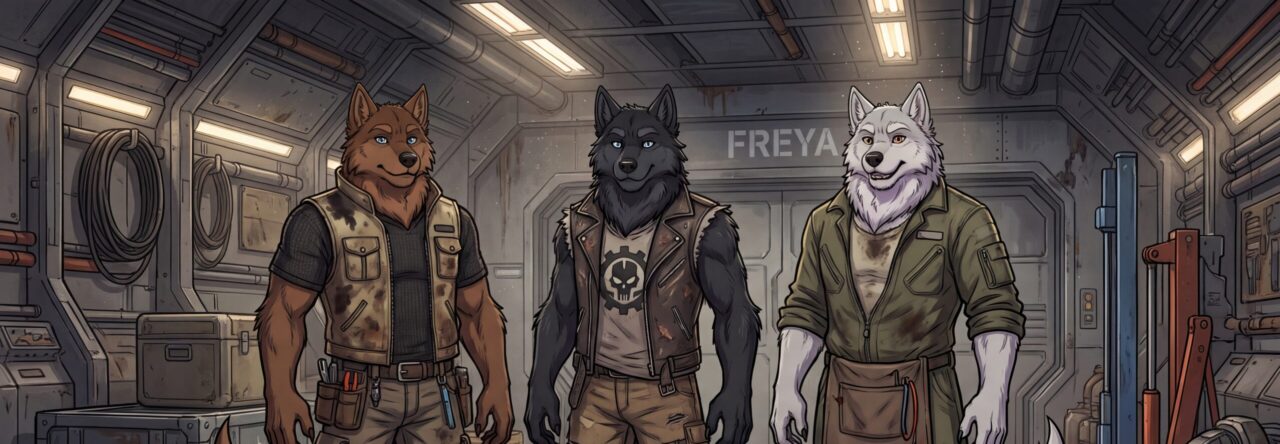
The first indication that Mark had found something interesting came at six seventeen in the morning.
The second was the sound of someone laughing in the engineering workshop.
Thane lay in his bunk for another moment, staring at the ceiling.
He knew that laugh.
It was quiet, slightly breathless, and possessed a particular quality that usually meant one of two things.
Either Mark had discovered something extraordinarily clever.
Or he’d found something so spectacularly stupid that he couldn’t help appreciating the creativity involved.
Thane rolled onto his side.
“Lord help us.”
He sat up, stretched his broad shoulders, and swung his clawed feet onto the deck.
Freya’s familiar vibration greeted him through his paws.
Everything felt normal.
The environmental systems were humming steadily. The ventilation was operating at its usual low overnight setting, and somewhere beyond his cabin, the ship’s power-distribution equipment maintained the comfortable rhythm he’d known for years.
Nothing sounded wrong.
Which meant Mark was probably just being Mark.
Thane pulled on his trousers, shrugged into a shirt, and headed for the galley.
Coffee first.
Whatever engineering miracle had occurred could survive another ten minutes.
By six forty-five, Thane had his coffee and was standing in the workshop doorway.
Mark was seated at the main electronics bench, surrounded by a collection of test leads, service manuals, and the old sequencing controller he’d purchased during their shore leave.
The controller’s outer housing had been removed.
Several internal modules were connected to a bench power supply and a diagnostic interface.
A portable display showed a series of configuration parameters.
Mark was grinning.
Thane leaned against the doorframe.
“Morning.”
Mark looked up.
“Morning!”
Thane studied his expression.
“Oh, that’s never good.”
“What?”
“That face.”
Mark glanced around.
“What face?”
“The one you make when you’re about to tell me something that costs money.”
Mark laughed.
“Relax. This doesn’t cost anything.”
Thane raised an eyebrow.
“That’s what you said before we bought the materials processor.”
“That was different.”
“Thirty-one thousand, eight hundred credits different.”
“Worth every one.”
Thane smiled.
“I know.”
He walked over to the bench.
“So what’s got you laughing before seven in the morning?”
Mark turned the display toward him.
“Remember that old sequencing controller we picked up yesterday?”
“Hard to forget. You looked like somebody had handed you a winning lottery ticket.”
Mark chuckled.
“Well, I powered it up last night and ran the internal diagnostics. Everything passed.”
“Good.”
“Then I checked the nonvolatile configuration storage.”
Thane glanced at the screen.
“Anything useful?”
“Oh, yeah.”
Mark scrolled through several pages.
“Whoever maintained this thing before it was decommissioned kept exceptionally good records. Configuration backups, test procedures, maintenance notes, even a few engineering sketches.”
Thane smiled.
“Sounds like somebody you would’ve liked.”
“Absolutely.”
Mark opened a text file.
“And then I found this.”
The document was labeled:
SECONDARY DISTRIBUTION MONITORING — SERVICE MODIFICATION NOTES
Thane took a sip of coffee.
“Okay.”
Mark pointed toward a diagram.
“See this?”
“I’m looking.”
“This controller came from an older transport with a power-distribution architecture very similar to Freya’s. Different manufacturer, different equipment family, but the same basic design philosophy.”
Thane examined the schematic.
“Separate primary and secondary buses?”
“Right. With local switching assemblies and individual branch-monitoring circuits.”
“Okay.”
“The previous engineer added a monitoring interface to improve fault diagnosis. Instead of relying solely on the controller’s summary alarms, it recorded individual voltage and switching states during power transitions.”
Thane looked thoughtful.
“Didn’t we discuss doing something similar?”
Mark grinned.
“About four years ago.”
“Why didn’t we?”
“Money.”
Thane laughed.
“Ah. Our old friend.”
“Exactly. At the time, we’d have needed custom interface hardware and a fair amount of fabrication work. We were still paying off the propulsion refurbishment.”
Thane nodded.
“And now?”
Mark gestured toward the workshop.
“Now we’ve got a precision materials processor, a fully equipped electronics bench, and a perfectly serviceable ship that doesn’t need to be torn apart to accommodate the improvement.”
Thane looked at him.
“How much?”
Mark smiled.
“Very little.”
Thane stared.
Mark stared back.
Finally, Thane said, “In normal money, or Mark money?”
Mark burst out laughing.
Tavin appeared in the doorway just in time to hear the last exchange.
His rust-red ears lifted.
“Did somebody say Mark money?”
Thane turned.
“Good morning, Tavin.”
“Morning.”
Tavin looked toward the dismantled controller.
“Oh, cool!”
He immediately crossed the room.
“Is that the one you bought yesterday?”
“Yep,” Mark replied.
“Does it work?”
“Beautifully.”
Tavin leaned over the bench.
“Wow.”
Mark pointed to the display.
“Take a look at this.”
For the next several minutes, Mark explained the maintenance records and the old engineer’s monitoring modification.
Tavin listened closely, asking questions whenever he didn’t understand something.
“So the modification doesn’t actually control the power switching?”
“Correct,” Mark said. “It monitors the individual signals and records their timing.”
“Which means if something trips, you can see what happened immediately before the fault.”
“Exactly.”
Tavin studied the diagram.
“That’s clever.”
“Very.”
“Could we do that on Freya?”
Mark smiled.
“That’s what I was thinking.”
Tavin’s ears perked up.
“Seriously?”
“Sure. We’d need to adapt the idea to our equipment, but the principle is sound.”
Thane took another sip of coffee.
“Assuming it doesn’t cost thirty thousand credits.”
Tavin glanced at Mark.
Then at Thane.
“How much is it going to cost?”
Mark shrugged.
“Probably a few hundred in materials. Most of the parts are already in inventory.”
Tavin considered that.
“Is that a few hundred in normal money, or—”
“Don’t start,” Mark said.
Thane laughed.
By eight thirty, Gabriel had joined them in the workshop.
He was carrying a mug of coffee, a portable terminal, and an expression suggesting he had already encountered several things that irritated him.
“Good morning, gentlemen.”
Thane looked up.
“Morning.”
Gabriel glanced at the dismantled controller.
“Oh, wonderful. We’re taking things apart again.”
Mark smiled.
“Just doing some testing.”
“That’s what you always say.”
Gabriel leaned against the workbench.
“Please tell me we’re not modifying the entire cargo-control system.”
“Nope.”
“Replacing a propulsion controller?”
“Nope.”
“Installing another thirty-thousand-credit technological miracle?”
“Nope.”
Gabriel narrowed his eyes.
“Then why are you smiling?”
Mark turned his display toward him.
“Because I’ve got an idea.”
Gabriel closed his eyes.
“Oh, God.”
Tavin grinned.
“It’s actually a pretty good idea.”
Gabriel looked at him.
“You’ve been here five minutes. You’re already conspiring?”
“Been here almost two weeks.”
“Feels like five years.”
Thane chuckled.
Mark explained the proposed modification.
Gabriel listened.
To his credit, he asked several sensible questions about cost, required downtime, and whether the changes would affect Freya’s operational certification.
Mark had answers for all of them.
The existing distribution equipment would remain unchanged during normal operation. The proposed monitoring system would be electrically isolated, read-only, and connected through properly rated sensing interfaces. No protective interlocks would be bypassed or modified.
Installation would be performed during a planned maintenance window with the affected secondary circuits isolated and verified de-energized.
The whole project could be reversed without altering Freya’s original controller configuration.
Gabriel considered this.
“So we’re adding better diagnostic logging.”
“Essentially.”
“And the existing system keeps working exactly as it does now.”
“Correct.”
“How much?”
Mark smiled.
“About two hundred and seventy credits in additional components.”
Gabriel stared at him.
“Two hundred and seventy?”
“Give or take.”
“No surprise expenses?”
“Not expecting any.”
Gabriel slowly nodded.
Then looked at Thane.
“Well, hell. Let him build it.”
Mark grinned.
“Thank you.”
Gabriel raised a finger.
“Provided we don’t take apart anything important while we still need it.”
Mark chuckled.
“Fair enough.”
Tavin looked delighted.
“Can I help?”
Mark turned toward him.
“Actually, I was planning to ask you something.”
Tavin straightened.
“What?”
“How would you like to build the monitoring interface?”
The young wolf blinked.
“Me?”
“Yep.”
Tavin looked at the schematic.
Then back at Mark.
“The whole thing?”
“The low-voltage acquisition module. I’ll handle the shipboard sensing hardware and overall integration.”
Tavin stared.
“You’d trust me with that?”
Mark smiled.
“Why wouldn’t I?”
Tavin looked momentarily speechless.
Gabriel glanced toward Thane.
“Uh-oh.”
Thane raised an eyebrow.
“What?”
“He’s quiet.”
Tavin turned.
“Enjoy it while it lasts.”
Gabriel sighed.
“There he is.”
The project began with a lesson.
Not a lecture.
A lesson.
Mark cleared a section of the electronics bench and placed a small development board beside Tavin’s new MDA-450 diagnostic analyzer.
“Before we build anything,” he said, “tell me what the monitoring system needs to do.”
Tavin studied the schematic.
“Measure the individual voltage states on the secondary distribution circuits.”
“Good.”
“Record when they change.”
“Good.”
“And send the information to the maintenance logging system.”
“Exactly.”
Mark folded his arms.
“Now tell me what it absolutely must not do.”
Tavin thought.
“Interfere with the existing controller.”
“Right.”
“Create a path for current to flow between circuits that are supposed to be isolated.”
“Very good.”
“Or affect the protective interlocks.”
Mark nodded.
“Excellent.”
Tavin smiled.
Mark continued.
“So what’s our first design consideration?”
“Electrical isolation?”
“Bingo.”
The older wolf pulled up the ship’s distribution schematic.
“Freya’s secondary system uses several different voltage references. Some circuits share a common return. Others are isolated. The status signals weren’t designed to be directly connected to a modern data-acquisition board.”
Tavin nodded.
“So we need to condition the signals.”
“Right. And preferably isolate them before they ever reach the processor.”
They discussed possible approaches.
Optically isolated digital inputs.
Differential sensing.
Protected analog-to-digital conversion.
Signal filtering.
Input impedance.
Mark didn’t simply give Tavin a completed design.
Instead, he asked questions.
What voltage ranges did the inputs need to accommodate?
What would happen during a transient?
What if a monitored conductor was accidentally shorted?
What if one of the interface modules failed?
Tavin worked through each question carefully.
Sometimes he answered immediately.
Sometimes he had to think.
Occasionally he was wrong.
Mark corrected him without making a production of it.
By lunchtime, they’d settled on a straightforward design using independently protected inputs, isolation components, and a small processor to timestamp transitions and communicate with Freya’s maintenance terminal.
Mark reviewed the schematic.
“Looks good.”
Tavin grinned.
“Really?”
“Yep.”
“Can I build it?”
Mark slid the component tray toward him.
“Have at it.”
While Mark and Tavin occupied the workshop, Thane and Gabriel headed back into Hesper Transfer Station.
Their first stop was the provisioning district.
Freya’s food stores were still reasonably full, but Thane preferred to restock whenever they had access to a well-supplied commercial station.
He had a particular fondness for fresh ingredients.
Especially meat.
Gabriel, meanwhile, was reviewing contract listings as they walked.
“Nothing spectacular,” he said.
Thane examined a display of imported vegetables.
“Anything worth considering?”
“A couple of routine equipment transfers. One abandoned cargo pod recovery. A small towing job out near the fifth orbital.”
“Rates?”
“Terrible.”
Thane glanced over.
“How terrible?”
Gabriel named a figure.
Thane laughed.
“No.”
“Exactly.”
They continued through the market.
A vendor offered Thane a sample of a dark-purple fruit with a bright yellow interior.
He tasted it.
His ears lifted.
“Oh, that’s good.”
Gabriel looked up from his terminal.
“What is it?”
The vendor explained that the fruit came from a temperate agricultural world several systems away.
Thane purchased a small bag.
Gabriel watched him.
“We came here for provisions.”
“That’s food.”
“We already have food.”
“We can have more.”
Gabriel sighed.
“I’m surrounded by spendthrifts.”
Thane grinned.
“Remind me how much you spent on those guitar strings yesterday?”
Gabriel looked offended.
“That was a professional investment.”
“Of course it was.”
An hour later, they were sitting at a small café overlooking one of the station’s enormous internal transit corridors.
Thane had coffee.
Gabriel had something that resembled coffee but smelled faintly of toasted nuts and citrus.
His terminal sat between them.
“So,” Thane said, “anything interesting?”
Gabriel scrolled through the listings.
“Not yet.”
Thane leaned back.
“Then don’t force it.”
Gabriel looked up.
“I wasn’t planning to.”
“Good.”
“Believe it or not, I do occasionally know what I’m doing.”
Thane smiled.
“I’ve noticed.”
Gabriel took a sip of his drink.
For a while, they watched the passing crowds.
Then Gabriel spoke.
“You know, I think the kid’s good for us.”
Thane glanced over.
“Tavin?”
“No, the elderly gentleman selling pastries over there.”
Thane laughed.
Gabriel smiled.
“Yeah, Tavin.”
Thane nodded.
“I think so too.”
Gabriel looked thoughtful.
“He’s smart.”
“Very.”
“And he works hard.”
“Yep.”
“And he’s got a mouth on him that could strip paint off a bulkhead.”
Thane burst out laughing.
Gabriel shook his head.
“Good lord, that kid can dish it out.”
“You two seem to enjoy yourselves.”
Gabriel grinned.
“I suppose we do.”
He paused.
“Seriously, though. He’s got something.”
Thane listened.
“Yesterday, when we were recovering that loading rig? He spotted the problem with the search model before the rest of us.”
“Yeah.”
“And he didn’t make a big deal out of it. He just asked a question.”
Thane nodded.
Gabriel continued.
“That’s the kind of person you want aboard a working ship. Somebody who thinks instead of just following a procedure because that’s what the procedure says.”
Thane smiled.
“He’s going to make a fine technician.”
“I think so.”
Gabriel looked down at his drink.
Then added, “And I think he’s happier than he knows what to do with.”
Thane’s expression softened.
“Yeah.”
“Did you see him yesterday with that analyzer?”
Thane chuckled.
“Sure did.”
“He looked like he’d bought himself an entire spaceship.”
“For him, that was a pretty big purchase.”
“I know.”
Gabriel paused.
Then smiled faintly.
“He was so proud of it.”
Thane nodded.
“And he should be.”
There was a moment of quiet.
Then Gabriel leaned back.
“Even if he is a monumental pain in my ass.”
Thane laughed.
“There it is.”
“What?”
“The declaration of affection.”
Gabriel stared.
“I beg your pardon?”
Thane grinned.
“You like him.”
“Of course I like him.”
“You’re practically his big brother.”
Gabriel opened his mouth.
Closed it.
Then sighed.
“God help us all.”
The conversation gradually drifted toward Freya.
They talked about the recent contracts.
About the increasingly useful preferred-contractor relationship established after the Mercy Dawn recovery.
About the cost of keeping an old industrial vessel in first-class operating condition.
Gabriel had been reviewing their financial position.
Things were good.
Not spectacularly wealthy.
Not enough to stop working.
But comfortably good.
The Mercy Dawn contract had provided an excellent financial cushion, and the Hesper recovery had added another forty-two thousand credits before operating expenses.
They could afford to be selective.
Thane liked that.
He had no intention of running his crew into the ground simply to keep revenue flowing.
Gabriel scrolled through another listing.
Then stopped.
“Huh.”
Thane looked up.
“What?”
“That’s interesting.”
Thane smiled.
“Careful. You’re starting to sound like Mark.”
Gabriel ignored him.
He enlarged the listing.
“Planetary equipment recovery. Private redevelopment contract.”
Thane leaned forward.
“Where?”
Gabriel read the details.
“Planet called Orthea. Second planet in the Peloran system. About five days from Hesper at our usual transit profile.”
“What’s the job?”
“Abandoned atmospheric mining installation. Previous operator shut down operations seven years ago. Property has since been acquired by a new development consortium.”
Thane nodded.
“And they want the old equipment removed.”
“Exactly.”
Gabriel continued reading.
“Several industrial processing units, two large power-generation assemblies, cargo-handling machinery, and miscellaneous support equipment.”
“Condition?”
“Unknown. Preliminary survey available.”
Thane considered that.
“What’s the atmosphere?”
Gabriel opened the planetary data.
Then smiled.
“Actually, this is rather nice.”
He turned the terminal.
Orthea was a temperate terrestrial world with a nitrogen-oxygen atmosphere, moderate gravity, and a substantial surface-water inventory.
The standard atmospheric profile was comfortably within the breathing requirements of humans and wolves.
Thane studied the figures.
“Twenty-one percent oxygen. Pressure just a little below Earth standard. Gravity point-nine-six.”
“Yep.”
“Temperature?”
“Site’s in a temperate highland region. Average daytime temperatures around twenty degrees Celsius this season.”
Thane smiled.
“Sounds pleasant.”
“Atmospheric contaminants are within normal tolerances, according to the latest environmental survey. No general respiratory equipment required.”
“Good.”
Gabriel scrolled.
“Local biological hazards are considered low, though standard off-world environmental precautions apply. The major concerns are industrial contamination, structural deterioration, and terrain access.”
Thane nodded.
“That’s manageable.”
“Potentially.”
“What’s the payout?”
Gabriel named the advertised compensation range.
Thane raised his eyebrows.
“Well.”
“Exactly.”
It was substantially higher than their Hesper recovery fee.
But the contract also involved considerably more work.
Disassembly.
Surface transport.
Possible fabrication.
And the complications of recovering heavy equipment from a planetary environment.
Thane studied the photographs.
The abandoned installation occupied a broad valley between forested hills.
Several enormous processing buildings stood beside a series of cylindrical storage tanks.
A long conveyor structure climbed toward a scarred mountainside.
Beyond the industrial site, green vegetation stretched across rolling terrain beneath a pale blue sky.
Tavin would love it.
Thane could already imagine the young wolf standing in an actual forest on an unfamiliar world, discovering that the galaxy contained more than ships, stations, and industrial corridors.
Gabriel watched him.
“Interesting?”
“Very.”
“Want me to request the detailed survey package?”
Thane nodded.
“Absolutely. But don’t commit to anything until Mark reviews the equipment and site conditions.”
“Agreed.”
Gabriel tapped the terminal.
A moment later, the request was transmitted.
“There.”
Thane smiled.
“Looks like we might have our next adventure.”
Gabriel grinned.
“And this time we get to work somewhere with actual dirt.”
Thane laughed.
“Imagine that.”
Back aboard Freya, Tavin was discovering that designing a working circuit and building a reliable one were not necessarily the same thing.
The first prototype had gone together beautifully.
He’d mounted the processor, installed the isolation components, connected the input-conditioning circuits, and carefully inspected every solder joint under magnification.
His new analyzer had performed wonderfully.
The instrument’s display was bright.
Its controls were intuitive.
And its measurements were precise enough to make Tavin grin every time he used it.
Mark watched him work with quiet satisfaction.
By midafternoon, the prototype was ready for testing.
They connected it to a bench fixture that simulated the distribution system’s voltage states.
Tavin powered up the acquisition module.
The display illuminated.
“Okay.”
Mark folded his arms.
“Let’s see what you’ve got.”
Tavin applied the first test signal.
The module recorded the transition correctly.
He changed the input state.
Another correct reading.
Then he applied a series of timed pulses.
The timestamps appeared in the proper sequence.
Tavin grinned.
“It works!”
Mark smiled.
“Looks good.”
They tested the remaining channels.
All passed.
Tavin leaned back.
“Holy hell.”
Mark chuckled.
“Feels good, doesn’t it?”
“Yeah!”
“Now let’s try it on the representative system fixture.”
Tavin looked up.
“What’s different?”
“The bench fixture supplies clean signals referenced to a common ground. The system fixture reproduces the electrical isolation, switching transients, and cable characteristics of Freya’s actual distribution equipment.”
Tavin nodded.
“Okay.”
They powered down the prototype and transferred it to the larger test fixture.
Mark checked the connections.
Tavin verified the supply voltages.
Everything appeared correct.
They powered up.
At first, the display showed normal operation.
Then Mark triggered a simulated contactor transition.
One channel changed state.
Another flickered unexpectedly.
A third reported a brief false transition.
Tavin frowned.
“That’s not right.”
Mark nodded.
“Nope.”
Tavin checked the input signals.
They appeared normal.
He ran the test again.
The false transitions returned.
His ears slowly lowered.
“What the hell?”
Mark said nothing.
Tavin examined the software logs.
The processor was functioning.
The input protection circuits showed no fault.
The isolation components appeared to be operating within specification.
He tried another test.
Same problem.
Tavin leaned back.
“It’s perfect on the bench.”
“Yep.”
“But it doesn’t work here.”
“Not reliably.”
Tavin looked at Mark.
“Did I build it wrong?”
Mark considered the question.
“Maybe. Or maybe something about our test conditions is different from what your design assumes.”
Tavin stared at the schematic.
“What changed?”
Mark smiled faintly.
“Good question.”
For nearly forty minutes, Tavin worked through the problem.
He checked the circuit layout.
Verified component values.
Reexamined the solder joints.
Reviewed the processor’s input thresholds.
Everything looked correct.
He ran the test again.
The false transitions returned.
Finally, he set down the analyzer.
“I don’t get it.”
Mark looked up from his terminal.
“What don’t you get?”
“The signals are clean. The processor is working. The isolation components are rated correctly. But the logging keeps recording events that didn’t happen.”
Mark nodded.
“Okay.”
Tavin looked frustrated.
“Okay?”
“Okay. What do you know for certain?”
Tavin took a breath.
“The processor is functioning.”
“Good.”
“The test fixture is generating the correct signals.”
“Have you verified that?”
“Yes.”
“How?”
Tavin pointed toward the analyzer.
“Measured them.”
Mark nodded.
“Measured them relative to what?”
Tavin opened his mouth.
Then stopped.
He looked at the analyzer.
Then at the fixture.
Then at the schematic.
His ears slowly lifted.
“Oh.”
Mark remained quiet.
Tavin leaned forward.
“Oh, hell.”
He examined the probe connections.
He’d been measuring the signal relative to the fixture’s local reference, which was perfectly appropriate for checking the signal source.
But the acquisition board was receiving the signal through an isolated interface.
The board’s input-side reference wasn’t necessarily at the same potential as the main fixture reference during switching events.
The difference was small.
Only a brief common-mode transient.
But it was enough to cause a few of the comparator stages to chatter at their thresholds.
Tavin stared at the display.
“I’ve been measuring the wrong thing.”
Mark smiled.
“Not wrong, exactly.”
“The wrong reference.”
“There you go.”
Tavin shook his head.
“The signal looks clean because I’m measuring it relative to the fixture ground. But the comparator sees the difference between its actual input terminals.”
“Exactly.”
Tavin immediately reconfigured the measurement using an appropriate differential input setup.
He ran the test again.
This time, the problem was obvious.
Brief voltage spikes appeared during switching transitions.
They were well within the isolation components’ voltage ratings, but large enough to cross the comparator thresholds.
Tavin stared.
“Son of a bitch.”
Mark chuckled.
“Found it?”
“Yep.”
“Good.”
Tavin looked at the schematic.
“So I need better hysteresis and filtering.”
“Possibly. What would you propose?”
Tavin thought.
He sketched a small modification using a comparator configuration with appropriate hysteresis and a short digital validation interval.
Mark reviewed the idea.
“Looks reasonable. What about real fault signals that might be brief?”
Tavin paused.
“Right.”
He checked the distribution controller’s timing specifications.
The shortest valid state change was considerably longer than the proposed filter interval.
He adjusted the design.
Then tested it against the fastest valid transition.
It passed.
He tested it against the simulated noise.
It passed.
They repeated the sequence dozens of times.
No false events.
Tavin slowly leaned back.
Then smiled.
“Oh, that’s beautiful.”
Mark grinned.
“Sure is.”
The young wolf looked over.
“You knew what it was, didn’t you?”
Mark considered that.
“I suspected.”
“Why didn’t you just tell me?”
“Because you were doing a pretty good job finding it yourself.”
Tavin looked at him.
“But I spent forty minutes chasing it.”
Mark smiled.
“And how much do you think you’ll remember about measurement references after today?”
Tavin thought about that.
Then laughed.
“Probably all of it.”
“Exactly.”
Thane and Gabriel returned to Freya shortly after seventeen hundred.
They found Mark and Tavin in the workshop, surrounded by diagnostic equipment and looking thoroughly pleased with themselves.
Thane stopped in the doorway.
“Well?”
Mark smiled.
“Successful prototype.”
Tavin grinned.
“After a few adjustments.”
Gabriel glanced at the workbench.
“Anything catch fire?”
“Nope,” Tavin replied.
“Anything explode?”
“Nope.”
“Any equipment destroyed?”
“Nope.”
Gabriel looked disappointed.
“Well, that’s hardly entertaining.”
Tavin smiled.
“You could always come over here and touch something.”
Thane burst out laughing.
Gabriel stared.
Mark shook his head.
“Don’t encourage him.”
Gabriel pointed at Tavin.
“One day, kid.”
Tavin grinned.
“You keep saying that.”
Mark showed them the completed interface module.
It was a compact assembly housed in a newly fabricated metal enclosure, with clearly labeled input connectors, an isolated communications port, and a small status display.
Tavin had even added a neat identification plate.
FREYA — SECONDARY DISTRIBUTION MONITOR
Thane smiled.
“That’s nice work.”
Tavin’s ears lifted.
“Thanks.”
Gabriel examined the enclosure.
“How much did it cost?”
Mark checked the parts list.
“Two hundred and sixty-three credits in additional materials.”
Gabriel blinked.
“Seriously?”
“Yep.”
“Under budget?”
“Seven credits.”
Gabriel slowly looked toward Thane.
Then placed a hand over his heart.
“I may cry.”
Tavin laughed.
Thane shook his head.
“Congratulations, Mark. You’ve achieved the impossible.”
Mark chuckled.
The actual installation took place the following morning.
Mark refused to rush it.
Although the monitoring system was read-only, it still required proper electrical isolation and integration with Freya’s existing distribution equipment.
The affected secondary circuits were transferred to their maintenance state.
The necessary sections were isolated.
Mark verified the absence of voltage using approved procedures and a properly tested instrument.
Tavin assisted with the checklist and cable identification.
Thane remained available on the bridge to coordinate ship operations.
Gabriel handled station services and confirmed that the necessary temporary power arrangements were in place.
Only after the electrical safety checks were complete did Mark begin the installation.
The fabricated enclosure mounted neatly beside the existing distribution cabinet.
The wiring was routed through designated cable paths, protected against abrasion, and clearly labeled.
Tavin carefully verified the input connections against the schematic.
Mark checked his work.
Then checked it again.
When everything was complete, they restored the affected circuits in the prescribed sequence.
Freya’s systems returned to their normal operating state.
The existing distribution controller behaved exactly as before.
The new monitoring system began recording.
They ran the acceptance tests.
Normal switching events.
Simulated fault conditions.
Loss and restoration of individual monitored signals.
Communication interruptions.
Recovery after power cycling.
Every test passed.
Mark studied the final log.
“Well.”
Tavin looked over.
“Well?”
Mark smiled.
“That’s a good piece of work.”
Tavin’s tail wagged.
“Really?”
“Absolutely.”
The young wolf looked at the display.
There it was.
His design.
His circuit.
His enclosure.
Installed aboard Freya.
Working.
Reliably.
He smiled so broadly that Thane, watching from the doorway, couldn’t help smiling too.
Mark placed a hand on Tavin’s shoulder.
“Congratulations.”
Tavin looked up.
“Thanks.”
“You did good.”
For a moment, the young wolf didn’t say anything.
Then he looked back at the monitoring display.
“That’s mine.”
Mark chuckled.
“Sure is.”
Tavin grinned.
“Holy hell.”
That evening, the four wolves gathered around the galley table.
Thane had prepared a substantial dinner of roasted meat, potatoes, and vegetables, accompanied by a fresh loaf of bread he’d purchased at the station market.
Gabriel was explaining the potential Orthea contract.
Mark listened intently.
Tavin was practically vibrating with excitement.
“A planet?”
Gabriel nodded.
“A whole planet.”
“With trees and everything?”
Thane chuckled.
“According to the survey.”
Tavin leaned forward.
“And we can breathe the air?”
“Comfortably,” Gabriel replied. “The atmosphere is compatible with our normal respiratory requirements.”
Tavin stared.
“That’s incredible.”
Mark smiled.
“Been planetside much?”
Tavin shook his head.
“Not really. A few times when I was younger, but mostly I’ve lived on stations.”
Thane nodded.
“Well, this might be a good opportunity.”
Gabriel brought up the survey images.
The table display showed Orthea’s abandoned mining facility.
Tavin stared at the green hills surrounding it.
“Wow.”
Mark studied the industrial structures.
“Interesting equipment.”
Gabriel grinned.
“Of course that’s what you notice.”
Mark pointed toward one of the buildings.
“Those look like older Kestral-series materials separators.”
Gabriel checked the equipment list.
“Actually, yes.”
Mark smiled.
“Good machines.”
Thane looked toward him.
“Recoverable?”
“Possibly. Depends on their condition and how they’ve been stored.”
Gabriel nodded.
“That’s why I requested the detailed survey.”
Thane looked around the table.
“If we take this contract, it’ll be different from our usual work. Surface operations. Local weather. Ground access. Potential environmental hazards.”
Tavin nodded enthusiastically.
“Sounds amazing.”
Gabriel smiled.
“Careful. You haven’t seen the bugs yet.”
Tavin blinked.
“Bugs?”
“Oh, yes.”
Thane looked at him.
“Gabriel.”
“Large alien insects. Unusual feeding habits. Possibly an appetite for young rust-red wolves.”
Tavin stared.
Then narrowed his eyes.
“You’re making that up.”
Gabriel smiled sweetly.
“Am I?”
Mark chuckled.
“The environmental survey classifies the local wildlife as low hazard.”
Gabriel looked disappointed.
“Thank you, Mark.”
“You’re welcome.”
Tavin grinned.
“Guess you’ll have to find another way to get rid of me.”
Gabriel sighed.
“Apparently.”
After dinner, the common room became the setting for a new kind of adventure.
Gabriel appeared carrying his guitar.
Tavin looked up from his terminal.
“What’s that for?”
Gabriel smiled.
“Your first lesson.”
Tavin’s ears shot upright.
“Oh!”
Thane looked over from his chair.
Mark put down his maintenance report.
Gabriel sat on the couch and gestured toward the space beside him.
“Come on.”
Tavin practically bounced over.
Gabriel handed him a spare practice guitar he’d retrieved from storage.
It was a modest instrument, smaller than Gabriel’s preferred guitar, with a comfortable neck and relatively light strings.
Tavin accepted it carefully.
“Wow.”
Gabriel smiled.
“First rule.”
Tavin looked up.
“What?”
“Don’t drop it.”
Tavin grinned.
“Excellent instruction.”
“Second rule.”
“Yeah?”
“Don’t try to play everything at once.”
Tavin nodded.
“Okay.”
“Third rule.”
Tavin sighed.
“How many rules are there?”
Gabriel smiled.
“As many as I decide.”
Thane laughed.
Mark chuckled.
Gabriel showed Tavin how to sit comfortably with the instrument.
How to support the neck.
How to position his fretting hand.
And how to avoid placing unnecessary strain on his wrist.
Tavin listened closely.
For once, he wasn’t making sarcastic remarks.
He was genuinely fascinated.
Gabriel demonstrated a simple chord.
The sound was clean and warm.
“See?”
Tavin nodded.
“Yeah.”
“Now you try.”
Tavin positioned his fingers.
Adjusted them.
Looked at Gabriel.
“Like this?”
“Almost. Move that finger back a little.”
Tavin adjusted.
“Okay.”
“Now strum.”
Tavin did.
The guitar produced a noise that sounded remarkably like a wounded ventilation fan being dragged across a metal floor.
The room went silent.
Thane slowly lowered his mug.
Mark blinked.
Gabriel stared at the guitar.
Tavin stared at the guitar.
Finally, Gabriel spoke.
“Well.”
Tavin looked up.
“Well?”
Gabriel considered his words.
“Congratulations. You’ve invented a new form of suffering.”
Mark burst out laughing.
Thane nearly spilled his tea.
Tavin looked offended.
“You said this was supposed to be fun!”
Gabriel grinned.
“It is.”
“For who?”
“Me.”
Tavin groaned.
The next twenty minutes were a fascinating combination of instruction, frustration, and increasingly creative insults.
Tavin’s problem wasn’t a lack of dexterity.
His fingers were strong and precise.
He could manipulate tiny electronic components, operate delicate tools, and perform intricate soldering work.
But guitar required a different kind of coordination.
His fingers needed to press the correct strings without accidentally touching adjacent ones.
His wrist needed to remain relaxed.
His strumming hand had to move independently of his fretting hand.
And his claws complicated things slightly, requiring him to adjust his finger angles to avoid unintended string contact.
At first, every attempt produced either a muted thump or a collection of buzzing notes.
Tavin grew increasingly annoyed.
Gabriel remained surprisingly patient.
“Relax your hand.”
“I am relaxed.”
“You’re gripping the neck like you’re trying to strangle it.”
“Maybe I am.”
“It’s a guitar, not an enemy combatant.”
Tavin sighed.
Gabriel gently repositioned his fingers.
“Here. Keep your thumb behind the neck. Use the pads of your fingers. Don’t flatten them against the strings.”
Tavin tried again.
Buzz.
Gabriel nodded.
“Better.”
Tavin stared.
“That was better?”
“Absolutely.”
“It sounded like somebody stepped on a dying animal.”
“An improvement over the ventilation fan.”
Thane laughed.
Mark shook his head.
“Progress.”
Tavin looked toward him.
“Traitor.”
Eventually, Gabriel simplified the exercise.
“Okay. Forget the full chord for a minute.”
Tavin looked relieved.
“Thank God.”
Gabriel demonstrated a single note.
“Just this.”
Tavin copied the finger position.
Plucked the string.
A clean note rang out.
His ears lifted.
“Oh!”
Gabriel smiled.
“There you go.”
Tavin played it again.
Another clean note.
Then another.
He grinned.
“Hey!”
“See?”
Gabriel demonstrated a second note.
Tavin followed.
Then a third.
Slowly, they worked through a simple melody.
It wasn’t impressive.
It wasn’t particularly musical.
But the notes were clean.
Tavin was beginning to understand how the instrument responded.
Gabriel nodded approvingly.
“Good.”
Tavin looked delighted.
“Really?”
“Yep. Now let’s try that chord again.”
Tavin groaned.
“Oh, come on!”
Gabriel laughed.
“Trust me.”
He carefully showed the young wolf where to place his fingers.
This time, Tavin took his time.
He checked each string individually.
Adjusted his wrist.
Moved one finger slightly.
Then strummed.
A chord rang out.
Not perfectly.
One note buzzed faintly.
But the others were clean.
Tavin froze.
Gabriel smiled.
“There you go.”
Tavin looked up.
“That was it?”
“That was it.”
The young wolf stared at the guitar.
Then slowly grinned.
“Holy shit.”
Gabriel chuckled.
“Congratulations. You’ve played your first chord.”
Tavin immediately tried again.
The result was considerably worse.
Gabriel burst out laughing.
Tavin groaned.
“Oh, for the love of—”
“Welcome to learning guitar.”
They continued for another half hour.
By the time Gabriel finally called an end to the lesson, Tavin’s fingers were tired, his wrist was sore, and his respect for musicians had increased enormously.
He set down the guitar.
“Good lord.”
Gabriel smiled.
“Not as easy as it looks, huh?”
Tavin shook his head.
“Not even close.”
“That’s okay.”
Gabriel leaned back.
“Everybody starts somewhere.”
Tavin looked at him.
“How long did it take you to get good?”
Gabriel considered that.
“Years.”
Tavin blinked.
“Years?”
“Yep.”
“Seriously?”
“Seriously.”
The young wolf looked thoughtful.
Gabriel continued.
“I’ve been playing most of my life. Practiced for hours. Got frustrated. Made mistakes. Played badly. Played better. Kept going.”
Tavin nodded slowly.
“So there’s no shortcut.”
“Nope.”
Gabriel smiled.
“But there is one thing.”
“What?”
“If you practice regularly, you’ll get better.”
Tavin considered that.
Then grinned.
“Guess I’ll keep at it.”
Gabriel nodded.
“Good.”
There was a brief silence.
Then Tavin added, “Besides, somebody around here needs to learn how to play properly.”
Gabriel stared.
Thane burst out laughing.
Mark shook his head.
Gabriel slowly smiled.
“Oh, you’re going to be a wonderful student.”
Tavin grinned.
“Natural talent.”
“Natural pain in my ass.”
“Same thing.”
Later, after the common room had quieted, Thane found Gabriel putting the guitars away.
The black wolf was carefully wiping down the strings on Tavin’s practice instrument.
Thane leaned against the doorway.
“You were good with him.”
Gabriel glanced over.
“What?”
“The lesson.”
Gabriel shrugged.
“He did fine.”
“I meant you.”
Gabriel stopped.
Then looked toward Thane.
“Oh.”
Thane smiled.
“You were patient.”
Gabriel grinned.
“Don’t sound so surprised.”
“I’m not.”
“You are a little.”
Thane chuckled.
“Maybe a little.”
Gabriel shook his head.
“Kid’s got good hands. He’ll learn.”
“I think so too.”
Gabriel placed the guitar in its case.
“He gets frustrated, though.”
“Everybody does.”
“Yeah.”
Gabriel closed the case.
“But he doesn’t quit.”
Thane smiled.
“No, he doesn’t.”
The two wolves stood quietly for a moment.
Then Gabriel looked toward the corridor.
“You know, I think he’s going to be pretty good.”
“At guitar?”
“Eventually.”
Gabriel smiled faintly.
“At a lot of things.”
Thane nodded.
“Yeah.”
Then Gabriel’s usual grin returned.
“Provided he survives my teaching methods.”
Thane laughed.
“Be nice.”
“Where’s the fun in that?”
The following morning, the detailed Orthea survey package arrived.
Gabriel forwarded it to Mark.
Thane reviewed the environmental information.
Tavin examined the planetary photographs with enormous interest.
The contract looked promising.
The site was accessible.
The atmosphere was breathable.
The equipment appeared potentially recoverable.
And the preliminary compensation was attractive enough to justify a serious inspection of the requirements.
There were questions to answer, of course.
Ground transportation.
Lifting arrangements.
Site access.
Equipment condition.
Potential contamination from the old mining operation.
But those were ordinary commercial and engineering considerations.
Nothing mysterious.
Nothing ominous.
Just another opportunity to do the kind of work Freya had been built for.
By midday, Mark had completed his initial review.
He found Thane and Gabriel on the bridge.
“Well,” he said.
Thane turned.
“Well?”
Mark smiled.
“I think we can do it.”
Gabriel grinned.
“That’s what I wanted to hear.”
“Assuming the detailed contract terms are reasonable.”
Thane nodded.
“Of course.”
“And we’ll need a proper site plan before we commit to any lifting operations.”
“Absolutely.”
Mark looked toward the planetary images.
“Would be nice to work somewhere with a sky for a change.”
Thane smiled.
“Wouldn’t it?”
From the auxiliary station, Tavin looked up.
“Can we really go there?”
Thane glanced over.
“Looks like a good possibility.”
Tavin grinned.
“Awesome.”
Gabriel turned toward him.
“Don’t get too excited. Planetary salvage isn’t all sightseeing.”
“I know.”
“There’s actual work involved.”
“I know.”
“And dirt.”
Tavin smiled.
“I’ve heard of it.”
“And bugs.”
Tavin sighed.
“Gabriel.”
“And possibly enormous carnivorous vegetation.”
Mark chuckled.
“There’s no evidence of that.”
Gabriel looked disappointed.
“Can’t a wolf have any fun?”
Thane laughed.
“Apparently not.”
That evening, Freya was quiet.
The new monitoring system had completed its first full day of operation without recording a single false event.
The recovered sequencing controller was safely stored as an emergency spare.
The ship’s supplies had been replenished.
The crew was rested.
And Gabriel had begun preliminary negotiations for the Orthea contract.
Thane sat in his cabin reviewing the day’s reports.
Everything looked good.
Then he noticed a new entry in the maintenance log.
It had been submitted by Tavin.
The title read:
Secondary Distribution Monitoring Interface — Installation and Acceptance Summary
Thane opened it.
The report was detailed.
Carefully written.
Technically accurate.
It described the equipment, the testing procedures, the encountered noise issue, the corrective design changes, and the final acceptance results.
At the end was a short note.
Special thanks to Mark for the instruction and supervision. Learned a lot about isolation, measurement references, and making sure something works under real operating conditions rather than just on a test bench.
Thane smiled.
He continued reading.
Also, I think my new analyzer has already paid for itself.
Thane laughed softly.
Then he saw the final line.
It’s pretty cool having something aboard Freya that I built myself.
For a moment, he simply looked at the words.
Then he closed the report.
And smiled.
In the common room, Tavin was sitting on the couch with his practice guitar.
His rust-red tail curled beside him.
His fingers moved carefully across the strings.
A note rang out.
Then another.
Then a third.
He frowned.
Adjusted his grip.
Tried again.
This time, the notes were clean.
He smiled.
From the doorway, Gabriel watched silently.
Tavin didn’t notice him.
The young wolf tried the chord he’d learned the previous evening.
Buzz.
He sighed.
Adjusted his fingers.
Tried again.
A clean chord filled the room.
His ears shot upright.
“Yes!”
Gabriel smiled.
Then quietly stepped away.
He didn’t interrupt.
Didn’t make a joke.
Didn’t offer a sarcastic remark.
He simply let the kid have his moment.
Down the corridor, Mark was reviewing the distribution-monitoring logs with a satisfied smile.
And in his cabin, Thane sat back in his chair, listening to the faint sound of a guitar drifting through Freya’s ventilation system.
He thought about the old ship.
About all the work they’d put into her.
About the years they’d spent making her better.
And about the young wolf who was now adding his own contributions.
A little more knowledge.
A little more confidence.
A new piece of equipment.
A new skill.
Another day together.
Freya wasn’t perfect.
She never would be.
But she didn’t need to be.
Neither did any of them.
They just needed to keep learning.
Keep working.
Keep taking care of one another.
And, whenever possible, make things a little better than they were yesterday.
Thane smiled.
Somewhere in the common room, Tavin played the chord again.
This time, perfectly.
And Freya hummed contentedly around them.