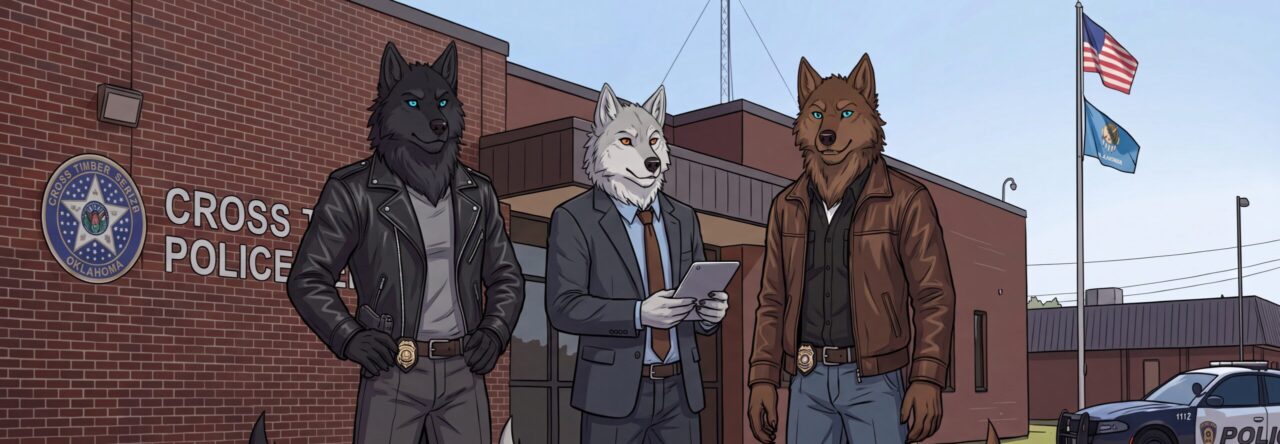
Parker Sloan chose the courthouse steps.
That was his first mistake.
He chose two o’clock in the afternoon, when the Oklahoma sun sat high enough to punish anyone foolish enough to wear a suit outside and when every local news crew could make it back to edit before the evening broadcasts.
That was not his mistake.
That was strategy.
His mistake was believing the steps belonged to him.
They did not.
They belonged to every person in Cross Timber who had walked up them with fear in their throat, paperwork in their hands, a child beside them, or a hope that someone inside the building would know the difference between law and noise.
Sloan arrived with Dale Whitcomb’s cousin, one junior attorney, one legal assistant, two poster boards, and a face built for cameras.
The poster boards were covered before the cameras started rolling.
That was his second mistake.
He should have left them covered.
A small press riser had been set up near the lower steps. Three television cameras waited. Two local newspaper reporters stood beneath the scant shade of a courthouse elm. A radio reporter balanced a recorder in one hand and a bottle of water in the other. A freelance blogger held a phone on a stabilizer and looked far too pleased to be near conflict.
Behind them, a crowd had begun gathering.
Not enormous.
Not organized.
Worse for Sloan.
Organic.
People arrived in twos and threes, drawn by the same quiet force that moved small towns when someone tried to speak loudly about someone they knew.
A retired teacher from the community garden stood with a straw hat in both hands.
The owner of the diner leaned against the low stone wall, arms folded.
Two firefighters stood near the back in station shirts.
A woman from Bridge House held a paper cup of iced tea and watched with the patient expression of someone who had heard better lies from worse men.
Kaden stood beside his father, both of them under the elm. Kaden wore his Keen sandals and clutched a folded drawing against his chest.
His father had clearly told him three times not to shout.
Kaden looked like he was considering obedience as an abstract concept.
A few patrol spouses were there.
A custodian from the high school.
The QuickMart clerk Thane had helped on his first ride-along.
A man whose mother had once wandered from home in winter and had been found because Thane could scent what others could not.
A woman from the summer movie night committee.
Two city maintenance workers who had watched three werewolves spend an entire Sunday moving lumber at the community garden and refusing applause.
None of them carried signs.
None of them had needed time to make signs.
They had brought themselves.
That was enough.
Sloan stepped to the microphones at 14:03.
The cameras lit.
He smiled with the grave restraint of a man pretending not to enjoy himself.
“Good afternoon. My name is Parker Sloan, and I represent Dale Whitcomb, a citizen of this community whose constitutional rights were violated in a manner so extreme, so disturbing, and so dangerous that no person in Cross Timber should feel safe ignoring it.”
The crowd was quiet.
Not approving.
Listening.
Sloan mistook the silence for space.
He continued.
“This case is about what happens when law enforcement allows fear and spectacle to replace constitutional policing. My client was not merely arrested. He was terrorized. A werewolf detective broke into his home, seized him, lifted him off the floor, pinned him against a wall, and threatened him with monstrous violence.”
A camera shifted.
Someone in the crowd muttered, “Your client was beating a kid.”
Sloan heard it.
He kept going.
“We must ask ourselves whether badge and fang together now place citizens beneath the protections the rest of us take for granted.”
The diner owner’s eyebrows went up.
The Bridge House woman took a slow drink of tea.
Sloan nodded to his legal assistant.
The first poster board was uncovered.
It showed a still image taken from a crime-scene photograph: the cracked wall beside the pantry, five claw marks visible in the plaster.
A murmur moved through the reporters.
Sloan turned to the image.
“This is not law enforcement. This is intimidation. This is terror as state policy. This is—”
“Counselor.”
The voice came from the front row.
Tanya Reeves from Channel 8 had been covering Cross Timber long enough to know when a man was trying to choose her headline for her.
Sloan turned toward her with polished patience.
“Yes.”
“Are you disputing that officers entered after a child reported active abuse?”
Sloan smiled slightly.
“We are disputing the lawfulness and proportionality of what followed.”
“That was not my question.”
The smile held.
“No, we are not disputing that a report was made.”
“Are you disputing that officers heard a child scream before entry?”
Sloan’s eyes flicked once toward his junior attorney.
“We have not had the opportunity to fully test every allegation—”
“So you are not disputing it today.”
“I am saying the State’s narrative is incomplete.”
Another reporter spoke before Reeves could follow up.
“Are you disputing that your client was holding a belt when officers entered?”
Sloan turned.
“The presence of a belt does not justify a werewolf detective threatening a citizen’s life.”
“Is that a no?”
Sloan’s smile thinned.
“I am not going to allow this press conference to become a trial of unproven allegations.”
The radio reporter lifted his recorder higher.
“Counselor, medical records referenced in court show injuries to Mason Whitcomb. Are you saying those injuries were fabricated?”
Sloan’s jaw worked.
“I am saying that my client is presumed innocent.”
“No one asked about presumption,” Reeves said. “Are you disputing the injuries?”
Sloan shifted his weight.
“We dispute the State’s characterization of events.”
The blogger, unexpectedly useful, said, “What about the locked pantry?”
The crowd moved.
Not loud.
A tightening.
The Bridge House woman lowered her tea.
Sloan turned too quickly.
“The allegations about household conditions are part of an ongoing case, and I will not litigate them here.”
“But you called the press conference,” the blogger said.
A sound moved through the crowd.
Not laughter exactly.
Recognition.
Sloan pressed his lips together.
“This press conference concerns police misconduct.”
A woman near the back called out, “It concerns what you want it to concern.”
The legal assistant looked nervous.
Sloan ignored her.
“Detective Thane’s conduct was so outrageous that the court has already recognized serious concerns—”
Reeves cut in.
“The court denied your motion to suppress the physical evidence.”
Sloan’s eyes sharpened.
“The court granted portions of our motion.”
“It limited statements made during the wall incident,” Reeves said. “It did not suppress the belt, the house evidence, the pantry lock, the medical findings, or officer observations. Correct?”
Sloan smiled again.
It was becoming less convincing each time.
“The court’s ruling was mixed.”
The radio reporter said, “But mostly against you.”
The crowd made that sound again.
Not applause.
Not quite.
Sloan’s left hand tightened on the side of the podium.
“Our fight is not over.”
A man from the crowd said, “Neither is Mason’s.”
That one landed harder.
The cameras shifted toward the voice.
Kaden’s father stood under the tree, one hand on his son’s shoulder.
He had not meant to become part of the press conference.
His face said as much.
But he had spoken.
Now everyone looked at him.
Sloan seized the opportunity.
“Sir, I understand emotions are high—”
Kaden’s father shook his head.
“No, you don’t.”
The crowd went silent.
He continued, voice steady.
“My son knows Detective Thane.”
Kaden looked up at him, then at Sloan.
“He’s nice,” Kaden said loudly.
His father’s hand tightened gently on his shoulder.
“Kaden.”
Kaden looked up.
“You said not to shout. I did not shout.”
Several people in the crowd smiled despite themselves.
Sloan’s expression flickered.
Kaden’s father continued.
“My son was scared of being different. Detective Thane treated him like he mattered. He got down low, talked gentle, let him be proud of his own feet. That wolf you keep trying to sell everybody? That’s not the man my kid knows.”
Sloan drew himself up.
“No one is denying that Detective Thane may have positive relationships in the community. That does not excuse—”
“No,” said the Bridge House woman.
Everyone looked at her.
She stepped forward half a pace.
“It does not excuse what he did wrong.”
Sloan brightened.
Too soon.
She continued.
“But it also does not excuse what your client did. And you are working very hard to talk about the wall because you do not want to talk about what was behind it.”
The cameras turned toward her.
Sloan’s legal assistant whispered something.
Sloan ignored it.
“This is precisely my concern,” Sloan said. “Community affection for a popular officer cannot be allowed to override constitutional principles.”
The diner owner laughed once.
Sharp.
“You think we love him because he’s popular?”
Sloan turned.
The diner owner stepped away from the wall.
“We love him because he shows up.”
A murmur moved through the crowd.
The owner kept going.
“He shows up when people are hungry. Shows up when somebody’s car dies. Shows up when a kid wants a picture and he’s tired enough to fall over. Shows up when nobody’s watching. You’re standing there acting like Cross Timber got fooled by teeth. We know exactly who he is.”
A firefighter near the back said, “He moved a roof beam off a man and apologized for scratching the paint.”
The high school custodian added, “He stayed two hours after an alarm because I was embarrassed and didn’t want to walk the building alone.”
The QuickMart clerk called out, “He did not scare me on the worst night of my life. He made me feel safe.”
Sloan lifted both hands.
“I understand people feel strongly—”
Reeves spoke over him.
“Counselor, do you believe the public should be more upset that your client was frightened than that five foster children were allegedly abused?”
Sloan stopped.
The whole press conference narrowed to that one question.
The cameras held him.
The crowd held him.
The courthouse steps held him.
His face moved through three possible answers and rejected all of them too late.
“That is a false choice,” he said finally.
The Bridge House woman said, “No, it isn’t.”
Sloan looked toward her.
She did not look away.
Reeves pressed.
“Then answer it another way. What should the public focus on first?”
Sloan inhaled.
“The public should focus on the fact that constitutional rights belong to everyone, even people accused of terrible crimes.”
That was his best answer.
It was also true.
That made it dangerous.
For one second, the crowd had to respect it.
Then the radio reporter asked, “Do children have rights in foster homes?”
Sloan’s face tightened.
“Of course.”
“Did Mason?”
Sloan did not answer fast enough.
The silence answered for him.
Kaden unfolded the paper in his hands.
His father looked down.
“Kaden, not now.”
Kaden looked at the drawing.
Then at Sloan.
Then at the cameras.
He held it up.
It was a crayon picture of three wolves standing beside a child in sandals. Above them, in crooked letters, it said:
POWERFUL PAWS, POWERFUL YOU
Sloan stared at it like it had been engineered by a hostile public-relations firm.
It had not.
That was why it worked.
The crowd did applaud then.
Not wild.
Not cruel.
Firm.
A sound that said enough.
Sloan tried to recover.
“My client deserves due process.”
The diner owner called back, “Then talk due process. Stop trying to make the wolf the monster.”
The cameras caught that too.
Sloan’s junior attorney leaned in and whispered urgently.
This time, Sloan listened.
He gathered his papers.
“We will continue to pursue every legal remedy available. No further questions.”
He stepped away from the microphones.
The reporters shouted anyway.
“Are you disputing the ledger?”
“Will your client testify?”
“Is Carol Whitcomb cooperating?”
“Do you have a response to the medical findings?”
“Counselor, did your client lose foster certification before?”
Sloan’s stride quickened.
The legal assistant struggled with the poster board of the wall.
The wind caught it, twisted it, and for one ridiculous second the claw-mark photograph spun sideways in front of the cameras.
Behind it, a child’s drawing remained lifted in two small hands.
That was the image the evening news used.
Not the wall.
Thane watched none of it live.
Eli had been very specific.
No press.
No comments.
No unofficial channels.
No texts.
No doom-scrolling.
Gabriel interpreted this as no doom-scrolling by Thane specifically, which meant Gabriel watched the entire press conference on his phone in the kitchen while narrating despite Mark telling him three times not to.
Thane sat at the far end of the island with coffee and the expression of someone pretending not to hear every word.
He heard every word.
Of course he did.
Gabriel leaned over the phone.
“Oh, Sloan just said badge and fang. That is terrible. That is almost good enough to be terrible on purpose.”
Mark did not look up from the tablet.
“Do not repeat his framing.”
“I am mocking his framing.”
“That still repeats it.”
Gabriel lowered the volume.
Then raised it again when Tanya Reeves began asking questions.
“Oh. Oh, she has teeth.”
Thane looked at him.
Gabriel glanced up.
“Journalistic teeth.”
Mark said, “Acceptable.”
Silas was at Red Dirt.
That helped and did not.
Thane was glad he was not there to watch him watch this.
He was also painfully aware that Silas would have known exactly when to say something that made the room bearable.
On the phone, Reeves asked whether the public should be more upset Dale had been frightened than that five foster children had been abused.
Gabriel went still.
Mark stopped pretending not to watch.
Thane lowered his eyes.
Sloan called it a false choice.
Gabriel’s ears went flat.
Mark said, very quietly, “It is not.”
Then Kaden’s voice came through the phone, bright and stubborn.
“He’s nice.”
Thane closed his eyes.
Gabriel did not narrate that part.
No one spoke when Kaden’s drawing appeared.
The applause sounded small through the phone speaker.
It still filled the kitchen.
Thane stood.
Gabriel muted the video.
Mark watched him carefully.
Thane walked to the window and looked out at the trees.
His throat hurt.
Gabriel came no closer.
“Thane.”
“I scared Toby.”
The sentence entered the room like something that had been waiting all morning outside the door.
Gabriel’s face softened.
“Yes.”
“They clapped anyway.”
Mark set the tablet down.
“They clapped for the whole of you. Not for that second.”
Thane looked back.
Mark continued, “There is a difference.”
Gabriel nodded.
“And they clapped against Sloan trying to make Dale small and you monstrous.”
Thane looked out the window again.
“I was monstrous.”
Gabriel’s voice sharpened.
“For a moment.”
Thane did not answer.
Mark stood.
“That is why the moment matters. That is not why Sloan gets the story.”
Thane breathed once.
The phone buzzed.
Gabriel looked down.
“Eli.”
Thane turned.
Gabriel answered and put it on speaker without asking because Eli always heard everything anyway.
Eli’s voice came through dry as dust.
“I trust nobody is watching the press conference.”
Gabriel looked at the muted phone screen.
Mark looked at Gabriel.
Thane looked at the ceiling.
Eli sighed.
“I hate all of you.”
Gabriel said, “In fairness, Thane did not touch the phone.”
“That defense would fail in court.”
“Would it fail spectacularly?”
“Do not fish for adjectives.”
Thane stepped closer.
“Eli.”
There was a pause.
Eli’s voice changed.
“You saw Kaden.”
“Yes.”
“Breathe through it.”
Thane did.
Not well.
Enough.
Eli continued, “Sloan overplayed. The reporters did their jobs. The community did what communities do when someone mistakes affection for gullibility.”
Thane looked down.
“Does it hurt the case?”
“No. Velez will be annoyed because press conferences always annoy prosecutors, but Sloan did not reveal evidence he should not have. Mostly he made himself look evasive.”
Gabriel said, “He held up the wall picture.”
“I saw.”
“It blew sideways.”
“I saw that too.”
“It was funny.”
“It was useful, which is better.”
Mark asked, “Public perception?”
“Currently not Sloan’s friend.”
Thane’s ears shifted.
Eli continued, “Do not enjoy that too much. Public affection is not legal clearance.”
“I know.”
“Good. Your review is at eighteen hundred. I will be present unless they tell me I cannot be, and then I will be nearby looking expensive and displeased.”
Gabriel whispered, “Boss.”
Eli said, “Gabriel.”
“Yes?”
“No.”
The call ended.
Gabriel stared at the phone.
“He preemptively no’d me after hanging up.”
Mark picked up the tablet again.
“Efficient.”
Thane almost smiled.
Almost.
Then his phone chimed.
Not Eli.
Silas.
A text.
Alejandra says Sloan looks like a man who argues with return policies.
Thane stared at it.
Gabriel leaned in.
Thane let him read it.
Gabriel wheezed.
Mark took the phone, read it, and nodded with serious appreciation.
“Precise.”
Thane took the phone back.
Another text appeared.
I say Kaden was right. Go answer clean. Come home after.
Thane read it twice.
Then typed:
I will.
He set the phone down.
Outside, the afternoon kept moving.
Inside, the next part waited.
Night Shift reported at 17:42.
Officially, Thane was still on administrative assignment until the review board gave preliminary direction.
Unofficially, every person in the building knew exactly where he was before he reached the squad room because conversations changed shape when he passed.
Not stopped.
Not dramatically.
Just adjusted.
Less loose.
More careful.
No one cheered.
No one clapped him on the back.
No one said what they would have done to Dale Whitcomb if given the chance, because cops who had been around long enough knew that fantasy did not belong near reports.
But as Thane walked past the front desk, Boyd looked up from paperwork and gave him one small nod.
Not approval on paper.
Not absolution.
A human thing.
Then Patel, standing near the printer with a stack of supplemental forms, did the same.
Serrano caught his eye from the hallway. Her face stayed professional. Her chin dipped once.
Darnell passed with coffee, slowed half a step, and said only, “Detective.”
The word carried more than rank.
Thane answered, “Officer.”
Grant was not in the building.
She was still following up with child welfare and the hospital, and Thane was relieved.
Seeing her might have undone him.
Crowe stood near the duty board, arms folded.
She watched the nods happen.
She did not stop them.
She also did not join them.
That was Crowe.
That was command.
Gabriel stepped close enough to murmur, “Subtle parade.”
Mark said, “Do not call it that.”
“It has nods.”
“It lacks permits.”
Thane looked at them both.
“Please stop helping.”
Gabriel nodded.
“Emotionally or legally?”
“Yes.”
Mark said, “Wise.”
They entered the conference room for handoff.
Voss and Rusk were already there with day-shift folders. Voss looked tired in the particular way of a detective who had spent too many hours asking questions no one wanted to answer. Rusk sat beside him with coffee, a pen, and the air of a man who could smell procedural trouble through walls without being a werewolf.
Voss looked up when Thane entered.
His eyes held on him for half a second.
Then he nodded.
Not small.
Not large.
Enough.
Rusk said, “Well, you made the news.”
Gabriel sat.
“Good or bad angle?”
“Depends whether you are the wall.”
Mark opened his tablet.
“Noted.”
Voss pointed his pen at the table.
“Handoff.”
They began.
Day shift had three burglaries that were probably one burglary with three addresses and one fool using the same stolen gray pickup.
A pharmacy fraud case had produced a partial plate.
A missing-person report from the morning had resolved when the adult daughter in question called from Amarillo and asked everyone to stop treating her vacation like a kidnapping.
Rusk gave that one with no expression.
Gabriel said, “Was it a good vacation?”
Rusk looked at him.
“She was in Amarillo.”
Gabriel nodded.
“Answered.”
Voss moved to a vandalism case at the high school.
Mark asked two questions about camera angles.
Gabriel asked one about whether the mascot statue had been repaired.
Thane listened.
He took notes.
Normal work moved around him like water finding a channel.
It helped.
Then Crowe opened the door.
“Thane.”
The room went quiet.
Not shocked.
Waiting.
Crowe’s voice stayed matter-of-fact.
“Review board is ready.”
Thane stood.
Gabriel began to stand too.
Crowe looked at him.
“No.”
Gabriel sat.
Mark’s eyes moved to Thane.
Thane gave him a small nod.
He followed Crowe out.
Behind him, Voss resumed handoff after exactly three seconds.
That helped too.
The work did not stop because one officer had to answer for himself.
Good.
It should not.
The administrative review met in the smaller command conference room.
No flag backdrop.
No raised table.
No theater.
Whitaker sat at the head.
Mercer sat to her right, jacket off, tie loosened, expression serious beneath the usual weary humor.
Crowe sat beside him with the case file.
Lieutenant Haskins from Professional Standards sat across the table with a recorder, a printed packet, and reading glasses low on his nose.
City Attorney Dana Pell sat near the end, there to make sure words meant what words were supposed to mean.
Eli sat beside Thane.
He had been allowed in.
He looked almost disappointed not to have had to fight about it.
Whitaker began.
“This is a preliminary administrative review regarding Detective Thane’s use of force and conduct during the arrest of Dale Whitcomb on Friday evening.”
Haskins turned on the recorder.
The small red light glowed.
Thane looked at it.
Then at Whitaker.
She continued.
“This is not a criminal proceeding. This is not a disciplinary hearing beyond preliminary findings and immediate personnel action. Detective Thane, you have submitted a written report and use-of-force statement. You have reviewed both?”
“Yes.”
“Do you stand by both as accurate?”
“Yes.”
“Do you wish to amend or clarify anything before questions?”
Thane glanced at Eli.
Eli did not move.
Thane looked back at Whitaker.
“No.”
Haskins opened the packet.
His voice was mild, almost gentle.
That made the process feel more serious, not less.
“Detective, I’m going to walk the sequence. If I misstate anything, correct me.”
“Yes, Lieutenant.”
“You responded from the community center after Lily reported active abuse.”
“Yes.”
“You followed her to the residence.”
“Yes.”
“You heard a child scream and sounds consistent with a belt strike before entry.”
“Yes.”
“You forced the front door.”
“Yes.”
“You observed Dale Whitcomb in the kitchen holding a belt over Mason.”
“Yes.”
“You disarmed Dale Whitcomb.”
“Yes.”
“At that point, was the belt still in Dale Whitcomb’s control?”
“No.”
“Was Mason still in immediate danger of being struck by the belt?”
Thane paused.
Eli’s eyes shifted to him.
Thane answered carefully.
“Not by the belt in that second.”
Haskins nodded.
“Then Dale Whitcomb verbally insulted Mason.”
“Yes.”
“What did he say?”
“He called him that little bastard.”
Mercer’s jaw tightened.
Crowe looked down at the file.
Haskins did not react.
“And after that statement, you struck the cabinet?”
“I struck the cabinet before that statement.”
Haskins checked the timeline.
“You are correct. Cabinet strike occurred after Dale said Mason stole food and ‘knows better.’ The lift occurred after the later insult.”
“Yes.”
“Why did you strike the cabinet?”
“To gain compliance through intimidation.”
Haskins wrote one note.
“Why did you lift Dale Whitcomb?”
Thane breathed once.
“To scare him.”
“Was that a trained control technique?”
“No.”
“Was he actively resisting arrest at that moment?”
“No.”
“Was he attempting to reach a weapon?”
“No.”
“Was he advancing on a child?”
“No.”
“Was he verbally cruel?”
“Yes.”
Haskins looked up.
“Is verbal cruelty alone justification for lifting and pinning a suspect to a wall?”
“No.”
The room stayed quiet.
Haskins nodded once.
“Did you intend to kill him?”
“No.”
“Did you want to?”
The question landed exactly where it was supposed to.
Eli’s posture changed by a fraction.
Whitaker watched Thane.
Crowe watched him too.
Thane answered.
“For a second, yes.”
Haskins did not blink.
“What stopped you?”
Thane looked down at his paws.
“Pack fear.”
No one spoke.
He continued.
“I smelled Gabriel and Mark afraid of what I might do. Then I saw the children watching.”
Haskins’s pen stopped for half a second.
Then moved.
“And you released him.”
“Yes.”
“Did you strike Dale Whitcomb?”
“No.”
“Did you injure him?”
“Not physically, according to available medical clearance.”
Pell made a note.
Haskins continued.
“Do you understand why this review is occurring?”
“Yes.”
“Tell me.”
Thane looked at Whitaker.
Then Crowe.
Then Haskins.
“I stopped the immediate threat lawfully. Then I let anger drive me past what was necessary. I used fear as punishment. I made myself the focus for the children after they had already been hurt by adults who lost control.”
The room held that.
Whitaker’s face did not soften.
But something in her eyes shifted.
Haskins closed the packet halfway.
“Do you offer any defense of your conduct?”
Eli looked at Thane.
Not warning.
Listening.
Thane sat still for a long moment.
Then said, “Only context.”
Haskins nodded.
“Go ahead.”
Thane’s claws rested open on the table.
“Police training changed me.”
No one interrupted.
“Before joining the department, I was not controlled the way I am now. I was protective. I was strong. I thought that was enough.”
He swallowed.
“It was not.”
Crowe’s eyes stayed on him.
Thane continued.
“Training taught me to slow down. To report before motion. To name what I can prove. To let law hold anger instead of letting anger pretend to be law.”
Mercer looked down at the table.
Thane’s voice lowered.
“Most things that used to make me angry do not get me there anymore. Insults. Threats. Guns. Pain. Being shot. Being hated. Being afraid. I can work through those.”
He stopped.
Then said the rest.
“Abuse of innocents still gets past me.”
The words seemed larger than the room.
“Children. Elderly people. Animals. People who cannot protect themselves from the person hurting them.”
His claws flexed once.
He made them still.
“That makes my blood boil. I am not saying that excuses what I did. It does not.”
He looked at Haskins.
“It is the place where the wolf outran the detective.”
No one spoke for several seconds.
The recorder’s red light stayed steady.
Finally, Whitaker said, “Then that is where the detective has more work to do.”
Thane nodded once.
“Yes, Chief.”
Haskins looked at his notes.
“Any questions from counsel?”
Eli sat back slightly.
“One clarification.”
Whitaker nodded.
Eli looked at Haskins.
“My client’s statement regarding anger at abuse of children, elderly persons, and animals is not offered as justification, and I would like the record to reflect he has expressly disclaimed it as justification.”
Haskins nodded.
“So reflected.”
Eli looked at Thane.
“Nothing further.”
Mercer folded his hands.
“I have one.”
Whitaker looked at him.
Mercer focused on Thane.
“If this happens tomorrow, what changes?”
The room went still again.
Thane did not answer fast.
Good.
He owed the question time.
Finally, he said, “I break the door.”
Mercer nodded.
“I take the belt.”
Another nod.
“I put myself between the adult and the child.”
“Yes.”
Thane’s voice roughened.
“Then I back out far enough for cuffs to become the answer.”
Crowe’s eyes sharpened.
Thane continued.
“If I feel the red coming, I say it out loud. Gabriel and Mark take physical position. Patrol cuffs. I do not stay in the suspect’s face to teach him fear.”
Mercer held his gaze.
“And if he says something vile?”
Thane’s jaw tightened.
“He probably will.”
“Yes.”
“I let the report carry it.”
Mercer leaned back.
“Good.”
Whitaker looked to Haskins.
“Preliminary finding.”
Haskins turned one page.
“Based on reports, witness statements, court ruling, and Detective Thane’s own statement, Professional Standards finds the initial response, entry, and disarm within policy given exigent circumstances and immediate threat to a child. The subsequent cabinet strike, physical lift, wall pin, and threatening statement are outside policy and constitute excessive intimidation and improper use of force for punitive compliance.”
Thane accepted each word.
“Recommended action,” Haskins continued. “Written reprimand placed in personnel file. Mandatory review of vulnerable-victim response protocols. Strong recommendation for continued work with Dr. Price regarding anger recognition and mitigation in vulnerable-victim cases. Return to active duty permitted under command discretion.”
Whitaker looked at Pell.
Pell nodded.
Whitaker opened a folder and slid a single page across the table.
“Letter of reprimand.”
Thane read it.
Every word.
No softening.
No embellishment.
It stated the good.
It stated the wrong.
It stated the expectation.
He signed.
The pen felt heavier than it should have.
Whitaker took the page back.
“This goes in your personnel file.”
“Yes, Chief.”
“You are cleared to return to active duty tonight.”
Thane looked up.
Gabriel and Mark were not there to hear it.
He wished they were.
Whitaker continued.
“You will attend vulnerable-victim protocol review within thirty days. You will schedule with Dr. Price before end of week.”
“Strong recommendation?” Eli asked mildly.
Whitaker looked at him.
“Strong enough that I will become irritating if ignored.”
Eli nodded.
“Understood.”
Thane said, “I’ll schedule.”
Crowe spoke for the first time.
“Not because you are broken.”
Thane looked at her.
“Because that line matters enough to guard before you are standing on it.”
Thane nodded.
“Yes, Lieutenant.”
Haskins turned off the recorder.
The red light died.
The room shifted.
Not relaxed.
Finished.
Mercer leaned back and rubbed one hand over his face.
“Off the record, which means Eli will pretend not to hear me.”
Eli said, “I heard the phrase off the record and immediately suffered temporary spiritual deafness.”
Mercer looked at Thane.
“You scared the hell out of a child abuser.”
Thane said nothing.
Mercer continued.
“A lot of people are going to understand that. Some are going to quietly approve. Some already do.”
Whitaker’s face warned him.
Mercer lifted one hand.
“I’m not done.”
He looked back at Thane.
“That approval cannot become permission. Not from them. Not from us. Not from you.”
Thane nodded.
“Yes, sir.”
Whitaker stood.
“Return to handoff.”
Thane stood too.
At the door, Haskins said, “Detective.”
Thane turned.
Haskins looked at him over the top of his reading glasses.
“My grandson has a dog he cannot bear to hear yelp. Sweetest kid in the world. Goes from zero to war if someone scares that animal.”
Thane waited.
Haskins closed his folder.
“We do not teach children that love is wrong. We teach them what to do with their hands.”
Thane’s throat tightened.
“Yes, Lieutenant.”
Haskins nodded.
“Go work.”
The handoff was nearly finished when Thane returned.
Gabriel looked up first.
His ears gave him away before his face did.
Mark looked next.
Voss stopped mid-sentence.
Rusk leaned back in his chair.
Crowe entered behind Thane and took her place by the board.
Whitaker did not come with him.
That told them enough.
Thane sat.
Gabriel stared.
Mark stared less obviously.
Voss tapped his pen once.
“Are we continuing?”
Thane said, “Cleared to work.”
Gabriel exhaled.
Not dramatically.
Almost.
Mark’s shoulders eased.
Rusk said, “Then try not to lift anyone during my burglary update.”
Gabriel pointed at him.
“That was almost tender.”
Rusk looked offended.
“It was not.”
Voss resumed.
“The gray pickup is probably still local. Tag is partial Oklahoma commercial, last two digits maybe seven-three. Owner of the pawn shop says the suspect tried to sell three cordless drills and a saxophone.”
Gabriel blinked.
“Same burglary?”
“Different burglary,” Voss said.
“Who steals a saxophone and drills?”
Rusk looked at him.
“An optimist.”
Mark made a note.
Thane listened.
The work moved back around him.
Not as if nothing had happened.
As if something had happened and the work still needed doing.
That was better.
When handoff ended, Gabriel waited until Voss and Rusk left before leaning toward Thane.
“Letter?”
“Yes.”
“Folder?”
“Yes.”
“Dr. Price?”
“Before end of week.”
Mark nodded.
“Good.”
Thane looked at him.
“You are relieved.”
“Yes.”
Gabriel crossed his arms.
“I am also relieved, but with more personality.”
Crowe, still at the board, said, “Try putting some of it in reserve.”
Gabriel closed his mouth.
Thane looked at Crowe.
“Lieutenant.”
She glanced over.
“Thank you.”
Her expression stayed flat.
“For what?”
“Being exact.”
Crowe looked at him for one long second.
“Stay worth it.”
Then she walked out.
Gabriel watched her go.
“She should teach greeting cards.”
Mark said, “I would buy them.”
The night, mercifully, refused to become historic.
Their first patrol assist was a disabled car at the intersection of Elm and Juniper during the dinner rush.
An elderly sedan had died in the left turn lane with its hazard lights blinking in exhausted apology. The driver, a college student with blue hair and the expression of someone one inconvenience away from becoming vapor, stood beside it holding jumper cables and a smoothie.
Patel had traffic blocked when the Humvee arrived.
Gabriel stepped out.
“Good evening. We are here to provide mechanical intimidation.”
The student blinked.
“What?”
Mark said, “Ignore him. What happened?”
“It just died. Like, spiritually.”
Thane looked at the sedan.
“That may be accurate.”
They pushed the car through the intersection into a gas station lot. Thane pushed from the rear bumper with two fingers because the bumper looked one sincere effort away from becoming evidence. Gabriel guided the steering wheel from outside the driver’s door because the student was too rattled to do it.
Mark set flares with Patel and called for a tow.
No one cried.
No one bled.
No one raised a belt.
The student looked at Thane when it was over.
“Are you the wolf from the news?”
The question landed awkwardly.
Patel looked suddenly fascinated by traffic cones.
Gabriel’s ears shifted.
Thane answered, “Yes.”
The student swallowed.
“Did you really break a wall?”
“Yes.”
“Oh.”
The student looked at the dead sedan.
Then back at him.
“My dad used to hit my brother.”
The gas station sounds seemed to lower.
Thane did not move.
The student hugged the smoothie against her chest.
“Nobody came.”
Gabriel’s face changed.
Mark’s did too.
The student looked embarrassed immediately.
“Sorry. That was weird.”
Thane kept his voice quiet.
“No.”
She looked up.
“I am sorry no one came.”
Her eyes filled fast.
She nodded, wiped them with the back of one hand, and looked away.
Patel stepped in gently.
“Tow’s ten minutes out. You got someone to wait with you?”
She nodded.
“My roommate.”
“Good.”
They left her under the gas station lights with Patel nearby and her phone pressed to her ear.
In the Humvee, Gabriel stared through the windshield.
“So much for ordinary.”
Mark said, “Ordinary contains more than we admit.”
Thane looked out the side window.
He said nothing.
But his paws stayed open.
The next call was a burglar alarm at the high school.
The culprit was the night custodian, who had entered through the wrong door after forgetting his badge in his truck.
He apologized thirteen times.
Thane recognized him from the press conference crowd.
The custodian recognized Thane recognizing him.
For a moment, both pretended not to.
Then the custodian looked at the floor.
“I should not have yelled at that lawyer.”
Gabriel said, “Volume was moderate.”
Mark said, “Content was pointed.”
Thane looked at the custodian.
“You said what you meant.”
The custodian nodded.
“He was trying to make people forget the kid.”
Thane’s voice stayed low.
“Yes.”
The custodian looked up.
“You didn’t.”
Thane did not know what to say to that.
So he said the truest available thing.
“I almost did, in another way.”
The custodian looked at him for a moment.
Then nodded slowly.
“Well.”
He held up his forgotten badge.
“Then don’t.”
Mark cleared the alarm with dispatch.
Gabriel waited until they were outside to say, “Cross Timber has become uncomfortably direct.”
Thane said, “Good.”
The third call was a water-main break near Henderson Avenue.
No crime.
Only water, mud, traffic cones, and city workers who looked at the wolves with the exhausted gratitude of men who needed large bodies more than conversation.
Thane and Gabriel moved barricades.
Mark coordinated with dispatch and public works.
A minivan tried to ignore the cones and nearly baptized itself in the sinkhole.
Gabriel stepped in front of it and pointed silently toward the detour.
The driver obeyed.
Mark looked at him.
“That was a legal use of intimidation.”
Gabriel brightened.
“I feel seen.”
Thane almost smiled.
The final call before dawn was not really a call.
It was Sandra.
Or possibly a different chicken.
No one could prove anything.
Serrano requested assistance near the restaurant supply warehouse with the clipped patience of an officer whose life had taken an unacceptable thematic turn.
“Dispatch, show me out with one loose chicken, same general area as last night. No additional units required unless Night Shift is bored.”
Gabriel seized the radio.
“Night Shift is never bored.”
Mark closed his eyes.
Thane drove.
Sandra, if it was Sandra, had positioned herself on top of a stack of pallets and was refusing negotiation.
Serrano stood below with a cardboard produce box.
“I am not writing another chicken supplement.”
Gabriel approached the pallets slowly.
“Sandra.”
The chicken looked at him.
Gabriel softened his voice.
“We talked about this.”
Mark said, “You talked. Sandra did not acknowledge.”
Thane stood beside the pallets and lifted one paw.
The chicken stepped onto it.
Everyone stared.
Thane lowered her into the box.
Serrano closed the flaps.
Gabriel looked betrayed.
“She chose you.”
Thane looked at the box.
“She recognized command presence.”
Mark said, “Or height.”
Serrano took the box.
“I hate that this is my favorite call of the week.”
Gabriel said, “Put that in the report.”
“No.”
They cleared just as the eastern sky began to pale.
At 05:47, Night Shift returned to the station.
No heroics.
No speeches.
No further legal emergencies.
The building smelled like coffee, floor cleaner, printer toner, and the end of a long night.
Crowe stood by the duty board with a fresh cup.
She looked at Thane.
“Anything I need to know?”
Mark said, “Disabled vehicle, alarm, water-main assist, chicken.”
Crowe paused.
“Same chicken?”
Gabriel said, “Emotionally, yes.”
Crowe looked at him for one full second.
Then wrote nothing down.
Good lieutenant.
Thane handed over the short summaries.
Crowe read them.
Her eyes paused on the disabled vehicle note, where Mark had written:
Driver made spontaneous personal statement regarding past family violence. No investigative action requested. Officer Patel remained until support person arrived.
Crowe looked at Thane.
He met her eyes.
She nodded once.
Not approval.
Not absolution.
Recognition.
“Go home,” she said.
They did.
The Humvee carried them through morning streets washed clean by sprinklers and the last blue edge of night.
At the cabin, Silas was in the kitchen again.
Work pants.
Red Dirt shirt.
Lunch bag.
The rhythm of him.
He looked up as they entered.
“Work?”
Thane set his keys on the island.
“Yes.”
“Review?”
“Letter. Cleared. Dr. Price.”
Silas nodded.
“Good.”
Gabriel opened the refrigerator.
Silas said, “Cheese is not breakfast.”
Gabriel closed the refrigerator.
Mark said, “Also good.”
Silas looked at Thane.
“Press conference?”
Thane exhaled.
“Kaden held up a drawing.”
Silas’s face softened.
“I saw.”
Of course he had.
Thane looked at him.
“He should not have to defend me.”
Silas stepped closer.
“Maybe he was defending what he knows.”
Thane said nothing.
Silas continued.
“People can know you did wrong and still know Sloan was lying about who you are.”
Thane looked down at his paws.
“They clapped.”
“Yes.”
“I do not want applause for that.”
Silas’s voice was steady.
“Then do not take it for that.”
Thane looked up.
Silas shrugged slightly.
“Take it for the years before it.”
Gabriel, from near the fridge, said softly, “That is annoyingly good.”
Mark said, “Very.”
Silas looked embarrassed and pleased again.
Thane stepped closer and pulled him into a careful hug.
Silas stiffened for half a second, then leaned in.
Red Dirt dust.
Coffee.
Pack.
Thane lowered his head.
“Thank you.”
Silas’s voice was muffled against his chest.
“You are welcome.”
Gabriel whispered, “Powerful paws, powerful litigation.”
Mark said, “No.”
Silas said, “Definitely no.”
Thane laughed before he could stop it.
Not much.
Enough.
The house accepted it.
Outside, the morning brightened through the trees.
Somewhere in Cross Timber, reporters were editing footage of a lawyer trying to point at claw marks while a town pointed back at bruises, locks, ledgers, and children.
Somewhere, Dale Whitcomb sat in a cell with due process around him whether he deserved the grace of it or not.
Somewhere, Mason and Lily and Toby and Emma and Rose were waking up in a place that was not the beige house with the welcome sign.
And somewhere inside Thane, the wolf still paced.
Not gone.
Never gone.
But watched now.
Named.
Reported before motion.
Guarded by training, by pack, by law, by Dr. Price, by the letter in his file, by the memory of Toby flinching, and by the knowledge that love did not make his hands right.
It only made them worth teaching.
Thane held Silas a moment longer.
Then let go.
Because good things had to stop too.
Because that was part of being safe.
Because the work would continue.
And because, for tonight, the facts had refused to move.