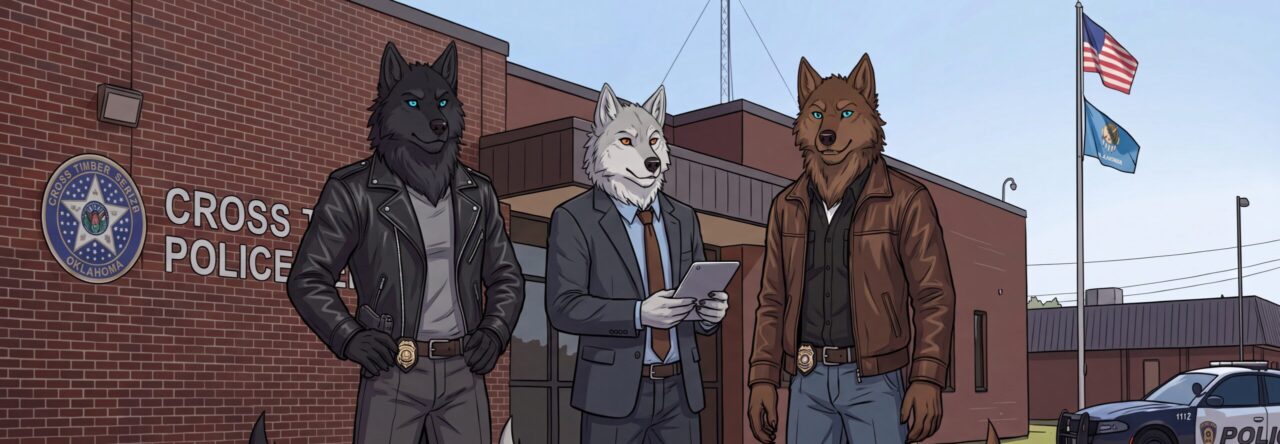
Mercer went looking for Tums before the trouble officially began.
That mattered later.
It proved instinct existed before evidence.
He had been in three meetings since lunch, two of which had involved budget numbers and one of which had involved a citizen advisory email thread that used the phrase optics of wolf-based policing six times in four paragraphs.
By 17:36, Deputy Chief Mercer had reached the natural conclusion of modern police administration.
He needed calcium carbonate.
He opened the breakroom cabinet above the microwave.
Coffee filters.
Stale crackers.
A jar of peanut butter with no name on it and three possible owners.
No Tums.
He opened the next cabinet.
Paper plates.
Plastic forks.
One abandoned mug that read WORLD’S OKAYEST FTO.
Still no Tums.
Mercer stared into the cabinet.
“Cowards,” he muttered.
From the hallway, Boyd called, “Sir?”
“Nothing.”
He opened the refrigerator, because desperate men searched irrational places.
No Tums.
Two energy drinks.
A suspicious foil-wrapped object.
A container labeled SERRANO — DO NOT TOUCH UNLESS YOU ENJOY CONSEQUENCES.
Mercer closed the refrigerator.
He was considering whether antacid could be requisitioned under emergency management supplies when the front lobby erupted.
Not screamed.
Not panicked.
Worse.
Professional commotion.
Multiple voices.
A camera case bumping against something.
Boyd saying, “Ma’am, you can’t—sir, this is not—please stay on the public side of—”
Mercer closed his eyes.
“No.”
The lobby got louder.
A woman’s voice said, “We are not leaving until we get a statement.”
A man said, “Deputy Chief Mercer is in the building.”
Mercer opened his eyes.
The empty breakroom cabinet offered no help.
“Traitor,” he told it.
Then he went to the front.
Night Shift was in day-shift handoff when Thane heard his name.
He heard it from two doors away, through walls, over Rusk’s explanation of a stolen saxophone that had somehow become more complicated since the night before.
Rusk said, “Pawn shop owner now says the saxophone case had a false bottom.”
Gabriel leaned forward.
“For drugs?”
“For coins.”
Gabriel blinked.
“Rare coins?”
“No.”
“Then why—”
From the front lobby, a woman’s voice carried sharp and clear.
“We are here to interview Detective Thane.”
Thane froze.
Gabriel turned slowly toward him.
Mark looked up from the tablet.
Voss stopped mid-note.
Rusk leaned back in his chair.
Thane said, “Oh no.”
Gabriel’s ears lifted.
“That sounded like media.”
Mark’s ears angled.
“Plural.”
Voss closed her folder.
“Stay here.”
Thane was already standing.
Voss pointed at him.
“That was not a suggestion.”
Thane looked toward the hallway.
Mercer’s voice rose from the lobby.
“Absolutely not. Interviews are scheduled through the department. You do not arrive with cameras and demand access to personnel.”
Another voice: “Deputy Chief, the public has a right to hear from him.”
Mercer: “The public has a right to many things. Ambushing detectives during shift change is not one of them.”
Thane winced.
Gabriel stood.
“This is either going to be terrible or educational.”
Mark stood too.
“Likely both.”
Voss looked at Rusk.
Rusk said, “You want me to stop them?”
Voss looked toward the hallway.
Mercer’s voice came again.
“No, you may not set up lights in the lobby.”
Voss sighed.
“No. At this point I want to see what happens.”
Thane headed for the door.
Gabriel and Mark followed.
Voss and Rusk came after them because detectives were still detectives even when pretending not to be curious.
The lobby looked like a press conference had been packed into a shoebox.
Two of the largest television stations in the area had arrived with full crews, shoulder cameras, lights, microphones, and the unstoppable confidence of people who believed public buildings existed to improve their footage.
Channel 8 was there.
So was Channel 6.
Tanya Reeves stood near the front desk with a microphone in one hand, calm as a blade. Beside her, a Channel 6 reporter named Nolan Price—not related to Dr. Price, thankfully for everyone—was arguing with Boyd about camera placement.
Boyd looked like he wanted to retire into the evidence freezer.
Mercer stood between the crews and the secure hallway with both hands out.
He had the face of a man who had found no Tums and then been given cameras instead.
“What do you want?” Mercer asked.
Reeves kept her tone reasonable.
“Deputy Chief, after yesterday’s press conference and the court ruling, the community wants to hear from Detective Thane directly.”
“The community can submit that desire through appropriate channels.”
Nolan Price lifted his mic.
“Is the department refusing to allow him to comment?”
“The department is refusing to allow an unscheduled media scrum in the lobby at shift change.”
“That sounds like refusing.”
“It sounds like policy because it is policy.”
Then Thane stepped into the end of the hall.
Every camera turned.
The lights followed.
Bright.
Hot.
Sudden.
The reporters saw him at the same time.
Mercer saw the reporters see him.
“Oh, come on,” Mercer said.
The crews moved around him like water splitting around a tired boulder.
Boyd said, “Hey—public side—”
No one listened.
The cameras reached Thane before the reporters did.
Thane stopped.
Gabriel stopped behind his left shoulder.
Mark behind his right.
Voss and Rusk remained near the hall because they were wise enough not to enter a trap they could observe from cover.
Reeves lifted her microphone.
“Detective Thane, can we ask you a few questions?”
Nolan Price stepped in from the other side.
“Detective, do you have any response to allegations that you terrorized Dale Whitcomb?”
Mercer pushed through the camera line.
“No. No, we are not doing this.”
Thane looked at him.
Then pointed at Mercer.
“He is the boss.”
The lobby went quiet for half a second.
Mercer blinked.
“What?”
Thane kept his paw extended toward him.
“It is up to him.”
Gabriel turned his head slightly and whispered, “Oh, that was beautifully cruel.”
Mark whispered, “Procedurally correct.”
Mercer looked at Thane.
Then at the cameras.
Then at Boyd, who had the desperate hope of a man watching command take command.
Mercer sighed so deeply it should have been filed as an incident report.
“Fine.”
The reporters surged.
Mercer lifted one hand.
“Fine with conditions. This is not a press conference. This is not a case briefing. You get a brief statement and a few questions. No child names beyond what is already in public court record. No evidence details beyond what has been addressed in court. If I say we’re done, we’re done.”
Reeves nodded immediately.
“Understood.”
Nolan Price nodded too, though with the face of a man already planning to ask one extra question.
Mercer turned to Thane.
“You do not have to do this.”
Thane looked at the cameras.
Then at Mercer.
“I know.”
Mercer studied him.
Whatever he saw did not make him happy.
It did make him step back.
“Then be careful.”
Thane nodded.
“Yes, sir.”
The lights were very bright.
The lobby smelled like hot plastic, floor cleaner, coffee, nervous sweat, and Mercer’s blood pressure.
Reeves began.
“Detective Thane, yesterday Dale Whitcomb’s attorney attempted to focus public attention on your use of force. The court found some of your conduct exceeded what was justified but allowed the case to proceed. What is your response?”
Thane looked at her.
Then at the cameras.
The first answer mattered.
He knew that.
Eli was not there.
That mattered too.
So Thane chose the sentence Eli would hate least.
“The court was right.”
The reporters went still.
Mercer’s head turned slightly.
Reeves blinked once.
“Can you elaborate?”
Thane clasped his paws in front of him, claws visible, open, still.
“The door needed to be broken. The child needed help. Dale Whitcomb had a belt raised over a six-year-old boy. Taking that belt from him was right.”
He paused.
“What happened after that went too far.”
Nolan Price lifted his mic.
“Detective, many people in the community disagree. They believe Mr. Whitcomb deserved to be scared. Do you?”
Gabriel went very still.
Mark’s eyes moved to Thane.
Mercer’s mouth tightened.
Thane did not dodge.
“Yes.”
The reporters sharpened.
He continued before they could celebrate it.
“I believe he deserved to feel fear. I am not proud of that answer, but it is honest. It felt good to scare a man who had made children afraid. It felt good to make him feel, for a few seconds, the kind of terror he had put into that house.”
The cameras held him.
The lobby held him.
Mercer looked like he had found a new ulcer and named it.
Thane’s voice lowered.
“That feeling is exactly why I was wrong.”
No one moved.
Thane continued.
“Police officers do not get to turn feeling into punishment. Detectives do not get to decide that fear is justice because it feels deserved. Werewolves especially do not get to let the feral part decide when enough is enough.”
Reeves lowered her mic by a fraction.
Nolan Price did not.
“But Detective, isn’t there a deterrent value? Some people would say child abusers should be afraid. They might think twice knowing you are out there.”
Thane looked at him.
“They should think twice because the law is coming. Because children will be believed. Because officers will break the door when they have to. Because doctors, child welfare workers, prosecutors, judges, and juries will carry the case where it belongs.”
His claws flexed once.
He made them still.
“Not because I might lose control.”
Mercer’s expression changed.
Not soft.
Less doomed.
Reeves asked, “Do you regret what happened?”
“I regret the moment after the threat was stopped.”
“Do you regret entering the home?”
“No.”
“Do you regret taking the belt?”
“No.”
“Do you regret protecting Mason?”
“No.”
Nolan Price asked, “Do you regret making Dale Whitcomb urinate on himself?”
The lobby went cold.
Boyd looked at the floor.
Gabriel’s ears went flat.
Mark’s jaw tightened.
Mercer took one step forward.
Thane answered before Mercer could end it.
“Yes.”
That surprised them more than any growl could have.
Thane looked directly into Nolan Price’s camera.
“Not because I feel sorry for him.”
He paused.
“Because if that is the part people cheer for, then I taught the wrong lesson.”
The microphone did not move.
Thane continued.
“There are probably people who watched that story and thought, ‘I wish I could be a werewolf. I wish I could scare someone like that.’ I understand that. There was a time before this badge when I might have thought the same thing.”
His voice roughened.
“But being a detective means I do not get to succumb to feral instinct and call it protection. Training exists because strength is easy. Authority is hard. Restraint is hard. The line is hardest when someone helpless has been hurt.”
Voss, at the hallway, looked down.
Rusk stared at Thane with no expression at all.
That meant he was listening closely.
Thane drew a breath.
“I crossed that line. I accepted the department’s reprimand. I will work with Dr. Price. I will do the work so that the next child I help sees a protector and not one more adult in the room who might not stop.”
Reeves’s face changed.
Softer.
More serious.
Thane looked back to the cameras.
“To the citizens of Cross Timber: I am sorry for the part I got wrong. I know what I am. I know what I can do. I know why that scares people when it goes too far. I will always strive to be worthy of the badge, worthy of your trust, and worthy of the children who need us to arrive.”
The lobby stayed silent after he stopped.
Even the cameras seemed quieter.
Mercer stared at him.
Not angry.
Almost inconvenienced by not being angry.
Reeves recovered first.
“Detective, what would you say to Mason if you could speak to him?”
Mercer started, “That’s—”
Thane lifted one paw slightly.
Mercer stopped.
Thane looked at Reeves.
“I am not cleared for contact, and that is right.”
Reeves nodded.
“If you could.”
Thane looked down.
Then up.
“I would say he was not in trouble. I would say Lily was brave. I would say adults are responsible for what adults do. And I would say I am sorry if I scared him too.”
Reeves lowered the mic.
She knew ending material when she heard it.
Nolan Price tried one more.
“Do you think Dale Whitcomb deserved mercy?”
Mercer said, “Last question.”
Thane answered carefully.
“I think Dale Whitcomb deserves due process.”
“That is not mercy.”
“It is more than he gave those children.”
That ended it.
Mercer stepped in.
“We’re done.”
This time, the reporters listened.
Mostly.
Reeves nodded to Thane.
“Thank you, Detective.”
Nolan Price said, “Deputy Chief, will there be a formal statement?”
Mercer looked at him.
“Yes. It will say interviews must be scheduled.”
Boyd made a sound behind the desk.
Possibly a cough.
Possibly joy.
The news crews began packing with the quick, satisfied efficiency of people who knew they had better footage than they had expected.
Mercer watched them leave.
He waited until the last camera cleared the lobby doors.
Then he turned to Thane.
For one long second, he said nothing.
Gabriel seemed to stop breathing.
Mark stood perfectly still.
Mercer pointed toward the hall.
“My office.”
Thane’s ears lowered.
“Yes, sir.”
Mercer turned.
Then stopped.
“No. Breakroom first.”
Gabriel whispered, “That seems worse.”
Mark said, “It may involve witnesses.”
Mercer walked into the breakroom, opened the cabinet above the microwave, and stared into it again.
Still no Tums.
He looked at the empty shelf.
Then at Thane.
“I hate this building.”
Thane said nothing.
Mercer opened the next cabinet.
Still no Tums.
He turned to Boyd, who had followed at a safe distance.
“Find out who finished the antacids and did not replace them.”
Boyd nodded solemnly.
“Yes, sir.”
Gabriel said, “Should this be investigated by Professional Standards?”
Mercer looked at him.
“Do you want to spend the next month inventorying traffic cones?”
Gabriel closed his mouth.
Mercer turned back to Thane.
“That was not what I expected.”
“No, sir.”
“You admitted too much for comfort.”
“Yes, sir.”
“You also probably saved me from writing four clarifying statements, two apologies, and one memo about public confidence.”
Thane blinked.
Mercer rubbed both hands over his face.
“I am not saying it was authorized. I am saying I am too tired to be mad at the best possible version of an unauthorized thing.”
Gabriel whispered, “That is going on a mug.”
Mercer pointed at him without looking.
“No.”
Mark nodded.
“Understandable.”
Mercer looked back at Thane.
“Next time, you let us schedule it.”
“Yes, sir.”
“And you call Eli before cameras happen.”
“Yes, sir.”
“And if you ever hand me authority in front of live cameras again, I will assign you to every civic association breakfast until retirement.”
Thane’s ears lifted in alarm.
“That seems excessive.”
“It is meant to.”
Mercer opened the refrigerator again, found no Tums, and closed it.
“Go finish handoff.”
Thane nodded.
“Yes, sir.”
At the door, Mercer added, quieter, “You did fine.”
Thane turned.
Mercer looked irritated by his own sincerity.
“In the interview. Not the wall.”
Thane nodded.
“I know.”
“Good. Go away before I develop feelings.”
Thane went.
Gabriel followed, whispering, “Too late.”
Mercer heard him.
“Traffic cones, Gabriel.”
Gabriel walked faster.
Handoff resumed with the strange energy of a room pretending half the department had not just watched Thane apologize on camera.
Voss sat with both hands folded over her notes.
Rusk held his coffee.
Crowe had arrived at the back of the conference room at some point and leaned against the wall with the unreadable face of command.
Thane entered.
No one spoke.
Then Rusk said, “You done being famous?”
Thane sat.
“I hope so.”
Gabriel sat beside him.
“That was not fame. That was accountability with lighting.”
Mark opened his tablet.
“Accurate.”
Voss looked at Thane.
“You okay?”
“No.”
Voss nodded.
“Good answer.”
Crowe crossed her arms.
“You kept it within the lines.”
Thane looked at her.
“Mercer permitted it.”
“I meant your answers.”
Thane nodded once.
“Thank you.”
Crowe looked toward the front lobby.
“Media will still cut it however they cut it.”
“I know.”
“But you gave them fewer stupid pieces.”
Gabriel raised one paw.
“Is that a formal metric?”
Crowe looked at him.
“It should be.”
Voss tapped the folder.
“Handoff. Again. Before a marching band arrives asking for wolf comment.”
The room returned to work.
The stolen saxophone with the false-bottom case turned out to be linked to a storage-unit burglary. The coins were not rare, but the case was. The suspect with the gray pickup had used his own rewards number at a gas station two blocks from the pawn shop, which made Rusk tired in his soul.
A fraud complaint at a used-car lot had become civil unless the missing title paperwork turned out not to exist.
A string of porch thefts on the east side involved packages, a bicycle, and possibly one teenager with a cape.
Gabriel looked up.
“A cape?”
Voss said, “Security video.”
“Good cape?”
Rusk said, “Focus.”
Mark asked for the video link.
Thane listened.
Took notes.
Asked one question about the storage-unit gate code.
The ordinary rhythm returned.
After the meeting, Crowe assigned them a standard patrol-assist rotation with restrictions still in place for vulnerable-victim calls.
“No child welfare, no domestic, no elder abuse, no animal cruelty unless immediate threat to life and no alternative,” she said.
Thane nodded.
“Yes, Lieutenant.”
The night behaved.
Mostly.
Their first assist was traffic control at a minor two-car collision near a supermarket entrance where both drivers insisted the other had waved first.
No injuries.
No intoxication.
No hidden tragedy.
Just two dented bumpers, six witnesses with incompatible confidence, and one shopping cart that had somehow become central to the emotional narrative.
Gabriel interviewed a woman who had seen “the whole thing” except the part where the cars touched.
Mark photographed skid marks that did not exist.
Thane lifted the shopping cart out of the gutter and set it by the cart return.
A small boy in the supermarket doorway pointed at him.
“Mom, that’s the big wolf from TV.”
His mother looked horrified.
Thane looked down.
Gabriel’s ears twitched dangerously.
The boy’s mother whispered, “I am so sorry.”
Thane crouched just enough.
The boy stared at him.
Thane said, “I am big.”
The boy nodded solemnly.
“Do wolves use time-out?”
Gabriel turned away.
Mark became fascinated by the accident scene.
Thane said, “Sometimes.”
The boy considered that.
“For breaking walls?”
His mother closed her eyes.
Thane’s answer came slower.
“Yes.”
The boy nodded.
“That’s fair.”
His mother looked at Thane, quieter now.
“I saw your interview. What you said mattered.”
Thane stood carefully.
“Thank you.”
She took her son’s hand and guided him back toward the store.
Gabriel waited until they were gone.
“Children are terrifying.”
Mark said, “Accurate.”
The call cleared without further philosophy.
Their second assist involved a stalled elevator at the municipal annex.
Three people were trapped between floors: one city planner, one janitor, and one man from the zoning board who had apparently spent twenty minutes explaining lot-line setbacks until the janitor threatened to pry the doors open with a mop handle.
Fire arrived.
Thane did not touch the elevator because Mark looked at him like structural restraint was now part of his therapy.
Gabriel spoke through the door.
“Good evening. This is Detective Gabriel. Please do not weaponize cleaning equipment.”
From inside, the janitor said, “Then make him stop explaining easements.”
The city planner said, “They are not easements. They are setbacks.”
The janitor said, “See?”
Fire got them out in eleven minutes.
No one was injured.
The janitor exited holding the mop like a holy object.
Thane carried the city planner’s briefcase because the man’s hands were shaking.
The planner looked at him.
“Thank you.”
“You’re welcome.”
The zoning board man began, “Actually, under municipal code—”
Gabriel said, “Sir, choose freedom.”
The man closed his mouth.
Their third assist was the cape teenager.
He was fourteen, bored, and had stolen four packages from porches while wearing a black costume cape because, in his words, “Nobody expects a cape.”
Rusk’s case notes had not exaggerated.
The cape was excellent.
The judgment was poor.
Serrano had him seated on a curb when Night Shift arrived, cape spread around him like defeated theater.
Gabriel stopped dead.
Mark whispered, “Do not.”
Gabriel said, “I have never been more proud or disappointed in a suspect.”
The teenager looked up.
“Are you the wolf from TV?”
Thane inhaled slowly.
“Yes.”
The teenager swallowed.
“My mom said you apologized better than my dad.”
Serrano looked at the sky.
“I hate this week.”
Thane crouched near the curb, keeping distance.
“You stole packages.”
The teenager looked down.
“Yes.”
“You scared people.”
“I guess.”
“Not guess.”
The boy’s shoulders rounded.
“I scared people.”
“Why?”
He shrugged.
“TikTok.”
Gabriel said, “Ah, the ancient legal defense.”
Mark looked at the returned packages.
“All unopened.”
Serrano nodded.
“Parents on the way. Victims willing to recover property and let juvenile intake decide.”
The teenager looked at Thane.
“Are you going to scare me?”
The question should have been funny.
It was not.
Thane answered evenly.
“No.”
The teenager looked at him.
“Why not?”
“Because you are already caught.”
Gabriel added, “And because capes are fragile ecosystems.”
The teenager blinked.
“What?”
Mark said, “Ignore him.”
Thane looked at the boy.
“You are young enough for this to become a stupid story instead of the beginning of a pattern. Choose the stupid story.”
The teenager nodded fast.
“Yes, sir.”
When his mother arrived, she marched across the parking lot with the furious speed of maternal justice.
The teenager stood.
“Mom, before you say anything—”
She snatched the cape off his shoulders.
“My curtains.”
Gabriel whispered, “Plot twist.”
Serrano turned away.
Mark pressed his lips together.
Thane looked at the night sky and found one star through the parking lot lights.
The city, against all odds, continued.
They returned to the station at 04:38 to start paperwork.
Not end of shift yet, but close enough that reports began gathering like weather.
The squad room was quieter than usual.
The front lobby had returned to normal.
No cameras.
No lights.
No Mercer visible, which meant he had either found Tums or gone somewhere private to become a warning legend.
Thane sat at his desk and opened the report template for the cape theft assist.
Gabriel sat across from him.
“I want it noted that the cape was made from curtains.”
Mark said, “It is noted in Serrano’s report.”
“With emotional emphasis?”
“No.”
“Then insufficient.”
Thane typed:
Assisted Officer Serrano with juvenile package theft suspect. Property recovered unopened. Parent responded. Juvenile intake notified by primary officer.
Gabriel peered at it.
“No cape?”
“Serrano has the cape.”
“We all had the cape.”
Mark said, “Please stop saying cape.”
Officer Patel walked through with coffee and paused.
“Detective Thane?”
Thane looked up.
Patel’s face was carefully neutral.
Too carefully.
“Can I borrow you for a second?”
Gabriel’s expression changed immediately.
Mark’s too.
Thane stood.
“Yes.”
Patel led him down the side hallway past interview rooms, past the copy machine, toward the small alcove by the old vending machines where officers went when they needed a phone call, a bad candy bar, or thirty seconds not to be seen.
Patel stopped there.
For a moment, he said nothing.
He held his coffee in both hands.
His eyes were red.
Not from lack of sleep.
Thane stayed still.
Open paws.
Quiet body.
The lessons of the week stood with him.
Patel looked at the vending machine.
Then at the floor.
Then finally at Thane.
“I need to say something, and I need you not to make it big.”
Thane’s voice came low.
“Okay.”
Patel nodded once.
Then his face broke just a little.
“I heard your interview.”
Thane waited.
Patel swallowed.
“I heard you say you were wrong.”
“Yes.”
“I heard you say it felt good.”
Thane did not answer.
Patel’s grip tightened around the coffee cup until the lid flexed.
“My stepdad used to make us stand in the hallway before he hit us.”
Thane’s chest went tight.
Patel stared at the floor.
“He liked the waiting part. I think more than the hitting. He’d make my brother hold his hands out. If they shook, he’d start over.”
The hallway seemed to narrow.
Thane did not move.
Patel took one hard breath.
“I was nine the first time I prayed for something bigger than him to come through the door.”
His eyes filled.
He blinked fast, angry at them.
“No one did.”
Thane’s throat tightened.
Patel looked up then.
Really looked.
“So when I saw Dale in the back of that unit, shaking like that, I thought…”
He stopped.
The coffee cup trembled.
Thane waited.
Patel finished in a whisper.
“I thought good.”
The word was not cruel.
That made it hurt more.
It was a child’s old prayer speaking through a grown officer’s mouth.
Patel wiped at one eye with the heel of his hand, furious now.
“I know we can’t say that. I know the reports. I know policy. I know why the review had to happen. I know all of it.”
Thane nodded.
“Yes.”
Patel looked at him.
“But I wish you had been there when I was little.”
The words struck harder than Sloan.
Harder than cameras.
Harder than the letter in the file.
Thane closed his eyes for half a second.
When he opened them, Patel was still there.
Trying not to cry.
Failing with dignity.
Thane spoke carefully.
“I wish someone had been there.”
Patel’s face twisted.
He nodded.
Thane continued.
“I am sorry no one came.”
Patel looked away.
A tear slipped despite him.
He wiped it fast.
“Yeah.”
The vending machine hummed.
Somewhere down the hall, a printer started.
Normal sounds.
Impossible sounds.
Patel took a breath.
“I’m not saying what you did was policy.”
“No.”
“I’m not saying do it again.”
“No.”
“I’m just saying…”
He looked back at Thane.
“Some of us know what that fear feels like from the other side.”
Thane’s paws stayed open at his sides.
“Yes.”
Patel gave a small, broken laugh.
“God, I hate that I’m thanking you for it.”
Thane’s voice was rough.
“Do not thank me for going too far.”
Patel shook his head.
“I’m not.”
He wiped his face again.
“I’m thanking you for coming through the door.”
Thane could not answer immediately.
So he nodded.
Once.
Patel nodded back, gathered himself piece by piece, and straightened.
The officer returned first.
The hurt boy tucked himself away behind the badge because that was what adults learned to do.
Patel looked at the coffee cup in his hands as if surprised it had survived.
“Okay.”
Thane said, “Okay.”
Patel started to leave, then stopped.
“Detective?”
“Yes?”
“My brother’s good now. Has kids. Good dad.”
Thane’s chest loosened by one painful inch.
“Good.”
Patel nodded.
“Yeah.”
Then he walked back toward the squad room.
Thane stayed by the vending machines for a moment.
He looked at his paws.
Open.
Empty.
Capable of too much.
Capable of doors.
The difference mattered.
It had to.
When Thane returned to the squad room, Gabriel looked up immediately.
Mark did too.
Neither asked in front of everyone.
Good.
Thane sat.
Gabriel watched him for three seconds.
Then looked at the report on Thane’s screen.
“You still omitted cape.”
Thane breathed out.
Almost a laugh.
Almost.
Mark said, “I added it to the shared notes.”
Gabriel turned.
“You did?”
“Yes.”
“Mark.”
“It was evidentiary.”
Gabriel looked touched.
“I am proud of you.”
Mark continued typing.
“Do not make it emotional.”
Thane returned to his report.
Across the room, Patel sat at his desk and wrote with his head down.
Steady.
Professional.
There.
Crowe came through at 05:12.
“Anything pending?”
Serrano said, “Juvenile intake follow-up in the cape matter.”
Crowe stopped walking.
“The what matter?”
Gabriel whispered, “The cape matter.”
Mark looked at him.
Thane stared at his screen.
Serrano sighed.
“The package theft assist.”
Crowe looked around the squad room.
Every officer suddenly became very busy.
She narrowed her eyes.
“I do not want to know.”
Rusk, who had returned early for a file, said from the doorway, “It was curtains.”
Crowe closed her eyes.
Mercer appeared behind him with a small white bottle in one hand.
Tums.
He shook two into his palm without breaking stride.
“I heard nothing. I saw nothing. I am medically unavailable for nonsense.”
Gabriel watched the bottle.
“You found them.”
Mercer pointed at Boyd with the bottle.
“Boyd had an emergency stash.”
Boyd called from the front desk, “For emergencies, sir.”
Mercer lifted the bottle.
“This week counts.”
Thane looked at him.
Mercer looked back.
For once, neither said anything.
Then Mercer nodded once.
Not public.
Not official.
Not approval of the wall.
Something else.
A recognition of doors, interviews, apologies, and the awful truth that sometimes a department had to hold more than one thing at the same time.
Then Mercer looked at Gabriel.
“No.”
Gabriel’s mouth closed.
“I had not—”
“Yes, you had.”
Mercer walked away.
Gabriel sighed.
“He is developing Eli powers.”
Mark said, “Stress adaptation.”
Thane smiled.
Small.
Tired.
Real.
At 05:58, the shift ended without ceremony.
Reports submitted.
Coffee abandoned.
Cape documented.
Tums secured under deputy-chief authority.
The Humvee carried Night Shift home through the blue-gray edge of morning.
No cameras followed.
No reporters waited at the gate.
No attorneys called.
For now.
The cabin lights glowed through the trees.
Silas was in the kitchen, because mornings had become his place in the rhythm of them.
Work pants.
Red Dirt shirt.
Lunch bag.
Coffee.
He looked up when they came in.
“How was it?”
Gabriel opened his mouth.
Thane said, “Cameras.”
Silas looked at Gabriel.
“Capes.”
Silas looked at Mark.
“Patel.”
Silas looked back at Thane.
That was Silas.
He heard the weight difference without explanation.
Thane set his keys on the island.
“One of the officers thanked me for coming through the door.”
Silas’s face softened.
“He had a Dale?”
Thane’s throat tightened.
“Yes.”
Silas nodded once.
“Many people do.”
No one spoke.
Silas stepped closer.
“That does not make the wall right.”
“I know.”
“It makes the door matter.”
Thane looked at him.
“Yes.”
Silas picked up his lunch bag, then paused.
“What did you tell the cameras?”
“That I was sorry for the part I got wrong.”
Silas nodded.
“Good.”
Gabriel leaned against the island.
“He was annoyingly noble.”
Mark said, “Accurate, but not performative.”
Silas looked pleased.
“Good.”
Thane looked at the coffee mug in Silas’s hand.
“Red Dirt?”
“Yes.”
“Go.”
Silas tilted his head.
“You are allowed to need me.”
“I know.”
“Do you?”
Thane smiled faintly.
“I am learning.”
Silas studied him.
Then nodded.
“Good answer.”
He stepped closer and pressed one paw briefly to Thane’s chest.
Same place as before.
Pack.
Then he left for work.
The door closed.
The house settled.
Gabriel went to the refrigerator.
Mark said, “Cheese remains not breakfast.”
Gabriel did not close the door.
“It is post-shift dairy.”
Thane walked toward the hallway.
Behind him, Gabriel and Mark began a quiet debate over whether shredded cheddar counted as a meal component if consumed while standing.
Normal.
Ridiculous.
Necessary.
At his bedroom door, Thane paused.
He thought of cameras.
Kaden’s drawing.
Mercer’s empty cabinet.
The boy at the supermarket asking whether wolves used time-out.
The cape made from curtains.
Patel in the vending-machine alcove, coffee shaking in both hands, thanking him not for the wall but for the door.
That was the line.
That had to be the line.
Break the door.
Take the belt.
Stop the monster.
Then stop himself.
He entered his room and closed the door gently behind him.
Because good things had to stop too.
Because powerful paws still needed rules.
Because somewhere in Cross Timber, more people than he wanted to imagine had once waited for something bigger than fear to come through the door.
And when it did, it had to know when to let go.