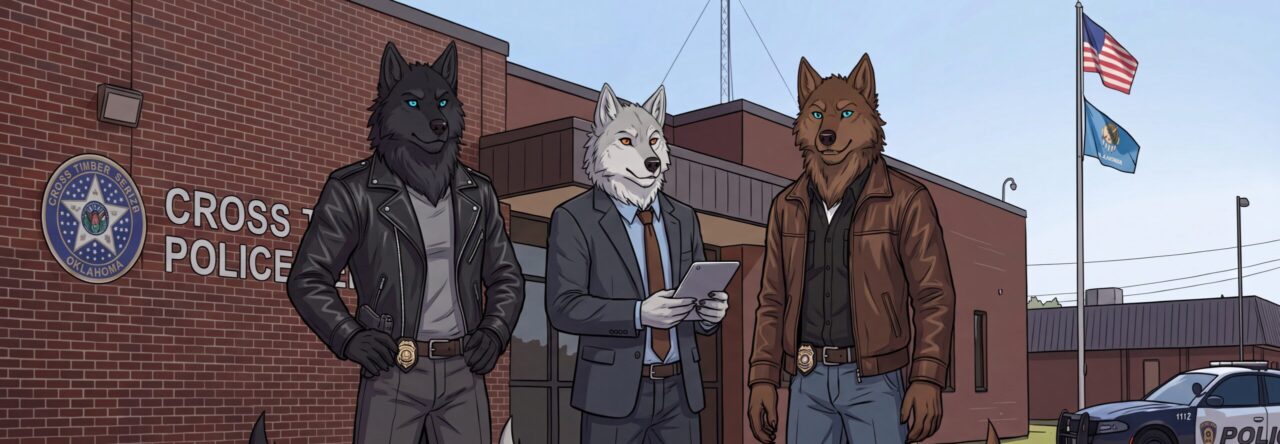
Silas came home grinning.
That was new enough to stop the room.
Not smiling.
Not trying not to smile.
Grinning.
He came through the side door in his Red Dirt ReBuild shirt, work pants dusty at the knees, lunch bag in one paw, new phone in the other, and a look on his muzzle so bright Gabriel actually lowered the sandwich he had been building.
Thane stood near the kitchen island, fastening his belt for Night Shift.
Mark looked up from checking his sidearm.
Gabriel narrowed his eyes.
“Something happened.”
Silas kicked the door closed behind him.
“Cam came back to work.”
Thane’s ears lifted.
“Already?”
“Light duty,” Silas said quickly. “Alejandra threatened to staple him to a chair if he tried to lift anything. But he was there. Pale, skinny, moving like a haunted coat rack, but there.”
Gabriel set the sandwich down.
“Haunted coat rack is usually recoverable.”
Mark said, “Excellent prognosis.”
Silas’s grin widened.
“He said the hospital financial office called him this morning. His patient balance changed.”
Thane leaned one hip against the island.
“Changed.”
“To zero.”
Gabriel’s mouth twitched.
Mark’s face remained still, but his eyes warmed.
Silas shook his head like he still could not quite believe the shape of it.
“He kept saying it had to be a mistake. Alejandra told him if the hospital wanted to make a fifty-thousand-dollar mistake in his favor, he should consider shutting up professionally.”
Gabriel pointed toward the door.
“I like Alejandra more every time she speaks.”
Silas laughed.
“He called them twice.”
Mark frowned.
“Of course he did.”
“First person said the hardship assistance was approved. Second person said his balance had been resolved through approved charity-care and provider assistance channels and there was no payment due from him at this time.”
Thane nodded once.
Eli had worked quickly.
Quietly.
Correctly.
Silas looked at Thane.
“He has no idea.”
“Good.”
“He thinks maybe Alejandra did something.”
Gabriel smiled.
“Alejandra sounds like a woman capable of miracles and workplace threats.”
“She told him she cannot make hospital bills vanish because if she could, she would start with her own blood pressure.”
Thane laughed under his breath.
Silas stood there, holding all of it in his face.
Cam alive.
Cam back.
Cam uncrushed by the number.
The secret intact.
The help clean.
No debt.
No spotlight.
No obligation.
Just a friend who could breathe easier because Silas had finally brought the worry home.
Thane stepped toward him.
“You did good.”
Silas’s grin faltered for a second under the weight of the words, then steadied.
“I brought it late.”
“You brought it.”
Silas nodded.
This time, he did not argue himself smaller.
Gabriel picked up his sandwich again.
“Next time you bring it sooner.”
Silas pointed at him.
“Next time you do not hide bacon behind vegetables.”
Gabriel froze.
Mark said, “Irrelevant but valid.”
Thane checked the time.
“We have to go.”
Silas shifted his lunch bag to the other paw.
“Yeah. I figured.”
He looked at all three of them in their duty clothes, weapons, cuffs, radios, notebooks, the ordinary weight of work settling back onto the pack.
“Normal shift?”
Gabriel picked up his jacket.
“You just cursed us.”
Mark said, “He did not.”
“He said normal.”
“That is not causative.”
“It is tempting fate.”
Thane took his keys from the counter.
“Stay out of the bacon.”
Silas smiled sharp.
“Find a better hiding place.”
Gabriel looked personally wounded.
They left him laughing in the kitchen.
That was a good way to leave.
For almost four hours, Gabriel was wrong.
The shift stayed normal.
Suspicious vehicle behind a closed garden center that turned out to belong to the owner’s nephew, who had parked there to avoid his girlfriend’s father.
Noise complaint at an apartment complex where three college kids with one guitar and no skill had tried to reinvent country music.
A domestic disturbance that looked ugly from dispatch but calmed before they arrived, with both parties separated, no injuries, and patrol already handling transport for one of them to a sister’s house for the night.
A follow-up interview with a gas-station clerk who remembered everything except the part that would have helped.
Normal.
Work.
Not easy, but known.
Then the radio cracked open at 12:43 a.m.
“Night Shift, respond to Black Oak Reserve. Patrol requesting detectives for reported high-value vehicle theft. Homeowner on scene. Vehicle is a Lamborghini Revuelto, reported stolen from private garage.”
Gabriel looked up from the passenger seat.
“There it is.”
Mark, in the back, already had his tablet open.
“Black Oak Reserve is the gated development east of Arcadia Road.”
Thane turned the Humvee toward the county line.
“Owner?”
Dispatch answered before Mark could.
“Complainant is Graham Lockridge.”
Gabriel’s expression soured.
“Oh.”
Thane glanced at him.
“You know him?”
“Not personally. I know the type. His face appears in charity-event photos like a rash.”
Mark scrolled.
“Graham Lockridge. Real estate investment, private lending, luxury short-term rentals, several civil suits, no convictions. Donor boards. Self-published business book.”
Gabriel looked back.
“Title?”
Mark’s mouth tightened.
“Own the Room Before You Enter It.”
Gabriel stared out the windshield.
“I hate him already.”
Thane said, “We investigate facts.”
“I can hate facts.”
“You can hate quietly.”
Gabriel folded his paws.
“I will be professional and spiritually loud.”
Black Oak Reserve announced itself with stone pillars, iron gates, private cameras, and landscaping that pretended Oklahoma weather did not exist. The guardhouse sat under warm exterior lights. A patrol unit blocked the visitor lane, and Officer Darnell stood beside the gate attendant with a notebook in hand.
The guard looked rattled.
Darnell looked relieved when the Humvee rolled up.
Thane parked.
No lights.
No siren.
Still enough presence that the guard straightened like he had been inspected by weather.
Darnell met them at the gate.
“Detectives.”
“What have we got?” Thane asked.
“Owner says his Lamborghini was in the garage at ten last night. Gone by six this morning. He claims no one had permission to move it. Patrol took initial report, secured the garage, told him not to touch anything.”
Gabriel looked past the gate.
“And?”
Darnell’s face went flat.
“He touched things.”
Mark’s ears shifted.
“Of course.”
“He also called his insurance agent, his attorney, two friends, and possibly a local news producer before patrol arrived.”
Thane exhaled through his nose.
“Cameras?”
“House system. Gate system. Neighbor systems pending. Owner says his house cameras ‘glitched’ for a few minutes around the relevant time.”
Mark said, “Convenient.”
Darnell nodded.
“Gate log shows a service exit at 2:24 a.m. using a contractor code.”
“What contractor?”
“Evergreen Pool and Spa.”
Gabriel looked toward the dark street beyond the gate.
“At 2:24 in the morning.”
“Yes.”
Mark typed.
“Vehicle through?”
“White enclosed trailer. Black pickup. Plate unreadable on gate video. Bike rack or plate cover. Guard on duty says it looked like an event rental trailer and the code cleared, so he logged it but did not stop it.”
Thane’s eyes narrowed.
“Did patrol preserve the log?”
“Yes.”
“Good.”
The gate opened.
Black Oak Reserve curved inward through manicured darkness. The homes sat far back from the road, each one large enough to have opinions. Uplighting washed stone facades. Irrigation ticked softly against lawns that had no business being that green in summer.
Graham Lockridge’s house occupied a corner lot near the back of the development, all glass, limestone, and aggressive roofline. A fountain burbled in the circular drive as if trying to soothe the mortgage.
The garage doors faced sideward behind the main house. Two patrol cars sat near the driveway. Officer Serrano stood at the edge of the garage with her arms folded, maintaining the sacred boundary between a scene and a wealthy man’s impatience.
Graham Lockridge paced near her in loafers, linen pants, and a shirt unbuttoned one button too far. He was in his late forties, tanned, sharp-jawed, with expensive hair and the restless anger of a man used to people mistaking volume for authority.
He saw the wolves and stopped pacing.
For half a second, his face registered surprise.
Then calculation.
Then annoyance.
“You’re the detectives?”
Thane walked toward him.
“Yes.”
Lockridge looked him up and down.
“I expected auto theft.”
Gabriel smiled without warmth.
“And we expected pants with a belt. Life surprises everyone.”
Serrano coughed once into her fist.
Mark looked at Gabriel.
Gabriel’s ears flicked.
“Spiritually loud. I warned him.”
Thane stopped in front of Lockridge.
“Graham Lockridge?”
“Yes. The victim. The person whose seven-hundred-thousand-dollar vehicle is missing while your officers tell me not to touch my own garage.”
“That is correct.”
Lockridge blinked.
“What?”
“They were right to tell you that.”
“This is absurd. Do you understand what was stolen?”
“A Lamborghini Revuelto,” Mark said. “Matte Verde Turbine wrap, black wheels, custom interior, Oklahoma plate V12GLD, VIN ending 9R44, according to the preliminary report.”
Lockridge looked at him.
“Yes.”
Mark looked back.
“Then yes.”
Lockridge’s mouth tightened.
Thane said, “We are going to investigate the theft. You are going to answer questions. You are not going to enter the garage until we release it.”
Lockridge laughed once.
“This is my home.”
“And that is our scene.”
The smile disappeared.
For a moment, Lockridge looked like he might say something stupid enough to become memorable.
Then his eyes moved over Thane’s shoulders, arms, claws, badge.
He chose a different mistake.
“I need this handled discreetly. I have people calling already.”
Gabriel looked toward the driveway full of patrol cars.
“Discretion left when you called half the metro before law enforcement finished the first page.”
Lockridge pointed at him.
“I don’t appreciate your tone.”
Gabriel’s smile widened.
“I am sanding it down for you.”
Thane did not look away from Lockridge.
“Mr. Lockridge. Last time you saw the vehicle?”
Lockridge inhaled through his nose.
“In the garage. Ten, maybe ten-thirty.”
“Running?”
“No.”
“Locked?”
“Yes.”
“Keys?”
“In the safe.”
Mark looked up.
“Which safe?”
Lockridge gestured toward the house.
“Kitchen office. Biometric safe.”
“Who has access?”
“Me.”
Mark waited.
Lockridge’s jaw flexed.
“My wife. My assistant knows the emergency code but not the biometric.”
“Assistant name?”
“Chase Bellamy.”
Gabriel wrote it down.
“Any household staff?”
“Housekeeper three days a week. Landscapers. Pool company. Detailer. Security consultant. Personal trainer for my wife. Chef when we entertain. Why?”
Thane said, “Because you asked who stole your car.”
Lockridge’s nostrils flared.
“No one on my staff did this.”
Mark looked toward the garage.
“Someone used a contractor code.”
“That does not mean my people are criminals.”
Gabriel said, “It means your access control is less exclusive than your haircut.”
Serrano turned away.
Thane gave Gabriel one look.
Gabriel lifted both paws.
“Last one for several minutes.”
Lockridge stepped closer to Thane.
“Do you know who I am?”
Thane had been waiting for that sentence since the gate.
He let the silence sit long enough for Lockridge to hear it.
Then he said, “A victim reporting a stolen vehicle.”
Lockridge’s face flushed.
That was probably the first useful thing he had done.
Thane continued.
“You do not have to be likable to receive a competent investigation. But you do have to stop obstructing the scene.”
The flush deepened.
Behind Lockridge, Serrano looked at a fixed point on the wall with professional discipline.
Mark said, “We need the safe, the garage, camera system access, contractor code list, recent service records, valet use, dealership contacts, detailing appointments, and names of anyone who knew the vehicle was here.”
Lockridge looked at Mark.
“That is excessive.”
“No,” Mark said. “It is late.”
Thane turned to Serrano.
“Garage preserved?”
“As much as possible,” Serrano said. “Patrol entered only to confirm vehicle gone and check for obvious forced entry. Owner crossed threshold twice before we arrived. We documented.”
Lockridge said, “I was checking my own property.”
Thane looked at him.
“You were contaminating a theft scene.”
Lockridge opened his mouth.
Thane’s expression stopped him.
For the first time that night, Graham Lockridge closed it.
Progress.
Small, but documented.
The garage was built for display.
Polished floor.
Climate control.
Wall-mounted lighting.
Cabinets with glass fronts.
Tools arranged by people who likely did not use tools.
A framed poster of the stolen Lamborghini hung on the far wall above the empty parking space, which was dramatic enough that Gabriel stared at it for three full seconds.
“You had a portrait of the car inside the room where the car lived,” he murmured.
Lockridge said from the threshold, “It is art.”
Gabriel nodded.
“For the car. I understand.”
Thane crouched near the empty space.
The garage smelled of wax, rubber, concrete, oil, ozone from electronics, and Graham Lockridge’s cologne lingering like an accusation.
The absence of the car was loud.
A vehicle like that left shape behind. Tire placement. Dust lines. Heat memory in surfaces. Even the way the floor had been polished around it told them where it had sat.
No broken glass.
No shattered lock.
No damaged garage door.
No obvious forced entry.
That mattered.
Mark examined the wall panel near the garage door.
“Door opened at 2:13 a.m.,” he said.
Lockridge frowned.
“How do you know that?”
“Because the smart opener logs retained the event even though your camera system lost video.”
“It glitched.”
Mark looked at him.
“The garage camera and exterior drive camera both lost connection from 2:12 to 2:19. The opener did not. That is not a glitch. That is a window.”
Thane moved along the floor.
There were faint black marks near the edge of the empty parking space.
Not tire burnout.
Transfer marks.
Rubber from something that had not belonged there long.
He leaned closer.
“Trailer.”
Mark came over.
Gabriel moved to the garage door track.
Thane pointed.
“Low scuffing. Parallel. Something backed close enough to load. Not the Lamborghini’s tires. Wider spacing. Trailer ramp or dolly.”
Gabriel crouched near the door.
“No scrape on the frame.”
Mark said, “Professional equipment.”
Thane stood.
“Neighbors hear the engine?”
Serrano checked her notes.
“Two neighbors interviewed so far. Neither heard the Lamborghini start. One heard a diesel truck around two-thirty but did not look.”
Gabriel looked at Lockridge.
“Your seven-hundred-thousand-dollar car is quiet?”
Lockridge looked offended.
“No.”
“Then it probably left without making Lamborghini noises.”
Mark nodded.
“Enclosed trailer.”
Thane studied the empty space again.
“How was it put in neutral?”
Lockridge said, “You cannot just put it in neutral. It is not some pickup.”
Gabriel looked at Mark.
“I heard a class judgment.”
Mark ignored him.
“Fob present?”
Lockridge hesitated.
Thane turned.
“You said keys were in the safe.”
“They are.”
“Show us.”
The kitchen office looked like a magazine had staged a wealthy man’s productivity. Books no one had opened. A desk with no papers. Golf memorabilia. A wall safe behind a framed abstract print.
Lockridge opened it with a thumbprint and code while Mark watched from an angle that saw everything without being rude about it.
Inside were two watch boxes, passports, a handgun in a soft case that made Thane’s eyes narrow, envelopes, and two Lamborghini key fobs in a black tray.
Mark photographed before touching.
“Both fobs present.”
Lockridge folded his arms.
“Told you.”
Mark did not answer.
He removed one fob with a gloved hand, placed it in an evidence bag, then did the same with the second.
Lockridge stepped forward.
“What are you doing?”
“Collecting potential evidence.”
“They are my keys.”
“And they may have been relayed, cloned, or accessed.”
Lockridge scoffed.
“They were in a safe.”
Mark looked at the safe.
“Biometric safes are not magic.”
Gabriel whispered, “Do not let Mark talk about safes unless you have water.”
Silas would have had something sharp to say about the safe.
The thought passed through Thane unexpectedly.
Silas would look at that framed print, the keypad angle, the polished desk, the access habits, and probably say something accurate and irritating.
Not as a thief.
As someone who knew doors.
Thane filed the thought away.
Lockridge pointed toward the evidence bags.
“I need those back.”
“When they are released.”
“This is outrageous.”
Thane looked at him.
“Your car was stolen without broken glass, without an engine start heard by neighbors, during a six-minute camera outage, after a contractor code opened the gate for a vehicle capable of carrying it. Your key fobs are evidence.”
Lockridge’s jaw moved.
No words came out.
Gabriel looked mildly impressed.
“Printer never shuts up. This guy does. Fascinating.”
Thane gave him another look.
Gabriel looked at the ceiling.
“Several minutes had passed.”
By 2:10 a.m., the scene had shape.
Not solution.
Shape.
Mark pulled the garage-door logs, camera outage times, router status, and alarm history. The house had never fully armed the garage interior because Lockridge disliked false alarms when staff moved between the garage and service entrance. The garage door had opened by remote access, not the wall button. The system labeled the device as “Guest Remote 3.”
Lockridge claimed not to know Guest Remote 3 existed.
His wife, reached by phone from a spa weekend in Santa Fe, knew immediately.
“That was for the detailer,” she said, voice thin through speaker. “Graham loses remotes and blames people.”
Lockridge turned away from everyone.
Gabriel wrote that down with visible joy.
The detailer, one Marco Ruiz—not related to Janelle Ruiz, Mark confirmed after three seconds of typing—had last worked on the Lamborghini eight days earlier. He had used Guest Remote 3 for years, according to Mrs. Lockridge. The pool company used a gate code. Landscapers used a different one. Event staff used temporary codes that Lockridge’s assistant managed and apparently never deleted.
“Access discipline is poor,” Mark said.
Lockridge said, “I run multiple businesses.”
Mark looked up.
“Not well, from an access-control standpoint.”
Gabriel whispered, “That was the meanest thing Mark has said all week.”
Thane stood near the garage opening, watching Darnell and Serrano mark the driveway area where faint trailer impressions cut across the sealed surface. The thief had backed cleanly, loaded fast, and left through the service exit.
No panic.
No smash.
No amateur rush.
The gatehouse video showed a black pickup pulling a white enclosed trailer with magnetic signs on the side. The signs read:
RIVERSIDE EVENT RENTALS
The company existed.
The trailer did not belong to them.
Mark confirmed within six minutes.
“Riverside has all trailers accounted for,” he said. “Their owner reports two magnetic signs stolen from a storage rack three weeks ago. They did not report it because they assumed teenagers.”
Thane’s eyes narrowed.
“Three weeks.”
Gabriel looked toward the empty space.
“That is planning.”
“Yes.”
The gate video was grainy but useful. The driver wore a cap low. Passenger side unknown. The pickup’s plate was obscured by a rear-mounted bike rack. The trailer had no visible plate at the gate angle.
But the left trailer taillight flickered every time the brakes hit.
A small thing.
A stupid thing.
The kind of flaw people left when the big parts of the plan were polished.
Mark marked the clip.
“That may help.”
Thane nodded.
“Send stills and video to auto theft, Edmond, Oklahoma County, state fusion center. BOLO for black three-quarter-ton pickup, white enclosed car hauler, left trailer brake light intermittent, fake Riverside Event Rentals signage.”
“Already drafting.”
Lockridge paced behind them.
“So what? You are looking for a trailer? My car could be in Texas by now.”
Thane looked at him.
“Yes.”
Lockridge stared.
“You are supposed to reassure me.”
“No. I am supposed to investigate.”
The man’s face twisted.
“You people have no idea how to deal with high-value property.”
The words landed badly.
Not because they were true.
Because they were ridiculous.
Thane owned enough land, accounts, investments, and quiet structures through Eli that Graham Lockridge’s entire performance of wealth felt like watching a man stand on a shoebox and call it a mountain.
Gabriel knew it too.
Mark knew it.
None of them said it.
That was the difference.
Lockridge wore money like armor and made everyone in range listen to it clank.
The pack had money like a loaded weapon locked in a safe no one saw unless there was a reason.
Thane stepped closer.
“Mr. Lockridge. You are going to stop confusing price with importance.”
Lockridge’s mouth opened.
Thane kept going.
“If this were a stolen ten-year-old work truck, we would still process the scene. If it were a single mother’s minivan, we would still pull the gate video. If it were your Lamborghini, we do the same work. The value changes paperwork. It does not change our job.”
Lockridge’s expression shifted.
For a moment, he looked almost embarrassed.
Then he recovered badly.
“I want updates every hour.”
“No.”
“I am the victim.”
“You will get updates when there is information we can provide.”
“I will call the chief.”
“Do that after we finish processing your garage.”
Gabriel looked down at his notebook, shoulders tight with contained laughter.
Mark did not look up from his tablet.
Serrano, at the driveway, suddenly found the asphalt fascinating.
Lockridge turned and walked toward the fountain, phone already in hand.
Gabriel watched him go.
“I am trying very hard to remember he is a victim.”
Thane said, “Keep trying.”
“How hard?”
“Harder.”
Gabriel sighed.
“I hate personal growth during luxury auto theft.”
The first real break came from outside the neighborhood.
Not the house.
Not the owner.
Not the gate.
A traffic camera at the county road intersection caught the black pickup and trailer turning east at 2:31 a.m. The angle was high, the image washed in sodium light, but the trailer’s left brake light flickered twice.
Same vehicle.
The pickup did not head toward I-35.
It took rural roads.
Mark traced the route across three cameras, one private gas-station clip, and a school-bus depot security camera that had no idea it was about to become useful.
At 3:04 a.m., the truck and trailer passed an industrial park on the east side of Edmond.
At 3:17, they disappeared near a cluster of storage warehouses, mechanic shops, and fenced lots.
Gabriel stood over Mark’s shoulder at the station while the video played on a monitor.
“Chop shop?”
Mark tilted his head.
“Possibly. Or transfer point. High-end vehicles are often moved quickly into enclosed transport, plates removed, trackers defeated, loaded into legitimate-looking channels.”
Thane stood behind them with arms folded.
“Car’s telematics?”
“Offline as of 2:20 a.m. Either disabled, shielded, or the system lost cellular connection. Manufacturer ping request pending through proper channel. Lockridge’s app shows last location at home because that is the last successful update.”
Gabriel looked at the frozen image of the trailer.
“If I had stolen an obnoxious green Lamborghini, I would not take it to a warehouse where every camera sees my suspicious trailer.”
Mark said, “You would not steal it in the first place.”
“I said if.”
“You would talk too much during planning.”
Gabriel looked offended.
“I would be charming.”
“You would be incarcerated.”
Thane pointed at the screen.
“Zoom the passenger side at the gas station clip.”
Mark did.
The pickup had stopped briefly near an air pump at a closed gas station. No one got out. The camera caught the passenger-side window for less than two seconds when a security light flickered across the glass.
A face?
No.
A shape.
Cap brim.
Jaw.
Maybe a beard.
Maybe shadow.
Mark froze it, sharpened what he could, then stopped before enhancement became fiction.
“Not enough.”
“Clothing?”
“Dark hoodie. Gloves. Passenger appears to look at camera and turn away.”
Gabriel leaned closer.
“Smart enough to know cameras. Not smart enough to fix a taillight.”
“Or did not notice,” Mark said.
Thane watched the shadowed head turn away on the screen.
“Someone who has done this before.”
“Yes.”
Crowe came out of his office with coffee and the expression of a man who had not been surprised by crime in twenty years but remained personally offended by paperwork.
“Update.”
Thane summarized.
Crowe listened without interruption.
When Thane finished, Crowe looked at the monitor.
“Organized?”
“Likely,” Mark said. “Planned access. Fake signage. Trailer. Camera outage. Contractor codes. No forced entry.”
“Inside information?”
“Very likely.”
Gabriel said, “Or the owner’s security is a buffet with a gate around it.”
Crowe looked at him.
“Both can be true.”
“Yes, Lieutenant.”
Crowe looked at Thane.
“Auto theft task force?”
“Looping them in. Edmond and Oklahoma County too.”
“Good. Any reason this is ours beyond location?”
“Black Oak Reserve sits inside our jurisdictional edge.”
Crowe nodded toward the screen.
“If it becomes a pattern, I want to know before the second angry rich man starts calling council members.”
Gabriel’s eyes lifted.
“Second?”
Crowe looked at him.
“Cars like this do not usually disappear because someone needed a ride to Tulsa.”
Mark said, “Agreed.”
Crowe turned to go, then stopped.
“And tell Lockridge that if he posts evidence online, I will develop a migraine with his name on it.”
Thane’s ears shifted.
“Has he?”
Crowe held up his phone.
“Apparently he has people.”
Gabriel closed his eyes.
“Oh good.”
On Lockridge’s social media, posted fifteen minutes earlier, was a furious caption about incompetence, gates, criminals, and a reward for information. Attached were three clips from his home system and a still from the gatehouse video.
The fake Riverside trailer.
The black pickup.
A dark figure moving near the garage just before the camera cut.
Not enough for identification.
Enough to damage the case.
Mark stared at the post.
“He posted video we told him not to release.”
Gabriel said, “Victim status does not cure jackass.”
Crowe looked at Thane.
“Call him.”
Thane did.
Lockridge answered on the second ring.
“Detective, I assume you saw that I am doing what should have been done hours ago.”
Thane held the phone very still.
“Take the post down.”
“No.”
“It contains evidence.”
“It contains my property being stolen.”
“And it may alert suspects to what we have and what we do not.”
“I am offering a reward.”
“You are interfering with an active investigation.”
Lockridge’s voice hardened.
“I have a platform. I intend to use it.”
Gabriel whispered, “So does a diving board. People still fall off.”
Thane covered the phone for one second.
“Quiet.”
Lockridge said, “What was that?”
“Take the post down.”
“My attorney says I am within my rights.”
“Then have your attorney call the city attorney and explain why you are distributing evidence after being asked not to.”
Lockridge scoffed.
“You cannot control public information.”
“No. But I can document your decision, its effect on the investigation, and every suspect who now knows what angle the gate camera captured.”
Silence.
Thane added, “Your choice.”
Lockridge hung up.
Gabriel looked at the phone.
“Did he take it well?”
Thane checked the post.
Thirty seconds later, it disappeared.
Mark said, “Post deleted.”
Crowe grunted.
“Good. Unfortunately the internet noticed it existed.”
Of course it had.
Within minutes, screenshots had already moved into neighborhood groups, car-spotter pages, and local gossip threads where people with no information were confidently solving things.
Gabriel scrolled one of them.
“Someone says it was cartel.”
Mark said, “No basis.”
“Someone says insurance fraud.”
“Possible but unsupported.”
“Someone says werewolves should sniff it out.”
Thane looked at him.
Gabriel put the phone away.
“Unhelpful public input concluded.”
Crowe pointed at the monitor.
“Work what is real.”
They did.
For the rest of the shift, the Lamborghini became less a stolen car and more a door into something larger.
The stolen Riverside signs.
The contractor code.
The deleted guest remote.
The camera outage.
The trailer with the flickering brake light.
The route to the industrial park.
The absence of engine noise.
The speed.
The confidence.
By dawn, they did not have the car.
They did not have the thief.
But they had enough to dislike the shape.
And Thane trusted dislike when it came from facts.
They came home just after sunrise.
Silas was in the kitchen again, dressed for Red Dirt, phone on the island, coffee in hand, muzzle still carrying some of yesterday’s good news even under morning fatigue.
He looked up as they came in.
“Bad shift?”
Gabriel dropped into a stool.
“Expensive shift.”
Silas glanced at Thane.
“Expensive how?”
“Car theft,” Thane said.
Mark set his tablet down.
“High-end vehicle.”
Silas poured coffee into Thane’s mug without asking.
“Anybody hurt?”
“No.”
“Good.”
Gabriel rubbed both paws over his face.
“Owner tried to weaponize social media before breakfast.”
Silas’s mouth twitched.
“Sounds like a victim you loved.”
Thane took the coffee.
“We investigated the theft.”
“That means no.”
Gabriel pointed at him without lifting his head.
“He knows us.”
Silas picked up his phone, checking the time before leaving for work. Then his screen lit with a notification from one of the local community groups he had joined after Sunday’s event. He frowned.
“What the hell is this?”
Mark looked over.
“Probably screenshots from Lockridge’s deleted post.”
Silas angled the phone away automatically.
“I shouldn’t look?”
Thane considered.
It was public now.
Not ideal.
Not confidential once it had already spread, though he hated that fact.
“You can look at public nonsense. Do not send it around.”
Silas snorted.
“I’m not Gabriel.”
Gabriel lifted one paw.
“Wounded.”
Silas opened the post.
Someone had screen-recorded the video before Lockridge deleted it. The clip was grainy, compressed, shared badly, and framed by someone’s caption about “Lambo stolen from Black Oak!!!”
Silas watched with mild curiosity.
The black pickup rolled through the gate.
The white trailer followed.
The fake Riverside signs flashed in the camera wash.
The left brake light flickered.
The clip jumped to the house angle.
A dark figure crossed the edge of the garage approach.
Cap low.
Hoodie.
Gloves.
Head turned just slightly before the camera cut.
Silas went still.
Thane noticed immediately.
So did Gabriel.
So did Mark.
The kitchen changed.
Silas replayed the clip.
Once.
Twice.
He zoomed in with two claws, careful not to scratch the screen.
The image blurred worse.
It did not matter.
He was not looking at the face.
He was looking at the movement.
The left-shoulder dip.
The quick glance up before the camera died.
The way the figure carried his weight forward, loose and cocky, like he had already mapped every exit.
Like he knew the room before he entered it.
Silas’s smile was gone.
Thane set his mug down.
“Silas.”
Silas did not answer.
He replayed the clip again.
Then he lowered the phone slowly.
Gabriel’s voice came quiet.
“What?”
Silas looked at Thane.
There was no fear in his face.
That was the first thing Thane noticed.
No shrinking.
No shame collapse.
No reflexive apology for recognizing the shape of old trouble.
Only recognition.
And anger.
Silas turned the phone so they could see the frozen figure near the garage.
“I know him.”
Mark stood.
Thane’s eyes stayed on Silas.
“Name.”
Silas swallowed once.
Then his muzzle hardened.
“Jace Larkin.”
Gabriel’s ears went back.
Mark’s expression sharpened.
Thane did not move.
Silas looked down at the frozen image again.
“He used to run jobs with people I knew.”
The kitchen held still around them.
Outside, morning light pushed through the trees.
Inside, the case changed shape.
Silas lifted his eyes to Thane.
“And if Jace is stealing cars like that,” he said, voice low and certain, “that Lamborghini is not the first thing he planned.”
Thane believed him.
Immediately.
Not because Silas was afraid.
Because Silas was five steps ahead of the room again.
And this time, he had brought the truth with him.