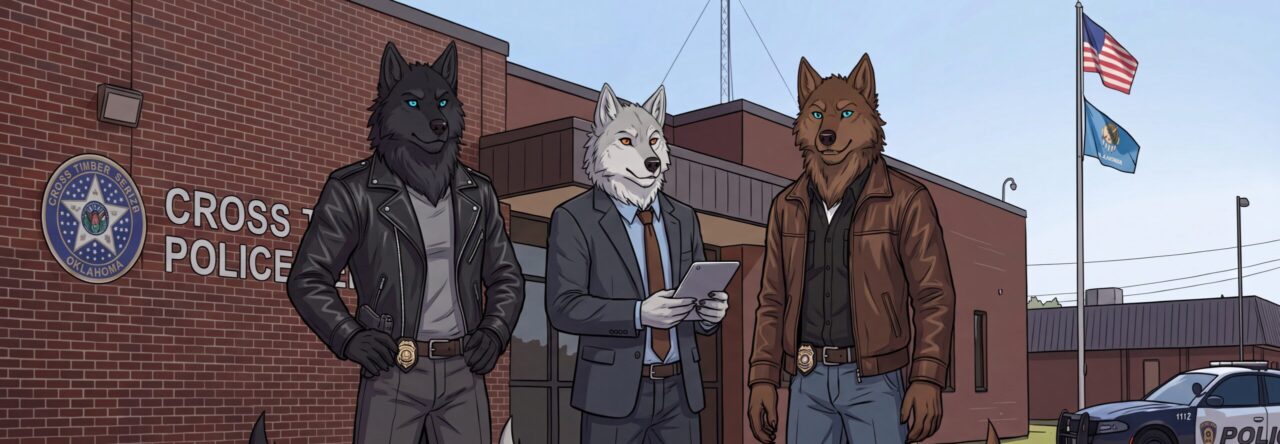
Deputy Chief Mercer had coffee, antacids, and the face of a man who had not slept enough to trust either one.
That was the first warning.
The second was Chief Whitaker standing in the small command conference room with her sleeves rolled up and no folder in her hands.
Whitaker liked folders.
Folders meant process.
No folder meant the meeting was not about paperwork yet.
Thane entered first, Gabriel behind him, Mark last with a tablet tucked under one arm. All three wore duty clothes. Clean shirts. Clean belts. Clean fur. No blood.
That mattered more than it should have.
Mercer looked them over anyway.
Thane saw him do it.
Chest.
Shoulders.
Side.
The places the rounds had hit yesterday.
The places the wounds had already vanished while the shirts became evidence.
Gabriel saw it too.
“Deputy Chief,” he said, “if this is a shirt inspection, I would like to file a complaint about the department-issued replacement.”
Mercer’s eyes shifted to him.
“You looked like a picnic table wearing a police logo.”
Mark said, “The proportions were poor.”
Gabriel pointed at him.
“See? Objective.”
Whitaker said, “Sit down.”
They sat.
The room closed around them. Chief Whitaker at the head of the table. Mercer to his right. Crowe leaned against the wall near the door, arms folded, expression unreadable in the way that meant he was reading everything.
For three seconds, nobody spoke.
Thane waited.
Mercer finally set his coffee down.
“All three hostages from Roseway are medically cleared. Shock, minor cuts, no gunshot injuries. Dr. Nair gave a statement this morning. Lena Ortiz gave a second one. Erin Coates asked whether she could send a thank-you card to the department without it becoming evidence.”
Gabriel’s ears shifted.
“Can she?”
Mercer looked at him.
“Yes. I am not confiscating gratitude.”
“That is growth, sir.”
“Do not test it.”
Whitaker said, “Briggs is in county custody. Charges are being stacked. State and federal interest likely. Firearm tracing underway. Search warrants on his residence, devices, storage unit, vehicle.”
Mark nodded.
“Expected.”
“Use of force review is preliminary but clean,” Whitaker continued. “Entry was command-authorized. Threat was immediate. Hostage lives at substantial risk. Suspect fired on officers. Rifle disarmed. Suspect controlled and transferred to patrol without injury beyond minor abrasions from his own fall.”
Gabriel looked at Thane.
“He will complain about the abrasions.”
Thane said, “Yes.”
Mercer rubbed his forehead.
“He already did.”
Gabriel leaned back.
“Excellent. Healing everywhere.”
Whitaker’s eyes stayed on Thane.
“Medical documentation?”
“Completed.”
“Photographs of clothing?”
“Completed,” Mark said.
“Statements?”
“Completed.”
“Any delayed symptoms?”
“No,” Thane said.
Whitaker watched him.
Thane let him.
The chief was not being dramatic. She was doing what command had to do after sending three detectives into automatic rifle fire and then watching them walk back out wearing most of the evidence.
Mercer picked up the antacid bottle, looked at it, then set it down unopened.
“I keep seeing the hallway,” he said.
No joke followed.
Not from Gabriel.
Not from anyone.
Mercer looked down at his coffee.
“I keep hearing the audio from the dropped phone. Briggs yelling. The hostages begging. Then the shots when you went in.”
His jaw tightened.
“I signed off on it.”
Whitaker said, “I signed off on it.”
“I know.”
Crowe spoke from the wall.
“I recommended it.”
Mercer looked at him.
“I know that too.”
Thane leaned forward.
“Good.”
Mercer’s eyes snapped to him.
Thane did not soften it.
“Good that you all understand what you decided. You should. You should hate it a little. You should remember the sound. That keeps it from becoming easy.”
The room went still.
Thane tapped one claw lightly against the table.
“But do not apologize for making the right call.”
Mercer’s mouth tightened.
“Thane.”
“No.”
Whitaker’s brows lowered slightly.
Thane kept his voice level.
“I have been telling you folks since we joined that you should use our abilities to end incidents quickly when the facts support it.”
Mark’s eyes moved to him, listening closely now.
Gabriel stayed quiet.
Thane looked from Mercer to Whitaker.
“We are not human officers. We are not better. We are not magic. We are not immune to pain. But the math is different. Yesterday, the human options were bad. Wait and hope Briggs stayed conversational. Breach with humans and risk him firing into hostages before tactical cleared the hallway. Sniper with no clean angle. Gas with hostages close and a rifle already in play. Every ordinary option carried more risk to the people on the floor than sending us through the front.”
Mercer said, “You were shot five times.”
“And Lena Ortiz was not.”
The sentence landed hard enough that even Crowe looked down.
Thane continued.
“Gabriel was hit.”
Gabriel lifted one paw.
“I was.”
“Mark was hit.”
Mark nodded once.
“And Dr. Nair is alive. Erin Coates is alive. Lena Ortiz is alive. Briggs is alive to be prosecuted. Patrol did not have to step over dead employees in a hallway.”
Whitaker’s voice came low.
“No one here disputes the result.”
“Then stop treating the tool like it is shameful.”
Mercer looked at him.
“That is not what this is.”
“It is part of what this is.”
The words were blunt.
Too blunt, maybe.
But Thane had learned that command rooms had enough soft language to pad every wall in the building. Sometimes the truth needed claws.
He sat back.
“You were trying to apologize yesterday before giving the address. I understand why. But if the department only uses us when pretending we are ordinary, it wastes the one thing that could keep people alive when ordinary fails.”
Whitaker’s face stayed hard.
“Careful.”
Thane met her eyes.
“Restraint is stupid when a solution exists that has minimal risk.”
Crowe’s head tilted.
Mark’s ears flicked.
Gabriel inhaled like he was preparing for weather.
Whitaker’s voice sharpened.
“Say that again with precision.”
Thane held the chief’s stare.
He knew what Whitaker heard.
A dangerous sentence.
A sentence that could excuse shortcuts.
A sentence that could turn the last year of training into a punchline if left sloppy.
So Thane corrected it.
“Standing still and calling it restraint is stupid when a lawful solution exists that has minimal risk to victims and acceptable voluntary risk to us.”
Mark nodded once.
“Better.”
Gabriel murmured, “He has upgraded from lawsuit to policy draft.”
Whitaker did not look away from Thane.
“Restraint is not stupid.”
“No.”
“Authority without restraint is why we had to review Dale Whitcomb.”
Thane absorbed that.
No flinch.
No denial.
“Yes.”
Whitaker leaned forward.
“We are not building a doctrine where three wolves become a department shortcut around patience, negotiation, warrants, or tactics.”
“No.”
“We are not sending you into every hard problem because you can heal.”
“No.”
“We are not confusing durability with invulnerability.”
“No.”
Mercer’s voice was quieter.
“And we are not turning you into meat shields.”
Thane looked at him.
“You cannot, unless we let you.”
Mercer’s eyes narrowed.
Thane continued.
“We are sworn detectives. We choose the risk. We understand it. We also understand the difference between useful risk and stupid risk.”
Gabriel lifted a finger.
“Mostly.”
Mark said, “Speak for yourself.”
Gabriel lowered the finger.
Whitaker leaned back.
Crowe pushed off the wall.
“The question is criteria.”
Mark set his tablet on the table.
“I drafted some.”
Mercer stared at him.
“Of course you did.”
Mark turned the screen around.
“Preliminary. Situations where the pack’s physiology materially changes the risk equation: active shooter with hostages and no safe angle; armed barricade where rounds are already being fired at victims; rescue where structural weight exceeds safe human lift but immediate action can stabilize before specialized equipment arrives; animal or human containment where claws and bite risk are manageable and lethal force can be avoided; hazardous approach where pain tolerance and healing reduce risk to officers but not where toxic exposure or environmental conditions could incapacitate us.”
Gabriel looked at Thane.
“He drafted a werewolf deployment matrix.”
Mark said, “A preliminary one.”
Mercer took the tablet.
His eyes moved across it.
Crowe came around to read over his shoulder.
Whitaker did not smile.
But some of the tension in her face changed shape.
“This is not policy yet,” the chief said.
“No,” Mark agreed. “It is a starting point.”
Thane looked at Mercer.
“That is all I am saying. Use the right tool when the right tool exists.”
Mercer read another line.
“Command authorization required except immediate life safety.”
“Yes,” Mark said.
“Medical documentation after ballistic impact.”
“Yes.”
“No use for crowd control, intimidation, civil demonstration management, warrant service solely for psychological effect—”
Gabriel pointed at that line.
“That one was definitely written by Mark after imagining a nightmare press conference.”
Mark said, “Multiple.”
Crowe nodded.
“Good exclusions.”
Whitaker looked at Thane.
“You understand why they matter.”
Thane nodded.
“Yes.”
The old heat of the Dale incident moved through the room without anyone inviting it in.
Thane let it.
It belonged there.
Not as shame.
As boundary.
Whitaker said, “Yesterday was the right call.”
The words were flat.
Official.
Real.
Mercer looked down at the tablet again.
“I still hate it.”
Thane nodded.
“You should.”
Mercer looked up.
Thane held his gaze.
“But make the call.”
For a moment, Mercer looked tired enough that the title Deputy Chief seemed like something someone had put on him in addition to the man.
Then he nodded.
“I will.”
Whitaker stood.
“That is all for now. Work your shift. Stay ordinary unless you are told otherwise.”
Gabriel stood.
“Chief, ordinary has become a challenging brand for us.”
Whitaker looked at him.
“Then aim for useful.”
Gabriel considered that.
“Achievable.”
Crowe opened the door.
“Patrol assist tonight. Nothing fancy on the board.”
Gabriel looked at him.
“You have cursed us.”
Crowe said, “If fate listens to me, it owes me back pay.”
They left the room.
Behind them, Mercer picked up the antacid bottle at last.
Thane heard it rattle.
The first call was a counterfeit twenty at a taco truck.
Not a hostage.
Not a rifle.
Not a command decision.
Just a taco truck owner named Maribel standing under string lights in a grocery-store parking lot, holding a bill between two napkins as if it might spread disease.
Officer Darnell had already arrived and was taking the complaint while three customers waited with the solemn patience of people unwilling to abandon good food because of crime.
Maribel looked past Darnell when the Humvee pulled in.
Her eyes widened.
Then narrowed at the bloodless shirts.
“You are the ones from the clinic.”
Gabriel stepped down from the passenger side.
“We are also available for currency disappointment.”
Darnell looked relieved.
“Detectives.”
Thane nodded.
“Counterfeit?”
Darnell handed Mark the bill in an evidence sleeve.
“Owner says a man paid with it ten minutes ago and walked off before she caught it.”
Maribel folded her arms.
“I caught it because Andrew Jackson looked like he was surprised to be there.”
Gabriel leaned toward Mark.
“That is valid analysis.”
Mark examined the bill.
“Poor print quality. Incorrect texture. Serial number repeated if passed elsewhere.”
Thane asked, “Description?”
Maribel gave it crisply.
White male, twenties, red cap, oil-stained shirt, tattoo on neck, walked toward the laundromat across the lot.
Gabriel looked at Thane.
“Careful. Laundromat.”
Thane said, “Not a pattern.”
Mark said, “It is a location.”
They found the man sitting behind the laundromat, eating tacos he had purchased with an allegedly fake bill and looking offended by consequences.
He had three more counterfeit twenties in his sock.
Gabriel stared as Darnell cuffed him.
“Sock banking remains underregulated.”
The suspect said, “They ain’t fake.”
Mark held one up.
“The watermark appears to be a cartoon eagle.”
“That’s patriotic.”
Darnell sighed.
Thane took the statement.
Maribel got her report number.
Before they left, she handed them a paper bag.
Thane looked at it.
“We cannot take—”
“You can pay,” Maribel said. “I am not feeding police for free. I am feeding hungry people who look like they forgot dinner.”
Gabriel pulled out his wallet.
“I respect this structure.”
They paid.
Maribel leaned closer to Thane as Gabriel collected the food.
“My cousin works at Roseway.”
Thane went still.
“She is home,” Maribel said. “Shaken. Alive.”
Thane nodded once.
“I am glad.”
Maribel’s face held too much to be called a smile.
“Me too.”
She turned back to her grill.
No speech.
No worship.
No argument.
Just tacos and a life still moving.
That was enough.
The second call was not theirs until it became theirs.
Patrol requested assistance at an old hardware store on Maple where a storage rack had failed in the back room. Fire and EMS were en route, but Officer Serrano’s voice over the radio had the clipped edge that meant the situation was worse than dispatch language could comfortably hold.
“Employee pinned under shelving. Conscious. Breathing. Heavy load. We are supporting manually but losing it.”
Thane turned before dispatch finished.
Gabriel set the taco bag down.
“Well.”
Mark pulled up the address.
“Two minutes.”
The hardware store was a narrow brick building that smelled of dust, fertilizer, lumber, and panic. The owner met them at the front, face pale, hands shaking.
“This way.”
In the back room, chaos had become a geometry problem.
A tall metal storage rack had failed sideways, collapsing against a workbench and pinning a teenage employee named Ryan from the waist down beneath stacked bags of concrete mix, boxes of tile, and metal shelving. Serrano and Boyd had wedged two floor jacks and a dolly frame under the rack, buying inches. Another employee held a flashlight with both hands, crying silently.
Ryan was conscious.
That was good.
Ryan was also too calm in the wrong way.
That was not.
“My legs feel weird,” he said.
Serrano looked up when Thane entered.
“Fire is four out.”
Mark was already assessing.
“Do not lift straight. If the load shifts, it drops onto his pelvis. We need upward stabilization and lateral unload.”
Gabriel moved to the far side.
“Tell me where.”
Mark pointed.
“Here. Brace. Do not lift until I say.”
Thane stepped over spilled hardware and crouched near Ryan’s head.
“Ryan?”
The teenager blinked up at him.
“You’re big.”
“Yes.”
“My mom is going to kill me.”
“Probably not today.”
Ryan gave a weak laugh that turned into a gasp.
Thane looked at Serrano.
“Pulse?”
“Fast. Skin cool. No obvious major bleeding.”
Mark said, “We stabilize first. Thane lifts from main upright. Gabriel takes crossbar. Boyd, back out on my count. Serrano, keep C-spine neutral until EMS. Owner, move away.”
The owner obeyed like Mark had been born in charge of storage racks.
Thane put both paws around the main upright.
The metal groaned under his grip.
Gabriel set his shoulders under the crossbar, claws carefully angled away from anything that might cut.
Mark watched the load.
“One inch,” Mark said.
Thane lifted.
Not like the picnic table.
Not for cheers.
For space.
The rack rose exactly one inch.
Gabriel took the shift and held it.
Bags of concrete creaked.
A box slid.
Mark caught it before it fell.
“Hold.”
Thane held.
Gabriel held.
Boyd eased the dolly frame out.
Mark directed two employees to remove loose boxes from the top layer one at a time.
“Slow. No pulling. Lift and place.”
Ryan’s breathing hitched.
Thane kept his voice low.
“Look at me.”
Ryan did.
“Good. Tell me what aisle the hammers are in.”
Ryan blinked.
“What?”
“Hammers.”
“Aisle four.”
“Screws?”
“Two.”
“Paint?”
“Six.”
“Terrible layout.”
Ryan made another small sound that might have been a laugh.
The load got lighter.
Fire arrived.
A captain came through the back, saw the three wolves holding the rack, and shifted from command to integration without wasting time.
“What do you need?”
Mark answered.
“Airbags under the lower frame. Cribbing on the left. We have manual lift but need controlled transfer.”
The captain nodded.
“Do it.”
Nobody apologized for using them.
Nobody stared at them like yesterday’s blood.
They used the tool in the room.
That was the point.
Within six minutes, the rack was cribbed, Ryan was slid free, and EMS had him on a backboard. He cried only when the pressure came off, which Thane respected. Sometimes pain waited until rescue made room.
Ryan grabbed Thane’s wrist as they carried him past.
“Am I going to lose my legs?”
Thane did not lie.
“I do not know.”
Ryan’s grip tightened.
Thane leaned closer.
“But you are out. That is the first fight.”
Ryan swallowed and nodded.
They took him to the ambulance.
The hardware store owner stood in the back room staring at the lifted rack, the cribbing, the spilled concrete, and the wolves now dusted gray from shoulders to paws.
He looked at Thane.
“I thought you were detectives.”
Gabriel brushed concrete dust off his sleeve.
“We contain multitudes.”
Serrano came up beside Thane.
“You got here fast.”
“Yes.”
She looked at the rack.
“Good.”
That was all.
It was enough.
As they walked out, Mark’s phone buzzed with an update from EMS routed through dispatch.
“Ryan has sensation returning in both feet.”
Thane stopped.
Gabriel closed his eyes briefly.
Serrano heard it and turned away to breathe.
The store owner sat down on a paint bucket and covered his face.
Normal shift.
Useful shift.
Right tool.
The third call was a church parking lot.
Gabriel looked at the dispatch screen and sighed.
“After yesterday, that feels narratively aggressive.”
Mark said, “It is a vehicle lockout.”
“At a church.”
“Vehicle lockout at a church.”
“Still.”
Thane turned into the lot of Grace Fellowship, where an evening youth group had apparently ended with one minivan locked, running, and containing a purse, keys, and a pan of brownies in the front seat.
No child inside.
No animal inside.
No emergency beyond embarrassment and brownies aging in captivity.
Officer Patel stood with a woman named Mrs. Keene, who kept apologizing to everyone while also blaming the minivan for betrayal.
Patel saw Thane and smiled faintly.
“Detectives. The situation has stabilized emotionally but not mechanically.”
Mrs. Keene looked at the wolves.
“Oh my.”
Gabriel stepped out.
“That is often the first report.”
Mrs. Keene pressed both hands to her mouth.
“I am so sorry. I know you have more important things—after what happened at that clinic, I mean. I didn’t mean—Patrol said—”
Thane lifted one paw.
“Mrs. Keene. Are those brownies for children?”
“Yes.”
“Then this is serious.”
Her eyes widened.
Gabriel nodded solemnly.
“Morale incident.”
Mark examined the vehicle.
“Keys visible on passenger seat. Engine running. Doors locked. Window gap insufficient.”
Patel said, “Lockout tools en route, but she is worried about the engine overheating. Also the brownies.”
Mrs. Keene looked anguished.
“They are for the seniors’ bake table tomorrow too.”
Gabriel went very still.
“This has escalated.”
Mark looked at him.
“I can bypass the weather stripping with patrol tools when they arrive.”
Thane looked at the minivan.
Then at the old side door latch, already dented from years of use, the rubber seal loose at one corner.
“No damage?”
Mark frowned.
“Minimal if careful.”
Gabriel looked at Mrs. Keene.
“Do you authorize Detective Mark to save the brownies with technique?”
“I authorize anything legal.”
Patel coughed.
Mark used the tool kit Patel had, a wedge, and patience sharper than force. Three minutes later, the lock popped.
Mrs. Keene clapped both hands together.
“Praise the Lord.”
Gabriel leaned toward Thane.
“This specialist was correct after all.”
Thane gave him a look.
Mrs. Keene retrieved the purse, keys, and brownies. Then she insisted they each take one.
Thane paid for four donation tickets to the seniors’ bake table instead.
Mrs. Keene tried to refuse.
Thane looked at her.
“Do not interfere with dessert procedure.”
Patel looked away, shoulders moving.
Gabriel accepted a brownie and took one bite.
Then stopped.
“Oh.”
Mrs. Keene’s face brightened.
“Good?”
Gabriel looked at her with solemn sincerity.
“Ma’am, this is evidence of talent.”
She beamed.
The church lights glowed behind them. People moved in and out carrying folding chairs, paper cups, hymnals, sports equipment, and ordinary life. A few looked at Thane. A few whispered. One older man gave a quiet nod, not toward the clinic, not toward the news, but toward being there.
Thane returned it.
No one argued theology.
No one turned the parking lot into yesterday.
A locked minivan was a locked minivan.
A brownie was a brownie.
Sometimes ordinary was not small.
It was proof that the world had not been surrendered.
The rest of the evening stayed human-scale.
A restaurant alarm caused by a new employee forgetting the closing code and then hiding in the walk-in because the siren scared him.
A suspicious-person call that turned into a man walking laps around a bank parking lot because his smartwatch had mocked his step count.
A landlord-tenant argument over an air conditioner that Mark documented with photographs, serial numbers, and enough statutory caution that both parties became calmer from exhaustion.
A traffic hazard where a couch had fallen from a trailer onto the right lane of North Ash and sat there like upholstered rebellion.
Thane and Gabriel moved it.
Mark checked for ownership paperwork because Mark believed even abandoned couches deserved due process.
At 2:31 a.m., dispatch sent them to assist patrol at a small apartment complex where a woman had called because someone was trying her doorknob.
The “someone” turned out to be her elderly neighbor from the next building, confused, dehydrated, and trying to enter the apartment he had lived in twelve years earlier.
His name was Mr. Alvarez.
He was eighty-one.
He wore one slipper.
He kept apologizing to the door.
Officer Boyd had him seated on the stairwell when they arrived. The woman who had called stood nearby in a robe, frightened and sympathetic in equal parts.
“No crime?” Gabriel asked quietly.
Boyd shook his head.
“Not unless being old and lost counts.”
Mark crouched in front of Mr. Alvarez.
“Sir, do you know where you live now?”
Mr. Alvarez looked at him.
“You are a very large dog.”
Gabriel opened his mouth.
Thane said, “No.”
Gabriel closed it.
Mark said, “I am a detective. Your name is Mr. Alvarez?”
“I know my name.”
“Good.”
“I do not know why Maria changed the locks.”
Boyd’s expression softened.
“Maria was his wife. Neighbor says she passed five years ago.”
Thane looked toward the parking lot.
No violence.
No threat.
Just age and heat and memory playing cruel games.
They found his apartment from a medical bracelet and a key fob in his pocket. Mark called the emergency contact listed through dispatch. Daughter on the way. EMS checked him for dehydration and confusion. The woman whose door he had tried to open brought him a glass of water and kept saying, “It’s okay, honey,” like she needed him to believe it so she could stop shaking.
Mr. Alvarez looked at Thane while EMS took his blood pressure.
“You police?”
“Yes.”
“You going to arrest me?”
“No.”
“Good,” he said. “Maria would be angry.”
Thane’s throat tightened.
“I believe you.”
When the daughter arrived, she was frantic, apologetic, exhausted, grateful, angry at herself, angry at time, angry at the world for not staying manageable.
Thane knew that kind of anger.
He stayed quiet while Mark explained the call and Boyd explained the medical recommendation. Gabriel stood near the daughter’s car, blocking the parking lot view without making it obvious.
On the way back to the Humvee, Boyd walked beside Thane.
“Feels stupid calling detectives for that.”
“No.”
Boyd looked at him.
Thane opened the driver’s door.
“Better us for ten minutes than him in jail, hurt, or missing.”
Boyd nodded slowly.
“Right tool?”
Thane glanced at him.
Boyd’s mouth twitched.
“Word travels.”
Thane got into the Humvee.
“Use it correctly.”
Boyd smiled.
“Yes, Detective.”
Near dawn, they stopped at the station for reports and coffee that had lost its will to live.
Mercer was still there.
That was a bad sign for Mercer’s health and a normal sign for command.
He stood in the break room, staring at the vending machine like it had made a policy recommendation he disliked.
Gabriel entered behind Thane.
“If you are searching for antacids, bottom row, left.”
Mercer did not turn.
“Empty.”
Gabriel’s ears lifted.
“A department-wide failure.”
Mark walked to the machine, looked through the glass, and said, “Inventory negligence.”
Mercer turned at last.
“How was patrol assist?”
Thane poured coffee.
“Useful.”
“That is not a report.”
“It is an answer.”
Mercer looked from one to the other.
“Anything major?”
“Counterfeit bills at a taco truck,” Gabriel said. “Hardware store rack collapse. Church brownie rescue. Confused elderly man at wrong apartment. Couch in roadway. Alarm. Property dispute.”
Mercer blinked.
“Church brownie rescue?”
Mark said, “Vehicle lockout with baked goods at risk.”
Mercer stared.
Thane took a drink of coffee.
“Normal shift.”
Mercer’s gaze settled on him.
“And the rack collapse?”
“Employee pinned. Fire and EMS en route. We stabilized and lifted enough for cribbing.”
Mercer’s face changed slightly.
“Outcome?”
“Sensation returning in both feet when transported.”
Mercer looked down at his coffee, then back up.
“Good.”
Gabriel leaned against the counter.
“No bullets. Still useful.”
Mercer’s mouth twitched despite himself.
“Do not put that on a patch.”
Gabriel looked interested.
Mark said, “No.”
Thane set the mug down.
“The department used us correctly tonight.”
Mercer looked at him.
“On a hardware store rack?”
“Yes.”
“And brownies?”
“Mark saved the brownies.”
Mark said, “With patrol tools.”
Gabriel added, “And precision.”
Mercer looked like he regretted entering the break room.
Thane’s voice shifted quieter.
“Yesterday was extreme. Tonight was not. Same principle.”
Mercer listened.
“Use the right tool. Sometimes that means we walk into gunfire. Sometimes it means we lift a rack before it crushes a kid. Sometimes it means Mark opens a minivan without breaking a window because Mrs. Keene’s brownies matter to Mrs. Keene.”
Gabriel nodded.
“They did.”
Mercer rubbed his eyes.
“You are going to make me defend brownie doctrine.”
“No,” Thane said. “I am saying the doctrine is not about us. It is about matching ability to need without ego, without apology, and without theater.”
Mercer looked at him for a long moment.
Then he nodded.
Once.
“Good shift.”
From Mercer, at dawn, with no antacids in the building, that was practically a medal.
Gabriel opened the cabinet above the sink and removed a fresh bottle of antacids.
Mercer stared at him.
Gabriel placed it on the counter.
“I restocked during the couch incident.”
Mark looked at him.
“You used the card for department antacids?”
Gabriel shrugged.
“Community stabilization.”
Mercer picked up the bottle slowly.
“I do not know whether to thank you or discipline you.”
Gabriel smiled.
“Right tool, sir.”
Mercer closed his eyes.
Thane laughed.
When they got home, Silas was in the kitchen.
Of course he was.
Work pants. Red Dirt shirt. Coffee. New phone. Lunch bag.
He looked up as they came in and searched them quickly.
No blood.
No torn shirts.
No borrowed department clothing.
His shoulders eased.
“Good shift?”
Gabriel dropped into a stool.
“I saved brownies.”
Silas looked at Thane.
“Is that true?”
“Yes.”
Mark set his tablet on the island.
“I saved the brownies.”
Gabriel waved that away.
“The pack saved brownies.”
Silas smiled.
“And other things?”
Thane leaned against the counter.
“A hardware-store employee. Maybe his legs.”
Silas’s face sobered.
“Good.”
“A confused elderly man.”
“Good.”
“A taco truck from counterfeit currency.”
Gabriel lifted a paw.
“And we purchased tacos properly.”
Silas looked at him.
“Proud of you.”
Gabriel bowed his head.
“I grow daily.”
Silas looked back at Thane.
“No clinic?”
“No clinic.”
“No bullets?”
“No bullets.”
Thane saw the relief Silas did not bother hiding.
Good.
Silas had stopped pretending not to care loudly.
That was better for everyone.
He took a drink of coffee.
“So the department figured out you can be useful without being dramatic?”
Gabriel said, “I was mildly dramatic.”
Mark said, “Only during brownies.”
Thane smiled.
“They are learning.”
Silas nodded.
“So are you?”
Thane looked at him.
Silas held the look, steady and sharp.
No accusation.
Just pack telling pack the truth had more than one direction.
Thane nodded.
“Yes.”
Silas accepted that.
Then he picked up his lunch bag.
“I have to go. Cam is back on light duty and already complaining about being supervised.”
Gabriel brightened.
“Tell him produce trucks remain suspicious.”
Silas pointed at him.
“I am not feeding that.”
Mark said, “Probably wise.”
At the door, Silas paused.
“Thane.”
“Yes?”
“Right tool does not mean only tool.”
The kitchen quieted.
Thane looked at him.
Silas’s ears shifted, but he did not look away.
“I know you know that. I am saying it anyway.”
Thane’s mouth curved.
“Good.”
Silas nodded once.
Then smiled.
“Pack problem.”
Gabriel put one paw over his heart.
“He weaponized our language.”
Mark said, “Correctly.”
Silas left for Red Dirt with his shoulders squared and his tail easy.
The door closed behind him.
Thane stood in the kitchen for a moment after he was gone.
Right tool.
Not only tool.
Restraint was not standing still.
Force was not always violence.
Strength was not always loud.
Sometimes it was walking into gunfire because three people had run out of time.
Sometimes it was lifting a rack one inch and holding.
Sometimes it was opening a minivan for brownies because an embarrassed woman was near tears in a church parking lot.
Sometimes it was listening when a former burglar reminded you not to let usefulness become pride.
Gabriel slid the taco bag from the refrigerator.
“Breakfast?”
Mark looked at the clock.
“That is not breakfast.”
Gabriel opened the bag.
“Right tool.”
Thane laughed.
The den held.
The day began.
And somewhere in the station, a deployment matrix waited for revision, because Cross Timber was learning that the difference between restraint and hesitation mattered.
So did the difference between a weapon and a tool.
So did who got to decide.