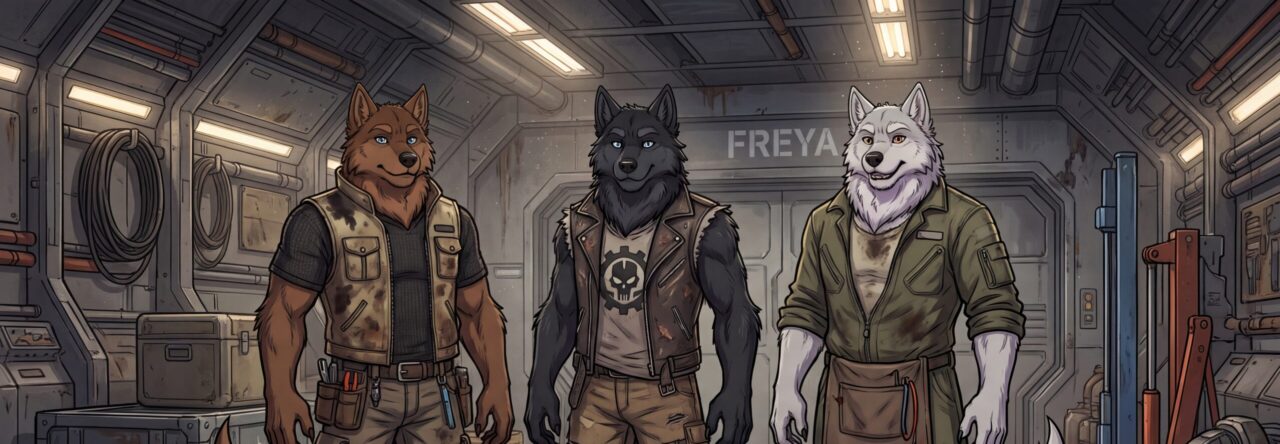
“Mark, why do we have seventeen different kinds of pressure fittings in this cabinet?”
“Because we have seventeen different kinds of pressure connections aboard the ship.”
Thane looked down at the open equipment locker.
“Seems excessive.”
“Which fittings would you like me to throw away?”
“Never mind.”
“That’s what I thought.”
Thane grinned and selected two universal diagnostic couplings from the neatly arranged compartments.
Behind him, Mark was working his way through a pre-boarding equipment checklist, gathering instruments with the meticulous attention to detail that had characterized his work for as long as Thane had known him.
The two wolves stood in Freya’s forward equipment preparation room, one deck below the bridge. Racks of protective suits lined the bulkheads, alongside diagnostic equipment, cutting tools, portable power supplies, and the specialized hardware required to work aboard disabled spacecraft.
Through a reinforced observation window, the Mercy Dawn floated silently against the distant backdrop of Rellan Four.
She looked harmless enough.
But Thane had learned a long time ago that disabled spacecraft were rarely as simple as they appeared.
“Portable power module?” he asked.
“Loaded.”
“Atmospheric sampler?”
“Loaded.”
“Structural scanner?”
“Loaded.”
“Emergency pressure patches?”
“Loaded.”
Thane paused.
“Coffee maker?”
Mark slowly looked up.
“No.”
“Well, that’s disappointing.”
“Thane.”
“What?”
“We’re going to inspect a freighter, not open a restaurant.”
“Just trying to maintain morale.”
“My morale would improve considerably if you’d finish checking your equipment.”
Thane laughed.
At six feet five inches tall, Mark was smaller than his companions but still a substantial figure. His gray-and-white fur was neatly groomed, and his brown eyes carried the familiar expression of an engineer who had already calculated six possible ways the day’s work could go wrong.
He wasn’t pessimistic.
He was prepared.
There was a difference.
Thane appreciated that distinction more than most people would ever understand.
He placed the diagnostic couplings into the equipment case and closed it.
“All right. Anything else?”
Mark studied his checklist.
“That should cover the initial inspection.”
“Good. Let’s get suited.”
The boarding suits were purpose-built for industrial work in vacuum.
They were not military combat armor, nor were they particularly elegant. Their primary purpose was to keep the wearer alive while allowing enough mobility to inspect, repair, and manipulate heavy machinery in environments that were frequently unpleasant and occasionally lethal.
The suits featured articulated protective shells, reinforced joints, independent environmental systems, and integrated communications.
Their boots were sealed components of the pressure assemblies, designed to accommodate the wolves’ plantigrade paws and claws without compromising mobility.
Neither Thane nor Mark particularly enjoyed wearing them.
Both preferred the unrestricted feeling of their bare paws against a solid deck.
But vacuum had a rather unforgiving attitude toward personal preferences.
Thane stepped into his suit’s lower assembly and secured the pressure seals.
Mark was already checking the connections on his own suit.
“Left shoulder coupling,” Mark said.
Thane reached across and inspected it.
“Seated.”
“Secondary seal?”
“Green.”
Mark nodded.
Thane turned slightly.
“Your turn.”
Mark checked the corresponding seals on Thane’s suit, then moved to the rear environmental connections.
“Primary oxygen good. Reserve good. Thermal control nominal.”
“Same on yours.”
They continued through the procedure without unnecessary conversation.
Each knew the sequence.
Each knew what the other would check.
They had performed this ritual hundreds of times.
When the inspections were complete, they secured their helmets.
Gabriel’s voice arrived over the communications channel.
“Well, look at you two. All dressed up for your date.”
Thane smiled inside his helmet.
“Jealous?”
“Terribly. Nothing says romance like crawling through somebody else’s broken machinery.”
Mark adjusted his wrist display.
“Gabriel, did you verify the boarding authorization?”
“Yes, Mother.”
“Cargo access?”
“Authorized.”
“Engineering access?”
“Authorized.”
“Computer systems?”
“Read-only diagnostic access until the insurer approves repairs.”
“Good.”
Thane collected his equipment case.
“All right, Gabriel. We’ll be going through the forward service airlock. Keep Freya at five hundred meters until we confirm a secure boarding connection.”
“Understood.”
“And monitor Mercy Dawn’s power output. I don’t want any surprises while we’re aboard.”
“Already tracking it.”
Thane smiled.
“Of course you are.”
Gabriel chuckled.
“Try not to break anything expensive.”
“No promises.”
Freya carried two compact EVA work pods.
They were small, rugged utility craft designed for moving personnel and equipment between vessels, inspecting large structures, and performing limited external maintenance.
Each had a pressurized cockpit, maneuvering thrusters, tool storage, and a powered docking interface.
The pods were functional rather than comfortable.
Thane climbed into the first pod and secured himself at the controls.
Mark occupied the second seat, his equipment case locked into the storage rack behind him.
The pod’s systems came online with a familiar sequence of indicator lights.
“Work Pod One, systems nominal,” Thane reported.
Gabriel answered from Freya’s bridge.
“Copy. Bay doors opening.”
Beyond the small forward windows, the enormous cargo-bay doors began to separate.
The interior atmosphere had already been isolated behind the bay’s pressure barrier, leaving the pod inside a depressurized launch compartment.
As the doors opened, the blackness of space appeared beyond them.
And there, less than a kilometer away, floated the Mercy Dawn.
Thane engaged the maneuvering controls.
“Releasing clamps.”
“Clamps released,” Gabriel confirmed.
The little craft drifted gently away from Freya.
For a moment, Thane caught sight of his own ship through the side window.
Her battered industrial hull filled much of the view, heavy salvage booms folded against her sides. Navigation lights blinked along her structural spine, and the large white letters spelling FREYA stood out against the dark gray plating.
She looked exactly as she should.
Like a ship that worked for a living.
“Something wrong?” Mark asked.
“Nope.”
“You’re staring.”
“Just admiring the view.”
Mark glanced toward Freya.
“She’s due for a hull wash.”
Thane laughed.
“You’re hopeless.”
“She is.”
“Mark, we’re a salvage company. She’s supposed to look like she’s been working.”
“There’s a difference between working and being dirty.”
“Tell that to Gabriel.”
“I have. Repeatedly.”
Thane chuckled and turned the pod toward the disabled freighter.
The Mercy Dawn’s forward service airlock was located beneath the command module.
It was a conventional commercial design, compatible with the universal docking collars used throughout most settled space.
Thane approached slowly, matching the pod’s orientation to the freighter’s docking axis.
The proximity display counted down.
Twenty meters.
Ten.
Five.
“Alignment good,” Mark reported.
Thane made a tiny correction with the lateral thrusters.
“Contact in three.”
The pod’s docking ring settled against the freighter’s collar.
A soft mechanical thump traveled through the cabin.
“Contact.”
“Clamps engaged,” Mark confirmed.
Thane waited while the seal pressure stabilized.
Then the docking system reported a secure connection.
“Freya, Work Pod One. Hard dock achieved. Beginning airlock verification.”
Gabriel answered immediately.
“Copy. I’m showing a good seal. Mercy Dawn’s forward compartment pressure is stable.”
“Understood.”
Thane released his restraints and stood.
“Ready?”
Mark collected the equipment case.
“Let’s see what we’ve got.”
The pod’s inner hatch opened.
Beyond it lay a short transfer passage and the freighter’s external airlock door.
Mark connected his diagnostic tool to the access panel.
The screen illuminated.
“Power available. Lock mechanism responding.”
“Any security restrictions?”
“Standard emergency access authorization accepted.”
The outer hatch released.
Thane stepped into the airlock, his heavy suit boots making a muted metallic sound against the deck.
Mark followed.
The hatch sealed behind them.
A low hiss announced the beginning of the pressurization cycle.
Thane watched the pressure gauge rise.
Twenty percent.
Forty.
Seventy.
One hundred.
The environmental indicator turned green.
“Atmosphere confirmed,” Mark said. “Oxygen and pressure within acceptable range. Trace contaminants below exposure thresholds.”
Thane checked his own display.
“Good. Let’s go inside.”
The inner hatch opened.
And the two wolves stepped aboard the Mercy Dawn.
The first thing Thane noticed was the smell.
Or rather, the lack of it.
The freighter’s interior air was cool, dry, and faintly metallic, with the stale quality of a ship that had been unoccupied for several weeks.
There was no scent of cooking, no lingering trace of people moving through the corridors, and none of the familiar lived-in atmosphere that made Freya feel like home.
Just recycled air and machinery.
The forward passage was narrow by the standards of Freya’s rebuilt residential deck.
Thane had to angle his shoulders slightly as he moved through it.
“Definitely not designed with us in mind,” he muttered.
Mark glanced around.
“Human-standard commercial layout.”
“Yeah, I noticed.”
“At least the ceiling clearance is adequate.”
“Barely.”
The corridor lighting was operating at reduced intensity.
Several wall panels were dark, and the emergency direction indicators glowed a soft amber.
Thane studied the overhead structures.
No visible damage.
No smoke residue.
No evidence of decompression.
He touched the communicator.
“Gabriel, we’re aboard. Atmosphere is good. No obvious interior damage.”
“Copy. Freya’s sensors agree. I’m recording your suit feeds.”
“Good.”
They proceeded toward the central access junction.
The Mercy Dawn was a relatively straightforward vessel.
Her forward command module contained the bridge, communications equipment, and a handful of crew compartments.
The central hull housed the primary cargo spaces.
Engineering and propulsion occupied the aft section.
Mark had already studied the general arrangement drawings, although he had repeatedly complained about their age.
“These schematics are from the original construction,” he said as they reached the junction.
“How old?”
“Twenty-four years.”
Thane looked at him.
“Same as the ship.”
“Exactly.”
“Imagine that.”
Mark ignored him.
“They don’t include the later modifications.”
“Well, let’s hope somebody labeled things.”
“I wouldn’t count on it.”
Thane smiled.
“Optimist.”
“Realist.”
They turned toward engineering.
The first sign of trouble appeared halfway down the main service corridor.
A section of overhead lighting flickered as the ship’s emergency power system switched between load cycles.
Mark stopped.
He watched the lights.
Then he checked his diagnostic scanner.
“Hmm.”
Thane recognized the tone.
“What?”
“Emergency bus voltage is fluctuating.”
“Bad?”
“Not critical yet. But it’s not supposed to do that.”
Mark connected his scanner to a wall maintenance port.
The display populated with system information.
He studied it for several seconds.
“Interesting.”
Thane folded his arms.
“That’s your second interesting today.”
“And?”
“Usually means something expensive.”
Mark smiled faintly.
“Only when it’s ours.”
He examined the electrical readings.
“Emergency power is being supplied by a pair of standby generators. The reactor is online at minimum output, but its main distribution connection remains isolated.”
“That’s consistent with the incident report.”
“Yes.”
Mark pointed toward the screen.
“But the standby generators are alternating loads more frequently than they should.”
“Faulty controller?”
“Possibly. Or the system’s compensating for something drawing more power than expected.”
Thane considered that.
“Could be why the lights are flickering.”
“Exactly.”
“Can we stabilize it?”
“Probably. But I want to see the main distribution equipment first.”
He disconnected the scanner.
“Let’s keep moving.”
The engineering compartment was larger than Thane expected.
The Mercy Dawn wasn’t a particularly big freighter, but her propulsion systems occupied a substantial portion of the aft hull.
The main engineering deck contained power-distribution cabinets, thermal-control equipment, propulsion support systems, and the access structures surrounding the reactor compartment.
A network of maintenance walkways crossed the room at several levels.
The machinery was silent except for the low hum of emergency circulation equipment.
Thane paused at the entrance.
“Well.”
Mark stepped beside him.
“Yep.”
“That’s a mess.”
“Not particularly.”
Thane pointed toward a section of open equipment cabinets.
“Half the covers are missing.”
“Probably removed during troubleshooting.”
“And somebody left tools on the floor.”
“That I don’t like.”
Thane grinned.
The engineer’s eyes moved systematically across the room.
He examined the equipment labels, the arrangement of power conduits, the routing of coolant lines, and the condition of the structural mounts.
Then he stopped.
His ears moved forward.
“Thane.”
“What?”
“Look at the main distribution cabinet.”
Thane followed his gaze.
The cabinet stood along the starboard bulkhead, a substantial rectangular assembly surrounded by heavy power conduits.
Most of its exterior matched the surrounding equipment.
But one section was distinctly newer.
Fresh paint.
Newer fasteners.
A replacement control module mounted behind a recently installed access panel.
Thane approached.
“There’s our upgrade.”
Mark nodded.
“Looks like it.”
He crouched beside the cabinet, examining the identification markings.
“Virex Industrial Power Systems. Model PD-8400.”
“Familiar?”
“Very.”
“Good unit?”
“Excellent unit.”
Thane smiled.
“Then what’s the problem?”
Mark studied the mounting arrangement.
“That’s what I’m going to find out.”
He opened the cabinet’s diagnostic access cover.
Inside, several status lights glowed amber.
A maintenance display showed a series of protective fault codes.
Mark connected his portable terminal.
The screen began downloading the controller’s event history.
Thane watched the engineer’s expression.
At first, Mark appeared mildly interested.
Then his ears shifted.
His brow furrowed.
Finally, he leaned closer to the display.
“Oh, you have got to be kidding me.”
Thane smiled.
“That sounds promising.”
Mark didn’t answer.
He scrolled through the event log.
Then he opened the configuration file.
Then he checked the identification plate again.
“Mark?”
“Give me a second.”
Thane waited.
He knew that look.
Mark wasn’t merely reading data anymore.
He was assembling a picture.
After another minute, the gray-and-white wolf slowly leaned back.
“Well, I think I found our problem.”
“Already?”
“I think so.”
“That was quick.”
Mark looked toward the cabinet.
“Somebody installed the wrong configuration.”
Thane frowned.
“Wrong controller?”
“No. The controller’s fine. It’s the configuration that’s wrong.”
He turned the terminal toward Thane.
“Look here.”
The screen displayed a series of operating parameters.
Maximum continuous current.
Transient overload tolerance.
Automatic recovery thresholds.
Protective isolation timing.
Thane studied them.
“All right.”
Mark tapped one particular value.
“This controller is configured for a standard medium-duty propulsion distribution network.”
“Which Mercy Dawn has?”
“No.”
Mark pointed toward the specifications on the cabinet.
“Mercy Dawn’s propulsion system uses a high-inrush induction stage. When the main drive comes online, it briefly demands significantly more current than it does during normal operation.”
Thane nodded.
“Startup surge.”
“Exactly. The original controller was designed to tolerate it.”
“And the new one isn’t?”
“The hardware can. But whoever programmed it left the default protection profile installed.”
Thane looked at the numbers again.
“So every time they started the main drive…”
“The controller saw the normal startup surge as an overload.”
“And tripped.”
“Yes.”
Thane considered that.
“Wouldn’t that have happened immediately after installation?”
Mark shook his head.
“Not necessarily. Depends on the operating conditions and the startup sequence. If the ship was using a reduced-power departure profile, the inrush might have stayed below the threshold.”
“But eventually they ran a full-power startup.”
Mark nodded.
“And the controller decided something was wrong.”
Thane looked around the silent engineering compartment.
“Well, shit.”
“Precisely.”
Gabriel listened to the explanation from Freya’s bridge.
“So you’re telling me somebody installed an expensive new power controller and forgot to tell it what kind of ship it was on?”
Mark sighed.
“That’s a crude way of putting it.”
“Is it wrong?”
A pause.
“No.”
Gabriel laughed.
“Oh, that’s beautiful.”
Thane leaned against the engineering console.
“Don’t celebrate yet. We haven’t established how much damage it caused.”
“Right,” Mark said. “The controller attempted several automatic recoveries before the protective systems isolated the main bus.”
Gabriel’s amusement faded slightly.
“That’s bad?”
“Potentially. Every recovery attempt would have subjected the distribution network to another high-current transient.”
Thane frowned.
“Could’ve damaged the switching assemblies.”
“Or the bus connections. Or both.”
Gabriel was quiet for a moment.
“How expensive are we talking?”
Mark looked around the compartment.
“Anywhere from a few replacement components to a complete rebuild of the propulsion distribution section.”
Gabriel made a wounded noise.
“Please tell me it’s the first one.”
“I’ll let you know.”
Thane smiled.
“All right, Gabriel. Log the findings. We’re continuing the inspection.”
“Copy. And Captain?”
“Yeah?”
“Please remind Mark that the insurance company is paying for this.”
Mark answered before Thane could.
“Only if we get the work authorized.”
“Which is why you have me.”
“Then stop distracting us.”
Gabriel laughed.
“Love you too, sweetheart.”
For the next two hours, Mark worked his way through the Mercy Dawn’s main power-distribution system.
Thane assisted where needed, removing access covers, carrying equipment, and checking structural connections.
The work was methodical.
Each section was isolated before inspection.
Every component was photographed.
Every abnormal reading was documented.
Mark refused to rush.
Thane had expected nothing less.
At the third distribution cabinet, the engineer found the first evidence of actual damage.
A heavy bus connection showed discoloration around one of its mounting points.
Mark examined it under the inspection light.
“There’s our first casualty.”
Thane leaned closer.
The metal surrounding the connection had darkened.
“Heat damage?”
“Yes.”
“How bad?”
“Hard to tell until we separate it.”
Mark retrieved a thermal imaging attachment.
The display showed no active hot spot, which wasn’t surprising given the system’s isolated condition.
But the visual evidence was enough to warrant closer inspection.
“Could be repairable,” Mark said.
“Could be scrap?”
“Also possible.”
Thane crouched beside him.
“Can we remove it?”
“Yes. But not until we’ve verified the entire section is electrically isolated.”
He checked the lockout indicators.
Then checked them again with an independent meter.
Finally, he nodded.
“All right.”
They removed the protective housing.
The damaged connection came free after several minutes of careful work.
Mark examined the contact surfaces.
His expression changed.
“Oh, that’s ugly.”
Thane looked.
The contact area was visibly pitted.
Tiny sections of metal had eroded away, leaving an uneven surface.
“Arcing?”
“Yep.”
“Replacement?”
“Definitely.”
Mark set the component aside.
“But here’s the good news.”
“There’s good news?”
“The damage appears localized.”
Thane raised an eyebrow.
“How localized?”
“Possibly just this connection and the associated switching assembly.”
“That’s encouraging.”
“Very.”
Thane looked at the engineer.
“Can we fabricate a replacement?”
Mark smiled.
“Maybe.”
Thane grinned.
There it was.
That particular smile.
The one Mark got when a complicated mechanical problem started looking like an interesting challenge instead of an expensive disaster.
They broke for lunch shortly after thirteen hundred.
Rather than returning to Freya immediately, Thane and Mark secured the engineering compartment and moved back through the freighter toward the forward airlock.
Gabriel had prepared food aboard their own ship.
He was waiting in the galley when they returned.
“Welcome back, gentlemen.”
Thane removed his suit helmet and took a deep breath.
“God, that feels better.”
Mark was already disconnecting his environmental harness.
Gabriel studied them.
“Productive morning?”
“Very,” Thane said.
“Anything explode?”
“No.”
“Anybody electrocuted?”
“No.”
“Excellent. I consider that a successful first half.”
Thane laughed and headed toward the equipment racks.
Once the suits were removed and secured, the two wolves cleaned up and made their way to the galley.
Gabriel had prepared sandwiches, roasted potatoes, and a large pitcher of cold fruit juice.
Thane looked at the food.
“Well, aren’t you domestic.”
Gabriel grinned.
“I contain multitudes.”
Mark sat down.
“Did you wash your paws?”
Gabriel stared at him.
“Yes, Mother.”
“Good.”
Thane laughed.
They ate while reviewing the inspection findings.
Mark displayed photographs of the damaged bus connection and the controller configuration.
Gabriel studied them carefully.
“So the original problem was basically a programming error?”
“Most likely,” Mark replied. “But I want to complete the electrical inspection before making that conclusion final.”
“And the physical damage?”
“Localized arcing in at least one distribution connection. Possibly more.”
Gabriel nodded.
“Can we fix it?”
Mark considered the question.
“I believe so.”
Thane leaned back.
“That’s what I wanted to hear.”
“But,” Mark continued, “we need to be careful.”
Gabriel sighed.
“There’s always a but.”
“The damaged connection is part of a high-current distribution assembly. We can’t just fabricate something that looks right and bolt it in.”
Thane nodded.
“Material composition?”
“Exactly. Conductivity, thermal expansion, mechanical strength, surface finish. All of it matters.”
Gabriel looked thoughtful.
“Could we get a replacement from the manufacturer?”
“Probably. But we’re six days from Calder, and I doubt Rellan has one in stock.”
“So what do we do?”
Mark smiled.
“We find out exactly what it’s made of.”
Thane laughed.
“There’s my engineer.”
The afternoon inspection revealed two additional damaged components.
A secondary switching contact showed signs of heat stress, and one protective relay had failed during the repeated overload events.
Neither problem was catastrophic.
But together, they explained why the crew had been unable to restore propulsion after the initial failure.
The system had not merely shut down.
It had suffered enough physical damage that resetting the controller would not have brought it back online safely.
By seventeen hundred, Mark had a preliminary repair plan.
He and Thane returned to Freya carrying several small components, a substantial collection of diagnostic records, and enough photographs to satisfy even the most demanding insurance adjuster.
Gabriel met them in the cargo bay.
“Well?”
Thane smiled.
“Looks like we might have ourselves a repair job.”
Gabriel’s ears perked.
“Really?”
Mark nodded.
“Assuming the remaining equipment passes inspection, I think we can restore the propulsion distribution network.”
“How long?”
“Three days. Maybe four.”
Gabriel considered that.
“That’s not bad.”
“Could be longer if we find additional damage.”
“Naturally.”
Thane placed the equipment case on a workbench.
“We’ll need authorization before we start.”
Gabriel grinned.
“Already working on it.”
Mark gave him a suspicious look.
“How?”
“Because I know you two. The moment I heard Mark say the damage was localized, I started preparing a repair proposal.”
Thane smiled.
“Good thinking.”
Gabriel looked pleased.
“I do occasionally have those.”
“Occasionally,” Mark agreed.
The insurance company’s representative appeared on Freya’s main communications display at eighteen thirty.
Her name was Mara Ellison.
She was a middle-aged human woman with short dark hair, sharp eyes, and the calm expression of someone who had spent many years dealing with commercial claims.
Gabriel had already provided her with the preliminary findings.
Thane stood beside the communications console while Mark sat at the engineering station.
“Captain,” Ellison said. “Gabriel. Mark”
I’ve reviewed your initial report.”
Thane nodded.
“Good evening, Ms. Ellison.”
“Good evening. I understand you believe the vessel may be repairable.”
“That’s correct.”
Ellison looked down at something on her desk.
“Your original contract was for recovery and delivery, not restoration.”
Gabriel smiled.
“We’re aware.”
“Then perhaps you can explain what you’re proposing.”
Thane gestured toward Mark.
The engineer brought up the damaged component photographs.
“We believe the propulsion failure originated in an improperly configured replacement distribution controller. The resulting protective shutdown sequence caused localized damage to several high-current connections and switching components.”
Ellison studied the images.
“How extensive?”
“Based on our inspection, less extensive than it could have been.”
“That’s encouraging.”
“Very. The main propulsion machinery appears undamaged. The reactor is stable. The primary distribution bus is intact, although several components require replacement.”
Ellison looked toward Thane.
“And you believe you can repair the vessel?”
“We believe it’s technically feasible,” Thane replied. “But we won’t certify anything until the repairs are completed and tested.”
Ellison nodded approvingly.
“Of course.”
Gabriel leaned forward.
“Here’s the interesting part, Ms. Ellison. Your current contract pays us eighty-five thousand credits to deliver the Mercy Dawn to an approved receiving facility.”
“Correct.”
“Presumably you expected her to arrive under tow.”
“That was our assumption.”
“Which means you’d receive a disabled vessel requiring substantial additional work before it could be sold.”
“Also correct.”
Gabriel smiled.
“What if she arrives under her own power?”
Ellison was silent for a moment.
Then she leaned back.
“I’m listening.”
Thane watched Gabriel work.
This was his element.
The black wolf’s usual playfulness remained, but it was tempered by genuine commercial intelligence and a thorough understanding of the contract.
“We’re proposing a restoration amendment,” Gabriel continued. “The existing recovery fee remains in place. The insurer authorizes documented repair expenses up to an agreed ceiling, and we receive an additional restoration fee if the vessel passes an independent operational certification.”
Ellison considered the proposal.
“How much additional?”
Gabriel smiled.
“That depends on how much you value receiving a functional freighter instead of a scrap candidate.”
Ellison returned his smile.
“Quite a bit, Sir. But not an unlimited amount.”
“Naturally.”
Thane folded his arms.
This was going to be entertaining.
The negotiation lasted nearly an hour.
Ellison was every bit as competent as Gabriel.
She asked pointed questions about the repair plan, the risks, the proposed certification procedure, and the cost of replacement components.
Gabriel answered with equal precision.
Mark provided technical explanations when necessary.
Thane addressed operational safety and liability.
At one point, Ellison questioned whether the repairs could reasonably be completed without a full shipyard facility.
Mark’s ears shifted forward.
“Ms. Ellison, Freya carries a fully equipped industrial fabrication shop, calibrated diagnostic equipment, and the specialized tooling required for this class of repair.”
“I’m not questioning your competence.”
“Good.”
“I’m questioning whether your vessel has the capacity to perform the work safely.”
Mark considered that.
Then he replied evenly.
“If we determine that we can’t complete the repairs safely, we won’t attempt them. We’ll tow the freighter under the original recovery agreement.”
Ellison nodded.
“That’s a satisfactory answer.”
Gabriel glanced at Mark with obvious amusement.
The engineer ignored him.
Eventually, they reached an agreement in principle.
The original eighty-five-thousand-credit recovery fee would remain unchanged.
The insurer would authorize documented materials and specialized equipment expenses up to twelve thousand credits, with additional expenditures requiring approval.
If the Mercy Dawn passed independent operational certification and arrived at the designated receiving facility under her own power, the insurer would pay an additional fifteen-thousand-credit restoration fee.
Any further performance payment would remain at the insurer’s discretion.
Gabriel leaned back.
“That works for us.”
Ellison nodded.
“I’ll have the amendment transmitted for signature.”
“Excellent.”
“Captain?”
Thane looked toward the display.
“Yes?”
“I appreciate your team’s thoroughness. We’ve had less satisfactory experiences with independent recovery contractors.”
Thane smiled.
“We take our work seriously.”
“So I see.”
Ellison paused.
“And Captain?”
“Yes?”
“Please don’t bring me a ship that looks repaired but isn’t.”
Thane’s expression became serious.
“We won’t.”
Something in his tone apparently satisfied her.
She nodded.
“Then I look forward to your results.”
The connection ended.
For a moment, the three wolves simply looked at one another.
Then Gabriel grinned.
“Well.”
Thane smiled.
“Well, indeed.”
Mark looked back toward the engineering photographs.
“Fifteen thousand additional credits.”
“Plus reimbursable materials,” Gabriel said.
“Not bad.”
Thane folded his arms.
“Now we just have to actually fix the damned thing.”
Mark’s expression changed.
A small smile appeared at the corners of his muzzle.
“Oh, I think we can manage that.”
Gabriel laughed.
“That’s the spirit!”
Thane looked toward the cargo bay, where the recovered components waited on the workbench.
“All right. Tomorrow morning, we start pulling the damaged assemblies.”
Mark nodded.
“I’ll run a materials analysis tonight.”
“Need help?”
“No. I’ve got it.”
Gabriel stretched.
“And I’ll prepare the final contract paperwork.”
Thane smiled.
“Look at us. Everybody’s got homework.”
Mark stood.
“Somebody has to pay for that ridiculous new fabrication machine Gabriel bought.”
Gabriel looked wounded.
“Ridiculous? That machine is a masterpiece of industrial engineering.”
“Which we haven’t installed yet.”
“Details.”
Thane laughed.
“Well, maybe we’ll have a reason to install it sooner than planned.”
Mark shook his head.
“Not during this job. We don’t need to add an uncommissioned machine to the repair chain.”
Gabriel sighed.
“You’re no fun.”
“I’m very fun.”
“No, you’re not.”
Mark looked at him.
“I’ve kept you alive for thirty years.”
Gabriel considered that.
“Fair point.”
Later that evening, Thane wandered into Freya’s fabrication shop.
Mark was standing beside a materials analyzer, examining the damaged bus connection they’d removed from the Mercy Dawn.
The component rested on a reinforced workbench beneath a bright inspection light.
Thane approached.
“Find anything?”
Mark nodded.
“Yes.”
“Good news?”
“Mostly.”
The engineer pointed toward the analyzer’s display.
“High-conductivity copper alloy with a specialized surface treatment. Nothing exotic. We have suitable stock aboard.”
Thane smiled.
“Excellent.”
“But the contact geometry matters. The original component was precision-machined to maintain uniform pressure across the connection surface.”
“Can we reproduce it?”
“Yes.”
“With our existing equipment?”
“Yes.”
Thane leaned against the bench.
“Then why do you look like you’re trying to solve the mysteries of the universe?”
Mark smiled faintly.
“Because I’d like to improve it.”
Thane laughed.
“Of course you would.”
“The original design uses a relatively narrow contact area. It’s adequate under normal conditions, but it doesn’t provide much tolerance for thermal expansion.”
“Which contributed to the damage?”
“Possibly. The controller malfunction started the problem, but the contact design may have made the consequences worse.”
Thane studied the component.
“So you’re thinking of modifying the replacement.”
“Within the manufacturer’s allowable geometry. Slightly improved contact distribution, better thermal behavior.”
“Will it still meet certification?”
“That’s what I’m checking.”
Thane nodded.
He trusted Mark’s judgment.
That trust had been earned over decades.
But he also knew his engineer well enough to recognize when a simple repair was threatening to become a personal crusade against imperfect design.
“Mark.”
“Hmm?”
“Don’t reinvent the entire propulsion system.”
Mark looked offended.
“I’m not.”
“Good.”
“Just the damaged parts.”
Thane laughed.
“That’s what worries me.”
Mark grinned.
Then his expression grew thoughtful.
“You know, Thane, this ship really isn’t in bad shape.”
“Mercy Dawn?”
“Yeah.”
He turned toward the engineering diagrams.
“Structurally sound. Reactor looks healthy. Propulsion machinery is intact. Aside from the electrical damage, she’s got a lot of life left.”
Thane considered that.
“Shame the company went under.”
“Sure is.”
“Could’ve happened to us.”
Mark looked at him.
“Maybe.”
Thane gestured toward the component.
“One bad repair. One expensive failure. Insurance company takes possession. Business collapses.”
Mark nodded slowly.
“That’s why we do things properly.”
Thane smiled.
“Exactly.”
For a while, they stood together in the quiet workshop.
The analyzer continued running.
Freya’s machinery hummed gently around them.
Eventually, Mark removed the damaged connection from the testing fixture and placed it beside a fresh block of alloy stock.
He studied the two pieces.
Then he looked at Thane.
“Want to see something?”
Thane grinned.
“Always.”
Mark opened a design program on the workshop terminal.
A three-dimensional model of the original component appeared on the screen.
He rotated it, enlarged the contact surfaces, and began adjusting several dimensions.
Thane watched with growing interest.
This was what he loved about working with Mark.
The engineer didn’t merely see broken machinery.
He saw systems.
Relationships between components.
Opportunities to make something work better than it had before.
And when he became absorbed in a problem, the rest of the universe might as well have ceased to exist.
“Here,” Mark said, pointing toward the display. “See this?”
Thane leaned closer.
“The contact shoulder?”
“Right. If we redistribute the pressure across this surface, we reduce the localized heating.”
“By how much?”
“Still calculating.”
“Wouldn’t that change the clamping load?”
“Yes. Which is why I’m adjusting the retaining geometry.”
Thane nodded.
“Interesting.”
Mark smiled.
“Now you’re getting it.”
They continued discussing the design for nearly an hour.
By the time Thane finally headed toward the residential deck, Mark had completed a preliminary replacement model and scheduled a series of simulations for the following morning.
The actual machining would wait until the design had been checked against the component’s specifications and the insurer’s repair authorization.
There would be no shortcuts.
Not aboard Freya.
At twenty-three fifteen, Gabriel found Thane sitting alone in the galley.
The captain had a mug of coffee in front of him and was reviewing the next day’s work schedule.
Gabriel poured himself a drink and sat opposite him.
“Mark still playing with his shiny broken parts?”
Thane smiled.
“Yep.”
“Thought so.”
“He’s got a plan.”
“Of course he does.”
Gabriel took a sip.
“Think we can pull this off?”
Thane looked at him.
“The repair?”
“Yeah.”
“Absolutely.”
“No doubts?”
“Plenty of doubts. That’s why we’re inspecting everything before we start.”
Gabriel nodded.
“Fair enough.”
Thane set down his tablet.
“But I know Mark. If he says he can repair that distribution network, I believe him.”
Gabriel smiled.
“Me too.”
For a moment, they sat quietly.
Then Gabriel leaned back and looked around the galley.
“One hundred thousand credits if we pull it off.”
Thane raised an eyebrow.
“Gross.”
“I know.”
“Before expenses.”
“I know.”
“Before fuel.”
“THANE.”
The captain burst out laughing.
Gabriel shook his head.
“You really know how to ruin a perfectly good moment.”
“Just keeping you grounded.”
“Well, stop it.”
Thane grinned.
Gabriel took another sip of his drink.
Then he looked toward the corridor leading to engineering.
“You know what’s funny?”
“What?”
“When we bought Freya, everybody thought we were insane.”
Thane smiled.
“Some of them still do.”
“Yeah, but look at us now.”
Thane followed his gaze.
The galley was warm and comfortable.
The ship’s systems hummed steadily beyond the bulkheads.
Somewhere below, Mark was probably still arguing with a piece of machinery.
And outside, a disabled freighter waited for them to return in the morning.
They had work.
They had a home.
They had each other.
Thane smiled.
“Yeah, Gabe.”
He lifted his coffee.
“Look at us now.”
Gabriel touched his mug against Thane’s.
“To Freya.”
“To Freya.”
The following morning, Mark was waiting in the fabrication shop before either of his companions arrived.
He had already run the simulations.
Twice.
The replacement contact design met the required electrical and mechanical specifications, but he wasn’t entirely satisfied with the thermal results.
He made one final adjustment.
Ran the simulation again.
Then smiled.
“Now that’s better.”
He saved the design and forwarded the revised calculations to Thane’s terminal for review.
The original failure had been straightforward enough.
A controller configured for the wrong operating profile had repeatedly interrupted the propulsion system during high-current startup.
The resulting electrical transients had damaged several distribution components.
But fixing the original configuration error was only part of the job.
They needed to replace the damaged hardware, verify the integrity of the entire distribution network, restore the correct protection settings, and confirm that the propulsion system could safely handle its full operating range.
There would be bench testing.
Insulation testing.
Load testing.
Thermal monitoring.
And finally, a carefully controlled propulsion startup.
A substantial amount of work.
Mark looked at the fresh alloy stock resting beside the milling machine.
Then at the three-dimensional model glowing on his terminal.
His tail moved once, slowly.
He picked up the stock, secured it in the machine’s fixture, and began the setup process.
There were few things in life he enjoyed more than making a broken machine work again.
And this one?
This one was going to be satisfying.