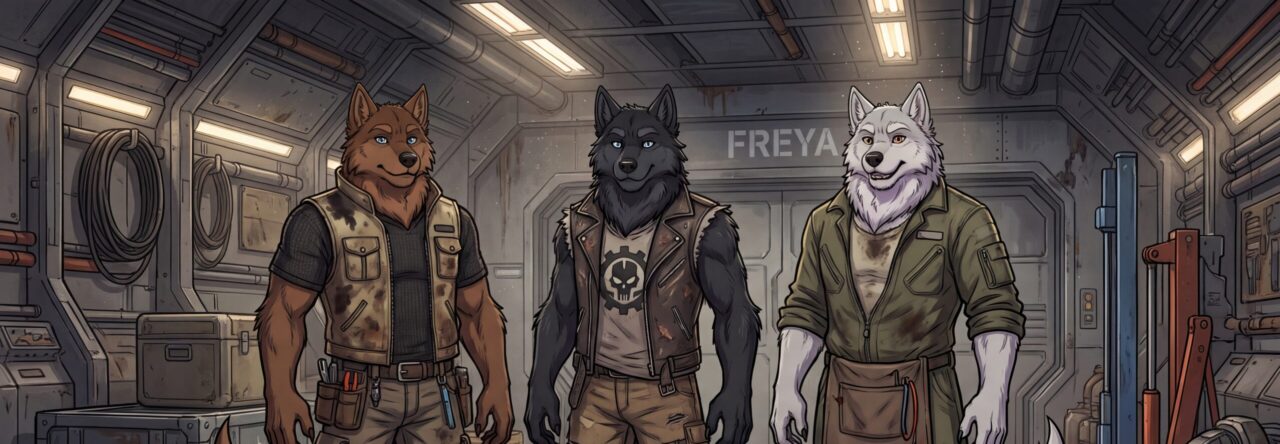
The first thing Gabriel heard when he woke up was a guitar.
Which was unusual, considering he wasn’t playing one.
He lay perfectly still beneath the covers, one black-furred ear turning toward the sound.
A few notes drifted through the cabin. An acoustic guitar, slightly out of tune, playing the opening bars of a melody he recognized.
His melody.
One he’d been working on for the better part of three weeks.
Gabriel opened his eyes.
The sound stopped.
He stared at the ceiling.
“Okay.”
A moment passed.
The guitar started again.
Gabriel sat up.
“Oh, you son of a bitch.”
He threw back the covers, swung his long legs over the side of the bed, and planted his broad, black-padded feet on the warm cabin floor.
The guitar continued.
He crossed the cabin in four long strides and slapped the communications panel beside the door.
“MARK!”
There was a brief silence.
Then the unmistakable sound of someone laughing.
Not Mark.
Thane.
Gabriel closed his eyes.
“Captain.”
“Morning, sunshine.”
“Did you two put a speaker in my ventilation duct?”
“Whatever gave you that idea?”
“THANE.”
“Gabriel, it’s six forty-five. Some of us have been up for hours.”
“Some of us were enjoying a perfectly good dream!”
“About what?”
“None of your damned business!”
Thane laughed again.
“Breakfast is in twenty minutes. And by the way, you’re flat on the third measure.”
The connection clicked off.
Gabriel stared at the communications panel.
Then a slow, decidedly mischievous grin spread across his muzzle.
“Oh, you just wait.”
Thane was standing in the galley making coffee when Gabriel arrived twenty minutes later.
The enormous brown wolf wore a dark blue work shirt and comfortable black utility trousers. His bare paws rested on the galley’s nonslip flooring, and his thick tail swayed lazily behind him as he studied a report on the wall display.
Mark sat at the dining table with a bowl of breakfast cereal, looking entirely too innocent.
Gabriel stopped in the doorway.
He looked at Mark.
Then Thane.
Then Mark again.
“One of you is going to regret this.”
Thane didn’t look up.
“Good morning to you, too.”
“I’m serious.”
“Coffee’s fresh.”
“That doesn’t make us even.”
“No, but it makes you caffeinated.”
Gabriel considered that argument.
Then he crossed to the counter, poured himself a substantial mug, and sat opposite Mark.
“You.”
Mark raised an eyebrow.
“Me?”
“You installed it.”
“Installed what?”
“The speaker.”
“Which speaker?”
Gabriel pointed at him.
“Don’t do that.”
Mark calmly took another bite of cereal.
“I have no idea what you’re talking about.”
Gabriel turned toward Thane.
“He’s lying.”
“That’s a serious accusation.”
“He’s a terrible liar.”
“Actually,” Thane said, “he’s an excellent liar. That’s what makes him so useful during maintenance inspections.”
Mark smiled faintly.
Gabriel stared at them both.
Then he laughed.
“Okay. Fine. You win this round.”
Thane finally turned from the display.
“Round?”
“Oh, Captain. We’re nowhere near finished.”
The insurance company’s response arrived at seven sixteen.
Gabriel had been expecting a counteroffer. He hadn’t been expecting one quite so accommodating.
He opened the message on his tablet, read it twice, and slowly lowered his coffee.
“Well, that’s interesting.”
Thane looked over.
“What?”
“They accepted the survey fee.”
“Good.”
“And the liability exclusions.”
“Even better.”
“And our request for the complete maintenance records.”
Mark stopped eating.
“All of them?”
“Apparently.”
Gabriel scrolled down.
“Five thousand credits for the initial inspection, credited toward the recovery contract if we proceed. Eighty-five thousand for successful delivery to an approved receiving facility. Extraordinary expenses subject to documented approval.”
Thane nodded.
“Reasonable.”
“There’s one catch.”
“Of course there is.”
“They want us underway within forty-eight hours.”
Mark frowned.
“That’s a little aggressive.”
Gabriel turned the tablet toward him.
“Recovery deadline.”
Mark read the clause.
The Mercy Dawn was drifting in a designated industrial holding orbit around Rellan Four, a rocky moon supporting several mining operations. The orbit itself was stable enough for the immediate future, but the freighter’s navigation and station-keeping systems were no longer maintaining its precise position.
Within approximately twenty-one days, its projected trajectory would carry it into a heavily used cargo-transfer corridor.
The local traffic authority had already issued a notice requiring removal.
Failure to comply would allow the authority to seize the vessel and arrange disposal at the insurer’s expense.
Thane studied the document.
“So they’ve run out of time.”
“Pretty much,” Gabriel said. “They need somebody moving now.”
Mark leaned back.
“Six days out. Possibly three or four days on site. Six days back if we’re towing her.”
“Longer under tow,” Thane corrected. “Depends on the mass and how much thrust we can safely apply.”
“True.”
Gabriel looked between them.
“Can we do it?”
Thane didn’t answer immediately.
He wasn’t studying the payout.
He was studying the timetable.
The Freya was capable of the work. That much was clear. She had been built for recovering vessels larger than the Mercy Dawn, and her towing systems had been extensively upgraded during the rebuild.
But capability and readiness weren’t the same thing.
“Mark?”
The engineer considered the question.
“We need to finish the crane certification. Coolant pump number two should get that seal before we leave, and I’d like to inspect the primary tow couplings. We haven’t put a sustained load on them since the Terron recovery.”
“How long?”
“Twenty-four hours if everything checks out.”
“Supplies?”
Gabriel was already opening another document.
“Fuel reserves are good. Food and consumables are fine. Medical supplies are stocked. We need a fresh set of industrial cutting heads, two replacement hydraulic couplings, and another spool of reinforced tow cable.”
Thane nodded.
“Can you get them?”
“Already requested quotes.”
Mark shook his head.
“Do you ever stop?”
Gabriel grinned.
“Not while somebody’s paying me.”
Thane looked toward the window overlooking the station’s inner cargo structure.
Forty-eight hours.
It was enough time.
Just.
“All right,” he said. “Let’s take the survey contract. Full recovery remains conditional on what we find.”
Gabriel nodded.
“I’ll confirm.”
“And make damned sure they understand we’re not guaranteeing recovery until we’ve physically inspected the vessel.”
“Already in the agreement.”
“Good.”
Thane finished his coffee.
“Then I suppose we’re going to Rellan.”
Mark stood.
“I’ll start the departure inspections.”
Gabriel rose as well.
“I’ll handle provisions and port clearance.”
Thane watched them head toward the galley door.
“Hey, Gabriel.”
The black wolf stopped.
“Yeah?”
“About that speaker.”
Gabriel’s ears perked.
Thane smiled.
“You’re still flat on the third measure.”
Gabriel slowly turned his head toward Mark.
Mark’s expression remained perfectly neutral.
“Oh, it’s on,” Gabriel said.
The Freya had five primary decks, although the layout was considerably more complicated than the simple designation suggested.
Originally, the vessel had been designed around a massive structural spine supporting heavy cargo-handling equipment, towing assemblies, and industrial processing systems. Living accommodations occupied a comparatively small portion of her interior.
During the rebuild, the three wolves had modified that arrangement substantially.
The residential deck was comfortable and spacious. The machinery spaces were better organized. The bridge had been modernized, and the fabrication shop had gained capabilities the original designers probably never imagined installing aboard a commercial salvage vessel.
But the fundamentals remained unchanged.
Freya was a machine built to work.
And preparing her for an interstellar recovery operation required considerably more than turning a key.
By eight thirty, Mark was deep inside the aft engineering compartment.
His bare gray-and-white paws rested on the grated maintenance platform as he examined the primary coolant circulation assembly.
A compact diagnostic scanner was connected to the pump’s control housing.
Its display showed a series of performance curves, temperatures, and pressure readings.
Mark studied them with narrowed brown eyes.
“You’re not fooling anybody,” he muttered.
The pump continued running.
He shut it down through the maintenance controller, isolated the associated coolant loop, and waited for the pressure indicators to fall.
Then he opened the access cover.
A faint metallic odor drifted from the housing.
Mark sniffed once.
“Yep.”
The seal was beginning to degrade.
Not catastrophically. Not even enough to produce an external leak.
But enough.
He reached for his communicator.
“Thane?”
“Go ahead.”
“Coolant pump seal confirmed. I’m replacing it.”
“Need anything?”
“No. I’ve got the replacement.”
“All right.”
“Where are you?”
“Cargo bay. Checking the tow assemblies.”
“Don’t cycle the port coupling yet.”
“Why?”
“I’ve got the hydraulic loop isolated.”
Thane paused.
“That would have been good to know five minutes ago.”
Mark stopped working.
“Thane.”
“I’m kidding.”
“You’re not funny.”
“I disagree.”
“I know.”
The connection ended.
Mark smiled to himself.
Then he returned to work.
In the cargo bay, Thane stood beside one of Freya’s massive aft towing mechanisms.
The assembly was a substantial arrangement of reinforced structural members, powered couplings, load sensors, and industrial-grade attachment hardware.
It had originally been designed to handle enormous mining platforms and disabled freighters.
During the rebuild, Mark had reinforced the mounting structures and replaced the outdated control systems with modern equipment.
The result was not particularly elegant.
But it was extraordinarily capable.
Thane ran one claw along the edge of a coupling housing, examining a shallow scrape in the protective coating.
The mark was new.
Probably from their last recovery.
He crouched and inspected the underside.
No deformation.
No visible cracking.
Good.
He tapped the communicator.
“Mark, I found some cosmetic damage on the starboard tow coupling. Nothing structural that I can see.”
“Photograph it.”
“Already did.”
“Send it to the maintenance log.”
“Already did.”
A pause.
“Good.”
Thane grinned.
“See? I can be trained.”
“Debatable.”
He stood and stretched.
For a moment, he simply looked around the cargo bay.
At one hundred fifteen meters long, Freya was a substantial vessel, and her central cargo compartment occupied an enormous portion of her interior volume.
Most of it was empty now.
The last recovery had been profitable, but the work had left evidence behind. A few scorched patches on the deck. Fresh abrasion marks around the loading tracks. A dented protective guard that needed straightening.
Ordinary wear.
Thane rather liked it.
A spotless salvage ship was either brand new or unemployed.
He preferred neither.
His communicator chimed again.
This time it was Gabriel.
“Captain, I have a question.”
“Go ahead.”
“How attached are you to the remaining funds in our operating account?”
Thane closed his eyes.
“What did you find?”
“An opportunity.”
“That’s never a comforting word coming from you.”
“Calder Industrial Supply has a surplus fabrication unit available. Nearly new. Apparently ordered for a mining contractor who went insolvent before delivery.”
Thane considered that.
“What kind?”
“Heavy materials processor. Capable of handling larger alloy stock than our current system.”
That caught his attention.
“How much?”
“Forty-two thousand credits.”
Thane whistled softly.
“That’s not pocket change.”
“No, but the original invoice was ninety-six.”
“Why are they selling it so cheap?”
“They need the warehouse space.”
“Have you talked to Mark?”
“Not yet.”
“Talk to Mark.”
“I was hoping you’d say that.”
“And Gabriel?”
“Yes?”
“Don’t buy it without discussing it with us.”
A brief silence.
“Define buy.”
“Gabriel.”
“I’m joking!”
Thane shook his head.
At least he hoped Gabriel was joking.
Calder Station’s industrial supply district occupied three interconnected commercial modules overlooking the main shipyard.
It was noisy, crowded, and smelled of machine lubricant, heated metal, and several species’ preferred street foods.
Gabriel loved places like this.
There was money to be made, deals to be found, and an endless assortment of unusual people to meet.
He moved through the crowded concourse with practiced ease, occasionally adjusting his path to avoid smaller pedestrians.
His height drew attention, as it usually did.
But he was accustomed to it.
A tall black-furred wolf with bright blue eyes, an easy grin, and a confident stride was difficult to overlook.
Most people simply stepped aside.
A few stared.
One small child, walking beside a human woman, pointed directly at him.
“Mom! Look at the wolf!”
Gabriel glanced down.
The child couldn’t have been more than five.
The mother looked embarrassed.
“I’m sorry.”
Gabriel grinned.
“No problem.”
He crouched slightly.
“Hey there, little guy.”
The child stared at his muzzle.
“Are your teeth real?”
Gabriel laughed.
“Every one of ’em.”
“Can I see?”
“Absolutely not,” the mother said immediately.
Gabriel chuckled.
“Fair enough.”
He gave the child a friendly wave and continued toward the supply office.
Behind him, he heard the boy whisper something about how enormous his paws were.
Gabriel smiled.
Some things never changed, no matter how many star systems humanity colonized.
The fabrication unit was impressive.
Mark had joined Gabriel at the supplier’s warehouse twenty minutes earlier, and the engineer was now walking slowly around the machine with the expression of a wolf who had unexpectedly encountered something beautiful.
Gabriel watched him.
“Well?”
Mark didn’t answer.
He crouched beside the processing chamber and examined the mounting hardware.
Then he checked the manufacturer’s identification plate.
Then the control connections.
Gabriel waited.
“Mark?”
“Quiet.”
Gabriel smiled.
Oh, this was going well.
Mark opened a maintenance panel.
“Interesting.”
“What?”
“Latest revision of the cutting assembly. Reinforced drive system. Updated thermal controls.”
“Is that good?”
“Very.”
“Better than ours?”
“Considerably.”
Gabriel folded his arms.
“So we want it.”
Mark straightened.
“Depends.”
“On?”
“Power requirements. Cooling capacity. Mounting space.”
“We have all those.”
“Probably.”
Gabriel grinned.
“Which means yes.”
“Which means I need to check the specifications.”
The supplier approached them.
He was a stocky human named Darrin Kells, with thinning hair and the harried expression of someone managing far too much inventory.
“Everything satisfactory, gentlemen?”
Gabriel smiled.
“Beautiful machine.”
“Excellent equipment. Practically new.”
“Never commissioned?”
“No, sir. Still under manufacturer warranty.”
Mark looked up sharply.
“Warranty transferable?”
Kells hesitated.
“I believe so.”
“Believe?”
“I can verify.”
“Please do.”
Gabriel suppressed a grin.
Mark could be absolutely merciless about technical details.
Kells pulled up the documentation.
“Yes. Transferable. Full coverage for another twenty-six months.”
Mark nodded.
“Good.”
Gabriel stepped forward.
“Now, Darrin. About that price.”
The supplier looked pained.
“We’ve already discounted it considerably.”
“Oh, absolutely. Very generous.”
“Forty-two thousand is an excellent price.”
“It certainly is.”
Kells relaxed slightly.
Gabriel smiled.
“Unfortunately, it’s not the price we’re going to pay.”
The man’s expression fell.
Mark quietly returned to examining the machine.
He knew better than to interrupt Gabriel when he was enjoying himself.
Three hours later, Gabriel and Mark returned to Freya.
Behind them, a station cargo tug carried the fabrication unit on a secured transport platform.
Thane was waiting in the cargo bay.
He watched the machine roll through the loading doors.
Then he looked at Gabriel.
“Please tell me you didn’t spend forty-two thousand credits.”
Gabriel smiled.
“Of course not.”
Thane narrowed his eyes.
“How much?”
“Thirty-one thousand, eight hundred.”
Thane stared.
Mark nodded approvingly.
“Including delivery, installation support, and the remaining warranty.”
Thane looked between them.
“Seriously?”
Gabriel spread his arms.
“What can I say? I’m charming.”
Mark snorted.
“He’s a menace.”
“An effective menace.”
Thane examined the machine.
It was larger than their current materials processor, but compact enough to fit comfortably in the fabrication shop once they rearranged the equipment.
“Do we actually have the space?”
Mark nodded.
“I measured.”
“Power?”
“Plenty.”
“Cooling?”
“Within capacity.”
“Installation?”
“I can have it operational after we get back from Rellan.”
Thane considered the purchase.
Thirty-one thousand credits was still a significant expense.
But the machine would greatly expand their fabrication capabilities and reduce their dependence on outside suppliers.
On a ship that spent much of its time operating far from major industrial centers, that was valuable.
He nodded.
“All right. Good purchase.”
Gabriel grinned.
“Thank you, Captain.”
“Now tell me how you got him down that far.”
Gabriel looked offended.
“Trade secrets.”
Mark folded his arms.
“He convinced the supplier that holding it another month would cost more than the difference.”
“Which is true,” Gabriel protested.
“And then offered to take two obsolete replacement drive assemblies they couldn’t sell.”
“Which we can use.”
“And negotiated a discount on the installation support.”
“Which we don’t actually need.”
Thane laughed.
“You magnificent bastard.”
Gabriel bowed.
“At your service.”
By the following morning, the Freya was nearly ready to depart.
The replacement coolant seal was installed.
The overhead crane had passed its operational checks.
The tow couplings had been inspected, tested, and certified.
Supplies were aboard.
The cargo bay had been secured, and the new fabrication unit was safely stowed until installation could be completed.
The three wolves gathered on the bridge at eight fifteen.
Freya’s command deck was a practical, modernized workspace located near the forward end of the vessel.
Large displays provided sensor information, navigation data, propulsion status, and communications.
The main flight controls occupied two stations at the front, while additional consoles along the sides supported engineering, cargo operations, and salvage equipment.
Thane settled into the captain’s chair.
It was larger than the original equipment, custom-built to accommodate his frame and tail comfortably.
Mark occupied the engineering station.
Gabriel sat at communications and navigation support, reviewing their departure authorization.
“Calder Traffic says we’re cleared to initiate departure preparations,” Gabriel announced.
Thane nodded.
“Mark, ship status?”
“Main power stable. Environmental systems nominal. Maneuvering thrusters online. FTL drive ready for departure sequence once we clear the station’s traffic boundary.”
“Cargo?”
“Secured.”
“Tow gear?”
“Locked and stowed.”
“External connections?”
Gabriel checked his display.
“Station power disconnected. Environmental umbilicals released. Docking clamps standing by.”
Thane rested his broad, clawed hands on the controls.
“All right. Let’s wake her up.”
Mark began the propulsion startup sequence.
Deep within the vessel, power flowed into the primary maneuvering systems.
A familiar low vibration traveled through the bridge.
Thane felt it through the floor beneath his bare paws.
He smiled.
There she was.
Freya.
Awake and ready to work.
“Thrusters responding,” Mark reported.
“Good.”
Gabriel keyed the communications system.
“Calder Traffic, independent salvage vessel Freya requesting departure clearance from Berth Seventeen.”
A moment later, a human voice answered.
“Freya, Calder Traffic. Departure approved. Maintain designated outbound corridor Bravo-Seven. Traffic separation in effect. Report clear of station control.”
“Understood, Calder. Bravo-Seven. Freya departing.”
Thane engaged the maneuvering controls.
The ship’s docking clamps released with a muted mechanical vibration.
Slowly, almost imperceptibly, Freya began moving away from the station.
The enormous industrial structure drifted across the forward displays.
Beyond it lay the dark curve of Veyra, its atmosphere glowing faintly in the light of the system’s star.
Thane watched the navigational markers.
“Port lateral thrusters, ten percent.”
Mark acknowledged.
The ship moved smoothly into the outbound corridor.
“Looking good,” Gabriel said.
Thane smiled.
“She always does.”
Mark made a skeptical noise.
“Except when she doesn’t.”
“You’re ruining the moment.”
“Somebody has to.”
Gabriel laughed.
The transit from Calder Station to the Rellan system would take approximately six days.
Interstellar travel had become routine centuries earlier, but it remained subject to practical limitations.
Ships couldn’t simply engage faster-than-light propulsion wherever they pleased.
They had to reach designated departure regions outside heavily trafficked orbital space, establish a safe trajectory, and verify that their projected transit corridor was clear.
Freya’s drive was reliable, though hardly state-of-the-art.
She was considerably faster than older industrial vessels and considerably slower than modern passenger transports.
Thane considered that a perfectly reasonable compromise.
A salvage ship wasn’t supposed to win races.
It was supposed to get the job done.
By ten forty, Freya had cleared the primary traffic zone and was approaching the system’s outer transit boundary.
Gabriel reviewed the navigation data.
“Rellan corridor confirmed. Estimated transit time five days, nineteen hours.”
“Any advisories?”
“Minor traffic congestion at the destination boundary. Nothing significant.”
Mark checked the drive systems.
“FTL ready.”
Thane leaned back.
“All right, gentlemen. Let’s go earn some money.”
Gabriel grinned.
“Music to my ears.”
Thane engaged the drive sequence.
The ship’s conventional propulsion systems reduced output as the faster-than-light field generators came online.
A low, resonant hum filled the bridge.
On the forward display, the stars distorted slightly as Freya entered the transit field.
Then the familiar blackness of open space gave way to the shifting, luminous patterns of faster-than-light travel.
They were underway.
Thane watched the displays for another minute, confirming that the ship’s trajectory remained stable.
Then he stood.
“Mark, you’ve got the bridge.”
“Got it.”
“Gabriel, let’s go review the contract terms.”
The black wolf groaned.
“Didn’t we just do that?”
“We’re about to spend six days getting there. I want everything clear before we arrive.”
Gabriel sighed.
“You’re no fun.”
Thane smiled.
“That’s why you love me.”
The first two days of transit passed without incident.
Which, aboard Freya, meant that everybody found plenty of things to do.
Mark spent most of his time checking the newly repaired systems and updating the ship’s maintenance records.
Thane inspected the recovery equipment, reviewed the Mercy Dawn’s technical documentation, and began planning possible approaches to the disabled freighter.
Gabriel handled communications with the insurance company, reviewed commercial regulations in the Rellan system, and spent several hours complaining about the price of replacement hydraulic components.
In between, they ate together, watched old movies, argued about music, and generally enjoyed the comfortable familiarity of their shared life.
On the third evening, Gabriel appeared in the common room carrying his guitar.
Thane was stretched out on the couch, reading.
Mark sat in his usual chair with a technical manual.
Gabriel looked around.
“All right, gentlemen.”
Neither looked up.
“I have an announcement.”
Thane turned a page.
“Congratulations.”
“You haven’t heard the announcement.”
“I’m sure it’s wonderful.”
Gabriel placed the guitar on the table.
“I have finished the song.”
Mark raised an eyebrow.
“What song?”
“The one I’ve been working on.”
“The one you keep playing at three in the morning?”
“I do not play at three in the morning.”
“You did Tuesday.”
“That was two thirty.”
Thane laughed.
Gabriel pointed at him.
“You’re not helping.”
“Sorry.”
The black wolf picked up the guitar and settled into his chair.
“Anyway. I want your opinions.”
Mark closed his manual.
Thane set aside his book.
Gabriel adjusted the tuning slightly, then began to play.
The melody was gentle at first, built around a series of carefully picked chords.
Then it developed into something richer, with a warm, rhythmic progression that carried a surprisingly wistful quality.
Gabriel played for several minutes.
There were no lyrics.
Just the guitar.
When he finished, the room remained quiet.
Thane smiled.
“That’s beautiful, Gabe.”
Gabriel looked pleased.
“Yeah?”
“Yeah. Really good.”
Mark nodded.
“I like the middle section.”
Gabriel turned toward him.
“The bridge?”
“Yes. Nice progression.”
“Thanks.”
Thane leaned forward.
“What’s it called?”
Gabriel looked down at the guitar.
“Haven’t decided.”
“What’s it about?”
The black wolf considered that for a moment.
“Home, I guess.”
Thane glanced around the common room.
At the worn furniture, the shelves, the photographs, the familiar signs of years spent living aboard an old industrial ship.
“Well,” he said quietly, “you picked a good subject.”
Gabriel smiled.
Then he looked toward Mark.
“By the way, I found that speaker you installed in my ventilation duct.”
Mark didn’t move.
“Oh?”
“Yep.”
“Interesting.”
“Very.”
Thane watched them with amusement.
Gabriel leaned back.
“Just thought you should know.”
Mark nodded.
“Good to know.”
A long silence followed.
Then Gabriel added, almost casually, “You might want to check your cabin’s announcement system.”
Mark slowly looked up.
Thane burst out laughing.
By the fifth day, the three wolves had settled into the predictable routine of interstellar transit.
Freya’s systems continued operating normally.
The FTL drive maintained a stable field.
Supplies were adequate, equipment was ready, and Gabriel’s revised contract documents had finally been acknowledged by the insurance company’s claims office.
The only remaining complication involved the Mercy Dawn’s maintenance records.
Or, more accurately, the lack of them.
Mark had been reviewing the files when he noticed the discrepancy.
He called Thane to engineering.
The captain arrived a few minutes later, carrying a mug of coffee.
“What’s up?”
Mark pointed toward the terminal.
“Take a look.”
The display showed a maintenance history covering the freighter’s previous eighteen months of operation.
Thane scanned the entries.
“Looks normal.”
“Keep going.”
Thane scrolled.
Routine inspections.
Minor equipment replacements.
Propulsion calibrations.
Environmental system servicing.
Then a gap.
He frowned.
“Where’s the last quarter?”
“Exactly.”
Thane looked at Mark.
“Missing?”
“Completely.”
“Could be a records transfer issue.”
“Could be.”
Mark opened another file.
“Except the incident report references a propulsion modification completed six weeks before the failure.”
Thane read the entry.
“Power-distribution upgrade.”
“Right.”
“But there’s no record of the work.”
“Not in the files we received.”
Thane leaned against the console.
“That’s not necessarily sinister.”
“I didn’t say it was.”
“Could’ve been done at an independent yard.”
“Certainly.”
“Or by the crew.”
“Possibly.”
Thane studied the information.
“But you’d like to know what they changed before we go poking around.”
Mark nodded.
“Exactly.”
Thane took another sip of coffee.
“All right. I’ll have Gabriel request the missing records.”
“Already asked him.”
Thane grinned.
“Naturally.”
Mark looked back at the screen.
“There’s something else.”
“What?”
“The propulsion failure appears to have originated in the main distribution network. That’s a fairly serious problem, but the ship’s independent systems continued operating normally.”
“We knew that.”
“Yes. But look at the emergency shutdown sequence.”
Thane leaned closer.
The readout displayed a timeline of events preceding the failure.
A power fluctuation.
A protective shutdown.
Several attempts to restore propulsion.
Then a complete isolation of the primary distribution bus.
Mark pointed toward one particular entry.
“This.”
Thane read it.
“Manual override?”
“Yes.”
“By the crew?”
“Apparently.”
“That seems reasonable if automatic recovery failed.”
“It does.”
Mark folded his arms.
“But I’d like to know why the captain ordered a complete shutdown of the propulsion distribution network when the system was already isolated.”
Thane considered that.
“Maybe they were being cautious.”
“Maybe.”
“Maybe they thought something was damaged.”
“Also possible.”
Thane looked at his old friend.
“What are you thinking?”
Mark shook his head.
“Nothing definite. I just don’t like incomplete information.”
Thane smiled.
“Now there’s a shock.”
Mark gave him a flat look.
“Very funny.”
“All right. We’ll find out when we get there.”
On the final evening before arrival, Thane found Gabriel alone on the bridge.
The black wolf was sitting at the communications station, reviewing the latest correspondence from the insurance company.
A half-finished mug of coffee rested beside him.
Thane entered quietly.
“Burning the midnight oil?”
Gabriel looked up.
“Just getting everything squared away.”
“Problems?”
“Not really.”
Thane settled into the captain’s chair.
Gabriel continued reading for a moment, then shut down the display.
“You know what I hate about insurance companies?”
Thane grinned.
“How much time have you got?”
“I’m serious.”
“All right.”
“They’re perfectly happy to write a contract that sounds straightforward, but every paragraph has six different ways for them to get out of paying you.”
“Which is why we have you.”
Gabriel smiled.
“True.”
He tapped the tablet.
“Still, this one’s unusual.”
“How so?”
“They’re being very accommodating.”
Thane raised an eyebrow.
“Isn’t that good?”
“Usually.”
“Usually?”
Gabriel leaned back.
“They accepted nearly every condition I requested. Didn’t argue much about the survey fee. Didn’t push back on our right to reject the recovery. They even agreed to cover additional equipment costs if the initial documentation turns out to be inaccurate.”
Thane considered that.
“Maybe they’re just desperate.”
“Probably.”
“Deadline’s getting close.”
“Yep.”
“Then what’s bothering you?”
Gabriel looked toward the forward display.
“Nothing specific. I guess I’m just suspicious when somebody makes my job too easy.”
Thane chuckled.
“Well, there’s a first.”
Gabriel grinned.
“Shut up.”
For a while, they sat together in comfortable silence.
Beyond the forward displays, the shifting patterns of the transit field moved steadily past.
Freya’s engines hummed beneath them.
Eventually Gabriel spoke again.
“Hey, Thane?”
“Yeah?”
“You ever regret buying her?”
Thane looked over.
“Freya?”
“Yeah.”
The captain considered the question.
“No.”
“Not even during the rebuild?”
Thane laughed.
“Oh, there were days I wanted to set her on fire.”
Gabriel burst out laughing.
“That electrical distribution nightmare?”
“Among others.”
“God, I thought Mark was going to lose his mind.”
“Mark doesn’t lose his mind.”
“He came close.”
Thane smiled at the memory.
The rebuilt power-distribution system had been one of the most difficult projects they’d undertaken. A supposedly compatible control module had turned out to require extensive modification, and the resulting installation had consumed nearly three weeks of work.
They’d been exhausted.
Frustrated.
And more than a little concerned about whether they’d made a terrible financial decision.
But they’d persevered.
As they always did.
“No,” Thane said again. “I don’t regret it.”
Gabriel nodded.
“Me neither.”
Thane glanced toward the communications station.
“Why do you ask?”
Gabriel shrugged.
“Just thinking.”
“About?”
“How different things could’ve been.”
Thane smiled.
“That’s true.”
“We could’ve bought a newer ship.”
“Couldn’t have afforded one.”
“Could’ve leased.”
“And spent the rest of our lives paying somebody else.”
“Fair point.”
Thane looked around the bridge.
“Besides, a newer ship wouldn’t be Freya.”
Gabriel smiled.
“No. Guess it wouldn’t.”
The Rellan system appeared on Freya’s navigation display at approximately eight forty the following morning.
The transition from faster-than-light travel to conventional space was smooth.
Thane sat at the helm, monitoring the final deceleration sequence.
Mark watched the engineering readouts.
Gabriel handled navigation and communications.
“FTL field collapsing normally,” Mark reported.
“Conventional propulsion standing by,” Thane replied.
“Rellan traffic control beacon acquired,” Gabriel announced. “We’re approximately forty-two million kilometers from the primary industrial zone.”
Thane nodded.
“Let’s establish contact.”
Gabriel keyed the transmitter.
“Rellan Traffic, this is independent salvage vessel Freya, inbound on commercial transit corridor Nine. Requesting clearance to proceed toward Rellan Four for authorized survey operations.”
The response arrived several seconds later.
“Freya, Rellan Traffic. Identification confirmed. Proceed along assigned approach vector. Be advised, industrial traffic is heavy in the Rellan Four transfer corridor. Maintain separation and report upon entering local control.”
“Understood, Rellan. Freya proceeding.”
Thane adjusted the navigation controls.
The ship responded smoothly.
“All right, gentlemen. Let’s see what we’ve got.”
The Rellan system was dominated by a pale yellow star surrounded by several planets, numerous industrial satellites, and an extensive network of mining installations.
Rellan Four was a rocky moon orbiting a gas giant in the outer portion of the system.
Its surface was heavily scarred by industrial excavation.
Large mining settlements occupied several equatorial regions, while orbital processing facilities handled the steady stream of raw materials leaving the moon.
The Mercy Dawn was located beyond the busiest portion of the industrial zone.
Freya would reach her in approximately eighteen hours.
Gabriel studied the local traffic information.
“Busy little place.”
Mark nodded.
“Mining systems usually are.”
Thane looked at the industrial installations on the display.
“Looks like they’ve got a decent economy.”
“Depends on who’s getting paid,” Gabriel said.
Thane glanced at him.
“Something you found?”
“Just reading the local trade reports. Several operators have been struggling with transport costs. A couple of smaller freight companies went under recently.”
“Including Mercy Dawn’s owners.”
“Exactly.”
Mark checked the sensor data.
“Nothing unusual about that. Frontier transportation margins are tight.”
Gabriel nodded.
“Yep. Fuel goes up, maintenance gets expensive, one ship breaks down, and suddenly you’re out of business.”
Thane understood that problem all too well.
Running an independent salvage operation required careful financial management.
Freya was fully paid for, and the three wolves had built a respectable operating reserve, but a major mechanical failure could still cause serious financial discomfort.
And unlike large corporations, they couldn’t simply transfer the cost to another division.
Gabriel’s work mattered.
So did Mark’s.
And so did Thane’s responsibility to ensure that every contract they accepted was worth the risks involved.
“All right,” Thane said. “Let’s review the approach plan.”
By the time the Mercy Dawn appeared on Freya’s long-range sensors, the three wolves had completed their initial preparations.
The disabled freighter was exactly where the orbital tracking data indicated.
Approximately ninety meters long, she was a conventional commercial transport with a broad cargo section, modest propulsion assembly, and a compact forward command module.
Her exterior showed the ordinary signs of years spent hauling freight along frontier routes.
Scuffed plating.
Replaced panels.
Faded company markings.
Nothing particularly remarkable.
Thane studied the image.
“Well, there she is.”
Gabriel enlarged the display.
“Not much to look at.”
Mark glanced over.
“Neither was Freya when we bought her.”
“Fair point.”
The captain reviewed the sensor readings.
“Any active transmissions?”
Gabriel checked.
“Automated navigation beacon. Emergency transponder. Standard vessel identification.”
“Life signs?”
Mark turned toward the sensor display.
“Atmosphere in the main compartments. Environmental systems running at reduced capacity. No confirmed occupants.”
“Reactor?”
“Low-power standby. Stable.”
Thane nodded.
“Structural condition?”
“Primary hull appears intact. No significant breaches. Some minor impact damage on the starboard cargo section.”
“All right.”
He adjusted their approach.
Freya moved slowly toward the disabled vessel, maneuvering thrusters making minute corrections as the distance closed.
At five kilometers, Thane reduced their relative speed.
At two kilometers, he began a detailed visual inspection.
At one kilometer, the Mercy Dawn filled much of the forward display.
Thane leaned forward.
“Mark, take a look at the aft section.”
The engineer studied the image.
“What am I looking for?”
“That panel near the main propulsion housing.”
Mark enlarged the view.
A rectangular section of hull plating appeared noticeably cleaner than the surrounding structure.
“Replacement panel,” Mark observed.
“Looks recent.”
“Could be part of the modification work.”
“That’s what I’m thinking.”
Gabriel glanced toward them.
“Is that a problem?”
“Not necessarily,” Mark replied. “But I want to know what’s behind it.”
Thane nodded.
“We’ll find out.”
He eased Freya into a stable position approximately five hundred meters from the freighter.
The two ships drifted together, their relative motion carefully matched.
Beyond them, Rellan Four hung against the blackness of space, its scarred surface illuminated by the distant sun.
Thane completed the positioning maneuver.
“All stop.”
Mark confirmed the propulsion status.
“Relative velocity stable.”
Gabriel checked the contractual authorization.
“Survey permit confirmed. Local traffic notified. We’re clear to begin inspection.”
Thane leaned back.
“Good.”
For a moment, nobody spoke.
The disabled freighter floated silently beyond the bridge windows.
She wasn’t especially impressive.
She wasn’t mysterious.
She was simply another aging commercial ship that had suffered an expensive mechanical failure.
Thane had seen hundreds like her.
He stood and stretched, his tail moving lazily behind him.
“All right, gentlemen. Let’s get suited up and see what kind of mess somebody left us.”
Mark was already rising from his station.
“I’ll get the portable diagnostic equipment.”
Gabriel shut down the communications display.
“And I’ll notify the insurance company that we’ve arrived.”
Thane nodded.
“Remember, inspection only. Nobody starts tearing anything apart until we’ve established exactly what we’re dealing with.”
“Understood,” Mark said.
Gabriel grinned.
“Yes, Mother.”
Thane gave him a sideways look.
“Keep it up, smartass.”
Gabriel laughed.
The three wolves left the bridge together.
Behind them, Freya maintained her position beside the silent freighter, her automated systems making tiny, precise corrections to hold station.
Another contract.
Another disabled ship.
Another day’s work.
And, as far as Thane was concerned, there was no better way to make a living.