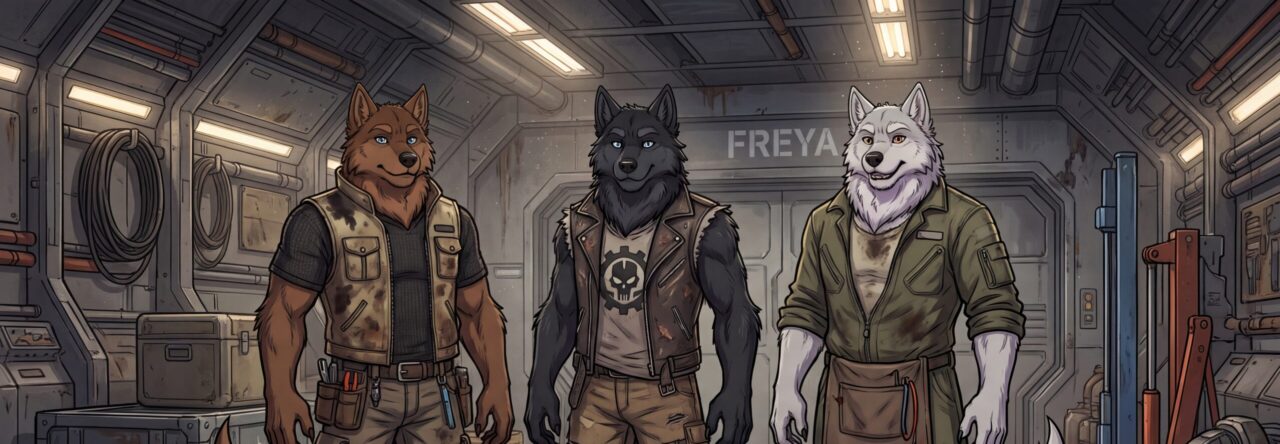
The first indication that something was wrong came from a noise that shouldn’t have been there.
It wasn’t particularly loud. Just a faint metallic tick, followed by a barely perceptible vibration through the deck plating.
Thane stopped walking.
He stood perfectly still in the main cargo bay of the Freya, his ears swiveling toward the portside overhead crane assembly.
There it was again.
Tick.
A moment later, a muted clunk.
The enormous brown-furred wolf slowly raised his head.
“Oh, you’re kidding me.”
At seven feet tall, Thane was an imposing figure even among his own species. Broad shoulders, powerful arms, and a substantial frame made him look considerably more formidable than his generally easygoing disposition suggested. His blue eyes tracked the overhead machinery while one clawed hand rested against the cold steel of a nearby cargo container.
He listened.
Tick.
Clunk.
“Mark,” he said into his wrist communicator. “You got a minute?”
The response came almost immediately.
“Depends.”
Thane smiled.
“How much do you love our portside cargo crane?”
A pause.
“What did Gabriel do?”
“Nothing, actually.”
“Then what did you do?”
“Why does everybody assume somebody did something?”
“Because I’ve known you two for thirty years.”
“Fair point. But neither of us touched it. I’m hearing something in the upper carriage assembly. Sounds like a bearing.”
Another pause, this one shorter.
“Don’t operate it. I’ll be there in five.”
“Wasn’t planning to.”
“Thane.”
“What?”
“Don’t operate it.”
Thane rolled his eyes.
“Yes, Mother.”
The communicator clicked off.
He looked up at the crane again.
“Well, sweetheart, I guess you’re getting another little bit of attention today.”
The Freya answered with the familiar deep vibration of her environmental machinery.
Thane grinned.
At thirty-two years old, the ship had earned the right to complain occasionally.
Besides, she was considerably better behaved than most of the people who worked aboard her.
Docking Berth Seventeen at Calder Industrial Station was not an especially glamorous place to spend a morning.
The station orbited Veyra, a heavily industrialized world whose primary contribution to interstellar civilization consisted of manufactured components, refined metals, and an astonishing amount of paperwork.
Calder itself was a sprawling collection of interconnected pressure modules, cargo platforms, processing facilities, and commercial berths. Thousands of vessels passed through every month.
Most of them were considerably newer than the Freya.
Few of them, in Thane’s admittedly biased opinion, were nearly as interesting.
Her hull was a broad, utilitarian arrangement of reinforced compartments and structural members surrounding a massive central cargo section. Heavy recovery booms folded against her flanks. Tow-coupling assemblies occupied much of her aft structure, and the angular machinery housings gave her the unmistakable silhouette of a working salvage vessel.
She wasn’t sleek.
She wasn’t particularly fast.
And her hull bore enough evidence of repaired impacts, replaced panels, and structural reinforcement to make an inexperienced inspector deeply nervous.
But underneath those scars was a ship that had been painstakingly rebuilt by three wolves who knew exactly what they were doing.
Thane had never wanted anything else.
Outside the cargo bay’s open inner loading doors, station personnel were transferring the final containers from their latest recovery contract.
A human forklift operator maneuvered a grav-assisted cargo platform into position while a pair of dockworkers checked the container’s identification markings against their manifest.
Thane watched the operation with the relaxed attention of someone who had supervised thousands of similar transfers.
“Hold there,” he called.
The operator stopped.
Thane pointed toward the container’s lower securing bracket.
“You’ve still got one transport lock engaged.”
The human leaned out of the cab, looked down, and frowned.
“Shit. You’re right.”
“Happens.”
The operator climbed down and released the lock.
“Thanks, Captain.”
“No problem. I’d rather find it now than have you drag half my floor out with it.”
The man chuckled, although he gave the enormous wolf a slightly cautious glance as he passed.
Thane barely noticed.
He’d been getting those looks his entire life.
Wolves were hardly unusual in civilized space, but a full-grown male standing seven feet tall still tended to attract attention, particularly among humans and smaller species.
Thane didn’t deliberately cultivate that effect.
He didn’t have to.
His natural bearing was calm, self-assured, and quietly imposing. He seldom raised his voice, and he generally treated everyone with the same straightforward courtesy.
It was simply difficult to forget that the friendly brown wolf discussing cargo locks could probably lift the average human dockworker off the floor with one arm.
“All clear, Captain,” the operator announced.
“Go ahead.”
The platform moved smoothly toward the station’s receiving area.
Thane checked the final item off his handheld manifest.
Twenty-seven containers of recovered industrial machinery, three damaged atmospheric processors, and approximately forty tons of assorted structural material.
Not glamorous salvage.
Not mysterious.
Just useful equipment that somebody was willing to pay good money to recover.
Exactly the kind of work that kept the Freya flying.
His communicator chirped.
“Captain?”
Thane recognized the voice immediately.
“Morning, Gabriel.”
“Are you aware that Calder Station apparently believes we’re operating a luxury passenger liner?”
Thane closed his eyes.
Here we go.
“What happened?”
“They sent us our docking invoice.”
“And?”
“And unless I’m reading this wrong, they expect us to pay eighteen thousand credits for the privilege of occupying a commercial berth for thirty-six hours.”
“That seems a little high.”
“A LITTLE HIGH?”
Thane pulled the communicator away from his ear.
“I mean, I’m looking at the invoice right now. They’ve charged us for hazardous materials handling, oversized vessel accommodation, supplementary security monitoring, and something called an enhanced environmental support assessment.”
“What’s that?”
“I HAVE NO IDEA!”
Thane laughed.
“Gabriel, lower your voice.”
“I’m perfectly calm.”
“You sound perfectly calm.”
“Thank you.”
“Where are you?”
“Commercial administration. I’m about to introduce somebody to the concept of fraudulent billing.”
“Try not to bite anyone.”
“That depends entirely on how this conversation progresses.”
The connection terminated.
Thane shook his head.
“Another beautiful morning.”
Mark was already halfway up the crane’s maintenance ladder when Thane returned to the cargo bay.
The gray-and-white wolf was shorter than his companions, though at six feet five inches he hardly qualified as small.
He wore dark work trousers and a faded engineering shirt, the sleeves rolled up past his elbows. A compact diagnostic unit hung from his belt, and his brown eyes were narrowed in concentration as he inspected the exposed carriage assembly.
Thane stopped beneath him.
“Well?”
Mark didn’t look down.
“Outer race on the number-three bearing.”
“Thought so.”
“There’s some scoring on the shaft, too.”
“Bad?”
“Not yet.”
“Can we machine it?”
“Probably. Depends on what I find when I pull the assembly.”
Thane nodded.
“Need a hand?”
“Eventually. Right now I need you to stop standing underneath me.”
Thane looked up.
“Why?”
“Because I’m holding a twelve-kilogram bearing housing.”
“Ah.”
He stepped aside.
Mark carefully lowered the component using a small maintenance hoist.
The assembly descended to the deck with a solid metallic thunk.
Thane crouched beside it.
The bearing was visibly worn.
“Well, that’s annoying.”
Mark climbed down.
“Original equipment.”
“Really?”
“Twenty-eight years old.”
Thane raised an eyebrow.
“That’s impressive.”
“It was a good bearing.”
“Apparently.”
Mark ran a claw along the edge of the housing, then frowned.
“Should’ve caught this during the last inspection.”
“Mark.”
“What?”
“It’s a bearing. They wear out.”
“Not supposed to wear out without me noticing.”
Thane smiled.
There were few things in the universe more predictable than Mark taking the failure of an aging mechanical component as a personal insult.
“Want me to get the replacement?”
“Already ordered one.”
“Of course you did.”
“Should be here in two hours.”
Thane looked at him.
“Two hours? You ordered it already?”
“Yesterday.”
“How’d you know?”
Mark pointed toward the housing.
“Temperature trend was creeping upward. Only a degree and a half over three weeks, but it wasn’t normal.”
Thane stared at him for a moment.
Then he shook his head.
“You’re a frightening individual.”
Mark shrugged.
“Somebody has to keep this bucket flying.”
“Don’t call her a bucket.”
“You call her a bucket.”
“That’s different.”
“How?”
“She’s my bucket.”
Mark gave him a long, thoroughly unimpressed look.
Then he picked up his diagnostic unit.
“Go bother Gabriel.”
Gabriel had reached the stage of negotiations where his smile was beginning to concern people.
Across the desk, a human commercial administrator named Peter Halden was studying the docking invoice with the increasingly desperate expression of a man who wished he’d called in sick.
Gabriel sat opposite him, his black-furred tail moving slowly behind the chair.
At seven feet tall, he was an impressive figure, although his easy grin, bright blue eyes, and generally cheerful disposition usually put people at ease.
Usually.
“Peter,” Gabriel said pleasantly, “I want you to understand something.”
Halden swallowed.
“Certainly, Sir.”
“I like your station.”
“Thank you.”
“Good facilities. Excellent cargo handling. Your people have been very helpful.”
“Glad to hear that.”
“And I have absolutely no objection to paying a fair price for the services we’ve actually used.”
“Of course.”
Gabriel tapped the invoice.
“But this?”
His smile widened.
“This is bullshit.”
Halden shifted in his chair.
“Those are our standard commercial charges.”
“No, Peter. Your standard commercial charges are published in the station tariff schedule, which I downloaded before we arrived.”
Gabriel produced his tablet.
“And according to that schedule, our actual docking charges should be approximately eleven thousand four hundred credits.”
“Well, there are additional assessments—”
“Yes! Let’s discuss those.”
Gabriel leaned forward.
Halden leaned backward.
“Supplementary security monitoring. Fourteen hundred credits. What exactly were you monitoring?”
“Our station security systems—”
“Which are already included in your standard berthing charges.”
“Well—”
“Enhanced environmental support assessment. Nine hundred credits. Did you send somebody aboard to inspect our environmental systems?”
“No, but—”
“Did we request additional environmental services?”
“No.”
“Did we connect to station atmospheric supplies?”
“No.”
“Then what precisely was enhanced?”
Halden opened his mouth.
Closed it.
Gabriel continued smiling.
“And let’s not even get started on hazardous materials handling, considering every item we transferred was certified nonhazardous industrial salvage.”
“I’ll need to consult with my supervisor.”
“Excellent idea.”
Gabriel leaned back.
“Tell you what. While you’re doing that, I’ll send the invoice and your published tariff schedule to the Commercial Port Authority. They might be interested in how your billing department interprets standard service rates.”
Halden went pale.
“That won’t be necessary.”
“Wonderful!”
Gabriel clapped his paws together.
“Then I think we’re making progress.”
Twenty minutes later, he emerged from commercial administration with a corrected invoice for eleven thousand two hundred credits and a complimentary three-day extension on their berth reservation.
He was whistling.
His communicator chirped.
“Gabriel?” Thane asked.
“Yes, my fearless leader?”
“How’d it go?”
“Beautifully.”
“Anybody bleeding?”
“Not a drop.”
“Any lawsuits?”
“None pending.”
“Any station personnel requiring medical attention?”
“Captain, I’m wounded by your lack of faith.”
“How much?”
“Eleven thousand two hundred.”
Thane laughed.
“You magnificent bastard.”
“I prefer financially responsible genius, but I’ll accept magnificent bastard.”
“Come on home. Mark’s got a crane torn apart, and I could use another set of paws.”
Gabriel sighed theatrically.
“Must I? I’ve just showered.”
“You showered this morning.”
“Exactly. I’m trying to establish a pattern.”
“Get your ass back here.”
“Aye, Captain.”
By late afternoon, the Freya had settled into the familiar rhythm of maintenance between contracts.
The main cargo bay was nearly empty, its enormous floor cleared of recovered equipment and cargo containers.
Overhead lights illuminated rows of structural supports, securing points, and industrial machinery.
Mark had disassembled the damaged crane carriage and spread its components across a maintenance bench.
Thane was operating the machine shop’s precision mill, carefully restoring the scored shaft while Mark monitored the measurements.
Gabriel sat nearby, reviewing their next set of potential contracts on a tablet.
He was also eating something crunchy from a bag.
Mark looked up.
“Don’t get crumbs in the bearing housing.”
“I’m nowhere near the bearing housing.”
“You’re within six meters of it.”
“Are you suggesting my crumbs possess independent propulsion?”
“I’m suggesting you’re a slob.”
Gabriel grinned.
“Such hostility.”
Thane examined the mill’s readout.
“Another four thousandths?”
Mark checked the measurement.
“Three. Then polish it.”
“Got it.”
Gabriel scrolled through his tablet.
“All right, gentlemen. I’ve got three possibilities.”
“Go on,” Thane said.
“First one. Recovery of a damaged agricultural transport from an orbital storage yard near Harrow. Fairly straightforward. Thirty-eight thousand credits.”
Mark looked unimpressed.
“What’s wrong with it?”
“Structural damage around the primary cargo spine.”
“How bad?”
“Client says moderate.”
Mark snorted.
“Which means severe.”
“Precisely why I love you.”
“Next.”
“Second one. Retrieval of abandoned construction equipment from a mining platform in the Kessler Belt. Sixty-two thousand credits.”
Thane paused the mill.
“That’s decent.”
“Travel time’s longer. Four days each way, plus whatever time we spend working.”
“Fuel?”
“Already factored in.”
“Net?”
“Somewhere around thirty-five thousand, assuming we don’t find any surprises.”
Mark looked up sharply.
“There are always surprises.”
“Which is why I said assuming.”
Thane resumed the mill.
“Third?”
Gabriel’s expression changed slightly.
“This one’s interesting.”
“That usually means expensive,” Mark observed.
“Not necessarily.”
“Usually.”
Gabriel ignored him.
“Independent recovery contract. Medium commercial freighter, approximately ninety meters long. Registered to a small freight outfit operating out of the outer settlements.”
Thane listened.
“What’s the problem?”
“Lost propulsion after an apparent power-system failure. Crew evacuated to a nearby mining station. Vessel’s been drifting in a stable holding orbit for about three weeks.”
“Location?”
“Rellan system. Outer industrial zone.”
Mark frowned.
“That’s frontier territory.”
“Yep.”
“What’s the payout?”
Gabriel smiled.
“Eighty-five thousand credits.”
The mill stopped.
Thane turned around.
“Eighty-five?”
“That’s what the listing says.”
“What’s the catch?”
“Ah. See? This is why you’re captain.”
Gabriel expanded the contract information.
“The freight company went insolvent last month. Their insurer is trying to recover the ship before its orbital maintenance window expires and the vessel becomes a navigation hazard.”
Mark crossed his arms.
“Why haven’t they hired a local contractor?”
“Apparently the local operators are booked, unavailable, or unwilling to take the job at the insurer’s original rate.”
“Which was?”
“Forty thousand.”
Mark laughed.
“Of course.”
“They’ve increased it twice. Nobody’s taken it.”
Thane considered that.
“Any indication of contamination? Structural instability? Reactor damage?”
“Nothing in the preliminary report. But there’s limited information.”
“That’s concerning.”
“Yep.”
“How long to get there?”
“About six days from Calder, depending on the transit corridor.”
Mark scratched his chin.
“What’s the ship?”
“Varton-class medium freighter. Older design. Pretty common.”
“I know the class.”
“Of course you do.”
Mark ignored him.
“Depending on the damage, we could tow it. If the primary structure’s intact, we’d probably be better off fitting an external power module and bringing enough systems online to stabilize it.”
Thane nodded.
“Could work.”
Gabriel watched them.
“Want me to request the complete survey?”
“Yeah,” Thane said. “But don’t commit yet. I want to see the documentation.”
“Already requested it.”
Thane raised an eyebrow.
Gabriel grinned.
“Come on. You think I don’t know you by now?”
The Freya’s galley was one of the few places aboard that didn’t look like it belonged inside an industrial salvage vessel.
That had been entirely intentional.
During the ship’s reconstruction, Thane had insisted that their living accommodations should be comfortable.
Not luxurious. Not extravagant.
Comfortable.
They spent too much of their lives aboard the vessel to live like prisoners in an equipment locker.
The result was a surprisingly welcoming residential section occupying much of Deck Two.
The galley was spacious, with warm lighting, durable cabinetry, and a large dining table designed to accommodate full-sized wolves without requiring anybody to tuck their knees under their chins.
A connected common room featured comfortable furniture, a large entertainment display, and several shelves crowded with books, equipment manuals, musical instruments, and assorted objects accumulated during years of travel.
Gabriel had claimed one particular chair as his own.
Nobody remembered exactly when that had happened.
It was simply understood.
By nineteen hundred shipboard time, the three wolves had finished their maintenance work, cleaned up, and gathered around the dining table.
Thane had prepared dinner.
Nothing elaborate. Grilled steaks, roasted vegetables, and a large bowl of seasoned potatoes.
Gabriel was enthusiastically working through his second helping.
Mark was reading something on his tablet.
Thane watched him over his coffee.
“You’re doing it again.”
Mark looked up.
“What?”
“Working through dinner.”
“I’m reading.”
“Maintenance reports.”
“Yes.”
“That’s working.”
Mark considered this.
Then he set down the tablet.
“Happy?”
“Ecstatic.”
Gabriel pointed his fork toward Thane.
“You know, technically, you’re working too.”
Thane raised an eyebrow.
“How do you figure?”
“You’re supervising Mark’s relaxation.”
“Somebody has to.”
Mark sighed.
“I live with idiots.”
Gabriel grinned.
“Two extremely talented idiots, thank you very much.”
“Debatable.”
Thane laughed.
For several minutes, they ate in comfortable silence.
The faint hum of the ship’s environmental systems drifted through the room.
Somewhere deeper in the vessel, a circulation pump cycled on.
Thane recognized the sound without consciously thinking about it.
He knew this ship.
Not quite as intimately as Mark, perhaps, but well enough that every familiar vibration and mechanical rhythm had become part of his daily existence.
They had purchased her nearly six years earlier.
Back then, she had been little more than a decommissioned industrial salvage vessel waiting for demolition.
Her previous owners had decided she wasn’t worth the cost of another major refurbishment.
Mark had disagreed.
Strongly.
The ship’s basic construction was exceptionally robust. Her primary structural members were sound, her pressure hull was intact, and her fundamental engineering design was simple enough to maintain without relying on proprietary manufacturer systems.
She needed work.
A tremendous amount of work.
But she wasn’t finished.
Thane had seen potential.
Mark had seen engineering.
Gabriel had seen an opportunity to negotiate a purchase price that still made Thane smile when he thought about it.
They had spent nearly three years rebuilding her.
There had been long nights, unexpected expenses, mechanical disasters, arguments, laughter, and more than a few occasions when all three wondered whether they’d completely lost their minds.
But eventually, the old ship had come alive again.
And somewhere along the way, she’d stopped being a project.
She’d become home.
Thane glanced toward the common room.
An old photograph hung on the wall near the entrance.
It showed the three wolves standing in front of the Freya on the day they’d purchased her.
Her hull was streaked with corrosion. Several external panels were missing. One of her recovery booms hung at an awkward angle.
Gabriel was grinning like an idiot.
Mark looked vaguely concerned.
Thane had one arm draped around each of them.
They’d been exhausted, dirty, and almost absurdly happy.
He smiled at the memory.
Gabriel noticed.
“What?”
“Nothing.”
“You’ve got that look.”
“What look?”
“The nostalgic one.”
Thane gestured toward the photograph.
“Just remembering when we bought her.”
Mark followed his gaze.
“God, she was a mess.”
“She certainly was.”
Gabriel leaned back.
“Best deal I ever made.”
Mark snorted.
“You nearly got us killed driving that first replacement power converter through the docking tunnel.”
“That was not my fault.”
“You ignored the clearance markings.”
“The markings were wrong!”
“The markings were painted on the wall!”
“And apparently painted incorrectly!”
Thane started laughing.
Mark shook his head.
“Four centimeters.”
Gabriel held up a finger.
“Four centimeters of clearance. Which means we cleared it.”
“You scraped the entire side of the transport.”
“Cosmetic damage.”
“To a rental!”
“Which the rental company ultimately waived.”
“Because Thane fixed it.”
Gabriel turned toward the captain.
“And that’s why we make such a wonderful team.”
Thane nearly choked on his coffee.
Later, after dinner had been cleared away and the dishes loaded into the galley’s washer, Gabriel retrieved his guitar from the common room.
It was an old-fashioned acoustic instrument, lovingly maintained despite having traveled through more star systems than most people ever visited.
He settled into his chair and began picking out a quiet melody.
Mark returned to his tablet.
Thane sat on the couch with the Rellan recovery contract displayed on the large wall screen.
The documentation Gabriel had requested had finally arrived.
And it was considerably more interesting than the original listing.
“Mark?”
“Hmm?”
“Take a look at this.”
Mark set aside his tablet and moved closer.
Thane enlarged the freighter’s engineering survey.
“Primary power bus failure, apparently caused by an overload in the propulsion distribution network.”
Mark studied the report.
“That’s odd.”
“What?”
“These readings.”
He pointed toward a series of diagnostic figures.
“Main reactor output was normal right up until the failure. There’s no indication of a reactor problem.”
“Could be a distribution fault.”
“Could be.”
Mark scrolled further.
“But look at the secondary systems.”
Thane leaned forward.
“Life support?”
“Still operating on emergency power. Navigation computers were functional when the crew abandoned ship. Communications too.”
Gabriel stopped playing.
“So they had power?”
“Enough to keep the ship habitable,” Mark replied. “Not enough to maneuver safely.”
“Then why abandon her?”
Thane studied the incident summary.
“Captain reported an unrecoverable propulsion failure. Requested assistance. Crew transferred to a mining station.”
“Reasonable enough,” Mark said. “If you’re looking at a major power-distribution repair without proper equipment.”
Gabriel resumed playing.
“Think we can fix her?”
“Possibly.”
Thane looked at Mark.
“How possibly?”
Mark gave him a faint smile.
“Bring me a ship and I’ll tell you.”
Gabriel laughed.
“There’s the confidence I like to hear.”
Thane continued reading.
The freighter’s name was Mercy Dawn.
She was twenty-four years old, registered to a small independent freight company that had operated along the outer trade routes for nearly a decade.
Nothing about her history was particularly remarkable.
She hauled manufactured goods, agricultural supplies, and industrial equipment between frontier settlements.
Her final cargo manifest showed several containers of mining machinery, replacement atmospheric equipment, and assorted commercial supplies.
Ordinary work.
Ordinary ship.
An expensive mechanical failure in an inconvenient location.
Thane could understand why the insurance company wanted her recovered.
At eighty-five thousand credits, the contract was attractive.
But he didn’t like the incomplete survey.
“Gabriel, can you get them to authorize an independent inspection before we commit to recovery?”
“Probably. Might need to negotiate a separate survey fee.”
“Do it.”
“How much?”
Thane considered.
“Five thousand. Credited against the recovery fee if we take the job.”
Gabriel nodded approvingly.
“Reasonable.”
“And I want the right to reject the contract if we find undisclosed hazards.”
“Naturally.”
“Plus reimbursement for extraordinary expenses caused by inaccurate information.”
Gabriel grinned.
“Captain, you’re speaking my language.”
Mark pointed at the screen.
“And I want full access to the ship’s engineering records.”
“Put it on the list.”
“Not just the incident report. Maintenance history, system modifications, everything.”
“Got it.”
Gabriel set aside his guitar.
“All right. I’ll send the counterproposal tonight.”
He stood and stretched, his black tail sweeping lazily behind him.
“Anything else?”
Thane thought for a moment.
“Yeah.”
“What?”
“Don’t piss off the insurance company.”
Gabriel looked genuinely offended.
“Why would you say something like that?”
Mark answered without looking up.
“Because you exist.”
At twenty-two thirty, Freya’s residential deck had grown quiet.
Gabriel had retired to his cabin after announcing that he intended to spend the remainder of the evening listening to music and doing absolutely nothing productive.
Mark had disappeared into engineering for what he claimed would be a quick final inspection.
Thane knew better than to expect him back within the hour.
He finished reviewing the next day’s maintenance schedule, shut down his terminal, and stood.
Rather than heading directly to his cabin, he took the lift down to the main cargo deck.
The cavernous compartment was mostly dark, illuminated by a handful of low-intensity safety lights.
Their latest salvage cargo was gone.
The deck was clean.
The overhead crane rested in its parking position, its repaired carriage assembly gleaming slightly beneath the work lights Mark had forgotten to switch off.
Thane wandered toward the center of the bay.
His footfalls echoed softly against the steel.
He paused beside one of the enormous structural columns supporting the ship’s central spine and rested a paw against it.
The faint vibration of Freya’s operating systems traveled through the metal.
Steady.
Familiar.
Comforting.
He’d spent enough time aboard spacecraft to know that every vessel developed its own collection of sounds and sensations.
But Freya was different.
They hadn’t merely bought her and moved aboard.
They’d rebuilt her with their own paws.
Every replaced conduit, every reinforced bulkhead, every upgraded system represented some shared memory.
He remembered Mark working thirty-six hours straight to bring the primary power distribution network online for the first time.
He remembered Gabriel practically dancing through the cargo bay after securing their first major commercial contract.
He remembered the three of them standing on the bridge during her first successful flight after the rebuild, listening to the engines come up to power.
That had been a good day.
A damned good day.
Thane smiled.
“Not bad for an old girl everybody wanted to scrap.”
Freya hummed quietly around him.
He patted the bulkhead.
“Yeah. I know. You’re not old.”
A maintenance hatch opened behind him.
Mark emerged carrying a diagnostic case.
“Talking to the ship again?”
Thane turned.
“Maybe.”
Mark shook his head.
“You know she can’t hear you.”
“Neither can you half the time.”
“That’s because I choose not to.”
Thane laughed.
“Everything good?”
“Crane’s back in service. Bearing temperature’s normal. Shaft repair looks good.”
“Excellent.”
“Primary coolant pump number two needs a seal eventually. Nothing urgent.”
“Put it on the list.”
“Already did.”
“Naturally.”
Mark joined him beside the structural column.
For a while, neither spoke.
The two wolves stood in the quiet cargo bay, surrounded by the machinery they’d spent years restoring.
Finally, Mark glanced toward the overhead crane.
“Think we’ll take that Rellan job?”
“If the insurance company agrees to our conditions.”
“Could be interesting.”
“Could be.”
Mark folded his arms.
“Something about that engineering report bothers me.”
Thane looked at him.
“Enough to pass on it?”
“Not yet.”
“Then we’ll see what Gabriel comes back with.”
Mark nodded.
Another comfortable silence followed.
Then he looked around the enormous cargo bay.
“You know, we ought to put some of this space to better use.”
Thane raised an eyebrow.
“How?”
“Well, we’re carrying more fabrication equipment than we originally planned. Could extend the machine shop into the forward storage compartment.”
“That’s not a bad idea.”
“Would give us room for a second mill, maybe a larger materials processor.”
“We’ve got the power capacity?”
“Plenty.”
“Something to think about.”
Mark glanced toward the lift.
“Come on. It’s getting late.”
Thane gave the bulkhead one last affectionate pat.
“Night, sweetheart.”
Mark sighed.
“You’re hopeless.”
“Yep.”
They headed for the lift together.
Several thousand kilometers away, Calder Station continued its endless commercial operations.
Cargo vessels arrived and departed. Maintenance crews repaired equipment. Controllers monitored traffic. Merchants negotiated contracts, passengers boarded transports, and countless ordinary lives unfolded beneath the station’s artificial lights.
Freya occupied Berth Seventeen, quietly connected to the station’s services.
Her hull bore the scratches and scars of three decades of industrial work. Her engines were powered down, her cargo bay was empty, and her three occupants were settling in for the night.
Tomorrow would bring another round of inspections, paperwork, maintenance, and whatever surprises Gabriel managed to uncover in the contract negotiations.
For now, though, the work was finished.
Deep within the ship, a circulation pump cycled on, sending a familiar, gentle vibration through her structure.
Freya rested quietly in her berth.
And aboard her, three old friends slept soundly in the home they’d built together.