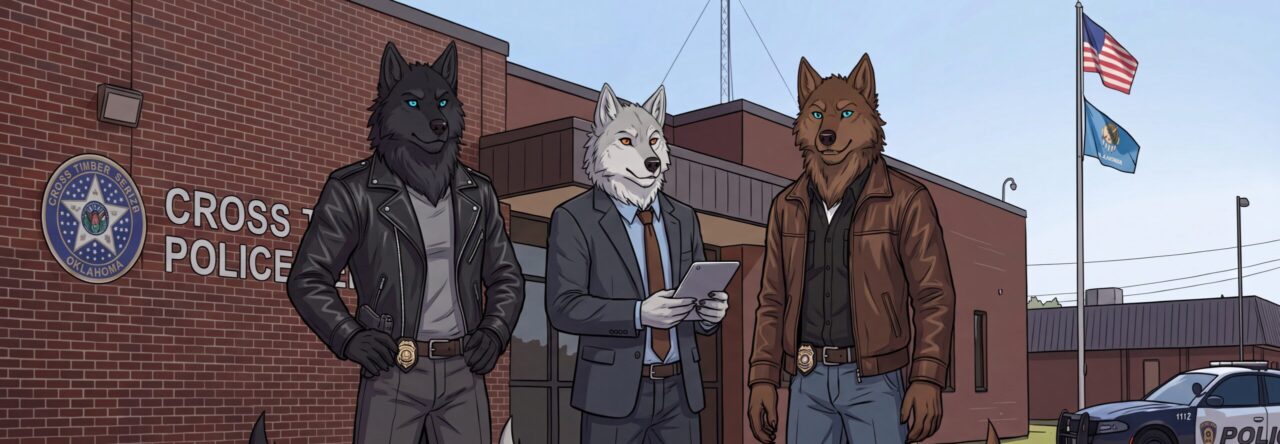
The medical clinic had not been warned enough.
That was obvious from the scale.
The nurse stared at it.
The scale stared back.
Thane stood on the platform with his arms crossed, brown fur still damp from the rain outside, clawed feet planted on either side of the little black rubber foot outlines that had been printed for humans who owned shoes and fit into reasonable expectations.
The scale beeped once.
Then again.
Then flashed:
ERROR
Gabriel leaned against the wall with both hands in his jacket pockets, black fur sleek, blue eyes bright with the kind of delight that meant he had found a situation where someone else had to be polite.
“Well,” he said. “That was rude.”
Mark stepped closer.
“It may have a maximum capacity.”
Thane looked down at the machine.
“It may have a survival instinct.”
The nurse, whose badge read JANELLE, gave a nervous little laugh that clearly had not asked permission to leave her body. She was mid-thirties, tired-eyed, curly-haired, and holding a clipboard with both hands like it had become a shield. To her credit, she recovered quickly.
“I’m sorry,” she said. “Let me get the industrial scale from physical therapy.”
Gabriel’s ears lifted. “There’s an industrial scale?”
Mark nodded. “That makes sense. Bariatric and rehabilitation use.”
Gabriel looked at him. “Must you make everything less magical?”
“Yes.”
Thane stepped off the scale.
It beeped again, as if relieved.
From the corner of the exam room, Sergeant Hale sipped coffee from a paper cup and looked far too pleased for a man supposedly present in an official capacity.
Thane narrowed his eyes at him.
“Why are you here?”
Hale did not look away from the scale. “Coordination.”
“Liar.”
“Observation.”
“Closer.”
Hale took another sip. “Professional curiosity.”
Gabriel smiled. “There it is.”
Hale shrugged. “First three werewolf applicants this program has ever processed. I would be irresponsible not to observe.”
“You mean you wanted to watch the scale lose,” Thane said.
“That too.”
Janelle looked between them. “Is he always like this?”
Gabriel, Mark, and Thane all answered at once.
“Yes.”
“No.”
“Worse.”
Hale nodded toward Gabriel. “His answer is closest.”
The industrial scale arrived ten minutes later, pushed in by a physical therapy tech who managed not to stare until he thought no one was watching. It had a wider platform, a taller post, and the air of a machine that had seen things.
Thane stepped onto it.
The scale considered him.
Then displayed a number.
Janelle wrote it down.
Gabriel leaned sideways to see.
Thane pointed at him.
“Don’t.”
Gabriel straightened. “I respect your privacy.”
“No, you don’t.”
“I respect your ability to make my afternoon difficult.”
“Better.”
Mark was next. The scale accepted him without drama, which somehow seemed to disappoint Hale. Gabriel stepped on after that, glanced at the number, and said, “Rude, but believable.”
Janelle moved them through intake.
Height was difficult because the wall chart stopped too soon and Thane’s ears complicated the question of where, exactly, one stopped measuring.
“Top of the skull,” Mark said.
Gabriel touched one of his own ears. “That feels discriminatory.”
“It is medically standard.”
“My ears are part of me.”
“They are not structurally relevant.”
“They are emotionally relevant.”
Hale looked at Janelle. “Write down top of skull before this becomes case law.”
Blood pressure came next.
The first cuff did not fit Thane’s arm.
The second cuff barely fit.
The third cuff, found after another trip to physical therapy, worked but made Janelle squint at the reading.
“Is that normal for you?”
Thane looked at the numbers.
“No idea.”
Mark leaned over.
Janelle turned the screen away. “Sir.”
Mark blinked. “Sorry.”
Gabriel grinned. “He sees numbers and forgets ethics.”
Mark’s ears tilted back. “I do not forget ethics.”
“You negotiate with them.”
Janelle tried again. “Do any of you have a primary care physician?”
The room went quiet.
Not dramatically.
Just enough.
Hale noticed.
Of course he noticed.
Thane said, “Not really.”
Janelle looked at the form. “Not really?”
Gabriel gave her his best reassuring smile, which worked on clients, angry bartenders, and once a raccoon that had gotten into the pantry.
“We heal quickly,” he said.
Janelle’s pen paused.
Mark cleared his throat. “That answer is accurate but incomplete.”
“Then complete it,” Thane said.
Mark folded his hands. “Werewolf physiology complicates ordinary medical care. Minor injuries resolve quickly. Moderate injuries often resolve before scheduled follow-up. Major injuries are rare and tend to become… unusual.”
Hale lowered his coffee.
“Define unusual.”
Mark looked at him. “No.”
Gabriel smiled. “That means messy.”
Janelle wrote something very carefully.
“Allergies?” she asked.
Gabriel said, “Silver clichés and cheap cologne.”
Mark said, “No known medication allergies.”
Janelle looked grateful for Mark.
Thane looked bored.
Janelle moved on to reflexes.
That was a mistake.
She tapped Thane’s knee with the little rubber hammer.
His leg reacted.
The exam table did not enjoy the result.
Neither did the cabinet he nearly kicked.
Janelle froze.
Hale looked at the cabinet.
Gabriel whispered, “Medical violence.”
Thane glared at him. “It was a reflex.”
Mark looked at the dent in the cabinet.
“A strong one.”
Janelle slowly lowered the hammer.
“I think we can mark reflexes as present.”
Hale nodded. “And hostile.”
By the time they reached the vision test, Janelle had adapted.
She pointed them toward the eye chart.
Thane read the bottom line from across the room before she asked.
Janelle paused.
“Please wait until instructed.”
Thane folded his arms.
Gabriel glanced at the chart. “The print on the manufacturer’s label under the chart says VisionCare Medical Supply, Tulsa, Oklahoma.”
Janelle stared.
Gabriel added, “Would you like the serial number?”
“No,” she said.
Mark looked at the wall. “The serial number is partially obscured.”
“Thank you, Mark,” Gabriel said. “We were all worried.”
Hearing test was worse.
Not because they failed.
Because they did not.
Janelle put headphones on Mark first. He listened, pressed the button, and then politely asked if the machine was supposed to emit a faint hum between tones.
The audiologist arrived.
The machine was not supposed to emit a faint hum between tones.
Gabriel took his test and raised his hand halfway through.
“Yes?” Janelle asked.
“There is a printer jam down the hall.”
Everyone went still.
From somewhere beyond the door, faintly, a voice said, “Why is it eating the paper?”
Hale looked at Gabriel.
Gabriel smiled.
Thane’s test lasted forty seconds.
Janelle removed the headphones and wrote hearing exceeds standard range in a way that made it look like an accusation.
By the end of the medical screening, the clinic had developed a system.
Janelle asked the question.
Mark answered accurately.
Gabriel made it worse.
Thane endured the process with the patience of a storm cloud.
Hale drank coffee and took notes he refused to show anyone.
When Janelle finally clipped the forms together, she looked tired but alive.
“Pending physician review,” she said, “I don’t see anything immediately disqualifying.”
Gabriel looked offended. “Immediately?”
Hale stood. “Congratulations. You confused a clinic and survived.”
Thane looked at him. “Is that part of the academy?”
“For you? Maybe.”
The physical assessment was held at the annex gym.
The gym smelled like rubber mats, old sweat, disinfectant, and human confidence in the process. Hale had arranged for it to happen while the building was otherwise quiet, which Thane suspected was less kindness than damage control.
Two evaluators waited with clipboards.
One was a broad-shouldered officer named Dwyer who looked like he had once been a linebacker and had never quite forgiven his knees for aging. The other was a lean woman named Officer Talia Ross, who had sharp eyes, close-cropped hair, and the calm expression of someone who enjoyed finding out what people were bad at.
She looked at the trio.
Then at Hale.
“You brought me the special project.”
Hale sipped his coffee. “I brought you history.”
Ross looked at Thane. “History is usually shorter.”
Gabriel murmured, “I like her too.”
Thane looked at him. “You like too many people.”
“I’m expanding my brand.”
Mark held his folder tighter.
Ross went through the requirements without ceremony.
Push-ups.
Sit-ups.
Timed run.
Basic mobility.
Grip strength.
Obstacle assessment.
“Obstacle assessment?” Thane asked.
Ross pointed toward a section of the gym with cones, a low wall, a dummy, a crawl space, and a narrow opening between two padded barriers.
“It gives us a sense of movement, balance, coordination, and whether you can follow instructions under time.”
Thane looked at the crawl space.
The crawl space looked back.
Gabriel smiled. “That seems personal.”
Mark asked, “Are modifications allowed for body dimensions?”
Ross looked at Hale.
Hale looked at the crawl space.
Then at Thane.
“If the test measures fitness, we modify the route. If it measures whether you fit through that specific space, you fail and we call it architecture.”
Ross made a note. “Reasonable.”
Dwyer seemed less amused.
“We still need measurable performance,” he said.
Gabriel looked at the push-up area. “That may not be your biggest problem.”
It was not.
Mark went first because Mark believed in structure and because Gabriel whispered, “Go inspire the spreadsheet.”
Push-ups were easy.
Too easy.
Mark performed them with clean form, steady pace, and the expression of someone mentally verifying that his elbows reached the correct angle each time.
Ross counted.
Dwyer counted too, then stopped counting because Mark passed the benchmark long before looking tired.
“Enough,” Ross said.
Mark stopped immediately.
Gabriel clapped once. “Beautifully compliant.”
Mark stood. “That is the assignment.”
Gabriel went next.
He was less rigid, more fluid, dropping and rising with effortless grace while making eye contact with Thane in a way that was deeply irritating.
Ross called time.
Gabriel kept going for three extra reps.
Ross lifted one eyebrow.
Gabriel stopped.
“Sorry,” he said. “Rhythm.”
Thane went last.
The mat was too small.
He got down anyway.
Dwyer started the timer.
Thane began.
The first ten were slow because he was annoyed.
The next thirty were faster because he became more annoyed.
At fifty, Gabriel said, “Are we bored yet?”
At seventy, Mark said, “Form remains acceptable.”
At ninety, Hale said, “We get it.”
Thane did ten more.
Ross called it.
Thane stood.
Dwyer stared at the clipboard.
Gabriel leaned toward him. “You can just write yes.”
Sit-ups went the same way.
The timed run was worse.
The annex had a track loop behind the building used for training. Wet air hung low over the pavement, and the sky threatened more rain. Ross explained the route, the time standard, and the expectation that no one cut corners.
Thane looked at the track.
Then at Gabriel.
Then at Mark.
“No racing.”
Gabriel looked wounded. “I said nothing.”
“You were thinking.”
“I am often thinking.”
“Not like that.”
Mark stretched his legs. “We should maintain a reasonable pace.”
Gabriel nodded. “Define reasonable.”
“Passing without attracting attention.”
Thane looked around at Hale, Ross, Dwyer, and the two maintenance workers pretending to fix something near the fence.
“That died when we arrived.”
Ross blew the whistle.
They ran.
For the first hundred yards, they behaved.
For the second hundred, Gabriel drifted ahead with the casual cruelty of someone pretending not to compete.
Thane increased speed.
Mark made a frustrated sound and followed because being left behind offended him on principle.
By the halfway point, Dwyer had lowered the stopwatch.
By the final curve, Hale had taken out his phone, not recording, just checking something with the expression of a man wondering if policy had a section for this.
Thane crossed first by half a stride.
Gabriel crossed second, smiling.
Mark crossed third, looking irritated that he had allowed the pace to become inefficient.
Ross looked at the stopwatch.
Then at Hale.
“This is useless.”
Hale nodded. “Educational, though.”
Dwyer stared at the time. “That can’t be right.”
Gabriel put his hands on his hips. “We can do it again slower if it helps your feelings.”
Thane growled.
Mark said, “That would invalidate the first test.”
Ross wrote something on her clipboard.
“Cardiovascular standard exceeded,” she said. “Judgment questionable.”
Hale pointed his coffee cup at her. “That may be the title of their file.”
The obstacle assessment almost became an international incident.
Mark overanalyzed the route but completed it cleanly.
Gabriel completed it beautifully, then bowed to the dummy after dragging it to the finish.
Thane reached the narrow padded opening and stopped.
Ross checked the sheet.
“You’re supposed to pass through.”
Thane looked at the opening.
Then at her.
“I disagree.”
Dwyer said, “That’s the route.”
Thane stepped forward, turned slightly, and tried.
The pads compressed.
The metal frame did not.
Gabriel covered his mouth.
Mark looked at the floor.
Thane backed out slowly.
One of the pads came with him.
It peeled away from the frame and hung from his shoulder like defeated furniture.
Hale closed his eyes.
Ross wrote on her clipboard.
“What are you writing?” Thane asked.
“Architecture,” Ross said.
Gabriel lost the fight and laughed.
Thane removed the pad and handed it to Dwyer.
Dwyer accepted it with the haunted look of a man who had not expected the building to lose.
Grip strength ended when the device made a small cracking sound in Thane’s hand.
Ross held out her palm before he could speak.
“Stop.”
“I barely—”
“Stop.”
Gabriel leaned over. “Can I try?”
“No,” Ross and Hale said together.
By early afternoon, the physical assessment was complete.
There was nothing to fail.
That seemed to irritate the system.
Hale gathered the sheets and looked them over.
“Congratulations,” he said. “You can overpower gravity, distance, and at least one piece of gym equipment.”
Gabriel smiled. “Thank you. We train hard.”
“No, you exist loudly.” Hale looked at Thane. “Physical ability is not your problem.”
Thane folded his arms. “You keep saying that.”
“Because you keep acting like it should impress me.”
“It impresses most people.”
“I’m not most people.”
“No,” Gabriel said. “Most people blink.”
Hale ignored him.
Ross handed over her clipboard. “They pass the physical standard pending equipment notes.”
Dwyer looked at the cracked grip tester.
“Equipment notes,” he muttered.
Hale took the clipboard.
“Good. Now comes the fun part.”
Thane’s ears lowered.
“What part was this?”
“The part that makes people think they’re doing well.”
The background interviews happened in a conference room that afternoon.
That was Hale’s word for them.
Interviews.
Thane had another word.
Interrogations with better lighting.
A civilian investigator named Paula Kent sat across from them with a laptop, three files, and the kind of polite smile people used when they already knew something but wanted to see whether you would lie about it.
She was not intimidated by them.
That was becoming a theme.
Thane was starting to resent the department’s hiring standards.
Kent began with ordinary questions.
Addresses.
Employment history.
Financial background.
Triad Sentinel Systems.
Consulting work.
The sale.
No current employer.
No debt issues.
No criminal record.
No arrests.
No active lawsuits.
No restraining orders.
No bankruptcy.
No obvious problems.
Then she turned a page.
The mood shifted.
“I also have several incident reports where your names do not appear,” she said.
Gabriel smiled faintly. “That sounds efficient.”
Kent looked at him. “Reports where witnesses describe unusual animal activity shortly before or after a crime, disturbance, or missing persons event.”
Mark went still.
Thane leaned back.
Kent continued.
“A domestic disturbance three years ago. Victim declined to cooperate. Suspect left the state the following week. Neighbor reported hearing what she described as ‘large wolves growling on the porch.’”
No one spoke.
“Two years ago,” Kent said, “suspected narcotics distributor found zip-tied to a stop sign outside a closed gas station. Claimed he was attacked by monsters. Later recanted. Moved to Arkansas.”
Gabriel said, “A lot of people move to Arkansas.”
Thane looked at him.
Gabriel shrugged. “Statistically.”
Kent did not smile.
“Last winter, missing hiker located in a ravine after search dogs lost scent. Family says they were told where to look by a ‘big gray wolf’ standing near the tree line.”
Mark’s ears angled back.
Kent looked at him.
Mark said nothing.
Kent scrolled.
“Four months ago, a convenience store robbery ended before officers arrived. Suspect found unconscious in the dumpster behind the store with the stolen cash bag on his chest and a note that said, ‘Try a job application next time.’”
Gabriel slowly looked at Thane.
Thane did not look back.
Kent waited.
Hale stood near the back wall, arms crossed, coffee gone cold in one hand.
He looked less entertained now.
Kent folded her hands.
“I’m not asking if you were involved in any of these.”
“Good,” Gabriel said.
“I’m asking whether you understand why a background investigator would notice a pattern.”
Mark answered first.
“Yes.”
Thane looked at him.
Mark kept his eyes on Kent.
“We understand why someone would notice.”
Kent nodded.
Gabriel added, “Patterns are tricky. They can mean something. They can also make people invent meaning where coincidence would do.”
“True,” Kent said. “Do you believe this is coincidence?”
Silence.
Gabriel’s smile faded.
“That sounds like a question you said you weren’t asking.”
Kent acknowledged that with a small nod.
“Fair.”
Thane leaned forward.
The table was sturdier than the interview room’s had been.
Lucky table.
“Are we disqualified because people tell stories?”
Kent looked at him.
“No.”
“Then what are we doing?”
“Determining whether stories become risk.”
Thane’s jaw tightened.
Hale spoke from the back.
“Answer that carefully.”
Thane’s eyes flicked to him.
Hale’s expression was flat.
Not warning him to lie.
Warning him to think.
Thane hated how useful that was.
Gabriel answered instead.
“People see us and remember us,” he said. “Sometimes they blame us. Sometimes they thank us. Sometimes they exaggerate because three werewolves near trouble makes a better story than whatever actually happened.”
Kent typed a note.
“That is probably true.”
“It is true.”
“It is also incomplete.”
Gabriel’s eyes sharpened.
Kent turned to Mark.
“Do you believe people with unusual ability have an unusual responsibility to stay within limits?”
Mark looked down at his hands.
Claws. Fur. Strength built into bones. Everything about him visible before he said a word.
“Yes,” he said.
Kent turned to Gabriel.
“Do you?”
Gabriel’s tail stilled.
“Yes.”
Then Kent looked at Thane.
The room waited.
Thane stared at her.
“Yes,” he said finally.
Kent typed.
Thane’s claws tapped once against the table.
Kent looked at them.
He stopped.
The psychological evaluations were last.
Different building.
Different waiting room.
Softer chairs.
Worse smell.
Not bad, exactly. Clean carpet, lavender diffuser, filtered air, stress hiding under mints in a little glass bowl. The kind of place designed to convince people they were safe enough to say something dangerous.
Gabriel looked at the bowl of mints.
“Trap,” he said.
Mark sat beside him. “They are mints.”
“That is exactly what a trap would look like.”
Thane stood near the wall because the chairs looked expensive and fragile.
Hale sat across from them reading messages on his phone.
Thane looked at him.
“You still here?”
Hale did not look up. “Yes.”
“Professional curiosity?”
“Now it’s concern.”
Gabriel placed a mint on Mark’s knee.
Mark picked it up and put it back in the bowl without comment.
A door opened.
A woman stepped out with a tablet in one hand.
“Gabriel?”
Gabriel stood.
“Tell my story,” he said.
Thane grunted.
Mark said, “Answer honestly.”
Gabriel smiled. “Those are not always compatible.”
The woman did not react.
Gabriel followed her into the office.
The door closed.
Mark went next twenty minutes later.
He emerged looking thoughtful, unsettled, and slightly offended.
Gabriel leaned forward. “Well?”
Mark sat down.
“She asked how I handle uncertainty.”
Gabriel winced. “Cruel.”
“I answered accurately.”
“Which means badly.”
Mark glared.
The door opened again.
“Thane?”
The psychologist was Dr. Lillian Price. Early fifties, silver hair cut short, brown eyes, calm voice, no wasted movement. Her office had two chairs, one couch, a desk, a bookshelf, and a window overlooking a wet courtyard with a single ornamental tree trying its best.
Thane chose the floor.
Price noticed.
“Chair uncomfortable?”
“Chair optimistic.”
She smiled faintly. “Floor is fine.”
That helped.
Not enough, but some.
She sat across from him with her tablet resting on one knee.
“I know today has been long,” she said.
Thane said nothing.
“I also know some of these questions may feel insulting.”
“Then why ask them?”
“Because people who want authority rarely object to easy questions.”
Thane looked at her.
Price waited.
He hated that too.
She started simple.
Sleep.
Stress.
Anger.
Relationships.
Work history.
Conflict.
Childhood.
Werewolf bloodlines.
Public reactions.
What it was like to be feared before speaking.
That one slowed him down.
Price did not rush.
Thane answered more honestly than he intended and less completely than she probably wanted.
He talked about being stared at. About rooms going quiet. About people pretending not to cross the street. About kids being curious and adults being worse. About men who acted brave because they wanted witnesses. About women who clutched purses tighter and then apologized with their eyes when they realized he had noticed.
He did not talk about the cabin.
Not directly.
Price eventually asked, “Why law enforcement?”
Thane looked toward the window.
Rain streaked the glass.
“I don’t know.”
“Most applicants prepare a better answer.”
“I’m not most applicants.”
“No,” she said. “You are not.”
He looked back at her.
She did not flinch.
“Try anyway,” she said.
Thane’s claws rested against his knees.
“Because people get hurt while everyone argues over who is allowed to help.”
Price made a note.
“That sounds frustrating.”
“It is.”
“What do you do with that frustration?”
“Depends.”
“On?”
“Who is hurting who.”
Another note.
Thane heard the stylus tap against the tablet screen.
A small sound.
Too loud.
Price looked up.
“Do you believe some people deserve to die?”
The office became very still.
Thane could hear traffic on the road outside. A printer somewhere down the hall. Gabriel’s voice faintly through a wall, talking to Hale or Mark. Mark’s quieter answer. Hale’s coffee cup setting down.
He could lie.
He should probably lie.
The correct answer sat right there between them, clean and useless.
No.
No, Doctor, of course not.
All life has value.
The justice system exists for a reason.
He thought of Emma’s porch.
He thought of the green blanket.
He thought of Harold Caine.
“Yes,” Thane said.
Price’s hand stopped.
Only for a second.
But he heard it.
“Do you believe you should be the one to decide that?”
Thane looked at the floor.
That question was worse.
Because a week ago, in the woods, with the smell of fear soaked into old timber and a child too weak to stand, the answer had felt obvious.
In this office, under soft light, with rain tapping politely against the window, obvious things became harder to defend.
“No,” he said.
Price waited.
Thane’s jaw tightened.
“That’s why I’m here.”
Price studied him for a long moment.
Then made another note.
“Do you trust the system?”
Thane huffed.
“No.”
“Do you want to?”
That question was unfair.
He looked at her.
Price’s expression did not change.
Thane looked back out the window.
“I want the system to be worth trusting.”
“That is not the same thing.”
“I know.”
“Would you follow an order you disagreed with?”
“Depends on the order.”
“If it was lawful?”
“Probably.”
Price lifted one eyebrow.
Thane growled softly, more at himself than her.
“Yes,” he said. “If it was lawful.”
“If your instincts told you someone was guilty but the evidence did not support action?”
His claws pressed lightly into the carpet.
He made himself stop.
“I would hate it.”
“That was not the question.”
“I know.”
He looked back at her.
“I would hate it and follow the rules.”
Price watched him.
“Could you?”
Thane’s ears angled back.
“I just said I would.”
“No,” she said calmly. “You said the answer you know you need to give. I am asking if you could do it after seeing someone hurt.”
Thane hated her.
Not really.
But close enough for the moment.
He thought of Mark in the kitchen saying people who decide they are the only ones allowed to fix things usually become dangerous.
He thought of Gabriel saying access matters.
He thought of Voss saying monsters do not get to decide what justice is.
He thought of Hale saying one percent when one percent is enough.
“I don’t know,” he said.
Price’s expression softened slightly.
That somehow felt worse than disapproval.
“But I think,” Thane continued, “if I can’t learn to, I shouldn’t be there.”
The stylus moved again.
Price said, “That may be the most important answer you’ve given.”
Thane did not know whether that meant good or bad.
The evaluation ended fifteen minutes later.
When Thane stepped back into the waiting room, Gabriel immediately looked up.
So did Mark.
So did Hale.
That annoyed him.
“What?”
Gabriel studied his face. “That went well.”
Thane stared.
Gabriel nodded. “Meaning it clearly did not.”
Mark stood. “Are you okay?”
“I am not injured.”
“That is not what I asked.”
“I know.”
Hale pushed himself out of the chair.
“Price wants a few minutes.”
Thane’s ears lifted. “With who?”
“Me.”
“Why?”
Hale looked at him. “Because psychologists enjoy suspense.”
Gabriel watched Hale go through the office door.
Then looked at Thane.
“What did you say?”
Thane crossed his arms.
“Words.”
Mark’s ears angled back. “Which words?”
“Honest ones.”
Gabriel closed his eyes. “Oh no.”
“I did not confess to anything.”
“That is a much lower bar than I wanted.”
Mark stepped closer. “Thane.”
Thane looked at him.
The worry in Mark’s eyes did what the whole day had not.
It made him feel tired.
“She asked if some people deserve to die,” Thane said.
Gabriel went still.
Mark’s face tightened.
Thane looked away.
“I said yes.”
Gabriel exhaled slowly.
Mark did not speak for a moment.
Then he asked, “And the follow-up?”
Thane’s voice went quieter.
“She asked if I should be the one to decide.”
Gabriel watched him.
Mark barely moved.
Thane looked back at them.
“I said no.”
Mark’s shoulders lowered.
Gabriel rubbed both hands over his face.
“Okay,” Gabriel said. “That is… less catastrophic.”
“Less?” Thane asked.
“Less is good. We like less.”
Mark’s ears tilted. “What else?”
“She asked if I could follow the rules if I knew someone was guilty and couldn’t act.”
Gabriel’s mouth tightened.
Thane did not say anything.
Mark understood anyway.
“Oh.”
“Yeah,” Thane said.
Gabriel looked toward the closed office door.
“What did you answer?”
Thane stared at the little bowl of mints.
“I said I didn’t know.”
Mark closed his eyes.
Gabriel whispered something under his breath that was probably not academy-approved.
Thane’s growl rose.
“You wanted honest.”
Mark opened his eyes.
“Yes,” he said. “We did.”
Gabriel looked back at Thane.
“He’s right. That was the honest answer.”
“It was also the answer that gets us thrown out.”
Gabriel did not immediately deny it.
That was how Thane knew it might be true.
Hale came out of Price’s office ten minutes later.
He did not look pleased.
He did not look angry either.
That was worse.
“Come on,” he said.
“Where?” Thane asked.
“Conference room.”
Gabriel stood. “That sounds ominous.”
“It is.”
The conference room was small, windowless, and colder than it needed to be. Hale shut the door behind them and set three folders on the table.
Not their application folders.
New ones.
Thane hated new folders.
Hale sat.
The three of them did not.
Hale looked at them for a moment.
Then at Thane.
“Medical screening is fine pending accommodation notes. Physical assessment is fine pending equipment replacement.”
Gabriel lifted one finger. “The grip thing was not—”
Hale looked at him.
Gabriel lowered his finger.
“Background review is not complete,” Hale continued. “There are patterns. Not proof. Not disqualifiers by themselves. Patterns.”
Mark nodded once.
Gabriel’s expression stayed calm.
Thane felt anything but.
Hale tapped the top folder.
“Psychological evaluations are preliminary. Mark, you got notes for over-control, perfectionism, high stress response when uncertainty is introduced.”
Gabriel whispered, “Shocking.”
Mark looked at him.
Hale continued, “Gabriel, you got notes for deflection, charm under pressure, and a tendency to control conversations with humor.”
Thane muttered, “Shocking.”
Gabriel placed a hand over his heart. “Wounded.”
Hale did not smile.
Then he looked at Thane.
“Thane, yours is more complicated.”
The room lost its air.
Mark’s ears lowered.
Gabriel’s humor disappeared completely.
Thane stared at Hale.
“Say it.”
Hale folded his hands.
“You did not fail.”
Thane’s eyes narrowed.
“That is not the same as passing.”
“No,” Hale said. “It is not.”
Mark’s hand tightened around the back of a chair.
Gabriel looked away for half a second.
Hale’s voice stayed even.
“Price flagged suitability concerns. Not stability. Not competence. Suitability.”
Thane felt the word like a door closing.
“Because I told the truth.”
“Because your truth is exactly why people will worry.”
Thane leaned forward.
Hale did not move.
“You want me to lie better?”
“No,” Hale said. “I want you to understand why your honest answer scares the people responsible for handing out authority.”
Silence.
The fluorescent light buzzed overhead.
Hale continued.
“The question is not whether you can pass the run. It’s not whether you can survive a fight. It’s not whether you can scare the hell out of someone who deserves it.”
His eyes stayed on Thane.
“The question is whether you can stand in front of someone who deserves it and still be governed by something bigger than your anger.”
Thane said nothing.
He could not.
Hale opened the folder.
“There will be a suitability review.”
Mark spoke before Thane could.
“With whom?”
“Me. Voss. Price. Someone from administration. Possibly legal, if they decide to ruin everyone’s morning.”
Gabriel’s voice was careful. “Are we talking about a delay or a denial?”
Hale looked at him.
“I don’t know yet.”
That was the first answer all day that sounded like it cost him something.
Thane stepped back.
Mark’s ears tilted toward him.
Gabriel’s blue eyes stayed on Hale.
“When?” Gabriel asked.
“Monday.”
Thane laughed once.
No humor in it.
“Fast.”
“Voss pushed.”
That landed strangely.
Hale closed the folder.
“You go home. You wait. You do not call. You do not email. Mark, you do not send supplemental documentation.”
Mark’s mouth closed.
Gabriel looked at him. “He knows you.”
“I had considered it,” Mark admitted.
“Of course you had.”
Hale stood.
The meeting was over.
But none of them moved.
Thane looked at the folders on the table.
All day, the system had measured them with the wrong tools and somehow still found the right bruise.
Hale walked to the door, then stopped.
He looked back.
“For what it’s worth,” he said, “I’d rather have an applicant who knows he might be dangerous than one who thinks he isn’t.”
Thane looked up.
Hale’s expression gave nothing away.
“That does not mean you pass,” he said. “It means Monday matters.”
Then he left.
The door clicked shut.
For several seconds, no one spoke.
Gabriel finally exhaled.
“Well,” he said quietly. “That was less funny at the end.”
Mark looked at Thane.
Thane did not look back.
He stared at the closed door, at the little rectangle of frosted glass, at the shadow of Hale moving away down the hall.
Built different.
That was what people always said when they wanted difference to sound like praise.
But difference was not praise in a file.
Difference was a question.
A risk.
A meeting.
A folder with his name on it and the word suitability waiting inside.
Thane turned toward the exit.
“Let’s go.”
Gabriel did not joke.
Mark did not argue.
They walked out together, past the receptionist, past the bulletin board, past the framed academy photos full of humans smiling in matching uniforms. Outside, the rain had stopped, but the sky remained low and heavy over Cross Timber.
The Xterra waited in its one proper parking space.
Thane got behind the wheel.
Gabriel climbed in beside him.
Mark sat in the back and did not touch his phone.
For once, no one mentioned the calendar.
Thane started the engine.
The clinic, the gym, the annex, the forms, the folders, the questions — all of it sat behind them now.
Monday waited ahead.
No amount of strength could reach it faster.
No claws could tear it open.
No growl could make it answer.
They drove home in silence, the city sliding past in wet gray pieces, and for the first time since this whole bad idea began, Thane wondered if the line had not been whether they would apply. Maybe the real line was whether the world would let them.