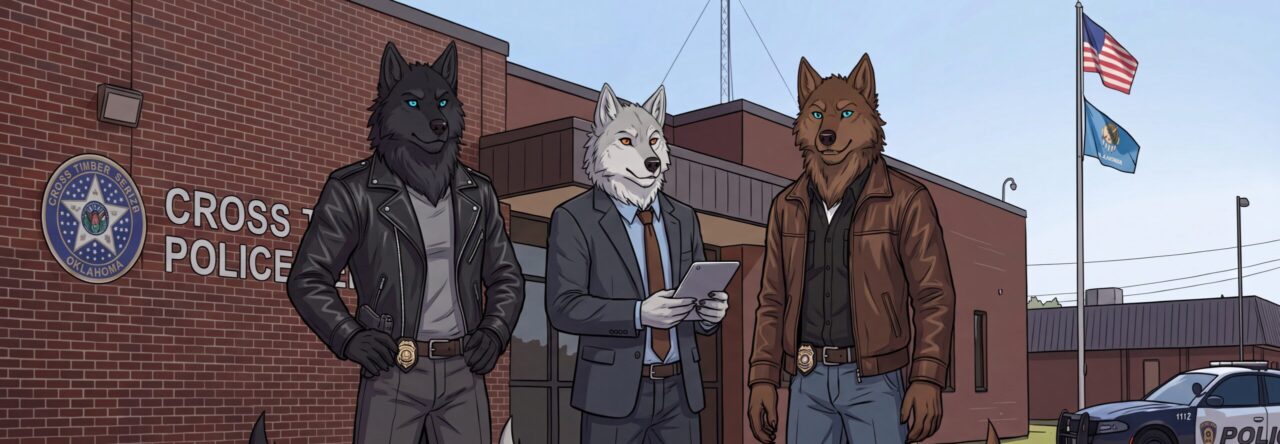
Detective Voss did not meet them in the lobby.
That was the first sign the morning would be unpleasant.
The receptionist looked up when the three of them entered, recognized them, and smiled with the slightly nervous warmth of someone who had learned they were not going to eat the furniture but had not entirely ruled out the possibility of paperwork.
“Detective Voss said to send you straight back,” she said.
Gabriel glanced toward the hallway. “That sounds ominous.”
“She also said if you asked whether it was ominous, I should say yes.”
Gabriel blinked.
Then smiled. “I respect preparation.”
Mark adjusted the folder tucked under his arm.
Thane looked at him. “Why did you bring that?”
Mark’s ears angled back. “It has our schedule.”
“We know the schedule.”
“It also has blank paper.”
“For what?”
“Notes.”
Gabriel leaned toward Thane. “He brought emotional support stationery.”
Mark frowned. “It is practical.”
The receptionist’s mouth twitched.
Thane pointed at Gabriel. “Don’t encourage her.”
“I didn’t say anything.”
“You existed with intent.”
Gabriel put a hand over his heart. “Finally, someone understands me.”
The hallway beyond the lobby smelled different from the training annex. Less floor wax, more coffee, paper, printer toner, wet coats, old carpet, and the faint metallic edge of stress that lived in police buildings no matter how many air fresheners tried to deny it.
The walls held framed photos of officers, city events, community programs, missing persons bulletins, commendations, and one poster reminding employees to report suspicious emails.
Mark slowed slightly at that.
Gabriel noticed.
“Do not audit their cyber hygiene on the way to the crime files.”
“I wasn’t.”
“You were breathing judgment.”
“There is a difference between judgment and concern.”
“Not on your face.”
Thane ignored both of them and kept walking.
His clawed feet were quiet against the tile. Gabriel’s were quieter. Mark’s had the careful rhythm of someone trying not to look around too much and failing because every system in the building was probably already organizing itself into categories in his head.
At the end of the hall, Detective Rusk waited beside an open conference room door.
He had a paper cup of coffee in one hand and the tired eyes of a man who had once again seen sunrise from the wrong side.
“Morning,” he said.
Thane nodded.
Gabriel gave him a small smile. “This where Voss hides the ominous?”
Rusk looked into the room.
“Some of it.”
That killed the joke gently.
Gabriel’s expression shifted.
Rusk stepped aside.
The conference room was colder than the hallway. A long table sat in the center. On it were four cardboard file boxes, several closed folders, three legal pads, three pens, a laptop, and a coffee cup that already belonged to Voss by force of personality.
Voss stood at the far end of the table, sleeves rolled up, hair pulled back, expression unreadable.
No Hale.
No Mercer.
No city attorney.
No psychologist.
Just Voss, Rusk, and paper.
Somehow that felt worse.
Thane stopped just inside the door.
Voss looked at Mark’s folder.
“No.”
Mark blinked. “No what?”
“No outside notes.”
Mark’s ears lifted. “You have not even seen them.”
“I know you. Put it on the counter.”
“You do not know me that well.”
Voss looked at the folder.
Then at him.
Mark hesitated.
Gabriel whispered, “This is his use-of-force test.”
Mark shot him a look.
Voss pointed to a side counter.
Mark set the folder down with the care of someone leaving a pet at surgery.
Gabriel watched it go. “Be strong.”
“It is paper,” Mark said.
“And yet.”
Voss waited until the folder was down.
“Today is not training,” she said. “It is not academy orientation. It is not a test you pass by being clever, strong, charming, or organized.”
Gabriel quietly said, “There goes the whole room.”
Voss looked at him.
He smiled politely.
She continued.
“You’ve seen what monsters do in the dark. Today you learn what happens after the lights come on.”
No one answered.
Voss gestured to the open side of the table.
“Stand or sit. I don’t care. Just don’t rearrange anything.”
Mark’s ears dipped.
Gabriel placed one hand on his shoulder. “She sees you.”
Mark shrugged him off.
Thane remained standing.
Gabriel leaned against the wall near him.
Mark looked at the chairs, then the table, then the files, and chose to stand because apparently the day was already cruel enough.
Rusk closed the door.
The room seemed to shrink.
Voss opened the first box.
Inside were case files arranged in hanging folders. Color-coded tabs. Labels. Dates. Names.
All of it ordinary.
All of it heavy.
She pulled one file and set it on the table.
“This is a domestic assault case from two years ago,” she said.
Thane’s ears angled slightly.
Voss opened the file but did not turn it toward them yet.
“Responding officer arrived on a noise complaint. Neighbor heard screaming. Victim answered the door and said everything was fine. Husband stood behind her. No visible injury from the doorway. No one wanted to talk.”
Gabriel’s expression changed.
He knew rooms like that.
Not as a cop. Not officially. But everyone who paid attention knew them. The too-clean smile. The person in the background. The air that smelled like fear and bleach.
Voss slid a report across the table.
Mark looked first.
Then Gabriel.
Thane last.
The report was dense. Date. Time. Address. Weather. Names. Observations. Statements. Body camera notation. Photographs logged. Follow-up referral. Evidence collected.
Boring, at first glance.
Voss tapped one paragraph.
“The officer wrote down the exact words the victim used when she first opened the door.”
Mark read aloud quietly. “‘He didn’t mean to. I made him mad.’”
The room went still.
Voss nodded.
“She recanted the next day. Wouldn’t testify. Said she fell. Said we misunderstood. Said she wanted everything dropped.”
Thane looked at the report.
Voss continued.
“But the officer documented the words. Documented the broken lamp visible through the doorway. Documented the neighbor’s statement. Documented the victim’s hand shaking when she signed the refusal. Photos showed bruising she tried to hide. Body camera caught the husband telling her to shut up from inside the house.”
Gabriel’s jaw tightened.
Rusk leaned against the wall, coffee forgotten.
Voss turned a page.
“Case held. Not perfectly. Not easily. But enough. He pled before trial. She and the kids left town.”
Thane stared at the report.
“That sentence mattered?” he asked.
Voss looked at him.
“Yes.”
“She said it and then took it back.”
“People take back the truth all the time,” Voss said. “Fear does that. Love does that. Money does that. Shame does that. A good report remembers what fear tries to erase.”
Mark’s eyes lowered to the page.
Gabriel’s sarcasm was nowhere to be found.
Voss let them sit with it.
Then she closed the file.
“That is paperwork doing its job.”
She set the file aside and pulled another.
“This one is paperwork failing.”
The second file was thinner.
That seemed like a bad sign.
Voss opened it.
“Burglary and assault. Suspect was guilty.”
Thane looked up.
Voss’s voice stayed flat.
“Not probably. Not maybe. Guilty. We knew it. Victim knew it. The suspect knew it.”
Gabriel said, “And?”
“And the case fell apart.”
She slid a court order across the table.
Mark read it first because he could not help himself.
His ears slowly angled back.
“Suppression,” he said.
Voss nodded.
Thane looked at him. “Meaning?”
Mark chose his words carefully. “Evidence excluded.”
Gabriel leaned closer. “Because?”
Mark looked at Voss.
She answered.
“Bad search. Officer entered a detached garage without enough legal basis. Found stolen property and a bloodied shirt. Thought he was saving time.”
Thane’s jaw tightened.
“Was he right?”
“That the suspect was guilty? Yes.”
“Then—”
“No,” Voss said.
The word cut cleanly through his sentence.
Thane’s eyes narrowed.
Voss did not back down.
“No,” she repeated. “Being right is not a warrant. Being angry is not exigent circumstances. Being sure is not probable cause in a judge’s head if you can’t explain how you got there.”
Thane looked at the order.
Voss tapped the file.
“That officer was not corrupt. He was not lazy. He was frustrated. He thought the rules were slowing him down. So he skipped one.”
Gabriel looked at Thane without turning his head.
Mark did not.
He did not need to.
Voss continued.
“The evidence was suppressed. The victim refused to go through trial without it. Suspect walked.”
Thane’s claws rested against the edge of the table.
He realized it and moved his hand away.
Voss saw.
Of course she saw.
“He hurt someone else four months later,” she said.
The room went colder.
Rusk looked down.
Thane stared at the file.
“That’s not fair.”
“No,” Voss said. “It isn’t.”
“The victim pays because an officer made one mistake?”
“Yes.”
“That’s insane.”
“Yes.”
Gabriel’s voice came quietly. “But it’s real.”
Voss looked at him.
Gabriel did not smile.
“It’s real,” he repeated.
Voss closed the file.
“That is paperwork not doing its job because someone decided the result mattered more than the path.”
Thane’s growl was low.
Not directed.
Just there.
Voss looked at him.
“Do not growl at evidence.”
“It deserves it.”
“Most of it does.”
That actually helped.
A little.
The third file was not a criminal conviction.
Voss warned them before opening it.
“This one involves force. No graphic photos. No names you need to remember. The point is not the incident itself. The point is what came after.”
Gabriel shifted.
Mark’s attention sharpened.
Thane folded his arms because he did not trust his hands near the table.
Voss laid out a short timeline.
Domestic disturbance. Man armed with a knife. Officer arrives first. Woman injured. Children in the back bedroom. Subject refuses commands. Moves toward the hallway. Officer fires. Subject dies. Shooting ruled legally justified.
“Good shoot?” Gabriel asked.
Voss’s eyes flicked to him.
The phrase seemed to taste bad in the room.
“Lawful,” she said.
Gabriel nodded once. Correction accepted.
“Lawful,” Voss continued. “Necessary, based on what we know. The officer saved the woman and probably the children.”
“Then why is this in the box?” Thane asked.
Rusk answered.
“Because lawful didn’t make it clean.”
Voss opened a folder of statements.
“Family said we murdered him. Neighbors said we waited too long. Others said we acted too fast. Bodycam showed most of it, not all of it. The officer second-guessed every second anyway. The woman survived and blamed herself. The kids heard the shot. Social media made a circus. The officer was cleared and still resigned nine months later.”
Thane listened.
He did not like where the lesson was going.
Voss looked at him.
“Force can be necessary and still break things.”
The room stayed quiet.
“It can be lawful and still leave scars. It can save a life and still ruin part of yours. If you think the question is just whether someone deserved it, you are not ready.”
Gabriel leaned against the wall, eyes lowered.
Mark’s hands were clasped so tightly his claws pressed into his own fur.
Thane stared at the file.
He thought of the woods.
Of anger.
Of certainty.
Of Harold Caine beneath the trees.
He pushed the thought away before it grew teeth.
Voss closed the file.
“Legal is not the same as clean. Remember that.”
She stacked the first three files neatly.
Then she did not reach for the box.
Rusk did.
That was when Thane knew what came next.
Rusk took a file from a separate folder he had carried in himself. Older. Thicker. Worn at the edges. Several colored tabs stuck out from the side. A rubber band held it closed.
He set it in front of Voss.
She looked at it for a moment before touching it.
The room knew the name before she said it.
“Harold Caine.”
Gabriel went still.
Mark’s ears lowered.
Thane looked at the closed file and felt the forest under his feet again.
Voss did not open it right away.
“This is not about what happened last week,” she said.
No one believed that.
She looked up.
“It is not about proving anything. It is not about asking questions you won’t answer. It is not about his death.”
Thane’s jaw tightened.
Voss rested her hand on the file.
“It is about everything before.”
She removed the rubber band.
The file opened.
There were reports. Transcripts. Search requests. Warrants. Denials. Photos turned facedown. Witness statements. Maps. Timelines. Notes. Pages and pages and pages of trying.
Thane had expected anger.
He had not expected volume.
Voss pulled the first section.
“First complaint. Eight years ago. Not enough. Family withdrew. Caine’s attorney threatened suit.”
Another section.
“Second. Anonymous tip. Property searched. Nothing found. Tipster disappeared.”
Another.
“Third. Interview with a child who later changed details after family pressure. Defense expert would have destroyed the testimony.”
Another.
“Fourth. Digital lead. Device wiped before warrant returned.”
Mark’s eyes sharpened painfully.
“Returned late?” he asked.
Voss nodded.
“Too late.”
Mark looked like someone had struck him.
Gabriel stared at the table.
Voss kept going.
“Fifth. Possible witness. Recanted. Sixth. Financial link to a rental property. Trust structure obscured ownership until after cleanup. Seventh. Vehicle sighting near an abduction. Camera resolution too poor.”
Rusk took over when Voss’s voice thinned.
“Last year we had him close. Closer than before. Then one piece got tossed. One witness got scared. One judge decided the affidavit leaned too hard on pattern.”
Thane heard himself speak.
“You knew.”
Voss looked at him.
“Yes.”
“You knew and couldn’t stop him.”
The sentence came out harsher than he intended.
Rusk’s face changed.
Not anger.
Pain.
Voss accepted it without flinching.
“Yes,” she said.
Thane looked at the file again.
All that paper.
All that weight.
All that failure stacked in folders.
His anger shifted, found no clean target, and turned inward like a blade.
“You thought we did nothing,” Voss said.
Thane did not answer.
She did not need him to.
“We did everything we could prove.”
The room went silent.
Voss’s hand rested flat on the file.
“That is not me defending the system. That is not me saying it worked. It did not work. It failed those families. It failed Emma until it didn’t. It failed us too, if that matters.”
Thane looked at her.
Voss’s eyes were tired, but not empty.
“It matters,” Mark said quietly.
Voss’s gaze moved to him.
Mark looked at the file.
“It should matter.”
Rusk rubbed one hand over his jaw.
Gabriel finally spoke.
“What happens to the rest of it now?”
Voss looked at him.
“The cabin evidence may close some old cases. It may not. Families may get answers. Some won’t. Caine is dead, so there won’t be a trial. No conviction. No sentencing. No allocution. No day in court where every page in this file becomes part of the record.”
Thane stared at the paper.
He had thought death ended things.
It did not.
It only changed who had to carry what was left.
Voss turned one page around.
Not a photo.
A report.
Highlighted lines.
“This is from a mother whose daughter disappeared six years ago,” Voss said. “She called every month for two years. Then every holiday. Then on the girl’s birthday. Then she stopped calling.”
Thane read the highlighted line.
Please just tell me if I am crazy for still thinking he did it.
His throat closed.
Gabriel looked away.
Mark’s eyes shone and he hated that they did.
Voss’s voice stayed steady by force.
“Paperwork is not the opposite of justice. Sometimes it is the only thing that remembers the shape of what happened when everyone else gets tired.”
Thane looked at the stacks.
The domestic report.
The bad search.
The lawful shooting.
Caine’s file.
He had hated paperwork because it slowed the hunt.
He had not understood that sometimes it was the only trail left.
Voss closed Caine’s file carefully.
Too carefully.
Like it might make noise if handled wrong.
Nobody spoke for a while.
Then Gabriel, quietly, said, “I miss the push-ups.”
Voss did not look up.
“Most people do.”
The small laugh that escaped Mark surprised everyone, including Mark.
Even Rusk smiled faintly.
The room breathed again.
Barely.
Voss set Caine’s file aside and pulled a thinner folder from the top of the nearest box.
“Now,” she said, “Gabriel.”
Gabriel lifted his head.
“Oh good. I was hoping to be personally attacked.”
“You’re welcome.”
She opened the folder.
“Interview transcript. Witness to a robbery. Detective led too hard. Asked questions that suggested the answer. Witness became more confident but less reliable.”
Gabriel’s expression sharpened.
Voss slid the transcript toward him.
He read.
At first, his face stayed neutral.
Then his ears lowered slightly.
Mark looked over, but Gabriel angled the page away.
Interesting.
Voss said, “Being good with people is useful. It can also be dangerous.”
Gabriel did not joke.
Voss continued.
“You can steer a room. I saw it in the interview room. Price saw it in evaluation. Hale sees it every time you open your mouth and somehow avoid consequences.”
Gabriel lifted one finger. “Not always.”
“Enough.”
He lowered the finger.
Voss tapped the transcript.
“If you go in wanting someone to say a thing, you may get them to say it. That does not make it true. It makes it yours.”
Gabriel’s eyes stayed on the paper.
That landed.
Thane watched him quietly.
Gabriel had talked plenty of people through fear, anger, panic, grief, and stupidity. He had a gift for finding the loose thread in a person and pulling gently until the knot opened.
But Voss was right.
A gift could become a weapon just by aiming it wrong.
Gabriel pushed the transcript back.
“Understood,” he said.
Voss studied him.
“Try again.”
His eyes lifted.
For once, the smile came late.
Not defensive.
Small.
“I understand that making someone comfortable enough to talk is not the same as making them safe enough to tell the truth.”
Voss nodded.
“Better.”
Gabriel leaned back against the wall, quieter than before.
Then Voss looked at Mark.
Mark was already braced.
Gabriel noticed and murmured, “Incoming.”
Voss opened another file.
“This is a missing persons case. Adult. No crime proven at first. Conflicting witness statements. Bad timeline. Family drama. Substance use history. Half the reports contradicted each other.”
Mark’s ears angled forward despite himself.
Voss slid him a packet.
“Build the timeline.”
Mark took it automatically.
Then froze.
Voss said, “Go ahead.”
Mark looked at the pages. Then at the table. Then at Voss.
“May I use the legal pad?”
“No.”
Mark looked personally wounded.
Gabriel whispered, “Cruel and unusual.”
Voss leaned back. “Build it in your head.”
Mark’s claws tightened slightly on the packet.
He read.
The room waited.
At first he moved quickly. Too quickly. Eyes scanning, details catching, sequence forming. Thane could almost see the structure building behind his eyes.
Then Mark stopped.
His ears shifted.
He went back three pages.
Then forward.
Then back again.
“It doesn’t line up,” he said.
Voss nodded.
“Why?”
Mark frowned. “Witness two gives a time that conflicts with the store receipt. Witness four says she saw him after that, but her location makes that unlikely unless she misremembered the day or saw someone else. The sister’s statement changes between initial call and follow-up.”
“Conclusion?”
Mark hesitated.
“He left voluntarily, then something happened later.”
Voss did not answer.
Mark’s eyes dropped back to the packet.
Gabriel watched him.
Thane watched Voss.
She gave nothing away.
Mark read again, slower.
His ears lowered.
“No,” he said quietly.
Voss waited.
Mark swallowed.
“The sister wasn’t lying. She was guessing. She didn’t know she was guessing. The store receipt time is wrong because the register clock was off.” He looked up. “The timeline is messy because people were scared and tired, not because the facts were useless.”
Voss nodded once.
“Body was found two days later,” she said. “Creek bed. Accident, most likely. But the first investigator dismissed the family’s timeline as unreliable and lost search time.”
Mark looked down at the packet.
Voss’s voice was not unkind.
“By the book matters. But people are not books. Trauma does not sort itself into chronological order because you prefer it.”
Mark was very still.
Gabriel did not tease him.
Thane wanted to, briefly, because that was how they usually saved each other from feelings. But this was not the time.
Mark set the packet down.
“I understand.”
Voss tilted her head. “Do you?”
Mark’s jaw moved once.
“I understand that messy does not mean useless.”
Voss nodded.
“Good.”
Rusk picked up the empty coffee cup and tossed it into the trash.
It landed cleanly.
Gabriel looked at him. “Nice.”
Rusk shrugged. “Paperwork is not my only skill.”
Voss closed the last folder and stacked it with the others.
The table looked different now.
Not cleaner.
Never cleaner.
But arranged.
Domestic violence. Suppressed evidence. Lawful force. Failed child cases. A bad interview. A missing person timeline.
No monsters with glowing eyes.
No cinematic villains.
Just people.
Broken, scared, cruel, guilty, innocent, complicated people.
The kind of people who called 911 and then regretted it. The kind who lied because truth cost too much. The kind who hurt others. The kind who survived and then had to keep surviving in statements, reports, photos, recordings, and court dates.
Thane looked at the paper.
“I understand why the reports matter now,” he said.
The words came out quieter than he expected.
Gabriel glanced at him.
Mark did too.
Voss studied Thane for a long moment.
No victory in her face.
No satisfaction.
Just recognition.
“Good,” she said.
Then she picked up Caine’s file and slid it back into Rusk’s folder.
Thane watched it go.
Part of him wanted it left open.
Part of him never wanted to see it again.
Voss rested both hands on the back of a chair.
“Still want in?”
Gabriel looked at Mark.
Mark looked at Thane.
Thane stared at the files.
Want was the wrong word.
He did not want the reports. The rules. The court orders. The mothers calling every holiday until hope exhausted itself. The lawful shootings that still broke everyone. The cases where being right was not enough and being wrong was fatal.
He did not want any of it.
That was probably why the question mattered.
“I don’t know,” he said.
Gabriel’s eyebrows lifted slightly.
Mark looked worried.
Voss did not.
She nodded.
“Best answer you could give.”
Thane frowned. “That was not an answer.”
“It was honest. I’ll take honest over eager.”
Gabriel’s smile returned faintly. “We can do honest. Eager was never likely.”
Rusk walked toward the door.
“Then we move on.”
Thane looked at him. “To what?”
Voss answered.
“Observation.”
Mark’s ears lifted.
Gabriel said, “That sounds less ominous than review.”
Voss looked at him.
He sighed. “Still ominous?”
“Yes.”
“Worth asking.”
Voss picked up a sheet from the end of the table and handed it to Mark.
Mark took it like a sacred object before remembering not to appear too happy about paper.
“Tomorrow night,” Voss said. “You observe patrol briefing and dispatch for the first half of shift. No field work. No ride-alongs yet. You listen. You watch. You do not interfere.”
Thane looked at the sheet.
“Dispatch?”
“Yes.”
“We sit in a room and listen to calls?”
“You sit in a room and learn that the radio never shuts up.”
Gabriel leaned toward Mark. “That sounds like your nightmare.”
Mark read the sheet. “It sounds informative.”
“That is your nightmare wearing a tie.”
Voss continued.
“After dispatch, you sit in on night shift patrol briefing. You do not talk unless asked. You do not correct anyone’s terminology.” She looked at Mark. “You do not audit their systems.”
Mark’s mouth closed.
Gabriel smiled.
Voss turned to Gabriel. “You do not entertain the room.”
Gabriel bowed his head. “Devastating but understood.”
Then she looked at Thane.
“You do not solve the city in one shift.”
Thane folded his arms. “Wasn’t planning to.”
Voss looked at him for half a second too long.
Thane growled.
Quietly.
She ignored it.
“Night shift begins at seven. Be here at six-thirty. Use the side entrance. Hale will know.”
Gabriel glanced at Rusk. “Is Hale always involved?”
Rusk opened the door.
“When something is likely to become weird, yes.”
Mark looked at the observation sheet. “Should we bring identification?”
“Yes,” Voss said.
“Notebook?”
“Yes.”
“Folder?”
“No.”
Mark looked pained.
Gabriel patted his shoulder.
Voss added, “One notebook. Each. No binders. No tabs. No prepared matrices.”
Mark stared at her.
“You do know me.”
“Yes.”
Thane almost smiled.
Voss began gathering files.
The orientation was over.
But Thane did not leave immediately.
His eyes went to the folder Rusk held.
Caine’s file.
Rusk noticed.
He paused.
Then, very quietly, he said, “We’re still working it.”
Thane looked at him.
Rusk’s face was tired.
Not defeated.
Just tired.
“Cabin evidence,” Rusk said. “Old connections. Families. We may not get all of it. But we’re still working it.”
Thane nodded once.
It was not enough.
It was all there was.
Gabriel opened the door fully and stepped into the hall. Mark followed with the observation sheet held carefully in one hand. Thane came last.
The hallway felt louder after the conference room. Phones. Printers. Radios. Footsteps. Someone laughing too hard at the far end. Someone else saying, “No, ma’am, I understand,” into a phone with the dead-eyed patience of public service.
They passed a patrol officer carrying a stack of citations. He looked at them, looked at the observation sheet in Mark’s hand, and wisely kept walking.
At the lobby, the receptionist looked up.
“Everything okay?”
Gabriel paused.
Then said, “I miss the medical scale.”
She blinked.
Mark said, “It was a difficult orientation.”
“Emotionally,” Gabriel added.
Thane pushed the front door open before he could add anything else.
Outside, Cross Timber was loud with afternoon traffic. The sky had cleared into a sharp blue that made everything look too honest. Cars moved along the street. A delivery truck idled across the road. Somewhere, a dog barked and then stopped abruptly when it caught their scent.
They walked to the Xterra.
No one got in right away.
Mark looked at the observation sheet.
Gabriel looked at the police building.
Thane looked at his own reflection in the driver’s window.
Brown fur. Blue eyes. Teeth. Claws. A shape the world called dangerous before asking what he wanted.
Behind that reflection, the department doors opened and closed as people came and went carrying files, coffee, radios, problems, and pieces of other people’s worst days.
Paperwork had weight.
He knew that now.
Not enough to like it.
Enough to respect it.
Gabriel leaned against the passenger door.
“So tomorrow night we learn why the radio never shuts up.”
Mark checked the sheet. “Six-thirty.”
Thane looked at him. “Don’t name it something stupid.”
Mark’s ears angled back.
Gabriel turned slowly. “Too late?”
Mark looked at his phone.
Thane closed his eyes.
“What did you call it?”
Mark hesitated.
Then said, “Night Shift Observation.”
Gabriel frowned. “Again with normal?”
Mark looked toward the police station.
Then at the paper in his hand.
“Today seemed like a normal title day.”
Gabriel’s expression softened.
Thane opened the driver’s door.
“We are still not cops.”
Gabriel opened the passenger door. “Not even close.”
Mark climbed into the back. “Observers.”
Thane got in and started the engine.
The Xterra rumbled awake.
He looked once more at the building.
Tomorrow night, they would come back after dark.
No claws in the woods.
No rumors.
No shadows.
Just dispatch tones, patrol briefing, officers with tired faces, and a radio full of people calling for help before anyone knew whether the night would give them back.
Thane shifted into gear.
The files stayed behind. The weight came with them.