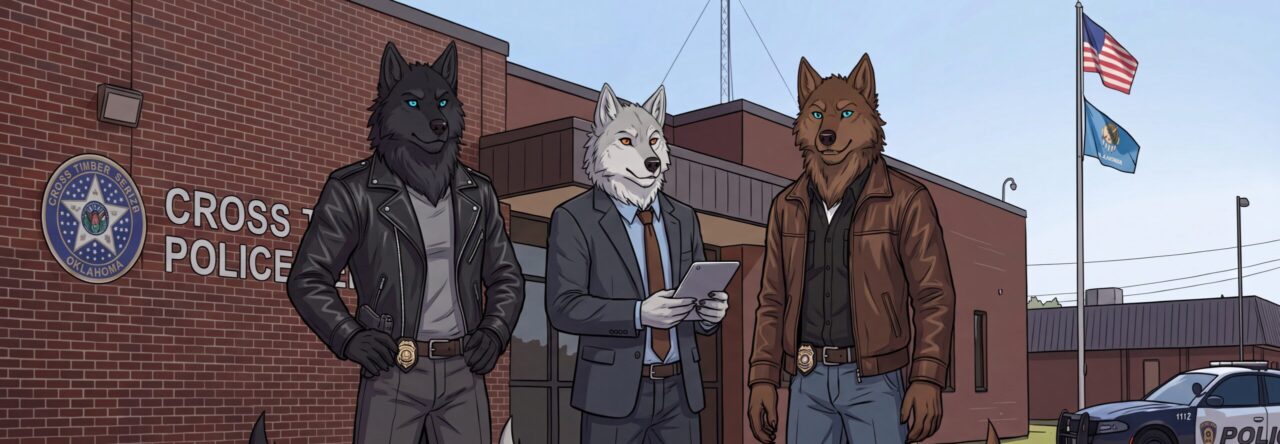
Mark brought one notebook.
One.
He held it like an insult.
Gabriel noticed before they were even out of the Xterra.
“You look wounded.”
Mark shut the rear door with more care than necessary. “It has no sections.”
“It is a notebook.”
“It has no tabs.”
“Still a notebook.”
“No pockets.”
Gabriel glanced at Thane over the roof of the truck. “He’s spiraling.”
Thane looked toward the side entrance of the Cross Timber Police Department.
“Let him.”
Mark’s ears angled back. “I am not spiraling. I am adapting.”
Gabriel smiled. “That’s what spiraling says when it learns vocabulary.”
The evening had gone dark blue around the edges. The sun was down but not gone, leaving a fading band of amber behind the police station roof. The main parking lot was busy with shift change: patrol cars idling, officers crossing between vehicles and side doors, radios murmuring from open windows, the smell of exhaust, rain-damp pavement, coffee, and human nerves.
It was different after dark.
The building felt awake in a way it had not during the day.
Not louder, exactly.
Hungrier.
Thane shut the driver’s door and looked at the side entrance Voss had told them to use. It had a keypad, a camera, and a small sign that read:
AUTHORIZED PERSONNEL ONLY
Gabriel followed his gaze.
“We are not authorized personnel.”
“Observers,” Mark said.
“That sounds authorized-adjacent.”
Thane walked toward the door. “We knock.”
“There is no doorbell.”
“Then we stand here until someone decides what we are.”
Gabriel leaned against the brick beside the door. “That is becoming a theme.”
Before Thane could answer, the door opened.
Sergeant Hale stood on the other side with a coffee cup in one hand and the expression of a man who had expected them and still resented being correct.
“You’re early.”
Mark looked relieved. “Six minutes.”
Hale looked at the notebook in Mark’s hand.
“One?”
Mark’s ears lifted. “One.”
Hale stared.
Gabriel said, “We’re proud of him.”
“I’m suspicious,” Hale said.
“As you should be.”
Hale stepped aside. “Inside.”
They entered into a narrow hallway that smelled like old carpet, radio equipment, disinfectant, and the faint stale edge of night shift food. Somewhere deeper in the building, a phone rang twice and stopped. A radio crackled. A printer woke angrily.
Hale let the door close behind them.
“Rules,” he said.
Thane sighed.
Hale pointed at him. “That reaction is why we start with rules.”
Gabriel folded his hands. “We are listening with open hearts.”
“No one believes that.” Hale turned and walked. “You observe dispatch first. You do not touch anything. You do not lean over anyone’s shoulder. You do not suggest system improvements.”
Mark opened his mouth.
Hale stopped walking.
Mark closed it.
“Good,” Hale said. “You do not answer phones. You do not react loudly to radio traffic. You do not leave the room because something sounds interesting.”
Thane’s ears angled forward.
Hale looked at him. “Especially you.”
“I didn’t say anything.”
“You got taller.”
Gabriel glanced at Thane. “He does that when he’s about to become a problem.”
Thane growled.
Hale continued down the hall. “After dispatch, patrol briefing. You stand in the back. You do not interrupt. You do not correct terminology. You do not intimidate anyone who says something stupid unless I approve it first.”
Gabriel lifted a finger. “Is there a form for that?”
“Yes,” Hale said. “It’s called my face.”
They passed through a secured door into a different part of the building. The sound changed immediately.
The dispatch center was not large, but it felt larger than it was because everything inside it moved.
Screens glowed from every desk. Maps. Call logs. Unit statuses. Camera feeds. Radio channels. Timers. Colored boxes. Blinking alerts. Three dispatchers sat at consoles wearing headsets, their hands moving between keyboards, mice, touchscreens, and radios with a speed that made Mark’s ears lift in involuntary respect.
Voices overlapped.
Not chaos.
Almost chaos.
Controlled by habit, caffeine, and people who had no time to explain why they were impressive.
A woman at the center console raised one finger without turning around.
“Do not come closer until I finish lying to this man about how calm he sounds.”
Gabriel’s eyes lit up.
Hale pointed at him.
“No.”
Gabriel whispered, “I didn’t say anything.”
“You admired loudly.”
The woman spoke into her headset, voice smooth and warm in a way that did not match the sharpness of her posture.
“Sir, I understand. Officers are on the way. I need you to put the golf club down and step away from the mailbox.”
A pause.
“No, sir, I do not believe the mailbox started it.”
Gabriel turned slowly toward Thane.
Thane said, “Don’t.”
Mark looked at the call log on one of the side monitors from a respectful distance. His entire body wanted to move closer.
Hale noticed.
“Mark.”
“I am not touching anything.”
“Your thoughts have fingerprints.”
Mark clasped the notebook against his chest.
The dispatcher finished the call, clicked something on her screen, spoke into the radio, updated a line in the system, and finally turned her chair.
She was maybe late thirties, with dark hair pulled into a messy knot, brown eyes, a headset over one ear, and the expression of someone who had heard every version of human stupidity and still occasionally found new material disappointing.
“Nina Alvarez,” she said. “Dispatch supervisor. I don’t care if you’re werewolves, vampires, visiting senators, or Hale’s emotional support circus. If you stand behind me and breathe on my neck, I will staple you to the wall.”
Gabriel looked enchanted.
Thane respected her immediately.
Mark asked, “Would that be with standard office staples or—”
Nina pointed at him. “Do not test the metaphor.”
Mark nodded. “Understood.”
Hale gestured toward them.
“Thane. Gabriel. Mark. Applicants. Observers. Do not let them help.”
Nina looked at the three of them.
“Werewolves who are not allowed to help. That seems sustainable.”
Gabriel smiled. “We specialize in sustainable poor choices.”
“I can tell.”
She turned back to her screens and pointed to a taped line on the floor about six feet behind the consoles.
“You stand behind that. You listen. You ask questions only when I’m not on a call, not transmitting, not typing, and not looking like I’m about to bite someone myself.”
Thane glanced at the line.
Gabriel stepped behind it.
Mark followed.
Thane did too, though he disliked obeying tape on principle.
Hale leaned against the wall near the door.
Nina looked over her shoulder.
“And you.”
Hale lifted his coffee. “Me?”
“You smirk, you leave.”
Hale’s mouth flattened.
Gabriel whispered, “She has authority.”
Nina turned back to her console.
For the first fifteen minutes, the radio never stopped.
A traffic stop.
A business alarm.
A welfare check.
A noise complaint.
A medical assist.
A shoplifting call where the caller was less upset about the theft than the suspect’s attitude.
A suspicious vehicle behind a church.
Two officers clearing from a crash.
Someone asking for animal control because a raccoon had entered a garage and “looked organized.”
Gabriel leaned slightly toward Thane.
“Organized raccoon feels like Mark’s jurisdiction.”
Mark did not look away from the screens. “Raccoons are naturally dexterous and opportunistic.”
“So yes.”
Nina said, without turning, “Tape line also hears whispers.”
Gabriel straightened.
Thane listened.
At first, he listened like he always did: for danger. Fear. Anger. Breath changing. The moment before something turned sharp.
But dispatch was different.
Everything came through incomplete.
A woman laughing too loudly while reporting a man in her yard.
A store clerk trying to sound bored while his voice trembled under the edges.
An elderly caller who could not remember his own address but knew someone had taken his red truck, which Nina found after three questions was parked in his own driveway.
A teenager whispering from a bathroom because her mother’s boyfriend was yelling in the kitchen.
That one changed the room.
Nina’s voice became softer.
Not weaker.
Softer like a hand around a match flame.
“Okay, honey. You’re doing good. I need you to keep your voice low. Is the bathroom door locked?”
Thane’s whole body went still.
Gabriel’s smile vanished.
Mark stopped writing.
Hale watched them from the wall.
Nina typed, clicked, listened, spoke to the girl, then keyed the radio with another hand.
“Units copy disturbance in progress, possible domestic, juvenile caller locked in bathroom, address confirmed…”
Her voice never shook.
Thane could smell the reaction in the room anyway. The other dispatchers changed posture. One muted a call long enough to listen. Another shifted a unit on the screen. Hale’s coffee lowered.
The girl on the line said something Thane could not hear.
Nina answered, “No, you are not in trouble. You called the right number.”
Thane’s claws curled.
Not into his palms. Not hidden.
Just there, visible at the ends of his fingers, suddenly too present.
Gabriel’s voice came low beside him.
“Not our call.”
Thane did not look at him.
“I know.”
Hale said nothing.
That helped.
Barely.
The radio moved. Units acknowledged. One asked for prior history. Nina answered. Another dispatcher pulled the address notes. The call expanded, changed shape, became a thing with numbers and units and times and warnings.
Thane wanted to move.
Every part of him wanted to move.
Instead he stood behind a strip of tape.
Nina kept the girl talking.
That was the part Thane had not expected.
The girl stayed on the line while officers drove. Nina asked about pets. About school. About whether she could sit in the bathtub and keep the phone close to the floor. About whether the yelling was closer or farther away now.
Not once did Nina sound afraid.
But Thane could hear the care inside every word.
A unit arrived.
Then another.
A door opened somewhere in a house miles away, and the girl on the phone started crying.
Nina stayed with her until an officer’s voice came over the line, close enough for the phone to catch.
“We got her.”
The room breathed.
Not dramatically.
No cheering.
No applause.
Just a tiny shift in everyone’s shoulders as one fire stopped spreading.
Nina ended the call, logged notes, updated the screen, and took a sip of coffee that had gone cold.
Gabriel said quietly, “You kept her from panicking.”
Nina glanced back.
“She kept herself from panicking. I gave her something to hold.”
Gabriel nodded.
No joke.
Mark wrote that down.
Nina saw him.
“That better not be a system suggestion.”
“No,” Mark said. “It was a good sentence.”
Nina looked at him for a second.
Then turned back to the radio.
“Fine. That one’s free.”
The calls kept coming.
Some were strange enough to be funny.
A man wanted officers to remove his adult son from the house because the son had eaten the last frozen pizza.
A caller reported “satanic chanting” that turned out to be a neighbor’s karaoke machine and poor taste in classic rock.
A woman called to ask whether police could make her husband stop using the leaf blower after dark.
“Is there a noise ordinance violation?” Mark asked.
Nina looked over her shoulder.
“There is a marriage violation.”
Gabriel nearly laughed, but caught himself before Hale could point.
Then came a call that seemed funny for three seconds and stopped.
A convenience store clerk reported a man acting weird in the parking lot, talking to himself, maybe drunk.
Nina asked the right questions.
The man had no shoes.
Thane’s ears angled.
The clerk said the man seemed confused.
He was trying to open car doors but did not seem to know why.
Then he sat down on the curb and started crying.
Nina changed the call from suspicious person to welfare check before Mark had finished writing.
Gabriel noticed.
“Fast.”
Nina’s fingers moved across the keyboard.
“Suspicious person is what people call someone they don’t understand. Welfare check is what I send when they might need help.”
Thane looked at the screen.
A small change in wording.
A different response.
Maybe a different night.
The radio never slept because the city never stopped becoming complicated.
After an hour, Hale led them out.
Mark looked back at the dispatch room as if leaving a museum before finishing the exhibit.
Gabriel noticed.
“You want to live there now.”
“No,” Mark said.
“You want to improve their CAD interface.”
Mark said nothing.
Hale looked over his shoulder.
“Say it and I turn this observation around.”
Mark closed his notebook.
“Understood.”
Patrol briefing was held in a larger room down the hall with rows of chairs, a whiteboard, a wall map, a projector, and officers in various stages of night shift readiness. Some looked alert. Some looked caffeinated. Some looked like they had woken up angry at the concept of pants.
Conversation dipped when the three werewolves entered.
Not as much as before.
But enough.
A few officers stared. One grinned. One whispered something to another and immediately stopped when a woman at the front of the room looked at him.
She was short, broad-shouldered, and built like bad weather. Her hair was tied back tight. Her uniform was sharp. Her eyes were sharper.
Lieutenant Dana Crowe, according to the nameplate on the podium.
She looked at Hale.
“These my observers?”
Hale nodded. “Unfortunately.”
Gabriel smiled. “We prefer conditionally.”
Crowe looked at him.
Gabriel’s smile became respectful at remarkable speed.
Thane approved.
Crowe faced the room.
“All right, listen up. Yes, they’re werewolves. No, you may not ask if they chase laser pointers. Anyone who makes a leash joke writes reports in the lobby until retirement.”
Gabriel leaned toward Thane.
“I like her.”
“You like authority figures who insult other people.”
“It’s refreshing.”
Crowe’s eyes flicked to him. “I hear whispers too.”
Gabriel straightened.
Hale looked almost proud.
Briefing began.
It was faster than Thane expected.
Crowe moved through the city like a map had been burned into her brain.
Stolen blue Ford F-150, partial plate, last seen near Eastview.
Catalytic converter thefts behind the medical plaza.
Construction zone hazard on Danforth extension.
Domestic address on Cedar Hollow flagged for prior weapons and threats against officers.
Missing juvenile possibly with older boyfriend, not yet confirmed runaway.
Two business alarms tripped three nights in a row at the same storage facility.
Reminder: bodycams on before contact, not halfway through the argument.
Reminder: reports completed before end of shift unless someone bleeds, screams, or sets something on fire.
Gabriel whispered, “That last policy has room for interpretation.”
Mark whispered back, “It likely does not.”
Thane watched the officers.
Some took notes. Some knew the information already. Some looked bored until one specific address came up and everyone’s posture shifted. The city was not one thing to them. It was layers. Houses with histories. People with patterns. Roads that flooded. Dogs that bit. Doors that opened safely last week and might not tonight.
Crowe pointed toward the back.
“Our observers are not backup. They are not mascots. They are not a dare. They do not go hands-on. They do not ride with you tonight. You do not test them, challenge them, borrow them, photograph them, or ask them to smell your lunch.”
An officer near the front slowly lowered his hand.
Crowe stared.
“Bell.”
The young officer froze.
“Tell me that hand was about police work.”
Officer Bell, who looked about twelve despite probably being twenty-four, cleared his throat.
“I was going to ask if enhanced scent detection could be useful for vehicle searches.”
Crowe held the stare.
Bell added, “In a controlled, policy-approved future context.”
Hale muttered, “He panicked into improvement.”
Gabriel smiled.
Crowe looked at Mark. “You want to answer that?”
Mark blinked. “Me?”
“You look like you have a policy answer fighting to escape.”
Gabriel whispered, “She sees everyone.”
Mark looked from Crowe to Hale, then back.
“In theory, yes,” he said carefully. “In practice, it would require standards. Documentation. Probable cause independent of species-specific ability unless the law recognizes the detection method. Reliability testing. Handler neutrality, though that term may not apply. Chain of custody. Defense challenge preparation. Also probably case law that does not exist yet.”
The room was silent.
Crowe stared.
Hale stared.
Gabriel looked delighted.
Thane crossed his arms.
Bell slowly lowered his hand the rest of the way.
Crowe looked at Hale. “You brought me a Supreme Court footnote with ears.”
Hale sighed. “I know.”
Mark’s ears went back. “Was that wrong?”
Crowe shook her head. “No. That’s what made it annoying.”
A few officers laughed.
The tension eased.
Briefing continued.
Then dispatch broke through the room speaker.
“Units copy for missing endangered adult, eighty-two-year-old male, dementia history, walked away from residence near Pine Draw and 184th, last seen approximately thirty minutes ago wearing brown cardigan, blue pajama pants, possibly disoriented, family reports he may head toward drainage area behind property.”
The room changed instantly.
Crowe stopped mid-sentence.
Thane’s head lifted.
Gabriel’s hand touched his arm.
Not hard.
Enough.
Mark looked at him, then at Hale.
Crowe was already moving.
“Who’s closest?”
Two officers answered.
Dispatch assigned units.
Hale watched Thane.
Thane watched the map.
Pine Draw. 184th. Drainage area. Trees, creek, dark, cooling air.
An old man in pajama pants.
Thirty minutes.
Dementia.
Thane could already feel his body preparing to move.
Hale’s voice was quiet beside him.
“You don’t know where to run yet.”
Thane’s eyes snapped to him.
Hale did not flinch.
“That’s what dispatch is for.”
Thane hated the words.
Needed them.
Crowe turned to Voss, who had entered the room at some point without Thane noticing. That annoyed him later. Not then.
Voss listened to the radio, then looked at the three werewolves.
No one spoke.
The room waited.
Crowe said, “K-9 available?”
Dispatch answered over the speaker.
“K-9 tied up on county assist, ETA at least forty.”
The air shifted.
Thane felt Gabriel beside him go still.
Mark’s notebook lowered.
Voss looked at Crowe.
“They’re not sworn,” Crowe said.
“I know.”
“They’re observers.”
“I know.”
“They go nowhere alone.”
“I know.”
Crowe’s eyes narrowed. “You have a plan?”
Voss looked at Thane.
“Yes.”
Thane did not like being the plan.
He liked even less how much he wanted to be.
Voss pointed at him, then Gabriel and Mark.
“You come with me. You stay in sight. You do not make contact unless I tell you. You do not run ahead. You do not touch evidence, doors, fences, vehicles, or people unless there is immediate danger to life. You smell something, hear something, see something, you say it out loud. Understand?”
Thane’s voice was low. “Yes.”
Gabriel nodded. “Yes.”
Mark said, “Understood.”
Hale looked at Voss.
“This your call?”
Voss nodded. “Yes.”
Crowe looked at Hale. “You going?”
Hale looked pained.
“I was hoping someone wouldn’t ask.”
Gabriel smiled. “Professional curiosity?”
Hale pointed toward the door. “Move.”
They moved.
Not running.
That was the first test.
Thane could have cleared the hallway in seconds. Could have been at the Xterra before Hale finished grabbing his jacket. Could have hit the street and followed the smell of age, medication, fear, wet wool, anything.
Instead he walked.
Fast, but walked.
Gabriel stayed beside him.
Mark behind him.
Voss in front.
Hale at the rear, because apparently even grumpy training coordinators could become shepherds when necessary.
They took two unmarked department SUVs.
Voss drove the first. Thane sat in the passenger seat, too large for it and too aware of every second. Gabriel and Mark sat in back. Hale followed in the second vehicle, probably to witness disaster or file it properly.
The radio filled the car.
Officers arrived at the residence.
Family confirmed the missing man’s name: Walter Reed. Eighty-two. Alzheimer’s. Former mail carrier. Loved walking. Hated being told not to. Had once been found two blocks away trying to deliver junk mail from 1997.
Gabriel leaned forward slightly.
“Former mail carrier,” he said.
Voss glanced at him. “You got something?”
“Patterns matter. Even broken ones.”
Mark nodded. “He may follow familiar routes.”
Thane stared out the windshield.
The city slid past in flashes. Porch lights. Wet streets. A gas station. A church sign. Dark trees beyond a row of houses. Every red light felt personal.
Voss did not speed recklessly.
That also felt personal.
They reached Pine Draw in eight minutes.
It felt like an hour.
The neighborhood sat on the edge of one of Cross Timber’s unfinished borders: newer homes backing up to a wooded drainage channel where development had scraped the land but not yet tamed it. Police lights flashed blue and red against garage doors. Family members stood in a driveway with an officer. Another officer swept a flashlight along the fence line.
The air was cooler here.
Damp.
Thane stepped out and immediately smelled too much.
People. Cars. Cut grass. Trash bins. Rain in soil. Dogs. Fear from the family. Exhaust. Flashlight batteries warming. Hale’s coffee from the second SUV. Voss’s controlled focus. Gabriel’s concern. Mark’s tension.
And under it all—
Thane’s ears angled forward.
Voss came around the front of the SUV.
“Talk me through it.”
Thane looked at her.
The instinct was to move.
Her words held him in place.
Talk me through it.
He breathed in again.
“Older male,” he said. “Medication. Sweat. Wool. Damp fabric.”
Voss lifted her radio.
“Direction?”
Thane turned slowly.
The world narrowed.
Not less complex.
More.
He could smell where Walter had stood near the side gate. Where hands had touched the wood. Where an officer had stepped over the scent and muddied it. Where a family member had walked in a circle, crying. Where the old man had gone through the gate and brushed against wet shrubs.
“That way,” Thane said, pointing. “Through the side yard. Gate. Along the fence.”
Voss spoke into the radio. “Possible track from side gate heading east along rear fence line. Units hold perimeter. Do not contaminate drainage entrance if avoidable.”
An officer near the gate stopped mid-step.
Thane appreciated that more than he wanted to.
Gabriel moved beside him, eyes scanning the houses, the windows, the people.
“He didn’t climb,” Gabriel said.
Voss looked at him.
Gabriel pointed to the gate latch. “Someone opened it. Family probably thinks it was closed. He knew how to work it.”
Mark added, “Former mail carrier. Repetitive route memory. He may not think he’s missing.”
Voss nodded once.
“Good. Keep talking.”
They moved as a group.
Voss first, flashlight low.
Thane beside her but half a step back because she had said stay in sight and not run ahead.
It was one of the hardest things he had ever done.
Gabriel and Mark followed.
Hale trailed behind, quiet now.
No jokes.
No coffee comments.
The drainage entrance was a gap between two fences where the grass fell away into a shallow wooded channel. Rainwater trickled over concrete and mud below. Trees leaned over the drainage ditch, black against the last bruised light of evening.
Thane smelled creek water.
Damp wool.
Fear.
Not sharp panic.
Confused fear.
“He went down,” Thane said.
Voss keyed her radio. “Track indicates descent into drainage. Need units at east and south exits. Med standby stage nearby.”
They climbed down carefully.
Or Voss, Gabriel, Mark, and Hale climbed carefully.
Thane could have dropped straight down and landed like a thought.
He did not.
The ditch smelled worse below.
Mud. Rotting leaves. Standing water. Raccoon. Dog. Old beer cans. Human footprints layered over animal tracks. A place where the city threw water and forgot people might follow it.
Thane moved slowly, nose working, ears turning.
Voss stayed close enough that her flashlight beam crossed where he pointed.
“Don’t chase the strongest scent,” she said.
Thane looked at her.
“Why?”
“Because the strongest scent may be where he stopped, not where he is. Talk it out.”
He breathed.
She was right.
Damn her.
“Here,” he said, pointing toward a low branch. “He grabbed that. Hand. Confused. Slipped there.”
Mark crouched near the mud but did not touch it.
“Drag mark?”
Voss angled the light.
“No,” Mark said. “Knee. He fell, got back up.”
Thane moved forward.
Gabriel suddenly lifted one hand.
“Wait.”
Everyone stopped.
Voss looked at him.
Gabriel pointed left, toward a concrete support under a walking path.
“Sound.”
Thane listened.
Water.
Distant radio.
Officer moving above.
A dog barking.
Then—
A soft scrape.
Fabric against concrete.
A breath.
Thane’s whole body locked.
“There,” he said.
Voss lifted the radio. “Possible contact beneath footbridge east of Pine Draw entrance. Hold traffic on walking path. Approach controlled.”
Thane was already moving.
Voss’s hand caught his arm.
Not hard enough to stop him physically.
Hard enough to remind him he had agreed.
He stopped.
Every muscle hated it.
Voss looked at him.
“Controlled,” she said.
The word was not a command.
It was a line.
Thane swallowed the growl in his throat.
“Controlled.”
They approached the footbridge.
Voss went first.
Thane stayed beside her, half a step back, hands open, claws visible and useless on purpose.
The flashlight found Walter Reed curled beneath the bridge in a brown cardigan soaked dark at the elbows. He was thin, white-haired, shivering, one slipper gone, blue pajama pants muddy to the knees. His eyes were open but unfocused.
He looked at the light and flinched.
Voss lowered the beam immediately.
“Walter?” she said, voice softer. “My name is Mara. Your family’s looking for you.”
Walter blinked.
“I have to finish the route,” he said.
Gabriel’s face changed.
Mark looked away for a second.
Thane stayed very still.
Voss crouched, not too close.
“The route’s done for tonight,” she said. “You did good. We’re going to get you warm.”
Walter’s eyes shifted past her.
To Thane.
Fear flickered.
There it was.
Always there eventually.
Thane stepped back.
Voss glanced at him, quick approval in her eyes, then back to Walter.
“This is Thane,” she said. “He helped us find you.”
Walter stared.
Thane lowered himself slowly to one knee, making himself smaller in the only way available.
Walter’s breath shook.
“Big dog,” he whispered.
Gabriel made a small sound behind him.
Not a laugh.
Something gentler.
Thane kept his voice low.
“Big wolf.”
Walter seemed to consider that.
Then he nodded, as if it made perfect sense.
“Mailman doesn’t like dogs.”
“Most don’t,” Thane said.
Walter’s mouth trembled.
“I lost the mail.”
Voss’s face softened.
“That’s all right. We found you instead.”
The radio crackled.
Hale called in their exact location. Medical moved closer. Officers shifted perimeter. Dispatch acknowledged.
The system moved around them.
Not slow.
Not perfect.
But moving.
Thane stayed kneeling until Walter let Voss and the first responding officer help him up. He did not touch the old man. He did not lift him, though he could have done it with one arm. He did not take over when the officer struggled slightly on the muddy slope.
He waited until Voss looked back and said, “Thane, steady his left side.”
Then he moved.
One percent.
One hand, open and careful, supporting Walter’s elbow with less pressure than he would use to hold a paper cup.
Walter leaned into him.
Not afraid now.
Just cold and tired.
They got him up the slope.
His family saw him and broke apart in the driveway.
Crying. Relief. Too many hands. Officers creating space. Medical checking him. A daughter saying, “Dad,” over and over like the word itself might keep him there.
Thane stepped back before he became the story.
Gabriel stood beside him.
Mark joined them, notebook closed.
Hale came up last, mud on one boot and annoyance on his face because apparently nature had insulted him.
Voss watched Walter’s family for a moment.
Then turned to Thane.
“You did good.”
Thane looked at her.
“Because I didn’t run?”
“Because you reported what you knew before you acted on it.”
He looked toward the drainage ditch.
The scent trail still existed in his head. Every step. Every stumble. Every place Walter had brushed a branch or touched concrete or paused in confusion.
He could have found him alone.
Probably faster.
Maybe.
But the radio had moved units. Voss had controlled approach. Medical had staged. Officers had held the perimeter. Dispatch had kept the family updated. No one had trampled the track after Voss called it. No one had scared Walter into running deeper into the dark.
Thane had not been slower.
He had been connected.
That was different.
Gabriel leaned close enough only Thane could hear.
“You’re having another productive emotional journey.”
“Shut up.”
“That’s his outdoor voice,” Gabriel said to Mark.
Mark’s mouth twitched.
Hale pointed at all three of them. “Do not get smug. You found one lost mailman in a ditch.”
Gabriel said, “Former mailman.”
“Do not get accurate either.”
Mark looked down at his notebook.
Too late.
They returned to the station after Walter was transported and his daughter had hugged Voss hard enough to make the detective visibly uncomfortable.
Dispatch was still moving when they came back.
Of course it was.
The radio had not paused for Walter Reed. It had kept going. Traffic stop. Alarm. Suspicious noise. Medical assist. A fight outside a bar. A caller asking whether fireworks were legal if they were “small but enthusiastic.”
Nina looked over as they entered.
“You find him?”
Voss nodded. “Alive.”
Nina’s shoulders dropped half an inch.
Then she keyed the radio, answered another line, and went right back to work.
Gabriel watched her.
“That’s it?”
Nina clicked through a screen. “That’s it.”
“No victory music?”
“I have three calls holding.”
Mark wrote something.
Nina looked at him. “That better not be about music.”
“It is not.”
She looked at Thane. “You did okay?”
Thane glanced at Voss.
Voss did not help.
He looked back at Nina.
“I understand why the radio never sleeps.”
Nina’s expression softened for maybe half a second.
Then she said, “Good. Don’t stand on my tape.”
Thane looked down.
One clawed foot was barely over the line.
He stepped back.
Gabriel smiled.
Mark wrote that down too.
Later, after briefing had ended, after dispatch rolled into the next crisis, after Hale had declared the observation “less disastrous than projected,” they stood in the side hallway near the exit.
The building hummed around them.
Not mechanical.
Alive.
Phones. Radios. Footsteps. Voices. Doors. Printers. Laughter. Frustration. Fear. Relief. Reports beginning before calls had fully ended.
Voss stood with them, arms crossed.
“You wanted the badge to slow you down,” she said.
Thane looked through the small interior window toward dispatch, where Nina’s voice moved officers through the dark.
“Maybe not slow,” he said.
Voss waited.
Gabriel and Mark both looked at him.
Thane watched the radio lights blink.
“Maybe aim.”
Voss studied him.
Then nodded once.
“Better.”
Hale opened the side door.
“Sentiment time is over. Go home before somebody decides you’re useful again.”
Gabriel stepped into the night air. “Too late.”
Mark followed. “We were useful in a limited observer capacity.”
Hale sighed. “That sentence is going to haunt me.”
Thane paused in the doorway and looked back once.
Dispatch kept moving.
Patrol units rolled under streetlights.
Somewhere in Cross Timber, Walter Reed was warm, alive, and probably confused about why everyone was making such a fuss.
Somewhere else, another call was starting.
The night did not care that one person had been found.
It kept opening doors.
Kept ringing phones.
Kept asking who would answer.
Thane stepped outside.
The air smelled like wet pavement, gasoline, cooling grass, and the edge of autumn.
Gabriel leaned against the Xterra.
“So,” he said, “night shift.”
Mark checked his notebook. “Observation one complete.”
Thane looked at him. “You named it already.”
Mark hesitated.
Gabriel’s eyes lit up. “What did you call it?”
Mark looked down.
Then, quietly, “The Radio Never Sleeps.”
Gabriel’s smile faded into something warmer.
Thane looked toward the station, where light spilled from the windows into the dark.
For once, he did not complain.
He opened the driver’s door.
“We are still not cops.”
Gabriel opened the passenger door. “No.”
Mark climbed into the back. “But we are learning.”
Thane started the engine.
The Xterra rumbled awake.
As they pulled out of the lot, a patrol car rolled past them in the opposite direction, lights off, radio alive, heading toward whatever the city had become next.
Thane watched it go.
The night stretched over Cross Timber, full of voices. For the first time, he wondered how many of them he might learn to hear without running ahead of the answer.