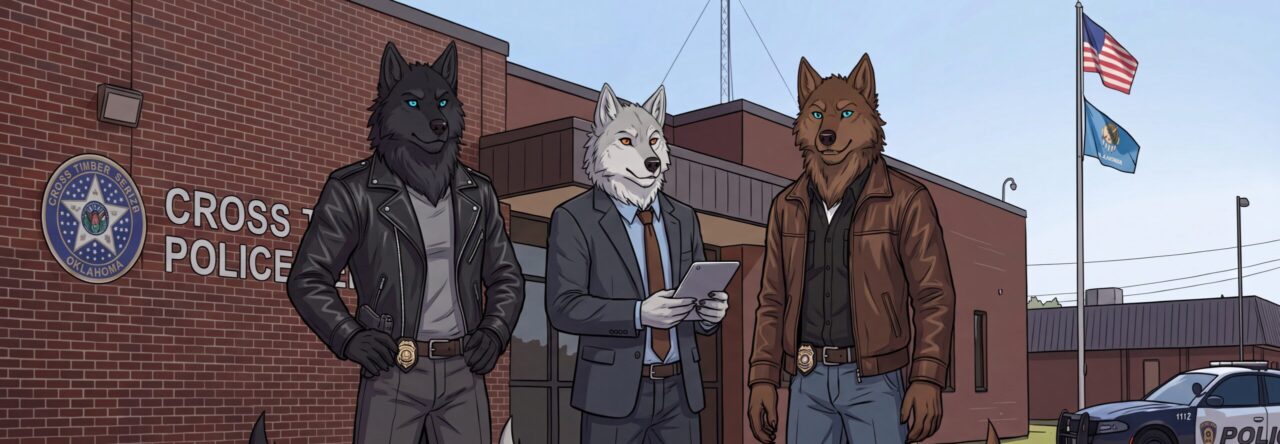
Chief Calder did not make the first fire-department visit feel like a celebration.
Thane appreciated that.
He hated it too.
But he appreciated it.
Station 3 sat on the north side of Cross Timber, brick and glass and bay doors, with Engine 3 parked nose-out under bright overhead lights. The late afternoon sun threw long shadows across the concrete apron. Hoses lay in neat stacks near the training yard. A rack of tools stood against the wall. The smell of diesel, rubber, metal, soap, old smoke, and coffee lived in the building like it paid rent.
Silas stood at the edge of the apron in full wolf form.
Dark charcoal fur.
Gray along the shoulders.
Amber eyes fixed on the bay floor like it might give him instructions if he stared hard enough.
He wore reinforced work pants and a sleeveless shirt Mark had adjusted again after declaring the previous version “functionally acceptable but structurally irritating.” The tail opening sat right. The shoulder seams held. The pouch for his probation phone was clipped where claws could use it.
He did not wear turnout gear.
No helmet.
No department shirt.
No name strip.
No symbol that suggested he belonged somewhere he had not earned.
That had been made very clear.
Silas had accepted it without argument.
Thane stood twenty feet away with Gabriel and Mark, far enough not to crowd the process, close enough that Silas could look over and know he was not alone.
Nora stood beside Supervisor Hale near the open bay door.
Chief Calder stood in front of Silas with Captain Ortiz on one side and Training Officer Elaine Reaves on the other.
Reaves was in her forties, compact, strong, and unsmiling in the way people became when their job involved teaching others not to die in preventable ways. Her dark hair was tied back. Her station polo had her name embroidered over one side. She held a clipboard like Gabriel held jokes: ready.
Calder spoke first.
“Today is not firefighter training.”
Silas nodded.
“Yes, sir.”
“Today is not a tryout.”
“Yes, sir.”
“Today is not a promise.”
“Yes, sir.”
“This is a supervised exposure visit approved by probation, counsel, city review, and my department under narrow conditions.”
“Yes, sir.”
Gabriel leaned slightly toward Mark and whispered, “He is getting very good at yes, sir.”
Mark whispered back, “That is the point.”
Thane watched Silas’s hands.
Open.
Claws visible.
Still.
Good.
Calder continued.
“You will not ride apparatus. You will not enter living quarters. You will not respond to calls. You will not touch tools without instruction. You will not lift anything unless told. You will not perform for anyone. If tones drop, you step back and stay exactly where Captain Ortiz tells you.”
Silas swallowed.
“Yes, sir.”
Reaves spoke next.
Her voice was flatter than Calder’s.
“Fire work is not strength. Fire work is order under stress. If you cannot stay when told to stay, you cannot go when told to go.”
Silas looked at her.
That one landed.
“Yes, ma’am.”
“We are going to do boring things.”
“Yes, ma’am.”
“Good. Boring things keep people alive.”
Gabriel’s eyes moved to Mark.
Mark gave him a look that said not now.
Gabriel obeyed.
That was how serious the moment felt.
Ortiz gestured toward the hose stack.
“First task. We are going to roll hose. You will watch one. Then you will do one with me talking you through it. Slow matters more than strong.”
Silas nodded.
“Yes, sir.”
Thane felt something loosen in his chest.
Not victory.
Not even hope exactly.
A shape smaller than hope.
Permission to begin.
Silas looked back once.
Just once.
Thane gave him a small nod.
Silas turned forward again.
Ortiz picked up one end of the hose and began explaining.
“Flat first. Check the couplings. No twists. You do not wrestle it. You organize it.”
Silas watched as if the hose was sacred.
Gabriel’s voice came very softly.
“He is going to remember every word.”
Mark said, “Yes.”
Thane did not speak.
He did not trust his voice yet.
Ortiz finished the demonstration and pointed.
“Your turn.”
Silas crouched.
Not fast.
Not theatrical.
He got both hands on the hose and waited.
Ortiz smiled faintly.
“Go ahead.”
Silas began rolling.
Too tight at first.
Ortiz said, “Ease off. You are not strangling it.”
Silas stopped immediately.
Adjusted.
Started again.
Reaves made one mark on her clipboard.
Thane saw it and forced himself not to wonder whether the mark was good or bad.
Silas rolled the hose slowly, carefully, asking twice before shifting his grip. The hose fought him in the ordinary way hose fought everyone. It wanted to twist. It wanted to bulge. It wanted to make the person rolling it look foolish.
Silas did not crush it into submission.
He corrected it.
At the end, the roll was not perfect.
Ortiz looked at it.
“Acceptable first roll.”
Silas’s ears lifted by half an inch.
“Thank you, sir.”
Reaves said, “Do it again.”
Silas nodded.
“Yes, ma’am.”
He did it again.
Better.
The third time, tones dropped.
The station changed instantly.
Not loudly at first.
A tone.
A voice over the speaker.
Medical call.
Engine 3 and the ambulance crew moved.
The bay filled with motion.
Controlled.
Fast.
Purposeful.
Silas froze beside the hose.
His whole body wanted to turn toward the apparatus.
Thane felt it from across the apron.
The pull.
The need.
People were going somewhere to help.
And Silas had just been told to stay.
Ortiz’s voice cut through the motion.
“Silas. Back line.”
Silas stepped back to the painted line on the bay floor.
Not one step too few.
Not one step too many.
Engine 3’s crew boarded. Doors shut. The engine rolled out with lights flashing, siren starting only once it reached the street.
Silas stood on the painted line until the engine was gone.
Then he looked at Ortiz.
His voice was rough.
“I stayed.”
Ortiz nodded.
“That was the task.”
Silas swallowed.
“Yes, sir.”
Reaves made another mark on the clipboard.
This time, Thane did not wonder.
He knew.
Calder glanced at Thane.
Just once.
There was no smile.
But there was something.
Looking.
That was all.
Looking was enough for today.
Night Shift started late again.
Crowe noticed again.
Of course she did.
This time, she did not ask why.
She stood in the garage with a clipboard, glanced at the three of them, and said, “Station visit?”
Thane nodded.
“Yes.”
“Any explosions?”
Gabriel said, “Emotional or physical?”
Crowe looked at him.
Gabriel wisely continued, “No physical.”
Mark said, “Silas rolled hose, followed commands, and stayed on the back line when tones dropped.”
Crowe’s expression shifted slightly.
“Good.”
Thane nodded.
“Yes.”
“Good is not done.”
“I know.”
“Good is good.”
“I know.”
She studied him for one more second, then handed Mark the assignment sheet.
“Patrol is thin from court overtime and training. You have the north-central zone unless something bigger drops. Start with a theft report on Juniper Lane. Stolen wheelchair ramp.”
Gabriel’s expression changed.
“Someone stole a wheelchair ramp?”
Crowe’s face hardened.
“Apparently.”
Mark looked at the sheet.
“Victim?”
“Mrs. Clara Keene. Eighty-two. Uses walker indoors, wheelchair outside. Portable aluminum ramp missing from front porch. Her daughter found her unable to leave for a doctor appointment.”
Thane’s ears lowered.
Crowe nodded once.
“That reaction is why I am sending you.”
Gabriel’s humor had gone quiet.
“On it.”
Crowe pointed after them as they moved toward the Humvee.
“And nobody buy every wheelchair ramp in the state before you finish the report.”
Thane stopped.
Gabriel looked at Mark.
Mark looked at Thane.
Thane said, “I was not thinking that.”
Crowe stared.
Thane added, “Yet.”
Crowe closed her eyes.
“Go.”
Mrs. Clara Keene’s house sat on a narrow lot shaded by two pecan trees and lit by a porch light with moths orbiting it like bad ideas.
The porch looked wrong before Thane reached it.
Four mounting marks showed where the portable aluminum ramp had rested. The threshold sat eight inches above the walkway, not high enough to matter to most people, high enough to trap someone who could not manage steps.
Darnell stood near the porch with Mrs. Keene’s daughter, a woman in her fifties named Dana West, who had the tight, furious composure of someone trying not to cry in front of police.
Mrs. Keene sat just inside the front door in a wheelchair, a blanket over her lap, white hair neatly brushed, chin lifted in refusal to look helpless.
The refusal made Thane like her immediately.
Darnell nodded as Night Shift approached.
“Ramp was here when daughter dropped groceries yesterday at 17:00. Gone when she arrived today at 18:10 for appointment. No camera at this house. Neighbor across street may have one.”
Dana West pointed at the empty porch edge.
“Who steals a ramp?”
No one answered.
There were questions that were not really questions.
Mark crouched near the mounting marks and took photographs.
“Portable modular aluminum, likely two sections?”
Dana nodded.
“Yes. We bought it used after Mom’s hip surgery. It folds. Two people can move it.”
Mrs. Keene called from inside, “One rude person with a truck could move it too.”
Gabriel stepped closer to the doorway.
“Ma’am, that is a useful investigative theory.”
Mrs. Keene gave him a look.
“I may be old. I am not decorative.”
Gabriel bowed his head slightly.
“Understood.”
Thane inhaled near the porch.
Metal.
Dust.
Old rain.
A faint smell of cut grass.
Gasoline.
Cheap gloves.
Sweat.
One male. Maybe two, but one stronger. Recent enough.
No blood.
No forced entry.
He looked at the threshold again.
Without the ramp, Mrs. Keene could not safely leave.
That made the theft heavier than the object.
Mark measured the distance between porch and walkway.
“We need a temporary access solution tonight.”
Dana said, “My brother is trying to find someone, but it is late.”
Darnell said, “I called Public Works. They do not have an after-hours ramp.”
Gabriel looked at Thane.
Thane had already reached for his phone.
Then stopped.
Crowe’s voice lived in his head.
Nobody buy every wheelchair ramp in the state before you finish the report.
He took a breath.
Mark saw the breath.
Good.
Thane lowered the phone.
“Clean first.”
Gabriel’s eyes softened.
“Clean first.”
Mrs. Keene looked between them.
“What does that mean?”
Thane looked at her.
“It means we find the right help without making this messy.”
She nodded as if that was the first sensible thing anyone had said all evening.
Mark made a call.
Not to Eli.
To dispatch.
“Can you check if Fire has a community lift-assist ramp or temporary threshold bridge available?”
Gabriel looked at him.
“Fire?”
Mark said, “They often handle mobility assists and may know resources.”
Thane looked at Mark.
Mark did not look back.
The radio answered two minutes later.
Engine 3 was still tied to the medical call.
Station 2 had a crew available with a temporary aluminum threshold ramp used for community hazard mitigation.
Chief Calder, monitoring traffic, added over the radio that he would send it if the resident accepted temporary placement and liability boundaries.
Mrs. Keene accepted before Mark finished repeating the sentence.
“Tell the fire chief I like him already.”
Gabriel smiled.
“Dangerous praise.”
The neighbor’s camera caught the theft.
Not perfectly.
Enough.
At 02:13 that afternoon, an older white work van stopped along the curb. No company lettering. Rear passenger-side brake light out. A dent on the sliding door. One man got out wearing a ball cap and reflective vest, carrying a clipboard.
He walked to Mrs. Keene’s porch, looked around, then lifted one ramp section.
A second man got out of the driver’s side and helped load both sections into the van.
The entire theft took less than four minutes.
Dana West watched the footage with her hands clenched.
“He wore a vest.”
Gabriel’s voice was low.
“That is why the vest exists.”
Mark paused the video.
“Reflective vest creates assumption of authority. Clipboard reinforces.”
Mrs. Keene, visible in her doorway behind them, said, “Clipboard criminals. That is where civilization went wrong.”
Gabriel looked at her.
“Ma’am, I agree completely.”
Thane watched the van.
No plate visible from the camera angle, but the dent, brake light, and a bumper sticker on the rear window gave them a start.
The sticker read I BRAKE FOR GARAGE SALES.
Gabriel stared.
“That feels like confession-adjacent.”
Mark took a still image.
Darnell sent it to patrol channels.
Then Station 2 arrived.
Not with sirens.
Just a utility pickup and two firefighters, one of whom carried a temporary ramp while the other checked the porch edge.
Mrs. Keene watched from inside.
“Are you stealing that one too?”
The firefighter carrying the ramp grinned.
“No, ma’am. Loaning it.”
“Good. I am armed with opinions.”
“I can tell.”
They set the temporary threshold ramp under Mark’s watchful eye and tested it with Dana assisting. It was not a perfect long-term solution, but it got Mrs. Keene safely out if needed.
Gabriel whispered, “She sees through walls.”
Mrs. Keene pointed at Thane.
“You look like a man who buys problems when he gets upset.”
Thane had no immediate defense.
Mark said, “That is sometimes accurate.”
Thane looked at him.
Mark did not apologize.
Mrs. Keene nodded.
“Find the person who stole my ramp. Then we will talk about breakfast.”
Thane smiled despite himself.
“Yes, ma’am.”
The second ramp theft came in at 20:46.
Same night.
Different neighborhood.
This one was on Maple Spur, outside a duplex occupied by a man named Horace Bellamy, age seventy-six, who used an electric scooter after a stroke. His portable aluminum side ramp had been stolen from the rear carport sometime between noon and 19:30.
The neighbor had assumed workers were moving it.
Workers.
Vest.
Clipboard.
White van.
One theft could be cruelty.
Two became a pattern.
Mark built the board in the Humvee while Thane drove.
“Both aluminum modular ramps. Both outside residences of disabled elderly victims. Both removable without tools or with minimal tools. Both daylight. Suspects use work-van presentation and reflective vest. Likely targeting visible accessibility equipment for scrap or resale.”
Gabriel’s voice was tight.
“People could be trapped.”
“Yes,” Mark said.
Horace Bellamy’s son had managed a temporary plywood solution by the time Night Shift arrived, which Mark described as “unsafe but understandable” and immediately documented so no one mistook it for acceptable.
Horace sat in his scooter under the carport, furious.
“I spent forty years fixing school buses. I know a thief when I smell one.”
Horace pointed toward the empty space.
“They took both sections and the side rail.”
Gabriel crouched near the carport.
“Any camera?”
“My neighbor has one pointed at bird feeders because squirrels are apparently criminals.”
Mark looked up.
“May we ask them?”
“Please do. The squirrels have had due process.”
The bird-feeder camera caught the white van.
This time, a partial plate.
Oklahoma tag.
Last three: 74K.
And a logo ghosted on the side where old lettering had been removed.
Mark enhanced the still as much as he could from the patrol laptop.
“Looks like ‘Morrow’ or ‘Morris’?”
Gabriel leaned in.
“If this is Ron Morrow’s cousin, I am retiring.”
“It is not,” Mark said.
Darnell, listening by radio, ran recent local reports.
At 21:12, he found one.
“Possible related. Last week, Edmond PD took a report on stolen aluminum loading ramps from a lawn service trailer. White van seen. Partial tag maybe 874K or B74K. They also had a scrap yard mention but no ID.”
Mark’s eyes sharpened.
“Scrap yard.”
Thane thought of the ATM outbuilding.
People stealing things too large to hide often had one of two plans: sell them whole, or turn them into pieces.
Gabriel looked at Horace.
“Anybody come by asking about the ramp recently?”
Horace’s expression changed.
“Man came Monday. Said he was with some county accessibility program. Asked if I needed my ramp inspected.”
Mark looked up.
“Name?”
“No. Vest. Clipboard. Said they were checking fall hazards.”
Gabriel stood slowly.
“There it is.”
Thane asked, “You let him look?”
“From the driveway. I told him if the county wanted to inspect something, they could send a letter with a phone number.”
Gabriel looked impressed.
Horace lifted his chin.
“I fixed school buses. You learn not to trust a man with a clipboard unless he can answer where the fuse panel is.”
Mark wrote that down.
Gabriel looked at him.
“You are not putting that in the report.”
“It may be relevant to victim observation.”
“It is also wisdom.”
Thane looked at the empty ramp space.
A fake inspection.
Target selection.
Daylight theft.
Disabled victims.
Reflective vest as costume.
His jaw tightened.
Mark saw it.
“Composed.”
Thane looked at him.
“Yes.”
“Good.”
By 22:03, Mark had the pattern narrowed.
Within two weeks, three reports in nearby jurisdictions involved stolen aluminum ramps or loading ramps. Two from residences. One from a church storage shed. One from a lawn service trailer.
A local scrapyard, Rooker Salvage, had logged several aluminum ramp sections sold as scrap by a man using the name Dale Purdy with an Oklahoma ID.
Mark found the ID number in the scrap transaction database.
Dale Purdy existed.
So did a misdemeanor theft history, two receiving-stolen-property arrests, and a current address at the edge of Cross Timber.
But the scrap yard transactions had stopped three days ago.
“Why stop scrapping?” Gabriel asked.
Mark studied the screen.
“Because whole ramps are worth more.”
He pulled up local marketplace listings.
There it was.
Portable aluminum wheelchair ramp, great condition, $450 cash. Pickup only.
The seller name: D.P.
The photo background showed the inside of a white van with a dented sliding door.
Gabriel smiled, but there was no humor in it.
“Clipboard criminal got lazy.”
Thane looked at the listing.
“How do we buy without buying?”
Mark said, “We do not. We coordinate controlled contact.”
Crowe approved the plan within three minutes.
Not a sting elaborate enough to impress anyone.
A lawful contact to identify stolen property and suspect.
Darnell and Patel took the lead on the meet location in a shopping center lot, with Night Shift nearby. The seller agreed to meet a supposed buyer at 23:00, cash only.
At 22:58, the white van arrived.
Brake light out.
Dent on sliding door.
Garage sale sticker.
The driver was a thin man in his forties with a sunburned neck and a ball cap. A second man rode passenger, heavier, younger, reflective vest folded on his lap like a dead flag.
Darnell approached as the “buyer,” plain jacket over his vest, patrol units nearby but not obvious.
Thane watched from the Humvee across the lot, window cracked.
The van smelled like gasoline, old carpet, aluminum dust, sweat, cheap gloves, and Mrs. Keene’s porch.
He knew it before the ramp came out.
The two men slid the ramp section from the rear.
Darnell looked it over, then asked a question Mark had fed him through comms.
“Got the other section and handrail?”
The driver said, “Cost extra.”
Patel moved first, emerging from behind a parked SUV.
Darnell stepped back and identified himself.
“Cross Timber Police. Keep your hands where I can see them.”
The passenger tried to shove the ramp section toward Darnell and run.
Thane was already out of the Humvee.
He did not sprint.
He did not need to.
The passenger made it six steps before seeing Thane step into the open lane between parked cars.
He stopped so abruptly his shoes squeaked.
Thane said, “No.”
The passenger put his hands up.
“Okay.”
Gabriel, arriving from the other side, said, “That was a wise monosyllable.”
The driver began talking immediately.
“I bought those. I buy and sell. I did not know nothing.”
Mark looked into the van.
Two ramp sections.
A side rail.
A bolt-on threshold plate.
A folded walker.
A box of loose porch hardware.
Mrs. Keene’s ramp still had a strip of blue tape on one edge where Dana had marked it after a previous adjustment.
Mark photographed it.
Darnell Mirandized the driver.
The driver stopped talking after “right to remain silent” finally sounded less theoretical.
The passenger did not.
“He said they were abandoned. He said old people get new ones from Medicare.”
Gabriel stared at him.
“That sentence got worse every word.”
Patel secured him.
Crowe arrived in an unmarked unit just as the van search was held pending warrant expansion and vehicle inventory.
She looked at the ramp section.
Then at Thane.
“You okay?”
Thane nodded.
“Yes.”
Crowe studied him.
“Because I also want to throw them into the sun.”
Gabriel’s ears lifted.
Crowe looked at him.
“That was not permission.”
Gabriel lowered his ears.
“Yes, Lieutenant.”
Mark stood near the van with the photographs.
“Likely victims beyond tonight. We need to cross-check ramp markings, marketplace messages, scrap records, and nearby theft reports. Also notify adult protective services liaison if victims were left without safe egress.”
Crowe nodded.
“Do it.”
Thane looked at the ramp.
A piece of metal to the thief.
A way out of the house to Mrs. Keene.
The first step.
Sometimes people stole the thing that made leaving possible and called it scrap.
He thought of Silas on the painted line at Station 3, staying when every part of him wanted to go.
Sometimes the first step was not moving.
Sometimes it was.
They returned Mrs. Keene’s ramp at 01:18.
Crowe approved it after photographs, evidence markings, and coordination because the item was mobility-critical and identifiable. The DA could live with photographs and documentation better than Mrs. Keene could live without leaving her house.
Darnell and Mark carried the first section.
Thane carried the second because pretending he could not would have been ridiculous.
Gabriel carried the side rail and announced himself as “assistant to mobility restoration,” which Mrs. Keene accepted with narrowed eyes.
Station 2’s temporary ramp was removed and set aside to return.
Mark supervised installation.
Dana West arrived in sweatpants and a jacket, hair loose, face tired and furious all over again.
“You found it?”
“Most of it,” Mark said. “We believe this is your mother’s ramp. Please confirm the blue tape marking.”
Dana crouched.
“That is ours.”
Mrs. Keene sat inside the doorway in her wheelchair with a blanket over her lap and watched the reassembly like a foreman.
“That section goes farther left.”
Mark looked.
She was correct.
He adjusted it.
Gabriel looked at her.
“Ma’am, you have command presence.”
“I raised four children and worked church dinners for thirty-two years. Of course I do.”
When they finished, Mark tested the ramp. Dana tested it. Then Mrs. Keene rolled forward.
The wheels hit aluminum.
Smooth.
Down to the walkway.
She stopped at the bottom, looked back at her porch, then at Thane.
“You found my way out.”
Thane’s throat tightened.
“Yes, ma’am.”
She held out one hand.
Thane took it carefully.
Her fingers were small and thin against his paw.
Her grip was firm.
“Thank you,” she said.
“You are welcome.”
She looked at Gabriel.
“And you.”
Gabriel placed a paw over his chest.
“I restored nothing but morale.”
“You carried the rail.”
“Also the rail.”
She looked at Mark.
“You can come back and fix my pantry shelves.”
Mark blinked.
Gabriel smiled.
Mark said, “That would need to be arranged through proper—”
Mrs. Keene waved a hand.
“I am teasing you. Mostly.”
Dana laughed then.
The first laugh of the night.
It sounded like a room opening a window.
At 02:34, while Mark was building the ramp-theft packet and Gabriel was eating vending-machine crackers with open disdain, Thane’s phone buzzed.
Silas.
Home from late walk. Shifted. Stable. No issue.
Then:
I keep thinking about staying on the line.
Thane looked at the message.
He showed Gabriel and Mark.
Mark’s expression softened.
Gabriel said, “That was the big moment.”
Silas replied:
It felt like failing because they left and I stayed.
Thane’s chest tightened.
He knew that feeling.
Being strong enough to go and disciplined enough not to.
He typed:
It was succeeding because you were told to stay and you stayed.
Silas answered after a minute.
Ortiz said that was the task.
Thane smiled faintly.
Ortiz was right.
Another pause.
I wanted to run after the truck.
Thane glanced at Gabriel.
Gabriel read the message and nodded.
Mark leaned forward.
Thane typed.
Wanting is not doing.
Silas replied:
That sounds like probation.
Thane smiled.
It is also pack.
The next reply took longer.
I want to go again.
Thane looked at the text until the letters blurred slightly.
He typed.
Then keep earning the next small thing.
Silas answered:
Today.
Then:
Also Reaves scares me.
Gabriel laughed aloud.
Mark asked, “What?”
Thane showed him.
Mark nodded.
“Training Officer Reaves appears effective.”
Gabriel leaned close.
“Tell him she scares everyone.”
Thane typed.
Good. She scares smart people.
Silas sent back:
Then I am smart.
Gabriel grinned.
“He is absolutely getting funnier.”
Mark said, “Yes.”
Thane stared at the phone, smiling before he could stop himself.
Silas was joking about being scared of a training officer.
That was not small.
Not really.
The radio interrupted before he could answer.
“Night Shift, suspicious person behind the bakery on West Main. Caller reports someone loading bread into a black trash bag.”
Gabriel straightened.
“Bread crime.”
Mark closed the laptop.
“Possible theft.”
Thane put the phone away.
“Responding.”
The suspicious person behind the bakery was the bakery owner.
He was loading unsold bread into black trash bags to deliver to Bridge House in the morning because the usual plastic crates had gone missing.
Gabriel looked disappointed.
“So not bread crime.”
The owner, a wide man named Allan with flour on one sleeve, looked at him.
“I hope not.”
Mark asked about the missing crates.
Allan sighed.
“Probably still at the shelter. Or my nephew used them for band equipment again. He thinks anything rectangular belongs to drums.”
Thane made a mental note not to tell Gabriel there might be a band-equipment crate dispute available.
Gabriel found out anyway.
“Drums?”
Mark said, “No.”
Allan offered them day-old cinnamon rolls.
Mark said they could not accept while on duty.
Gabriel looked personally injured.
Thane bought a box instead.
Mark allowed that because it was a purchase.
Gabriel called it “legally supported pastry recovery.”
The night softened after that.
At 03:41, they helped Grant locate a lost dog named Biscuit who had trapped himself in a fenced tennis court and refused to come out until Thane crouched and spoke to him in a voice that made Gabriel pretend not to melt.
At 04:22, they assisted Patel with a noise complaint involving an outdoor fountain that had begun making a sound described by the caller as “a ghost gargling.” The pump was failing. The ghost was mechanical.
At 05:10, Darnell asked if anyone knew how to remove a child’s toy police car from a storm drain grate.
Mark did.
Gabriel declared the toy car “rescued from infrastructure custody.”
By morning, the ramp-theft suspects were booked, the van was held, search warrants were pending for storage units and messages, and two elderly residents had temporary or restored safe access.
Not glamorous.
Not viral.
Not a headline anyone would chant over.
But Mrs. Keene could leave her house.
That counted.
Morning handoff felt heavier than usual.
Voss read the ramp-theft summary slowly.
Rusk stood behind her with coffee.
Crowe stood near the board, arms folded.
“Two suspects,” Voss said. “Dale Purdy and Evan Wilkes. White van. Marketplace listing. Scrap records. At least five possible linked thefts.”
Mark nodded.
“Search warrant for Purdy’s rental storage requested. Marketplace account preservation sent. Rooker Salvage transaction packet pending.”
Rusk shook his head.
“Stealing wheelchair ramps.”
Gabriel’s voice was flat.
“Clipboard criminals.”
Voss looked at him.
“That is not going in the report.”
“It should.”
“It will not.”
Crowe looked at Thane.
“Mrs. Keene got her ramp back?”
“Yes.”
Crowe pushed away from the wall.
“Go home. Sleep.”
Rusk pointed at Thane.
“No fire trucks.”
Thane said, “I will not buy a fire truck.”
Crowe closed her eyes.
Gabriel whispered, “That is probably the best we get.”