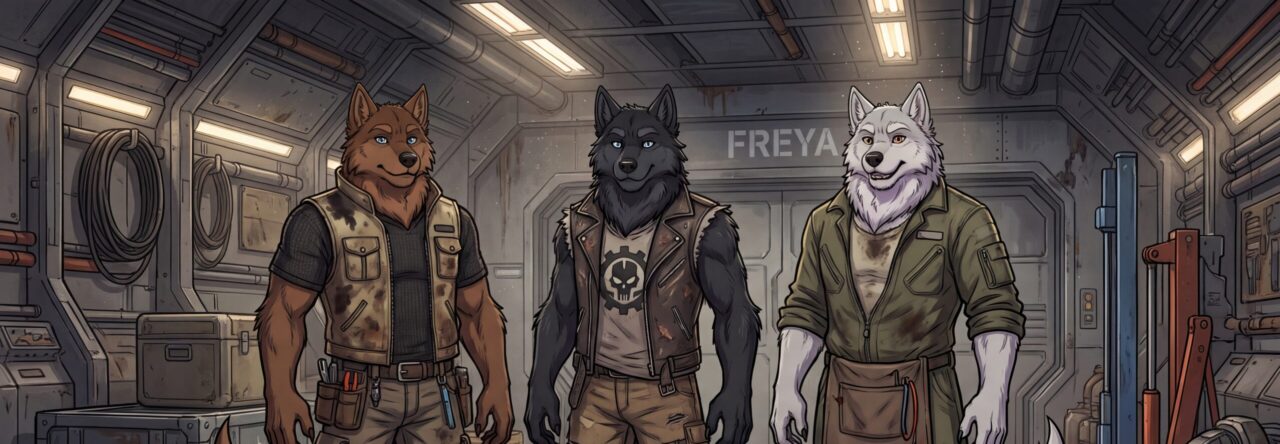
Category: Ship Life

Chapter 4: A Matter of Tolerance

The first piece of metal came off the milling machine at seven forty-three.

It was approximately the size of Thane’s palm, machined from a block of high-conductivity copper alloy, and represented nearly three hours of Mark’s careful preparation.

Gabriel looked at it.

Then at Mark.

Then back at the piece of metal.

“Thirty-eight thousand credits’ worth of equipment, six hours of engineering calculations, and an entire morning of work.”

Mark didn’t look up from the inspection bench.

“Your point?”

Gabriel held up the finished component.

“You made a shiny doorstop.”

Thane laughed from the adjacent workstation.

Mark slowly raised his head.

“Put that down.”

“It’s beautiful, really. Very modern. Very artistic.”

“Gabriel.”

“Could sell these in upscale gift shops.”

“Put. It. Down.”

Gabriel carefully returned the component to the padded inspection tray.

Then he grinned.

“Touchy.”

Mark picked up a precision measuring instrument.

“Some of us are attempting to accomplish something useful.”

“And some of us,” Gabriel replied cheerfully, “are providing essential morale support.”

Thane looked over.

“Gabriel, go provide morale support somewhere else.”

The black wolf placed a paw against his chest.

“Wounded. Betrayed. Rejected by my own pack.”

“Go make coffee.”

“Ah! A task worthy of my extraordinary talents.”

He turned toward the workshop door.

“Would either of you gentlemen like anything?”

“Coffee,” Thane said.

“Silence,” Mark added.

Gabriel smiled over his shoulder.

“One of those I can manage.”

The door closed behind him.

Mark waited three seconds.

Then he looked at Thane.

“Why do we keep him?”

Thane grinned.

“Because nobody else would put up with him.”

“Fair point.”

Freya’s fabrication shop occupied a substantial compartment along the forward portion of Deck Four, adjacent to the main cargo bay.

It was one of the areas the three wolves had spent the most time modifying during the ship’s reconstruction.

The original designers had provided a modest machine shop sufficient for routine maintenance and emergency repairs.

Thane and Mark had considered that entirely inadequate.

Over the years, they’d installed precision milling equipment, automated lathes, materials analyzers, welding and cutting systems, heat-treatment equipment, and an assortment of specialized tools accumulated through salvage contracts and carefully negotiated purchases.

Gabriel maintained that the shop represented the galaxy’s most expensive collection of objects Mark didn’t want anyone else touching.

He wasn’t entirely wrong.

The new fabrication unit they’d purchased at Calder remained secured in the neighboring storage compartment, awaiting installation after the current contract.

Mark had resisted the temptation to commission it immediately.

For once, he had a perfectly functional machine already available, a validated process, and absolutely no reason to complicate the job.

The replacement contact assembly resting on the inspection bench was the first major component of the Mercy Dawn’s restoration.

And Mark intended to make certain it was right.

He adjusted the measuring instrument, checked the component’s contact surface, and compared the reading against his design specifications.

“Three hundredths,” he murmured.

Thane looked over.

“High or low?”

“High.”

“Within tolerance?”

“Technically.”

Thane smiled.

There was that word.

Technically.

In Mark’s vocabulary, technically acceptable and actually acceptable were two very different things.

“How much material?”

“Thirty microns on the outer contact shoulder.”

Thane studied the measurement.

“Surface finishing?”

Mark nodded.

“That’s what I’m thinking.”

He rotated the component beneath the inspection light.

The polished copper alloy reflected the bright overhead illumination.

“Geometry’s good. No chatter marks. No measurable distortion.”

“Then we’re close.”

“Very.”

Thane folded his arms.

“Want me to set up the finishing station?”

“Already programmed.”

“Of course you did.”

Mark looked at him.

“Would you prefer I didn’t?”

“Nope.”

“Then stop complaining.”

Thane laughed.

It was going to be a good day.

The replacement assembly was more complicated than its appearance suggested.

A high-current electrical connection aboard a commercial freighter might look like a relatively simple piece of metal, but its performance depended on several interacting factors.

The contact surfaces had to distribute electrical current evenly.

The fastening system needed to maintain consistent pressure through repeated heating and cooling cycles.

The materials had to withstand vibration, mechanical stress, and the electrical demands of propulsion startup.

And perhaps most importantly, the finished component had to remain compatible with the original equipment’s certified operating limits.

Mark had no intention of installing some clever improvised part that worked beautifully until an insurance inspector asked where its certification came from.

He’d designed the replacement using the manufacturer’s approved dimensional envelope, making modest improvements to the contact geometry without altering its fundamental operating characteristics.

Even so, he had spent much of the previous evening comparing material specifications, running thermal simulations, and reviewing the manufacturer’s service documentation.

Now he was verifying that the actual component matched the design.

Thane stood beside him as the automated surface-finishing system completed its programmed cycle.

The machine emitted a soft chime.

Mark removed the component.

He examined it under magnification.

Then measured it again.

And again.

Finally, he nodded.

“That’s better.”

Thane leaned closer.

“How much?”

“Within eight microns of nominal.”

“Happy?”

Mark considered that.

“Reasonably.”

Thane laughed.

“High praise.”

Mark placed the component into a protective tray.

“Now we test it.”

By nine thirty, the replacement assembly was mounted inside a dedicated electrical test fixture.

The fixture was a heavy, insulated apparatus designed to simulate the mechanical and electrical conditions experienced by industrial power connections.

Freya carried it primarily for testing recovered components and verifying fabricated replacement parts.

It was not particularly glamorous equipment.

But it was exactly the kind of machinery that separated a professional repair operation from somebody improvising with a wrench and a prayer.

Mark connected the measurement leads.

Thane checked the fixture’s mechanical clamps.

“Contact pressure nominal.”

“Good.”

“Thermal sensors responding.”

“Good.”

“Current monitoring calibrated.”

Mark nodded.

“All right. Let’s start at ten percent.”

Thane enabled the test sequence.

The fixture’s power supply began applying a controlled load through the component.

A series of readings appeared on the display.

Voltage drop.

Contact resistance.

Temperature.

Mechanical expansion.

Mark watched every value.

“Looking good.”

Thane increased the current.

Twenty percent.

Forty.

Sixty.

At eighty percent, the component’s temperature began rising.

Not unexpectedly.

Every electrical conductor generated heat under load.

The question was whether the connection could dissipate that heat without exceeding its operating limits.

Mark studied the temperature curve.

“Nice.”

Thane looked over.

“Very nice?”

“Don’t push it.”

Thane grinned.

The test continued.

At full rated current, the component stabilized comfortably within the manufacturer’s thermal limits.

Then Mark initiated a controlled transient-load sequence simulating the brief current demands associated with propulsion startup.

The readings climbed.

The contact warmed.

The test fixture hummed.

Thane watched the temperature display.

“Still good.”

Mark nodded.

“Hold it.”

The transient ended.

Current returned to nominal.

The component began cooling.

Mark reviewed the data.

Then, very slowly, a satisfied smile spread across his muzzle.

Thane saw it.

“There it is.”

Mark glanced at him.

“What?”

“That smile.”

“What smile?”

“The one you get when something works exactly the way you wanted.”

Mark looked back at the display.

“Well, it does.”

Thane clapped him on the shoulder.

“Beautiful work.”

The engineer’s tail moved once.

“Thanks.”

At that exact moment, Gabriel’s voice erupted from the workshop speakers.

“LADIES AND GENTLEMEN! ANOTHER MIRACLE OF MODERN ENGINEERING!”

A short burst of triumphant orchestral music followed.

Thane doubled over laughing.

Mark closed his eyes.

“Gabriel.”

The music swelled.

“Gabriel.”

A recorded crowd began cheering.

“GABRIEL!”

The music stopped.

A moment later, the black wolf’s cheerful voice answered.

“Yes, darling?”

Mark stared toward the ceiling.

“I’m going to disconnect every speaker on this ship.”

Gabriel laughed.

“Then how will you hear my beautiful voice?”

“That is precisely the objective.”

The humor lasted approximately another ten minutes.

Then the three wolves returned to work.

The replacement contact passed its mechanical inspection and electrical tests. Mark completed the certification documentation, attached the test results, and transmitted the package to the insurer’s engineering representative.

The component was ready for installation.

Unfortunately, it was only one piece of the problem.

The Mercy Dawn’s propulsion distribution system contained three damaged assemblies: the primary high-current connection, a secondary switching contact, and a protective relay that had failed during the repeated overload events.

Mark had already determined that the switching contact was too badly damaged to justify rebuilding it.

Fortunately, the replacement was a standard industrial component.

Unfortunately, Freya didn’t carry one.

Gabriel had spent much of the morning locating an approved equivalent through Rellan’s commercial supply network.

At eleven fifteen, he appeared in the fabrication shop carrying his tablet.

“Gentlemen, I have good news and bad news.”

Thane looked up from the workbench.

“Bad news first.”

“The manufacturer doesn’t have a local distributor.”

Mark sighed.

“Of course they don’t.”

“Good news: a mining equipment supplier on Rellan Four has four compatible units in stock.”

Mark’s ears perked.

“Exact model?”

“Manufacturer-approved replacement. Same voltage and current ratings, matching control interface.”

“Price?”

Gabriel winced theatrically.

“Don’t ask.”

Thane folded his arms.

“Gabriel.”

“Eight hundred forty credits.”

Mark blinked.

“That’s not terrible.”

“For a component that sells for two hundred sixty on Calder?”

“Frontier markup.”

“Highway robbery with a docking permit,” Gabriel muttered.

Thane smiled.

“Can we get it delivered?”

“Already arranged. They’re sending it up on the next commercial shuttle.”

“How long?”

“Six hours.”

Mark nodded.

“That’ll work.”

Gabriel brightened.

“And before either of you asks, yes, I negotiated the price.”

“To what?” Thane asked.

“Six hundred twenty, including delivery.”

Thane grinned.

“Nicely done.”

Gabriel bowed.

“I live to serve.”

Mark looked at him.

“Then you can help us carry the diagnostic equipment back to the work pod.”

Gabriel’s smile vanished.

“Apparently I live to serve selectively.”

The afternoon boarding operation was more involved than the initial inspection.

This time, Thane and Mark carried the tested replacement contact, diagnostic instruments, electrical isolation equipment, portable work lights, and an assortment of tools.

Gabriel remained aboard Freya to coordinate the parts delivery, maintain communications with the insurer, and monitor both vessels’ operating systems.

The EVA transfer proceeded without difficulty.

Once aboard the Mercy Dawn, Thane and Mark returned directly to engineering.

The compartment looked much as they’d left it.

Access panels remained open.

Protective covers were stacked neatly beside the distribution cabinets.

Maintenance tags identified isolated equipment.

The damaged assemblies were clearly marked.

Mark inspected the work area before opening his equipment case.

“Everything’s where we left it.”

Thane looked around.

“Would’ve been concerning if it wasn’t.”

“True.”

They began with the main distribution cabinet.

Before installing the fabricated contact, Mark repeated the electrical isolation checks.

Thane verified the lockout status independently.

Only then did they proceed.

The replacement assembly slid into position with the precise fit Mark had designed.

He secured the mounting hardware using the specified clamping sequence, checking contact pressure and alignment as he worked.

Thane held the inspection light and passed tools.

Neither needed much instruction.

“Torque wrench.”

Thane handed it over.

“Insulation probe.”

Already in his paw.

“Retaining clip.”

Thane held it out.

Mark glanced at him.

“You’re getting annoyingly good at that.”

Thane smiled.

“Thirty years of practice.”

Mark secured the final connection.

Then he leaned back.

“All right.”

Thane studied the installation.

“Looks good.”

“Let’s verify it.”

The next forty minutes consisted of mechanical measurements, insulation checks, and continuity testing.

Every reading fell within specification.

Mark saved the results.

Then he looked at Thane.

“One down.”

“Two to go.”

The protective relay proved more troublesome.

Its replacement was a standard industrial unit, and Freya had a compatible spare aboard.

But when Mark removed the failed relay from the Mercy Dawn’s distribution cabinet, he discovered something that made him stop working.

“Well, that’s interesting.”

Thane looked over.

“Good interesting or bad interesting?”

“Undetermined.”

Mark turned the relay in his paws.

The component’s exterior showed no obvious damage.

Its identification markings matched the maintenance records.

But the connector housing had been modified.

Not crudely.

Not carelessly.

In fact, the work appeared quite professional.

Someone had installed a small adapter assembly between the relay and the original wiring harness.

Thane examined it.

“Part of the controller upgrade?”

“Probably.”

“Problem?”

“Maybe.”

Mark connected the adapter to his diagnostic terminal.

The display showed the pin assignments and control-signal routing.

He frowned.

Then checked the schematic.

Then frowned harder.

“Oh, for crying out loud.”

Thane smiled faintly.

“Found something?”

Mark pointed toward the display.

“They adapted the relay interface to work with the new controller.”

“Which makes sense.”

“Except they didn’t update the isolation feedback circuit.”

Thane leaned closer.

The diagram showed two independent feedback paths: one confirming that the main distribution contactor was open, and another confirming that the protective isolation relay had disengaged.

The adapter routed both signals through a common interface.

Thane studied the arrangement.

“That means the controller couldn’t distinguish between the two?”

“Exactly.”

“Wouldn’t that cause a fault?”

“Not under normal conditions. Both signals would usually agree.”

“But during the shutdown…”

Mark nodded.

“The controller may have received an ambiguous isolation status. That could explain why it attempted repeated recovery cycles before the manual shutdown.”

Thane considered that.

“So we have two problems from the same upgrade.”

“At least two.”

“Wrong protection profile and an improperly adapted feedback circuit.”

“Right.”

Thane shook his head.

“Somebody really made a mess of this.”

Mark examined the adapter again.

“To be fair, the wiring work itself is excellent.”

Thane looked at him.

“You’re defending them?”

“No. I’m saying whoever installed this knew how to make a proper electrical connection.”

“Just not how the system was supposed to operate.”

“Precisely.”

Thane laughed.

“That’s almost worse.”

Gabriel listened to the explanation over the communications channel.

“So the previous repair crew knew how to wire things together but didn’t understand what they were connecting?”

Mark sighed.

“That’s a simplified description.”

“Is it inaccurate?”

“No.”

“Then I stand by it.”

Thane leaned against the cabinet.

“Gabriel, we need the complete documentation for that adapter.”

“Manufacturer?”

“Possibly custom-fabricated.”

“Wonderful.”

Gabriel tapped something on his console.

“Give me a minute.”

Mark continued examining the device.

The adapter housing carried a small identification plate bearing the name of a maintenance contractor.

Harrow Technical Services.

Mark read the name aloud.

Gabriel searched the commercial registry.

A moment later, he whistled.

“Well, there’s a surprise.”

Thane looked toward his communicator.

“What?”

“Harrow Technical Services ceased operations four weeks ago.”

Mark stopped.

“Really?”

“Yep. Commercial license inactive. Registered business dissolved.”

Thane frowned.

“That’s unfortunate.”

“Depends on your perspective.”

“How so?”

Gabriel continued reading.

“Looks like they were a small independent maintenance outfit operating in the outer settlements. Their primary contracts were industrial transport repairs and equipment upgrades.”

“Any indication why they closed?”

“Not in the public registry.”

Mark looked toward the damaged controller.

“Could be unrelated.”

“Absolutely,” Gabriel agreed. “Businesses fail all the time.”

Thane nodded.

“Let’s not invent a conspiracy where there isn’t one.”

“Agreed.”

Gabriel paused.

“But it does mean getting documentation might be difficult.”

Mark considered that.

“Then I’ll trace the adapter manually.”

Thane grinned.

“Of course you will.”

By sixteen hundred, Mark had identified the adapter’s complete signal routing.

The device wasn’t beyond repair, but he didn’t like its design.

More importantly, it didn’t meet the isolation-feedback requirements specified by the replacement controller’s manufacturer.

He documented the discrepancy, photographed the assembly, and added the findings to the insurer’s report.

Then he turned toward Thane.

“We’re not reinstalling this.”

“Agreed.”

“I want to replace it with a proper interface.”

“Can we fabricate one?”

“Yes. But we’ll need to run a dedicated cable from the isolation relay back to the controller.”

Thane looked at the wiring conduit.

“Through there?”

Mark nodded.

“About twelve meters.”

“Fun.”

“Could be worse.”

“How?”

“Could be twenty.”

Thane laughed.

They began tracing the existing cable route.

The work was awkward.

The conduit passed behind several equipment cabinets, through a narrow maintenance passage, and beneath an overhead support structure.

At one point, Thane found himself lying on his side inside a service compartment, reaching behind a bundle of heavy electrical conduits.

His broad shoulders barely fit.

“Mark?”

“Yeah?”

“Remind me why we didn’t bring someone smaller.”

Mark looked toward the access opening.

“Because there are only three of us, and Gabriel’s busy.”

“Gabriel would fit better.”

“Gabriel would complain more.”

Thane considered that.

“Fair.”

He reached farther into the compartment.

His claws scraped lightly against the metal housing.

“Got it.”

“Can you see the connector?”

“Yep.”

“Release the upper retaining clip.”

Thane manipulated the clip.

It came free.

“Done.”

“Now the lower one.”

“Hang on.”

He adjusted his position.

The compartment was warm, cramped, and smelled faintly of electrical insulation.

Thane worked his paw around the back of the conduit.

There.

He pressed the clip.

It released with a soft snap.

“Got it.”

“Good. Pull the harness toward you.”

Thane did.

The connector came free.

Mark leaned into the opening.

“Beautiful.”

Thane looked at him.

“You’re buying dinner.”

Mark smiled.

“Put it on my tab.”

They finished the cable route shortly before eighteen hundred.

The new interface would require several small components, all of which Freya carried in stock.

Mark could assemble and test the replacement the following morning.

Thane was satisfied with the day’s progress.

But when they returned to Freya, he noticed something unusual.

Gabriel wasn’t waiting in the cargo bay.

He wasn’t in the galley.

And he wasn’t on the bridge.

Thane checked the ship’s internal location system.

Gabriel was in the communications office.

The captain headed there.

He found the black wolf sitting at his desk, staring at a message on his terminal.

His ears were angled backward.

His tail was still.

Thane recognized the signs immediately.

“Problem?”

Gabriel looked up.

“Not exactly.”

“That sounds encouraging.”

Gabriel turned the display toward him.

“The insurance company wants an updated estimate.”

“Fair enough.”

“They’re questioning the additional labor associated with the controller interface.”

Thane frowned.

“Why?”

“Because the original survey didn’t identify it.”

“Neither did we until today.”

“Exactly.”

Thane leaned against the desk.

“What did you tell them?”

“That the adapter was an undocumented modification that failed to meet the controller manufacturer’s specifications, and that replacing it was necessary to restore safe operation.”

“Sounds reasonable.”

“It is reasonable.”

Gabriel’s voice had acquired a sharp edge.

Thane glanced at him.

“Gabriel.”

“What?”

“What’s really bothering you?”

The black wolf exhaled.

“They suggested we could simply reinstall the old adapter and document it as an existing condition.”

Thane’s expression changed.

“Who suggested that?”

“One of their technical claims reviewers. Not Ellison.”

Thane stared at the message.

For several seconds, he said nothing.

Then he looked at Gabriel.

“Absolutely not.”

Gabriel gave a short, humorless laugh.

“That’s what I said.”

Thane read the exchange.

The reviewer had indeed suggested that the existing adapter might be reused if it had not directly caused the original failure.

Gabriel’s response was considerably more forceful.

It was also entirely professional.

Barely.

Thane smiled despite himself.

“You showed remarkable restraint.”

Gabriel looked offended.

“I always show remarkable restraint.”

“You called his proposal technically indefensible.”

“It is.”

“And commercially irresponsible.”

“Also true.”

“And you suggested he consult an actual engineer before commenting further.”

Gabriel’s ears shifted.

“That may have been a little pointed.”

Thane laughed.

“A little.”

Gabriel folded his arms.

“I’m not putting our names on a repair we know isn’t right.”

“Neither am I.”

“Good.”

Thane straightened.

“Send the complete findings to Ellison. I’ll add my authorization to the repair recommendation.”

Gabriel nodded.

“Already drafted.”

“Of course you did.”

He paused at the doorway.

“And Gabriel?”

“Yeah?”

“Nice work.”

The black wolf’s expression softened.

“Thanks.”

Mara Ellison called the following morning.

Thane, Mark, and Gabriel gathered in the communications office.

Ellison appeared on the display looking mildly irritated.

Not with them.

With someone else.

“Gentlemen,” she began, “I’ve reviewed the revised engineering report.”

Thane nodded.

“Good morning, Ms. Ellison.”

“First, let me apologize for the earlier correspondence.”

Gabriel smiled pleasantly.

“No apology necessary.”

Thane glanced at him.

Gabriel’s smile widened.

Ellison continued.

“Our technical reviewer was working from the original survey and had not yet examined the adapter documentation.”

Mark nodded.

“That explains the recommendation.”

“Yes. It does.”

Ellison looked directly at the engineer.

“Your proposed replacement is approved. Documented materials and labor remain within the existing amendment’s authorization.”

“Thank you,” Mark replied.

“And for the record, I agree that reinstalling a component known to be incompatible with the controller would be unacceptable.”

Thane smiled.

“Glad we’re on the same page.”

Ellison leaned forward.

“Captain, I want this vessel restored properly. If we can’t achieve that, I want it recovered under tow. I’m not interested in cutting corners to save a few hundred credits.”

“Neither are we.”

“Good.”

Her expression softened slightly.

“How’s the work progressing?”

Mark brought up the repair schedule.

“Primary contact installed and tested. Secondary switching component arriving from the local supplier. We’re fabricating a replacement relay interface today.”

“And the remaining distribution network?”

“Insulation and continuity checks are complete. No additional damage identified.”

Ellison nodded.

“Excellent.”

Thane folded his arms.

“If everything continues as expected, we should be ready for controlled power restoration tomorrow.”

“That’s encouraging.”

“After that, propulsion testing.”

“Understood.”

Ellison looked toward Gabriel.

“I’ll have the updated authorization transmitted within the hour.”

“Thank you.”

She smiled faintly.

“And I hope your next message is less colorful than the last one.”

Gabriel’s ears twitched.

Thane bit the inside of his cheek.

Mark looked down at his tablet.

Gabriel maintained an expression of perfect innocence.

“I’ll do my best, Ms. Ellison.”

The connection ended.

For approximately three seconds, nobody spoke.

Then Thane burst out laughing.

Gabriel threw up his paws.

“Oh, come ON!”

Mark shook his head.

“Less colorful.”

“She was joking!”

“Was she?”

“YES!”

Thane laughed harder.

Gabriel pointed at both of them.

“I hate you.”

“Love you too, Gabriel.”

By midday, the replacement relay interface was complete.

Mark had fabricated a compact mounting bracket, installed approved terminal hardware, and assembled the new signal connections according to the controller manufacturer’s specifications.

The assembly was not particularly impressive to look at.

A small metal enclosure.

Several connectors.

A short length of shielded cable.

But its function was critical.

It provided independent status feedback for the main distribution contactor and protective isolation relay, ensuring the controller could correctly identify which portions of the electrical network were connected or isolated.

Before installation, Mark subjected the assembly to a simulated fault sequence.

He deliberately created conditions representing an open contactor, a failed relay, and conflicting feedback states.

Each time, the controller correctly detected the condition and inhibited power restoration.

Thane watched the results.

“Exactly what we want.”

Mark nodded.

“Fail safe.”

“Beautiful.”

Gabriel, standing nearby, studied the test display.

“So basically, if something goes wrong, the controller knows what’s wrong instead of guessing?”

Mark considered that.

“That’s a reasonable summary.”

Gabriel grinned.

“I should’ve been an engineer.”

Mark looked at him.

“God help us.”

The replacement switching contact arrived from Rellan Four at thirteen twenty.

Gabriel accepted delivery through Freya’s cargo airlock, inspected the packaging, and verified the part number against the order.

Then he carried the component into the fabrication shop.

“Your ridiculously overpriced electrical widget has arrived.”

Mark looked up.

“Six hundred twenty credits isn’t ridiculous.”

“For something that costs two hundred sixty on Calder?”

“Gabriel.”

“What?”

“Did you get the right one?”

“Of course.”

“Then thank you.”

The black wolf smiled.

“You’re welcome.”

Thane examined the component.

“Manufacturer seal intact?”

“Yep.”

“Documentation?”

“Included.”

“Good.”

Mark accepted the package.

He opened it carefully, inspected the contact assembly, and checked the manufacturer’s test certificate.

Everything matched.

He looked pleased.

“Perfect.”

Gabriel folded his arms.

“See? I do good work.”

Thane grinned.

“Occasionally.”

They boarded the Mercy Dawn again that afternoon.

This time, all three wolves made the trip.

Gabriel had completed his immediate contract work and wanted to see the repair operation firsthand.

He was also, by his own admission, getting tired of staring at paperwork.

The EVA transfer went smoothly.

Once aboard, the three wolves removed their helmets in the pressurized forward compartment and continued into engineering.

Gabriel looked around the machinery space.

“Well, this is cheerful.”

Thane smiled.

“Welcome to the glamorous world of commercial freight transportation.”

“Remind me never to buy a freighter.”

Mark looked over.

“You already own part of a salvage company.”

“That’s different.”

“How?”

“Our ship has better furniture.”

Thane laughed.

They carried the replacement components to the main distribution cabinet.

Mark directed the installation.

Thane handled the heavy mechanical work.

Gabriel assisted with tools, cable routing, and documentation.

The black wolf was not an engineer, but he had spent enough years rebuilding Freya alongside the others to be entirely comfortable working around industrial equipment.

He knew how to follow procedures.

He knew when to ask questions.

And, despite his usual joking, he knew when to shut up and concentrate.

The switching contact went into place without difficulty.

The new relay interface required more work.

The additional feedback cable had to be routed through the service conduit they’d prepared the previous day.

Gabriel fed the cable from the distribution cabinet while Thane guided it through the access passage.

Mark monitored the installation from the controller end.

“Another half meter,” Mark said.

Gabriel pushed.

“How’s that?”

“Good. Hold it.”

Gabriel stopped.

Thane secured the cable.

“Clamped.”

Mark checked the routing.

“No sharp bends. Good separation from the high-current conductors.”

Gabriel leaned against the cabinet.

“Look at us. Three professional electricians.”

Mark gave him a sideways glance.

“Two technicians and a nuisance.”

Gabriel grinned.

“An exceptionally handsome nuisance.”

Thane laughed.

“Keep feeding that cable, handsome.”

The final connection was completed at seventeen forty.

Mark stepped back from the distribution cabinet.

He studied the installation.

Every cable was properly secured.

Every connector was labeled.

Every protective cover had been restored.

The replacement components matched the approved documentation.

The damaged assemblies had been tagged and packaged for the insurer.

Thane stood beside him.

“Well?”

Mark considered the question.

“Mechanically complete.”

“Electrically?”

“Initial checks passed.”

“Ready for power?”

“Not yet.”

Gabriel groaned.

“Oh, come on.”

Mark turned toward him.

“We have to verify the protection settings, test the isolation sequence, and confirm the controller responds correctly to simulated faults.”

Gabriel raised both paws.

“All right, all right. I know. No shortcuts.”

“Exactly.”

Thane smiled.

“How long?”

“Another hour or two.”

“Then let’s do it.”

The controlled test sequence began at eighteen fifteen.

Mark connected his diagnostic terminal to the replacement controller.

Thane monitored the distribution cabinet.

Gabriel recorded the test results and maintained communications with Freya.

The first test verified the controller’s response to a simulated overload.

The system detected the condition.

Opened the protective contactor.

Isolated the affected circuit.

And refused to restore power until the simulated fault was cleared.

Mark nodded.

“Good.”

The second test simulated a failed isolation relay.

The controller correctly identified the disagreement between the contactor and relay feedback signals.

It inhibited restoration.

“Excellent.”

The third test verified the revised propulsion startup profile.

Mark carefully entered the manufacturer’s approved parameters for the Mercy Dawn’s induction stage.

Then he initiated a simulated high-inrush startup.

The controller recognized the transient as an expected operating condition.

No protective trip occurred.

Thane watched the display.

“That’s what we wanted.”

Mark smiled.

“Exactly.”

Gabriel leaned forward.

“So the thing finally knows what ship it’s installed on?”

Mark sighed.

“Yes, Gabriel.”

“Wonderful. Can we go home now?”

“One more test.”

Gabriel stared at the ceiling.

“Of course there is.”

The final test verified the complete protective shutdown sequence.

Mark initiated a simulated fault.

The controller detected it.

The main distribution contactor opened.

The protective relay disengaged.

The system confirmed electrical isolation.

And the controller entered a safe shutdown state.

No repeated recovery attempts.

No ambiguous feedback.

No uncontrolled cycling.

Everything happened in the correct order.

Mark studied the results for several seconds.

Then he slowly leaned back.

“Well.”

Thane looked at him.

“Well?”

Mark smiled.

“That’ll do.”

Gabriel threw both arms into the air.

“HALLELUJAH!”

Thane burst out laughing.

Mark shook his head.

“You’re an idiot.”

“A happy idiot!”

Thane clapped Mark on the shoulder.

“Beautiful work, brother.”

The engineer looked at the repaired distribution cabinet.

For a moment, he said nothing.

Then he nodded.

“Thanks.”

It was a small moment.

No dramatic music.

No flashing lights.

Just three experienced wolves standing in the engineering compartment of an old freighter, looking at a repair that had been done properly.

Thane understood exactly how much satisfaction Mark took from that.

He felt much the same way.

They returned to Freya shortly after nineteen hundred.

The work had gone well.

The replacement components were installed.

The distribution controller was correctly configured.

The protective systems had passed their simulated tests.

And the documentation package was complete.

But one major step remained.

They had not yet energized the repaired propulsion distribution network.

That would happen the following morning, after a final inspection and a review of the full restoration procedure.

Thane insisted on it.

Mark agreed.

Gabriel complained mildly about the delay, but only because he enjoyed complaining.

They gathered in the galley for a late dinner.

Thane had prepared a large pot of stew earlier that morning, leaving it in the automated cooker while they worked.

Now the three wolves sat around the table, tired, hungry, and thoroughly satisfied with the day’s progress.

Gabriel tasted the stew.

Then looked at Thane.

“Captain.”

“Yeah?”

“This is fantastic.”

“Thanks.”

“Seriously. You should open a restaurant.”

Mark looked up.

“Don’t encourage him.”

Thane laughed.

“Why not?”

“Because then he’d have two businesses to run.”

Gabriel grinned.

“I could handle the contracts.”

Mark stared at him.

“Absolutely not.”

Thane laughed again.

They ate in comfortable silence for several minutes.

Then Gabriel set down his spoon.

“You know, I think we’re going to pull this off.”

Thane looked at him.

“The Mercy Dawn?”

“Yeah.”

Mark nodded.

“Assuming the power restoration goes as expected.”

Gabriel smiled.

“Always with the qualifications.”

“That’s how engineering works.”

“I know, I know.”

Thane leaned back.

“We’ve got a good chance.”

Gabriel considered that.

“Imagine Ellison’s face when we bring that freighter back under her own power.”

Thane smiled.

“Let’s not get ahead of ourselves.”

“Oh, come on. You have to admit it’d be satisfying.”

“It would.”

Mark took another bite.

“Still have to test the propulsion system.”

Gabriel sighed.

“Yes, Mark.”

“And the thermal controls.”

“Yes, Mark.”

“And the emergency isolation sequence under actual load.”

“YES, MARK.”

Thane laughed.

Mark smiled faintly.

“Just making sure.”

Later that evening, after Gabriel had retired to the common room with his guitar, Thane found Mark in the engineering office.

The gray-and-white wolf was reviewing the next day’s test procedure.

Thane leaned against the doorway.

“Still working?”

Mark looked up.

“Just finishing.”

“Everything ready?”

“Almost.”

Thane entered and sat opposite him.

“What’s bothering you?”

Mark considered that.

“Nothing specific.”

“That’s not an answer.”

The engineer sighed.

“I want tomorrow to go smoothly.”

Thane smiled.

“So do I.”

“We’ve replaced the damaged components. Corrected the configuration. Verified the protective systems.”

“Yep.”

“But we haven’t actually put the propulsion network under load.”

“That’s what tomorrow is for.”

Mark nodded.

“I know.”

Thane studied his old friend.

For all his technical brilliance, Mark never took a successful repair for granted.

He understood that simulations and bench tests were only part of the process.

Machinery had a way of revealing its true condition when asked to work.

And sometimes, despite every precaution, it surprised you.

Thane appreciated that caution.

It had saved them more than once.

“Mark.”

“Hmm?”

“You’ve done good work.”

“Thanks.”

“Whatever happens tomorrow, we deal with it.”

Mark smiled faintly.

“I know.”

“We always do.”

The engineer nodded.

“Yeah.”

Thane stood.

“Come on. Gabriel’s playing something in the lounge.”

Mark raised an eyebrow.

“Anything good?”

“Actually, yes.”

“That’s unusual.”

Thane laughed.

“Don’t let him hear you say that.”

They headed toward the residential deck together.

The following morning, Freya floated quietly beside the Mercy Dawn.

The two vessels remained separated by several hundred meters, their relative positions maintained by automated maneuvering systems.

Beyond them, Rellan Four turned slowly beneath the distant sunlight.

Aboard the disabled freighter, the repaired propulsion distribution network waited in a cold, isolated state.

Every replacement component had been installed.

Every connection had been tested.

Every protective parameter had been verified.

And in Freya’s galley, three wolves were finishing breakfast.

Thane checked the time.

“All right, gentlemen.”

Mark looked up.

Gabriel finished his coffee.

“Ready?” Thane asked.

Mark nodded.

“As ready as we’re going to be.”

Gabriel grinned.

“Then let’s go make an old freighter do something she hasn’t done in a month.”

Thane smiled.

“That’s the plan.”

He stood, his broad bare paws settling against the deck.

“Let’s get to work.”

Chapter 3: The Inspection

“Mark, why do we have seventeen different kinds of pressure fittings in this cabinet?”

“Because we have seventeen different kinds of pressure connections aboard the ship.”

Thane looked down at the open equipment locker.

“Seems excessive.”

“Which fittings would you like me to throw away?”

“Never mind.”

“That’s what I thought.”

Thane grinned and selected two universal diagnostic couplings from the neatly arranged compartments.

Behind him, Mark was working his way through a pre-boarding equipment checklist, gathering instruments with the meticulous attention to detail that had characterized his work for as long as Thane had known him.

The two wolves stood in Freya’s forward equipment preparation room, one deck below the bridge. Racks of protective suits lined the bulkheads, alongside diagnostic equipment, cutting tools, portable power supplies, and the specialized hardware required to work aboard disabled spacecraft.

Through a reinforced observation window, the Mercy Dawn floated silently against the distant backdrop of Rellan Four.

She looked harmless enough.

But Thane had learned a long time ago that disabled spacecraft were rarely as simple as they appeared.

“Portable power module?” he asked.

“Loaded.”

“Atmospheric sampler?”

“Loaded.”

“Structural scanner?”

“Loaded.”

“Emergency pressure patches?”

“Loaded.”

Thane paused.

“Coffee maker?”

Mark slowly looked up.

“No.”

“Well, that’s disappointing.”

“Thane.”

“What?”

“We’re going to inspect a freighter, not open a restaurant.”

“Just trying to maintain morale.”

“My morale would improve considerably if you’d finish checking your equipment.”

Thane laughed.

At six feet five inches tall, Mark was smaller than his companions but still a substantial figure. His gray-and-white fur was neatly groomed, and his brown eyes carried the familiar expression of an engineer who had already calculated six possible ways the day’s work could go wrong.

He wasn’t pessimistic.

He was prepared.

There was a difference.

Thane appreciated that distinction more than most people would ever understand.

He placed the diagnostic couplings into the equipment case and closed it.

“All right. Anything else?”

Mark studied his checklist.

“That should cover the initial inspection.”

“Good. Let’s get suited.”

The boarding suits were purpose-built for industrial work in vacuum.

They were not military combat armor, nor were they particularly elegant. Their primary purpose was to keep the wearer alive while allowing enough mobility to inspect, repair, and manipulate heavy machinery in environments that were frequently unpleasant and occasionally lethal.

The suits featured articulated protective shells, reinforced joints, independent environmental systems, and integrated communications.

Their boots were sealed components of the pressure assemblies, designed to accommodate the wolves’ plantigrade paws and claws without compromising mobility.

Neither Thane nor Mark particularly enjoyed wearing them.

Both preferred the unrestricted feeling of their bare paws against a solid deck.

But vacuum had a rather unforgiving attitude toward personal preferences.

Thane stepped into his suit’s lower assembly and secured the pressure seals.

Mark was already checking the connections on his own suit.

“Left shoulder coupling,” Mark said.

Thane reached across and inspected it.

“Seated.”

“Secondary seal?”

“Green.”

Mark nodded.

Thane turned slightly.

“Your turn.”

Mark checked the corresponding seals on Thane’s suit, then moved to the rear environmental connections.

“Primary oxygen good. Reserve good. Thermal control nominal.”

“Same on yours.”

They continued through the procedure without unnecessary conversation.

Each knew the sequence.

Each knew what the other would check.

They had performed this ritual hundreds of times.

When the inspections were complete, they secured their helmets.

Gabriel’s voice arrived over the communications channel.

“Well, look at you two. All dressed up for your date.”

Thane smiled inside his helmet.

“Jealous?”

“Terribly. Nothing says romance like crawling through somebody else’s broken machinery.”

Mark adjusted his wrist display.

“Gabriel, did you verify the boarding authorization?”

“Yes, Mother.”

“Cargo access?”

“Authorized.”

“Engineering access?”

“Authorized.”

“Computer systems?”

“Read-only diagnostic access until the insurer approves repairs.”

“Good.”

Thane collected his equipment case.

“All right, Gabriel. We’ll be going through the forward service airlock. Keep Freya at five hundred meters until we confirm a secure boarding connection.”

“Understood.”

“And monitor Mercy Dawn’s power output. I don’t want any surprises while we’re aboard.”

“Already tracking it.”

Thane smiled.

“Of course you are.”

Gabriel chuckled.

“Try not to break anything expensive.”

“No promises.”

Freya carried two compact EVA work pods.

They were small, rugged utility craft designed for moving personnel and equipment between vessels, inspecting large structures, and performing limited external maintenance.

Each had a pressurized cockpit, maneuvering thrusters, tool storage, and a powered docking interface.

The pods were functional rather than comfortable.

Thane climbed into the first pod and secured himself at the controls.

Mark occupied the second seat, his equipment case locked into the storage rack behind him.

The pod’s systems came online with a familiar sequence of indicator lights.

“Work Pod One, systems nominal,” Thane reported.

Gabriel answered from Freya’s bridge.

“Copy. Bay doors opening.”

Beyond the small forward windows, the enormous cargo-bay doors began to separate.

The interior atmosphere had already been isolated behind the bay’s pressure barrier, leaving the pod inside a depressurized launch compartment.

As the doors opened, the blackness of space appeared beyond them.

And there, less than a kilometer away, floated the Mercy Dawn.

Thane engaged the maneuvering controls.

“Releasing clamps.”

“Clamps released,” Gabriel confirmed.

The little craft drifted gently away from Freya.

For a moment, Thane caught sight of his own ship through the side window.

Her battered industrial hull filled much of the view, heavy salvage booms folded against her sides. Navigation lights blinked along her structural spine, and the large white letters spelling FREYA stood out against the dark gray plating.

She looked exactly as she should.

Like a ship that worked for a living.

“Something wrong?” Mark asked.

“Nope.”

“You’re staring.”

“Just admiring the view.”

Mark glanced toward Freya.

“She’s due for a hull wash.”

Thane laughed.

“You’re hopeless.”

“She is.”

“Mark, we’re a salvage company. She’s supposed to look like she’s been working.”

“There’s a difference between working and being dirty.”

“Tell that to Gabriel.”

“I have. Repeatedly.”

Thane chuckled and turned the pod toward the disabled freighter.

The Mercy Dawn’s forward service airlock was located beneath the command module.

It was a conventional commercial design, compatible with the universal docking collars used throughout most settled space.

Thane approached slowly, matching the pod’s orientation to the freighter’s docking axis.

The proximity display counted down.

Twenty meters.

Ten.

Five.

“Alignment good,” Mark reported.

Thane made a tiny correction with the lateral thrusters.

“Contact in three.”

The pod’s docking ring settled against the freighter’s collar.

A soft mechanical thump traveled through the cabin.

“Contact.”

“Clamps engaged,” Mark confirmed.

Thane waited while the seal pressure stabilized.

Then the docking system reported a secure connection.

“Freya, Work Pod One. Hard dock achieved. Beginning airlock verification.”

Gabriel answered immediately.

“Copy. I’m showing a good seal. Mercy Dawn’s forward compartment pressure is stable.”

“Understood.”

Thane released his restraints and stood.

“Ready?”

Mark collected the equipment case.

“Let’s see what we’ve got.”

The pod’s inner hatch opened.

Beyond it lay a short transfer passage and the freighter’s external airlock door.

Mark connected his diagnostic tool to the access panel.

The screen illuminated.

“Power available. Lock mechanism responding.”

“Any security restrictions?”

“Standard emergency access authorization accepted.”

The outer hatch released.

Thane stepped into the airlock, his heavy suit boots making a muted metallic sound against the deck.

Mark followed.

The hatch sealed behind them.

A low hiss announced the beginning of the pressurization cycle.

Thane watched the pressure gauge rise.

Twenty percent.

Forty.

Seventy.

One hundred.

The environmental indicator turned green.

“Atmosphere confirmed,” Mark said. “Oxygen and pressure within acceptable range. Trace contaminants below exposure thresholds.”

Thane checked his own display.

“Good. Let’s go inside.”

The inner hatch opened.

And the two wolves stepped aboard the Mercy Dawn.

The first thing Thane noticed was the smell.

Or rather, the lack of it.

The freighter’s interior air was cool, dry, and faintly metallic, with the stale quality of a ship that had been unoccupied for several weeks.

There was no scent of cooking, no lingering trace of people moving through the corridors, and none of the familiar lived-in atmosphere that made Freya feel like home.

Just recycled air and machinery.

The forward passage was narrow by the standards of Freya’s rebuilt residential deck.

Thane had to angle his shoulders slightly as he moved through it.

“Definitely not designed with us in mind,” he muttered.

Mark glanced around.

“Human-standard commercial layout.”

“Yeah, I noticed.”

“At least the ceiling clearance is adequate.”

“Barely.”

The corridor lighting was operating at reduced intensity.

Several wall panels were dark, and the emergency direction indicators glowed a soft amber.

Thane studied the overhead structures.

No visible damage.

No smoke residue.

No evidence of decompression.

He touched the communicator.

“Gabriel, we’re aboard. Atmosphere is good. No obvious interior damage.”

“Copy. Freya’s sensors agree. I’m recording your suit feeds.”

“Good.”

They proceeded toward the central access junction.

The Mercy Dawn was a relatively straightforward vessel.

Her forward command module contained the bridge, communications equipment, and a handful of crew compartments.

The central hull housed the primary cargo spaces.

Engineering and propulsion occupied the aft section.

Mark had already studied the general arrangement drawings, although he had repeatedly complained about their age.

“These schematics are from the original construction,” he said as they reached the junction.

“How old?”

“Twenty-four years.”

Thane looked at him.

“Same as the ship.”

“Exactly.”

“Imagine that.”

Mark ignored him.

“They don’t include the later modifications.”

“Well, let’s hope somebody labeled things.”

“I wouldn’t count on it.”

Thane smiled.

“Optimist.”

“Realist.”

They turned toward engineering.

The first sign of trouble appeared halfway down the main service corridor.

A section of overhead lighting flickered as the ship’s emergency power system switched between load cycles.

Mark stopped.

He watched the lights.

Then he checked his diagnostic scanner.

“Hmm.”

Thane recognized the tone.

“What?”

“Emergency bus voltage is fluctuating.”

“Bad?”

“Not critical yet. But it’s not supposed to do that.”

Mark connected his scanner to a wall maintenance port.

The display populated with system information.

He studied it for several seconds.

“Interesting.”

Thane folded his arms.

“That’s your second interesting today.”

“And?”

“Usually means something expensive.”

Mark smiled faintly.

“Only when it’s ours.”

He examined the electrical readings.

“Emergency power is being supplied by a pair of standby generators. The reactor is online at minimum output, but its main distribution connection remains isolated.”

“That’s consistent with the incident report.”

“Yes.”

Mark pointed toward the screen.

“But the standby generators are alternating loads more frequently than they should.”

“Faulty controller?”

“Possibly. Or the system’s compensating for something drawing more power than expected.”

Thane considered that.

“Could be why the lights are flickering.”

“Exactly.”

“Can we stabilize it?”

“Probably. But I want to see the main distribution equipment first.”

He disconnected the scanner.

“Let’s keep moving.”

The engineering compartment was larger than Thane expected.

The Mercy Dawn wasn’t a particularly big freighter, but her propulsion systems occupied a substantial portion of the aft hull.

The main engineering deck contained power-distribution cabinets, thermal-control equipment, propulsion support systems, and the access structures surrounding the reactor compartment.

A network of maintenance walkways crossed the room at several levels.

The machinery was silent except for the low hum of emergency circulation equipment.

Thane paused at the entrance.

“Well.”

Mark stepped beside him.

“Yep.”

“That’s a mess.”

“Not particularly.”

Thane pointed toward a section of open equipment cabinets.

“Half the covers are missing.”

“Probably removed during troubleshooting.”

“And somebody left tools on the floor.”

“That I don’t like.”

Thane grinned.

The engineer’s eyes moved systematically across the room.

He examined the equipment labels, the arrangement of power conduits, the routing of coolant lines, and the condition of the structural mounts.

Then he stopped.

His ears moved forward.

“Thane.”

“What?”

“Look at the main distribution cabinet.”

Thane followed his gaze.

The cabinet stood along the starboard bulkhead, a substantial rectangular assembly surrounded by heavy power conduits.

Most of its exterior matched the surrounding equipment.

But one section was distinctly newer.

Fresh paint.

Newer fasteners.

A replacement control module mounted behind a recently installed access panel.

Thane approached.

“There’s our upgrade.”

Mark nodded.

“Looks like it.”

He crouched beside the cabinet, examining the identification markings.

“Virex Industrial Power Systems. Model PD-8400.”

“Familiar?”

“Very.”

“Good unit?”

“Excellent unit.”

Thane smiled.

“Then what’s the problem?”

Mark studied the mounting arrangement.

“That’s what I’m going to find out.”

He opened the cabinet’s diagnostic access cover.

Inside, several status lights glowed amber.

A maintenance display showed a series of protective fault codes.

Mark connected his portable terminal.

The screen began downloading the controller’s event history.

Thane watched the engineer’s expression.

At first, Mark appeared mildly interested.

Then his ears shifted.

His brow furrowed.

Finally, he leaned closer to the display.

“Oh, you have got to be kidding me.”

Thane smiled.

“That sounds promising.”

Mark didn’t answer.

He scrolled through the event log.

Then he opened the configuration file.

Then he checked the identification plate again.

“Mark?”

“Give me a second.”

Thane waited.

He knew that look.

Mark wasn’t merely reading data anymore.

He was assembling a picture.

After another minute, the gray-and-white wolf slowly leaned back.

“Well, I think I found our problem.”

“Already?”

“I think so.”

“That was quick.”

Mark looked toward the cabinet.

“Somebody installed the wrong configuration.”

Thane frowned.

“Wrong controller?”

“No. The controller’s fine. It’s the configuration that’s wrong.”

He turned the terminal toward Thane.

“Look here.”

The screen displayed a series of operating parameters.

Maximum continuous current.

Transient overload tolerance.

Automatic recovery thresholds.

Protective isolation timing.

Thane studied them.

“All right.”

Mark tapped one particular value.

“This controller is configured for a standard medium-duty propulsion distribution network.”

“Which Mercy Dawn has?”

“No.”

Mark pointed toward the specifications on the cabinet.

“Mercy Dawn’s propulsion system uses a high-inrush induction stage. When the main drive comes online, it briefly demands significantly more current than it does during normal operation.”

Thane nodded.

“Startup surge.”

“Exactly. The original controller was designed to tolerate it.”

“And the new one isn’t?”

“The hardware can. But whoever programmed it left the default protection profile installed.”

Thane looked at the numbers again.

“So every time they started the main drive…”

“The controller saw the normal startup surge as an overload.”

“And tripped.”

“Yes.”

Thane considered that.

“Wouldn’t that have happened immediately after installation?”

Mark shook his head.

“Not necessarily. Depends on the operating conditions and the startup sequence. If the ship was using a reduced-power departure profile, the inrush might have stayed below the threshold.”

“But eventually they ran a full-power startup.”

Mark nodded.

“And the controller decided something was wrong.”

Thane looked around the silent engineering compartment.

“Well, shit.”

“Precisely.”

Gabriel listened to the explanation from Freya’s bridge.

“So you’re telling me somebody installed an expensive new power controller and forgot to tell it what kind of ship it was on?”

Mark sighed.

“That’s a crude way of putting it.”

“Is it wrong?”

A pause.

“No.”

Gabriel laughed.

“Oh, that’s beautiful.”

Thane leaned against the engineering console.

“Don’t celebrate yet. We haven’t established how much damage it caused.”

“Right,” Mark said. “The controller attempted several automatic recoveries before the protective systems isolated the main bus.”

Gabriel’s amusement faded slightly.

“That’s bad?”

“Potentially. Every recovery attempt would have subjected the distribution network to another high-current transient.”

Thane frowned.

“Could’ve damaged the switching assemblies.”

“Or the bus connections. Or both.”

Gabriel was quiet for a moment.

“How expensive are we talking?”

Mark looked around the compartment.

“Anywhere from a few replacement components to a complete rebuild of the propulsion distribution section.”

Gabriel made a wounded noise.

“Please tell me it’s the first one.”

“I’ll let you know.”

Thane smiled.

“All right, Gabriel. Log the findings. We’re continuing the inspection.”

“Copy. And Captain?”

“Yeah?”

“Please remind Mark that the insurance company is paying for this.”

Mark answered before Thane could.

“Only if we get the work authorized.”

“Which is why you have me.”

“Then stop distracting us.”

Gabriel laughed.

“Love you too, sweetheart.”

For the next two hours, Mark worked his way through the Mercy Dawn’s main power-distribution system.

Thane assisted where needed, removing access covers, carrying equipment, and checking structural connections.

The work was methodical.

Each section was isolated before inspection.

Every component was photographed.

Every abnormal reading was documented.

Mark refused to rush.

Thane had expected nothing less.

At the third distribution cabinet, the engineer found the first evidence of actual damage.

A heavy bus connection showed discoloration around one of its mounting points.

Mark examined it under the inspection light.

“There’s our first casualty.”

Thane leaned closer.

The metal surrounding the connection had darkened.

“Heat damage?”

“Yes.”

“How bad?”

“Hard to tell until we separate it.”

Mark retrieved a thermal imaging attachment.

The display showed no active hot spot, which wasn’t surprising given the system’s isolated condition.

But the visual evidence was enough to warrant closer inspection.

“Could be repairable,” Mark said.

“Could be scrap?”

“Also possible.”

Thane crouched beside him.

“Can we remove it?”

“Yes. But not until we’ve verified the entire section is electrically isolated.”

He checked the lockout indicators.

Then checked them again with an independent meter.

Finally, he nodded.

“All right.”

They removed the protective housing.

The damaged connection came free after several minutes of careful work.

Mark examined the contact surfaces.

His expression changed.

“Oh, that’s ugly.”

Thane looked.

The contact area was visibly pitted.

Tiny sections of metal had eroded away, leaving an uneven surface.

“Arcing?”

“Yep.”

“Replacement?”

“Definitely.”

Mark set the component aside.

“But here’s the good news.”

“There’s good news?”

“The damage appears localized.”

Thane raised an eyebrow.

“How localized?”

“Possibly just this connection and the associated switching assembly.”

“That’s encouraging.”

“Very.”

Thane looked at the engineer.

“Can we fabricate a replacement?”

Mark smiled.

“Maybe.”

Thane grinned.

There it was.

That particular smile.

The one Mark got when a complicated mechanical problem started looking like an interesting challenge instead of an expensive disaster.

They broke for lunch shortly after thirteen hundred.

Rather than returning to Freya immediately, Thane and Mark secured the engineering compartment and moved back through the freighter toward the forward airlock.

Gabriel had prepared food aboard their own ship.

He was waiting in the galley when they returned.

“Welcome back, gentlemen.”

Thane removed his suit helmet and took a deep breath.

“God, that feels better.”

Mark was already disconnecting his environmental harness.

Gabriel studied them.

“Productive morning?”

“Very,” Thane said.

“Anything explode?”

“No.”

“Anybody electrocuted?”

“No.”

“Excellent. I consider that a successful first half.”

Thane laughed and headed toward the equipment racks.

Once the suits were removed and secured, the two wolves cleaned up and made their way to the galley.

Gabriel had prepared sandwiches, roasted potatoes, and a large pitcher of cold fruit juice.

Thane looked at the food.

“Well, aren’t you domestic.”

Gabriel grinned.

“I contain multitudes.”

Mark sat down.

“Did you wash your paws?”

Gabriel stared at him.

“Yes, Mother.”

“Good.”

Thane laughed.

They ate while reviewing the inspection findings.

Mark displayed photographs of the damaged bus connection and the controller configuration.

Gabriel studied them carefully.

“So the original problem was basically a programming error?”

“Most likely,” Mark replied. “But I want to complete the electrical inspection before making that conclusion final.”

“And the physical damage?”

“Localized arcing in at least one distribution connection. Possibly more.”

Gabriel nodded.

“Can we fix it?”

Mark considered the question.

“I believe so.”

Thane leaned back.

“That’s what I wanted to hear.”

“But,” Mark continued, “we need to be careful.”

Gabriel sighed.

“There’s always a but.”

“The damaged connection is part of a high-current distribution assembly. We can’t just fabricate something that looks right and bolt it in.”

Thane nodded.

“Material composition?”

“Exactly. Conductivity, thermal expansion, mechanical strength, surface finish. All of it matters.”

Gabriel looked thoughtful.

“Could we get a replacement from the manufacturer?”

“Probably. But we’re six days from Calder, and I doubt Rellan has one in stock.”

“So what do we do?”

Mark smiled.

“We find out exactly what it’s made of.”

Thane laughed.

“There’s my engineer.”

The afternoon inspection revealed two additional damaged components.

A secondary switching contact showed signs of heat stress, and one protective relay had failed during the repeated overload events.

Neither problem was catastrophic.

But together, they explained why the crew had been unable to restore propulsion after the initial failure.

The system had not merely shut down.

It had suffered enough physical damage that resetting the controller would not have brought it back online safely.

By seventeen hundred, Mark had a preliminary repair plan.

He and Thane returned to Freya carrying several small components, a substantial collection of diagnostic records, and enough photographs to satisfy even the most demanding insurance adjuster.

Gabriel met them in the cargo bay.

“Well?”

Thane smiled.

“Looks like we might have ourselves a repair job.”

Gabriel’s ears perked.

“Really?”

Mark nodded.

“Assuming the remaining equipment passes inspection, I think we can restore the propulsion distribution network.”

“How long?”

“Three days. Maybe four.”

Gabriel considered that.

“That’s not bad.”

“Could be longer if we find additional damage.”

“Naturally.”

Thane placed the equipment case on a workbench.

“We’ll need authorization before we start.”

Gabriel grinned.

“Already working on it.”

Mark gave him a suspicious look.

“How?”

“Because I know you two. The moment I heard Mark say the damage was localized, I started preparing a repair proposal.”

Thane smiled.

“Good thinking.”

Gabriel looked pleased.

“I do occasionally have those.”

“Occasionally,” Mark agreed.

The insurance company’s representative appeared on Freya’s main communications display at eighteen thirty.

Her name was Mara Ellison.

She was a middle-aged human woman with short dark hair, sharp eyes, and the calm expression of someone who had spent many years dealing with commercial claims.

Gabriel had already provided her with the preliminary findings.

Thane stood beside the communications console while Mark sat at the engineering station.

“Captain,” Ellison said. “Gabriel. Mark”

I’ve reviewed your initial report.”

Thane nodded.

“Good evening, Ms. Ellison.”

“Good evening. I understand you believe the vessel may be repairable.”

“That’s correct.”

Ellison looked down at something on her desk.

“Your original contract was for recovery and delivery, not restoration.”

Gabriel smiled.

“We’re aware.”

“Then perhaps you can explain what you’re proposing.”

Thane gestured toward Mark.

The engineer brought up the damaged component photographs.

“We believe the propulsion failure originated in an improperly configured replacement distribution controller. The resulting protective shutdown sequence caused localized damage to several high-current connections and switching components.”

Ellison studied the images.

“How extensive?”

“Based on our inspection, less extensive than it could have been.”

“That’s encouraging.”

“Very. The main propulsion machinery appears undamaged. The reactor is stable. The primary distribution bus is intact, although several components require replacement.”

Ellison looked toward Thane.

“And you believe you can repair the vessel?”

“We believe it’s technically feasible,” Thane replied. “But we won’t certify anything until the repairs are completed and tested.”

Ellison nodded approvingly.

“Of course.”

Gabriel leaned forward.

“Here’s the interesting part, Ms. Ellison. Your current contract pays us eighty-five thousand credits to deliver the Mercy Dawn to an approved receiving facility.”

“Correct.”

“Presumably you expected her to arrive under tow.”

“That was our assumption.”

“Which means you’d receive a disabled vessel requiring substantial additional work before it could be sold.”

“Also correct.”

Gabriel smiled.

“What if she arrives under her own power?”

Ellison was silent for a moment.

Then she leaned back.

“I’m listening.”

Thane watched Gabriel work.

This was his element.

The black wolf’s usual playfulness remained, but it was tempered by genuine commercial intelligence and a thorough understanding of the contract.

“We’re proposing a restoration amendment,” Gabriel continued. “The existing recovery fee remains in place. The insurer authorizes documented repair expenses up to an agreed ceiling, and we receive an additional restoration fee if the vessel passes an independent operational certification.”

Ellison considered the proposal.

“How much additional?”

Gabriel smiled.

“That depends on how much you value receiving a functional freighter instead of a scrap candidate.”

Ellison returned his smile.

“Quite a bit, Sir. But not an unlimited amount.”

“Naturally.”

Thane folded his arms.

This was going to be entertaining.

The negotiation lasted nearly an hour.

Ellison was every bit as competent as Gabriel.

She asked pointed questions about the repair plan, the risks, the proposed certification procedure, and the cost of replacement components.

Gabriel answered with equal precision.

Mark provided technical explanations when necessary.

Thane addressed operational safety and liability.

At one point, Ellison questioned whether the repairs could reasonably be completed without a full shipyard facility.

Mark’s ears shifted forward.

“Ms. Ellison, Freya carries a fully equipped industrial fabrication shop, calibrated diagnostic equipment, and the specialized tooling required for this class of repair.”

“I’m not questioning your competence.”

“Good.”

“I’m questioning whether your vessel has the capacity to perform the work safely.”

Mark considered that.

Then he replied evenly.

“If we determine that we can’t complete the repairs safely, we won’t attempt them. We’ll tow the freighter under the original recovery agreement.”

Ellison nodded.

“That’s a satisfactory answer.”

Gabriel glanced at Mark with obvious amusement.

The engineer ignored him.

Eventually, they reached an agreement in principle.

The original eighty-five-thousand-credit recovery fee would remain unchanged.

The insurer would authorize documented materials and specialized equipment expenses up to twelve thousand credits, with additional expenditures requiring approval.

If the Mercy Dawn passed independent operational certification and arrived at the designated receiving facility under her own power, the insurer would pay an additional fifteen-thousand-credit restoration fee.

Any further performance payment would remain at the insurer’s discretion.

Gabriel leaned back.

“That works for us.”

Ellison nodded.

“I’ll have the amendment transmitted for signature.”

“Excellent.”

“Captain?”

Thane looked toward the display.

“Yes?”

“I appreciate your team’s thoroughness. We’ve had less satisfactory experiences with independent recovery contractors.”

Thane smiled.

“We take our work seriously.”

“So I see.”

Ellison paused.

“And Captain?”

“Yes?”

“Please don’t bring me a ship that looks repaired but isn’t.”

Thane’s expression became serious.

“We won’t.”

Something in his tone apparently satisfied her.

She nodded.

“Then I look forward to your results.”

The connection ended.

For a moment, the three wolves simply looked at one another.

Then Gabriel grinned.

“Well.”

Thane smiled.

“Well, indeed.”

Mark looked back toward the engineering photographs.

“Fifteen thousand additional credits.”

“Plus reimbursable materials,” Gabriel said.

“Not bad.”

Thane folded his arms.

“Now we just have to actually fix the damned thing.”

Mark’s expression changed.

A small smile appeared at the corners of his muzzle.

“Oh, I think we can manage that.”

Gabriel laughed.

“That’s the spirit!”

Thane looked toward the cargo bay, where the recovered components waited on the workbench.

“All right. Tomorrow morning, we start pulling the damaged assemblies.”

Mark nodded.

“I’ll run a materials analysis tonight.”

“Need help?”

“No. I’ve got it.”

Gabriel stretched.

“And I’ll prepare the final contract paperwork.”

Thane smiled.

“Look at us. Everybody’s got homework.”

Mark stood.

“Somebody has to pay for that ridiculous new fabrication machine Gabriel bought.”

Gabriel looked wounded.

“Ridiculous? That machine is a masterpiece of industrial engineering.”

“Which we haven’t installed yet.”

“Details.”

Thane laughed.

“Well, maybe we’ll have a reason to install it sooner than planned.”

Mark shook his head.

“Not during this job. We don’t need to add an uncommissioned machine to the repair chain.”

Gabriel sighed.

“You’re no fun.”

“I’m very fun.”

“No, you’re not.”

Mark looked at him.

“I’ve kept you alive for thirty years.”

Gabriel considered that.

“Fair point.”

Later that evening, Thane wandered into Freya’s fabrication shop.

Mark was standing beside a materials analyzer, examining the damaged bus connection they’d removed from the Mercy Dawn.

The component rested on a reinforced workbench beneath a bright inspection light.

Thane approached.

“Find anything?”

Mark nodded.

“Yes.”

“Good news?”

“Mostly.”

The engineer pointed toward the analyzer’s display.

“High-conductivity copper alloy with a specialized surface treatment. Nothing exotic. We have suitable stock aboard.”

Thane smiled.

“Excellent.”

“But the contact geometry matters. The original component was precision-machined to maintain uniform pressure across the connection surface.”

“Can we reproduce it?”

“Yes.”

“With our existing equipment?”

“Yes.”

Thane leaned against the bench.

“Then why do you look like you’re trying to solve the mysteries of the universe?”

Mark smiled faintly.

“Because I’d like to improve it.”

Thane laughed.

“Of course you would.”

“The original design uses a relatively narrow contact area. It’s adequate under normal conditions, but it doesn’t provide much tolerance for thermal expansion.”

“Which contributed to the damage?”

“Possibly. The controller malfunction started the problem, but the contact design may have made the consequences worse.”

Thane studied the component.

“So you’re thinking of modifying the replacement.”

“Within the manufacturer’s allowable geometry. Slightly improved contact distribution, better thermal behavior.”

“Will it still meet certification?”

“That’s what I’m checking.”

Thane nodded.

He trusted Mark’s judgment.

That trust had been earned over decades.

But he also knew his engineer well enough to recognize when a simple repair was threatening to become a personal crusade against imperfect design.

“Mark.”

“Hmm?”

“Don’t reinvent the entire propulsion system.”

Mark looked offended.

“I’m not.”

“Good.”

“Just the damaged parts.”

Thane laughed.

“That’s what worries me.”

Mark grinned.

Then his expression grew thoughtful.

“You know, Thane, this ship really isn’t in bad shape.”

“Mercy Dawn?”

“Yeah.”

He turned toward the engineering diagrams.

“Structurally sound. Reactor looks healthy. Propulsion machinery is intact. Aside from the electrical damage, she’s got a lot of life left.”

Thane considered that.

“Shame the company went under.”

“Sure is.”

“Could’ve happened to us.”

Mark looked at him.

“Maybe.”

Thane gestured toward the component.

“One bad repair. One expensive failure. Insurance company takes possession. Business collapses.”

Mark nodded slowly.

“That’s why we do things properly.”

Thane smiled.

“Exactly.”

For a while, they stood together in the quiet workshop.

The analyzer continued running.

Freya’s machinery hummed gently around them.

Eventually, Mark removed the damaged connection from the testing fixture and placed it beside a fresh block of alloy stock.

He studied the two pieces.

Then he looked at Thane.

“Want to see something?”

Thane grinned.

“Always.”

Mark opened a design program on the workshop terminal.

A three-dimensional model of the original component appeared on the screen.

He rotated it, enlarged the contact surfaces, and began adjusting several dimensions.

Thane watched with growing interest.

This was what he loved about working with Mark.

The engineer didn’t merely see broken machinery.

He saw systems.

Relationships between components.

Opportunities to make something work better than it had before.

And when he became absorbed in a problem, the rest of the universe might as well have ceased to exist.

“Here,” Mark said, pointing toward the display. “See this?”

Thane leaned closer.

“The contact shoulder?”

“Right. If we redistribute the pressure across this surface, we reduce the localized heating.”

“By how much?”

“Still calculating.”

“Wouldn’t that change the clamping load?”

“Yes. Which is why I’m adjusting the retaining geometry.”

Thane nodded.

“Interesting.”

Mark smiled.

“Now you’re getting it.”

They continued discussing the design for nearly an hour.

By the time Thane finally headed toward the residential deck, Mark had completed a preliminary replacement model and scheduled a series of simulations for the following morning.

The actual machining would wait until the design had been checked against the component’s specifications and the insurer’s repair authorization.

There would be no shortcuts.

Not aboard Freya.

At twenty-three fifteen, Gabriel found Thane sitting alone in the galley.

The captain had a mug of coffee in front of him and was reviewing the next day’s work schedule.

Gabriel poured himself a drink and sat opposite him.

“Mark still playing with his shiny broken parts?”

Thane smiled.

“Yep.”

“Thought so.”

“He’s got a plan.”

“Of course he does.”

Gabriel took a sip.

“Think we can pull this off?”

Thane looked at him.

“The repair?”

“Yeah.”

“Absolutely.”

“No doubts?”

“Plenty of doubts. That’s why we’re inspecting everything before we start.”

Gabriel nodded.

“Fair enough.”

Thane set down his tablet.

“But I know Mark. If he says he can repair that distribution network, I believe him.”

Gabriel smiled.

“Me too.”

For a moment, they sat quietly.

Then Gabriel leaned back and looked around the galley.

“One hundred thousand credits if we pull it off.”

Thane raised an eyebrow.

“Gross.”

“I know.”

“Before expenses.”

“I know.”

“Before fuel.”

“THANE.”

The captain burst out laughing.

Gabriel shook his head.

“You really know how to ruin a perfectly good moment.”

“Just keeping you grounded.”

“Well, stop it.”

Thane grinned.

Gabriel took another sip of his drink.

Then he looked toward the corridor leading to engineering.

“You know what’s funny?”

“What?”

“When we bought Freya, everybody thought we were insane.”

Thane smiled.

“Some of them still do.”

“Yeah, but look at us now.”

Thane followed his gaze.

The galley was warm and comfortable.

The ship’s systems hummed steadily beyond the bulkheads.

Somewhere below, Mark was probably still arguing with a piece of machinery.

And outside, a disabled freighter waited for them to return in the morning.

They had work.

They had a home.

They had each other.

Thane smiled.

“Yeah, Gabe.”

He lifted his coffee.

“Look at us now.”

Gabriel touched his mug against Thane’s.

“To Freya.”

“To Freya.”

The following morning, Mark was waiting in the fabrication shop before either of his companions arrived.

He had already run the simulations.

Twice.

The replacement contact design met the required electrical and mechanical specifications, but he wasn’t entirely satisfied with the thermal results.

He made one final adjustment.

Ran the simulation again.

Then smiled.

“Now that’s better.”

He saved the design and forwarded the revised calculations to Thane’s terminal for review.

The original failure had been straightforward enough.

A controller configured for the wrong operating profile had repeatedly interrupted the propulsion system during high-current startup.

The resulting electrical transients had damaged several distribution components.

But fixing the original configuration error was only part of the job.

They needed to replace the damaged hardware, verify the integrity of the entire distribution network, restore the correct protection settings, and confirm that the propulsion system could safely handle its full operating range.

There would be bench testing.

Insulation testing.

Load testing.

Thermal monitoring.

And finally, a carefully controlled propulsion startup.

A substantial amount of work.

Mark looked at the fresh alloy stock resting beside the milling machine.

Then at the three-dimensional model glowing on his terminal.

His tail moved once, slowly.

He picked up the stock, secured it in the machine’s fixture, and began the setup process.

There were few things in life he enjoyed more than making a broken machine work again.

And this one?

This one was going to be satisfying.

Chapter 2: The Price of a Promise

The first thing Gabriel heard when he woke up was a guitar.

Which was unusual, considering he wasn’t playing one.

He lay perfectly still beneath the covers, one black-furred ear turning toward the sound.

A few notes drifted through the cabin. An acoustic guitar, slightly out of tune, playing the opening bars of a melody he recognized.

His melody.

One he’d been working on for the better part of three weeks.

Gabriel opened his eyes.

The sound stopped.

He stared at the ceiling.

“Okay.”

A moment passed.

The guitar started again.

Gabriel sat up.

“Oh, you son of a bitch.”

He threw back the covers, swung his long legs over the side of the bed, and planted his broad, black-padded feet on the warm cabin floor.

The guitar continued.

He crossed the cabin in four long strides and slapped the communications panel beside the door.

“MARK!”

There was a brief silence.

Then the unmistakable sound of someone laughing.

Not Mark.

Thane.

Gabriel closed his eyes.

“Captain.”

“Morning, sunshine.”

“Did you two put a speaker in my ventilation duct?”

“Whatever gave you that idea?”

“THANE.”

“Gabriel, it’s six forty-five. Some of us have been up for hours.”

“Some of us were enjoying a perfectly good dream!”

“About what?”

“None of your damned business!”

Thane laughed again.

“Breakfast is in twenty minutes. And by the way, you’re flat on the third measure.”

The connection clicked off.

Gabriel stared at the communications panel.

Then a slow, decidedly mischievous grin spread across his muzzle.

“Oh, you just wait.”

Thane was standing in the galley making coffee when Gabriel arrived twenty minutes later.

The enormous brown wolf wore a dark blue work shirt and comfortable black utility trousers. His bare paws rested on the galley’s nonslip flooring, and his thick tail swayed lazily behind him as he studied a report on the wall display.

Mark sat at the dining table with a bowl of breakfast cereal, looking entirely too innocent.

Gabriel stopped in the doorway.

He looked at Mark.

Then Thane.

Then Mark again.

“One of you is going to regret this.”

Thane didn’t look up.

“Good morning to you, too.”

“I’m serious.”

“Coffee’s fresh.”

“That doesn’t make us even.”

“No, but it makes you caffeinated.”

Gabriel considered that argument.

Then he crossed to the counter, poured himself a substantial mug, and sat opposite Mark.

“You.”

Mark raised an eyebrow.

“Me?”

“You installed it.”

“Installed what?”

“The speaker.”

“Which speaker?”

Gabriel pointed at him.

“Don’t do that.”

Mark calmly took another bite of cereal.

“I have no idea what you’re talking about.”

Gabriel turned toward Thane.

“He’s lying.”

“That’s a serious accusation.”

“He’s a terrible liar.”

“Actually,” Thane said, “he’s an excellent liar. That’s what makes him so useful during maintenance inspections.”

Mark smiled faintly.

Gabriel stared at them both.

Then he laughed.

“Okay. Fine. You win this round.”

Thane finally turned from the display.

“Round?”

“Oh, Captain. We’re nowhere near finished.”

The insurance company’s response arrived at seven sixteen.

Gabriel had been expecting a counteroffer. He hadn’t been expecting one quite so accommodating.

He opened the message on his tablet, read it twice, and slowly lowered his coffee.

“Well, that’s interesting.”

Thane looked over.

“What?”

“They accepted the survey fee.”

“Good.”

“And the liability exclusions.”

“Even better.”

“And our request for the complete maintenance records.”

Mark stopped eating.

“All of them?”

“Apparently.”

Gabriel scrolled down.

“Five thousand credits for the initial inspection, credited toward the recovery contract if we proceed. Eighty-five thousand for successful delivery to an approved receiving facility. Extraordinary expenses subject to documented approval.”

Thane nodded.

“Reasonable.”

“There’s one catch.”

“Of course there is.”

“They want us underway within forty-eight hours.”

Mark frowned.

“That’s a little aggressive.”

Gabriel turned the tablet toward him.

“Recovery deadline.”

Mark read the clause.

The Mercy Dawn was drifting in a designated industrial holding orbit around Rellan Four, a rocky moon supporting several mining operations. The orbit itself was stable enough for the immediate future, but the freighter’s navigation and station-keeping systems were no longer maintaining its precise position.

Within approximately twenty-one days, its projected trajectory would carry it into a heavily used cargo-transfer corridor.

The local traffic authority had already issued a notice requiring removal.

Failure to comply would allow the authority to seize the vessel and arrange disposal at the insurer’s expense.

Thane studied the document.

“So they’ve run out of time.”

“Pretty much,” Gabriel said. “They need somebody moving now.”

Mark leaned back.

“Six days out. Possibly three or four days on site. Six days back if we’re towing her.”

“Longer under tow,” Thane corrected. “Depends on the mass and how much thrust we can safely apply.”

“True.”

Gabriel looked between them.

“Can we do it?”

Thane didn’t answer immediately.

He wasn’t studying the payout.

He was studying the timetable.

The Freya was capable of the work. That much was clear. She had been built for recovering vessels larger than the Mercy Dawn, and her towing systems had been extensively upgraded during the rebuild.

But capability and readiness weren’t the same thing.

“Mark?”

The engineer considered the question.

“We need to finish the crane certification. Coolant pump number two should get that seal before we leave, and I’d like to inspect the primary tow couplings. We haven’t put a sustained load on them since the Terron recovery.”

“How long?”

“Twenty-four hours if everything checks out.”

“Supplies?”

Gabriel was already opening another document.

“Fuel reserves are good. Food and consumables are fine. Medical supplies are stocked. We need a fresh set of industrial cutting heads, two replacement hydraulic couplings, and another spool of reinforced tow cable.”

Thane nodded.

“Can you get them?”

“Already requested quotes.”

Mark shook his head.

“Do you ever stop?”

Gabriel grinned.

“Not while somebody’s paying me.”

Thane looked toward the window overlooking the station’s inner cargo structure.

Forty-eight hours.

It was enough time.

Just.

“All right,” he said. “Let’s take the survey contract. Full recovery remains conditional on what we find.”

Gabriel nodded.

“I’ll confirm.”

“And make damned sure they understand we’re not guaranteeing recovery until we’ve physically inspected the vessel.”

“Already in the agreement.”

“Good.”

Thane finished his coffee.

“Then I suppose we’re going to Rellan.”

Mark stood.

“I’ll start the departure inspections.”

Gabriel rose as well.

“I’ll handle provisions and port clearance.”

Thane watched them head toward the galley door.

“Hey, Gabriel.”

The black wolf stopped.

“Yeah?”

“About that speaker.”

Gabriel’s ears perked.

Thane smiled.

“You’re still flat on the third measure.”

Gabriel slowly turned his head toward Mark.

Mark’s expression remained perfectly neutral.

“Oh, it’s on,” Gabriel said.

The Freya had five primary decks, although the layout was considerably more complicated than the simple designation suggested.

Originally, the vessel had been designed around a massive structural spine supporting heavy cargo-handling equipment, towing assemblies, and industrial processing systems. Living accommodations occupied a comparatively small portion of her interior.

During the rebuild, the three wolves had modified that arrangement substantially.

The residential deck was comfortable and spacious. The machinery spaces were better organized. The bridge had been modernized, and the fabrication shop had gained capabilities the original designers probably never imagined installing aboard a commercial salvage vessel.

But the fundamentals remained unchanged.

Freya was a machine built to work.

And preparing her for an interstellar recovery operation required considerably more than turning a key.

By eight thirty, Mark was deep inside the aft engineering compartment.

His bare gray-and-white paws rested on the grated maintenance platform as he examined the primary coolant circulation assembly.

A compact diagnostic scanner was connected to the pump’s control housing.

Its display showed a series of performance curves, temperatures, and pressure readings.

Mark studied them with narrowed brown eyes.

“You’re not fooling anybody,” he muttered.

The pump continued running.

He shut it down through the maintenance controller, isolated the associated coolant loop, and waited for the pressure indicators to fall.

Then he opened the access cover.

A faint metallic odor drifted from the housing.

Mark sniffed once.

“Yep.”

The seal was beginning to degrade.

Not catastrophically. Not even enough to produce an external leak.

But enough.

He reached for his communicator.

“Thane?”

“Go ahead.”

“Coolant pump seal confirmed. I’m replacing it.”

“Need anything?”

“No. I’ve got the replacement.”

“All right.”

“Where are you?”

“Cargo bay. Checking the tow assemblies.”

“Don’t cycle the port coupling yet.”

“Why?”

“I’ve got the hydraulic loop isolated.”

Thane paused.

“That would have been good to know five minutes ago.”

Mark stopped working.

“Thane.”

“I’m kidding.”

“You’re not funny.”

“I disagree.”

“I know.”

The connection ended.

Mark smiled to himself.

Then he returned to work.

In the cargo bay, Thane stood beside one of Freya’s massive aft towing mechanisms.

The assembly was a substantial arrangement of reinforced structural members, powered couplings, load sensors, and industrial-grade attachment hardware.

It had originally been designed to handle enormous mining platforms and disabled freighters.

During the rebuild, Mark had reinforced the mounting structures and replaced the outdated control systems with modern equipment.

The result was not particularly elegant.

But it was extraordinarily capable.

Thane ran one claw along the edge of a coupling housing, examining a shallow scrape in the protective coating.

The mark was new.

Probably from their last recovery.

He crouched and inspected the underside.

No deformation.

No visible cracking.

Good.

He tapped the communicator.

“Mark, I found some cosmetic damage on the starboard tow coupling. Nothing structural that I can see.”

“Photograph it.”

“Already did.”

“Send it to the maintenance log.”

“Already did.”

A pause.

“Good.”

Thane grinned.

“See? I can be trained.”

“Debatable.”

He stood and stretched.

For a moment, he simply looked around the cargo bay.

At one hundred fifteen meters long, Freya was a substantial vessel, and her central cargo compartment occupied an enormous portion of her interior volume.

Most of it was empty now.

The last recovery had been profitable, but the work had left evidence behind. A few scorched patches on the deck. Fresh abrasion marks around the loading tracks. A dented protective guard that needed straightening.

Ordinary wear.

Thane rather liked it.

A spotless salvage ship was either brand new or unemployed.

He preferred neither.

His communicator chimed again.

This time it was Gabriel.

“Captain, I have a question.”

“Go ahead.”

“How attached are you to the remaining funds in our operating account?”

Thane closed his eyes.

“What did you find?”

“An opportunity.”

“That’s never a comforting word coming from you.”

“Calder Industrial Supply has a surplus fabrication unit available. Nearly new. Apparently ordered for a mining contractor who went insolvent before delivery.”

Thane considered that.

“What kind?”

“Heavy materials processor. Capable of handling larger alloy stock than our current system.”

That caught his attention.

“How much?”

“Forty-two thousand credits.”

Thane whistled softly.

“That’s not pocket change.”

“No, but the original invoice was ninety-six.”

“Why are they selling it so cheap?”

“They need the warehouse space.”

“Have you talked to Mark?”

“Not yet.”

“Talk to Mark.”

“I was hoping you’d say that.”

“And Gabriel?”

“Yes?”

“Don’t buy it without discussing it with us.”

A brief silence.

“Define buy.”

“Gabriel.”

“I’m joking!”

Thane shook his head.

At least he hoped Gabriel was joking.

Calder Station’s industrial supply district occupied three interconnected commercial modules overlooking the main shipyard.

It was noisy, crowded, and smelled of machine lubricant, heated metal, and several species’ preferred street foods.

Gabriel loved places like this.

There was money to be made, deals to be found, and an endless assortment of unusual people to meet.

He moved through the crowded concourse with practiced ease, occasionally adjusting his path to avoid smaller pedestrians.

His height drew attention, as it usually did.

But he was accustomed to it.

A tall black-furred wolf with bright blue eyes, an easy grin, and a confident stride was difficult to overlook.

Most people simply stepped aside.

A few stared.

One small child, walking beside a human woman, pointed directly at him.

“Mom! Look at the wolf!”

Gabriel glanced down.

The child couldn’t have been more than five.

The mother looked embarrassed.

“I’m sorry.”

Gabriel grinned.

“No problem.”

He crouched slightly.

“Hey there, little guy.”

The child stared at his muzzle.

“Are your teeth real?”

Gabriel laughed.

“Every one of ’em.”

“Can I see?”

“Absolutely not,” the mother said immediately.

Gabriel chuckled.

“Fair enough.”

He gave the child a friendly wave and continued toward the supply office.

Behind him, he heard the boy whisper something about how enormous his paws were.

Gabriel smiled.

Some things never changed, no matter how many star systems humanity colonized.

The fabrication unit was impressive.

Mark had joined Gabriel at the supplier’s warehouse twenty minutes earlier, and the engineer was now walking slowly around the machine with the expression of a wolf who had unexpectedly encountered something beautiful.

Gabriel watched him.

“Well?”

Mark didn’t answer.

He crouched beside the processing chamber and examined the mounting hardware.

Then he checked the manufacturer’s identification plate.

Then the control connections.

Gabriel waited.

“Mark?”

“Quiet.”

Gabriel smiled.

Oh, this was going well.

Mark opened a maintenance panel.

“Interesting.”

“What?”

“Latest revision of the cutting assembly. Reinforced drive system. Updated thermal controls.”

“Is that good?”

“Very.”

“Better than ours?”

“Considerably.”

Gabriel folded his arms.

“So we want it.”

Mark straightened.

“Depends.”

“On?”

“Power requirements. Cooling capacity. Mounting space.”

“We have all those.”

“Probably.”

Gabriel grinned.

“Which means yes.”

“Which means I need to check the specifications.”

The supplier approached them.

He was a stocky human named Darrin Kells, with thinning hair and the harried expression of someone managing far too much inventory.

“Everything satisfactory, gentlemen?”

Gabriel smiled.

“Beautiful machine.”

“Excellent equipment. Practically new.”

“Never commissioned?”

“No, sir. Still under manufacturer warranty.”

Mark looked up sharply.

“Warranty transferable?”

Kells hesitated.

“I believe so.”

“Believe?”

“I can verify.”

“Please do.”

Gabriel suppressed a grin.

Mark could be absolutely merciless about technical details.

Kells pulled up the documentation.

“Yes. Transferable. Full coverage for another twenty-six months.”

Mark nodded.

“Good.”

Gabriel stepped forward.

“Now, Darrin. About that price.”

The supplier looked pained.

“We’ve already discounted it considerably.”

“Oh, absolutely. Very generous.”

“Forty-two thousand is an excellent price.”

“It certainly is.”

Kells relaxed slightly.

Gabriel smiled.

“Unfortunately, it’s not the price we’re going to pay.”

The man’s expression fell.

Mark quietly returned to examining the machine.

He knew better than to interrupt Gabriel when he was enjoying himself.

Three hours later, Gabriel and Mark returned to Freya.

Behind them, a station cargo tug carried the fabrication unit on a secured transport platform.

Thane was waiting in the cargo bay.

He watched the machine roll through the loading doors.

Then he looked at Gabriel.

“Please tell me you didn’t spend forty-two thousand credits.”

Gabriel smiled.

“Of course not.”

Thane narrowed his eyes.

“How much?”

“Thirty-one thousand, eight hundred.”

Thane stared.

Mark nodded approvingly.

“Including delivery, installation support, and the remaining warranty.”

Thane looked between them.

“Seriously?”

Gabriel spread his arms.

“What can I say? I’m charming.”

Mark snorted.

“He’s a menace.”

“An effective menace.”

Thane examined the machine.

It was larger than their current materials processor, but compact enough to fit comfortably in the fabrication shop once they rearranged the equipment.

“Do we actually have the space?”

Mark nodded.

“I measured.”

“Power?”

“Plenty.”

“Cooling?”

“Within capacity.”

“Installation?”

“I can have it operational after we get back from Rellan.”

Thane considered the purchase.

Thirty-one thousand credits was still a significant expense.

But the machine would greatly expand their fabrication capabilities and reduce their dependence on outside suppliers.

On a ship that spent much of its time operating far from major industrial centers, that was valuable.

He nodded.

“All right. Good purchase.”

Gabriel grinned.

“Thank you, Captain.”

“Now tell me how you got him down that far.”

Gabriel looked offended.

“Trade secrets.”

Mark folded his arms.

“He convinced the supplier that holding it another month would cost more than the difference.”

“Which is true,” Gabriel protested.

“And then offered to take two obsolete replacement drive assemblies they couldn’t sell.”

“Which we can use.”

“And negotiated a discount on the installation support.”

“Which we don’t actually need.”

Thane laughed.

“You magnificent bastard.”

Gabriel bowed.

“At your service.”

By the following morning, the Freya was nearly ready to depart.

The replacement coolant seal was installed.

The overhead crane had passed its operational checks.

The tow couplings had been inspected, tested, and certified.

Supplies were aboard.

The cargo bay had been secured, and the new fabrication unit was safely stowed until installation could be completed.

The three wolves gathered on the bridge at eight fifteen.

Freya’s command deck was a practical, modernized workspace located near the forward end of the vessel.

Large displays provided sensor information, navigation data, propulsion status, and communications.

The main flight controls occupied two stations at the front, while additional consoles along the sides supported engineering, cargo operations, and salvage equipment.

Thane settled into the captain’s chair.

It was larger than the original equipment, custom-built to accommodate his frame and tail comfortably.

Mark occupied the engineering station.

Gabriel sat at communications and navigation support, reviewing their departure authorization.

“Calder Traffic says we’re cleared to initiate departure preparations,” Gabriel announced.

Thane nodded.

“Mark, ship status?”

“Main power stable. Environmental systems nominal. Maneuvering thrusters online. FTL drive ready for departure sequence once we clear the station’s traffic boundary.”

“Cargo?”

“Secured.”

“Tow gear?”

“Locked and stowed.”

“External connections?”

Gabriel checked his display.

“Station power disconnected. Environmental umbilicals released. Docking clamps standing by.”

Thane rested his broad, clawed hands on the controls.

“All right. Let’s wake her up.”

Mark began the propulsion startup sequence.

Deep within the vessel, power flowed into the primary maneuvering systems.

A familiar low vibration traveled through the bridge.

Thane felt it through the floor beneath his bare paws.

He smiled.

There she was.

Freya.

Awake and ready to work.

“Thrusters responding,” Mark reported.

“Good.”

Gabriel keyed the communications system.

“Calder Traffic, independent salvage vessel Freya requesting departure clearance from Berth Seventeen.”

A moment later, a human voice answered.

“Freya, Calder Traffic. Departure approved. Maintain designated outbound corridor Bravo-Seven. Traffic separation in effect. Report clear of station control.”

“Understood, Calder. Bravo-Seven. Freya departing.”

Thane engaged the maneuvering controls.

The ship’s docking clamps released with a muted mechanical vibration.

Slowly, almost imperceptibly, Freya began moving away from the station.

The enormous industrial structure drifted across the forward displays.

Beyond it lay the dark curve of Veyra, its atmosphere glowing faintly in the light of the system’s star.

Thane watched the navigational markers.

“Port lateral thrusters, ten percent.”

Mark acknowledged.

The ship moved smoothly into the outbound corridor.

“Looking good,” Gabriel said.

Thane smiled.

“She always does.”

Mark made a skeptical noise.

“Except when she doesn’t.”

“You’re ruining the moment.”

“Somebody has to.”

Gabriel laughed.

The transit from Calder Station to the Rellan system would take approximately six days.

Interstellar travel had become routine centuries earlier, but it remained subject to practical limitations.

Ships couldn’t simply engage faster-than-light propulsion wherever they pleased.

They had to reach designated departure regions outside heavily trafficked orbital space, establish a safe trajectory, and verify that their projected transit corridor was clear.

Freya’s drive was reliable, though hardly state-of-the-art.

She was considerably faster than older industrial vessels and considerably slower than modern passenger transports.

Thane considered that a perfectly reasonable compromise.

A salvage ship wasn’t supposed to win races.

It was supposed to get the job done.

By ten forty, Freya had cleared the primary traffic zone and was approaching the system’s outer transit boundary.

Gabriel reviewed the navigation data.

“Rellan corridor confirmed. Estimated transit time five days, nineteen hours.”

“Any advisories?”

“Minor traffic congestion at the destination boundary. Nothing significant.”

Mark checked the drive systems.

“FTL ready.”

Thane leaned back.

“All right, gentlemen. Let’s go earn some money.”

Gabriel grinned.

“Music to my ears.”

Thane engaged the drive sequence.

The ship’s conventional propulsion systems reduced output as the faster-than-light field generators came online.

A low, resonant hum filled the bridge.

On the forward display, the stars distorted slightly as Freya entered the transit field.

Then the familiar blackness of open space gave way to the shifting, luminous patterns of faster-than-light travel.

They were underway.

Thane watched the displays for another minute, confirming that the ship’s trajectory remained stable.

Then he stood.

“Mark, you’ve got the bridge.”

“Got it.”

“Gabriel, let’s go review the contract terms.”

The black wolf groaned.

“Didn’t we just do that?”

“We’re about to spend six days getting there. I want everything clear before we arrive.”

Gabriel sighed.

“You’re no fun.”

Thane smiled.

“That’s why you love me.”

The first two days of transit passed without incident.

Which, aboard Freya, meant that everybody found plenty of things to do.

Mark spent most of his time checking the newly repaired systems and updating the ship’s maintenance records.

Thane inspected the recovery equipment, reviewed the Mercy Dawn’s technical documentation, and began planning possible approaches to the disabled freighter.

Gabriel handled communications with the insurance company, reviewed commercial regulations in the Rellan system, and spent several hours complaining about the price of replacement hydraulic components.

In between, they ate together, watched old movies, argued about music, and generally enjoyed the comfortable familiarity of their shared life.

On the third evening, Gabriel appeared in the common room carrying his guitar.

Thane was stretched out on the couch, reading.

Mark sat in his usual chair with a technical manual.

Gabriel looked around.

“All right, gentlemen.”

Neither looked up.

“I have an announcement.”

Thane turned a page.

“Congratulations.”

“You haven’t heard the announcement.”

“I’m sure it’s wonderful.”

Gabriel placed the guitar on the table.

“I have finished the song.”

Mark raised an eyebrow.

“What song?”

“The one I’ve been working on.”

“The one you keep playing at three in the morning?”

“I do not play at three in the morning.”

“You did Tuesday.”

“That was two thirty.”

Thane laughed.

Gabriel pointed at him.

“You’re not helping.”

“Sorry.”

The black wolf picked up the guitar and settled into his chair.

“Anyway. I want your opinions.”

Mark closed his manual.

Thane set aside his book.

Gabriel adjusted the tuning slightly, then began to play.

The melody was gentle at first, built around a series of carefully picked chords.

Then it developed into something richer, with a warm, rhythmic progression that carried a surprisingly wistful quality.

Gabriel played for several minutes.

There were no lyrics.

Just the guitar.

When he finished, the room remained quiet.

Thane smiled.

“That’s beautiful, Gabe.”

Gabriel looked pleased.

“Yeah?”

“Yeah. Really good.”

Mark nodded.

“I like the middle section.”

Gabriel turned toward him.

“The bridge?”

“Yes. Nice progression.”

“Thanks.”

Thane leaned forward.

“What’s it called?”

Gabriel looked down at the guitar.

“Haven’t decided.”

“What’s it about?”

The black wolf considered that for a moment.

“Home, I guess.”

Thane glanced around the common room.

At the worn furniture, the shelves, the photographs, the familiar signs of years spent living aboard an old industrial ship.

“Well,” he said quietly, “you picked a good subject.”

Gabriel smiled.

Then he looked toward Mark.

“By the way, I found that speaker you installed in my ventilation duct.”

Mark didn’t move.

“Oh?”

“Yep.”

“Interesting.”

“Very.”

Thane watched them with amusement.

Gabriel leaned back.

“Just thought you should know.”

Mark nodded.

“Good to know.”

A long silence followed.

Then Gabriel added, almost casually, “You might want to check your cabin’s announcement system.”

Mark slowly looked up.

Thane burst out laughing.

By the fifth day, the three wolves had settled into the predictable routine of interstellar transit.

Freya’s systems continued operating normally.

The FTL drive maintained a stable field.

Supplies were adequate, equipment was ready, and Gabriel’s revised contract documents had finally been acknowledged by the insurance company’s claims office.

The only remaining complication involved the Mercy Dawn’s maintenance records.

Or, more accurately, the lack of them.

Mark had been reviewing the files when he noticed the discrepancy.

He called Thane to engineering.

The captain arrived a few minutes later, carrying a mug of coffee.

“What’s up?”

Mark pointed toward the terminal.

“Take a look.”

The display showed a maintenance history covering the freighter’s previous eighteen months of operation.

Thane scanned the entries.

“Looks normal.”

“Keep going.”

Thane scrolled.

Routine inspections.

Minor equipment replacements.

Propulsion calibrations.

Environmental system servicing.

Then a gap.

He frowned.

“Where’s the last quarter?”

“Exactly.”

Thane looked at Mark.

“Missing?”

“Completely.”

“Could be a records transfer issue.”

“Could be.”

Mark opened another file.

“Except the incident report references a propulsion modification completed six weeks before the failure.”

Thane read the entry.

“Power-distribution upgrade.”

“Right.”

“But there’s no record of the work.”

“Not in the files we received.”

Thane leaned against the console.

“That’s not necessarily sinister.”

“I didn’t say it was.”

“Could’ve been done at an independent yard.”

“Certainly.”

“Or by the crew.”

“Possibly.”

Thane studied the information.

“But you’d like to know what they changed before we go poking around.”

Mark nodded.

“Exactly.”

Thane took another sip of coffee.

“All right. I’ll have Gabriel request the missing records.”

“Already asked him.”

Thane grinned.

“Naturally.”

Mark looked back at the screen.

“There’s something else.”

“What?”

“The propulsion failure appears to have originated in the main distribution network. That’s a fairly serious problem, but the ship’s independent systems continued operating normally.”

“We knew that.”

“Yes. But look at the emergency shutdown sequence.”

Thane leaned closer.

The readout displayed a timeline of events preceding the failure.

A power fluctuation.

A protective shutdown.

Several attempts to restore propulsion.

Then a complete isolation of the primary distribution bus.

Mark pointed toward one particular entry.

“This.”

Thane read it.

“Manual override?”

“Yes.”

“By the crew?”

“Apparently.”

“That seems reasonable if automatic recovery failed.”

“It does.”

Mark folded his arms.

“But I’d like to know why the captain ordered a complete shutdown of the propulsion distribution network when the system was already isolated.”

Thane considered that.

“Maybe they were being cautious.”

“Maybe.”

“Maybe they thought something was damaged.”

“Also possible.”

Thane looked at his old friend.

“What are you thinking?”

Mark shook his head.

“Nothing definite. I just don’t like incomplete information.”

Thane smiled.

“Now there’s a shock.”

Mark gave him a flat look.

“Very funny.”

“All right. We’ll find out when we get there.”

On the final evening before arrival, Thane found Gabriel alone on the bridge.

The black wolf was sitting at the communications station, reviewing the latest correspondence from the insurance company.

A half-finished mug of coffee rested beside him.

Thane entered quietly.

“Burning the midnight oil?”

Gabriel looked up.

“Just getting everything squared away.”

“Problems?”

“Not really.”

Thane settled into the captain’s chair.

Gabriel continued reading for a moment, then shut down the display.

“You know what I hate about insurance companies?”

Thane grinned.

“How much time have you got?”

“I’m serious.”

“All right.”

“They’re perfectly happy to write a contract that sounds straightforward, but every paragraph has six different ways for them to get out of paying you.”

“Which is why we have you.”

Gabriel smiled.

“True.”

He tapped the tablet.

“Still, this one’s unusual.”

“How so?”

“They’re being very accommodating.”

Thane raised an eyebrow.

“Isn’t that good?”

“Usually.”

“Usually?”

Gabriel leaned back.

“They accepted nearly every condition I requested. Didn’t argue much about the survey fee. Didn’t push back on our right to reject the recovery. They even agreed to cover additional equipment costs if the initial documentation turns out to be inaccurate.”

Thane considered that.

“Maybe they’re just desperate.”

“Probably.”

“Deadline’s getting close.”

“Yep.”

“Then what’s bothering you?”

Gabriel looked toward the forward display.

“Nothing specific. I guess I’m just suspicious when somebody makes my job too easy.”

Thane chuckled.

“Well, there’s a first.”

Gabriel grinned.

“Shut up.”

For a while, they sat together in comfortable silence.

Beyond the forward displays, the shifting patterns of the transit field moved steadily past.

Freya’s engines hummed beneath them.

Eventually Gabriel spoke again.

“Hey, Thane?”

“Yeah?”

“You ever regret buying her?”

Thane looked over.

“Freya?”

“Yeah.”

The captain considered the question.

“No.”

“Not even during the rebuild?”

Thane laughed.

“Oh, there were days I wanted to set her on fire.”

Gabriel burst out laughing.

“That electrical distribution nightmare?”

“Among others.”

“God, I thought Mark was going to lose his mind.”

“Mark doesn’t lose his mind.”

“He came close.”

Thane smiled at the memory.

The rebuilt power-distribution system had been one of the most difficult projects they’d undertaken. A supposedly compatible control module had turned out to require extensive modification, and the resulting installation had consumed nearly three weeks of work.

They’d been exhausted.

Frustrated.

And more than a little concerned about whether they’d made a terrible financial decision.

But they’d persevered.

As they always did.

“No,” Thane said again. “I don’t regret it.”

Gabriel nodded.

“Me neither.”

Thane glanced toward the communications station.

“Why do you ask?”

Gabriel shrugged.

“Just thinking.”

“About?”

“How different things could’ve been.”

Thane smiled.

“That’s true.”

“We could’ve bought a newer ship.”

“Couldn’t have afforded one.”

“Could’ve leased.”

“And spent the rest of our lives paying somebody else.”

“Fair point.”

Thane looked around the bridge.

“Besides, a newer ship wouldn’t be Freya.”

Gabriel smiled.

“No. Guess it wouldn’t.”

The Rellan system appeared on Freya’s navigation display at approximately eight forty the following morning.

The transition from faster-than-light travel to conventional space was smooth.

Thane sat at the helm, monitoring the final deceleration sequence.

Mark watched the engineering readouts.

Gabriel handled navigation and communications.

“FTL field collapsing normally,” Mark reported.

“Conventional propulsion standing by,” Thane replied.

“Rellan traffic control beacon acquired,” Gabriel announced. “We’re approximately forty-two million kilometers from the primary industrial zone.”

Thane nodded.

“Let’s establish contact.”

Gabriel keyed the transmitter.

“Rellan Traffic, this is independent salvage vessel Freya, inbound on commercial transit corridor Nine. Requesting clearance to proceed toward Rellan Four for authorized survey operations.”

The response arrived several seconds later.

“Freya, Rellan Traffic. Identification confirmed. Proceed along assigned approach vector. Be advised, industrial traffic is heavy in the Rellan Four transfer corridor. Maintain separation and report upon entering local control.”

“Understood, Rellan. Freya proceeding.”

Thane adjusted the navigation controls.

The ship responded smoothly.

“All right, gentlemen. Let’s see what we’ve got.”

The Rellan system was dominated by a pale yellow star surrounded by several planets, numerous industrial satellites, and an extensive network of mining installations.

Rellan Four was a rocky moon orbiting a gas giant in the outer portion of the system.

Its surface was heavily scarred by industrial excavation.

Large mining settlements occupied several equatorial regions, while orbital processing facilities handled the steady stream of raw materials leaving the moon.

The Mercy Dawn was located beyond the busiest portion of the industrial zone.

Freya would reach her in approximately eighteen hours.

Gabriel studied the local traffic information.

“Busy little place.”

Mark nodded.

“Mining systems usually are.”

Thane looked at the industrial installations on the display.

“Looks like they’ve got a decent economy.”

“Depends on who’s getting paid,” Gabriel said.

Thane glanced at him.

“Something you found?”

“Just reading the local trade reports. Several operators have been struggling with transport costs. A couple of smaller freight companies went under recently.”

“Including Mercy Dawn’s owners.”

“Exactly.”

Mark checked the sensor data.

“Nothing unusual about that. Frontier transportation margins are tight.”

Gabriel nodded.

“Yep. Fuel goes up, maintenance gets expensive, one ship breaks down, and suddenly you’re out of business.”

Thane understood that problem all too well.

Running an independent salvage operation required careful financial management.

Freya was fully paid for, and the three wolves had built a respectable operating reserve, but a major mechanical failure could still cause serious financial discomfort.

And unlike large corporations, they couldn’t simply transfer the cost to another division.

Gabriel’s work mattered.

So did Mark’s.

And so did Thane’s responsibility to ensure that every contract they accepted was worth the risks involved.

“All right,” Thane said. “Let’s review the approach plan.”

By the time the Mercy Dawn appeared on Freya’s long-range sensors, the three wolves had completed their initial preparations.

The disabled freighter was exactly where the orbital tracking data indicated.

Approximately ninety meters long, she was a conventional commercial transport with a broad cargo section, modest propulsion assembly, and a compact forward command module.

Her exterior showed the ordinary signs of years spent hauling freight along frontier routes.

Scuffed plating.

Replaced panels.

Faded company markings.

Nothing particularly remarkable.

Thane studied the image.

“Well, there she is.”

Gabriel enlarged the display.

“Not much to look at.”

Mark glanced over.

“Neither was Freya when we bought her.”

“Fair point.”

The captain reviewed the sensor readings.

“Any active transmissions?”

Gabriel checked.

“Automated navigation beacon. Emergency transponder. Standard vessel identification.”

“Life signs?”

Mark turned toward the sensor display.

“Atmosphere in the main compartments. Environmental systems running at reduced capacity. No confirmed occupants.”

“Reactor?”

“Low-power standby. Stable.”

Thane nodded.

“Structural condition?”

“Primary hull appears intact. No significant breaches. Some minor impact damage on the starboard cargo section.”

“All right.”

He adjusted their approach.

Freya moved slowly toward the disabled vessel, maneuvering thrusters making minute corrections as the distance closed.

At five kilometers, Thane reduced their relative speed.

At two kilometers, he began a detailed visual inspection.

At one kilometer, the Mercy Dawn filled much of the forward display.

Thane leaned forward.

“Mark, take a look at the aft section.”

The engineer studied the image.

“What am I looking for?”

“That panel near the main propulsion housing.”

Mark enlarged the view.

A rectangular section of hull plating appeared noticeably cleaner than the surrounding structure.

“Replacement panel,” Mark observed.

“Looks recent.”

“Could be part of the modification work.”

“That’s what I’m thinking.”

Gabriel glanced toward them.

“Is that a problem?”

“Not necessarily,” Mark replied. “But I want to know what’s behind it.”

Thane nodded.

“We’ll find out.”

He eased Freya into a stable position approximately five hundred meters from the freighter.

The two ships drifted together, their relative motion carefully matched.

Beyond them, Rellan Four hung against the blackness of space, its scarred surface illuminated by the distant sun.

Thane completed the positioning maneuver.

“All stop.”

Mark confirmed the propulsion status.

“Relative velocity stable.”

Gabriel checked the contractual authorization.

“Survey permit confirmed. Local traffic notified. We’re clear to begin inspection.”

Thane leaned back.

“Good.”

For a moment, nobody spoke.

The disabled freighter floated silently beyond the bridge windows.

She wasn’t especially impressive.

She wasn’t mysterious.

She was simply another aging commercial ship that had suffered an expensive mechanical failure.

Thane had seen hundreds like her.

He stood and stretched, his tail moving lazily behind him.

“All right, gentlemen. Let’s get suited up and see what kind of mess somebody left us.”

Mark was already rising from his station.

“I’ll get the portable diagnostic equipment.”

Gabriel shut down the communications display.

“And I’ll notify the insurance company that we’ve arrived.”

Thane nodded.

“Remember, inspection only. Nobody starts tearing anything apart until we’ve established exactly what we’re dealing with.”

“Understood,” Mark said.

Gabriel grinned.

“Yes, Mother.”

Thane gave him a sideways look.

“Keep it up, smartass.”

Gabriel laughed.

The three wolves left the bridge together.

Behind them, Freya maintained her position beside the silent freighter, her automated systems making tiny, precise corrections to hold station.

Another contract.

Another disabled ship.

Another day’s work.

And, as far as Thane was concerned, there was no better way to make a living.

Chapter 1: Another Day, Another Wreck

The first indication that something was wrong came from a noise that shouldn’t have been there.

It wasn’t particularly loud. Just a faint metallic tick, followed by a barely perceptible vibration through the deck plating.

Thane stopped walking.

He stood perfectly still in the main cargo bay of the Freya, his ears swiveling toward the portside overhead crane assembly.

There it was again.

Tick.

A moment later, a muted clunk.

The enormous brown-furred wolf slowly raised his head.

“Oh, you’re kidding me.”

At seven feet tall, Thane was an imposing figure even among his own species. Broad shoulders, powerful arms, and a substantial frame made him look considerably more formidable than his generally easygoing disposition suggested. His blue eyes tracked the overhead machinery while one clawed hand rested against the cold steel of a nearby cargo container.

He listened.

Tick.

Clunk.

“Mark,” he said into his wrist communicator. “You got a minute?”

The response came almost immediately.

“Depends.”

Thane smiled.

“How much do you love our portside cargo crane?”

A pause.

“What did Gabriel do?”

“Nothing, actually.”

“Then what did you do?”

“Why does everybody assume somebody did something?”

“Because I’ve known you two for thirty years.”

“Fair point. But neither of us touched it. I’m hearing something in the upper carriage assembly. Sounds like a bearing.”

Another pause, this one shorter.

“Don’t operate it. I’ll be there in five.”

“Wasn’t planning to.”

“Thane.”

“What?”

“Don’t operate it.”

Thane rolled his eyes.

“Yes, Mother.”

The communicator clicked off.

He looked up at the crane again.

“Well, sweetheart, I guess you’re getting another little bit of attention today.”

The Freya answered with the familiar deep vibration of her environmental machinery.

Thane grinned.

At thirty-two years old, the ship had earned the right to complain occasionally.

Besides, she was considerably better behaved than most of the people who worked aboard her.

Docking Berth Seventeen at Calder Industrial Station was not an especially glamorous place to spend a morning.

The station orbited Veyra, a heavily industrialized world whose primary contribution to interstellar civilization consisted of manufactured components, refined metals, and an astonishing amount of paperwork.

Calder itself was a sprawling collection of interconnected pressure modules, cargo platforms, processing facilities, and commercial berths. Thousands of vessels passed through every month.

Most of them were considerably newer than the Freya.

Few of them, in Thane’s admittedly biased opinion, were nearly as interesting.

Her hull was a broad, utilitarian arrangement of reinforced compartments and structural members surrounding a massive central cargo section. Heavy recovery booms folded against her flanks. Tow-coupling assemblies occupied much of her aft structure, and the angular machinery housings gave her the unmistakable silhouette of a working salvage vessel.

She wasn’t sleek.

She wasn’t particularly fast.

And her hull bore enough evidence of repaired impacts, replaced panels, and structural reinforcement to make an inexperienced inspector deeply nervous.

But underneath those scars was a ship that had been painstakingly rebuilt by three wolves who knew exactly what they were doing.

Thane had never wanted anything else.

Outside the cargo bay’s open inner loading doors, station personnel were transferring the final containers from their latest recovery contract.

A human forklift operator maneuvered a grav-assisted cargo platform into position while a pair of dockworkers checked the container’s identification markings against their manifest.

Thane watched the operation with the relaxed attention of someone who had supervised thousands of similar transfers.

“Hold there,” he called.

The operator stopped.

Thane pointed toward the container’s lower securing bracket.

“You’ve still got one transport lock engaged.”

The human leaned out of the cab, looked down, and frowned.

“Shit. You’re right.”

“Happens.”

The operator climbed down and released the lock.

“Thanks, Captain.”

“No problem. I’d rather find it now than have you drag half my floor out with it.”

The man chuckled, although he gave the enormous wolf a slightly cautious glance as he passed.

Thane barely noticed.

He’d been getting those looks his entire life.

Wolves were hardly unusual in civilized space, but a full-grown male standing seven feet tall still tended to attract attention, particularly among humans and smaller species.

Thane didn’t deliberately cultivate that effect.

He didn’t have to.

His natural bearing was calm, self-assured, and quietly imposing. He seldom raised his voice, and he generally treated everyone with the same straightforward courtesy.

It was simply difficult to forget that the friendly brown wolf discussing cargo locks could probably lift the average human dockworker off the floor with one arm.

“All clear, Captain,” the operator announced.

“Go ahead.”

The platform moved smoothly toward the station’s receiving area.

Thane checked the final item off his handheld manifest.

Twenty-seven containers of recovered industrial machinery, three damaged atmospheric processors, and approximately forty tons of assorted structural material.

Not glamorous salvage.

Not mysterious.

Just useful equipment that somebody was willing to pay good money to recover.

Exactly the kind of work that kept the Freya flying.

His communicator chirped.

“Captain?”

Thane recognized the voice immediately.

“Morning, Gabriel.”

“Are you aware that Calder Station apparently believes we’re operating a luxury passenger liner?”

Thane closed his eyes.

Here we go.

“What happened?”

“They sent us our docking invoice.”

“And?”

“And unless I’m reading this wrong, they expect us to pay eighteen thousand credits for the privilege of occupying a commercial berth for thirty-six hours.”

“That seems a little high.”

“A LITTLE HIGH?”

Thane pulled the communicator away from his ear.

“I mean, I’m looking at the invoice right now. They’ve charged us for hazardous materials handling, oversized vessel accommodation, supplementary security monitoring, and something called an enhanced environmental support assessment.”

“What’s that?”

“I HAVE NO IDEA!”

Thane laughed.

“Gabriel, lower your voice.”

“I’m perfectly calm.”

“You sound perfectly calm.”

“Thank you.”

“Where are you?”

“Commercial administration. I’m about to introduce somebody to the concept of fraudulent billing.”

“Try not to bite anyone.”

“That depends entirely on how this conversation progresses.”

The connection terminated.

Thane shook his head.

“Another beautiful morning.”

Mark was already halfway up the crane’s maintenance ladder when Thane returned to the cargo bay.

The gray-and-white wolf was shorter than his companions, though at six feet five inches he hardly qualified as small.

He wore dark work trousers and a faded engineering shirt, the sleeves rolled up past his elbows. A compact diagnostic unit hung from his belt, and his brown eyes were narrowed in concentration as he inspected the exposed carriage assembly.

Thane stopped beneath him.

“Well?”

Mark didn’t look down.

“Outer race on the number-three bearing.”

“Thought so.”

“There’s some scoring on the shaft, too.”

“Bad?”

“Not yet.”

“Can we machine it?”

“Probably. Depends on what I find when I pull the assembly.”

Thane nodded.

“Need a hand?”

“Eventually. Right now I need you to stop standing underneath me.”

Thane looked up.

“Why?”

“Because I’m holding a twelve-kilogram bearing housing.”

“Ah.”

He stepped aside.

Mark carefully lowered the component using a small maintenance hoist.

The assembly descended to the deck with a solid metallic thunk.

Thane crouched beside it.

The bearing was visibly worn.

“Well, that’s annoying.”

Mark climbed down.

“Original equipment.”

“Really?”

“Twenty-eight years old.”

Thane raised an eyebrow.

“That’s impressive.”

“It was a good bearing.”

“Apparently.”

Mark ran a claw along the edge of the housing, then frowned.

“Should’ve caught this during the last inspection.”

“Mark.”

“What?”

“It’s a bearing. They wear out.”

“Not supposed to wear out without me noticing.”

Thane smiled.

There were few things in the universe more predictable than Mark taking the failure of an aging mechanical component as a personal insult.

“Want me to get the replacement?”

“Already ordered one.”

“Of course you did.”

“Should be here in two hours.”

Thane looked at him.

“Two hours? You ordered it already?”

“Yesterday.”

“How’d you know?”

Mark pointed toward the housing.

“Temperature trend was creeping upward. Only a degree and a half over three weeks, but it wasn’t normal.”

Thane stared at him for a moment.

Then he shook his head.

“You’re a frightening individual.”

Mark shrugged.

“Somebody has to keep this bucket flying.”

“Don’t call her a bucket.”

“You call her a bucket.”

“That’s different.”

“How?”

“She’s my bucket.”

Mark gave him a long, thoroughly unimpressed look.

Then he picked up his diagnostic unit.

“Go bother Gabriel.”

Gabriel had reached the stage of negotiations where his smile was beginning to concern people.

Across the desk, a human commercial administrator named Peter Halden was studying the docking invoice with the increasingly desperate expression of a man who wished he’d called in sick.

Gabriel sat opposite him, his black-furred tail moving slowly behind the chair.

At seven feet tall, he was an impressive figure, although his easy grin, bright blue eyes, and generally cheerful disposition usually put people at ease.

Usually.

“Peter,” Gabriel said pleasantly, “I want you to understand something.”

Halden swallowed.

“Certainly, Sir.”

“I like your station.”

“Thank you.”

“Good facilities. Excellent cargo handling. Your people have been very helpful.”

“Glad to hear that.”

“And I have absolutely no objection to paying a fair price for the services we’ve actually used.”

“Of course.”

Gabriel tapped the invoice.

“But this?”

His smile widened.

“This is bullshit.”

Halden shifted in his chair.

“Those are our standard commercial charges.”

“No, Peter. Your standard commercial charges are published in the station tariff schedule, which I downloaded before we arrived.”

Gabriel produced his tablet.

“And according to that schedule, our actual docking charges should be approximately eleven thousand four hundred credits.”

“Well, there are additional assessments—”

“Yes! Let’s discuss those.”

Gabriel leaned forward.

Halden leaned backward.

“Supplementary security monitoring. Fourteen hundred credits. What exactly were you monitoring?”

“Our station security systems—”

“Which are already included in your standard berthing charges.”

“Well—”

“Enhanced environmental support assessment. Nine hundred credits. Did you send somebody aboard to inspect our environmental systems?”

“No, but—”

“Did we request additional environmental services?”

“No.”

“Did we connect to station atmospheric supplies?”

“No.”

“Then what precisely was enhanced?”

Halden opened his mouth.

Closed it.

Gabriel continued smiling.

“And let’s not even get started on hazardous materials handling, considering every item we transferred was certified nonhazardous industrial salvage.”

“I’ll need to consult with my supervisor.”

“Excellent idea.”

Gabriel leaned back.

“Tell you what. While you’re doing that, I’ll send the invoice and your published tariff schedule to the Commercial Port Authority. They might be interested in how your billing department interprets standard service rates.”

Halden went pale.

“That won’t be necessary.”

“Wonderful!”

Gabriel clapped his paws together.

“Then I think we’re making progress.”

Twenty minutes later, he emerged from commercial administration with a corrected invoice for eleven thousand two hundred credits and a complimentary three-day extension on their berth reservation.

He was whistling.

His communicator chirped.

“Gabriel?” Thane asked.

“Yes, my fearless leader?”

“How’d it go?”

“Beautifully.”

“Anybody bleeding?”

“Not a drop.”

“Any lawsuits?”

“None pending.”

“Any station personnel requiring medical attention?”

“Captain, I’m wounded by your lack of faith.”

“How much?”

“Eleven thousand two hundred.”

Thane laughed.

“You magnificent bastard.”

“I prefer financially responsible genius, but I’ll accept magnificent bastard.”

“Come on home. Mark’s got a crane torn apart, and I could use another set of paws.”

Gabriel sighed theatrically.

“Must I? I’ve just showered.”

“You showered this morning.”

“Exactly. I’m trying to establish a pattern.”

“Get your ass back here.”

“Aye, Captain.”

By late afternoon, the Freya had settled into the familiar rhythm of maintenance between contracts.

The main cargo bay was nearly empty, its enormous floor cleared of recovered equipment and cargo containers.

Overhead lights illuminated rows of structural supports, securing points, and industrial machinery.

Mark had disassembled the damaged crane carriage and spread its components across a maintenance bench.

Thane was operating the machine shop’s precision mill, carefully restoring the scored shaft while Mark monitored the measurements.

Gabriel sat nearby, reviewing their next set of potential contracts on a tablet.

He was also eating something crunchy from a bag.

Mark looked up.

“Don’t get crumbs in the bearing housing.”

“I’m nowhere near the bearing housing.”

“You’re within six meters of it.”

“Are you suggesting my crumbs possess independent propulsion?”

“I’m suggesting you’re a slob.”

Gabriel grinned.

“Such hostility.”

Thane examined the mill’s readout.

“Another four thousandths?”

Mark checked the measurement.

“Three. Then polish it.”

“Got it.”

Gabriel scrolled through his tablet.

“All right, gentlemen. I’ve got three possibilities.”

“Go on,” Thane said.

“First one. Recovery of a damaged agricultural transport from an orbital storage yard near Harrow. Fairly straightforward. Thirty-eight thousand credits.”

Mark looked unimpressed.

“What’s wrong with it?”

“Structural damage around the primary cargo spine.”

“How bad?”

“Client says moderate.”

Mark snorted.

“Which means severe.”

“Precisely why I love you.”

“Next.”

“Second one. Retrieval of abandoned construction equipment from a mining platform in the Kessler Belt. Sixty-two thousand credits.”

Thane paused the mill.

“That’s decent.”

“Travel time’s longer. Four days each way, plus whatever time we spend working.”

“Fuel?”

“Already factored in.”

“Net?”

“Somewhere around thirty-five thousand, assuming we don’t find any surprises.”

Mark looked up sharply.

“There are always surprises.”

“Which is why I said assuming.”

Thane resumed the mill.

“Third?”

Gabriel’s expression changed slightly.

“This one’s interesting.”

“That usually means expensive,” Mark observed.

“Not necessarily.”

“Usually.”

Gabriel ignored him.

“Independent recovery contract. Medium commercial freighter, approximately ninety meters long. Registered to a small freight outfit operating out of the outer settlements.”

Thane listened.

“What’s the problem?”

“Lost propulsion after an apparent power-system failure. Crew evacuated to a nearby mining station. Vessel’s been drifting in a stable holding orbit for about three weeks.”

“Location?”

“Rellan system. Outer industrial zone.”

Mark frowned.

“That’s frontier territory.”

“Yep.”

“What’s the payout?”

Gabriel smiled.

“Eighty-five thousand credits.”

The mill stopped.

Thane turned around.

“Eighty-five?”

“That’s what the listing says.”

“What’s the catch?”

“Ah. See? This is why you’re captain.”

Gabriel expanded the contract information.

“The freight company went insolvent last month. Their insurer is trying to recover the ship before its orbital maintenance window expires and the vessel becomes a navigation hazard.”

Mark crossed his arms.

“Why haven’t they hired a local contractor?”

“Apparently the local operators are booked, unavailable, or unwilling to take the job at the insurer’s original rate.”

“Which was?”

“Forty thousand.”

Mark laughed.

“Of course.”

“They’ve increased it twice. Nobody’s taken it.”

Thane considered that.

“Any indication of contamination? Structural instability? Reactor damage?”

“Nothing in the preliminary report. But there’s limited information.”

“That’s concerning.”

“Yep.”

“How long to get there?”

“About six days from Calder, depending on the transit corridor.”

Mark scratched his chin.

“What’s the ship?”

“Varton-class medium freighter. Older design. Pretty common.”

“I know the class.”

“Of course you do.”

Mark ignored him.

“Depending on the damage, we could tow it. If the primary structure’s intact, we’d probably be better off fitting an external power module and bringing enough systems online to stabilize it.”

Thane nodded.

“Could work.”

Gabriel watched them.

“Want me to request the complete survey?”

“Yeah,” Thane said. “But don’t commit yet. I want to see the documentation.”

“Already requested it.”

Thane raised an eyebrow.

Gabriel grinned.

“Come on. You think I don’t know you by now?”

The Freya’s galley was one of the few places aboard that didn’t look like it belonged inside an industrial salvage vessel.

That had been entirely intentional.

During the ship’s reconstruction, Thane had insisted that their living accommodations should be comfortable.

Not luxurious. Not extravagant.

Comfortable.

They spent too much of their lives aboard the vessel to live like prisoners in an equipment locker.

The result was a surprisingly welcoming residential section occupying much of Deck Two.

The galley was spacious, with warm lighting, durable cabinetry, and a large dining table designed to accommodate full-sized wolves without requiring anybody to tuck their knees under their chins.

A connected common room featured comfortable furniture, a large entertainment display, and several shelves crowded with books, equipment manuals, musical instruments, and assorted objects accumulated during years of travel.

Gabriel had claimed one particular chair as his own.

Nobody remembered exactly when that had happened.

It was simply understood.

By nineteen hundred shipboard time, the three wolves had finished their maintenance work, cleaned up, and gathered around the dining table.

Thane had prepared dinner.

Nothing elaborate. Grilled steaks, roasted vegetables, and a large bowl of seasoned potatoes.

Gabriel was enthusiastically working through his second helping.

Mark was reading something on his tablet.

Thane watched him over his coffee.

“You’re doing it again.”

Mark looked up.

“What?”

“Working through dinner.”

“I’m reading.”

“Maintenance reports.”

“Yes.”

“That’s working.”

Mark considered this.

Then he set down the tablet.

“Happy?”

“Ecstatic.”

Gabriel pointed his fork toward Thane.

“You know, technically, you’re working too.”

Thane raised an eyebrow.

“How do you figure?”

“You’re supervising Mark’s relaxation.”

“Somebody has to.”

Mark sighed.

“I live with idiots.”

Gabriel grinned.

“Two extremely talented idiots, thank you very much.”

“Debatable.”

Thane laughed.

For several minutes, they ate in comfortable silence.

The faint hum of the ship’s environmental systems drifted through the room.

Somewhere deeper in the vessel, a circulation pump cycled on.

Thane recognized the sound without consciously thinking about it.

He knew this ship.

Not quite as intimately as Mark, perhaps, but well enough that every familiar vibration and mechanical rhythm had become part of his daily existence.

They had purchased her nearly six years earlier.

Back then, she had been little more than a decommissioned industrial salvage vessel waiting for demolition.

Her previous owners had decided she wasn’t worth the cost of another major refurbishment.

Mark had disagreed.

Strongly.

The ship’s basic construction was exceptionally robust. Her primary structural members were sound, her pressure hull was intact, and her fundamental engineering design was simple enough to maintain without relying on proprietary manufacturer systems.

She needed work.

A tremendous amount of work.

But she wasn’t finished.

Thane had seen potential.

Mark had seen engineering.

Gabriel had seen an opportunity to negotiate a purchase price that still made Thane smile when he thought about it.

They had spent nearly three years rebuilding her.

There had been long nights, unexpected expenses, mechanical disasters, arguments, laughter, and more than a few occasions when all three wondered whether they’d completely lost their minds.

But eventually, the old ship had come alive again.

And somewhere along the way, she’d stopped being a project.

She’d become home.

Thane glanced toward the common room.

An old photograph hung on the wall near the entrance.

It showed the three wolves standing in front of the Freya on the day they’d purchased her.

Her hull was streaked with corrosion. Several external panels were missing. One of her recovery booms hung at an awkward angle.

Gabriel was grinning like an idiot.

Mark looked vaguely concerned.

Thane had one arm draped around each of them.

They’d been exhausted, dirty, and almost absurdly happy.

He smiled at the memory.

Gabriel noticed.

“What?”

“Nothing.”

“You’ve got that look.”

“What look?”

“The nostalgic one.”

Thane gestured toward the photograph.

“Just remembering when we bought her.”

Mark followed his gaze.

“God, she was a mess.”

“She certainly was.”

Gabriel leaned back.

“Best deal I ever made.”

Mark snorted.

“You nearly got us killed driving that first replacement power converter through the docking tunnel.”

“That was not my fault.”

“You ignored the clearance markings.”

“The markings were wrong!”

“The markings were painted on the wall!”

“And apparently painted incorrectly!”

Thane started laughing.

Mark shook his head.

“Four centimeters.”

Gabriel held up a finger.

“Four centimeters of clearance. Which means we cleared it.”

“You scraped the entire side of the transport.”

“Cosmetic damage.”

“To a rental!”

“Which the rental company ultimately waived.”

“Because Thane fixed it.”

Gabriel turned toward the captain.

“And that’s why we make such a wonderful team.”

Thane nearly choked on his coffee.

Later, after dinner had been cleared away and the dishes loaded into the galley’s washer, Gabriel retrieved his guitar from the common room.

It was an old-fashioned acoustic instrument, lovingly maintained despite having traveled through more star systems than most people ever visited.

He settled into his chair and began picking out a quiet melody.

Mark returned to his tablet.

Thane sat on the couch with the Rellan recovery contract displayed on the large wall screen.

The documentation Gabriel had requested had finally arrived.

And it was considerably more interesting than the original listing.

“Mark?”

“Hmm?”

“Take a look at this.”

Mark set aside his tablet and moved closer.

Thane enlarged the freighter’s engineering survey.

“Primary power bus failure, apparently caused by an overload in the propulsion distribution network.”

Mark studied the report.

“That’s odd.”

“What?”

“These readings.”

He pointed toward a series of diagnostic figures.

“Main reactor output was normal right up until the failure. There’s no indication of a reactor problem.”

“Could be a distribution fault.”

“Could be.”

Mark scrolled further.

“But look at the secondary systems.”

Thane leaned forward.

“Life support?”

“Still operating on emergency power. Navigation computers were functional when the crew abandoned ship. Communications too.”

Gabriel stopped playing.

“So they had power?”

“Enough to keep the ship habitable,” Mark replied. “Not enough to maneuver safely.”

“Then why abandon her?”

Thane studied the incident summary.

“Captain reported an unrecoverable propulsion failure. Requested assistance. Crew transferred to a mining station.”

“Reasonable enough,” Mark said. “If you’re looking at a major power-distribution repair without proper equipment.”

Gabriel resumed playing.

“Think we can fix her?”

“Possibly.”

Thane looked at Mark.

“How possibly?”

Mark gave him a faint smile.

“Bring me a ship and I’ll tell you.”

Gabriel laughed.

“There’s the confidence I like to hear.”

Thane continued reading.

The freighter’s name was Mercy Dawn.

She was twenty-four years old, registered to a small independent freight company that had operated along the outer trade routes for nearly a decade.

Nothing about her history was particularly remarkable.

She hauled manufactured goods, agricultural supplies, and industrial equipment between frontier settlements.

Her final cargo manifest showed several containers of mining machinery, replacement atmospheric equipment, and assorted commercial supplies.

Ordinary work.

Ordinary ship.

An expensive mechanical failure in an inconvenient location.

Thane could understand why the insurance company wanted her recovered.

At eighty-five thousand credits, the contract was attractive.

But he didn’t like the incomplete survey.

“Gabriel, can you get them to authorize an independent inspection before we commit to recovery?”

“Probably. Might need to negotiate a separate survey fee.”

“Do it.”

“How much?”

Thane considered.

“Five thousand. Credited against the recovery fee if we take the job.”

Gabriel nodded approvingly.

“Reasonable.”

“And I want the right to reject the contract if we find undisclosed hazards.”

“Naturally.”

“Plus reimbursement for extraordinary expenses caused by inaccurate information.”

Gabriel grinned.

“Captain, you’re speaking my language.”

Mark pointed at the screen.

“And I want full access to the ship’s engineering records.”

“Put it on the list.”

“Not just the incident report. Maintenance history, system modifications, everything.”

“Got it.”

Gabriel set aside his guitar.

“All right. I’ll send the counterproposal tonight.”

He stood and stretched, his black tail sweeping lazily behind him.

“Anything else?”

Thane thought for a moment.

“Yeah.”

“What?”

“Don’t piss off the insurance company.”

Gabriel looked genuinely offended.

“Why would you say something like that?”

Mark answered without looking up.

“Because you exist.”

At twenty-two thirty, Freya’s residential deck had grown quiet.

Gabriel had retired to his cabin after announcing that he intended to spend the remainder of the evening listening to music and doing absolutely nothing productive.

Mark had disappeared into engineering for what he claimed would be a quick final inspection.

Thane knew better than to expect him back within the hour.

He finished reviewing the next day’s maintenance schedule, shut down his terminal, and stood.

Rather than heading directly to his cabin, he took the lift down to the main cargo deck.

The cavernous compartment was mostly dark, illuminated by a handful of low-intensity safety lights.

Their latest salvage cargo was gone.

The deck was clean.

The overhead crane rested in its parking position, its repaired carriage assembly gleaming slightly beneath the work lights Mark had forgotten to switch off.

Thane wandered toward the center of the bay.

His footfalls echoed softly against the steel.

He paused beside one of the enormous structural columns supporting the ship’s central spine and rested a paw against it.

The faint vibration of Freya’s operating systems traveled through the metal.

Steady.

Familiar.

Comforting.

He’d spent enough time aboard spacecraft to know that every vessel developed its own collection of sounds and sensations.

But Freya was different.

They hadn’t merely bought her and moved aboard.

They’d rebuilt her with their own paws.

Every replaced conduit, every reinforced bulkhead, every upgraded system represented some shared memory.

He remembered Mark working thirty-six hours straight to bring the primary power distribution network online for the first time.

He remembered Gabriel practically dancing through the cargo bay after securing their first major commercial contract.

He remembered the three of them standing on the bridge during her first successful flight after the rebuild, listening to the engines come up to power.

That had been a good day.

A damned good day.

Thane smiled.

“Not bad for an old girl everybody wanted to scrap.”

Freya hummed quietly around him.

He patted the bulkhead.

“Yeah. I know. You’re not old.”

A maintenance hatch opened behind him.

Mark emerged carrying a diagnostic case.

“Talking to the ship again?”

Thane turned.

“Maybe.”

Mark shook his head.

“You know she can’t hear you.”

“Neither can you half the time.”

“That’s because I choose not to.”

Thane laughed.

“Everything good?”

“Crane’s back in service. Bearing temperature’s normal. Shaft repair looks good.”

“Excellent.”

“Primary coolant pump number two needs a seal eventually. Nothing urgent.”

“Put it on the list.”

“Already did.”

“Naturally.”

Mark joined him beside the structural column.

For a while, neither spoke.

The two wolves stood in the quiet cargo bay, surrounded by the machinery they’d spent years restoring.

Finally, Mark glanced toward the overhead crane.

“Think we’ll take that Rellan job?”

“If the insurance company agrees to our conditions.”

“Could be interesting.”

“Could be.”

Mark folded his arms.

“Something about that engineering report bothers me.”

Thane looked at him.

“Enough to pass on it?”

“Not yet.”

“Then we’ll see what Gabriel comes back with.”

Mark nodded.

Another comfortable silence followed.

Then he looked around the enormous cargo bay.

“You know, we ought to put some of this space to better use.”

Thane raised an eyebrow.

“How?”

“Well, we’re carrying more fabrication equipment than we originally planned. Could extend the machine shop into the forward storage compartment.”

“That’s not a bad idea.”

“Would give us room for a second mill, maybe a larger materials processor.”

“We’ve got the power capacity?”

“Plenty.”

“Something to think about.”

Mark glanced toward the lift.

“Come on. It’s getting late.”

Thane gave the bulkhead one last affectionate pat.

“Night, sweetheart.”

Mark sighed.

“You’re hopeless.”

“Yep.”

They headed for the lift together.

Several thousand kilometers away, Calder Station continued its endless commercial operations.

Cargo vessels arrived and departed. Maintenance crews repaired equipment. Controllers monitored traffic. Merchants negotiated contracts, passengers boarded transports, and countless ordinary lives unfolded beneath the station’s artificial lights.

Freya occupied Berth Seventeen, quietly connected to the station’s services.

Her hull bore the scratches and scars of three decades of industrial work. Her engines were powered down, her cargo bay was empty, and her three occupants were settling in for the night.

Tomorrow would bring another round of inspections, paperwork, maintenance, and whatever surprises Gabriel managed to uncover in the contract negotiations.

For now, though, the work was finished.

Deep within the ship, a circulation pump cycled on, sending a familiar, gentle vibration through her structure.

Freya rested quietly in her berth.

And aboard her, three old friends slept soundly in the home they’d built together.

Page 2 of 2

COPYRIGHT © 2026 · THREE WEREWOLVES LLC