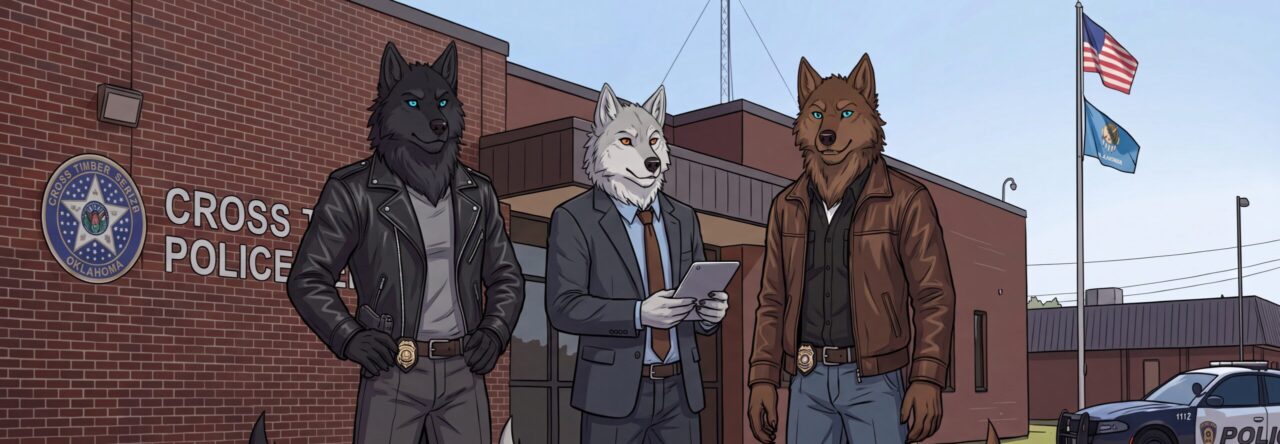
By nineteen hundred, Cross Timber had gone fully dark.
The last light had faded behind low western clouds, leaving the city washed in streetlamp glow, brake lights, and the cold blue rectangles of televisions behind living-room windows. The station had changed with the shift. Day-shift conversations were gone. The front lobby was quiet. Dispatch had settled into its overnight rhythm—fewer voices, sharper tones, every call carrying a little more weight because there were fewer units free to answer.
Night Shift had the board.
Thane stood in their office with one hand braced against the wall map while Mark pulled active locations onto the large monitor at his desk.
“Dana Keeler’s house first,” Mark said. “Then her aunt’s address.”
Gabriel leaned back in his chair with one ankle resting across the opposite knee.
“Romantic.”
“It is a protective-order welfare check.”
“I know what it is.”
“Then stop calling it romantic.”
Gabriel turned toward Thane.
“He gets bossy when he has maps.”
“He gets bossy when he has air,” Thane said.
Mark did not look up.
“I heard that.”
“Good.”
The protective order involving Dana Keeler had not produced a fresh call that evening. That was good. It was also the sort of good that could become dangerous if it made people careless.
Dana’s former boyfriend had not come to her door. Had not sent another message. Had not tried to reach her through a friend or a new number.
Not yet.
But the report carried two prior domestic calls. It carried escalating threats. It carried the particular shape of fear that made a person leave her own home because silence no longer felt safe.
Thane looked at the screen.
“Then industrial district?”
“Catalytic-converter corridor,” Mark said. “We know where the thefts happened. We need to know the area before we come back in a hurry.”
Gabriel stood and clipped his badge wallet into place beside his holster.
“An educational drive.”
“A baseline sweep.”
“Same thing, but less boring.”
Mark gave him a look.
“Facts are not boring.”
“Facts are sometimes very boring.”
Thane looked between them.
“Facts are useful.”
Mark’s mouth shifted almost imperceptibly.
Gabriel pointed at Thane.
“See? He is getting better at detective talk.”
“I have always had detective talk.”
“You once described a suspect as having ‘the smell of bad intentions.’”
“He did.”
“That is not the point.”
The three of them headed out.
The Humvee waited beneath the lot lights, too large and too square and too familiar to look anything but at home among the patrol cars. Thane took the driver’s seat. Gabriel settled into the passenger side. Mark climbed into the rear with his laptop bag, field notebook, and compact evidence kit at his feet.
The engine started with its familiar heavy growl.
Thane pulled out of the lot.
For several minutes, the city passed in quiet layers: late dinner traffic, a couple walking a dog under a porch light, a convenience-store window glaring white into the dark, a teenager on a bicycle cutting through a parking lot with earbuds in.
Gabriel watched the city through his window.
“Do you think anyone will ask you to jump a fence tonight?”
Thane kept his eyes on the road.
“No.”
Mark spoke from the back seat.
“Please do not encourage him.”
“I am not encouraging him. I am asking a question.”
“You ask dangerous questions.”
Gabriel looked at Thane.
“Would you jump a fence if someone asked?”
“No.”
Mark made a quiet sound that was not quite a laugh.
Gabriel turned.
“See? Even Mark does not believe you.”
“I would evaluate the fence,” Thane said.
“That is not a no.”
Thane’s ears angled back.
“You two are exhausting.”
“Night Shift is officially underway,” Gabriel said. “We need to establish a tone.”
“That tone is apparently harassment.”
“Affectionate harassment.”
“Still harassment.”
Mark looked out the side window.
“Dana’s street is next right.”
The joking stopped without anyone announcing it.
The neighborhood sat in a quiet pocket of Cross Timber where modest brick homes lined narrow streets beneath older oaks. Porch lights glowed over trimmed lawns. A pickup sat in one driveway. A minivan in another. Television light flickered blue against curtains.
Dana Keeler’s house stood halfway down the block.
The porch light was on.
A lamp burned in the front room.
Nothing moved near the curb.
No unfamiliar vehicle idled at the corner. No shadow waited between houses. No one stood beneath the streetlamp trying too hard not to look like they belonged there.
Thane slowed the Humvee to a crawl.
The scent of the neighborhood moved through the cracked windows in soft layers—wet grass, laundry soap, old leaves, dog fur, gasoline from a mower stored in a nearby shed.
Dana’s scent lingered around the front walk and driveway.
So did the older, steadier scent of the aunt who owned the house.
Nothing fresh suggested the ex had been close.
Nothing sharp.
Nothing wrong.
Thane drove past without stopping.
Gabriel watched the house disappear behind them.
“Quiet,” he said.
“Quiet is good,” Mark said.
“Quiet can be good,” Thane corrected.
Neither argued.
Dana’s family address was four minutes away in a cul-de-sac near a small church and a fenced playground. A different kind of quiet lived there.
More cars in driveways. More porch decorations. A bright kitchen window. A television on behind the front curtains. A child laughing somewhere inside.
Dana’s gray sedan was there this time, parked beside an older SUV.
The house smelled lived-in. Warm food. Laundry. Multiple adults. A child. No fresh unfamiliar scent near the driveway. No male scent lingering close to the porch that did not belong to the household. No vehicle waiting at the end of the street.
Mark logged the pass-by.
“Both locations clear from public roadway. No observed contact. No suspicious vehicles. No immediate action.”
Gabriel glanced over his shoulder.
“Do we call her?”
“Not unless we have a reason,” Thane said. “She knows patrol is aware. A quiet night is not a reason to make her relive it.”
Mark nodded.
“Agreed.”
Thane turned the Humvee toward the industrial district.
The city changed block by block.
Neighborhood streets widened into four-lane roads. Houses became self-storage facilities, tire shops, fleet yards, industrial warehouses, plumbing suppliers, truck-repair bays, and long stretches of chain-link fence.
The catalytic-converter thefts had occurred across a three-mile corridor over the previous week.
A small commercial fleet company.
A landscaping business.
A municipal utility yard.
Two independent mechanics.
The common thread was not the victims.
It was the access.
Vehicles parked outside.
Cameras with blind spots.
Night shifts ending before dawn.
Lanes wide enough for a thief to work unseen for a few minutes, then disappear before anyone realized what was gone.
Thane drove slowly.
Not suspiciously slowly.
Just slowly enough to look.
Mark had the map open beside him now, theft locations and time windows marked in different colors.
“First hit was here,” he said, pointing toward a tire shop with a bright security light over the front drive and darkness pooled along the rear fence. “Two fleet vans. Time window between 01:10 and 02:00.”
Gabriel looked out.
“Rear access?”
“Unpaved service lane behind the building. No fence on the south side.”
Thane took the next turn and drove the service lane.
The Humvee rolled through old gravel and shallow puddles. The lane ran behind the tire shop, then past a storage yard with stacked pallets, a metal supply warehouse, and a closed loading dock.
Thane’s senses filled in what the map could not.
Old oil.
Warm rubber from trucks that had been parked hours ago.
Diesel.
Cooling metal.
The stale scent of exhaust trapped beneath awnings.
A recent welding smell near one shop.
A stray cat somewhere beneath a dumpster.
Nothing that did not belong.
That was the point.
“Normal?” Gabriel asked.
“Mostly,” Thane said.
“Mostly is not normal.”
“No. Mostly means there is nothing I would write down yet.”
Mark added a note.
“South lane has no lighting past the pallet yard. Utility-access gate is secured, but lower hinge is rusted. Good camera coverage on front lot. Poor coverage from rear service lane.”
Gabriel looked at the hinge.
“You think they are using the same route?”
“I think we do not know yet,” Mark said.
Thane drove on.
They covered the entire corridor that way.
Not hunting.
Learning.
The dark places.
The open places.
The businesses with motion lights.
The businesses with cameras pointed too high.
The spots where a vehicle could wait without looking abandoned.
The places where fresh-cut metal, unfamiliar footwear, odd shadows, a running engine, or a light in the wrong window would stand out.
At the landscaping yard, Thane caught the lingering scent of hot metal from legitimate maintenance work earlier that day and committed it to memory.
At the utility lot, Mark counted camera housings and traced their coverage angles from the road.
At a warehouse with three box trucks backed against a loading dock, Gabriel heard a loose HVAC panel tapping in the wind and made a face.
“That noise could hide someone moving.”
Mark looked up.
“Good point.”
Gabriel looked pleased.
“See? I do detective work too.”
“You do,” Thane said.
Gabriel blinked at him.
“Was that praise?”
“Do not make it weird.”
By the time they cleared the industrial district, Thane could picture the roads with his eyes closed.
He knew where standing water collected.
He knew which lights flickered.
He knew where the rear fences narrowed.
He knew which scent belonged to the tire shop’s service lane and which belonged to the loading dock behind the supply warehouse.
Anything new would stand out.
Mark closed the map.
“Baseline complete.”
Gabriel looked at him.
“You make that sound like we just mapped the moon.”
“We mapped three miles of active theft corridor.”
“The moon would have been easier.”
Thane turned toward Westfield Pharmacy.
The burglary had happened two nights earlier.
The store had been closed. A rear door had been forced. The cash drawer had been emptied, and controlled medication had been taken from a secured cabinet.
Rusk’s handoff had included a few solid details.
Black Subaru.
Partial plate.
Possibly two offenders.
A receipt left at the counter.
No confirmed identity.
No confirmed weapons.
Nothing that justified an immediate stop by itself.
But enough to keep eyes open.
They had just passed the third turnoff toward the pharmacy when Mark leaned forward.
“Thane.”
Thane had already seen it.
A black Subaru sat at the curb across from a closed strip center.
Its headlights were off.
Two people were inside.
The car began moving as the Humvee came into view, easing away from the curb and rolling through the empty lot without turning into any storefront.
It passed the pharmacy.
Then doubled back.
Slowly.
Gabriel leaned toward the windshield.
“That feels wrong.”
Mark had his tablet up.
“Plate is partially obscured by dirt.”
Thane adjusted his speed, staying two vehicles behind.
The Subaru turned onto the access road behind the strip center.
It passed a closed pet-grooming business, a dry cleaner, and a small clinic with dark windows.
Then it turned around again.
Mark narrowed his eyes at the rear plate.
“Black Subaru. Partial plate is consistent with the Westfield Pharmacy burglary bulletin. Same three visible characters, same placement. Two occupants. Vehicle is circling commercial lots near the burglary location.”
Gabriel looked at Thane.
“They are looking for another hit.”
“Maybe.”
“Maybe is enough.”
Thane keyed the encrypted tactical channel.
“Night Shift to patrol. Possible match on the Westfield Pharmacy burglary vehicle. Black Subaru, two occupants, partial plate consistent with bulletin. Currently eastbound behind the Westfield strip center, moving slow and circling lots. We are following at distance.”
Dispatch answered immediately.
“Copy, Night Shift. Units are moving.”
Thane continued behind the Subaru.
Not close enough to crowd it.
Not so far that he lost it.
The city lights moved across the black paint in brief blue-white flashes. The Subaru rolled through one more parking lot, then turned onto a wider road leading north.
“Eastbound on Mayfair,” Thane said into the radio. “Passing the old theater lot. No evasive driving. No visible weapons.”
Gabriel watched the car.
“Driver keeps checking mirrors.”
“Passenger?” Thane asked.
“Head down. Maybe looking at a phone.”
Mark leaned forward between the seats.
“Unit Two-Fourteen is coming from the north. They will have visual in thirty seconds.”
Thane kept pace.
The marked patrol unit appeared ahead at the next intersection.
It turned smoothly behind the Subaru.
Its emergency lights came on.
For one second, Thane thought the driver might run.
The engine revved.
Then the Subaru moved to the shoulder.
“Traffic stop,” Mark said.
Thane pulled the Humvee in behind the patrol unit, leaving enough room for the officer’s rear approach and any additional backup.
“Quiet exit,” Thane said. “Stand by the vehicle until we know what we have.”
Gabriel nodded.
The three of them stepped out into the warm night.
The patrol officer—Officer Darnell—approached the Subaru on the driver’s side.
Traffic hissed past in the nearest lane, headlights sweeping across the scene. A second patrol unit had been called, but was still a few minutes out.
Thane stood near the rear quarter of the Humvee with Gabriel and Mark, quiet and still.
They could hear nearly everything.
The driver rolled down his window.
Officer Darnell spoke in the calm, practiced tone of someone beginning an ordinary traffic stop.
“Evening. I need your driver’s license, registration, and proof of insurance.”
The driver handed over a card.
Darnell looked at it.
Then looked at the driver.
Then at the card again.
The photograph did not match.
Not close.
The man in the photo had a narrow face and a shaved head.
The driver had a heavy beard and a jagged scar along one cheek.
Officer Darnell kept his voice even.
“Step out of the vehicle for me.”
The driver opened his door.
“Why?”
“We will talk about it outside.”
The driver stepped out.
The passenger door opened almost immediately.
A second man climbed out.
Large enough to make Officer Darnell adjust his stance.
“Passenger, stay in the vehicle,” Darnell said.
The passenger kept moving.
“I did not do anything.”
“Get back in the vehicle.”
The passenger did not.
He stood beside the Subaru with his hands low.
Too low.
His shirt had ridden up at the back when he stepped out.
Thane saw the grip of a handgun tucked at the small of his back.
Black polymer.
No holster.
No room for mistakes.
Thane moved.
Not fast enough to make noise.
Just fast enough that the passenger never had time to understand the distance closing behind him.
He came around the rear of the Subaru and reached in one motion.
One hand controlled the passenger’s shoulder.
The other stripped the handgun cleanly from the waistband before the man could turn.
Thane shoved him chest-first against the Subaru.
The metal door boomed under the impact.
The passenger gasped.
Thane held him there with his weight and one broad hand between the shoulder blades.
“Do not move,” he said.
The passenger froze.
Thane secured the handgun in his back pocket, out of the man’s reach.
“Gun on passenger,” he announced. “Passenger secure.”
Officer Darnell’s head snapped toward them.
The driver saw his chance.
His hand came out of his pocket with a folding knife already open.
He lunged toward Darnell.
Gabriel moved before the officer could.
The blade drove into the thick web of Gabriel’s palm as he closed his hand over it.
Blood surfaced bright against black fur.
Gabriel did not even blink.
The driver’s eyes went wide.
Gabriel looked at him with a small, almost amused smile.
“No.”
He locked his other hand around the knife handle, twisted the blade free from the driver’s grip, and stepped backward with it.
Officer Darnell recovered instantly.
“Hands behind your back!”
The driver hesitated.
Then saw Gabriel’s bleeding hand, Thane pinning his armed passenger against the Subaru, and Mark standing steady behind them with camera running and radio in hand.
His hands went up.
Darnell cuffed him.
Gabriel handed the knife over hilt-first.
“Careful,” he said. “It is sharp.”
Darnell looked at Gabriel’s palm.
“You okay?”
Gabriel glanced down.
The wound was already closing.
“Occupational hazard.”
Mark had not moved from his position near the Humvee.
He had documented the entire sequence from a safe angle, then keyed his radio.
“Second unit, expedite. Firearm recovered from passenger. Driver secured. One knife recovered. Officer is okay. Two suspects detained.”
Thane brought the passenger around from the Subaru, keeping him controlled but upright.
The man had gone pale.
Not from pain.
From fear.
Thane had not hurt him beyond what was necessary to stop him.
But the passenger had seen enough.
He did not fight.
“Hands behind your back,” Thane said.
The man obeyed.
Thane cuffed him, checked the restraints, then held him beside the rear bumper while they waited for backup.
Gabriel pressed his palm against his shirt. The blood had already slowed.
Officer Darnell looked from the hand to Gabriel’s face.
“That knife went through your hand.”
Gabriel looked at him.
“It was rude.”
Darnell blinked.
Then looked at Thane.
“You all always show up like this?”
Thane glanced at the Subaru.
“Not usually.”
Mark looked up from his notes.
“Statistically, we are having an unusual weekend.”
Gabriel turned toward him.
“That is the closest thing to a joke you have made all night.”
“I am adapting.”
The second patrol unit arrived with a third close behind it.
The scene expanded quickly.
Extra lights.
More uniforms.
The roadway secured.
The suspects separated.
The driver placed in one unit.
The passenger placed in another.
Thane handed the recovered handgun to a patrol sergeant, giving the location and condition exactly as he had found it.
“Passenger’s waistband, small of back. I removed it after visual confirmation. No discharge. Secured in my back pocket until transfer.”
The sergeant nodded.
“Good.”
Mark provided the camera and location notes.
“Black Subaru. Partial plate consistent with the Westfield burglary bulletin. Officer Darnell initiated the stop after the vehicle was observed circling commercial lots near the pharmacy. Driver presented identification not matching his appearance. Passenger exited against commands. Detective Thane observed a concealed firearm. Driver then produced a knife during detention.”
The sergeant looked at the Subaru.
“That vehicle is going nowhere tonight.”
“No,” Thane said. “It is not.”
The burglary link had become much stronger.
A black Subaru matching the partial plate.
Two men circling the area around the pharmacy.
A false ID.
A concealed gun.
A knife.
Then Mark looked through the rear passenger window.
His ears lifted.
“Thane.”
Thane moved beside him.
A pharmacy stock bottle was visible beneath the front passenger seat.
White plastic.
Orange label.
Westfield Pharmacy inventory sticker.
Another sat in the center console.
A third was shoved into the driver-side door pocket.
None of them were hidden well.
Not really.
The patrol sergeant followed their gaze.
“Probable cause is getting prettier by the second.”
“Photograph everything in place,” Thane said. “Then we process under vehicle-search authority.”
The sergeant nodded and started issuing assignments.
Once the scene was stable and the vehicle search was approved, Night Shift went to work.
Mark documented first.
Always first.
Wide photographs of the Subaru.
The plate.
The exterior.
The windows.
The visible medication bottles.
The positions of the seats.
The scattered wrappers and receipts.
The false identification card lying on the driver-side floor mat.
Gabriel stood beside him, gloves on now, his palm nearly healed.
“Twenty bucks says there is something dumb in the glove box,” he said.
Mark did not look up from the camera.
“Do not gamble at a crime scene.”
“Not gambling. Estimating.”
“Still no.”
Thane opened the rear hatch after Mark finished documenting it.
The Subaru smelled like old fast food, sweat, gun oil, stale cigarette smoke, and the sharp chemical bite of recently handled medication.
Then he caught something else beneath it.
Fresh-cut metal.
Hot exhaust residue.
Oil and road grit worked into the rear cargo carpet.
He looked toward Mark.
“Cargo area.”
Mark moved around with the camera first, documenting the rear hatch, the spare-tire compartment, and the nylon grocery bags before touching anything.
Beneath an old blanket in the cargo well, they found a compact floor jack, a battery-powered cutting tool, spare blades, heavy gloves, and three freshly removed catalytic converters wrapped in contractor bags.
Gabriel stared into the back of the Subaru.
“Well,” he said. “That answers one question.”
Mark photographed the recovered parts from every angle, then leaned close without touching.
One of the converter housings carried a faint etched inventory code.
His eyes narrowed.
“This may be one of the fleet vans from the tire shop.”
“May?” Gabriel asked.
“It needs confirmation. But the code format matches their equipment records.”
Thane looked into the cargo area.
“So these were not only pharmacy burglars.”
Mark glanced from the converters to the medication bottles waiting to be cataloged.
“Likely pharmacy burglars and catalytic-converter thieves.”
Gabriel leaned against the rear bumper.
“They really committed to being bad at crime in several categories.”
“Do not put that in the report,” Mark said.
“I was not going to.”
“You were absolutely going to.”
The first bottle came from the center console.
Then three more from the driver-side door pocket.
Two from a compartment beneath the rear passenger floor mat.
Four more inside a nylon grocery bag shoved beneath the spare-tire cover.
Cash appeared in the center-console compartment, folded in rubber-banded stacks.
More cash in the glove box.
When Mark finished counting, he looked up.
“Nine hundred and sixty-eight dollars in cash.”
Gabriel peered into the cargo area.
“And twenty suspected controlled-medication bottles.”
“Twenty bottles requiring pharmacy verification,” Mark corrected. “Several are marked as Westfield stock. Some may be patient-dispensing bottles.”
Thane looked at the evidence bags forming beside the vehicle.
“Make sure both suspects are advised of their charges. Separate transports. No custodial questioning about the burglary or the thefts until they have been Mirandized.”
The sergeant nodded.
“Understood.”
Officer Darnell stood near the front of his patrol unit, watching evidence bags begin to stack.
“You three were supposed to be doing a burglary follow-up?”
“We were,” Gabriel said.
Darnell looked at the cash, the medication, the gun case, the knife bag, and the contractor bags holding catalytic converters.
“Seems like you found both cases.”
Thane looked at the Subaru.
“We found what did not belong.”
Mark glanced at him.
Then wrote the phrase into his notes.
Gabriel noticed.
“Oh, that is going in the report?”
“No,” Mark said.
“It should.”
“No.”
“It is a good line.”
“It is not evidence.”
“That has never stopped Thane from saying something dramatic.”
Thane looked at Gabriel.
“I am holding a crime scene together.”
“You are standing near a car.”
“Same thing.”
Gabriel smiled.
The suspects were transported one at a time.
The evidence was tagged.
The Subaru was sealed and prepared for tow.
The pharmacy burglary detective on the case was notified, then given the clean version: vehicle match, observed behavior, false identification, firearm, knife, suspected stolen medication, cash, and all scene documentation preserved.
The property-crimes detective handling the converter theft series got the second call.
Three recovered converters.
Cutting equipment.
Floor jack.
A vehicle operating inside the theft corridor.
A likely fleet inventory mark.
By the time the final patrol unit cleared, the roadway had gone quiet again.
The traffic stop had become a tow truck, a few lingering tire marks, and the smell of warm asphalt beneath streetlights.
Thane stood beside the Humvee with Gabriel and Mark.
Gabriel flexed his healed hand.
“How many incidents was that tonight?”
Mark checked his notes.
“Dana Keeler’s protective-order welfare passes. Catalytic-theft corridor baseline. Pharmacy burglary vehicle. Armed stop. Two felony arrests. Suspected controlled-medication recovery. Possible clearance of three converter thefts.”
Gabriel looked at Thane.
“We have been on shift for, what, three hours?”
“About that.”
Gabriel leaned against the passenger door.
“I would like less convenient criminals.”
Mark looked at him.
“You just complained that they were not smarter.”
“I did not say I wanted them smarter. I said I wanted them less conveniently stupid.”
Thane opened the driver’s door.
“I want them to stop robbing pharmacies.”
“That too,” Gabriel said.
Mark climbed into the back seat.
“Dana’s locations remain quiet.”
Thane paused.
“How do you know?”
“Patrol units did two additional checks while we were on the Subaru. No contact. No suspicious vehicle. No violation.”
Thane nodded.
“Good.”
Gabriel settled into the passenger seat.
“See? A productive evening.”
Thane started the engine.
“A weird evening.”
“Normal for us.”
“That is not comforting.”
“It is not supposed to be comforting.”
The Humvee rolled back toward the station.
By the time they reached their office, the evidence notifications had already begun arriving.
The property log.
The vehicle tow confirmation.
The medication count pending pharmacy verification.
The firearm serial check.
The arrest reports.
The burglary detective’s request for supplemental narratives.
The converter-theft detective’s request for images of the etched inventory mark.
Mark claimed the main desk immediately.
Gabriel took the chair beside him and began dictating the sequence of the stop in clipped, clean language while Thane worked through the initial investigative narrative.
No one wrote anything they could not defend.
No one made the story sound cleaner than it had been.
The driver had lunged with a knife.
Gabriel had intervened.
Thane had recovered a concealed firearm from the passenger.
The evidence had been secured.
The suspects had been transported.
The vehicle had been searched lawfully and documented completely.
At 01:43, Gabriel leaned back in his chair and rubbed at his eyes.
“That was too easy.”
Mark did not look up.
“It was not easy.”
“It was easier than it could have been.”
“That is different.”
Thane finished typing a sentence and glanced at both of them.
“I hope the next one is smarter.”
Gabriel looked at him.
“Do not say that out loud.”
“I mean it.”
“No. You do not. You want criminals who are less careless, not smarter.”
Thane considered that.
“Fine. Less careless.”
Mark looked up from the evidence log.
“That is still not a good wish.”
Gabriel grinned.
“You know what he means.”
Thane leaned back in his chair.
“I mean I want a case that makes us work.”
Mark’s expression shifted.
Not disagreement.
Understanding.
“You will get one,” he said.
Outside the windows, Cross Timber held its night.
Patrol cars moved through dark streets.
Porch lights burned.
People slept behind locked doors.
Somewhere, someone made a bad decision.
Somewhere else, someone needed help.
Night Shift had learned the city’s shadows.
Now it had started learning what stood out inside them.
And the shift was not over yet.