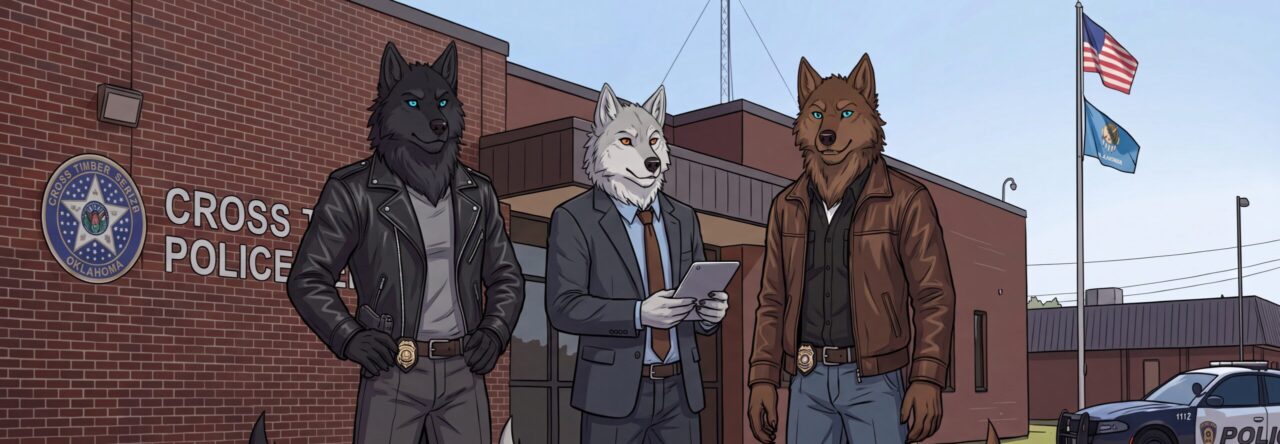
The hearing was set for Friday afternoon.
That was the first sign that everyone understood the case had become something larger than a burglary prosecution.
Normal plea hearings did not require extra deputies, hospital security consultation, probation supervisors, district attorney leadership, city legal, county counsel, a medical-risk memo, a sealed supervision plan, a restitution trust agreement, and three werewolf detectives sitting in the second row like a quiet promise that the room could remain a room.
Silas Creed entered the courtroom through the side door at 13:54.
He was human.
Dressed in a dark gray suit Nora Wexler had arranged, because she had taken one look at the medical custody tear-away clothing and said no client of hers would stand for sentencing dressed like an institutional apology.
He wore no collar.
No chain.
No theatrical restraint.
A GPS ankle monitor sat beneath his left pant leg, visible only when he moved. Two deputies stood near him. Crowe stood by the side aisle. Thane, Gabriel, and Mark sat behind the prosecution table, not in uniform, not as witnesses for the moment, and not as rescuers.
Just present.
Silas saw them immediately.
His eyes found Thane first.
Then Gabriel.
Then Mark.
For one second, his face changed.
Not a smile.
Not relief exactly.
Something smaller.
Something he quickly put away.
He sat beside Nora at the defense table and placed both hands flat on the surface.
Model prisoner, Thane thought.
No tests.
No threats.
No clever comments about doors.
Silas had kept that promise through ten days of secure medical custody, four attorney visits, two medical evaluations, one controlled transformation assessment, one probation-risk interview, and an uncomfortable number of people asking him what he could break if he wanted to.
He had answered.
Honestly, according to Mark’s review of the reports.
That mattered.
It did not erase anything.
It mattered anyway.
Gabriel leaned slightly toward Thane.
“He looks terrified.”
Thane kept his eyes forward.
“Yes.”
Mark said quietly, “He is entering a room where every possible future is controlled by other people.”
Gabriel glanced at him.
“That was bleak.”
“It is also accurate.”
Thane looked at Silas again.
Silas sat very still.
Too still.
Like movement itself might be mistaken for threat.
The courtroom filled in layers.
District Attorney Kincaid sat at the prosecution table with Assistant District Attorney Tran beside her. Kincaid had agreed to recommend the plea, but she had not become gentle about it. She had made that clear in every meeting Eli had described.
The victims sat on the left side of the gallery.
Arthur and Elise Redding.
Daniel and Priya Harlan.
Magnus and Caroline Albrecht.
They did not sit together.
They did not look at Silas the same way.
Arthur looked like he wanted prison.
Elise looked tired.
Priya held a folded tissue in one hand.
Daniel’s jaw stayed tight.
Magnus Albrecht looked offended by the entire justice system.
Caroline watched Silas with a quietness Thane could not read.
Eli sat behind the defense table but one row back, because he represented the support structure, not Silas. He wore a dark suit, calm expression, and the faint air of a man who had already told everyone in the building no at least twice.
Voss and Rusk stood near the back wall.
Chief Whitaker sat beside Mercer.
Darnell, Patel, and Grant had come in plain clothes on their own time and stayed near the aisle.
No media were in the courtroom.
The judge had ordered that.
The case was public.
The spectacle was not.
At 14:02, the bailiff called the room to order.
Judge Marianne Bellamy entered.
Everyone stood.
Silas stood too, hands visible, shoulders tight.
Judge Bellamy was in her sixties, with short white hair, dark-framed glasses, and the kind of face that suggested she had heard every excuse in the county and filed most of them under weather.
She took the bench, looked over the courtroom, and let the silence settle.
Then she said, “Be seated.”
The room obeyed.
Judge Bellamy opened the file in front of her.
“We are here in State of Oklahoma versus Silas Creed. This matter is set for plea and sentencing recommendation under a negotiated agreement submitted by the state, defense counsel, probation, medical custody representatives, and the court-approved restitution administrator.”
Her eyes lifted.
“I have reviewed the agreement. I have reviewed the risk assessment. I have reviewed the medical containment report. I have reviewed the victim impact statements submitted in writing. I have reviewed the proposed restitution structure and the funding disclosures.”
She looked over her glasses.
“I have also reviewed photographs of my interview hallway looking as though a tornado learned burglary.”
A small sound moved through the room.
Not laughter exactly.
Pressure releasing.
Silas looked down.
Judge Bellamy’s expression did not soften.
“This is an unusual case. That does not make it unserious. Mr. Creed is not here because of what he is. He is here because of what he did.”
The room went still again.
Good, Thane thought.
Good.
Judge Bellamy turned to Kincaid.
“State.”
Kincaid stood.
“Your Honor, the state has reached a negotiated plea agreement with the defendant. Under that agreement, Mr. Creed will plead guilty to multiple counts, including first-degree burglary, grand larceny, unlawful computer access, attempted burglary, destruction of property, and escape-related charges arising from his conduct at Cross Timber Police Department.”
Silas did not move.
Kincaid continued.
“The state will recommend a fifteen-year deferred sentence under strict supervision, with the full prison term available upon violation. The recommendation is conditioned on full allocution, return of all recoverable property, full restitution, no contact with victims, GPS monitoring, home and work confinement, court-approved housing, court-approved employment, mandatory therapy, transformation-control compliance, regular judicial review, and restrictions on all security, alarm, estate, art-handling, locksmithing, private acquisition, and related consulting work.”
She paused.
“This recommendation is not made because Mr. Creed’s conduct was minor. It was not. It is not made because the victims were unharmed. They were harmed. Their homes were violated. Their privacy was exploited. Their sense of safety was damaged.”
Arthur Redding’s face tightened.
Kincaid did not look away from the judge.
“This recommendation is made because the state believes this structure provides the best available path to public safety, victim restitution, accountability, and lawful containment of a defendant whose physiology creates extraordinary detention problems not contemplated by ordinary correctional facilities.”
Judge Bellamy nodded slightly.
“Defense.”
Nora stood.
“Your Honor, Mr. Creed is prepared to plead guilty and accept the conditions outlined. He understands this is not leniency without consequence. He understands that any violation may result in prison. He understands that the court is giving him a door, not erasing the lock.”
Thane looked down for a second.
A door.
Nora continued.
“He is prepared to speak to the court and to the victims.”
Judge Bellamy looked at Silas.
“Mr. Creed, stand.”
Silas stood.
His hands remained at his sides.
Judge Bellamy watched him carefully.
“Do you understand the agreement presented to this court?”
“Yes, Your Honor.”
“Do you understand that I do not have to accept it?”
“Yes.”
“Do you understand that if I do accept it and you violate the conditions, you may be sentenced to prison for the full term available under the law?”
“Yes.”
“Do you understand that your ability to transform does not place you outside the law?”
Silas’s eyes flicked once toward Thane.
Then back to the judge.
“Yes, Your Honor.”
“Do you understand that your history may explain parts of your life, but it does not excuse these crimes?”
Silas swallowed.
“Yes, Your Honor.”
Judge Bellamy sat back.
“Then tell me what you did.”
Silas looked down at the table.
For a moment, Thane thought he might fail.
Not because he would refuse responsibility.
Because saying it aloud in front of the people he had harmed required a kind of strength he had never practiced.
Nora did not touch him.
She did not rescue him.
Good attorney, Thane thought.
Silas lifted his head.
“I used my work as a security consultant to learn private information about homes, safes, alarm systems, hidden rooms, and valuables.”
His voice was rough but clear.
“I used access credentials and knowledge from that work to disable or bypass security systems. I targeted the Redding home, the Harlan home, and the Albrecht home because I believed the owners were away and because I knew or suspected where they kept valuable property.”
Arthur stared at him.
Silas forced himself not to look away.
“I tore doors open. I broke safes. I entered private rooms. I stole art, jewelry, cash, watches, coins, and other property. I took items that had financial value and items that had personal value.”
Priya’s hand tightened around the tissue.
Silas saw it.
His voice changed.
“I made people afraid in their own homes. I used information they trusted professionals with against them. I told myself they had enough that it did not matter.”
He paused.
“That was a lie.”
The courtroom held its breath.
Silas continued.
“When I was arrested, I broke restraints, changed form, damaged the interview room, and tried to escape. I endangered officers and staff. I did that because I thought being stronger meant I could leave.”
His eyes found Thane again.
Then returned to the judge.
“I was wrong.”
Judge Bellamy let the silence sit.
Then she said, “Victim statements.”
Arthur Redding stood first.
He had written his statement.
He did not read much of it.
He looked at Silas and said, “You made my home feel like a display case you could open. I still check doors three times a night. My wife will not go into the gallery alone. I do not care what happened to you when you were young. You chose us because you thought we were soft targets with expensive things.”
Silas said nothing.
Arthur looked at the judge.
“I do not support this agreement. I think he should go to prison.”
He sat.
The words landed hard because they were fair.
Elise stood next.
She did read.
Her voice shook only once.
She spoke about walking into her house and knowing something was wrong before seeing the damage. About how the missing art mattered less than the hidden room being exposed. About feeling foolish for trusting locks.
Then she looked at Silas.
“I do not forgive you. But I do not know what prison means for someone like you. I do not know whether it makes anyone safer or just angrier. I want the court to make him answer. I also want him watched carefully if you let him out.”
Silas bowed his head.
Priya Harlan spoke about the bronze bird.
“My father touched that piece every time he visited,” she said. “He said it looked like something about to fly but deciding to stay. You took it because you knew it mattered. Or maybe because you did not care that it mattered.”
Silas’s eyes closed briefly.
Priya looked at Judge Bellamy.
“I support restitution. I support getting our property back. I support him having consequences. I do not know if I support this plea. But I heard he has to say what he did. I heard he has to live under rules. I heard he has to work. Maybe that is better than putting another angry person in a hole.”
Daniel Harlan did not speak.
Magnus Albrecht did.
He opposed the agreement in polished, furious language and used the phrase “outrageous public-safety experiment” twice.
Caroline Albrecht spoke last.
She said only, “If the court does this, do not do it because of the wolves in the room. Do it because it is the right sentence. If it is not the right sentence, do not let them make it feel right.”
Judge Bellamy nodded.
“Thank you.”
Thane felt that sentence settle in his chest.
Do not let them make it feel right.
That mattered too.
Judge Bellamy turned a page.
“Detective Thane.”
Thane stood.
The courtroom shifted slightly.
Not fear.
Attention.
Silas looked at him.
The victims looked at him.
So did the judge.
Judge Bellamy studied him for several seconds.
“Detective, I am aware you are not appearing as an investigator today. You are appearing because the proposed supervision plan names you, Detective Gabriel, and Detective Mark as approved support contacts and transformation-control mentors under probation oversight.”
“Yes, Your Honor.”
“I am also aware, on a less formal note, that my granddaughter believes the Kaden Face is among the highest achievements of modern law enforcement.”
A ripple of laughter moved through the room before anyone could stop it.
Gabriel covered his mouth.
Mark looked at the floor.
Thane’s ears went hot.
Judge Bellamy lifted one hand.
“That is not why you are speaking today.”
“No, Your Honor.”
“But it is why I know that public admiration can make otherwise intelligent adults forget that you are not magic.”
Thane nodded.
“Yes, Your Honor.”
“So I am asking you plainly. Why are you doing this?”
The room became still again.
Thane looked at Silas first.
Then the victims.
Then the judge.
“Because I helped put him in that room.”
Silas’s expression changed.
Thane continued.
“I know what he did. I worked the case. I saw the doors. The safes. The hidden rooms. I saw how carefully he chose targets. I know he hurt people.”
He looked toward Arthur and Elise.
“Not only financially. He made homes feel unsafe. He used trust like a tool. That matters.”
Arthur’s face stayed hard.
Thane accepted it.
“I also know what he is. Not completely. He shifts. We do not. His life is different from ours. But he is close enough that when I saw him chained by the neck in a concrete room, I understood something that is difficult to write in a report.”
Judge Bellamy waited.
Thane’s voice lowered.
“No wolf belongs in a cage.”
Silas looked down.
Gabriel’s eyes shone.
Mark stayed still.
Thane continued.
“That does not mean no wolf belongs under law. It does not mean no punishment. It does not mean victims matter less. It means the answer should not become cruelty because the system is scared of what he can break.”
The judge’s expression did not move.
Thane went on.
“He made bad choices. Criminal choices. I am not asking you to pretend otherwise. I am asking for a sentence that can hold him without destroying whatever part of him might still learn to be safe.”
He looked at Silas.
“He thought strength meant permission. He was wrong. He has to learn that strength means responsibility. Restraint. Work. Rules. Being told no and obeying it.”
Silas swallowed.
Thane looked back to the judge.
“If he violates, he should face the consequences. If he hurts someone, he should face them. If he lies, runs, shifts outside his conditions, contacts victims, touches security work, or tests the boundaries, then the door closes.”
He paused.
“But if he follows the rules, works, pays restitution, attends therapy, learns control, and lives where probation can see him, then maybe he becomes safer than a chain could ever make him.”
Judge Bellamy leaned back slightly.
“And your money?”
Thane’s ears tipped back.
“My money should not touch the scale.”
“Explain.”
“It should not buy forgiveness. It should not buy support. It should not make the victims feel like their fear has a price tag. If the court accepts my money for restitution and supervision costs, it should be because those costs exist and can be paid cleanly. Not because anyone owes me anything.”
Judge Bellamy watched him.
“What do you get out of this?”
Thane answered honestly.
“I get to not walk away from a cage I helped fill.”
Silence.
Then Judge Bellamy looked at Gabriel.
“Detective Gabriel, do you agree with him?”
Gabriel stood.
“Yes, Your Honor.”
“Why?”
Gabriel looked at Silas.
Then the victims.
“Because compassion without accountability is just another way to ignore harm. But accountability without a way forward can turn into storage. I do not want him stored. I want him watched, restricted, forced to face what he did, and given a chance to make a different choice every day.”
Judge Bellamy nodded.
“Detective Mark.”
Mark stood.
“I agree with the proposed structure because it is more measurable than indefinite improvisation.”
A faint smile touched the judge’s mouth.
“Go on.”
“Prison infrastructure is not currently designed for his transformation risk. Secure medical custody is not a long-term correctional environment. The proposed conditions create known boundaries: location monitoring, employment restrictions, prohibited industries, therapy, control training, regular review, no-contact orders, financial restitution, search conditions, and revocation exposure.”
Mark glanced at Silas.
“It is not trust. It is a framework in which trust can be earned or lost with documented behavior.”
Judge Bellamy nodded slowly.
“Thank you.”
They sat.
Silas looked at the table.
Something had shifted in him.
Not absolution.
Not relief.
Recognition.
He had watched the court listen to three wolves with respect, skepticism, humor, and seriousness all at once.
He had watched them be admired without being excused from questions.
He had watched Thane speak for him and against him in the same breath.
That was a different way to be seen.
Judge Bellamy took off her glasses.
“I have spent the better part of my career telling defendants that their past does not decide their future. I have also told many victims that accountability is not the same as revenge.”
She looked at Silas.
“Mr. Creed, you are dangerous. Not because you are a werewolf. Because you are intelligent, practiced, angry, and have used strength and access to harm others.”
Silas stood straighter.
“This agreement is not mercy without teeth. It is a leash you have agreed to hold yourself. If you drop it, this court will not hesitate.”
“Yes, Your Honor.”
Judge Bellamy turned to the victims.
“To the victims: this court has heard you. I understand not all of you support this resolution. Your opposition is part of the record. Your restitution rights remain intact. Your safety matters. Your fear matters. This court is not assigning a lesser value to your homes because the defendant presents an unusual detention problem.”
Arthur looked down.
Priya wiped at her eyes.
Judge Bellamy replaced her glasses.
“After review, I will accept the plea agreement.”
The room exhaled.
Not all in relief.
Some in anger.
Some in disbelief.
Some in something too complicated to name.
Silas closed his eyes.
Judge Bellamy continued.
“Mr. Creed, I accept your guilty plea. Sentencing is deferred for fifteen years under the terms filed and modified on the record today. You will comply with GPS monitoring, home and work confinement, court-approved housing, court-approved employment, therapy, medical review, transformation-control conditions, and all restrictions stated in the agreement. You will have no contact with victims. You will return all property and identify any unrecovered property immediately through counsel. You will not work in security, alarms, safes, locksmithing, estate access, art handling, private acquisitions, or any similar field. You will not shift except under approved conditions or genuine emergency, and any involuntary shift must be reported immediately.”
Silas nodded.
“Yes, Your Honor.”
“If you violate, I can sentence you to prison. Do you understand?”
“Yes.”
“If you test this court, you will lose.”
“Yes.”
“If you test Detective Thane, I suspect you will also lose.”
The courtroom went very quiet.
Then, unexpectedly, Rusk made a sound near the back wall and covered it with a cough.
Gabriel looked down.
Thane did not move.
Judge Bellamy’s eyes flicked toward Thane.
“That was an observation, not a condition.”
“Yes, Your Honor,” Silas said.
For the first time, his mouth twitched.
Judge Bellamy closed the file.
“Then choose better, Mr. Creed. Every day. Court will review compliance in thirty days.”
The gavel came down.
The release process took six hours.
Because freedom, when constructed by lawyers, probation officers, medical staff, deputies, court clerks, and one extremely suspicious county supervisor, moved at the speed of signatures.
Silas was not released from the courthouse directly.
He was transported back to secure medical for processing, final medical clearance, removal from custody status, installation confirmation for the GPS monitor, probation intake, and review of the housing plan.
Thane, Gabriel, and Mark waited in a conference room with Eli, Nora, and Probation Supervisor Hale.
Not Sergeant Hale from CLEET.
A different Hale.
This one was shorter, human, female, and possessed the same dry stare as every effective supervision officer Thane had ever met.
She explained Silas’s conditions like she was reading weather warnings.
“Residence except approved work, therapy, medical, legal, probation, court, or pre-approved mentor contact. No alcohol. No weapons. No access devices. No unauthorized internet-capable work without monitoring. No security consulting. No client homes. No private locked spaces except his own residence. No travel outside county without approval. No contact with victims. No shifting except approved sessions or emergency. GPS tamper equals violation. Missed check-in equals violation. Unapproved absence equals violation. Aggressive conduct equals violation. Threats equal violation.”
Gabriel whispered, “She is thorough.”
Mark whispered back, “Good.”
Eli looked at both of them.
They stopped.
Supervisor Hale turned to Thane.
“You are listed as support contact. That does not make you probation.”
“I understand.”
“You do not authorize anything.”
“I understand.”
“You do not hide anything.”
“I will not.”
“You do not decide a violation is no big deal because you empathize.”
Thane met her eyes.
“I will report violations.”
She studied him.
Then nodded once.
“Good.”
Gabriel lifted one hand.
“Are we also support contacts?”
“Yes,” Hale said. “That means if he calls you at two in the morning because he wants to shift and run through a wall, you call probation.”
Gabriel nodded.
“And possibly Thane.”
“After probation.”
Gabriel looked at Thane.
Thane said, “After probation.”
Mark asked, “What employment categories are initially acceptable?”
Hale looked at him.
“Warehouse, supervised physical labor, municipal contractor work if no restricted access, approved restoration shop, maybe disaster cleanup if travel rules are handled. Nothing involving security systems, keys, alarms, safes, estate access, valuables, or vulnerable clients.”
Mark nodded.
“That is reasonable.”
Nora looked at Thane.
“The apartment is approved.”
Thane’s ears shifted.
Eli immediately said, “Through the court-approved housing support structure.”
“I know.”
“Say it.”
“Through the court-approved housing support structure.”
Gabriel leaned toward Mark.
“He is being trained.”
Mark said, “It is overdue.”
Eli continued.
“It is not a gift Silas can sell. It is not in your name personally. It is a one-year lease with review, paid through the support trust, disclosed to the court, conditioned on compliance, and administered independently.”
Thane nodded.
“Good.”
Nora’s expression softened slightly.
“It is a nice apartment.”
Thane looked at her.
“Good.”
“Not extravagant.”
“Good.”
“Stable.”
Thane nodded again.
“Good.”
Gabriel looked at him.
“That is three goods.”
“I heard.”
“You are having feelings.”
“Yes.”
Mark said, “Understandable.”
Eli looked at all three of them.
“When he walks out, do not overwhelm him.”
Gabriel put one paw over his chest.
“I am famously subtle.”
Eli stared.
Gabriel lowered his paw.
“I will become subtle.”
At 19:41, Silas Creed walked out of secure medical without the collar.
That was the moment Thane had been waiting for and dreading at the same time.
The door opened.
Not for a visit.
Not for medical staff.
Not for deputies to check restraints.
For release.
Silas stepped through wearing the same gray suit from court, though the jacket was now folded over one arm. The ankle monitor was secured. A folder of probation documents rested in Nora’s hand. Supervisor Hale stood on one side. Laird stood on the other, arms folded.
Silas stopped in the corridor when he saw Thane, Gabriel, and Mark.
For a second, his hand moved unconsciously toward his throat.
Where the collar had been.
Nothing was there.
His fingers touched skin.
His eyes closed briefly.
Thane felt something inside his own chest ease and hurt at the same time.
Laird noticed too.
Her face did not soften much.
But it softened enough.
“You come back here because you did something stupid,” she said, “and I will be extremely disappointed.”
Silas opened his eyes.
“Yes, ma’am.”
“I mean that in the professional sense.”
“I understand.”
“And the personal one.”
Silas looked at her.
Laird pointed at him.
“Do not make me build a bigger chain.”
Silas swallowed.
“I will try not to.”
“No,” Thane said.
Silas looked at him.
Thane stepped closer.
“You will not.”
Silas went still.
Then nodded.
“I will not.”
Nora handed him the folder.
“You ride with Probation to the apartment. Detectives will meet you there. That is the approved sequence.”
Silas looked at Thane.
Thane nodded.
“We will see you there.”
Silas seemed like he wanted to say something.
He did not.
Good, Thane thought.
One step at a time.
The apartment was on the ground floor of a quiet complex near the north edge of town.
Not luxury.
Not cheap.
Clean brick buildings. Good lighting. Working cameras in public areas. A small patch of grass behind the unit. A grocery store within walking distance. A bus stop near the entrance. Probation-approved routes. No wealthy estates nearby. No private security clients. No hidden vaults.
The unit had one bedroom, a small living room, a kitchen, a bathroom, and a back patio with a privacy fence just high enough to make it feel like a boundary without feeling like a cage.
The furniture was simple and sturdy.
Sofa.
Table.
Chairs.
Bed.
Dresser.
Cookware.
Towels.
Food in the pantry.
Coffee.
Not because Thane had asked.
Because Gabriel had.
Mark had added labels to the breaker panel, Wi-Fi instructions, emergency numbers, probation contacts, trash schedule, and a printed copy of Silas’s approved movement conditions in a folder on the counter.
Gabriel saw the folder and sighed.
“You labeled freedom.”
Mark said, “Freedom with conditions benefits from clarity.”
Silas stood in the doorway, holding the probation folder against his side, staring into the apartment like he did not trust it to remain real if he stepped fully inside.
Supervisor Hale stood behind him.
“This is your approved residence. GPS boundary is set. You may move within the unit, patio, and assigned parking space. Work search appointments require approval. Therapy starts Tuesday. Probation check-in Monday at 09:00. Any questions?”
Silas looked at the living room.
“No.”
Hale’s eyes narrowed.
“That was too quick.”
Silas looked at her.
“I have questions. I do not know how to ask them yet.”
That answer seemed to satisfy her more.
“Start with reading the folder.”
“Yes, ma’am.”
Hale looked at Thane.
“You have thirty minutes.”
Thane nodded.
“Understood.”
She left with Nora after a final look that promised consequences in several legal dialects.
Eli remained near the door long enough to look at Thane.
“No speeches that create obligations.”
Thane sighed.
“I know.”
“No promises beyond approved support.”
“I know.”
“No saying pack in a way that makes me appear by summoning circle.”
Gabriel’s ears lifted.
“Can you do that?”
Eli looked at him.
“I already do.”
Gabriel nodded slowly.
“That explains things.”
Eli left.
The door closed.
For the first time, Silas stood in a room that was his and not locked from the outside.
He did not move.
Gabriel’s voice was gentle.
“You can come in.”
Silas looked down.
“I know.”
Mark said, “Do you?”
Silas gave a small, uneven breath.
“Not yet.”
Thane stepped into the living room first.
Gabriel followed.
Mark went to the counter and set down the small grocery bag he had insisted on bringing despite the pantry already being stocked.
Silas finally crossed the threshold.
No chain followed him.
He noticed.
Everyone noticed.
He set the folder on the table with care, as though careless movement might void the room.
“This is mine?”
“For now,” Thane said. “As long as you comply.”
Silas looked at him.
“Not a gift.”
“No.”
“Not a reward.”
“No.”
“Not pack.”
Thane held his gaze.
“Not pack.”
Silas nodded.
The words hurt him.
They also steadied him.
“Good.”
Gabriel sat on the arm of the sofa.
“You keep saying that when people tell you no.”
Silas looked at him.
“I trust no when it is honest.”
Gabriel’s face changed.
He did not make a joke.
Mark opened the folder on the counter.
“Your conditions are here. Probation contacts here. Emergency medical instructions here. If you feel an involuntary shift coming, this number first, then this number, then us if approved by probation.”
Silas looked at the papers.
“You made instructions.”
“Yes.”
“Of course you did.”
“It seemed useful.”
Silas looked at him.
“It is.”
Mark nodded once.
Thane walked to the kitchen counter.
“There is food. Coffee. Basic things. If something is missing, tell probation or Nora. Do not decide a store shelf is easier.”
Silas’s mouth twitched.
“That was almost a joke.”
“It was not.”
Gabriel smiled.
“It was a little.”
Thane looked at him.
Gabriel lifted both paws.
“Supportive observation.”
Silas walked slowly through the apartment.
Bedroom.
Bathroom.
Kitchen.
Back patio.
He opened the patio door and stepped outside.
The privacy fence enclosed a small concrete slab, a strip of grass, and a view of the complex’s rear lawn.
The sky had turned violet over the trees.
Silas stood in the doorway with one hand on the frame.
Not pushing.
Not testing.
Just touching.
Thane stayed inside.
Gabriel and Mark stayed behind him.
Silas spoke without turning.
“I thought I would die in that room.”
No one answered quickly.
Then Thane said, “So did I.”
Silas turned.
His eyes were wet again.
He did not hide it this time.
“Why?”
Thane knew what he meant.
Why the money.
Why the court.
Why the apartment.
Why the fight.
Why the door.
“No wolf belongs in a cage.”
Silas looked down.
Thane continued.
“That does not mean you are free of what you did. It means you are free enough to choose what you do next.”
Silas pressed his lips together.
“I do not know how to be this.”
Gabriel stood.
“Neither did we.”
Silas looked at him skeptically.
Gabriel shrugged.
“Different circumstances. But we had to learn what our strength meant too.”
Mark added, “And what it did not mean.”
Thane walked closer.
“I will help you find work.”
Silas blinked.
“Work.”
“Legal work. Approved work. Something that uses strength without using access. Warehouse. restoration. disaster cleanup. Whatever probation approves.”
Silas stared.
“You are serious.”
“Yes.”
Gabriel said, “You are not allowed anywhere near rich people’s safes for a while.”
Silas gave a broken little laugh.
“No.”
Mark said, “Possibly ever.”
Silas nodded.
“Fair.”
Thane looked toward the small living room.
“You can call us if you need help. Advice. Control. Company. If your conditions allow it, and if probation approves, you can come to the cabin sometimes.”
Silas went still.
Not dramatically.
Completely.
Gabriel watched him carefully.
Mark did too.
Thane continued before Silas could misunderstand.
“You call first. You do not come to hide. You do not come if you have violated. You do not come instead of calling probation when probation is required. You come because being alone with your head can be dangerous and because sometimes a wolf needs to sit in a room with other wolves and remember he has choices.”
Silas’s face folded.
Not much.
Enough that the man who had once ripped vault doors open looked like he might fall under the weight of a chair offered kindly.
“I do not know how to repay this.”
“You don’t,” Thane said.
Silas shook his head.
“I have to.”
“No.”
“I do.”
Thane stepped closer.
“No debt.”
Silas looked at him through tears.
Thane’s voice was firm now.
“No favors. No special loyalty. No pretending we were right if we are wrong. No silence if you are in trouble. No gratitude that turns into a leash.”
Silas swallowed.
“What, then?”
“Compliance,” Mark said.
Silas looked at him.
Mark’s voice was steady.
“Truth. Work. Restitution. Therapy. Court appearances. No testing locks. No using people’s trust against them.”
Gabriel said, “And eat actual meals.”
Silas laughed and wiped his face with one hand.
“I thought the gray one was the strict one.”
“I am,” Mark said.
Gabriel pointed at himself.
“I contain nutritional concern.”
Thane looked at Silas.
“You promised not to let us down.”
Silas’s expression tightened.
“I do.”
“That is too much pressure,” Thane said.
Silas blinked.
Thane continued.
“Promise to follow the rules today. Then tomorrow, promise again.”
Silas stared at him.
Then nodded slowly.
“Today,” he said.
“Good.”
“And tomorrow.”
“When tomorrow comes.”
Silas looked around the apartment again.
Sofa.
Table.
Kitchen.
Folder.
Food.
Door.
A door that opened.
A door that locked from the inside.
A door he did not have to rip apart.
“I promise today,” Silas said.
Thane nodded.
“That is enough.”
They left at 20:16.
Silas stood inside the apartment doorway as they walked out.
He did not follow them.
He did not test the boundary.
He did not make a joke about locks.
He simply stood there with one hand on the doorframe, watching three wolves walk away from the first room that had ever been given to him with rules instead of chains.
At the Humvee, Gabriel stopped and looked back.
Silas was still there.
Gabriel lifted one paw.
Silas hesitated.
Then lifted his hand.
Mark got into the backseat.
Gabriel climbed into the passenger seat.
Thane stood beside the driver’s door for one more second.
Across the lot, Silas slowly closed his apartment door.
From the outside, it looked like any other door.
Plain.
Painted.
Numbered.
Ordinary.
But Thane knew better.
Some doors were built of steel and fear.
Some were built of law and conditions.
Some were built by lawyers, judges, victims, probation officers, medical staff, and people willing to be told no until the yes was clean enough to hold.
This one had a lock.
It also had a way out.
Thane climbed into the Humvee.
Gabriel looked at him.
“You okay?”
Thane started the engine.
“Yes.”
Mark leaned forward from the back.
“That sounded true.”
“It is.”
Gabriel looked toward the apartment.
“You think he can do it?”
Thane watched the closed door.
“I think he can do today.”
Mark nodded.
“Today is measurable.”
Gabriel smiled faintly.
“Of course you like that.”
Thane put the Humvee in gear.
They pulled out of the complex and turned toward home.
Behind them, Silas Creed stood in a quiet apartment with food in the pantry, rules on the counter, a monitor on his ankle, a suspended sentence over his head, victims he could not contact, debts he could only repay through obedience and restitution, and a future narrow enough to frighten him.
But it was not a cage.
Not anymore.
And for tonight, that was enough.