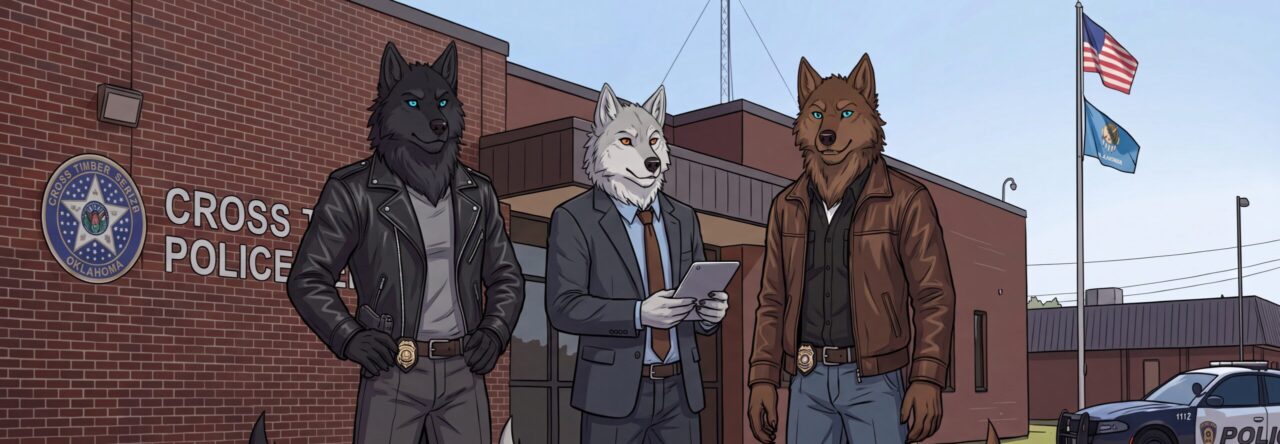
The rest of the shift did not ask much of them.
That was not the same thing as being quiet.
Night Shift still took a noise complaint that turned out to be two roommates arguing over a broken air conditioner. They reviewed a minor hit-and-run report from patrol, helped Dispatch narrow the location of a stranded motorist whose phone battery was nearly dead, and spent twenty minutes confirming that a warehouse alarm had been caused by a loose loading-bay door in the wind.
Nothing bled.
Nothing ran.
Nothing caught fire.
By four in the morning, Gabriel had declared the night “suspiciously cooperative.”
By four-thirty, Mark had corrected the phrasing.
“A cooperative night is not suspicious.”
“It is if we are working it,” Gabriel said.
Thane looked up from his report.
“Do not say that like the city hates us.”
“The city loves us,” Gabriel said. “The city also keeps handing us people with knives.”
Mark did not look away from his laptop.
“One person with a knife.”
“Tonight.”
“One person tonight.”
“That is still too many.”
Thane went back to typing.
On the whiteboard behind them, two active case cards had changed.
WESTFIELD PHARMACY BURGLARY now carried the black Subaru’s plate number, two suspects’ names, a note for the recovered medication, and an evidence-request line that stretched halfway across the board.
Beside it, INDUSTRIAL CORRIDOR CONVERTER THEFTS had new markings: the three recovered converters, the likely vehicle, the tools, and a pending inventory comparison from the tire shop and landscaping company.
Neither case was finished.
Not legally.
Not yet.
The pharmacy medications still needed to be verified by inventory. The cash had to be counted and sourced. The firearm needed a serial-number return, a trace request, and ballistic review. The false identification card needed to be matched to its owner and connected to the driver.
The converters needed lab confirmation and victim identification.
The suspects needed to be interviewed.
Search warrants might still be necessary.
But the road existed now.
And the road was solid.
At five-thirty, Mark finished the evidence-status sheet for the third time.
Gabriel watched him from across the desk.
“You know it is not going to get more correct because you stare at it.”
Mark did not look up.
“It may become more readable.”
“It is a table.”
“It has six evidence categories.”
“It has color coding.”
“The color coding is useful.”
Gabriel looked at Thane.
“Is it?”
Thane read the page over Mark’s shoulder.
“Yes.”
Gabriel leaned back in his chair.
“You are both terrible.”
Mark clicked the final file into the shared case folder.
“Westfield summary is complete. Converter-theft summary is complete. Dana Keeler’s welfare-pass notation is complete. Evidence status is current as of zero-five-thirty-eight.”
Thane glanced at the clock.
“Day shift gets here in less than an hour.”
Gabriel stood and stretched until his back gave a soft series of pops.
“Good. I am ready to hand somebody else the paperwork.”
“You are still doing your supplemental narrative,” Mark said.
Gabriel froze halfway through the stretch.
“I thought I was done.”
“You have not completed your statement regarding the knife.”
Gabriel looked at his palm.
The wound had closed completely now. Only a faint dark line remained beneath the fur where the blade had entered.
“I caught the knife.”
“You did.”
“Then Officer Darnell cuffed the driver.”
“Yes.”
Gabriel sat down again.
“That is the whole narrative.”
Mark pushed a blank report form toward him.
“Write it down.”
Gabriel stared at the form.
“You have become the enemy.”
“I have always been the enemy.”
Thane’s mouth shifted.
“That is not a healthy self-description.”
Mark looked at him.
“It is accurate in this context.”
Outside, the first hint of daylight began to soften the eastern windows.
Cross Timber looked different before sunrise.
The streets quieted. The last overnight traffic thinned. Porch lights clicked off one at a time. Bakeries and coffee shops began warming their ovens. Delivery trucks moved through the industrial district while most of the city still slept.
At six-twenty, Voss came through the Investigations Bureau door with coffee in one hand and a legal pad tucked beneath her arm.
Rusk followed her, carrying two coffees, a breakfast sandwich, and the expression of a man who had not yet decided whether the day was worth participating in.
He stopped in the doorway.
Looked at the whiteboard.
Looked at the evidence-status sheet on Mark’s desk.
Looked at the stack of reports.
Then looked at the three wolves.
“What did you do?” he asked.
Gabriel leaned back in his chair.
“We had a productive night.”
Rusk stared at the board.
“You were supposed to be doing a quiet patrol-support shift.”
“We did patrol support,” Gabriel said. “Very successfully.”
Voss set her coffee down near the conference table.
“Morning handoff.”
The room changed.
Gabriel straightened.
Mark opened his notebook.
Thane stood and carried the main case file to the table.
It was not a performance.
That mattered.
No one had to impress anyone.
The work spoke for itself.
Voss took the chair at the end of the table. Rusk dropped into the one beside her, took a bite of his sandwich, and held out a hand.
“Give me the night.”
Mark began.
“First item: Dana Keeler protective-order watch.”
He slid a printed map across the table.
“Night Shift conducted public-roadway welfare passes at Dana’s residence and her aunt’s residence between nineteen-fifteen and nineteen-thirty. No observed contact. No suspicious vehicles. No fresh indicators of the respondent near either location. Patrol completed two additional checks after midnight. Same result.”
Voss nodded.
“Dana?”
“No direct contact from us,” Mark said. “No reason to disturb her. Her family was present. Patrol has the active location and knows the history.”
“Good,” Voss said. “It stays active. Day shift can make a non-emergency follow-up later.”
Rusk pointed with his sandwich.
“Anything from the masked numbers?”
“Nothing overnight,” Mark said.
“Fine. Next.”
Mark turned the page.
“Catalytic-converter theft corridor. We conducted a baseline sweep across the theft locations and probable access routes. We identified likely staging areas, blind camera zones, rear service lanes, lighting gaps, and normal overnight noise patterns.”
Rusk looked at Thane.
“You drove three miles of industrial road to learn what a loose HVAC panel sounds like?”
Gabriel raised one finger.
“It is a very specific loose HVAC panel.”
Mark ignored him.
“The sweep established the probable offender approach routes. That became relevant later.”
Voss’s eyes moved to the black Subaru photos clipped behind the pharmacy paperwork.
“Later,” she said.
Thane took over.
“After the corridor sweep, we moved toward Westfield Pharmacy. Mark observed a black Subaru with a partial plate consistent with the burglary bulletin. Two occupants. Vehicle was circling closed commercial lots near the pharmacy, then moved north through the area.”
Rusk stopped chewing.
“Did you initiate?”
“No,” Thane said. “We followed at distance and notified patrol on tactical. Unit Two-Fourteen initiated the stop.”
“Good.”
“During the stop, the driver provided identification that did not match his appearance. Officer Darnell asked him to step out. Passenger exited against commands.”
Voss looked at Thane.
“And?”
Thane’s expression stayed matter-of-fact.
“I observed a concealed handgun at the passenger’s waistband. I removed the firearm and secured the passenger before he could access it.”
Rusk looked at the arrest report.
“Then the driver produced a knife.”
“Correct,” Gabriel said.
Voss turned toward him.
“Your hand.”
Gabriel held it up.
“It is fine.”
“I know it is fine now.”
“He lunged at Officer Darnell,” Gabriel said. “I caught the blade before it got to him. Darnell took the driver into custody.”
Rusk stared at Gabriel for a second.
Then took another bite of his sandwich.
“You are all a paperwork nightmare.”
Gabriel smiled.
“Thank you.”
“That was not praise.”
“It had praise-adjacent energy.”
Mark continued before the exchange could grow.
“Two suspects were separated and transported. Patrol sergeant supervised the vehicle search after we established the visible medication, the false identification, the firearm, and the burglary-vehicle match.”
He laid out the evidence photos in a clean row.
“Twenty suspected controlled-medication bottles. Nine hundred sixty-eight dollars in cash. One compact floor jack. One battery-powered cutting tool. Spare blades. Gloves. Three recovered catalytic converters.”
Voss picked up the photo of the cargo well.
“Three.”
“Three,” Mark said. “One has a visible asset mark consistent with the tire shop’s fleet coding. I notified the property-crimes detective. Confirmation is pending, but the vehicle was operating in the active theft corridor and the tools are consistent with the method.”
Rusk looked from the evidence photos to the board.
“So you found the pharmacy burglary suspects while they were carrying probable evidence from the converter series.”
Gabriel leaned back.
“When you say it like that, it sounds like we planned it.”
“You did not?” Rusk asked.
“No,” Gabriel said. “We mostly drove around and offended the laws of probability.”
Mark looked at him.
“We performed a targeted patrol sweep of active areas, identified a vehicle matching an active bulletin, maintained observation, and coordinated with patrol for a lawful stop.”
Gabriel considered that.
“Your version is less fun.”
“It is more accurate.”
Thane looked at Voss.
“The cases did not fall into our laps. We knew the areas first. The Subaru was out of place because we had just spent hours learning what belonged there.”
Voss watched him for a moment.
Then nodded.
“Good answer.”
The words were quiet.
They landed anyway.
Rusk picked up the photo of the three converters again.
“Day shift will take the follow-up interviews once the suspects have counsel or waive. We will get property crimes on the converter identifications and pharmacy inventory confirmation. Mark, send the baseline map and your access-route notes to Detective Hsu. He will want them.”
“Already uploaded,” Mark said.
Rusk stared at him.
“Of course they are.”
Mark’s ears shifted.
“I anticipated the request.”
Gabriel looked at Thane.
“He is going to be unbearable about this.”
Mark glanced at him.
“I have not said anything.”
“That is how I know.”
Voss flipped through the report packet.
“Officer Darnell’s body camera?”
“Requested and cross-referenced,” Mark said. “Gabriel’s supplemental statement includes the knife intervention. Thane’s firearm-recovery statement is complete. Patrol sergeant has the chain-of-custody documentation.”
“Good.”
Voss set the packet down.
The room went quiet for a second.
Then she looked at the three of them.
“You had a quiet protective-order check, a theft-corridor sweep, and a potential pharmacy-burglary vehicle. You did not rush the stop. You brought patrol in. You identified the firearm before it became a problem. You preserved the scene. You documented the evidence.”
Gabriel tilted his head.
“Are we being complimented?”
Rusk gave him a tired look.
“Do not ruin it.”
Voss’s mouth twitched.
“You had a good night.”
Thane nodded once.
“So did the city.”
Rusk pointed at him with the last corner of his breakfast sandwich.
“That is a much better answer than ‘we got lucky.’”
Gabriel looked offended.
“But we did get lucky.”
“No,” Voss said. “You were prepared when an opportunity appeared. That is not luck.”
Mark looked at the board.
“It is also partly luck.”
Voss looked at him.
Mark considered his wording.
“Preparation created the conditions for recognition. The Subaru’s presence was not random, but encountering it during our patrol interval was not entirely controllable.”
Rusk held up both hands.
“Fine. You were professionally lucky.”
Gabriel brightened.
“I will take that.”
Voss stood.
“Property crimes and the pharmacy case detective have the day. You three go home.”
Gabriel looked around the conference table.
“That is it?”
“That is it.”
“You are not assigning us another case?”
“You are off in ten minutes.”
Gabriel sighed dramatically.
“Cruel leadership.”
Voss picked up her coffee.
“Go sleep before you become a liability.”
Mark closed his notebook.
“Already in progress.”
Rusk rose from his chair and gathered the case packet.
As he passed Thane, he stopped.
“You know what the dangerous part is?”
Thane looked at him.
“What?”
“You are going to start thinking this is normal.”
Gabriel answered before Thane could.
“It is normal.”
Rusk looked at him.
“For you three, maybe.”
Thane smiled faintly.
“Hopefully not every night.”
Rusk nodded.
“That is the correct answer.”
They left the conference room together.
Day shift spread into the bureau behind them, gathering files, opening cases, making phone calls, turning the three wolves’ overnight work into subpoenas, inventory requests, witness follow-ups, and charging packets.
Night Shift had handed off the road.
Now someone else would walk the next part of it.
Outside, the sun had fully cleared the horizon.
Cross Timber looked pale and ordinary in the morning light.
The three wolves crossed the parking lot toward the Humvee, slower now than they had moved all night.
Gabriel climbed into the passenger seat and let his head fall back against the rest.
“Breakfast.”
Mark got into the rear.
“Breakfast.”
Thane settled behind the wheel.
“Where?”
Gabriel opened one eye.
“Somewhere with pancakes.”
Thane looked at him.
“Not IHOP.”
“Why not?”
“You had pancakes yesterday.”
“I had pancakes yesterday afternoon. This is morning.”
Mark buckled in.
“That is not a meaningful distinction.”
“It is a deeply meaningful distinction.”
Thane started the Humvee.
“No cinnamon.”
Gabriel turned toward him.
“Cruel.”
“No cinnamon.”
“You are still holding that against me?”
“I will hold it against you until the end of time.”
Mark looked out the window.
“That seems disproportionate.”
Thane pulled out of the lot.
“You ate them too.”
“I ate one.”
“You ate three.”
“I was gathering evidence.”
Gabriel smiled.
“See? We are detectives. Everything is evidence.”
They found a small diner just off the highway, one of those places that had been open long enough for the booths to remember generations of elbows and coffee mugs.
The waitress took one look at the three exhausted wolves in plain clothes, badges still clipped at their belts, and brought coffee before anyone ordered it.
“Long night?” she asked.
Gabriel looked at the mug like it had personally saved his life.
“Unreasonably productive.”
Thane ordered pancakes.
Soft ones.
Mark ordered eggs, toast, and something with enough protein to qualify as a strategy.
Gabriel ordered pancakes too, then looked at Thane.
“Do you think these bend?”
Thane looked at the menu.
“They better.”
When the food came, they ate without talking for the first few minutes.
Not because anything was wrong.
Because exhaustion had finally settled over them.
The kind that came after adrenaline had been replaced by paperwork, then paperwork by daylight.
Gabriel cut into his pancakes.
The fork sank through easily.
He looked at Thane.
“Soft.”
Thane nodded.
“Acceptable.”
Mark drank his coffee.
“High praise.”
Gabriel leaned back in the booth.
“You know, for a night where we allegedly only drove around and looked at things, we did a lot.”
Thane looked out the window at the morning traffic beginning to build.
“Yeah.”
Mark folded his napkin carefully beside his plate.
“Preparation mattered.”
Gabriel looked at him.
“You are going to put that on a mug.”
“No.”
“You should.”
“No.”
Thane smiled.
“Maybe a shirt.”
Mark looked at both of them.
“Absolutely not.”
Gabriel grinned.
“Night Shift: Preparation Matters.”
Thane added, “And pancakes should bend.”
Mark closed his eyes.
“I need sleep.”
“Agreed,” Thane said.
They paid, left a generous tip, and climbed back into the Humvee.
The city was fully awake now.
School buses moved through intersections. Delivery trucks backed into restaurants. People hurried into offices carrying coffee and phones and all the small concerns of daylight.
Thane drove them home through it all.
The cabin waited beyond the city, quiet beneath the trees.
By the time they turned into the gravel drive, Gabriel had fallen asleep in the passenger seat with his head tilted toward the window. Mark was not asleep, exactly, but his eyes had closed somewhere between the highway and the woods.
Thane parked the Humvee.
For a moment, he sat with both hands resting on the wheel.
The weekend had been loud.
Pancakes. Park videos. An officer in trouble. A morning handoff. A black Subaru full of evidence. The strange, almost dizzying realization that they had spent so much time trying to prove they belonged here—and now the work was simply theirs to do.
Gabriel stirred beside him.
“Home?”
“Home,” Thane said.
Mark opened one eye from the back seat.
“Bed.”
“Bed,” Thane agreed.
They went inside together.
The cabin was quiet.
The daylight stayed outside.
And for a few hours, Night Shift belonged only to sleep.