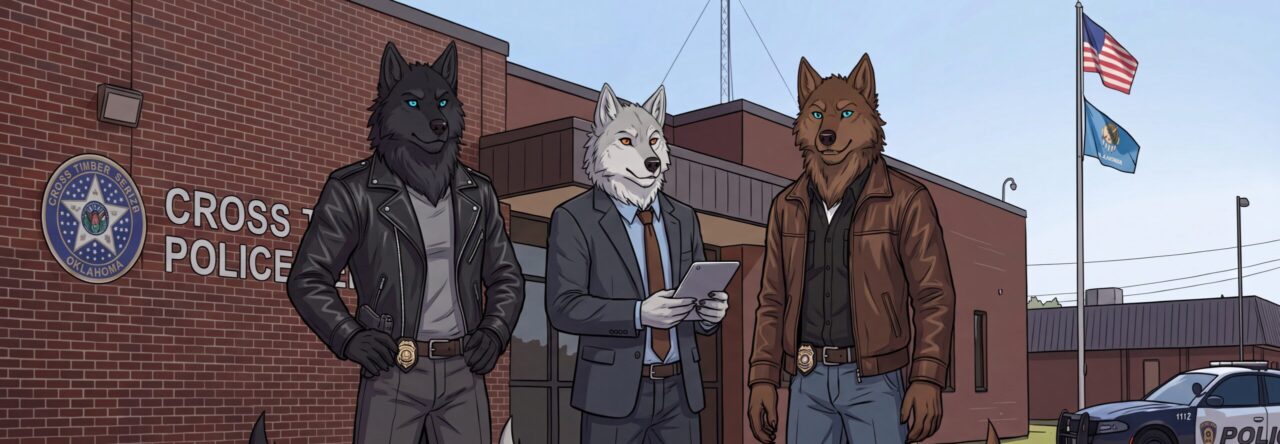
The next few days were ordinary.
Not empty.
Not uneventful in the way people outside the department used the word.
There were reports to finish, evidence logs to update, and the steady procession of smaller calls that reminded Night Shift why routine mattered. A welfare check became a diabetic emergency before it became a tragedy. A loud argument outside a bar stayed an argument because patrol arrived early. A lost teenager got home. A stolen bicycle turned up behind a detached garage because Mark found a marketplace listing that did not fit the seller’s story.
The city kept moving.
Night Shift kept pace with it.
Kessler returned to his normal day-shift routine.
He did not suddenly become easygoing. He did not walk into the office every morning trying to prove he had changed. He simply did the work in front of him, spoke when he had something useful to say, and stopped looking at Thane, Gabriel, and Mark as if their existence was an insult he had to answer.
On Wednesday morning, while Night Shift was wrapping up a stack of reports before heading home, Kessler passed their office door with a file tucked under one arm.
“Morning,” he said.
“Morning,” Thane answered.
Kessler paused.
“The property-crimes team confirmed the third catalytic converter. Your Subaru idiots cleared all three thefts.”
Gabriel looked pleased.
“Professionally lucky.”
Kessler’s mouth shifted.
“Professionally lucky.”
Then he continued down the hall.
That was enough.
By Friday evening, Cross Timber had settled into the familiar end-of-week rhythm.
Traffic thickened along the restaurant corridor. The movie theater was filling. The brewery district was bright with patio lights and people trying to decide whether they wanted a quiet evening, a loud evening, or an evening they would regret by morning.
At 17:56, Thane, Gabriel, and Mark came through the side entrance together.
The Investigations Bureau felt different before anyone said a word.
Voss stood beside the case board with a legal pad in one hand.
Rusk sat at the conference table, coffee untouched beside him.
The room was quieter than it should have been for a Friday evening.
Mark noticed the new card first.
It had been placed at the center of the board.
Not in the usual corner reserved for developing calls.
Not beneath property crimes.
Not under welfare checks.
Center.
Written in dark blue marker:
LEAH MORENO — SEXUAL ASSAULT — PRIORITY
Gabriel stopped moving.
Thane felt something in his chest settle into place.
Mark’s notebook was already open.
Voss waited until they were seated.
Then she spoke.
“Yesterday afternoon, at approximately fifteen-fifteen, Leah Moreno left a coworker’s event at the Hawthorne Arts Center.”
No one interrupted.
“She parked in the Cedar Plaza garage behind the building. The garage serves the arts center, a law office, and several restaurant tenants. It is partially public, partially permit access. Leah had parked on the second level.”
Voss looked down at her notes.
“Her coworkers saw her leave alone. Her vehicle was found in the garage shortly after sixteen hundred. Her purse was inside. Her phone was missing.”
Rusk took over.
“A security employee located Leah near the lower stairwell at sixteen-twenty-three. She was disoriented, injured, and unable to give a full account of what happened. EMS transported her to Mercy. She consented to a forensic medical exam and has given an initial statement.”
The room stayed quiet.
Voss’s jaw tightened.
“Leah has reported that she was sexually assaulted.”
She said it plainly.
No euphemism.
No distance.
Then, after a beat:
“She remembers telling the man no.”
The scent in the room changed.
Thane caught it immediately.
Not surprise.
Not the ordinary anger Voss carried into difficult cases.
Something older.
Something that had been carefully buried and had surfaced anyway.
Her coffee sat untouched beside the board. Her posture remained exactly the same. Her voice stayed calm.
But beneath all of it, Thane caught the sharp edge of fear remembered too clearly.
Gabriel’s ears shifted once.
Almost imperceptibly.
Mark did not look up from his notes.
Voss continued.
“She cannot provide a reliable face. She remembers a man’s voice. She remembers a dark jacket. She remembers a chemical-cleaner scent, possibly citrus or industrial degreaser. She remembers being pulled toward the service corridor near the stairwell.”
Rusk pushed a printed garage layout toward Mark.
“Cameras cover the main entrances, vehicle lanes, and public stairwells. The service corridor has a camera. It went offline at fifteen-oh-seven and came back online at fifteen-thirty-one.”
“Maintenance outage?” Mark asked.
“Unknown,” Rusk said. “The property manager says there was no scheduled maintenance event.”
Voss set down her legal pad.
“Kessler spent the day on preservation requests. Garage owner. Camera vendor. Arts center. Restaurants and businesses with exterior views of the vehicle exits and surrounding streets. He uploaded the files and his notes before he left at seventeen-thirty.”
Mark nodded.
“Any usable footage?”
“Not yet,” Voss said. “There are vehicles entering and leaving during the relevant window. Plate glare. shadows. Different camera systems. Different clock settings.”
Rusk gave a tired look toward the garage map.
“One camera is four minutes slow. One is almost six minutes fast. The garage system is probably wrong in a different direction.”
Gabriel leaned back slightly.
“Of course it is.”
Voss rested both hands on the conference table.
“Leah is safe. She is with family. She has been clear that she wants this investigated.”
Her voice stayed steady.
The scent beneath it did not.
“We will do that.”
Nobody spoke.
Then Voss looked directly at Thane, Gabriel, and Mark.
“This is the priority case. Day shift is handling formal interviews, medical coordination, warrants, and the camera preservation work. Night Shift will support the scene familiarity, late-hour canvass, patrol visibility, and any time-sensitive lead that comes in after daylight hours.”
Thane nodded once.
“Understood.”
Voss’s eyes moved across all three of them.
“This case is not an excuse to hunt for someone you want to be guilty.”
“No,” Thane said.
“It is not an excuse to turn instinct into conclusion.”
“No,” Mark said.
“It is not an excuse to make Leah repeat herself because we want a cleaner story.”
Gabriel’s expression sharpened.
“No.”
Voss nodded.
“Good.”
Rusk pushed the garage map closer to Mark.
“Start by learning the place. Vehicle access. Foot traffic. Service corridors. Nearby businesses. What the property manager calls normal. What is actually normal.”
Mark took the map.
“Got it.”
Voss closed the case file.
“Night Shift takes the board at eighteen hundred. Check Hawthorne. Check the garage perimeter. Keep patrol informed. And keep your reports clean.”
Thane stood.
“We will.”
Voss gathered her legal pad.
“Rusk and I will see you at zero-six-thirty.”
Rusk looked at the three wolves.
“Do not solve this by midnight.”
Gabriel blinked.
“We were not planning to.”
“Good,” Rusk said. “Because nothing about it will be that simple.”
They left.
The room remained quiet after the conference-room door closed.
Mark studied the garage map.
Gabriel stared at Leah Moreno’s name on the board.
Thane waited.
It was Gabriel who spoke first.
“That hit her.”
Mark’s pen stopped.
Thane nodded slowly.
“Yeah.”
Gabriel looked toward the hallway where Voss had disappeared.
“I do not know what happened to her. I am not going to pretend I do.”
“Good,” Mark said quietly.
“But when she said Leah told him no…” Gabriel swallowed. “Voss smelled like old fear. Not fear of this case. Fear from somewhere else.”
Thane’s hands rested on the edge of the conference table.
“I caught it too.”
Mark closed his notebook.
“That is not proof of anything.”
“No,” Gabriel said. “It is not.”
“It might be personal history,” Thane said. “Or someone she cared about. Or an old case. We do not know.”
Gabriel looked at him.
“I think she was raped.”
Mark’s eyes lifted.
“Gabriel.”
“Not as a fact,” Gabriel said quickly. “Not as a rumor. I am not saying we tell anyone. I am saying I think this case touched something she knows too personally.”
Thane looked down at the dark blue case card.
“Maybe.”
The word held heavier than it should have.
Mark’s voice remained careful.
“Then we do not ask.”
“No,” Thane said.
“We do not speculate out loud.”
“No.”
Gabriel leaned back in his chair.
“We just do the work.”
Thane looked at Leah Moreno’s name.
“Yeah.”
They did.
The Hawthorne Arts Center sat on the edge of downtown Cross Timber, a restored brick building with tall windows, a black-box theater, community gallery space, and enough exposed beams to make every event flyer look expensive.
The Cedar Plaza garage stood behind it.
Four levels of concrete, steel rails, and fluorescent lights.
At night, it looked less like a building than a stack of shadows.
Thane parked the Humvee on the public street across from the garage entrance.
The evening was still young. Restaurant traffic moved through the surrounding blocks. A couple argued softly beside a parking meter. A server hurried toward a compact sedan with her apron folded under one arm. Somewhere nearby, a bass line pulsed behind the walls of a bar.
Mark opened the garage plans on his tablet.
“Main vehicle entrance here. Pedestrian entrance to the arts center here. Public stairwell at the northwest corner. Service corridor runs behind the maintenance office and connects to the lower stairwell.”
Gabriel looked through the windshield.
“Camera outage was there?”
“Service corridor camera. Fifteen-oh-seven to fifteen-thirty-one.”
Thane watched people entering and leaving.
“What is normal?”
Mark looked at the map.
“That is what we are here to learn.”
They walked the public areas first.
No shortcuts.
No closed doors.
No stepping over boundaries because they wanted an answer quickly.
The garage smelled like every garage.
Hot concrete.
Oil.
Old exhaust.
Cleaning product.
Metal railings warmed all day and now cooling into the evening.
The faint electrical bite of fluorescent fixtures.
Cars moved in and out at uneven intervals.
A family with two children returned to a minivan on the first level. A man in office clothes crossed toward the elevators. A restaurant employee pushed a wheeled bin toward the service alley.
Thane listened.
Gabriel watched people.
Mark counted cameras.
By the time they reached the second level, Mark had already noted three places where someone could stand out of direct camera view without being hidden from every angle.
“That corner,” he said, indicating a recess between the elevator landing and the service door. “Camera Two sees the main lane but not the inset wall.”
Gabriel looked at the concrete alcove.
“Good place to wait.”
“Or good place to stand while waiting for a ride,” Mark said.
“Both can be true.”
Thane moved closer to the service door but stayed on the public side of the boundary.
The metal door carried a sharp citrus-cleaner scent.
Not uniquely.
Not enough to build a case.
But there.
Fresh over older layers.
A stronger concentration near the hinge and lower handle.
He looked at Mark.
“Same cleaner note. Stronger here.”
Mark nodded but did not write a conclusion.
“Observed odor consistent with industrial citrus cleaner near service door. We need to determine whether that is standard for the garage.”
Gabriel looked through the narrow wired-glass window into the corridor beyond.
“Can we ask?”
“Not tonight,” Mark said. “Kessler’s notes say the property manager is meeting Voss and Rusk in the morning. They will request a controlled walk-through and maintenance records.”
Thane nodded.
They continued.
The lower stairwell had been reopened after Crime Scene finished its initial work, but yellow evidence markers remained near the far wall. The camera overhead had a temporary status light blinking red.
Out of service.
Gabriel stood beside the stairwell entrance and listened to the building.
The elevator cables.
The hum of a ventilation fan.
Footsteps on a level above.
The distant clang of a restaurant dumpster lid.
Nothing else.
He looked at Thane.
“Nothing fresh.”
“Not now,” Thane said.
“No,” Gabriel agreed. “But it was quiet enough here.”
Mark looked at the stairwell.
“Quiet is not privacy. That matters.”
Gabriel glanced at him.
“Meaning?”
“Meaning somebody may have heard something and assumed it was normal. A door. A raised voice. A struggle. The question is not only who was here. It is who heard something and did not know what they were hearing.”
Thane looked down the public walkway toward the restaurants.
“Night staff.”
“Restaurant staff. Delivery drivers. Garage attendants. People smoking outside. Anyone who used the stairs.”
Mark’s eyes moved across his map.
“Tomorrow, day shift builds the canvass list. Tonight, we identify who is actually here after dark and what traffic patterns change.”
The three of them stood in the stairwell for another moment.
Then Thane turned away.
“Let’s not make her scene into a shrine.”
Gabriel looked at him.
“No.”
They walked out.
At 20:31, Dispatch interrupted their second perimeter pass.
“Night Shift, Patrol Three-One is requesting assistance on a traffic stop at Eastbound Seventy-Four and Brookfield. Officer reports known narcotics subject, lawful equipment stop, and requests sensory assistance. No K-9 available.”
Gabriel turned in his seat.
“Did Dispatch just call us the next best thing?”
Mark was already checking the location.
“Six minutes.”
Thane turned the Humvee toward the highway.
“Then let’s be useful.”
The stop sat on a broad shoulder just past the Brookfield exit.
Officer Morris’s patrol unit was behind a dark gray sedan with a failed rear tag light. The sedan’s driver-side window was down. Traffic hissed past in the far lane, headlights throwing quick flashes across the scene.
Morris stood near the rear quarter of his unit when the Humvee rolled in behind him.
He gave them a short nod as they stepped out.
“Appreciate you coming,” he said. “Driver is Damon Reddick. Known dealer. I stopped him for the tag light and a rolling stop at the ramp. He has been nervous since I walked up, but nervous is not a search.”
“Agreed,” Mark said.
Morris glanced toward the sedan.
“I asked for consent. He said no.”
“Also his right,” Gabriel said.
“Yep.”
Morris lowered his voice.
“There is no K-9 available. You all were nearby. I figured I would ask.”
Thane looked toward the sedan.
He had not moved more than ten feet from the Humvee.
He did not need to.
The scent came hard through the open driver-side window.
Sharp.
Chemical.
A bitter, contaminated mix of methamphetamine, stale sweat, plastic packaging, and the faint burnt note of something recently handled.
Gabriel’s nose wrinkled.
Mark’s ears tipped forward.
All three of them looked at one another.
Morris saw it.
“What?”
Thane motioned him back toward the Humvee.
“Come here.”
Morris stepped closer.
Thane kept his voice low.
“There is meth in that car. A lot of it”
Morris’s eyes shifted toward the sedan.
“You sure?”
“Yes,” Thane said.
Gabriel nodded.
“Strongly.”
Mark spoke with the calm precision he brought to every report.
“Distinct odor consistent with methamphetamine and associated packaging is coming from the open driver-side window. All three of us detected it independently.”
Morris looked at them.
“Can you articulate that?”
“Yes,” Thane said. “We will document it. You should notify your sergeant. We are not asking you to take our word like magic. We are telling you what we observed.”
Morris nodded and keyed his shoulder mic.
“Three-One to Sergeant. I have independent narcotics-odor observations from Night Shift at an open driver window. Requesting confirmation for probable-cause vehicle search.”
The response came back after a short pause.
“Copy. Confirm your observations and proceed consistent with policy. I am en route.”
Morris lowered the radio.
“Okay.”
Thane looked at the sedan.
“Let’s make it clear.”
They approached together.
Not rushing.
Not surrounding the driver like a threat.
Morris took the lead.
The driver watched them come in his mirror.
Damon Reddick was in his thirties, thin-faced, wearing a black hoodie despite the warmth. His hands stayed on the wheel, but his eyes had begun moving too fast.
He looked at Thane.
Then Gabriel.
Then Mark.
His face changed.
Not guilt exactly.
Recognition.
The particular, sinking look of someone realizing the plan had just become impossible.
Morris stopped at the open window.
“Mr. Reddick, step out of the vehicle.”
Reddick shook his head.
“For a tag light?”
“For the traffic stop and the probable cause we have developed.”
“What probable cause?”
Gabriel leaned slightly toward the window.
“You know.”
Reddick’s jaw tightened.
“You cannot smell anything.”
Gabriel smiled without warmth.
“We can.”
Thane caught the stronger source now.
Back seat.
Black backpack behind the passenger seat.
The scent was concentrated enough to make the rest of the interior seem washed out around it.
He looked at Morris.
“Back seat. Black backpack.”
Morris’s expression stayed neutral.
“Step out of the vehicle, Mr. Reddick.”
Reddick looked toward the backpack.
That was enough.
Morris opened the driver’s door carefully and guided him out.
Reddick started talking immediately.
“You cannot search my car because some dog people say—”
“We are not dogs,” Gabriel said.
Mark looked at him.
“Do not say anything else.”
Gabriel closed his mouth.
Morris cuffed Reddick and placed him in the rear of the patrol unit.
Then he, his arriving sergeant, and a second patrol officer began the vehicle search.
Night Shift stayed where they were supposed to be.
Close enough to assist.
Far enough not to turn a patrol case into a performance.
The backpack contained several sealed bags of suspected methamphetamine, a digital scale, cash, and packaging materials.
Morris looked over at them after the evidence had been photographed.
“Good call.”
Thane nodded.
“Write it clean.”
Morris smiled slightly.
“I will.”
Gabriel watched Reddick sitting in the back of the patrol car.
“You know, I hate when people call us the K-9 unit.”
Thane looked at him.
“No one called us that.”
“They were thinking it.”
Mark slipped his tablet back into his bag.
“It is a poor comparison.”
Gabriel looked relieved.
“Thank you.”
Mark continued.
“Dogs receive treats after successful alerts.”
Gabriel stared at him.
Thane’s mouth twitched.
Morris heard it and laughed despite himself.
“Coffee shop is two miles up the road,” he said. “I can get you all a pup cup.”
Gabriel looked offended.
“Now you are doing it on purpose.”
The sergeant sealed the evidence bag.
“Go back to work, detectives.”
They did.
Twenty minutes later, the city gave them a different kind of call.
Not through Dispatch.
Just through the windshield.
The diner sat at the corner of Harlan and Sixth, one of those old roadside places with a neon sign, faded booths, and a breakfast menu that never entirely disappeared even at night.
Several people stood outside its front entrance.
Not in a line.
Not casually.
Uncomfortably.
A thin man in a dirty gray jacket stood near the doorway, speaking too loudly to a couple trying to leave.
“Come on, man. I just need something to eat. I am not asking for a car. I am asking for a sandwich.”
The couple looked trapped between irritation and guilt.
The man took one step closer.
Not enough to touch them.
Enough to make them move backward.
Thane slowed the Humvee.
Gabriel looked through the passenger window.
“That is not going well.”
“No,” Thane said.
Mark had already checked the street.
“No weapons visible. No active fight. He is agitated but not currently assaultive.”
Thane parked.
The man saw the Humvee.
His posture changed immediately.
His hands came up.
“I’m leaving,” he said. “I’m leaving.”
Thane, Gabriel, and Mark approached without rushing.
The couple stepped aside.
“Name?” Thane asked.
The man looked at him.
“Ray.”
“Ray,” Thane said. “Are you hurt?”
“No.”
“Are you carrying anything that can hurt someone else?”
“No.”
“Have you been drinking?”
Ray shook his head quickly.
“No. I just—” He looked toward the diner. “I have not eaten in two days.”
Gabriel watched him carefully.
There was no alcohol on him.
No fresh chemical scent.
No immediate danger.
Just hunger.
Exhaustion.
Embarrassment arriving too late to protect him from the fact that other people had seen him desperate.
Ray looked down at the sidewalk.
“I did not mean to be pushy. I just asked the guy and he acted like I was going to rob him. I am sorry.”
The couple looked uncomfortable.
The woman gave a small nod.
“He did not touch us.”
Thane looked at Ray.
“You cannot crowd people like that.”
“I know.”
“You cannot make them feel like they cannot leave.”
“I know.”
Ray swallowed.
“I will go.”
Gabriel stepped close enough to Thane that his voice would not carry.
“We should buy him dinner.”
Thane looked at him.
Gabriel’s expression stayed soft.
Not joking.
Not now.
Thane nodded once.
“Yeah.”
He looked back at Ray.
“Go inside.”
Ray blinked.
“What?”
“Go inside the diner.”
Ray’s face tightened.
“I said I am sorry. I will apologize.”
“You can apologize if you want,” Thane said. “Then sit in a booth.”
Ray stared at him.
Mark stepped toward the entrance and opened the door.
“Come on.”
Ray looked like he expected a trick.
Like the three wolves were bringing him inside so he could be scolded in private.
He moved slowly through the door.
The diner went quiet.
A waitress paused near the counter with a coffee pot in her hand.
The booths were half full. A pair of truck drivers looked over from the corner. A woman in scrubs held a fork halfway to her mouth.
And, of course, phones appeared.
Not everyone.
But enough.
Thane felt the irritation rise.
Not at Ray.
At the screens.
At the instinct people had to turn every unexpected kindness into content before they had even decided whether it was kind.
He kept it off his face.
Mostly.
Ray stood just inside the door, uncertain.
“Sit,” Thane said, pointing toward an empty booth by the window.
Ray sat.
The waitress looked at Thane.
“Everything okay?”
Thane nodded.
“This man could really use a good meal.”
The waitress glanced toward Ray.
Then back at Thane.
Thane reached for his wallet.
“Would you bring him whatever he wants tonight? It is on us.”
Ray looked up sharply.
“You do not have to—”
“Yes,” Thane said.
Gabriel slid into the booth across from Ray for a moment, not sitting fully, just leaning one hand on the table.
“Order food, Ray.”
Ray’s eyes had gone wet.
“I do not want to take advantage.”
Gabriel smiled gently.
“You are not. Eat.”
Mark placed a small folded card beside the menu.
It listed the overnight shelter, a community meal site, and a number for a local outreach worker.
“After dinner,” he said, “the diner closes at midnight. This place has beds available and a late intake window. You do not have to use it. But you should know where it is.”
Ray touched the card like it might disappear.
“Thank you.”
Thane handed him the menu.
“Everything and anything you want.”
Ray looked down at it.
Then back up.
“Really?”
“Really.”
The nearest phone was still pointed at them.
Thane turned toward it.
The person holding it—a young man in a branded delivery jacket—froze.
Thane’s stare was not angry.
It was steady.
“Look,” he said, loud enough for the room to hear. “Sometimes people just need a helping hand.”
The phone lowered slightly.
Thane continued.
“You do not have to turn every decent thing into a show. Let the man eat.”
The delivery driver’s face went red.
He put the phone away.
A few other phones lowered too.
The diner seemed to exhale.
Ray looked at Thane.
“Why?”
Thane considered the question.
Then he held out his hand.
Ray looked at it before taking it.
His grip was thin, rough, and shaking.
“Because somebody should,” Thane said.
Ray’s hand tightened once.
Then he let go.
Gabriel stood.
“Get the pie too,” he said. “You look like a pie person.”
Ray gave a wet, disbelieving laugh.
“I do like pie.”
“See?” Gabriel said. “Detective work.”
Mark looked at him.
“That is not detective work.”
“It was an accurate inference.”
Thane headed toward the door.
“Let him eat.”
They stepped back outside.
The night air felt cooler than it had a minute earlier.
Gabriel walked beside Thane toward the Humvee.
“You did good.”
Thane unlocked the driver’s door.
“We did good.”
Mark climbed into the back.
“Ray also has an outreach option for later. That matters.”
Gabriel settled into the passenger seat.
“See? We are all emotionally responsible.”
Thane started the engine.
“Don’t ruin it.”
Gabriel smiled.
“Would not dream of it.”
They returned to the Hawthorne district just after midnight.
Not because a miracle lead had appeared.
Because the work of looking required repetition.
The garage was quieter now.
Restaurant traffic had thinned. The arts center had gone dark. The fluorescent lights inside the garage hummed over mostly empty levels.
Mark pulled up a secure case-folder upload.
“Kessler got this in before he left,” he said. “Time-stamped seventeen-forty-two.”
Gabriel looked over.
“Restaurant camera?”
“Original file. Not the compressed version. He also got the garage vendor to admit their clocks have not been synchronized since a software update in March.”
Thane parked in a legal space near the garage exit.
“What does the clip show?”
Mark watched it twice.
Then once more.
“Maybe something.”
Gabriel leaned closer.
“Maybe?”
“A dark SUV exits the garage at fifteen-twenty-seven according to the restaurant camera. The plate is unreadable because of glare. Rear left taillight appears damaged.”
Thane looked toward the exit lane.
“Can we connect it to Leah?”
“No,” Mark said. “Not yet.”
“Can we identify it?”
“Maybe. If we align camera clocks, obtain the garage entrance footage, and locate additional cameras along the likely outbound route.”
Gabriel nodded slowly.
“One car.”
“Not enough,” Mark said.
“No,” Thane agreed. “But it is a direction.”
They stayed another hour.
They documented which entrance lights reflected on the pavement.
Which lane camera pointed toward the exit.
How long it took a vehicle to travel from the second level down to the street.
The route a dark SUV would likely use if it wanted to avoid the busiest intersection.
They did not solve the case.
They made the next question sharper.
At 01:36, Gabriel stopped near the service-door corridor and listened.
A restaurant employee pushed a trash bin through the alley.
A rideshare driver pulled in, waited two minutes, then left.
A man in a dark jacket walked through the garage with his phone in one hand and a takeout bag in the other.
Gabriel followed him with his eyes until he reached a parked car, opened it, and drove away.
“Nothing,” Gabriel said.
“Nothing is still useful,” Mark said.
Gabriel looked at him.
“Only you would say that.”
“It is true.”
Thane stood near the garage entrance, watching the shadows between parked vehicles.
“This place feels different after midnight.”
Mark glanced toward him.
“How?”
“Less traffic. Fewer witnesses. More sound carries.”
Gabriel nodded.
“And everyone who is here has a reason to be.”
“Maybe,” Mark said. “Or they have a reason to look like they have one.”
Thane looked down the service lane.
“Either way, we learn it.”
By 03:08, they were back at the station.
Mark built a timeline on the case-board screen.
15:07 — SERVICE CAMERA OFFLINE
15:15 — LEAH LEAVES EVENT
15:23 — SECURITY EMPLOYEE REPORTS ELEVATOR MALFUNCTION
15:27 — DARK SUV EXITS GARAGE / DAMAGED LEFT TAILLIGHT
15:31 — SERVICE CAMERA RETURNS
16:23 — LEAH LOCATED BY SECURITY
Gabriel stood behind him.
“That is a lot of space for something bad to happen.”
Mark nodded.
“Too much.”
Thane looked at the timeline.
“Can we prove the SUV is involved?”
“No,” Mark said. “Not yet.”
“Can we identify it?”
“Maybe. If we align camera clocks, obtain entry footage, and check nearby cameras for the damaged taillight.”
Gabriel looked toward Leah Moreno’s case card.
“Then that is where we start.”
Thane nodded.
“Monday.”
The rest of the night stayed quiet.
They made two more passes through the Hawthorne district.
Checked the hospital lot.
Responded with patrol to a burglar alarm at a small accounting office that turned out to be an HVAC sensor reacting to a loose vent panel.
At 04:17, a patrol officer asked them to assist with a confused elderly woman who had wandered from an assisted-living facility and was found sitting safely at a bus stop two blocks away.
Gabriel sat with her until staff arrived.
Mark found her emergency-contact card tucked into her purse.
Thane stood nearby, keeping the early morning traffic from getting too close.
It was not glamorous.
It was not central to Leah Moreno’s case.
It was still the job.
At 06:23, the first day-shift lights came on in the bureau.
At 06:30 exactly, Voss and Rusk came through the door.
Kessler followed a few steps behind them with a travel mug and a slim laptop case.
He glanced at the new timeline on the board, then at Night Shift.
“You got something from the restaurant camera.”
Mark nodded.
“Dark SUV. Damaged left taillight. No plate yet.”
Kessler set his mug down and moved closer to the screen.
“Good. I have the raw garage footage request approved. The vendor says we should have the entry feed by late morning.”
Voss set down her coffee.
“Morning handoff.”
The room changed.
Mark began.
“Timeline and evidence status. We completed two public-area passes through the Cedar Plaza garage and surrounding Hawthorne district. No new incidents. No new forced-entry indicators. We documented public traffic patterns, camera coverage, probable blind areas, and the route from the second-level parking area to the garage exit.”
He indicated the map.
“Observed a stronger industrial citrus-cleaner odor near the service door. This is consistent with Leah’s initial description but not yet distinctive. We need maintenance-product records before drawing meaning from it.”
Voss nodded.
“Good.”
Mark continued.
“Restaurant camera footage, preserved by Kessler before day shift ended yesterday, shows a dark SUV exiting the garage at fifteen-twenty-seven. Rear left taillight appears damaged. Plate unreadable. Camera-clock alignment remains unresolved.”
Kessler took a note.
“I will work the offset chart and compare it to the garage’s entry logs as soon as we have the raw files.”
Gabriel took over.
“Witness and interview issues. We identified likely late-hour witnesses for day-shift canvass: restaurant staff, delivery drivers, garage attendants, rideshare drivers, employees using the stairwell, and people smoking in the service alley. The stairwell is quiet enough that a person might hear a raised voice or movement without recognizing what they are hearing.”
Rusk nodded.
“That is useful.”
Gabriel continued.
“Nothing overnight suggests Leah’s case was public enough to draw immediate attention. That does not mean nobody saw anything. It means we need to ask better questions than ‘did you see an assault?’”
Voss looked at him.
“Exactly.”
Thane finished.
“Scene actions and active leads. We stayed within public access areas, learned the route geometry, and confirmed that after midnight, the garage is much quieter. A person moving through the service corridor or lower stairwell would have fewer people nearby and more sound carry. The dark SUV is our strongest current vehicle lead, but we cannot place it with Leah or the assault yet.”
Voss looked at the board.
Then at all three of them.
“You did what I asked. You learned the place without inventing a story about it.”
Thane nodded.
“We will keep looking.”
Voss met his eyes.
“Yes,” she said. “We will.”
Kessler picked up his laptop case.
“I will send the clock-comparison worksheet once I have the footage. Mark, I need your notes on the travel time from second level to the exit.”
“Already in the case folder,” Mark said.
Kessler blinked once.
Then nodded.
“Of course they are.”
Gabriel smiled.
“He anticipated the request.”
Rusk picked up the Hawthorne folder.
“Dark SUV, damaged taillight, missing phone, camera outage. Nothing easy.”
“No,” Gabriel said. “Not easy.”
Voss gathered the reports.
“Go home. Sleep. Come back Monday night ready to work the next thing we can prove.”
The three wolves stood.
The shift was over.
But Leah Moreno’s case stayed on the board.
Dark blue marker.
Centered.
Waiting.
Outside, dawn was beginning to lighten the streets of Cross Timber.
The city woke around a crime it did not yet understand.
And somewhere inside it, someone had gone home believing the afternoon had hidden them.
Night Shift knew better.
The city always left something behind.
You just had to keep looking.