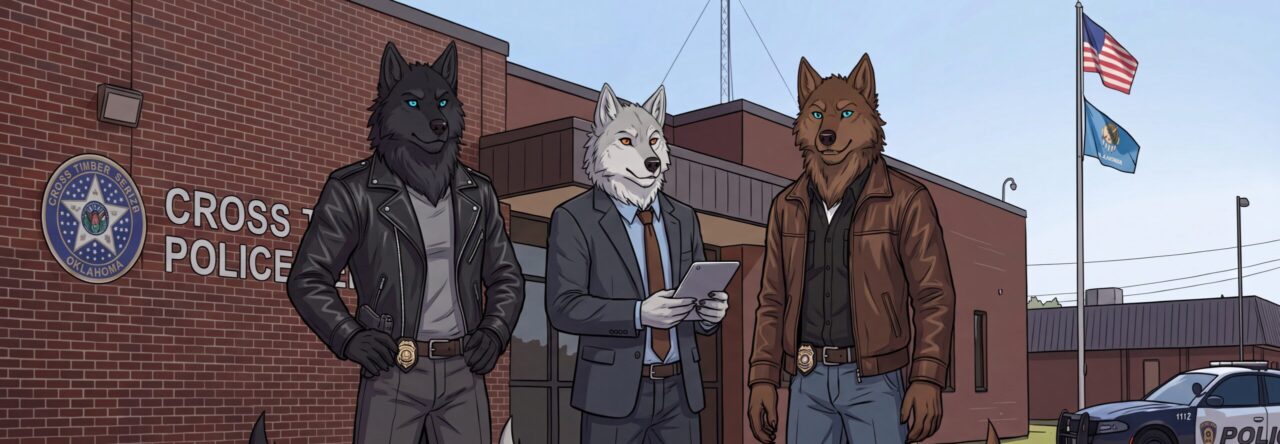
The first thing Thane noticed when they entered the station was that Deputy Chief Mercer’s office door was open.
The second thing he noticed was Mercer’s voice.
Not loud.
Not angry in the way people got angry when they wanted an audience.
Tight.
Measured.
The kind of controlled frustration that came from someone trying to explain the same urgent truth to a person who had already decided there was no money for it.
Thane slowed near the hallway junction.
Gabriel, beside him, took one more step before realizing Thane had stopped.
“What?” he murmured.
Thane lifted one paw.
Mark stopped on Thane’s other side.
Mercer stood inside his office with a phone pressed to one ear and one hand braced against the edge of his desk. The door was open just wide enough that the three wolves could hear him clearly without needing to move closer.
“No, I understand the capital schedule,” Mercer said. “I understand roads need money. I understand Fire needs equipment. I understand the water department has its own replacement plan.”
He listened.
Then rubbed one hand across his forehead.
“What I do not understand is how I am supposed to keep eighteen twelve-year-old patrol units on the street when half of them spend more time waiting on repairs than they do answering calls.”
Gabriel’s expression changed.
Mark’s ears angled forward.
Inside the office, Mercer continued.
“No, I am not asking for luxury vehicles. I am asking for modern patrol units that start reliably, brake reliably, run the radio and computer systems reliably, carry medical equipment, and get officers home at the end of a shift.”
A pause.
His jaw tightened.
“The full replacement package comes to one point seven million. That is eighteen Ford Police Interceptor Utilities, the standard police upfit, cameras, radios, protective partitions, equipment mounts, emergency lighting, and everything else that turns an SUV into a working patrol car.”
He listened again.
Then closed his eyes.
“No. I understand. Not this fiscal year.”
Another pause.
“Not next year either.”
Gabriel’s eyes moved toward Thane.
Mercer’s voice became quieter.
“Five years is too long.”
He listened.
For several seconds, nobody spoke.
Then Mercer said, “Understood. I will keep patching what I can.”
He ended the call.
The phone clicked softly into its cradle.
Thane stood in the hallway for one beat longer.
He could smell the stale coffee in Mercer’s office.
Printer toner.
The faint heat of a computer monitor.
And underneath it, the particular exhausted frustration of someone who had spent the afternoon being told that a safety problem was financially inconvenient.
Gabriel looked at him.
Thane looked at Mark.
Mark nodded once.
Gabriel nodded too.
No discussion.
No pack meeting.
No argument about whether the need was real.
Thane took out his phone.
They stepped away from Mercer’s office before he made the call.
Eli answered on the second ring.
“Thane.”
“Eli.”
“Please tell me no one has been arrested.”
“No one has been arrested.”
“Good. That puts us ahead of schedule.”
Gabriel leaned toward the phone.
“We overheard something.”
Eli was quiet for half a second.
“That sentence almost never improves.”
“Mercer was on the phone with the city,” Thane said. “They need patrol vehicles.”
“Every department needs patrol vehicles.”
“These are twelve years old,” Mark said. “Eighteen of them. The city cannot replace them this year. Or next year. Maybe not for five years.”
Eli’s voice changed.
Not softer.
Sharper.
Attorney attention settling into place.
“And the cost?”
“About one point seven million,” Thane said.
Gabriel added, “Fully outfitted. New Ford Police Interceptors. The actual police kind, not just regular SUVs with a light bar thrown on top.”
“I assumed as much.”
“We want to help,” Thane said.
Eli exhaled through his nose.
“Of course you do.”
“We want to do it right.”
“That is why I am still speaking to you.”
Mark looked down the hallway to make sure nobody was within earshot.
“The city needs to choose the specifications. The department needs full operational control. We do not select vehicles, officers, assignments, vendors, or policy.”
“Correct,” Eli said. “You are not privately purchasing eighteen police vehicles and dropping them in the department lot with giant bows.”
Gabriel’s face fell.
“I was not going to suggest giant bows.”
“Good.”
“I was going to suggest a tasteful banner.”
“No.”
“Fine.”
Eli continued.
“The Cross Timber Community Fund can make an anonymous restricted public-safety grant. The money goes to the city, not directly to the department. City Legal reviews it. Finance accepts it. The council approves it if their rules require approval. Fleet and procurement handle the purchase. The police department writes the specifications and assigns the vehicles. Your only condition is that the money is used for fleet replacement and police safety.”
“That is what we want,” Thane said.
“There will be people who need to know the donor’s identity.”
“We know.”
“City Legal, foundation leadership, their auditors, possibly the Chief and Mercer for conflict review. You cannot demand total secrecy from every person whose signature is legally required.”
“We are not asking that,” Thane said. “Just keep it quiet.”
“I can do quiet.”
Mark asked, “Can the grant cover upfit and delivery?”
“Yes. It should. Giving a city eighteen bare vehicles and asking it to somehow afford the radios, cages, cameras, lights, and equipment is not help. It is a new problem wearing a nice suit.”
Gabriel smiled.
“You are getting funnier.”
“I am billing you for that comment.”
Thane looked through the station windows toward the lot.
“How fast?”
“Not fast enough to appear magical,” Eli said. “Fast enough to be useful. I will speak with Red River’s executive director and the city attorney’s office. I will create the restricted grant language and have a preliminary offer delivered before tomorrow evening.”
Thane nodded even though Eli could not see him.
“Okay.”
Eli paused.
“Thane.”
“Yeah?”
“You heard a problem. You are allowed to care about it. But this is a municipal gift. Once it is made, you step back. No asking when the vehicles arrive. No asking who receives which unit. No asking whether the city chose the exact tires you would have chosen.”
Gabriel looked at Mark.
“Mark would ask about tires.”
“I would ask about procurement specifications,” Mark said.
Eli heard him.
“Precisely why I said it.”
Thane’s mouth twitched.
“We will step back.”
“Good,” Eli said. “Go be detectives. I will be your lawyer.”
The call ended.
For a moment, the three wolves stood in the hallway.
The department moved around them.
A patrol officer walked past with a report folder and did not look twice. Dispatch chatter crackled faintly through the communications wing. Someone laughed near the break room.
Gabriel looked at Thane.
“You know this is a lot.”
“Yes.”
“You okay with that?”
Thane looked toward Mercer’s office.
“Those officers drive those cars every night.”
Mark nodded.
“Then it is a legitimate need.”
Gabriel’s expression softened.
“Okay.”
Thane put his phone away.
“Briefing.”
Mercer came out of his office two minutes later.
His face had been reset.
The frustration was gone from it, or hidden well enough that most people would not see it.
He paused when he saw Night Shift near the Investigations hallway.
“Evening.”
“Evening,” Thane said.
Mercer looked at all three of them for a beat.
Then his eyes moved to the file in Mark’s hand.
“Quiet night,” he said.
Gabriel glanced at the ceiling.
“We would like one.”
Mercer’s mouth shifted almost imperceptibly.
“Do not say it out loud.”
Then he walked away.
The evening briefing began at 18:00.
Voss stood near the case board with Rusk beside her. Kessler was still finishing his day-shift notes at the conference table, laptop open and a jacket folded over the back of his chair.
Leah Moreno’s file remained active, but no longer sat at the center of the board.
The case was moving through the prosecutor’s office.
Lab analysis had begun.
Mays remained in custody.
There would be hearings, defense motions, follow-up interviews, and more work ahead.
But the emergency part had passed.
Tonight, the city had other problems.
Voss tapped two new folders on the table.
“First, we have a property-crimes pattern that may be nothing,” she said. “Or may be something that has been missed because each individual report looked too small.”
Gabriel leaned forward.
“What kind of property crime?”
“Residential burglary,” Rusk said.
Mark opened his notebook.
“High-value property?”
“That is the strange part,” Voss said. “Not really.”
She opened the first folder.
“Three homes in the north and west residential districts. No forced entry in two. One rear window removed cleanly. Electronics left behind. Jewelry left behind. Cash left behind.”
Thane frowned.
“What was taken?”
Rusk slid a property list toward them.
“Garage remotes. Spare keys. Mail. Prescription medications. A file folder from a home office. An old phone from a kitchen drawer. Vehicle registration papers. An emergency contact list from a refrigerator.”
Gabriel’s ears lowered.
“They are not taking valuables.”
“No,” Voss said.
Mark scanned the list.
“They are taking access.”
“Maybe,” Voss said. “Or they are taking information.”
Kessler turned his laptop so they could see a map.
The three homes sat in different subdivisions.
Far enough apart that patrol had not connected them.
All within a twenty-minute drive.
All entered during daylight hours while occupants were gone.
All houses with one thing in common.
“Each homeowner had a recently installed smart doorbell system,” Kessler said.
Gabriel looked at him.
“That is the connection?”
“Maybe. Or maybe the offenders simply knew those homeowners would assume the doorbell camera was enough.”
“Any video?” Thane asked.
“Partial,” Kessler said. “In each case, the camera either lost connection briefly or caught only a vehicle at the edge of the street.”
Mark studied the map.
“Same vehicle?”
“Unknown. One witness recalls a white cargo van. Another recalls a dark contractor SUV. Third has no vehicle description.”
Rusk leaned back in his chair.
“Right now, we have three weird burglaries. Patrol has a fresh call in Brookstone Estates. Same basic circumstance. Homeowner returned from dinner, found a back door unsecured, and says several things are missing that do not make any sense.”
Voss looked at Night Shift.
“You take that scene. Do not decide it is connected before you see it. Learn the house. Learn what is missing. Learn what is not.”
Thane nodded.
“Understood.”
Voss tapped the second folder.
“Then we have a missing-person report that came in less than an hour ago.”
The mood in the room shifted.
“Name is Luis Ortega,” she said. “Thirty-four. Construction foreman with Prairie Ridge Development. His wife reported him missing after he did not come home from work.”
Mark looked up.
“Vehicle?”
“Pickup truck found at the Briar Glen development site,” Rusk said. “His employer says he clocked out at seventeen-twenty. His wife says he texted her at seventeen-forty-six that he was ‘running late’ and would explain when he got home.”
“Phone?” Gabriel asked.
“Last location near the development. Then nothing.”
“Medical concerns?”
“His wife says he has Type 1 diabetes,” Voss said. “His insulin kit was not in the truck. But his backup supplies were left at home.”
Thane’s eyes moved to the map.
“When did he disappear?”
“Somewhere between seventeen-twenty and eighteen-thirty, probably,” Voss said. “We do not know whether he left the development voluntarily, got a ride, was hurt, or is hiding from something.”
Rusk added, “We have patrol at the site. His wife is there now. Missing-person detectives are tied up on another active case, so this comes to you.”
“Start with Brookstone,” Voss said. “Then take the Ortega call. If the missing-person situation turns hot, call it in and we will come back.”
Kessler closed his laptop.
“Do not build a theory for either case before you have a reason.”
Gabriel nodded.
“Tonight’s theme.”
“Every night’s theme,” Kessler said.
Voss looked at the three wolves.
“Go.”
Brookstone Estates was one of those neighborhoods built to look like nobody had ever made a bad financial decision.
Neat brick homes.
Fresh landscaping.
Wide sidewalks.
Matching streetlights.
Driveways filled with expensive SUVs and pickup trucks that rarely carried anything dirtier than sporting equipment.
The home on Hawthorn Crest belonged to Steven and Carla Mullen.
They stood in their front room when Night Shift arrived, both still dressed for dinner.
Carla held a purse against her chest.
Steven held a baseball bat.
The bat had apparently been his first response to finding the back door open.
Thane looked at it.
Steven followed his gaze.
“I did not touch anything.”
“Good,” Thane said.
“I just picked that up when I heard something.”
“Still good.”
Officer Grant had arrived first and secured the house without entering farther than necessary.
“No sign anyone is still inside,” Grant said quietly. “Back door is open. Homeowners say they were out from about six-thirty to nine.”
“Camera system?” Mark asked.
“Doorbell camera and two exterior units. They lost connection for eleven minutes around seven-twelve.”
Grant gave him a look.
“Why?”
“Because that matters.”
The house smelled like fresh-cut flowers, expensive candle wax, dinner leftovers, and the sharp clean scent of an alarm system’s plastic components.
No unfamiliar person remained inside.
No fresh hidden presence.
But the entryway carried the layered smell of someone who had been there earlier.
Work boots.
Synthetic fabric.
Rubber gloves.
A faint metallic smell that did not belong to the house.
Thane stood near the open back door.
The latch had not been broken.
The deadbolt had not been forced.
The door had simply been opened.
“How do you usually secure this?” he asked.
Steven pointed to a keypad lock.
“It locks automatically.”
“Do you have spare keys?”
Carla’s face changed.
“There was one in the mudroom drawer.”
“Was,” Steven said.
They checked.
The drawer had been opened.
The key was gone.
Mark moved through the house with Carla, documenting each item that had been taken.
The list grew stranger.
A spare garage-door remote from the kitchen counter.
A folder from Steven’s home-office drawer containing vehicle insurance cards, a recent utility bill, and printed tax documents.
An old iPhone from a charging drawer.
A prescription bottle from the bathroom cabinet.
A set of spare car keys.
Not the primary keys.
The spare keys.
Gabriel stood beside Carla in the home office.
“Anything expensive missing?”
Carla shook her head.
“My laptop is right there. My jewelry box is upstairs. His watch collection is in the closet.”
Steven looked toward the hallway.
“They did not take any of that.”
“No,” Gabriel said. “They did not.”
“Why?”
Gabriel looked at the folder-shaped empty space in the desk drawer.
“We do not know yet.”
In the kitchen, Mark knelt beside the smart-home control panel.
“The system was not merely disconnected,” he said. “The router was rebooted remotely.”
Steven blinked.
“Can someone do that?”
“If they have access to the network,” Mark said. “Or if they are using a vulnerability. We will need the service logs.”
Carla looked frightened.
“Can they get back in?”
“Not if we help you secure it,” Mark said. “We will document what happened, then we will make sure you have the right next steps.”
Thane returned from the back door.
“Any exterior cameras on the alley?”
Grant nodded.
“Neighbor across the back fence has one. I am trying to reach them.”
Gabriel looked at Thane.
“They took enough information to know routines.”
“Maybe,” Thane said.
“Maybe,” Mark corrected from the control panel.
Thane nodded.
“Maybe.”
The neighbor’s camera gave them forty-five seconds of usable footage.
A white utility van had pulled into the rear service lane at 19:08.
No clear logo.
No readable plate.
The driver wore dark work clothes and a baseball cap.
The van remained just outside the Mullen property line for nine minutes.
Then drove away.
The intrusion began at 19:11.
The doorbell system returned online at 19:23.
Thane watched the footage twice.
Then looked at the strange missing-property list again.
“They are not stealing things,” he said.
Mark looked up.
“They are stealing routes.”
Gabriel’s ears tipped forward.
“Routes?”
“Keys. remotes. mail. records. phones. schedules. Vehicle information,” Mark said. “Things that tell them how to come back, how to access something else, or how to pretend to be the owner.”
Steven stared at him.
“You think they are coming back?”
“We do not know,” Thane said immediately.
“But we are going to make sure they cannot.”
They spent the next hour doing the part of police work most people did not picture when they imagined detectives.
Helping the Mullens change the physical lock cylinder.
Explaining how to disable and reprogram garage remotes.
Connecting them with the smart-home company’s emergency support line.
Telling them what credit-monitoring steps to take.
Making sure they had a safe place to sleep if the house no longer felt safe.
Carla did not want to leave.
Not because she believed the burglars were outside.
Because she refused to be chased from her own home.
Thane understood that.
So he did not push.
He simply made sure patrol added the house to its overnight visibility list.
Before they left, Steven stood in the entryway, baseball bat still leaning against the wall.
“Are you going to catch them?” he asked.
Thane looked at the open front room.
The clean furniture.
The strange missing pieces.
The places where a person’s life had been quietly copied instead of robbed.
“We are going to find out what they are opening,” Thane said.
Steven did not look reassured.
But he nodded.
It was the best answer Thane could give.
At 21:36, Dispatch updated the Ortega call.
Luis Ortega’s wife had received no new messages.
His pickup remained at the Briar Glen development.
The site supervisor had checked the active work areas and found nothing.
Patrol had started a perimeter, but the development sat against a broad stretch of unfinished lots, construction roads, drainage channels, and wooded property that ran toward the creek.
Thane turned the Humvee south.
The development came into view twenty minutes later.
Half-built homes stood along unfinished streets beneath portable work lights.
Framing lumber lay stacked beneath tarps.
A backhoe rested beside a pile of dirt.
A temporary construction trailer glowed near the main entrance.
Beyond the last row of lots, the land fell away toward dark brush and a shallow drainage easement.
Luis Ortega’s pickup sat alone near a model-home lot.
The driver’s door was locked.
The cab was dark.
His wife stood beside Officer Bell near the construction trailer.
She was small, dark-haired, wearing jeans and a light jacket pulled tight around herself despite the warmth.
When she saw the Humvee, she looked up.
Not relieved exactly.
More like she had reached the point where every new person arriving represented another chance that someone might know what to do.
Bell met them near the truck.
“His name is Luis Ortega. Thirty-four. Foreman. Wife says he is not the kind of person who disappears.”
Thane nodded.
“What did the company say?”
“Supervisor says Luis left the main work area around five-twenty. He was supposed to close out a materials count and go home. He did not clock out through the trailer system, but his work tablet was left inside.”
Mark’s ears lifted.
“Left inside?”
“On the desk,” Bell said. “Logged in. No sign-off.”
Gabriel looked toward the pickup.
“Phone?”
“Last carrier ping placed it near the south edge of the development at eighteen-oh-one. No activity since.”
Luis’s wife stepped closer.
“My husband does not leave his tablet,” she said. “He forgets lunch. He forgets his jacket. He forgets every birthday except mine. But he does not leave his tablet.”
Gabriel softened immediately.
“What was he wearing when he left for work?”
“Blue work shirt. Reflective vest. Boots. Black ball cap. He had his insulin kit with him. It is not in the truck.”
“Any argument recently?” Mark asked.
She hesitated.
“Not with me.”
“That is okay,” Gabriel said. “We are not asking you to protect anyone. We are asking what might matter.”
Luis’s wife looked toward the construction trailer.
“He told me last week that something was wrong at work. He said somebody was stealing materials and making it look like inventory errors.”
Bell looked at Thane.
“Supervisor says there have been discrepancies.”
“Who was Luis talking about?” Thane asked.
She shook her head.
“He did not say. He said he did not want to bring it home until he knew what he could prove.”
Thane felt the phrase settle into place.
What you can prove.
Luis had been trying to do the job right.
And now he was missing.
Mark stepped toward the pickup.
“Can we process the vehicle?”
Bell nodded.
“Wife consented. It is his truck.”
The pickup smelled like dust, coffee, motor oil, Luis’s sweat, and the faint medicinal scent of insulin supplies.
Nothing inside suggested he planned to leave town.
His wallet was in the center console.
His work bag sat behind the passenger seat.
A lunch container, mostly untouched, rested in a cooler bag on the floorboard.
His keys were gone.
His phone was gone.
And in the cup holder sat a folded piece of paper.
Mark photographed it before unfolding it.
A handwritten list.
Lot 17 — fixtures short
Lot 22 — copper count wrong
Trailer records altered?
Ask M. why truck left early
Mark looked at Bell.
“Who is M.?”
Bell shook his head.
“Could be anyone.”
Thane took a slow breath.
Luis’s scent led away from the truck.
Toward the south edge of the development.
Past the last framed house.
Past a row of stacked drywall.
Toward the drainage easement.
He looked at Gabriel.
Gabriel tilted his head.
At first there was only the construction site.
Wind brushing tarp edges.
A metal panel knocking somewhere in the dark.
The distant traffic of the highway.
Then, faintly, almost too faint to trust—
A sound.
Not a voice.
Not exactly.
A repeated metallic tap.
Tap.
Pause.
Tap.
Gabriel looked toward the drainage line.
“Something.”
Mark opened the site map on his tablet.
“The south easement runs under the access road through a storm culvert. There is a utility trench farther east.”
Bell’s expression tightened.
“Search team is five minutes out.”
“We have a scent trail,” Thane said.
Bell looked at him.
Then toward the dark brush.
“Can you follow it?”
“Yes.”
“Can you do it without getting yourself hurt?”
Thane looked at the unfinished ground.
The rebar.
The unstable dirt piles.
The drainage channel.
“No promises,” Gabriel said.
Thane looked at him.
Gabriel raised both hands.
“Sorry.”
Bell made a decision.
“Grant is coming in from the west with a second unit. You three take the main trail to the culvert. Stay on radio. Do not go into any confined space without Fire or rescue.”
“Understood,” Mark said.
They moved.
The scent trail was not easy.
Construction sites held too many layered smells.
Wet dirt.
Concrete dust.
Diesel.
Paint.
Wood.
Metal.
Sweat from dozens of workers.
But Luis’s scent was there.
Fresher near the pickup.
Then broken.
Then stronger again where he had crossed the edge of the site.
Thane followed it down the slope.
Gabriel stayed close enough to listen.
Mark navigated with the site map and flashlight.
The drainage easement opened into a wide cut beneath the unfinished access road.
A large concrete culvert ran under the roadbed.
Water moved through the bottom in a shallow, muddy stream.
The repeated tap came again.
Tap.
Pause.
Tap.
Gabriel’s ears lifted.
“Luis!”
The tapping stopped.
Then a weak voice came from inside the culvert.
“Here.”
Thane dropped to one knee near the entrance.
“Luis Ortega?”
“Yes.”
“Police. Do not move if you can help it.”
“I cannot.”
His voice was strained.
Too weak.
Gabriel crouched beside Thane.
“What happened?”
“I fell,” Luis said from the darkness. “Something hit me. I think my leg—”
Thane’s eyes narrowed.
“Something hit you?”
“I was walking back from the trailer. Somebody came up behind me. I heard a truck. Then I woke up down here.”
Bell’s voice came through the radio.
“Night Shift, status?”
Thane keyed his mic.
“Located Luis Ortega alive in south culvert. Possible leg injury and possible assault. He says he was struck and fell into the drainage channel. Need Fire and EMS at culvert access. We are holding position.”
“Copy. Fire and EMS rerouting. Stay out of the culvert.”
Thane looked into the dark opening.
Luis’s scent carried blood.
Not much.
But enough.
Pain.
Fear.
Mud.
And something else.
A sharper odor beneath it.
Fresh diesel exhaust.
A particular synthetic rubber scent from large work tires.
Gabriel caught it too.
“Someone drove down here,” he said quietly.
Mark looked at the ground near the culvert entrance.
“There are tire tracks.”
Not normal construction tracks.
Newer.
Deep in the damp dirt.
A vehicle had pulled down the service lane after rain earlier in the day, then reversed quickly.
Thane scanned the pattern.
“Truck came in from the east.”
“Can we tell what kind?” Bell asked over radio.
“Not yet,” Mark said. “But it is not Luis’s pickup.”
Inside the culvert, Luis coughed.
“Please,” he said. “I need insulin.”
Gabriel’s expression changed.
Mark checked the clock.
“How long since he took it?”
Luis’s answer was too weak to be useful.
Thane keyed the radio again.
“Advise EMS: diabetic patient, insulin kit missing, timing unknown. Expedite.”
“Copy.”
They waited.
It felt like the longest kind of wait.
The kind where someone was close enough to hear but not close enough to safely reach.
Gabriel kept talking to Luis.
Not asking for a full statement.
Not pressing him for details.
Just keeping him awake.
“What is your wife’s name?” Gabriel asked.
“Marina.”
“She is here. She knows we found you.”
“Tell her I am sorry.”
“You can tell her yourself.”
Luis made a weak sound that might have been a laugh.
Mark kept the radio updates clean and regular.
Location.
Patient status.
Scene hazards.
Possible vehicle tracks.
No theories.
No accusations.
No guesses about who had done this.
Thane watched the darkness inside the culvert.
He wanted to go in.
Every part of him wanted to crawl through the mud and drag Luis out before another minute passed.
But Bell’s voice came back in his mind.
Do not become the wall.
And Hale’s.
Strength is easy. Authority is not.
And Voss’s.
Name it first. Move second.
So Thane stayed where he was.
He gave the facts.
He waited for the right people.
He did not turn instinct into action just because the instinct hurt.
Fire arrived six minutes later.
It felt like sixty.
Rescue personnel lowered a medic into the culvert with a rope line and a spine board. Thane stayed at the entrance, helping light the space and keeping the area clear.
Luis had a broken lower leg.
A head injury that needed evaluation.
No obvious gunshot wound.
No immediate sign of severe bleeding.
But he had been down there too long.
His insulin kit was gone.
Whether it had been lost in the fall or taken by whoever struck him remained unknown.
By 22:44, Luis was out.
Mud-covered.
Pale.
Breathing hard.
Alive.
Marina reached him as EMS loaded him into the ambulance.
She did not ask questions.
She did not make a scene.
She simply held his hand through the open ambulance door and told him she was there.
Luis looked at her.
“I told you I would explain.”
Marina laughed and cried at the same time.
“You can explain later.”
The ambulance pulled away.
The construction site fell quiet again.
But the dirt near the culvert held new things.
Tire tracks.
A partial boot impression.
A broken strip of reflective material caught on a thorn bush.
And a fresh smear of blue industrial paint along the concrete edge of the culvert.
The same blue used on Prairie Ridge Development’s fleet trucks.
Bell stood beside Thane, hands on his duty belt.
“You think someone did this because of what he found?”
Thane looked toward the construction trailer.
“I think someone did not want him asking questions.”
Mark crouched near the paint smear.
“Or someone wanted him to think that.”
Gabriel looked at him.
“That is annoyingly fair.”
“It is also true.”
Bell nodded.
“Scene gets locked down. We preserve the tire tracks. I will get the supervisor back here and locate every company vehicle that was on site tonight.”
Thane looked at the half-built houses.
The bright work lights.
The dark gaps between unfinished walls.
A place full of people who knew how to hide a mistake inside a pile of materials.
“Good,” he said.
The second case had opened.
Not cleanly.
Not safely.
But it had opened.
By 00:12, Night Shift had returned to the station.
The burglary files sat open on Mark’s desk.
The Ortega scene notes sat beside them.
Two cases.
Two different kinds of missing thing.
One had people stealing the pieces that let them get inside someone’s life.
The other had a man nearly killed because he had started looking too closely at what was disappearing.
Gabriel stared at both folders.
“Normal Friday would be nice.”
Thane looked at him.
“It is Tuesday.”
“Normal Tuesday, then.”
Mark entered the initial scene data.
“Neither case is solved.”
“No,” Thane said.
“But both now have direction.”
Gabriel looked toward the board.
“That is what we have.”
Thane nodded.
“That is what we work.”
At 01:06, Dispatch sent them to an alarm at a self-storage facility.
It turned out to be a squirrel running along a motion sensor in an upper crawlspace.
Gabriel was offended by the squirrel’s ability to waste police time.
Mark pointed out that the system had functioned correctly.
Thane told both of them to stop arguing with a squirrel.
At 02:14, they assisted Patrol with a disabled sedan on the access road.
No crime.
No mystery.
Just a young couple whose car had overheated on their way home from a concert.
Thane helped push the vehicle safely onto the shoulder while Gabriel made the driver laugh enough to stop panicking and Mark coordinated the tow through Dispatch.
At 03:27, they stopped at a twenty-four-hour diner for coffee.
Gabriel looked at a stack of pancakes on the menu.
Thane looked at him.
“No.”
“I did not say anything.”
“You were thinking it.”
“I was thinking about hash browns.”
“Still no.”
Mark sat down with his coffee.
“Breakfast is not a right.”
Gabriel stared at both of them.
“This pack has become authoritarian.”
Thane took a drink of coffee.
“Eat your eggs.”
At 04:18, Eli’s message appeared on Thane’s phone.
Initial grant framework accepted for review by Red River and City Legal. Restricted amount: $1,734,000. Municipal fleet renewal only. City retains sole procurement, specification, assignment, and operational control. Confidential donor representation confirmed. I will update you when there is something you need to know.
Thane read the message once.
Then showed it to Mark.
Mark nodded.
“The amount accounts for upfit, procurement contingency, delivery, and fleet integration.”
Gabriel looked at the screen.
“It is a lot of money.”
“Yes,” Thane said.
“But it is eighteen cars.”
“Yes.”
Gabriel was quiet for a moment.
Then he nodded.
“Good.”
Thane put the phone away.
No more needed to be said.
Two evenings later, Mercer came to their office at 22:16.
Night Shift had just returned from a canvass in the Brookstone burglary case.
The white utility van had been seen near another neighborhood, but no one had a plate.
Mark was comparing garage-door remote manufacturers.
Gabriel was building a timeline of the smart-camera outages.
Thane was rereading Luis Ortega’s initial statement from the hospital.
Luis was stable.
His leg was broken.
His concussion was being monitored.
He remembered a pickup truck.
A male voice he did not recognize.
The smell of diesel.
Someone saying, “You should have let it go.”
Nothing yet that would identify the attacker.
The office door opened.
Mercer stood there.
No coffee.
No folder.
No pretense that he had stopped by casually.
“Close the door,” he said.
Gabriel looked at Thane.
Mark stood and closed it.
Mercer remained near the case board.
For a moment, he did not speak.
Then he said, “Tell me I am wrong.”
Thane’s chest tightened.
Gabriel’s ears lowered.
Mark waited.
Mercer looked from one wolf to the next.
“City Legal called me into a meeting today. Red River Community Foundation has offered the City of Cross Timber a restricted grant for one million, seven hundred thirty-four thousand dollars.”
Gabriel looked down.
Mercer continued.
“It is enough to replace every marked patrol vehicle in the fleet. Eighteen Ford Police Interceptor Utilities. Full police upfit. Cameras. radios. partitions. lights. mounts. Everything.”
No one answered.
“The donor is confidential,” Mercer said. “The donor’s legal representative is Elias Carroway.”
Gabriel’s ears lowered another fraction.
Mercer looked at Thane.
“You three did this.”
Thane did not deny it.
“We heard you on the phone.”
Mercer’s face tightened.
“That was not an invitation.”
“We know,” Thane said.
“It was a need,” Mark added quietly.
Mercer looked at him.
Then at Gabriel.
Then back at Thane.
“You cannot fix every problem you overhear with a million-dollar phone call.”
“Almost two million,” Mark said.
Gabriel closed his eyes.
“Mark.”
“What? It is relevant.”
“No,” Mercer said. “It is not.”
Mark nodded.
“Understood.”
Mercer paced once across the office.
His frustration was real.
But beneath it was something else.
Something heavier.
“You understand what I had to do today?” he asked. “I had to sit in City Legal while they asked whether the donor expected influence. Whether the fund expected special treatment. Whether the city was accepting a gift that could later be used as leverage against command decisions, procurement, discipline, or criminal investigations.”
Thane nodded.
“Yes.”
“And?”
“We do not expect anything,” Thane said. “No special treatment. No input. No vehicles assigned to us. No speech. No press release. No plaque.”
Gabriel raised one finger.
“No plaque.”
Mercer looked at him.
“That is what he just said.”
“I am supporting the point.”
Mercer exhaled slowly.
“You funded Safe Steps too.”
The office went quiet.
Thane looked at Gabriel.
Then Mark.
Mercer saw the answer before anyone gave it.
“You did,” he said.
“Yes,” Thane said.
Mercer stood still.
For a moment, the only sound in the room was the ventilation fan above the door.
Then he looked at the Safe Steps flyer still pinned at the edge of the case board.
“The fund helped Leah,” he said.
“We know,” Thane said.
“It helped Officer Serrano, did it not?”
Thane’s ears shifted.
Mercer saw that too.
He did not press.
Instead, he looked away.
“You are going to get yourselves in trouble one day,” he said.
Gabriel’s mouth twitched.
“We are detectives. That is sort of the job.”
“That was not a joke.”
“I know.”
Mercer looked at all three of them.
Then he pulled a chair out from the conference table and sat down.
The movement was tired.
Human.
Not the Deputy Chief managing a department.
Just a man who had spent years trying to keep people safe with too little budget, too few resources, and too many things that broke at the wrong time.
“You have no idea what those cars mean,” he said.
Thane sat across from him.
“Then tell us.”
Mercer looked down at his hands.
“Patrol units are not just cars. They are office, ambulance, evidence locker, shield, radio room, crime scene, transport van, and sometimes the only place an officer gets to sit down for twelve hours.”
Gabriel’s expression softened.
Mercer continued.
“When a unit overheats in July, the officer does not stop needing to answer calls. When the radio system cuts out, Dispatch does not stop needing them. When the brakes go soft or the computer freezes or the rear door will not lock, there is no version of that which is acceptable because the city did not have the money.”
Mark listened carefully.
“Why did the city refuse?”
Mercer gave a humorless laugh.
“Because cities have more needs than money. Roads. water. Fire. salaries. pensions. storm damage. Every department can make a compelling argument. Everyone is right. There is never enough.”
Thane nodded.
“We know.”
“No,” Mercer said quietly. “You know money. You do not know what it feels like to ask for something your people need and be told to keep patching it until somebody gets hurt.”
The words landed hard.
Thane did not look away.
“You are right,” he said. “We do not know that.”
Mercer studied him.
Thane continued.
“But we heard you. And we could do something.”
Mercer looked toward the locked cabinet where the ceremonial key sat beneath an evidence blanket.
Then back at Thane.
“You do not want credit.”
“No.”
“You do not want a dedication.”
“No.”
“You do not want the city to announce that three wealthy detectives rescued the fleet.”
Gabriel winced.
“When you say it like that, it sounds obnoxious.”
“It would be obnoxious,” Mercer said. “Which is why I am asking.”
Mark spoke carefully.
“We want the officers driving those cars to have reliable equipment. That is all.”
Mercer looked at him.
“And you are comfortable with the city deciding the specifications?”
“Yes,” Mark said. “They know their fleet needs better than we do.”
“With procurement choosing the vendor?”
“Yes.”
“With the vehicles assigned through normal department processes?”
“Yes.”
“With no Night Shift units, no special markings, no donor acknowledgment, and no private influence over any police function?”
Thane answered.
“Yes.”
Mercer sat back.
The room stayed quiet.
Then Gabriel said, “We want to be helpful. Not important.”
Mercer looked at him.
The line seemed to catch him off guard.
Gabriel shrugged.
“That is the whole thing.”
Mercer rubbed one hand over his face.
“You three are making my job difficult.”
Thane’s ears lowered.
“Sorry.”
Mercer looked at him.
Then, despite himself, the corner of his mouth moved.
“Do not apologize for this.”
Gabriel blinked.
“Is that an official statement?”
“No.”
“Can I quote you?”
“No.”
“Can I frame it?”
“No.”
Mark looked at the three of them.
“Could we return to the relevant boundaries?”
Mercer pointed at him.
“Thank you.”
Then he looked at all three wolves again.
“Here are the boundaries. You continue doing what you have been doing: you see a need, you call Carroway, and he finds the lawful route. You do not direct city procurement. You do not ask officers what they need in a way that makes them feel they should come to you for money. You do not intervene in discipline, personnel decisions, promotions, or investigations with foundation funds.”
“We will not,” Thane said.
“And when the city accepts this grant, there will be people who know enough to understand the source. City Legal. The foundation. Finance. The Chief. Me.”
“We understand,” Mark said.
Mercer nodded.
“I will keep your names out of public documents and public conversations. I will not make this about Night Shift.”
Thane looked at him.
“Thank you.”
Mercer shook his head.
“No. Thank you.”
The words sat in the room.
No ceremony.
No plaque.
No golden key.
Just a tired Deputy Chief thanking three detectives for making a problem smaller before it could become a tragedy.
Mercer stood.
Then paused at the door.
“One more thing.”
Gabriel looked worried.
“What?”
Mercer looked directly at Thane.
“Do not buy the department a helicopter.”
Thane blinked.
“I was not going to.”
Gabriel opened his mouth.
Thane reached over and closed it with one paw.
“No.”
Mercer’s mouth twitched.
Then he left.
The door clicked shut behind him.
For several seconds, nobody spoke.
Gabriel finally pulled Thane’s paw gently away from his muzzle.
“I was going to say we should get a helicopter with a coffee machine.”
“No.”
“A small helicopter.”
“No.”
Mark looked at the closed door.
“Deputy Chief Mercer is now part of the confidential circle.”
Thane nodded.
“Yeah.”
“Do you trust him?”
Thane thought about Mercer’s exhausted voice on the phone.
The way he had asked not for luxury but for reliability.
The way he had understood the boundaries before he accepted the help.
“Yeah,” Thane said. “I do.”
Gabriel leaned back in his chair.
“So now we have a secret lawyer, a secret fund, a secret city grant, a detective who suspects us, a deputy chief who knows, and eighteen secret police cars.”
Mark looked at him.
“The vehicles are not secret.”
“You know what I mean.”
“I do,” Mark said. “Unfortunately.”
Thane turned back to Luis Ortega’s file.
The work was still there.
The burglars were still taking keys, remotes, records, and routes.
Luis had been attacked because he had started tracing missing materials.
Nothing was solved.
Not yet.
But somewhere inside City Hall, a grant agreement was moving through legal review.
Somewhere in the future, eighteen officers would step into new patrol units that started when they turned the key, carried what they needed, and brought them home after the shift.
And tonight, that was enough.
For now.
Outside the office, Dispatch called a unit to a noise complaint.
A patrol officer laughed near the coffee machine.
The city continued.
Night Shift opened the next case file.
And went back to work.