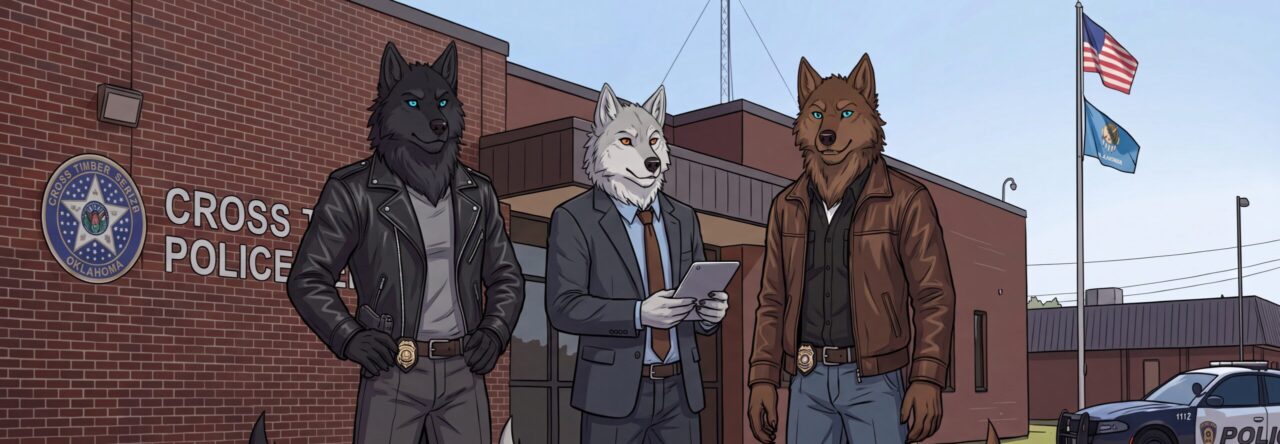
Sunday started earlier than Gabriel believed any Sunday had the right to start.
At 7:14 in the morning, he stood in the kitchen in a faded black T-shirt and loose work shorts, one hand wrapped around a mug of coffee and the other pressed to the side of his head as though he had been personally offended by daylight.
Thane came down the stairs wearing an old dark green work shirt with the sleeves cut short. His cargo pants had been modified for his tail, the knees already stained from some previous project neither Gabriel nor Mark had ever managed to identify.
Mark sat at the island with a tablet open beside a printed volunteer confirmation.
He had dressed exactly as expected: gray work shirt, dark utility pants, compact first-aid pouch clipped to his belt, and a small notebook tucked into one pocket.
Gabriel stared at him.
“You have a notebook.”
“It is a volunteer workday.”
“Yes.”
“Volunteer workdays involve measurements, material counts, task assignments, and basic logistical coordination.”
Gabriel took a sip of coffee.
“You are excited.”
“I am prepared.”
“That is Mark for excited,” Thane said as he crossed toward the refrigerator.
Mark gave him a look.
“You are both confusing competence with emotion.”
Gabriel smiled faintly.
“Sure.”
The kitchen smelled like coffee, toast, and the breakfast burritos Thane had started warming in the oven before anyone else came downstairs. Outside, sunlight already moved through the trees beyond the wide cabin windows. The June morning was bright and warm, the kind that would be pleasant for another hour and then begin reminding everyone that Oklahoma did not believe in moderation.
Thane set three bottles of water on the counter.
“We need to leave in twenty minutes.”
Gabriel looked at the clock.
“We need to leave at all?”
“Yes.”
“Why?”
Thane looked at him.
“Because we signed up.”
Gabriel narrowed his eyes.
“Who signed us up?”
Mark raised one hand slightly.
“I forwarded the community-center announcement.”
“That is not the same thing.”
“You all replied.”
Gabriel looked at Thane.
“You replied?”
Thane opened the oven, checked the burritos, then looked back at him.
“It is a garden expansion and pantry buildout. They need volunteers.”
Gabriel paused.
“Today?”
“Yes.”
“Like… actual work?”
“Like actual work,” Thane said.
Gabriel’s ears drooped.
“On a Sunday.”
Mark looked down at the printed confirmation.
“The Eastside Community Garden serves the pantry program at Hollow Creek Community Center. They are adding six raised beds, replacing a damaged rainwater-catchment system, expanding the accessible path, and reorganizing the pantry’s dry-goods storage.”
Gabriel listened.
Then looked at the three bottles of water.
“Why do I get the feeling you have known about this for days?”
“Because I told you about it Friday morning,” Mark said.
Gabriel thought.
Then pointed at him.
“That was before the cake incident.”
“The cake incident did not erase the calendar.”
“Emotionally, it did.”
Thane pulled the burritos from the oven and set them on plates.
“We are going.”
Gabriel stared at the plate in front of him.
Then at the morning sunlight.
Then at the two wolves who had apparently decided that the correct use of a Sunday was hauling dirt in the heat.
“Fine,” he said at last. “But I am not pretending to enjoy wheelbarrows.”
Mark looked up.
“Nobody asked you to.”
“Good. Because they are a betrayal of engineering.”
Thane sat down with his breakfast.
“Eat.”
Gabriel did.
He complained while doing it, but he ate every bite.
The Hollow Creek Community Center sat in an older east-side neighborhood where small brick homes stood beneath thick shade trees and nearly every front porch had some version of a folding chair, a wind chime, or a flowerpot someone had painted by hand.
The community-center building had once been an elementary school.
Its faded red-brick walls still held the shape of that history: broad windows, a central entrance, wide hallways visible through the front glass, and an old playground at the back that had been converted into a small public recreation area.
Behind the building, the garden spread across what had once been a cracked section of blacktop.
It already had several raised beds, a compact greenhouse, a compost area, two rain barrels, and a small covered table where pantry volunteers sorted donated produce.
Today, the space was full of people.
Families in work clothes.
Teenagers from a local church youth group.
A pair of older women in sun hats and gardening gloves.
A retired firefighter in a sweat-darkened T-shirt.
Two middle-school boys carrying shovels much too large for them.
A dozen folding tables.
Stacks of lumber.
Pallets of bagged soil.
Cinder blocks.
Mulch.
Garden tools.
Boxes of canned goods waiting to be sorted inside the center.
And, parked near the curb, the Humvee.
The moment Thane turned into the lot, three teenagers near the volunteer check-in table stopped moving.
One pointed.
The other two looked.
Gabriel groaned quietly from the passenger seat.
“There it is.”
Thane parked along the far edge of the lot.
“It will be fine.”
Gabriel looked at the growing cluster of people noticing the vehicle.
“You say that like you do not understand what the Humvee does to people.”
Mark climbed out of the back seat carrying the water and a small canvas tool bag.
“It is visually distinctive.”
“That is Mark for ‘people are going to lose their minds,’” Gabriel said.
Thane opened the rear hatch and pulled out a pair of old work gloves. He held them up, looked at the claws at the end of his fingers, then tossed the gloves back into the cargo area.
Gabriel noticed.
“Going barepawed?”
“Easier.”
Mark did the same with his own gloves.
Gabriel looked at his claws.
“I am pretty sure my hands are already gardening equipment.”
They crossed the lot.
The volunteer coordinator spotted them almost immediately.
She was a Black woman in her late forties with a bright orange Hollow Creek Community Center shirt, jeans, Keen work boots, and a clipboard that looked as though it had survived several previous community projects by force of personality alone.
For a second, she stopped.
Then she recovered.
“Detectives?”
“Off duty,” Thane said.
Her expression softened.
“Right. Sorry. Thane?”
“Yeah.”
“I am Renee Holloway. I run the community center.”
She held out her hand.
Thane shook it carefully.
“Nice to meet you.”
Renee looked at Gabriel and Mark.
“You three are really here.”
Gabriel smiled.
“That is usually how it works.”
Renee laughed once, still looking faintly stunned.
“I saw the volunteer confirmation come through and thought somebody was playing a joke on me.”
Mark held up the printed registration sheet.
“It was a legitimate confirmation.”
“I believe that now.”
Renee glanced toward the cluster of people gathering near the check-in table.
Her expression shifted into practical concern.
“I need to ask,” she said carefully, “were you expecting media? Or a photographer? We did not arrange anything.”
Thane shook his head immediately.
“No.”
Renee blinked.
“No?”
“We did not come for that,” he said. “No media. No special announcement. We came to work.”
For a moment, she just looked at him.
Then some of the surprise left her face.
“Okay,” she said.
Gabriel smiled.
“Where do you need us?”
Renee looked past them toward the garden.
Then at the stacks of lumber.
Then at the pallet of soil, where three volunteers were already studying a pallet jack with the resigned expression of people who had discovered a design limitation.
Her smile came back.
“Oh, I have ideas.”
Before she could say more, the first teenagers reached them.
A girl with a volunteer badge clipped to her shirt held up her phone, looking embarrassed.
“Excuse me,” she said. “Could we get a picture first? Before you get all dirty?”
Gabriel glanced at Thane.
Thane looked at Renee.
Renee gave a small shrug.
“It may be easier to get it out of the way.”
Gabriel nodded.
“Okay. Five minutes.”
The five minutes became twelve.
Not because anyone was rude.
Just because people were excited.
A middle-aged couple asked for a photo with all three wolves. A young boy named Kaden wanted one with Thane because he had “the biggest paws.” An older volunteer asked Mark to sign a small notebook for her granddaughter, who was apparently studying criminal justice. Two teenage girls asked Gabriel whether he was really “the funny one.”
Gabriel looked toward Mark.
“See? Officially confirmed.”
Mark signed the notebook.
“To Brianna,” he wrote. “Ask good questions. Check the facts. Do not let confidence replace evidence.”
The older volunteer read it and smiled.
“That is good advice.”
“It generally is,” Mark said.
Gabriel signed the girls’ phone cases with a marker someone produced from nowhere.
“To Kayla,” he wrote on one. “Be kind. Drink water. Do not let your friends film you doing dangerous things.”
On the other, he wrote:
“To Tori. Trust your instincts, but do not text while walking.”
The girls laughed.
Thane signed a baseball cap for Kaden, then crouched carefully when the boy asked whether he could touch one of Thane’s claws.
“Just the back,” Thane said.
Kaden traced one fingertip over the brown fur near Thane’s wrist, then stared at the claw with enormous seriousness.
“Are they sharp?”
“Yes.”
“Do they hurt?”
“They can.”
Kaden thought about that.
“Do you use them on bad guys?”
Thane looked at him.
“I use them carefully.”
Kaden nodded as if that had answered something important.
Then he hesitated, clutching the phone his father had handed him.
“Could I get a picture with you?”
Thane nodded.
“Sure.”
Kaden stepped closer, then looked up with sudden uncertainty.
“Could you maybe do, like… a wolf face?”
Gabriel turned his head immediately.
“A wolf face?”
Kaden’s eyes went huge.
“Like snarling. Or growling. If that is okay.”
His father looked embarrassed.
“You do not have to do that, sir. I am sorry. He just thinks—”
“It is fine,” Thane said.
Kaden froze.
“Really?”
Thane looked down at him.
“You sure you want the scary version?”
Kaden nodded so hard his hair bounced.
“Yes.”
Gabriel took the phone from him.
“Oh, this is absolutely happening.”
Mark sighed, though his ears had tipped forward.
“Of course it is.”
Kaden hurried to Thane’s side, trying to look fierce.
“Like this?” he asked, throwing his hands up like claws and making the most determined little growl face he could manage.
Gabriel nearly laughed.
“Perfect. No notes.”
Thane lowered himself slightly so he was closer to Kaden’s height. Then he turned toward the phone, squared his shoulders, bared his fangs, and let out a low, rumbling growl.
It was controlled.
Not loud enough to frighten anyone.
But real enough that three nearby volunteers startled and one teenage girl made a startled noise before immediately laughing at herself.
Kaden did not flinch.
He threw his hands up beside Thane’s, made his fiercest face again, and looked directly at the camera.
Gabriel snapped the photo.
Then another.
Then a third.
When Thane let the growl fade and relaxed, Kaden looked like he had just been handed the greatest picture in the history of pictures.
His father stared at the phone screen.
“Oh, he is never getting over this.”
Gabriel handed the phone back.
“He should not.”
Kaden looked at the picture and made a sound halfway between a laugh and a squeal.
“This is SO AWESOME.”
Thane’s mouth shifted with a faint smile.
“Glad you like it.”
Kaden looked up at him with complete seriousness.
“That is the coolest picture I have ever had.”
Gabriel leaned toward Mark.
“He is correct.”
Mark nodded once.
“Objectively.”
Then Kaden ran back to his father, clutching the phone like it contained classified evidence.
Renee watched the crowd with a mixture of amusement and concern.
Gabriel noticed.
“Okay,” he called gently. “Last couple, then we have to go carry things.”
A few people laughed.
The crowd thinned.
The phones lowered.
And the day became about work.
Renee led them through the garden.
The existing beds stood in neat rows beside the greenhouse, full of tomatoes, peppers, squash, herbs, and a few determined sunflowers that had pushed themselves taller than the fence line.
Beyond them, six new bed frames lay stacked near the edge of the former blacktop.
Each was built from thick cedar boards, eight feet long and four feet wide, already screwed together but not yet placed.
A trench had been dug for a gravel base and accessible path.
A small group of volunteers stood nearby, trying to decide how to carry the first frame without scraping it against the ground or breaking the uneven corners of the gravel bed.
Renee pointed.
“The new beds go there. We need them placed, leveled, lined, filled, and planted by the end of the day if we can manage it.”
Thane looked at the frames.
“How heavy?”
“Two or three people, normally,” Renee said. “We have been doing it in shifts.”
Thane walked to the nearest frame.
He crouched, slipped his claws beneath the lower edge, and tested the weight.
Cedar.
Solid.
Awkward more than impossibly heavy.
He looked back at Renee.
“Where exactly?”
She pointed to the first cleared rectangle.
“North edge aligned with the string line. Six inches from the path.”
Mark was already crouched beside the stakes.
“The first frame needs to be square to the existing beds,” he said. “Otherwise the accessible path will pinch near the greenhouse.”
Renee looked at him.
“Yes. Exactly.”
Mark stood and pointed toward the far corner.
“Thane, if you set this edge parallel to the string, I can confirm the spacing.”
Thane nodded.
Then lifted the entire bed frame by himself.
The conversation around him stopped.
Not dramatically.
No one screamed.
But every nearby volunteer went still for half a second as the broad cedar rectangle rose smoothly off the ground.
A retired firefighter named Walt, who had been about to grab one side, stared at Thane.
“You got that?”
Thane looked at him.
“Yeah.”
Walt took one step back.
“Apparently.”
Thane carried the frame carefully across the gravel, holding it high enough that the bottom boards cleared the uneven ground. He did not hurry. He did not swing it around. He moved with the precise, quiet attention of someone carrying something breakable.
“Two inches left,” Mark said.
Thane shifted.
“Straighten the far side a little.”
Thane adjusted.
“Stop.”
He lowered the frame gently into place.
The cedar settled exactly inside the string lines.
Mark crouched, checked the corners, then looked up.
“Square within less than half an inch.”
Renee stared at the bed.
Then at Thane.
Then at Mark.
“That usually takes four people and an argument.”
Gabriel smiled.
“We have fewer people, but we can still argue if it helps the atmosphere.”
“No,” Mark said.
Walt walked over and checked the frame himself.
His hand rested on the cedar corner.
Then he looked at Thane.
“That was a hundred-and-something pounds.”
“Probably,” Thane said.
Walt shook his head once.
“You made it look like a chair.”
Thane’s ears lowered slightly.
“It was awkward.”
“That is not the word I would use.”
Renee looked at the remaining five frames.
Then looked at the wolves.
“Can you do the others?”
Gabriel stepped toward the next one.
“Where do you need them?”
Renee smiled.
And the work began.
By ten-thirty, the garden had changed shape.
Thane carried three more cedar frames into position.
Gabriel carried the next two, each resting across his shoulder while he navigated around shovels, wheelbarrows, and volunteers with the careful ease of someone who had learned long ago that strength was only useful if nobody got hurt around it.
Mark carried the last frame alone, one end tucked against his side, claws gripping the lower board while he stepped precisely along the edge of the gravel base.
The frame was not as heavy as the others.
It was just more awkward.
Twelve feet long, built to become a narrow herb bed beside the greenhouse.
Three volunteers had been trying to hold it level.
Mark picked it up, checked the path, and carried it through the narrow opening without touching a single tomato plant.
A teenage volunteer named Jessa watched him move past.
“You are not even struggling.”
Mark looked at her.
“It is not particularly efficient to struggle.”
Jessa laughed.
“That was not an answer.”
“It was accurate.”
Gabriel, working nearby with a shovel, looked over.
“That is Mark for ‘yes, I am showing off a little.’”
“I am not.”
“You carried a twelve-foot garden bed by yourself.”
“It needed moved.”
Jessa grinned.
“You guys are weird.”
Gabriel nodded.
“Correct.”
Once the beds were in place, the real work started.
Landscape fabric had to be cut and laid.
Gravel needed to be leveled beneath the frames.
Soil had to be moved from pallets at the back lot into each bed.
Compost needed to be mixed.
The accessible path needed another layer of crushed stone.
And inside the community center, pantry donations had arrived in more boxes than anyone had expected.
The volunteers divided naturally into groups.
Some worked in the garden.
Some ran the pantry tables.
Some sorted seeds and labels.
Some unpacked canned food and hygiene products from donation boxes.
The wolves did whatever was needed.
At first, people kept looking at them.
Not in a bad way.
Just in disbelief.
Thane would take a stack of bagged soil that two volunteers had been preparing to lift together, settle it against one shoulder, and carry it to a raised bed without breaking stride.
Gabriel would pick up a large rolled section of landscape fabric and a box of irrigation fittings at the same time, then grin at the volunteer who had been reaching for the box.
“Where do you want it?”
Mark would carry long cedar boards, bags of gravel, stacks of pantry boxes, and a heavy metal shelving unit with the same calm expression he used when reviewing evidence logs.
Nobody could quite get used to it.
At one point, Walt and another volunteer were trying to drag an old cast-iron bench away from the path construction area.
It had been sitting near the garden since before the community center opened. Heavy, weathered, painted green twenty years ago and touched up in several different shades since.
Walt wiped sweat from his forehead.
“Need four people on this thing.”
Thane looked over.
“How far?”
Walt pointed to a new concrete pad beneath a shade tree near the garden entrance.
“Just over there.”
Thane walked to the bench.
He tested it with both hands.
The iron legs scraped slightly against the pavement.
He looked at Walt.
“Clear the path.”
Walt raised both eyebrows.
“You sure?”
“Yeah.”
Walt and the other volunteer stepped back.
Thane crouched, slid his claws carefully beneath the iron frame, and lifted.
The bench came up in one smooth motion.
It was too heavy for any one human volunteer to move safely alone. It was also long, bulky, and uneven enough that lifting it wrong could have damaged the old ironwork or sent someone stumbling backward.
Thane carried it slowly.
No strain in his face.
No flexing.
No dramatic pause.
Just careful steps across the garden edge, around a stack of soil bags, and onto the newly poured pad.
“Little left,” Mark said.
Thane shifted.
“Back an inch.”
Thane adjusted.
“Good.”
He lowered the bench so gently that its legs touched the concrete without a scrape.
For a second, nobody said anything.
Then Walt let out a low whistle.
“I have been lifting things my whole life,” he said. “And that is one of the more ridiculous things I have ever seen.”
Thane looked at the bench.
“Is it straight?”
Mark checked it.
“Within one degree.”
Walt looked at Mark.
“You measure the bench?”
“It matters.”
Gabriel rested both forearms on the handle of a shovel.
“Welcome to our home life.”
A few people laughed.
The tension broke.
Work resumed.
But after that, the volunteers stopped asking whether the wolves could handle something.
They simply pointed.
“Where do you need it?”
That became the question all day.
Where do you need it?
The lumber stack.
The soil pallets.
The pantry shelves.
The rainwater tank.
The heavy metal rolling cart that had been stuck in a storage room for years.
The sagging picnic table that needed to be moved out of the way before the accessible path was finished.
Where do you need it?
The answer was always somewhere.
And the wolves went.
The rainwater system became the first real problem of the day.
A donated 275-gallon water tank had arrived on a flatbed trailer that morning.
It was empty, but it was still massive: white plastic inside a metal cage, taller than most of the volunteers and wide enough that the delivery driver had to angle it carefully around the center’s rear gate.
It needed to go beside the greenhouse, where a new gutter system would feed rainwater from the community-center roof into the tank for garden irrigation.
The driver had a small lift gate.
The community center had gravel, uneven grass, and a narrow path between the greenhouse and a maple tree.
The pallet jack could not cross the grass.
The delivery driver looked at the tank.
Then at the path.
Then at Renee.
“I can leave it here,” he said. “But I cannot guarantee I can get it where you want it.”
Renee looked at the tank.
Then at the greenhouse.
Then at the volunteers.
Nobody said anything.
Gabriel stepped closer.
“How much does it weigh empty?”
The driver shrugged.
“Maybe a hundred and fifty? More with the cage. It is just awkward.”
Mark walked the route from the trailer to the greenhouse.
He measured the narrowest point with his eyes, then checked the gap between the tree and the corner of the building.
“Thirty-eight inches,” he said. “It will fit if we rotate it through the gate and keep the lower cage clear of the stone border.”
The driver looked at him.
“You sure?”
Mark nodded.
Thane looked at Gabriel.
Gabriel looked at Mark.
Then all three looked at the tank.
Renee folded her arms.
“You are about to do something that will make my insurance policy nervous, are not you?”
Thane looked at her.
“We will be careful.”
“Those words rarely make me feel better.”
Walt came over from the raised beds, wiping dirt from his hands.
“What is happening?”
Gabriel pointed.
“Big plastic thing needs to go over there.”
Walt looked at the tank.
“That big plastic thing is an IBC tote.”
Gabriel nodded.
“Sure.”
“Four people, maybe six,” Walt said.
Thane stepped toward one side of the tank.
Gabriel took the other.
Mark moved to the rear corner.
They did not try to lift it all at once.
First, Mark checked the metal cage for sharp bends and loose wire.
Then Thane and Gabriel shifted it just enough to find its balance.
Then they moved it off the trailer’s lift gate.
The tank rose.
Not high.
Not dramatic.
Just enough to clear the lip.
Thane took most of the front weight. Gabriel balanced the opposite end. Mark guided the lower cage and watched the corners.
The three of them carried it across the grass.
Every volunteer nearby stopped working.
A few phones came out.
Renee raised one hand immediately.
“No videos unless they say it is okay.”
Gabriel, still carrying a portion of a giant water tank, managed to look toward her.
“Pictures are fine later. We are busy.”
Several people laughed.
They turned the tank sideways near the greenhouse.
Mark called the clearances.
“Two inches right. Now rotate. Stop. Thane, lift the front three inches. Gabriel, level. Good.”
The tank slid into place beside the gutter line.
Thane and Gabriel lowered it gently.
Mark stepped back, checked the angle, then nodded.
“Correct position.”
The delivery driver stared at the tank.
Then at the empty trailer.
Then at the three wolves.
“I have seen crews of six take longer than that.”
Gabriel rubbed one hand against his shirt.
“Good crew.”
Walt shook his head.
“You guys ever think about construction?”
Thane glanced toward the garden beds.
“We have enough jobs.”
Walt looked around at the work they had already done.
“Fair.”
Renee walked over and touched one hand to the metal cage of the tank.
Her eyes were bright.
“That was supposed to take us half the afternoon,” she said.
“It still needs connected,” Mark said.
Renee looked at him.
“You are right.”
Mark pointed toward the irrigation fittings.
“Where are the downspout adapters?”
A volunteer near the supply table raised a hand.
“Blue bin.”
Mark nodded.
“Then we should proceed.”
Gabriel looked at Thane.
“He is fully in it now.”
Thane smiled faintly.
“Yeah.”
By noon, the garden looked like it had been transformed by a very organized storm.
The six new raised beds stood in two straight rows.
Their cedar frames glowed honey-colored in the sunlight.
Soil filled the first four nearly to the top.
The accessible path had taken shape along the greenhouse side.
The rainwater tank stood waiting beside the new gutter line.
The old cast-iron bench had been moved under the maple tree, where someone had already placed a small hand-painted sign beside it:
REST HERE. THEN KEEP GROWING.
Inside, pantry volunteers had built new shelving rows and started sorting food by category.
Outside, the air smelled like mulch, soil, herbs, hot gravel, and the sweet smoke of a grill someone had set up near the shade tent.
Renee called everyone in for lunch.
The volunteers gathered beneath a line of pop-up canopies.
Someone had brought hot dogs, burgers, baked beans, chips, sliced watermelon, and a huge cooler full of ice water.
Nobody had expected a formal event.
It was not one.
People ate standing up, sitting on overturned buckets, perching on the edges of raised beds that were not yet planted, or folding themselves into camp chairs beneath the shade.
The wolves sat with Walt, Jessa, and a few of the church-group volunteers near the garden entrance.
Gabriel had dirt across one cheek and a streak of dark soil down one forearm.
Mark’s shirt had somehow remained mostly neat except for a smear of gravel dust near one shoulder.
Thane looked as though he had been assembled out of cedar, mulch, and determination.
Jessa sat across from them, drinking water and staring at the new beds.
“You guys really came here just to volunteer?”
Gabriel took a bite of his burger.
“Yep.”
“No cameras. No event. No big speech?”
“Nope.”
Jessa looked at Thane.
“Why?”
Thane looked down at his plate for a moment.
Then toward the garden.
“Because it needs built.”
Jessa followed his gaze.
“That is it?”
“That is enough.”
Walt nodded slowly.
“That is a pretty good answer.”
Kaden had ended up at the next table over with his father, dirt on his knees, a hot dog in one hand, and his phone on the table beside him.
He had apparently shown the picture to every volunteer within reach.
Walt was looking at it now, holding the phone at arm’s length while Kaden watched him with the solemn pride of someone presenting a major scientific discovery.
“That,” Walt said, looking from the screen to Thane, “is a very convincing growl.”
Kaden beamed.
“I did the claws too.”
“You did,” Walt agreed. “You look terrifying.”
Kaden sat up straighter.
“I know.”
Gabriel leaned toward Thane.
“He has been emotionally promoted to wolf.”
Thane glanced at Kaden’s father.
“You okay with that?”
Kaden’s father laughed.
“I think he has been a wolf since kindergarten.”
Kaden looked back at the photo.
“Can I show this at school?”
“You can show it at school,” his father said. “You cannot use it to threaten anybody.”
Kaden looked genuinely offended.
“I would not.”
Gabriel nodded solemnly.
“Correct answer.”
Kaden pointed toward the garden beds.
“Are you tired?”
Thane looked at him.
“A little.”
Kaden’s eyes widened.
“Really?”
“Yeah.”
“But you lifted the big bench.”
“Strength does not mean you never get tired.”
Kaden looked at his small shovel leaning against the table.
“What does it mean?”
Thane thought about it.
Then said, “It means you still have to know when to be careful. And when to let other people help.”
Kaden nodded seriously.
His father smiled.
“That is good advice.”
Gabriel leaned toward Thane.
“You are accidentally becoming wise again.”
Thane looked at him.
“Eat your food.”
Mark took a drink of water.
“His point is correct.”
Gabriel looked at him.
“You too?”
“I am not being wise. I am confirming accuracy.”
Walt laughed.
“You three always like this?”
“Unfortunately,” Gabriel said.
Mark ignored him.
“You were a firefighter?” he asked Walt.
“Twenty-eight years,” Walt said. “Retired five years ago.”
Gabriel nodded toward the garden.
“And now you do this?”
“Gardens, pantry work, veterans’ breakfast twice a month, grandkids whenever they let me.” Walt smiled. “Keeps me useful.”
Thane looked at the raised beds.
“You are useful.”
Walt looked at him for a second.
Then nodded.
“Thanks.”
A young woman approached their table holding a phone.
She looked at Renee first.
Renee looked at the wolves.
Gabriel set down his burger.
“Okay. Lunch selfies.”
The young woman smiled.
“Only if you have time.”
“We have time.”
For the next fifteen minutes, they took pictures with volunteers.
Not dozens this time.
Just the people who had spent the morning working beside them.
Jessa got one with all three wolves, shovel over one shoulder.
Walt took a picture with Thane in front of the cast-iron bench.
Kaden got one holding his tiny shovel beside Gabriel, who posed with exaggerated seriousness.
Mark ended up in a picture with three pantry volunteers who had discovered that he had spent half an hour helping them organize food-storage labels by expiration date and category.
One of them looked at the labels and said, “You made this make sense.”
Mark looked at the shelves.
“It was not difficult.”
The volunteer smiled.
“It was to us.”
Mark’s ears lowered slightly.
“You are welcome.”
Then lunch ended.
The work started again.
The afternoon was hotter.
The kind of heat that pressed down from above and radiated up from the old pavement beneath the garden area.
Volunteers moved a little slower.
Water breaks happened more often.
The shade tents became more valuable.
But nobody left.
Not the church group.
Not Walt.
Not the older women in sun hats.
Not the pantry crew.
And not the wolves.
Thane spent the next hour hauling soil into the final two beds.
The bags were heavy enough that most volunteers carried one at a time or worked in pairs.
Thane carried three.
Gabriel carried two, then added a third after a teenager tried to help him and nearly lost his grip on the top bag.
Mark carried two large bags at a time but spent more of his energy arranging the distribution so nobody was making unnecessary trips.
He set up a simple relay line from the pallet to the beds.
Volunteers carried individual bags along the shorter sections.
The wolves handled the long distances and heavier loads.
It was not glamorous.
Nobody applauded every time a bag moved.
That was what made it good.
They worked.
They sweated.
They got dirt beneath their claws.
They lifted, carried, leveled, planted, swept, sorted, stacked, and repeated.
Gabriel found himself helping a group of children fill the first bed with soil.
The children had small plastic scoops and were determined to be useful.
They were also moving approximately three cups of soil at a time.
Gabriel knelt beside them.
“You know,” he said, “I think this might take a while.”
A little girl named Bri pointed toward the giant pile.
“We can do it.”
Gabriel looked at the scoop in her hand.
Then at the bed.
Then back at her.
“Okay. You take that side. I will take this side.”
Bri nodded.
Together, they worked.
Gabriel filled the bed with broad, careful shovelfuls while the children added their scoops to the corners, patted the soil flat, and argued about whether tomatoes or strawberries were the superior plant.
“Strawberries,” Bri said firmly.
“Tomatoes,” Kaden argued.
“Strawberries.”
“Tomatoes go on burgers.”
“Strawberries go on everything.”
Gabriel looked between them.
“Both are good.”
The children stared at him.
Then Bri said, “That is not choosing.”
Gabriel sighed.
“You are right. Strawberries.”
Kaden looked betrayed.
“Gabriel,” Mark called from beside the irrigation system, “you are creating a conflict.”
“I am resolving it emotionally.”
“That is not a resolution.”
Thane carried another stack of soil bags past them.
“Strawberries are better.”
Kaden stared at him too.
“This whole place is unfair.”
Walt, working nearby, laughed hard enough that he had to set down his rake.
The pantry expansion became Mark’s project by accident.
At first, he had only gone inside to help move a heavy metal shelving unit from the storage room.
The unit had been bolted to the floor years ago, then left half-empty after one leg bent slightly during a prior move.
Two volunteers had been trying to tilt it enough to adjust the footing.
Mark examined it.
Then crouched.
“Do not lift yet,” he said.
The volunteers paused.
He checked the bent leg, the floor seam, and the stack of boxes nearby.
Then he shifted the unit alone.
Not far.
Just enough to clear the floor seam.
He straightened the foot, set the unit back down, and tested it.
The shelves stopped wobbling.
One of the pantry volunteers blinked.
“That has been broken for six months.”
Mark looked at it.
“It was poorly positioned.”
The volunteer laughed.
“You are saying that like it is the shelf’s fault.”
“It was.”
After that, Renee asked whether he could help reorganize the pantry’s dry-goods area.
Mark had expected to move boxes.
Instead, he found a crowded room with mixed donation categories, overlapping expiration dates, canned goods stacked with paper products, hygiene supplies in three different places, and no clear space for volunteers to build food boxes efficiently.
He stood in the doorway for a minute.
Then removed his notebook.
Gabriel passed by the open pantry door with a bag of soil over one shoulder and saw Mark staring at the shelves.
“Oh no.”
Mark looked at him.
“What?”
“You have the face.”
“I do not have a face.”
“You have the ‘I have discovered a solvable system failure’ face.”
Mark looked back at the pantry.
“It is not efficient.”
Gabriel smiled.
“I will see you tonight.”
Mark did not deny it.
For the next two hours, he worked beside pantry volunteers.
He did not take over.
He asked questions.
What got used most often? Which items came in most often? Which boxes were hard to reach? Which volunteers worked weekday mornings? What did seniors ask for most? What did families need in the summer when school meals were not available?
Then he helped make the room make sense.
Breakfast items together.
Pasta and sauces together.
Canned vegetables and soups together.
Hygiene supplies near the packing table.
Baby items in one clearly labeled section.
Water and drink mixes low enough for volunteers to lift safely.
Older-date items forward.
Newer-date items behind.
The pantry volunteers did most of the moving.
Mark moved the heavy shelves, the stacked cases, and the awkward boxes that would have slowed everybody down.
By midafternoon, the room looked different.
Not fancy.
Not professionally designed.
Just usable.
A volunteer named Mrs. Lang stood at the packing table, looking around in disbelief.
“I can find things.”
Mark nodded.
“That is the intended result.”
She laughed.
“You know, you could run a warehouse.”
“I do not want to run a warehouse.”
“That is exactly what someone who could run a warehouse would say.”
Mark considered this.
Then said, “Perhaps.”
At four-thirty, the final raised bed was ready to plant.
The garden coordinator had brought seedlings from a local nursery: tomatoes, peppers, cucumbers, green beans, basil, mint, squash, lettuce, and a row of marigolds for the edges.
The volunteers gathered around the beds in smaller groups.
The hard construction work had slowed into quieter tasks.
Hands in soil.
Rows measured.
Seedlings placed.
Watering cans filled.
Kids assigned to label stakes.
The garden became a garden.
Not just lumber and dirt.
Not a list of projects waiting to be completed.
Something alive.
Thane knelt beside the far bed with Kaden and Bri.
They planted tomato starts beneath the afternoon sun.
Bri held the seedling carefully with both hands.
“Like this?”
Thane looked at the hole she had dug.
“Little deeper.”
She scooped out another handful of soil.
“Now?”
“Now.”
Bri lowered the plant in.
Thane helped guide the roots without crushing them.
Kaden planted a pepper beside it.
“What happens if we put them too close?” he asked.
“They fight for space,” Thane said.
“Like brothers?”
Gabriel, passing behind them with a watering can, looked over.
“Exactly like brothers.”
Mark did not look up from the label stakes he was arranging.
“Not exactly.”
Gabriel watered a row of basil.
“You know what I mean.”
Thane glanced at the plants.
“They need room to grow.”
Kaden nodded.
Then pressed the soil gently around the base of the pepper.
A few feet away, Renee stood beside the shade-tree bench with Walt.
They watched the garden come together.
Renee looked tired.
Happy tired.
The kind that did not come from a meeting or a successful grant proposal or a good day in an office.
The kind that came from watching a lot of people put their hands on something real.
She looked at Thane.
“You know these beds will feed people all summer.”
Thane looked at the seedlings.
“Good.”
“The pantry uses this produce for seniors, families, and the after-school program. People take home fresh food who normally get canned food or whatever is cheapest.”
Thane nodded.
“Good.”
Renee looked at him.
“That is all you have to say?”
Thane’s ears lowered slightly.
“It is what we came for.”
Renee looked over the garden.
At the cedar beds.
At the rainwater tank.
At the accessible path.
At the pantry volunteers carrying their first organized food boxes from the new shelves.
At Gabriel laughing with children near the tomato rows.
At Mark correcting the alignment of a sign stake by maybe half an inch.
At the three wolves who had arrived without press, without speeches, without a check, and worked until their clothes were dusty and their fur smelled like soil.
Then she smiled.
“Good hands,” she said.
Thane looked at her.
“What?”
Renee nodded toward the whole group.
“My grandmother used to say you can tell who means what they say by their hands. Some people point. Some people clap. Some people make promises. But good hands get dirty.”
Thane looked down at his own claws.
Dark soil packed in the fur around them.
A splinter of cedar caught near one knuckle.
A faint streak of mulch across the back of his wrist.
Then he looked back at the garden.
“Yeah,” he said quietly. “I like that.”
The final task took everybody.
The accessible path had been laid and leveled, but it needed one last layer of crushed stone before the garden could fully open to people using walkers, wheelchairs, strollers, or carts.
The remaining gravel sat in a large metal hopper near the back lot.
The small dump trailer that had delivered it could not get close enough to the path because of the garden fence.
Normally, it would take a long wheelbarrow line, several hours, and a lot of tired volunteers.
By then, everyone was tired anyway.
Gabriel stood beside a wheelbarrow and looked at it with open distrust.
“I still think these are poorly designed.”
Walt rested both hands on a shovel.
“They have one wheel.”
“Exactly. That is the problem.”
“One wheel makes it easier to turn.”
“It makes it easier to betray you on uneven ground.”
Thane looked at the hopper.
Then at the path.
Then at the volunteers.
“We can move it.”
Renee looked at the remaining gravel.
“It is a lot.”
Mark checked the distance.
“About fifty yards. The path needs roughly nine more wheelbarrow loads.”
Gabriel looked at the wheelbarrows.
“Nine?”
“Approximately.”
Gabriel brightened.
“Fine. I can survive nine.”
The volunteers formed a line.
Not because the wolves could have done every load alone.
They probably could have moved the gravel faster that way.
But that was not what the day was about.
Everybody took a job.
Thane filled wheelbarrows from the hopper with a shovel that looked too small in his hands.
Gabriel took the loaded wheelbarrows down the path, carefully keeping them balanced despite his complaints.
Mark leveled the gravel with a wide rake, measuring depth by eye and correcting the low spots with exacting patience.
Walt and the other adults worked beside them.
Kids carried small buckets of gravel to fill corners.
Teenagers tamped the surface.
Renee ran water and checked on volunteers.
Nobody stood around watching.
Nobody was a spectator.
The work took forty-five minutes.
By the end, Gabriel had stopped complaining about wheelbarrows.
Mostly.
He pushed the final load to the far end of the path, tipped it carefully, and stepped back.
Mark spread the last of the stone.
Then stood.
The accessible path ran cleanly from the community-center entrance past the pantry door, alongside the new raised beds, and toward the shaded bench beneath the maple tree.
Renee walked it slowly.
One foot after the other.
Then she turned.
“It is done.”
For a moment, nobody said anything.
Then the kids cheered.
The teenagers clapped.
Walt raised his shovel in the air.
Someone started applauding, and the rest of the volunteers joined in.
Not for the wolves.
Not only for the wolves.
For the whole day.
For the garden.
For the pantry.
For the fact that a cracked piece of old blacktop behind a community center now held new beds, fresh plants, working water storage, organized food shelves, and a path anyone could use.
Gabriel stood beside Thane, chest rising and falling with tired breaths.
“That feels good,” he said quietly.
Thane looked at the garden.
“Yeah.”
Mark dusted gravel from his hands.
“It is functional.”
Gabriel looked at him.
“That is your emotional statement?”
“It is a significant one.”
Thane smiled.
“Yeah.”
Renee came toward them with her clipboard tucked beneath one arm.
Her shirt was dusty.
Her hair had come loose from its clip.
She looked exhausted and proud.
“Group photo,” she said.
Gabriel’s ears tipped back.
“Are we allowed to be in it?”
“You are volunteers. Of course you are.”
Thane looked at the group assembling near the garden sign.
Then at the raised beds.
Then at the people who had worked all day.
“Okay,” he said.
The photograph took three tries.
On the first one, Kaden held his shovel over his face.
On the second, Gabriel looked at the wrong camera because another volunteer had tried to take a phone picture at the same time.
On the third, Mark was caught in the middle of telling someone not to lean against the still-wet path edging.
Renee finally held up her clipboard.
“Everyone look here. Nobody move. Gabriel, stop talking.”
“I was not talking.”
“You were absolutely talking.”
“I was smiling.”
“You can smile quietly.”
Gabriel smiled quietly.
The photo was taken.
Later, it would probably end up on the community center’s social page with a simple caption about volunteers, garden beds, pantry shelves, and a Sunday of hard work.
By the time the Humvee pulled back into the cabin driveway, the sun had started to lower behind the trees.
The three wolves climbed out slowly.
Not injured.
Not truly worn down.
But tired in the good way.
Tired in their shoulders and legs.
Tired from heat, movement, lifting, dirt, and a full day spent doing something real.
Gabriel opened the rear hatch and stared at the empty cargo area.
“We did not bring anything home.”
Thane looked at him.
“We brought ourselves home.”
“That sounds like something you would say after we forgot groceries.”
“We did not forget groceries.”
Mark grabbed the water bottles.
“Technically, we brought dirt home.”
Gabriel looked down at his clothes.
He was coated in soil from knee to elbow. There was mulch caught in the fur of his forearms. His shirt had a green smear across the front from helping move the rainwater tank.
“Okay,” he said. “We brought a lot of dirt home.”
Inside, the cabin felt cool and quiet.
The clean paper towels from Target sat exactly where Mark had stocked them.
The pantry was full.
The coffee was ready.
The den was comfortable.
But none of them went straight to the couch.
First, they cleaned up.
Instead, there were muddy clothes in the laundry room, towels on the floor, a trail of mulch near the shower hall, and Mark standing in the doorway telling Gabriel not to shake dirt out of his fur in the living room.
“I did not shake,” Gabriel said.
“You were about to.”
“I was stretching.”
“You were preparing to shake.”
Thane passed them both carrying a laundry basket full of work clothes.
“Outside.”
Gabriel looked at him.
“I am not a dog.”
“No,” Thane said. “You are worse. Outside.”
Gabriel went outside.
Mark followed, mostly to make sure he did not shake near the porch furniture.
Ten minutes later, all three of them sat around the kitchen island in clean clothes.
Thane had made grilled cheese sandwiches and tomato soup because none of them had enough energy left for a complicated dinner.
Gabriel had added chips to his plate.
Mark had added fruit.
Thane had added extra cheese to everything.
They ate in silence for the first several minutes.
Not awkward silence.
Satisfied silence.
The kind that came after a day where everyone had used up enough words.
Gabriel finally looked up from his soup.
“You know what I liked?”
Thane glanced at him.
“What?”
“That nobody needed us to be detectives.”
Mark nodded.
“We were still useful.”
“Yeah,” Gabriel said. “But nobody was scared. Nobody was having the worst day of their life. Nobody needed a report or a case number or somebody to explain what happened next.”
Thane took a bite of grilled cheese.
“People needed beds built.”
“Exactly.”
Mark rested his spoon against the side of his bowl.
“The accessible path matters.”
Gabriel smiled.
“I knew you would say that.”
“It does.”
“It does,” Gabriel agreed.
Thane looked toward the kitchen windows.
The light outside had gone soft through the trees.
He thought of the garden.
The little tomato plants.
The rainwater tank beside the greenhouse.
The cast-iron bench beneath the maple.
The pantry shelves Mark had made usable.
Kaden’s small shovel.
Bri declaring strawberries superior to tomatoes.
Renee saying good hands get dirty.
“It felt honest,” Thane said.
Gabriel looked at him.
“Yeah.”
Mark nodded once.
“It was real help.”
Thane looked down at his hands.
They were clean now.
Mostly.
A little dirt still lived beneath one claw where the shower had not quite reached.
He could scrub it out later.
For now, he did not mind.
The world had too many things that could not be fixed with one afternoon of work.
Too many problems that needed more than strong backs, cedar boards, soil, and willing hands.
But a garden could be built.
A pantry could be organized.
A path could be made accessible.
Food could grow.
People could carry boxes together.
And for one Sunday, the three wolves had not needed money, influence, or a badge to matter.
They had just needed to show up.
Gabriel finished his soup and leaned back in his chair.
“Next Sunday, I am doing absolutely nothing.”
Mark looked at him.
“You said that last week.”
“This time I mean it.”
Thane smiled faintly.
“Sure.”
Gabriel pointed at him.
“Do not sign us up for anything.”
Thane looked at Mark.
Mark looked at his tablet, which had been left on the counter all day.
Then back at Gabriel.
“I will not forward any volunteer announcements before Tuesday.”
Gabriel stared at both of them.
“This is how I end up carrying mulch.”
Thane stood and gathered the empty bowls.
“You carried one bag of mulch.”
“I carried it emotionally.”
Mark nodded.
“That part is true.”
Gabriel sighed.
Then smiled.
“Good day, though.”
Thane looked at him.
“Yeah.”
Mark took the last bite of his grilled cheese.
“Good day.”
Outside, the trees moved in the evening breeze.
Somewhere across Cross Timber, volunteers were probably still walking home dirty and tired, telling families about the beds they had built and the food pantry they had organized and the wolves who had carried things that should have required three people.
But what Thane would remember was not the surprise on anyone’s face.
It would be the moment the whole group had moved the last wheelbarrow load of gravel together.
Nobody standing back.
Nobody waiting for someone else to fix it.
Just hands.
Good hands.
And work worth doing.