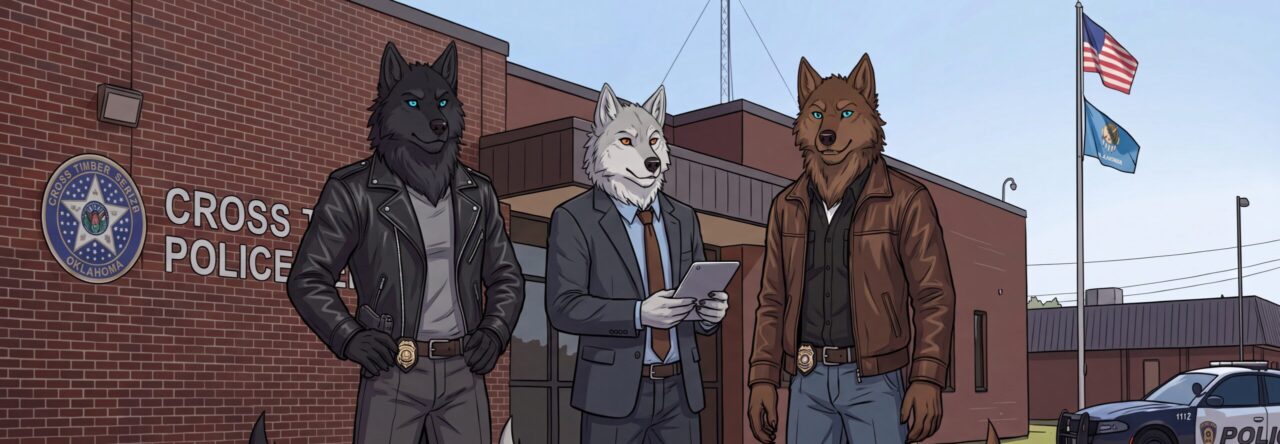
Friday arrived without a press conference.
No cameras waited in the lobby.
No one had asked Thane to stand beneath a department seal and explain gunfire, healing, risk, or why the people who worked beside him deserved more attention than he did.
The flower table in the lobby had shrunk to one small arrangement near reception.
The cards had been moved into neat archival boxes, except for the handful Carla still kept out for officers coming off difficult shifts.
The department had begun to look like itself again.
That was good.
Thane walked into the Night Shift office at 18:03, expecting the familiar beginning-of-evening handoff.
Voss stood at the far end of the table with a folder open in front of her.
Rusk leaned against the counter with coffee in one hand.
Gabriel entered behind Thane, already looking suspiciously pleased with the fact that the night did not appear to contain any microphones.
Mark followed with his notebook, tablet, and the small expression of satisfaction he got whenever a room contained the correct number of chairs and none of them were occupied by reporters.
Thane crossed to his desk.
Then stopped.
A box sat in the center of it.
It was square.
Plain brown cardboard.
Large enough to hold a small appliance, a stack of files, or a deeply impractical gift.
A red bow had been taped across the top.
No card.
No return label.
No explanation.
Thane looked at the box.
Then at the bow.
Then at Gabriel.
Gabriel’s expression remained almost impressively neutral.
Almost.
“Do not,” Thane said.
Gabriel blinked.
“I have not done anything.”
“You are enjoying something.”
“I enjoy many things.”
Mark set his tablet on the table.
“The bow is suspicious.”
Rusk took a slow drink of coffee.
“Everything is suspicious to you.”
“No,” Mark said. “Only things that present themselves without identifying information.”
Voss looked at the box.
“Do not open it if you think it is a threat.”
Thane studied the cardboard.
It smelled like cardboard.
Packing tape.
A faint trace of store shelf dust.
Nothing chemical.
Nothing sharp.
Nothing concerning.
Underneath it all, something dry and animal.
He looked at Voss.
“It is not a threat.”
“Then open it carefully,” she said.
Thane set one claw beneath the edge of the tape.
Gabriel had taken one step closer.
Mark had shifted just enough that he could see inside without leaning over Thane’s shoulder.
Rusk remained against the counter.
Perfectly still.
Perfectly straight-faced.
The tape tore.
Thane lifted the top flaps.
Looked inside.
Then went very quiet.
For a second, no one moved.
He reached down into the box.
Slowly withdrew the contents.
It was a large rawhide dog-bone chew toy.
Ridiculously large.
Nearly the length of Thane’s forearm.
White at the center, knotted at both ends, and wrapped in a clear plastic sleeve bearing a cheerful label that read:
NATURAL BEEF-FLAVOR CHEW
Thane stared at it.
His ears tipped back.
A low growl began somewhere deep in his chest.
Gabriel made one strangled sound.
Then doubled over against the edge of the table, one hand pressed to his muzzle as laughter shook him.
Mark looked at the rawhide.
Looked at Thane.
Then looked away.
His shoulders moved once.
Twice.
He was chuckling.
Actually chuckling.
Voss closed her eyes briefly.
Rusk remained still.
Thane turned slowly.
The rawhide bone hung from one paw.
His gaze traveled around the room.
To Gabriel, who had lost any remaining ability to pretend.
To Mark, who was attempting to rearrange a stack of folders without looking amused.
To Voss, whose expression had the exhausted patience of someone who knew better than to ask how much worse this was about to become.
Then to Rusk.
“Okay,” Thane said.
His voice was calm.
That was worse than the growl.
“Which one of you did this?”
Gabriel managed to straighten halfway.
“It could have been anyone.”
“No,” Thane said, still looking at Rusk. “It could not.”
Rusk lifted one eyebrow.
“Strong accusation.”
“You are the only person in this room old enough to think rawhide is still funny.”
Voss made a quiet sound into one hand.
Gabriel folded over again.
Mark’s ears flattened against his head as he fought another laugh.
Rusk’s mouth twitched.
Only slightly.
“I will have you know,” he said, “the gift was selected with great care.”
“Was it?” Thane asked.
“I considered a squeaky toy.”
Gabriel made a noise so abrupt he had to sit down.
Thane looked at the bone again.
Then at the box.
Then back at Rusk.
The growl deepened.
Rusk’s expression finally cracked.
A smile began at the corner of his mouth.
That was enough.
Thane moved.
One instant he stood beside his desk.
The next, he planted one paw on the desk edge, vaulted cleanly over the two empty guest chairs, and landed directly in front of Rusk and Voss in one fluid motion.
The chairs did not move.
The coffee on the counter did not spill.
But the sound of Thane’s landing carried through the office hard enough that the officers passing in the Investigations hallway stopped.
Darnell appeared in the doorway first.
Patel behind her.
Then Grant.
Then two patrol officers Thane did not know well enough to name without checking their badges.
Every face went still.
Thane held the rawhide bone loosely at his side.
His shoulders squared.
His blue eyes narrowed.
The expression he wore was not the Kaden Face.
The Kaden Face was theatrical. Controlled. Something a child could laugh at once the growl ended.
This was quieter.
Sharper.
His lips lifted just enough to show his teeth.
A warning without sound.
Rusk stopped smiling.
For perhaps the first time in several years, Detective Owen Rusk looked genuinely unsure whether he had made an error in judgment.
Voss did not move.
But her eyes tracked Thane’s hands, his stance, the distance between him and Rusk.
She knew him too well.
She knew the difference between anger and control.
Outside the office, nobody breathed.
Thane took one step toward Rusk.
Rusk’s coffee lowered slowly.
“Thane,” he said.
Thane stared at him.
Then the snarl vanished.
His expression broke into a wide, bright, entirely toothy grin.
He set one large paw on Rusk’s shoulder.
“You need new material, Rusk,” he said. “This joke is so old it qualifies for a pension.”
For a second, Rusk only blinked.
Then he laughed.
Not his usual dry little laugh.
Not the faint breath through his nose he used when Gabriel said something stupid.
A full, startled, helpless laugh that bent him forward and made him set his coffee down before he spilled it.
The office exploded with laughter around him.
Gabriel had both hands braced on the table now, laughing so hard his ears had nearly disappeared into his fur.
Mark had given up entirely. He stood beside the table, shoulders shaking, one hand pressed against the edge of his tablet as though he needed it for balance.
Even Voss smiled.
Not widely.
Never widely.
But enough.
Darnell leaned against the doorway.
“I need that written down somewhere.”
“No,” Thane said.
Patel pointed toward the rawhide bone.
“Is that evidence?”
“Unfortunately, no.”
Grant looked at Rusk.
“You really bought him a dog chew?”
Rusk wiped at one eye.
“I had it gift-wrapped.”
Thane looked at him.
“That made it worse.”
“It had a bow.”
“That did not improve it.”
“It showed commitment.”
“It showed premeditation,” Mark said.
Rusk looked at him.
“You are supposed to be the reasonable one.”
“I am being reasonable. You planned a prank, acquired materials, packaged them, transported them into a police facility, and placed them on a detective’s desk.”
Gabriel lifted one hand.
“Mark has entered the prosecution phase.”
Rusk pointed at him.
“You are not helping.”
“No,” Gabriel said cheerfully. “I am enjoying the consequences.”
Voss looked toward the officers gathered at the doorway.
“Back to work.”
Nobody moved.
Voss raised one eyebrow.
The hallway cleared immediately, though Darnell’s laugh followed him around the corner.
Thane stepped back from Rusk.
The rawhide still hung from one paw.
Rusk looked at it.
Then at Thane.
“Are you going to keep that?”
Thane looked down at the bone.
“No.”
“Good.”
“I am putting it in your desk drawer.”
Rusk stopped smiling.
Thane’s grin sharpened.
“Unless you want it framed.”
“That would be cruel.”
“You bought it.”
“Fair.”
Voss took the rawhide from Thane with two fingers, as though it might somehow spread bad judgment.
“This is going in the property-disposition bin,” she said.
Gabriel looked wounded.
“You are throwing it away?”
“I am protecting all of you from becoming worse.”
“That ship sailed when Rusk found the bow.”
Rusk leaned back against the counter, still smiling despite himself.
“I regret nothing.”
Thane looked at him.
“Good. It will make the next part more satisfying.”
Rusk’s smile faded by a fraction.
Voss pointed at both of them.
“No escalation.”
Thane’s expression became innocent.
“I said nothing about escalation.”
“That is why I am concerned.”
“Reasonable,” Mark said.
Voss returned to the handoff folder.
“Can we work now?”
Gabriel straightened his shirt.
“Honestly, I am emotionally ready for a boring Friday.”
“That is the correct attitude,” Voss said.
Rusk picked up his coffee again.
“And, for the record, there are no active major cases requiring Night Shift action.”
“Good,” Thane said.
“The Varela investigation remains with Property Crimes, Digital Forensics, and the county fraud unit. Marlowe Court and Juniper Trace have begun the access-control overhaul. The ownership company has issued notices to all residents. No new related incidents overnight.”
Mark nodded.
“Any return-property identifications?”
“Several,” Voss said. “Day shift handled two. More will be scheduled next week. Nothing needs you tonight.”
“Heritage Liquor?” Gabriel asked.
“Rosa has been cleared for limited follow-up contact through Victim Services. Evan is with family and declined further media attention. The critical-incident review is still moving normally. No new action for you tonight.”
Thane nodded.
“Okay.”
Rusk opened the next folder.
“Patrol has three low-level assist requests that may develop into something more complicated, but probably will not. A civil standby at a grocery-store parking lot. A recurring false-alarm problem in North Cedar. A late-night noise complaint near the recreation center.”
Gabriel leaned back in his chair.
“Nothing says Friday like someone else’s avoidable situation.”
“Your empathy remains inspiring,” Voss said.
“It is accurate empathy.”
Crowe stepped into the doorway at that moment, already in uniform and looking like she had heard exactly enough of the rawhide conversation to regret entering.
“Tell me nobody is hurt.”
“No one is hurt,” Voss said.
Crowe looked at the empty box on Thane’s desk.
Then at Rusk.
Then at the rawhide bone still sitting in Voss’s hand.
“Do I want to know?”
“No,” six people said at once.
Crowe considered that.
“Good. Night Shift, take the grocery-store standby first. Then keep your radio on.”
Thane stood.
Gabriel grabbed his jacket.
Mark collected his tablet.
Rusk called after them, “Try not to get any more gifts.”
Thane looked back.
“I will do my best.”
Rusk smiled.
“Excellent.”
Thane gave him one last look.
Rusk’s smile became less certain.
Then Night Shift left the office.
The civil standby unfolded in the far corner of a grocery-store parking lot beneath a buzzing light pole and a sky still holding the last orange edge of Friday evening.
Officer Grant had arrived first.
She stood beside her unit with a tablet in one hand and a patient expression on her face.
Across from her, a woman in a green sweatshirt stood with her arms folded.
A man in a blue work shirt stood ten feet away, hands in his pockets.
Between them sat a golden retriever with one ear folded backward and a red leash looped around its collar.
The dog wagged so hard his entire rear half moved.
Grant looked toward the Humvee.
“Glad you are here.”
Thane stepped out.
“What is it?”
Grant glanced at the dog.
“Breakup disagreement. They share the dog. They disagree about who keeps him this weekend. Both claim the other is violating an arrangement that exists mostly in text messages and bad assumptions.”
Gabriel looked at the golden retriever.
“Who is the dog?”
“Biscuit,” the woman said.
The dog heard his name and began wagging harder.
Thane looked at Biscuit.
Then at the rawhide-bone memory still much too fresh in his mind.
Gabriel noticed.
His eyes brightened.
Thane gave him a warning glance.
Gabriel looked away immediately.
Not convincingly.
Mark opened his notebook.
“Any threats? Physical contact? Property damage?”
“No,” Grant said. “Raised voices. A shopping-cart incident. No assault. Store security called because they were arguing near the entrance.”
The woman sighed.
“I did not hit him with the cart.”
“You pushed it at me,” the man said.
“I pushed it past you.”
“It hit my knee.”
“It brushed your knee.”
Biscuit barked once.
Gabriel crouched a few feet away from the dog.
“Your witness has strong feelings.”
The woman looked at the dog.
“He has dinner in fifteen minutes.”
The man looked at her.
“You always say that like dinner matters more to him than I do.”
Biscuit sat.
Then looked directly at the man.
Then at the woman.
Then at the grocery bag resting between them.
Gabriel glanced at the bag.
“What is in there?”
“Chicken treats,” the woman said.
Biscuit’s tail became dangerous.
Thane folded his arms.
“The dog does not appear to have selected a side.”
The man stared at him.
“What?”
“He appears to have selected dinner.”
Grant smiled into her tablet.
The woman’s mouth twitched despite herself.
The man tried not to smile.
Failed.
The tension in the parking lot loosened by half an inch.
Mark spoke before it could tighten again.
“We cannot decide ownership of Biscuit. That is a civil matter. But we can help you separate the immediate problem from the larger one.”
The woman looked at him.
“What does that mean?”
“It means neither of you is deciding permanent custody in a grocery-store parking lot at nineteen thirty-seven on a Friday.”
The man nodded slowly.
“That seems fair.”
Mark continued.
“You need a temporary plan for the weekend. Then you need to put the agreement in writing somewhere clearer than text messages.”
Gabriel looked at Biscuit.
“Preferably before he starts requiring legal counsel.”
The dog barked again.
Thane pointed gently toward the leash.
“Who had him last weekend?”
The woman raised her hand.
“Me.”
“Who has him this weekend?”
The man said, “Me.”
The woman immediately said, “But he has a vet appointment Saturday.”
The man looked at her.
“You did not tell me that.”
“I told you he had an appointment.”
“You said ‘something Saturday.’”
“I said it was important.”
Mark held up one hand.
“Stop.”
Both of them did.
He looked at the woman.
“Vet appointment time?”
“Eleven.”
“Can he take Biscuit?”
She looked at the man.
The man looked at Biscuit.
Biscuit looked at the grocery bag.
“Yeah,” the man said. “I can take him.”
“Then he takes Biscuit tonight. You meet at the vet tomorrow at ten forty-five. After the appointment, you decide the remaining weekend schedule in writing.”
The woman frowned.
“And if we cannot agree?”
“Then you use a mediator, attorney, or civil process,” Mark said. “Not a shopping cart.”
Grant added, “And definitely not the grocery-store entrance.”
The woman nodded.
The man nodded.
Biscuit barked again.
Gabriel smiled.
“Unanimous.”
The exchange took another ten minutes.
No one hugged.
No one declared peace forever.
But the man took the leash.
The woman handed over Biscuit’s small food bag and the vet paperwork.
Biscuit accepted both outcomes with equal enthusiasm.
As Night Shift returned to the Humvee, Gabriel waited until the dog was safely in the other car before he spoke.
“Interesting.”
Thane looked at him.
“No.”
“You did not say anything about the bone.”
“I know.”
“You were thinking about it.”
“I was not.”
Mark got into the rear seat.
“You paused for 1.6 seconds after hearing the dog’s name.”
Thane looked at him through the open driver’s door.
“Why do you know that?”
“I noticed.”
“That is worse.”
Gabriel climbed into the passenger seat.
“Rawhide has become emotionally significant.”
Thane started the Humvee.
“Do not make me put you in Rusk’s desk drawer.”
Gabriel smiled.
“Worth it.”
At 22:41, Officer Patel requested assistance at a small townhouse complex off North Cedar.
The emergency call had come from a woman named Linda Turner, seventy-two, who reported that her home speaker had called emergency services twice in one evening.
The first time, she had assumed it was a malfunction.
The second time, the speaker had announced, in a cheerful automated voice, that it was contacting emergency assistance.
Linda had panicked and unplugged it.
Then called the police because she was worried the device had been hacked.
When Night Shift arrived, Patel stood in the living room with a notebook open while Linda and her husband Gus sat on the couch beneath a framed wedding photograph.
The speaker sat unplugged on the coffee table.
A television show played silently across the room.
Thane recognized the shape of the problem before anyone said anything.
On the television, a detective reenactment paused beneath large white letters:
CALL 911 BEFORE IT IS TOO LATE
Gabriel stared at the screen.
Then at the speaker.
Then at Linda.
“Were you watching this when it called?”
Linda looked embarrassed.
“Yes.”
Gus pointed at the television remote.
“It said the number. Twice.”
Patel looked at the speaker.
“So did the speaker.”
Mark examined the settings screen through the phone app Linda had reluctantly opened for him.
“It appears the emergency voice feature is active,” he said. “The television dialogue may have triggered it.”
Gus looked at him.
“The television called the police.”
“The device misheard the television,” Mark said.
“That is worse.”
“It is inconvenient,” Mark corrected.
Gabriel sat on the edge of the armchair across from Linda.
“Nothing suggests someone hacked it. The device heard a command it should not have acted on.”
Linda looked toward the speaker.
“Can it do that again?”
Mark adjusted the settings.
“I am disabling emergency voice activation. You can still place emergency calls manually through the phone or by using the speaker’s standard contact prompt, but it will not interpret the television as a request for help.”
Gus looked relieved.
“Good.”
Thane nodded toward the television.
“Maybe turn the show down too.”
Linda sighed.
“It is my favorite.”
Gus looked at her.
“It is always somebody getting murdered.”
“It is a mystery program.”
“It is a very loud mystery program.”
Gabriel smiled.
“Both can be true.”
The speaker rebooted.
A calm synthetic voice announced that emergency voice activation had been disabled.
Gus pointed at it.
“Good. Stay that way.”
Patel closed her notebook.
“Call us if it happens again. But I think we have the explanation.”
Linda looked at Thane.
“You are the one from television too.”
Thane paused.
Not because he was uncomfortable with the recognition.
Not exactly.
Because he was learning how much better it felt when people looked at him and did not immediately ask about blood.
“Yes, ma’am.”
“My niece sent me that video. I did not watch the whole thing.”
“That was probably wise.”
Linda nodded.
“But I saw enough.” She looked at him carefully. “I am glad you are all right.”
Thane inclined his head.
“Thank you.”
Gus looked from Thane to the speaker.
“Honestly, I am more afraid of that thing now.”
Gabriel stood.
“That is also probably wise.”
At 00:36, the noise complaint near the recreation center arrived exactly as Rusk had predicted.
A caller reported yelling, music, and “possibly a large fight” at the outdoor basketball court behind Cross Timber Community Recreation.
By the time Night Shift arrived, Officer Darnell had already determined that there was no fight.
There were eight teenagers playing three-on-three under court lights that should have been off thirty minutes earlier.
There was one portable speaker.
There was a small crowd of friends on the bleachers.
And there was a neighbor in a duplex across the lot who had a newborn daughter and had reached the point where another bass line might have counted as an act of war.
Darnell stood near the sideline with her arms folded.
A teenager in a faded Thunder shirt held a basketball at his hip.
“We are not doing anything wrong,” he said.
“You are playing basketball after the park closes,” Darnell said.
“We are not breaking anything.”
“You are keeping a baby awake.”
The teenager looked toward the duplex.
Then back at Darnell.
He did not have a response ready.
Thane stepped onto the edge of the court.
The teenagers recognized him quickly.
Not with the wide-eyed shock people had shown during the week after the shooting.
More with the uncertain curiosity of people who had seen someone online and did not know whether that person was still ordinary once they stepped into the same light.
The boy in the Thunder shirt looked at Thane’s chest.
Then quickly looked away.
Thane noticed.
He did not mention it.
“What time is it?” he asked.
The boy checked his phone.
“Twelve thirty-seven.”
“What time does the court close?”
“Midnight.”
“Then you know why we are here.”
The boy shifted the ball.
“Yeah.”
Thane looked toward the duplex.
A narrow upstairs window glowed faintly.
The curtains were drawn.
Somewhere inside, a baby cried once.
Not loudly.
Not for long.
But enough.
Thane looked back at the group.
“No one is in trouble tonight. But the person who called has a newborn. Her day does not stop because yours feels like it just started.”
A girl in a red hoodie looked toward the building.
“We did not know.”
“I know,” Thane said. “Now you do.”
The boy with the basketball looked at the speaker.
Then at his friends.
“We can go.”
Darnell’s posture eased.
“Good choice.”
Gabriel pointed toward the edge of the court.
“Take the speaker with you before somebody decides to leave it in a bush.”
The girl in the red hoodie picked it up.
“I was not going to leave it in a bush.”
Gabriel smiled.
“Then you have already exceeded expectations.”
A few of the teens laughed.
The ball bounced once as the boy tucked it under his arm.
Then he hesitated.
“Detective?”
Thane looked at him.
“Yeah?”
“I saw what happened at the store.”
Thane waited.
The boy looked at the court.
Then at the duplex.
Then back at Thane.
“My mom made me watch the press conference after. She said I should hear the whole thing.”
Thane nodded.
“Did you?”
“Yeah.”
“What did you think?”
The boy shrugged.
“I guess I thought you were, like… not scared of anything.”
Thane looked at him for a second.
Then said, “I know what I can do. That does not mean I get to ignore what can go wrong.”
The boy nodded slowly.
Thane added, “You have people who depend on you?”
The boy looked toward his friends.
Then toward the duplex.
“Yeah.”
“Then be the kind of person who makes it easier for them to get home safe.”
The boy looked down at the basketball.
“Okay.”
The group left without argument.
The portable speaker stayed off.
The court lights clicked dark behind them.
As Night Shift returned toward the Humvee, Darnell looked at Thane.
“You keep accidentally giving speeches.”
Thane looked at her.
“I did not.”
“You did.”
Gabriel opened the passenger door.
“He cannot help it. He was made in a lab to deliver emotionally reasonable statements.”
Thane stared at him.
“That is not how werewolves work.”
Mark got into the rear seat.
“Also, not how labs work.”
Gabriel looked between them.
“You are both exhausting.”
At 03:18, the final patrol assist came from a quiet neighborhood south of the old rail corridor.
A resident had called about a suspicious vehicle parked near the entrance to a closed elementary school.
No lights.
No obvious driver.
No movement.
The kind of call that could be nothing or something.
Patel arrived first.
Grant came from the north side.
Night Shift rolled in behind them.
The vehicle was an older silver sedan parked beneath a streetlamp beside the school fence.
A man stood near the driver’s side, one hand resting on the roof.
At first glance, he looked nervous enough to make the call reasonable.
At second glance, the reason became clear.
A teenage girl sat behind the wheel.
Both hands clenched around the steering wheel.
Her father stood outside the car with an expression of exhausted patience.
Patel approached the passenger window.
“Evening,” she said.
The father looked relieved.
“Officer. I am sorry. We are not doing anything.”
“Why are you parked at a closed school at three in the morning?”
The girl’s face disappeared behind her hands.
The father sighed.
“Parallel parking.”
Grant looked at the empty curb.
“Parallel parking.”
“She has her driving test tomorrow.”
“Today,” the girl mumbled.
The father looked at his watch.
“Yes. Today.”
Thane stepped closer, staying far enough back not to crowd the girl.
“Why here?”
The father gestured helplessly at the empty lot.
“No traffic. No parked cars to hit. No people to scare.”
The girl lowered her hands.
“I am terrible at it.”
“You are learning,” the father said.
“I almost hit the dumpster.”
“The dumpster is fine.”
“It made a noise.”
“The dumpster has had worse.”
Gabriel looked toward the school’s large metal trash enclosure.
“That dumpster has definitely had worse.”
The girl looked at Thane.
Recognition came slowly.
Then all at once.
“You are Detective Thane.”
“Yeah.”
She looked embarrassed.
“I am sorry you got shot.”
“Thank you.”
“I saw the video.”
“Okay.”
“I did not watch all of it.”
“That was smart.”
She looked down at the wheel.
“Do you ever get nervous?”
Her father gave her a tired look.
“Hannah.”
“It is a question.”
Thane considered it.
The quiet street.
The school fence.
The girl holding the steering wheel like it had personally betrayed her.
“Sometimes,” he said. “But usually the question is what you do with it.”
She looked at him.
“What do you do?”
“I use what I know. I slow down. I ask for help when I need it. I do not pretend I can do something before I am ready.”
The father glanced at his daughter.
Hannah looked toward the empty curb.
“Can I try again?”
Patel stepped back.
“You have ten minutes. Then everybody goes home.”
The father nodded quickly.
“Yes, ma’am.”
Grant smiled.
“Good luck.”
Night Shift watched from beside the Humvee as Hannah pulled forward, checked her mirrors, and attempted the maneuver again.
The first try was crooked.
The second was worse.
The third placed the sedan within a respectable distance of the curb without touching the cone her father had set out in place of another car.
Hannah looked over her shoulder.
Then stared at the result.
“I did it.”
Her father beamed.
“You did it.”
Gabriel applauded once.
Quietly.
So did Patel.
The girl laughed.
Not because the parking job was perfect.
Because it was hers.
As they drove away, Mark looked back at the silver sedan.
“She will likely pass.”
Gabriel looked at him.
“Based on what?”
“Improvement across three trials. Appropriate correction. Reduced steering overcompensation.”
Gabriel nodded solemnly.
“Very romantic.”
“It is objectively encouraging.”
Thane drove through the quiet streets toward the station.
For once, none of them argued.
At 05:54, the Investigations hallway was quiet when Night Shift returned.
The day-shift lights had not fully come on yet.
The coffee machine had started its first unhappy gurgle.
A few officers moved through the corridor with the slow purpose of people who had arrived early enough to resent the sun.
Thane entered the Night Shift office.
His desk was clear.
No box.
No bow.
No rawhide.
He looked at Rusk’s desk.
Rusk was not there yet.
Gabriel leaned against the doorframe.
“Disappointed?”
“No.”
“Relieved?”
“No.”
“Planning?”
Thane looked at him.
“Maybe.”
Mark set his tablet on the table.
“Voss explicitly prohibited escalation.”
“Voss prohibited immediate escalation.”
Mark stared at him.
“That is not materially different.”
“It is temporally different.”
Gabriel smiled.
“Oh, this is going to be good.”
“It is not,” Thane said.
The office door opened.
Rusk stepped in with coffee in one hand and a folder in the other.
He looked at Thane’s desk first.
Then at Thane.
Then at Gabriel’s grin.
His eyes narrowed.
“No.”
Thane smiled.
“What?”
“I know that look.”
“You do?”
“Yes. It is the same look you had before you tried to scare me into an early cardiac event.”
“I did not try to scare you.”
“You leapt over furniture.”
“Carefully.”
“Into my personal space.”
“Also carefully.”
Rusk set his coffee down.
“I want it noted that I was the victim of an overreaction.”
Voss entered behind him.
“You purchased a rawhide bone.”
“It had a bow.”
“That is not a defense.”
“It was a very good bow.”
Thane looked at Rusk.
“I told you. New material.”
Rusk nodded once.
“Fine. No more dog jokes.”
“Good.”
“Unless they are exceptionally good.”
“Rusk.”
“Fine.”
Voss opened the handoff folder.
“Normal Friday?”
“Normal Friday,” Thane said.
“Any arrests?”
“No.”
“Any injured parties?”
“No.”
“Any active cases?”
“No.”
“Any reports that will surprise me?”
Gabriel looked toward Thane.
“The parallel-parking suspect was released with a warning.”
Voss looked at him.
“Was she?”
“Absolutely,” Gabriel said. “She had a cone.”
Rusk took a drink of coffee.
“I leave you alone for one shift.”
Mark handed Voss the reports.
“Civil standby resolved without incident. False emergency-device activation resolved. Noise complaint resolved voluntarily. Suspicious vehicle unfounded. All patrol-support documentation is complete.”
Voss reviewed the stack.
Then looked at the three wolves.
“Good work.”
Thane nodded.
“Thank you.”
Rusk picked up the empty rawhide box from the recycling bin.
He examined the torn bow still stuck to one flap.
Then looked at Thane.
“For the record, this was funny.”
Thane smiled.
“It was.”
Rusk blinked.
“It was?”
“No,” Thane said. “But I respect the commitment.”
Rusk looked briefly pleased.
Then Thane added, “That does not mean you are safe.”
Rusk’s expression changed.
Gabriel started laughing before he could stop himself.
Mark sighed.
Voss closed the handoff folder.
“Go home.”
They did.
Outside, the first pale edge of morning spread over Cross Timber.
A city waking up.
A police department returning to its ordinary rhythms.
No gunfire.
No press conference.
No flowers arriving by the crate.
Just reports, patrol assists, bad jokes, a dog named Biscuit, a television that had tried to call emergency services, a girl learning to parallel park, and three werewolves walking toward their Humvee together.
For one quiet Friday night, that was more than enough.