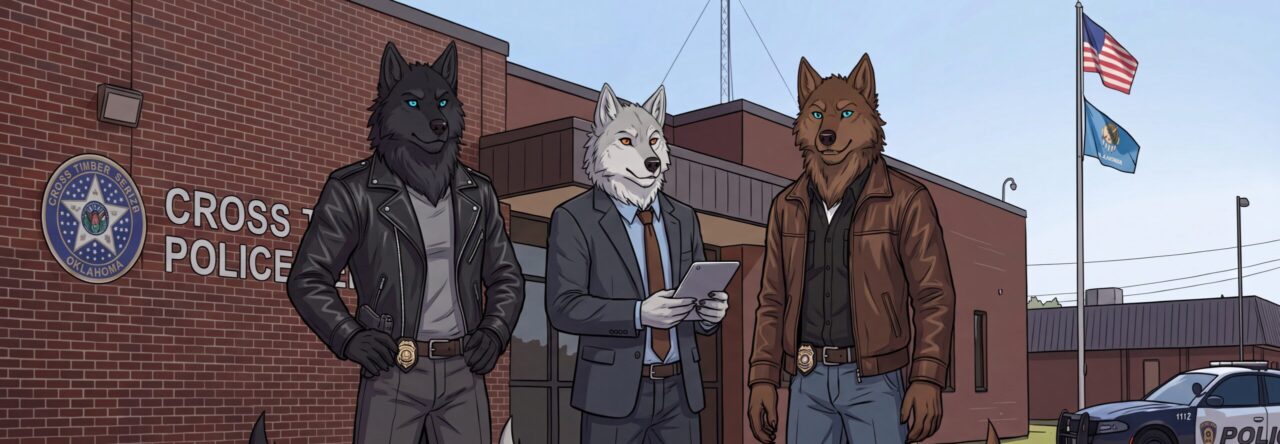
By Saturday evening, the cabin had gone quiet in a way that usually meant everyone was thinking too loudly.
Gabriel sat on the great-room sofa with one leg stretched out and the other folded beneath him, pretending to watch a movie neither Thane nor Mark had agreed to. The volume was low enough that the dialogue blurred into noise.
Mark sat at the dining table with his laptop open, a legal pad beside it, and three pens arranged parallel to the edge of the paper. He had not written anything for several minutes.
Thane stood near the windows, looking out into the trees.
The secure medical unit had stayed with him.
Not the building.
Not the deputies.
Not Laird’s dry voice or the absurd safe door with its bolts and locking wheel.
The chain.
The huge steel chain running from Silas’s collar to the wall anchor.
It had been necessary.
Thane knew that.
Silas had broken standard cuffs. He had ripped an interview-room door out of its frame. He had tried to run through a police station. He had hurt people with fear, violation, theft, and the deliberate use of his strength to make other people’s walls meaningless.
The chain had been necessary.
That did not make it bearable.
Gabriel paused the movie.
The screen froze on a man holding a flashlight in what appeared to be a basement no reasonable person should have entered.
“Thane.”
Thane did not turn.
“Yeah?”
“You have been staring at the trees for twenty-two minutes.”
Mark looked up.
“Twenty-four.”
Gabriel glanced at him.
“I was giving him emotional privacy.”
“You were giving him inaccurate privacy.”
Thane’s mouth moved slightly.
Not quite a smile.
Gabriel set the remote down.
“Say it.”
Thane turned from the window.
“I want him out of that room.”
The words landed.
Neither Gabriel nor Mark looked surprised.
That almost made it harder.
Mark closed the laptop.
Gabriel leaned forward, elbows on his knees.
“The secure room.”
“Yes.”
“The concrete room with the giant chain.”
“Yes.”
Gabriel’s ears lowered.
“Me too.”
Mark did not answer quickly.
Thane looked at him.
Mark’s face was calm, but the calm had weight behind it.
“He cannot simply be released.”
“I know.”
“He committed planned burglaries.”
“I know.”
“He violated homes.”
“I know.”
“He used private information against people who trusted him professionally.”
“I know.”
“He escaped custody.”
“Attempted.”
“After breaking restraints and a police interview-room door.”
Thane’s ears tipped back.
“Yes.”
Mark’s voice stayed level.
“He terrified victims. He endangered officers. He is dangerous.”
Thane looked down.
“Yes.”
Gabriel stood and crossed the room slowly.
His expression was different now.
Less humor.
More pack.
“I want him out of that room too,” Gabriel said. “But I do not want Elise Redding or Priya Harlan hearing that our money matters more than their fear.”
Thane closed his eyes for half a second.
That struck where it was supposed to.
“I do not want that either.”
Mark stood from the table.
“You participated in the investigation. You physically subdued him. You are a witness. Any attempt by you to pay restitution, court costs, attorney fees, housing, or supervision creates conflicts.”
“I know.”
“Do you?”
Thane looked at him.
Mark’s voice sharpened.
“Because wanting something good does not make the route good. Paying his restitution directly could look like buying leniency. Asking the district attorney for release into your custody could look like an arresting detective influencing prosecution. Offering him pack, housing, money, and work could look like reward after harm.”
Gabriel said quietly, “Mark.”
“No.” Thane lifted one paw. “He is right.”
Mark’s expression shifted, but he did not soften the next words.
“And ‘no wolf belongs in a cage’ cannot become ‘victims matter less when the defendant is like us.’”
Silence filled the room.
The words were brutal.
They were also true.
Thane looked back toward the trees.
“I know.”
Gabriel walked closer.
“But.”
Thane turned back.
Gabriel’s voice softened.
“But no wolf belongs in a cage.”
Mark looked away first.
That said enough.
Thane stepped toward them.
“He did wrong. I know that. He made choices. Criminal choices. Cruel choices. He has to answer for them.”
His voice stayed even, but the heat beneath it rose.
“But I saw that chain. I saw him sitting there with a collar around his neck like something out of a monster movie. I saw the first honest relief on his face when we walked in because we were the only people in the building who knew what he was without needing a containment briefing.”
Gabriel’s eyes lowered.
Thane continued.
“He is not innocent. I am not saying that. I am saying the room will not make him better. The chain will not make him safer. Not inside. It will teach him that every bad thing he believed about humans was true.”
Mark’s jaw tightened.
Thane looked at him.
“Tell me the clean way.”
Mark looked back.
“What?”
“Tell me the clean way,” Thane said. “I do not want to buy him out. I do not want to erase what he did. I do not want to hurt the victims twice. I want a way to get him out of the cage without pretending he does not belong in court.”
Gabriel nodded slowly.
“That is the right question.”
Mark was quiet.
Then he looked toward the dining table.
“We call Eli.”
Thane nodded.
“Yes.”
“And we accept whatever ethical limits he gives us.”
“Yes.”
“And if the clean answer is no?”
Thane did not answer immediately.
That was the problem.
Gabriel watched him.
Mark did too.
Finally Thane said, “Then we keep looking for a clean answer that is not no.”
Mark sighed.
“That is not reassuring.”
“It is honest.”
Gabriel nodded.
“Also very Thane.”
Mark looked at him.
Gabriel shrugged.
“He asked for the clean way. Not the easy way.”
Mark picked up his phone from the table and slid it toward Thane.
“Call Eli.”
Elias Carroway answered on the third ring.
“Thane.”
“Eli.”
“It is Saturday evening. That means one of three things. You are in trouble, you have found trouble, or you are attempting to solve trouble in a way that will create a new legal category.”
Gabriel murmured, “He knows us too well.”
Thane put the call on speaker.
“It is Silas Creed.”
Eli was quiet for half a second.
Then his voice changed.
The amusement drained away, replaced by the precise calm of a lawyer sitting forward in his chair.
“Start at the beginning you are allowed to tell me.”
Thane did.
Not the evidence.
Not privileged case details beyond what was already in public filings or what Eli would learn soon enough through formal channels.
He described the medical lockup.
The room.
The chain.
The visit.
Silas’s history in broad terms as Silas had shared it.
The conversation about better choices.
The fact that Silas remained dangerous.
The fact that Thane could not stop seeing the collar.
When he finished, Eli did not speak for several seconds.
Then he said, “You want him released.”
“I want him out of a cage.”
“That is not the same legal sentence, but it is close enough to be dangerous.”
“I know.”
“Do you?”
Mark’s eyes flicked toward Thane.
Gabriel’s ears lowered.
Thane said, “Mark already said that.”
“Good. Then I can say it again with billable punctuation.”
“Eli.”
“You are an arresting officer, a detective involved in the investigation, a use-of-force witness, a wealthy potential benefactor, and someone with personal species-related identification with the defendant.”
Thane’s ears tipped back.
Eli continued.
“That combination is a conflict bonfire.”
“I know.”
“You cannot buy a sentence.”
“I do not want to.”
“You cannot buy forgiveness.”
“I know.”
“You cannot make victims whole by making them feel purchased.”
“I know.”
“You cannot offer Silas a soft landing so attractive that it appears crime led him to a better life than accountability would have.”
Thane closed his eyes.
“I know.”
“Good,” Eli said. “Now tell me what you actually want.”
Thane opened his eyes.
“I want a deferred sentence or structured probation if the DA will consider it. Long term. Strict. Ankle monitor. Home and work confinement. Therapy. Control training. No security work. No access to alarms, safes, estates, art handling, high-value clients. Full restitution. Full allocution. Court reviews. Prison time hanging over him if he violates.”
Mark looked faintly surprised.
Gabriel did too.
Thane continued.
“I want all stolen property returned. I want any damages not covered by recovered property or insurance paid. Repair costs, deductibles, uncovered loss, counseling if victims need it, court costs. I want to cover it, but cleanly. Through the court, or victim compensation, or whatever structure does not make it look like I am handing people money to feel better.”
Eli’s voice was quieter when he answered.
“That is better than I expected.”
Gabriel whispered, “That is Eli praise.”
Mark nodded once.
Thane said, “I want you to be his attorney.”
“No.”
The answer came instantly.
Thane went still.
Eli continued before he could respond.
“I cannot represent Silas as his criminal attorney.”
“Why?”
“Because I represent you. I represent Gabriel and Mark. I represent your financial structures, your philanthropic structures, and your interests. You are witnesses. You are involved in his arrest. You used force against him. Your interests and his interests may diverge sharply.”
Thane looked down.
“Okay.”
“What I can do,” Eli said, “is arrange independent criminal counsel for him. Someone excellent. Someone who answers to Silas, not to you. I can pay that attorney through a clean structure you fund, provided Silas consents and the court is aware. I can represent you in making a lawful support offer. I can negotiate with the DA on your behalf regarding restitution funding, housing support, supervision resources, and expert assistance.”
Thane absorbed that.
“Who?”
“Nora Wexler.”
Gabriel’s eyebrows lifted.
Mark’s did too.
Thane knew the name.
Carroway & Wexler.
Eli’s partner.
Former federal public defender, according to the brief biography Eli had once grudgingly allowed them to read when Gabriel accused him of being “suspiciously lawyer-shaped.”
Eli said, “Nora handles criminal defense and complex sentencing. If she agrees and if conflict review clears, she represents Silas. I do not. And if she represents Silas, she represents Silas. Not you. Not your guilt. Not your hope. Him.”
Thane nodded slowly.
“Good.”
“You do not get privileged updates.”
“I understand.”
“You do not steer the defense.”
“I understand.”
“You do not tell her what Silas should accept.”
“I understand.”
“You do not ask Silas to accept a deal because you want him out of that room.”
Thane’s jaw tightened.
“I understand.”
Eli’s voice softened by one degree.
“And, Thane, if Silas wants to plead guilty and accept prison rather than live under supervision connected to you, that is his choice.”
Thane had not expected that to hurt.
It did.
“Yes.”
Gabriel looked at him.
Mark looked down at the legal pad.
Eli continued.
“Now, as for restitution. We can offer a court-administered restitution fund. Not direct payments from you to victims. We can cover repair costs, insurance deductibles, uncovered losses, security repairs, appraisal gaps, and documented emotional-harm services if the court allows. The offer cannot be contingent on victims supporting the plea.”
“Good.”
“It must be available whether they support it or not.”
“Yes.”
“It cannot buy their silence.”
“No.”
“It cannot buy their forgiveness.”
“No.”
“It cannot buy Silas a door.”
Thane’s ears shifted.
Eli let that sit.
Then said, “It can help build one if the court decides a door is lawful.”
Gabriel exhaled softly.
Thane looked toward the dark windows.
“Can you talk to Silas?”
“I can ask Nora to meet him tonight. I can join for the portion involving your proposed support only if Nora approves and Silas consents. But he needs his own lawyer before anyone discusses plea possibilities.”
“I want to see him too.”
“No.”
“Eli.”
“No. Not until counsel is assigned and present. You have already had one welfare visit. Anything from here forward touches legal strategy, sentencing, restitution, supervision, and custody. You do not walk into that room again because your heart is loud.”
Gabriel looked at Thane.
Mark’s mouth tightened, approving despite himself.
Thane said, “Fine.”
“Say that like it is true.”
“It is true.”
“No, it is not. But you will obey it.”
Thane’s mouth twitched despite everything.
“Yes.”
Eli sighed.
“I will make calls. Do not contact the DA directly. Do not contact victims. Do not contact Silas. Do not write checks. Do not lease apartments. Do not set up employment. Do not solve anything until I tell you what shape the solution can legally have.”
Gabriel whispered, “He is taking away all your hobbies.”
Thane ignored him.
“Thank you, Eli.”
“Do not thank me yet. This is going to be ugly.”
“I know.”
“No,” Eli said. “You do not. But you will.”
The call ended.
For a moment, the cabin remained silent.
Then Gabriel said, “Well.”
Mark looked at the phone.
“That was the correct answer.”
“It was a lot of no.”
“Yes.”
Thane sat down slowly in the nearest chair.
Gabriel sat across from him.
Mark stayed standing.
Thane looked at both of them.
“He was right.”
“Yes,” Mark said.
Gabriel nodded.
“Annoyingly.”
Thane leaned forward, elbows on his knees.
“I still want to help.”
Gabriel’s expression softened.
“We know.”
Mark sat at last.
“We do too.”
Thane looked up.
Mark held his gaze.
“I do not want him in that room either.”
Gabriel’s voice went quieter.
“No wolf belongs in a cage.”
Mark nodded once.
“No.”
Thane closed his eyes.
For the first time all day, the words did not feel like a reason to run.
They felt like a reason to build carefully.
Nora Wexler met Silas Creed at 20:18.
Thane did not go.
Gabriel did not go.
Mark did not go.
That was the first hard part.
The second hard part was waiting.
Eli called at 22:06.
“Nora has agreed to represent him, pending written conflict disclosures, which she believes are manageable because her representation is independent and adverse where necessary. Silas accepted.”
Thane stood so quickly Gabriel looked up from the sofa.
“He accepted?”
“Yes.”
“How is he?”
“I am not his attorney.”
Thane stopped.
Eli continued.
“But Nora authorized me to tell you one thing because Silas asked her to communicate it.”
Thane’s throat tightened.
“What?”
“He said, ‘Tell him I will not test the chain.’”
Gabriel’s ears lowered.
Mark looked away.
Thane sat back down.
“Okay.”
Eli’s voice softened.
“That matters.”
“Yes.”
“Nora also says Silas is willing to consider a plea if it gets him out of secure medical custody and into a lawful supervised structure. She has not advised him to accept anything yet. She needs discovery. She needs charging decisions. She needs to evaluate exposure. But he is willing to listen.”
Thane let out a slow breath.
“Good.”
“Tomorrow morning, Nora and I will request a meeting with District Attorney Kincaid. Not an ambush. Formal. Clean. The DA will know Nora represents Silas, and I represent your support proposal.”
“Okay.”
“You will not attend.”
Thane’s ears flattened.
Eli continued, “Not the first negotiation. You are a witness. Your presence would distort the room.”
“I understand.”
“Eventually, the DA may want to hear from you. That will be controlled.”
“Yes.”
“And Thane?”
“Yeah?”
“This may fail.”
Thane closed his eyes.
“I know.”
“Do not promise Silas anything.”
“I will not.”
“Good.”
District Attorney Rachel Kincaid agreed to meet at 09:30 Sunday morning because the case had already become impossible enough to ignore normal hours.
She was waiting in the conference room at the DA’s office when Eli arrived with Nora Wexler.
Kincaid was in her early fifties, with silver-streaked black hair pulled into a low knot and the kind of calm that did not invite people to mistake it for softness. She had prosecuted murders, public corruption, child abuse, violent assaults, and enough wealthy defendants to know that money usually entered a criminal case wearing good shoes and a wounded expression.
She did not rise when Eli entered.
“Nora,” she said.
“Rachel.”
“Eli.”
“District Attorney.”
Kincaid looked at the folders in their hands.
“I assume this is not a social call.”
“No,” Nora said.
“You represent Silas Creed.”
“I do.”
Kincaid looked at Eli.
“And you?”
“I represent Thane, Gabriel, and Mark regarding a proposed support and restitution structure. I do not represent Silas.”
“Good,” Kincaid said. “Because for half a second I thought this was going to become professionally absurd before I had coffee.”
Eli sat.
“It may still become professionally absurd, but not for that reason.”
Kincaid did not smile.
Nora opened her folder.
“My client is prepared to discuss a global plea resolution after discovery review. This meeting is preliminary.”
“Your client committed multiple planned residential burglaries, used professional security access to target victims, stole high-value property, attempted another burglary, broke police restraints, transformed into a werewolf in an interview room, and attempted to escape custody.”
Nora nodded.
“Correct.”
Kincaid looked at Eli.
“And your clients would like to spend their way around prison.”
“No,” Eli said.
Kincaid’s eyes sharpened.
“Convince me.”
Eli did not rush.
“Thane, Gabriel, and Mark are not asking that the charges be dismissed, reduced beyond legal justification, or minimized. They are not asking you to ignore the victims. They are not offering money in exchange for victim support. They are not asking for control over prosecution.”
Kincaid leaned back.
“What are they asking?”
“A sentence with a door.”
Kincaid stared at him.
“That sounds like Thane.”
“It is.”
“I do not sentence metaphors.”
“No. But judges sometimes do.”
Nora glanced at him.
Eli took the warning and continued more plainly.
“We are asking you to consider a deferred sentence or structured probationary resolution with a long suspended prison term, strict supervision, GPS monitoring, home and work restrictions, no-contact orders, employment restrictions, mandatory treatment, transformation-control compliance, court reviews, and immediate revocation exposure.”
Kincaid’s face did not change.
“That is a large ask.”
“Yes.”
“Why should I even consider this?”
“Because long-term incarceration of a shifter is not a normal correctional problem,” Eli said. “County cannot hold him in a regular cell. The state currently has no werewolf-rated detention infrastructure. Secure medical custody is expensive, ethically fragile, and not designed as punishment. Sedating him indefinitely is not lawful punishment. Chaining him indefinitely is not rehabilitation. Building a custom prison solution may cost enormous public resources and still produce a worse version of the same man.”
Kincaid folded her hands.
“That sounds like a public-budget argument.”
“It is partly one.”
“I do not decide justice by spreadsheet.”
“No,” Eli said. “But you do decide whether a proposed sentence protects the public. A structure designed around what he is may protect the public better than a cage designed around what he is not.”
Kincaid looked at Nora.
“Your client’s history?”
Nora opened a second folder.
“Abandonment after first manifestation at thirteen. Multiple foster placements. Documented behavioral reports involving property damage, fear responses from caregivers, and placement disruption. Juvenile property offenses. No documented assaults causing serious injury. Adult record is limited and scattered across jurisdictions, mostly suspected but uncharged property crimes. We are still verifying.”
Kincaid’s expression hardened.
“Tragic past does not excuse present harm.”
“No,” Nora said. “But it may inform supervision, treatment, and sentencing.”
Kincaid looked at Eli again.
“And the wolves?”
Eli knew which wolves she meant.
“Thane’s position is emotional but not irrational.”
“That is generous.”
“It is also true,” Eli said. “He knows Silas caused harm. He knows Silas must plead, allocute, return property, pay restitution, and submit to supervision. But he saw the chain.”
Kincaid looked down briefly.
She had seen the photographs.
Everyone necessary had.
The steel collar.
The absurd chain.
The concrete room.
The secure door.
She said nothing.
Eli continued.
“Thane’s exact words to me were that no wolf belongs in a cage. That does not mean no wolf belongs under law. It means the structure should not become cruelty simply because the system was surprised by biology.”
Kincaid’s eyes lifted.
“That is also Thane.”
“Yes.”
“And the money?”
“Court-administered restitution fund. No direct victim contact from Thane. No requirement that victims support the plea. Full coverage of repair costs, uncovered losses, deductibles, appraisal gaps where property cannot be returned, and court-approved services related to the crime impact. Funds available regardless of victim position. My clients will also offer to cover extraordinary public costs related to safe supervised placement if the court and county accept through a transparent agreement.”
Kincaid tapped one finger on the table.
“So they pay for the damage, pay for the supervision, pay for the problem, and the defendant avoids prison.”
Nora answered this time.
“He avoids a cage that may make him more dangerous. He does not avoid conviction if he pleads. He does not avoid a suspended sentence. He does not avoid supervision. He does not avoid conditions. He does not avoid public accountability.”
Kincaid’s eyes narrowed slightly.
“And if he violates?”
“Revocation,” Nora said. “Full exposure.”
“Full?”
Nora did not hesitate.
“Full.”
Eli added, “Thane will not shield him.”
Kincaid looked at him.
“Can you promise that?”
“No. Thane can.”
“He is not here.”
“Because I thought you would appreciate the room being less emotionally large.”
For the first time, Kincaid almost smiled.
Almost.
Then she looked back at the file.
“Victims.”
“Yes,” Eli said.
“The Reddings, Harlans, and Albrechts get a voice.”
“Absolutely.”
“They may hate this.”
“Yes.”
“They may see it as the werewolf detectives protecting one of their own.”
“Yes.”
“They may go to the press.”
“Yes.”
Kincaid leaned forward.
“And they may be right.”
Eli’s expression did not move.
“No,” he said. “They may reasonably fear that. They may reasonably resent the proposal. They may reasonably reject forgiveness. But if the structure is transparent, court-approved, victim-centered, and available without buying support, then they are not right that the process was corrupt.”
Kincaid watched him.
Nora said, “My client would be required to stand in court and say what he did. Not generally. Specifically. He would have to acknowledge that he studied homes, used trust, violated private spaces, damaged property, stole items, and caused fear. If he cannot do that, there is no deal.”
Kincaid looked at Nora.
“Can he?”
Nora paused.
“I believe he can.”
“You believe.”
“I have been his attorney for thirteen hours.”
“Fair.”
Eli slid a proposed framework across the table.
Kincaid did not pick it up immediately.
“What does Thane want personally?”
Eli took a breath.
“Silas out of the concrete room.”
“That is it?”
“No,” Eli said. “He wants him given a chance to become something other than a monster in a story people tell themselves later.”
Kincaid’s face shifted.
Small.
Enough.
Eli continued.
“He also wants to help pay for an apartment, employment placement, therapy, monitoring, restitution, and safe supervision. I have already told him all of that must be structured through court and counsel, not personal rescue.”
“Will he listen?”
“Yes.”
Kincaid looked skeptical.
Eli said, “Eventually.”
Nora’s mouth twitched.
Kincaid picked up the framework at last.
She read for several minutes.
Neither lawyer interrupted.
When she reached the proposed conditions, she slowed.
Long deferred sentence.
GPS ankle monitor.
Home, work, court, medical, therapy, legal appointments only.
No contact with victims.
No access to alarm systems, security consulting, safes, locksmithing, estate services, art handling, private acquisitions, high-value residential clients, or related technology.
Mandatory employment approved by probation.
Mandatory therapy.
Mandatory transformation-control training with approved specialists.
Regular court reviews.
No shifting except in approved medical, training, or emergency circumstances.
Immediate reporting of any involuntary shift.
No possession of burglary tools, security bypass devices, or unauthorized access equipment.
Full restitution.
Full allocution.
Search conditions for devices and residence.
Travel restriction.
Revocation for violation.
Kincaid set the pages down.
“This is not nothing.”
“No,” Eli said.
“It is also not prison.”
“No.”
She looked at Nora.
“Would your client accept a long deferred term?”
“Subject to review, yes.”
“How long?”
Nora said, “We would discuss ten.”
Kincaid said, “Fifteen.”
Nora did not react.
“We would discuss fifteen.”
“Full restitution before release.”
Eli said, “Funds can be placed with the court in advance.”
“Recovered property returned first.”
“Yes.”
“Victim statements before final agreement.”
“Of course.”
“No direct contact between Thane and victims.”
“Agreed.”
“No press.”
“Agreed.”
“No hero narrative.”
Eli nodded.
“Agreed.”
Kincaid looked at him.
“And Thane understands this is not adoption.”
Eli’s face stayed calm.
“Yes.”
Nora added, “Silas understands that too.”
Kincaid looked at her.
“Does he?”
“He asked whether this meant pack.”
Eli looked at Nora.
He had not known that.
Nora continued.
“I told him no. Not legally. Not socially. Not now. He understood.”
Kincaid’s expression softened and hardened at the same time.
“Good.”
The room went quiet.
Finally Kincaid closed the folder.
“I am not agreeing today.”
Eli nodded.
“I did not expect you to.”
“I need victim consultation. I need to speak with the judge’s clerk about whether the court will even entertain this structure. I need county, probation, medical, and state input. I need cost estimates. I need risk assessment. I need to know whether your clients’ money can be accepted without poisoning the case.”
“Yes.”
“And I want to hear from Thane.”
Eli nodded slowly.
“Controlled setting.”
“Yes. Not as detective. Not as donor. As the person asking me to consider a door.”
Nora looked at Eli.
Kincaid stood.
“Bring me proof this protects the public, respects the victims, and does not let money touch the scale. Then I will decide whether to take it to the court.”
Eli stood.
“Thank you for considering it.”
Kincaid looked at him.
“I have not considered it kindly yet.”
“No.”
“But I am considering it.”
“That is enough for today.”
Kincaid’s expression turned dry.
“For you, maybe.”
Eli called the cabin at 11:14.
Thane answered before the first ring finished.
Gabriel looked up from the kitchen island.
Mark turned from the stove, where he had been making lunch because waiting apparently required sandwiches.
Eli did not bother with greeting.
“She did not say yes.”
Thane’s shoulders lowered slightly.
“But?”
“She did not say no.”
Gabriel closed his eyes.
Mark exhaled.
Thane gripped the phone.
“What does she want?”
“Everything.”
“That sounds fair.”
“It is,” Eli said. “Victim consultation. Court input. Probation and medical plans. County detention analysis. Cost estimates. A clean restitution mechanism. Risk assessment. Proof that money does not buy the outcome. Proof that public safety is better served by structure than by improvising a werewolf cage.”
Thane nodded even though Eli could not see him.
“Okay.”
“She also wants to hear from you.”
Gabriel looked at Thane.
Mark went still.
Eli continued.
“Not today. Not casually. I will prepare you, and you will not improvise in a way that makes me consider early retirement.”
Thane’s mouth moved faintly.
“I will try.”
“That was not the sentence I requested.”
“I will not improvise.”
“Better.”
Thane looked toward the window.
“How is Silas?”
“I am not his attorney.”
Thane closed his eyes.
“Eli.”
“Nora says he remains compliant. He ate breakfast. He has not tested the restraints. He asked whether the court would require him to speak to the victims.”
Gabriel’s ears lowered.
“What did Nora say?”
Eli answered, “She said court may require allocution and victim impact, but no private contact. He said good.”
Thane looked down.
“Good.”
“Do not read too much into one word.”
“I know.”
“You do not.”
“No,” Thane admitted. “I do.”
Eli was quiet for a moment.
Then said, “Thane.”
“Yeah?”
“You are doing the right thing by trying to do this cleanly.”
Thane swallowed.
“Thank you.”
“But clean does not mean painless.”
“I know.”
“Good. Because the victims may hate you for this.”
Thane’s ears lowered.
“I know.”
“They may see your compassion for Silas as betrayal.”
“I know.”
“The DA may still say no.”
“I know.”
“The judge may say no.”
“I know.”
“Silas may fail.”
Thane closed his eyes.
The kitchen was silent.
Gabriel’s face had gone tight.
Mark looked down at the counter.
Thane said, “I know.”
Eli’s voice softened.
“Then we keep going.”
Thane opened his eyes.
“Yes.”
The call ended.
For a while, none of them spoke.
Then Gabriel said, “Sandwiches?”
Thane looked at him.
Gabriel’s smile was small and tired.
“We still have to eat.”
Mark turned back to the stove.
“He is correct.”
Thane sat at the island.
The chair creaked under him.
Gabriel slid a plate toward him a few minutes later.
Turkey sandwich.
Chips.
Pickle.
Ordinary food on an ordinary Saturday while somewhere across town a werewolf sat in a concrete room waiting to find out whether the world had any answer for him except steel.
Thane picked up the sandwich.
His appetite was not there.
He ate anyway.
Because Gabriel was watching.
Because Mark had made it.
Because trying to build a door required staying steady long enough to lift the frame.
Gabriel sat beside him.
“You know Mark was right.”
Thane nodded.
“Yes.”
“You know Eli was right.”
“Yes.”
“You know the DA is right to be hard.”
“Yes.”
Gabriel bumped his shoulder lightly against Thane’s arm.
“And you are still right to ask.”
Thane looked at him.
Gabriel’s eyes were bright.
“No wolf belongs in a cage,” he said.
Mark placed his own plate on the island and sat across from them.
“No,” he said. “But if we build a door, it has to lock from the outside until he earns it.”
Thane nodded slowly.
“That is fair.”
“And victims get to say what the lock costs,” Mark added.
“Yes.”
Gabriel picked up a chip.
“And Silas has to stop trying to rip doors off hinges.”
Thane’s mouth curved faintly.
“Yes.”
The three of them sat together in the kitchen, eating lunch they barely tasted, while the house settled around them.
No victory.
No promise.
No easy mercy.
Only the shape of a possible path, narrow and difficult and clean enough that it might hold.
Thane looked toward the trees beyond the window.
He could still see the chain.
He suspected he always would.
But for the first time since he had stood in that concrete corridor, he could see something else too.
Not freedom.
Not forgiveness.
Not pack.
A door.
And that was enough to keep fighting.