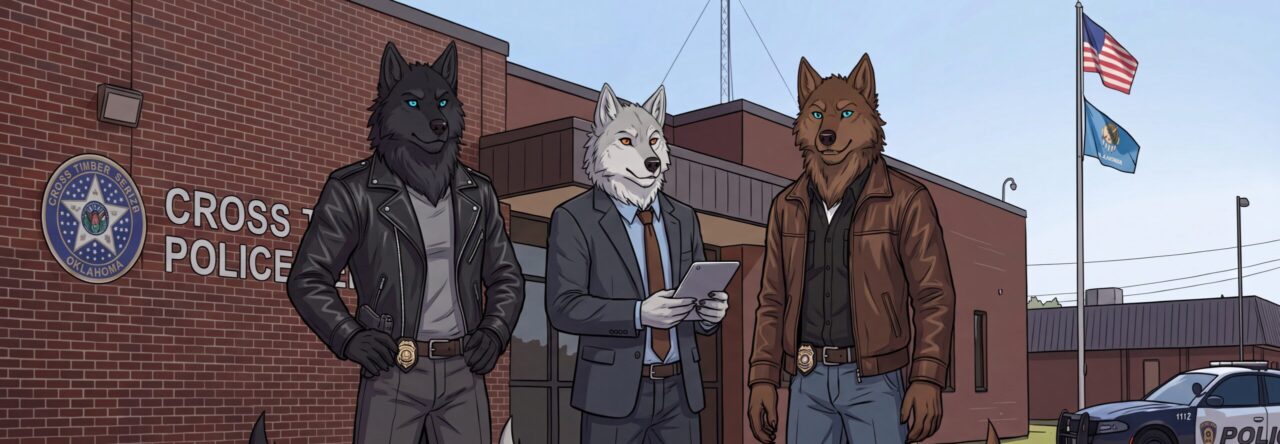
The CLEET packet sat on Thane’s lap like an accusation.
He had not put it there.
Mark had.
Thane had tossed it onto the center console somewhere between the police station and the first traffic light. Mark had watched it slide, waited exactly three seconds, then reached forward from the back seat and set it neatly across Thane’s thigh as if restoring order to the universe.
Thane looked down at it.
Then into the rearview mirror.
Mark looked back at him with perfect innocence.
“No,” Thane said.
“I didn’t say anything,” Mark replied.
“You moved it.”
“It was getting bent.”
“It deserves to be bent.”
Gabriel sat in the passenger seat with one elbow against the window, black fur catching the pale morning light, blue eyes half-lidded in the way that meant he was amused and trying not to make it worse.
Trying poorly.
“It is a brochure,” Gabriel said. “Not a confession.”
Thane growled.
The dashboard vibrated faintly.
Gabriel smiled. “Audio confirmed.”
Mark sighed from the back seat. “We have already retired that joke.”
“You retired it. I appealed.”
“There is no appeal process.”
“Exactly what someone losing an appeal would say.”
Thane gripped the steering wheel harder.
The 2014 Nissan Xterra rattled slightly as it rolled over a rough seam in the road. It was old enough to have opinions, boxy enough to suit him, and sturdy enough that Thane trusted it more than most people. The driver’s seat had been modified years ago, the pedals adjusted, the floor mats replaced with heavy rubber that did not care about clawed feet, mud, or blood.
Usually, driving calmed him.
Not today.
Behind them, the Cross Timber Police Department shrank into the morning. Ahead, the city stretched north and east under a low gray sky, all wet asphalt, stoplights, fast-food signs, churches, schools, medical offices, strip centers, and half-finished subdivisions pushing into land that had once been pasture and blackjack oak.
Cross Timber, Oklahoma.
Too big to be a small town. Too small to admit it wanted to be Oklahoma City.
It sat along the northern edge of the metro, close enough to borrow the city’s traffic and far enough out to keep its secrets in tree lines, creek beds, old barns, and gravel roads no GPS handled correctly.
Thane liked the edges better than the center.
The edges made more sense.
“You’re reading it,” Gabriel said.
Thane glanced over.
Gabriel pointed with one claw.
Thane looked down. His eyes had dropped to the packet without permission.
He shoved it toward the console.
“I am not reading it.”
“You were looking at words.”
“I was glaring at them.”
“Advanced literacy.”
Mark leaned forward between the seats. “Technically, visual hostility toward text still requires processing the text.”
Thane looked at him in the mirror.
Mark settled back.
“Noted,” he said.
The packet slid again as Thane turned onto a wider road lined with new construction. A coffee shop sat on one corner. A bank on the other. Beyond them, a field had been scraped clean for another neighborhood with a cheerful sign promising luxury homes starting in the low six hundreds, as if luxury could be ordered by the pallet and installed before closing.
Gabriel watched it pass.
“Remember when that was all trees?”
“Remember when you said development was inevitable and we should buy land before everyone else noticed?” Mark asked.
Gabriel smiled. “I enjoy being right.”
Thane snorted. “You enjoy people knowing you’re right.”
“That is the main benefit.”
Mark looked out the window. “We got lucky.”
“No,” Gabriel said. “We got paranoid before it became fashionable.”
That was closer to true.
Years ago, before Cross Timber had started swelling at the seams, before every pasture became a zoning fight and every old county road became a shortcut for people late to brunch, the three of them had bought land northeast of town. More land than anyone thought they needed. More trees than any realtor knew how to describe. A slope, a creek, a long gravel drive, and enough distance from the nearest neighbor that three full-time werewolves could step outside at midnight without becoming somebody’s blurry social media post.
The money had come from code and nerves.
A cybersecurity platform first. Then emergency systems integration. Then a monitoring tool Mark had built because he was tired of vendors saying certain things were impossible. Thane had handled infrastructure, field testing, and the kind of meetings where executives needed to understand that “secure enough” was not a technical term. Gabriel handled clients, contracts, and the delicate art of smiling while telling people their million-dollar plan was stupid.
They sold too early, according to Mark.
They sold at the perfect time, according to Gabriel.
They sold before Thane bit a venture capital guy, according to everyone.
The merger had not made them private-island rich. It had made them free.
Bills paid. Land bought. House built. Work optional. Consulting selective. No fluorescent office, no mandatory team-building retreat, no quarterly vision statement written by someone who thought “synergy” was a personality.
It was supposed to mean peace.
Thane looked down at the packet again.
Apparently, peace had paperwork.
Gabriel reached over and plucked the packet off the console.
Thane snapped his eyes toward him.
“What are you doing?”
“Relax. I’m not joining. I’m mocking.”
He flipped to the first page.
“Council on Law Enforcement Education and Training,” Gabriel read. “That sounds deeply unpleasant.”
“Good,” Thane said. “Throw it out the window.”
Mark’s ears lifted. “Do not litter.”
“Fine. We’ll burn it.”
“That is still improper disposal.”
Gabriel turned a page. “There’s probably a section on improper disposal.”
“There is,” Mark said.
Gabriel paused.
Thane stared into the rearview mirror.
Mark looked out the side window.
Gabriel slowly turned around. “You already read it.”
“I skimmed.”
“You read government training material in a moving vehicle before breakfast.”
“I was curious.”
“You were seduced.”
“I was informed.”
Thane pointed ahead without looking. “Both of you stop flirting with the police pamphlet.”
Gabriel looked back down at it. “It has standards, Thane. Mark never stood a chance.”
Mark made a sound that was almost dignified.
Almost.
They left the denser part of Cross Timber behind. The lanes narrowed. The gas stations thinned out. Fences appeared, then trees, then stretches of land where red dirt showed through winter grass. The city did not end so much as loosen its grip.
Thane turned off the paved road onto gravel.
The Xterra’s tires crunched.
Gabriel grew quieter as the trees closed in.
They all did.
The road curved twice, dipped past a creek crossing, then climbed toward the ridge. The house came into view slowly, first the roofline, then the stone chimney, then the wide front porch supported by cedar posts thick enough to look grown instead of built.
The cabin was not really a cabin.
That had started as a joke and become a lie everyone kept using.
It was a log home big enough to make delivery drivers question their maps. Massive timbers, broad windows, reinforced doors, deep overhangs, a wraparound porch, and a garage that had been expanded twice because Thane’s idea of “reasonable vehicle storage” had never survived contact with reality.
The Humvee sat under the side carport like a sleeping animal.
Matte green. Broad. Ugly. Perfect.
Gabriel eyed it as they pulled in.
“You know,” he said, “if we ever do become police-adjacent, arriving in that would not help the public image.”
“We are not becoming police-adjacent,” Thane said.
Mark unbuckled. “You said we weren’t becoming cops. Police-adjacent may still be undecided.”
Thane turned in the seat.
Mark opened the rear door before the glare could fully land.
Clawed feet touched gravel. No shoes, no socks, no attempt to pretend otherwise. None of them bothered. They were werewolves. Fully, always. Hands clawed, feet clawed, fur visible, ears expressive no matter how inconvenient. The world had known werewolves existed for generations, but knowing and seeing were different things.
Most bloodlines had thinned. Most remaining werewolves never changed at all, or changed rarely, or treated the old form like an embarrassing family illness.
Thane, Gabriel, and Mark did not have that option.
Or maybe they had never wanted it.
They were what they were.
The porch steps creaked under Thane but did not complain. He had rebuilt them himself after the first set had failed under less dramatic circumstances than Gabriel liked to imply.
Inside, the house smelled of cedar, stone, coffee, old books, and the faint metallic tang of last night’s rain still clinging to their fur. The entryway opened into a great room with a vaulted ceiling and exposed beams. The fireplace could have roasted an elk. The furniture was oversized, heavy, and chosen for the single practical question that governed their domestic lives:
Would it survive Thane sitting down angry?
So far, mostly yes.
Gabriel dropped into one of the chairs near the fireplace with the grace of someone who had claimed it years ago and considered the matter legally settled.
Mark went straight to the kitchen island and set the CLEET packet in the exact center.
Thane stopped in the doorway.
“No.”
Mark looked at him. “It is not radioactive.”
“It is worse.”
Gabriel leaned back. “It does have more forms.”
Thane crossed the room, picked up the packet, and moved it to the far end of the island.
Mark watched him.
Then calmly moved it back to the center.
Thane’s eyes narrowed.
Mark’s ears angled forward.
Gabriel raised one hand. “Before this becomes territorial, I would like breakfast.”
“It is not staying on the island,” Thane said.
“It is the only thing we need to talk about,” Mark said.
“No. We need to talk about coffee. Food. Sleep. Possibly bleaching the police station smell out of my nose.”
Gabriel sniffed his shoulder. “You smell like interrogation room and moral ambiguity.”
Thane pointed at him. “You smell like sarcasm and bad decisions.”
“Thank you.”
“Not a compliment.”
“I know.”
Mark opened the refrigerator.
“Eggs?”
Thane grunted.
Gabriel lifted two fingers. “Yes, but emotionally supportive eggs.”
Mark ignored that, which was usually the safest response.
For a few minutes, the house settled into routine.
Coffee maker growling. Pan heating. Refrigerator door opening and closing. Gabriel pretending not to read the packet from across the room. Thane pacing once from the kitchen to the windows and back, claws clicking softly against the hardwood. Mark cracking eggs with too much precision for someone who claimed not to be nervous.
Outside, the woods stood still under the gray morning.
No police station.
No mirror.
No file folder.
No little girl’s picture on a table.
Just home.
That made it worse somehow.
Thane stopped by the window, looking out toward the trees beyond the porch.
Gabriel noticed first.
He always did.
“Thane.”
“I’m fine.”
“Nobody asked.”
“You were about to.”
“I was about to say you’re blocking the view.”
Thane huffed.
Mark slid a mug of coffee onto the island. It stopped near Thane’s hand.
Thane looked at it.
Then at Mark.
“Bribe?”
“Stabilization effort.”
Gabriel lifted his mug. “I support peacekeeping operations.”
Thane took the coffee.
For a while, breakfast happened without much conversation. Scrambled eggs, leftover steak cut into strips, toast for Gabriel because Gabriel insisted toast made breakfast civilized, and a bowl of fruit Mark put out because Mark believed in nutritional balance even on mornings that smelled like homicide.
Thane did not sit until Mark did.
The packet remained between them.
A fourth place at the table.
Uninvited.
Gabriel tapped one claw lightly against his mug.
“So,” he said. “We are not becoming cops.”
“No,” Thane said.
“Obviously not.”
“Correct.”
“Which is why we should discuss why we are absolutely not attending the informational session next week.”
Thane set his fork down.
Mark kept eating.
Thane looked at him. “You too?”
Mark swallowed before answering. “I did not say we should attend.”
Gabriel smiled. “You arranged the packet perpendicular to the table edge. That’s practically a marriage proposal.”
“I arranged it because you tossed it down crooked.”
“You see? Passion.”
Mark looked at Thane. “I think we should talk about it.”
“No.”
“Talking is not agreeing.”
“It is with you. You talk until the rest of us are too tired to fight.”
Gabriel nodded. “That is his hunting style.”
Mark folded his hands around his coffee mug.
“I think Voss had a point.”
Thane’s ears lowered.
Gabriel’s expression shifted, humor easing back into caution.
Mark did not look away.
“I’m not saying she was right about everything,” Mark continued. “I’m not saying we owe anyone anything. I am saying she put a packet on the table for a reason.”
“Yeah,” Thane said. “Because cops like paperwork.”
“Because she thinks we are going to keep ending up near trouble.”
Gabriel murmured, “Historically supported.”
Thane ignored him.
Mark’s voice stayed calm. “And because if people like us keep ending up near trouble, someone eventually decides whether that makes us useful or dangerous.”
The word hung there.
Dangerous.
Thane leaned back in his chair.
“We are dangerous.”
“Yes,” Mark said.
No hesitation.
That landed harder than if he had argued.
Mark glanced toward the window, toward the trees, toward the world beyond them.
“That does not mean wrong. It does not mean bad. It means dangerous. There is a difference.”
Gabriel turned his mug slowly between both hands.
“Voss sees it too,” he said.
Thane looked at him.
Gabriel shrugged. “She wasn’t scared of us.”
“She should be smarter.”
“She was measuring us.”
Mark nodded. “Yes.”
Thane growled under his breath. “Great. Two of you.”
“She didn’t bring us in to solve last night,” Gabriel said. “She brought us in to decide what we are.”
Thane’s eyes sharpened.
“And what are we?”
Gabriel held his gaze.
“That is probably why the packet is on the table.”
Mark said nothing.
The house seemed to quiet around them.
Thane pushed back from the table and stood.
The chair legs scraped against the floor.
“I know what I am.”
Gabriel looked up at him. “Do you?”
Thane’s lips pulled back just enough to show teeth.
Mark’s ears tilted, but he did not interrupt.
Gabriel’s voice stayed even. Not soft. Not afraid.
“Because last night you were ready to tell Voss the whole system failed.”
“It did.”
“Sure.”
“There is no sure. It did. That man walked over and over and over because everyone who knew what he was had their hands tied.”
Gabriel nodded once.
“Yes.”
Thane jabbed one claw toward the packet.
“And now the same system wants us to sit in a classroom and learn how to tie ours.”
“No,” Mark said.
Thane swung his gaze to him.
Mark set his mug down.
“The system does not want us,” he said. “Not yet. Maybe not ever. One detective handed us a packet because she saw three people who might become a problem and decided to put a line in front of them before someone else put a target on them.”
Gabriel looked at Mark with open appreciation.
“That was annoyingly clear.”
Mark sighed. “Thank you.”
“I hate when you’re right,” Thane said.
“I know.”
“I especially hate when you’re right before noon.”
“I also know that.”
Thane turned away from the table and walked into the great room.
His clawed feet were quiet now despite his size. That was another thing people misunderstood. They expected werewolves to stomp, crash, snarl, announce themselves like monsters in old movies. Thane could move silently when he wanted to.
He usually did not want to.
Today, the quiet came on its own.
He stopped near the fireplace and stared at the cold ash from the night before.
Gabriel came to stand a few feet behind him.
Mark remained at the table.
Smart.
“Do you want my honest answer?” Gabriel asked.
“No.”
“Good. I was going to give it anyway.”
Thane closed his eyes.
Gabriel leaned one shoulder against the mantel.
“I think becoming cops sounds awful.”
Thane opened one eye.
Gabriel continued. “The hours are bad. The politics are worse. Everyone lies to you. Half the public hates you until they need you. You get blamed for the law, the budget, the weather, and probably potholes. There are forms. So many forms. Mark will thrive. It’ll be disgusting.”
“I can hear you,” Mark called.
“I counted on that.”
Thane’s mouth twitched despite himself.
Gabriel’s smile faded.
“But I also think access matters,” he said. “Information matters. Being allowed through the tape matters. Knowing where the missing kid was last seen before the trail goes cold matters. Getting called before everything is already ruined matters.”
Thane said nothing.
Gabriel lowered his voice.
“And maybe having rules would not be the worst thing for us.”
Thane looked at him then.
Gabriel did not flinch.
“Us?”
Gabriel’s blue eyes stayed calm. “Yes. Us.”
Thane wanted to argue.
He had arguments ready. Good ones. Angry ones. Ones with teeth.
But the truth was sitting in the room with them, quiet and heavy as the packet on the table.
The girl was home.
That mattered.
The dead man would never hurt anyone again.
That mattered too.
But Voss’s words had followed him home no matter how fast he drove.
Monsters do not get to decide what justice is.
Thane hated that sentence.
He hated it because part of him agreed.
The television clicked on behind them.
Thane turned.
Mark stood with the remote in one hand.
“I thought you were making more coffee,” Gabriel said.
“I was,” Mark replied. “Then I saw the alert.”
The screen showed a local morning news broadcast. The volume was low at first, then Mark raised it.
A woman in a blue coat stood outside Cross Timber Police Department, hair moving slightly in the wind, microphone held near her chin. Behind her, cruisers sat in the lot like the morning had not changed anything.
“—five-year-old Emma Kincaid was found alive early this morning after being missing for more than two weeks,” the reporter said. “Police are not releasing many details at this time, but sources confirm Emma was located at her family’s home shortly after three a.m. and transported for medical evaluation.”
The screen changed to a photo of Emma.
Same missing poster picture.
Same smile.
Same missing tooth.
Thane’s throat tightened.
Gabriel stopped leaning against the mantel.
Mark lowered the remote slowly.
The reporter continued.
“Her parents released a brief statement asking for privacy and thanking law enforcement, volunteers, neighbors, and everyone who helped bring their daughter home. Police have not confirmed whether a suspect is in custody, but investigators are reportedly searching a rural property north of the city connected to the case.”
Gabriel’s ears angled back.
Thane stared at the screen.
Then the broadcast cut to shaky footage outside a house. Not close. Respectful distance. A front porch. A police cruiser at the curb. A woman holding onto a man in the driveway while another adult tried to guide them away from cameras.
Emma’s mother.
No sound from her at first.
Then the clip shifted to a short recorded statement. Her face was pale and swollen from crying, her hair pulled back carelessly, one hand gripping the man beside her as if gravity had become unreliable.
“We just want to say thank you,” she said, voice breaking. “To everyone who searched. Everyone who prayed. Everyone who didn’t give up on our baby.”
She stopped.
The man beside her put an arm around her shoulders.
She tried again.
“Whoever brought her home…” Her mouth trembled. “Thank you. Thank you for bringing our little girl home.”
The clip ended.
The studio returned.
Mark muted the television.
No one moved.
Outside, wind pushed through the trees. The house creaked softly around them, old wood answering cold air. The world felt too large and too small at the same time.
Thane looked away first.
Gabriel cleared his throat.
“Well,” he said quietly. “That was unfair.”
Mark set the remote down. “Yes.”
Thane walked to the window.
Again.
Same view. Same trees. Same wet morning light.
He could still see the porch from the news clip. Not in detail. Not like memory, exactly. More like the shape of it. The little girl wrapped in green. Tiny feet. Big eyes. A voice too small for the dark she had survived.
The big wolves brought me.
Thane pressed one clawed hand against the window frame.
Not the glass.
The frame.
He did not trust himself with glass.
Behind him, Mark picked up the packet.
Paper shifted.
Thane’s ears turned toward the sound.
“You’re really reading it now?” Gabriel asked.
“I’m looking at dates,” Mark said.
“Of course you are.”
“There is an informational session next Thursday.”
“We know. Voss said that.”
“It starts at six-thirty.”
“Mark.”
“It says registration is recommended but not mandatory.”
“Mark.”
“There is a contact number.”
“Mark.”
“What?”
Gabriel pointed at Thane’s back.
Mark looked up.
Thane did not turn around.
The room went still again, but it was not the same stillness as before.
This one waited.
Thane hated waiting rooms. Waiting questions. Waiting decisions.
He hated the way both of them knew him well enough not to push.
Finally, he spoke.
“We go.”
Gabriel said nothing.
Mark said nothing.
Thane turned from the window.
“We go,” he repeated. “We listen. Then we leave.”
Gabriel’s mouth curved faintly. “That is historically how all our worst ideas begin.”
“We are not applying.”
“Of course not.”
“We are not becoming cops.”
“Obviously.”
“We are not letting some detective with a folder and a guilt complex shove us into the world’s most annoying career.”
Mark nodded. “Understood.”
Thane narrowed his eyes. “You’re agreeing too fast.”
“I am trying positive reinforcement.”
“Do it less.”
Gabriel walked back to the table and looked down at the packet.
“Six-thirty next Thursday,” he said. “That gives us a week to come up with a good reason not to go.”
“We have several,” Thane said.
“Excellent. We can bring them with us.”
Mark reached for his phone.
Thane’s head snapped toward him. “What are you doing?”
“Checking the calendar.”
“No.”
“Purely hypothetically.”
“No.”
Gabriel leaned over Mark’s shoulder. “Do we have anything Thursday?”
Mark tapped the screen. “Consulting call at two. Nothing after four.”
“Cancel the call,” Thane said.
Mark looked up. “Why?”
“Because I don’t want to be annoyed twice in one day.”
Gabriel smiled. “That sounds like preparation.”
“That sounds like threat management.”
Mark typed something.
Thane pointed at him. “Do not put CLEET on the calendar.”
Mark paused.
Gabriel looked delighted.
“What did you title it?”
Mark did not answer.
Thane crossed the room.
Mark angled the phone away.
Thane leaned over him.
On the calendar, next Thursday at six-thirty, Mark had entered:
Bad Idea — Informational Only
Gabriel laughed.
Thane stared at it.
Then at Mark.
Mark’s ears tilted back. “It seemed accurate.”
Thane held the glare for another second.
Then he looked at Gabriel.
“If this becomes a thing, I am blaming both of you.”
Gabriel put a hand over his heart. “I accept no responsibility and all narrative credit.”
Mark picked up the packet and stood.
“I’ll make copies.”
“No copies,” Thane said.
“One working copy. One backup.”
“No.”
“One digital scan.”
“Mark.”
“What if someone spills coffee on it?”
“I will spill coffee on it.”
“That is why we need a scan.”
Gabriel touched Thane’s shoulder as he passed. “Let him have this. He’s bonding.”
“With a police brochure.”
“We all grieve differently.”
Thane growled, but there was less force in it now.
Mark disappeared toward the office.
Of course he did. The office was his real den: monitors, servers, radio equipment, network gear, labeled bins, cable runs so clean they made other technicians emotional. If the house had a brain, it was in that room. If anything in the state connected to anything else, Mark could probably map it, secure it, or explain why someone had done it wrong.
Gabriel lingered near the table.
“You know,” he said, “if we ever did this, Mark would be insufferable.”
“He already is.”
“Worse.”
“Impossible.”
“He would read every manual.”
“He reads appliance manuals.”
“He would score highest on every test.”
Thane looked toward the office doorway.
From inside came the sound of a scanner warming up.
Thane closed his eyes.
Gabriel nodded. “Already started.”
“I hate this.”
“I know.”
Thane opened his eyes. “Do you?”
Gabriel’s expression softened.
“Yes.”
For once, no joke followed.
Thane looked back at the muted television. Emma’s picture was gone now, replaced by weather. A cheerful map promised drizzle before noon and colder air by evening.
Ordinary things.
The world always had the nerve to keep being ordinary.
Gabriel leaned against the island.
“We don’t have to decide today.”
“We decided to go.”
“That’s not the same thing.”
Thane grunted.
Gabriel looked toward the windows, toward the woods.
“We built this place so we could be left alone,” he said. “Remember?”
“Yes.”
“No neighbors staring. No landlords complaining about claw marks. No jobs that required pretending conference room chairs were made for us. No explaining ourselves every day.”
Thane said nothing.
Gabriel’s voice lowered.
“And now we’re talking about walking into a system where every room is too small, every rule is written for humans, and every person we meet will have an opinion about what we are.”
Thane looked at him.
That was the part Gabriel had not said in the truck.
The real part.
Werewolves were known.
Rare, but known.
People said they were fine with it until one stood too close in line at a grocery store. Until claws touched the card reader. Until blue eyes looked back from a muzzle full of teeth. Until a child pointed and a parent pulled them away. Until someone remembered an old story their grandfather swore was true.
Thane was used to being stared at.
He was less used to voluntarily signing up for more.
Mark returned with the packet in a neat folder.
Because apparently it had already needed a folder.
“I scanned it,” he said.
Thane stared.
Mark added, “For reference.”
Gabriel nodded solemnly. “The bond deepens.”
Mark ignored him and set the folder on the island.
Then he looked at both of them.
“I know what this costs.”
Gabriel’s humor faded.
Thane waited.
Mark rested one hand on the folder.
“If we go, even just to listen, people will know. If we keep going after that, people will talk. Not just cops. Everyone. News. Neighbors. Old bloodline families. People who think werewolves should stay quiet. People who think we’re animals. People who think we’re useful animals.”
Thane’s jaw tightened.
Mark continued.
“I am not excited about that.”
Gabriel gave him a small smile. “You hide your excitement well.”
“I am serious.”
“I know.”
Mark looked at Thane.
“I like our life,” he said. “I like this house. I like choosing our work. I like not having to prove every day that I’m safe to stand near.”
That one hurt.
Because Mark did not say things like that often.
Thane’s anger cooled into something heavier.
“Then why are you pushing?”
Mark looked down at the folder.
“Because Emma is home.”
No one answered.
“And because next time, maybe there is no porch. No doorbell. No second chance. Maybe next time the police do not know where to look, and we do. Or they know and cannot get there fast enough. Or they get there first and need something only we can do.” He looked up. “I don’t know if becoming part of that world is the answer. I just know standing outside it forever is also a choice.”
Gabriel was quiet for a long moment.
Then he said, “That was worse than unpleasantly mature.”
Mark’s ears dipped. “Sorry.”
“No, I mean effective. Which is worse.”
Thane rubbed both hands over his face, claws combing through the fur along his muzzle.
“I said we’d go.”
Mark nodded.
“Informational only.”
Another nod.
“If anyone says obstacle course, I’m leaving.”
Gabriel’s smile returned. “Liar.”
“If anyone says group exercise, I’m biting the nearest clipboard.”
Mark lifted one finger. “That would make a poor first impression.”
“I am not trying to impress them.”
“You will anyway,” Gabriel said.
Thane looked at him.
Gabriel shrugged. “Not always in the way they want.”
A faint sound escaped Thane before he could stop it.
Not a laugh.
Close enough that Gabriel noticed.
Mark noticed too, but wisely pretended not to.
The morning stretched around them.
Coffee cooled. Eggs disappeared. The scanner in the office clicked once as if approving of its own productivity. Outside, the woods stayed quiet, keeping their secrets.
Thane picked up the folder.
It looked absurd in his clawed hand. Thin paper. Government formatting. Dates and bullet points and polite instructions for people who wanted permission to carry authority.
He thought of Voss’s face across the table.
He thought of the old detective’s nod in the hallway.
He thought of Emma’s mother saying thank you to whoever brought her home.
He set the folder back down.
Carefully.
“Next Thursday,” he said.
Gabriel nodded. “Next Thursday.”
Mark looked relieved enough that Thane immediately regretted giving him anything.
“And until then,” Thane said, “we do not talk about this.”
Gabriel opened his mouth.
Thane pointed at him.
“We do not joke about this.”
Gabriel closed his mouth.
Mark picked up his coffee.
“We should probably research CLEET requirements.”
Thane turned slowly.
Mark took a sip and added, “Silently.”
Gabriel smiled into his mug.
Thane looked between them.
His home. His pack. His problem.
Same as always.
He walked toward the office.
Gabriel straightened. “Where are you going?”
“To look at the requirements.”
Mark’s ears lifted.
Thane stopped in the doorway and looked back.
“Silently,” he said.
Gabriel’s grin widened.
Mark tried not to smile and failed.
Thane growled once, mostly for dignity, and disappeared into the office.
On the television, the weather map shifted from drizzle to a seven-day forecast.
On the island, the folder waited.
Outside, Cross Timber woke fully into the gray morning, all its roads and schools and churches and locked doors, all its ordinary people carrying ordinary fears, all its hidden places where bad things thought they could stay hidden.
The three werewolves had not decided to become cops.
Not even close.
They had only decided to listen.
But in the quiet house at the edge of the woods, with Emma Kincaid alive and Harold Caine dead and a police packet scanned into Mark’s computer under a folder he had probably already labeled, the line between no and maybe had become thinner than any of them wanted to admit.