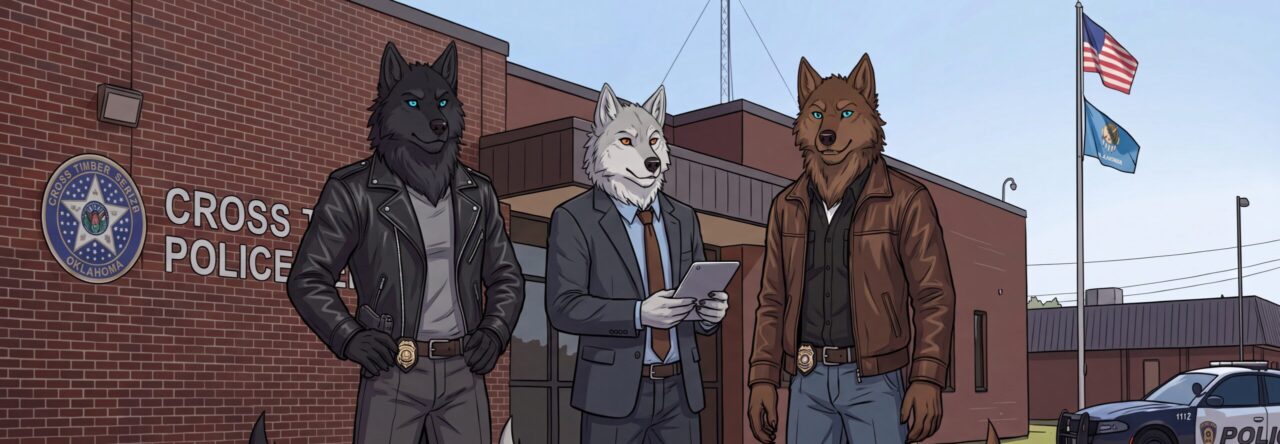
The accommodations meeting had a name that sounded harmless.
That was how Thane knew it was lying.
He stood outside Conference Room C at the Cross Timber Public Safety Training Annex, staring at a printed sign taped to the door.
APPLICANT ACCOMMODATION REVIEW
Beneath it, in smaller letters:
TRAINING / LEGAL / HR / EQUIPMENT / SAFETY
Gabriel leaned beside him, black fur sleek, blue eyes bright with anticipation.
“That sign has too many departments on it.”
Mark stood on Thane’s other side holding one notebook, one pen, and the strained expression of a wolf trying very hard not to have prepared a binder.
“It is a multidisciplinary meeting.”
Gabriel looked at him. “That means too many departments.”
“It means multiple areas of expertise.”
“It means someone in there has a spreadsheet called Werewolf Problems.”
Thane looked at Mark.
Mark did not answer quickly enough.
Thane’s eyes narrowed. “Do you have a spreadsheet called Werewolf Problems?”
“No.”
Gabriel smiled. “He renamed it.”
Mark’s ears angled back. “It is called Applicant Accommodation Matrix.”
Thane closed his eyes.
Gabriel whispered, “That is somehow worse.”
Before Thane could respond, the door opened.
Sergeant Hale stood inside with a coffee cup, a stack of folders, and the look of a man who had accepted that his day would become a story told in training meetings forever.
“You’re early.”
Mark lifted his notebook. “Four minutes.”
Hale looked at the notebook.
“Still just one?”
“Yes.”
Hale stared at him.
Mark stared back.
Hale looked at Gabriel. “Is he okay?”
Gabriel shook his head. “No, but he’s brave.”
“I am standing right here,” Mark said.
“I know. We’re all standing right here. That’s why this is meaningful.”
Hale stepped aside. “Come in before someone adds another department.”
Conference Room C had been rearranged.
That was the first thing Thane noticed.
The normal chairs had been pushed back against the wall. A heavy bench had been placed on one side of the table. Two reinforced folding chairs stood nearby with yellow tags still hanging from their frames, as if maintenance had purchased them under protest.
Hale saw Thane looking.
“Don’t get emotional.”
Thane grunted. “I wasn’t.”
“You looked at the bench like it understood you.”
Gabriel patted the bench. “It’s nice to be seen.”
Around the table sat a collection of people who looked like they had all been invited to different meetings and only recently discovered they were in the same one.
Assistant City Attorney Priya Shah sat with her legal pad and aligned pens.
Officer Talia Ross, the defensive tactics evaluator, leaned back with arms crossed and the comfortable posture of someone who expected nonsense and planned to enjoy surviving it.
A woman in a burgundy blazer with a city ID badge read MARLENE GIVENS — HR. She had kind eyes, anxious hands, and a stack of forms thick enough to qualify as a defensive barrier.
Beside her sat a broad man with a shaved head, salt-and-pepper beard, and a uniform polo stretched across shoulders that had probably moved file cabinets recreationally. His badge read QUARTERMASTER DALTON PIKE. He had a measuring tape, a tablet, and the haunted look of a man who had been told “custom uniform solutions” by someone who did not have to solve them.
At the far end sat a thin man in glasses with a laptop already open and a department IT badge.
Mark noticed him instantly.
The man noticed Mark noticing him.
A silent exchange of technical suspicion passed between them.
Gabriel leaned toward Thane. “The nerds have made eye contact.”
Thane whispered, “Which one wins?”
“Mark. Always. But the other one may not know yet.”
Hale shut the door.
“All right,” he said. “Purpose of today’s meeting: determine practical accommodations for three non-standard applicants entering pre-academy orientation and potential law enforcement training.”
Gabriel lifted one claw. “Non-standard feels generous.”
Pike muttered, “Non-standard is doing a lot of work.”
Hale pointed at him. “Dalton, do not start grieving yet.”
“I saw the physical assessment report,” Pike said. “I’ve already been grieving.”
Ross smiled. “He read the part about the grip tester.”
Pike looked at Thane. “Did you really crack it?”
Thane folded his arms. “Barely.”
“That is not better.”
“It was small.”
“It was calibrated.”
Gabriel said, “Briefly.”
Shah took a breath. “Before this becomes a memorial service for equipment, I’d like to establish the legal framework.”
Hale sat. “Please do. It’ll make the chaos feel expensive.”
Shah ignored him, which was probably wise.
“Accommodation does not mean lowered standards,” she said. “It means identifying what a standard is actually intended to measure and whether there is a reasonable equivalent method for applicants whose physiology does not match assumptions built into existing policy.”
Mark’s ears lifted.
Gabriel whispered, “Careful. She’s speaking your language.”
Mark whispered back, “It was a very good sentence.”
Shah looked at him. “Thank you.”
Gabriel smiled. “Strong room.”
Shah continued.
“If the standard is ‘wear boots,’ that may not be meaningful here. If the standard is ‘maintain safe traction and protect the foot from normal hazards,’ then we evaluate whether their natural anatomy satisfies or exceeds that requirement.”
Thane looked down at his clawed feet.
His pads were thick, dark, and tough enough to handle gravel, asphalt, heat, broken glass, and the kind of terrain that made humans invent footwear in the first place. His claws curved against the floor, visible, useful, part of him.
Pike leaned forward.
“So we’re really starting with no shoes?”
“Yes,” Thane said.
“No boots?”
“No.”
“Custom tactical footwear?”
“No.”
“Protective overshoes?”
Thane stared at him.
Gabriel said, “I admire your optimism.”
Mark added, “Footwear would interfere with claw articulation, traction, balance, and sensory feedback through the pads. Their footpads are substantially tougher than human soles.”
Pike blinked.
Mark cleared his throat. “Our footpads.”
Gabriel smiled. “He briefly became a field guide.”
Ross looked under the table toward Thane’s feet.
“You can run on asphalt, gravel, broken terrain?”
“Yes,” Thane said.
“Glass?”
“Yes.”
“Nails?”
“Depends.”
Pike brightened. “Aha.”
Thane looked at him.
Mark said, “A nail through the pad would be painful but not operationally disabling for long.”
Marlene from HR lowered her pen very slowly.
“Not operationally disabling for long,” she repeated.
Gabriel gave her a sympathetic smile. “You’re doing great.”
“I don’t feel like I am.”
“You’re still writing.”
“That may be panic.”
Hale sipped coffee. “Panic documentation is still documentation.”
Ross leaned forward.
“Fine. No shoes. But we document traction testing, puncture concerns, blood exposure concerns, and scene contamination concerns.”
Thane’s ears angled.
“Scene contamination?”
Shah nodded. “Bare feet at a crime scene may transfer trace material.”
Mark leaned in despite himself. “We could establish a protocol for scene entry. Disposable path covers where needed. Limited stepping zones. Photo documentation of foot impressions if unavoidable.”
Hale pointed at him. “No policy draft.”
Mark sat back.
“That was a protocol concept.”
“No.”
Gabriel said, “He’s vibrating again.”
Mark looked down at his notebook and did not write.
Heroic.
Pike scrolled on his tablet.
“Next: uniforms.”
The room’s mood shifted.
Not darker.
More doomed.
Pike looked at the three werewolves.
Then at his tablet.
Then back at them.
“I’ll be honest,” he said. “Standard sizing is dead.”
Gabriel lowered his head solemnly. “It died bravely.”
Pike ignored him.
“Shirts can be custom. Pants are… complicated.”
Thane’s ears lifted.
Mark said, “Tail clearance, hip structure, range of motion.”
Gabriel added, “And dignity.”
Pike nodded. “That too.”
Marlene looked at her form. “Are pants required?”
The room went still.
Thane stared at her.
Marlene’s face reddened. “I mean as a uniform standard. I am asking as HR.”
Gabriel placed both hands on the table.
“Marlene, that may be the bravest question anyone has asked in this room.”
Hale closed his eyes.
Shah looked at the ceiling.
Ross laughed once into her hand.
Mark said, with painful seriousness, “Uniform coverage standards can be met with modified tactical trousers or duty kilt-style configurations depending on anatomy and mobility requirements.”
Everyone looked at him.
Mark’s ears went back. “What?”
Gabriel whispered, “Duty kilt.”
“No,” Thane said.
“I did not recommend it. I said it was an option.”
“Remove the option.”
Pike typed something.
Thane pointed at him. “Do not type duty kilt.”
Pike did not look up. “Too late.”
Gabriel made a sound of pure joy.
Hale pointed at Gabriel. “If that phrase leaves this room, I will assign you paperwork until retirement.”
“I’m not even hired.”
“I’ll get creative.”
Shah regained control by force of will.
“Uniform objective: clear identification, professional appearance, safety, equipment support, and public recognizability. We can consider custom tactical shirts, modified pants, and external identification panels if needed.”
Gabriel nodded. “So no duty kilt.”
Thane growled.
Gabriel smiled. “Just confirming for the record.”
Pike moved on quickly.
“Body armor.”
“No,” Thane said.
Pike blinked.
Shah looked up.
Marlene’s pen paused.
Ross’s eyebrows lifted.
Hale’s coffee stopped halfway to his mouth.
Gabriel nodded. “Also no.”
Mark said, “Correct.”
Pike stared at them. “You’re refusing body armor?”
“Yes,” Thane said.
Pike looked like someone had kicked his procurement budget.
“Why?”
Gabriel leaned back. “Because we can get shot or stabbed multiple times and heal almost instantly.”
Marlene made a small sound.
Not quite a gasp.
Not quite a prayer.
Mark added, “Ballistic armor may still reduce immediate kinetic trauma, but it would also restrict movement, interfere with heat regulation, complicate fit, and provide minimal benefit relative to our healing capacity.”
Ross looked at Thane. “Multiple shots?”
Thane shrugged. “Depends where.”
Hale set his coffee down. “Do not shrug at bullet wounds.”
Thane looked at him. “You asked.”
“I did not ask. Dalton asked. I was hoping he wouldn’t.”
Pike rubbed his forehead.
“I have never had applicants refuse armor because bullets are inefficient.”
Gabriel smiled. “First time for everything.”
Shah’s expression sharpened.
“Let’s be precise. You are not invulnerable.”
“No,” Mark said. “But substantially resilient.”
“Fatal injury is possible?”
“Yes.”
“Long-term incapacitation?”
“Possible, but unlikely from ordinary gunshot or stab wounds unless damage is extreme, repeated, or involves specific vulnerabilities.”
Marlene wrote specific vulnerabilities and then seemed to regret having words.
Hale looked at Thane.
“What about pain?”
Thane shrugged again.
Hale pointed at him. “I swear.”
Thane huffed. “It hurts. Then it heals.”
Gabriel added, “He gets cranky.”
“I am already cranky.”
“Yes, but with ventilation.”
Pike slowly set his tablet down.
“I need a minute.”
Ross grinned. “Take two.”
Shah made notes.
“Policy concern: refusal of standard protective equipment. We’ll need a waiver, medical confirmation, risk assessment, and probably language stating that refusal is based on physiological redundancy, not bravado.”
Gabriel leaned toward Thane. “Physiological redundancy. That’s you.”
Thane glared.
Mark wrote it down.
Thane looked at him.
Mark covered the notebook with one hand.
Hale sighed. “Moving on before Dalton quits.”
Pike picked up his tablet again with the grim courage of a man returning to battle.
“Gloves.”
“No,” all three werewolves said at once.
Marlene flinched.
Pike stared.
Hale nodded slowly. “Efficient.”
Shah asked, “Reason?”
Mark answered. “Reduced tactile sensitivity, interference with claws, poor fit, low need for biological protection. We do not contract human diseases and cannot transmit them through ordinary contact.”
Marlene looked up.
“You don’t get sick?”
Gabriel tilted his hand. “We can get poisoned, injured, burned, annoyed, and occasionally emotionally cornered by psychologists.”
Thane grunted.
“But colds, flu, stomach bugs, bloodborne pathogens?” Gabriel shook his head. “No.”
Marlene looked like HR had just discovered a new species of paperwork and wanted to pet it from a distance.
“So no sick leave?”
Gabriel smiled.
Mark said, “That is not what he said.”
Hale pointed at Marlene. “Do not get excited.”
“I am not excited,” she said. “I am… recalculating.”
Thane looked at Gabriel. “You made HR recalculate.”
“I have that effect.”
Ross tapped the table.
“Gloves may still be needed for evidence handling.”
Mark nodded. “For contamination prevention, yes. But standard gloves will tear on claws. We may need modified evidence handling tools or oversized nitrile barriers adapted for claws.”
Pike whispered, “Custom gloves.”
Thane said, “No gloves.”
Pike looked up. “Evidence gloves.”
Thane paused.
Gabriel leaned toward him. “That’s how they get you.”
Mark said, “Evidence integrity matters.”
Thane sighed. “Fine. Evidence gloves if needed.”
Pike looked relieved.
Then nervous.
“I have no idea what those are.”
Mark opened his mouth.
Hale pointed without looking. “No.”
Mark closed it.
The IT man finally spoke.
“Body cameras?”
Everyone turned to him.
He straightened slightly. “Trevor Lin, systems.”
Gabriel murmured, “The challenger emerges.”
Mark’s eyes narrowed. “Body camera placement is a valid concern.”
Trevor nodded. “Standard chest mount may capture muzzle, fur obstruction, or be angled too low or too high depending on posture.”
Gabriel looked down at his chest.
“If it points too high, it records the suspect’s final view before Thane explains consequences.”
Mark nodded. “That is exactly why camera angle matters.”
Hale stared at them.
“I hate that both of you are right.”
Trevor clicked something on his laptop.
“We could test shoulder mounts.”
Ross shook her head. “Too much movement.”
“Collar mount?”
All three werewolves looked at him.
Trevor froze.
Gabriel’s smile became dangerous and polite.
“Would you like to rephrase that?”
Trevor swallowed.
“Upper harness mount.”
“Better,” Thane said.
Marlene wrote upper harness mount very quickly.
Mark leaned forward. “A sternum harness with stabilizing straps may work if it is positioned below the line of the muzzle and above equipment interference. It would need breakaway safety or reinforced attachment depending on use-of-force risk.”
Trevor looked interested despite himself.
“Yes. We could run test footage.”
Hale looked between them.
“No one is bonding over camera calibration.”
Mark and Trevor both looked disappointed.
Gabriel whispered, “Nerd duel became nerd courtship.”
Mark’s ears went back. “It did not.”
Trevor said, “It absolutely did not.”
Thane looked at Gabriel. “You’re enjoying this too much.”
“I have been given gifts.”
Pike scrolled to the next section.
“Duty belt.”
Mark immediately said, “May need harness integration instead of belt-only carry.”
Pike looked at him.
Mark lowered his pen. “Sorry.”
“No,” Pike said. “That’s probably right.”
Mark looked both vindicated and afraid.
Pike continued. “Standard belts assume human waist, hip structure, equipment spacing, and reach. Firearm, radio, cuffs, less-lethal, baton, gloves, medical kit, flashlight—”
“No baton,” Ross said.
Pike looked at her.
Ross nodded toward Thane. “If he needs a stick after showing up with those arms, we have failed as a species.”
Gabriel raised one claw. “Can I have a baton for theatrical purposes?”
“No,” Hale said.
“Worth asking.”
Shah looked at the equipment list.
“Firearms.”
The room quieted slightly.
Not heavily.
Just enough.
Gabriel’s smile faded into attention.
Pike said, “If academy path requires firearms training, we need modified grip evaluation. Trigger guard clearance with claws. Retention holster. Range safety.”
Thane flexed one clawed hand.
“I can shoot.”
Hale looked at him. “No one asked if you can make holes in paper.”
“I can.”
“Again, not the concern.”
Shah leaned forward.
“The concern is how a prosecutor explains a werewolf with claws, teeth, exceptional strength, near-instant healing, and a pistol to a jury after any use-of-force incident.”
Gabriel lifted one finger. “So the issue is that the werewolf with built-in knives might also have a gun.”
“Yes,” Shah said.
Gabriel lowered his finger. “That is fair.”
Mark said, “If sworn officers are generally armed, unequal disarmament could create legal and operational questions.”
Shah nodded. “Correct.”
Ross added, “Also, firearms aren’t just about need. They’re about standard training, threat response, retention, and knowing what not to do with one.”
Hale pointed at Ross. “That.”
Thane looked at the table.
“I don’t need one.”
Hale’s voice sharpened.
“That sentence is dangerous.”
Thane’s ears angled forward.
Hale met his eyes.
“You don’t get to decide training is beneath you because your body came with extra options.”
The room went still.
Gabriel did not joke.
Mark did not intervene.
Hale continued.
“You may not need a gun to survive. But you need to understand firearms law, safety, escalation, retention, and what every officer around you is carrying. You need to know what happens when a suspect has one. You need to know what happens when an officer drops one. You need to know why not needing something does not make you exempt from respecting it.”
Thane held his gaze.
Then nodded once.
“Fine.”
Hale leaned back.
“Progress.”
Gabriel whispered, “He used one percent.”
Thane looked at him.
Gabriel gave him a mild smile.
Ross turned a page.
“Less-lethal.”
Pike brightened slightly, then seemed to remember the candidates.
“Taser exposure?”
“No,” Thane said.
Pike’s hope died.
Mark clarified, “Minimal effect.”
Ross leaned forward. “Minimal?”
Gabriel shrugged. “It tingles.”
Hale looked pained. “It tingles.”
“For me,” Gabriel said. “Thane gets annoyed.”
“Everything annoys Thane.”
“Exactly.”
Pike looked at Ross. “Less-lethal rounds?”
Thane shrugged.
Hale pointed. “Stop shrugging at impacts.”
“They bruise.”
Mark added, “Briefly.”
Marlene whispered, “Briefly.”
Shah wrote something that probably cost the city money.
Ross’s eyes sharpened.
“Pepper spray?”
The room changed.
All three werewolves went still.
Gabriel’s ears angled back first.
Mark’s nose wrinkled.
Thane’s eyes narrowed.
Ross smiled slowly.
“Oh.”
Hale looked delighted. “Finally.”
Pike leaned in. “Pepper spray works?”
Gabriel said, “Worse.”
Thane growled. “Much worse.”
Mark adjusted his posture. “Our olfactory sensitivity makes chemical irritants significantly more debilitating. Ocular recovery is fast. Nasal and respiratory overstimulation is the larger issue.”
Ross looked at Hale. “So pepper spray is our emergency stop button.”
“No,” Thane said immediately.
Gabriel pointed at Ross. “Dangerous phrase.”
Hale smiled into his coffee.
Thane turned toward him. “Do not enjoy this.”
“I am learning.”
“You are enjoying.”
“Both can be true.”
Ross leaned back.
“Training exposure?”
Gabriel’s ears flattened. “Absolutely not.”
Mark said, “Standard OC exposure may be excessive.”
Thane said, “No.”
Ross looked at Hale.
Hale looked at Shah.
Shah looked at Mark.
Mark looked like he wanted to be anywhere else.
“Controlled minimal exposure may be necessary if chemical agents are part of the environment,” Shah said carefully. “But standard exposure could be medically inappropriate.”
Gabriel said, “There are many words in that sentence and I hate all of them.”
Marlene asked, “Could exposure cause permanent harm?”
Mark shook his head. “Unlikely. Temporary incapacitation, extreme discomfort, sensory overload, possible disorientation.”
Hale looked at Thane. “So if someone sprays you in the field?”
“I get very angry.”
Everyone went quiet.
Thane heard it after he said it.
He closed his mouth.
Price’s voice, memory only, crossed his mind.
Name it first.
Move second.
Thane exhaled slowly.
“I would need to disengage or be guided out until I recover,” he said. “Because I would be angry and less useful.”
Hale’s expression changed.
Not much.
Enough.
Ross nodded. “That goes in the plan.”
Shah wrote.
Mark wrote too.
Gabriel glanced at Thane, something warm and proud hidden under the corner of his mouth.
Thane pretended not to see it.
Pike looked relieved to move on.
“Vehicles.”
Hale immediately said, “Before anyone says Humvee, no.”
Thane closed his mouth.
Gabriel leaned back, delighted. “He’s learning you.”
“I wasn’t going to say Humvee.”
Mark looked at him.
Gabriel looked at him.
Hale looked at him.
Pike looked hopeful and horrified.
Thane growled. “Fine. I was thinking it.”
Hale nodded. “No.”
Pike pulled up a diagram of a patrol SUV on the room screen.
“Standard patrol vehicles have issues. Seat size, partition clearance, pedal spacing, steering wheel clearance, radio controls, equipment console, seatbelt length, and upholstery survivability.”
Gabriel smiled. “Upholstery survivability sounds like Thane’s biography.”
Pike ignored him with the thousand-yard stare of a man who had priced custom seats.
Mark leaned forward.
“A modified seat track and reinforced seat may be sufficient. Partitioned prisoner transport would likely need to be handled by another unit unless vehicle cage dimensions are altered. Footwell clearance for claws is critical. Pedal modifications may be needed. Controls should be accessible without claw strike.”
Trevor, the IT man, added, “Radio mic mounting too.”
Mark nodded.
Thane looked between them.
“They’re doing it again.”
Gabriel whispered, “Let them. It’s beautiful and terrible.”
Hale pointed at both Mark and Trevor. “No redesigning the fleet today.”
Pike muttered, “Please redesign the fleet today.”
Shah said, “Absolutely do not.”
Pike sighed.
Marlene shuffled her forms.
“Public interaction.”
Everyone looked at her.
She looked like she wished the forms had kept quiet.
“I mean, if uniforms identify them as law enforcement trainees or future officers, how do we manage public concern? Citizen complaints? Media questions? Children?”
Gabriel’s expression sharpened.
That was his arena.
Not because it was easy.
Because he understood stories.
“You’re not just fitting gear,” he said. “You’re fitting the story people will tell when they see us in it.”
The room went quiet.
Shah’s pen stopped.
Hale watched him.
Gabriel continued.
“If people see three werewolves in tactical gear, some will think monsters. Some will think mascots. Some will think weapons. Some will think politics. Some will record us hoping we do something they can post before we finish speaking.” His smile was faint, without humor. “The uniform can’t make us look normal. It needs to make us look accountable.”
Marlene wrote that down.
So did Shah.
Hale looked at Gabriel for a long moment.
“That was annoyingly useful.”
Gabriel placed one hand over his heart. “I live for your praise.”
“Do less.”
Ross tapped the table.
“Defensive tactics.”
Thane already disliked the way she said it.
Ross looked directly at him.
“Your biggest problem is not winning fights. It’s not accidentally ending them.”
No one joked.
That helped the words land.
Ross continued.
“Standard control techniques assume comparable anatomy and force. That will not apply. If you grab someone like a human officer grabs someone, you may break them. If you pin someone, you may crush them. If you react to pain compliance, it may not matter. If someone tries to fight you, you may forget how fragile they are.”
Thane’s jaw tightened.
Report before motion.
Name it first.
Move second.
One percent.
Ross saw his face.
Good.
“Training focus for you is minimal contact, positioning, barriers, disengagement, verbal control, and handoff. You will learn how to be present without putting hands on people unless necessary.”
Gabriel looked at Thane. “Present is one of your stronger skills.”
Thane glared.
Ross said, “He’s not wrong. Presence can be a tool. It can also be intimidation.”
“Sometimes intimidation works,” Thane said.
Ross nodded. “And sometimes it turns a scared idiot into a desperate idiot.”
That was also fair.
Annoyingly fair.
Mark asked, “Would we train with human partners?”
Ross looked at Hale.
Hale looked at Shah.
Shah looked tired.
Ross answered. “Eventually, yes. Carefully. With supervision. Nobody learns control without something to control. But we start with pads, dummies, restraint devices, and instructors who signed waivers they probably should have read.”
Pike said, “Do I need to order stronger dummies?”
Ross looked at Thane.
“Yes.”
Thane said, “I haven’t broken a dummy.”
“Yet,” Gabriel said.
Hale pointed at him. “Stop helping.”
Marlene raised another hand slightly.
“What about infection control?”
Gabriel looked at Mark.
Mark answered, “As stated, we do not contract human pathogens. We heal quickly. We do not require standard PPE for personal protection from disease, though PPE may still be required for contamination control, public confidence, evidence preservation, or policy consistency.”
Marlene blinked.
Gabriel leaned toward her. “Translation: we don’t need gloves to stay healthy, but we may need them so everyone else stops screaming.”
Mark thought about that.
“Yes.”
Marlene wrote public confidence and underlined it twice.
The meeting went on.
Classroom seating.
Bench placement.
Table height.
Door clearance.
Restroom access.
Locker room privacy.
Emergency medical protocols.
Whether standard injury reporting applied when injuries healed before a supervisor arrived.
It did.
Whether blood exposure policies applied when their blood might be gone by the time someone found a bandage.
Also yes.
Whether bite force needed to be documented.
“No,” Shah said.
“Absolutely not,” Hale said.
Pike whispered, “I was curious.”
Gabriel said, “A lot of people are, Dalton. Fight it.”
Whether claws counted as weapons under academy policy.
The room went silent at that one.
Shah removed her glasses.
“They are part of your body.”
Ross nodded. “But they are also capable of lethal injury.”
Hale looked at Thane. “So is your fist.”
“More so,” Gabriel said.
Thane looked at him.
Gabriel shrugged. “Accurate.”
Mark said, “Policy should classify claws as anatomical force capability, not carried weapons.”
Hale stared at him.
Shah slowly nodded.
“That may actually work.”
Mark sat a little straighter.
Hale pointed at him. “Do not look proud.”
“I am not.”
“You are glowing in regulatory language.”
Gabriel whispered, “He is.”
By the second hour, Marlene had filled three pages. Pike looked like he wanted to retire into a cabin without uniforms. Trevor and Mark had been forbidden from discussing camera firmware twice. Ross seemed deeply entertained. Shah had consumed one entire legal pad page and part of another.
Hale looked at the wall clock.
“All right. Summary.”
Everyone looked relieved.
“Shoes: no, with traction and contamination protocol. Gloves: no for disease protection, yes or adapted tools for evidence handling. Body armor: refused, pending medical and risk documentation. Bodycams: custom harness testing. Uniforms: custom. Duty kilts: dead.”
Thane pointed at him. “Dead.”
Gabriel sighed. “A loss for history.”
“Vehicles: modified seating assessment. Firearms: standard safety and legal training with modified grip review. Less-lethal: tasers and impact rounds minimally effective for training assumptions. Pepper spray: unfortunately very effective.”
“Unfortunately?” Gabriel asked.
Hale smiled thinly. “For you.”
Thane growled.
“Defensive tactics: minimal contact and control emphasis. Classroom: reinforced seating. Public interaction: accountable visibility.”
Gabriel nodded once. “That phrase works.”
Marlene looked at her notes. “Accountable visibility. Yes.”
Shah closed her notebook.
“I’ll draft the formal accommodation memo.”
Mark made a tiny sound.
Everyone looked at him.
He cleared his throat. “May I review for technical accuracy?”
“No,” Hale said.
Shah said, “Yes.”
Hale turned to her. “Priya.”
She shrugged. “I’d rather have him catch the impossible parts before someone with a worse attitude does.”
Gabriel smiled at Hale. “You lost custody of the memo.”
Hale looked wounded in a way he would deny under oath.
Mark looked like he had been handed a sacred duty.
Thane leaned toward Gabriel. “We’ll never see him again.”
“He’ll live in the margins now.”
Mark ignored them with dignity that fooled no one.
Pike pushed back from the table.
“I still need measurements.”
Thane’s ears angled forward.
“For uniforms,” Pike said quickly.
“Say that first next time.”
Pike picked up his measuring tape.
Gabriel looked delighted.
Thane looked betrayed by the universe.
Hale stood. “I’m leaving before this becomes theater.”
Gabriel said, “It became theater when someone said duty kilt.”
“Enough.”
Pike approached Thane with the measuring tape and the caution of a man approaching an expensive horse with anger issues.
“Arms out?”
Thane stared.
Pike waited.
Thane slowly lifted his arms.
Gabriel’s grin widened.
Thane looked at him. “Say nothing.”
Gabriel pressed his lips together.
Pike measured shoulder width.
Then stopped.
Checked the tape.
Measured again.
Marlene looked up. “Problem?”
Pike said, “No. Just emotionally processing fabric cost.”
Ross laughed.
Mark was next and cooperated fully, which made the process fast and boring until Pike measured around his tail clearance and Gabriel whispered, “Historic.”
Mark kicked backward without looking.
Gabriel stepped out of range because he had lived this long for a reason.
Gabriel’s measurements turned into a performance despite Hale’s absence. He stood with theatrical patience while Pike measured and made small noises.
“Do all of you have to be this… non-standard?” Pike asked.
Gabriel looked at him. “I could slouch.”
“Please don’t.”
When Pike finished, he lowered the tape and stared at his notes.
“I need a new vendor.”
Trevor muttered from his laptop, “I need a new camera mount.”
Marlene whispered, “I need a new form.”
Ross leaned back. “I’m having a great day.”
Thane looked at her.
“You enjoy chaos.”
“I teach defensive tactics,” Ross said. “Chaos pays my bills.”
At last, the meeting broke apart.
Shah gathered her legal pad. Marlene stacked her forms like they might run. Trevor packed his laptop while Mark asked one extremely restrained question about camera data retention and was rewarded with a business card. Pike left muttering about fabric, harnesses, and “no duty kilt, apparently.” Ross paused by the door and looked at Thane.
“One percent,” she said.
Thane looked at her.
She tapped the table.
“Remember it when we start control work.”
Then she left.
Gabriel watched her go. “I like her.”
Thane grunted. “You like everyone who threatens me constructively.”
“Constructive threats are how adults bond.”
Mark was reading Trevor’s business card.
Thane took it from his hand.
“Hey.”
“No firmware courtship.”
“It is not courtship.”
Gabriel leaned close. “You’re blushing in binary.”
Mark snatched the card back.
Hale reappeared in the doorway like he had been waiting for the worst to end.
“Everyone alive?”
Marlene, from the hallway, called, “Define alive.”
Hale nodded. “Good enough.”
He stepped into the room and handed Mark a sheet.
“Pre-academy orientation. Monday morning. Full group.”
Mark looked at the paper.
His ears lifted.
“Full group?” Gabriel asked.
Hale looked at him. “Yes.”
“How full?”
“Enough.”
“That’s not a number.”
“It’s a warning.”
Thane looked at the sheet.
Names, time, room, instructions.
A real orientation.
Not a special meeting.
Not a private review.
A full group.
Humans. Applicants. Instructors. Chairs that hopefully knew what they were getting into.
Hale crossed his arms.
“Congratulations. The system has decided you are possible.”
Gabriel blinked.
“That sounds less flattering than I hoped.”
“It was a fight to get that wording.”
Mark looked down at the page, then at Hale.
“Possible is not accepted.”
“No,” Hale said. “Possible is the door before accepted.”
Thane took the sheet from Mark and read it.
Monday.
Eight a.m.
Pre-academy orientation.
Dress: business casual or agency uniform if applicable.
He looked down at himself.
Gabriel leaned over.
“Business casual werewolf. That’ll be fun.”
Mark murmured, “We need to define that.”
Hale pointed at him. “No spreadsheet.”
Mark looked personally wounded.
Gabriel smiled. “Applicant Accommodation Matrix Two: Fashion Crimes.”
Thane handed the sheet back to Mark.
“We are still not cops.”
Gabriel nodded. “No.”
Mark folded the sheet carefully. “But we are possible.”
Thane looked toward the conference room table, where the wrong rulers had failed one after another and somehow produced something like a path.
No shoes.
No armor.
No gloves unless evidence demanded it.
Pepper spray as a nightmare.
Cameras, harnesses, vehicles, claws, reports, policies, and a room full of humans trying, badly but seriously, to measure what mattered.
For once, the system had not said fit the box.
It had asked what the box was for.
That was new.
Hale opened the door wider.
“Go home. Monday will be worse.”
Gabriel stepped into the hall. “You always know what to say.”
“Years of practice.”
Mark followed, already reading the orientation sheet.
Thane paused beside Hale.
The sergeant looked up at him.
“What?”
Thane glanced back at the room.
“All that because we don’t wear shoes.”
Hale sipped his coffee.
“All that because the city is trying to figure out whether three werewolves can stand inside the rules without the rules pretending you’re human.”
Thane said nothing.
Hale added, “Wrong ruler. Right question.”
That sounded too much like a chapter title.
Thane hated it.
“Monday,” Hale said.
Thane nodded.
They walked out through the side hall, past the classrooms, past the locked equipment room, past the vending machine Gabriel still considered a crime against snacks, and into the parking lot where the Xterra waited in its proper space.
The day was bright and windy.
Mark looked at the orientation sheet.
Gabriel looked at Mark.
Thane looked at both of them.
“What did you name it?”
Mark’s ears angled back.
Gabriel smiled. “There it is.”
Mark looked at his phone.
“Pre-Academy Orientation.”
Gabriel groaned. “You are killing the brand.”
“It is accurate.”
Thane opened the driver’s door.
“Leave it.”
Gabriel stared at him. “You too?”
Thane looked back toward the annex.
Possible.
Not accepted.
Not trusted.
Not ready.
But possible.
For today, normal words were enough.
He climbed into the Xterra.
Gabriel got in beside him, muttering about lost artistic standards.
Mark sat in the back with the orientation sheet on his lap and the expression of a wolf trying not to smile at a schedule.
Thane started the engine.
As they pulled out of the lot, a gust of wind pushed dry leaves across the pavement. They scattered under the tires, light and quick and impossible to organize.
Gabriel looked at the annex shrinking behind them.
“No shoes, no armor, no gloves, hates pepper spray, breaks grip testers, emotionally wounds quartermasters.”
Mark nodded. “Accurate summary.”
Gabriel turned to Thane. “They still said possible.”
Thane kept his eyes on the road.
“Yeah.”
The word felt strange.
Small.
Heavy.
Ahead, Cross Timber waited, full of rules written for human hands, human feet, human bodies, human fear.
Behind them, a room full of people had started rewriting the ruler.
Not to make the standard easier.
To find out what it was actually measuring. Thane drove home with his claws light on the wheel, the road bright ahead, and Monday waiting like a door someone had finally unlocked but not yet opened.