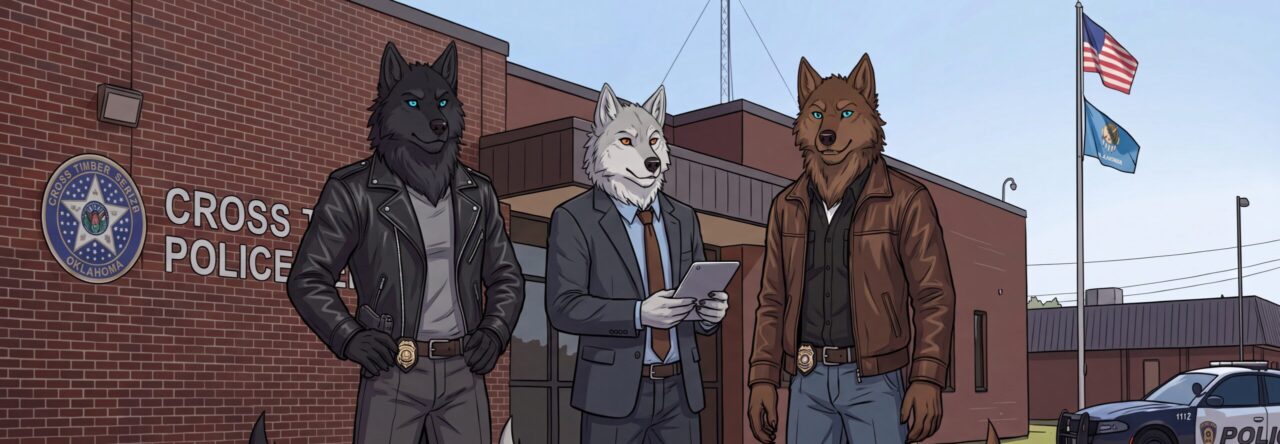
Thane hated the passenger seat before he sat in it.
Voss stood beside the unmarked department SUV with the passenger door open and one hand resting on the roof. Her face held the calm patience of a detective who had already decided not to negotiate with large mammals before coffee.
“It’s modified,” she said.
Thane looked at the seat.
The seat looked back spiritually.
“No.”
Voss glanced inside. “It has extended tracks, reinforced brackets, and the console was shifted two inches.”
“Two inches.”
“That was what maintenance could do without swearing in writing.”
Gabriel leaned against the next SUV over, where Rusk stood with keys in one hand and amusement hidden badly behind tired eyes.
Gabriel said, “It looks cozy.”
Thane looked at him.
Gabriel smiled. “For a suitcase.”
Mark stood near Lieutenant Crowe’s supervisor vehicle, notebook in hand, ears angled in a way that said he was handling the situation calmly and also absolutely not handling it.
The pack was being separated.
Not far.
Not permanently.
Not even out of radio reach.
That did not help as much as it should have.
The three of them had been separated before, obviously. They did not walk around tied together like nervous sled dogs. But this was different. Training different. Official different. A line drawn by people outside the pack.
Thane with Voss.
Gabriel with Rusk.
Mark with Crowe.
Three vehicles.
Three assignments.
Three pieces of one instinct forced into separate seats.
Hale stood near the building entrance with coffee, because apparently the department had discovered he could appear whenever emotional discomfort was educational.
“If you can’t function without standing shoulder-to-shoulder,” Hale said, “you can’t function.”
Gabriel sighed. “He says things like that and expects us not to resent the accuracy.”
Mark adjusted his grip on the notebook. “I am functioning.”
Crowe, short and sharp-eyed beside him, looked up from her tablet.
“You’re holding that notebook like it’s a flotation device.”
Mark looked down.
Then loosened his grip by one percent.
Crowe nodded. “Brave.”
Rusk opened the passenger door of his SUV for Gabriel.
Gabriel looked inside.
“Do I get to touch the siren?”
“No,” Rusk said.
“What if morale requires it?”
“Especially no.”
Gabriel glanced toward Thane. “Cruel department.”
Thane was still staring at Voss’s passenger seat.
Voss tapped the roof.
“In.”
“It’s small.”
“It is a vehicle, not a cabin.”
“It has opinions.”
“So do you. In.”
Thane folded himself into the seat.
Folded was the right word.
His knees disliked the dashboard. His tail found the modified clearance and accepted it grudgingly. His shoulders touched the door and almost the console at the same time. The seatbelt fit because someone had clearly argued with it beforehand.
Voss watched him settle.
“You good?”
“No.”
“Can you survive it?”
“Unfortunately.”
She shut the door.
Gabriel climbed into Rusk’s SUV with more grace and immediately said something that made Rusk point at him through the windshield.
Mark got into Crowe’s supervisor vehicle, where two radios, a mounted laptop, a tablet, and a dashboard camera made the inside look like a rolling command desk.
Mark’s eyes lit despite the pack separation.
Crowe noticed.
“Ride-along rule one,” she said through the open door. “Do not insult the car.”
Mark blinked. “I had not spoken.”
“Your face said the mobile terminal is mounted at an inefficient angle.”
Mark looked at it.
Then at Crowe.
“That was concern.”
“The car has heard enough.”
Hale looked between the three vehicles.
“Limited observation,” he said. “Passenger seat means passenger seat. You do not act unless directed. You do not make contact unless directed. You do not turn a ride-along into a documentary about feelings.”
Gabriel leaned out Rusk’s window. “What if feelings arise naturally?”
“Suppress them professionally.”
Mark raised one claw slightly. “Question.”
Hale looked pained. “Of course.”
“If we observe something relevant in separate vehicles, do we report to the assigned officer or over shared channel?”
Crowe answered before Hale could. “Assigned officer first unless immediate safety issue. You’re observers, not traffic on my radio.”
Mark nodded. “Understood.”
Crowe looked at him. “Good. Also, do not audit my CAD workflow.”
Mark opened his mouth.
Crowe pointed at him.
He closed it.
Hale looked almost proud.
“All right. Go learn why clean training lines get smeared.”
Voss got into the driver’s seat and started the SUV.
The radio came alive.
Thane looked through the windshield as the three vehicles pulled out of the lot in different directions.
Gabriel and Rusk turned right.
Crowe and Mark turned left.
Voss went straight.
The separation tugged in Thane’s chest.
Not fear.
Not exactly.
A wrongness.
The absence of familiar bodies in familiar places. Gabriel’s quiet humor not beside him. Mark’s breathing not behind him. The pack scattered into radio traffic and headlights.
Voss noticed without looking at him.
“You’re allowed to dislike it.”
Thane stared forward. “I don’t.”
“Bad lie.”
He growled softly.
“Also allowed,” she said. “Quietly.”
The SUV moved through Cross Timber as evening settled over the city. Streetlights flickered on. Store signs glowed. Traffic thinned but did not disappear. A line of cars curled around a coffee stand. A dog behind a fence barked once, caught Thane’s scent through the passing window, and reconsidered its plan.
Voss drove like she did everything else: controlled, unsentimental, aware of exits.
“Tonight is observation,” she said. “Not patrol. Not enforcement. We listen, we respond if assigned, you stay in the passenger seat unless I say otherwise.”
“I heard Hale.”
“Good. Hear me too.”
Thane looked at her.
Voss kept her eyes on the road.
“You do not need to prove you learned Ross’s lessons.”
“That sounds like a trap.”
“It is a warning. People fail training by trying to demonstrate training.”
Thane looked out the window.
Fair.
Annoying.
A different radio voice came over the channel. Crowe, calm and clipped.
“Supervisor two clear from annex. Monitoring east side.”
Mark’s voice was not on the radio.
Good.
Then Rusk checked in.
“Two-twelve clear, north sector.”
Gabriel did not add anything.
Also good.
Probably painful.
Voss keyed her mic.
“Two-oh-eight clear, central.”
The night moved.
For the first twenty minutes, nothing dramatic happened.
That was also part of the lesson.
A traffic stop that cleared with a warning.
A suspicious vehicle that turned out to be teenagers eating tacos in a church parking lot.
A noise complaint.
A reckless driver call that vanished before units arrived.
A welfare check pending.
Radio voices rose, crossed, cleared, updated, disappeared.
Thane listened from the passenger seat and hated how passive it felt.
Voss glanced at him.
“Passenger seat is not nothing.”
“Feels like nothing.”
“Then you’re doing it wrong.”
He looked at her.
She turned onto a commercial street lined with strip centers, gas stations, pharmacies, and fast food places glowing under fluorescent signs.
“Observation means you watch what the driver can’t. Hands. Cars. Doors. People turning away when they see us. People looking too long. People who don’t look at all.”
Thane’s ears angled forward.
“Passenger seat is discipline,” Voss said. “You are not less responsible because you’re not driving.”
He did not answer.
But he started watching differently.
Not just the street.
Everything.
A man pacing outside a laundromat, phone pressed to his ear, angry but stationary. A woman at a bus stop with two kids and three bags, tired but alert. A truck parked crooked behind a closed vape shop. A bicycle half-hidden beside a dumpster. A convenience store clerk taping a sign to a window.
The city was not quiet.
It only hid its noise in layers.
The call came at 8:17 p.m.
“Units copy disturbance, QuickMart at Danforth and Pine. Caller reports male subject inside yelling at customers, possibly intoxicated, possibly armed with knife. Subject described white male, forties, gray hoodie, jeans, bleeding from hand. Caller says subject is near front doors. Multiple customers inside.”
Voss’s posture changed before the dispatcher finished.
Thane’s did too.
The word knife arrived with a specific weight.
Then bleeding.
Then customers.
Then front doors.
Voss keyed the mic.
“Two-oh-eight en route.”
Rusk answered a beat later.
“Two-twelve en route from north.”
Crowe followed.
“Supervisor two monitoring. Advise on staging.”
Thane heard nothing from Mark.
But he could imagine him in Crowe’s passenger seat, eyes scanning CAD, hands wanting to type, brain building the scene faster than the radio could feed it.
Voss glanced at Thane.
“What do you know?”
He recognized the question.
Not what do you think.
Not what do you want to do.
What do you know.
“Male subject. Yelling. Possibly intoxicated. Possibly armed. Bleeding. Near front doors. Customers inside.”
“What do you assume?”
“That he’s dangerous.”
Voss nodded. “And?”
Thane forced himself.
“That the knife report may be wrong. That intoxicated may be wrong. That bleeding could be injury, not threat.”
“Good.”
The SUV accelerated, but not recklessly.
Still controlled.
Still maddening.
The QuickMart sat on the corner of Danforth and Pine, a bright rectangle of glass, gas pumps, and cheap light against the dark. Two cars were parked at angles near the entrance. One driver stood halfway out of her car with her phone up, filming. Another person hovered near the ice machine. Inside, several customers clustered too close to the front.
Voss parked at an angle that gave her view of the doors without blocking the whole lot.
“Passenger seat,” she said.
Thane’s claws flexed once.
“Passenger seat.”
She got out.
He stayed.
Every part of him hated it.
Voss moved toward the front, one hand low near her radio, posture open but ready. Rusk’s SUV pulled in from the opposite side seconds later. Gabriel stayed inside until Rusk gave him a small hand signal.
Thane saw Gabriel exit.
Hands open.
No performance.
No velvet.
Good.
Another patrol unit arrived and started moving customers back from the door.
Inside the store, a man in a gray hoodie paced near the front counter. Thane could see him through the glass. White male, forties maybe. One hand bleeding. Face flushed. Hair damp. He kept turning in circles as if the room moved when he did.
Not rage.
Panic.
Thane smelled it even through glass, gasoline, hot pavement, and the stale candy air leaking from the store every time the door opened.
The man shouted something.
The clerk shouted back.
Bad.
The woman filming moved closer.
Worse.
Voss spoke to the first officer. Rusk angled toward the entrance. Gabriel remained behind him, visible but not central.
The man inside saw them.
His head snapped toward the door.
He backed up and hit a display of chips. Bags spilled. A customer screamed. Someone yelled, “He’s got a knife!”
Thane’s hand went to the door handle.
Voss turned her head.
Through the windshield, across twenty feet of parking lot and noise, she looked directly at him.
No.
He let go.
Report before motion.
Passenger seat.
Mark’s voice finally came over Crowe’s radio, relayed through the supervisor channel, not the main one.
Crowe keyed up.
“Supervisor two to units at QuickMart. CAD update: caller now says object may be broken glass or box cutter from counter, not confirmed knife. Also store layout shows north side exit partially blocked by promotional display.”
Thane breathed out through his nose.
Voss keyed her mic.
“Copy. Have unit clear north exit if accessible. Keep customers moving south and away from glass.”
Gabriel heard it too. Thane saw him shift.
Not forward.
Sideways.
He pointed to the north side, said something to Rusk, and Rusk nodded.
Inside, the man’s shouting had changed.
Words now.
“I don’t know where it is! I don’t know where it is!”
Gabriel turned his head slightly.
Listening.
Rusk opened the door slowly, staying outside the threshold.
“Sir, Cross Timber Police. Keep your hands where I can see them.”
The man flinched hard.
Too hard.
His bleeding hand lifted.
There was something in it.
Glass.
Maybe.
Maybe not.
Voss positioned herself outside the door, angled, not blocking it.
Good.
Do not become the wall.
Thane sat in the SUV and watched the lesson unfold in real time, smeared by fluorescent glare, customers, phones, bad information, and someone crying near the drink coolers.
Gabriel spoke.
Not too smooth.
Not too warm.
Clear.
“Look at me. You’re bleeding. We can help with that.”
The man’s eyes jerked to Gabriel.
“Where’s my truck?”
Gabriel did not answer the question directly.
“What’s your name?”
“My truck. I had the keys.”
Rusk kept his voice steady. “Sir, set the glass down.”
The man looked at his hand as if discovering it belonged to him.
Blood ran down his fingers.
He swayed.
Crowe, calm but clipped.
“Supervisor two advising: clerk reports subject came in asking for orange juice, knocked over bottle near cooler, cut hand picking up glass. No confirmed theft. Possible medical issue.”
Medical issue.
Thane’s ears angled forward.
Voss heard it.
So did Rusk.
So did Gabriel.
Gabriel lowered his voice.
“Sir, did you need orange juice?”
The man stared at him.
“My sugar,” he said.
The whole call shifted.
Not safe.
Never safe.
But different.
Voss keyed up.
“Start EMS. Possible diabetic emergency. Subject still agitated, bleeding, object in hand.”
Thane looked at the man again.
Sweating. Shaking. Confused. Aggressive because the world had stopped making sense.
Not every threat was an enemy.
The passenger seat felt smaller.
The woman filming stepped closer again.
Voss turned her head.
“Ma’am, back behind the pump.”
“I’m allowed to film.”
“Yes,” Voss said. “From back there.”
“I pay taxes!”
Gabriel did not look away from the subject, but Thane saw the corner of his mouth move.
Even now.
Rusk said, “Nobody’s stopping you. Move behind the pump.”
The woman hesitated, then moved back, still filming.
Cameras don’t care what you meant, Rusk had said in another life Thane had not lived but understood.
Gabriel adjusted his posture so his hands were clearly visible.
Voss did too.
Accountable visibility.
The man stumbled toward the doors.
Customers surged back.
The north exit was still partially blocked. An officer moved the promotional display with more violence than promotional displays probably deserved.
The man came through the doorway suddenly, still holding the piece of glass.
Voss stepped back and angled left, giving him space out of the store without giving him the lot.
“Sir, stop there.”
He did not.
He staggered toward the pump lane.
Toward traffic.
Voss’s eyes flicked to Thane.
Then to the man.
Then back.
“Thane.”
The word hit like a release and a leash at the same time.
He opened the SUV door and stepped out.
Slow.
Hands open.
Claws visible.
Not reaching.
The man saw him.
Fear flashed.
Of course it did.
Thane stopped immediately.
Not close.
Not blocking.
Not the wall.
Gabriel spoke before the fear could become flight.
“That’s Thane. He’s staying right there. Look at me.”
The man’s eyes pulled back to Gabriel.
Good.
Voss moved half a step.
“Thane. Boundary at the lot side. Do not crowd.”
Thane moved to the edge of the pump lane, placing himself between the man and moving traffic without closing the distance to the man himself.
A boundary.
Not a wall.
The man swayed again.
Glass in hand.
Blood dripping.
Rusk said, “Set the glass down.”
“I can’t find my truck.”
Gabriel said, “We’ll find it. First, hand down. Look at me. Breathe.”
“Supervisor two: vehicle likely red Dodge parked on east side pump three, keys visible on front counter per clerk.”
Voss glanced toward the counter.
There they were.
A set of keys by the register.
The man’s brain had built a crisis around a lost truck that was twenty feet away.
Voss spoke carefully.
“Your keys are on the counter. Your truck is here. You’re not in trouble for needing help.”
The man’s face twisted.
“I need sugar.”
EMS was not there yet.
The clerk, still too close, held up a bottle of orange juice.
Rusk said, “Set it down and step back.”
The clerk looked insulted.
“Do you want it or not?”
Gabriel turned his head just enough.
“Set it down. Step back.”
Less velvet.
More command.
The clerk obeyed.
The man moved toward the juice, glass still in hand, too close to the broken bottle pieces near the entrance.
Voss’s voice sharpened.
“Thane. Guide him left. Two fingers.”
The world narrowed.
Brent hovering six inches above the mat.
The class laughing.
Ross saying, You moved him instead of guiding him.
Thane moved.
Slow.
From the side.
Not behind.
Not straight on.
“Sir. I’m going to guide your arm. I won’t hurt you.”
The man barely looked at him.
That might have been better.
Thane placed two fingers lightly above the man’s elbow.
Not a grip.
Not a clamp.
Enough to communicate.
Not enough to relocate furniture.
“Step left.”
The man moved.
One step.
Then another.
Away from the glass.
Away from the pump lane.
Feet on the ground.
No panic.
No lifting.
Voss’s eyes flicked to Thane.
Approval.
Tiny.
Enough.
Gabriel took over the voice.
“Good. Right there. Juice is coming to you.”
Rusk used a gloved hand and a calm command to get the glass down. The man resisted for half a second, then released it onto the pavement. An officer kicked it back out of reach.
EMS arrived in a wash of lights.
Not dramatic.
Efficient.
Paramedics moved in, checked glucose, asked questions, got juice into him, then gel, then more care. The man began to return to himself in pieces.
Confusion first.
Then embarrassment.
Then fear of consequences.
Voss kept her voice level.
“You’re not under arrest right now. We’re getting you checked out.”
The clerk started complaining about the broken display.
Rusk handled him with the dead patience of a man who had survived many clerks.
Gabriel stood nearby, hands open, saying less than he normally would have.
Thane stepped back.
All the way back.
The woman filming had her phone still up.
Her face had changed.
The video would show a werewolf stepping out of a police SUV.
It would also show him stopping when the man got scared.
It would show open hands.
It would show two fingers.
It would show no one being thrown, dragged, pinned, or made smaller.
Maybe that mattered.
Maybe cameras did care what happened, if you gave them the truth plainly enough.
Crowe arrived with Mark a few minutes later, after the scene was controlled.
Mark exited the supervisor vehicle too quickly, then slowed as if remembering he was still an observer. His eyes found Thane first.
Then Gabriel.
Then the man with EMS.
Then the glass.
Then the exit.
Then the camera.
Systems, scene, pack, proof.
Crowe noticed.
“You done inventorying reality?”
Mark’s ears flicked. “Mostly.”
“Good. Keep it to one paragraph.”
Mark nodded, visibly suffering.
Gabriel approached Mark from the side.
“You did good.”
“The object was misidentified.”
“Yes.”
“The truck keys were visible on the counter.”
“Yes.”
Thane remained near the SUV, watching EMS load the man for transport. Voss came to stand beside him.
“You did not levitate him.”
Thane growled. “That happened once.”
“That we know of.”
He looked at her.
She did not smile.
Exactly.
“You listened,” she said.
“Mostly.”
“Mostly is why we’re still doing this.”
He looked back at the ambulance.
“He was sick.”
“Yes.”
“Could have looked like a threat.”
“He was a threat,” Voss said. “He had glass in his hand, was bleeding, confused, and moving toward customers and traffic. But threat does not mean enemy.”
Thane absorbed that.
Threat did not mean enemy.
The line mattered.
Again.
Always.
Rusk walked over with Gabriel, rubbing one hand across his jaw.
“Clerk wants to press charges for a broken juice bottle and emotional distress to the chip rack.”
Gabriel said, “The chip rack looked shaken.”
Voss looked at Rusk. “And?”
“I told him to call corporate and be grateful the diabetic man with broken glass didn’t bleed out next to the taquitos.”
Gabriel nodded. “Measured.”
Rusk looked at him. “I left out taquitos.”
“Less colorful, but professional.”
Crowe joined them with Mark.
“Scene’s stable. EMS transporting. Clerk has officer info. Customers cleared. Filming lady wants badge numbers, the mayor, and possibly a podcast.”
Voss sighed. “Of course.”
Mark looked toward the woman.
“She was too close during the active scene.”
Crowe nodded. “Yes.”
“Could have interfered with safe movement.”
“Yes.”
“Public filming policy complicates perimeter enforcement.”
Crowe looked at him.
Mark closed his mouth.
“Good stopping point,” she said.
Hale arrived late.
No one knew from where.
He walked across the parking lot with a coffee cup that had no business still being full and looked at the scene, the broken glass, the ambulance pulling away, the customers dispersing, the trio standing in three separate clusters that were slowly becoming one again.
He looked at Voss.
“Anyone break the city?”
Gabriel answered, “Not permanently.”
Hale looked at him. “That answer keeps aging badly.”
Thane looked at Hale. “Why are you here?”
“Professional dread.”
Crowe said, “He monitors the radio when his problem children are out.”
Hale glared at her.
Gabriel’s face lit up.
“Problem children.”
“No,” Hale said.
Mark looked interested. “Plural confirmed.”
“No.”
Voss ignored them.
“They did well,” she said.
Hale looked suspiciously at all three.
“All of them?”
Rusk nodded. “Gabriel talked less.”
Hale’s eyebrows lifted. “Medical issue?”
Gabriel placed one hand over his heart. “Growth.”
Hale looked at Thane.
Voss said, “Two fingers. No levitation.”
Hale’s mouth twitched.
Thane pointed at him. “Do not.”
“I said nothing.”
“You thought it.”
“I think many things.”
Gabriel whispered to Mark, “He likes us.”
Mark whispered back, “In a supervisory-risk way.”
Hale looked at them.
“I hear whispers.”
“Everyone does now,” Gabriel said.
They returned to the station after clearing the scene.
Not together.
That was the rule.
Thane rode back with Voss, folded into the passenger seat, the smell of gasoline and broken glass still in his nose.
Gabriel rode with Rusk, visible in the side mirror for three blocks before traffic separated them.
Mark rode with Crowe, probably thinking through how to turn field observation into a flowchart and being spiritually restrained by one-page limits.
The separation still felt wrong.
But less wrong than before.
Or maybe Thane was learning the shape of it.
At the station, they regrouped in the side hallway near dispatch. The building hummed with night work. Phones. Radios. Doors. Reports. Someone laughing too loudly in the break room. Someone else swearing softly at a printer.
Nina looked through the dispatch window as they passed.
“You survive passenger seat?”
Thane said, “Barely.”
She nodded. “That’s how it knows you respect it.”
Gabriel smiled. “The passenger seat?”
“The radio,” Nina said, then turned back to her console.
Hale led them into a small briefing room for debrief. Voss, Rusk, Crowe, and the trio took seats. Hale stood because sitting might imply comfort.
“Short version,” Hale said. “What did you learn?”
Gabriel raised a claw.
Hale pointed at him. “Not actually short version. Thoughtful version.”
Gabriel lowered the claw, offended by precision.
Mark spoke first.
“Information quality changes the call. The initial report created assumptions: intoxicated, armed, aggressive. Subsequent information changed the response. The object was misidentified. Medical context mattered. Store layout mattered. Exit blockage mattered. Public filming affected scene control.”
Crowe stared at him.
Mark added, “That was one paragraph.”
Crowe nodded. “Barely legal.”
Gabriel went next.
“Voice can steer without taking over. I wanted to talk more. It would have made me feel useful. It would not necessarily have made things better.”
Rusk nodded.
“You did fine.”
Gabriel looked touched.
Then suspicious.
Rusk said, “Don’t make it weird.”
“Too late internally.”
Hale looked at Thane.
Thane stared at the table.
Training lines.
Street smears.
Passenger seat.
Glass.
Orange juice.
Phone camera.
Two fingers.
“He was a threat,” Thane said. “But not an enemy.”
The room went quiet.
Voss nodded once.
Hale watched him.
“And?”
Thane looked down at his hands.
“I wanted out of the seat before I knew enough.”
Hale said nothing.
“I still wanted to move when he came through the door.”
“That’s not automatically wrong,” Voss said.
“I know.”
The answer surprised him.
He did know.
Motion was not the enemy.
Unexamined motion was.
He continued.
“I was more useful when I waited for where to stand.”
Ross would have approved, probably with an insult.
Hale did not smile.
But his eyes changed.
“Good.”
Rusk leaned back.
“Passenger seat teaches humility.”
Gabriel looked at him. “You say that like yours has legroom.”
“It does. For me.”
Mark closed his notebook.
Thane looked at him.
“What did you write?”
Mark hesitated.
Then read, “The passenger seat is not passive. It is assigned restraint.”
Gabriel stared.
Hale looked annoyed by how good that was.
Voss said, “Write that in your report.”
Mark looked up. “We have a report?”
Hale smiled.
All three werewolves went still.
“One page,” Hale said.
Mark’s ears lifted in pain and joy.
Gabriel leaned back. “This is how he feeds.”
Hale looked at them.
“Field observation summary. What you knew, what you assumed, what changed, and where you were useful. Due Friday.”
Thane grunted.
Hale looked at him. “Yes, you too.”
“I didn’t say anything.”
“Your soul complained.”
Gabriel smiled. “It does that.”
The debrief ended at nearly ten.
Outside, the parking lot was dark except for overhead lights and the moving glow of patrol cars. The Xterra waited where Thane had left it, practical and quiet. Gabriel and Mark walked beside him, close enough now that the wrongness in his chest eased.
No one mentioned it.
That was mercy.
Gabriel stretched his shoulders.
“Pack separated and nobody died.”
Mark said, “That is a low standard.”
“It is day one of being separated in police vehicles. I’m taking the win.”
Thane opened the driver’s door.
“We are still not cops.”
Gabriel looked toward the patrol cars rolling back into the dark.
“No.”
Mark held his notebook against his chest.
“But today we were passengers.”
Thane paused.
Passenger seat had felt smaller than the driver’s seat.
Maybe that was why it taught more.
He looked back at the station, at the radio-lit windows, at officers coming and going, at the city beyond waiting to turn someone’s bad night into a call.
Then he climbed into the Xterra.
Gabriel got in beside him.
Mark settled in the back.
For a moment, none of them spoke.
The pack was together again.
But the silence was different.
Not relief exactly.
Adjustment.
Thane started the engine.
The radio was not in the Xterra, but he could still hear it in memory.
A call becoming a scene.
A scene becoming choices.
Choices becoming reports.
Reports becoming weight.
He pulled out of the lot and turned toward home.
Behind them, the station stayed awake.
Ahead, Cross Timber stretched under streetlights, full of doors, glass, cameras, fear, sickness, anger, and people who might look dangerous before anyone understood why.
Training gave clean lines.
The street smeared them.
Thane drove with both hands on the wheel, claws resting lightly against leather, and thought that maybe the passenger seat was not where control ended. Maybe it was where control learned to listen.