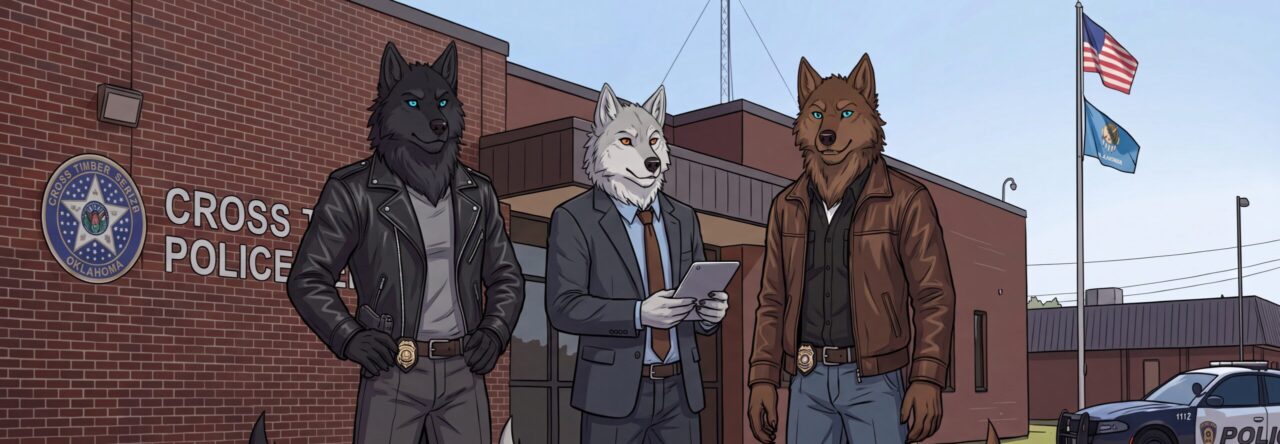
By sunrise, the Fairland fire had become a folder.
Not a solved folder.
Not even a confident folder.
Just a folder thick enough to prove the night had not been imagining things.
Mark did not like folders that could not decide what they were.
He sat at the briefing table at 06:32 with his tablet, two printed maps, Fire Marshal Valdez’s preliminary scene notes, Patrol’s canvass sheet, three witness summaries, and the old Lowell incident report from two weeks earlier.
Gabriel sat beside him with coffee and the expression of a wolf who had already regretted being awake.
Thane stood near the board, arms folded, smoke still faint in his fur despite a station washdown.
Crowe leaned against the wall with a fresh cup of coffee and the dry patience of a night commander who had not ordered the fire but still resented it.
Voss and Rusk arrived exactly on time.
Voss took one look at the table.
“That is not a minor fire folder.”
Mark looked down at the documents.
“No.”
Rusk sat and slid his coffee into position.
“Copper theft?”
Gabriel said, “The copper theft equivalent of a child putting one sock in the laundry and calling the room clean.”
Rusk blinked.
“Still early for metaphor.”
“He had coffee,” Mark said.
“Regrettable.”
Voss pulled the Fairland scene photo closer.
“Start clean.”
Thane nodded.
“Fairland. Vacant single-family residence under renovation. Fire reported at 22:02 by neighbor across the street. Fire contained to utility room and adjacent hallway. No injuries. Power disconnected at meter. Gas locked out. Side entry showed forced access. Small visible section of copper pipe removed near origin point.”
Mark tapped the Lowell report.
“Lowell. Two weeks prior. Vacant single-family residence, also under renovation. Minor fire in utility area. Neighbor extinguished it with garden hose before full fire response. Power also disconnected. Gas inactive. Side entry forced. Small section of copper removed. Initially categorized as attempted copper theft with incidental fire damage.”
Voss looked at him.
“You don’t like incidental.”
“No.”
Rusk leaned forward.
“Copper thieves usually steal copper. It’s one of their defining traits.”
Gabriel pointed at him.
“That’s what I said, but Mark made it less charming.”
Mark ignored him.
“At Fairland, multiple accessible copper runs were left untouched. The removed section was short, visible, and close to the fire origin. At Lowell, according to photos, same issue. A visible section was removed while more valuable material remained.”
Voss looked at the photos.
“So staged.”
“Likely staged,” Mark said.
Voss nodded once.
“Good. Likely is an honest word.”
Crowe said, “Doorbell footage?”
Gabriel took over.
“Mrs. Hanley saw a white panel van parked two houses down around 21:40. Patrol contacted the doorbell-camera owner. We got footage at 03:10. Van passes eastbound at 21:34, parks just outside the camera’s best angle, leaves westbound at 21:57. Fire reported five minutes later.”
Rusk looked at him.
“Plate?”
“No full plate. Rear passenger brake light out. No visible logo. Possible magnetic sign outline on the driver’s door. Mark has been emotionally bonding with pixels.”
Mark turned his tablet around.
The image showed a white panel van at night, headlights blown bright, body partly washed out by the camera’s porch light. It was not useless. It was also not enough.
Mark zoomed to the side panel.
“Clean rectangle here. Dust pattern suggests a removable magnetic sign was recently taken off or replaced. There’s a shallow dent near the rear wheel well. Roof has two dark parallel marks consistent with a removed ladder rack.”
Voss studied the image.
“Make, model?”
“Likely Ford Transit or similar high-roof work van. I won’t narrow further from this angle.”
Rusk sipped coffee.
“I appreciate when the pixels refuse to confess.”
Gabriel said, “Rude of them.”
Voss looked at the map.
“Connections between Fairland and Lowell?”
Mark had been waiting for that.
He slid the first map forward.
“Both are inside the east redevelopment corridor. Not adjacent, but within the area where multiple older homes have been sold, renovated, demolished, or converted to rentals over the last eighteen months. Both had active or recently active remodel permits. Both had vacancy complaints in the last six months.”
Crowe looked at the map.
“Owners?”
“Different. Fairland is owned by Drew Nance through Nance Family Rentals LLC. Lowell is owned by Marion Webb personally. No shared ownership.”
“Contractors?”
“Still pulling.”
Voss put both hands on the edge of the table.
“Do not fall in love with arson until the evidence asks you to.”
Thane nodded.
“We’re not there yet.”
“Good. Because right now you have two fires with suspicious staging and a van. That’s a pattern starting to raise its hand. It is not a confession.”
Gabriel lifted one paw slightly.
“What if the pattern is waving?”
Voss looked at him.
“Then you wave back with subpoenas.”
Rusk smiled into his coffee.
Crowe pointed at the board.
“Day shift will keep patrol aware and lock down any immediate neighborhood footage before it overwrites. Voss and Rusk can start owner contacts this morning. Night Shift goes home, sleeps, and comes back early. I don’t need three sleep-deprived wolves interviewing contractors like a haunted lumberyard.”
Gabriel looked offended.
“I’d be a charming haunted lumberyard.”
Mark said, “That is not reassuring.”
Thane gathered the folder.
“We’ll be back at fifteen hundred.”
Voss nodded.
“I’ll have whatever we can get by then.”
Rusk looked at the photos one more time.
“Two fires pretending to be theft.”
Gabriel stood.
“Bad theater.”
Rusk nodded.
“With props.”
Voss closed the folder.
“Then let’s find the stage crew.”
Silas was awake when they got home.
That still surprised Thane sometimes.
Not that Silas woke early. Not that he moved quietly through the den. Not that he made coffee and sat at the kitchen island with his shoulders relaxed and his phone beside one paw.
The surprising part was that it felt normal now.
Silas at the island.
Silas’s keys on the hook.
Silas’s safety vest hanging beneath them.
Silas looking up when the garage door opened because pack had come home.
He studied them as they entered.
“You smell like smoke.”
Gabriel dropped into a chair.
“We have been lightly seasoned.”
Mark set his tablet down.
“That is not how smoke contamination works.”
Silas looked at Thane.
“Was it bad?”
Thane poured coffee.
“Vacant house. Fire knocked down. No injuries.”
Silas waited.
He did not ask where.
He did not ask how.
He did not ask what they knew.
The waiting itself showed the line.
Thane added only what he could.
“Suspicious.”
Silas nodded once.
“That’s yours.”
Gabriel leaned back.
“And what’s yours?”
Silas looked toward his safety vest.
“Hose. Cabinets. Washing things that are already clean because Reaves says clean has levels.”
Mark nodded.
“Accurate.”
Gabriel smiled.
“And trees.”
Silas’s mouth twitched.
“And trees.”
Thane handed him a fresh cup of coffee.
Silas accepted it with both paws.
“You going to Red Dirt later?”
“Afternoon. Then I have approved volunteer time at Station Three after. Ortiz texted Hale the schedule. Hale texted me a paragraph that started with ‘do not confuse being welcome with being employed.’”
Gabriel put a paw over his heart.
“I adore that woman.”
Silas smiled.
“She also said if anyone calls me Practicing Firefighter Wolf, I should not answer officially.”
Mark considered.
“That is sensible.”
Gabriel pointed at him.
“But unofficially?”
Mark looked at Silas.
“Unofficially, it is descriptive.”
Silas groaned.
Thane smiled into his coffee.
The case waited in the folder.
Smoke waited in his fur.
But for a few minutes, the great room held coffee, morning light, and Silas being annoyed by a nickname he did not hate.
That was allowed.
Then Thane looked at him.
“You did good yesterday.”
Silas’s ears shifted.
“With Noah?”
“Yes.”
Silas looked down into his coffee.
“Ortiz assigned me.”
“And you did the task.”
Silas smiled faintly.
“That’s what he said.”
“He was right.”
Nobody made the moment larger than it wanted to be.
Gabriel only reached across the island and tapped one claw lightly against Silas’s cup.
“Practicing.”
Silas tapped back.
“Annoying.”
“Also accurate.”
Silas smiled.
Then Mark looked at Gabriel’s hand.
“You have cereal dust on your fingers.”
Gabriel immediately pulled his paw back.
“That’s private.”
“You were eating from the non-emergency cereal again.”
“I reject the category.”
Silas looked between them.
“There’s emergency cereal?”
Thane picked up the fire folder and headed down the hall.
He was not getting involved in that.
Some investigations were safer than breakfast.
By late afternoon, Night Shift was back at the station, called in early after Voss found a third possible address.
Voss had already built them a better problem.
She had pinned three addresses to the board.
Fairland.
Lowell.
And Marlowe.
Thane stopped in the doorway.
“Three?”
Voss stood beside the board, jacket off, sleeves rolled to her elbows.
“Maybe.”
Rusk sat at the table with a sandwich and the expression of a man who had found a new reason to distrust paperwork.
“Detached garage fire six weeks ago. Vacant house on Marlowe. Written up as suspected transient warming fire. Minimal damage. No one was ever found. Side door forced. Small copper section missing from garage utility wall.”
Gabriel slowly set his coffee down.
“Three bad plays. Same props.”
Mark moved to the board.
“Power status?”
Voss pointed to the report.
“Disconnected pending renovation.”
“Gas?”
“Locked out.”
“Fire origin?”
“Utility corner of detached garage.”
Mark said nothing for a moment.
That was always louder than speaking.
Crowe entered behind them.
“I assume silence means bad.”
Mark looked at her.
“Silence means pattern.”
Rusk took a bite of sandwich.
“Same neighborhood corridor. Three owners. Three vacant renovation properties. Three small fires. Three tiny copper thefts that a real thief should be embarrassed by.”
Gabriel looked at Rusk’s sandwich.
“Do you rehearse those?”
“No. I’m just good.”
Voss tapped the first address.
“Fairland owner is coming in at sixteen hundred. Lowell owner at seventeen thirty by phone. Marlowe owner is out of state but emailed documents. I’ve got permit history, code complaints, sale offers, and contractors where available.”
Thane looked at the board.
“Any shared contractor?”
“Not general contractor. Different people. Different permits. Different owners. That’s why it took longer.”
Mark’s ears lifted slightly.
“But?”
Rusk smiled without humor.
“But there are overlaps in the background noise.”
Voss handed Mark a folder.
“All three owners received purchase inquiries from RidgeMark Development or related brokers within the last four months.”
Gabriel leaned in.
“That sounds motive-shaped.”
“It does,” Voss said. “But don’t marry it.”
Crowe glanced at Gabriel.
“Dating with subpoenas only.”
Gabriel looked wounded.
“I said one thing.”
“And it survived. Unfortunately.”
Mark flipped through the folder.
“Ridgemark Development has been assembling properties along the corridor for a mixed-use redevelopment proposal.”
Voss nodded.
“Still unofficial. No final city filings beyond preliminary inquiries. They’re buying where they can. Some owners are selling. Some aren’t.”
Thane looked at the photos.
“Burning resistant properties would pressure sales.”
“Yes,” Voss said. “It would also be stupid, risky, and unnecessary if they have money and lawyers.”
Rusk lifted his sandwich.
“Never discount stupid with resources.”
Gabriel pointed at him.
“Government slogan.”
Crowe said, “Keep both lanes open. Developer pressure, contractor access, cleanup companies, insurance, vandals, actual thieves. Evidence decides.”
Thane nodded.
“What did Valdez say?”
“She’s waiting for you at Fairland. Lab will take longer, but she has daylight observations.”
Mark closed the folder.
“Then we start with fire.”
Fairland looked worse in daylight.
Night had made the damage dramatic.
Day made it specific.
The side of the house was stained black around the utility door. Soot feathered up under the eave. The yard was trampled where fire crews had worked. Yellow tape moved slightly in the warm wind.
Valdez stood near a folding evidence table under a canopy, camera hanging from her neck, hair pulled back tighter than the day before. Her turnout pants were dirty at the knees. Her department shirt had a smear of ash at the shoulder.
She looked up as they approached.
“Detectives.”
Thane stopped outside the marked path.
“Marshal.”
Gabriel looked at the side entrance.
“Daylight did not improve it.”
“No,” Valdez said. “But it did make it more honest.”
Mark stepped beside the table.
“What have you got?”
Valdez picked up a photo sheet.
“Preliminary only. Origin remains utility-room lower west wall. Fire burned hot and fast in a small area, then started moving up the wall. Suppression stopped it before it got into the attic. No electrical source. Power confirmed disconnected by utility. Gas locked and verified.”
She pointed at a close-up.
“This residue was found low at the origin point. Could be remnants of cloth, plastic, and a container. I collected samples. Lab will tell us more.”
Thane looked at the photo.
“Chemical odor was strongest there.”
Valdez nodded.
“I noticed it too after overhaul cleared enough smoke. Not gasoline. Not heavy petroleum. More like solvent. Could be paint thinner, adhesive remover, certain construction cleaners, or something similar.”
Mark typed.
“Common on renovation sites.”
“Exactly. Which is useful and annoying.”
Gabriel said, “A suspect pool of everyone with a garage.”
Valdez gave him a brief look.
“And a hardware store.”
“Worse.”
She picked up another photo.
“Copper removal. The cuts were made with a small tubing cutter, not random tearing. Clean enough to be deliberate. But the piece removed was short and visible. Other accessible copper remained untouched.”
Mark nodded.
“Same at Lowell and Marlowe?”
“Lowell yes. I reviewed those photos this morning. Marlowe is less clear because the garage damage was old and the initial scene wasn’t preserved as suspicious, but the visible section missing is similar.”
Thane looked toward the utility door.
“Could a small fire be meant to look like a warming fire or accident?”
Valdez nodded.
“At Marlowe, yes. At Lowell, maybe. At Fairland, no. This one was more deliberate, or whoever is doing it is escalating.”
Crowe had told them not to marry arson.
The evidence was starting to bring flowers.
Valdez leaned one hip against the table.
“People think arson is always rage. Sometimes it’s paperwork with a flame.”
Gabriel went still.
Mark looked up.
Thane watched Valdez’s face.
She continued.
“These aren’t wild fires. They’re contained enough to avoid immediate catastrophe if discovered early, but dangerous enough to trigger reports, insurance, owner panic, neighborhood pressure, contractor calls, board-up, cleanup, maybe sale decisions.”
Gabriel’s voice lost its humor.
“Administrative fire.”
“Sometimes. Maybe not here. But the pattern makes me wonder who benefits from damage that looks criminal but stays manageable.”
Mark said, “A developer trying to lower purchase resistance.”
“Yes.”
Thane added, “A contractor creating repair work.”
“Yes.”
Gabriel said, “A cleanup company creating cleanup.”
Valdez pointed at him.
“Yes.”
Mark typed faster.
Valdez looked toward the house.
“Or someone angry at redevelopment who wants attention without casualties. Or an actual thief who is bad at copper but consistent at fire. Don’t narrow too soon.”
Thane nodded.
“Voss said the same.”
“Good. Listen to her.”
Gabriel glanced at Mark.
“Everyone keeps telling us not to make up our minds.”
Mark said, “Because you enjoy narrative completion.”
Drew Nance looked like a man who had gotten into rental property because a podcast made it sound easy.
He was thirty-seven, clean-shaven, pressed shirt, expensive watch, and tired eyes. He sat in Interview Room Two with a bottle of water he hadn’t opened and a folder of documents held too tightly.
Gabriel took the lead because anger often opened better for him than for Thane.
Thane sat beside him anyway.
Mark observed with the documents.
“This is not an accusation,” Gabriel said. “We’re trying to understand who had access, who had conflict, and who knew the property was vacant.”
Nance nodded.
“I get it. I mean, I don’t get any of this, but I understand why you’re asking.”
Gabriel smiled slightly.
“Fair distinction.”
Mark said, “Who had keys?”
“Me. My contractor, Rob Ellis. The city inspector had access by lockbox when scheduled. That’s it.”
“Lockbox code?”
Nance winced.
“Same one I use on all my properties.”
Mark looked at him.
Nance immediately said, “I know. I’m changing it.”
Gabriel kept his tone easy.
“Any recent disputes?”
Nance laughed without humor.
“Which category?”
“Start with loudest.”
“Neighbors hate the remodel. They think I’m turning the house into a short-term rental. I’m not. Maybe later, but not right now. Contractor’s behind. Costs are up. Code officer keeps tagging the porch railing. Insurance is asking for photos every ten minutes. And RidgeMark keeps trying to buy it for less than I have in it.”
Thane’s attention sharpened.
“RidgeMark.”
Nance nodded.
“Yeah. Some broker called twice, then emailed. Offered cash, fast close. Lowball. I said no.”
“Any threats?”
“Not threats. Pressure. ‘Properties in that corridor are becoming difficult for small owners.’ ‘Renovation costs are likely to rise.’ ‘Vacancy risk is increasing.’ Stuff like that.”
Gabriel looked at him.
“Sounds like a warning wearing a tie.”
Nance pointed at him.
“Exactly.”
Mark made a note.
“Any cleanup or board-up companies involved before the fire?”
Nance frowned.
“Before? Not for fire. I had someone come by about securing the property after a break-in scare.”
Thane kept still.
“What break-in scare?”
“Three weeks ago, I got a call from a neighbor that the side door looked open. It wasn’t damaged, just not latched right. I called a company to check doors, windows, that kind of thing.”
Mark asked, “Company name?”
Nance looked through his email on his phone.
“Briggs Restoration and Recovery.”
Mark’s typing paused for one fraction of a second.
Gabriel saw it.
So did Thane.
Nance looked up.
“What?”
Gabriel smiled.
“Just getting it right.”
Nance turned the phone toward them.
“Briggs did a vacant-property security check. Boarded one rear window, recommended motion lights, sent me a quote for ongoing checks. I didn’t sign up.”
Mark wrote the invoice number.
“Did they use a van?”
“White van, I think. With magnetic signs.”
Thane’s jaw tightened.
Gabriel leaned back.
“Who from Briggs?”
“Guy named Caleb. Caleb Briggs? Maybe owner’s son? I can forward the invoice.”
Mark nodded.
“Please.”
Nance looked at the table.
“Is this connected?”
Gabriel did not answer too quickly.
“We don’t know yet.”
That was the honest answer.
Nance hated it because honest answers were rarely comforting.
At 17:26, while waiting for the Lowell owner’s call, Thane stepped into the hallway and checked his phone.
Silas had texted from Station 3.
Approved volunteer time. Rolling hose. Reaves says I am less abusive to hose now.
Thane smiled.
Progress.
A second message came in.
Vaughn says Practicing Firefighter Wolf has improved hose empathy.
Thane replied:
That title is spreading.
Silas:
I am aware.
Then, after a pause:
Firefighters are talking about vacant house fires. I am not asking questions.
Thane stared at the message for a second.
Gabriel appeared beside him.
“What?”
Thane showed him.
Gabriel’s expression softened.
“That’s good.”
Mark joined them.
Thane showed him too.
Mark nodded.
“Clean boundary.”
Thane typed:
Proud of you. Not yours.
Silas replied quickly.
I know. This is mine today.
Then a picture came through.
A hose roll.
Not perfect.
But good.
Reaves’s boot stood at the edge of the photo, and someone had taped a small note to the concrete beside the hose.
LESS RUDE TO HOSE
Gabriel laughed.
Mark looked at the photo.
“That roll is acceptable.”
Thane typed:
Acceptable hose wolf.
Silas replied:
Do not combine titles.
Gabriel took Thane’s phone and typed before Thane could stop him.
Too late.
Silas sent back only:
I know that was Gabriel.
Gabriel looked offended.
“He knows my voice in text.”
Mark said, “Everyone does.”
Thane took the phone back.
He did not ask Silas about Station 3.
Silas did not ask about the fires.
Both facts mattered.
Through the hallway window, the afternoon light had started to tilt toward evening.
Work waited on both sides of town.
Different work.
Clean lines.
Good.
Marion Webb answered the phone on the third ring and began the call already angry.
“I told the first officer this wasn’t right.”
Gabriel put her on speaker with permission.
Voss sat in for the call because Lowell had happened on day shift’s earlier watch, and because Voss disliked gaps.
“We’re reviewing that now, Ms. Webb,” Voss said. “Tell us what concerned you.”
“My late husband was a plumber. I know what copper theft looks like. They didn’t strip the house. They took one little piece from where anybody could see it, then somehow a fire starts right there? That isn’t theft. That’s somebody insulting my intelligence.”
Gabriel glanced at Mark.
Mark was already typing.
“Who had access to the Lowell property?” Gabriel asked.
“Me, my nephew, the contractor I fired, and whatever code people went by.”
“Why did you fire the contractor?”
“He stopped showing up. Then he wanted more money. Then Ridgemark started calling me like vultures in dress shoes.”
Voss’s eyes sharpened.
“RidgemMark contacted you too?”
“Three times. Offered less than the land’s worth. Told me vacant houses attract trouble. Then trouble showed up. You tell me how that sounds.”
Thane leaned closer.
“Did you have anyone inspect or secure the property before the fire?”
“Yes. Briggs Restoration. They came out after somebody broke a rear window. Boarded it up. Nice enough man. Too chatty.”
Mark’s pen stopped.
“What was his name?”
“Caleb.”
Gabriel looked at Thane.
Thane kept his face still.
Marion continued.
“He told me I should consider selling before the corridor got worse. Said small owners get eaten alive in redevelopment zones. I told him I’d been married to a plumber for forty-one years and wasn’t scared of a man with a clipboard.”
Rusk, listening from the corner, whispered, “I like her.”
Voss ignored him.
“Did Caleb say who you should sell to?”
“Not directly. Mentioned Ridgemark was buying. Said they had cash. Said cash was simpler than fighting vacancy, vandals, and fire risks.”
Voss’s face went still.
“Fire risks?”
“That’s what he said. I thought he meant generally. Then my utility room burned three days later.”
The room settled.
Gabriel’s voice stayed gentle.
“Ms. Webb, do you have any invoices, emails, or texts from Briggs?”
“I kept everything.”
“Would you forward them?”
“I already did to the first officer. I’ll send them again because apparently paper has to knock twice before people open the door.”
Rusk whispered, “I love her.”
Mark said, “Please do.”
Marion was not done.
“And you can tell whoever did this that if they wanted to scare me into selling, they should have started with someone easier.”
Gabriel smiled.
“I believe they’re learning that.”
The neighborhood activist was not what Gabriel expected.
He expected a bullhorn.
Maybe a handmade sign.
Possibly a person who said “community” like it had teeth.
Evelyn Harrow did have signs, but they were stacked neatly in her front hallway by topic and date. She was in her late sixties, tall, with silver hair braided down her back and the brisk manner of someone who had attended too many city meetings to fear anyone with a title.
Her living room contained maps, binders, and a framed photo of the neighborhood from 1978.
She invited them in, looked at Thane’s shoulders, and said, “Do not break the Morris chair.”
Thane looked at the chair.
“I’ll stand.”
“Good choice.”
Gabriel smiled.
“We’re looking into the fires on Fairland, Lowell, and possibly Marlowe.”
Evelyn’s face hardened.
“So now they interest you.”
Mark said, “They interest us now because there is a clearer pattern.”
She looked at him.
“At least you didn’t say isolated incidents.”
Mark blinked.
“They may still be isolated.”
Gabriel slowly turned toward him.
Evelyn stared.
Then, unexpectedly, she laughed.
“You’re honest. Annoying, but honest.”
Mark nodded.
“Frequently.”
She motioned toward the dining table.
“Sit where you fit.”
They did.
Thane stood.
Evelyn opened a binder labeled CORRIDOR PRESSURE — PROPERTY CONTACTS.
Gabriel looked at the label.
“You have binders.”
“I have survived three rezoning fights and a drainage lawsuit. Of course I have binders.”
Mark’s eyes changed.
Not emotionally.
Professionally.
He respected a binder.
Evelyn noticed.
“You can look if your paws are clean.”
Mark lifted both paws slightly.
“They are.”
She slid the binder to him.
The next twenty minutes were useful.
Very useful.
Evelyn hated Ridgemark Development.
She did not hide it. She called them “polished scavengers” and “urban renewal in expensive shoes.” She believed they wanted the east corridor cheap, quiet, and empty of anyone without legal counsel.
That made her sound like a suspect for about six minutes.
Then Gabriel asked where she had been during the Fairland fire.
“At the library board meeting, arguing about roof leaks. Twelve people can confirm. I spoke for fourteen minutes and was gaveled down twice.”
Mark checked the time.
That ended that.
But Evelyn had photos.
She had dates.
She had copies of letters owners had shared with her.
She had a spreadsheet printed in color because “some people need shame highlighted.”
She also had a photo of a white van outside the Lowell property four days before the fire.
Not the night of.
Not proof.
But the van had a rear passenger brake light with red tape over a crack.
And a faint rectangle on the driver’s door where a magnetic sign had been removed.
Thane leaned closer.
“Can we get a copy?”
Evelyn looked offended.
“I already printed three.”
Gabriel accepted the photos.
“You’re prepared.”
“No. I’m tired of being ignored.”
That landed differently.
Gabriel’s smile faded.
“We’re listening now.”
Evelyn studied him.
Then nodded once.
“Good.”
Mark pointed at a name in the binder.
“Briggs Restoration and Recovery appears in your notes.”
“Yes. They’ve been sniffing around almost as much as Ridgemark.”
“How?”
“Offering vacant-property checks, board-up, cleanup, security recommendations. They show up after broken windows, loose doors, complaints. Sometimes before owners even know there’s a problem.”
Thane looked at her.
“Before?”
Evelyn nodded sharply.
“Marlowe’s owner lives in Colorado. Briggs left a flyer after the garage window broke. Owner told me he hadn’t even been notified yet. How does a company know faster than the owner unless somebody tells them?”
Mark made a note.
“Could be scanner traffic. Could be code complaint records. Could be neighborhood reporting.”
“Could be,” Evelyn said. “Or could be a man creating his own weather and selling umbrellas.”
Gabriel went still.
Thane looked at the binder.
A fire wearing theft.
Paperwork with flame.
Weather and umbrellas.
Different words.
Same smoke line.
Evelyn slid another sheet across the table.
“Here. List of everyone who told me Ridgemark contacted them, and anyone who said Briggs came by. I don’t know who’s burning things. I know who benefits when people get scared.”
Voss would like that sentence.
Because it did not pretend to be proof.
It pointed toward a road.
Thane picked up the list.
“Thank you.”
Evelyn looked at him.
“I’m not doing this for you.”
Gabriel smiled faintly.
“No, ma’am.”
“I’m doing it because I don’t want my neighborhood turned into a balance sheet.”
Mark looked up.
“We can work with documents.”
For the first time, Evelyn smiled at him.
“I bet you can.”
The case expanded without becoming clearer.
That was the cruel trick.
More information did not always produce answers.
Sometimes it produced hallways.
By 20:15, Night Shift had:
Three suspicious fires.
Three properties in the redevelopment corridor.
Three owners contacted by RidgeMark or related brokers.
Three properties touched by Briggs Restoration and Recovery before or after recent “security” concerns.
One white panel van seen near Fairland.
One likely matching van photographed near Lowell days before the fire.
One Marlowe owner who confirmed by email that Briggs had quoted him for board-up and cleanup services two weeks before his detached garage burned.
No direct witness to ignition.
No plate.
No lab results.
No confession.
No warrant.
Crowe stood in the bullpen, reading the update off Mark’s tablet.
“This is both better and worse.”
Gabriel nodded.
“Better because pattern. Worse because pattern has friends.”
Thane looked at the board.
“Ridgemark has motive.”
Mark said, “Briggs has access and operational opportunity.”
“Contractors have access too.”
“Yes. But not across all three.”
Gabriel leaned against the table.
“Ridgemark pressures owners. Briggs shows up to secure properties. Fires happen. Owners panic. Somebody gets paid. Somebody maybe sells.”
Crowe looked at him.
“That’s a theory.”
“Yes.”
“Evidence?”
“Annoyingly pending.”
“Then annoyingly don’t act like it’s done.”
Gabriel nodded.
“Dating only.”
Crowe closed her eyes.
“I hate that I understand the callback.”
Patel walked in with a flash drive in one hand.
“Doorbell footage from Marlowe’s neighbor. Old, but they had cloud backup.”
Mark stood.
“Relevant?”
“Maybe. White van. No plate. Same bad brake light or same universe mocking us.”
Gabriel pointed at Patel.
“See? Wednesday had intentions.”
Patel looked confused.
Mark took the drive.
“Ignore him.”
They loaded the video.
Marlowe’s camera angle was poor. The timestamp was six weeks old. The van was partially blocked by a tree and washed by afternoon sun.
But it was white.
High-roof.
No visible logo.
A rectangular clean patch on the driver’s door.
A dent near the rear wheel well.
And when the van slowed near the curb, the rear passenger brake light flashed weak and uneven through red tape.
Gabriel’s humor drained away.
“That’s the same van.”
Mark did not answer immediately.
He placed the Fairland still beside it.
Then Lowell’s photo from Evelyn.
Three images.
Three imperfect angles.
Three nights and days that had not known they were related until someone placed them in the same room.
“It is strongly consistent,” Mark said.
Gabriel looked at him.
“Mark.”
Mark exhaled.
“Yes. It is very likely the same van.”
Crowe leaned in.
“Can we tie it to Briggs?”
“Not yet,” Mark said. “But Briggs operates white work vans. Public photos on their website show magnetic door signs.”
Gabriel opened his mouth.
Crowe said, “No warrant based on vibes and website aesthetics.”
“I wasn’t going to say that.”
“You were.”
Gabriel paused.
“I was going to say maybe.”
Thane looked at the board.
“What do we have for Caleb Briggs?”
Mark had already started.
“Caleb Briggs. Thirty-four. Field operations manager for Briggs Restoration and Recovery. Son of owner Daniel Briggs. Prior misdemeanor assault nine years ago, dismissed after deferred. Civil lawsuits involving billing disputes, no convictions. Company does board-up, smoke cleanup, water mitigation, vacant property securing, emergency response, light demolition, and post-loss restoration.”
Patel whistled softly.
“That’s a lot of reasons to be near damaged property.”
“Or a lot of legitimate explanations,” Mark said.
Crowe nodded.
“Which is why we do not kick doors.”
Thane looked at the van images.
“Can we get company fleet records?”
Mark said, “Voluntary request first. Subpoena if refused. Also business registration, insurance claims, job invoices, any GPS if their fleet uses tracking.”
Gabriel said, “Interview Caleb?”
Crowe looked at Voss, who had entered during the video review and stood quietly near the doorway.
Voss considered it.
“Not tonight unless you’re ready. If he’s our guy, a casual contact tips him. If he’s not, we may need his records. Start with records. Talk to owners. Lock footage. Get Valdez’s fire reports connected. Find the van without letting the van know it’s interesting.”
Rusk appeared behind her with coffee.
“Stalk the van emotionally.”
Gabriel turned.
“You can say that but I can’t?”
Rusk shrugged.
“Seniority.”
Crowe looked at him.
“Why are you still here?”
Rusk lifted the coffee.
“Forgot this.”
Voss said, “That is your third forgotten coffee.”
“Hydration.”
Mark said, “Coffee is not—”
Thane touched his arm.
“Let it go.”
Mark looked pained.
But he did.
Mostly.
At 21:07, Silas texted.
Leaving Station 3. Approved volunteer time complete. Going home. No stops.
Then:
Reaves says my hose roll is acceptable. Vaughn says I am less rude to hose. Ortiz says back line was good.
Thane smiled.
Good work. Come home safe.
Silas:
Pack.
Thane:
Pack.
Gabriel watched him put the phone away.
“He’s okay not asking?”
Thane nodded.
“Yeah.”
Mark looked at the board.
“He understands the boundary.”
Gabriel’s voice softened.
“He didn’t always.”
“No,” Thane said. “He didn’t.”
Crowe looked at them.
“Good. Keep it that way. If this turns into arson tied to vacant properties, defense counsel would enjoy arguing that your recently convicted former burglar with property-crime history had informal access to investigative details.”
Thane’s jaw tightened.
“He doesn’t.”
“I know. Make sure the file shows the line stayed clean.”
Mark nodded.
“It will.”
Gabriel looked toward the board.
“Silas gets hoses, cabinets, trees, and not this.”
Thane said, “Right.”
It was not punishment.
It was protection.
For Silas.
For the case.
For the victims.
For whatever truth waited under the smoke.
The break came from paper.
Mark trusted paper more than people because paper usually lied less creatively.
At 22:36, he sat at the bullpen table with three owner files, four invoices, two emailed quotes, public contractor records, and Evelyn Harrow’s printed spreadsheet with shame highlighted in yellow.
Gabriel stood behind him eating vending-machine pretzels.
Thane leaned against the wall.
Crowe had gone back to command but left them with the instruction, “Wake me only if the building is on fire or the case becomes less stupid.”
Mark had taken that personally.
He wanted the case less stupid.
He started with dates.
Marlowe: broken garage window reported April 28. Briggs quote April 29. Fire May 3.
Lowell: rear window broken June 10. Briggs board-up June 11. Fire June 14.
Fairland: side door found open June 29. Briggs security check June 30. Fire July 20.
Not proof.
But rhythm.
Then he looked at billing language.
Marlowe: Vacant property assessment. Board-up estimate. Fire/water mitigation availability noted.
Lowell: Rear window board-up. Utility-room access observed. Optional copper security recommendation.
Fairland: Side-entry inspection. Utility area noted. Recommend owner consider emergency-response retainer due corridor risk.
Mark stopped.
Gabriel leaned closer.
“What?”
Mark held up one claw.
Gabriel stopped chewing.
Mark opened the Fairland invoice.
Then Lowell.
Then Marlowe.
He highlighted one phrase in each.
Due corridor risk.
Corridor risk.
Increased corridor risk profile.
Thane stepped forward.
“They used the same language?”
“Yes.”
“Could be template.”
“Yes.”
“But?”
Mark opened Ridgemark’s purchase email to Nance.
The sentence sat in the middle of the page.
Given the increased risk profile in the east corridor, our client believes a cash purchase may be the simplest path forward.
Gabriel’s voice went low.
“There it is.”
Mark did not smile.
He opened Marion Webb’s forwarded email from Ridgemark.
Vacancy, vandalism, and corridor risk may continue to affect cost exposure for small owners.
Then Marlowe’s email.
Our offer reflects current corridor risk and anticipated mitigation costs.
Thane stared at the words.
Corridor risk.
Administrative fire.
Weather and umbrellas.
Mark pulled up Briggs’s website.
One service page used the same phrase.
Briggs Restoration and Recovery provides responsive mitigation support for properties affected by vandalism, vacancy exposure, and corridor risk.
Gabriel leaned both paws on the table.
“That’s not normal, right?”
Mark’s eyes stayed on the screen.
“It is specialized language.”
“Mark.”
“No. It’s not normal.”
Thane pointed at the Ridgemark emails.
“Could RidgeMark and Briggs be coordinating?”
“Could be shared industry language.”
Gabriel said, “Do not say that like you believe it.”
“I don’t believe it. I’m preserving the possibility.”
Thane looked at the board.
“Pull corporate connections.”
Mark was already typing.
Public records were not always fast.
They were, however, patient.
Briggs Restoration and Recovery was owned by Daniel Briggs.
Ridgemark Development was managed by Ridgemark Holdings LLC.
Ridgemark Holdings had a registered agent.
That agent represented twenty-seven LLCs, which meant nothing by itself except that corporate law enjoyed nesting dolls.
Mark kept digging.
Gabriel stopped eating.
Thane pushed away from the wall.
At 22:58, Mark found a permit attachment from a planning commission packet three months old.
Not an official development filing.
A preliminary contractor interest list.
Companies that had attended a corridor redevelopment information session.
RidgeMark Development.
Briggs Restoration and Recovery.
Several demolition companies.
Two environmental firms.
A bank.
A civil engineer.
Not proof.
But it placed them in the same room.
Mark printed it.
Gabriel looked at the sheet as it came out.
“That’s thin.”
“Yes.”
“But not nothing.”
“No.”
Thane studied the line items again.
“Briggs was at all three properties before the fires.”
Mark nodded.
“Within days.”
“Ridgemark contacted all three owners before or after Briggs.”
“Yes.”
“Same risk language.”
“Yes.”
Gabriel looked at the van images.
“And the same van shows up near all three.”
Mark hesitated.
“Very likely same van.”
Gabriel sighed.
“I’ll take it.”
Thane’s eyes moved from photo to invoice to map.
The case did not solve itself.
Cases rarely had the decency.
But now the smoke had lines.
Not straight lines.
Not clean lines.
Enough to follow.
Crowe returned at 23:10 because Patel had apparently told her Mark had “the look,” and command staff feared Mark’s look the way ordinary people feared weather alerts.
She read the board.
Read the invoices.
Read the Ridgemark emails.
Read the Briggs website printout.
Then looked at Night Shift.
“What can we prove tonight?”
Mark answered.
“Three fire-damaged properties in the corridor had prior contact from Briggs Restoration and Recovery. Three had Ridgemark purchase pressure using similar risk language. Three had staged or potentially staged copper removal. A very likely same white panel van appears near all three before or near the fire events. We cannot yet prove who drove it, who ignited anything, or whether Ridgemark and Briggs are coordinating.”
Crowe nodded.
“Good answer. Next steps?”
Gabriel said, “Fleet records. Owner interviews. Ridgemark contact timeline. Briggs job records. Identify Caleb’s van. Find plate. Valdez lab. See if any other corridor properties got the same pitch and haven’t burned yet.”
Crowe looked at Thane.
“And if you find properties with the same pitch?”
Thane’s voice was low.
“We warn without tipping suspects. Directed patrol. Fire awareness. Quiet owner contacts. No panic.”
Crowe nodded.
“Do it. Work the pattern, not your anger.”
Thane accepted that.
He was angry.
Not loudly.
Not dangerously.
But vacant houses were not harmless just because no one slept there. Fire moved. Smoke moved. Neighbors breathed. Firefighters entered. Children watched from sidewalks. Old women kept binders because nobody listened fast enough.
Someone was turning risk into money.
Maybe.
Likely.
Not proven.
Yet.
Mark taped the three van images beneath the three addresses.
Gabriel added the owner contact dates.
Thane drew no lines on the board.
Not yet.
The lines had to earn ink.
But he could see them.
Fairland.
Lowell.
Marlowe.
Ridgemark.
Briggs.
Corridor risk.
Gabriel stood beside him.
“That’s either terrible luck…”
Thane looked at the blackened photo of Fairland’s utility room.
“Or somebody’s business model.”
No one laughed.
The board did not answer.
But for the first time, the smoke had direction.