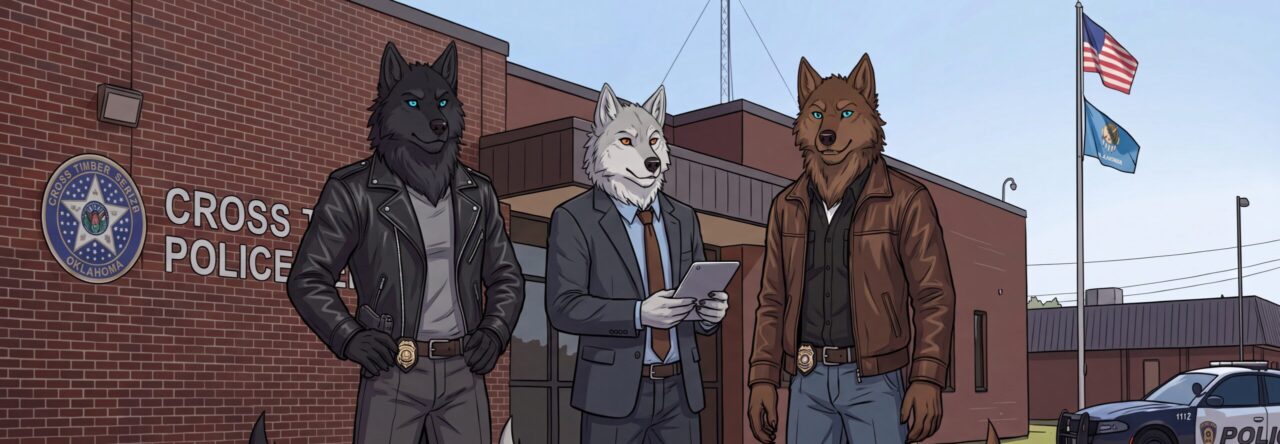
The Humvee took up two spaces outside Cross Timber Police Department.
Mark had stopped commenting on it.
This did not mean he approved.
It meant he had entered the more dangerous stage of disapproval: documentation.
A folded sheet of paper sat in the center console between the front seats. Thane had found it there when he climbed in that morning. The title read:
ONGOING VEHICLE UTILIZATION CONCERNS
He had not opened it.
Gabriel had.
“It’s only one page now,” Gabriel said, looking over the top of it as Thane pulled into the lot. “Mark is growing.”
From the back seat, Mark said, “It is a concise operational memorandum.”
“It has a pie chart.”
“It illustrates fuel inefficiency.”
Thane parked.
The Humvee settled into its two adjacent spaces with all the quiet modesty of a tank at a farmers market.
Mark stared out the rear window.
“Technically,” he said, “you are not within either set of lines.”
Thane unbuckled.
“Technically, I am within both.”
Gabriel made a pleased sound.
“Alpha review complete.”
Mark got out before he could say something regrettable in front of the building.
The air outside carried the cool gray smell of rain that had passed before dawn. Puddles shone in the parking lot. The sky over Cross Timber was flat and low, all cloud and no decision.
Inside, the station was already moving.
Dispatch radios murmured through the walls. A printer somewhere was losing an argument with paper. Someone had burned coffee. Someone else had made fresh coffee and burned it differently.
The three of them had barely reached the briefing room when Mark noticed Voss.
She stood near the back wall beside Rusk, arms folded, dark hair pinned up, expression quiet in the way it became when she was carrying more information than she wanted to share.
Thane saw her too.
Gabriel’s ears shifted.
Nobody said anything.
That was never a good sign.
Lieutenant Crowe started briefing at exactly six-thirty.
“Morning. Overnight report: weather moved east, one collision at Pine and Walnut, no serious injuries. Two car burglaries on the north side. One domestic follow-up. One missing adult follow-up that may become more than a follow-up.”
She looked toward Voss.
Voss stepped forward.
“Emily Carter has not been located.”
The room quieted.
Even officers who had not been at Dollar Barn knew enough now. Riley Nash, seventeen. Liam, her toddler nephew. Baby formula and diapers. A locked car in heat. A sister who had vanished after a fight.
Riley and Liam had been placed overnight through DHS. Liam was safe. Riley was safe enough to sleep.
Emily was still missing.
Voss continued.
“Riley’s initial statement put Emily at the apartment she shared with Kyle Brenner the night before she disappeared. Kyle has declined further contact. A neighbor came forward overnight after recognizing the situation from the welfare call and remembering a dark SUV near the rear lot.”
Rusk, beside her, said, “Which means we have a memory, a vehicle description, and exactly enough uncertainty to ruin everyone’s morning.”
Crowe looked down the room.
“This is not a detective squad exercise.”
That was aimed at several people.
It landed hardest on the three wolves.
Voss’s eyes found them.
“You are patrol officers under field training. You are not going to chase a mystery because you had one difficult call and now the case has a narrative.”
Mark sat straighter.
Gabriel looked perfectly neutral.
Thane’s hands rested open on his knees.
Voss continued.
“But patrol units are closest, and patrol officers often get the first chance to preserve a fact before it evaporates.”
She let that settle.
“Your job today is not to solve Emily Carter’s disappearance. Your job is to secure the next fact before it disappears.”
That was the assignment.
Not justice.
Not answers.
The next fact.
Crowe took over again.
“Bell and Thane, you will conduct a knock-and-talk at the Carter-Brenner apartment. You are there to request contact, request consent, observe what you can lawfully observe, and document what you are told.”
Bell, standing beside the wall with his coffee, looked at Thane.
“No kicking doors because it smells wrong.”
Thane looked at him.
“That is not what I was going to do.”
Bell took a sip of coffee.
“You were thinking it loud.”
A few officers smiled into their notepads.
Crowe continued.
“Ortiz and Gabriel, neighborhood canvass. Talk to people. Get clean statements. You are not interviewing for a documentary. Ask what they saw, what they heard, and when.”
Ortiz nodded once.
Gabriel nodded too.
No speeches.
No performances.
Facts.
“Cho and Mark,” Crowe said, “you will coordinate with the apartment manager and nearby businesses for voluntary preservation of security footage, access logs, and any camera angles covering the rear lot. You are not building a conspiracy map. You are preserving evidence.”
Mark opened his mouth.
Cho put one hand lightly on Mark’s shoulder.
Mark closed it.
Crowe looked around the room.
“Questions?”
Gabriel raised one hand.
Crowe sighed before he spoke.
“Yes?”
“Does the Humvee count as a conspiracy map if it blocks half the rear lot?”
Mark turned toward him.
Thane did not.
Crowe stared at Gabriel.
“No.”
Gabriel nodded. “Important clarification.”
Hale stood near the side wall with coffee and the exhausted expression of a man who had once believed training ended at graduation.
“You’re all still rookies,” he said. “Do not let a missing-person call make you feel promoted.”
Then he looked at Thane.
“Especially you.”
Thane nodded.
“Yes, Sergeant.”
Hale pointed at him.
“And do not take another bullet today.”
Gabriel muttered, “That seems reasonable.”
Bell said, “Vehicle check. Then we go.”
The teams separated.
Thane followed Bell toward the patrol bay, feeling the old pack-instinct discomfort rise as Gabriel and Mark headed in different directions.
It was quieter than it used to be.
Still there.
But quieter.
They had learned that separation was not abandonment.
They were in the same city.
On the same radio.
Doing the same work.
That had to be enough.
Bell’s patrol unit smelled like wet pavement, vinyl, coffee, old paper, and the faint trace of the replacement shirt Thane had worn after the shooting. Bell had cleaned the interior twice. Thane knew because he could smell the citrus cleaner layered over the memory.
Bell started the engine.
“Talk me through the call.”
“Knock-and-talk,” Thane said. “We request contact with Kyle Brenner. Ask about Emily Carter. Ask for consent to enter. We do not enter without consent, warrant, or emergency circumstances.”
“What are emergency circumstances?”
“Immediate threat to life. Sounds of distress. Visible medical emergency. Something that requires action before a warrant can be obtained.”
Bell nodded.
“What are not emergency circumstances?”
“Suspicion. Anger. Bad smell. Wanting answers.”
Bell glanced at him.
“Better.”
Thane looked out the window as the patrol unit pulled into the rain-dark streets.
“What if he lies?”
“He probably will.”
“What if he has her inside?”
Bell’s face stayed calm.
“Then we need facts that make a judge agree with us before we go through that door.”
Thane’s jaw tightened.
Bell saw it.
“The law is not asking you to ignore what you think. It is asking you to explain why you know what you know.”
Thane looked down at his hands.
Claws rested against his uniform trousers.
“The law takes too long.”
“Yes.”
“And sometimes people get hurt while it does.”
“Yes.”
Bell drove another block before speaking again.
“And sometimes the law is the thing that keeps us from hurting the wrong person because we were certain too early.”
Thane did not answer.
He did not need to.
The apartment complex sat off East Ridge Road behind a fading sign and a row of dumpsters that had given up on lids. The buildings were two-story brick boxes with narrow breezeways, cracked sidewalks, and rainwater dripping from gutter seams.
Bell parked near the front office.
No lights. No sirens.
Just a black-and-white patrol unit arriving in a place where people noticed anything official.
Thane stepped out and smelled the apartment complex before he saw much of it.
Wet concrete. Mold. laundry soap. stale cooking oil. cigarettes. old carpet. dogs. a dozen human lives stacked close enough to bleed into each other.
And under it all, somewhere toward the rear lot—
Bleach.
Not fresh.
Strong.
Wrong in a place that already smelled like rain and trash.
Bell saw Thane’s ears shift.
“What?”
“Cleaning chemical.”
“Where?”
“Rear lot. Maybe one of the apartments. I can’t narrow it yet.”
Bell nodded.
“Put it in the report later. Don’t make it a conclusion now.”
They started toward Building C.
A woman carrying a trash bag stopped near the walkway. Her eyes moved from Bell to Thane, then lingered on Thane’s badge.
“You’re here about Emily?”
Bell stopped.
“Yes. Did you know her?”
The woman hesitated.
“Not really. She was quiet. Had that little boy sometimes. The sister too.”
“Riley.”
“Yeah. The teenage one.”
“Did you see Emily after Monday night?”
“No.”
“Did you see Kyle?”
The woman looked toward the second-floor apartments.
“He comes and goes.”
“Did you see a dark SUV?”
Her eyes narrowed as she thought.
“Maybe. There’s always cars back there.”
Bell handed her a card.
“If you remember something specific, call.”
She took it.
Then looked at Thane again.
“I saw that video.”
Bell’s posture changed by a degree.
The woman noticed.
“Sorry. Just… glad you’re okay.”
Thane did not know what to say to that anymore.
“Thank you,” he said.
The woman nodded and went back toward the dumpsters.
Bell looked at him.
“Better than growling.”
Thane gave him a look.
Bell’s mouth twitched.
They climbed the stairs.
Apartment C-12 was at the end of the breezeway.
The door was closed. A cheap plastic planter sat beside it, dead soil and one broken garden stake. A child’s chalk drawing had washed into pale smears near the threshold.
Bell knocked.
“Cross Timber Police. Kyle Brenner, we need to speak with you.”
Nothing.
Thane listened.
Television, low.
Footsteps.
One adult male heartbeat.
A refrigerator hum.
Water running somewhere farther in.
Bell knocked again.
“Kyle, this is Officer Bell. We need to speak with you about Emily Carter.”
The water stopped.
A deadbolt turned.
The door opened three inches and held on a chain.
Kyle Brenner looked out.
He was younger than Thane had expected. Late twenties. Narrow face. Dark stubble. T-shirt with an oilfield logo. Red-rimmed eyes, though that could have been sleeplessness or anything else. His gaze landed on Bell first.
Then Thane.
His face tightened.
“Great,” he said. “They sent the bulletproof one.”
Thane did not move.
Bell said, “We’re here about Emily Carter.”
Kyle’s eyes returned to Bell.
“I already talked to police.”
“You spoke with an officer by phone. We’re following up.”
“She left.”
“When?”
“Monday.”
“What time?”
Kyle’s shoulders shifted.
“Night. I don’t know. Late.”
“Where did she go?”
“I don’t know.”
“Did she take her son?”
“No. Riley was watching him.”
“Why?”
“She said she needed space.”
“From you?”
Kyle gave Bell a tired look.
“From everything.”
Bell held his gaze.
“Were you arguing Monday night?”
“People argue.”
“Were you arguing?”
Kyle’s jaw worked.
“Yes.”
“What about?”
“Money.”
“Did anyone else come to the apartment?”
“No.”
Thane caught it immediately.
Not the lie.
The body.
Kyle’s breath changed too soon. His eyes shifted toward the rear lot.
Bell caught none of that.
But Bell caught Thane catching it.
“What do you have?” Bell asked quietly.
Thane chose his words carefully.
“Strong cleaning chemical. Old iron odor. One additional adult male scent besides Kyle. I cannot say what any of it proves.”
Kyle’s eyes snapped to him.
“What the hell does that mean?”
Bell did not look at Thane.
“It means we are asking you again. Did anyone else come to this apartment Monday night?”
Kyle’s face hardened.
“No.”
Bell nodded slowly.
“May we come inside and speak?”
“No.”
“May we look around to confirm Emily is not in distress?”
“No.”
“May we speak with you away from the door?”
“No.”
Bell stood still.
No anger.
No threat.
“Okay.”
Kyle blinked.
Maybe he had expected a push.
Maybe he needed one.
Bell continued.
“Do you own a dark SUV?”
“No.”
“Do you have access to one?”
“No.”
“Have you driven one recently?”
“No.”
Thane smelled another lie.
Not proof.
Not reportable without context.
Just another stone in the gut.
Bell said, “We’ll be in the area. If Emily contacts you, call us immediately. If you remember anything more about Monday, call us immediately. If you decide you want to speak voluntarily, call us immediately.”
Kyle gave a humorless smile.
“Sure.”
Bell handed him a card.
Kyle did not take it.
The door shut.
The chain slid.
The deadbolt turned.
The door stayed closed.
Thane stared at it.
His body knew how easily it would open.
One shoulder.
One hard step.
One bad decision.
Bell stood beside him.
“Talk.”
Thane’s eyes stayed on the door.
“He lied.”
“About what?”
“Someone else was here.”
“That is your observation?”
“It’s what I smelled.”
“Say it correctly.”
Thane forced the words through his teeth.
“I detected another adult male scent inside the apartment. I detected strong cleaning chemical and an odor consistent with old blood or iron. I cannot determine the source without lawful entry and testing.”
Bell nodded.
“Good. Anything visible?”
Thane looked down the breezeway.
“The floor just inside is damp.”
Bell looked.
A faint wet shine showed under the door seam.
“Could be mopping,” Bell said.
“Yes.”
“Could be cleaning.”
“Yes.”
“Could be a dozen things.”
“Yes.”
Bell looked at him.
“You are allowed to think it is bad.”
Thane’s eyes went back to the door.
“But?”
“But we do not write what we want to be true.”
Bell nodded.
“Now we go look at the rear lot.”
They walked down the stairs and around the building.
The rear lot was half mud, half gravel, with a row of dented dumpsters and a line of covered parking spaces. A black SUV sat near the end beneath a carport.
Cracked right taillight.
Faded county fair sticker in the rear window.
Rainwater beaded on the hood.
Thane stopped.
Bell looked at him.
“Same vehicle?”
“Matches the description we have. Dark SUV, cracked right taillight, fair sticker.”
“Anything else?”
“Same male scent from the apartment. Old cigarette smoke. Cleaning chemical.”
Bell walked around the vehicle without touching it.
The license plate was visible.
Registered to a woman named Crystal Brenner.
Kyle’s sister, maybe.
A small reddish-brown smear marked the lower lip of the rear hatch. It might have been rust. It might have been mud. It might have been nothing.
Bell took photographs from where he stood.
No touching.
No collecting.
No opening.
No searching.
Thane stared at the smear.
His claws pressed into his palms.
A voice came from behind them.
“Y’all gonna tear that place apart?”
A young man stood near the dumpsters with a phone held up, filming.
Bell turned.
“You can remain on the public walkway. Do not interfere.”
The young man lifted his phone.
“Man, I saw the video. You gonna have your wolf kick the door in?”
Thane felt Bell’s attention shift toward him.
Not command.
Trust.
Thane turned his head slightly toward the young man.
“You can film from there,” he said. “You cannot interfere with a missing-person investigation.”
The young man’s face changed.
Not because the words were clever.
Because they were not.
He had expected spectacle.
He got patrol.
Bell keyed his radio.
“Three-oh-four. We have possible vehicle matching witness description in rear lot, registered to Crystal Brenner. Photographing from lawful position. Request records check and advise Detective Voss.”
Nina answered.
“Copy. Voss notified.”
Thane looked at the apartment above them.
The door stayed closed.
Across the complex, Gabriel stood outside Apartment C-6 with Ortiz.
Tessa Walsh’s mother had answered the door in a robe and house slippers, tired eyes, coffee mug in one hand. Tessa stood half behind her, fourteen or fifteen, dark hair in a braid, backpack already slung over one shoulder.
“I told her she can talk,” her mother said. “But I don’t want her dragged into anything.”
Ortiz nodded.
“She won’t be.”
Tessa watched Gabriel.
Not fear exactly.
Caution.
Everyone watched him differently now. The uniform helped. The black fur did not hurt. The video had made him recognizable in a way he did not enjoy.
He kept his hands visible.
“Hi, Tessa. I’m Officer Gabriel. This is Officer Ortiz. We’re trying to understand what happened Monday night. You don’t have to guess. We only need what you saw or heard.”
Tessa looked at her mother.
Her mother nodded.
Gabriel did not rush the silence.
He had learned better.
Ortiz stood beside him, quiet and solid.
Tessa finally said, “I didn’t see everything.”
“That’s okay,” Gabriel said. “What was the first thing you noticed that felt wrong?”
Her eyes lowered.
“The SUV.”
“What about it?”
“It was parked by the dumpsters. That’s weird because it was raining, and nobody parks back there unless they’re trying not to be seen.”
Ortiz’s eyes moved slightly.
Gabriel kept his voice level.
“What time was that?”
“I don’t know. Maybe after ten. I was doing homework.”
“Did you see who was in it?”
“One guy got out. Not Kyle.”
“Can you describe him?”
“Tall. Gray jacket. Ball cap. I didn’t see his face.”
“Did you see Emily?”
Tessa shook her head first.
Then stopped.
“Maybe.”
Gabriel waited.
“She came outside after Kyle started yelling.”
“Did you hear what he said?”
“Not all of it.”
“Anything specific?”
Tessa twisted the strap of her backpack around her fingers.
“He said, ‘You don’t get to leave with him.’ I think. Or ‘You don’t get to leave with it.’ Something like that.”
“Who was he talking to?”
“Emily. I think.”
“Did you see what happened next?”
Tessa swallowed.
“Emily went toward the SUV. The other guy had her elbow.”
Gabriel kept his expression still.
“Was he pulling her?”
“I don’t know.”
“Was she walking on her own?”
“I don’t know.”
“Did she say anything?”
“No. Or I couldn’t hear it.”
“Did the SUV leave?”
“Yes.”
“Did you see Emily inside?”
Tessa looked up.
“No.”
The answer hung there.
Not proof.
Not nothing.
Gabriel nodded once.
“Thank you. You did the right thing telling us exactly what you saw.”
Tessa looked uncertain.
“Am I in trouble?”
“No.”
“Will Kyle know I talked to you?”
Ortiz stepped in before Gabriel could make a promise that patrol could not keep.
“We will not tell him you spoke with us. But if he ever threatens you, comes to your door, or makes you feel unsafe, call us. Right away.”
Tessa’s mother put a hand on her daughter’s shoulder.
Gabriel handed both of them cards.
As they walked away, Ortiz said, “That was clean.”
Gabriel looked at her.
“Clean?”
“You asked. You listened. You did not fill in the blanks.”
Gabriel smiled despite himself.
“That is nearly praise.”
“It is not.”
“Cruel.”
“Accurate.”
At the apartment office, Mark stood with Cho in front of a man named Daryl who managed the complex with the resigned hostility of someone who had spent fifteen years explaining late fees to people who believed consequences were personal attacks.
“I have cameras,” Daryl said. “They’re old. They’re bad. They mostly catch raccoons stealing cat food.”
Cho nodded.
“Do any cover the rear lot?”
“One does. Sort of.”
“Can we view Monday night footage?”
Daryl looked at Mark.
Then at Cho.
“You got a warrant?”
“Not yet,” Cho said. “We’re requesting voluntary cooperation to preserve possible evidence in a missing-person investigation.”
Daryl sighed.
“Fine. But I’m not giving you my whole system.”
Mark spoke before Cho could.
“We only need the rear lot camera between nine p.m. and midnight Monday, and any access logs for Building C from the same period.”
Cho looked at him.
Mark held still.
Daryl looked relieved by the specificity.
“That I can do.”
The office smelled like dust, cheap carpet, and old air conditioning. Daryl sat at a computer with a cracked monitor and clicked through a security system that appeared to have been designed by an enemy of time.
The rear lot footage was grainy.
Black and white.
Fixed angle.
The timestamp in the corner read 9:46 p.m.
Mark watched it for six seconds.
Then said, “The system clock is wrong.”
Daryl looked over.
“How do you know?”
“The rain begins at 9:46 on this footage. City weather logs show the rain started at 10:13.”
Cho looked at him.
Mark continued.
“The clock is at least twenty-seven minutes slow. Possibly more, depending on camera delay.”
Daryl frowned.
“Yeah, it’s always wrong. I keep meaning to fix it.”
Cho looked at him.
“Please don’t.”
Daryl stopped reaching for the keyboard.
Mark watched the footage again.
At 10:02 camera time—actually 10:29 p.m., if his estimate was right—a dark SUV pulled into the rear lot.
Cracked right taillight.
Fair sticker in rear window.
It parked under the carport.
A tall man in a cap got out from the driver’s side.
Twenty seconds later, Kyle came down the stairs.
They spoke.
No audio.
Kyle’s body language was sharp, aggressive. The other man kept his hands low.
At 10:08 camera time, Emily came down the stairs.
She was visible for only a few seconds.
Dark jacket. Hair loose. One arm held close to her body.
Kyle stepped between her and the SUV.
The tall man moved toward them.
There was an argument.
Then the camera’s view was partially blocked by a delivery van passing through the lot.
When the view cleared, Kyle stood alone near the carport.
The other man was loading something into the rear hatch.
Not a person.
Not visibly.
A long shape under a blanket or comforter.
Could have been anything.
A bag.
A box.
Laundry.
A body.
Mark did not say the last thought.
The SUV left at 10:15 camera time.
10:42 actual, maybe.
Emily was not visibly in the front seat.
The rear windows were tinted too dark to tell anything else.
Cho watched without speaking.
Daryl said, “What is that?”
Mark answered carefully.
“An unidentified covered item.”
Daryl looked at him.
“That’s it?”
“That is all the video shows.”
Cho nodded once.
“Good.”
Mark’s ears moved.
He had not overbuilt.
Yet.
“We need to preserve the original file,” Cho said. “Not a phone recording. Not a screen capture. Original system export with metadata if available.”
Daryl scratched his head.
“I can burn it to a drive.”
“Can you make a copy and retain the original system data?”
“Probably.”
Mark leaned forward.
“I can walk you through the export process.”
Cho looked at him.
Mark added, “If you want.”
Daryl looked grateful.
“Yes. Please.”
For the next twenty minutes, Mark did exactly what he was told.
He did not solve the case.
He did not name the blanket.
He did not turn the SUV into certainty.
He preserved the video.
He documented the apparent timestamp discrepancy.
He wrote down the camera angle, the system make, the file name, Daryl’s name, and the exact steps used to create the copy.
When the file finished exporting, Cho said, “Chain of custody.”
Mark nodded.
“I already started it.”
“Say it.”
“I already started it.”
“Better.”
Mark held the evidence drive carefully.
It weighed almost nothing.
That was how evidence worked.
The important things were rarely heavy enough.
By early afternoon, all three FTO units met in the rear lot of the apartment complex.
Voss and Rusk had arrived in an unmarked sedan.
Crowe stood beside them, arms folded, rain darkening the shoulders of her uniform.
The black SUV remained under the carport.
Kyle’s apartment door remained closed.
Thane stood near Bell. Gabriel near Ortiz. Mark near Cho, evidence drive secured in a labeled bag.
For a moment, the trio looked at one another.
No reunion.
No conversation.
Just the quiet acknowledgment that all three had found something.
Voss began with Bell.
“Talk to me.”
Bell gave the clean version.
Contact with Kyle. Denial of anyone else being present. Denial of SUV access. Refusal of consent to enter. Vehicle observed matching witness description. Visible reddish-brown stain on rear hatch lip, not touched or tested. Thane’s observations regarding cleaning odor, old iron odor, and an additional male scent.
Voss looked at Thane.
“Your words.”
Thane stepped forward slightly.
“From the public breezeway, I detected a strong cleaning chemical odor near the apartment and rear lot. I detected an odor consistent with old blood or iron inside the apartment near the doorway. I detected a second adult male scent in the apartment distinct from Kyle Brenner’s scent. I cannot identify the source of any odor without lawful entry, testing, or comparison.”
Voss nodded.
“Good.”
Rusk said, “Bleach is not a felony.”
“No,” Thane said.
“But lying to officers about who was present may be useful later.”
Thane nodded.
Voss turned to Gabriel.
“Tessa?”
Gabriel gave the statement without adding meaning.
Dark SUV. Tall man in gray jacket and cap. Kyle arguing with Emily. Emily moved toward SUV. The other man held her elbow. Tessa could not say whether it was forceful. She heard Kyle say something close to, “You don’t get to leave with him,” though she was uncertain of exact wording. SUV departed. Tessa did not see Emily visibly inside.
Ortiz added, “Mother present for initial contact. Tessa was told only to provide what she saw. No leading questions.”
Voss’s eyes moved to Gabriel.
“You left the gaps open.”
Gabriel nodded.
“Yes.”
Rusk said, “Miracles happen.”
Gabriel looked offended.
Voss moved to Mark.
“Show me.”
Mark handed her the evidence bag.
“Original camera footage voluntarily preserved from rear lot security system. Apartment manager Daryl Mays provided access. System timestamp appears approximately twenty-seven minutes slow based on recorded rainfall onset compared with city weather records. Exact offset pending validation.”
Voss raised an eyebrow.
“Good.”
Mark continued.
“Video shows dark SUV matching the observed vehicle: cracked right taillight, faded county fair sticker. At approximately 10:29 p.m. corrected estimate, a tall male in a cap exits the SUV. Kyle meets him in rear lot. Emily later exits Building C. Argument occurs. View partially obstructed. SUV departs approximately 10:42 p.m. corrected estimate. Emily is not visibly identifiable in front seat. An unidentified covered object is loaded into rear hatch before departure.”
Voss watched the footage on a tablet as Mark spoke.
No one interrupted.
The rain tapped softly on the carport roof.
Crowe looked at the SUV.
Then at the apartment door.
Then at Voss.
“So.”
Voss paused the video on a grainy frame of the dark SUV beneath the carport.
“So,” she said, “we have more than we had this morning.”
Thane looked toward the apartment.
“Can we go in?”
Voss did not look at him.
“Not yet.”
The answer hit like a wall.
Gabriel’s ears lowered slightly.
Mark held the evidence bag tighter.
Voss continued.
“We have a missing adult, a prior domestic history, a child left without responsible care, an inconsistent account from Kyle, an identified vehicle, a witness statement, security footage, possible physical evidence, and observations that may support probable cause.”
Thane waited.
“But,” Voss said, “we do not search a home because we are uncomfortable. We do not search a vehicle because a blanket looks bad on bad footage. We do not force a door because our instincts tell us it is the right door.”
Rusk leaned against the unmarked sedan.
“You search because you can explain it to a judge who does not know you, does not trust you, and will never forgive you for being sloppy.”
Voss looked at the trio.
“You found the door. You did not kick it open. Good.”
Thane’s claws flexed once.
He made them stop.
Crowe turned to Bell.
“Can we preserve the vehicle?”
Bell looked to Voss.
Voss considered.
“Kyle has denied access. Vehicle registration is to Crystal Brenner. We have enough to request a warrant. We do not have enough to turn this lot into a circus while we wait.”
Rusk added, “And if we spook him into moving the vehicle, we’ll need to explain why we let him.”
Voss nodded.
“Rusk, discreet surveillance. Bell, coordinate patrol observation without sitting directly under his window. Ortiz, finish canvass. Cho, verify the timestamp against another source and preserve any additional footage from businesses facing the road.”
Then Voss looked at the trio.
“And you three?”
They stood straighter.
“You write.”
Gabriel sighed.
Mark blinked.
Thane looked briefly betrayed.
Voss’s mouth moved almost toward a smile.
“You think the exciting part is the warrant. It isn’t. The exciting part is whether your reports are good enough to get one.”
That shut them up.
For the next hour, patrol became what it usually was.
Slow.
Necessary.
Uncelebrated.
Bell and Thane drove the perimeter around the complex and nearby roads, checking for the black SUV without flashing lights or building an audience.
The SUV remained parked.
Kyle did not leave.
A curtain moved once in C-12.
Then stopped.
Bell kept the patrol unit rolling past every twenty minutes.
Thane sat in the passenger seat, listening to the city, smelling rain, wet leaves, cold pavement, and the endless low life of Cross Timber moving around them.
“Feels wrong,” he said.
Bell kept his eyes on the road.
“Yes.”
“Feels like we’re letting him sit up there.”
“We are.”
“He could be cleaning.”
“Yes.”
“He could be leaving.”
“Yes.”
“He could be—”
Bell stopped at a red light and looked at him.
“Do you know what the hardest part of this job is?”
Thane looked back.
“Waiting?”
“No.”
Bell turned forward as the light changed.
“Knowing when waiting is the thing that protects the case.”
Thane said nothing.
Bell continued.
“Sometimes patrol is keeping a bad night from becoming an unfindable one.”
That stayed with Thane.
Across town, Gabriel and Ortiz returned to the complex for a second pass.
Not because they expected a new dramatic witness.
Because witnesses remembered details in pieces.
A man walking a pit bull remembered the SUV had been idling for nearly ten minutes before the argument.
An older woman in Building B remembered a gray jacket and a ball cap but said she had thought it was a delivery driver.
A maintenance worker recalled seeing Kyle spray something near the carport early Tuesday morning. He had assumed it was bug spray.
Gabriel did not interpret.
He wrote.
Ortiz watched him work.
“You’re quieter.”
Gabriel looked at his notebook.
“I am learning to save my best lines for people I know.”
“Do not make that sound like a threat.”
“It is a promise.”
She gave him a look.
Gabriel smiled.
Just a little.
Mark and Cho spent an hour at a laundromat across the street because the owner had a camera aimed toward the access road behind the apartment complex.
The owner, a broad man named Vince, wanted to know whether the missing woman had “gone with one of those weird church groups.”
Cho said, “We are not discussing theories.”
Mark added, “We are requesting video.”
Vince squinted at him.
“You’re the smart one, huh?”
Mark paused.
Cho watched him carefully.
Mark said, “I am the officer requesting video.”
Vince blinked.
Then nodded.
“Fair enough.”
The camera footage was worse than the apartment footage.
Rain-streaked lens. Poor angle. Delivery vans blocking half the road.
But Mark found the SUV passing eastbound at a recorded time that matched the apartment footage once adjusted.
The partial license plate became clearer in one reflected frame.
Not complete.
Enough.
Three characters.
Maybe four.
Mark wrote them down.
Cho looked over his shoulder.
“Can you say that without sounding excited?”
“Yes.”
“Do it.”
“Partial plate visible. Three confirmed characters. Possible fourth. Not sufficient for identification alone.”
Cho nodded.
“Good.”
Mark watched the black SUV disappear down the wet road on grainy footage.
No Emily visible.
No answers.
But a direction.
That was something.
By late afternoon, the rain had stopped.
The clouds broke just enough to let a hard gray light spill over the station parking lot.
The trio sat in separate corners of the report room, each writing their own piece of the same day.
Bell sat beside Thane, reading the draft one line at a time.
Thane had written:
I knew Kyle Brenner was lying because—
Bell tapped the screen.
“No.”
Thane changed it.
Kyle Brenner’s verbal responses appeared inconsistent with my observations.
Bell shook his head.
“Still conclusion.”
Thane looked at him.
“What do you want?”
“Tell me what happened.”
Thane stared at the screen.
Then typed:
When Officer Bell asked whether another adult male had been present in the apartment, Brenner stated no. I detected an additional adult male scent distinct from Brenner’s scent inside the apartment doorway area.
Bell nodded.
“Better.”
Thane continued.
I detected a strong cleaning chemical odor and an odor consistent with old blood or iron. I could not identify the source without entry or testing.
Bell read it.
“Good.”
Thane looked at the line.
It felt too small.
Like writing around a fire without saying fire.
But it was true.
Gabriel’s report had fewer corrections than usual.
Ortiz read it in silence, then tapped one paragraph.
“You wrote, ‘Tessa appeared afraid.’ Why?”
Gabriel pointed.
“She repeatedly looked toward Building C, lowered her voice when Kyle’s name came up, and asked whether he would know she spoke to us.”
Ortiz nodded.
“Put those facts first. Then you can write that her behavior was consistent with fear.”
Gabriel adjusted it.
“How does that look?”
“Like you were there.”
“That is nearly poetry.”
“Do not make me take it back.”
Mark’s report was the longest of the three.
Cho had crossed out four paragraphs already.
“This is not a documentary treatment of timestamp discrepancy.”
“It affects the sequence.”
“Yes. In two sentences.”
“It requires context.”
“It requires a report.”
Mark stared at him.
Cho pointed to the clock.
“You have seven minutes to make it useful.”
Mark stared at the screen.
Then, with visible pain, made it shorter.
At six forty-two, Voss came through the report room door carrying a folder thick enough to bend.
The room went quiet.
Rusk followed with two coffees and a face that suggested he had spent the last hour explaining patience to someone who wanted to throw a truck through a courthouse.
Voss set the folder on the central table.
“Affidavit drafted,” she said.
Thane stood.
“Warrant?”
“Requested.”
The word was small.
Heavy.
Mark looked at the folder.
Gabriel looked at Voss.
“What now?”
“Now a judge reads it.”
“And?”
“And we wait.”
Thane’s ears went back.
Voss looked at him.
“I know.”
“Could take how long?”
“An hour. Could take longer. Depends on availability, review, questions, and whether the judge believes our facts support what we are asking for.”
“We have facts,” Mark said.
Voss looked at him.
“Yes. Because you preserved them.”
Mark went still.
That was praise.
Real praise.
Rusk set one coffee beside Voss and kept the other.
“We have enough to ask,” he said. “That is not the same as enough to assume.”
Gabriel leaned against a desk.
“So we go home while he sits there?”
“No,” Voss said. “Rusk has surveillance. Patrol maintains normal visibility. We do not create a siege because a warrant is pending.”
Thane looked at the report in front of him.
The door stayed closed.
The SUV stayed parked.
Emily stayed missing.
No cuffs.
No rescue.
No clean win.
Crowe appeared in the doorway.
“End of shift for probationary officers.”
No one moved.
Crowe looked at them.
“That was not a suggestion.”
Bell stood.
“Come on.”
Thane hesitated.
Bell lowered his voice.
“You did your part.”
“It doesn’t feel like enough.”
“It rarely does.”
Gabriel gathered his notebook.
Mark closed his report file with more force than necessary.
They walked out together.
The Humvee waited in the lot, broad and dark beneath the clearing sky. It still occupied two spaces. Mark saw it, visibly considered resuming the argument, and decided he did not have enough energy.
That was how tired he was.
Thane opened the driver’s door.
Gabriel got in beside him.
Mark settled in the back with the evidence drive receipt tucked safely inside his report folder.
For a while, they sat without starting the engine.
The station glowed behind them.
Inside, Voss’s warrant packet waited.
Rusk watched an apartment.
Somewhere in Cross Timber, Riley sat with Liam in a temporary room and waited for a sister who had not come back.
Thane looked at the steering wheel.
“We should have found her.”
Gabriel turned toward him.
“We found things.”
“Not her.”
“No.”
Mark spoke from the back seat.
“We have the SUV description, partial plate, video, witness statement, possible vehicle evidence, and a reportable inconsistency from Kyle.”
Thane did not answer.
Mark’s voice changed slightly.
“That is not nothing.”
Gabriel looked out the windshield.
“It doesn’t feel like a win.”
“No,” Mark said. “It feels like paperwork.”
Gabriel gave a tired laugh.
“Hope, but administrative.”
Mark considered that.
“Yes.”
Thane started the engine.
The Humvee rumbled awake.
They pulled out of the lot slowly.
No lights.
No siren.
No victory.
Just three probationary officers going home after a day that had given them a closed door, a dark vehicle, a frightened witness, a missing woman, and enough facts to ask for the right to do more.
Behind them, the station remained lit.
Ahead of them, Cross Timber spread under the broken clouds.
They had not found Emily.
They had not fixed Riley’s life.
They had not put Kyle in cuffs.
But the door had not stayed closed because they lacked the courage to force it.
It had stayed closed because they had learned the difference between wanting in and having the right to enter. Tonight, that difference was the case.