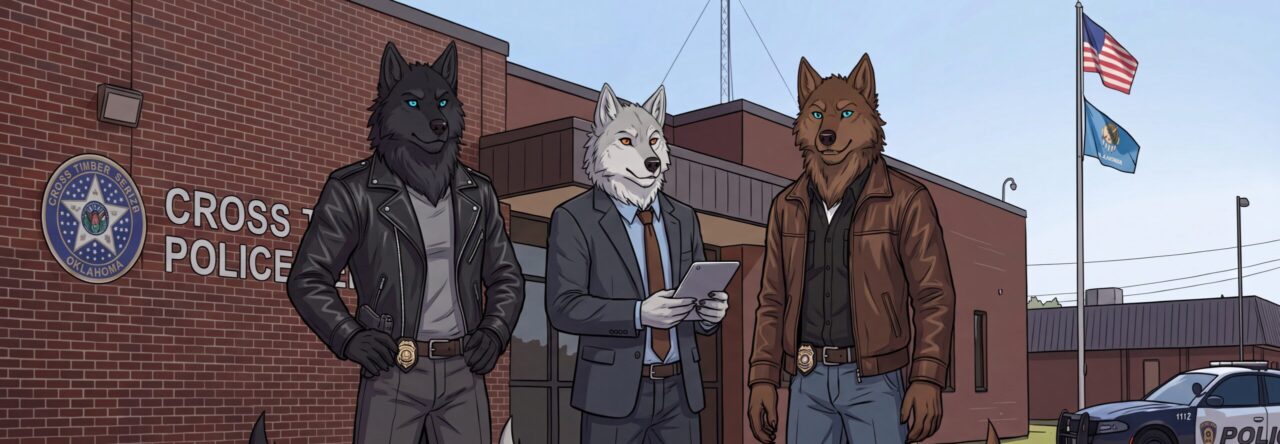
Thane had been thinking about pizza since the Humvee turned onto the road toward the station.
Not because he was hungry.
He was hungry, obviously. He had been awake for most of the day, had eaten breakfast at a time that technically counted as lunch, and had spent the afternoon reading through two case files that made every snack in the cabin feel inadequate.
But that was not the point.
The point was that the evening shift had been running hard for weeks.
Patrol had handled the pharmacy burglars. The vehicle-theft pattern. The protective-order calls. The festival crowds. The construction-site search. The string of strange home invasions that were not quite home invasions yet.
The department was doing what police departments did: making do, catching up, carrying one another, and pretending the tiredness did not settle into everyone’s bones.
Thane turned into the station lot at 17:24.
Gabriel looked over from the passenger seat.
“You are doing the thinking face.”
“I am driving.”
“You can do both.”
Mark leaned forward slightly from the back seat.
“What are you thinking about?”
“Pizza.”
Gabriel blinked.
Then his ears lifted.
“Pizza.”
“Yeah.”
“That is not what I expected.”
“What did you expect?”
“I do not know. Burglary maps. Truck telemetry. The continuing decline of civilization. Not pizza.”
Thane parked the Humvee.
“I was thinking maybe we order some for evening shift.”
Gabriel turned in his seat.
“All of evening shift?”
“Yeah.”
Mark unbuckled his duty bag.
“There are approximately twenty-seven people scheduled between patrol, dispatch, the front desk, detention, supervisors, and support personnel.”
Thane looked at him.
“You counted already?”
“I began counting when you said ‘some.’”
Gabriel nodded gravely.
“That is why we keep him.”
Mark opened the door.
“That is not why you keep me.”
“No,” Gabriel said. “But it is a significant factor.”
Thane got out.
“Half a medium pizza per person.”
Mark stopped beside the Humvee.
“Fourteen medium pizzas would provide one hundred twelve slices if cut into eighths.”
Gabriel stared at him.
“You had that ready.”
“I estimated.”
“Did you estimate topping distribution?”
“Yes.”
Thane looked at them both.
“Let’s ask Crowe.”
Lieutenant Crowe was in her office with the door open, reviewing a patrol staffing sheet and drinking coffee that had clearly been poured before the coffee had any right to be awake.
She looked up when Thane appeared in the doorway with Gabriel and Mark behind him.
“What?”
Thane paused.
Crowe narrowed her eyes.
“Why are all three of you standing there?”
“I have a question.”
“That is rarely comforting.”
“Would it be okay if I ordered pizza for everybody on the evening shift?”
Crowe blinked.
For a second, nothing in her expression moved.
Then she leaned back in her chair.
“Pizza.”
“Yes.”
“For the evening shift.”
“Yes.”
“With whose money?”
“Mine.”
Crowe considered him.
“You are asking me because you do not want people abandoning posts or Dispatch getting overwhelmed while everyone crowds into the break room.”
“Yes.”
Her mouth moved very slightly.
“Good.”
Gabriel leaned around Thane’s shoulder.
“We have a plan.”
Crowe looked at him.
“That sentence worries me.”
“Fourteen medium pizzas,” Mark said. “The order accounts for the number of scheduled personnel, dietary variety, and the likelihood that Gabriel will consume more than the average allocation.”
Gabriel looked offended.
“I am a predictable consumer.”
“You are an excessive consumer,” Mark said.
Crowe looked between them.
Then back at Thane.
“You can order the pizza.”
Thane nodded.
“Thank you.”
“But,” Crowe added, holding up one finger, “it stays simple. No event. No announcement. No press. No fleet of delivery cars blocking the emergency lane. Dispatch eats when their radios allow it. Patrol rotates through. Nobody ignores a call because they are holding a slice of supreme.”
“Understood,” Thane said.
“And no pineapple.”
Gabriel looked at her.
“You are taking a hard line on this.”
“I have standards.”
Thane nodded.
“No pineapple.”
Crowe looked down at the staffing sheet again.
“Order it for eighteen-forty-five. If it gets there early, it sits. If it gets there late, it is pizza. Nobody dies.”
Gabriel smiled.
“Noted.”
They turned to leave.
Crowe called after them.
“Thane.”
He looked back.
“That was a kind thought.”
Thane’s ears tipped back a little.
“Thanks.”
Crowe gave him a single nod.
Then returned to the staffing sheet.
Thane called the local pizza place from the hallway just outside Investigations.
Marty’s Pizza had been in Cross Timber longer than the police department had occupied its current building. Its storefront sat three blocks off Main, between a hardware store and a laundromat, and its kitchen had fed half the city after football games, graduations, fundraisers, and every weather emergency that had knocked out enough power to make people suddenly remember food mattered.
A woman answered on the third ring.
“Marty’s Pizza, this is Delia.”
“Hey, Delia. This is Thane from Cross Timber PD.”
“Oh, Detective Thane,” she said. “You all are ordering pizza?”
Thane blinked.
“How did you know?”
“I have a restaurant. I know things.”
Gabriel covered his mouth.
Mark looked at the floor.
Thane decided not to argue.
“Fourteen medium pizzas. Delivery for eighteen-forty-five.”
Delia made a small sound of approval.
“Feeding the whole shift?”
“Most of it.”
“Good. They have been nice to us.”
Thane looked down the hallway.
“Yeah.”
“Okay. What do you want?”
Mark stepped closer and read from his phone.
“Five pepperoni. Three sausage. Two supreme. Two cheese. One vegetable. One half-cheese, half-sausage for dietary allocation.”
Gabriel stared at him.
“Dietary allocation.”
“It prevents waste.”
Delia laughed.
“You got any allergies?”
“None reported,” Mark said.
“Any special requests?”
“No pineapple,” Crowe said from her office without looking up.
Delia paused.
Then laughed again.
“Copy that. No pineapple.”
Thane gave her the department address, paid over the phone, and hung up.
Gabriel looked at him.
“You realize we are going to be known as the detectives who ordered fourteen pizzas.”
“We are already known as the detectives who bought dog toys, stopped a wedding dispute, and apparently sleep like fallen bearskin rugs.”
Gabriel’s grin widened.
“Still mad about that?”
Thane looked at him.
Gabriel lifted both hands.
“Not a word.”
Mark’s phone chimed.
He glanced down.
Then his expression tightened.
“BrightNest sent a supplemental server report.”
“Now?” Gabriel asked.
“Now.”
Thane looked toward the conference room.
“Briefing first.”
Voss was still in the building.
It was later than she normally stayed.
Day shift had technically ended, and Rusk had already disappeared toward the parking lot with the kind of exhausted speed that suggested he had heard no fewer than three people mention another late report before escaping.
But Voss stood alone in the evidence corridor with a file tucked under one arm.
She was waiting.
Thane knew it before she said anything.
Gabriel and Mark saw it too.
Voss’s gaze settled on Thane.
“Can I have a minute?”
Gabriel looked at Mark.
Mark looked at Gabriel.
Both of them moved on toward the conference room without a word.
Thane stayed in the corridor.
The fluorescent lights buzzed above them.
Somewhere nearby, the evidence-room refrigerator clicked on.
Voss held the file against her side.
“I know.”
Thane did not move.
“You know what?”
“I know it was you three.”
He kept his face neutral.
Voss’s eyes did not leave his.
“The fund,” she said. “Safe Steps. The Community Fund. The way it appeared. The way Carroway appeared. The way you all become intensely interested in your paws every time I mention either one.”
Thane looked down once.
Then back at her.
“I cannot confirm or deny involvement in any donor arrangement.”
Voss’s mouth tightened slightly.
“That is not a denial.”
“It was not intended as a confirmation.”
“No,” she said. “It was not.”
The silence stretched.
Voss did not look angry.
She did not look triumphant.
If anything, she looked tired in the familiar way detectives looked when they finally reached a conclusion and discovered it did not give them the right to do anything with it.
“I told Rusk I would stop digging unless I found a reason,” she said.
Thane said nothing.
“I have not found a reason.”
“Good.”
Voss’s eyes narrowed slightly.
“That was almost a reaction.”
“Was it?”
“Thane.”
He sighed softly through his nose.
The truth was that he trusted Voss.
The truth was also that the fund was not supposed to become a department project, a badge project, or a rumor that turned every person needing help into somebody who wondered what the wolves wanted in return.
So he held the line.
Voss looked toward the conference room, then back at him.
“The fund helped Leah.”
“I know.”
“It helped her without making her tell a donor’s story. It helped her without suggesting that she owed anyone gratitude. It helped her get a phone, transportation, counseling access, and room to make decisions when the rest of her life was chaos.”
Thane’s ears lowered.
Voss continued.
“That matters to me.”
“It should.”
“I also know it helped Officer Serrano.”
Thane did not answer.
Voss watched him for a moment.
Then she nodded to herself.
“I am not asking you to admit it.”
“Okay.”
“I am not asking you to tell me where the money came from.”
“Okay.”
“I am asking you to understand something.”
Thane waited.
“The fund has to remain outside the badge.”
His eyes stayed on hers.
“It does.”
“It cannot become a way to reward people who cooperate with police. It cannot become a way to influence a victim, a witness, a suspect, a prosecutor, or a city official. It cannot give anyone the impression that help comes with a condition.”
“It does not,” Thane said.
Voss studied him.
“Good.”
Thane’s voice softened.
“The point is that people get help. Not that they know who helped.”
For the first time, something warmer touched Voss’s face.
Not quite a smile.
“Then whoever started it understood the assignment.”
Thane said nothing.
Voss adjusted the file beneath her arm.
“Keep it clean.”
“We will.”
“Keep it independent.”
“We will.”
“Keep it quiet.”
Thane nodded once.
“Yeah.”
Voss stepped past him.
Then paused at the edge of the corridor.
“Oh. And your pizza is already causing speculation.”
Thane blinked.
“What?”
“Officer Patel has started a bracket predicting toppings. Grant thinks there will be garlic knots. Darnell thinks this is an attempt to distract everyone from the poster.”
Thane’s ears flattened.
“It is not.”
“I know.”
Voss’s mouth moved again, almost a smile.
“Good night, Thane.”
Then she walked away.
Thane stood in the corridor for a moment longer.
Not because he was afraid of what she knew.
Because she had said it plainly.
She knew.
And she had chosen not to make it into something else.
That mattered too.
The evening briefing began at 18:04.
Crowe ran it from the head of the conference table, with the overnight patrol sergeants and the Night Shift detectives gathered around the room.
No Voss.
No Rusk.
No day-shift detectives lingering after hours.
Just the people who owned the night.
Crowe tapped the first folder.
“Property crimes.”
Mark opened his notebook.
“BrightNest confirmed that the same legacy service account was used to initiate the remote router resets at all five burglary locations.”
He looked at the report on the monitor.
“The account belonged to a former HomeLink Integrations technician named Devin Cross. His employment ended seven months ago following an internal policy violation involving unauthorized remote access.”
“Why was his account still active?” Officer Grant asked.
“Because HomeLink is now learning a very expensive lesson about offboarding procedures,” Mark said.
Crowe’s expression did not change.
“Keep it professional.”
“It was a professional assessment.”
Gabriel’s ears lifted.
“Technically true.”
Mark continued.
“BrightNest was able to identify the network signature used during the unauthorized resets. It matches the onboard cellular hotspot installed in the MetroWorks rental van currently leased to Bryan Latham.”
The room went quiet.
Crowe looked at Thane.
“Your traffic-stop guy.”
“Yes,” Thane said.
“Do we have enough for a warrant?”
“Not yet,” Mark said. “But we have stronger probable cause than yesterday.”
He changed the screen.
A map appeared.
The GPS record for Latham’s rented van placed it within one block of every known burglary during the relevant time window.
The van had also made repeated late-night visits to Crescent Storage on the east side of Cross Timber.
On three of those visits, a black pickup registered to Devin Cross appeared on the storage facility’s entry cameras within fifteen minutes of the van.
Gabriel leaned forward.
“So Cross uses the old tech account to put the systems to sleep. Latham gets inside. They take keys, remotes, documents, phones, access information—”
“Maybe,” Mark said.
Gabriel looked at him.
“Mark.”
“Likely,” Mark amended. “But we have not searched the van or the storage unit. We do not yet know exactly what they are taking, where it is being stored, or what their intended next offense is.”
Crowe looked at the patrol sergeant.
“Can we put eyes on them?”
“Yes,” the sergeant said. “We can do a lawful, low-profile watch on the storage facility and the van. No contact unless we have a reason.”
Thane nodded.
“That is what we need.”
Crowe turned to the second folder.
“Ortega assault and Prairie Ridge thefts.”
Gabriel’s expression lost its humor.
Mark brought up a second set of maps.
“Luis Ortega’s laptop confirms that his concern about altered material records was legitimate. A review of the audit logs shows the same user account changed delivery quantities, truck logs, and return records multiple times.”
“Mason Vail,” Crowe said.
“Yes.”
“Can he say someone else used his account?”
“He can say it,” Mark replied. “And he probably will. We are checking physical access and device logs.”
Thane looked at the next page.
“His truck?”
“Prairie Ridge fleet telematics records show Unit Forty-Two, the blue pickup assigned to Vail, leaving the site at 17:48 on the night Luis disappeared. It did not return until 18:31.”
Gabriel looked up.
“What did Vail tell the company?”
“That he went home early at approximately seventeen-thirty because he was not feeling well.”
Crowe’s eyes narrowed.
“So he lied.”
“His alibi does not match the truck log,” Thane said. “That is not the same as proving he assaulted Luis.”
“Correct,” Crowe said.
Mark changed the screen again.
“Fuel-station video two miles south of the development captured Unit Forty-Two at 18:04. The vehicle turns onto the service road that connects to the drainage easement where Luis was found.”
The room went still.
Gabriel looked toward the construction-site map.
“That puts the truck near the culvert.”
“It does,” Mark said.
“Does it show Vail driving?”
“Not clearly. The windshield reflection is poor. The vehicle is identifiable.”
Crowe folded her arms.
“Anything else?”
“Unit Forty-Two also made six after-hours visits over the past two months to a fenced storage yard outside the development,” Mark said. “The site is listed in company logs as a temporary materials overflow area.”
“Is it legitimate?” Crowe asked.
“We do not know,” Mark said. “The lease paperwork is not in Prairie Ridge’s central files. The gate access code was issued through Mason Vail’s work account.”
Gabriel sat back.
“So he may have been stealing materials, changing records, and moving them to an offsite yard.”
“Maybe,” Thane said.
Mark nodded.
“Likely. But we need to see the yard records and establish ownership, inventory, and what was transported there.”
Crowe looked at them.
“Tonight?”
“Tonight,” Thane said.
“Do it right,” Crowe replied. “No private searches. No creative property access. No becoming a headline.”
Gabriel glanced at Thane.
“Do we ever become headlines?”
Crowe looked at him.
“You do not want me to answer that.”
“No, ma’am.”
The briefing ended.
Patrol units moved out.
Dispatch began assigning calls.
And somewhere in the building, fourteen medium pizzas were already making their way through a hot oven.
At 18:47, the first delivery driver arrived.
Marty’s Pizza sent one compact sedan and a young man named Connor carrying insulated red bags that looked like they had been packed for a campaign rally.
The break room filled slowly.
Not all at once.
Crowe’s rules held.
Dispatch rotated one person at a time. Patrol officers grabbed plates between calls. The detention officer took two slices into the booking area because somebody had to stay there. The front desk clerk accepted a cheese slice and looked like she might cry from gratitude.
The food smelled like tomato sauce, melted cheese, pepperoni, warm bread, and garlic.
For ten minutes, the station felt almost like any other workplace.
Not a place full of radios and case boards and people who knew too much about what could happen after dark.
Just people eating dinner.
Officer Patel opened the first box.
“Pepperoni.”
Darnell opened another.
“Sausage.”
Grant lifted the lid on a cheese pizza.
“Who ordered plain cheese?”
Mark raised one paw.
“Not everyone prefers meat.”
Grant looked at him.
“You ordered enough pepperoni to feed a small army.”
“I ordered enough variety to meet projected demand.”
Gabriel took two slices from the supreme box.
“That is the most romantic thing anyone has ever said to me.”
Mark gave him a look.
“It is not.”
Thane stood near the break-room counter, holding a paper plate with three slices and watching everyone filter through.
No speeches.
No announcement.
No need for anyone to thank him.
But people did anyway.
Officer Bell came in from a traffic call, grabbed a slice of sausage, and looked at Thane.
“This was you?”
Thane shrugged slightly.
“Crowe approved it.”
Bell looked at the pizza.
Then at the crowded break room.
“Good call.”
“Yeah.”
Bell took a bite.
Then nodded.
“Really good call.”
Near the doorway, Darnell pointed at the vegetable pizza.
“Who ordered that?”
Gabriel raised one hand.
“I did.”
Darnell stared.
“You?”
“Yes.”
“You eat steak like it owes you money.”
“I am a complex creature.”
Mark looked at the box.
“You ordered vegetables because you wanted more pepperoni available for everyone else.”
Gabriel turned slowly toward him.
“You do not have to tell people everything.”
“That is not true.”
The room laughed.
Thane took another bite of pizza.
For once, the sound did not feel like something he had to manage.
It just felt good.
Then Dispatch called.
“Patrol Three, disturbance at Westbrook and Ninth.”
Officer Bell set down his plate.
“Duty calls.”
Gabriel pointed at the half-eaten slice in Bell’s hand.
“Take it with you.”
Bell stared at him.
“I am not eating pizza in a domestic disturbance.”
“You have to maintain strength.”
Bell walked out.
“You are unbearable.”
“Yet helpful,” Gabriel called after him.
Thane watched Bell leave.
Then looked at the pizza boxes.
Maybe that was all the department needed sometimes.
Not a fleet grant.
Not a fund.
Not a massive solution.
Just dinner on a Thursday.
At 20:03, Night Shift was parked two blocks from Crescent Storage with the Humvee’s lights off.
The storage facility sat behind a row of low commercial buildings near the industrial edge of town.
Tall chain-link fencing surrounded the property. The gate opened through an electronic keypad system. Security cameras sat above the entrance and at the far corners of the lot.
Rows of metal roll-up doors disappeared into the dark.
A place designed to hold things people did not want in their homes.
Officer Grant sat in an unmarked unit farther down the block.
Another patrol officer watched from the opposite side of the access road.
No one had entered the facility.
No one had called attention to the watch.
They waited.
Gabriel shifted in the passenger seat.
“This is the worst part of detective work.”
“Waiting?” Thane asked.
“Yes.”
Mark looked at the tablet in his lap.
“Waiting prevents mistakes.”
“Waiting makes me think about pizza.”
“You had five slices.”
“Four and a half.”
“You ate five.”
“I shared half of one.”
“With yourself.”
Gabriel looked offended.
“Technically, all sharing is with yourself if you consider pack property communal.”
Thane glanced at him.
“Stop.”
Gabriel smiled.
Then his expression changed.
A white cargo van turned onto the access road.
No company marking.
MetroWorks rental sticker low on the rear bumper.
The same van.
Latham’s van.
Mark checked the plate.
“Confirmed.”
The van slowed at the gate.
The driver entered a code.
The gate slid open.
Thane watched through the windshield as the van rolled inside.
“Dispatch,” Mark said quietly into the radio, “Night Shift has visual confirmation of the MetroWorks van entering Crescent Storage. Time twenty-oh-six.”
Grant answered from the other unit.
“Copy. No passenger visible from my angle.”
The gate closed behind the van.
They waited again.
Eight minutes passed.
Then a dark pickup turned in from the east.
Black.
Older model.
It stopped at the gate.
The driver entered a code.
The gate opened.
The truck pulled inside.
Mark read the plate.
“Devin Cross.”
Gabriel leaned forward.
“Okay.”
“Document it,” Thane said.
“Already done.”
The pickup moved through the rows of storage units and disappeared behind Building C.
The cargo van was no longer visible.
Thane could smell nothing useful from this distance.
Exhaust from passing trucks.
Wet grass.
Faint dumpster odor from the warehouse next door.
No magic answer in the air.
Just two vehicles entering the same storage facility within minutes of each other.
But on the security monitor from Grant’s unit, the internal lot camera recorded both vehicles stopping in front of Unit C-184.
Latham stepped out of the van.
Cross stepped out of the pickup.
Both men wore dark clothes and ball caps.
Neither looked around much.
That was almost more suspicious than looking around too much.
People who believed they belonged somewhere often moved like they did.
Latham opened the storage door.
For less than three seconds, the interior was visible on camera.
Plastic storage totes.
A metal shelving unit.
A stack of cardboard file boxes.
At least two sealed moving cartons.
And hanging along the rear wall, a collection of garage-door remotes and key rings.
The door rolled down again before the camera could capture detail.
Gabriel’s ears lowered.
“There.”
Thane did not move.
“Do not say anything we cannot prove yet.”
“We have them on camera.”
“We have them entering a storage unit.”
“With keys.”
“Possibly keys.”
“With a wall of keys.”
Mark looked at Thane.
“He is emotionally correct.”
“Emotionally is not legally.”
“No,” Mark said. “But it is a useful starting point.”
They watched for twenty more minutes.
Latham and Cross came out again carrying two plastic totes.
One was labeled in thick marker:
MULLEN
The other had no visible label.
They loaded both into the cargo van.
Grant’s breath came sharply over the radio.
“I have the label on camera.”
Thane’s jaw tightened.
Steven and Carla Mullen.
The first house.
The spare key.
The garage remote.
The home-office folder.
The pieces of a life somebody had taken apart because they thought they could use it later.
Cross climbed into his pickup.
Latham got into the van.
The storage gate opened.
The vehicles began moving.
Thane keyed his radio.
“Maintain visual. Do not stop them without a lawful reason. We have enough to build the warrant.”
Gabriel looked at him.
“We let them leave again?”
“We do not know what is in the totes. We do not know where they are going. We do not know whether there are more victims, more property, or another location.”
“And if they go to a house?”
“Then we intervene.”
The cargo van turned south.
The black pickup followed.
Night Shift and the patrol units fell in behind them at distance.
The vehicles drove three miles.
Then four.
Then turned into a residential area near the eastern edge of Cross Timber.
Not toward another affluent subdivision.
Toward a modest block of duplexes and older homes.
The cargo van stopped in front of a small rental house with a detached garage.
Cross parked behind it.
Latham opened the van’s rear doors.
The men carried the Mullen tote into the detached garage.
Then another tote.
Then another.
At 21:11, the garage door came down.
They disappeared inside.
Thane stared at the dark garage.
“Dispatch,” Mark said, “add this residence to the affidavit. We need ownership, utility records, and any prior calls for service.”
Grant came over the radio.
“Same.”
Gabriel leaned back in his seat.
“They have a house full of stolen access.”
“Maybe,” Mark said.
Gabriel turned.
“Mark.”
“Likely,” Mark corrected.
Thane started the Humvee.
“We go write it down.”
The Prairie Ridge lead was quieter.
More careful.
The storage yard sat outside city limits but within the county’s patrol coverage, a half-acre rectangle of gravel and fencing behind an industrial equipment supplier.
At 22:26, Night Shift met Officer Bell near the entrance.
The yard’s gate was locked.
No visible movement inside.
A small office trailer sat dark near the rear fence.
Stacks of palletized pipe and boxed fixtures stood beneath tarps.
A blue Prairie Ridge pickup rested near the far corner.
Unit Forty-Two.
Mason Vail’s truck.
Bell stood beside the unmarked unit, arms folded.
“County deputy checked the lease records,” he said. “The site is leased to a company called Redline Material Recovery.”
“Who owns it?” Thane asked.
“Corporate paperwork points to a registered agent in Tulsa. But the mailing address goes to a P.O. box. No obvious Prairie Ridge connection.”
Mark looked at the gate keypad.
“Gate access?”
“Private system. No immediate cooperation from the manager. They said they need a warrant or their attorney.”
“Correct answer,” Mark said.
Bell looked at him.
“You sound disappointed.”
“I am not. Private-property managers should require legal process.”
Gabriel leaned toward Thane.
“He is disappointed.”
“I am not.”
Thane looked through the fence.
The yard smelled of rust, wet gravel, diesel, treated wood, and enough construction material to make every scent layered and complicated.
But there was something else.
Fresh citrus hand cleaner.
The same sharp note he had smelled at the Whitcomb house.
Common enough to mean nothing.
Repeated enough to write down.
He did.
At the far corner of the yard, Unit Forty-Two’s driver-side door opened.
A man stepped out.
Even at a distance, Thane recognized the shape from the employee photo in Vail’s personnel file.
Tall.
Broad.
Work jacket.
Mason Vail.
He walked to the office trailer, unlocked it, and went inside.
Bell’s eyes narrowed.
“Is he allowed to be here?”
“We do not know,” Thane said.
“Then we find out.”
Mark checked the municipal and county property records.
“Vail is not listed on the lease. But Redline Material Recovery’s registered-agent filings were submitted by a business-services company that also handles several Prairie Ridge subcontractors.”
Gabriel stared at the screen.
“That is a lot of words for ‘he is hiding behind paperwork.’”
“It is a lot of words for ‘we need more paperwork,’” Mark said.
Thane watched the dark office trailer.
Mason was inside.
Maybe reviewing stolen inventory.
Maybe making calls.
Maybe sitting at a desk and doing nothing that mattered.
The whole point of a good investigation was accepting that they did not know which.
Bell’s radio crackled.
“County unit is five minutes out. They can help preserve the scene exterior if we decide to apply for a warrant.”
Thane nodded.
“Good.”
Then Mason stepped out of the trailer again.
This time, he carried a blue insulated bag.
The kind used to keep medication cold.
He walked to Unit Forty-Two.
Opened the passenger door.
Set the bag inside.
Gabriel went still.
“Luis’s insulin kit.”
“Maybe,” Mark said quietly.
Thane looked through the fence.
The bag was blue.
Luis’s wife had described a blue insulated pouch.
The same shape.
The same kind.
It could have belonged to anybody.
But Vail had no reason to carry that kind of bag into a private material yard after hours.
Not if it was not his.
Mason stood beside the truck, phone at his ear.
They could not hear his words.
Not from this distance.
But his posture shifted as he listened.
Shoulders tight.
One hand pressing the phone harder against his head.
Then he ended the call.
Looked around the yard.
And drove away.
Bell watched the blue truck disappear down the service road.
“Tell me we have enough now.”
Mark looked at the legal checklist on his tablet.
“Not enough for an arrest. Potentially enough for a warrant, combined with the altered-record evidence, false alibi, truck location, assault timeline, and the visual observation of a medication-style pouch.”
Thane keyed his radio.
“Crowe, Night Shift.”
“Go ahead,” Crowe answered.
“We have a developing location tied to Mason Vail. We observed him at an unlisted materials yard after hours. He placed a blue insulated pouch consistent with Luis Ortega’s missing insulin kit into the blue Prairie Ridge truck assigned to him.”
A pause.
Then Crowe’s voice came back steady.
“Do not enter. Preserve the exterior. Start your affidavits. I will contact Voss for the morning warrant review.”
Gabriel looked at Thane.
“Voss is going to love being called.”
“She will love the warrant,” Thane said.
“She will hate the time.”
“Probably.”
Bell exhaled.
“We hold the scene?”
“Exterior only,” Thane said. “No contact. No signal that we are here.”
They remained where they were.
Watching the dark yard.
Watching the blue truck’s taillights disappear.
Watching one more piece settle into place.
At 23:48, Night Shift returned to the station.
The pizza boxes were mostly empty.
One cheese slice remained beneath a folded paper towel.
Gabriel opened the box.
“Mine.”
Mark looked at the slice.
“It has been sitting out for hours.”
“It is still pizza.”
Thane looked at the slice.
Then at Gabriel.
“Eat it at your own risk.”
Gabriel picked it up.
“Worth it.”
The break room had quieted.
The early warmth of dinner had faded into the practical tiredness of late shift.
But on the counter sat a handwritten note from Dispatch.
THANK YOU, NIGHT SHIFT.
— Dispatch
Below it, someone had drawn a crude pizza slice wearing a police badge.
Gabriel held the note up.
“See? We are beloved.”
Thane took the note from him.
“No.”
“We are appreciated.”
“Maybe.”
Mark looked at it.
“The drawing is inaccurate. Pizza does not wear badges.”
Gabriel pointed at him.
“Don’t make this weird.”
They carried the note into their office.
Thane pinned it beside the case board.
Not in the center.
Not like a trophy.
Just where they could see it.
Then they went to work.
The burglary affidavit took time.
Mark built the timeline from BrightNest server logs, MetroWorks van telemetry, storage-facility cameras, victim reports, the traffic stop, the remote-access account, the visible key rings, and the labeled Mullen tote.
Gabriel organized the victim-impact portions.
Not emotional speeches.
Not speculation.
The plain facts of what had been taken and why it mattered.
A family’s spare key.
A child’s old phone.
A garage remote.
A schedule board.
The pieces that made a house more than a house.
Thane wrote the scene narrative from Crescent Storage.
What they saw.
What the cameras captured.
What they did not enter.
What they did not seize.
What they did not claim to know.
At 01:36, Kessler’s day-shift contact forwarded a quick records update.
Bryan Latham’s rental agreement had been paid with a prepaid card.
But the emergency-contact number attached to the reservation belonged to Devin Cross.
The name connection was now on paper.
Not a guess.
Not a smell.
Not a feeling.
A connection.
“Send it to the affidavit,” Thane said.
Mark did.
The Prairie Ridge affidavit took longer.
The evidence was more fragile.
A stolen-material scheme was not the same as seeing a labeled tote through a storage door.
They had to prove the record changes.
The truck’s movements.
Vail’s false statement.
The video path to the culvert.
Luis’s injury and missing insulin kit.
The gate records.
The after-hours material yard.
The blue insulated pouch.
They had to explain why searching Unit Forty-Two, the Redline yard, Vail’s work devices, and his company records might reveal evidence of theft and assault.
At 02:17, Mark stopped typing.
“What?”
Gabriel looked over.
Mark turned his laptop screen toward them.
The Prairie Ridge truck telematics report had one more entry.
A stop at 18:14 on the night Luis was attacked.
Not the culvert.
Not the main road.
A brief five-minute stop at a self-service car wash two miles north of the development.
Thane looked at the timestamp.
“Why?”
“To wash something,” Gabriel said.
“Maybe,” Mark replied.
Then he opened the fuel-station camera index.
The car wash had exterior surveillance.
Cross Timber PD had already preserved footage because of the assault timeline.
The thumbnail loaded slowly.
Then sharpened.
Unit Forty-Two sat in a wash bay.
Mason Vail stood beside it.
Visible enough to identify.
He wore a blue work shirt.
His right sleeve was torn at the elbow.
He scrubbed mud from the passenger-side floor mat.
Then opened the passenger door and removed a blue insulated pouch.
Gabriel stared at the screen.
“That is Luis’s kit.”
“It is consistent with the description,” Mark said.
“Mark.”
“It is probably Luis’s kit.”
Thane looked at the video.
Mason Vail.
At the car wash.
After the assault.
Cleaning mud from the truck.
Holding the missing insulin pouch.
That was no longer a vague possibility.
It was a path.
“Add it,” Thane said.
Mark did.
At 03:04, Crowe appeared in the office doorway.
She had exchanged her uniform shirt for a dark department polo but had not gone home. Her hair had come loose from its usual neat arrangement. She held a coffee in one hand and the expression of a commander who had decided sleep was an optional future luxury.
“Status?”
Thane stood.
“Two affidavits nearly complete.”
“Anything urgent?”
“Both suspects remain free,” Mark said. “Latham and Cross are at their residence or storage location, likely. Vail left the Redline yard and returned to his home address at twenty-three-oh-eight.”
Crowe looked at the board.
“Can they destroy evidence?”
“Yes,” Thane said.
“Can we arrest them now?”
“Not cleanly,” Mark said. “Not without the warrants.”
Crowe nodded.
“Then we move fast and correct.”
She looked at the two folders.
“Voss will review at six-thirty. Judge availability begins at seven. I have an overtime team on standby if warrants are signed.”
Gabriel looked at her.
“That means no one sleeps.”
Crowe looked at him.
“That is detective work.”
“Seems unfair.”
“File a complaint.”
“With whom?”
Crowe took a drink of coffee.
“God, probably.”
Then she left.
Gabriel stared after her.
“I like her.”
“She was not joking,” Thane said.
“I know.”
At 06:29, the department began shifting from night to day.
The air changed.
Coffee brewed again.
Locks clicked.
New footsteps entered the hallway.
Night patrol came in with tired eyes and report folders. Day patrol arrived cleaner, louder, and already arguing about parking spaces.
Voss came into the Night Shift office at exactly 06:31.
Rusk followed with coffee and no visible enthusiasm for being conscious.
Kessler came behind them, laptop bag over one shoulder.
Voss looked at the board.
Then at the affidavits.
Then at the three wolves.
“Talk.”
Mark began with the access-burglary case.
He gave the facts in order.
Legacy HomeLink credential.
BrightNest intrusion logs.
MetroWorks hotspot match.
GPS placement.
Storage camera footage.
The Mullen tote.
Latham and Cross’s documented connection.
No searches conducted yet.
No property seized.
Warrant request ready.
Voss listened without interruption.
Then she looked at Kessler.
“Anything missing?”
Kessler scanned the affidavit.
“Add the homeowners’ confirmed missing-property lists in a one-page appendix. Make the access pattern explicit without editorializing. Keys, remotes, vehicle documents, old phones, recovery information.”
Mark nodded.
“Done.”
Voss turned to the Prairie Ridge case.
Thane gave the summary.
Luis’s records.
Mason’s access changes.
His false alibi.
Truck telematics.
Fuel-station video.
Car-wash footage.
The missing insulin kit.
The Redline yard.
The evidence request.
Rusk lowered his coffee cup.
“That is a lot of bad luck for Mason Vail.”
“It is,” Thane said.
“Or a lot of evidence,” Rusk added.
Voss read the car-wash still again.
Then looked at Thane.
“Good work.”
The words were quiet.
Uncomplicated.
He nodded.
“Thank you.”
Voss took both folders.
“I will clean up the warrant language with the prosecutor. Judge Reyes is on the bench at seven-thirty.”
Gabriel looked at the clock.
“That is soon.”
“Yes,” Voss said.
“Will we execute today?”
“If the judge signs,” she said. “And if the warrant team is ready.”
Crowe appeared at the door behind her.
“It is ready.”
Rusk looked between them.
“Everybody has now decided sleep is overrated.”
Gabriel nodded.
“Finally, somebody understands me.”
Rusk looked at him.
“I did not say that.”
Voss gathered the files.
Then paused.
Her eyes moved to the handwritten Dispatch note pinned beside the case board.
The pizza slice with a badge.
She read it.
Then looked at Thane.
“Nice dinner.”
Thane’s ears tipped back.
“Crowe approved it.”
“I know.”
Voss’s mouth moved faintly.
Then she headed toward the prosecutor’s office.
Night Shift stayed where they were.
The cases were not solved.
Not yet.
But two warrant packets were moving toward a judge.
Two sets of suspects were waking up somewhere in Cross Timber, unaware that the things they had tried to hide were beginning to line up.
Keys.
Garage remotes.
A missing insulin kit.
A torn work shirt.
A white cargo van.
A blue truck.
Small things.
Ordinary things.
The kind that became evidence only when someone cared enough to see what they opened.
And in the quiet left behind after everyone else moved, Gabriel looked at the pizza drawing one more time.
“You know,” he said, “we should do this every Thursday.”
Thane looked at him.
“Pizza?”
“Pizza.”
Mark considered it.
“A recurring food order would require a budget.”
Gabriel stared at him.
“You ruin everything.”
“No,” Mark said. “I organize it.”
Thane looked at both of them.
Then, despite the lack of sleep and the work waiting ahead, he smiled.
“Maybe next week.”