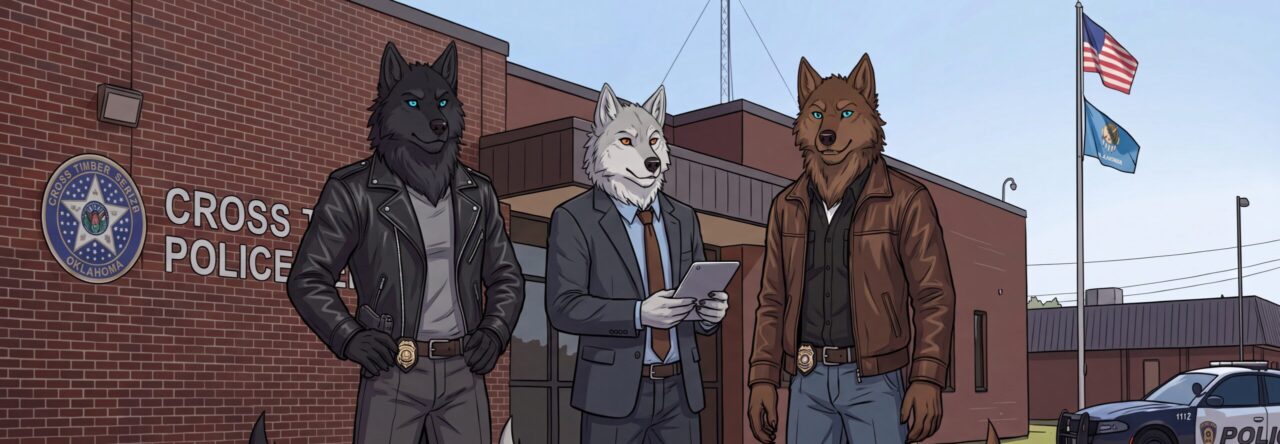
The station was quieter than usual when the Humvee rolled in.
Not empty.
Cross Timber Police Department was never empty.
But the usual shift-change noise had a different shape to it. Fewer patrol officers drifting through the lot. More unmarked vehicles parked along the far side of the building. Two evidence technicians carrying hard cases through the rear entrance. A county unit idling near the service bay.
The kind of quiet that meant people were working toward something.
Thane noticed all of it before he had both clawed feet on the pavement.
Gabriel noticed him noticing.
“Warrants?”
“Probably.”
Mark climbed out of the back seat with his duty bag and laptop case.
“Crowe’s message said to report directly to Investigations.”
Gabriel looked toward the building.
“That is never a sentence that means somebody brought donuts.”
Thane shut his door.
“Come on.”
They entered through the rear hallway.
The smell of coffee was stronger than usual. So was the smell of printer toner, hot electronics, and the faint chemical odor of fresh evidence bags.
Nobody stopped them.
Nobody asked about the weekend.
Officer Bell passed them near the evidence corridor with a vest over one arm and gave Thane a short nod.
“Morning.”
“Evening,” Thane said.
Bell glanced at the three wolves.
“Good luck.”
Then he kept walking.
Gabriel watched him go.
“Definitely warrants.”
They reached the Investigations hallway.
Voss stood near the far end, waiting beside an unused interview room.
Rusk leaned against the wall several feet away, coffee in hand.
He saw the three wolves approach and immediately looked unhappy.
Not tired-unhappy.
Not coffee-unhappy.
The specific expression of a man who had arrived too late to stop an argument he had already predicted.
Voss looked at Thane.
“Can I speak with you for a minute?”
Gabriel’s ears tipped back.
Mark’s gaze moved from Voss to Rusk.
Rusk said, “Mara.”
Voss did not look at him.
“One minute.”
Rusk straightened from the wall.
“No.”
The corridor went still.
Voss finally turned her head.
“No?”
“No,” Rusk said. “You told me you were done digging.”
“I am.”
“Then stop standing in a hallway like you are about to interrogate him.”
“I am not interrogating him.”
“You are not doing a great impression of anything else.”
Gabriel looked at Thane.
Thane looked back at him.
Neither spoke.
Voss folded her arms.
“I need to clarify something.”
Rusk took a slow drink of coffee.
“No, you do not.”
“Yes, I do.”
“Mara.”
She looked at him, and something in her face tightened.
“This department is receiving a restricted public-safety grant worth nearly two million dollars from an anonymous source represented by Elias Carroway. Safe Steps appeared in the middle of an active sexual-assault investigation. Officer Serrano received anonymous financial help that happened to arrive through a professional legal structure tied to the same attorney. And I have three detectives who become deeply interested in wall paint every time I mention any of it.”
Gabriel’s mouth opened.
Mark glanced at him.
Gabriel closed it again.
Voss looked directly at Thane.
“I do not need proof that it is you.”
Rusk pushed off the wall.
“Then do not ask.”
“I need to understand whether the people working my investigations are operating a private fund that could create ethical problems for victims, witnesses, officers, or the city.”
Rusk’s voice sharpened.
“Then ask the foundation. Ask the city attorney. Ask anyone who has actual oversight. Do not make him confess to being decent because you are uncomfortable with an unanswered question.”
Voss looked at him.
“I am not uncomfortable with decency.”
“No,” Rusk said. “You are uncomfortable with not having the whole file.”
For a moment, Voss did not answer.
The fluorescent lights hummed overhead.
A radio crackled somewhere near Dispatch.
Thane could hear a patrol officer laughing in the bullpen, unaware that the hall had gone tense.
Voss spoke quietly.
“I am responsible for making sure this department does not become dependent on invisible favors. I am responsible for making sure victims are not accidentally made to feel that help comes with a relationship to law enforcement. I am responsible for protecting the integrity of cases.”
“And that is fair,” Thane said.
Rusk looked at him.
“Thane.”
“No,” Thane said. “She is right about that part.”
Voss’s eyes held his.
Thane looked toward the closed interview-room door.
Then back at her.
“Not here.”
Rusk sighed.
“Thane.”
“I know.”
Gabriel stepped closer.
“You do not have to tell her anything.”
Thane’s ears lowered slightly.
“I know.”
Mark stood very still.
“The decision should be collective.”
Thane looked at both of them.
Gabriel’s expression was wary, but he gave a small nod.
Mark did too.
Thane turned back to Voss.
“One minute,” he said. “All of us.”
Voss nodded.
Rusk muttered something under his breath that sounded like a prayer for everyone involved to make better choices.
Then they went into the interview room.
The room was small.
Windowless.
A metal table bolted to the floor.
Four chairs.
A camera in the corner that had been disabled for maintenance after a software update, its small indicator light dark.
Voss shut the door behind them.
Rusk stayed nearest the door.
Not blocking it.
Just positioned there in the way he sometimes did when he wanted people to remember that a conversation still had boundaries.
Thane sat on one side of the table with Gabriel and Mark beside him.
Voss remained standing for a moment.
Then she pulled out the chair across from them and sat down.
Nobody spoke first.
Finally, Voss said, “I am not here to accuse you of anything.”
Gabriel looked at her.
“That is usually how accusations start.”
“Gabriel,” Mark said.
“No, he is allowed to be cautious,” Voss said.
Gabriel leaned back, still watching her.
Voss looked at Thane.
“I know you do not want credit. I understand that. I understand why. But I need to know enough to make sure the help stays clean.”
Thane looked down at his claws against the metal table.
For several seconds, he said nothing.
Then he lifted his eyes.
“You already know the important part.”
Voss waited.
“The important part is that no one owes us anything.”
“I need more than that.”
Thane’s ears angled back.
Rusk spoke immediately.
“Mara.”
“No,” Voss said. “Not because I am curious. Because if I am expected to use Safe Steps with victims, I need to know that it is not secretly controlled by three detectives who may someday be working their case.”
Mark answered before Thane could.
“It is not secretly controlled by us.”
Voss looked at him.
Mark continued.
“The Cross Timber Community Fund is housed at Red River Community Foundation. It has independent governance. The foundation and partner agencies make eligibility decisions. We do not approve recipients. We do not select recipients. We do not direct benefits to people in our cases.”
Gabriel looked at Mark.
“You just said it.”
“I did.”
Voss’s expression softened slightly.
“And Safe Steps?”
“Restricted program,” Mark said. “Emergency support for people affected by violent crime, domestic violence, sexual assault, stalking, emergency displacement, and comparable crises. It can pay for emergency lodging, transportation, replacement communication devices, locks, food, medication, counseling copays, relocation needs. Through qualified advocates and partners.”
Voss looked from Mark to Thane.
“And you funded it.”
Thane’s jaw tightened.
Gabriel’s ears tipped back.
Rusk said, “Mara, stop.”
Voss looked at Thane.
“Did you?”
For a moment, the room felt smaller.
Thane could hear his own breathing.
Could hear the low air-conditioning fan above them.
Could hear the old instinct inside himself—the one that wanted to go quiet, close ranks, and make the whole conversation disappear.
But that was not what they had built.
They had built something meant to survive scrutiny.
They had just not wanted scrutiny to become ownership.
Thane exhaled.
“Yes.”
Gabriel looked at him.
Mark’s paw rested on the table beside his notebook.
Voss did not move.
Thane continued.
“We created the fund through Red River. We made the initial gift. Safe Steps was the first restricted program.”
Rusk closed his eyes briefly.
Not angry.
Just resigned.
Voss’s voice stayed low.
“And the fleet grant?”
“Yes.”
“The eighteen patrol vehicles?”
“Yes.”
“Officer Serrano?”
Thane looked at her.
“That was different.”
Voss waited.
“It was not Safe Steps,” Thane said. “It was not fund money. It was private money through a separate account Eli administers.”
Rusk made a faint sound in the back of his throat.
Voss’s eyes narrowed.
“Quiet Response.”
Thane nodded once.
“Quiet Response.”
Gabriel looked at the table.
“Emergency things that cannot wait for a grant process. Hotel rooms. Locksmiths. Phone replacements. Food. Transportation. Direct payments to vendors. Not cash handed to people. Not favors. Not anything tied to a case.”
Voss was quiet.
Thane’s voice lowered.
“Officer Serrano was behind the station. She was scared. She was crying. Her mortgage was behind because her car repair wiped her out. We called Eli. He made sure the arrears were paid anonymously. No one asked her for anything. No one told her who did it. No one gets to use that to expect anything from her.”
Voss looked down at the table.
“And Leah?”
“Leah got help through Safe Steps,” Thane said. “The advocate referred her. Not us. We did not choose what she got. We did not get updates beyond what you told us.”
Voss’s gaze lifted.
“You knew?”
“We knew the program helped her,” Thane said. “Not the details. We did not ask.”
“And the animal shelter?”
Gabriel’s expression softened.
“That was us. No structure. No secret fund. We bought beds and toys and treats because Thane wanted the dogs to have a good day.”
Voss’s mouth moved faintly.
“The pizza?”
Thane blinked.
“The pizza was pizza.”
Rusk let out a short laugh despite himself.
Gabriel pointed at Voss.
“See? This is why people are afraid to tell you things.”
“I am not investigating pizza,” Voss said.
“You asked about it.”
“I was clarifying.”
“Pizza does not require clarification.”
Mark spoke quietly.
“Could we return to the relevant boundaries?”
Rusk looked at him.
“Thank you.”
Voss leaned back in her chair.
For the first time since the conversation began, she looked less like a detective building a file and more like a person trying to understand what had been placed in her hands.
“How much?”
Thane’s ears lowered.
“What?”
“How much money is in the fund?”
Rusk put his coffee down on the table by the door.
“Mara.”
Voss looked at him.
“It matters.”
“No,” Rusk said. “It does not.”
“It matters if the fund becomes a major actor in the community.”
“The foundation has oversight,” Rusk said. “The city has legal review. The donor has counsel. You do not need the balance sheet to decide whether a victim advocate can use a clean emergency-assistance program.”
Voss looked back at Thane.
He stared at her for a long moment.
Then something in him tightened.
Not fear.
Not shame.
Anger.
It came low and hot, drawn up from weeks of people noticing, asking, pushing, wondering what they could get from the pack, what the pack wanted, why they did anything at all.
His claws clicked once against the metal table.
Gabriel went still.
Mark looked at him, not afraid, just attentive.
Thane took one breath.
Then another.
When he spoke, his voice was low.
Controlled.
But there was a growl beneath it.
“I am angry.”
Voss did not move.
Rusk’s eyes shifted toward him.
Thane continued.
“I am angry because we tried to do this right. We called Eli before we did anything. We built walls around it. We made sure people do not owe us. We made sure we do not decide who gets help. We made sure the city controls the vehicles. We made sure the foundation is independent.”
His eyes stayed on Voss’s.
“And still, every time somebody notices something good, they start pulling at it. They want to know who gave it. They want a name. They want a reason. They want to find the hook.”
Voss’s expression softened.
Thane’s growl deepened just slightly.
“We do not want to be noticed.”
The room had gone completely silent.
“We do not want plaques. We do not want people thanking us. We do not want a victim wondering whether she is supposed to trust us because somebody paid for her phone. We do not want Officer Serrano wondering if she owes us something. We do not want patrol officers thinking they need to laugh at our jokes because we helped buy vehicles.”
Gabriel looked down.
Mark’s ears lowered.
Thane leaned forward just enough that Voss’s attention stayed fixed on him.
“We want to help. That is it. No strings. No favors. No influence. No secret club. We see a need, we call Eli, and he tells us whether there is a legal, ethical way to do something without hurting anybody.”
Voss listened.
Thane’s voice sharpened—not louder, but firmer.
“So why can’t you just let it be?”
Rusk’s eyes flicked toward him.
Thane looked at Voss.
“Why can’t you let a good thing be a good thing?”
For one second, Rusk said nothing.
Then the corner of his mouth turned up.
Small.
Tired.
Almost proud.
“There it is,” he said quietly.
Voss looked between them.
Thane sat back.
The growl faded from his voice, but not entirely from his chest.
“I am sick of people meddling with something that is supposed to help. I am sick of people treating it like there has to be a bad reason behind it.”
Voss held his gaze.
“No one has said there is a bad reason.”
“Not yet.”
“Mara has not—” Rusk began.
Thane lifted one paw slightly.
“No. I know. But that is how it starts. Somebody asks. Then somebody else hears. Then it becomes a story. Then the people we wanted to help hear it. Then it is not clean anymore.”
Voss looked down at her hands.
For several seconds, nobody spoke.
Finally, she said, “You are right.”
Thane’s ears moved slightly.
Voss looked back up.
“I did not come in here because I thought you had a bad reason. I came in here because I was worried that I did not know enough to protect the people we serve.”
“Then protect them,” Thane said. “By leaving this alone.”
Voss nodded slowly.
“I can do that.”
Rusk picked up his coffee again.
“Good.”
Voss looked at the three wolves.
“Here is what I need to say clearly. I will keep this confidential. I will not go looking for more information. I will not ask Red River for donor details. I will not ask Eli. I will not tell anyone who does not already have a legal need to know.”
Gabriel’s shoulders loosened.
Voss continued.
“But if I ever see the fund being used to influence a witness, a victim, a case decision, a prosecutor, an officer, or the city, I will act.”
Thane nodded immediately.
“You should.”
“If I see someone being pressured to accept help because of you, I will act.”
“You should.”
“If I see someone trying to use the fund to buy something from you—loyalty, silence, access, information—I will shut it down.”
Thane’s voice was quiet again.
“Good.”
Voss studied him.
“You mean that.”
“Yes.”
Mark spoke carefully.
“Those are the conditions under which the system exists.”
Voss looked at him.
“Then we are aligned.”
Gabriel leaned back.
“Are we done?”
Voss glanced at him.
“Mostly.”
Gabriel’s ears lifted.
“Mostly?”
“The pizza really was pizza?”
Gabriel stared at her.
“Voss.”
Rusk laughed into his coffee.
Thane gave Voss a flat look.
“The pizza was pizza.”
For the first time, she smiled.
A real one.
Small, but there.
“Fine,” she said. “Then we are done.”
Rusk opened the door.
“Good. Because the warrants are signed, and I would like to arrest actual criminals before everybody gets emotionally dehydrated.”
They stood.
Voss paused beside Thane on her way out.
Her voice was low enough that only he could hear.
“Thank you for telling me.”
Thane looked at her.
“You did not leave me much choice.”
“No,” she admitted. “I did not.”
He considered that.
Then nodded once.
“Do not make me regret it.”
Voss’s expression turned serious.
“I will not.”
The briefing room was already full when they entered.
Crowe stood at the head of the table.
Bell, Grant, Patel, Darnell, two county deputies, an evidence supervisor, and a small tactical-entry team filled the remaining chairs and leaned against the walls.
Kessler had stayed late.
So had the city attorney’s investigator assigned to the burglary case.
The warrant packets sat in two thick stacks on the table.
One labeled:
STATE v. BRYAN LATHAM / DEVIN CROSS
The other:
STATE v. MASON VAIL
Crowe looked up.
“Everyone ready?”
Nobody answered.
They did not need to.
Crowe began.
“Burglary team first. Search warrants signed for Bryan Latham’s residence, detached garage, the MetroWorks cargo van, Crescent Storage Unit C-184, Devin Cross’s residence, vehicle, electronic devices, and HomeLink-related access records.”
Kessler tapped the relevant pages.
“Charges are pending, but probable cause supports burglary, conspiracy, computer crimes, identity theft, possession of stolen property, and related offenses. Do not overstate what we have. We are executing warrants to recover property, identify additional victims, and preserve digital evidence.”
Voss pointed to the map.
“Latham and Cross were both observed at Latham’s detached garage last night. Patrol confirmed both vehicles returned there this afternoon. We expect both suspects on scene.”
Crowe shifted to the second packet.
“Prairie Ridge team. Warrants signed for Mason Vail’s residence, his assigned company truck, the Redline Material Recovery yard, company devices, business records, and associated storage areas.”
Bell looked at the photo of Unit Forty-Two.
“Vail’s truck is at his house now.”
“Good,” Crowe said. “County is securing the Redline exterior until our search team arrives. We have a preservation order on Prairie Ridge records. No one contacts the company manager beyond what is necessary for warrant service.”
Voss looked at Night Shift.
“You three built both cases. You will split.”
Gabriel looked at Thane.
Thane already knew what she meant.
“Thane and Bell with the Vail team,” Voss said. “Gabriel and Mark with the Latham/Cross team. Radio contact stays open. You do not need to be in the same room to do your jobs.”
The old pack-instinct tugged at Thane.
Not fear.
Not exactly.
Just the familiar resistance to being divided.
Gabriel met his eyes.
Then gave him a small nod.
“We have this.”
Mark added, “We will maintain communication.”
Thane nodded.
“Okay.”
Crowe stood.
“Move.”
Latham’s rental house sat at the end of a narrow east-side street where every driveway held a vehicle that had seen better years.
The detached garage stood behind the house, its side window covered with black plastic from the inside.
The white MetroWorks cargo van sat under the carport.
Devin Cross’s black pickup was parked behind it.
Two suspects.
One warrant.
Enough stolen access material inside to build a second city if the evidence lists were right.
Gabriel stood with Mark and Grant behind the marked units while the entry team positioned at the front and rear doors.
The night was humid.
Thunder muttered far to the west.
A dog barked behind a neighboring fence, then stopped.
The lead officer raised a fist.
Everyone went still.
“Police department,” he called. “Search warrant. Open the door.”
Nothing.
Then movement inside.
A floorboard.
A low male voice.
“Police department. Search warrant. Open the door now.”
The front curtain shifted.
A face appeared behind it.
Bryan Latham.
His eyes widened when he saw the officers.
Then he disappeared from the window.
Gabriel’s ears lifted.
“Rear,” he said into the radio.
Grant was already moving.
The garage side door opened.
Latham came out carrying a plastic tote against his chest.
He saw Grant.
Saw the uniformed officers.
Saw the red-and-blue lights reflecting against the garage wall.
For one second, he considered running.
Then he stopped.
The tote slipped from his hands.
Its lid popped loose.
Garage remotes spilled across the driveway.
Key rings.
A stack of old phones.
Mail.
A small bundle of vehicle registration papers bound with a rubber band.
The air seemed to leave Latham’s body.
Grant stepped forward.
“Bryan Latham, hands where I can see them.”
Latham raised his hands.
Inside the house, Cross shouted something Gabriel could not make out.
The entry team continued the front-door announcement.
Cross did not run.
He did not fight.
He came out five minutes later in socks, hands raised, demanding an attorney before anyone had asked him a question.
“Smartest thing you have said all night,” Grant muttered.
Gabriel stood near the spilled tote while evidence technicians began photographing everything where it had landed.
He looked down at the garage remotes.
One had a small strip of masking tape with a name written in black marker.
MULLEN
Another carried a faded sticker from the Whitcomb family’s vehicle.
A third had a child’s glittery keychain attached to it.
The small pieces of other people’s lives.
Collected.
Sorted.
Labeled.
Not taken because they were valuable.
Taken because they opened something else.
Mark crouched beside the tote without touching anything.
“Do not move the phones until digital evidence photographs them,” he said.
An evidence technician nodded.
“Already called.”
Inside the garage, the search began.
The walls held shelves of plastic bins labeled by street name.
Not every victim.
Not yet.
But enough.
The Mullen files.
The Whitcomb documents.
Spare keys.
Garage remotes.
Old electronics.
Mail.
Insurance cards.
A notebook with handwritten entries beside addresses.
OUT OF TOWN 6/14–6/18
GARAGE SIDE ENTRY
KIDS PICKUP TUES/THURS
LOCKBOX UNDER FAKE ROCK
ALARM RESET 7–10 MIN
Gabriel stared at the page.
Then looked away.
He had seen worse.
But there was something particularly ugly about the ordinary details.
A family’s school pickup time.
A vacation schedule.
The place someone hid a spare key because they believed it made their home safer.
Mark stood beside him.
“This establishes planning.”
“Yes,” Gabriel said.
“And victim selection.”
“Yes.”
“And the intended follow-up access.”
Gabriel looked at him.
“You can say it.”
Mark’s ears lowered.
“They planned to come back when the homes were empty.”
Gabriel nodded.
“Yeah.”
In Cross’s home office, digital forensics found a laptop running a copied version of the old HomeLink technician interface.
The legacy credential had been preserved.
Access logs matched the remote resets at every burglary scene.
A spreadsheet listed neighborhood addresses, security-system types, family names, and coded notes.
Another spreadsheet contained account-recovery data pulled from stolen mail and documents.
Kessler’s voice came through Gabriel’s earpiece from the evidence command channel.
“Mark, we have a file called ‘second visits.’”
Mark’s face changed.
“Open it carefully.”
“It is a list of targets. Some are marked ‘easy’ or ‘away.’ Several have dates.”
Gabriel stared at the garage wall.
A coldness moved through him.
Not fear for himself.
For the families.
For the people who had come home to a missing remote and thought it was strange.
For the people who had slept in houses where strangers had already catalogued the rhythms of their lives.
“Any date soon?” he asked.
Kessler answered immediately.
“Tomorrow. Two addresses.”
Gabriel keyed his radio.
“Crowe, Night Shift. We have active target lists with two potential follow-up burglaries scheduled for tomorrow evening. Need immediate victim notification and patrol visibility.”
Crowe’s voice came back sharp and calm.
“Copy. Dispatching units now. Get the names to me.”
Mark already had them.
Two more families.
Two more homes.
Two more chances for the city to lock doors before someone came back through them.
Latham and Cross were placed in separate patrol units.
Neither spoke.
Neither needed to.
The garage and digital records spoke plenty.
Across town, Thane stood outside Mason Vail’s home beneath a darkening sky.
The house was newer than Latham’s rental and cleaner than the workyard had suggested.
A small brick place in a quiet development.
Trim grass.
Two decorative planters on the front porch.
A blue Prairie Ridge company pickup parked in the driveway.
Unit Forty-Two.
The truck that had left the jobsite after Luis Ortega was attacked.
The truck that had gone through the car wash with mud on the passenger floor mat.
The truck where Vail had been seen carrying a blue insulated pouch.
Bell stood beside Thane.
“Ready?”
Thane looked toward the porch.
“No.”
Bell glanced at him.
“Me neither.”
They moved anyway.
The warrant team reached the front door.
“Police department. Search warrant.”
A light came on inside.
Then another.
Mason Vail opened the door wearing gym shorts and a T-shirt, his face already angry.
“What is this?”
Voss stepped forward with the warrant in hand.
“Mason Vail?”
“Yes.”
“We have a search warrant for this residence, your company vehicle, your electronic devices, business records, and associated property. Step outside.”
Vail looked at the paper.
Then at the officers.
Then past them toward his pickup.
“This is because of Luis?”
Voss did not answer the question.
“Step outside.”
Vail’s jaw tightened.
“I did not do anything to him.”
“Step outside.”
He looked back into the house.
A woman’s voice spoke from somewhere inside.
“Mason?”
“Stay in there,” he called.
Then he stepped onto the porch.
The officers placed him in handcuffs for the duration of the search.
Vail stared at Thane.
“You think I did this.”
Thane did not answer.
“You have nothing.”
Voss looked at him.
“You should not discuss this without an attorney.”
Vail laughed once.
“Yeah. That is what you want.”
“No,” Voss said. “It is what you want.”
The search began.
The company truck first.
Evidence technicians photographed the blue pickup from every angle.
The torn passenger-side floor mat had been cleaned.
But not perfectly.
Dark staining remained along the underside near the seat rail.
A blue insulated pouch sat beneath the passenger seat.
The same one seen on the car-wash video.
The same one Luis’s wife had described.
Its zipper was half open.
Inside were two insulin pens.
A glucose monitor.
A small packet of emergency glucose tablets.
And a folded hospital-information card.
LUIS ORTEGA
Bell looked at Thane.
Thane looked at the pouch.
The evidence technician photographed it in place.
Then bagged it.
Vail watched from the porch.
The color drained from his face.
“I found that,” he said.
No one responded.
“I found it at the site.”
Voss turned toward him.
“You asked for an attorney.”
“I was going to return it.”
Voss’s voice stayed even.
“Do not make this worse.”
Vail closed his mouth.
The house search found more.
A pair of work boots with mud ground into the tread. The mud pattern did not prove anything by itself, but soil samples were collected.
A blue Prairie Ridge work shirt with the right elbow torn cleanly through.
A small tear in the cuff stained dark near the seam.
A metal lockbox in the master-bedroom closet containing cash, duplicate company inventory sheets, and photographs of construction materials stacked in the Redline yard.
In the home office, digital technicians recovered a work laptop and Vail’s phone.
The phone had been wiped recently.
Not factory-reset.
Just several message threads deleted.
That was not proof of what the messages contained.
But it was proof that someone had been busy.
At the Redline Material Recovery yard, county deputies opened the gate for the evidence team once the warrant was served.
The office trailer was no longer dark.
Lights came on.
A man in his fifties with a gray beard stepped outside in a stained work jacket.
He identified himself as Harold Brice, the listed yard manager.
Voss presented the warrant.
Brice read the first page.
Then looked toward the stacks of material under tarps.
“You are here because of Mason.”
“We are here because of the warrant,” Voss said.
Brice swallowed.
“I told him I did not want to know where it came from.”
Bell glanced toward Thane.
Thane kept his eyes on Brice.
“Then you knew something was wrong.”
Brice’s shoulders dropped.
“I knew it was cheap.”
“That is not an answer.”
“It was cheaper than it should have been.”
Voss stepped forward.
“Harold, do not make statements you do not understand. You are not under arrest right now. You may speak with an attorney. But we are searching this property, and we will inventory everything.”
Brice looked at the warrant again.
Then nodded.
The search team pulled tarps.
Pallet after pallet of Prairie Ridge materials appeared beneath them.
Copper bundles marked with project delivery codes.
Specialty wiring.
Fixture boxes.
Plumbing components.
HVAC units.
Tools.
Equipment that had been reported missing, damaged, miscounted, or never delivered.
And in the office trailer, a file cabinet contained purchase records showing Redline had been buying materials through a series of cash payments and false vendor invoices.
The paperwork linked back to Mason Vail’s work account.
His company login had altered the inventory.
His truck had transported materials after hours.
His private yard arrangement had turned the missing inventory into money.
The theft scheme had been real.
Luis had found it.
And when Luis had started keeping copies, Mason had tried to make him stop.
At 22:48, the digital examiner at Vail’s house made the phone chirp.
The device had recovered enough deleted data to show message fragments.
Not every message.
Not a full conversation.
But enough.
A text sent from Vail’s number on the evening Luis disappeared:
He found the changes. I handled it. Move the Lot 22 stuff tomorrow.
Another message, sent twenty minutes later:
Truck needs cleaned. Don’t call me.
The recipient was an unsaved prepaid number.
Not an obvious accomplice.
Not yet.
But the message existed.
And so did the car-wash video.
And the insulin kit.
And the torn shirt.
And the truck’s route.
And Luis’s words.
You should have let it go.
Voss stood at the command vehicle with the evidence summary in hand.
Bell beside her.
Thane a few feet away.
Mason Vail sat cuffed in the back of a patrol unit, staring through the window toward the house he had expected to sleep in that night.
Voss read the summary once.
Then shut the folder.
“Bring him out.”
The patrol officer opened the rear door.
Vail stepped onto the driveway.
He looked at the evidence team.
At the company truck.
At Voss.
Then at Thane.
“You do not know what happened.”
Thane looked at him.
“No,” he said. “But we are learning.”
Vail’s face twisted.
“Luis was going to ruin everything.”
Bell’s eyes sharpened.
Voss stepped forward.
“Mason, stop talking.”
Vail looked at her.
“He was going to get me fired.”
“Stop talking.”
“I did not mean for him to get hurt.”
Voss’s voice turned hard.
“Stop talking.”
Vail finally went silent.
The patrol officer guided him toward the unit.
Voss spoke clearly.
“Mason Vail, you are under arrest on probable cause for assault, unlawful restraint, theft, fraud, evidence tampering, and related offenses. You have the right to remain silent. You have the right to an attorney.”
Vail did not answer.
The rear door closed.
The unit pulled away.
Thane watched the taillights disappear.
He thought of Luis in the culvert, tapping metal against concrete because he could not stand up, could not find his insulin, could not see a way out.
He thought of Marina holding Luis’s hand through the ambulance door.
He thought of a stolen blue pouch beneath a truck seat.
Small things.
Ordinary things.
The kind that became proof when somebody followed them far enough.
Bell stood beside him.
“Luis is going to want to know.”
“Yeah.”
“He will know we got the guy.”
“Yeah.”
Bell looked at the evidence team continuing their work.
“Good job, Detective.”
Thane glanced at him.
“Good team.”
Bell nodded.
“Good team.”
The warrants took most of the night.
They always did.
Arrests lasted minutes.
Evidence took hours.
Photographs.
Lists.
Property logs.
Device imaging.
Serial-number checks.
Victim notifications.
Reports that had to be precise enough to survive people who had every reason to challenge them.
At 01:18, Mark and Gabriel rejoined Thane at the station.
Gabriel looked tired.
Not physically tired.
The other kind.
The kind that came after seeing how close a family had come to being violated twice.
“The target list was real,” he said quietly.
Thane nodded.
“Any victims hurt?”
“No,” Gabriel said. “Patrol made contact before either house was left empty. Both families are safe. Cross and Latham are in custody.”
Mark set a sealed evidence summary on the conference table.
“Storage unit inventory is extensive. We have property tied to seven confirmed burglaries and three additional addresses not yet reported.”
“More victims,” Thane said.
“Likely,” Mark replied. “But we will confirm before notifying anyone.”
Gabriel looked at him.
“That is a good use of likely.”
“Thank you.”
Thane showed them the still photograph from Vail’s phone extraction.
He found the changes. I handled it.
Gabriel’s ears lowered.
“That is ugly.”
“Yeah,” Thane said.
Mark read the list of recovered evidence.
Then looked at the blue insulin pouch in the photograph.
“Luis’s medical kit creates a direct physical link between Vail and the attack.”
“Along with the truck, the car wash, the messages, the shirt, the records, and the yard,” Thane said.
Mark nodded.
“The cases are strong.”
“They are not done,” Gabriel said.
“No,” Mark agreed. “But the active threat is contained.”
That mattered.
Not everything.
But enough.
At 02:04, Dispatch sent Night Shift to a simple vandalism report at a public playground.
Somebody had sprayed graffiti across a slide and two benches.
No suspects on scene.
No dramatic discovery.
Just a parks employee standing under a streetlight with a frustrated expression and a clipboard.
The city kept going.
Even on a night where detectives had executed six warrants, arrested three people, and recovered enough stolen property to fill a storage room.
Thane looked at the paint across the slide.
“Get photographs first,” he told the officer.
“Already did,” she said.
“Good.”
Gabriel inspected the graffiti.
“It says ‘Troy is a coward.’”
Mark looked at it.
“Could be a targeted message.”
“Could also be a teenager with a grudge.”
Thane looked at the playground equipment.
“Both can be true.”
They took the report.
They gave the parks employee the incident number.
They left.
Nothing dramatic.
Nothing that would make the news.
But one more piece of the city put back into order.
At 04:41, Night Shift returned to the office.
The case board had changed.
The access-burglary map remained, but the red pins now had names beneath them.
LATHAM — IN CUSTODY
CROSS — IN CUSTODY
PROPERTY RECOVERY IN PROGRESS
ADDITIONAL VICTIMS BEING IDENTIFIED
The Prairie Ridge board had changed too.
VAIL — IN CUSTODY
REDLINE YARD SEARCH COMPLETE
MATERIALS INVENTORY / DIGITAL REVIEW PENDING
ORTEGA FOLLOW-UP WHEN MEDICALLY APPROPRIATE
Thane stood in front of both boards for a long moment.
Gabriel dropped into a chair.
Mark opened his laptop.
“Luis should be notified before the morning news cycle carries an arrest update.”
Voss appeared in the doorway.
She had returned from the Vail scene less than an hour before but somehow still looked composed.
“Marina is with him,” she said. “I called her. She knows he is safe, and she knows Vail is in custody. I told her we will meet with them later, when Luis is rested.”
Gabriel nodded.
“Good.”
Voss looked at the burglary board.
“Victim advocates are contacting the families whose information was recovered. We will not give them details they do not need before we verify everything, but they will know the immediate threat is contained.”
Mark nodded.
“Good.”
The word sat there again.
Simple.
Heavy.
Good.
Voss looked at Thane.
He met her eyes.
For a second, neither spoke about the interview room.
The fund.
The secret.
The promise.
Then Voss said, “You were right about one thing.”
Gabriel looked up.
“That is dangerous.”
Voss ignored him.
“The city does not need to know who did good things for it.”
Thane’s ears moved slightly.
“No.”
“It just needs the good things done cleanly.”
“Yeah.”
Voss nodded once.
“That is what I intend to protect.”
Thane watched her for a moment.
Then nodded.
“Okay.”
Rusk appeared behind her, coffee in hand.
He looked at the case boards.
Then at the three wolves.
“Three arrests,” he said. “Two case clusters moving toward prosecution. No one shot, stabbed, thrown through a wall, or photographed asleep on a couch.”
Gabriel raised one finger.
“Technically—”
Rusk held up his hand.
“Do not.”
Gabriel lowered it.
Rusk looked at Thane.
“Good work.”
“Thank you.”
Rusk took a drink of coffee.
Then glanced at Voss.
“Everything settled?”
Voss looked at him.
“Yes.”
Rusk’s eyes shifted to Thane.
Thane gave the smallest nod.
Rusk’s shoulders loosened.
“Good,” he said. “Let a good thing be a good thing.”
This time, no one argued.
At 06:30, the official handoff began.
Day shift arrived.
The station filled again with clean uniforms, fresh coffee, and people who had not yet learned what kind of night everyone else had survived.
Mark gave the evidence and timeline summary.
“Access-burglary warrants resulted in the arrest of Bryan Latham and Devin Cross. Recovered evidence includes stolen access devices, keys, garage remotes, personal records, old phones, victim schedules, HomeLink-related remote-access tools, target lists, and associated digital records. Seven confirmed victims, with three additional possible victims under review.”
Voss nodded.
“Good.”
Gabriel gave the witness and victim-care summary.
“Every known victim household has been contacted or placed with an advocate for notification. Two potential follow-up targets were secured before further entry attempts. No injuries. The burglary suspects’ target records suggest the primary goal was repeat access while families were away.”
Rusk’s expression hardened.
“Ugly work.”
“Yeah,” Gabriel said.
Thane finished with the Prairie Ridge case.
“Mason Vail was arrested. Evidence recovered includes Luis Ortega’s missing insulin kit from Vail’s assigned company truck, company-record discrepancies tied to Vail’s account, evidence of stolen material at Redline Material Recovery, truck-location data, car-wash video, digital messages, and physical evidence still being processed. Luis is stable. Active materials recovery and fraud review continue.”
Kessler, who had returned for the handoff, looked at the board.
“That is a hell of a night.”
Thane nodded.
“Good team.”
Kessler smiled faintly.
“Yeah.”
The handoff ended.
Night Shift gathered their bags.
Gabriel checked his phone.
“No new messages.”
Mark closed his laptop.
“No new warrants.”
Thane looked toward the locked cabinet.
The ceremonial key sat inside.
The rolled photograph sat somewhere behind it, preserved against his will.
A good thing existed in the city now.
Actually, several.
A fund with no names on it.
A program that helped people without asking them to perform gratitude.
A department that would soon have safer patrol vehicles.
A shelter full of dogs with new beds and toys.
A city where three families could sleep without wondering if strangers still held their keys.
A construction worker alive in a hospital bed because somebody had listened for a faint sound in a culvert.
The work had not fixed everything.
It never would.
But it had opened doors.
And sometimes it had closed them too.
Thane reached for the office light.
Gabriel looked at him.
“Home?”
Thane nodded.
“Home.”
They walked out together.
Outside, morning had begun to spread across Cross Timber.
The city was waking.
And for one more day, the pack had helped make it a little safer without asking anyone to remember who had done it.