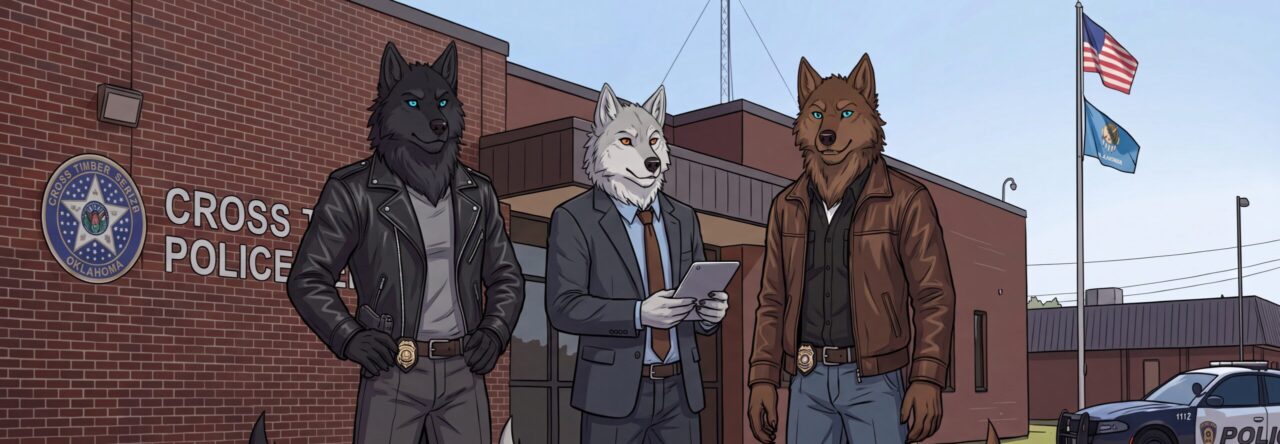
Tuesday evening began with a retired firefighter asking Thane to snarl at him in the lobby.
Walt stood near the front desk in a clean denim shirt, Keen work boots, and the faintly uncomfortable expression of a grown man who had decided he was willing to endure any amount of embarrassment for his grandchildren.
Thane stopped just inside the station entrance.
Gabriel, beside him, saw Walt and immediately brightened.
“Oh, no.”
Walt held up his phone.
“It is for my grandkids.”
Thane looked at the phone.
Then at Walt.
Then at the front desk clerk, who had already turned slightly in her chair because she knew exactly where this was going.
“No.”
Walt nodded as though he had expected that.
“Fair.”
“My granddaughter saw the garden photo,” he said. “The one with that kid, Kaden. She has asked me three times whether I know the wolf who makes the scary face.”
Gabriel leaned against the front counter.
“Forest boss monster.”
Thane looked at him.
“Do not.”
Walt’s mouth twitched.
Mark stepped around the pair of them with his laptop case, heading for Investigations.
Thane sighed.
“Quick.”
Walt’s face lit up.
“Really?”
“Quick.”
Gabriel took the phone before Walt could unlock it.
“Okay. You know the format. Hands up. Claws. Commitment.”
Walt looked down at his own hands.
“I am sixty-three.”
“You were a firefighter,” Gabriel said. “You can handle two little claw hands.”
Walt raised both hands beside his chest.
The effort was sincere.
Not successful.
He looked less like a terrifying woodland creature and more like a man startled by a tax bill.
Gabriel stared at him.
“Walt.”
“What?”
“More commitment.”
“I am committing.”
“You look like you are trying not to touch a hot pan.”
Walt gave Gabriel a flat look.
“Do you want this picture or not?”
Gabriel grinned.
“I absolutely do.”
Thane lowered himself beside Walt with the long-suffering resignation of someone who had already lost the argument before it began.
He squared his shoulders.
Bared his fangs.
And let a low, rumbling growl roll through his chest.
Walt immediately broke.
Not in fear.
In laughter.
Gabriel caught the first photo anyway.
The second came out better.
On the third, Walt managed a genuinely ferocious look, hands up like claws, standing beside Thane as if the two of them had just defended a forest kingdom from an invading army.
Gabriel handed him the phone.
“That is excellent.”
Walt looked at the screen.
Then he laughed again.
“Oh, my granddaughter is going to lose her mind.”
Thane stood.
“Good.”
Walt put the phone away.
“You know, you did not have to do that.”
Thane’s ears tipped back slightly.
“I know.”
“Still appreciate it.”
Thane nodded once.
Walt headed for the front doors, then stopped.
“Garden’s looking good, by the way.”
Thane looked at him.
“Yeah?”
“Kids are already asking when the tomatoes will be ready.” Walt smiled. “You did good work.”
“Everybody did,” Thane said.
Walt nodded.
Then he was gone.
Gabriel watched him leave.
“You know you are going to end up on a mural.”
“I am not.”
“Somewhere,” Gabriel said, “a local artist is already sketching you as a snarling garden guardian.”
Mark looked over from the hallway.
“That would be structurally inappropriate for the community center.”
Gabriel stared at him.
“You considered it.”
“I assessed it.”
Thane began walking.
“Can we work now?”
Gabriel followed, still smiling.
“Sure, Forest Boss Monster.”
Thane did not look back.
“Gabriel.”
“Sorry.”
He was not sorry.
Voss and Rusk were waiting in the case room.
It was not a formal briefing space. It never had been. The room was too small for that—one scarred conference table, a whiteboard with the faint ghosts of old case diagrams still visible beneath fresh marker, a coffee maker in the corner that had survived at least three budget cycles through sheer hostility, and a narrow window that looked out toward the department lot.
Voss sat at the table with three folders in front of her.
Rusk leaned in the corner beside the coffee maker, holding a sandwich in one hand and his phone in the other.
The second Thane entered, Rusk looked up.
“Walt texted me.”
Thane stopped.
“No.”
Rusk held up the phone.
“Remarkably convincing.”
Gabriel covered his mouth.
Voss did not look up from the folder she was reading.
“Rusk.”
“What? I am giving professional feedback.”
“You are never giving professional feedback.”
Rusk looked at Thane.
“Your growl has improved.”
“It has not.”
“Then it is naturally excellent.”
Mark sat down and opened his laptop.
“Can we begin?”
Voss slid the first folder toward Thane.
“Yes.”
The humor settled out of the room.
Not gone.
It never completely left with Gabriel and Rusk present.
But shifted aside.
Voss folded her hands.
“New report. It came in late this afternoon through Patrol. I want fresh eyes on it before it becomes a property-dispute supplement and disappears into a pile.”
Thane opened the folder.
At the top was a handwritten patrol report, a photocopy of a business card, and several printed photographs.
The complainant’s name was Lydia Harlan, seventy-two.
Her husband, James, had died six weeks earlier.
Gabriel’s ears lowered.
Voss continued.
“Mrs. Harlan came in with her daughter around sixteen hundred. She believes a company called Clearview Estate Solutions removed property from her garage and workshop Saturday morning under false pretenses.”
“False pretenses how?” Mark asked.
Rusk set his sandwich down.
“They told her her daughter had arranged it.”
Gabriel looked at the report.
“Her daughter did not.”
“No,” Voss said.
“Company real?” Thane asked.
“Maybe. Maybe not. The business card has a local phone number, a website, a mailing address, and a logo that looks very professional. Patrol tried the phone. It went to a generic voicemail. The website currently returns an error page.”
Mark picked up the photocopied business card.
The logo was clean and unremarkable: a navy-blue house outline with a neat white box beneath it.
CLEARVIEW ESTATE SOLUTIONS
Estate Clear-Outs • Donation Coordination • Home Transition Support
The number had a local area code.
The address was a small suite in a commercial office building off Memorial.
Gabriel read the tagline once.
Then looked at Voss.
“Home transition support.”
“Exactly,” Voss said.
“Who let them in?” Thane asked.
“Mrs. Harlan.”
Nobody moved for a second.
Then Gabriel said, quietly, “Okay.”
Voss held his gaze.
“Her husband died. She has been trying to sort the garage because relatives are coming next weekend to help with the estate. Three people arrived Saturday morning in a white cargo van. Two men and a woman. Branded polo shirts. Clipboard. Work order. They said her daughter, Dana, had arranged for them to remove unwanted workshop equipment and donation boxes before an appraiser came through.”
“Dana is the daughter who came in with her?” Mark asked.
“Yes.”
“And Mrs. Harlan believed them,” Voss said. “At first.”
Rusk picked up his sandwich again but did not eat.
“Then she realized they had taken items Dana never would have authorized. A hand-built walnut tool chest. A locked document box. A set of military medals. A pocket watch. Several antique hand tools. Family photographs.”
Gabriel’s expression changed.
“Photographs?”
“Some were in boxes near the workshop,” Voss said. “Others may have been mixed in with papers. Mrs. Harlan is not entirely sure yet. That is part of the problem.”
Thane looked down at one of the photographs.
A garage.
Organized, but lived in.
Tools hanging in careful rows over a workbench. A tall red toolbox against the wall. Stacks of labeled plastic bins. A walnut chest with brass corners resting beneath a framed photograph of an older man in a dark suit beside a vintage pickup truck.
James Harlan, probably.
Thane studied the room.
“What did they leave?”
“Power tools. Lawn equipment. The riding mower. Two newer tool chests. A television that was still boxed from a recent purchase. A cabinet full of ordinary household supplies.”
Mark’s ears tipped forward.
“They selected.”
“That is what I thought,” Voss said.
Gabriel flipped to the second photograph.
There was an empty space under the workbench.
A pale rectangle in the dust where the walnut chest had been.
“Did they have a list?” he asked.
“Mrs. Harlan says the woman with the clipboard had a work order with the property address, James’s name, and a list of broad categories. ‘Workshop contents. donation boxes. documents for sorting.’”
Mark frowned.
“Documents for sorting?”
“Her daughter says that phrase stood out too.”
Thane looked at Voss.
“Where is Mrs. Harlan now?”
“Interview room two,” Voss said. “Dana is with her.”
Gabriel stood.
“Let’s talk to her.”
Voss nodded.
“Be careful. She already thinks this happened because she was stupid.”
Thane closed the folder.
“She was not.”
“No,” Voss said. “She was grieving. They came prepared for that.”
Rusk looked toward the hallway.
“Go make sure she hears the difference.”
Lydia Harlan sat at the small interview-room table with both hands wrapped around a paper cup of coffee.
She was neatly dressed in a pale blue blouse and dark slacks. Her silver hair had been pinned back carefully. She looked like someone who had made herself put together because being anything less had felt too dangerous.
Her daughter, Dana, sat beside her.
Dana was in her early forties, tired-eyed and tense, with a legal pad on the table in front of her covered in notes.
Both women looked up as the three wolves entered.
Gabriel gave them a gentle smile.
“Mrs. Harlan? Ms. Harlan?”
Lydia nodded.
“Please call me Lydia.”
“Okay,” Gabriel said. “I’m Gabriel. This is Thane, and Mark.”
Dana looked at their badges.
“You are the Night Shift detectives.”
“We are,” Mark said.
Lydia looked down at her coffee.
“I did not mean to cause trouble.”
Thane pulled out a chair across from her.
“You are not causing trouble.”
She looked at him.
“I let them in.”
Thane held her gaze.
“We know.”
Lydia’s mouth tightened.
“They seemed so certain. They had paperwork. They knew Jim’s name.”
Gabriel sat beside Thane rather than directly opposite her.
“Can you tell us exactly what they said?”
Lydia took a breath.
“They said… they said Dana had called. That she had asked them to come clear the workshop before someone came to look at the house.”
Dana spoke quickly.
“I never did. I have not even talked to an appraiser. We are not selling the house.”
Lydia nodded.
“I know that now.”
“What did they call James?” Gabriel asked.
Lydia blinked.
“What?”
“Your husband. Did they call him Jim? James? Mr. Harlan?”
Lydia thought.
“The woman said ‘Mr. Harlan’ at first.”
“And after that?”
“She said Jim.” Lydia’s eyes narrowed slightly. “But she said it oddly.”
“How?” Gabriel asked.
Lydia looked down at the table.
“Like she had read it somewhere.”
Dana turned toward her.
“Mom.”
“No, I mean…” Lydia shook her head. “Everyone who knew him called him Jimmy. His mother called him James. I called him Jim. But the woman said it like she was trying to sound familiar.”
Gabriel nodded slowly.
“That is useful.”
Lydia looked embarrassed.
“It sounds silly.”
“It is not silly,” Gabriel said. “Those small things matter.”
Mark had opened a document on his laptop.
“Do you remember the company name exactly?”
“Clearview Estate Solutions.”
“Did they provide a written receipt?”
Lydia’s fingers tightened around the coffee cup.
“They had me sign something.”
Dana’s head snapped around.
“What?”
“I thought it was a pickup acknowledgment. The woman said they needed it for their records.”
“Do you have a copy?”
Lydia shook her head.
“She said they would email it.”
“Have they?” Mark asked.
“No.”
Mark nodded once.
“Do you remember where you signed?”
“The kitchen counter.”
“Do you remember what the paper looked like?”
“White paper. A logo at the top. Some typed lines. I did not read it carefully.”
Dana reached over and took her mother’s hand.
“Mom, you were trying to get through Saturday.”
Lydia’s eyes filled.
“I should have called you.”
“You called me after,” Dana said. “That is what matters.”
Thane watched them for a moment.
Then asked, “How long were they there?”
“Maybe forty minutes,” Lydia said. “They moved quickly. The men carried things out. The woman asked questions.”
“What kind of questions?” Mark asked.
“Where Jim kept important papers. Whether there were any tools he wanted donated to veterans. Whether the old truck paperwork was in the garage or inside the house.”
Thane’s ears went forward.
“Did you answer?”
Lydia looked down.
“I told her the truck title was probably in the lockbox.”
Dana squeezed her hand.
“They took the lockbox.”
“Yes.”
The room went quiet.
Gabriel’s voice stayed gentle.
“Lydia, this is important. You did not hand them things because you were careless. They came with a story designed for somebody who was tired, grieving, and trying to sort through a life that had changed too fast.”
Lydia looked up.
The tears in her eyes did not fall.
But they came close.
“I just wanted to get through the garage,” she said.
“I know,” Gabriel said.
Thane leaned forward slightly.
“Do you remember the van?”
“White cargo van. No rear side windows. Dark lettering on the doors. The same company logo as the business card.”
“Anything else?”
“There was a dent near the back bumper on the passenger side,” Lydia said. “And one of the men had a tattoo on his wrist.”
“What kind?” Mark asked.
“A black circle. Or maybe a gear.” Lydia frowned. “I only saw it once.”
“Anything about their clothes?” Gabriel asked.
“The woman wore a navy polo shirt. The men had navy shirts too. Khaki pants. One had gray work gloves tucked into his back pocket.”
“Any names?”
“The woman said hers was Carissa.”
“Last name?”
“She did not say.”
Mark typed.
“Did anyone else see them?”
“The neighbor across the street might have,” Dana said. “Mr. Salazar. He is outside all the time. He watches the block.”
Thane looked at the garage photographs again.
“Can we see the house?”
Lydia hesitated.
Dana looked at her.
“You do not have to go right now.”
Lydia shook her head.
“No. I want to.”
She straightened in her chair.
“They took things that were Jim’s.”
Thane nodded.
“Okay.”
The Harlan house sat in a quiet older neighborhood near the north edge of Cross Timber.
It was a brick ranch with a wide front porch, a clipped lawn, and a small flag hanging from a bracket beside the door. The garage occupied one side of the house, its door open beneath the fading evening light.
A wind chime moved softly on the porch.
Nothing about the place looked like a crime scene.
That was part of what made it worse.
The house looked like a home where a man had spent decades building things, fixing things, storing things, keeping things because they had mattered to someone.
Lydia led them through the side garage door.
The smell inside was cedar, motor oil, old metal, dust, and the faint lingering clean-citrus scent of commercial degreaser.
Thane stopped.
It was there.
Not proof.
Not yet.
But distinct.
A sharp synthetic citrus cleaner, stronger than normal household spray, mixed with the rubber scent of moving straps and the faint chemical note of packing tape adhesive.
He did not say anything immediately.
He looked around.
The garage had been orderly once.
It was still orderly, mostly.
But there were gaps.
A bare pale rectangle beneath the workbench where the walnut chest had rested.
Empty hooks on the wall where several old tools had hung.
A cleared section of shelving where document boxes had been stacked.
A heavy cabinet open near the back corner.
Thane crouched beside the empty rectangle.
The dust around it had been disturbed.
Boot prints crossed the concrete, but the floor had been swept enough that the details were soft and incomplete.
Not useless.
Not enough.
Mark took photographs.
“Did they use any packing material?” he asked.
Lydia pointed to a corner near the door.
“They had blankets. Blue moving blankets. And plastic wrap.”
Gabriel glanced toward the garage opening.
“Did they bring everything in from the van?”
“I think so.”
“Did they go inside the house?”
“Only the woman,” Lydia said. “She came in twice.”
“For what?”
“The first time, she asked for water. The second time…” Lydia stopped.
Dana put a hand on her shoulder.
“The second time, Mom says she went to the bathroom.”
Thane looked at the hallway leading into the house.
“Was she alone?”
“I think so.”
“Did she have a bag with her?”
Lydia frowned.
“A small black tote. Like a work bag.”
Mark looked up.
“Did anything go missing from inside the home?”
“I do not know,” Lydia said quietly. “I have not checked everything.”
Gabriel’s ears lowered.
“We will help you make a list. Not tonight if it is too much. But soon.”
Lydia nodded.
Thane stood and moved to the workbench.
The empty wall hooks were shaped around their missing items. A hand plane. An old brace drill. A small leather roll of chisels.
Nothing that would scream value to a stranger.
Everything that would matter to someone who knew tools.
“Did Jim restore things?” Thane asked.
Lydia’s face changed.
The first real warmth touched it.
“He restored old furniture. He could fix almost anything. He made that tool chest himself.”
She pointed to the pale rectangle on the floor.
“For our twenty-fifth anniversary.”
Dana looked away.
“He carved the corners by hand,” Lydia said. “The brass pieces came from an old trunk his father had.”
Gabriel stood quietly near her.
“What was in it?”
“His tools. Some papers. The medal box.” Lydia swallowed. “The pocket watch was in the top drawer.”
Thane looked at the empty space again.
“They took the chest because they knew it was worth taking.”
Lydia’s eyes narrowed.
“I thought maybe they just grabbed what was easy.”
“No,” Mark said. “They passed over items that were easier to identify and sell.”
Dana looked at the untouched boxed television.
“They left that.”
“Exactly,” Mark said.
Thane walked to the cabinet near the back wall.
The lockbox had been stored there.
The cabinet door was closed now, but the latch had a faint smear of something on it.
He leaned in.
The scent was the same citrus cleaner.
He looked toward Lydia.
“Did you clean this cabinet after they left?”
“No.”
“Did Dana?”
“No.”
Thane did not touch the latch.
“Mark.”
Mark came over with his evidence kit.
“Possible contact transfer,” Thane said. “The latch may have been wiped or handled with something on a glove.”
Mark looked closely.
“There is residue.”
“Can you collect it?”
“Yes.”
Lydia looked between them.
“Will that help?”
“Maybe,” Mark said honestly. “It could be nothing. But we collect what is there.”
Gabriel crouched near the open cabinet.
“Lydia, do you remember if the woman opened this?”
“She did,” Lydia said. “I told her the lockbox might be inside.”
“Did you see her take it?”
“No. One of the men carried it out later.”
“Which man?”
“The taller one.” Lydia’s face tightened. “He asked if he should take ‘the papers box too.’ Like he wanted me to say yes.”
“Did you?”
“I said I did not know.”
“What did he do?”
“He took it anyway.”
Dana’s jaw tightened.
“Mom.”
“I should have stopped him.”
Gabriel turned toward her.
“No. He made it sound ordinary. That is what he was there to do.”
Lydia closed her eyes.
For a second, the garage was silent except for the low click of Mark’s camera and the faint wind moving past the open door.
Then Lydia said, “I thought I was getting rid of old things.”
Gabriel looked at the empty place beneath the workbench.
“They knew you were trying to make room. They used that.”
Thane walked toward the driveway.
Near the curb, the concrete held faint tire scuffs where the van had backed in.
The impressions were partial and blurred by two days of heat, vehicles, and foot traffic.
Still, he saw something.
A shallow diagonal pattern in the passenger-side rear tire.
More importantly, a streak of black rubber along the curb edge where the vehicle had climbed it slightly while turning out.
He photographed it with his phone, then pointed it out to Mark.
“Document it,” he said. “Not enough for an ID, but maybe later.”
Mark took several photographs.
“Possible right rear tire wear pattern.”
Thane nodded.
At the end of the driveway, a voice called from across the street.
“Detectives.”
An older man stood beside a white pickup, one hand resting on the open tailgate.
Mr. Salazar, probably.
He wore a faded baseball cap, a sleeveless work shirt, and the alert expression of someone who knew every vehicle that came down his street.
Thane crossed the road with Gabriel while Mark finished documenting the garage.
“Mr. Salazar?”
“That is me.”
“Mrs. Harlan said you might have seen the crew Saturday.”
“I saw them.”
Gabriel’s ears tipped forward.
“Can you tell us what you remember?”
Mr. Salazar looked at the Harlan house.
“They came around nine, maybe a little after. White cargo van. Navy shirts. There were three of them. One woman, two men.”
“Did you see the company name?”
“Blue lettering. Could not read it from here.”
“Anything about the van?”
“Dent back by the passenger bumper. Side door stuck a little. One of the men had to pull it twice.”
Gabriel glanced at Thane.
“Anything else?”
Mr. Salazar thought.
“The woman was talking on a phone when they first got there. She was saying something like, ‘No, the son is in Tulsa. We have time.’”
Thane went still.
“Are you sure?”
Mr. Salazar nodded.
“I was watering the yard. I remember because I thought it was rude. Lady is standing in front of somebody else’s house talking about them like they are not there.”
Gabriel’s voice stayed even.
“Did she say anything else?”
“Not that I heard. Then she saw me watching and turned away.”
“Did you see where they went when they left?”
“South on Winfield. Toward Memorial.”
“Did anyone take pictures?”
Mr. Salazar shook his head.
“I wish I had.”
“You gave us a lot,” Gabriel said.
Mr. Salazar looked at the Harlan house again.
“Jim was a good man.”
“We know,” Thane said.
The older man looked at him.
“You get their things back.”
Thane did not promise.
Not before he had proof.
Not before he knew where the things had gone.
But he looked at the empty garage across the street and thought of Lydia’s face when she spoke about the hand-built tool chest.
“We are going to work it,” he said.
Mr. Salazar nodded.
That was enough for him.
For now.
Back at the station, Mark took over one corner of the case room.
He put the business card under the document camera.
Clearview Estate Solutions.
The website address.
The phone number.
The suite address.
The neat navy logo.
All of it looked convincing at a glance.
That was the point.
Rusk returned from somewhere with fresh coffee and watched Mark work.
“Please tell me the website has a stock photograph of a smiling family standing in front of a house.”
Mark looked up.
“It does.”
Rusk nodded.
“Of course it does.”
“Did,” Mark corrected. “The page is currently offline.”
“Somebody took it down?”
“Or the site failed,” Mark said. “I am preserving what remains through the web cache and domain-registration information.”
Voss stood near the whiteboard, reading the patrol report again.
“Business registration?”
Mark typed.
“Nothing under Clearview Estate Solutions in state records. There is a Clearview Home Transition LLC registered in Missouri, but it is not connected to this phone number or mailing address.”
“Mailing address?” Voss asked.
“Private mailbox center. Suite number is a rented mailbox.”
Rusk took a drink of coffee.
“Legitimate companies always describe themselves as ‘home transition support’ and operate out of a mail drop.”
Gabriel sat near the end of the table, reviewing Lydia’s list.
“Could still be a theft crew using a fake company name for one job.”
“Could be,” Voss said.
Mark looked at the business-card phone number.
“It is a voice-over-IP number. The provider will have subscriber information, payment records, account-creation data, possibly access logs. We will need legal process.”
Thane stood beside the whiteboard.
“What about the van?”
“Nothing from Lydia’s street camera,” Mark said. “Her doorbell camera was unplugged during a kitchen remodel and has not been reconnected. Mr. Salazar has no exterior camera. I sent the description to patrol and ran a limited review of traffic cameras along Winfield and Memorial, but we need a tighter time window.”
Gabriel tapped the report.
“They knew the son was in Tulsa.”
“Mr. Salazar heard that,” Thane said. “Maybe they had watched the house. Maybe they had access to something else.”
“Obituary,” Mark said.
Everyone looked at him.
Mark turned his laptop screen.
James Harlan’s obituary had been posted online five weeks earlier.
It listed Lydia.
Dana.
A son named Robert who lived in Tulsa.
A granddaughter.
A memorial service at a local church.
A note about Jim’s lifelong love of restoring antique furniture and serving in the Army National Guard.
Gabriel stared at the screen.
“They did not need an inside source to know there was a son in Tulsa.”
“No,” Mark said. “They could have built enough of a story from public information.”
Thane looked at the obituary.
A photograph showed James Harlan smiling beside the old pickup truck Lydia had mentioned.
The caption beneath it said, Jim could repair anything with patience, a good tool, and coffee strong enough to wake the dead.
The grief in the words was still fresh.
And somebody had read them like instructions.
Gabriel leaned back.
“They knew exactly where to look.”
“Not exactly,” Mark said. “They knew enough to sound plausible. Then they asked questions until Lydia gave them more.”
Voss nodded.
“Social engineering.”
“On people who are already overwhelmed,” Gabriel said.
Rusk set down his coffee.
“Somebody sells you an old story with a new label, and suddenly it is not ‘I am stealing from you.’ It is ‘I am helping you sort through a hard day.’”
Thane looked at the business card.
“What else?”
Mark hesitated.
Then opened a department search.
“I ran key phrases from Lydia’s report against recent incident narratives.”
Voss looked at him.
“What did you find?”
“Three prior reports in the last two months.”
Gabriel sat forward.
“Same company?”
“Not named in all three. But similar facts.”
Mark turned the laptop so they could see.
One report from a family cleaning out an older man’s home after he had moved into assisted living.
Another from a woman whose father had died and whose adult children were preparing the house for sale.
A third from a man who believed a “donation pickup crew” had taken a box of coins and documents while collecting furniture.
Each had been entered as a possible civil dispute, property misunderstanding, or insufficient-information theft report.
Each involved a white cargo van.
Each involved people in matching dark shirts.
Each involved someone saying a relative had made arrangements.
And in each one, the victim had initially hesitated to call.
“Why were they not connected?” Gabriel asked.
“Different patrol beats. Different report language. No obvious business name. Two victims said they were not sure whether they had authorized the removal,” Mark said.
Thane looked at the screen.
“What did they take?”
Mark opened the first report.
“Family documents, jewelry box, old photographs, a collection of coins.”
The second.
“Tools, antique furniture hardware, old letters, one locked filing box.”
The third.
“Furniture and clothing were removed as expected. The disputed items were a military shadow box, a ceramic urn that turned out to be empty, and a small safe.”
The room went quiet.
Rusk folded the sandwich wrapper in half.
Then in half again.
“They are not just grabbing random things.”
“No,” Thane said.
“They are looking for things people might not inventory immediately,” Mark said. “Items stored in garages, workshops, basements, closets, mixed boxes. Documents. heirlooms. valuables with personal significance.”
Gabriel stared at Lydia’s picture of the empty workshop floor.
“They are taking what people do not realize they are missing until after the van is gone.”
Voss walked to the whiteboard.
She uncapped a marker.
“Names.”
Mark read them out.
Lydia Harlan.
Carol Dempsey.
Albert Brice.
Marta and Jason Bell.
Voss wrote each one in a vertical line.
Then she added the dates.
Then the neighborhoods.
Then, beside each name, the public transition that had made the person vulnerable.
Husband died.
Moved to assisted living.
Father died.
Parents’ estate clearance.
Gabriel looked at the board.
“They are reading obituaries.”
“Maybe,” Mark said. “And property listings. Community posts. probate notices. moving announcements. Any public signal that a home is in transition.”
Thane looked at Voss.
“Can we talk to the other victims tonight?”
Voss considered it.
“Not all of them. It is late, and some of them may not want detectives at their door after dark. But we can start with Carol Dempsey. Her report lists an evening number and says she was worried about the crew returning.”
Mark pulled up the address.
“She is staying with her daughter temporarily. Six blocks from here.”
Rusk looked toward the whiteboard.
“Go.”
Gabriel stood.
“Do we call it a pattern yet?”
Voss capped the marker.
“We call it an investigation.”
Thane looked at the names.
At the bare line beside Lydia Harlan.
At the list of things taken from people when their lives were already coming apart.
Then he picked up the folder.
“Okay.”
Carol Dempsey’s daughter lived in a duplex near the old library.
The porch light was on when Night Shift arrived.
Carol opened the door herself before they knocked.
She was small, white-haired, and wearing a lavender cardigan despite the warmth. Her daughter stood behind her with a worried expression and a phone clutched in one hand.
“Detectives,” Carol said. “Did they come back?”
“No,” Gabriel said immediately. “We are following up on your report.”
Carol let out a breath.
“Come in.”
The living room was full of boxes.
Not chaotic boxes.
Careful boxes.
Each one labeled in thick marker: KITCHEN, PHOTO ALBUMS, WINTER CLOTHES, GRANDKIDS, KEEP.
A framed photograph of a man in a firefighter’s uniform sat on a side table beside a vase of artificial flowers.
Carol noticed Thane looking at it.
“My husband,” she said. “He passed three years ago.”
Gabriel nodded gently.
“I am sorry.”
“Thank you.” She looked toward the boxes. “I moved into Willow Ridge last month. Smaller apartment. My daughter has been helping.”
Her daughter, Teresa, spoke quickly.
“We hired an actual moving company for the furniture. Then two days later, these people showed up and said Mom’s neighbor had arranged a donation pickup for the rest.”
Carol looked down at her hands.
“I thought maybe I had forgotten.”
“You did not,” Teresa said.
Carol gave a small, embarrassed laugh.
“I forget things sometimes.”
Gabriel sat across from her.
“What did they take?”
Carol’s eyes moved toward the boxes.
“My husband’s fire-service plaque. A box with our family pictures. My jewelry box.” She hesitated. “And a blue suitcase with all the paperwork from our house.”
Teresa’s mouth tightened.
“They also took a binder with Mom’s medical documents and financial information. We did not realize until later.”
“Did they use a company name?” Mark asked.
Carol thought.
“Clear… something.”
Teresa nodded.
“Clearview. I wrote it down after I got home.”
Mark looked at Thane.
There it was.
Not a theory anymore.
Not yet a complete case.
But the same name.
The same white van.
The same matching dark shirts.
The same lie.
Gabriel asked, “What did they say to you?”
Carol closed her eyes.
“They said they had been sent because I had already done the hard part.”
The room got very still.
“What did that mean?” Gabriel asked.
“They said I had already moved. That I should not have to deal with the leftovers. That they would take care of it.”
Carol’s eyes opened.
“They were so kind.”
Gabriel did not look away.
“People who take advantage of others are often kind at first.”
Carol’s face folded slightly.
“I should have known.”
“No,” Gabriel said. “You should have been able to trust a person who showed up saying they were there to help.”
Teresa reached for her mother’s hand.
Carol held it.
Mark opened his notebook.
“Did you see the van?”
“White. Dent on the back. The side door made a terrible sound.”
“Did you see any employee names?”
“One man said his name was Aaron,” Carol said. “The woman called him ‘Nate’ once, though.”
Gabriel’s ears tipped forward.
“She called him Nate?”
“I think so.”
“Did he react?”
Carol frowned.
“He looked at her. Like he did not want her to say it.”
Mark wrote quickly.
“Did they leave you any paperwork?”
Carol nodded toward a drawer in the side table.
Teresa retrieved a crumpled carbon-copy form.
The top had the Clearview logo.
The lines below were vague: General household goods / donation materials / estate transition items.
There was a signature at the bottom.
Carol’s.
And beneath it, in smaller print:
Customer acknowledges removal of listed materials and waives claim to donated items.
Gabriel looked at the paper.
Then at Carol.
“They gave you this?”
“Yes.”
“Did anyone explain that language?”
“No. They said it was just for their records.”
Mark photographed the document.
“May we take this for evidence?”
Carol looked frightened.
“Will I get it back?”
“Yes,” Mark said. “We will make you a copy before we leave. You will not lose your paperwork because someone else took advantage of you.”
Something in Carol’s expression eased.
“Okay.”
Thane looked around the room.
Every box was a piece of a life someone had spent years putting together.
The crew had known that.
They had stepped into homes full of grief and transition and made themselves sound like relief.
Then they had carried out the parts people could never replace.
As they left, Carol stood in the doorway.
“Do you think you can get it back?”
Thane looked at her.
He wanted to say yes.
He wanted to promise the photographs would be found, the plaque recovered, the papers returned.
But that was not what detectives did.
Not if they were going to protect the truth long enough for it to be found.
“We are going to find out who did this,” he said. “And we are going to work to recover what we can.”
Carol nodded.
It was not a promise.
But it was honest.
Her daughter held the door as they walked back to the Humvee.
Gabriel waited until they were at the curb.
Then said quietly, “She thought she was being helped.”
Thane looked back at the porch light.
“They all did.”
Mark opened the passenger door.
“Which means the crew’s first tool is not the van.”
Gabriel looked at him.
“What is it?”
Mark’s face had gone still.
“Trust.”
At 00:36, the case room wall had begun to fill.
The lights were low except for the case-room table and the whiteboard. Dispatch murmured somewhere beyond the hall. A printer ran briefly, then stopped. The rest of the station had settled into the quieter rhythm of the deep overnight hours.
Mark stood at the whiteboard with a marker in one hand and his laptop open on the table behind him.
Lydia Harlan.
Carol Dempsey.
Albert Brice.
Marta and Jason Bell.
Gerald Pruitt.
Five names.
Five homes in transition.
Five versions of the same lie.
Mark had written the dates beside them, then the locations, then the public detail that had made each household visible.
Husband died.
Moved to assisted living.
Father died.
Parents’ estate clearance.
Wife died.
Gabriel stood with both arms folded, looking at the board.
“They are not just looking for valuables.”
“No,” Thane said.
“They are looking for people who are overwhelmed.”
Mark nodded.
“The property is secondary at first. The transition is the target.”
Gabriel looked at Lydia’s name.
“They do not need to know where the important things are before they get inside.”
“Exactly,” Mark said. “They arrive with broad categories. They ask questions that sound helpful. They watch what the victim hesitates over, what they protect, what they mention. Then they take those things along with enough ordinary property to make it look like a legitimate pickup.”
Thane looked down at the printed photographs from Lydia’s garage.
The empty shape beneath the workbench.
The missing walnut chest.
The pale rectangle in the dust.
“They make people help them steal,” he said.
Gabriel’s ears lowered.
“Not willingly.”
“No,” Thane said. “But they make it feel like the victim agreed.”
Mark turned back to his laptop.
“The Clearview phone number is voice-over-IP. I have preserved the website cache, domain-registration data, mailbox-center listing, and public business-record searches. None of it identifies the crew yet, but it gives day shift a starting point for legal process.”
“Can you put the other reports together?” Thane asked.
“I already did.”
Mark clicked a folder open.
A single summary report appeared on the screen.
Similar company descriptions.
Similar white cargo van.
Matching dark work shirts.
A supposedly authorized pickup.
Family papers, personal heirlooms, medals, photographs, old tools, safes, document boxes, jewelry.
Victims who had been grieving, moving, clearing a home, or trying to make decisions under pressure.
Gabriel read the headings.
“Why were none of these tied together?”
“Different patrol beats,” Mark said. “Different terminology. Different victims who were not sure whether they had approved the removal. Two reports were initially treated as civil property disputes because family members disagreed about what had been promised.”
Thane looked at the list.
“Not anymore.”
Mark’s ears tipped forward.
“No.”
Gabriel leaned against the table.
“They do not just take things. They take what comes after.”
Mark looked at him.
“What do you mean?”
Gabriel stared at the names.
“The person is gone. The house changes. Everybody starts sorting through what is left. And these people walk in and take the things that tell you somebody was there.”
Thane looked at the board.
At Lydia’s tool chest.
Carol’s fire-service plaque.
Photographs.
Letters.
Medals.
Documents.
Pieces of a life somebody else had decided were easy to carry away.
“Secondhand,” he said.
Gabriel looked at him.
“Yeah.”
Mark considered it for a moment.
Then wrote beneath the company name:
SECONDHAND
The marker squeaked softly against the whiteboard.
For a second, the three wolves simply stood there.
No dramatic breakthrough.
No suspect name.
No warrant.
Just the first clear outline of something ugly.
A crew that had learned grief could make people doubt their own memories.
A white cargo van that looked official enough.
Matching shirts.
A clipboard.
A few pieces of public information.
And the confidence to walk into a home at exactly the moment somebody was least prepared to question them.
Mark set the marker down.
“I am sending the preliminary pattern summary to Voss, Rusk, Kessler, and the property-crimes unit. I will flag the preservation requests as time-sensitive.”
“Do it,” Thane said.
Mark typed.
The message was short and careful.
Night Shift has identified at least five potentially connected estate-transition theft reports involving a suspected fictitious company using the name Clearview Estate Solutions. Similarities include a white cargo van, matching navy work shirts, claimed authorization through relatives or neighbors, and targeted removal of heirlooms, documents, tools, medals, photographs, and financial records. Preliminary supporting materials and preservation targets attached. Recommend coordinated follow-up at start of day shift.
He added the report numbers.
The victim names.
The known company phone number.
The mailbox address.
The website information.
Then he sent it.
The message disappeared into the department system.
Gabriel watched the screen.
“That feels small.”
“It is not,” Mark said.
“No,” Thane agreed. “It is the first thing that makes all of them part of the same case.”
Mark closed the laptop halfway.
“The next step is identifying the people behind Clearview. The phone account. The mailbox renter. The van. The website payment. Any storage-rental or resale pattern.”
“And stopping them before they reach another house,” Gabriel said.
Thane looked at the names one more time.
Then at the blank space beneath them.
There would be more, probably.
More reports buried under vague language.
More people who had doubted themselves before they called.
More homes where someone had opened the door because they were tired of sorting through a life that had changed too quickly.
He hated that.
But hating it was not the job.
The job was finding the road.
“Tomorrow, we work the facts,” Thane said.
Gabriel looked at him.
“Tonight too.”
Thane nodded.
“Tonight too.”
They stayed another hour.
Not because Voss or Rusk needed them to.
Not because anyone had ordered them to.
Because the facts were still there, waiting to be organized.
Mark ran additional searches for similar key phrases.
Gabriel read old reports for the human details nobody had initially understood were important.
Thane studied the van descriptions, the property lists, and the public timelines around each victim’s loss.
At 01:51, Mark found a sixth possible report from a neighboring jurisdiction.
A retired teacher named Evelyn Porter.
Her husband had died in March.
Two people in dark shirts had arrived saying her niece arranged for a donation pickup.
She had not been sure whether she had authorized the removal.
No charges filed.
No company name remembered.
But a white van with a dent near the passenger-side rear bumper.
Thane added her name to the board.
The whiteboard became quieter afterward.
He looked at it once more before they left the room.
Not a solved case.
Not even close.
But no longer a collection of separate shame-filled reports scattered across different desks.
Now it had a name.
Now it had a pattern.
Now somebody was looking.
Outside, the city moved through its late-night hours.
People slept.
People grieved.
People sorted through closets and garages and old boxes, trying to decide what stayed and what went.
And somewhere in Cross Timber, a white cargo van with blue lettering was still moving through the dark.
Looking for another house where somebody had died.
Another family too tired to question a clipboard.
Another person who only wanted help getting through a hard day.
Thane picked up Lydia’s folder.
“Let’s find them.”