By Wednesday evening, the word SECONDHAND had stopped looking like a title and started looking like a warning.
It sat beneath CLEARVIEW ESTATE SOLUTIONS on the case-room whiteboard in dark blue marker.
Under that came names.
Lydia Harlan.
Carol Dempsey.
Albert Brice.
Marta and Jason Bell.
Gerald Pruitt.
Evelyn Porter.
Six households.
Six versions of the same lie.
A white cargo van.
Navy work shirts.
A clipboard.
A company name that did not really exist.
And a sentence designed to make a tired person lower their guard.
Your family arranged this.
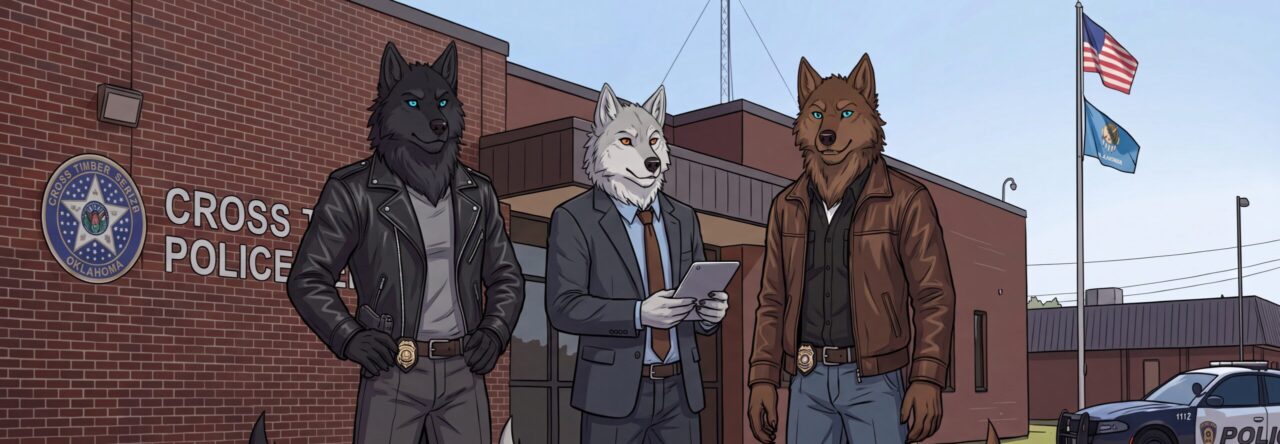
The three wolves reached Investigations a few minutes before eighteen hundred.
Voss and Rusk were already in the case room. Kessler stood at the far end of the table with his laptop open and a stack of printed photographs arranged in careful order beside it.
Rusk had coffee.
Voss had files.
Kessler had the particular focused expression that meant he had found something and wanted nobody interrupting him before he could explain it properly.
Gabriel stopped in the doorway.
“Oh, that is a lot of paper.”
Rusk looked at him.
“Good evening to you too.”
Gabriel pointed at the table.
“That looks like progress.”
“It looks like trees dying for justice,” Rusk said.
Mark sat down beside Kessler.
“Which is it?”
Kessler turned his laptop toward them.
“Both, potentially.”
Thane took the chair nearest the whiteboard.
Voss closed one of the folders in front of her.
“Day shift got enough back today to establish that Clearview is not a confused business transaction.”
Gabriel’s expression settled.
“Good.”
“Not solved,” Voss said. “Do not get ahead of yourselves. But good.”
Kessler tapped the first photo.
It showed Lydia Harlan’s walnut tool chest.
Not the old photograph from her garage.
This was a recent image, taken in a bright back room with gray concrete floors and a painted brick wall.
The brass corners caught the overhead light.
The hand-carved detail along the lid was unmistakable.
Gabriel leaned closer.
“They found it.”
“They did,” Kessler said.
“Where?” Thane asked.
“Cedar & Brass Consignment on West Edmond Road. A property-crimes bulletin went out yesterday morning to local pawn shops, antique stores, consignment businesses, estate-sale companies, and a few specialty dealers. We used photographs and narrow descriptions, not victim names.”
Kessler clicked to the next image.
A consignment receipt.
Seller: Nathan Vale.
Item: Early twentieth-century walnut tool chest, brass-trimmed, contents not included.
Payment: Pending sale.
Date received: Monday, 14:22.
Thane looked at the date.
Monday.
Two days after Lydia’s garage had been cleared.
“They still have it?” he asked.
“The shop put an immediate hold on it after they saw the bulletin,” Voss said. “The owner recognized the brass corners and the carved lid. She called Property Crimes instead of releasing it to the seller or putting it on the floor.”
Gabriel exhaled.
“Good.”
“It gets better,” Kessler said.
He brought up a still image from the shop’s exterior camera.
A white cargo van backed into the loading area.
The rear bumper on the passenger side had a dent.
The sliding side door was open.
A tall man in a navy polo carried the walnut chest with a second man. A woman stood near the van’s front, holding a phone to her ear.
Even grainy and still, the image carried a familiar shape.
The same van Mr. Salazar had described.
The same uniforms.
The same careful performance of legitimacy.
Mark looked at the time stamp.
“Monday afternoon.”
“Yes,” Kessler said. “Two days after the Harlan theft, one day before the store received the bulletin.”
Rusk took a drink of coffee.
“Sometimes luck shows up early.”
“Not luck,” Voss said. “A good store owner who paid attention.”
Rusk nodded.
“Fine. Sometimes good store owners show up early.”
Kessler zoomed in on the receipt.
“Nathan Vale used his actual driver’s license. He gave the shop a residential address. He signed the consignment agreement with his own name.”
Gabriel blinked.
“Why would he do that?”
“Because he may not understand the whole operation,” Mark said.
“Or he thinks the paperwork protects him,” Voss said. “Or he thinks the people above him will take the fall.”
Thane studied the image.
The tall man had his head angled downward. His face was obscured beneath the brim of a dark ball cap.
But the work shirt fit loose over narrow shoulders.
Not polished.
Not confident.
He looked like someone doing what he had been told because he had been told to do it.
Kessler brought up a second still.
This one showed the woman more clearly.
Thirty-something, maybe.
Dark hair pulled into a low ponytail.
Navy polo.
Khaki work pants.
A slim black tote over one shoulder.
She looked directly toward the shop’s front door.
Her face was visible.
“Do we have her?” Thane asked.
“Not yet,” Kessler said. “But we have something.”
He switched to a separate image from the private mailbox center listed on the Clearview business card.
The mailbox rental had been opened under the name Claire Morgan using an Oklahoma driver’s license that State Records had confirmed belonged to a real woman in Muskogee who had reported it stolen last year.
The application had a false date of birth, a copied signature, and a local phone number that belonged to Clearview’s voice-over-IP account.
The mailbox-center camera showed the same woman from Cedar & Brass entering the lobby two weeks earlier.
Navy polo.
Black tote.
Same face.
And beside her, carrying a stack of flat-rate mailers, was Nathan Vale.
“Same pair,” Gabriel said.
“Likely,” Kessler replied. “The mailbox clerk remembers them because the man was nervous. She said the woman did all the talking and kept correcting him when he tried to answer questions.”
Mark’s ears tipped forward.
“Correcting him how?”
Kessler checked his notes.
“The clerk quoted her as saying, ‘Nate, stop volunteering information.’”
Gabriel looked at Thane.
“Nate.”
Thane nodded.
“Same person.”
Voss slid another folder toward them.
“Nathan Vale is twenty-six. No felony history. A handful of minor traffic cases. One misdemeanor shoplifting charge when he was nineteen, dismissed after diversion. Employment has been mostly short-term labor, moving crews, warehouse work, delivery contracts.”
“Family?” Gabriel asked.
“Mother in Yukon. Younger brother in high school. Nathan’s current address matches a monthly rental at the Sunset View Motor Lodge on the east side.”
Rusk folded the sandwich wrapper he had not yet used.
“Living in a monthly motel on temporary labor wages. Not exactly the profile of a criminal mastermind.”
“No,” Voss said. “But he carried stolen property.”
Thane held her gaze.
“He may have known it was stolen.”
“He may have,” Voss agreed. “Or he may have been paid to stop asking questions. Either way, we do not decide his role before we know it.”
Mark looked at the still of the walnut chest.
“Has Cedar & Brass been searched?”
“Not yet,” Voss said. “The owner voluntarily preserved the chest, the consignment paperwork, camera footage, and every related communication. Property Crimes photographed it in place. The shop remains open. We will obtain the correct legal process before seizure.”
“Good,” Mark said.
Gabriel looked at the whiteboard.
“What about the other reports?”
Kessler turned to the stack of folders.
“Day shift contacted Albert Brice and the Bells. Both confirmed the company name after seeing the business card. Both had signed vague removal forms. Both describe the same woman—or a woman matching the same general description—asking questions about where documents, personal papers, and family items were stored.”
Thane leaned forward.
“Anything specific?”
“Albert Brice said she told him, ‘Your niece said the old woodworking pieces were set aside for the veterans’ donation.’ He does not have a niece. He has two nephews.”
Gabriel’s face hardened.
“They made a mistake.”
“They did,” Kessler said. “But he was packing to move into assisted living. He thought maybe a social worker had spoken to someone. He did not realize the wording was wrong until later.”
“And the Bells?” Mark asked.
“Marta Bell’s father died in April. She and her husband were clearing his house for probate. The crew told them a cousin had arranged for furniture donation and document shredding. They took a military shadow box, a box of old coins, two filing boxes, a locked safe, and a framed university diploma.”
Gabriel looked down.
“What did they leave?”
“Television. Dining room furniture. Lawn tools. A refrigerator in the garage.”
“Same selection,” Thane said.
“Exactly,” Voss replied. “Things that looked valuable to a stranger were not the priority. Things that mattered to a person were.”
The room went quiet.
Rusk broke it first.
“What are you doing tonight?”
Voss looked at the three wolves.
“Cedar & Brass. The owner is staying late to meet you and show you exactly what came in. Then you make contact with Nathan Vale.”
Gabriel looked at the address sheet.
“Knock and talk?”
“Yes,” Voss said. “No arrest warrant. No search warrant yet. We have enough to ask questions. We do not have enough to force the entire case into a bad decision.”
Thane nodded.
“Understood.”
“Keep it clean,” Voss said. “He is an identified seller connected to stolen property. That matters. But it does not tell us whether he is a driver, a thief, a frightened employee, or all three.”
Mark closed his laptop.
“What about the woman?”
“Kessler is working image comparison, rental records, account-preservation requests, and the site-registration trail with Property Crimes. We are not naming her until we can support it.”
Rusk looked at the photo of the woman with the tote.
“She will make a mistake.”
Gabriel’s ears lowered.
“She already has.”
Voss stood.
“Find out how much Nathan knows. Do not promise him anything. Do not make him think cooperation is a trade you can authorize. If he wants counsel, the questioning stops.”
“Of course,” Thane said.
Voss gathered her folders.
Then paused.
“One more thing.”
Gabriel waited.
Voss looked at Thane.
“Do not do the Kaden Face in a consignment shop.”
Thane stared at her.
“I was not going to.”
Rusk looked deeply disappointed.
“I was hoping the tool chest needed a morale photo.”
Gabriel smiled.
“Maybe the store owner’s grandkids—”
“Go work,” Thane said.
Rusk lifted his coffee.
“Forest Boss Monster, your estate thieves await.”
Thane stood.
“Goodnight, Rusk.”
Rusk grinned.
“Try not to become a mural.”
Cedar & Brass Consignment sat in a narrow older storefront between a frame shop and a small bakery that had already closed for the evening.
The display windows held antique lamps, refinished chairs, brass trays, old maps, glass-front cabinets, and the kind of carefully arranged objects that made people wonder whether a chipped vase from their grandmother’s attic might secretly be worth rent money.
A small painted sign hung above the door.
CEDAR & BRASS
Furniture, Objects, Stories
Inside, the store smelled like lemon oil, old wood, dust, and the faint sweetness of beeswax polish.
The owner met them near the front counter.
Anika Shah was in her fifties, neatly dressed in dark slacks and a linen shirt with the sleeves rolled to the elbows. Her silver-streaked hair was pulled into a loose knot. She carried herself with the calm alertness of someone who had learned that every object in her store had a story, and most sellers wanted her to guess only the part that made them look good.
“Detectives,” she said. “Thank you for coming.”
“Thank you for holding the chest,” Thane said.
Anika nodded.
“I am glad I saw the bulletin.”
She led them through the front showroom toward a locked workroom at the back.
The walnut chest sat on a rolling cart beneath bright task lights.
It looked heavier here than it had in Lydia’s garage.
More deliberate.
The carved lid bore a simple pattern of oak leaves and small brass inlays at the corners. A brass plate on the front carried a name engraved in clean, careful lettering.
JAMES HARLAN
Thane stopped beside it.
For a moment, nobody said anything.
The chest was not merely a thing.
It was the exact shape of what Lydia had described: a gift made by hand, built to last, marked with the name of the man who had made it.
Gabriel leaned close enough to read the engraving.
“Her anniversary gift.”
Anika’s expression softened.
“That is what the officer told me.”
Mark put on evidence gloves.
“May I examine the exterior?”
“Of course.”
He photographed the chest from every side.
The brass corners.
The carving.
The nameplate.
The faint scratches in the same places shown in Lydia’s garage photographs.
A small burn mark near the lower right foot where someone had once set down something hot.
There was no question.
“Exact match,” Mark said quietly.
Gabriel exhaled.
“Good.”
Thane looked at Anika.
“How did Nathan bring it in?”
“Monday afternoon,” she said. “He and the woman in the photograph carried it through the loading door. He did most of the lifting. She did most of the talking.”
“Did she identify herself?” Gabriel asked.
“She told me her name was Carrie Lorne.”
“Did she give identification?”
“No. Nathan did. She said he was the owner of the item and she was ‘helping with the estate transition.’”
Mark looked at the consignment paperwork.
“Did she sign anything?”
“No. She refused. Said she did not want to complicate probate issues.”
Gabriel’s eyes narrowed slightly.
“What made you suspicious?”
Anika smiled without humor.
“The fact that she knew exactly which words to use to make me think I should not ask more questions.”
She walked to a small desk and opened a file drawer.
“I asked for provenance. Not a sentimental story. Just basic origin. Where had the chest been acquired? Was there a family representative? Were there estate documents? She told me it was from ‘a gentleman’s workshop’ and that the family wanted it gone.”
“And Nathan?” Thane asked.
“He said, ‘It was his anniversary chest.’”
The room went still.
Anika looked toward the walnut chest.
“He realized he had said too much. The woman looked at him, and he corrected himself. Said he meant it was ‘part of an anniversary estate pickup.’”
Gabriel looked at Thane.
“He knew enough to know it mattered.”
“Maybe,” Thane said. “Or he heard it in the house.”
“Either way,” Anika said, “I told them I would only accept it on consignment. No immediate cash. No private sale. No release until I had the seller’s identification and complete agreement.”
“Did that upset her?” Mark asked.
“Very much.”
Anika opened a second folder.
“I wrote down the woman’s vehicle because she asked whether I had a rear entrance that would keep them out of view from the front street. I told her no.”
She handed Mark a photocopy of a handwritten note.
White cargo van — rental plate 7KY-241. Rear pass. bumper dent. Woman said ‘we’ll come back for the rest.’
Mark looked at the plate number.
“Full plate?”
“Full plate.”
Thane felt the case move.
Not leap.
Not solve itself.
Move.
The way a locked door sometimes shifted when the correct key finally turned.
“Did they come back?” he asked.
“No,” Anika said. “But I was expecting them to.”
Gabriel looked toward the shelf near the workroom door.
“Did they bring anything else inside?”
“Two items,” Anika said. “A small brass clock and a tray of hand tools. I declined both because the woman could not tell me where they came from.”
“Where are they?” Mark asked.
“Still in the van when they left, as far as I know.”
She hesitated.
“There is one more thing.”
Thane looked at her.
“After they left, Nathan came back alone.”
Gabriel’s ears tipped forward.
“When?”
“About forty minutes later. He said he needed to know whether the chest had sold.”
“Why?” Mark asked.
“I asked him that. He said he had made a mistake. Then he said he had to go.”
“What did you tell him?”
“That the chest was still here. That I would call the seller if there was interest. He looked relieved.”
Gabriel folded his arms.
“Relieved?”
“Not happy,” Anika said. “Not like someone waiting for money. More like someone who wanted the thing to stay where it was.”
Thane looked at the chest.
“Did he leave a number?”
Anika nodded.
“He wrote one down. It is the same number on the consignment agreement.”
Mark photographed it.
“Thank you.”
Anika looked at the detectives.
“Will Mrs. Harlan get this back?”
Thane did not answer quickly.
“It belongs to her,” he said. “We will work through the evidence process and return it as soon as we can.”
Anika nodded.
“That is good.”
Gabriel looked at the chest one more time.
“You did the right thing.”
Anika’s expression tightened.
“I almost did not. It is easy to tell yourself it is none of your business if somebody has paperwork.”
Thane held her gaze.
“It became your business when it did not feel right.”
Anika looked down.
Then back at the chest.
“I suppose.”
She walked them to the front door.
Outside, the bakery windows reflected the streetlights across the damp pavement. The city had cooled only slightly after the day’s heat, and the air carried the smell of asphalt, distant restaurant grease, and rain that had fallen somewhere else but not here.
Mark stood beneath the storefront awning and entered the rental plate into the system.
The result came back within seconds.
Vehicle: 2024 Ford Transit cargo van.
Owner: MetroWorks Fleet Rental.
Rental Agreement: C. Lorne Logistics LLC.
Gabriel looked at the screen.
“C. Lorne.”
“Possibly the woman’s alias,” Mark said.
“Or a real company,” Thane said.
Mark checked state records.
“No active Oklahoma registration under that name.”
Thane looked at the rental agreement expiration.
“Due back?”
“Friday at noon.”
Gabriel’s ears lowered.
“Two more days.”
“Could be extended,” Mark said.
“Could be returned tonight,” Thane said.
“Could be parked at Nathan’s address,” Gabriel added.
Mark looked up.
“That is the next reasonable step.”
Thane nodded.
“Let’s go talk to Nate.”
The Sunset View Motor Lodge stood behind a gas station and an aging strip of fast-food restaurants on the east side of Cross Timber.
It was not the kind of place people chose because they liked it.
It was the kind they chose because it allowed weekly payment, did not ask too many questions, and had enough thin walls that everybody knew when their neighbors argued, cooked, cried, or came home late.
The parking lot was half full.
A faded blue sedan.
Two work pickups.
A minivan with a cracked rear window.
A delivery van with a magnetic plumbing logo.
And, near the far end of the second building, a white Ford Transit cargo van with a dented passenger-side rear bumper.
Thane slowed the Humvee as they passed.
The van’s side panels were blank.
No blue lettering.
No Clearview logo.
But faint rectangular marks along the doors showed where magnetic signs had recently been removed.
Mark saw them too.
“Same vehicle class,” he said. “Same plate.”
Gabriel looked toward the driver’s window.
“Same dent.”
Thane parked three spaces away.
They did not rush.
They did not surround the van.
They did not touch it.
It sat in public view beneath a weak parking-lot light, carrying the same faint scent of commercial citrus cleaner and moving blankets that had clung to Lydia’s garage.
Thane noted it.
He did not say it.
Not as evidence.
Not yet.
Mark checked the rental status again.
“Active agreement. Renter listed as C. Lorne Logistics LLC. The rental company’s after-hours contact will preserve all related records pending legal process.”
“Good,” Thane said.
The motel room on Nathan’s driver’s-license address was 214.
The exterior hallway smelled of old carpet, stale cigarette smoke, detergent, and someone’s dinner reheated in a microwave.
Gabriel walked between Thane and Mark.
Mark opened his notebook and checked the time.
“Knock and talk,” Gabriel said quietly.
“Knock and talk,” Thane agreed.
Thane knocked.
For several seconds, there was no answer.
Then a chain slid across the door.
The door opened three inches.
Nathan Vale looked out.
He was younger than his photograph.
Twenty-six, maybe. Narrow-faced, unshaven, dark hair falling into his eyes. He wore a gray T-shirt and worn jeans. His gaze moved from Thane to Gabriel to Mark, then past them toward the parking lot.
He saw the Humvee.
He saw the badges.
His face went pale.
“Nate?” Gabriel asked.
Nathan swallowed.
“Yeah.”
“I’m Detective Gabriel. This is Detective Thane and Detective Mark. We would like to talk with you about Clearview Estate Solutions.”
Nathan’s eyes shifted.
“I don’t know anything about that.”
“We are not asking to come inside,” Gabriel said. “We are asking whether you are willing to speak with us.”
Nathan kept one hand on the door.
“I have to go to work.”
“It is almost nine,” Mark said.
Nathan looked at him.
“I work nights sometimes.”
“Okay,” Gabriel said calmly. “Then we can talk for a few minutes here, or you can tell us you do not want to talk.”
Nathan’s gaze flicked toward the van again.
Thane watched him.
Not his scent.
Not his fear.
His hands.
The way his fingers tightened around the door edge.
The way he looked over his shoulder toward the room, then back at the officers.
Like he was trying to decide whether something inside could be seen from the hall.
Gabriel’s voice stayed low.
“You brought a walnut tool chest to Cedar & Brass on Monday.”
Nathan’s face changed.
Just slightly.
But enough.
“I did not steal that.”
Thane said nothing.
Gabriel did not push.
“Tell us what you did.”
Nathan shook his head quickly.
“I just moved stuff. That is what I do. I move things.”
“You moved a chest that belonged to Lydia Harlan,” Gabriel said. “Her husband made it for their anniversary. It was taken from her workshop Saturday.”
Nathan’s eyes went down.
“I did not know.”
“You knew it mattered,” Thane said.
Nathan looked up.
The hallway went quiet.
A motel door opened somewhere down the corridor, then closed again.
Nathan’s voice came out thin.
“She said it was estate stuff.”
“Who?” Gabriel asked.
Nathan did not answer.
“Carissa?” Mark asked.
Nathan flinched.
Not much.
Enough.
Thane saw it.
Gabriel saw it too.
Nathan pressed his lips together.
“I do not know her last name.”
“You know her first name?” Gabriel asked.
Nathan said nothing.
“Did she rent the van?” Mark asked.
Nathan’s eyes moved to the lot again.
“I do not know.”
“You drove it,” Thane said.
“I drove where she told me.”
“Did you go into Lydia Harlan’s garage?” Gabriel asked.
Nathan nodded once.
“Did you carry out the lockbox?”
His face tightened.
“I carried boxes.”
“Did you know what was in them?”
“No.”
“Did you ask?”
Nathan looked at the floor.
“No.”
Gabriel took a slow breath.
“That is not the same as not knowing.”
Nathan’s jaw worked.
For a moment, he looked angry.
Not at them.
At himself.
“She said the paperwork was handled,” he said. “She said families always get weird when they are tired. That they forget what they agreed to. She said we were doing them a favor.”
Thane held his gaze.
“Did you believe her?”
Nathan laughed once.
It had no humor in it.
“At first.”
“What changed?” Gabriel asked.
Nathan looked toward the room behind him.
Then back at the officers.
“The old lady.”
“Lydia?”
“No. Another one.” His voice lowered. “She was moving. She had all these boxes. The woman with us kept asking where the papers were. She kept asking what was in the blue suitcase. The lady said it had her husband’s things.”
“Carol Dempsey?” Mark asked.
Nathan did not answer, but his face answered for him.
“What did Carissa do?” Gabriel asked.
Nathan swallowed.
“She told her it would be safer to get it out of the way before the move. Like she was helping.”
“And then?” Thane asked.
Nathan’s eyes filled unexpectedly.
“And then I carried it to the van.”
Nobody spoke for a few seconds.
Gabriel did not soften his voice into pity.
He did not sharpen it into accusation either.
“You can stop making that choice.”
Nathan looked at him.
“What does that mean?”
“It means you can tell the truth.”
Nathan looked toward the van again.
“She will know.”
“Who?” Thane asked.
Nathan pressed his lips together.
Gabriel said, “Nathan, we cannot promise you anything. We cannot promise you will not face consequences for what you did. But the people you worked with are still doing this. They are still going to houses. They are still taking things from people who trust them.”
Nathan rubbed a hand across his face.
“I did not take the pictures.”
“What pictures?” Mark asked.
Nathan went still.
Gabriel waited.
Nathan looked at the floor.
“I should not talk.”
“That is your decision,” Gabriel said. “You are not under arrest right now. You are free to stop talking.”
Nathan looked at Thane.
“Am I going to jail?”
Thane answered honestly.
“I do not know. I cannot decide that. But lying to us or helping them keep doing this will not make your situation better.”
Nathan’s throat moved.
“I need a lawyer.”
Gabriel nodded immediately.
“Okay.”
The shift in the conversation was instant.
No more questions.
No pressure.
No careful traps.
Just the boundary.
“If you want an attorney,” Gabriel said, “we stop asking you about the case. You can contact one yourself. If you are taken into custody later, you will be advised of your rights then. Right now, you are free to close the door.”
Nathan looked almost confused.
“That is it?”
“That is it,” Gabriel said.
Nathan held the door for another second.
Then he said, “I have copies.”
Mark did not move.
Gabriel kept his voice even.
“You asked for a lawyer. We are not going to ask what that means right now.”
Nathan looked at each of them.
“I kept copies of the pickup sheets. She shorted me on money. I thought if I had something, she could not say I was lying.”
Thane said nothing.
Gabriel did not ask where the copies were.
Nathan seemed to understand the restraint.
“They are in there,” he said, glancing behind him.
Then his face tightened again.
“I want a lawyer before I give you anything.”
Gabriel nodded.
“That is your right.”
Nathan swallowed.
“Will you tell her I talked?”
“We will not discuss our investigation with anyone who does not need to know,” Thane said. “But you should understand that we cannot guarantee what she may learn from events around her.”
Nathan nodded faintly.
“I know.”
He looked down the hall.
Then back at them.
“I did not know it was like this.”
Gabriel’s ears lowered.
“Then do not keep helping it be like this.”
Nathan’s eyes met his.
For a moment, he looked like someone standing at the edge of something steep.
Then he nodded once.
The door closed.
The chain slid back into place.
The three wolves stood in the hallway for several seconds.
Mark looked at the room number.
Mark opened his notebook and wrote down the exact time.
“Document the precise point where he requested counsel,” he said. “And that questioning stopped immediately.”
Gabriel nodded.
“Already doing it.”
Gabriel looked toward the van.
“He has copies.”
“Maybe,” Thane said.
“He also knows they are worse than a questionable moving crew.”
“Maybe,” Mark said.
Thane looked at the blank side panels where the magnetic Clearview logo had been.
“He knows enough to be scared.”
Gabriel nodded.
“Yeah.”
They walked back toward the Humvee.
Behind the motel curtains, a light came on in Room 214.
Then another went off.
At 22:16, a patrol officer called from a pawn shop near the county line.
Not an emergency.
Not a crime in progress.
Just a shop owner who had heard the estate-theft bulletin through a professional alert network and wanted someone to look at a small item before he made a mistake.
Thane drove south.
The shop was closed, but the owner waited inside beneath fluorescent lights.
His name was Russell Cain, and he carried a velvet-lined wooden box as though it might break if he set it down too hard.
“I bought this Sunday,” he said. “From a guy who said it was part of a house cleanout.”
He opened the box.
Inside lay a silver pocket watch.
The metal had been polished recently, but the back bore a small engraved monogram.
JH
Gabriel leaned close.
“James Harlan?”
Russell nodded.
“I did not know when I bought it. The seller had a driver’s license. A different guy than the one in your bulletin, I think. But he came from a white cargo van. I remember because he asked if I would buy a whole box of old military stuff. I said no.”
Mark examined the purchase record.
The seller had signed as Derek Raines.
The identification copy was a real Oklahoma license.
A third name.
A third crew member.
Thane looked at the surveillance still.
The man was broader than Nathan. Older. Light hair. The same dark work polo.
“What else did he have?” Thane asked.
Russell pointed toward the handwritten line on the receipt.
“Pocket watch. Two medals. A small brass clock. Hand tools. I bought the watch only.”
“Where are the medals?” Mark asked.
“Still in the van when he left. I told him I needed more time. He got irritated.”
Russell hesitated.
“Did I do something wrong?”
“No,” Gabriel said. “You called.”
Russell looked at the watch.
“I can give it back?”
“It will be evidence first,” Mark said. “Then we will return it to its owner.”
Russell nodded quickly.
“Take it.”
He placed the velvet box in Mark’s gloved hands.
The pocket watch was small.
Silver.
Ordinary-looking to anyone who did not know its story.
But Lydia had said it had belonged to James’s grandfather.
The kind of thing that survived because someone had kept it through wars, moves, births, deaths, and decades.
The kind of thing a thief could hold in one hand and turn into cash.
Thane looked at the watch.
Then at the image of Derek Raines.
The case was moving again.
Not enough.
But moving.
At 23:41, the case room belonged only to Night Shift.
Voss and Rusk had gone home hours earlier.
Kessler’s laptop notes had become attachments in the case system.
The department had settled into the lower, quieter rhythm of the deep overnight.
Dispatch voices behind glass.
Patrol reports being completed.
A vending machine humming in the hallway.
No one waiting for the three wolves to make the case work.
Just the work itself.
Mark had claimed the whiteboard.
The names remained in one column.
The known crew identities in another.
CARISSA / CARRIE LORNE — unidentified
NATHAN VALE — consignment seller / driver / mover
DEREK RAINES — pawn-shop seller / mover
Below them came the evidence matrix.
Lydia Harlan: Clearview card, fake form, van, neighbor witness, tool chest, pocket watch.
Carol Dempsey: Clearview form, van, blue suitcase, family papers, Nathan admission.
Albert Brice: matching crew description, false relative reference, estate-transition story.
Marta & Jason Bell: shadow box, safe, coins, documents, matching form.
Gerald Pruitt: white van, donation lie, document box.
Evelyn Porter: matching van dent, possible connected report.
Then, in a separate section:
Cedar & Brass: tool chest preserved, Nathan’s signed consignment agreement, surveillance, rental plate.
Russell Cain Pawn: pocket watch recovered, Derek Raines identification, surveillance, purchase record.
Private mailbox: false identity application, Carissa and Nathan on video, Clearview VoIP number.
Sunset View: Nathan statement, request for counsel, possible pickup-sheet copies.
Gabriel stood at the table, reading the list.
“They are spreading things out.”
Mark nodded.
“Consignment shop for larger furniture and antiques. Pawn shops for smaller valuables. Probably online resale for documents, coins, collectibles, anything they can list without showing much history.”
Thane looked at the evidence lines.
“What do we have for a search warrant?”
Mark considered carefully.
“Potentially enough for several targeted requests. Not one broad search for everything connected to everyone.”
“Talk me through it,” Thane said.
Mark pointed to the first line.
“Rental van. We have the full plate. It is tied to the fake C. Lorne Logistics company. It appears at Cedar & Brass in the company of Nathan and the unidentified woman. It matches the van described at multiple victim scenes. The rear bumper dent matches. Nathan admits driving it for the crew and moving property from at least two homes.”
Gabriel nodded.
“Evidence likely inside?”
“Moving blankets. work shirts. paperwork. packaging. potentially property not yet sold. digital devices. removable signage. possibly location records.”
“Okay,” Thane said.
“Second: Nathan’s motel room.”
Gabriel’s ears lowered.
“He said copies were inside.”
“Yes,” Mark said. “Voluntary statement before he requested counsel. We document it exactly as said. Combined with his connection to the fake company, the consignment sale, and the recovery of Lydia’s property, that supports probable cause to search for pickup sheets, communications, business materials, and stolen property.”
“Not everything,” Thane said.
“Not everything,” Mark agreed. “Specifically described evidence.”
“Third?” Gabriel asked.
“Private mailbox records and contents. We have false identification used to rent the box, tied to Clearview’s VoIP number and confirmed by surveillance involving the same woman and Nathan. It could contain payment cards, correspondence, account records, fake business documents, customer lists, or postmarked materials.”
“Fourth?” Thane asked.
“Account records for the VoIP phone number, website registration, business email, and the rental-company agreement. We need subscriber information, payment method, login data, rental pick-up and return records, and any associated driver names.”
Gabriel looked at the board.
“And Derek?”
“His address is in the pawn paperwork,” Mark said. “But one pawn-sale receipt alone may be enough to start an investigation, not necessarily enough for a residence search. We need more. Vehicle surveillance. records. a statement. something linking him to the scheme instead of one possibly stolen item.”
Thane nodded.
“Good.”
Mark looked at him.
“We build it so it survives.”
Thane held his gaze.
“Exactly.”
Gabriel pulled out a chair and sat down.
“Who do we need?”
“The on-call assistant district attorney,” Mark said. “Then a judge once the affidavits are ready.”
Thane looked at the clock.
“Do we have enough time?”
“Enough time to do it right,” Mark said.
They worked.
Not fast for the sake of looking fast.
Carefully.
Mark drafted the factual timeline.
Thane reviewed every sentence involving Lydia and Carol, making sure it said what each woman had actually observed, not what the detectives believed it meant.
Gabriel assembled the victim statements in order and flagged the phrases that repeated across reports.
Your family arranged this.
We are here to make the transition easier.
You have already done the hard part.
We can take the papers too.
He read them aloud once, then stopped.
“God.”
Thane looked at him.
Gabriel’s voice had gone quiet.
“They made it sound kind.”
“Yeah,” Thane said.
“That is why people believed them.”
Mark typed another line.
“Deception by confidence.”
Gabriel looked at him.
“Do not put that in the affidavit.”
“I was not going to.”
“Good.”
At 01:08, the on-call assistant district attorney joined them by secure video.
She was young enough that Gabriel expected her to look tired. Instead, she looked alert, hair pulled back, glasses on, one hand holding a legal pad covered in quick notes.
She read the initial packet in silence.
Then she asked questions.
Not easy ones.
Necessary ones.
“Do you have direct evidence that the tool chest came from Lydia Harlan’s garage?”
“Photographs before and after, matching engraving, matching carving, matching burn mark, victim identification, and the consignment shop’s documentation,” Mark said.
“Did Nathan state that he moved the chest?”
“He stated that he moved property from Lydia Harlan’s garage,” Thane said. “He did not specifically name the chest.”
“Do not overstate it,” the attorney said.
“We will not.”
“Did he state where the copies were?”
“He said they were ‘in there,’ referring to his motel room,” Gabriel said. “When he requested counsel, questioning ceased immediately.”
“Good. Put the exact language in quotation marks. Do not summarize it as more than it was.”
Mark typed.
The attorney reviewed the van section.
“Tell me why you believe evidence is currently in the vehicle.”
Thane answered.
“The van remains actively rented to the fake company. It matches the vehicle described at multiple locations. The crew has used it to transport stolen property. The magnetic company signage appears to have been removed recently, but rectangular marks remain visible on the door. Nathan admitted driving it for the crew. It is likely to contain materials used in the scheme or property not yet sold.”
“Likely is not enough by itself,” she said.
Mark added the Cedar & Brass footage and the pawn-shop receipt.
“The van was used Monday to transport Lydia Harlan’s tool chest. Derek Raines arrived at Russell Cain Pawn in the same vehicle Sunday with Lydia’s pocket watch and other property. Both transactions occurred after the Harlan theft. The vehicle was used as the transport platform for recently stolen property.”
The attorney nodded.
“That is stronger.”
They worked through the motel room.
The mailbox.
The account records.
The exact scope of each requested search.
The list of categories they could lawfully seek and the categories they could not.
No fishing expedition.
No “anything related to crime.”
No broad language that would make the evidence vulnerable later.
At 02:03, the attorney sat back.
“These are good affidavits,” she said.
Mark’s ears tipped forward.
“Thank you.”
She looked at him.
“That is not a compliment. It means I have fewer concerns.”
Gabriel smiled.
“It is Mark’s favorite kind.”
Mark ignored him.
The attorney continued.
“I will contact the on-call judge. Be ready to swear to the facts in your affidavits. Assume the judge will ask why each place, each account, and each category matters.”
Thane nodded.
“Okay.”
She disconnected.
For a moment, nobody spoke.
Then Gabriel looked at the whiteboard.
“Nate is going to know we are coming.”
“Maybe,” Thane said.
“Maybe he is already calling Carissa.”
“Probably,” Mark said.
“Then why are we waiting?”
Mark looked at him.
“Because a bad warrant can cost us the good evidence.”
Gabriel sighed.
“I know.”
Thane rested one hand on the table.
“We do not become what they are.”
Gabriel looked at him.
“No.”
“They got people to trust a story because it was easier than slowing down and checking it. We do not do that.”
Mark nodded.
“We build the case.”
Thane looked at the names.
At Lydia’s tool chest.
At Carol’s blue suitcase.
At the pocket watch resting in its evidence box.
“Then we get it back.”
At 02:28, the judge called.
One affidavit at a time.
The rental van.
The motel room.
The private mailbox.
The account records.
Questions came.
Thane answered the questions about the victim scenes and Nathan’s contact.
Mark answered the questions about the records, identifiers, data connections, and limited search categories.
Gabriel answered the questions about the interviews, the repeated language, the emotional pressure the crew used, and the exact moments victims had realized the pickup was not what it claimed to be.
Nothing was dramatic.
Nobody said anything cinematic.
The judge approved the warrants because the facts supported them.
At 03:11, the final signature came through.
Mark printed the authorization pages.
The paper made a soft mechanical sound as it emerged from the printer.
Gabriel stared at it.
“That is it?”
“That is the beginning,” Thane said.
Mark sorted the warrants into separate folders.
“Rental van first,” he said. “Then Room 214. The mailbox center opens at eight. Account records will take longer.”
Thane looked at the clock.
“Do we have enough people?”
“Crowe needs to coordinate the execution team,” Mark said. “This is an active operational decision.”
Thane nodded.
“Call her.”
Mark did.
Lieutenant Crowe answered on the third ring with the voice of someone who had been asleep but had become fully awake at the words signed search warrants.
“Talk,” she said.
Mark did.
He gave her the facts.
No dramatics.
No assumptions.
One active rental van tied to multiple thefts.
One motel room occupied by a cooperative-risk participant who had requested counsel but had identified possible records inside.
A safe, limited operation requiring patrol support and property-crimes coordination.
Crowe listened.
Then said, “Do not touch anything until I get there.”
“Understood,” Mark said.
“Bell and Patel will meet you at Sunset View. Grant will secure the van. No one opens the motel-room door until the warrant team is present. No exceptions.”
“Understood.”
Crowe hung up.
Gabriel looked at Thane.
“This is real now.”
Thane looked at the signed papers.
“It was real when Lydia opened her garage.”
Gabriel’s expression hardened.
“Yeah.”
The whiteboard stood behind them.
Six victims.
Three identified crew members or aliases.
A van.
A fake company.
A stack of warrants built carefully enough to stand.
And somewhere beyond the station windows, in a room at the Sunset View Motor Lodge, Nathan Vale was awake or asleep or staring at a wall, trying to decide whether the people who had used him were worth protecting.
Thane picked up the warrant folder.
“Let’s go find out.”