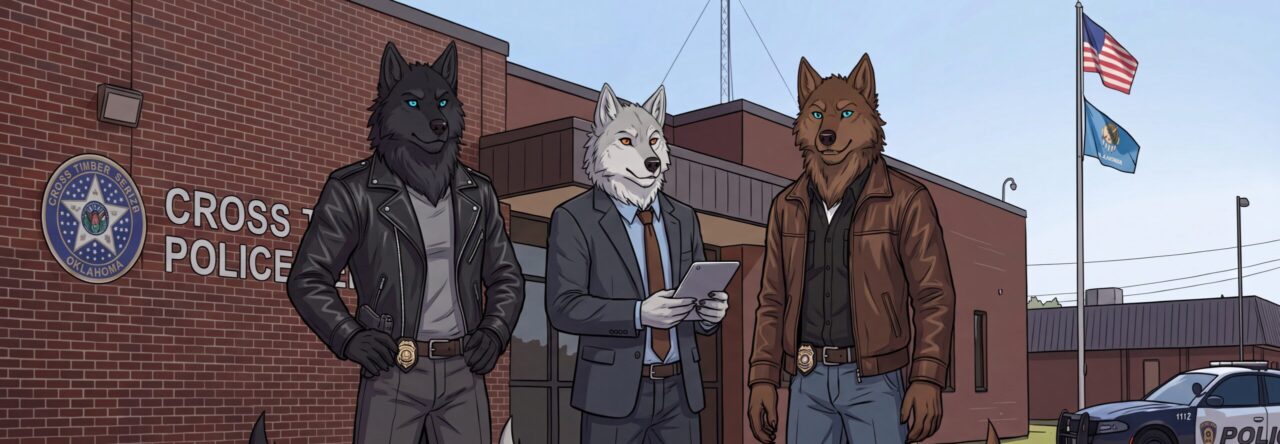
At 03:28, the Sunset View Motor Lodge looked exactly like it had an hour earlier.
The same weak yellow lights over the exterior walkway.
The same rows of doors with peeling paint around the locks.
The same faded sign by the office advertising weekly rates and free cable.
The same thin curtains in Room 214, drawn shut against a night that had begun hot and had only barely cooled.
But the parking lot had changed.
Officer Bell’s new Interceptor sat near the motel entrance, lights off.
Patel’s unit waited along the far side of the second building, positioned where she could see the exterior stairwell and the row of rooms without blocking traffic.
Grant stood near the white cargo van three spaces down from Room 214, talking quietly with a property-crimes technician beside the passenger-side rear bumper.
Lieutenant Crowe had arrived in an unmarked department SUV and was standing at the edge of the lot with a warrant folder open in one hand.
Thane, Gabriel, and Mark approached her from the Humvee.
No one was speaking loudly.
No one needed to.
The warrants had changed the shape of the night.
Not because they made the case solved.
Because now the facts had been tested, written down, reviewed by an attorney, questioned by a judge, and found sufficient to let the department look where the evidence pointed.
Crowe looked up as they reached her.
“Room 214 and the Transit are both covered,” she said. “No unexpected movement. Nathan has not left the room. No one has approached the van.”
Mark glanced toward the white Ford Transit.
The dent near the passenger-side rear bumper caught the parking-lot light.
The blank side panels still carried faint rectangular shadow marks where magnetic signs had been removed.
“Rental vehicle remains active,” he said. “Records-preservation request was confirmed by MetroWorks. They will provide the rental agreement, payment records, GPS data, and pickup-return logs when legal process reaches them.”
Crowe nodded.
“Good.”
Bell came over from the motel entrance.
He wore his patrol armor, radio, and standard duty gear. Patel and Darnell, stationed farther down the walkway, were dressed the same.
The three wolves wore their normal duty gear, visible badges, sidearms secured, radios checked.
Crowe looked at all of them.
“This is a search-warrant service. Not a raid. Nathan Vale has not been charged yet. He is the occupant of the room and a person named in the warrant materials. We identify ourselves, announce the warrant, secure the room, and search within scope.”
She looked at Thane.
“No improvised conversations.”
Thane nodded.
“He requested counsel.”
“Exactly,” Crowe said. “No questions about the case. No ‘just one thing.’ No good-cop conversation on the way to the car. If he chooses to say something without being prompted, document it. But nobody pulls information out of him.”
Gabriel nodded.
“Understood.”
Crowe turned to Bell.
“You and Patel are at the door. Darnell holds the exterior walkway. Grant stays on the van until we clear the room, then joins the vehicle search with the tech.”
Bell nodded.
“Got it.”
Crowe looked at Mark.
“You handle the warrant inventory and keep everyone inside scope.”
Mark’s ears tipped forward.
“Yes.”
“Thane, Gabriel, you are with Bell and Patel. Keep the room secure. We are not looking for a fight, but we are not assuming there will not be one.”
Thane looked toward Room 214.
“Okay.”
Crowe closed the folder.
“One more thing. This crew has been comfortable walking into homes because they know what fear does to people. We do not bring that into this room. We do this by the book.”
The statement settled over the group.
Then Crowe looked at Bell.
“Go.”
Bell climbed the exterior stairs first.
Patel followed on the other side of the narrow walkway, while Thane, Gabriel, and Mark moved behind them.
The motel corridor was quiet.
A television murmured somewhere behind a closed door.
An air-conditioning unit rattled in the wall near Room 210.
A child coughed once from the far end of the building.
Room 214 sat beneath a flickering overhead light.
Bell knocked.
“Police department. Nathan Vale, come to the door.”
No answer.
He knocked again, harder.
“Mr. Vale. Police department. We have a search warrant. Come to the door.”
For a few seconds, the only sound was the weak buzz of the overhead light.
Then movement.
A scrape across the floor.
The chain slid.
The door opened three inches.
Nathan Vale looked out.
He had not slept.
His eyes were red. His hair was flattened on one side, as though he had lain down and then given up on the idea. He wore the same gray T-shirt from the night before, now wrinkled and darkened with sweat near the collar.
He looked at Bell first.
Then Patel.
Then the three wolves behind them.
Then past them, toward the parking lot.
He saw the patrol units.
He saw Crowe.
He saw the cargo van.
His face drained.
Bell held the warrant folder where Nathan could see it.
“Mr. Vale, we have a signed search warrant for this room. Step outside, please.”
Nathan swallowed.
“Am I under arrest?”
“Not at this moment,” Bell said. “You are being temporarily detained while we execute the warrant. We will tell you if your status changes.”
Nathan looked down the hallway.
Then back at Bell.
“My lawyer—”
Bell nodded immediately.
“You asked for one last night. We are not here to question you.”
Nathan’s eyes moved to Gabriel.
Gabriel kept his voice calm.
“You do not have to say anything.”
For a moment, Nathan looked almost confused by that.
Then he stepped back.
The chain came off.
Bell opened the door fully.
Patel moved in first, checking the narrow room with a practiced glance.
One bed.
A small table.
A bathroom door standing open.
A microwave on top of a mini refrigerator.
A cheap dresser.
A duffel bag near the wall.
No one else inside.
“No other occupants,” Patel said.
Bell guided Nathan into the exterior walkway, where Darnell waited beside a metal chair.
“Sit here,” Bell said. “Keep your hands where we can see them.”
Nathan sat.
His knees bounced immediately.
Darnell stood a few feet away, not looming over him, not trying to talk.
Just there.
The warrant team entered.
Mark opened the folder and read the scope one more time under his breath.
Business documents.
Customer lists.
Pickup sheets.
Electronic devices and storage media associated with Clearview Estate Solutions or related aliases.
Property believed to be stolen from identified victims.
Moving supplies, clothing, signage, tools, packaging material, and evidence of the fraudulent estate-transition operation.
Thane stood near the door, eyes moving across the room.
The place smelled like stale air, cheap detergent, cold fast food, and Nathan’s fear.
Under it was the same faint citrus cleaner he had smelled in Lydia Harlan’s garage.
The same sharp artificial scent.
Not enough to prove anything.
But enough to place the room in the same story.
Mark set an evidence log on the small motel table.
“Search begins at zero-three thirty-six,” he said.
The property-crimes technician, a quiet woman named Kim Alvarez, began photographing the room exactly as it stood.
The bed.
The duffel bag.
The dresser drawers.
The table.
The shoe rack beside the door.
The motel key card on the nightstand.
No one touched anything before it was documented.
Then the search began.
Gabriel opened the dresser slowly.
Shirts.
Two pairs of jeans.
A stack of socks.
A flashlight.
Nothing else in the top drawer.
The second held receipts, a gas-station loyalty card, loose change, and a folded tourist map of Oklahoma City.
The third held a small notebook.
Gabriel stopped.
“Mark.”
Mark came over.
The notebook was black, spiral-bound, its cover bent from being shoved into a drawer too many times.
Mark photographed it where it lay.
Then lifted it with gloved hands.
Inside were pages of dates, addresses, initials, and short notes.
Not polished bookkeeping.
Not a master plan.
Just the rough, cramped handwriting of someone trying to keep track of a job that had started becoming something he did not fully understand.
Harlan — Sat / garage + box / C says keep papers
Dempsey — blue case / pic boxes / 2 trips
Brice — old tools / medals? C handles
Bell — shadow / safe / files
Porter — no good? too much watching
Gabriel read the last line over Mark’s shoulder.
“Porter.”
Evelyn Porter.
The sixth report.
The one from the neighboring jurisdiction.
The crew had tried her house.
Maybe failed.
Maybe backed off because she had too many people around.
Maybe because she had asked too many questions.
Thane looked toward the exterior walkway where Nathan sat silent beneath the buzzing light.
“He was keeping track.”
Mark’s expression stayed measured.
“He was documenting activity. We cannot infer motive from the notebook alone.”
“No,” Thane said. “But it matters.”
Mark turned another page.
There were amounts beside some addresses.
Not enough to indicate what property had sold for.
More like payment splits.
N — 250
D — 400
C — cash later
Gabriel’s ears lowered.
“Two hundred and fifty dollars.”
Mark nodded once.
“For carrying things out of a grieving person’s garage.”
No one said anything.
Kim continued photographing.
Thane moved to the duffel bag.
Inside were work clothes.
Two navy polos with no logo.
A pair of khaki pants.
Gray work gloves.
A roll of packing tape.
A bundle of zip ties.
Blue moving blankets folded carefully beneath a worn hoodie.
He found a rectangular cardboard sleeve at the bottom.
Inside were three flexible magnetic signs.
The same navy house outline.
The same neat white box beneath it.
CLEARVIEW ESTATE SOLUTIONS
Estate Clear-Outs • Donation Coordination • Home Transition Support
Gabriel looked at the signs.
“They came off the van.”
“Likely,” Mark said.
“They knew when to look official and when to disappear.”
Mark photographed the signs.
Then placed them in separate evidence bags.
Behind the duffel, tucked between the bed frame and the wall, Thane noticed a narrow zippered document case.
He pointed.
“Mark.”
Mark crouched beside the bed.
Kim photographed the case in place.
Then Mark opened it.
Inside were photocopies.
Work orders.
Blank acknowledgment forms.
Receipts.
A small stack of business cards.
A color printout of the Clearview website homepage.
And, beneath those, a set of handwritten pickup sheets.
Not all of them matched names on the board.
Some were addresses.
Some were partial initials.
Some had handwritten notes.
Widow — son in Dallas.
Probate sale? church memorial Sat.
Call before 9.
Garage first.
Ask about papers.
“Donation” if they hesitate.
Gabriel went very still.
Mark did not say anything for a moment.
Then he turned another page.
A small storage-rental receipt was clipped behind the pickup sheets.
Northgate Storage
Unit C-184
Renter: Claire Morgan
Monthly autopay active
A brass key tag hung from a thin metal ring behind it.
C-184
Thane felt the room change.
Not in the way rooms changed when someone drew a weapon or tried to run.
In the quieter way a case moved when a fact stopped being theory and became direction.
Mark looked at Crowe, who had entered the room after receiving Bell’s clear signal.
“Storage unit,” he said.
Crowe stepped closer.
“Document it.”
Kim took photographs.
Mark read the receipt again.
“Northgate is open twenty-four hours through gate access, but the office does not open until eight. We have renter information, unit number, and a key recovered from a room occupied by a documented participant in the fraudulent operation.”
Crowe’s eyes moved to the pickup sheets.
Then to the name.
Claire Morgan.
The stolen identity used for the private mailbox.
The woman in the dark polo.
The woman carrying the black tote.
The woman who had called James Harlan “Jim” like she had learned it from a page.
“Call the ADA,” Crowe said.
Mark nodded.
“I will prepare the supplement.”
Crowe looked at Thane.
“Anything else here?”
Thane scanned the room again.
The small refrigerator.
The bathroom.
The microwave.
The cheap table.
Then he spotted a torn envelope beneath the motel-room trash liner.
Not hidden.
Not even fully discarded.
He pointed it out to Kim.
The envelope bore the faded letterhead of a local bank.
Inside was a printed transfer confirmation.
Sender: Carissa Mason
Recipient: Nathan Vale
Memo: labor / cleanout
Amount: $250.00
The date was Saturday.
The day Lydia Harlan’s garage had been cleared.
Gabriel looked at the name.
“Carissa Mason.”
Mark’s ears tipped forward.
“Not Claire Morgan.”
“Real payment account,” Crowe said.
“Potential real identity,” Mark replied. “We still verify.”
Crowe nodded.
“Do it.”
Outside, Nathan shifted in his chair.
He had heard nothing specific.
No one had spoken loudly enough for that.
But he had watched the detectives carry evidence bags from the room.
He had seen the document case.
And the way his face changed told Thane he knew exactly what they had found.
Nathan looked at him.
Thane did not approach.
Did not ask a question.
Did not make a promise.
He simply held Nathan’s gaze for a moment.
Then turned back inside.
The cargo van was searched under the hard white light of the motel lot.
Grant had already positioned the evidence technician’s rolling cart beside the passenger-side door.
The van’s sliding door opened with a reluctant metal scrape.
Exactly as Mr. Salazar had described.
Inside, the cargo area was mostly empty.
That was almost worse.
The blue moving blankets had been folded into a stack near the front bulkhead. A hand truck stood strapped to one wall. A dolly rested beside it. There were two small furniture pads, a box of blank labels, a roll of clear plastic wrap, and a black tote bag shoved beneath the passenger seat.
Nothing looked immediately valuable.
Nothing looked immediately criminal.
That had been the design.
The van could pass for any moving vehicle in the city.
But the search was not about what it looked like at first glance.
Kim photographed the interior.
Mark checked the warrant scope.
Grant stood at the rear door, keeping the lot clear and watching the motel walkway.
Thane stepped into the cargo area.
The floor smelled of rubber, dust, old cardboard, citrus cleaner, and the faint metallic scent of tools.
Near the left wall, he saw a small red streak caught beneath a tie-down rail.
Not blood.
Paint.
The same muted red as the tall metal toolbox in Lydia’s garage photograph.
He pointed it out.
“Possible transfer.”
Kim crouched near it.
“Photographing.”
Thane moved farther inside.
A clear plastic storage tote sat beneath the folded blankets.
The lid was secured with two plastic latches.
Mark checked the warrant.
“Stolen property and business records. Open it.”
Kim photographed the tote.
Then released the latches.
Inside were folders.
Not victim property.
Paperwork.
Multiple copies of the vague Clearview acknowledgment form.
Blank work orders.
A small portable label printer.
An envelope of magnetic business-card stock.
A stack of navy polo shirts still folded in plastic.
And a cheap handheld card reader.
Gabriel picked up one of the blank forms with gloved hands.
The language was broad enough to sound harmless.
General household goods. Donation materials. Estate transition items.
At the bottom, in smaller print:
Customer acknowledges removal of listed materials and waives claim to donated items.
“Everything they needed to make a tired person sign something without reading it,” Gabriel said.
Mark examined the forms.
“The signature line is deliberately separated from the waiver language.”
Crowe looked at him.
“Meaning?”
“Meaning they wanted the person focused on acknowledging pickup, not on what they were giving away.”
Gabriel stared at the paper.
“They built a trap out of typography.”
“Document it,” Crowe said.
Mark did.
The black tote beneath the passenger seat held more.
A prepaid phone.
A tablet.
A portable receipt printer.
A small stack of fake employee badges with first names only.
CARISSA
NATE
DEREK
LENA
And a sealed evidence envelope marked in black marker:
H — not sold
Thane looked at it.
Mark photographed the envelope before opening it.
Inside lay a velvet medal box.
The wood was dark blue. The lid bore a small brass plate with an engraved name.
JAMES T. HARLAN
Lydia’s husband.
The box contained Army National Guard medals, a service ribbon bar, a folded flag presentation pin, and a small black-and-white photograph of a younger James Harlan in uniform.
Gabriel’s breath caught.
“They kept it.”
“Maybe they were waiting to sell it,” Mark said.
“Maybe,” Thane said.
But the box had been marked.
Not by a victim.
By someone in the crew.
H — not sold.
A piece of a man’s life treated like inventory.
Crowe looked at the medal box.
Then at the blank forms.
Her voice stayed even.
“Bag it.”
Kim did.
The next tote held a mix of smaller objects.
A blue leather suitcase with an airline tag bearing Carol Dempsey’s name.
A framed fire-service plaque.
A stack of family albums wrapped in a moving blanket.
A coin binder.
A box of letters tied with faded ribbon.
A small metal lockbox.
Each item was photographed.
Each was documented.
Each one shifted from anonymous property into a line of evidence that could be returned to someone who had thought it was gone.
Mark opened the storage box enough to read the name label on the front.
Dempsey — papers / do not mix
Gabriel looked at him.
“She has her things.”
“Some of them,” Mark said.
“Enough to start.”
Thane stood in the open van, looking at the evidence cart filling with the pieces of six different lives.
A tool chest.
A pocket watch.
A medal box.
Photographs.
Letters.
A blue suitcase.
There would be more.
He knew that already.
The storage receipt in Nathan’s room meant the van had been only the moving part.
The place where things passed through before they were sold, stripped, boxed, or hidden.
Crowe stepped closer.
“Mark.”
Mark already had his phone out.
“I am contacting the ADA.”
“Do it.”
The supplemental warrant took forty-seven minutes.
Not because anyone was slow.
Because the right thing had to be written the right way.
Mark sat in the back of the Humvee with his laptop open across his knees, the warrant folder balanced beside him. Crowe stood outside the passenger door, listening as he read the new facts into the secure call with the on-call assistant district attorney.
Nathan Vale’s signed consignment connection.
The documented pickup sheets.
The storage receipt.
The recovered key.
The evidence from the van.
The transfer payment from Carissa Mason.
The fake business materials.
The property of identified victims.
The specific reason to believe additional stolen property, business records, victim information, and evidence of the fraudulent operation would be stored in Unit C-184 at Northgate Storage.
The attorney asked the same kind of questions she had asked earlier.
Precise.
Careful.
Annoying only if someone did not understand that she was trying to make the case survive.
“Can you establish that the storage receipt is current?”
“Yes,” Mark said. “The receipt shows monthly autopay active. The key was recovered from Nathan Vale’s motel room alongside current pickup records. The unit is listed under the Claire Morgan identity already tied to Clearview’s mailbox rental and the unidentified female participant.”
“Do you know whether the unit has been accessed recently?”
“Not yet. We are preserving facility records and will request gate logs. The unit key is in evidence. We have not opened the unit.”
“Does the warrant request identify what may be searched for?”
“Yes. Specific categories: stolen property identifiable to known victims; business records; customer lists; fraudulent work orders; identification documents; digital storage media and devices used to facilitate the operation; packaging, labels, and resale documentation; physical evidence tying individuals to the unit and the stolen property.”
The attorney paused.
Then said, “Send the supplement.”
Mark did.
The on-call judge received it twelve minutes later.
By 04:58, the supplemental warrant had been signed.
And by then, the rental company had responded to the original records request.
The white Transit had been rented online using a debit card in the name of Carissa Mason.
The card belonged to a woman with an Oklahoma address in northwest Oklahoma City.
The driver’s-license photograph matched the woman from the Cedar & Brass surveillance still.
Same dark hair.
Same cheekbones.
Same small scar near the left jawline.
Same narrow shoulders beneath the navy polo.
Kessler, awake now because Mark had called him at four-thirty, confirmed the comparison through the department system and sent the identification result back with a concise note.
Carissa Mason, 34. Prior employment: administrative assistant, residential moving company; terminated fourteen months ago after internal complaint involving customer-document access. No prior felony convictions. Two misdemeanor fraud-related charges dismissed after restitution in 2018.
Thane read the message twice.
“She used to work for a moving company.”
Gabriel’s expression went cold.
“She learned the vocabulary somewhere.”
“Maybe the customer records too,” Mark said.
Crowe looked at the screen.
“Do not write that until we can prove it.”
“No,” Mark said. “But it gives us a direction.”
Another message came through from Kessler.
Derek Raines, 39. Prior convictions: receiving stolen property, possession of stolen credit cards, misdemeanor assault. Current address: 7400 block of North Mercer. Vehicle: dark gray Chevrolet Silverado, plate confirmed.
Crowe looked toward Bell.
“Get a unit on that address. Quietly. I want to know if the truck is there.”
Bell nodded and stepped away to make the call.
Nathan Vale remained seated outside Room 214.
The room search had ended.
The evidence had been logged.
The warrant scope had been completed.
Crowe approached him with a second folder.
“Nathan Vale.”
He looked up.
The exhaustion had settled into him now.
Not panic.
Something duller.
The look of someone who had spent a long night realizing the truth had kept moving after he stopped looking at it.
Crowe held the folder where he could see it.
“You are under arrest for your role in the theft operation under investigation. You will be transported, booked, and advised of your rights. You requested an attorney earlier. That request remains in effect.”
Nathan closed his eyes.
“Okay.”
Bell stepped forward and placed him in handcuffs.
No struggle.
No speech.
Nathan looked once toward Room 214.
Then toward the white van.
Then down at the pavement.
As Bell guided him toward the patrol unit, Nathan said quietly—not to any particular person, not as an answer to a question—
“I did not know how bad it was at first.”
Gabriel heard him.
So did Thane.
Neither responded.
There was nothing to say that would make it less true or less his responsibility.
Nathan sat in the rear of Bell’s Interceptor.
The door closed.
Bell drove away toward booking.
Crowe watched the vehicle leave.
Then looked at the time.
“Northgate,” she said.
The first gray edge of dawn had begun to show by the time they reached Northgate Storage.
The facility sat behind a row of light-industrial buildings south of the old rail line.
Long rows of metal storage doors stretched beneath security lights. A keypad gate stood at the entrance. Security cameras watched the drive lanes from high poles.
The office was still closed.
The gate logs had been preserved electronically through an emergency request from the facility manager, who had been reached at home and was now on his way.
But the warrant did not require the office to be open.
It required the unit.
C-184.
Crowe parked the unmarked SUV near the outer fence, where the team could see the main lane without blocking the entrance.
Bell had transported Nathan to booking. Patel and Darnell had arrived from the motel operation, both carrying fresh coffee and the look of officers who had not expected their shift to turn into an estate-theft case at three in the morning.
Grant sat in his Interceptor near the far row, keeping eyes on the gate.
Thane, Gabriel, and Mark stood beside Crowe near the rear of the Humvee.
The warrant folder rested on the hood between them.
Crowe looked at the team.
“We have the unit. We have the key. We have cause to search. We also have a strong possibility that Carissa Mason or Derek Raines may come here once they realize something has gone wrong.”
Gabriel looked toward the rows of doors.
“You think they know?”
Crowe nodded toward the time.
“Nathan did not return to work. The van is gone. The motel room is being searched. They may know by now.”
Mark looked at the gate logs on his tablet.
“Facility manager provided the last six hours remotely. Unit C-184 was accessed at 22:17 last night. The entry code was used again at 04:11, but no gate exit followed.”
Thane looked at him.
“Someone is inside?”
“Possibly,” Mark said. “Or someone entered and left through an open gate behind another vehicle. The log does not tell us.”
Crowe’s face hardened.
“Then we do not casually walk up and lift a door.”
She looked at Patel.
“Can you get eyes on the unit from the side lane?”
Patel nodded.
“From the drainage access, probably.”
“Do it. Darnell with you. No contact unless there is an immediate threat.”
Patel and Darnell moved off.
Grant stayed near his unit, watching the gate and the lane.
Crowe looked at the wolves.
“Stay with me until we know whether someone is inside.”
Thane nodded.
The morning air smelled like hot metal, old concrete, damp grass beyond the fence, and oil from the rail line.
The storage facility itself smelled of dust and sealed spaces.
Too many locked doors.
Too many things people had put away because they did not know what else to do with them.
Thane listened.
Nothing obvious.
No voices.
No footsteps.
No van engine.
But the facility carried noise strangely.
A distant rattling door could be the wind.
A small scrape could be a pigeon in the rafters.
He did not pretend certainty where there was none.
“We do not know,” he said quietly.
Crowe nodded.
“Good.”
Her radio clicked.
Patel’s voice came through.
“Crowe, Unit C-184 door is down approximately two feet. Interior lights on. I can see shelving and boxes. No visible person from this angle.”
Crowe looked at the team.
“Down two feet?”
“Affirmative.”
Mark glanced toward the warrant.
“Potential active access.”
Thane’s ears tipped forward.
The metal roll-up door was not fully closed.
Someone had been inside recently.
Maybe still was.
Crowe raised a hand.
“Move.”
They went in carefully.
Not running.
Not crashing through the facility.
A controlled line down the side lane, keeping distance from the partially raised door.
Grant moved to cover the rear lane. Patel and Darnell came around from the drainage side. The three wolves followed Crowe and stayed where she could see them.
The door to C-184 stood two feet above the concrete.
Enough to show a strip of shadow beneath it.
Enough for Mark to see the lower edge of a cardboard box inside.
Enough for Thane to smell dust, old wood, paper, moving blankets—
And fresh coffee.
Someone had been here recently.
“Crowe,” he said quietly. “Fresh coffee. Could be someone inside.”
Crowe nodded once.
Then raised her voice.
“Police department. Anyone inside Unit C-184, announce yourself.”
No answer.
“Police department. We have a signed search warrant. If you are inside, come out with your hands visible.”
Still nothing.
Darnell moved toward the side of the door mechanism.
“Could be empty.”
“Could be,” Crowe said.
She looked at Thane.
“Can you lift it?”
Thane looked at the roll-up door.
Then at the team.
“Yes.”
“Do it slowly. Everyone stays clear.”
Thane crouched beside the bottom edge.
The metal was cold beneath his claws.
He got a careful grip and lifted.
The door rolled upward with a harsh metallic rattle.
Three feet.
Four.
Five.
Enough to reveal the unit.
No one inside.
Not at the moment.
But someone had been.
A paper coffee cup sat on a folding table near the back wall, steam no longer rising but the lid still warm enough for Thane to smell the fresh dark-roast coffee beneath the dust.
The storage unit was larger than it had looked from outside.
Ten by twenty.
Shelves lined the walls.
Plastic bins stacked in rows.
Antique furniture wrapped in moving blankets.
Boxes labeled with street names, initials, and vague phrases like OFFICE, TOOLS, KEEP, PHOTO, SELL, DONATE.
A long folding table stood in the center with a laptop, receipt printer, blank forms, and a small portable scanner.
On the wall above it hung a whiteboard.
It held addresses.
Names.
Dates.
Short notes.
And on the far side of the unit, beside a stack of boxes, stood a dark gray Chevrolet Silverado.
Derek Raines’ truck.
The driver-side door was open.
Crowe looked at Grant.
“Where is he?”
Grant’s radio clicked.
“Vehicle entered through south gate thirty seconds ago. Silver SUV. One driver, one passenger.”
Crowe’s eyes went hard.
“Positions.”
The team moved.
Not into the unit.
Not yet.
They took cover along the row, leaving the unit door open enough that it looked undisturbed from the main lane.
Thane moved behind a concrete support column beside Gabriel. Mark stayed near Crowe and the warrant folder, where he could document but not be exposed.
The silver SUV appeared at the end of the lane.
It rolled slowly toward C-184.
Carissa Mason drove.
Derek Raines sat in the passenger seat.
The surveillance stills had not lied.
Carissa’s dark hair was pulled back. She wore a dark polo shirt beneath a light jacket. Her face looked tight and pale.
Derek was broader than Nathan, light-haired, thick through the shoulders, wearing a gray T-shirt and work jeans.
The SUV stopped outside the open storage unit.
Neither noticed the patrol units positioned farther back.
Neither noticed Grant’s vehicle in the side lane.
They saw only the open door.
The dark inside.
The truck parked where Derek had left it.
Carissa got out first.
She looked around once.
Then walked toward the unit.
Derek followed.
“What happened to the door?” he asked.
“Maybe Nate came by,” Carissa said.
“He did not answer.”
“Then he is scared.”
Derek looked toward the folding table.
“You think he talked?”
Carissa stopped.
For one second, she did not answer.
Then she said, “He does not know enough to talk.”
Thane felt Gabriel shift beside him.
Not forward.
Not yet.
Crowe waited until both suspects were within the unit doorway.
Then stepped out.
“Police. Hands where we can see them.”
Carissa spun.
Derek froze.
For half a second, nobody moved.
Then Derek took one hard step backward toward the Silverado.
Bell was not there.
He was still at booking.
But Grant came around the rear lane at the same moment, blocking the truck side.
“Hands up,” Grant ordered.
Derek looked toward the truck.
Then toward the storage-unit shelves.
Then toward Thane.
Thane stepped into view.
Not fast.
Not threatening.
Just placing himself between Derek and the only open direction.
“Hands open,” Thane said.
Derek’s hands clenched.
“Move.”
“No.”
“Get out of my way.”
“Hands open.”
Derek’s eyes flicked toward Thane’s claws.
Then to the patrol officers.
Then back to the open unit.
He took another step.
Thane did not move.
“You are not getting past me,” he said.
Derek’s shoulders tensed.
Crowe’s voice cut through the space.
“Derek Raines, you are under arrest. Do not make this harder.”
Carissa lifted her hands first.
Her face had gone blank.
Controlled.
The kind of blankness that came from somebody realizing every exit had disappeared.
Derek stared at Thane for another second.
Then, slowly, his hands opened.
Thane nodded once.
“Good.”
Patel stepped in and secured Derek in handcuffs.
Grant moved to Carissa.
Carissa looked toward the shelves.
Toward the bins.
Toward the whiteboard on the wall.
Then she looked at Thane.
“You have no idea what people throw away.”
Gabriel stepped closer.
“You do not get to decide what is trash in somebody else’s grief.”
Carissa’s eyes flashed.
“They leave it sitting in garages. They call it junk. They tell us to take it.”
“No,” Gabriel said. “They tell you they are overwhelmed. You hear what you want.”
Carissa’s mouth tightened.
Derek looked at the floor.
Crowe stepped between the detectives and the suspects.
“Do not say anything else,” she told both of them. “You will be advised of your rights.”
Carissa laughed once.
It was sharp.
Humorless.
“You think Nate did this?”
Crowe looked at her.
“You should stop talking.”
Carissa’s jaw set.
She did.
Grant guided her toward the SUV.
Patel led Derek the other way.
The storage unit stayed open behind them.
A whole room full of proof.
Not a theory.
Not a pattern on a whiteboard.
Proof.
The first thing Mark found was Lydia Harlan’s name.
It was written on the side of a plastic storage bin in black marker.
HARLAN — HOLD
The lid was taped shut.
Kim photographed it.
Mark read the warrant scope one more time.
Then cut the tape.
Inside lay a careful stack of objects wrapped in old moving blankets.
A framed photograph of James Harlan beside his vintage pickup truck.
A leather roll of hand tools.
A brace drill.
A small set of carving chisels.
A file box full of documents.
The original title to the old truck.
A bundle of letters tied with a faded green ribbon.
And beneath all of that, wrapped in soft blue cloth, the rest of the medal box’s contents.
Not the box from the van.
Additional items.
Service papers.
Unit photographs.
A folded program from a retirement ceremony.
A yellowed newspaper clipping about James’s National Guard service.
Gabriel stood beside the tote, quiet.
“They separated it.”
“High-value items in the van,” Mark said. “Other property here.”
“Not just value,” Thane said. “They knew what was personal.”
Mark looked at the wrapped letters.
“Some of them may have been selected by accident.”
Thane shook his head.
“Maybe. But they held on to them.”
No one argued.
Across the unit, another bin held Carol Dempsey’s blue suitcase.
Her fire-service plaque lay beside it, wrapped in a towel.
A second photo album rested beneath the plaque.
The pages had been left intact.
No one had taken them apart.
No one had thrown them away.
They had simply been waiting.
Like stock.
Like inventory.
Like the people who owned them did not exist.
The deeper the team searched, the more names appeared.
Albert Brice’s antique woodworking tools.
Marta Bell’s military shadow box.
The locked safe from her father’s home.
A jewelry box from Gerald Pruitt’s house.
A stack of files from Evelyn Porter.
Photographs.
Letters.
Medals.
Wedding albums.
Military records.
Birth certificates.
Vehicle titles.
Old watches.
Furniture hardware.
Small boxes full of things nobody would recognize as valuable until they belonged to someone who had lost the person connected to them.
The unit held property tied to the known victims.
And more.
A second whiteboard on the back wall listed addresses in three neighboring jurisdictions.
Some had dates beside them.
Some had simple check marks.
Some had notes.
Obit posted.
Daughter out of state.
Church memorial.
Ask for donation contact.
Garage access.
Old man alone.
Call after funeral.
Gabriel read the last line.
Then stepped away from the board.
His ears had gone flat.
“They built a list.”
Mark photographed every inch of it.
“They were planning targets.”
Thane looked at the addresses.
“Get patrol notifications out now.”
Crowe nodded.
“Already happening.”
She had stepped aside to call Dispatch. The addresses would be checked. Families would be contacted carefully. Not with panic. Not with a dramatic warning that made them feel hunted.
With information.
With a chance to secure their homes and know what to look for.
The kind of warning Lydia Harlan had never gotten.
Near the folding table, Kim found a portable card scanner linked to a laptop.
Mark began the process of documenting the devices without opening or browsing through them beyond what the warrant allowed.
Business emails.
Customer spreadsheets.
Templates.
Photographs.
Storage inventory lists.
Potentially a record of every person they had targeted.
Potentially names of buyers.
Potentially evidence of the moving-company records Carissa had accessed before she was fired.
The case was not finished.
Not close.
There would be forensic downloads.
Account returns.
Victim identification.
Prosecutor review.
Additional search warrants.
More reports.
More names.
But the crew’s working center had been found.
And the people running it were in custody.
At 07:14, the sun rose fully over the storage-facility roofs.
The light came in hard and gold through the open door of Unit C-184.
It fell across boxes of photographs.
Across furniture wrapped in blue blankets.
Across the whiteboard full of people’s vulnerable moments.
Across the evidence cart filling with the things that had been stolen from homes where someone had trusted the wrong voice.
Thane stood near Lydia’s bin.
He found the framed photograph of James Harlan by the pickup.
The same picture from the obituary.
James smiling in the sun, one hand resting on the hood, looking like a man who had probably spent decades making things work.
Thane looked at the photograph.
Then at the evidence label Mark was preparing.
Item: framed family photograph, identified victim Lydia Harlan.
A sterile line.
A necessary line.
But not the whole truth.
Not even close.
At 08:02, Voss walked into Unit C-184 carrying coffee and looking like someone who had been told the overnight team had cracked open a major property-theft operation before breakfast.
Rusk followed her.
He had a breakfast sandwich in one hand and stopped just inside the open storage door.
For the first time in a long while, he did not make a joke immediately.
He looked at the shelves.
At the bins.
At the photographs.
At the whiteboard.
Then at the evidence cart.
“Jesus,” he said quietly.
Voss stood beside him.
Her face had gone still.
Crowe met them near the folding table.
“Three in custody. Nathan Vale, Derek Raines, Carissa Mason. We have the rental van, Nathan’s motel room, the storage unit, the fake business materials, victim property, target lists, and digital devices.”
Voss looked at the whiteboard.
“They were using obituaries.”
“Obituaries, probate notices, community posts, property-transition signals,” Mark said. “Anything that suggested a home was in change.”
Rusk looked at a bin of family albums.
“They thought grief was a business model.”
Gabriel folded his arms.
“Yeah.”
Voss walked slowly through the unit.
She did not touch anything.
She looked at the items.
The military shadow box.
The blue suitcase.
The tool rolls.
The stacks of letters.
The boxes marked with addresses.
Then she stopped beside Lydia Harlan’s bin.
The framed photograph of James Harlan rested near the top.
Voss looked at Thane.
“You found more than the chest.”
“We found enough to start giving people pieces back,” Thane said.
Voss’s eyes shifted to the evidence labels.
“After the right documentation.”
“Of course,” Mark said.
Rusk finally took a bite of his sandwich.
Then looked at Thane.
“You know,” he said, “this is an exceptionally poor place for the Kaden Face.”
Thane stared at him.
“Rusk.”
Rusk nodded.
“I know. Too soon.”
Gabriel made a small noise that was almost a laugh.
It did not erase the room.
Nothing could.
But it put one small thread of normal life back into the morning.
Voss looked at Crowe.
“Property Crimes has the lead on the extended inventory?”
“Yes,” Crowe said. “They will need days. Maybe longer.”
“And the target list?”
“Patrol notifications already started. We will coordinate victim-contact teams, county agencies, and the neighboring jurisdictions.”
Voss nodded.
Then she looked at the three wolves.
“Good work.”
Thane looked around the unit.
At the evidence.
At the people’s lives stacked in plastic bins.
“It is not done.”
“No,” Voss said. “But it is stopped.”
For now.
That mattered.
By Thursday afternoon, the storage unit had become a controlled maze of evidence tables, inventory sheets, photographs, and case numbers.
Property Crimes had documented every item from the van, motel room, and storage unit.
The prosecutor’s office had approved the release of several large, clearly identified items once forensic photography, trace examination, and chain-of-custody documentation were complete.
Some things would have to remain.
Digital devices.
Certain documents.
The blank forms.
The fake badges.
The business cards.
Items needing fingerprint or trace processing.
But not everything had to stay behind a locked evidence-room door.
Lydia Harlan’s walnut tool chest had been fully documented at Cedar & Brass.
The pocket watch had been photographed, identified through the pawn-shop record, and processed.
The framed photograph of James by the pickup had been documented and cleared.
The medal box and service papers needed a little longer.
Not because anyone wanted to keep them.
Because the case needed them.
Voss called Lydia late that afternoon.
She did not say much over the phone.
Only that detectives had recovered several items and wanted to return what they could.
Lydia had gone quiet.
Then asked, “Did you find Jim’s chest?”
Voss looked across the property room toward Thane, Gabriel, and Mark.
“Yes,” she said. “We did.”
The Harlan garage looked different in daylight.
The open space beneath the workbench still remained.
The pale rectangle in the dust had been cleaned now.
Dana had swept the floor, perhaps because staring at the empty outline had been too much.
But the empty hooks on the wall were still there.
The cabinet where the lockbox had been stored remained open.
The garage still smelled of cedar, metal, and old motor oil.
Still felt like a place waiting for its owner to come back and finish something.
Lydia stood near the workbench with Dana beside her when the department SUV pulled into the driveway.
Voss drove.
Rusk rode in the passenger seat, looking out the window with the expression of a man who knew he had been invited because someone needed to keep the moment from becoming too solemn.
Behind them, the Humvee rolled in.
Thane parked at the curb.
Gabriel and Mark climbed out.
Property Crimes had brought the tool chest in the SUV’s rear cargo area.
It took two evidence technicians and a rolling cart to move it to the garage.
Thane could have carried it himself.
He did not.
This was not a moment for making anything about his strength.
The chest had been documented, sealed, transported, and released through the right process.
It would be returned the same way.
Lydia stood completely still as the chest came through the side door.
Dana’s hand found hers.
The evidence technician rolled it carefully across the concrete and stopped it in front of the pale space beneath the workbench.
For a second, nobody spoke.
Then Lydia stepped forward.
Her fingers hovered over the carved lid before she touched it.
She traced the oak-leaf pattern.
The brass corner.
The engraved plate.
JAMES HARLAN
Her breath caught.
“Oh.”
Dana covered her mouth.
Lydia’s fingers moved to the lower right foot of the chest.
To the small dark burn mark.
“He set a soldering iron down there,” she said softly. “Twenty years ago. I told him he was going to ruin it.”
Her voice broke.
“He said it would give it character.”
Thane stood a few feet away.
He did not move.
Lydia looked at him.
At Gabriel.
At Mark.
At Voss.
At the chest.
Then she touched the brass nameplate again.
“I thought it was gone.”
Voss’s voice was quiet.
“We found it at a consignment shop. The owner held it for us.”
Lydia looked down.
“You found it.”
“We found more,” Voss said carefully. “Some of it needs to remain in evidence for now. But we recovered your pocket watch too.”
Mark held out a small evidence-release box.
Inside, wrapped in protective cloth, lay the silver watch.
Lydia made a small sound.
Not a sob.
Not quite.
She took the box with both hands.
The watch had been cleaned and documented, but it still carried the same small monogram on the back.
JH
She opened it.
The face ticked.
Quietly.
Steadily.
As though it had been doing that all along.
Dana put an arm around her mother.
Lydia looked at the watch.
Then at the chest.
Then at the framed photograph the evidence technician handed her next.
James by the truck.
Smiling.
Alive.
She pressed the picture to her chest.
“I know these are things,” she said.
Thane shook his head.
“They are not just things.”
Lydia looked at him.
“No,” she said. “They are not.”
For a moment, the garage held only the quiet sound of the watch ticking.
Rusk stood near the door with both hands in his pockets.
His eyes had gone suspiciously focused on the floor.
Gabriel noticed.
He did not say anything.
Voss stepped closer to Lydia.
“The people responsible are in custody. The investigation is still active. There may be more property to identify, and we will keep you informed through the case process.”
Lydia nodded.
“Okay.”
“We cannot promise every item will come back,” Voss said. “But we are working through the inventory.”
Lydia took a breath.
Then looked at the tool chest.
“You told me you would work it.”
Thane remembered the driveway.
Mr. Salazar asking them to get the things back.
Lydia standing in the interview room, convinced the whole thing had happened because she had been foolish.
He had not promised.
He had said they would work it.
“We did,” he said.
Lydia looked at him for a long moment.
Then she smiled.
Small.
Tired.
Real.
“Yes,” she said. “You did.”
Dana wiped at her eyes.
Then looked at the three wolves.
“Thank you.”
Gabriel shook his head gently.
“You do not owe us thanks.”
“I know,” Dana said. “But I am giving it anyway.”
Gabriel smiled.
“Okay.”
Lydia looked down at the watch again.
Then at the chest.
“I do not know what to do with all of this now.”
Thane glanced toward the workbench.
“The chest goes back where it belongs.”
Lydia looked at the pale rectangle on the garage floor.
Then she nodded.
Thane stepped forward only after the evidence technician had cleared the process.
He crouched beside the chest, got both hands beneath the lower frame, and lifted it carefully.
Not like a show.
Not like the garden bench.
Just enough strength used gently.
He carried it the few feet to the workbench.
Mark stood beside the old floor marks.
“Two inches left,” he said.
Thane shifted.
“Back half an inch.”
Thane adjusted.
“Good.”
He lowered the chest into the space where it had rested before.
The wood touched concrete.
The pale empty rectangle disappeared beneath it.
Lydia let out a breath.
The garage changed.
Not completely.
James was still gone.
The house was still full of decisions and grief and the strange work of learning how to live after someone had left.
But the chest was back.
The watch was ticking.
The photograph was in Lydia’s hands.
A few pieces of a life had come home.
Rusk looked at the chest.
Then at Thane.
“Do not growl at it.”
Thane turned his head slowly.
Rusk held up both hands.
“Too soon?”
Gabriel made a tired laugh.
Lydia looked between them.
Then, unexpectedly, she laughed too.
Softly at first.
Then enough that Dana laughed with her.
The sound did not undo anything.
It did not erase what had been taken.
But it belonged in the garage.
It belonged beside the watch and the chest and the man in the photograph.
Voss looked at the group.
Then at Lydia.
“We will be in touch.”
Lydia nodded.
“Okay.”
As the detectives stepped outside, Thane looked back once through the open garage door.
Lydia stood beside the chest.
One hand resting on the carved lid.
Dana beside her.
The watch still open in her other hand.
The late-afternoon sun came in through the garage opening and touched the brass corners of the chest.
For the first time since they had arrived at her house, the space beneath the workbench was not empty.
The Humvee pulled away from the curb as the day began to soften toward evening.
Gabriel sat in the passenger seat, quieter than usual.
Mark sat in the back with his notebook closed on his knee.
For several blocks, nobody spoke.
Then Gabriel looked out the window.
“People think arrests are the ending.”
Thane kept his eyes on the road.
“Sometimes they are.”
“Not this time.”
“No.”
Mark looked down at the closed notebook.
“The arrests stopped the operation. The property return is separate.”
Gabriel nodded.
“But it matters.”
“Yes,” Mark said.
Thane drove through Cross Timber as the city moved around them.
People walked dogs.
Kids rode bikes.
Someone carried groceries across a parking lot.
A man stood beside an old truck in a driveway, talking on his phone.
Ordinary life.
Messy life.
The kind that kept going even when something terrible happened inside it.
Thane thought of the storage unit.
The bins.
The labels.
The whiteboard of targets.
The way Carissa Mason had said people threw things away.
She had been wrong.
People did not throw away the parts of a life that mattered.
Sometimes they got tired.
Sometimes grief made the house feel too big and the garage too full and every box impossible to open.
Sometimes they trusted someone who sounded kind.
That was not the same as giving things away.
Gabriel looked toward Thane.
“You okay?”
Thane nodded.
“Yeah.”
Mark glanced out the window.
“The chest is where it belongs.”
Thane’s mouth moved faintly.
“Yeah.”
Behind them, the case would continue.
There would be reports.
Interviews.
Digital evidence.
Victim notifications.
More property to identify.
More people to contact.
The work would not be finished for a long time.
But tonight, a tool chest sat beneath a workbench in the garage where James Harlan had built it.
A pocket watch ticked in Lydia’s hand.
A photograph had come home.
And for one family, at least, the empty place was no longer empty.