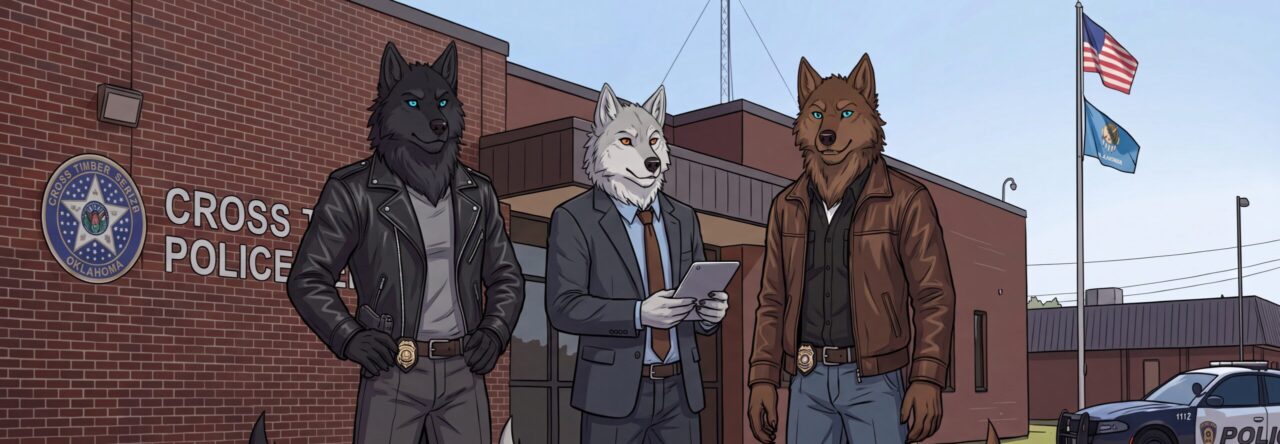
At 18:07, Thane expected to walk into the Cross Timber Police Department, collect the night handoff, and begin a normal shift.
He got as far as the Investigations hallway before Deputy Chief Mercer stepped out of the Chief’s office and said, “Good. You are all here.”
That alone was enough to make Gabriel slow down.
Mark looked up from the folder tucked beneath one arm.
Thane stopped.
Mercer wore a dark suit instead of his usual department polo. His tie was straight. His expression was controlled in the particular way it became when he had spent too long thinking about something unpleasant and had arrived at the conclusion that he still had to do it.
Behind him, Chief Whitaker stood in the doorway with Voss and Rusk.
Crowe was there too.
That was not a normal shift handoff.
Gabriel looked down the hallway.
Then back at Mercer.
“Oh, no.”
Mercer folded his hands.
“At eighteen-thirty, we are holding a press conference in the Community Room.”
All three wolves went still.
Mercer looked directly at Thane.
“You will be speaking.”
For one full second, no one answered.
Thane’s eyes widened.
Gabriel’s eyes widened.
Mark’s eyes widened.
Rusk looked at all three of them and took a slow drink of coffee.
“I have never seen that happen at the same time.”
Gabriel pointed at Mercer.
“You cannot just say that like it is a normal sentence.”
“I am aware,” Mercer said.
Thane found his voice first.
“I have a shift.”
“You do,” Mercer said. “It will begin after the press conference.”
“I thought the department had already released a statement.”
“We did.”
“And Chief Whitaker spoke yesterday.”
“She did.”
“Then why am I speaking?”
Mercer glanced toward the closed doors of the Community Room.
“Because the city has spent four days trying to understand what it saw through incomplete, frightening video. Because the public knows you were shot. Because people know you healed faster than they thought was possible. Because people are filling the lobby with cards, flowers, food, stuffed animals, deeply questionable wolf-themed gifts, and notes asking whether you are all right.”
Gabriel’s ears lifted.
“Questionable gifts?”
“Not relevant,” Mercer said.
“It is relevant to me.”
Mercer ignored him.
“More importantly,” he continued, looking at Thane, “there are already too many people online calling you invincible. There are people turning a violent robbery into a superhero story. We need the facts to be louder than that.”
Thane’s ears lowered slightly.
“I do not want a press conference about me.”
“I know.”
“I do not want anyone thinking getting shot was impressive.”
“I know.”
“I do not want to become—”
“A slogan?” Mercer asked.
Thane looked at him.
Mercer nodded once.
“Neither do I.”
The hallway quieted.
Chief Whitaker stepped forward.
“You are not being asked to perform,” she said. “You are being asked to tell the truth. You will speak only to what you know. You will not speculate. You will not answer questions about evidence that remains under review. You can say ‘I do not know’ whenever you need to.”
Thane glanced at Voss.
“Do I have to answer questions?”
“No,” Voss said. “You can decline any question. Mercer or I will step in if it goes somewhere it should not.”
Rusk lifted his coffee.
“And I have been instructed to remain silent.”
Gabriel looked at him.
“That is the smartest decision anyone has made all day.”
Rusk smiled.
“I do not disagree.”
Mark looked toward the Community Room doors.
“How many people are out there?”
Mercer’s mouth tightened.
“More than I expected.”
“That is not an answer,” Mark said.
“There are local, regional, and national media outlets. There are citizens. Some of the Heritage Liquor staff are here. Rosa’s sister is here. Evan’s mother is here. Officers from every shift are here. Dispatch sent two representatives. Fire and EMS have people in the room.”
Gabriel looked at Thane.
“That is a lot.”
“It is,” Thane said.
Mercer studied him.
“You do not have to give a speech. But the city needs to hear something from you that is not a viral clip of a gunman firing at you.”
Thane looked down at his hands.
The old ache had mostly faded.
His chest no longer pulled when he breathed deeply. His thigh no longer made him favor one side. The wounds had closed. His body had repaired itself.
But that did not mean the memory had become small.
He still remembered the glass breaking.
The feeling of the rounds hitting him.
Rosa crawling behind the counter.
The gun rising toward her again.
He looked up.
“What do you want me to say?”
Mercer answered quietly.
“The truth.”
Gabriel stepped closer to Thane.
“You are good at that.”
Thane looked at him.
“I am not good at microphones.”
“You are good at telling people what matters,” Gabriel said.
Mark nodded.
“And at correcting inaccurate assumptions.”
Thane glanced toward the Community Room.
“That is not the same thing.”
“No,” Mark said. “But it is adjacent.”
For the first time since Mercer had spoken, Thane’s mouth twitched.
Rusk noticed.
“There. He is emotionally prepared.”
“Rusk,” Voss said.
“I am being supportive.”
“No,” Gabriel said. “You are being Rusk.”
Chief Whitaker checked the time.
“Twenty minutes.”
Mercer looked at Thane.
“You do not need to be perfect. You need to be honest.”
Thane nodded once.
“Okay.”
The Community Room had been used for retirement receptions, citizen-academy nights, training sessions, school presentations, and once, according to Gabriel, a disastrous chili cook-off that had required three fire extinguishers and a plumbing contractor.
Tonight, it looked like a different room.
Rows of folding chairs filled the center.
Television cameras stood along the back wall beneath the department seal.
Reporters clustered near the aisle with notebooks, microphones, and phones already recording.
The side walls held city staff, officers, dispatchers, firefighters, paramedics, and citizens who had run out of room in the chairs.
The front row was not media.
Rosa Martinez sat there with her sister.
Her upper arm was wrapped beneath a loose cardigan. She looked tired. Pale, maybe. But upright.
Beside her sat Evan and his mother.
Evan looked as though he wanted to disappear into his chair.
When he saw Thane enter through the side door, though, his eyes widened.
Then he stood.
Rosa stood too.
The room noticed.
The applause began quietly.
Not a roar.
Not at first.
Just hands coming together from the front row.
Then the people behind them joined.
Then the officers near the walls.
Then the reporters stopped moving long enough to clap too.
Thane froze near the side of the room.
Gabriel stood beside him.
Mark was on his other side.
For one second, Thane looked as though he might turn around and walk straight back into the hallway.
Gabriel leaned close enough that only Thane could hear him.
“You do not have to do anything except stand there.”
Thane looked at Rosa.
At Evan.
At the people holding cards in their laps.
At the woman from the pharmacy whose medication bag they had found under her mobility scooter.
At the exhausted delivery driver from the dumpster call.
At volunteers from Hollow Creek.
At patrol officers who had taken calls with them, trained with them, argued with them, and worked beside them while the city tried to turn one frightening night into a legend.
He stayed.
The applause faded slowly.
Mercer stood at the podium beneath the department seal.
Chief Whitaker stood a few steps behind him.
Voss, Rusk, Crowe, Bell, Grant, Serrano, Patel, Darnell, and several other officers lined the wall to one side.
Thane noticed Grant first.
She gave him a small nod.
Nothing big.
Nothing public.
Just a quiet reminder.
You are here.
The room settled.
Mercer looked out at the crowd.
He had given public statements before.
Budget statements.
Policy statements.
Statements after difficult calls when the city needed facts more than reassurance.
But he did not look comfortable.
That was how Thane knew this mattered.
“Thank you for being here,” Mercer began.
His voice carried cleanly through the room.
“On Thursday night, Cross Timber Police officers responded to an armed robbery at Heritage Liquor on East Chandler. The suspect fired multiple rounds inside the business, injured an employee, and continued to present an immediate threat to the people inside the store and responding officers.”
The room was quiet enough that Thane could hear the soft mechanical hum of the camera lights.
“Officer Grant and Officer Serrano arrived first and established exterior positions. Detective Thane, Detective Gabriel, and Detective Mark arrived shortly afterward. Officers identified an injured clerk behind the counter, an additional employee trapped inside the store, and an armed suspect who remained active.”
Mercer paused.
“The suspect fired at Detective Thane. Detective Thane was struck seven times. He was injured. He was not invulnerable.”
Several people in the room shifted.
Some looked toward Thane.
Others looked down.
Mercer continued.
“Werewolf healing is extraordinary. It is also not an absence of pain, risk, trauma, or consequence. Detective Thane remained functional long enough to protect an injured clerk from an immediate threat, disarm the suspect, and secure him in custody. Once the threat ended, the force ended.”
The words landed heavily.
Not applause words.
Not hero words.
Facts.
“The suspect received medical treatment and remains in custody. His injuries are not life-threatening. Rosa Martinez, the clerk injured during the robbery, is recovering. Evan, the employee trapped inside the store, was physically unharmed and has access to support services.”
Rosa’s sister reached for her hand.
Mercer looked toward her briefly.
Then back to the room.
“The criminal investigation remains active. The department’s use-of-force review remains active. That is standard process. The review exists to protect the public, protect the officers, and establish a complete record based on physical evidence, video, witness statements, radio traffic, and sworn reports.”
He adjusted one page on the podium.
“We have heard the public concern. We have received cards, flowers, food, messages, drawings, and gifts. We have also seen online speculation that is inaccurate, unsafe, or disrespectful to the people who were harmed.”
His eyes moved across the rows of cameras.
“We are asking everyone not to share graphic footage from the scene. Do not turn Rosa’s worst night into content. Do not turn Evan’s fear into content. Do not turn gunfire into entertainment because a wolf healed faster than you expected.”
No one moved.
Mercer’s voice softened.
“People are alive because officers, dispatchers, paramedics, firefighters, hospital staff, and civilians did their jobs under extraordinary pressure. That is the story.”
Then he stepped slightly aside.
“Detective Thane has agreed to say a few words.”
The room turned.
Thane looked at Gabriel.
Gabriel gave him the smallest nod.
Mark said quietly, “You know what matters.”
Thane walked to the podium.
The path felt longer than it should have.
The bright lights made the room warm. The microphone sat low from Mercer’s remarks, so Thane adjusted it upward with one careful claw.
Thane looked at the room.
At the cameras.
At Rosa.
At Evan.
At the reporters waiting with their questions already built.
For one strange second, all he could think was that there were too many people.
Too many eyes.
Too much silence.
Then he looked at Mercer.
Mercer was trying very hard not to look anxious.
Thane leaned toward the microphone.
“We’ve really got to stop meeting like this.”
For half a heartbeat, the room stayed still.
Then people laughed.
Not because the shooting had been funny.
Because it was a release.
A roomful of people had been carrying fear for days, and Thane had handed them one breath of air.
The laughter became applause.
Gabriel covered his muzzle with one hand.
Mark looked down, though the faint movement of his ears gave him away.
Rusk, against explicit instruction, murmured, “Good opening.”
Voss elbowed him without looking.
Thane waited for the applause to settle.
Then his expression changed.
Not harder.
Just more serious.
“I am okay,” he said. “I am fully healed.”
“But I am not the person who needs the most attention tonight. Rosa is recovering. Evan is safe. The suspect is in custody and receiving medical care. That matters.”
Rosa looked down.
Her sister squeezed her hand again.
Thane continued.
“I know a lot of people have been worried. I know people have seen the video. I know it looked frightening.”
His voice lowered.
“It was frightening.”
The room quieted again.
“I was hurt. It hurt. Healing quickly does not mean bullets are harmless. It does not mean I want anyone to think that walking into gunfire is something a person should do because they believe they can survive it.”
He paused.
“I moved because someone was still in danger. That was it.”
No one clapped.
That was right.
Thane looked toward Grant and Serrano along the wall.
“Officer Grant and Officer Serrano were there first. They established the scene. They protected people outside the store. They kept the response organized while the threat was still active.”
Grant looked like she wished she could become part of the wall.
Serrano looked at the floor.
Thane kept going.
“Officer Bell, patrol officers, dispatchers, paramedics, firefighters, hospital staff, evidence technicians, investigators—there were a lot of people doing exactly what they had trained to do.”
He looked back at the audience.
“Gabriel, Mark, and I never wanted to be the center of attention. None of us did. We came here to be useful. That is all.”
Gabriel’s ears lowered.
Mark stood a little straighter.
Thane’s gaze moved over the officers near the side wall.
“The talented law-enforcement people in this building deserve every bit as much attention as we do. They work every day. They answer calls nobody records. They sit with people when their lives are falling apart. They carry bad news. They find lost children. They help somebody get home. They take reports that matter even when nobody is watching.”
His voice roughened slightly.
“They are heroes every day. They keep this city safe. Please do not forget them.”
For a moment, no one moved.
Then Rosa stood.
Slowly, carefully.
She began clapping.
Evan stood beside her.
Then the room rose with them.
The applause came back louder this time.
Not for the gunfire.
Not for the healing.
For the people along the wall who had spent years doing ordinary, difficult work without a camera pointed at them.
Grant covered her face for a second.
Serrano laughed softly, embarrassed.
Bell folded his arms and looked down, as though he had suddenly found the floor fascinating.
Mercer stood near the podium with his jaw set tight.
Chief Whitaker did not look away from Thane.
When the room finally quieted, Mercer stepped forward.
“We will take a limited number of questions,” he said. “Questions must remain within the boundaries of the active investigation. We will not discuss specific forensic findings, witness statements, protected medical details, or operational tactics beyond what has already been publicly stated.”
Hands rose immediately.
A reporter from one of the Oklahoma City stations stood first.
“Deputy Chief, the public has seen Detective Thane take what appears to be seven rounds and remain standing. Is he bulletproof?”
“No,” Mercer said.
Then he nodded to Thane.
Thane stepped closer to the microphone.
“No,” he repeated. “Not remotely. I was hurt. I could have been hurt worse. I am lucky to heal the way I do, but that does not make gunfire safe. It does not make me bulletproof.”
The reporter nodded.
A woman near the center aisle stood next.
“Detective, why did you keep moving after you were shot?”
Thane took a breath.
“The clerk was still in the line of fire. The gun came up again, and I could not leave her there.”
A man from a national cable outlet raised his hand.
“Does your physiology give you an advantage that other officers do not have? Does that mean werewolf officers can take risks others should not?”
Chief Whitaker stepped forward first.
“Detectives Thane, Gabriel, and Mark are held to the same legal and policy standards as every Cross Timber officer. Their physiology does not change the law. It does not lower the threshold for force. It does not excuse recklessness.”
Thane nodded.
“It changes what damage I might survive,” he added. “That can matter if somebody else is in danger and there is no safer choice. But it does not mean I get to take risks because I want to look brave. It does not mean I get to ignore cover, commands, backup, de-escalation, or procedure.”
Mark’s ears tipped forward.
Gabriel looked like he wanted to say something but wisely did not.
Thane continued.
“Being able to heal does not give us permission to be careless.”
The reporter lowered his hand.
Another question came from the back.
“Did you intend to break the suspect’s finger?”
Mercer raised one hand.
“The precise mechanics of the disarm are part of the active review.”
Thane looked at the reporter.
“My intent was to stop him from firing again.”
“Was the injury necessary?”
“The review will determine all of the facts,” Mercer said. “The suspect resisted control of a firearm during an active threat. He received treatment. He is in custody. We will not litigate that event through a press conference.”
The reporter nodded and sat.
A younger journalist from a local paper stood next.
“Detective, you said you never wanted attention. How does it feel to receive hundreds of cards and gifts from people who are grateful you survived?”
Thane looked toward the lobby doors.
Through the narrow glass window beside them, he could see the bright blur of flowers.
The stacks of cards.
A small paper banner someone had taped near reception.
He did not know who had made it.
He had not asked what it said.
“I am flattered,” he said carefully. “I am grateful. I do not know how to say thank you well enough for all of it.”
A few people smiled.
Thane looked toward Rosa again.
“But I hope people remember why they are sending those things. A clerk went home to her daughter. A young employee went home to his mother. Officers and dispatchers and medics went home too. That is the part I care about.”
The journalist nodded.
“Thank you.”
A final hand rose near the front.
The speaker was not press.
She was an older woman Thane recognized from the pharmacy call days earlier—the one who had believed her prescription bag had been stolen.
Her hands shook slightly as she stood.
“May I ask something?”
Mercer looked at Chief Whitaker.
The Chief nodded.
“You may,” Mercer said.
The woman looked at Thane.
“My grandson watched the video before I could stop him. He is eight. He keeps asking me whether wolves can die.”
A murmur moved through the room.
Thane did not answer immediately.
He thought about Kaden’s drawing.
The red circles and black Xs.
The words in blue crayon telling him not to get shot anymore.
He thought about the lunchbox with laser eyes.
The strangers online calling him unstoppable.
Then he looked at the woman.
“Yes,” he said.
The room went still.
“Werewolves can die. We can be hurt. We can make mistakes. We heal fast, but that is not the same thing as being invincible. It does however take a great deal more damage to kill us.”
The woman nodded slowly.
“What should I tell him?”
Thane’s expression softened.
“Tell him strong people still need to be careful. Tell him guns are dangerous. Tell him when he sees something frightening, he should talk to someone he trusts instead of carrying it alone.”
The woman’s eyes filled.
“I will.”
Thane nodded.
“Thank you.”
Mercer stepped back to the podium.
“That will be all for today.”
The questions stopped.
The room did not rise into applause this time.
It did not need to.
People stood anyway.
Not all at once.
Not in a wave.
Just individuals coming to their feet.
Rosa first.
Then Evan.
Then Grant.
Then Serrano.
Then the people along the walls.
Thane looked at the room one more time.
At the faces.
At the cameras.
At the officers who would leave this room and go right back to working calls before sunrise.
He lifted one hand.
“Thank you,” he said. “All of you.”
Then he stepped away from the microphone.
Gabriel met him before he reached the side door.
“That was good,” he said quietly.
Thane looked at him.
“I said too much.”
“No.”
“I probably said too much.”
“No,” Gabriel repeated.
Mark joined them.
“The public-safety message was direct, accurate, and proportionate.”
Thane looked at him.
“That is your version of ‘good.’”
“Yes.”
Rusk appeared behind them.
“I have an alternate version.”
“No,” Voss said from somewhere nearby.
Rusk sighed.
“It involved the phrase ‘you made the room cry, big guy.’”
Thane stared at him.
Rusk held up both hands.
“Fine. It was good.”
Mercer walked over last.
For a second, he looked at Thane without saying anything.
Then he exhaled.
“I have scheduled press conferences before,” he said. “I have never been happier to be able to stop talking.”
Thane’s mouth twitched.
“You did okay.”
Mercer looked offended.
“I did more than okay.”
Gabriel smiled.
“Powerful press conference, powerful you.”
Mercer looked at him.
“Do not start that.”
Gabriel’s smile widened.
Too late.
Chief Whitaker approached from the podium.
“Night Shift,” she said. “You have a normal shift to work.”
Thane nodded.
“Okay.”
She looked at him.
“Are you ready?”
Thane glanced back toward the Community Room.
The audience was already beginning to disperse. Reporters gathered their equipment. Rosa hugged her sister. Evan’s mother had one hand on his shoulder.
Outside, the station lobby waited with flowers, cards, and the city’s accumulated concern.
Inside, there would be reports.
Calls.
People who needed help.
The work.
“Yes,” he said.
Once the Community Room had cleared, Voss and Rusk gave Night Shift the actual handoff in the small case room. There were no active detective cases requiring overnight action—only a few patrol-support requests, routine follow-up notes, and instructions to remain available if the liquor-store investigation developed anything urgent.
Their first call came at 20:14.
Officer Darnell had stopped to help a driver whose small utility trailer had blown a tire on the service road behind a hardware store.
The trailer had drifted partly into a shallow ditch.
The driver was not injured.
His cargo consisted of two ladders, a cooler, several bags of mulch, and what looked like the world’s least cooperative riding lawn mower.
When the Humvee pulled in behind Darnell’s unit, the driver looked from Thane to the trailer.
Then back to Thane.
“You are the one from the news.”
Thane looked at the trailer.
“Tonight, I am the one helping get this out of the ditch.”
The man blinked.
Then nodded.
“Fair.”
Darnell directed traffic while Mark checked the trailer hitch and wheel position.
Gabriel climbed carefully onto the rear bumper and began moving loose bags of mulch away from the damaged tire.
Thane stood beside the tongue of the trailer, assessing the angle.
His body felt normal.
No sharp pain.
No soreness.
No bruised memory in his muscles.
But he still moved carefully.
Not because he needed to.
Because he had promised people he would.
“Can we shift it without pulling the hitch loose?” Thane asked.
Mark examined the attachment.
“Yes. Lift at the rear. Darnell will guide the driver’s steering. We need the wheel clear of the ditch before we rotate.”
Darnell looked at Thane.
“You good?”
Thane nodded.
“Yes.”
She looked at him for a second longer.
Then nodded back.
“Okay. On your call.”
Thane placed both hands beneath the trailer’s rear frame.
Gabriel took the opposite side.
Together they lifted.
Not dramatically.
Not like a feat for a camera.
Just enough to take weight off the damaged wheel.
Darnell guided the driver.
Mark called the angle.
Thirty seconds later, the trailer rolled back onto level ground.
The driver stared at it.
Then at the two wolves.
Then at the news alert still glowing on his phone screen.
“You all really did come straight from that press conference to pull a trailer out of a ditch?”
Gabriel brushed mulch from his shirt.
“Police work is glamorous.”
Darnell snorted.
Thane looked at the driver.
“Get the tire replaced before you haul it again.”
“Yes, sir.”
“Good.”
They drove away before he could ask for a photograph.
That felt like progress.
At 22:02, they assisted Grant with a welfare check at a small duplex near the north edge of town.
An older man had not answered his sister’s calls since the afternoon.
His car was in the drive.
The porch light was on.
The television could be heard through the front window.
Grant had already spoken to a neighbor, who said the man had been working outside all day and had seemed tired but normal.
The door opened on the third knock.
The man stood there in a bathrobe, holding a television remote in one hand and looking deeply offended.
“What?” he demanded.
Grant lowered her notebook.
“Mr. Wilcox?”
“Yes.”
“Your sister asked us to check on you. She said you have not answered your phone.”
Mr. Wilcox looked toward the coffee table.
A phone lay beneath a folded newspaper.
He stared at it.
Then looked back at Grant.
“It is on silent.”
“Yes, sir.”
“That is ridiculous.”
“It happens.”
He looked past Grant and saw Thane.
Recognition spread across his face.
“Oh.”
Thane gave him a small nod.
“Evening.”
Mr. Wilcox looked at his chest.
Then at Grant.
“Is he supposed to be out?”
Grant did not miss a beat.
“He is medically cleared and currently helping me check on you.”
Mr. Wilcox seemed to consider whether that was a sufficient answer.
Then he pointed toward the phone.
“Tell my sister I am alive.”
Grant’s mouth moved toward a smile.
“I will.”
“Tell her I was watching television.”
“I will.”
“Tell her to stop calling every hour.”
Grant looked at him.
“I will not tell her that.”
Mr. Wilcox grumbled.
Then he saw Gabriel and Mark beside the walkway.
“You got the whole wolf department out here?”
Gabriel smiled.
“Just the night shift.”
Mr. Wilcox nodded as if that explained everything.
Then he looked at Thane again.
“My wife saw the video.”
Thane waited.
“She cried.”
Thane’s ears lowered slightly.
“I am sorry.”
Mr. Wilcox shook his head.
“She cried because you came back up.”
The old man stood in the open doorway for a moment.
Then he said, “Tell your people I said thank you.”
Thane looked at Grant.
Then at the other officers on the street.
“I will.”
They left Mr. Wilcox safe, irritated, and newly aware that his phone had a volume setting.
At 00:36, Night Shift assisted Patel at a grocery-store parking lot where a teenager had locked his keys, his wallet, and his younger sister’s inhaler inside a car.
The inhaler was not urgently needed.
The sister was breathing fine.
But the teenager had become frantic enough that the store manager called police before he tried to smash a window.
Mark talked him through roadside assistance.
Gabriel sat on the curb with the younger sister, who was mostly upset because she had been promised ice cream.
Thane found a spare key taped beneath the teenager’s rear bumper in one of those magnetic boxes every parent hoped no one else would discover.
The teen stared at it.
“I forgot that was there.”
“Your mother did not,” Thane said.
The teenager got the inhaler, the wallet, and eventually the ice cream.
Patel watched Thane close the car door again.
“You doing okay?” she asked quietly.
“Yes.”
She raised an eyebrow.
Thane corrected himself.
“I am fully healed.”
He looked at her.
“You do not have to keep checking.”
“I know.”
“Then why do you?”
Patel looked at the young girl eating ice cream in the passenger seat.
“Because you got shot seven times.”
Thane let out a breath.
“That is fair.”
At 02:18, the quiet finally settled in.
They sat in the break room with two patrol officers, a half-empty coffee pot, and a box of donated cookies that Mark had approved after confirming the sender was a local bakery with a receipt and no request for special treatment.
Darnell had one cookie in each hand.
Grant had coffee.
Patel sat across from Thane, elbows resting on the table.
No one was in a hurry to speak.
The night had been ordinary.
A trailer.
A welfare check.
A locked car.
The kind of calls that mattered without becoming stories.
Eventually, Darnell looked at Thane.
“Can I ask something?”
Thane leaned back.
“Yes.”
“Does getting shot hurt?”
Grant closed her eyes briefly.
“Darnell.”
“What? Everybody is thinking it.”
Gabriel lifted one hand.
“I was not thinking it because I already know.”
Darnell looked at him.
“Okay, then everybody else is thinking it.”
Thane considered the question.
“It hurts.”
Darnell waited.
“It hurts a lot.”
The room quieted.
Thane continued.
“The first part is force. Heat. Pressure. Your body knows something is wrong before your mind catches up. Then you feel where it hit. You feel what it changed.”
Grant looked down at her coffee.
“And then you heal.”
“Yes.”
“How fast?”
“Fast enough that the worst of it starts fading before you have fully processed what happened.”
Patel looked at him.
“Like pain running backward?”
“Not exactly,” Thane said. “More like the body catches up and starts telling you that you are still alive.”
Darnell turned the cookie in his fingers.
“Does it still hurt after?”
“Sometimes. The damage closes faster than the memory does.”
Grant looked at him.
Thane shrugged slightly.
“It is the true one.”
Patel sat forward.
“Does healing make you more willing to take risks?”
Thane looked around the table.
He had answered versions of that question before.
At the press conference.
In his formal statement.
But here, at two in the morning, with patrol officers who had seen too much and asked too little of each other, the answer felt different.
“It lets us take different risks sometimes,” he said. “Not more risks.”
Darnell frowned.
“What is the difference?”
Thane took a breath.
“If someone is in danger and there is no safe, workable alternative, I am able to put myself in a position another officer cannot. I am able to take the harm instead of a civilian. I may be able to close distance when waiting would make things worse.”
Mark nodded.
“But that changes only the risk to us,” he said. “It does not change the legal threshold. It does not make the action automatically wise. It does not make us immune to bad decisions.”
Gabriel rested his forearms on the table.
“We still use cover. We still give commands. We still wait when waiting is safe. We still need backup.”
Grant looked at Thane.
“You were scared?”
“No,” Thane said.
The answer landed quietly.
“I have been a werewolf my entire life. I know my body. I knew the shots would hurt, and I knew they were unlikely to stop me.”
Darnell’s expression shifted.
“Then what made you move?”
“Rosa was still there.”
The room stayed quiet.
Thane continued.
“Knowing I could take the rounds did not make the gun less dangerous. It meant I had a chance to get between it and her before he fired again.”
Patel looked down at her coffee.
Grant let out a slow breath.
Darnell set one cookie down untouched.
Then Gabriel broke the silence.
“Also, for the record, he has been insufferably stubborn since he healed.”
Thane looked at him.
“You were supposed to rest.”
“I rested.”
“You sat down for seven minutes and then reorganized the pantry.”
Mark nodded.
“Accurate.”
Thane looked at Mark.
“You are not helping.”
“I am providing corroboration.”
Darnell smiled.
“So werewolf healing does not fix personality?”
“No,” Mark said.
Gabriel leaned back.
“Tragically, it does not.”
The room laughed.
Even Grant.
Even Patel.
Thane shook his head.
Then he looked at the patrol officers again.
“I mean what I said earlier. Being a werewolf does not make us better police.”
Grant looked at him.
“It gives us abilities. It changes what our bodies can survive. But the badge is what tells us what we owe people.”
Mark’s ears tipped forward.
Gabriel was quiet.
Thane looked at the room.
“We do not get to be careless because we heal. We do not get to turn pain into a reason to hurt somebody back. We do not get to use strength just because we have it.”
Darnell nodded.
“Hands open.”
“Hands open,” Thane said.
Grant lifted her coffee cup.
“To ordinary nights.”
Patel raised hers.
“To ordinary nights.”
Gabriel lifted a cookie.
“To no more press conferences.”
Mark considered that.
“Temporarily reasonable.”
Thane looked at him.
“Mark.”
“What?”
“Just say it.”
Mark looked around the room.
Then lifted his coffee.
“To ordinary nights.”
They drank to that.
Outside, Cross Timber moved quietly beneath the late-summer dark.
No gunfire.
No flashing lights.
No packed rooms.
No cameras pointed at a wolf detective trying to explain why he had moved.
Just patrol cars moving through familiar streets.
Dispatchers answering phones.
Nurses working late.
Parents driving home.
People locking doors behind them and trusting that someone would come if they needed help.
At 06:15, Night Shift walked out into the beginning of morning.
Behind them, the station waited.
Ahead of them, the city did too.
And for one more quiet night, the people of Cross Timber had made it safely to dawn.