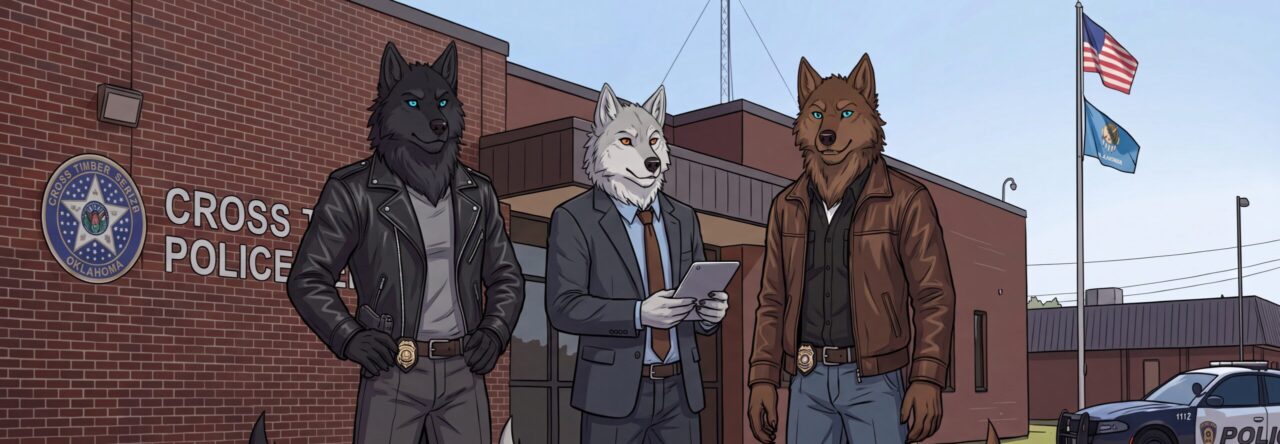
By the time Thane returned to the Cross Timber Police Department, the front lobby had acquired a second folding table.
The first held cards.
The second held flowers.
A third had been placed near the break-room door for food deliveries, where someone had taped up a handwritten sign in thick black marker:
NOT EVIDENCE. PLEASE LABEL ALLERGENS.
Thane stopped just inside the front doors.
Gabriel came in behind him, looked over the tables, and exhaled through his nose.
Carla at the reception desk looked tired, pleased, and one minor delivery away from declaring herself the commander of a small floral nation.
“Someone sent a get-well card covered in loose silver glitter. It shed all over the counter. Dispatch found it in the radio-room carpet.”
Thane stood there for a moment, taking it in.
The flowers were not as overwhelming as they had been the previous day. Most had already been redirected to hospital staff, dispatch, Heritage Liquor, Victim Services, and the officers working overnight patrol.
But there were still enough to make the station smell faintly like a greenhouse.
Sunflowers.
Carnations.
Roses.
A vase of wildflowers in a mason jar with a card that read:
FOR DETECTIVE THANE AND THE PEOPLE WHO KEPT ROSA SAFE.
The card table was worse.
There were stacks of envelopes from local schools, church groups, senior centers, businesses, and people who had apparently decided that mailing a police detective a handwritten note was the most useful thing they could do after watching a frightening video online.
A small stuffed wolf wearing a yellow construction vest sat beside a handmade sign.
GET WELL, BIG WOLF.
Thane looked at it.
Gabriel looked at him.
“Do not.”
“I did not say anything.”
“You were going to.”
“I was going to say the vest is adorable.”
Thane gave him a flat look.
Mark glanced at the toy.
“It is not regulation.”
Gabriel put one hand over his chest.
“Mark. It is a child’s gift.”
“It can be both adorable and noncompliant.”
Carla cleared her throat.
“The stuffed animals are being routed through Victim Services after the tags are recorded. That one is currently waiting for Sergeant Hale’s niece, who has been in the children’s hospital wing for a week.”
Thane nodded.
“Good.”
Carla smiled.
“And before you ask, no, you are not taking it home.”
Thane blinked.
“I was not going to.”
Gabriel looked at her.
“He was absolutely not going to.”
Carla pointed at the three of them.
“You have no idea how many people have asked whether he needs a special recovery den.”
Thane closed his eyes.
“Please tell me none of them brought one.”
“Not yet.”
“Carla.”
“One person offered to donate a custom recliner.”
Gabriel’s ears lifted.
“Was it nice?”
“Gabriel.”
“What? He got shot seven times. A good recliner is not an unreasonable public-health intervention.”
Mark adjusted the folder beneath one arm.
“Department policy does not permit acceptance of a custom recovery recliner.”
Gabriel looked at him.
“Your fun-to-information ratio is devastating.”
Thane shook his head and walked past the tables.
He was fully healed.
That was what the doctor had called it when the final examination ended earlier that afternoon.
No open wounds.
No retained rounds.
No internal injury.
No limitations beyond the soreness that remained in strange, stubborn places.
His chest felt tight if he stretched too far.
His thigh complained when he climbed stairs.
There was a faint ache beneath his ribs, as if his body had remembered the shape of the impacts even after it had repaired the damage.
He knew it would fade.
Probably soon.
That did not make it nothing.
Mark fell into step beside him.
“You are compensating slightly on the right side.”
Thane looked at him.
“I am walking.”
“Yes.”
“Normally.”
“Mostly.”
Gabriel came around the other side.
“Congratulations. You are now medically healthy enough to be criticized by both of us.”
Thane pointed toward the Investigations hallway.
“Statement first.”
Gabriel’s expression sobered.
“Statement first.”
The formal interview took place in a small conference room beside the Chief’s office.
Not an interrogation room.
Not a place designed to make someone uncomfortable.
A table.
Six chairs.
A carafe of coffee no one had touched.
A city-seal plaque on the wall.
Two unopened boxes of tissues sitting in the center of the table, as if somebody had decided the room itself would make people cry.
Leila Ochoa waited at one end with a recorder, a notebook, and a thick folder marked HERITAGE LIQUOR — CRITICAL INCIDENT REVIEW.
A representative from the police association sat quietly beside Thane. The department had made the option available. Thane had taken it, not because he expected wrongdoing, but because every officer who gave a full statement after a critical incident deserved the same process.
Mark and Gabriel had completed their own statements separately.
No coordinated language.
No shared drafts.
No comparing who remembered which second.
Just what each of them had seen.
Mercer stood outside the room with Voss.
Neither would be part of the statement.
Neither wanted to be.
Ochoa clicked on the recorder.
“Today is Monday, eighteen thirty-two hours. Detective Thane is present voluntarily for his full statement regarding the armed robbery and shooting at Heritage Liquor on Thursday night. Detective, are you medically cleared to participate?”
“Yes.”
“Are you taking any medication that affects your ability to understand or answer questions?”
“No.”
“Have you reviewed any evidence from the scene since your initial public-safety interview?”
“No.”
“Have you discussed the substance of your statement with Detectives Gabriel and Mark?”
“No.”
“Are you prepared to proceed?”
“Yes.”
Ochoa nodded.
“Start with your arrival.”
Thane did.
He told it cleanly.
The dispatch call.
The reported armed robbery.
The shots fired.
Grant and Serrano already positioned outside the store.
The clerk behind the counter.
The young employee near the boxed-wine display.
The gunman’s position.
The shattered front window.
The absence of a clean shot.
He did not make himself larger.
He did not make the suspect smaller.
He did not call the gunman evil.
He did not say he had known exactly how everything would end.
He described what he had seen.
What he had heard.
What he had assessed.
Ochoa asked questions when she needed more detail.
“Why did you enter the doorway?”
“The gunman had turned the weapon toward Rosa Martinez. She was injured and crawling toward the counter opening. Grant and I did not have a clean angle from outside without risking her.”
“Did you believe the suspect remained an immediate threat?”
“Yes.”
“Why?”
“The handgun was still in his hand. He had fired multiple rounds. Rosa was exposed. He moved the gun toward her.”
“Describe what happened after you entered.”
Thane took a breath.
“He fired.”
“How many times?”
“Seven.”
“Did you remain standing?”
“Yes.”
“Did that affect your decision to continue?”
“It affected what I knew I might survive.”
Ochoa looked up.
“Explain that.”
Thane considered the words before he used them.
“I am a werewolf. My healing is faster. My chances of permanent injury are different than they would be for a human officer in the same position.” He paused. “That did not make the situation safe. It did not mean the shots did not hurt.”
The room remained quiet.
Ochoa wrote.
Thane continued.
“It meant I knew I would be able to take a risk that Rosa could not take. The gun was still pointed at her. There was no clean shot. There was no time to wait for a better position.”
“Were you attempting to demonstrate that you could survive gunfire?”
“No.”
“Were you angry because the suspect shot you?”
“No.”
“Why did you move toward him?”
“Because he raised the gun again.”
Ochoa nodded once.
“Describe the disarm.”
“I caught his gun wrist and redirected the muzzle away from the clerk. He resisted. His trigger finger stayed inside the guard. I turned the pistol until it came free.”
“Did you intend to break his finger?”
“No.”
“What was your intent?”
“To keep him from firing again.”
“Did you use force after the weapon was secured?”
“No.”
“Did you strike him?”
“No.”
“Did you use force after he was in handcuffs?”
“No.”
“Did you make any threats?”
“No.”
“Did you give commands?”
“Yes.”
“What commands?”
“Drop it. Then hands open.”
Ochoa looked down at the report summary.
“You told the initial investigator that the suspect said, ‘They leave stuff. They move out and leave everything. Nobody wants it.’ Was that connected to the Heritage Liquor robbery?”
“No. That was Cole Varela in the earlier case.”
Ochoa paused.
Then closed her eyes briefly.
“Different critical incident. Long week.”
Thane’s ears tipped forward.
“You okay?”
She looked at him.
“I am fine.”
Gabriel’s voice, from somewhere in the hallway beyond the door, carried faintly through the wall.
“No.”
Ochoa stared at the door.
Then, despite herself, smiled once.
“Thank you, Detective Gabriel.”
Thane’s mouth twitched.
Ochoa returned to the record.
“Detective, is there anything else about your decision-making that you believe the review team needs to understand?”
Thane looked at the table.
At his hands.
At the claws that had stayed visible beneath the conference-room lighting through every sentence.
“Yes,” he said finally.
Ochoa waited.
“Being able to heal does not mean I get to be careless. We still use cover. We still wait when waiting is safe. We still use verbal commands. We still take the least dangerous option we have.”
He looked up.
“There was no safe option left for Rosa. That is why I moved.”
Ochoa held his gaze for a moment.
Then nodded.
“Thank you.”
The recorder clicked off.
The statement was complete.
Not the whole investigation.
Not the final review.
Not the reports, forensic findings, video analysis, witness interviews, or supervisor findings still to come.
But his part of the truth was in the room now.
Placed where it could be seen.
Voss was waiting in the hallway when Thane stepped out.
Mercer stood beside the window with his hands in the pockets of his suit trousers, staring down at the patrol lot below.
Neither spoke immediately.
That was not their style.
Thane looked between them.
“Was it okay?”
Voss answered first.
“It was complete.”
He nodded.
“That is what I wanted.”
“You did not make it about being hard to hurt,” she said. “You made it about why Rosa could not be the one left in that line of fire.”
“She could not.”
“No,” Voss said. “She could not.”
Mercer turned from the window.
He looked at Thane for a long second.
There was no dramatic expression on his face.
No swelling speech.
Just something honest and difficult to hide.
“You took seven handgun rounds,” he said. “Several of them through your core. No body armor. No retreat path. And you remained functional enough to see the threat, protect a civilian, disarm the shooter, stop using force when the threat stopped, and give a clear statement afterward.”
Thane’s ears lowered slightly.
“Okay.”
Mercer’s mouth moved toward a humorless smile.
“You are very bad at accepting the point of a compliment.”
“I do not want people to think I am invincible.”
“They should not,” Mercer said. “You are not.”
“I know.”
“But I am still impressed,” he said. “I would be lying if I said otherwise.”
Thane did not know what to say to that.
So Voss did.
“Being impressed is not the same as turning you into a symbol.”
Mercer nodded.
“No. It is not.”
Voss looked at Thane.
“You made a terrible situation smaller. That is what I want remembered.”
Thane looked down the hallway toward the lobby.
The flowers.
The cards.
The stuffed wolf in a construction vest.
The whole city trying to tell him that standing through gunfire had meant something.
“Rosa went home yesterday,” he said.
“Yes,” Voss said.
“Evan too.”
“Yes.”
“Then that is enough.”
Mercer’s expression softened.
“For the case, maybe. Not for the people who care about you.”
Thane glanced at him.
Mercer continued before he could object.
“You do not have to perform gratitude. You do not have to become a hero poster. But let people be glad you are alive.”
Thane was quiet for a moment.
Then nodded once.
“Okay.”
Rusk appeared at the end of the hallway carrying two coffees and a department-issued travel mug that read:
CROSS TIMBER PD — HANDLE WITH CARE
He looked at Thane.
“Apparently somebody thought this was funny.”
Gabriel emerged from the break room behind him.
“It is funny.”
“It is a mug,” Thane said.
“It is a mug with a warning label.”
Mark appeared last, looking at the mug.
“Technically, it is prudent.”
Rusk handed it to Thane.
“Carla said it was from a local print shop. Policy says it stays in the communal gift stack.”
Thane turned it over in his hands.
“Good.”
Rusk took a sip of coffee.
“Also, do not get shot tonight.”
Thane looked at him.
“I was not planning to.”
“Excellent. We have exceeded our flower-storage capacity.”
Gabriel nodded seriously.
“Dispatch is near revolt.”
“Dispatch has created a flower-inventory system,” Rusk said.
Mark’s ears tipped forward.
“May I see it?”
“No,” Thane said.
Mark looked offended.
“I only want to review the structure.”
“That is exactly why no.”
Voss gathered the remaining handoff folders.
“Enough. Night Shift, you have an actual shift.”
The first patrol assist came at 20:11.
Officer Grant had a disabled hatchback stalled halfway into the eastbound lane on Chandler, just beyond the grocery store.
No injuries.
No collision.
No crime.
Just a tired mother, two restless children in the backseat, and a car that had decided its transmission was done with the entire concept of forward movement.
The woman stood beside the open driver’s door with one hand pressed against her forehead.
A toddler in a dolphin shirt leaned against the rear window and cried with the quiet determination of someone who had been promised dinner twenty minutes ago.
Grant stood near the front bumper, directing traffic around the car.
When the Humvee pulled up behind his unit, he looked toward Thane.
“Glad you are back.”
“Glad it is a car,” Thane said.
Grant smiled faintly.
“Same.”
Mark stepped out first and assessed the lane.
“Traffic is light enough to move it to the grocery lot. We need one officer at the west approach and one at the intersection.”
Gabriel looked at the woman.
“Hi. We are going to get you out of the road.”
She looked at him, then at Thane.
Her face changed.
Not fear.
Recognition.
“Oh,” she said. “You are—”
Thane held up one hand gently.
“Tonight, I am helping move your car.”
The woman blinked.
Then nodded.
“Okay.”
It was exactly what she needed to hear.
Not a story.
Not a photograph.
Not a question about how many bullets could hit a werewolf before he stopped walking.
Just a plan.
Grant took the west approach.
Serrano arrived from the intersection and blocked traffic briefly.
Mark directed the angles.
Gabriel got the woman and children safely into the grocery-store lot.
Thane put both hands against the rear of the hatchback.
The soreness in his ribs tugged when he leaned into it.
Not sharply.
Not enough to stop him.
Enough that he noticed.
The car rolled.
Slowly at first.
Then more easily.
Mark moved with him, guiding the front wheel while Grant kept the lane clear.
Thirty seconds later, the hatchback sat safely in a parking space beneath a grocery-store light.
The toddler had stopped crying.
The older child, maybe six, pressed both hands against the back window and stared at Thane.
The mother came over once traffic began moving again.
“Thank you,” she said.
“You are welcome.”
She hesitated.
Then looked at his chest.
Not at the wounds, which were hidden beneath his uniform shirt.
At him.
“I saw the video.”
Thane nodded.
“I am sorry you had to see it.”
Her eyes widened slightly.
“No. I just…” She looked toward her kids. “I am glad you are okay.”
Thane looked at the two children in the car.
Then back at her.
“Me too.”
Gabriel appeared beside him with the woman’s roadside-assistance number written on a small card.
“Tow truck is on the way. The grocery manager said you can wait inside with the kids if you want.”
The woman took the card.
“Thank you.”
As Night Shift walked back toward the Humvee, Grant fell into step beside Thane.
For half a block, she said nothing.
Then she cleared her throat.
“Can I ask you something?”
Thane looked at her.
“Yes.”
“I keep replaying it.”
“The store?”
Grant nodded.
“I saw the first shot hit you. Then the second. I knew Rosa was in the line. I knew I did not have the angle.” She looked down at the pavement. “I keep thinking I should have done more.”
Thane stopped.
Grant stopped too.
“You did do more,” Thane said.
Grant looked at him.
“You got there first. You set the position. You called the threat. You kept the front covered. You got Evan out. You backed me when I moved.”
“But you got shot.”
“Yes.”
Grant’s jaw tightened.
“Seven times.”
“Yes.”
Thane let the words sit.
Then said, “That does not make it your fault.”
Grant looked away.
“It feels like it should.”
“I know.” Thane’s voice stayed low. “But you did not put the gun in his hand. You did not make him fire. You did not fail because I had a different body than you do.”
Grant looked back at him.
Thane continued.
“You were where you needed to be. Rosa is alive. Evan is alive. You got the scene stable after the threat ended. That matters.”
Grant nodded slowly.
“Okay.”
“Do not carry the parts that belong to the gunman.”
For a moment, Grant did not answer.
Then he said, “You have been talking to Dr. Price again.”
Thane’s mouth moved faintly.
“Maybe.”
Grant looked relieved enough to laugh once.
“Good.”
At 22:36, Night Shift assisted Patel at an apartment complex off North Cedar.
The call had come in as a possible domestic disturbance.
Raised voices.
Something crashing.
A neighbor worried that someone was being hurt.
By the time they arrived, it was three adults in a cramped apartment, two open moving boxes, an overturned laundry basket, and a disagreement about whether a ninety-two-year-old grandmother’s old sewing machine belonged to the eldest daughter or the grandson who had promised to repair it.
No one had been struck.
No one had threatened anyone.
Everyone was exhausted.
The grandmother had died two weeks earlier.
Her family had been trying to clear the apartment before the end of the month.
The sewing machine was the last thing anybody had expected to become a fight.
Gabriel sat at the small kitchen table with the eldest daughter, Nadia.
Mark spoke quietly with the grandson, who was nineteen, angry, embarrassed, and very close to crying about a machine he had not actually known how to repair.
Thane stood in the doorway between the living room and kitchen, giving the room enough space to breathe.
Patel leaned against the wall beside him.
“Quiet night,” she murmured.
Thane glanced toward the sewing machine.
“Very.”
Patel looked at him.
“How are you?”
“Fine.”
She gave him a look.
He corrected himself.
“Healing.”
“Better.”
After a minute, she said, “Does it still hurt?”
Thane looked toward the kitchen.
Gabriel had made Nadia laugh softly at something. Mark was showing the grandson how the machine’s serial plate could help identify the model and perhaps find an original manual online.
“It did,” Thane said. “A lot.”
Patel was quiet.
“I have been shot at,” she said. “Never hit. I have thought about it since Thursday.”
Thane nodded.
“Most officers have.”
“Does it feel different because you heal?”
“Yes.”
“How?”
He thought about the answer.
“The first part does not feel different.”
Patel waited.
“It is force. Heat. Pressure. It feels like your body being told something is very wrong all at once.” Thane looked down at his hands. “You do not stop feeling pain because you are a werewolf. You do not get used to it. The pain is real.”
Patel’s expression stayed serious.
“Then the healing starts.”
“Fast,” Thane said. “The worst of it fades fast. The pressure goes. The damage closes. Your body starts catching up to what happened.”
“And the memory?”
Thane looked at her.
“The memory takes longer.”
Patel nodded once.
That was enough.
Across the room, the grandson said, “I do not want to sell it.”
Nadia wiped at her face.
“I do not either.”
Gabriel looked between them.
“Then do not make the decision tonight.”
The young man looked toward the sewing machine.
“But the apartment has to be empty by Friday.”
Mark spoke without looking up from his tablet.
“You can move the machine to storage for thirty days. That gives you time to decide without making the decision while everyone is upset.”
Nadia looked at him.
“Can we do that?”
Patel stepped forward.
“I can call a storage place near here. See who has a small unit available.”
The whole apartment seemed to unclench.
Not solve.
Not heal.
Just breathe.
Thane watched the sewing machine get moved carefully into a corner away from the boxes.
A small practical delay.
A little more time.
Sometimes that was all police could give people.
Sometimes it was enough.
As they walked back toward the Humvee, Patel fell into step beside Thane again.
“You know what people are saying?”
Thane looked at her.
“That I am invincible?”
“Some of them.”
“I am not.”
“I know.”
“They should know.”
“They will,” Patel said. “But they also saw you keep going.”
Thane was quiet.
Patel continued.
“You did not make it look easy.”
He looked at her.
“No.”
“Good.”
Then she went back to her unit.
At 00:18, the station break room had become a problem.
Not a serious problem.
A food problem.
Someone had delivered two trays of breakfast burritos for night shift, even though it was midnight and no one could explain why breakfast food had become the city’s chosen language of concern.
Another donor had sent cookies.
Dispatch had received sandwiches.
The fire department had sent a note saying they were not accepting any more donuts because Cross Timber apparently wanted every public-safety worker to gain ten pounds by the end of the month.
Rusk had written GOOD LUCK beneath the note.
Gabriel stood near the counter, holding a burrito in one hand.
“This is a tremendous public service.”
Mark looked at the handwritten labels on the trays.
“It is an unstructured resource-distribution issue.”
Gabriel stared at him.
“You have a burrito. Be happy.”
“I am happy.”
“You look like you are planning an audit.”
“I am planning a rotation.”
Thane sat at one of the small break-room tables with a bottle of water and half a burrito.
His ribs still felt mildly sore when he laughed.
He had discovered that twice already.
He was now trying not to give Gabriel the satisfaction.
Grant came in first.
Then Darnell.
Serrano came in after clearing a report.
Patel arrived a minute later.
None of them sat immediately.
They hovered the way people did when they had a question but had not decided whether they were allowed to ask it.
Gabriel saw it.
“Oh, no,” he said cheerfully. “This is an intervention.”
“It is not,” Darnell said.
“It is absolutely an intervention.”
Grant looked at Thane.
“Can we ask you something?”
Thane put down his water.
“Yes.”
Darnell grabbed a burrito and sat across from him.
“Does being a werewolf make you more willing to take chances?”
The room went quieter.
Not awkward.
Just attentive.
Thane looked at the patrol officers.
Then at Gabriel.
Then at Mark.
He knew what they were really asking.
Not whether bullets hurt.
Whether a body that healed could make an officer careless.
Whether his kind of strength changed the rules.
“No,” Thane said.
Darnell waited.
Thane continued.
“Being a werewolf does not make us more willing to take chances. It gives us a different calculation when there is no clean safe answer.”
Grant leaned forward slightly.
“What does that mean?”
“It means we can sometimes put ourselves into danger that would create a higher risk of permanent injury for someone else.” Thane looked down at the water bottle. “We may be able to take the hit instead of a civilian. Or take an angle another officer cannot safely take. Or close distance when waiting would let someone get hurt.”
He looked back up.
“But that only changes the risk to us. It does not remove the risk. It does not make force easier to justify. It does not mean we get to be reckless because we heal.”
Mark nodded once.
“‘We could survive it’ is never enough.”
Darnell looked at him.
“Then what is enough?”
Mark folded his hands on the table.
“An immediate threat. A lawful purpose. No safer workable alternative. A clear reason the action reduces overall harm.”
Gabriel took another bite of burrito.
“And even then, we have to live with it afterward.”
The room stayed quiet.
Grant looked at Thane.
“Were you scared?”
Thane did not hesitate.
“Yes.”
That answer seemed to surprise them more than anything else.
Serrano’s expression shifted.
“Really?”
“Yes.”
“Even after the first shot?”
“Especially after the first shot.”
Darnell stared at the table.
“So how did you keep moving?”
Thane thought about the liquor store.
The shattered window.
Rosa crawling.
The gunman looking at him with the pistol rising again.
“I did not keep moving because I was fearless,” he said. “I kept moving because Rosa was still there.”
Grant nodded slowly.
Gabriel looked at him.
“That is the part people miss when they watch the video.”
“They see the bullets,” Patel said.
“Yeah,” Gabriel said. “They do not see the decision before them.”
Serrano sat across from Thane.
“What is it like to heal that fast?”
The question landed softer than the others.
More curious than afraid.
Thane leaned back carefully in his chair.
“It is strange,” he said.
Darnell smiled faintly.
“That is not a very technical answer.”
“I am not Mark.”
Mark looked mildly offended.
“You can be technical without being me.”
Gabriel made a thoughtful sound.
“I disagree.”
Thane continued before either could argue.
“It hurts first. It all hurts. You feel where the damage is. You know what happened.” He glanced down at his chest. “Then it starts to fade. The heat goes away. The pressure goes away. The body starts putting itself back together faster than your mind catches up.”
“Like pain running backward?” Grant asked.
Thane considered it.
“Maybe. Not exactly. More like your body is working very hard to convince you that you are not dying.”
No one laughed.
Thane went on.
“The soreness stays longer. Not always. But sometimes. My body heals the wound before my mind has finished understanding it.”
Serrano nodded.
“That makes sense.”
“It also means we have to be careful,” Thane said. “We can look fine before we are ready. We can move before we should. We can convince ourselves the damage does not count because it does not last.”
Gabriel looked at him.
“Do we?”
Thane looked back.
“Yes.”
Gabriel nodded once.
“Fair.”
Patel rested her hands around her coffee cup.
“So you do not think of yourselves as safer?”
Mark answered this time.
“We are safer from some kinds of lasting injury. We are not safer from bad decisions.”
Darnell gave a low whistle.
“That should be on a poster.”
Gabriel pointed at him.
“No more posters.”
“Seriously,” Thane said.
Darnell held up both hands.
“No posters.”
There was a beat.
Then he added, “Maybe a mug.”
Thane stared at him.
The whole table laughed.
Even Thane, though he stopped quickly and pressed one hand to his ribs.
Gabriel’s expression changed immediately.
“You okay?”
Thane looked at him.
“Healing.”
Mark nodded.
“Accurate.”
The final patrol assist came at 03:47.
A caller at the northside gas station had reported a man “passed out” near the air pump.
The call sounded worse than it was.
The man was awake when Patel arrived.
He was seventy-four, stubborn, mildly dehydrated, and deeply offended that his old pickup had chosen the gas-station lot to suffer a dead battery.
His name was Walter Briggs.
He had been driving home from visiting his brother in the hospital.
He had sat down on the curb after his truck would not start and fallen asleep because he had not slept much in two days.
The station clerk had seen him and called.
By the time Night Shift arrived, Walter had been given water, checked by EMS, and was arguing that he did not need anyone fussing over him.
“I have had worse nights,” he said.
Patel looked at him.
“Your truck is dead, your phone battery is at three percent, and you fell asleep beside an air pump.”
Walter pointed a finger at her.
“Still had worse.”
Thane crouched beside the truck’s open hood.
“Battery terminal is loose.”
Walter looked over.
“You know cars?”
“No,” Thane said. “But Mark does.”
Mark inspected the cable connection.
“Corrosion buildup. Loose clamp. Likely recoverable temporarily.”
Walter narrowed his eyes at him.
“You are a detective.”
“Yes.”
“And you are fixing my truck.”
“No,” Mark said. “I am identifying why it does not work.”
He checked the battery terminal again.
“Corrosion buildup. Loose clamp. I can clean the connection enough to get you safely home, but the battery and terminal need proper service tomorrow.”
Walter narrowed his eyes.
“You can do that?”
“Yes.”
Patel stepped back toward her unit, keeping an eye on the lot.
“Road is clear,” she said. “Take the time you need.”
Mark nodded once.
Then he cleaned the terminal and tightened the clamp.
Walter looked between them.
“I did not ask for all this.”
Gabriel leaned against the pump.
“You did not ask for a dead battery either. Yet here we are.”
The old man grumbled, but not seriously.
A few minutes later, Mark had the clamp cleaned enough to reconnect.
Thane held the hood steady while Walter turned the key.
The engine coughed.
Failed.
Then caught.
Walter stared at the dashboard.
“Well,” he said.
Mark stepped back.
“Drive directly home. Replace the battery and terminal connection tomorrow.”
Walter looked at Thane.
Then looked again.
Recognition reached his face slowly.
“You are that wolf.”
Gabriel closed his eyes.
Thane waited.
Walter pointed toward Thane’s chest.
“You got shot.”
“Yes.”
“Seven times?”
“Yes.”
Walter shook his head.
“That seems excessive.”
“It was.”
Walter was quiet for a moment.
Then he looked at Patel.
“Does it still hurt?”
Patel glanced at Thane.
Thane answered for himself.
“A little.”
Walter nodded.
“Good.”
Gabriel blinked.
“Good?”
Walter leaned on the open truck door.
“If it did not hurt, you might think you could do it again.” He looked at Thane. “Pain has a job.”
The words settled into the cold early-morning air.
Thane looked at him.
“Yes,” he said. “It does.”
Walter nodded once, apparently satisfied.
Then he got into his truck.
Before pulling away, he rolled down the window.
“Do not let them make you a fool because you heal fast.”
Thane’s ears tipped forward.
Walter tapped the steering wheel.
“People see a strong thing and assume it does not need protecting. That is how strong things get broken.”
Then he drove away slowly toward the north road.
No one spoke for a few seconds.
Gabriel watched the taillights disappear.
“Well,” he said. “That man just emotionally corrected all of us.”
Mark looked at Thane.
“He was not wrong.”
“No,” Thane said. “He was not.”
At 05:51, the Humvee rolled back into the station lot.
The sky was beginning to turn pale above Cross Timber.
The flower tables in the lobby remained.
The cards remained.
The sign about glitter remained.
But the building had settled into the ordinary quiet of the hour before day shift.
Carla had gone home.
Dispatch had changed over.
The donated breakfast burritos were gone.
Rusk’s travel mug sat abandoned in the break room beside a stack of reports.
Thane stood for a moment in the lobby before heading out.
A new card rested on top of the morning stack.
The handwriting was large and careful.
Probably a child.
DEAR DETECTIVE THANE,
I SAW YOU GET HURT ON THE PHONE.
I AM GLAD YOU GOT BETTER.
MY MOM SAYS YOU ARE NOT BULLETPROOF.
I THINK YOU SHOULD STILL BE CAREFUL.
LOVE, JASMINE
Thane read it twice.
Gabriel came up beside him.
“Good advice.”
“Yeah.”
Mark looked over his shoulder.
“Clear, concise, and medically appropriate.”
Thane held the card gently between both hands.
Then put it back on the table.
He looked at Gabriel and Mark.
“Being a werewolf does not make us better police.”
Gabriel looked at him.
“No?”
“It gives us advantages,” Thane said. “It changes what we can survive. It changes what we can do when someone is in danger.”
Mark waited.
Thane looked toward the quiet lobby.
At the cards.
The flowers.
The city’s fear turned into handwriting, sunflowers, burritos, and small reminders to be careful.
“But the badge is the part that tells us what we owe people.”
Mark nodded.
Gabriel was quiet for a moment.
Then he smiled slightly.
“That is pretty good.”
Thane looked at him.
“Do not put it on a mug.”
Gabriel lifted both hands.
“No mugs.”
Mark glanced toward the break room.
“Reasonable policy.”
The three of them walked out together.
Behind them, the cards waited for someone to read them.
Ahead, morning came slowly over the city.
And for one quiet night, nothing had needed saving by force.