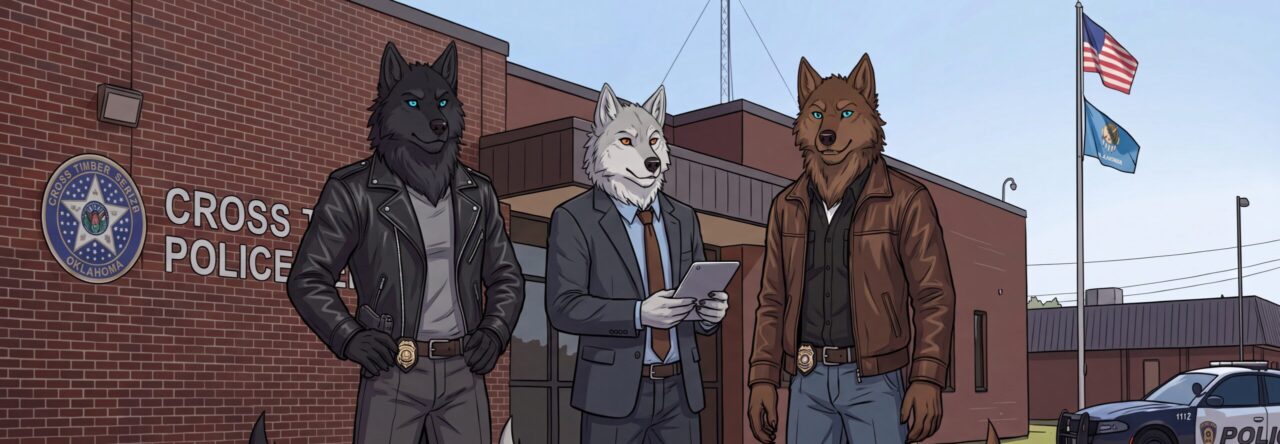
At 17:55 on Monday evening, Thane pulled the Humvee into the Cross Timber Police Department lot and saw Officer Patel drop Darnell near the employee entrance.
Not in a patrol unit.
In Patel’s personal crossover.
Darnell climbed out with a paper coffee cup in one hand and his duty bag over one shoulder. He leaned back toward the open passenger window.
“I owe you gas money.”
Patel looked at him through the window.
“You owe me one quiet ride home when this is over.”
“That is not a real thing.”
“It is now.”
She pulled into a parking space beside the row of employee vehicles.
Gabriel watched through the passenger-side window of the Humvee.
“Darnell has a chauffeur.”
Darnell glanced over.
“My truck is at Northline.”
Gabriel’s ears tipped forward.
“Bad?”
“Depends how much you enjoy transmissions.”
“I enjoy them best when they remain inside vehicles.”
“Then it is bad.”
That was all Darnell said.
He headed for the employee entrance with Patel beside him.
Thane parked the Humvee in its normal space.
Mark climbed out of the backseat.
“Transmission?”
“Apparently,” Thane said.
Gabriel shut his door.
“Are we asking?”
“No.”
Gabriel nodded once.
“Correct answer.”
They entered the station together.
The Investigations hallway was quiet for the beginning of shift.
No raised voices near the vending machines.
No reporters in the lobby.
No department-wide emergency moving through the radio room.
Just the familiar smell of coffee, printer toner, wet pavement tracked in from the parking lot, and the faint tiredness of a building changing shifts.
Voss stood in the case room doorway when they arrived.
Rusk was at the table behind her, holding coffee in one hand and two thin folders in the other.
“Night Shift,” Voss said.
Gabriel looked around.
“No press conference?”
“Not tonight.”
“No rawhide?”
Rusk looked at Thane.
“Not from me.”
Thane gave him a long look.
Rusk lifted his coffee.
“I learned something from Friday.”
Gabriel leaned toward Mark.
“He absolutely did not.”
“I heard that,” Rusk said.
“That was intentional.”
Voss set the folders on the table.
“Nothing active requiring overnight detective work. One stolen vehicle recovered at a tow yard, but the owner has been notified and day shift will handle the follow-up. A burglary report from Cedar Ridge may become something more, but at the moment it is a broken rear window, an unlocked garage, and a homeowner who may have misplaced his own power tools.”
Mark opened the first folder.
“Any evidence indicating entry?”
“Nothing obvious.”
“Any camera footage?”
“A doorbell camera facing the wrong direction.”
Gabriel sighed.
“Of course it does.”
“The owner said he bought it on sale,” Rusk said.
“That makes it less useful but somehow more understandable.”
Voss continued.
“Crowe wants you available for general patrol support. Darnell and Grant are handling a disturbance call near Willow Creek if it develops.”
“No cases,” Gabriel said.
“No cases,” Voss confirmed.
Thane nodded.
“Good.”
Rusk looked at the three of them.
“Try to keep the city standing until morning.”
Gabriel smiled.
“That is a very broad assignment.”
“It is the best kind.”
Voss gathered her notebook.
“Have a boring Monday.”
Gabriel stood.
“Finally, an achievable goal.”
At 20:21, boring Monday took the form of a cable barrier, two blocked lanes, and a utility contractor who had misunderstood the difference between secured and tied down.
A flatbed trailer carrying bundled orange construction barrier had hit a pothole on East Hunter as the driver turned toward the industrial park.
One roll came loose.
Then another.
By the time Grant arrived, bright orange mesh had blown across both lanes and wrapped itself around a road sign, a traffic barrel, and one extremely unhappy sedan that had stopped halfway through the mess.
The contractor stood beside his truck with both hands on his hips.
“I had ratchet straps on it.”
Grant looked at the torn strap hanging from the trailer rail.
“You had one ratchet strap on it.”
“I had two.”
“One is in the road.”
He looked at the barrier fluttering under the streetlights.
“Right.”
The Humvee pulled in behind Grant’s unit.
Thane parked at an angle to protect the nearest lane, set the hazard lights, and stepped out.
Gabriel stared at the orange mesh.
Then at the contractor.
Then at the roadway.
“Congratulations,” he said. “You have invented industrial spaghetti.”
The contractor blinked.
“What?”
“Nothing. We will get it cleared.”
Mark walked the edge of the trailer, studying the remaining load.
“The weight distribution is uneven. Do not move the vehicle until the loose materials are resecured.”
The contractor nodded.
“Okay.”
Grant looked toward Thane.
“Can you and Gabriel pull the barrier clear while we keep traffic stopped?”
“Yes.”
She was not asking his permission.
She was coordinating a scene where everyone had a job.
Thane and Gabriel took opposite ends of the tangled mesh, working along the shoulder to gather it into manageable sections. The barrier caught against boots, road seams, and the underside of the stopped sedan, but between them they freed it without dragging it across traffic.
Mark worked with the contractor to redistribute the remaining bundles.
Grant directed cars through the single open lane.
Darnell arrived in his patrol unit just as they cleared the first section of road.
He stepped out, checked the traffic pattern, and moved to help Grant keep drivers from trying to make their own lanes through the work zone.
His phone rang.
He glanced at the screen.
Something in his face changed.
Not dramatically.
Just enough.
He walked a few steps away from the roadway before answering.
“Yeah. This is Darnell.”
He listened.
His shoulders settled lower.
“No, I understand what a transmission does.”
A pause.
“No. I am asking whether there is any version of that sentence that costs less than thirty-eight hundred dollars.”
Grant glanced in his direction.
Patel, who had arrived to help with traffic, did not.
Darnell listened again.
“Okay. Run it by me one more time.”
He rubbed one hand over the side of his face.
“Monday morning diagnosis. Replacement assembly. Labor. Fluids. Tax. I understand.”
Another pause.
“Call me when you know how quickly you can get the part.”
He ended the call.
For a few seconds, he stood beside his patrol unit looking down at his phone.
Then he put it away.
Patel walked over first.
“Northline?”
Darnell nodded.
“Transmission’s gone.”
Grant looked toward the trailer.
“Thirty-eight?”
“Thirty-eight hundred.”
Gabriel had stopped pulling orange mesh long enough to hear that.
His expression softened.
“That is brutal.”
Darnell gave him a small shrug.
“Could be worse.”
“It could,” Gabriel said. “It is still brutal.”
Patel’s voice stayed low.
“You put in the application?”
Darnell looked at her.
For a moment, Thane thought he might refuse the question.
Then he nodded once.
“This afternoon.”
“Good.”
Darnell’s jaw tightened.
“I do not love it.”
“You do not have to love it,” Patel said. “You just have to use the option that exists.”
Darnell looked down at his phone again.
Then nodded.
“Okay.”
Thane did not say anything.
He did not ask what application.
He did not need to.
The contractor tightened the final replacement strap.
Then tested it twice.
Grant watched him.
“Better?”
“Much better.”
“Good. You are going directly back to your yard and replacing every damaged strap before you haul anything else.”
“Yes, ma’am.”
Gabriel stood beside Thane, orange mesh draped over one shoulder.
“You know what I like about this?”
Thane looked at him.
“I am not sure I want to know.”
“No one is shooting anyone.”
“That is a good thing to like.”
“And we are helping with traffic cones.”
“That is also fine.”
Gabriel smiled.
“We are living the dream.”
Grant walked past them toward her unit.
“You are both putting that barrier in the truck bed, right?”
Gabriel looked at the huge tangled bundle.
“I was hoping it would become a community art installation.”
“No.”
“Worth asking.”
At 23:17, Patel’s laundromat alarm turned out to be neither a burglary nor an equipment fire.
It was a wedding ring.
Or, more accurately, the absence of one.
Rita’s Wash & Fold sat at the edge of a small shopping center beside a closed pharmacy and a discount furniture store. Its windows glowed under fluorescent lights, and the air inside smelled like detergent, warm fabric, and the metallic heat of overworked dryers.
A woman in a gray sweatshirt stood near a row of front-loading washers with both hands pressed against her mouth.
Her husband stood beside her, trying very hard to look calm.
He was not succeeding.
Patel met Night Shift near the entrance.
“Her ring was in the left pocket of a pair of jeans,” she said quietly. “She checked before loading them. Now it is gone. She thinks it came out during the cycle.”
Gabriel looked at the washers.
“Could it have?”
“Yes,” Patel said. “Possibly into a seal, drain catch, or beneath the machine. The manager has not arrived yet.”
The woman saw Thane and Mark approach.
Her eyes widened slightly.
Then her attention snapped back to the washer.
“I know it is stupid,” she said. “It is just a ring.”
“It is not stupid,” Thane said.
Her husband put one hand against her back.
“It was her grandmother’s.”
The woman swallowed.
“She gave it to me when I got married. She said she wore it through forty-seven years with my grandfather, and I was supposed to keep it safe.”
Mark crouched beside the washer.
“Which pocket?”
“Left front.”
“Did you check the drum?”
“Yes. Twice.”
“Did you check the door seal?”
“I do not know where—”
“I will.”
Mark carefully ran one claw along the thick rubber gasket around the washer door.
Nothing.
He checked the lower edge.
Still nothing.
Then he leaned closer.
“The ring may have moved behind the internal seal. I need the machine unplugged before we do anything further.”
Patel looked toward the manager’s office.
“Lockbox?”
The husband pointed.
“Behind the counter. The employee said the manager gave her a key.”
The employee hurried over with a ring of keys and a worried expression.
“I am so sorry. I did not know what else to do.”
“You called,” Patel said. “That was the right thing.”
Mark waited until the washer was unplugged.
Then, using the small emergency-release access panel beneath the door, he checked the narrow space around the lower filter housing.
His claws were precise.
Slow.
A few seconds passed.
Then Mark stopped.
The woman held her breath.
Mark reached farther into the opening.
When he withdrew his paw, a thin gold band rested against one dark claw.
The woman made a sound that was half laugh and half sob.
Her husband sat down abruptly in one of the plastic chairs.
Gabriel smiled.
“Found it.”
The woman took the ring from Mark with both hands.
She pressed it to her lips.
Then looked up at all of them.
“Thank you.”
Mark nodded.
“You should have the washer inspected before using it again. The seal has a gap large enough for small objects to move behind it.”
The employee looked horrified.
“I will call the manager.”
“Good.”
The woman slipped the ring back onto her finger.
Then clasped her hand tightly around it.
Thane watched her do that.
For a moment, he thought about the cards that had filled the station lobby after Heritage Liquor.
The drawings.
The flowers.
The way people sometimes believed helping had to be large to count.
But a ring found in a washer at midnight could be enormous to the person who had lost it.
Patel walked the couple toward the door.
The husband paused beside Thane.
“That was a good thing you did.”
Thane shook his head slightly.
“Mark found it.”
The husband looked at Mark.
Mark looked briefly uncomfortable with the direct attention.
Then the man smiled.
“Still. Good thing.”
Mark nodded once.
“Yes.”
Gabriel waited until they were back outside.
“That was nice.”
Mark glanced at him.
“The ring was not damaged.”
“I know. That is why it was nice.”
“It was also statistically fortunate.”
Gabriel looked at Thane.
“See? He is almost sentimental now.”
Mark got into the backseat.
“I am not.”
Thane started the Humvee.
“You were.”
“I was accurate.”
Gabriel smiled.
“Close enough.”
At 01:46, Night Shift assisted Darnell at a small apartment complex off Willow Creek.
The call had come in as a possible disturbance.
A resident reported shouting, a slammed door, and someone crying on the stairs.
By the time Thane, Gabriel, and Mark arrived, the immediate tension had already settled into something smaller and more complicated.
A young couple stood near the stairwell.
A toddler slept on the shoulder of a woman in a faded blue hoodie.
The man stood ten feet away, hands visible, eyes red, looking like he regretted every word he had said in the past hour.
Darnell had positioned himself between them without making it obvious.
Patel spoke quietly with the woman.
Grant talked to the man near the parking lot.
Nobody had been hit.
No property had been damaged.
No one wanted an arrest.
But both people needed the night to end without becoming worse.
Darnell looked at Thane as he approached.
“Can you take the guy for a walk around the building?” he asked. “Just enough distance that he stops trying to apologize directly at her.”
Thane nodded.
“Yeah.”
The man looked at him.
Then at the sleeping child.
Then back at Thane.
“I did not touch her.”
“I know,” Thane said. “Come walk.”
They went around the side of the building where the air smelled of damp grass, warm concrete, and someone’s late-night barbecue grill.
The man scrubbed both hands over his face.
“I keep trying to fix it while she is still mad.”
“That usually does not work,” Thane said.
“I know that. I just—”
“You want it over.”
The man looked at him.
“Yes.”
Thane nodded.
“Then stop trying to make her make you feel better about it.”
The man went quiet.
They walked a few more steps.
“I said things I should not have said.”
“Then tomorrow, you can apologize when she is ready to hear it.”
“What do I do tonight?”
“Give her room. Make sure the kid has what she needs. Sleep somewhere else if she asks you to. Do not turn one bad argument into five more because you cannot stand silence.”
The man looked down.
“Okay.”
When they returned to the stairwell, Patel had helped the woman arrange for her sister to pick her up.
Grant had the man’s keys in hand only long enough to make sure he was not driving angry.
Darnell stood by the patrol unit, taking the final notes.
The woman carried the sleeping toddler carefully to her sister’s car.
The man watched her leave.
Then turned to Darnell.
“I will stay at my brother’s.”
Darnell nodded.
“Good. Text him before you leave. Let him know you are coming.”
The man did.
No arrest.
No report that would make the morning news.
No miracle reconciliation.
Just two people separated for the night before a hard conversation became something unforgivable.
As Night Shift walked back toward the Humvee, Darnell fell into step beside Thane.
“Thanks,” he said.
“Of course.”
Darnell nodded.
His phone buzzed.
He glanced down automatically.
Then stopped.
The screen reflected pale light across his face.
Patel noticed first.
“Everything okay?”
Darnell did not answer for a second.
He read the message again.
Then let out a breath that seemed to come from somewhere deeper than his lungs.
“Yeah,” he said.
Patel’s expression changed.
“Yeah?”
Darnell looked at the phone.
“It went through.”
For a moment, nobody said anything.
Then Patel smiled.
“Good.”
Grant’s face softened.
“Good.”
Darnell read another line.
“Red River will pay Northline directly. The shop gets confirmation in the morning. They can order the part as soon as it clears.”
Gabriel looked at him.
“That is good news.”
Darnell nodded, still staring at the screen.
“Yeah.”
He sounded like he did not completely trust his voice.
Thane did not ask what had been submitted.
He did not ask who had reviewed it.
He only said, “Good.”
Darnell looked up.
Their eyes met.
Something passed across Darnell’s face.
Not certainty.
Not yet.
Just the recognition that Thane had heard enough to understand something mattered—and had not taken another inch.
Darnell put his phone away.
“Yeah,” he said again. “Good.”
The remainder of the shift passed in the quiet, useful pieces that rarely made anyone’s memory of a week.
They helped Grant keep a lane clear while a tow truck removed a stalled delivery van from an underpass.
They stood with Patel outside a convenience store while a locksmith replaced the damaged front lock after a delivery driver snapped a key in the cylinder.
They checked on an older man whose personal emergency alarm activated because he had leaned too heavily against the pendant while reaching for a can of soup.
He was fine.
Embarrassed.
And deeply offended that the responding officers insisted on making sure he actually had enough soup before leaving.
By 05:58, the sky over Cross Timber had begun turning from black to the soft, uncertain gray that came before sunrise.
The city was not awake yet.
But it was getting there.
Bakery lights came on.
A school bus moved empty through a quiet intersection.
A woman in running clothes crossed the street with a reflective leash in one hand and a sleepy beagle at the other end.
Thane drove the Humvee back toward the station.
Gabriel had gone quiet in the passenger seat.
Not asleep.
Gabriel did not usually sleep in moving vehicles.
He just looked tired in the good way—the way people did after a shift that had not demanded more than they could give.
Mark sat behind Thane with his tablet open, finishing the last patrol-assist notes.
“No unresolved follow-up,” Mark said.
“Good,” Thane replied.
Gabriel looked out the windshield.
“Boring Monday.”
“Very boring Monday,” Thane said.
Gabriel smiled faintly.
“I am starting to understand the appeal.”
Voss and Rusk were already in the case room at 06:27.
Voss had fresh coffee.
Rusk had a different fresh coffee.
Neither looked fully awake, but both had been detectives long enough to make exhaustion look like a scheduling preference.
“Anything burning?” Rusk asked.
“No,” Gabriel said.
“Any major crime?”
“No.”
“Any rawhide?”
Thane looked at him.
Rusk held up one hand.
“Professional curiosity.”
“Nothing,” Mark said.
Rusk sighed.
“Fine.”
The morning handoff was short.
No new investigative calls.
No violent incidents.
No warrants requiring follow-up.
Just patrol-assist reports, notes from the apartment disturbance, and a brief mention of the recovered wedding ring in case the laundromat manager called about the damaged machine.
Voss read through the summary.
“Good work.”
“Thank you,” Thane said.
Rusk looked at the stack of reports.
“You found a wedding ring in a washer.”
“Mark did,” Gabriel said.
“Technically,” Mark said, “the ring was lodged in an internal access gap.”
Rusk considered that.
“Romantic.”
Mark stared at him.
“That word does not apply.”
“It applied to somebody.”
Voss closed the folder.
“Go home.”
They did not need to be told twice.
Gabriel stood first.
“Cabin. Coffee. No alarms.”
Mark gathered his tablet.
“And breakfast.”
“Yes,” Gabriel said. “Breakfast first. Then no alarms.”
Thane rose from the table.
They walked together through the Investigations hallway toward the garage access door.
Darnell stood near the end of the corridor.
He had changed out of his duty gear.
His phone rested in one hand.
He looked up as they approached.
“Thane.”
The tone in his voice made Gabriel and Mark slow down.
Thane stopped.
“Yeah?”
Darnell glanced toward Gabriel and Mark.
Then back to Thane.
“Can I talk to you for a minute?”
Gabriel looked at Thane.
Thane gave the smallest nod.
“We’ll be by the Humvee,” Gabriel said.
Mark followed him through the garage door without comment.
They stepped into the garage, leaving Thane and Darnell in the quiet stretch of hallway beside the secured exit.
For several seconds, Darnell only looked at the phone in his hand.
Then he said, “You saw that earlier.”
Thane nodded once.
“I saw you got good news.”
“You did not ask what it was.”
“It was not mine to ask.”
Darnell looked down at the screen.
“My truck died Saturday.”
Thane waited.
“Transmission started slipping near the old rail bridge. I got it to the shoulder, barely. Had it towed to Northline. They were closed Sunday. Monday morning they gave me the estimate.”
He gave a short, humorless laugh.
“Thirty-eight hundred dollars.”
Thane’s ears shifted slightly.
Darnell continued.
“I had some savings. Not enough. Rent had cleared. My daughter’s summer program was due this week. Her mom has night shifts most of the month, so I have been doing more morning drop-offs.”
He looked at Thane.
“I can get myself to work. I have a unit. Patel has been good enough to give me a lift to the station. But I cannot get my kid where she needs to go. Cannot get groceries. Cannot get through a normal week without making it someone else’s problem.”
Thane nodded slowly.
“Patel told me to apply.”
“She was right.”
“I know.”
Darnell looked at his phone again.
“I hated doing it.”
“That does not mean it was wrong.”
“No.” Darnell shook his head. “It did not feel wrong. It just felt like admitting I had run out of options.”
Thane’s expression softened.
“You did not run out of options. You used one.”
Darnell looked at him.
For a second, he seemed like he might argue.
Then he looked back down.
“The approval says Red River will pay Northline directly. The truck should be ready in a few days, assuming they can get the part.”
“Good.”
“Good,” Darnell echoed.
The hallway stayed quiet.
Then Darnell looked up again.
“I need to ask something.”
Thane sighed softly.
“That phrase has never led anywhere good.”
Darnell’s mouth twitched.
“I know you did not know I applied.”
“I did not.”
“I know you did not know I was approved.”
“I did not.”
“I believe you.”
Thane waited.
Darnell leaned one shoulder against the wall.
“There have been stories for a while.”
“What kind of stories?”
“Not specific ones. Just patterns.” Darnell shrugged. “The fleet grant. Safe Steps. The Community Fund. Things get built or funded, and nobody ever wants credit for them. Most of what people say is probably garbage.”
Thane did not move.
Darnell continued.
“But I have worked scenes with you three. I have watched you take time for people when you did not have to. I have seen how serious you get when someone might feel obligated, embarrassed, or exposed.”
He looked down at his phone.
“Then I got that email, and you heard enough to know it mattered. You did not get curious. You looked relieved that whatever had happened helped.”
Thane’s ears tipped back slightly.
Darnell held his gaze.
“That did not feel like someone hearing routine good news.”
Thane said nothing.
“You three helped make this fund happen, didn’t you?”
The cleanest answer would have been no answer.
The safest answer would have been no answer.
The fund did not belong to them anymore. That had been the point. Red River held it. Independent reviewers made decisions. Direct vendors were paid. The department did not decide. The pack did not decide.
But Darnell stood in front of him with a truck that would be repaired, a daughter who would not lose her routine, and gratitude he had not asked for.
Thane did not want to lie.
So he chose the smallest truth he could.
“Yes,” he said quietly. “We helped establish it.”
Darnell went still.
Thane held up one paw before he could speak.
“But we do not decide who receives help. We do not review applications. We do not get names. I did not know your truck was in the shop. I did not know you applied. I did not know you were approved until you said it outside that apartment.”
“You are serious.”
“Yes.”
“So you put money into a fund and just let strangers decide?”
“Independent people with rules decide,” Thane said. “That matters.”
“Why?”
“Because otherwise it becomes a favor.”
Darnell looked down.
Thane continued.
“If we pick who gets help, people start wondering what they owe us. If we know who applies, people start wondering whether we will treat them differently on a scene or in a report. If they know we helped them, they may feel like they have to agree with us, protect us, laugh at our bad jokes, or look the other way when we are wrong.”
Darnell’s mouth pulled faintly to one side.
“Rusk bought you a rawhide bone.”
“That is exactly the kind of corruption I am trying to prevent.”
Darnell laughed once.
It was quiet.
Then it faded.
“I do not feel like I owe you,” he said.
“Good.”
“I feel grateful.”
“You are allowed to be grateful.”
Darnell looked at the phone in his hand.
“Then what do you want from me?”
“Use the help,” Thane said. “Take care of your daughter. Get your truck fixed. Keep doing your job the way you would have done it if the fund never existed.”
Darnell nodded slowly.
“And keep it quiet.”
“Yes.”
“Because the fund stays cleaner that way.”
“Yes.”
Darnell was quiet for a long moment.
Then he said, “You three really are rich, aren’t you?”
Thane’s ears tipped back.
“I would rather not talk about our money.”
“That is not a no.”
“No.”
Darnell’s expression became almost apologetic.
“I am not trying to be rude. I just do not understand how somebody becomes rich enough to help start something like this and still comes to work night shift in a Humvee.”
Thane looked through the garage-door window.
Gabriel leaned against the passenger side of the Humvee, talking with his hands about something Mark clearly had no interest in discussing.
Mark stood beside him, patient and quiet.
Thane looked back at Darnell.
“We have more than we need.”
Darnell blinked.
“That is a very calm way to say you are millionaires.”
Thane did not answer.
Darnell’s eyes widened a fraction.
“Oh.”
“Yes,” Thane said at last. “We are.”
Darnell was quiet for a moment.
Then he asked, “Why are you police officers?”
The question was not accusing.
It was honest.
Like Darnell had spent the entire night thinking about a broken truck, his daughter’s program, the fund that kept one bad week from becoming six worse ones, and the three wolves who could apparently afford to never work again but still answered calls about cable barriers, lost wedding rings, and arguments in apartment parking lots.
Thane considered him.
Then said, “Because money is useful, but it is not enough.”
Darnell waited.
“We have abilities that can help people,” Thane continued. “We have strength. We heal fast. We can hear things other people cannot. We can track. We can get somewhere quickly. We can take risks sometimes that other people should not have to take.”
He glanced toward the station around them.
“But none of that means much if we are not using it for something.”
Darnell’s expression changed.
Thane went on.
“The fund can help someone keep a vehicle running. Stay in an apartment. Cover emergency childcare. Get through one bad month before it becomes six worse ones.”
He looked at Darnell’s phone.
“And this job lets us help in other ways. We can show up. We can listen. We can look for people. We can stand between someone and a bad night. We can do it inside a system with rules, reports, oversight, and people who will tell us when we are wrong.”
Darnell was quiet.
“We do not need the paycheck,” Thane said. “But we want to use what we are to help folks. In as many ways as we can.”
For a moment, Darnell only looked at him.
Then he nodded.
“That makes more sense than I expected.”
Thane’s mouth twitched.
“It is not always a high bar.”
“No.” Darnell smiled. “But it is a hell of a reason.”
He held out his hand.
Thane took it carefully.
Darnell’s grip was firm.
Not worshipful.
Not indebted.
Just grateful.
“Thank you,” Darnell said.
“You do not owe us anything.”
“I know.”
“No special loyalty.”
Darnell’s smile widened slightly.
“I was already loyal to the department. I do not need a transmission to change that.”
“Good.”
“And I will not tell anyone.”
Thane nodded.
“Thank you.”
Darnell looked at his phone one more time.
“Anybody asks where the help came from, I have the right answer.”
Thane waited.
“Red River Community Foundation.”
“That is the right answer,” Thane said.
Darnell stepped back toward the garage door.
Then paused.
“And, for what it is worth, Detective?”
“Yeah?”
“My daughter gets to stay in her program.”
Thane’s ears lowered slightly.
“Good.”
Darnell nodded.
Then he walked away.
Thane watched him go for a moment before stepping through the garage door.
Gabriel looked up immediately.
“Everything okay?”
“Yeah.”
Mark studied his expression.
“Did he ask?”
“Yes.”
“Did you answer?”
“Some of it.”
Gabriel leaned against the Humvee.
“You are terrible at evasive answers.”
“I know.”
Mark nodded once.
“Did he agree to maintain confidentiality?”
“Yes.”
“Good.”
Thane opened the driver’s door.
Morning light reached across the garage entrance beyond them.
Somewhere across town, a transmission would be ordered, a repair would be completed, and a father would keep getting his daughter where she needed to go.
Thane did not know the details Red River had reviewed.
He did not know what the panel had considered.
He did not know whether there had been other applicants that day.
That was right.
The fund had done what it was built to do.
And Darnell did not owe him for it.
That was enough.