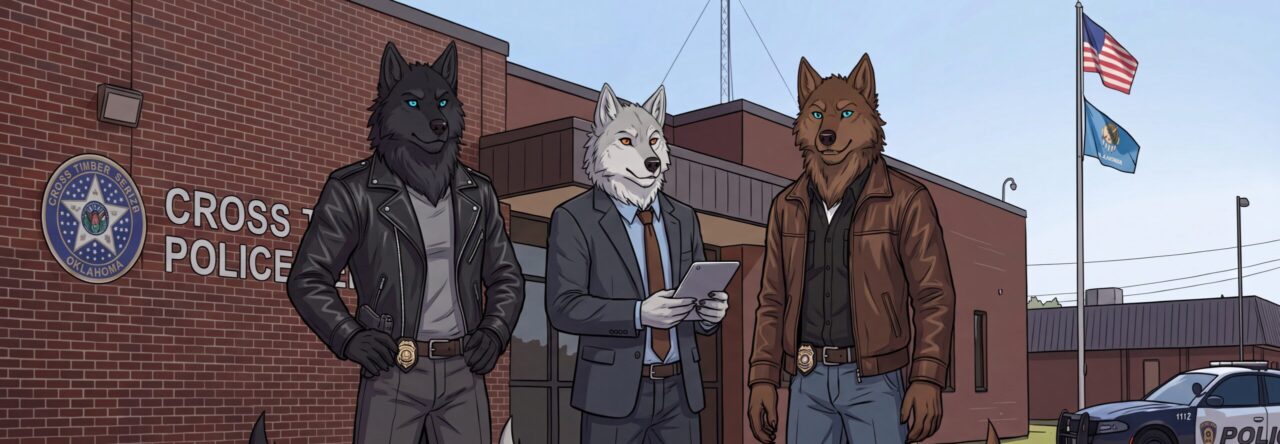
By Friday evening, Cross Timber had managed an entire week without asking Night Shift to stand in front of cameras, chase a suspect through an apartment complex, disarm a gunman, or explain werewolf physiology to anyone holding a microphone.
Gabriel considered that a civic achievement.
He said so at 18:04, standing in the small case room with one shoulder against the wall and a fresh coffee in one hand.
“I think we should commemorate it.”
Voss did not look up from the folder in front of her.
“With silence?”
“That was not where I was going.”
“It is where I am going.”
Rusk sat beside her, reviewing the short handoff sheet with the same solemn attention he might have given a homicide packet.
“Monday was quiet,” he said. “Tuesday was quieter. Wednesday somehow contained three lost-wallet reports, none of which belonged to the same person. Thursday involved a possum in a pharmacy stockroom.”
Gabriel lifted one finger.
“That possum was innocent.”
“It was in the antihistamines,” Mark said.
“It had seasonal needs.”
Thane leaned back in his chair.
“The pharmacist disagreed.”
“The pharmacist screamed,” Gabriel said. “That is not the same as disagreement.”
Voss finally looked up.
“The possum was removed without injury. The pharmacy resumed normal operation. No one filed a complaint.”
“Because we are excellent,” Gabriel said.
“Because Animal Control arrived before you named it.”
Gabriel paused.
“I had not named it.”
Mark looked at him.
“You were considering it.”
“I was considering options.”
Rusk turned a page.
“Other than the possum, the week has been mostly patrol assists, follow-up calls, and people discovering that summer creates noise complaints.”
Thane nodded.
“No major cases.”
“No major cases,” Voss confirmed.
There was relief in that.
Not because major cases were avoidable forever.
They were not.
The city would hurt again. Someone would go missing. Someone would lie. Someone would need the kind of help that came with reports, warrants, interviews, and hard answers.
But for one week, Cross Timber had mostly required officers to move traffic cones, calm arguments, recover property, check on people, and help ordinary problems remain ordinary.
That mattered too.
Mark opened his tablet.
“The Darnell vehicle issue is resolved?”
Voss glanced at him.
“Not a case.”
“I know. I am asking because we worked with him twice this week, and he was using a temporary ride arrangement.”
Rusk took a drink of coffee.
“His truck was returned Thursday afternoon. Northline replaced the transmission assembly and documented the work. Darnell has been instructed by several people, including Patel, not to personally inspect the repair while off duty and annoyed.”
Gabriel smiled.
“How did he take that?”
“Poorly,” Rusk said. “But silently.”
“Growth.”
Thane said nothing.
He had seen Darnell Thursday night in the parking lot.
No big conversation.
No renewed thanks.
Just Darnell leaning beside his repaired truck, one hand on the door, looking across the lot at Thane for a moment before giving a small nod.
Thane had nodded back.
No debt.
No favors.
No special loyalty.
Just a truck running again and a father able to get his daughter where she needed to go.
That was enough.
Voss slid the handoff folder toward Thane.
“Tonight should be the same kind of shift. Patrol is short two people because of training and one sick call. Crowe asked that you remain available for assists.”
“What kind?” Thane asked.
“Nothing complicated yet. Grant has a traffic complaint near the youth sports fields. Patel has a possible disabled vehicle near the west access road. Darnell is handling a welfare check that may only be a neighbor overreacting to unopened mail.”
Rusk added, “There is also a recurring complaint about teenagers skateboarding behind the old post office.”
Gabriel’s ears lifted.
“Are they damaging property?”
“No.”
“Threatening anyone?”
“No.”
“Leaving trash?”
“Apparently one energy-drink can.”
Gabriel looked offended.
“So the complaint is that teenagers are outside?”
Rusk nodded.
“An ancient crime.”
Mark made a note.
“If there is no property damage or trespass after posted hours, the appropriate response is likely advisory.”
Gabriel looked at him.
“You were born to make skateboarding less cool.”
“I have no opinion on skateboarding.”
“That is exactly what I mean.”
Voss closed her notebook.
“Go have another boring Friday.”
Thane stood.
“We will try.”
Rusk looked at him.
“Try harder than usual.”
Gabriel pointed at Rusk as they headed for the door.
“That sounded supportive.”
“It was not.”
“Still heard it that way.”
Rusk sighed.
Their first call came at 19:12 near the youth sports fields, where a line of cars had turned a narrow access road into a slow-moving knot of headlights, brake lights, and parental impatience.
Friday evening baseball.
Two fields active.
One concession stand running out of nacho cheese.
One parking lot designed by a person who had apparently believed families arrived by parachute.
Officer Grant stood near the entrance lane with a reflective vest over her uniform and a look of grim patience.
A man in a minivan had attempted to create his own parking spot beside a drainage ditch.
A woman in an SUV had blocked half the exit while waiting for someone to leave.
A pickup truck with a trailer full of folding chairs had stopped in the center lane because the driver was trying to call his wife and ask which field their grandson was on.
No one was injured.
Everyone was irritated.
That was sometimes worse.
Thane parked the Humvee near the far edge of the lot, where its size would not add to the problem.
Gabriel stepped out and surveyed the scene.
“Parent traffic,” he said quietly. “The purest form of civic collapse.”
Grant pointed at him.
“Do not start.”
“I had one sentence.”
“You always have one sentence. Then seven more show up.”
Mark was already studying the lot.
“The exit is blocked because vehicles entering the gravel overflow area are cutting across the flow instead of circling.”
Grant looked at him.
“Can you fix that without using the word flow?”
“Yes.”
“Good.”
Mark walked toward the overflow entrance and began directing vehicles into a single loop with short, precise gestures.
Gabriel took the minivan.
Thane took the pickup.
The driver of the pickup rolled down his window as Thane approached.
“I am just trying to find Field Two.”
“You are currently blocking both fields.”
The man looked around as though noticing the line behind him for the first time.
“Oh.”
“Pull forward to the gravel. Park along the fence. Then walk.”
“My wife said to call when I got here.”
“Call after you park.”
The man nodded quickly.
“Yes, sir.”
He moved.
The entire lane exhaled.
Gabriel convinced the minivan driver that the drainage ditch was not a parking space, even if “everybody else was making up rules.”
Grant got the SUV moving.
Mark turned the gravel overflow into something that almost resembled an intentional system.
Within fifteen minutes, the knot had loosened.
Parents still grumbled.
Children still ran across the grass with gloves and bats and snow cones.
The concession stand still ran out of nacho cheese, which caused one small boy to declare the evening ruined.
But no vehicles were trapped anymore.
Grant took off the reflective vest and looked at the three wolves.
“Thank you.”
Gabriel looked across the field.
“Do we get baseball?”
“No.”
“Not even one inning?”
“You are working.”
“I could emotionally support the community.”
“From your patrol-assist vehicle.”
Thane looked toward the concession stand.
A little girl with a batting helmet too large for her head stared at him from near the fence.
He lifted one hand.
She smiled, then hid behind her father’s leg.
Thane smiled faintly.
“Come on,” he said.
Gabriel sighed.
“Fine. But if the nacho-cheese situation becomes a riot, remember I warned you.”
At 21:03, Patel’s disabled-vehicle call turned out to be an overheated sedan, a grandmother named Mrs. Naylor, and two bags of frozen groceries that were losing their fight against the June evening.
The sedan sat on the shoulder near the west access road, hood raised, hazard lights blinking weakly.
Patel stood beside the driver’s door speaking with Mrs. Naylor, who was short, silver-haired, and furious at the engine.
“I told my son that car was making a noise.”
Patel nodded.
“What kind of noise?”
“A bad one.”
Gabriel stopped beside Thane.
“That is mechanically specific.”
Mark moved toward the open hood.
Mrs. Naylor pointed at him.
“Does he know cars?”
“Yes,” Thane said.
Mark glanced once into the engine compartment.
“Coolant leak.”
Mrs. Naylor looked at Patel.
“That sounds expensive.”
“It may not be catastrophic,” Mark said. “But it should not be driven tonight.”
Mrs. Naylor’s expression hardened.
“I have chicken in the trunk.”
That, apparently, was the emergency.
Thane looked at Patel.
“Tow?”
“Already called. Thirty minutes.”
Mrs. Naylor made a sound of deep betrayal.
“My chicken does not have thirty minutes.”
Gabriel leaned slightly toward Thane.
“This is our moment.”
Thane looked at him.
“Our moment?”
“To save the chicken.”
Mrs. Naylor pointed at Gabriel.
“He understands.”
Patel closed her eyes.
Mark checked the coolant reservoir, then stepped back.
“The vehicle needs to remain off. If she has a cooler, the groceries can be moved into it.”
Mrs. Naylor looked offended.
“If I had a cooler, I would not be discussing chicken with the police.”
Thane thought for a moment.
“There is an insulated evidence transport bag in the Humvee.”
Mark turned toward him.
“It is clean.”
“I know.”
“It has never been used for biological evidence.”
“I know.”
Gabriel looked delighted.
“We are saving chicken with police-adjacent logistics.”
“It is not police-adjacent,” Mark said. “It is a clean insulated bag.”
“It has department energy.”
Mrs. Naylor looked between them.
“Is it clean?”
“Yes, ma’am,” Thane said.
“Then I do not care what energy it has.”
They moved the frozen groceries into the insulated bag and placed it in the shade of the Humvee. Mrs. Naylor called her son, told him the police were saving her chicken, and then spent the next twenty minutes describing the sedan’s long history of disrespect.
When the tow truck arrived, her son arrived with it.
A tired man in work boots and a city utilities shirt climbed out of his pickup, took one look at the Humvee, the wolves, Patel, his mother, and the insulated grocery rescue operation, and said, “I am not asking.”
“Smart,” Gabriel said.
Mrs. Naylor took the grocery bag from Thane.
“You are very polite for something so large.”
Thane paused.
“Thank you.”
“I mean that as a compliment.”
“I accepted it as one.”
She patted his arm.
“You tell your mother you were raised right.”
Gabriel made a strangled sound.
Mark looked away.
Thane looked at Mrs. Naylor.
“I will.”
They waited until she and her son left safely with the groceries.
Patel watched the tow truck pull away.
“I am writing this as motorist assist.”
Gabriel leaned against the Humvee.
“Not poultry preservation?”
“No.”
“Missed opportunity.”
At 23:46, Darnell’s welfare check turned out to be unopened mail, an unplugged phone charger, and a retired teacher named Mr. Abbott who had become so engrossed in organizing his late wife’s recipe cards that he had forgotten to call his sister for two days.
He was not hurt.
He was not confused.
He was, however, surrounded by index cards, shoeboxes, and three open binders on the dining-room table.
Darnell stood in the doorway with one hand resting against the frame.
“Mr. Abbott, your sister was worried.”
Mr. Abbott, eighty-one and wearing a cardigan despite the warm night, adjusted his glasses.
“My sister worries professionally.”
“She said you call every evening.”
“I was busy.”
Gabriel looked at the table.
“With pie?”
“With history,” Mr. Abbott said.
That made Mark step closer.
“What kind of history?”
“My wife kept every family recipe she ever liked. Some are from her mother. Some from mine. Some from church friends who have been gone thirty years.” He picked up a card with careful fingers. “If I do not put them in order, half of this disappears when I do.”
The room changed slightly.
Darnell’s posture softened.
Thane looked at the table.
The cards were stained with vanilla, oil, coffee, and time.
Names were written in corners.
Dates.
Notes.
Too much salt.
Good for Christmas.
Marla liked this one.
Mr. Abbott saw Thane looking.
“She wrote comments on everything.”
Thane nodded.
“That seems useful.”
“It was annoying when she was alive,” Mr. Abbott said. “Now it is useful.”
No one answered quickly.
Finally, Gabriel said, “You should call your sister.”
Mr. Abbott sighed.
“Yes. I suppose I should.”
“Before she calls us again.”
“She would.”
“She did.”
Mr. Abbott looked at Darnell.
“Tell her I am alive.”
Darnell smiled.
“You can tell her yourself.”
Mr. Abbott reached for his phone.
It did not turn on.
Mark looked at the charger lying disconnected behind a side table.
“I found the issue.”
Mr. Abbott watched Mark plug it in.
Then the phone lit up.
“Well,” he said. “That is embarrassing.”
“Less embarrassing than a search party,” Gabriel said.
Mr. Abbott considered that.
“True.”
They stayed long enough for Mr. Abbott to call his sister, endure her scolding, and promise to call again the next evening.
As they left, he stopped Thane near the porch.
“You are the wolf from the news.”
Thane did not tense.
Not anymore.
“Yes.”
Mr. Abbott studied him for a moment.
“My wife would have liked you.”
Thane looked at him.
“Why?”
“She liked people who showed up.”
Then he stepped back inside and closed the door.
The porch light remained on behind them.
Darnell walked beside Thane down the path.
“Good check.”
“Yeah.”
“Better than some.”
Thane nodded.
“Much better.”
The next two hours passed in the kind of small work that filled a night without changing its shape.
A store alarm tripped because a helium balloon had drifted in front of a motion sensor.
Two teenagers behind the old post office were not damaging anything, though one did reluctantly pick up the energy-drink can after Mark looked at it for longer than was comfortable.
A delivery driver called for help after his van’s rear door jammed shut with half a restaurant order inside. Gabriel held the flashlight, Mark identified the latch problem, and Thane freed the door without bending it.
The driver stared at the rescued stack of food containers like they had pulled a child from a well.
“You saved twelve orders of wings.”
Gabriel placed one hand over his heart.
“Finally, someone understands the stakes.”
At 01:38, they sat in the Humvee in a mostly empty parking lot while Mark finished the brief notes on the delivery assist.
Gabriel had found a paper bag of fries in the order the restaurant had remade after the delay, and the owner had insisted they take them.
Mark had checked the bag.
Receipt.
No request.
No special treatment.
Acceptable.
Gabriel held a fry up between two claws.
“To slow weeks.”
Thane took one.
“To slow weeks.”
Mark took one after a moment.
“To properly documented slow weeks.”
Gabriel smiled.
“There he is.”
The radio carried routine traffic.
A parking complaint.
A medical call for Fire and EMS.
A noise complaint that resolved before anyone arrived because the caller’s neighbor turned the music down after receiving a text.
Normal.
Useful.
Manageable.
At 02:26, they helped Grant and Patel search a convenience-store parking lot for a lost set of keys that turned out to be inside the caller’s other pocket.
At 03:14, they stood by while a tow driver changed a tire for a college student whose spare had less air than the flat.
At 04:02, they checked a construction fence after a caller reported “a suspicious shadow,” which proved to be a loose tarp moving in the wind.
Gabriel looked at the tarp.
“Arrest it.”
Patel shook her head.
“No.”
“It was suspicious.”
“It was fabric.”
“Suspicious fabric.”
Mark looked at the fence tie.
“It does need to be secured.”
Gabriel pointed at him.
“See?”
“That is not probable cause.”
“You are ruining my case.”
Thane tied the tarp down.
Case closed.
At 04:47, they were on their way back from the construction site, heading east along Meridian toward the center of town.
The city had grown quiet in the way it did before dawn.
Not asleep.
Never fully asleep.
But lower.
Softer.
The traffic lights changed for almost no one. Gas-station signs glowed over empty pumps. A bakery truck turned slowly onto a side street. The first thin edge of gray waited somewhere beyond the rooftops.
Gabriel sat in the passenger seat, one elbow against the door, watching the dark storefronts pass.
Mark had finished the last patrol-assist note and closed his tablet.
Thane drove with the windows cracked enough to bring in the night air.
They passed the old library.
The closed hardware store.
The mural near the community clinic.
Then the city’s main shelter came into view.
Cross Timber Bridge House occupied a long brick building near the edge of downtown, where the old warehouse district had become a mix of social-service offices, storage lots, small churches, and businesses that opened early or not at all.
The shelter lights were on.
Not just the front light.
All of them.
The entrance doors stood open, and warm yellow light spilled onto the sidewalk.
A sign near the door read:
EVENING MEAL — 5:30–7:00
Another beneath it:
OVERNIGHT CHECK-IN FULL
The line was still there.
At nearly five in the morning, the dinner line should have been gone.
But people remained along the wall and around the corner, some sitting on the curb, some standing with bags at their feet, some wrapped in jackets despite the warm June night because exhaustion made everyone look cold.
No one was yelling.
No obvious fight.
No medical emergency.
No call for service.
Just a line of people waiting near a building that did not have enough of something.
Enough beds.
Enough food.
Enough staff.
Enough room.
Enough time.
Thane slowed without meaning to.
Gabriel’s expression changed.
Mark leaned slightly forward from the backseat.
For a few seconds, none of them spoke.
A man near the wall sat with his elbows on his knees and his head down.
A woman held a plastic grocery sack against her chest like it contained everything she owned.
An older man stood near the curb with a cane in one hand, staring at the open door with no expression at all.
A young person in a hoodie kept one hand on a backpack strap and the other around a paper cup.
Faces turned briefly toward the Humvee.
Not with excitement.
Not recognition first.
Just the wary instinct of people who had learned to notice vehicles, uniforms, power, attention.
Then most of them looked away.
Thane kept the Humvee moving slowly.
The line continued around the corner.
Farther than he expected.
Farther than it should have.
Gabriel’s voice was quiet when he finally spoke.
“Jesus.”
Mark did not correct him.
Thane looked through the windshield.
The shelter entrance passed beside them.
A volunteer in a yellow vest stepped outside carrying an empty plastic bin. He looked exhausted. Another person just inside the doorway held a clipboard and spoke gently to someone Thane could not see.
Thane’s chest tightened.
Not fear.
Not pain.
Something older.
Something sharper.
The feeling of seeing a problem big enough that strength alone looked useless against it.
“How awful must it be,” he said quietly, “to be homeless and broke?”
Neither Gabriel nor Mark answered quickly.
The Humvee rolled past the corner.
More people waited along the side street.
Some had blankets.
Some had bags.
Some had nothing visible at all.
Gabriel swallowed.
“I cannot imagine sleeping outside because every safe place is already full.”
Mark looked through the side window.
“Or having to decide whether to stand in line for food, shelter, paperwork, medical help, or a bathroom because each one requires time and energy you may not have.”
Thane’s paws tightened slightly on the wheel.
They had seen hardship before.
Victims who left homes with nothing but a phone and a child.
Officers one broken transmission away from crisis.
Families deciding which bill could wait.
People whose grief made them vulnerable to thieves.
But this was different in scale.
Not a single emergency.
A whole line of them.
A block-long reminder that being safe was not a default state.
The light changed ahead.
Thane stopped at the intersection.
No cars crossed.
No one honked.
For one suspended moment, the three of them sat in the Humvee while the shelter line stretched behind them in the mirrors.
Gabriel looked at Thane.
“We cannot fix all of that tonight.”
“I know.”
Mark’s voice was quiet.
“And not by showing up with money in our paws.”
Thane nodded.
“I know that too.”
The light turned green.
He did not move for half a second.
Then he drove.
The shelter disappeared behind them, but the image did not.
People along the wall.
The open door.
The sign that said overnight check-in full.
The faces.
Not all despair.
That would have been too simple.
Some were tired.
Some guarded.
Some blank.
Some embarrassed.
Some angry.
Some trying not to look like they were hoping too hard.
But the weight on the sidewalk was unmistakable.
By the time they reached the next block, Thane said, “We should stop by tomorrow.”
Gabriel turned toward him.
“Saturday?”
“Yeah.”
Mark asked, “In what capacity?”
“Not police,” Thane said. “Not donors. Not some big thing.”
Gabriel nodded slowly.
“Just us.”
“Just us,” Thane said. “Ask if they need hands. Serving food. Moving boxes. Cleaning. Whatever. Maybe we can cheer some folks up a little.”
Mark looked toward the rear window, though the shelter was gone from view.
“We should call first.”
“Yeah.”
“And ask what they actually need.”
“Yeah.”
“And not assume our presence helps.”
Thane nodded.
“Agreed.”
Gabriel’s ears lowered slightly.
“If they say no?”
“Then we respect that.”
“And if they say yes?”
Thane looked at the road ahead.
“Then we show up.”
Gabriel was quiet.
Then he said, “I want to.”
Mark nodded once.
“So do I.”
The words settled inside the Humvee.
Not a plan yet.
Not a solution.
Just the first honest response to seeing a line of people outside a shelter at the edge of morning and realizing that looking away would be easier.
Thane turned toward the station.
“Tomorrow,” he said.
Gabriel looked out the side window.
“Tomorrow.”
The rest of the shift stayed uneventful.
They returned to the station at 05:58.
Mark filed the final notes.
Gabriel refilled his coffee and did not drink it.
Thane stood for a moment in the garage beside the Humvee, looking toward the eastern edge of the sky as morning gathered itself over Cross Timber.
By 06:27, Voss and Rusk were back in the case room.
Voss looked at the stack of reports.
“Slow night?”
“Slow night,” Thane said.
Rusk took the top page.
“Traffic assist. Disabled vehicle. Welfare check. Store alarm. Delivery van. Lost keys. Tire assist. Suspicious tarp.”
Gabriel nodded.
“The tarp was suspicious.”
“No, it was not,” Mark said.
“It moved with intent.”
“It moved with wind.”
Rusk looked at Voss.
“Do we have a form for fabric-based criminal intent?”
“No.”
“We should.”
Voss ignored him and reviewed the summary.
“No arrests. No injuries. No pending detective follow-up.”
“No,” Mark said.
“Good.”
Thane stood beside the table.
He was listening.
He was answering.
But part of him was still at Bridge House.
At the line around the corner.
At the man with his head down.
At the woman holding the grocery sack like letting go of it might mean losing the last piece of a life.
Voss noticed.
She always did.
“You alright?”
Thane looked up.
“Yes.”
Rusk lowered his coffee slightly.
“That sounded mostly true.”
Gabriel glanced at Thane.
Then said, “We drove past Bridge House on the way back.”
The room changed quietly.
Voss’s expression settled.
Rusk looked down at the folder.
“They have been full most nights this month.”
Mark’s ears tipped forward.
“Social Services sent out a general notice last week. Meal demand is up. Overnight beds are full. Cooling-center planning is starting early because July is coming.”
Thane looked at her.
“Do they need volunteers?”
“Probably,” Voss said. “But ask them, not me. Shelter work has its own rules. People need dignity more than they need spectacle.”
Thane nodded.
“That is what we thought.”
Rusk looked between the three of them.
“Going tomorrow?”
“Maybe,” Gabriel said. “If they want us.”
Mark said, “The problem is systemic, resource-intensive, and affected by housing cost, mental health access, employment instability, addiction services, medical debt, domestic violence—”
Rusk held up one hand.
“I believe you.”
Mark stopped.
Gabriel looked at him.
“You were ready.”
“I was accurate.”
Thane’s mouth moved slightly.
Voss saw it and let the moment breathe.
Then she said, “Go home. Sleep. Call Bridge House when normal people are awake.”
Gabriel nodded.
“Define normal.”
“Not you.”
“Fair.”
They left the case room.
The station was waking around them.
Day shift moving in.
Night shift thinning out.
The old rhythm continuing because it had to.
In the garage, Thane unlocked the Humvee.
Gabriel climbed into the passenger seat.
Mark got into the back.
No one spoke until Thane started the engine.
Mark looked out toward the garage exit as morning light spilled in.
Thane backed the Humvee out into the pale morning.
The city waited beyond the lot.
Safe for some.
Hard for others.
Too hard for too many.
For one more night, Cross Timber had made it to dawn.
But not everyone in it had made it there easily.