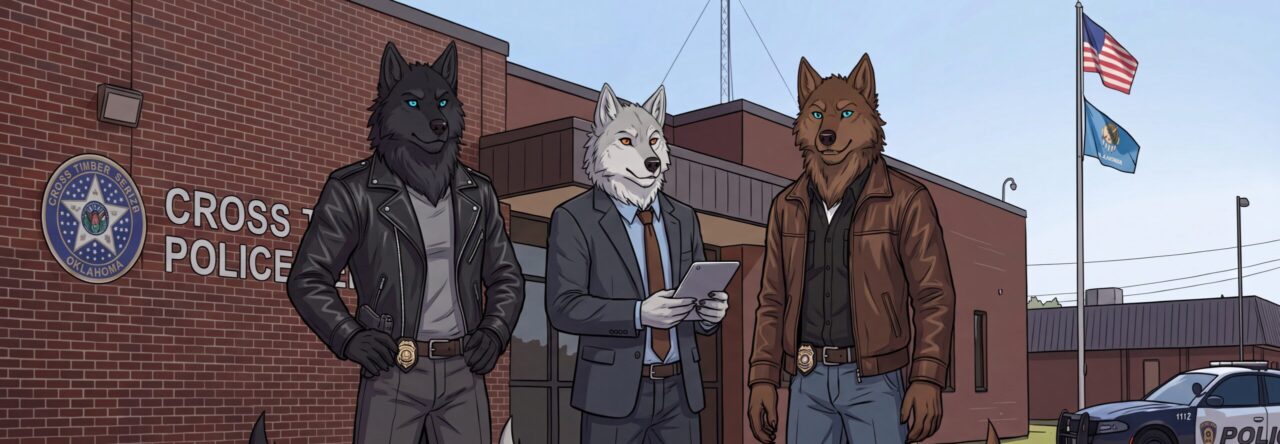
By twelve-oh-six, the rain had turned Cross Timber into a city of blurred headlights and shining streets.
Water ran in hard sheets down the station windows. Lightning flashed behind the detective bullpen, turning the glass white for an instant before leaving the room in monitor glow again.
The Night Shift office no longer looked new.
It looked occupied.
Case files covered two desks. Alicia Monroe’s photograph rested beside Mark’s open notebook. A printout of Cedarline’s badge-access log sat under Gabriel’s elbow. Thane stood at the wall map with one claw resting against the eastern edge of town, where red marker lines traced the route from Cedarline Contracting to the trailhead.
Cedarline.
Trailhead.
East Ridge.
Three places. One missing hour.
Mark sat at his desk with a department IT technician on speakerphone and three windows open across his monitor.
“Say that again,” Voss said.
Mark did not look up.
“Marin’s company laptop is not connecting from her home network.”
“Where is it connecting from?” Rusk asked.
Mark’s claws moved precisely over the keyboard.
“Vehicle hotspot.” He clicked through another screen. “The white crossover assigned to her has an active mobile connection. IT can identify the vehicle account, but the telematics feed is delayed.”
“How delayed?” Voss asked.
“Six minutes.”
Gabriel looked at the weather radar on the side monitor.
“Six minutes feels generous tonight.”
Mark’s eyes narrowed at a string of numbers.
“Last ping was east of town. Near East Ridge.”
Rusk swore under his breath.
The East Ridge project had been stalled twice that year—first by financing, then by weather. Half-built model homes sat along muddy graded roads, surrounded by stacks of lumber, wrapped insulation, portable work lights, generators, and unfinished utility trenches. Beyond the development, the ground dropped toward an old low-water crossing and a county road that became unreliable whenever the creek rose.
Thane studied the map.
“If she gets across the crossing before it floods, she has the old equipment yard and the county road.”
Gabriel turned toward him.
“If she does not?”
“She is trapped on the site.”
Voss took the warrant packet from the printer tray and skimmed the first page.
“Patrol gets both exits. Thane, take western containment. Bell and the west-side units are yours. Rusk, you and Gabriel approach the site office and trailer row. Mark, you stay mobile with me until we have a confirmed structure, then you move where the evidence needs you.”
Mark looked up.
“I can work the telematics from the command unit.”
“And when we have a scene?” Voss asked.
“I work the scene.”
“Good.”
Rusk grabbed his keys.
“No one enters alone. No one chases her into an unstable structure without confirming what we have.”
Thane looked at Voss.
“She has Alicia’s phone.”
“She may,” Voss said.
“She is deleting the records.”
“She is.”
“She may destroy both.”
Voss met his eyes.
For one second, the rain seemed to get louder against the windows.
Then Voss said, “You are detectives now. Use what you are.”
Gabriel went still.
Mark’s ears lifted slightly.
Voss continued.
“Find her. Preserve the evidence. Bring her in alive.”
Rusk opened the office door.
“Move.”
The Humvee fought through the storm like a stubborn green animal.
Thane drove with both hands planted on the wheel, windshield wipers slamming back and forth across the glass. Water pooled in the ruts of the access road. Mud sprayed high behind the tires. The headlights cut only a few yards into the rain before the darkness swallowed them.
Gabriel sat in the passenger seat, case bag at his feet, listening to dispatch traffic through one ear.
Mark rode in back with his laptop tethered to a portable hotspot and a charger plugged into the rear power port. The screen reflected pale light across his gray-white muzzle.
“Telematics updated,” he said.
Thane glanced at him through the rearview mirror.
“Where?”
“East Ridge main gate. Eleven fifty-nine.”
“Any movement after?”
“Not yet.”
“Could be delayed,” Gabriel said.
“It is delayed,” Mark answered. “That does not mean it is wrong.”
Thane turned onto the unfinished development’s access road.
The site gate stood open.
Patrol units had already set up at the north exit and the old creek crossing. Red-and-blue light pulsed across rows of unfinished homes. White rain jackets moved between portable floodlights.
The white crossover waited beside the site office trailer.
Empty.
Its engine ticked softly beneath the rain.
A reflective safety vest hung in the rear window.
Gabriel looked at it.
“That’s Eli’s vest.”
“Not his,” Mark said. “The type he saw.”
“Right. That sounded better in my head.”
Thane shut off the Humvee.
The night rushed in around them: rain, wet construction wood, diesel from a portable generator somewhere deeper in the site, soaked earth, fresh-cut lumber, cold metal, and the muddy river smell rising from the creek bed.
Bell was waiting beneath the trailer awning with two patrol officers, rain darkening his uniform shoulders. He saw Thane step out of the Humvee and gave him a short nod.
“Perimeter is locked, Detective. North gate and creek crossing are covered. West team is standing by. What do you need?”
Thane looked toward the white crossover.
“Keep the western access closed. Put one unit at the road cutoff and one on the rear footpath. Nobody approaches the east structure until I know where Marin is.”
“Copy.”
Thane stepped toward the crossover.
The smell hit him before he reached it.
Bleach.
Lavender.
Wet fabric.
Alicia’s blood—not fresh enough to overwhelm the rain, but there, trapped beneath the rear hatch seam and soaked into the cargo mat.
He crouched beside the rear tire.
The red clay in the treads matched the service road behind the trailhead. There was wild mint caught in the narrow grooves of the rubber, green leaves flattened hard against the mud.
Thane looked toward the unfinished homes.
The scent trail left the crossover and cut east.
Not toward the office trailer.
Not toward the north gate.
Toward the lowest row of model homes near the creek.
He followed it only as far as the marked western perimeter, then stopped.
The trail was not clean. Rain fought it. Construction dust, wet drywall, old smoke from a generator, and raw lumber layered over each other.
But Marin’s scent remained beneath the noise.
Lavender detergent.
Floral sanitizer.
The sharp copper edge of panic.
And Alicia’s phone.
Not the device itself, exactly. Electronics had their own smell when warmed by a hand and enclosed in plastic. Oil from fingers. Screen-cleaner residue. The faint warmed-metal scent that lingered in a pocket or bag.
Thane looked at Bell.
“Marin left the crossover on foot,” he said. “She is carrying something handled at the trailhead. Likely Alicia’s phone or evidence from the vehicle.”
Bell looked toward the unfinished homes.
“Direction?”
“East. Toward the model home nearest the creek.”
Bell studied the rain and the narrow route between the structures.
“You want the west side held?”
Thane nodded.
“Hold the west side. Nobody comes out through that rear line.”
“Done.”
Bell turned to the patrol officers.
“You heard Detective Thane. West line. No gaps.”
Mark came around the front of the crossover with an evidence light and a camera hanging from his neck.
“I have a match,” he said.
Voss joined them.
“Talk.”
Mark held up a photo on his phone.
“The reflective safety clip recovered at the trailhead has a torn plastic attachment point. This vest has the matching torn loop on the lower rear strap.”
Gabriel leaned closer.
“So the vest was in both places.”
“Likely,” Mark said. “It still needs lab comparison, but the damage pattern aligns.”
He moved the light toward the rear cargo area without opening it.
“Also, the industrial dust from the service road contains gypsum, red clay, and a fine aggregate consistent with the East Ridge site material. We collected trace transfer from Alicia’s crossover at the trailhead. The same blend is on Marin’s cargo mat.”
Voss looked between Mark and Thane.
“Can we say she transported Alicia?”
“Not yet,” Mark said. “We can say the vehicle likely traveled between the trailhead and this site. We can say the trace material is consistent. We still need to establish timing, content, and contact.”
“Good,” Voss said. “Keep every word of that.”
A gust hit the site hard enough to rattle loose plastic sheeting against the nearest frame.
Thane’s head turned.
There.
Faint beneath the generator hum.
A lighter wheel clicking.
Once.
Twice.
Then the soft crackle of paper catching fire.
Gabriel’s ears rose.
“You hear that?”
Thane nodded.
“Rear room.”
Gabriel tilted his head, listening through rain and the constant fluttering slap of plastic tarps.
“One person,” he said. “Moving slow. Something metal in one hand. Phone in the other, maybe. I hear the screen tapping against something when she shifts.”
Rusk looked toward the nearest unfinished model.
“Which room?”
“Back side,” Gabriel said. “Laundry or utility room. Generator is close.”
Mark glanced at the construction plan taped to the trailer wall.
He traced a finger across it.
“Model Four. Rear utility room opens onto an unfinished mudroom. The generator is outside the back wall. Permanent power is not connected.”
Voss lifted her radio.
“Units hold perimeter. No one approaches the east structure without direction. We have a suspect inside with a possible ignition source and evidence. Fire-rescue stage at the nearest safe point.”
She looked at the trio.
“Night Shift. Show me the room.”
The unfinished model home had no front door.
Just a rough opening beneath a temporary plastic flap that snapped wildly in the wind.
Inside, the structure smelled of wet wood, drywall dust, exposed insulation, and generator fumes. Rain hammered the roof sheathing overhead. Water blew through gaps around the windows, running down bare studs and pooling in pale streaks across the unfinished floor.
Rusk and Gabriel took the front opening.
Thane pointed Bell toward the narrow overhang along the west side.
“Stay with me. Watch the rear opening and keep Gabriel’s exit clear.”
Bell nodded once.
“With you, Detective.”
They moved along the side under the narrow overhang, careful of exposed nails and uneven ground.
Voss and Mark stayed outside the immediate entry path, protected behind a stack of wrapped lumber with a clear view through the open wall framing.
The portable generator chugged near the rear of the house.
Its exhaust mixed with the storm air.
The room beyond it glowed orange.
A metal trash can burned low beside a plastic folding table.
Marin Cole stood near it.
She had shed her rain jacket. Her lavender sweater clung damply to her arms. Her hair had come loose from its careful work knot. Alicia’s phone shone in one hand.
In the other, a cheap silver lighter trembled.
She looked smaller than Thane expected.
That did not make her less dangerous.
The phone was evidence.
The lighter was fire.
The house was unfinished.
The generator was running.
The rain had not made the structure safe. It had made it worse.
Gabriel stepped into the open front room but stopped well short of the rear utility area.
“Marin.”
She turned sharply.
The lighter came up.
Rusk’s hand hovered near his weapon but did not draw.
“My name is Detective Gabriel,” Gabriel said. “I need you to put down the lighter and the phone.”
Marin laughed once.
It was a broken sound.
“You don’t understand.”
Gabriel’s voice stayed low.
“Then help me understand. But do not burn the evidence while you do it.”
“You don’t know what she was doing.”
“We know Alicia found irregular payroll records.”
Marin’s face changed.
The lighter clicked again.
Every part of him wanted to close the distance.
The woman was cornered. The room was unstable. The fire was growing. One movement could turn the entire structure into a trap.
Thane stayed where he was, listening for the next thing that changed.
Marin looked through the half-built room toward the sound of the storm.
“She was going to destroy the company.”
Gabriel did not nod.
He did not soften the words for her.
“She was going to report what she found.”
“She didn’t understand.” Marin’s voice rose. “You think those numbers mean theft? You have no idea what it takes to keep a company afloat.”
“Then tell me,” Gabriel said. “Tell me what happened.”
Marin stared at the phone in her hand.
“She came in with that stupid report.” Her breath shook. “She had screenshots. Notes. She said she was going to take it to the owner on Monday.”
“Did you meet her at Cedarline?”
“Yes.”
“Did you argue?”
“Yes.”
“Did you hurt her?”
Marin’s face crumpled.
“She fell.”
Gabriel did not rush to fill in the space.
Rain slammed against the half-finished roof.
The generator sputtered.
The paper in the trash can crackled louder.
“Tell me what happened,” Gabriel said again.
“She was going to ruin everything.”
“Alicia was going to report theft.”
“It was not theft.” Marin’s eyes flashed. “I was keeping things moving. The projects were bleeding. Vendors wanted money. People needed jobs. I moved funds where they had to go.”
“You used inactive employee accounts.”
“I borrowed from them.”
“You created a vendor that did not exist.”
“I made it work.”
“You took money that was not yours.”
Marin looked at him like he had struck her.
Then she looked toward the rear door.
Thane saw it.
The thought of running.
The ground beyond the door sloped toward the creek. Rainwater was already pouring through the back opening in a widening stream.
The drop beyond the threshold was hidden in darkness.
A person could take three steps and disappear into the drainage cut.
Voss spoke over the radio from outside.
“Thane. Report rear terrain.”
He answered without taking his eyes off Marin.
“Water rising behind the structure. Ground drops past the rear door. Mud is unstable. She cannot see where she would step.”
Voss’s voice came back calm.
“Use it.”
Thane spoke then.
Not loud.
Not threatening.
“Marin.”
She looked at him.
“You are not going to hurt me?” she asked.
The question hung in the unfinished room.
Thane could hear Gabriel breathe.
Could smell Bell’s attention sharpen beside him.
He looked at Marin’s shaking hand around the lighter.
At the phone.
At the fire.
At the water moving behind her.
“No,” he said.
Marin stared.
Thane kept his voice low.
“But you need to put the lighter down and come out. The water is rising behind you. The ground drops past that door. You cannot see where you are stepping.”
“I can get out.”
“Not that way.”
“You don’t know that.”
“I know enough.”
Her eyes flicked toward the rear door again.
The lighter trembled harder.
A gust tore through the exposed framing.
The plastic covering one wall ripped free with a violent crack.
A section of temporary exterior bracing shuddered.
Thane heard the change before anyone else.
Wood under strain.
A long, splitting groan from the side wall nearest the utility room.
“East wall is going,” he said.
Mark’s voice snapped through the radio.
“I see it. The temporary brace is pulling loose from the sill.”
Voss answered at once.
“Thane, you have scene safety. Can you stabilize it without crossing the fire line?”
“Yes.”
“Do it.”
Thane keyed his radio.
“Bell, take the rear exit with Rusk. Keep Gabriel’s path clear. Fire-rescue Lieutenant, I need a shore brace on the east wall now.”
Bell did not hesitate.
“On it, Detective.”
The fire-rescue lieutenant answered through the noise.
“Moving.”
Thane moved.
Not toward Marin.
Toward the wall.
The unfinished exterior frame leaned inward as the wind pressed hard against loose plastic and wet sheathing. One of the diagonal temporary braces had come free at the top. The wall was not about to collapse like a building in a movie, but it was shifting enough to turn the narrow room into a crush point if it gave way.
Thane planted both feet in the mud just outside the open framing.
His claws dug deep.
He put one shoulder beneath the sagging beam and both hands against the wet stud wall.
The wood groaned again.
Then stopped moving.
The force of it drove through his arms and spine, heavy but manageable.
Rain ran down his muzzle.
Mud sucked at his feet.
Behind the wall, Marin stared at him.
The lighter remained in her hand.
Gabriel took one careful step forward.
“Marin,” he said. “Look at him.”
She did.
Thane held the wall in place.
Not looking at her like prey.
Not growling.
Not demanding anything.
Just holding the danger away from everyone in the room.
“You have choices,” Gabriel said. “But burning the phone is not one of them.”
Marin shook her head.
“You don’t understand.”
“Then explain it later,” Gabriel said. “You can tell us what happened. You do not get to decide what it means alone.”
Her eyes filled.
“I did not mean to kill her.”
The room went still.
Even the generator seemed quieter.
Gabriel’s voice softened, but did not forgive.
“Then do not make us guess what happened. Put it down.”
The fire in the trash can flared.
Rusk moved closer with the extinguisher he had taken from the entry station.
Marin looked at the burning papers.
Then at Alicia’s phone.
Then at Thane holding the wall against the storm.
She dropped the lighter.
It struck the wet floor with a small metallic clink.
Gabriel did not move.
“The phone too.”
Marin held it for another second.
Then let it fall.
The phone hit the floor beside the lighter.
Rusk moved first.
He crossed quickly, kicked the trash can away from the wall, and discharged the extinguisher in a short burst. White foam swallowed the fire. He recovered the lighter and phone with evidence gloves from a pouch at his belt.
“Evidence secure,” he said.
“Marin,” Gabriel said. “Walk toward my voice.”
She took one step.
Then another.
Her knees gave out before she reached him.
Bell and Rusk had already cleared the side exit. The fire-rescue lieutenant and another firefighter forced a temporary shore brace into position beneath the shifting frame.
Thane kept the wall steady until the lieutenant looked toward him and raised a hand.
“Brace is holding.”
Thane tested the pressure once, felt the load transfer into the new support, and stepped clear.
Bell called from the side exit, soaked through and breathing hard.
“Clear route, Detective.”
Thane nodded.
“Keep it clear until we have her out.”
The wall held.
He moved into the room only after the path had been cleared.
Marin was on her knees in the wet floor dust, sobbing into both hands.
Thane approached.
“Marin Cole,” he said. “You are under arrest for the murder of Alicia Monroe.”
She looked up at him.
“You said you wouldn’t hurt me.”
“I won’t.”
He guided her hands behind her back.
No pressure beyond what was needed.
No anger.
No performance.
The cuffs clicked.
Thane secured the cuffs, checked their placement, and released Marin’s arm the instant the restraint was complete.
No extra pressure.
No warning squeeze.
No need to prove anything.
Bell remained at the clear exit, directing the transport officer toward the safest route through the mud.
Marin folded forward, crying.
Gabriel crouched several feet away—not touching her, not comforting her, just keeping his voice steady.
“Medical is going to check you,” he said. “Then we are going to talk.”
Marin did not answer.
The storm moved through the open walls around them.
And for the first time that night, the case stopped running.
The first scene at Cedarline told the story better than Marin ever could.
By two in the morning, Voss had a search warrant team at the company office. The building’s security footage was recovered before the storm could knock out the external backup connection.
Mark stood beside Voss in the mobile command SUV as the video played.
The footage was grainy.
Enough.
Alicia entered the office at 7:41 p.m.
Marin met her near the finance wing.
They spoke in the hall.
Neither looked calm.
At 8:03, the two women entered the loading corridor near the rear exit.
The camera angle caught only part of the space. Stacks of wrapped materials blocked the far end.
Alicia raised a hand.
Marin moved closer.
The audio was poor, but the argument was unmistakable.
At 8:10, Alicia turned toward the exit.
Marin stepped in front of her.
Alicia shoved past.
Marin grabbed her arm.
The video shook once as a forklift passed outside.
Then came a hard sound.
Metal against something solid.
When the camera cleared, Alicia was down behind the stack of materials.
Marin stood frozen for two seconds.
Then she looked toward the camera.
Looked at Alicia.
And ran.
She returned six minutes later with a rolling equipment cart.
At 8:24, the cart moved toward the rear exit beneath a tarp.
Alicia’s badge never registered out.
Marin’s did.
Mark watched the timestamp.
Then pulled up the vehicle telematics beside it.
White crossover leaving Cedarline.
White crossover at the trailhead service road.
White crossover at East Ridge.
The path existed now.
Not as a wolf’s certainty.
Not as a hunch.
As facts.
Mark opened the phone recovery report from the digital-forensics technician working across the lot.
“Voss.”
She looked at him.
“The phone log confirms a remote lock at 9:31.”
“From Alicia’s phone?”
“Yes.”
“Meaning?”
Mark looked at the vehicle record.
“Marin left Alicia’s key fob inside the crossover. Then used the companion app on Alicia’s phone to lock the vehicle from outside after she staged the body.”
The locked car had been deliberate.
The phone had not been missing property.
It had been the tool.
And the evidence.
Mark stared at the recovered activity log.
“Marin did not take the phone because it mattered to Alicia,” he said. “She took it because it could lock the car, erase the files, and show where she had been.”
Voss nodded.
“Put that in the warrant supplement.”
Mark’s claws clicked softly against the keyboard.
“It also contains the login record for Alicia’s payroll folder. There is an audio file from the meeting.”
“Can we recover it?”
“Probably.”
“Probably?”
Mark looked up.
“It is enough to work.”
Voss’s mouth shifted.
“Good.”
In the interview room before dawn, Marin gave them pieces.
Not a confession anyone would call clean.
Not a story that spared her.
Just pieces.
Gabriel sat across from her. Priya joined by secure video from home, hair pulled back and expression already alert despite the hour. Rusk stood near the observation window with his arms folded.
Marin looked exhausted now.
Her lavender sweater had been bagged as evidence. She wore a department-issued gray shirt. Her hands rested on the table, cuffed in front.
Gabriel placed a printed still from the Cedarline footage between them.
Alicia in the loading corridor.
Marin facing her.
“You argued,” he said.
Marin stared at the image.
“She was going to ruin everything.”
“Alicia was going to report fraud.”
“It was not fraud.”
Gabriel waited.
Marin’s mouth tightened.
“I took money. I moved money. I paid things that needed to be paid.”
“You used inactive employee accounts.”
“I was going to put it back.”
“You created a vendor that did not exist.”
“I was keeping the projects alive.”
“You were stealing.”
Marin looked at him with something like hatred.
“She did not understand.”
Gabriel’s voice stayed level.
“She understood enough to save the records.”
Marin looked away.
“What happened in the loading corridor?”
“She shoved me.”
“Then what?”
“She fell.”
“Into what?”
“I don’t know.”
“The steel cabinet?”
Silence.
Gabriel did not push the answer into her mouth.
He let it stay there.
Finally, Marin whispered, “She hit her head.”
“Was she alive?”
Marin’s eyes filled again.
“Yes.”
“Did you call for help?”
“No.”
“Why not?”
“She was going to report me.”
“So you put her on a cart.”
Marin covered her face with both hands.
“You drove her to the trailhead.”
No answer.
“You put her in her car.”
No answer.
“You locked the car from outside.”
Marin’s shoulders shook.
“You took her phone.”
No answer.
Gabriel leaned back.
“You can explain your choices later. But every time Alicia needed help, you made another choice.”
Marin lowered her hands.
For the first time, she looked at him.
Not through him.
Not at the room around him.
At him.
“I panicked.”
Gabriel nodded once.
“Panic is not the same thing as an accident.”
No one spoke after that.
There was nothing left to improve by making her cry harder.
The evidence already held.
Mara Monroe came to the station after sunrise.
The rain had passed, leaving Cross Timber washed cold and silver beneath the morning light. Water dripped from every tree along the station lot. The air smelled clean in the way it did only after a hard storm had beaten everything down.
Mara sat in the family interview room with a paper cup of coffee she had not touched.
Voss sat across from her.
Gabriel stood near the window. Mark had a thin folder in his hands. Thane remained by the door, not looming, not distant—just there.
Voss spoke first.
“We have someone in custody for Alicia’s death.”
Mara closed her eyes.
Her breath caught.
“Who?”
“Marin Cole. Finance director at Cedarline.”
Mara stared at her.
“Marin?”
“She and Alicia met at Cedarline last night,” Voss said. “Alicia had uncovered financial fraud involving company payroll records. During the confrontation, Alicia was seriously injured.”
Mara pressed one hand over her mouth.
“Marin did this?”
“Yes.”
“What about Nate?”
Gabriel stepped forward slightly.
“Nate was investigated,” he said. “He had sent threatening messages. He had reason to be angry. But the evidence confirms he was at the sports bar during the time Alicia was transported to the trailhead.”
Mara looked down.
“I thought it was him.”
“A lot of people did,” Gabriel said gently.
“He was awful to her.”
“He may have been,” Gabriel said. “But he did not kill her.”
Mara’s eyes filled again.
Mark opened the folder in his hands.
“Your sister saved records,” he said.
Mara looked at him.
“She documented the irregular payroll payments. She kept notes. She created a file with the information Marin was trying to erase.”
“Did that get her killed?”
The question sat in the room.
Mark did not answer quickly.
“No,” he said. “Marin’s choices got her killed.”
Mara looked down at the untouched coffee.
Thane spoke then.
“She made it hard for someone to erase what they did.”
Mara’s shoulders shook.
This time, when she cried, no one tried to make it better.
There was no better.
Gabriel handed her a tissue box.
Mark set Alicia’s recovered notes folder on the table but did not push it toward her.
Voss explained what came next.
The medical examiner.
The prosecutor.
The evidence process.
The long road through court.
It was not comfort.
But it was truth.
And sometimes that was the only thing detectives could offer.
By sunrise, the Night Shift office looked like it had survived a small war.
Three empty coffee cups sat on Mark’s desk.
Gabriel’s chair was turned sideways, one foot hooked beneath the edge of the evidence cabinet. A half-eaten protein bar had disappeared somewhere under a stack of reports.
Thane stood before the wall map.
A new case card had been pinned beneath a red line running from Cedarline to the trailhead, then east to East Ridge.
ALICIA MONROE
HOMICIDE / FINANCIAL FRAUD
MARIN COLE — IN CUSTODY
Below it, Mark had added another card.
NATE WILCOX — CLEARED / NOT RESPONSIBLE
Gabriel came up beside him, holding a fresh cup of coffee.
“First night as detectives,” he said. “We got a murder, fraud, a rainstorm, and a woman trying to set paperwork on fire.”
Mark looked up from his report.
“Technically, she tried to set paper on fire.”
Gabriel turned toward him.
“You are going to be exhausting in this office.”
“The office is already exhausted.”
Thane looked at the board.
Alicia’s photograph.
Nate’s name moved out of the suspect column.
Marin’s arrest card.
The route between scenes.
The facts that had refused to line up until the team gave them room to be wrong first.
“We almost had the wrong answer,” Thane said.
Mark joined him at the board.
“We had the first answer.”
Gabriel leaned against the desk.
“Then we did the work.”
Voss appeared in the doorway with a fresh stack of overnight reports tucked beneath one arm.
“Good,” she said. “Learn from this one.”
Rusk followed behind her, coat still damp at the shoulders.
“And do not get attached to sleep.”
Gabriel accepted the coffee Voss handed him.
“Detective work is glamorous.”
Rusk looked at the case board.
“It is paperwork with consequences.”
Thane looked at Alicia’s photograph one last time.
He did not feel triumphant.
He felt responsible.
That was better.
Outside, the storm had passed.
The evidence had not.
And Night Shift had its first case.