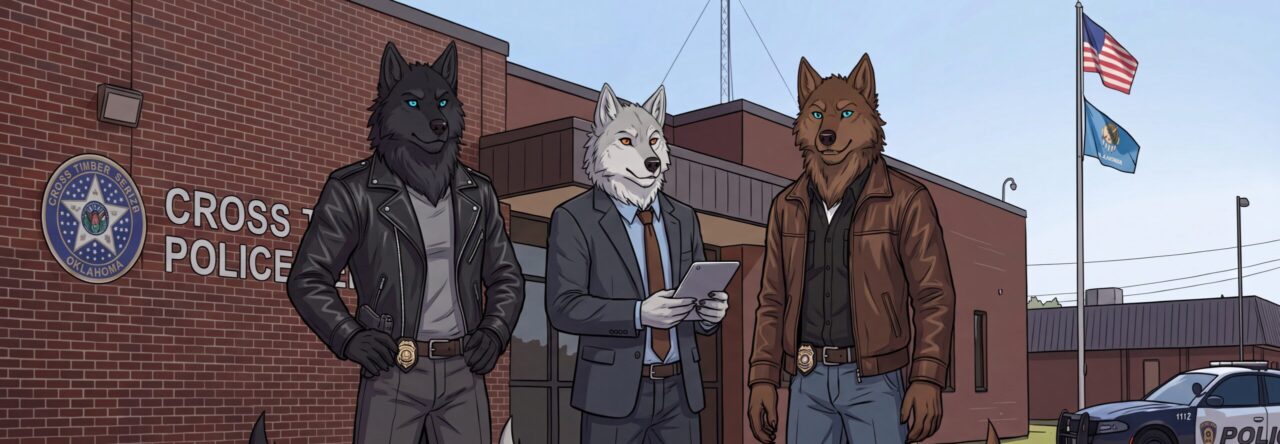
Three nights after Cole Varela was taken into custody, Night Shift came in expecting a quiet Thursday.
That was the first mistake.
Not theirs.
Not anyone’s, exactly.
It was simply the sort of thing police officers said when the city had been calm for several hours, the weather was warm without being brutal, and the handoff folder waiting in the small case room contained more loose ends than emergencies.
Voss and Rusk stood at the end of the table when the three wolves entered.
Rusk had coffee.
Voss had two slim case files, a tablet, and the expression she wore when she had already organized a problem into the things that mattered and the things that could wait until morning.
Thane sat down.
Gabriel took the chair beside him.
Mark opened his laptop and set his small notebook within reach.
Rusk glanced at Thane.
“No footwear questions tonight.”
Thane looked at him.
“Why would there be footwear questions?”
“Because, apparently, there are no limits to what people will ask a wolf detective after he appears in a national hiking video.”
Gabriel sat back.
“That is not even a joke anymore. It is public-service forecasting.”
Voss gave Rusk a look.
He lifted his coffee.
“I said nothing about boots.”
“You were about to.”
“I was not.”
“You were.”
Rusk smiled.
“Maybe.”
Thane looked at Voss.
“Can we work?”
“Yes,” she said.
She slid the first file across the table.
“Varela is in custody. Property Crimes, Digital Forensics, and the county fraud unit have the larger investigation. They have identified sixteen probable victims across the four apartment properties. More may follow once the laptop and recovered records are processed.”
Mark nodded.
“Jessa?”
“Her attorney is talking with the prosecutor’s office,” Voss said. “The company is conducting an internal review of the fee waivers, access failures, and key controls. She has not been charged with the burglary pattern or the identity theft activity. At this point, the evidence does not place her in those crimes.”
Gabriel leaned forward.
“Good.”
“Do not confuse that with the matter being over,” Voss said. “It is not. But she gave us information that mattered when it counted.”
Thane looked at the file.
“Maya and Alana?”
“Both are home. Both units have new locks, new access protocols, and patrol checks for now. Victim Services is helping them decide what they need next.”
“Good,” Thane said.
Voss nodded once.
The second file held little that required Night Shift.
A recovered stolen vehicle needed follow-up in the morning. A suspected retail-fraud ring had been handed to Financial Crimes. A small evidence discrepancy from a weekend call had already been corrected.
Normal work.
Necessary work.
Nothing that made the room feel dangerous.
Rusk tapped the folder with one finger.
“So, barring catastrophe, you have a mostly ordinary Thursday.”
Gabriel looked at Thane.
“We should not say it out loud.”
“I did not say it,” Rusk said. “I implied it.”
“That is worse,” Mark said.
Rusk stared at him.
“You are becoming a problem.”
Mark considered that.
“I think I have been one for some time.”
Voss closed the folders.
“Crowe has a patrol support request near the east commercial strip, but it is a property-dispute follow-up. No active risk. Take it if you are clear.”
Thane nodded.
“Okay.”
Voss looked at all three of them.
“Go have a boring night.”
Rusk lifted his coffee.
“And do not become any additional cultural phenomena.”
Gabriel stood.
“No promises.”
Thane pointed at him.
“Do not.”
Gabriel smiled.
“Sorry.”
He was not sorry.
The first two hours were exactly as unremarkable as Cross Timber had promised them.
At 19:26, they helped Officer Serrano untangle a dispute outside a small strip-mall restaurant where a delivery driver had backed into a dumpster, then convinced himself someone had hit his van and fled.
Mark found the security footage.
Gabriel talked the driver down from calling three different insurance companies before anyone had even identified damage.
Thane crouched beside the van’s rear bumper and found the scrape line matched the chipped edge of the dumpster exactly.
No hit-and-run.
No mystery.
No crime.
Just a tired man at the end of a long shift who had panicked because he was already late on rent and could not afford another problem.
When Mark showed him the footage, the driver sat on the curb beside his van and laughed until he had to wipe at his eyes.
“I am sorry,” he said. “I thought somebody did this to me.”
Gabriel crouched beside him.
“You had a bad night.”
“I have had a bad month.”
Gabriel nodded.
“That tracks.”
The driver looked at the scrape.
“Can I still drive it?”
“Yes,” Thane said. “But maybe do not reverse into dumpsters again.”
The man gave him a weak smile.
“Fair.”
At 20:41, they answered a call at a neighborhood pharmacy where an older customer believed somebody had stolen her prescription bag.
The bag had been tucked beneath the seat of her mobility scooter.
She cried when Mark found it.
Not because the bag had been expensive.
Because her medication was inside, and she had spent twenty panicked minutes thinking she had lost the one thing she needed to feel steady.
Thane helped her settle the bag back into the scooter basket.
Gabriel checked that she had the right pharmacy number saved in her phone.
Mark wrote down the time of the call, the medication name as the customer had spelled it, and the fact that no theft had occurred.
Then they left her with a cold bottle of water from the pharmacy cooler and a promise from the manager that someone would walk her to her car.
By 21:37, the Humvee rolled through the east side of Cross Timber beneath a sky still holding the last dull purple light of evening.
Thane drove.
Gabriel had one elbow against the passenger door, phone facedown in his lap.
Mark sat in the rear seat with his laptop closed for once, looking out the window as the commercial strip passed by.
A tire shop.
A laundromat.
A dollar store.
A small taqueria with bright red lettering above its windows.
An auto-parts store.
A standalone liquor store at the edge of a larger parking lot.
“Normal,” Gabriel said.
Thane glanced at him.
“Do not.”
“I am observing.”
“You are tempting fate.”
Mark looked out the rear window.
“Statistically, fate does not respond to verbal provocation.”
Gabriel turned around.
“You say that now.”
The radio cracked.
Dispatch’s voice cut cleanly through the Humvee.
“Units, priority traffic. Multiple callers reporting shots fired at Heritage Liquor, 4817 East Chandler. Possible armed robbery in progress. Male with handgun reported inside. One employee down behind the counter. Suspect believed still inside.”
The city changed shape instantly.
Thane’s hand tightened on the wheel.
Gabriel’s phone disappeared into his pocket.
Mark was already reaching for his notebook and radio.
Dispatch continued.
“Additional callers report shots from the front entrance. Units respond emergency. Use caution.”
Thane keyed the radio.
“Night Shift is two minutes out.”
Crowe’s voice answered from the channel.
“Copy, Night Shift. Grant and Serrano are closest. Do not enter blind. Confirm threat, establish positions, and report.”
“Understood,” Thane said.
The Humvee accelerated.
No one spoke for the next block.
Not because they had nothing to say.
Because there was nothing useful to say yet.
Lights blurred across the windshield.
Traffic moved aside as they came through the next intersection.
Ahead, a burst of gunfire cracked across the radio feed.
Not close enough to hear through the windshield.
Close enough to make the dispatcher’s voice sharpen.
“Additional shots fired. Heritage Liquor. All responding units, suspect still active.”
Gabriel looked at Thane.
“Still two minutes?”
“One.”
Mark keyed the radio.
“Dispatch, any description?”
“Male, gray hooded sweatshirt, dark ball cap, handgun. Caller cannot confirm number of people inside. Employee down behind counter may still be moving.”
Thane took the last turn hard but controlled.
The store came into view.
Heritage Liquor sat alone at the corner of a tired shopping center, its bright blue sign glowing over wide front windows. A large ice chest stood outside beneath the awning. A delivery van sat crooked near the curb. One set of headlights shone from a car abandoned at an angle in the parking lot.
Officer Grant’s patrol unit was already positioned near the front corner of the building.
Officer Serrano crouched behind the engine block of a second unit, radio in hand, eyes fixed on the store entrance.
A round struck the glass front door from inside.
The glass starred but held.
Grant shouted something into his shoulder mic.
Thane parked the Humvee behind a row of concrete planters, angled enough to provide cover without blocking Grant’s exit route.
The three wolves were out before the engine fully settled.
“Grant,” Thane called.
Grant looked over.
“Suspect is inside front aisle. Handgun. He fired at the clerk, then at us when we arrived. I have one employee behind the counter. She is alive. I cannot see whether she is hit.”
“Serrano?” Gabriel asked.
“Rear door covered,” Grant said. “No clear exit yet. We have a customer or second employee somewhere near the back. I heard somebody crying.”
Another gunshot cracked from inside.
Grant flinched behind the patrol unit.
The round hit the metal edge of the hood and snapped away into the parking lot.
“Still shooting,” he said unnecessarily.
Crowe’s voice came through the radio.
“Status.”
Thane keyed his mic.
“Active threat inside Heritage Liquor. Male with handgun in front aisle or near counter. One clerk down but moving. At least one additional civilian unaccounted for. Grant and Serrano have exterior positions. No clear shot from outside.”
“Do not rush the doorway,” Crowe said. “More units are coming.”
A scream cut through the front glass.
Not loud.
Not long.
But unmistakably terrified.
Thane moved closer to the front corner, using the brick wall for cover.
The store’s front windows were plastered with beer advertisements, lottery signs, neon brand logos, and rows of bottles behind the counter. The interior was bright enough that the shapes inside moved behind the glare.
A man in a gray hoodie stood near the front aisle.
His back was partly turned.
One hand held a black handgun.
The other gripped a canvas bag.
Behind the counter, a woman in a red work shirt lay low on the floor. One arm was wrapped around her upper body. Blood darkened the sleeve near her shoulder, though Thane could not tell whether it was a direct wound or shattered-glass injury.
Near the end of the counter, another person crouched behind a display of boxed wine.
A young man.
Maybe nineteen.
Frozen.
The gunman shouted something Thane could not fully hear through the glass.
Then he fired once into the ceiling.
Bottles rattled.
The clerk screamed.
Grant lifted his radio.
“Suspect is agitated. No clear angle. Clerk has possible gunshot injury.”
Thane watched the gunman’s stance.
Not steady.
Not trained.
But dangerous enough.
The pistol came up and down with every breath.
The bag hung loose from his other hand.
His attention kept moving between the front doors, the counter, and the rear of the store.
A robbery that had gone wrong.
A man with a gun who had discovered that panic could make the world feel smaller until all he saw were threats.
Gabriel eased up beside Thane, keeping to cover.
“Second employee is by the back display,” he said.
“I see him.”
“Can we get him out?”
“Not from here.”
A shot exploded through the front window.
Glass burst outward in a glittering wave.
Thane pulled Gabriel back behind the brick corner.
The bullet struck somewhere behind them and vanished into the parking lot.
Grant swore.
Serrano’s voice came across the radio.
“Rear door remains closed. I have no movement.”
Inside, the clerk behind the counter shifted.
She was trying to crawl.
Slowly.
One hand dragging her toward the narrow opening at the end of the counter.
The gunman saw her.
His head snapped toward the movement.
The pistol began to turn.
Thane saw the line before anyone else spoke.
The clerk.
The gun.
The open floor between them.
No officer outside had a clean angle.
Grant could not fire through the glass without risking the woman.
Serrano was at the rear.
Gabriel’s eyes followed the same motion.
“Thane.”
Thane keyed his radio.
“Clerk is moving. Gun is coming toward her. No clear outside shot.”
Crowe answered immediately.
“Hold your position. Additional units are thirty seconds—”
The gunman raised the pistol.
Thane stepped out from cover.
“Police!” he shouted. “Drop the gun!”
The man turned.
For an instant, his face showed only confusion.
He saw the largest wolf in the city standing in the shattered doorway, claws visible, badge catching the store lights.
Then he fired.
The first round struck Thane high in the chest.
It felt like being hit by a sledgehammer swung at full speed.
His shoulder snapped back.
The second caught his side.
The third hit low enough to fold his right leg beneath him.
He stumbled into the endcap beside the front door, knocking bottles loose from a display.
The gunman kept firing.
Four.
Five.
Six.
Seven.
Each impact was its own flash of heat and force.
One tore through his upper arm.
One slammed into his abdomen.
One struck his thigh and turned his balance sideways again.
The seventh hit somewhere near his ribs and drove him hard enough into the metal shelf that glass clinked and rattled around him.
Pain did not disappear because he healed.
It never did.
It arrived bright and immediate and total.
Then the body did what it had always done.
It fought.
Blood spread across the front of Thane’s shirt.
Ran dark through fur.
Dripped onto the tile.
His knees almost gave.
The gunman stopped firing.
Not because he was done.
Because Thane was still standing.
For one impossible second, the man simply stared.
The handgun hung low in his grip.
The clerk behind the counter was still moving.
Still trying to crawl.
Still alive.
Thane drew one breath.
Then another.
“Drop it,” he said.
His voice was rougher than he intended.
The gunman’s face had gone pale.
“You were—”
The pistol started to rise again.
Not toward Thane.
Toward the clerk.
Thane moved.
Not fast because he was angry.
Not because he wanted revenge for seven rounds of handgun fire.
Because the gun was moving toward someone who could not get away.
He crossed the distance before the man understood he had made the wrong choice.
Thane’s left hand caught the gunman’s wrist.
His right hand drove the pistol away from the counter, up and outward toward the empty ceiling.
The gunman fought him.
Hard.
His trigger finger stayed hooked inside the guard.
The pistol twisted between them.
There was a sharp, ugly snap.
The gunman screamed.
The weapon came free.
Thane threw it across the tile and out of reach.
Then he turned the man into the aisle wall, controlled both arms, and put him down hard enough that the struggle stopped.
“Hands open,” Thane said.
The man gasped through the pain.
“Get off me!”
“Hands open.”
The gunman’s clenched fist trembled beneath Thane’s grip.
His breathing came too fast.
His face was white with shock.
Thane did not tighten further.
Did not threaten.
Did not growl.
He held the man exactly where he needed to be.
Nothing more.
The fist opened.
Thane secured one wrist.
Then the other.
The cuffs closed with two hard clicks.
He checked them once.
Firm.
Controlled.
Done.
Grant was through the shattered front doorway seconds later, weapon drawn, covering the suspect until Thane moved back.
Serrano came around the counter toward the injured clerk.
“Suspect in custody!” Grant shouted into his radio. “Gun secure. Shots fired suspect in custody. EMS expedite.”
The young employee behind the boxed-wine display began sobbing.
Not loudly.
Not dramatically.
Just the sound of someone whose body had waited until the danger stopped before it remembered fear.
Gabriel reached him first.
“Hey,” he said, dropping into a crouch a few feet away. “You are okay. You are safe right now.”
The young man stared at him.
“I thought he killed him.”
Gabriel looked toward Thane.
So did everyone else.
The gunman lay cuffed on the tile, staring up at the blood across Thane’s shirt.
Thane swayed once.
Caught himself on the edge of the counter.
The gunman’s eyes went wide.
“I shot you,” he said.
Thane looked down at him.
Then at the gun lying several feet away.
Then at the clerk Serrano was helping behind the counter.
“Hands open,” Thane said again.
The gunman stared at him.
His broken trigger finger curled against his palm.
For once, he had nothing left to say.
The first ambulance arrived less than two minutes later.
By then, additional patrol units had sealed the parking lot, moved witnesses behind cover, and established the outer perimeter.
The store manager had arrived from somewhere nearby and stood outside with both hands pressed over his mouth.
A customer who had hidden in the rear stockroom was brought out by officers and wrapped in a blanket.
The clerk behind the counter—Rosa Martinez, thirty-one—was conscious and furious at anyone who asked whether she could breathe.
The wound in her upper arm was a graze, shallow but bloody. A paramedic wrapped it while Rosa kept asking about the teenage stocker, whose name turned out to be Evan.
Evan sat on the curb with Gabriel beside him, holding a cup of water in both shaking hands.
“I did not do anything,” Evan kept saying.
“You did not need to do anything,” Gabriel told him. “You stayed down. You survived. That was enough.”
Inside the store, Mark moved with the careful efficiency that always appeared when other people’s panic needed structure.
He documented where the handgun landed.
The shattered front glass.
The blood patterns.
The torn canvas bag.
The fired casings.
The clerk’s location.
The gunman’s discarded maintenance of the robbery scene.
He did not say anything about body-camera footage.
The detectives did not wear cameras.
But the store had interior security video. Grant and Serrano’s patrol systems had recorded the exterior response. Witnesses had phones. Dispatch had radio traffic.
There would be more evidence than anyone could sort before morning.
Mark knew that.
So he started with the things that could not be moved twice.
He stood near the door and looked at Thane.
“Do not walk through the casing field.”
Thane looked down.
His shirt hung in ribbons across his chest and side.
Blood darkened his fur in wide, uneven patches.
The holes in the cloth told their own ugly story.
Thane’s wounds were already closing.
Not all at once.
Not cleanly.
But fast enough that the paramedic approaching him stopped short.
“Oh, hell,” she said.
Thane looked at her.
“I am healing.”
“That was not a question.”
He blinked.
The paramedic—Nora Ellis, according to the patch on her sleeve—pointed toward the front of the store.
“You were hit.”
“Yes.”
“How many times?”
“I do not know.”
Grant, standing near the evidence line, looked at the floor.
“Seven. I think.”
Mark glanced up from his notes.
“Seven rounds fired directly at Thane after he entered.”
The sentence was flat.
Professional.
But Mark’s ears had gone low against his head.
Nora stared at Thane’s torn shirt.
“You are coming with us.”
“I need to—”
“You need to sit down before you fall down.”
“I am not going to fall.”
Gabriel appeared beside him.
Blood had soaked into the front of Thane’s shirt and along one arm. Gabriel looked at it for half a second too long.
Then he looked at Thane’s face.
“That was not a plan, was it?”
Thane swallowed.
“The clerk was in the line.”
“I know.”
“That was the shot line.”
“I know.”
Gabriel’s voice tightened.
“That was not what I asked.”
For a moment, the store filled with sound.
Radios.
Ambulance equipment.
The buzz of broken neon.
The faint scrape of someone sweeping glass into a pan outside the evidence boundary.
Thane looked past Gabriel to Rosa, now being loaded into the ambulance.
Then to Evan on the curb.
Then to the suspect, who sat on another stretcher with one hand restrained and his injured finger being splinted.
“Nobody else got hit,” Thane said.
Gabriel’s expression did not soften.
Not yet.
“I know,” he said.
Mark came closer, notebook still in hand.
“The scene will show the angle,” he said. “The patrol-car video will show Grant’s position. The store cameras will show Rosa crawling. It will show you stopped once the weapon was controlled.”
Thane looked at him.
“That matters.”
“It matters,” Mark said.
Nora stepped between them.
“Great. Love the documentation. Hate the amount of blood. Sit.”
Thane looked at the ambulance.
Then at Crowe arriving at a fast walk from her unmarked SUV.
The lieutenant had not been on the scene when the first calls went out. She had been two miles away at another patrol matter when the radio traffic changed.
Now she crossed the parking lot with a look Thane had only seen a few times.
Not anger.
Not fear exactly.
The kind of focused control that came when the person in charge knew something had gone very wrong and everybody around her needed to remain useful anyway.
She stopped in front of Thane.
Her eyes went to his shirt.
Then to his face.
Then to the suspect on the stretcher.
“Medical?” she asked.
Nora answered before Thane could.
“Transporting. He took multiple gunshot wounds.”
“Seven,” Mark said quietly.
Crowe looked at Thane.
“You are going.”
“Yes, Lieutenant.”
Her gaze held his for a second.
“Do not minimize this.”
“I am not.”
“Good.”
She turned to Mark.
“Initial public-safety statement only. Preserve every camera system, every witness name, every officer position. Nobody gives media a story. Nobody gives anyone a dramatic version because they think it will be helpful.”
Mark nodded.
“Understood.”
She looked at Gabriel.
“Ride with him.”
Gabriel’s ears tipped back.
“I can—”
“That was not a question.”
Gabriel nodded.
“Yes, Lieutenant.”
Crowe turned back to Thane.
“The shooting will be investigated. Your force response will be reviewed. The gunman’s actions will be investigated. That is how this works.”
Thane nodded.
“I know.”
“Good.” Her expression shifted by the smallest amount. “You protected the clerk. Now let someone take care of you.”
Thane looked as though he wanted to argue.
Then he looked at the blood on the floor.
At the shells near the endcap.
At the clerk’s ambulance pulling away.
And he nodded once.
“Okay.”
The hospital emergency department had a private room ready by the time the ambulance arrived.
Not because Thane received special treatment.
Not exactly.
But because the uniformed officers outside the door, the torn bloodied shirt, and the fact that a suspect had fired seven rounds into a Cross Timber detective made privacy necessary before the waiting room turned into a problem.
The first physician through the door was Dr. Hayes, a human emergency physician who had seen werewolves before but never seemed entirely prepared for the reality of their healing.
She stood at the foot of the bed, reviewing the paramedic notes.
“Seven?” she asked.
Thane sat upright against the raised backrest.
“Yes.”
“Do you know where?”
“Chest. Side. arm. abdomen. thigh.”
Dr. Hayes looked at the ruined shirt in the evidence bag on the counter.
“That is not an answer I enjoy hearing.”
“Sorry.”
“Do not apologize to me. Just answer questions.”
Gabriel sat in a chair near the wall.
Mark stood beside the door with his notebook closed now, hands resting together in front of him.
Neither had left.
Neither looked inclined to.
Dr. Hayes examined the wounds.
Some had already sealed to narrow red lines.
Others remained open enough to require cleaning and observation, though the edges were closing even as she watched.
She called for imaging anyway.
Thane did not object.
No one had to tell him twice.
The pain had faded from blinding to deep and ugly.
His leg still ached whenever he shifted.
His ribs felt tight.
His body was healing.
That was not the same as being untouched.
After the scan, Dr. Hayes returned with her arms folded.
“No retained rounds,” she said.
Mark’s ears tipped forward.
“None?”
“None.” Dr. Hayes looked at Thane. “Your body did what it does. Two projectiles were recovered at the scene, and the rest either passed through or lodged in store fixtures. You have no pneumothorax, no active internal bleeding, no fracture visible at this time.”
Gabriel looked at Thane.
“Seven rounds.”
Thane looked away.
Dr. Hayes pulled the curtain farther closed.
“You will remain under observation for a few hours. I do not care that you are healing. I do not care that you are stubborn. I do not care that you have work to do.”
Thane looked back at her.
“I do have work to do.”
“I know. You can do it after I clear you.”
She pointed at him.
“No walking out. No disappearing. No arguing with nurses.”
Thane blinked.
“Okay.”
Dr. Hayes looked at Gabriel.
“If he tries to leave?”
Gabriel’s expression did not change.
“I will sit on him.”
Thane stared at him.
“You will not.”
Gabriel looked at Dr. Hayes.
“He will not get far.”
For the first time since the shooting, Thane’s mouth moved toward something almost like a smile.
Dr. Hayes nodded.
“Good. I like this plan.”
Then she left them alone.
The room quieted.
Outside, someone rolled a cart down the hallway.
A monitor beeped softly from another room.
The city had kept going.
It always did.
Gabriel looked at the evidence bag containing Thane’s shirt.
The fabric was shredded at the chest, side, arm, and thigh.
The blood had dried dark along the edges.
He looked away first.
Thane watched him.
“I am sorry.”
Gabriel’s head came up.
“For what?”
“For making you watch that.”
Gabriel let out a breath.
“You did not make me watch it.”
“I moved.”
“You moved because she was in the line of fire.”
“I know.”
“Then do not make this into some kind of apology where I tell you it was fine.”
Thane’s ears tipped back.
“I was not.”
Gabriel leaned forward, elbows on his knees.
“I know why you did it. I know you were trying to get to Rosa. I know you did not lose control. You did not punish him. You did not keep hitting him once he was down.”
Thane looked toward the floor.
Gabriel’s voice dropped.
“But I watched seven rounds hit you.”
The words sat heavily in the small room.
Thane swallowed.
“I was afraid.”
Gabriel looked at him.
“Yeah?”
“Yeah.”
“You were?”
“Yes.”
Gabriel leaned back.
For a second, his eyes closed.
Then he opened them again.
“Okay.”
It was not forgiveness.
Not needed.
Not even really about forgiveness.
It was an acknowledgment.
A truth placed in the room where it could be seen.
Mark came in.
“The clerk is stable.”
Thane looked at him.
“Rosa?”
“Stable. Surgery is not expected. The round grazed her upper arm. She has glass cuts, but nothing life-threatening.”
“Evan?”
“Physical injuries none. He is with his mother.”
Thane exhaled.
“The suspect?”
“His finger is fractured. EMS transported him under guard. No other significant injury reported.”
Thane nodded.
“No one else got hit.”
Gabriel looked at him.
“No.”
Mark’s voice stayed calm.
“Not after you moved.”
A knock came at the door.
Chief Whitaker entered first.
Mercer followed behind her.
Neither wore uniforms.
The Chief had thrown a dark blazer over what looked like ordinary clothes. Mercer’s tie was crooked, and his hair had clearly not been combed since somebody called him out of bed.
They both looked at Thane.
For a moment, nobody said anything.
Chief Whitaker crossed to the foot of the bed.
“You look terrible.”
Thane glanced at the bloodied shirt bag.
“Thank you, Chief.”
“That was not a compliment.”
“I know.”
Mercer stopped beside Gabriel’s chair.
His eyes moved over Thane’s healed and healing wounds.
Then to the X-ray report clipped at the end of the bed.
“Seven rounds,” he said quietly.
“Yes.”
The Chief looked at Thane.
“Do you have a formal statement pending?”
“Initial public-safety questions only. Critical Incident will take the detailed statement after medical clearance.”
“Good.”
She nodded once.
“No press statement from you. No phone calls to reporters. No social-media response. No family member, friend, officer, or well-meaning stranger tells the story before the evidence does.”
“Yes, Chief.”
“The store video, patrol-car systems, dispatch recordings, witness accounts, physical evidence, and your statements will all be reviewed. That is not punishment. It is process.”
“I understand.”
Chief Whitaker’s expression held.
Then she said, “You were shot seven times.”
Thane looked at her.
“Yes, Chief.”
“You do not get to call that fine just because you are healing.”
Thane’s ears lowered.
“Okay.”
Mercer looked toward the window.
Outside, the first thin blue edge of morning had begun to touch the hospital parking lot.
“I have already had three calls from people who saw police lights,” he said. “One from a local reporter. Two from city staff who heard rumors. None of them are getting anything from us tonight.”
“Good,” Gabriel said.
Mercer looked at him.
“You all right?”
Gabriel hesitated.
Then nodded once.
“I am here.”
Mercer accepted that.
He turned to Mark.
“Scene secure?”
“Yes,” Mark said. “Critical Incident has the store cameras. Grant and Serrano’s patrol systems are preserved. The physical evidence is photographed. The weapon, casings, clothing, and witness positions are documented. The detectives’ notes are in progress.”
Mercer nodded.
“Good.”
Chief Whitaker looked back at Thane.
“Do you need anything?”
The question caught him off guard.
Not because it was unusual for the Chief to ask.
Because it had been a long time since anyone had asked him that in a room where he did not need to be the strongest person in it.
Thane thought about Rosa.
Evan.
The gunman’s face when he realized the bullets had not stopped him.
Gabriel’s voice saying he had watched seven rounds hit him.
Mark’s calm inventory of what the review would show.
“I need to give my statement,” Thane said finally.
The Chief nodded.
“Then give it clearly. Give it completely. Let the evidence carry what it can carry.”
“Yes, Chief.”
She looked at him for a moment longer.
Then her expression softened in a way most officers in Cross Timber probably never saw.
“Rest when they let you.”
Thane nodded.
“I will.”
Chief Whitaker looked at Gabriel.
“Make sure he does.”
Gabriel nodded once.
“With enthusiasm.”
Thane stared at him.
“Do not sit on me.”
Gabriel looked at the Chief.
“No promises.”
For the first time, Mercer smiled.
Only a little.
But enough.
The initial statement room was not an interrogation room.
It was a small hospital conference room with beige walls, one table, six chairs, a box of tissues no one had touched, and a window looking out over the far side of the parking lot.
Thane wore a plain dark hospital shirt.
His torn duty shirt had been taken for evidence.
His badge and sidearm had been secured under department procedure, then returned to the appropriate evidence chain until the review team cleared the scene portion of the event.
He sat at the end of the table with a bottle of water in front of him.
Mark sat beside him.
Gabriel sat on the other side.
Crowe stood near the wall.
Across from them, a Critical Incident investigator named Leila Ochoa opened a notebook.
She was not there to accuse.
She was not there to praise.
She was there to record what had happened before memory and exhaustion began sanding the edges off it.
“Detective,” she said, “I need only the public-safety information right now. We will schedule the full formal interview after you have rested and medical clears you.”
Thane nodded.
“Okay.”
“Was anyone else injured by the suspect?”
“Rosa Martinez. Clerk. Upper-arm graze and glass injuries. Evan Cole, stocker, no visible physical injuries. Suspect, fractured finger during disarm. No other injuries I know of.”
“Any outstanding suspects?”
“No.”
“Any additional weapons?”
“Not that I know. One handgun recovered near front aisle.”
“Any evidence requiring immediate preservation?”
“Store video. Exterior camera systems. Grant and Serrano’s patrol recordings. Firearm. casings. bag. suspect clothing. my clothing. clerk location. bullet damage in front entry and shelves.”
Ochoa wrote.
“Any immediate threat to the public?”
“No.”
“Describe your decision to move from cover.”
Thane took a breath.
He looked at the water bottle.
Then at Ochoa.
“The clerk was on the floor behind the counter. She started crawling toward the opening. The suspect saw her and raised the handgun toward her. Grant and I had no clear outside angle without risking her. I reported the line of fire. The gun was moving toward her.”
“Did you fire your weapon?”
“No.”
“Why not?”
“No clean shot. The clerk was behind him or near his line.”
“What happened after you moved?”
“He fired multiple times. I remained upright. I ordered him to drop the weapon. He raised it again toward the clerk. I closed distance, controlled the gun hand, redirected the muzzle away from people, took the weapon, and restrained him.”
“Did you strike him after the weapon was secured?”
“No.”
“Did you use force after he was cuffed?”
“No.”
“Did he say anything after arrest?”
“No.”
“Anything else that you believe we need to know immediately?”
Thane thought of the moment after the seventh shot.
The store lights.
The gunman staring at him.
The clerk still moving.
The choice that had not felt like a choice.
“No,” he said.
Ochoa closed her notebook.
“Thank you. We will speak again after you have rested.”
Thane nodded.
The interview was over.
The room stayed quiet.
Crowe remained by the wall until Ochoa left.
Then she looked at the three wolves.
“Formal review tomorrow evening. You will all have union or counsel options if you want them. You will have time to review your reports. You will not coordinate language. You will tell the truth individually.”
Mark nodded.
“Understood.”
Gabriel nodded too.
Thane looked at the table.
“Okay.”
Crowe’s face softened by a fraction.
“You did not become the wall tonight.”
Thane looked up.
She continued.
“You saw the threat. You named it. You moved because someone was in danger. And you stopped when the danger stopped.”
The words landed differently than praise.
They were not applause.
They were a reminder.
A measurement against the person he had once been afraid of becoming.
Thane nodded once.
“Thank you.”
Crowe opened the door.
“Go home when medical releases you.”
Then she left them alone.
Gabriel stared at the closed door for a few seconds.
Then looked at Thane.
“I hate that she is good at this.”
Thane’s mouth moved faintly.
“She is.”
Mark picked up the bottle of water and handed it to Thane.
“You should drink.”
Thane took it.
“Yes, Mark.”
Gabriel leaned back in his chair.
“You know you can just say you are scared sometimes.”
Thane looked at him.
“I did.”
“Tonight.”
Gabriel nodded.
“Good.”
Mark stood.
“I will get the discharge instructions when Dr. Hayes returns.”
Thane looked at him.
“You do not have to do that.”
“I know.”
Mark left the room.
Gabriel stayed.
For once, he did not make a joke.
Not about the hiking video.
Not about powerful paws.
Not about Thane looking like a mythical trail guardian who had wandered into a liquor store robbery.
He simply sat there.
Thane looked at the empty chair across the table.
At the seat where he had just described the gunfire in careful, clean sentences.
At the chair where he had not allowed himself to sit when the shots hit.
Because standing had felt necessary.
Standing had felt like the only thing between Rosa and the pistol.
Now the store was secure.
Rosa was alive.
Evan was with his mother.
The gun was in evidence.
The man who fired it was in custody.
The story would be told by footage, casings, notes, wounds, radio traffic, and the truth.
Thane let out a breath.
Then, for the first time that night, he let himself sit all the way back in the chair.
The bullets had not stopped him.
But they had mattered.
And he was still here.