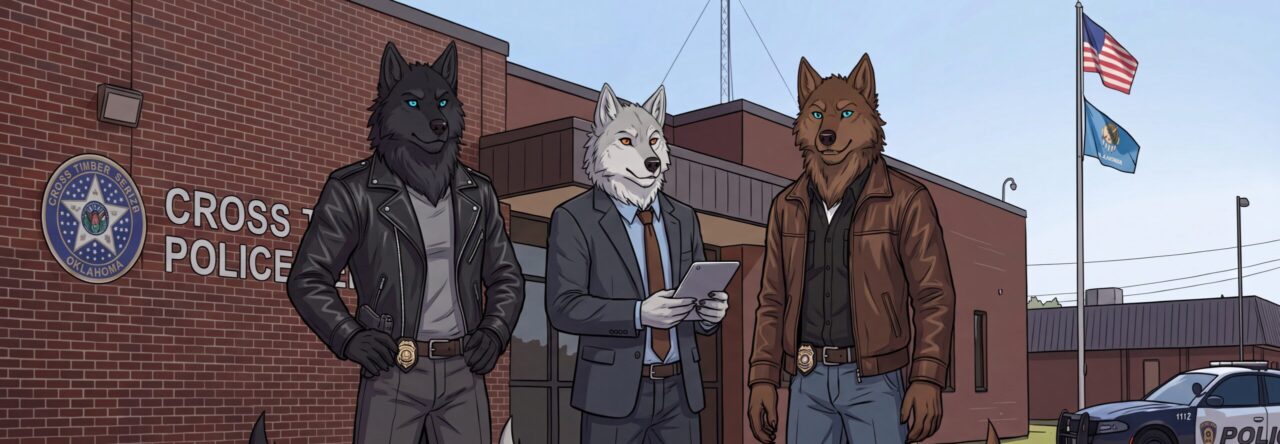
Monday evening began like a normal shift.
That was the first warning sign.
Thane parked the Humvee in its usual place at 17:58. Gabriel climbed out with a coffee in one hand and the skeptical expression of someone who no longer trusted Mondays on principle. Mark stepped down from the back seat with his tablet tucked under one arm and his shirt already neat despite the ride.
The air was warm.
The station looked ordinary.
No media trucks.
No flowers piled near reception.
No unusual calls rolling across the radio.
No one waiting outside the employee entrance with a clipboard, a crisis, a casserole, or an animal in a box.
Gabriel looked toward the building.
“I do not like it.”
Thane shut the driver’s door.
“What?”
“The calm.”
Mark glanced toward the station.
“The absence of visible crisis is not evidence of hidden crisis.”
Gabriel pointed at him.
“That is exactly what hidden crisis wants us to think.”
Thane started toward the door.
“We are going to handoff.”
“That is where they get you,” Gabriel said.
Mark followed.
“They?”
“Monday.”
“Monday is not sentient.”
“It has patterns.”
Thane badged them through the employee entrance.
Inside, the hallway smelled like coffee, paper, floor cleaner, and the faint metallic warmth of a building that had been running its air conditioning hard all day.
The radio room hummed.
Someone laughed near records.
A patrol officer they did not know well passed them carrying a stack of citation books and gave a quick nod.
Normal.
Gabriel narrowed his eyes.
“Too normal.”
Thane did not answer.
They reached the Investigations hallway and turned toward the Night Shift office.
Then all three stopped.
Voss was inside.
Rusk was inside.
Mercer was inside.
Deputy Chief Mercer stood near Thane’s desk with both hands on his hips, wearing the expression of a man who had opened a door expecting a closet and found a live orchestra.
Voss sat at the table with a folder closed in front of her.
Rusk leaned against the file cabinet with coffee in hand.
None of them spoke.
Gabriel looked at Mercer.
Then at Voss.
Then at Rusk.
Then slowly turned toward Thane.
“Oh, hell.”
Thane’s ears tipped back.
Mark looked at the room.
Then at the hallway behind them, as if briefly calculating the odds of leaving before anyone acknowledged their arrival.
Too late.
Mercer pointed at Thane.
“A hundred grand?”
Thane blinked.
Gabriel’s mouth opened.
Mark became very still.
Mercer’s voice rose.
“You gave a homeless shelter a hundred grand?”
Thane looked at Voss.
Voss’s face remained composed.
Too composed.
Rusk took a slow drink of coffee.
Thane looked back at Mercer.
“I thought they could use the cash.”
Gabriel made a small sound.
Not a laugh.
Not quite.
More like the sound of a man realizing this conversation had begun halfway down a hill and was still gaining speed.
Mercer stared at Thane.
“You thought they could use the cash.”
“Yes.”
“So you handed the administrator of Bridge House a folded envelope at the end of a full volunteer day and walked out before she could open it.”
Thane paused.
“That is accurate.”
Voss closed her eyes briefly.
Rusk looked at the ceiling.
Gabriel whispered, “Strong exit.”
Mark said nothing.
Mercer turned slightly, then turned back, as if his first response had physically failed to locate the correct place to go.
“Talia Warren called my office this afternoon.”
Thane’s expression changed.
“Is something wrong?”
“No,” Mercer said. “Nothing is wrong. That is the problem. Nothing is wrong. She called to tell me that three of my detectives spent sixteen hours at Bridge House on Saturday moving boxes, serving meals, organizing storage, cleaning, taking photos, making staff laugh, and apparently causing a pantry volunteer named Dennis to develop strong opinions about bean labels.”
Mark’s ears tipped forward.
“The labels were necessary.”
“I am sure they were,” Mercer said.
Gabriel raised one hand slightly.
“For the record, Mary invited me back.”
“She said you had poor knife discipline but strong morale value.”
Gabriel lowered his hand.
“That is fair.”
Mercer looked at Thane again.
“She was crying, Thane.”
The room quieted.
Mercer’s voice dropped.
“She tried not to. Administrator voice. Professional voice. All of that. But I could hear it. She said the money will keep their food purchasing stable through the hottest part of the summer, cover a cooler replacement, help with emergency overflow supplies, and give them breathing room on staffing.”
Thane did not know what to do with that.
So he nodded.
“Good.”
Mercer stared at him.
“Good.”
“Yes.”
“A hundred thousand dollars.”
“They needed it.”
“I understand that part.”
Thane waited.
Mercer spread both hands.
“What I do not understand is how that number came out of your back pocket like a grocery receipt.”
Gabriel looked down.
Mark looked at the table.
Voss’s mouth moved slightly, but she did not interrupt.
Mercer’s eyes moved across all three wolves.
“How much money do you three actually have?”
Thane’s ears lowered.
“I do not think that is relevant.”
“It became relevant when one of my detectives started quietly dropping six-figure checks into social-service agencies.”
“That was one check.”
Mercer pointed at him again.
“That is not the defense you think it is.”
Rusk murmured, “It was a very Thane defense.”
Voss said, “Rusk.”
“What? It was.”
Thane folded his arms.
“We have enough money to be comfortable.”
Mercer stared.
“Comfortable.”
“Yes.”
“I would say way more than comfortable.”
“That depends on your definition.”
“Thane.”
The name landed with administrative weight.
Thane looked at Gabriel.
Gabriel immediately looked away.
“No.”
“I did not ask anything.”
“You were going to.”
Thane looked at Mark.
Mark looked back at him calmly.
That was worse.
Mercer saw the look.
“Oh, he knows.”
Mark said, “Yes.”
Thane narrowed his eyes.
“Mark.”
Mercer turned fully toward Mark.
“How much?”
Mark did not hesitate.
“All in, sixty-seven million, three hundred forty-nine thousand, forty-one dollars and twenty-two cents.”
The room went silent.
Not quiet.
Silent.
Gabriel stared at Mark.
Thane stared at Mark.
Voss stared at Mark.
Rusk stopped with his coffee halfway to his mouth.
Mercer’s hand dropped slowly to his side.
Thane was the first to recover.
“How in the hell do you know that off the top of your head?”
Mark’s mouth moved into the smallest possible smile.
“As of Friday close of business.”
Gabriel turned in his chair.
“You have that number memorized?”
“I know the current total.”
“Why?”
“It is useful.”
“For what?”
“Knowing.”
Thane stared at him.
Mark took the expression as a request for more information.
“That figure includes liquid accounts, investment accounts under our direct personal control, and funds not already restricted or legally committed elsewhere. It excludes the cabin, vehicles, certain trust structures, and funds already committed to charitable programs.”
Mark paused, as if deciding whether omission would create more confusion than disclosure.
“Our managed investment portfolios also generate, on average, between ten and twelve million dollars a year in returns and distributions, depending on market performance. That income is separate from our salaries, which are functionally irrelevant to our personal finances.”
Mercer sat down.
Not dramatically.
Just straight down into the nearest chair.
Rusk finally lowered his coffee.
“Sixty-seven million.”
“And change,” Gabriel said faintly.
Voss looked at him.
“Do not help.”
Gabriel nodded.
“Not helping.”
Mercer rubbed one hand over his face.
“Let me make sure I understand what just happened.”
He looked at Mark.
“You three have sixty-seven million dollars available, not counting the cabin, vehicles, trusts, or money already locked into charity.”
Mark said, “Correct.”
“And that money is still generating another ten to twelve million dollars a year.”
Mark’s ears shifted once.
“On average.”
Mercer stared at him.
“Mark.”
“Yes?”
“That did not make it smaller.”
“No.”
Mercer leaned back in the chair and looked at the ceiling.
“I need a minute.”
Thane looked uncomfortable enough that Rusk’s expression softened by a fraction.
Voss folded her hands on the table.
None of them spoke for several seconds.
Then Rusk said, very quietly, “You have sixty-seven million dollars available, and it makes another ten to twelve million a year, and you still come here for night shift?”
Thane looked at him.
“Yes.”
“Your paycheck does not even matter.”
Gabriel gave a faint, uncomfortable smile.
“Financially? No.”
Voss looked between them, expression unreadable.
Rusk shook his head once, like the math had become personal.
“Then why?”
It was the same question Darnell had asked.
Different room.
Different weight.
Same answer.
Thane did not look at Gabriel or Mark first.
He did not need to.
“Because we like to help people,” he said. “And we need to feel useful.”
Gabriel’s expression changed.
He nodded.
Mark nodded too.
“That is accurate,” Mark said.
Mercer looked at all three of them.
“You could do anything.”
“We know,” Gabriel said.
“And this is what you choose?”
“Yes,” Thane said.
Mercer leaned back slowly.
Voss watched him.
Rusk looked down at his coffee like it had become less interesting than the room.
Thane continued, quieter now.
“Money helps. Saturday proved that. The fund proved that. The fleet proved that. But money does not sit with someone after bad news. Money does not find a lost wedding ring. Money does not calm a parking-lot argument before it becomes worse. Money does not serve dinner unless someone shows up to serve it.”
He glanced at Gabriel and Mark.
“We can do both. So we try to do both.”
Mercer was silent.
Voss’s expression had softened, though she kept it contained.
Rusk cleared his throat.
“Damn.”
Gabriel looked at him.
“That is the whole comment?”
“For now.”
Mercer stood.
His face had changed.
Not fully.
He still looked stunned.
But the sharp administrative edge had eased into something heavier and quieter.
He walked to Thane first.
Held out his hand.
Thane looked at it.
Then took it carefully.
Mercer’s grip was firm.
“That was an incredibly generous thing you did for Bridge House,” Mercer said.
Thane’s ears shifted.
“They needed it.”
“I know. And you gave it.”
Thane did not answer.
Mercer released his hand, then turned to Gabriel.
Gabriel accepted the handshake with unusual seriousness.
“You too,” Mercer said.
Gabriel’s smile was small.
“I mostly chopped uneven onions.”
“You showed up.”
Gabriel nodded.
“Yeah.”
Mercer turned to Mark.
Mark took the handshake.
“Talia said the pantry was a miracle.”
“The prior organization was inefficient.”
Mercer looked at him.
Then, despite himself, smiled.
“Of course it was.”
Mark nodded.
“Yes.”
Mercer looked at all three again.
“I am not telling you to stop helping. I am not sure I could if I tried.”
“You could try,” Gabriel said.
Mercer gave him a look.
Gabriel raised both hands.
“Not a suggestion.”
“But,” Mercer continued, “remember what you already know. No leverage. No influence. No expectations. No personal decision-making on services tied to department work. Keep legal structures clean when they need to be clean. Keep yourselves out of recipient decisions.”
Mark nodded immediately.
“Agreed.”
Thane nodded too.
“Agreed.”
Gabriel said, “Agreed.”
Mercer looked toward the hallway.
“And if you are going to hand someone a hundred-thousand-dollar check in an envelope, understand that at some point someone is going to call me while crying.”
Thane winced slightly.
“I did not think about that part.”
“I noticed.”
Voss looked down.
Rusk smiled into his coffee.
Mercer moved toward the door.
“Carry on.”
Then he stopped.
Looked back.
“Sixty-seven million.”
Thane sighed.
Mark said, “And twenty-two cents.”
Mercer stared at him.
Gabriel covered his muzzle.
Rusk lost the first small laugh.
Mercer shook his head and left.
The hallway swallowed his footsteps.
For a moment, nobody moved.
Then Rusk looked at Mark.
“Twenty-two cents.”
“Correct.”
“You could have rounded.”
“I was asked how much.”
Voss looked at Thane.
“You alright?”
Thane looked toward the doorway Mercer had left through.
“Yes.”
“That sounded mostly true.”
“It is.”
Gabriel leaned back in his chair.
“I feel financially exposed.”
Mark looked at him.
“You did not know the number either.”
“I knew the vibe.”
“That is not accounting.”
“It is emotional accounting.”
Voss held up one hand.
“No.”
Gabriel closed his mouth.
Rusk opened the handoff folder.
“Now that we have established that Night Shift is apparently better capitalized than several city departments—”
“Rusk,” Voss said.
“I am moving on.”
“You are not moving on well.”
“I rarely do.”
Thane sat.
“Actual handoff?”
“Actual handoff,” Voss said.
She opened the folder.
“Nothing major from the weekend. Bridge House already sent Talia’s official thank-you email to the department, which we will file and not turn into a press release.”
“Thank you,” Thane said.
“Saturday volunteer work is not department activity,” Voss continued. “No report. No public statement. No further discussion unless someone raises a conflict issue.”
Mark nodded.
“Darnell’s truck is back. He is annoyingly pleased about it.”
Gabriel smiled.
“Good.”
“Patrol is short tonight,” Rusk said. “Two sick calls and one training absence. Crowe asked if you three can cover traffic enforcement on the east highway approach for the first half of the shift.”
Gabriel blinked.
“Traffic?”
“Yes.”
“As in traffic stops?”
“Yes.”
“As in patrol?”
Rusk’s smile grew faintly.
“As in the thing you used to do before you became detectives and started hiding in plain clothes.”
Thane looked toward Voss.
“Traffic enforcement?”
Voss nodded.
“Problem area. Vehicles coming off Highway 62 into town are carrying highway speeds too far past the limit change. Patrol has had complaints from businesses near the east edge and two near-misses this week.”
Mark opened his tablet.
“Speed transition from sixty-five to forty-five to thirty-five?”
“Yes,” Voss said. “Posted clearly. Enforcement requested.”
Gabriel looked at Thane.
“We get to be patrol again.”
“For half a shift,” Thane said.
Rusk added, “Crowe said if you complain, she will assign you the skateboard complaint behind the old post office for three consecutive evenings.”
Gabriel straightened.
“I love traffic.”
Voss smiled faintly.
“You will need uniforms.”
Thane’s ears moved.
“Our old patrol uniforms?”
Mark’s expression became thoughtful.
“Will they still fit?”
Gabriel looked at him.
“That is the most dangerous question anyone has asked today.”
Thane stood.
“We’ll find out.”
The locker room had not changed much since their patrol days.
Same benches.
Same dented lockers.
Same smell of gear, detergent, rubber mats, and institutional soap.
Thane opened his old locker and stared at the uniform hanging inside.
It looked smaller than he remembered.
Gabriel opened his.
“Oh, no.”
Mark examined his uniform with concern.
“It should fit.”
Gabriel held his shirt against his chest.
“Clothes shrink when abandoned.”
“They do not.”
“They develop resentment.”
Thane took his uniform down.
Dark department shirt.
Modified seams.
Tail clearance.
Pants built for werewolf legs and movement but still recognizably patrol uniform pants.
Badge.
Name strip.
The uniform felt strange in his paws.
Familiar, but not current.
Like picking up an older version of himself.
Gabriel looked over.
“You okay?”
“Yeah.”
“Thinking about patrol?”
“A little.”
Mark began changing with practical efficiency.
“We were patrol officers for longer than we have been detectives.”
“True,” Gabriel said.
“We should remain proficient.”
Gabriel looked at him.
“You are excited.”
“I am not excited.”
“You are patrol-excited.”
“That is not a category.”
“It absolutely is.”
Thane pulled the uniform shirt on.
The shoulders fit.
Barely.
Gabriel watched.
“That shirt is doing its best.”
Thane looked at him.
“Yours is next.”
“I am emotionally smaller.”
“You are not physically smaller enough.”
Gabriel’s shirt fit after a short struggle and one alarming sound from a seam that did not actually tear.
Mark’s fit cleanly, which made Gabriel personally offended.
“Of course yours fits.”
“It was stored correctly.”
“So was mine.”
“Your locker contained an empty snack bag.”
Gabriel paused.
“That was emergency morale.”
Thane fastened his duty belt.
The weight settled against him in a way that belonged to old muscle memory.
Not uncomfortable.
Not preferred.
Just known.
Mark checked his own belt, then looked at Thane.
Gabriel adjusted his badge.
“Still weird to see us like this.”
Mark looked at him.
“We wore uniforms for months.”
“I know. But now it feels like a costume.”
Thane looked at himself in the mirror.
Large brown wolf.
Blue eyes.
Black patrol uniform.
Badge visible.
Claws bare.
No attempt to pretend the uniform made him ordinary.
“It is not a costume,” he said.
Gabriel’s expression softened.
“No.”
Mark nodded once.
“It is a role.”
Thane looked at him.
“One we know how to do.”
They left the locker room together.
Patel saw them first in the hallway and stopped dead.
Then smiled.
“Well, look at that.”
Gabriel spread his arms.
“Retro night.”
Darnell leaned out of the report room.
“Oh, hell yes.”
Thane looked at him.
“Do not make it weird.”
“You are in uniform in daylight.”
“It is evening.”
“Still weird.”
Grant walked by with a folder, saw them, and grinned despite herself.
“Traffic wolves.”
Gabriel pointed at her.
“Trademark that.”
“No.”
“Coward.”
Crowe appeared at the far end of the hallway.
She looked them up and down once.
“Uniforms fit?”
Gabriel lifted both arms slightly.
“Define fit.”
Crowe’s expression did not change.
“Can you move, breathe, and not split a seam on camera?”
“Yes.”
“Then they fit.”
Mark nodded.
“Acceptable standard.”
Crowe handed Thane a key fob.
“Unit Twelve. New Interceptor. Radar calibrated last month. In-car system works. Use standard traffic-stop protocol, cite or warn as appropriate, and do not turn the east approach into a circus.”
Gabriel accepted the assignment with a solemn nod.
“No circus.”
Crowe looked directly at him.
“I mean you.”
“I sensed that.”
Thane looked at the key fob.
“Unit Twelve?”
“It has the most legroom.”
Gabriel smiled.
“That is a beautiful sentence.”
Crowe added, “Still not enough.”
Unit Twelve was a new Ford Police Interceptor Utility.
One of the city’s new vehicles.
Clean.
Well-equipped.
Fresh graphics.
Modern lightbar.
In-car camera system.
Computer mount.
Cage behind the front seats.
Built, in theory, to carry officers, gear, and the occasional prisoner.
Not built, in any meaningful sense, for three full-time werewolves.
Thane opened the driver’s door.
Looked at the seat.
Looked at the steering wheel.
Looked at Gabriel.
Gabriel looked at the passenger seat.
“This vehicle is optimistic.”
Mark opened the rear door.
Then stared at the cage partition.
“No.”
Gabriel leaned over.
“You fit?”
“No.”
“You have not tried.”
“I have assessed.”
Thane looked into the rear area.
Mark’s ears had lowered.
His tail flicked once.
The rear seat had enough room for a normal human officer transporting a normal human prisoner.
It did not have enough room for Mark’s legs, tail, shoulders, and dignity.
Gabriel looked at Crowe, who had followed them into the garage for reasons Thane now understood were probably entertainment.
“Lieutenant.”
Crowe folded her arms.
“You asked for the most legroom. That is the most legroom.”
Mark looked at the rear seat again.
“I could sit sideways.”
“No,” Thane said.
“I could.”
“No.”
Gabriel walked around the vehicle.
“What if Mark sits front passenger and I ride in back?”
Mark and Thane both looked at him.
Gabriel looked into the rear seat.
He paused.
“No.”
Crowe’s mouth twitched.
Thane adjusted the driver’s seat as far back as it would go.
It moved.
Not far enough.
He got in anyway.
His knees fit.
Technically.
His ears brushed the roof.
His tail required negotiation.
Gabriel climbed into the front passenger seat and immediately moved it back.
It hit the cage.
“Ah.”
Mark stood outside the rear door.
Expression calm.
Eyes bleak.
Thane looked at Crowe.
“Humvee?”
“No.”
“Lieutenant.”
“Marked unit for traffic enforcement.”
“It is marked when we put a light on it.”
“No.”
Gabriel was trying not to laugh.
Mark finally climbed into the rear seat sideways, one leg angled, tail carefully tucked, shoulders turned enough to avoid the cage partition.
He shut the door.
His face appeared behind the cage.
Gabriel turned and looked at him.
“You look like a disappointed museum exhibit.”
Mark stared through the partition.
“I dislike this.”
Crowe nodded.
“Documented.”
Thane looked over his shoulder.
“You okay?”
“No.”
“Can you tolerate it for traffic duty?”
“Yes.”
Gabriel smiled.
“Brave.”
Mark looked at him through the cage.
“I will remember this.”
Gabriel faced forward.
“Traffic duty is already exciting.”
Crowe stepped back.
“East approach. First half of shift. Be visible, be professional, and do not let the first driver you stop record you arguing about legroom.”
Thane started the Interceptor.
“Yes, Lieutenant.”
They rolled out of the garage.
The vehicle felt strange.
Smooth.
Quiet.
Too low.
Too enclosed.
The computer screen glowed beside him.
The radar unit sat mounted near the dash.
The camera system blinked ready.
Gabriel shifted carefully.
“This seat was designed by someone who hates tails.”
Mark’s voice came from behind the cage.
“All rear compartments were designed by someone who hates tails.”
Thane turned onto the street.
“It is temporary.”
Mark said, “Time is subjective when seated improperly.”
Gabriel looked back.
“I am using that later.”
The east highway approach ran past the edge of town where Highway 62 narrowed, slowed, and became Cross Timber instead of open road.
The speed dropped in stages.
Sixty-five.
Forty-five.
Thirty-five.
The signs were large.
Reflective.
Obvious.
And, judging by the first ten minutes of radar returns, aspirational.
Thane parked Unit Twelve in a visible spot near a closed feed store where the road widened enough for safe stops.
The first few drivers saw the marked unit and slowed hard.
Gabriel watched one pickup nose-dive.
“That man just discovered brakes.”
Mark, still angled uncomfortably in the back, said, “Forty-seven in a thirty-five.”
“Warning?” Gabriel asked.
Thane watched the pickup continue at a corrected speed.
“Not stopping him for correcting before the zone.”
Mark nodded.
“Reasonable.”
At 20:03, the radar chirped.
Fifty-six in a thirty-five.
A black sedan entered the reduced zone without slowing.
Thane pulled out smoothly.
Gabriel straightened.
“Oh, here we go.”
Mark activated the stop entry on the computer from his rear position with visible annoyance at the angle.
Thane lit the sedan.
It took the driver an extra half block to pull over, then stopped safely on the shoulder beneath a streetlight.
Thane parked behind it.
“Same protocol,” he said.
Gabriel nodded.
“Contact and cover?”
“I will contact. You cover passenger side.”
Mark said from the back, “I will remain wedged and monitor.”
Gabriel looked back.
“Your sacrifice is noted.”
Thane stepped out.
The evening air felt enormous after the Interceptor.
He approached the driver’s side with his hands visible.
The driver, a man in his thirties wearing a polo shirt and the expression of someone already preparing an argument, had his window down before Thane reached him.
“Officer, I was just coming off the highway.”
“Detective,” Thane said. “You were traveling fifty-six in a posted thirty-five.”
The man blinked.
His eyes moved up.
And up.
And up.
Whatever argument he had prepared did not survive contact with a seven-foot werewolf in uniform standing beside his sedan.
“Uh.”
Gabriel stood near the passenger side, perfectly polite, perfectly still.
The driver swallowed.
“I did not realize it dropped that fast.”
Thane pointed back toward the road.
“There are two signs before this point. Forty-five, then thirty-five.”
“Yes, sir.”
“License and proof of insurance.”
The man handed them over quickly.
Back at the Interceptor, Gabriel leaned toward Thane.
“He had a whole speech ready.”
“Yes.”
“It died young.”
Gabriel checked the driver through dispatch.
“No wants. Valid license. Insurance current. Local address.”
Thane looked at the speed.
Fifty-six.
Twenty-one over.
First stop of the night.
Clear zone.
No aggressive driving beyond speed.
He returned to the sedan.
“I am issuing a citation for speed. The reduced zone begins before the businesses and side streets. People are turning in and out of those lots. Slow down before the sign, not after it.”
The driver nodded.
“Yes, sir.”
He signed.
No argument.
As Thane walked back, Gabriel watched the sedan pull away carefully at exactly thirty-five.
“That man will observe the speed limit until his grandchildren are old.”
“Good.”
Mark’s voice came through the open rear window.
“Citation was appropriate.”
Gabriel looked back.
“Thank you, cage oracle.”
“I dislike you.”
The second stop was a warning.
A college student in a small hatchback doing forty-seven in the thirty-five zone, visibly embarrassed, with a trunk full of laundry and a passenger holding a half-eaten burrito.
She apologized before Thane reached the window.
“I know, I know. I saw the sign too late.”
Thane looked at her license.
“You live in town?”
“Yes.”
“Then you know the road changes.”
“I do. I just zoned out.”
Gabriel looked at the passenger’s burrito.
The passenger held it lower.
Gabriel said, “That burrito is not evidence.”
The passenger said, “Okay.”
Thane gave the driver a written warning.
“Slow down before the first sign. Not at the second.”
“Yes, sir.”
As they returned to Unit Twelve, Gabriel said, “The burrito feared me.”
“The burrito did not.”
“The passenger did.”
“Because you commented on his burrito.”
“It looked nervous.”
Mark entered the warning.
“You are why traffic stops become strange.”
Gabriel opened the passenger door.
“I am why traffic stops become memorable.”
“That is worse,” Mark said.
At 21:12, they stopped a landscaping truck whose trailer lights were out.
The driver had no idea.
Mark, despite still being confined to the rear seat, identified the likely issue before Thane finished the stop.
“Loose connector at the hitch.”
The driver checked it.
The lights came on.
Thane issued a warning and told him to replace the worn connector.
The driver stared at Mark through the rear window.
“Is he okay back there?”
Gabriel smiled.
“He is thriving.”
Mark’s voice came flatly from inside the cage.
“I am not.”
The driver wisely did not ask more.
At 21:54, a red sports car came through at sixty-two in the thirty-five.
Thane stopped it.
The driver was seventeen.
New license.
Borrowed car.
Too much confidence.
Not enough road.
The boy’s hands shook when he handed over his license.
His father arrived fifteen minutes later after Thane called the registered owner.
The father did not yell.
That was worse.
He stood beside the sports car, looked at the citation, looked at his son, and said, “We will discuss this at home.”
The boy looked like he would have preferred yelling.
Thane handed the father the paperwork.
“This road has businesses, side streets, and pedestrians near the turnoff. Sixty-two is not a mistake. It is a decision.”
The boy stared at the ground.
“Yes, sir.”
Gabriel stood quietly on the passenger side.
No jokes.
Mark, from the rear seat, documented the stop.
When they returned to Unit Twelve, Gabriel exhaled.
“Good dad.”
“Yeah,” Thane said.
Mark added, “The silence was effective.”
Gabriel nodded.
“I feared it from here.”
At 22:31, a motorcycle approached fast enough that the radar chirped before the rider saw the marked unit.
The bike slowed immediately.
Thane watched it pass at thirty-eight.
Gabriel looked at him.
“Stopped himself.”
“Yes.”
“Do we count that as a win?”
“Yes.”
Mark shifted behind the cage.
“I would like to count returning this vehicle as a win.”
Thane looked back.
“One more hour.”
Mark closed his eyes briefly.
“I will survive.”
Gabriel turned around.
“That sounded dramatic.”
“It was precise.”
“You are emotionally compressed.”
“I am physically compressed.”
“Both can be true.”
At 23:04, Crowe called them over the radio.
“Unit Twelve, status?”
Thane answered.
“Unit Twelve, east approach. Five stops. Two citations, three warnings. Traffic speeds reduced.”
A pause.
“Any problems?”
Thane looked at Gabriel.
Gabriel looked at Mark.
Mark said from the back, “The rear compartment is a problem.”
Thane keyed the mic.
“No operational problems.”
Crowe’s voice remained dry.
“Copy. Return after midnight. Patrol can resume coverage.”
Gabriel looked back at Mark.
“You have been spared.”
Mark said, “Eventually.”
At 00:12, they returned Unit Twelve to the station.
Mark exited the rear compartment with the careful dignity of a man determined not to let a vehicle know it had won.
Gabriel stepped out and stretched.
“That was educational.”
Thane climbed out.
“About traffic?”
“About Mark’s tolerance for confinement.”
Mark looked at him.
“It has decreased.”
Crowe was waiting near the garage entrance.
“Vehicle intact?”
“Yes,” Thane said.
“Any complaints?”
“Not from citizens,” Gabriel said.
Crowe looked at Mark.
Mark said, “I have several.”
“File them with the seat manufacturer.”
“I may.”
Crowe’s mouth twitched.
“Go change. Patrol assist for the rest of the shift. Nothing active right now.”
They returned to the locker room and changed back into plain clothes.
Gabriel peeled off the uniform shirt with visible relief.
“I respect patrol, but I do not miss uniform seams.”
Mark hung his carefully.
“The uniform was functional.”
“You rode sideways in a cage.”
“That was the vehicle, not the uniform.”
Thane looked at his old patrol shirt before hanging it back in the locker.
It had felt strange at first.
Then familiar.
Then strange again.
He closed the locker.
Gabriel noticed.
“Good strange or bad strange?”
“Both.”
Mark shut his locker.
“We did the work.”
“Yeah,” Thane said.
Gabriel smiled.
“And we survived the Interceptor.”
Mark said, “Barely.”
The second half of shift returned to the ordinary rhythm they knew better now.
At 01:03, they assisted Patel with a convenience-store disturbance that turned out to be two customers arguing over whether one had cut in line for the microwave.
Gabriel handled it by asking both men what they had purchased.
One had a frozen burrito.
The other had instant noodles.
Gabriel looked deeply solemn.
“Gentlemen, no meal here is worth jail.”
Patel closed her notebook.
“That is the most accurate de-escalation statement I have heard all week.”
The men separated.
The microwave survived.
At 02:18, Grant called for help moving a fallen branch out of a residential street after a light storm passed north of town and sent a gust through an older neighborhood.
The branch was large enough that public works had been notified.
Not large enough to keep Thane, Gabriel, and Mark from moving it to the curb in one coordinated lift.
A woman in a robe watched from her porch.
“You boys are handy.”
Gabriel smiled.
“We are available for municipal lumber relocation.”
Mark looked at him.
“No, we are not.”
“Emotionally.”
“No.”
At 03:41, Darnell requested backup on a report of someone sleeping behind a closed auto parts store.
The man was not intoxicated.
Not aggressive.
Just exhausted and trying to stay out of view.
He had been turned away from Bridge House because overnight beds were full.
That made the three wolves quiet.
Darnell handled the contact gently.
No citation.
No threat.
He connected the man with the overnight outreach number Bridge House had provided, then gave him information about the morning intake window and a place he could wait without blocking the business entrance.
Thane stood nearby, hands relaxed.
Not crowding.
Not looming.
The man looked at him once.
Then away.
Before they left, he said, “You were at Bridge House.”
Thane nodded.
“Saturday.”
The man’s eyes narrowed slightly.
“People said the pantry looked different.”
Mark, beside the Humvee, straightened by a fraction.
Gabriel smiled softly.
“Beans had a big day.”
The man huffed.
Almost a laugh.
Almost.
Then he nodded and turned back toward Darnell.
On the drive back, none of them spoke for several minutes.
Finally, Gabriel said, “We are going back.”
Thane nodded.
“Yeah.”
Mark looked out the window.
“We should ask about overnight overflow needs.”
“Yeah,” Thane said.
No one mentioned the check.
No one needed to.
Morning handoff came at 06:29.
Voss and Rusk were in the case room again.
Mercer was not.
That made Gabriel visibly relax.
Rusk noticed immediately.
“Disappointed?”
“No.”
“Were you hoping for another financial audit?”
“Absolutely not.”
Mark set the traffic-enforcement summary on the table.
“East approach coverage: eight stops, three citations, five warnings. Average observed speed decreased after visible enforcement. No arrests. No vehicle searches. No pursuits.”
Voss reviewed the sheet.
“Good.”
Rusk looked at Thane.
“How was the Interceptor?”
Mark answered before Thane could.
“Inadequate.”
Rusk looked delighted.
“For all of you?”
“Yes.”
“Good to know.”
Gabriel pointed at him.
“You are enjoying that too much.”
“I enjoy precise discomfort when it is harmless.”
Mark stared.
“That sentence is concerning.”
Voss took the rest of the reports.
“Convenience-store disturbance resolved. Branch assist. Contact behind auto parts store handled with outreach referral.”
Her eyes moved briefly to Thane.
“Good.”
Thane nodded.
“Darnell did it right.”
“I know.”
Rusk set his coffee down.
“Any other surprises?”
Gabriel looked at Thane.
Thane looked at Mark.
Mark looked at Gabriel.
“No,” Thane said.
Rusk studied them.
“That pause was suspicious.”
“It was fatigue,” Mark said.
“Also suspicious.”
Voss closed the folder.
“Go home.”
They stood.
Gabriel stretched his shoulders.
“I never thought I would miss the Humvee.”
Thane looked at him.
“You complain about the Humvee constantly.”
“I complain with affection.”
Mark gathered his tablet.
“The Humvee is objectively better suited to our dimensions.”
Gabriel smiled.
“See? He loves it too.”
“I did not say love.”
“You meant love.”
“I meant suited.”
Thane walked toward the door.
Behind them, Rusk said, “Sixty-seven million dollars and they still argue about legroom.”
Voss said, “Let them.”
Thane smiled despite himself.
In the garage, the Humvee waited exactly where they had left it.
Huge.
Impractical.
Comfortable in the way few things built for humans ever were.
Gabriel climbed into the passenger seat with a sigh of relief.
Mark settled into the back like a man returning from exile.
Thane started the engine.
Morning light spilled across the open garage door.
The city waited beyond it.
A little safer on the east approach.
A little quieter after a slow night.
Still full of people who needed things money could help and things money could not touch.
Gabriel looked out the windshield.
“Comfortable.”
Thane glanced at him.
“What?”
“You said you had enough money to be comfortable.”
Mark’s ears tipped forward.
Gabriel smiled.
“I think this is comfortable.”
The Humvee rumbled softly beneath them.
Thane looked ahead.
“Yeah,” he said.
Then he drove them home.