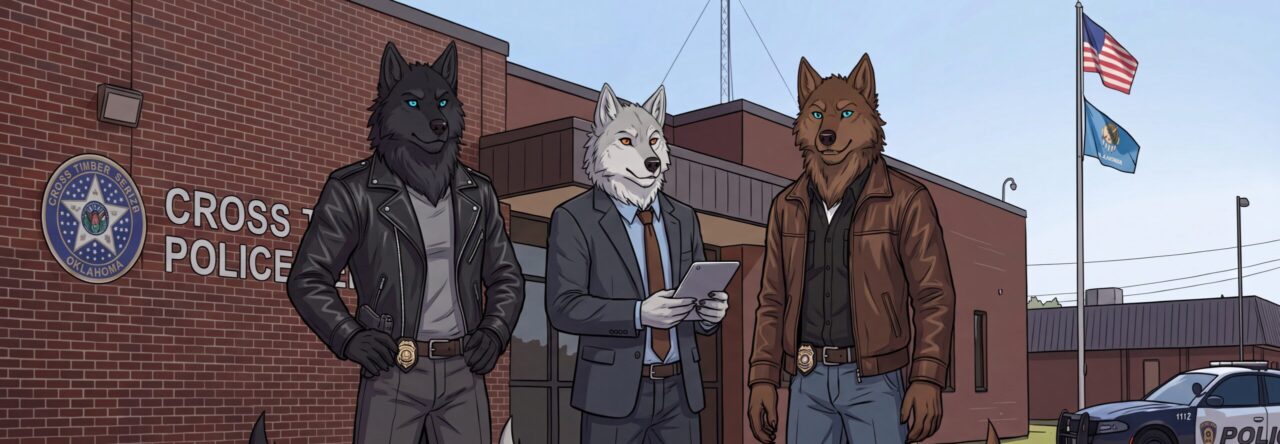
Seven weeks after Emily Carter came out of the trailer alive, the department stopped pretending the wolves’ abilities were an administrative inconvenience.
It did not stop being careful.
That part mattered.
It just stopped treating every useful thing the three of them could do as something dangerous that needed to stay locked in a drawer.
The policy arrived as a twelve-page general order with three appendices, two signature blocks, a training acknowledgment form, and a title that Mark insisted was “surprisingly efficient for government writing.”
SPECIAL CAPABILITIES SUPPORT
Gabriel had read the title over Mark’s shoulder at breakfast and said, “That sounds like we are being issued as optional equipment.”
Mark had not looked up from the packet.
“It means they have created a formal structure for requesting our assistance during appropriate incidents.”
Thane took the Humvee keys from the bowl beside the garage door.
“It means we get called when useful.”
Mark looked up.
“It means we get called when directed.”
Thane considered that.
“Same thing.”
“It is not remotely the same thing.”
Gabriel leaned against the kitchen counter with coffee in one hand and an expression of deep satisfaction.
“The Alpha has spoken. The systems wolf has filed a dissent.”
Mark folded the policy packet carefully.
“Humvee use is unrelated to Special Capabilities Support.”
Thane opened the garage door.
“Still driving it.”
“Of course you are.”
The storm had begun before dawn.
Rain hammered the cabin roof in long, hard sheets. Water ran down the windows in silver ropes. The gravel drive had become dark mud between the trees, and the low places near the creek were already filling.
For once, Mark had not objected to the Humvee.
Not out loud.
That was as close as anyone was getting to victory.
The Humvee pushed through standing water on the way into Cross Timber, tires hissing through rain-black streets. Gabriel sat in the passenger seat with his coffee secured between his knees. Mark sat in back with the Special Capabilities packet open again, reading it for perhaps the fourth time.
Thane glanced in the mirror.
“You memorizing it?”
“I am verifying the language.”
“You already read it.”
“Yes.”
“Four times.”
Mark looked up.
“Three.”
Gabriel smiled.
“Top of class.”
Mark’s ears flattened.
“Relevant policy review is not a character flaw.”
“Not by itself,” Gabriel said.
The station parking lot was nearly empty when they arrived. Most officers had already been inside for briefing. The rain came down hard enough to blur the cruiser lights and turn every puddle into a trembling mirror.
The Humvee rolled into its usual two spaces.
Mark got out, looked at the angle, looked at the rain, and said nothing.
Thane noticed.
“Nothing?”
Mark shut the rear door.
“Ground clearance is currently operationally justified.”
Gabriel stopped in the rain.
“Did anyone hear that?”
“No,” Mark said immediately.
“You just complimented the Humvee.”
“I did not.”
“You did.”
“I made a narrow, weather-dependent observation.”
Thane started toward the station.
“Alpha review complete.”
Mark made a sound from behind him that was too tired to become an argument.
Inside, the department had that particular storm-day energy where everyone moved faster and no one smiled. Wet uniforms. Damp boots. Radios carrying flooded-road reports. Dispatch screens filled with yellow weather alerts and traffic notifications.
Nina looked through the dispatch window as the three wolves came in.
“Morning.”
Gabriel blinked.
“No insult?”
“I have seventeen flooded-road calls holding, three alarm systems reporting water intrusion, one tree in a power line, and a woman on River Road who has called six times because her neighbor’s trampoline blew into her koi pond.”
Gabriel nodded solemnly.
“Crisis conditions.”
“Exactly.”
Crowe stood near the briefing-room doorway with a tablet in hand.
“Inside. Now.”
The briefing room was full.
Bell stood near the front wall, arms crossed. Ortiz sat with one boot hooked beneath her chair. Cho had a paper cup of coffee in one hand and a stack of weather-response forms in the other.
Voss and Rusk were not there.
That made sense.
The Emily Carter case had gone to investigators after Kyle Brenner and Derek Vane were charged. Patrol had done its part. Now detectives, prosecutors, victim advocates, evidence technicians, and people with offices took over the longer work.
The trio had returned to patrol.
Real patrol.
Flooded roads. Welfare checks. Public-assistance calls. Broken-down cars. Alarm calls. Routine reports. Traffic direction. The thousand small things that kept a city from becoming worse before anyone noticed.
Crowe began.
“Storm conditions are expected to continue through midday. Low-water crossings are closed. Do not drive around barricades. Do not let citizens drive around barricades. If somebody says, ‘I know this road,’ you say, ‘That is not the same as knowing where the water is.’”
She tapped the tablet.
“Fire and county rescue are handling a flooding response east of town. We may be called for traffic management, evacuation support, or search assistance. Use your heads.”
Her eyes settled briefly on the trio.
“Today is also the first operational day under General Order 4.17.”
A few officers looked toward them.
Not with suspicion.
Not exactly.
With awareness.
Crowe continued.
“Special Capabilities Support does not mean three probationary officers are suddenly a superhero team. It means their documented abilities may be requested by incident command during appropriate events. Search. Rescue. Evacuation. Hazardous conditions. Evidence location. Every use is directed. Every use is documented. Every officer remains subject to the same standards, the same command structure, and the same common sense.”
Gabriel raised a hand.
Crowe closed her eyes.
“Why?”
“Can we get jackets?”
“No.”
“Patches?”
“No.”
“Small embroidered—”
“No.”
Mark said, “The policy does not authorize visual insignia.”
Gabriel turned toward him.
“You read the appendix?”
“There are three.”
Crowe pointed at the trio.
“Bell. Ortiz. Cho. Same assignments. Later-phase FTO means they will take more lead responsibility today. It does not mean you stop supervising them.”
Bell nodded.
Ortiz nodded.
Cho sipped coffee.
Crowe’s expression shifted as Nina’s voice came through the room speaker.
“Lieutenant, Fire Command requesting Special Capabilities Support at Hollow Creek crossing. Missing adult female. Vehicle located. Possible water rescue and search operation.”
The room changed.
Crowe glanced at the dispatch screen.
“Details.”
Nina came back immediately.
“Thirty-one-year-old female, Megan Rourke. Vehicle found partially off the low-water crossing at Hollow Creek Road east of town. Caller is her employer. Rourke left the hospital night shift approximately ninety minutes ago and sent a partial emergency call after her vehicle entered floodwater. Call disconnected. Vehicle located by county deputy. Driver absent. Rescue teams searching downstream.”
Crowe looked at Bell, Ortiz, and Cho.
“You are requested.”
Thane’s posture changed.
Bell saw it.
“Not yet.”
Thane looked at him.
“We are not moving until command says move.”
“Yes.”
Crowe handed Bell a printout.
“Fire Command has incident control. You do exactly what they ask, nothing they do not ask. This is not a police rescue with firefighters invited.”
Bell nodded.
“Understood.”
Crowe looked at the trio.
“Listen to your FTOs. Listen to fire command. Do not make me regret policy implementation before lunch.”
Gabriel stood.
“No capes.”
Crowe stared at him.
Gabriel raised both hands.
“No capes.”
The drive east took fifteen minutes through rain and standing water.
Thane drove the Humvee because it was their vehicle, because the roads were bad, and because Bell had looked at the weather and said only, “Take something that won’t float away.”
Mark had sat in the back without argument.
That was still victory.
The road narrowed as they left the developed part of Cross Timber. Trees crowded close to the shoulders. Fields had become shallow lakes. Ditches ran brown and fast. Low clouds pressed close enough to feel like another layer of weather under the sky.
The radio gave them fragments.
“—county unit holding east approach—”
“—water rising at bridge marker—”
“—vehicle confirmed unoccupied—”
“—fire command requests the three probationary officers stage at south command—”
Gabriel looked out the windshield.
“Does anybody else hate the phrase ‘vehicle confirmed unoccupied’?”
No one answered.
They all did.
Hollow Creek crossing had vanished beneath water.
What had been a narrow concrete road over a shallow creek was now a broad, fast-moving brown channel cutting across the countryside. Rainwater rushed through the trees on either side, pulling branches and trash and broken fence posts along with it.
Fire engines lined the south approach. County rescue trucks stood farther back. A sheriff’s office command trailer sat on higher ground with its awning down against the rain. Personnel in bright rain gear moved between vehicles, carrying rope bags, radios, helmets, and equipment that looked designed for situations everyone hoped never occurred.
Megan Rourke’s car rested at an angle near the far edge of the crossing.
A gray sedan.
Front end partly submerged in the runoff.
Driver’s door open.
Rear lights blinking weakly beneath the rain.
Thane saw it and felt his stomach tighten.
Bell parked the Humvee where directed. It looked almost normal beside the rescue trucks for once.
Almost.
A woman in a yellow incident-command jacket approached them. She was in her late forties, broad-shouldered, rain plastered across the edges of her dark hair, and carried herself with the calm of someone who had already made twenty decisions before anyone else finished asking questions.
“Battalion Chief Calder,” she said. “You’re the police support?”
Bell stepped forward.
“Officer Bell. These are Probationary Officers Thane, Gabriel, and Mark. Their FTOs are present.”
Calder looked at the trio.
Not with awe.
Not with fear.
With evaluation.
“Good. I need useful.”
Bell nodded.
“That’s what they do.”
Calder’s eyes went to Thane first.
“Your people can track?”
Thane answered carefully.
“Yes, ma’am. Under the right conditions.”
“Can you tell me whether she left the vehicle?”
“Possibly.”
“Can you hear beyond what my people can?”
Gabriel said, “Sometimes.”
“Can you organize search coverage?”
Mark said, “Yes.”
Calder looked at all three again.
“Good. You work under my command while we are on this incident. You do not enter water, unstable ground, or a rescue zone unless I approve it. You report observations. You do not turn observations into conclusions. You do not become casualties.”
Thane nodded.
“Yes, ma’am.”
Calder pointed toward the vehicle.
“First question. Did Megan Rourke leave the car, and if so, where did she go?”
The sedan sat beyond a rope line established by fire rescue. A deputy in rain gear stood near it, keeping anyone from approaching too close. Two rescue technicians had already assessed the vehicle from a tethered position and confirmed no one was trapped inside.
Bell walked with Thane toward the edge of the safe approach.
“Same rules,” he said.
Thane looked at the floodwater.
“Yes.”
“Say them.”
“I report before motion. I do not enter water without command approval. I do not assume. I do not run because I smell something.”
Bell nodded.
“Good.”
They stopped where the ground began to slope toward the submerged crossing.
Thane closed his eyes.
Rain complicated everything.
Water carried scents apart, blended them, broke them open against mud and grass and wet stone. The air smelled like runoff, gasoline, soaked wood, exhaust, creek silt, wet leaves, frightened people, rescue gear, and rain itself.
But beneath it—
Megan.
Not from memory. From her jacket, perhaps, or the car interior. A human scent that separated from the rest because it traveled away from the vehicle.
Thane opened his eyes.
“She left the car.”
Bell looked at him.
“Direction?”
Thane pointed toward the downstream tree line.
“Southwest. She went toward the trees, not the road.”
“Can you tell when?”
“No. Rain damages it.”
“Any injury?”
Thane hesitated.
“Blood. Small amount. Not enough to tell how serious.”
Bell keyed his radio.
“Fire Command, police support. Probationary Officer Thane reports adult female scent leaves vehicle area heading southwest toward tree line. Possible small blood presence. Rain degradation prevents time estimate. Recommend search focus downstream on southwest bank.”
Calder answered.
“Copy. Search Group One, shift southwest. Marking that as Zone Bravo.”
Mark heard it from the command trailer and looked toward the terrain map spread across a folding table.
Cho stood beside him.
“What does that change?”
Mark leaned over the map.
The crossing. The creek. The slope. The drainage channel. A washed-out footpath that ran along the southwest bank before disappearing beneath tree cover.
“The road rises here,” Mark said. “If she left the car and tried to get away from the water, she would likely move uphill toward the old maintenance trail. But the floodwater cuts that trail off about four hundred yards down.”
Cho nodded.
“Likely shelter?”
Mark studied the map.
“Old footbridge support. There is a raised concrete culvert here. If she reached it before the water rose, it would provide cover from wind and visibility from the creek.”
Calder looked over from the command position.
“You certain?”
Mark shook his head.
“No. It is the next place I would search.”
Calder nodded.
“Good. That is all I need.”
She pointed to the map.
“Search Group One takes the southwest bank. Group Two checks the maintenance trail. Group Three works the bridge and culvert. Mark, you stay at command with Cho. Update the grid as teams clear zones.”
Mark blinked.
He looked toward the woods.
Then toward the map.
Then toward the radio log.
“Yes, ma’am.”
Cho watched him.
“You heard her.”
“Yes.”
“What is your job?”
“Give people the next place to look.”
Cho nodded.
“Then do it.”
Gabriel and Ortiz were assigned near the south bank where the tree line began.
A rescue team in helmets and harnesses moved ahead along the cleared edge, probing the ground for washouts. Ortiz stood beside Gabriel near a temporary marker line, both of them in rain gear over their uniforms.
“Do not wander,” Ortiz said.
“I know.”
“You are not a search dog.”
Gabriel looked at her.
“I am very aware of that distinction.”
“Good. You are an officer with ears.”
“That is somehow less flattering.”
Ortiz glanced down the slope.
“It is more legally accurate.”
Gabriel listened.
The creek roared beneath the rain.
Wind shoved through bare branches. Water slapped against half-submerged rocks. Rescue radios crackled. People called out Megan’s name in measured intervals.
“Megan!”
Nothing.
“Megan Rourke!”
Nothing.
Gabriel tilted his head.
There.
Not a voice.
Not exactly.
A thin, high sound beneath the flood noise.
Three notes.
Pause.
Two more.
He looked toward the downstream culvert.
Ortiz saw the change in him.
“What?”
Gabriel held up one hand.
He listened again.
Three notes.
Pause.
Two.
A whistle.
Weak.
Farther than it should have carried.
“Over there,” Gabriel said.
Ortiz followed his gaze.
“You hear her?”
“I hear something.”
“Report it.”
Gabriel keyed his radio.
“Search Group One to command. Possible whistle signal downstream near the old footbridge culvert, southwest bank. Repeating pattern, three notes, pause, two notes. Request search team check.”
Calder’s answer came immediately.
“Copy. Group Three redirecting. Do not self-deploy.”
Gabriel did not move.
Every part of him wanted to.
The sound came again.
Fainter.
Three.
Pause.
Two.
Ortiz watched him remain where he was.
“That hard?”
“Yes.”
“Good.”
Gabriel gave her a look.
“You and Bell have been hanging out.”
“No. You are all just predictable.”
At command, Mark marked the sound location on the map.
Then he looked again at the terrain.
The culvert sat beneath what had once been a pedestrian footbridge. The footbridge itself had collapsed years ago and been closed off, but the concrete abutments remained. Water now ran around both sides, forming a deep pocket where debris collected.
If Megan had gone there for shelter, she might be trapped.
If the water rose much higher, she might lose the only ground under her.
Mark picked up the radio.
“Command, mapping update. Culvert pocket is accessible from south bank via old maintenance trail, but the direct route crosses unstable ground near the washout. Recommend rescue team approach from east with rope line, not from creek side.”
Calder looked at him across the table.
“You see that from the map?”
“And the contour lines. Water is draining toward the low point here.”
Calder nodded.
“Rescue, confirm approach from east. Marking south trail as unstable.”
Cho looked down at the grid.
“You are not drawing a perfect map.”
Mark’s eyes stayed on the paper.
“I know.”
“You are giving people the next place to look.”
Mark nodded.
“Yes.”
The first search team found Megan’s shoe near the maintenance trail.
The second found a small smear of blood on a broken branch.
Thane smelled both before the technicians reached them.
He did not touch them.
Did not move them.
Did not follow the trail without direction.
He stood beside Bell at the rope line and reported what he could.
“Same scent.”
“Any change?”
“Stronger.”
“Direction?”
“Toward culvert.”
Bell relayed it.
Calder approved movement.
“Thane, you may accompany Rescue Team Three to the east approach. You stay tethered. You follow their instructions. You do not enter the water unless ordered.”
Bell looked at him.
Thane met his eyes.
“Yes.”
Bell checked the harness himself.
It was custom-fitted, adapted for Thane’s shoulders, tail, chest, and the reality that a normal rescue harness had not been designed for a full-time werewolf built like a truck.
The straps were reinforced.
The line anchored to a rescue technician.
A second rescuer checked the buckle.
Bell watched all of it.
“You feel it pull wrong, you stop.”
“Yes.”
“You lose footing, you call it.”
“Yes.”
“You see her, you report before you move.”
“Yes.”
Bell held his gaze.
“You are not the rescuer until they tell you you are.”
Thane nodded.
“Yes.”
The east approach was worse than it looked from the map.
Mud sucked at Thane’s footpaws. Water ran through the grass in thin brown rivers. The trees leaned over the bank, roots exposed where the ground had washed away beneath them.
The rescue team moved ahead slowly.
One technician tested each step with a probe.
Another managed rope.
Thane stayed between them, not leading, not pushing, not trying to save time by being faster than everyone else.
That was harder than the terrain.
At the edge of the culvert pocket, the whistle sounded again.
Three.
Pause.
Two.
Gabriel heard it from above and answered through the radio.
“Possible victim signal confirmed.”
Then, from the other side of the ravine, his voice rose.
“Megan! This is Cross Timber Police! If you can hear me, whistle again!”
The answer came.
Three.
Pause.
Two.
Thane saw her then.
A shape beneath the remains of the old footbridge.
Megan Rourke lay against the concrete abutment on a narrow shelf of mud and broken stones. One leg was trapped beneath a fallen tree limb. Her rain jacket was torn at the shoulder. Her face was pale beneath wet hair.
But she was conscious.
Her eyes were open.
Thane stopped.
“Victim located,” he said into the radio. “Adult female, conscious. Lower leg trapped beneath fallen limb. Water rising around location.”
The rescue team moved into practiced motion.
“Do not approach yet,” the lead technician said.
Thane’s body went tight.
Megan saw him through the rain.
Her eyes widened.
He understood why.
A huge brown wolf in a police uniform, standing in stormwater beneath a broken bridge, was not what anyone expected to see when they thought they might die.
Gabriel’s voice carried from the higher bank.
“Megan! You’re not alone. We have rescue teams with you. Keep talking to us if you can.”
Megan tried to answer.
Her voice did not carry.
She lifted one hand.
Gabriel called back.
“That’s enough. We see you.”
The rescue technician assessed the limb.
Too heavy to shift by hand.
The tree had been carried down in the flood and wedged against the concrete abutment. Moving it wrong could worsen her leg injury or push debris into the water.
The technician looked at Thane.
Then at the branch.
Then at the command radio.
“Fire Command, Rescue Three. We have victim trapped by approximately ten-inch tree limb. Request authorization for special capabilities support to stabilize and lift obstruction.”
Calder’s voice came fast.
“Approved. Thane, follow Rescue Three lead. Lift only when directed. Maintain position until victim is clear.”
Thane’s chest tightened.
“Yes, ma’am.”
The technician moved beside him.
“Listen carefully. You take the limb here and here. Do not pull it upstream. Lift vertical just enough for us to free her leg. We will tell you when. If it shifts, stop.”
Thane nodded.
He stepped into position.
Mud pressed cold between his toes. Water surged around his ankles. His rope line tightened behind him.
Megan looked at him.
Afraid.
Thane kept his voice low.
“I’m going to move the tree. They are going to get your leg free.”
Her lips parted.
“You’re—”
“Police,” he said.
The rescue technician gave the signal.
“Lift.”
Thane placed both hands beneath the limb.
He felt the weight.
Wet wood. Mud. Water. The pressure of the branch against stone.
He did not rip it aside.
He did not throw it.
He lifted.
Slowly.
A few inches.
The limb groaned.
The technician slid a stabilization block beneath it.
“Hold.”
Thane held.
Water pushed against his legs. His muscles locked. The rope line pulled taut.
One rescuer worked at Megan’s trapped boot and lower leg. Another kept her head steady and checked circulation.
“Almost there,” the rescuer said.
Megan made a sound between pain and fear.
Gabriel’s voice carried down through the rain.
“Megan, look at me if you can.”
She turned her face toward the sound.
“You are doing exactly what you need to do. Stay with us.”
The rescuer called, “Clear!”
The technician looked at Thane.
“Lower it slow. Not on her.”
Thane lowered the limb onto the stabilization block and let it settle.
Then he stepped back.
Immediately.
The rescuers moved Megan onto a rescue blanket and secured a harness around her torso.
Calder’s voice came through the radio.
“Water is rising. Can she be moved through the east route?”
The lead technician looked toward the narrow slope.
“Not safely on foot. We can guide-line her, but the shelf is collapsing.”
The rope team studied the route.
Thane looked at Megan.
She was shivering hard now.
Her lips had turned pale.
The technician looked at him again.
“Thane.”
He turned.
“You have the strength to carry her through the first section?”
“Yes.”
“Can you do it without losing balance?”
“Yes.”
“Not your estimate. Can you do it tethered, guided, with two rescuers alongside?”
Thane looked at the route.
At the ropes.
At the shallow-but-fast water between the culvert shelf and the higher ground.
At the rescue technician.
“Yes.”
The technician keyed command.
“Request authorization to use Thane as assisted extraction carrier. Victim will be secured in rescue harness and guide-lined. Two rescuers alongside. Route checked.”
Calder did not hesitate.
“Approved. Rescue Three lead maintains control.”
Bell’s voice came over the radio.
“Thane.”
Thane answered immediately.
“Yes.”
“Slow.”
“Yes.”
“One percent.”
Thane looked at the water.
“Maybe two.”
For the first time all morning, Bell’s voice changed.
“Good.”
They secured Megan against Thane’s chest with a rescue harness and a guide line anchored to the east bank. One rescuer stayed at Megan’s side, checking her airway and keeping her head supported. Another moved beside Thane with the main safety line.
Thane stood.
Megan’s weight was almost nothing.
The route was everything.
He took one step.
Tested the mud.
Second step.
Water pushed against his legs.
Third.
The current shoved harder.
The rope line tightened.
“Stop,” the technician said.
Thane stopped.
A branch rolled past downstream, fast enough to remind everyone what the water could do.
“Two feet right,” the technician directed.
Thane moved two feet right.
“Good. Keep coming.”
Gabriel stood on higher ground where Megan could see him between branches and rain.
“You’re doing it,” he called. “You’re almost out.”
Megan’s fingers clenched weakly in Thane’s uniform shirt.
He kept his eyes on the ground.
Not the strength.
Not the weight.
The next safe place.
Step.
Check.
Step.
Check.
The slope rose.
The water lowered.
Rescuers moved in closer.
Then Thane reached solid ground.
The team took Megan from him immediately, transferring her to the stretcher with practiced hands.
Thane stepped back as the paramedics closed around her.
He was soaked through. Mud streaked his uniform. His shoulders ached from holding still more than from lifting the tree or carrying her.
Bell reached him first.
“You okay?”
“Yes.”
Bell looked at the water behind him.
Then at Megan on the stretcher.
Then back at Thane.
“You listen?”
Thane breathed hard once.
“Yes.”
Bell nodded.
“Good.”
Megan’s eyes fluttered open as paramedics prepared to move her toward the ambulance.
She looked toward the line of officers and rescue workers.
Then found Gabriel.
He came close enough to be heard, not close enough to crowd.
“You made it,” he said.
Megan’s voice was barely there.
“I heard you before I saw you.”
Gabriel’s ears softened.
“That was the plan.”
She looked past him at Thane, then Mark standing near the command map, then the rescue workers.
“Thank you,” she whispered.
Gabriel shook his head slightly.
“Save your strength.”
The ambulance doors closed around her.
They drove away through rain and flashing lights.
No applause followed.
No crowd waited behind barricades.
No one chanted.
The storm went on.
But there was a woman alive inside that ambulance who had not been alive in the plan an hour earlier.
That was enough.
At command, Calder stood over the damp map with Mark and Cho.
The search grid was full of colored marks now. Vehicle location. Last phone point. scent trail. whistle location. discovered shoe. blood on branch. teams cleared. unstable ground. safe route.
A map of every place they had looked.
And one place they had found her.
Calder tapped the culvert mark.
“Good work.”
Mark looked at the map.
“Thank you.”
“You got the teams to the right place.”
“I suggested a route.”
“You did not order anyone into danger. You gave command a better decision.”
Mark’s ears lifted.
Cho looked at him.
“Write that down later.”
Mark blinked.
“Write down praise?”
“No. Write down the process that got us there. The next person needs the road.”
Mark nodded.
“Yes.”
Mercer arrived just as the incident shifted from rescue to recovery.
He stood beneath an umbrella that did nothing useful against the wind and watched the teams pack rope, fold equipment, mark evidence, and reload vehicles.
Crowe stood beside him.
The three wolves gathered with their FTOs near the command trailer, wet and exhausted.
Mercer looked at each of them.
Then at Bell, Ortiz, and Cho.
Then at Calder.
“This is exactly what General Order 4.17 was written for,” he said.
No speech.
No podium.
No cameras.
Just the truth.
Calder nodded.
“I requested support. I got support. Nobody freelanced. Nobody became the problem. Your officers helped find her, helped keep her alive, and followed command.”
Mercer looked at the trio again.
“We did not spend months teaching you restraint so we could leave your strengths in a drawer.”
The rain softened around them.
“We taught you restraint so this department could use them without fearing them.”
Thane felt the words settle somewhere beneath his ribs.
Gabriel looked down briefly.
Mark’s hands tightened around the damp edge of his clipboard.
Bell stood beside Thane.
Quiet.
Solid.
After a moment, Bell said, “You used what you are.”
Thane looked at him.
“Yes.”
“You did not make us rescue the rescuer.”
“No.”
“You did not treat the command structure like a suggestion.”
“No.”
Bell nodded.
“That is progress.”
Gabriel smiled faintly.
“High praise.”
Ortiz looked at him.
“You heard the whistle. You reported it. You stayed in position until the team could act.”
Gabriel nodded.
“Yes.”
“You did not ask her for her story while she was trapped.”
“No.”
“You helped her hold on.”
Gabriel’s expression softened.
“That part I can do.”
Ortiz nodded.
“I know.”
Cho turned to Mark.
“You built a search grid with incomplete information in bad weather.”
Mark looked at the soaked map.
“It was not complete.”
“No.”
“I did not know where she was.”
“No.”
“I only knew where to look next.”
Cho’s eyes held his.
“That is enough more often than you think.”
For once, Mark did not argue.
They returned to the station near the end of shift.
The Humvee was covered in mud along the lower doors. The front tires looked like they had been used to excavate a creek bed.
Mark saw it and took a long breath.
Thane waited.
Gabriel waited.
Mark looked at the mud.
Then at Thane.
“Ground clearance remained operationally justified.”
Thane nodded.
“Alpha review complete.”
Mark got into the back before the argument could start.
At the station, reports waited.
Of course they did.
Fire Command’s incident log. Patrol supplemental reports. Support use documentation. Search-grid preservation. Witness summaries. Vehicle recovery notes. Medical transfer times. Team locations. Every small thing that had become part of the route to Megan Rourke alive in an ambulance.
Gabriel sat beside Ortiz at a report terminal.
“I have to write that I heard a whistle.”
“Yes.”
“That sounds insane.”
“You heard a whistle.”
“I heard it better than anyone else.”
“Then write exactly that.”
He sighed.
“Do I get to say I have excellent ears?”
“No.”
Mark built the search grid again in the department system, cleaner this time, with the zones, terrain hazards, team routes, and corrected time stamps.
Cho stood behind him.
“You are making it too pretty.”
“It needs to be readable.”
“It needs to be usable.”
Mark removed one shading layer.
Thane sat beside Bell, staring at the line where he had written:
At the direction of Rescue Team Three and under Battalion Chief Calder’s incident command, I lifted the fallen limb approximately six inches to permit rescuers to free Megan Rourke’s lower leg.
Bell tapped the screen.
“Good.”
Thane looked at him.
“No correction?”
“Not yet.”
Thane waited.
Bell read the next sentence.
I then transported Rourke through the approved east extraction route while she was secured in a rescue harness and guide line, accompanied by two rescue technicians.
Bell nodded.
“Also good.”
Thane looked at him suspiciously.
Bell continued.
“Do not get used to it.”
There it was.
Normal again.
At the end of the night, the three of them walked out to the Humvee together.
The storm had finally moved east.
Clouds broke over Cross Timber, leaving the pavement dark and shining beneath the streetlights. The creek water would keep rising for a while. Roads would remain closed. The city would continue needing patrol officers for ordinary trouble.
Gabriel climbed into the passenger seat and let his head rest against the window.
“We saved someone.”
Thane started the engine.
“Yes.”
Mark sat in the back with the folded Special Capabilities policy packet in his hands.
“No,” he said quietly.
Gabriel opened one eye.
“No?”
Mark looked down at the pages.
“Fire rescue saved her. EMS saved her. Command made the decisions. We helped.”
Thane looked at him in the rearview mirror.
Mark looked back.
Then added, “But we helped well.”
Gabriel smiled.
“There he is.”
The Humvee pulled away from the station.
Mud dried along its doors.
The city slid past in wet reflections.
They were still probationary officers.
Still in field training.
Still writing reports that came back with corrections.
Still doing parking complaints, welfare checks, found property, barking dogs, bad traffic, worse weather, and every small human disaster that never went viral.
But somewhere east of town, a woman who had nearly disappeared into floodwater was alive.
The department had asked the wolves to be wolves.
And they had known exactly how.