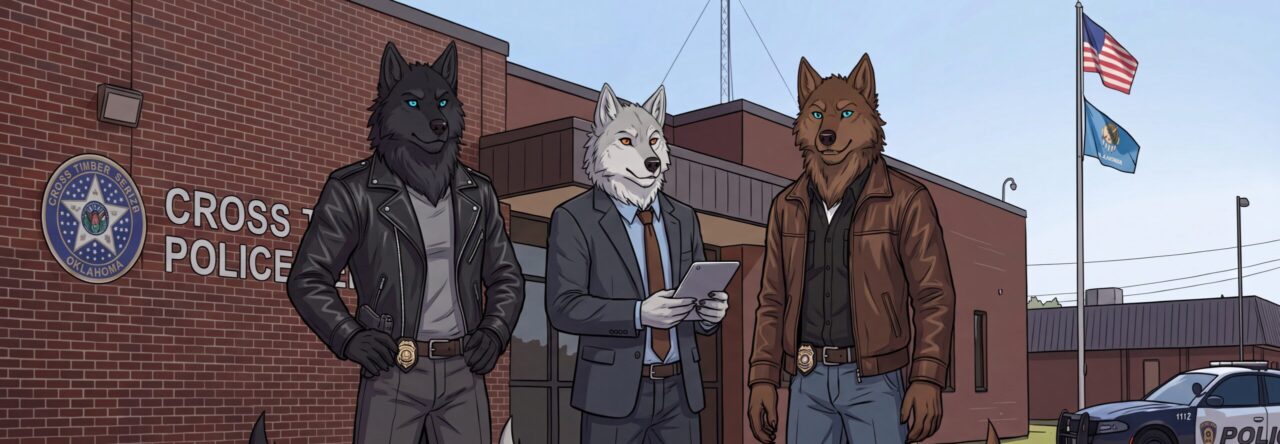
The woman at the front desk had brought cookies.
That was new.
Not entirely new. Cross Timber had been smiling at the wolves more often since the press conference and the flood rescue. People waved from porches. Kids pressed their hands to patrol-car windows. Older people offered handshakes with both hands and said things like I saw the video or my nephew works at the hospital or thank you for coming when my husband was confused last month.
But cookies were still a development.
The woman stood just inside the police department lobby with a metal tin tucked against her chest. She was in her sixties, maybe, hair pinned neatly beneath a knitted cap, a long raincoat buttoned wrong at the top.
Thane saw the tin and stopped.
Gabriel saw Thane stop and immediately looked delighted.
Mark saw the tin and looked cautious.
The woman smiled at all three of them.
“Morning, officers.”
Not wolves.
Not heroes.
Officers.
Thane’s ears shifted.
“Morning.”
“I brought these for the shift,” she said. “Not just you three. Everyone. That feels important.”
Gabriel nodded solemnly.
“It does.”
She opened the tin a fraction. Peanut butter cookies. Still warm.
“My husband was the gentleman at the QuickMart,” she said, looking toward Thane. “The one who was confused. Low blood sugar. You were there.”
Thane remembered.
The broken glass. The false knife. The customer who had been terrified until they realized the man needed help, not force.
“Yes.”
“He talks about you all the time now. Mostly about how you did not make him feel stupid.”
Thane stood still.
He was better at handling armed suspects than gratitude.
The woman saw it and softened.
“You don’t have to say anything. I just wanted you to know it mattered.”
She held out one hand.
Thane looked at it.
Bell’s voice appeared in his head, dry and exact.
A handshake after a call is fine. A hug during a domestic disturbance is not.
Thane took her hand gently.
Her grip was small. Warm.
“Thank you,” he said.
The woman nodded, then looked at Gabriel.
“You must be the funny one.”
Gabriel placed a hand over his chest.
“Professionally, sometimes.”
“And you,” she said to Mark, “you’re the gray one who writes everything down.”
Mark blinked.
“Yes.”
“My husband says that is why the ambulance people believed what happened right away.”
Mark’s ears lifted.
“Your husband provided useful information.”
“He says you gave him a blanket and wrote down the name of his favorite baseball team.”
Mark glanced at Gabriel.
Gabriel was grinning now.
“That was operationally relevant,” Mark said.
The woman laughed.
“I am sure it was.”
Then she pushed the cookie tin gently toward them.
“Please make sure the others get some.”
Nina leaned out through the dispatch window.
“Leave them there. If Gabriel touches the tin first, nobody else gets cookies.”
Gabriel looked offended.
“I distribute joy.”
“You distribute crumbs.”
The woman set the tin beside Nina’s keyboard and went on her way.
Thane watched her leave through the glass doors.
Outside, rain had stopped sometime before dawn. The street glistened beneath low gray clouds. A teenager across the road saw Thane through the lobby window and waved hard enough to nearly drop his backpack.
Thane raised one hand.
The teenager grinned and kept walking.
Gabriel leaned close.
“Public relations suit you.”
“No.”
“Your first fan club has baked goods.”
“No.”
Mark adjusted the strap of his duty belt.
“The cookies were for the department.”
Gabriel looked at him.
“That is exactly what someone says while preserving the best one for later.”
Mark’s ears flattened.
“I did not preserve anything.”
Nina lifted the tin lid.
“There are eighteen.”
Gabriel looked at Mark.
“Top of class math says there are now seventeen.”
Mark stared at the ceiling.
“I am not discussing this.”
Crowe’s voice carried from the briefing-room doorway.
“Inside. Now.”
The room quieted when they entered.
Not because the three wolves had arrived.
That part had become normal enough.
Because the board at the front of the room listed the overnight call summary, and the numbers at the bottom were not normal.
Armed robbery reports: 0
Shots-fired calls: 0
Gun-brandishing complaints: 1
Crowe stood at the front with a tablet in hand.
“Before anyone congratulates themselves,” she said, “we are not becoming complacent because the city has had a quieter month.”
She tapped the screen behind her.
“Open displays of firearms during robberies and street disputes are down. Dramatically. We all know why.”
A few eyes shifted toward Thane.
He did not move.
Crowe continued.
“People saw a gun fired at an officer. They saw that officer stay upright. They saw a suspect lose control of that weapon. Some of the criminals who used to wave guns around like they were magic are thinking harder before they do it.”
Bell leaned against the wall beside Thane’s row, arms folded.
“But,” Crowe said, “do not confuse a lower gun-display rate with a lower danger rate. Cowards adapting is not the same thing as crime disappearing.”
The room settled further.
“Domestic abuse does not stop because somebody is afraid of being filmed. Stalking does not stop. Fraud does not stop. Planned theft does not stop. The people who want power simply get quieter about how they take it.”
She let that stay in the room.
“Which means patrol work gets harder, not easier. You do not wait for a weapon to appear before you take a call seriously.”
Mark made a small note in the margin of his briefing pad.
Cho saw it.
“Do not turn that into a quote poster.”
“It is relevant guidance.”
“It is a sentence.”
“Those can be relevant.”
Cho took a sip of coffee.
“Your FTO evaluation is nearly complete. I can still write ‘unable to distinguish useful note from decorative note.’”
Mark closed the pad.
Crowe moved on.
“Final late-phase FTO week. Bell with Thane. Ortiz with Gabriel. Cho with Mark. You have more responsibility. That does not mean you have less supervision. Your FTOs are evaluating whether you can carry the job without someone standing over every sentence you write.”
Gabriel raised a hand.
Crowe stared at him.
“Why?”
“Do we get a ceremony?”
“No.”
“A small pin?”
“No.”
“Maybe a laminated—”
“No.”
Gabriel lowered his hand.
“Hostile workplace.”
Bell muttered, “You will survive.”
“Emotionally, uncertain.”
Crowe finished assignments.
“Routine patrol. Business checks. Theft reports. Traffic complaints. Do your jobs. And remember: just because the city is smiling at you does not mean it gets to distract you from the call.”
The briefing broke.
Bell stopped Thane near the door.
“Ready?”
“Yes.”
Bell looked at him.
“Not what I asked.”
Thane waited.
Bell folded his arms.
“You have been doing well. That is true. Today could be boring. It could be loud. It could be nothing at all. Your job is not to make the day important.”
Thane nodded.
“Be useful.”
Bell’s mouth shifted.
“Now you’re learning.”
They split.
Three patrol cars. Three FTOs. Three rookies who were almost not rookies anymore.
The city went on around them.
Thane’s first call was a security alarm at a closed insurance office.
Bell made him check the building.
Doors. Windows. Rear access. Roofline. Alarm panel. No forced entry. No suspect. A loose exterior sign had shifted in the wind and tripped a motion sensor.
Thane wrote the report in four sentences.
Bell read it from the passenger seat.
“Good.”
Thane turned his head.
“No correction?”
“Don’t get used to it.”
Thane looked back at the laptop.
“You say that every time.”
“Because every time, you look like you expect applause.”
“I do not.”
Bell’s expression made clear that he did.
By ten-thirty, they had handled a parking complaint outside a dentist’s office, a minor crash in a grocery-store lot, and a welfare check on an elderly man who had been asleep with his phone on silent.
At the welfare check, the man opened the door, saw Thane, and immediately smiled.
“Hell, it’s the bulletproof officer.”
Thane’s ears went back.
Bell stepped in before Thane could answer.
“Sir, Officer Thane is not bulletproof. We are here because your daughter could not reach you.”
The man’s smile faded.
“Right. Sorry.”
Thane said, “It’s okay.”
The man looked at him.
“I saw you on television.”
“I know.”
“Scared me.”
Thane did not know what to do with that either.
The man continued.
“Then I saw you talk at the station. You said you were a rookie trying not to screw up.”
Gabriel would have loved that.
Thane tried not to.
The man smiled again.
“That sounded honest.”
Thane looked at Bell.
Bell gave him nothing.
So Thane looked back at the man.
“It was.”
The old man nodded.
“Good. Keep doing that.”
They cleared the call.
Bell drove for two blocks before speaking.
“Not a landmark.”
Thane looked at him.
“Good.”
“Then stop standing like one.”
Thane stared out the window.
The radio cracked.
“Three-oh-four, available for a commercial burglary alarm at Cedar Ridge Animal Clinic, rear access. Keyholder en route. Alarm company reports rear motion and glass-break activation.”
Bell’s hands shifted on the wheel.
“Now we have a call.”
They arrived at Cedar Ridge Animal Clinic under a pale noon sky that still held the gray edge of weather.
The clinic sat on a quiet side street behind a grooming salon and a feed store. The front windows were bright with cartoon cats and dogs. A hand-painted sign near the door advertised low-cost vaccination clinics on Saturdays.
The rear alley was different.
Trash bins.
Delivery crates.
A narrow strip of damp pavement.
A broken rear window.
Bell parked without lights, radioed their arrival, and stepped out.
“Talk me through it.”
Thane looked at the building.
“Commercial burglary. Rear window forced. Unknown number of suspects. Possible animal medications or equipment inside. We establish perimeter, wait for backup and keyholder unless immediate threat is visible.”
Bell nodded.
“Good. What do you not do?”
“Go through the window because I can fit.”
“Especially because you can fit.”
Thane’s ears shifted.
Bell glanced toward the broken glass.
“See anything?”
“Broken pane. No blood visible. One boot print near the sill. Looks like someone entered.”
“Anything else?”
Thane stopped.
The alley smelled of wet cardboard, old fryer grease from the diner behind the block, dog shampoo, disinfectant, and something sharper underneath.
Citrus industrial cleaner.
Clove cigarettes.
Damp canvas.
He looked down.
The scent trail did not belong in an alley behind an animal clinic.
Not with the forced window.
“Two people,” Thane said.
Bell looked at him.
“Facts.”
“Two distinct adult scent trails. One crossed the window sill and entered the building. One remained in the alley near the delivery gate. Both carried the same citrus cleaner and clove-cigarette odor.”
“Can you identify them?”
“No.”
“Can you tell when?”
“Recent. Rain and wind make it difficult to narrow further.”
Bell keyed his radio.
“Three-oh-four on scene. Forced rear entry confirmed. Possible two suspects, one inside and one outside based on observable tracks and officer sensory observations. Request backup and keyholder.”
Nina answered.
“Copy. Three-twelve and Three-eighteen available nearby.”
Gabriel and Mark were both close.
That was unusual.
Thane’s ears shifted.
Bell noticed.
“Do not turn it into a reunion.”
“I wasn’t.”
“You were thinking it loud.”
Thane said nothing.
The clinic keyholder arrived before anyone else: a woman in scrubs named Dr. Mallory Venn, hair damp from the rain, face white when she saw the window.
“Oh God.”
Bell held up one hand.
“Stay by the patrol unit. We will clear it.”
Dr. Venn nodded, shaking.
“I don’t understand. There’s no cash back there. The register is empty. We don’t keep—”
She stopped.
Bell looked at her.
“What do you keep?”
“Medication. Some regulated medication. Sedatives. Pain medicine. But it’s locked.”
“Who has access?”
“Me, my office manager, two technicians. Why?”
“Let us clear the building first.”
Backup arrived.
Ortiz and Gabriel took the front entrance. Cho and Mark held the east side near the side gate. Bell and Thane waited at the rear.
The clearing was standard.
Professional.
Slow.
No one asked the wolves to lead with their senses. No one treated them like a shortcut through danger.
Bell announced.
“Cross Timber Police! If you’re inside, make yourself known!”
Nothing.
They entered through the rear with Dr. Venn’s key after the warrantless emergency-burglary protocol was met and the building was cleared for safety.
The clinic smelled like animals, antiseptic, fur, wet food, and fear.
No human inside.
No animal injured.
The medication cabinet in the treatment room had been opened.
Not broken.
Opened.
A key had been used.
Mark met them in the hallway with Cho behind him.
“Rear window entry confirmed,” Mark said. “Interior office door accessed without force. Medication cabinet accessed without force. Cash drawer untouched. Computers untouched.”
Cho lifted one eyebrow.
“Patrol-sized.”
Mark adjusted.
“Specific medication and access items taken. Other valuables left.”
Bell looked at Dr. Venn.
“What was taken?”
She checked the cabinet, hands trembling.
“Ketamine. Butorphanol. Buprenorphine. Small quantities. A few sedatives. Nothing huge.”
“Anything else?”
She opened a nearby drawer.
Her face changed.
“The cabinet key log.”
Bell looked at her.
“Key log?”
“We document who checks out controlled medication keys. It’s a state requirement.”
Mark glanced toward Cho.
Cho gave him the smallest nod.
Relevant.
Dr. Venn kept looking.
“And the delivery schedule.”
“Delivery schedule for what?”
“Heartland Animal Health. They bring most of our regulated inventory from their regional warehouse.”
The room changed.
Not loudly.
Not visibly.
But Thane felt it.
Bell looked toward Mark.
Mark had gone still.
Gabriel, standing near the front desk, looked at Ortiz.
The same thought had crossed all of them.
No one said it first.
That was the training.
Bell said, “We document this call fully. Nobody builds a theory on one burglary.”
Mark’s ears lowered a fraction.
“Yes.”
Thane looked toward the rear window.
The cigarette and cleaner scent still sat in his nose.
He remembered it.
He did not call it a pattern.
Not yet.
Gabriel’s call came thirty-six minutes later.
He and Ortiz were at a convenience store on North Mayfield, standing beside a young clerk who kept apologizing for calling police.
“I know it sounds stupid,” she said. “He didn’t do anything. He was just weird.”
Ortiz stood beside the front counter, calm and direct.
“We are here because you called. Start where it makes sense.”
The clerk’s name was Brianna. She was nineteen, maybe twenty, with a dark green store polo and a nervous habit of pulling at the cuff of her sleeve.
Gabriel stood a little to the side.
Not crowding.
Not smiling too warmly.
Not making the words easier than they were.
He had learned that part.
“He came in three times this week,” Brianna said. “Maybe four. Always late. Like right before closing.”
“Same person each time?” Ortiz asked.
“Yes.”
“Describe him.”
“White guy. Maybe thirty. Brown hair. Gray work jacket. He had a hat one night. Like a ball cap. He smelled like smoke.”
Gabriel’s ears shifted.
Ortiz saw it.
She did not react.
“What did he say?” she asked.
Brianna looked down at the counter.
“He flirted.”
Gabriel did not move.
“How?”
“He called me pretty. Asked if I was always here alone. Asked if I had a boyfriend. Just normal creepy-guy stuff.”
Ortiz nodded.
“What else?”
Brianna hesitated.
“That’s why I feel dumb.”
“You do not have to feel dumb,” Gabriel said.
Ortiz looked at him.
He held up one hand slightly.
Not taking over.
Just keeping the door open.
Brianna looked at him.
“He asked which cameras worked.”
Gabriel’s expression stayed still.
“What exactly did he ask?”
“Like… which ones were for show. He said the front one looked fake.”
“Did he touch any cameras?”
“He pointed.”
“Where?”
Brianna showed them.
The front register camera. The one above the cooler aisle. The one pointed toward the door.
“What else?”
“He asked what time deliveries came. Asked if the armored truck still came Wednesdays. Asked if we had a panic button.”
Ortiz’s posture changed.
“Did he ask who had keys?”
Brianna nodded.
“And he asked about the animal clinic.”
Gabriel looked at her.
“Which animal clinic?”
“Cedar Ridge. Across from the alley. He said he saw someone loading medicine over there once. He asked if they stayed open late.”
“Did he say why?”
“No.”
“Did he mention a vehicle?”
Brianna looked toward the parking lot.
“Dark van. Cargo van. No back windows. He parked by the dumpsters.”
“What color?”
“Maybe blue. Or dark gray.”
“Anything distinctive?”
She thought.
“There was a sticker on the back window. Like a county fair thing? I remember because it was peeling.”
Gabriel’s ears shifted again.
“Did you see a plate?”
“No. I’m sorry.”
“You have nothing to apologize for.”
Ortiz looked at him.
Gabriel kept his eyes on Brianna.
“Did he ever say a name?”
“He said his name was Dean, but I don’t think it was. He had one of those fake-friendly voices. Like he was trying to make you feel bad for being nervous.”
Gabriel understood that kind of voice.
He did not like it when someone else used it.
“Did he ever threaten you?”
“No.”
“Did he ever block you from leaving?”
“No.”
“Did he ask anything else about police response?”
Brianna nodded slowly.
“He asked how fast police usually came if a place got hit.”
Ortiz’s face stayed calm.
“Okay. That matters.”
Brianna looked nervous again.
“Am I in trouble?”
“No,” Ortiz said. “You did the right thing.”
Gabriel added, “You noticed something felt wrong before someone gave you permission to call it wrong. That is useful.”
Brianna’s eyes watered slightly.
“That’s what my mom says. She says I always make a big deal.”
Gabriel’s voice softened.
“Your mom is not on this call.”
Ortiz’s mouth shifted.
Very slightly.
Brianna laughed despite herself.
They requested the store’s security footage. The man appeared on camera only in pieces—gray work jacket, ball cap, dark cargo van beyond the glass. He never committed a visible crime. He never touched the clerk. He never stole anything.
He just watched.
Asked.
Measured.
When the call cleared, Ortiz sat in the patrol unit with Gabriel for a moment before starting the engine.
“You wanted to tell her she was right to be worried.”
“She was.”
“Yes.”
“You wanted me to wait.”
“I wanted you to let her tell us why.”
Gabriel looked at the rain-blurred store behind them.
“She did.”
Ortiz nodded.
“She did. Good.”
Gabriel leaned his head against the seat.
“That is nearly praise.”
“It is not.”
“Cruel.”
“Accurate.”
Mark’s call came an hour later at a medical-supply delivery company on the west side of town.
The building was plain, low, and forgettable. White warehouse walls. Three delivery vans. A loading dock. Faded blue company lettering.
The operations manager met Cho and Mark in the lot with a clipboard clenched in both hands.
“I don’t understand what they wanted,” he said. “They left everything valuable.”
Cho looked at him.
“Start from the beginning.”
The man’s name was Emilio Vargas. He led them to one of the company vans parked under a security light.
The passenger-side window had been pried open.
Inside, the glove box hung open.
The driver’s wallet sat untouched on the seat.
A company tablet rested in its charging mount.
A small cash pouch was still tucked beneath a clipboard.
Mark looked through the open van door without touching anything.
“What is missing?” Cho asked.
Vargas checked a list on his clipboard.
“Gate fob. Dock access badge. Key ring for two route vans. A route packet. Delivery schedule clipboard.”
“Anything else?”
“Not that I can see.”
“Are any of those items valuable?”
“Not by themselves.”
Mark’s ears shifted.
“What does the route packet include?”
“Stops. Time windows. Delivery contacts. Secure-access instructions for some sites. Medical offices, clinics, retirement homes. Some veterinary locations.”
“Which veterinary locations?”
Vargas looked down the list.
“Cedar Ridge Animal Clinic. Hillside Vet. Heartland Animal Health Distribution.”
Mark went still.
Cho saw it.
“What do we know?”
Mark looked at the van.
“The offender took access tools, route information, keys, and facility-specific delivery instructions. They left cash, electronics, and personal property.”
“What does that tell us?”
“It could indicate the items are more useful for entering locations than selling them.”
Cho nodded.
“Could.”
Mark looked at the route list still in Vargas’s hand.
“Heartland Animal Health Distribution is on this list.”
Cho looked at him.
“And?”
“Cedar Ridge’s delivery schedule was taken this morning.”
Cho said nothing.
Mark continued more carefully.
“The veterinary clinic burglary and this vehicle entry may be connected by access to the same supply chain. The clerk report may also be relevant because the man asked about the clinic and camera coverage.”
Cho nodded once.
“Now we have something.”
Mark’s chest warmed.
Not because he had solved it.
Because he had said it right.
Cho keyed his radio.
“Three-eighteen to command. Request Lieutenant Crowe review three related reports: Cedar Ridge Animal Clinic burglary, North Mayfield convenience-store suspicious contact, and medical-supply vehicle entry. Possible common access and supply-chain link.”
Crowe’s response came after a pause.
“Copy. All three FTO units return to station for briefing. Preserve scene. Do not extend beyond your assigned call.”
Mark looked at the route packet.
The map was there.
Not the answer.
Not yet.
But the beginning of one.
The briefing room filled again before the afternoon had fully settled.
Crowe stood at the front with the three reports open on the large monitor.
Bell leaned against the wall beside Thane.
Ortiz stood near Gabriel.
Cho sat beside Mark, coffee in hand, unreadable.
Voss appeared on the screen through a secure video call from investigations. Rusk sat beside her, looking like he had been interrupted during something he would rather have ignored.
Crowe pointed to the first report.
“Cedar Ridge Animal Clinic. Forced rear entry. Controlled veterinary medications taken. Controlled-medication key log taken. Delivery schedule for Heartland Animal Health Distribution taken.”
Then the second.
“North Mayfield convenience store. Suspicious male asks clerk about camera placement, keys, delivery times, panic systems, police response times, and Cedar Ridge Animal Clinic. Described dark cargo van with county-fair sticker. Gray work jacket. Cigarette odor.”
Then the third.
“Medical-supply company. Cargo van entered. Cash and electronics left. Gate fob, dock access badge, route information, keys, and delivery schedule taken. Heartland Animal Health Distribution listed as destination.”
The room went quiet.
Crowe looked at the trio.
“Talk.”
Thane looked at Bell first.
Bell gave him a slight nod.
“Two people at Cedar Ridge,” Thane said. “One entered. One waited outside. Both had citrus industrial cleaner and clove-cigarette odor.”
Gabriel picked up from there.
“The clerk described one male in a gray work jacket who smelled of smoke. He asked about camera coverage, keys, delivery schedules, and response times. He watched the animal clinic.”
Mark looked at the reports.
“The stolen items are not primarily valuable for resale. They provide access. Gates, docks, route information, delivery timing, keys. The crew may be preparing to enter a larger location without forced entry.”
Crowe tapped the Heartland listing.
“Likely target?”
Mark nodded.
“Heartland Animal Health Distribution.”
Voss looked through the screen.
“Why?”
Mark answered without rushing.
“They have regulated veterinary medication, temperature-controlled inventory, exterior loading access, and regular delivery windows. The stolen materials would help someone identify blind spots, access doors, and response times.”
Rusk leaned toward the screen.
“Or?”
Mark paused.
“Or they are building access to multiple smaller sites and Heartland is only one of them.”
Voss nodded.
“Good.”
Thane looked at the screen.
“They already know where to go.”
Gabriel added, “They were checking who would notice.”
Crowe folded her arms.
“That is the pattern.”
The words landed heavily.
Not because it was detective work.
Because it was patrol work done well enough to become useful before the next crime happened.
Voss spoke through the screen.
“Do not chase the pattern. Position for the next likely move and let them show you what they intend to do.”
Rusk sighed.
“I hate when she says that because it means we are about to sit somewhere cold for several hours.”
Crowe looked around the room.
“Heartland has been notified quietly. They are cooperating. We do not light up the place with marked units and scare this crew into choosing another target. Patrol units will hold low-visibility positions. Command will coordinate.”
She looked at Bell, Ortiz, and Cho.
“Your rookies have earned more responsibility. They are not running this operation. You are.”
Bell said, “Understood.”
Ortiz said, “Understood.”
Cho nodded.
Crowe looked at the trio.
“You are not detectives. You are not bait. You are not a trap. You are patrol officers under supervision who happened to recognize a pattern. Continue being useful.”
Gabriel raised one finger.
Crowe stared at him.
He lowered it.
“Nothing.”
The operation began after sunset.
Heartland Animal Health Distribution sat on the edge of Cross Timber’s industrial district, surrounded by trucking companies, storage lots, and dark stretches of road that held their own silence after business hours.
The warehouse was large but unremarkable: broad concrete walls, three loading bays, a guarded front entrance, and a fenced rear lot with a service road running along the southwest side.
The public knew nothing.
No social-media live feeds. No waving citizens. No kids holding signs.
Just patrol cars positioned where they could see without being seen.
Bell and Thane took the rear loading lane.
Bell parked behind an equipment shed with a clean view of the southwest service exit.
“Talk me through our role.”
Thane looked at the dark warehouse.
“Containment. Observation. Report movements. Prevent escape if command directs.”
Bell nodded.
“What are you not?”
“A trap.”
“What else?”
“Entry team. Breach team. Tactical unit.”
“Good.”
Thane watched the loading dock.
The air smelled like wet pavement, diesel, cardboard, cooling machinery, and industrial disinfectant.
Then the citrus cleaner.
Then clove cigarettes.
Then three adult human scent trails.
His body went still.
Bell noticed.
“What?”
“Three adults. Two moving toward southeast dock. One remains in the cargo van.”
“Anything else?”
Thane listened.
The warehouse hum. A distant train. Rainwater dripping from a gutter. The quiet shift of people trying to be quiet.
“Odor consistent with weapon lubricant from at least one source,” he said. “I cannot confirm a firearm.”
Bell nodded.
“Report it.”
Thane keyed his radio.
“Rear perimeter to command. Three distinct adult scent sources. Two approaching southeast loading dock. One remains in dark cargo van. Detecting citrus cleaner and clove-cigarette odor consistent with prior scenes. Possible weapon lubricant from at least one subject. No visual firearm confirmation.”
Crowe answered from command.
“Copy. Maintain position. Front team, stand by.”
Gabriel and Ortiz were positioned near the front service entrance where a single loading-door light cast a weak cone across wet pavement.
From there, Gabriel could see the front offices through the glass and hear the warehouse’s internal machinery humming behind the walls.
Ortiz stood beside him.
“Do not narrate.”
Gabriel sighed.
“You make that sound like a chronic illness.”
“It is.”
He listened.
A door opened somewhere on the far side of the building.
A faint beep.
Access badge.
Then a muffled voice.
One male. Angry.
Another voice answered.
Gabriel caught only pieces through metal and rain.
“—said cameras—”
“—doesn’t matter—”
“—alarm shouldn’t—”
The second voice tightened.
Panic.
Gabriel keyed his radio.
“Front access. Two voices inside or immediately adjacent to southeast dock. One subject appears agitated. Possible dispute regarding alarm or camera system. No visual.”
Crowe’s response came fast.
“Copy. Hold.”
Mark and Cho were in a quiet command position inside a warehouse manager’s office across the lot, watching a facility map, exterior-camera feeds, and a simple incident board.
Nothing glamorous.
A portable radio.
A dry-erase marker.
A printed site plan.
A stack of blank perimeter logs.
Mark had been assigned to track confirmed unit positions, camera failures, door status, and vehicle movement.
Normal patrol support.
Important patrol support.
Cho stood beside him.
“What do you see?”
Mark studied the camera screen.
The cargo van sat near the southeast dock.
Not backed into a bay.
Not positioned to load.
It angled toward the southwest service road.
The only route that bypassed the front entrance.
The only route currently visible only to Bell and Thane.
“Van is staged for departure,” Mark said.
“Why?”
“Driver-side orientation. Nose pointed toward southwest service exit. It is not aligned with the dock. If it moves, it can avoid the front access point and clear the lot through the rear road.”
Cho looked at the map.
“Anything else?”
“The rear route passes a blind spot between the equipment shed and the fence line.”
Cho looked at him.
“Report it.”
Mark keyed the radio.
“Command, vehicle analysis. Cargo van at southeast dock is angled toward southwest service exit, not loading position. Likely escape route through rear service lane. Recommend coverage adjustment to avoid blind spot between equipment shed and perimeter fence.”
Crowe answered immediately.
“Copy. Unit Five, shift south on Mark’s recommendation. Hold service lane.”
Mark looked at the map as the unit marker moved.
Cho said, “Good.”
Mark waited.
Cho added, “Do not smile at the map.”
“I was not.”
“You were thinking it loud.”
That phrase had spread.
Mark disliked that.
At 9:17 p.m., the first suspect emerged from the southeast loading door.
Gray work jacket.
Ball cap.
He carried a small duffel bag.
Gabriel saw him first.
“Visual. Gray jacket exiting southeast dock. Carrying duffel. Hands not visible.”
Ortiz raised her radio.
“Cross Timber Police! Stop where you are! Show us your hands!”
The man froze.
For one moment, he looked toward the dark cargo van.
Then toward the warehouse.
Then toward the officers.
His hands came up.
The duffel fell to the wet pavement.
“Get on your knees!” Ortiz commanded.
He did.
No drama.
No fight.
Gabriel approached only when Ortiz directed, maintaining the angle she taught him in training. The man kept looking over his shoulder.
“Where’s the gun?” Ortiz asked.
“I don’t have one.”
Gabriel smelled the lie.
Not a scent. A body response. Sweat sharpened. Breath changed. Eyes went away from the duffel too fast.
He did not say anything.
Ortiz had already seen it.
“Keep your hands up.”
The second suspect came through the loading door two seconds later.
He saw the police.
Saw the first suspect on his knees.
Then ran back inside.
Gabriel moved instinctively.
Ortiz caught his shoulder.
“Hold.”
He stopped.
Every part of him wanted to go through the doorway.
The suspect was inside a warehouse filled with unknown rooms, unknown inventory, unknown lines of fire.
Not his call.
Not his door.
Ortiz keyed her radio.
“Second suspect retreated into warehouse from southeast dock. Entry team requested.”
Crowe answered.
“Copy. Warehouse manager confirms building clear except security staff staged in office. Entry team moving. Front units hold.”
Gabriel stood at the door and listened.
The second suspect ran deeper inside.
Fast.
Then a metallic crash.
Then silence.
Ortiz looked at Gabriel.
“What?”
“Back loading corridor,” he said. “He went west.”
“Report it.”
He did.
Across the lot, the cargo van’s engine started.
Thane heard it before the headlights came on.
The familiar citrus cleaner and clove smoke shifted in the air.
The third suspect was still inside.
Bell straightened.
“Vehicle moving.”
The van rolled away from the dock.
Not fast.
Not yet.
It turned toward the southwest service road exactly as Mark had predicted.
Bell keyed his radio.
“Rear perimeter. Cargo van moving toward southwest exit.”
Crowe came back.
“Service units in position. Hold until vehicle commits.”
The van accelerated.
It hit the wet gravel at the corner, tires sliding slightly as it swung toward the service road.
A marked unit appeared ahead, quiet until then, blocking the route.
The van braked hard.
For a second, it sat angled in the lane, headlights washing across the fence.
Then the driver door opened.
A man jumped out.
His hand went to his waistband.
Thane saw it.
Bell saw it.
The driver saw Thane.
The dark cargo van’s headlights lit the brown fur, blue eyes, badge, open hands, and enormous frame beside Officer Bell’s patrol unit.
Something crossed the man’s face.
Recognition.
Fear.
Calculation.
He pulled a handgun halfway free.
Then stopped.
Thane did not move.
Bell’s voice was steady.
“Drop the weapon.”
The man looked at Thane again.
The gun lowered.
He let it fall into the wet gravel.
“Nope,” he said.
The word came out thin.
“I’m not doing that.”
Bell did not react.
“Step away from the weapon. Hands up.”
The man stepped away.
Then ran.
Bell looked at Thane.
“Take him.”
Thane moved.
Not with the blind violence of an old instinct.
Not with a camera pointed at him.
Not with a crowd watching.
With a command.
A fleeing suspect.
A lawful reason.
The man was fast.
He cut along the fence line, trying to reach the narrow gap between the warehouse and a stacked row of pallets.
Thane closed the distance in seconds.
The suspect heard him coming.
Thane knew because the man’s breath changed.
He turned as if to swing.
Then saw Thane’s badge.
Thane caught his upper arm, turned him away from the fence, and guided him down onto the wet ground.
Controlled.
Not gentle enough to let him escape.
Not hard enough to break anything.
The suspect hit the pavement, cursed, tried to pull free once, and stopped when Thane’s weight settled beside him.
“Hands behind your back,” Thane said.
The man obeyed.
Bell arrived with cuffs.
“Hands open.”
Thane released the instant Bell had control.
Bell cuffed the suspect, checked him, and rolled him to his side.
The man panted into the wet pavement.
“I saw the video,” he said.
Bell looked at him.
“Then you know how this works.”
The suspect squeezed his eyes shut.
“I wasn’t gonna shoot.”
Bell said, “You had a gun in your hand.”
“I dropped it.”
“You did.”
The man looked at Thane.
Thane stood, rainwater streaking down the dark fabric of his uniform trousers.
“You should have,” he said.
No speech.
No threat.
Just truth.
Inside the warehouse, the second suspect was found hiding behind shrink-wrapped pallets in the western loading corridor.
He had taken off his jacket and tried to blend into the shadows.
Gabriel heard his breathing before the entry team saw him.
He reported it.
He did not rush in.
The entry team found the suspect, gave commands, and took him into custody without anyone getting hurt.
The duffel bag contained stolen access badges, gate fobs, medication keys, a small laptop, two handheld radio scanners, and a printed list of delivery routes.
The van held the missing route packet, a set of bolt cutters, several boxes of stolen veterinary medication, and a whiteboard listing camera blind spots at locations across Cross Timber.
Not a huge criminal empire.
Not a mastermind operation.
A small crew.
Careful enough to be dangerous.
Quiet enough to keep moving until patrol noticed the pieces.
Voss and Rusk arrived after the scene was secure.
They stepped out of the unmarked sedan just as evidence technicians began photographing the van.
Voss looked at the three arrested suspects.
Then at the recovered property.
Then at the trio standing with their FTOs near the loading dock.
“You did not solve a case you were not assigned,” she said.
Gabriel’s ears lowered slightly.
Voss continued.
“You recognized a pattern. You preserved the next target. You gave patrol command a reason to position units. And you gave investigators something we can build on.”
Rusk looked toward the van.
“Which is, annoyingly, what good detectives do.”
Gabriel smiled.
“That sounded almost complimentary.”
Rusk looked at him.
“Don’t ruin it.”
Mark stared at the whiteboard recovered from the van.
The neat lines. The camera notes. The route numbers.
A map built by criminals.
Not as good as his.
But organized.
Useful.
Dangerous.
Cho followed his eyes.
“Do not touch it.”
“I was not going to.”
“You were thinking about reorganizing it.”
Mark looked offended.
“It is already evidence.”
“Good. Then let it stay evidence.”
Thane stood beside Bell as the suspect he had caught was led toward a transport unit.
Bell looked at him.
“You did what?”
Thane knew the test.
“Moved on command. Controlled the suspect. Released when the threat ended.”
Bell nodded.
“What did you not do?”
“Punish him.”
“Good.”
Thane watched the suspect disappear into the back of the transport vehicle.
For a long moment, the warehouse lights hummed around them.
No one had been shot.
No one had been hurt.
The guns had stayed in the gravel and holsters.
That was not an accident.
That was work.
The final FTO evaluations happened after midnight.
Not in a ceremonial room.
Not with candles or speeches or framed certificates.
In the same tired report room where all three had learned to cut conclusions, reduce sentences, and stop treating every report like a personal war against incompleteness.
Bell sat beside Thane at one table.
Ortiz sat across from Gabriel.
Cho stood beside Mark, holding three folders.
Crowe waited near the back wall.
Voss and Rusk had gone back to investigations.
The warehouse case had already expanded beyond patrol. Search warrants, evidence inventories, interviews, charging packets.
The kind of work that would continue long after everyone in the room went home.
Bell opened Thane’s folder.
For once, there was no immediate correction.
No red marks.
No highlighted sentence.
Thane looked at the pages.
Then at Bell.
Bell rested his forearms on the table.
“You are still dangerous.”
Thane said nothing.
Bell continued.
“That part is not going away.”
Thane nodded.
“No.”
“But now I know what you do with it.”
The room stayed quiet.
Bell looked at the final evaluation sheet.
“You report before motion. You take direction. You can be corrected. You can stand still when standing still is the work. And when it is time to move, I trust you to move for the right reason.”
Thane felt something in his chest shift.
Not pride.
Something heavier.
Bell slid the folder across the table.
His signature sat at the bottom.
FIELD TRAINING COMPLETE
Thane looked at it.
Bell said, “Do not make this weird.”
“I won’t.”
“You are making it weird with your face.”
Thane looked away.
Bell’s mouth twitched.
Across the room, Ortiz had Gabriel’s folder open.
Gabriel leaned back in his chair, trying for casual. It did not quite work.
Ortiz read from the evaluation first.
“Strong communication. Good situational awareness. Excellent rapport under stress. Needs continued discipline around unnecessary commentary.”
Gabriel nodded.
“Fair.”
“Also,” Ortiz said, “you know how to make people listen.”
Gabriel’s expression changed.
Just a little.
He waited.
Ortiz held his eyes.
“Now you know when they need you to listen first.”
Gabriel’s ears lowered slightly.
Then lifted.
“Thank you.”
Ortiz nodded.
“Do not make me regret it.”
“Never.”
She gave him a look.
Gabriel sighed.
“Probably.”
Ortiz signed the final page and slid it across the table.
Gabriel looked at the words.
FIELD TRAINING COMPLETE
For once, he did not make a joke.
Mark was last.
Cho stood beside him with his folder closed.
Mark sat straight, hands folded, ears neutral in the careful way that meant he was feeling too much and trying to make it a posture problem.
Cho opened the folder.
“Strong reports. Strong law. Strong evidence handling. Strong scene awareness. You see patterns early.”
Mark nodded once.
Cho looked down at the page.
“You will never have all the facts.”
Mark said, “I know.”
Cho looked at him.
“No.”
Mark went quiet.
Cho’s voice softened by one degree.
“You know it now.”
Mark’s throat moved.
He looked at the report room around them.
At the endless files. The evidence lockers beyond the glass. The lives that came in fragments and had to be handled before they made sense.
“Yes,” he said.
Cho signed the page.
Then handed it over.
Mark looked down at the words.
FIELD TRAINING COMPLETE
He checked the signature line once.
Then twice.
Gabriel saw it.
“Top-of-class behavior.”
Mark did not look up.
“It is an official document.”
Thane said, “You checked Bell’s signature too.”
Mark looked at him.
“I did not.”
Bell said, “He did.”
Mark’s ears flattened.
Crowe stepped forward.
The room went quiet again.
She looked at the three completed folders.
Then at the officers who had trained them.
“Effective next shift,” Crowe said, “Probationary Officer status ends. You are cleared to solo patrol.”
No one spoke.
The words were simple.
They changed everything.
No FTO in the passenger seat.
No one to quietly correct a radio call before dispatch heard it.
No one to kick a report back before it became the record.
No one to tell them where to stand.
They would still have supervisors.
They would still have policies.
They would still have Bell, Ortiz, and Cho if they needed them.
But the decisions would be theirs.
And so would the consequences.
Gabriel looked at Thane.
Then at Mark.
Mark looked down at the folders.
Thane’s hands rested open on the table.
Crowe continued.
“You are not finished learning. You are not independent because you are exceptional. You are independent because you have shown you can ask for help, follow command, document your actions, and carry the job without making it about yourselves.”
She paused.
“Do not make me regret the distinction.”
Gabriel said, “Never.”
Crowe stared at him.
Gabriel lowered his head.
“Probably.”
The door opened behind them.
Voss stood there with Mercer.
Mercer wore his usual gray suit and his usual expression of administrative fatigue, but there was something warmer behind it tonight.
Voss looked at the three folders.
“You keep turning routine patrol calls into the beginning of good cases.”
Gabriel’s ears lifted.
Mark looked toward her.
Thane held still.
Mercer folded his hands.
“That does not make you detectives.”
Gabriel’s ears lowered again.
Mercer looked at all three of them.
“It makes you officers who may someday be ready to try.”
The words settled softly.
Not a promise.
Not a promotion.
A door somewhere ahead.
Voss added, “For now, learn solo patrol. Get good at the work no one applauds. Build a reputation that survives when nobody is watching.”
Rusk’s voice came from the hallway behind her.
“And try not to start any more international incidents with goats.”
Gabriel looked up.
“That goat respected Officer Thane.”
Bell said, “The goat slept on him.”
“Exactly.”
Mark closed his folder.
“Was that report ever finalized?”
Everyone looked at him.
Mark blinked.
“The animal-control report.”
Crowe rubbed a hand over her face.
“Go home.”
The Humvee waited outside in the dark lot.
For the first time, there were no FTOs behind them.
Bell, Ortiz, and Cho stood near the station doors under the yellow overhead lights, watching the trio cross the parking lot.
Thane reached the driver’s side and held up the keys.
Mark looked at them.
For a moment, he opened his mouth.
Then stopped.
Thane waited.
Gabriel waited.
Mark looked at the huge green vehicle occupying two spaces.
Then at the police department behind them.
Then at the signed folder tucked under his arm.
“We are solo now,” he said.
Thane nodded.
“Yes.”
Mark looked at the lot again.
“I am still documenting my objection.”
Gabriel grinned.
“Some things survive promotion.”
Thane started the engine.
The Humvee rumbled awake.
Bell raised one hand from the doorway.
Thane returned it.
Ortiz did the same.
Cho nodded once.
The three wolves pulled out of the parking lot and into Cross Timber’s sleeping streets.
No FTO rode with them.
No one sat beside them to say slow down, write it shorter, stop talking, take one step back, hands open.
Those voices would still be there.
Inside them now.
The city stretched ahead under a dark Oklahoma sky.
Not theirs to save.
Theirs to serve.
And for the first time, they were going to do it alone.