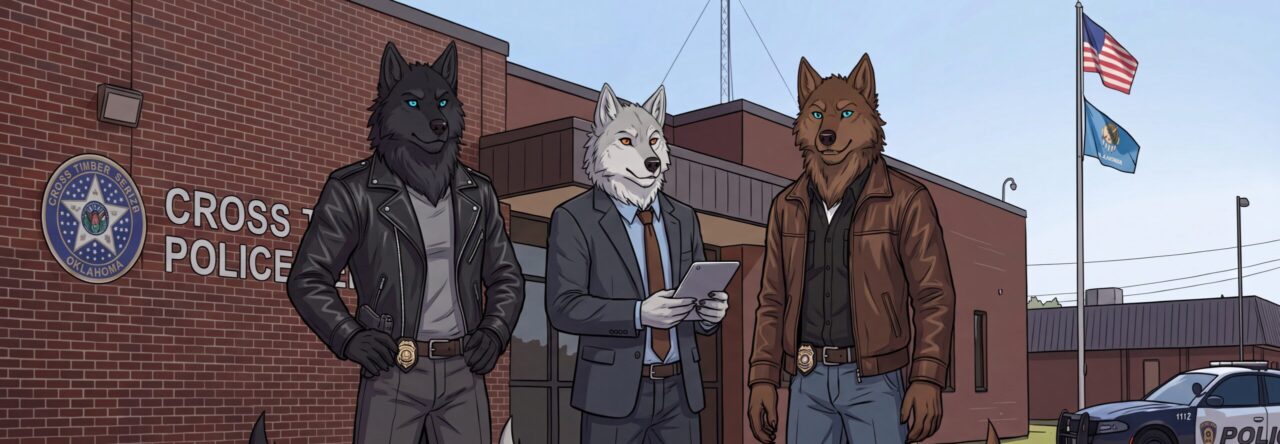
The detective exam began with silence.
Not the comfortable silence of the cabin at dawn, when rain tapped the windows and Gabriel slept too late and Mark pretended he had not been awake for an hour already.
Not the familiar silence of a patrol car before a call, when everyone knew the radio could break it at any second.
This was formal silence.
Measured silence.
The kind created by individual desks spaced evenly across a briefing room, water bottles placed beside sharpened pencils, and sealed packets thick enough to make Thane suspicious before he had even opened one.
He stood in the doorway with Gabriel and Mark on a Saturday morning, all three in clean uniforms, all three without their patrol bags, radios, or normal shift gear.
The room looked wrong without clutter.
No maps on the walls.
No officers coming and going.
No open laptops or coffee cups near keyboards.
Just ten desks.
Ten packets.
Ten candidates.
And a large clock mounted above the whiteboard, its second hand moving with the steady indifference of something that had never been asked to pass an oral board.
Gabriel looked at the room.
“Well,” he said quietly, “this feels inviting.”
Mark looked at the cover page of the nearest packet without touching it.
“There is a word limit.”
Gabriel turned toward him.
“We have been inside for three seconds.”
“It is listed on the cover sheet.”
Thane stared at the packet.
It was thick.
Thicker than it needed to be.
“This has too many pages.”
From the back wall, Sergeant Hale took a sip of coffee.
“Crime has paperwork.”
Gabriel’s ears lifted.
“He waited years to say that.”
Hale did not look at him.
“I can make you leave before you begin.”
Gabriel lowered his head.
“Understood.”
The other candidates were already finding their seats.
Cass Morgan sat near the front row, shoulders squared, dark hair pulled back, expression calm enough to make everyone else feel louder by comparison. She gave the trio a small nod when she noticed them.
A few other patrol officers filled the room: a traffic officer with six years on, a senior night-shift patrolwoman Thane knew only as Rodriguez, two officers from days, and a detective-assignment hopeful from the county task-force rotation.
No one was there to make the wolves comfortable.
No one was there to celebrate what they had done.
They were candidates now.
That was all.
Deputy Chief Mercer entered at exactly eight.
He wore the same gray suit he wore during press conferences, command meetings, disciplinary reviews, and any other event that required a person to look calm while everyone else became nervous around him.
Assistant City Attorney Priya Shah entered behind him, carrying a thin binder and three aligned pens. Voss and Rusk took seats against the side wall. Crowe stood near the door. Hale remained at the rear with his coffee.
Mercer waited until everyone had found a seat.
“This examination creates an eligibility list,” he said. “It does not guarantee an assignment, a title, an office, a badge change, or a desk with a window.”
Gabriel glanced toward Mark.
Mark did not look back.
Mercer continued.
“It establishes who is qualified to compete when a detective opening exists. The people who pass will not all become detectives immediately. Some may never be assigned. That is not failure. This is a standard, not a promise.”
He looked across the room.
“The standard exists because detectives do not simply respond to facts. They organize them. They preserve them. They question them. They decide what can be proved, what cannot yet be proved, and what must be done next before the truth disappears.”
Priya Shah stepped forward.
“The job is not to identify a person you think did it.”
Her eyes moved across the candidates.
“The job is to build a case that can survive everyone who wants to prove you wrong.”
Thane sat a little straighter.
That sentence did not feel like a legal lecture.
It felt aimed.
Priya continued.
“You will be evaluated on law, evidence, ethics, procedure, investigative planning, report quality, witness handling, and judgment. You will not be evaluated on confidence, reputation, physical ability, popularity, or how many people recognize you from the news.”
Gabriel’s ears lowered slightly.
Priya looked at him.
“Especially not that.”
Gabriel nodded once.
“Fair.”
Hale cleared his throat.
“Phones in the lockers. Watches off. No talking. No signaling. No helping each other. You are not a pack for the next four hours.”
The room got quieter.
Thane glanced at Gabriel.
Gabriel was looking at the sealed packet.
Mark was already sitting with both hands flat beside his pencil, as if physically holding himself away from opening it early.
Hale looked at the clock.
“You may begin.”
The packets opened with a low rustle.
Thane turned the first page.
DETECTIVE ELIGIBILITY WRITTEN EXAMINATION
SECTION ONE: INVESTIGATIVE LAW, EVIDENCE, ETHICS, AND REPORT STANDARDS
He read the first question.
A witness had been shown a social-media photograph by an officer before giving a formal identification statement. The witness then claimed the pictured person was the suspect.
Which step was required?
Document the officer’s action.
Preserve the original social-media source.
Avoid treating the identification as independent.
Conduct an appropriate follow-up procedure.
The answer was not hard.
The answer was just longer than Thane liked.
He selected the most complete choice and moved on.
The next question involved a patrol officer who smelled a chemical odor near a vehicle but could not identify the substance.
What could be written?
What required corroboration?
What could not be claimed?
Thane’s pencil moved more easily.
He knew this one.
Officer may document detected odor, describe it without unsupported identification, and note its relevance to scene assessment. Officer may not state the odor proves criminal intent or chemical identity without corroboration.
He paused.
Read it again.
Then moved to the next.
A suspect made an ambiguous request for counsel.
A victim recanted after an assault.
A body-camera video appeared to show an incident but had missing metadata.
A welfare check revealed evidence in plain view.
Every question came down to the same thing.
What did you know?
What could you say?
What could you do next?
And what did you have to leave alone until you had the right authority?
Mark wrote with relentless steadiness.
Not fast.
Not slow.
His pencil moved, stopped, circled a phrase, moved again.
On a question involving a confused witness and a partially suggested identification, he frowned at two answers that were both incomplete in different ways.
He looked at the clock.
Then at the options.
Then back at the clock.
Complete was not always useful.
Correct enough to act was better than perfect too late.
He chose the answer that preserved the witness statement, documented the contamination, and created a path for a clean follow-up.
Then he kept moving.
Gabriel reached a question about an injured witness who had asked whether the suspect would be told they had spoken with police.
His first instinct was toward the answer that emphasized reassurance and support.
He almost selected it.
Then he reread.
The question was not asking how to make the witness feel safe.
It was asking how to preserve a voluntary statement without making promises an officer could not keep.
Ortiz’s voice came back to him, dry and exact.
You are here to hear the part they can tell.
Gabriel chose the answer that protected the witness without directing them.
Then he let out a slow breath and moved on.
Thane reached Question Twenty-Seven.
A likely suspect had motive, opportunity, prior threats, and proximity to the scene. There was no direct physical evidence.
Which investigative step was most appropriate?
He read the answers.
Interview the suspect immediately.
Seek a warrant for the suspect’s residence.
Preserve the suspect’s known communications and verify the suspect’s movements through independent evidence.
Contact the victim’s family and advise them the suspect had been identified.
The third one was obvious.
He marked it.
Then a follow-up asked which evidence should be prioritized first and why.
Thane wrote in the margin before he could stop himself.
Find evidence.
He stared at the words.
That was not an answer.
Not really.
Not enough.
What evidence?
Whose evidence?
What disappeared first?
What could prove him wrong?
The question had too many roads.
He selected the best option, but the unsettled feeling remained.
By the time Hale called the first break, Thane’s neck ached.
The candidates stood quietly, stretched, drank water, and avoided looking at one another as if eye contact might accidentally exchange an answer.
Gabriel went to the water dispenser.
Mark stood beside the window with both hands clasped behind his back.
Thane leaned against the far wall.
Cass crossed the room to refill her bottle. She passed them without speaking, then paused just long enough to say, “No one looks comfortable.”
Gabriel gave her a thin smile.
“That is because this is a welcoming environment.”
Cass glanced toward Hale.
“He looks thrilled.”
Hale did not look up from his coffee.
“I can hear you.”
Cass nodded.
“Then it is working.”
The second packet arrived after the break.
Thane saw the title and felt the room shift.
CASE FILE EXERCISE: KESTREL MOTORS FIRE
Mercer stood at the front again.
“You are not being asked to solve the case,” he said. “You are being asked to build the first forty-eight hours of the investigation.”
Priya added, “A strong case file does not reward the person who falls in love with the first suspect. It rewards the person who protects enough paths to discover what is actually true.”
Thane’s ears shifted.
She did not look at him.
That did not help.
The file was thick.
Of course it was.
A used-car dealership called Kestrel Motors had burned at 2:13 a.m. The office was heavily damaged. The night security guard had been struck while attempting to leave. The guard was alive but hospitalized.
The obvious suspect was Damon Pike, a recently fired employee.
Pike had sent angry texts to the owner two days earlier.
A witness had seen a man in a dark hoodie near the lot around midnight.
Pike knew the alarm system and rear access layout.
A traffic camera had captured his vehicle two miles away near the relevant time.
The owner claimed Pike had threatened to burn the place down.
Thane read those facts once.
Then again.
Damon Pike.
The answer assembled itself quickly.
Anger. Access. Opportunity. Threats. Vehicle near the scene.
He could see the road already.
Then the file complicated it.
The business owner had increased the fire-insurance policy six weeks before the blaze.
The internal camera system had been disabled from inside the office.
The owner was behind on inventory payments.
The security guard reported hearing two voices arguing before he was struck.
The eyewitness could not identify the hoodie wearer’s face, height, or build.
The traffic camera might show Pike traveling in the opposite direction from the dealership.
An accounting discrepancy suggested someone had been removing vehicle-title files from the office.
The instructions followed.
Submit:
- Ranked investigative priorities.
- At least three plausible theories.
- Facts supporting and contradicting each theory.
- Warrant or consent issues.
- Witness-interview plan.
- Evidence-preservation steps.
- Concise probable-cause summary for the next action.
Mark’s first page became an investigation matrix.
Not a giant flowchart.
Not the kind of sprawling, immaculate document Gabriel made fun of at home.
A working order.
Fire-origin scene preservation first.
Security guard’s initial spontaneous statement and medical status.
Exterior and interior video recovery.
Alarm-system access logs.
Insurance policy and claims history.
Financial records.
Title-file discrepancies.
Pike’s work schedule, phone data, vehicle movements, and communications.
Owner’s timeline.
Identification of the second voice.
He wrote the list.
Then ranked it.
Then crossed out three words.
Then rewrote a sentence.
The word limit sat at the top of the page like a threat.
Mark hated it.
Gabriel saw the people first.
The owner’s allegation against Pike sounded persuasive.
Too persuasive.
A recently fired employee. Angry text messages. A supposedly direct threat. A fire.
That kind of story came ready-made.
Gabriel wrote down the owner’s statement, then added a note beneath it:
Obtain exact language of alleged threat; distinguish direct quotation from owner interpretation.
He flagged the security guard as urgent but not uncomplicated.
Injured.
Possibly medicated.
Possibly frightened.
Possibly carrying the only unshaped memory of the argument.
He wrote:
Preserve first spontaneous account before interview contamination; coordinate medically appropriate follow-up.
He added the witness in the hoodie.
Establish observation conditions before treating description as identification.
Lighting.
Distance.
Duration.
Prior familiarity.
Whether anyone had mentioned Pike’s name before the witness gave a description.
Gabriel’s instinct was to build a path through people.
That was useful.
It could also become too much.
He caught himself writing a full paragraph about building trust with the security guard.
Then looked at the instruction.
Operational plan.
Not therapy plan.
He cut it down.
Thane wrote Damon Pike at the top of his page.
Not in large letters.
Not dramatically.
Just as a working lead.
Then he built around it.
Locate Pike.
Preserve his vehicle.
Seek legally appropriate phone-location data.
Verify his route and alibi.
Preserve the threat messages.
Compare his familiarity with alarm systems and rear access.
Locate clothing and footwear.
Check for injuries consistent with a struggle.
It was clean.
Useful.
Strong.
Then he reached the instruction:
What facts would most seriously undermine your primary theory?
Thane stopped.
The traffic camera might show Pike traveling away from the scene.
The camera system had been disabled from inside.
The owner had increased insurance.
The title files were missing.
Two voices had argued before the guard was struck.
He wrote them down.
But he wrote them as complications.
Questions around Pike.
Not alternate roads.
The file asked for three plausible theories.
He gave them.
Pike acting alone.
Owner-or-insider financial motive.
Third-party theft or title-fraud scheme involving internal access.
But when he ranked priorities, Pike came first.
Pike’s phone.
Pike’s route.
Pike’s clothing.
Pike’s messages.
The owner’s financial records appeared lower.
The security guard’s second voice appeared lower.
He was not ignoring them.
He was just moving toward the suspect who made sense first.
His pencil paused above the page.
He thought of Bell.
What would prove you wrong?
Thane wrote down the traffic camera contradiction.
Then moved on.
The final written exercise came after lunch.
By then, the room smelled faintly of pencils, bottled water, anxiety, and the sandwiches people had eaten in near silence.
Hale distributed a stack of disorganized supplemental reports.
Conflicting witness accounts.
Partial CCTV timestamps.
A vague social-media post.
An anonymous tip that might be nothing.
A patrol officer’s scent observation.
An incomplete property inventory.
A pending digital-evidence request.
The instruction was one sentence.
Write the report an incoming detective needs at 3:00 a.m. to understand what is known, what is uncertain, and what must happen next.
Mark made five pages of notes.
He knew they had two pages.
He hated that.
He organized the reports into categories:
Known facts.
Unverified claims.
Evidence at risk.
Contradictions.
Next steps.
Then he began cutting.
A sentence became a phrase.
A phrase became a precise bullet.
He removed a useful detail because it did not change the next decision.
It hurt.
But when he reached the end, he had a report that could be read quickly by a tired detective and used immediately.
No unnecessary language.
No loose claims.
No missing steps.
Gabriel’s report was readable in the way a good conversation was readable.
He wrote people clearly without turning them into characters.
He almost wrote that a witness was clearly terrified.
Then he stopped.
He crossed it out.
Instead, he wrote:
Witness spoke quietly, cried intermittently, and repeatedly asked whether the suspect would be told she had called police.
That was better.
Thane wrote a direct summary.
Clear.
Structured.
No overstatement.
No unsupported scent claims.
He identified the key evidence.
He listed uncertainties.
He made sure the incoming detective would know what needed immediate preservation.
But his first paragraph named a primary suspect.
Based on the victim’s prior conflict with Pike, Pike’s knowledge of the facility, and traffic-camera capture near the relevant time frame, Pike should be considered the primary investigative focus pending corroboration.
It was not wrong.
The owner’s insurance increase appeared later.
The internal camera access appeared later.
The second voice appeared later.
All present.
All noted.
But the report had already leaned.
The angle was there.
The written portion ended at 2:45.
Hale collected the packets one desk at a time.
No one spoke.
No one compared answers.
No one asked whether anyone else had noticed the owner’s insurance policy or the camera timing or the witness who could not identify a face.
When Hale reached Thane’s desk, he took the packet, looked at the cover page, and nodded once.
“Done.”
Thane watched it disappear into the stack.
For the first time in years, he wished he could rewrite something after submitting it.
Hale faced the room.
“You have completed the written portion. Congratulations. You are now forbidden from replaying every answer in your head for the rest of the weekend.”
Gabriel raised a hand.
Hale stared at him.
Gabriel lowered it.
“Nothing.”
“Good.”
Hale’s gaze moved across the room.
“Oral boards and practical interview evaluations begin next week. Do not come in thinking charm will replace preparation. Do not come in thinking a good written score will replace judgment. And do not come in thinking strength is relevant.”
His eyes landed on Thane for half a second.
Thane did not look away.
The candidates were dismissed.
Outside the station, the afternoon had gone soft and gray. Spring clouds stretched over Cross Timber, and a light rain had started somewhere beyond the parking lot.
The three wolves walked to the Humvee in silence.
Gabriel opened the passenger door, sat down, and stared through the windshield.
Mark climbed into the back with the grim posture of someone who had just survived a difficult system audit.
Thane got behind the wheel but did not start the engine.
For a while, no one said anything.
Then Gabriel exhaled.
“I think I did well.”
Mark looked up from the back seat.
“You cannot know that.”
“I know I did not humiliate myself.”
“That is not the same as doing well.”
Gabriel considered that.
“Still progress.”
Thane kept both hands on the steering wheel.
Gabriel turned toward him.
“What?”
Thane looked through the windshield at the station doors.
“The fire case.”
Mark went quiet.
“We cannot discuss answers,” he said.
“I know.”
Gabriel’s voice lowered.
“You think you missed something?”
Thane’s ears shifted back.
“I think I found the answer fast.”
Mark watched him carefully.
“That is not always bad.”
“No.”
Gabriel waited.
Thane looked down at his hands.
“But I do not know if I looked hard enough at the other answers.”
The Humvee held the silence.
Mark did not offer false reassurance.
Gabriel did not make a joke.
Finally, Mark said, “Then the oral board is where you show them you know the difference.”
Thane looked at him.
Gabriel nodded.
“And if you do not,” he said, “you learn it before someone’s real case depends on it.”
That was how they loved each other.
Not by saying the hard part was easy.
By refusing to pretend it was not hard.
Thane started the engine.
The Humvee rumbled awake beneath them.
At home that night, Mark built an oral-board study schedule.
Of course he did.
He spread printed policies, old case summaries, evidence references, and a notebook across the long kitchen table. The schedule had columns. Categories. Time blocks. Color coding.
Gabriel stood over his shoulder with a mug of tea.
“This is color-coded.”
“The colors represent topic categories.”
“You made interrogation theory green.”
“It is a calming color.”
Thane sat at the far end of the table, reading the oral-board preparation sheet for the third time.
“There are too many sections.”
Mark looked up.
“There are six.”
“Too many.”
Gabriel leaned back against the counter.
“I think we should practice.”
Mark looked suspicious.
“Practice what?”
“Answers. Questions. Being emotionally harassed by a panel of people who enjoy making us uncomfortable.”
“That is not a formal testing category.”
“It should be.”
Thane looked at the schedule.
“Who is on the panel?”
“Not listed,” Mark said.
Gabriel smiled.
“Then we assume everyone.”
Mark went back to the papers.
“Panel interview. Mock witness interview. Case-presentation defense. Testimony under adversarial questioning. Judgment scenario.”
He paused.
“They only gave us thirty minutes per section.”
Gabriel looked at him.
“That is because God loves us and wants you to suffer.”
Mark stared at the page.
“This is not a theological conclusion.”
Thane looked at the date.
One week.
One week before they sat in front of people who would not care how fast he could run, how much he could lift, how much fear he could smell in a room, or whether a criminal dropped a gun when he arrived.
They would care how he thought.
How he chose.
How he explained what he knew and what he did not.
Monday morning, each candidate received an email.
DETECTIVE ELIGIBILITY PROCESS — ORAL BOARD ASSIGNMENT
The message was brief.
Panel interview. Mock witness interview. Case-presentation defense. Testimony under adversarial questioning. Judgment scenario.
Gabriel read the words panel interview and smiled.
Mark read the schedule and looked personally betrayed by the time limits.
Thane read the email twice.
Then a third time.
The written test had asked them to find the road.
The oral board would ask whether they could defend every step they took upon it.