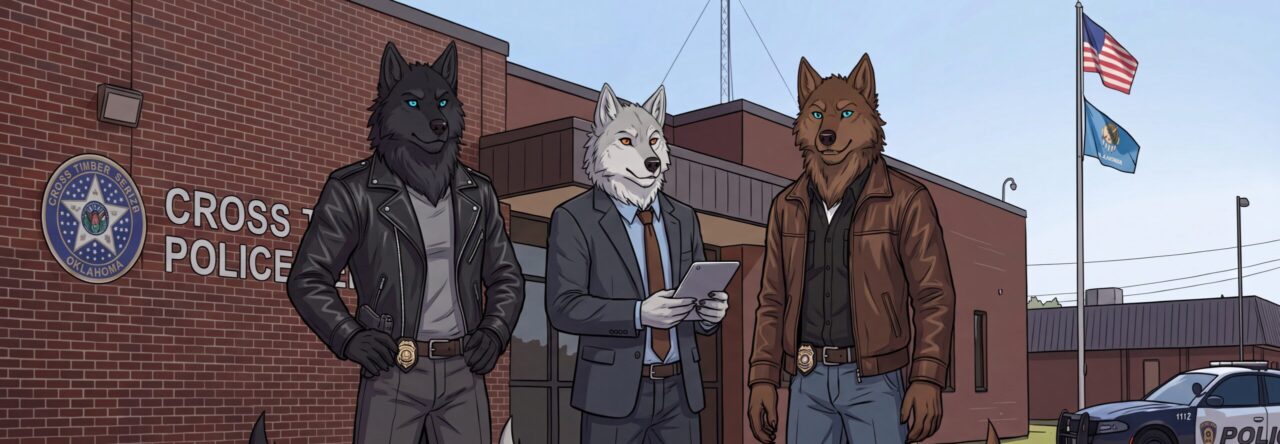
The first night without an FTO began with the Humvee taking up two parking spaces.
Mark stood beside it in the damp gray light before roll call, his patrol bag over one shoulder and his newly issued solo-unit keys in one hand.
He looked at the Humvee.
Then at the two painted white lines it had straddled.
Then at Thane.
Thane waited.
Gabriel waited too, leaning against the passenger door with the calm, interested posture of someone who knew an argument might happen and was determined to enjoy it if it did.
Mark drew in a breath.
“We are solo officers now.”
Thane nodded.
“Yes.”
Mark looked back at the vehicle.
“I am still documenting my objection.”
Gabriel smiled.
“Some traditions hold civilization together.”
Thane locked the Humvee with a heavy electronic chirp and started toward the station.
Mark followed, muttering something about width restrictions and municipal parking standards.
That also felt traditional.
Inside, the department was quiet in the particular way it became quiet before a night shift began. Day watch had mostly cleared out. The lobby lights were warmer than the fluorescent wash of the report room. Dispatch screens glowed behind Nina’s glass window. Somewhere deeper in the building, someone was reheating something that smelled aggressively like onion soup.
Nina saw the three of them enter.
“Congratulations,” she said.
Gabriel put a hand to his chest.
“Thank you.”
“I was congratulating the department.”
Gabriel nodded solemnly.
“Still accepted.”
Nina’s eyes moved to Thane.
“You have a kid waiting by the front window.”
Thane looked.
A boy of maybe seven stood with his father near the lobby doors, backpack still on, cheeks round with the exhausted determination of someone who had refused to leave until he got what he wanted.
When Thane noticed him, the boy’s whole face lit up.
He waved.
Thane lifted one hand.
The boy looked at his father.
“See?”
His father smiled apologetically.
“Sorry, Officer. He saw you on the news a while back. He thinks you’re the coolest person alive.”
Thane’s ears went back.
Gabriel made a soft, pained noise behind him.
Mark was already trying not to smile.
The boy came closer, stopping a respectful distance away.
“Are you really a police wolf?”
Thane looked down at him.
“Yes.”
“Can you smell bad guys?”
Thane thought about that.
“Sometimes.”
The boy considered this carefully.
“Can you smell my dad?”
His father sighed.
“Eli.”
Thane’s muzzle shifted.
“Mostly coffee.”
The boy looked delighted.
His father laughed, then sobered slightly.
“Thank you,” he said. “For what you all do.”
Thane nodded.
“Have a good night.”
The boy waved again as his father led him out.
Gabriel waited exactly three seconds before speaking.
“You handled that surprisingly well.”
“He asked a question.”
“He asked you to confirm you were cooler than his father.”
“I did not.”
“Your silence was legally an admission,” Gabriel said.
Mark adjusted the strap on his uniform vest.
“Please do not explain legal standards to children.”
Crowe appeared in the briefing-room doorway.
“Inside.”
This time, nobody made a joke.
The room had changed since their last shift as probationary officers.
Their names were no longer grouped under a late-phase FTO roster. Bell, Ortiz, and Cho were still there, all assigned to the same night watch, but they stood among the other patrol officers now. No one occupied the passenger seats in the three units assigned to Thane, Gabriel, and Mark.
The empty seats felt larger than they should have.
Crowe stood at the front with the nightly board behind her.
“Congratulations again,” she said. “You are clear to solo patrol. Enjoy the feeling for exactly eight seconds.”
Gabriel glanced at the clock.
Crowe saw him.
“Seven left.”
He lowered his eyes.
Crowe continued.
“No passenger seat tonight. No FTO to quietly rewrite your report before it becomes the record. No one to tell you where to stand before you stand there wrong. No one to reach for the radio before you decide you should have.”
Her gaze passed over the three of them.
“That does not mean you are alone. You call for backup when you need it. You call a supervisor when the scene needs one. You ask questions when you do not know. That is not failure. That is police work.”
Thane felt Bell’s eyes on him from across the room.
Not judgment.
Not instruction.
Something closer to trust.
Crowe assigned zones.
“Thane, north industrial corridor and business district. Gabriel, central residential and apartment sector. Mark, east side—hospital corridor, traffic routes, and commercial response.”
She tapped the board.
“Special Capabilities Support remains active. You may be requested when appropriate. That does not turn you into independent search teams, canine units, tactical assets, or a reason to skip procedure. You are patrol officers first.”
Mark wrote that down.
Cho saw it.
“Not everything needs to become a note.”
“It is direct operational guidance.”
“It is already on the board.”
Mark closed his notebook.
Crowe gave final notices, then dismissed them.
Three separate patrol units rolled out into Cross Timber’s night.
For the first time, no one else’s hand rested near the radio first.
Thane’s first solo call came twenty-six minutes into shift.
A business owner on the north side reported a suspicious person behind a closed appliance store. The caller had seen someone near the loading docks with a long metal bar and assumed they were trying to force open the rear door.
Thane arrived first.
The store sat dark beneath a strip of yellow security lighting. A delivery truck was parked on the neighboring lot. The air smelled of wet asphalt, cardboard, discarded packing foam, and the faint electrical heat of a rooftop unit.
A figure stood near the rear storage area.
Male. Thin. Hood pulled up. Crowbar in one hand.
Thane parked at an angle that kept distance and coverage, notified dispatch, and stepped out.
“Cross Timber Police,” he called. “Set the bar down.”
The man startled hard.
The crowbar came up.
Not like a weapon.
Like a shield.
Thane stopped.
The man’s scent was fear, sweat, stale rainwater, and the sharp bitter edge of panic.
“No,” the man said. “No, no, no. I heard somebody.”
“Set the bar down,” Thane repeated.
“I heard somebody in there.”
Thane looked past him toward the storage shed at the end of the loading dock. A small detached structure, padlocked, no lights inside.
“Who?”
“A girl.” The man’s voice broke. “I heard her crying.”
Thane kept his hands open at his sides.
“Did you see her?”
“No.”
“Did you call anyone?”
“My phone died.”
The man looked toward the shed again.
“I was trying to get it open.”
The crowbar lowered slightly.
Thane had a possible burglary. A possible trespass. A possible person trapped inside. And a man with a tool who might be frightened enough to make a bad decision if Thane made one first.
He keyed his radio.
“Three-oh-one to dispatch. I have one male with a crowbar behind Morrow Appliance. Subject reports possible person trapped in detached storage shed. Request additional unit and fire for welfare access.”
“Copy,” Nina said. “Unit Three-oh-seven en route.”
Thane looked at the man again.
“Set the bar down. Then step away from it.”
The man swallowed.
Thane waited.
The crowbar hit the pavement with a hollow metal clack.
The man stepped back.
“Good,” Thane said. “What is your name?”
“Caleb.”
“Caleb, stay where you are. We are going to check the shed.”
The second unit arrived two minutes later. Officer Janice Bell—not Bell, but a different Bell from day watch, which had confused Thane for the first three weeks of academy—took position with him.
They checked the shed.
The padlock had not been broken. No one was inside.
But they did find the source of the crying: a small orange cat wedged in an open gap beneath the rear flooring, scared and yowling every time the wind shifted.
Caleb sat on the curb while animal control was called.
He had not been trying to steal anything. He had been sleeping in the nearby bus shelter, heard the cat, and convinced himself a child was trapped because the sound had pulled at something old in him.
Officer Bell ran his name. No active warrants.
The appliance-store manager, reached by phone, did not want trespass charges.
Thane stood with Caleb while they waited.
“You did not need to pry the shed open,” he said.
“I know.”
“You could have called.”
“My phone was dead.”
“You could have gone to the fire station. Or the convenience store. Or found somebody.”
Caleb looked down at his hands.
“I thought if I left, it would stop.”
Thane understood that answer more than he wanted to.
“The next time you think someone is trapped,” he said, “you get help before you make a hole.”
Caleb nodded.
“Yes, Officer.”
The cat came out on its own before animal control arrived, streaking beneath the loading dock and vanishing into the dark.
Caleb watched it go.
“Guess it wasn’t a kid.”
“No.”
“You going to arrest me?”
Thane looked at the crowbar resting beside the patrol unit.
“No.”
Caleb blinked.
“Why?”
“Because nobody was hurt. Nothing was damaged. And now you know what to do differently.”
Caleb nodded slowly.
Thane wrote the report himself.
No Bell in the passenger seat to tell him he had been too hard or too soft.
No one to remind him that a crowbar did not automatically make a person a burglar.
When he submitted it, he read it once more.
Facts.
Commands.
Welfare check.
Disposition.
The next morning, Crowe left one short comment in the system.
Good judgment.
Thane read it three times.
Gabriel’s first solo call that night was an apartment disturbance in a building he already knew too well.
The caller said someone was inside an elderly woman’s apartment. The woman herself had called, whispering that she could hear a man moving in her kitchen.
Gabriel arrived with another unit because he had called for one before getting out of his car.
That felt like progress in itself.
The apartment door stood partially open.
Gabriel announced.
“Cross Timber Police. Ms. Halverson?”
A voice from inside, thin and frightened.
“In here.”
Gabriel and Officer Lattimore cleared the apartment together.
No intruder.
No broken window.
No forced entry.
The kitchen was empty except for a small radio playing softly on the counter.
Ms. Halverson sat in a chair in the living room with both hands wrapped around a cordless phone. She was eighty-two, maybe, with silver hair pinned up and fear bright in her eyes.
“I heard him,” she said. “He was in the kitchen.”
Gabriel crouched far enough away not to crowd her.
“Who did you hear?”
“My husband.”
“Where is your husband now?”
The answer took time.
Her eyes shifted toward a framed photograph on the side table.
“He’s at work,” she said.
Gabriel followed her gaze.
The photograph showed a younger man in a Navy uniform.
On the table beside it sat a folded funeral program.
Gabriel felt his chest pull tight.
He did not correct her immediately.
He did not tell her she was confused.
He asked, “What does he do for work?”
“He drove the bus. Nights.” Her mouth trembled. “He always came in after midnight. Made tea. I heard him in the kitchen.”
Gabriel glanced toward the radio.
It was playing old jazz quietly.
The kind of thing someone might have put on after midnight.
Officer Lattimore found the home-health schedule on the refrigerator. Ms. Halverson’s daughter had missed a scheduled evening check-in because of a delayed flight.
Gabriel called the daughter, then sat with Ms. Halverson until a neighbor arrived.
He did not perform kindness.
He did not turn the room into a stage.
He made tea.
When the daughter finally came through the door, crying and apologizing, Ms. Halverson looked at Gabriel and said, “He found you?”
Gabriel swallowed once.
“No,” he said softly. “But your daughter came home.”
The woman’s hand found his.
She held it for a moment.
“You have kind eyes,” she said.
Gabriel looked toward the kitchen.
“Sometimes.”
When he wrote the report, he used language Ortiz would have approved of.
No indication of forced entry or unauthorized person present. Ms. Halverson appeared disoriented regarding the death of her spouse and was released to the care of her adult daughter. Family provided information regarding follow-up medical and welfare resources.
No dramatics.
No poetry.
Just the truth.
Mark’s first solo night went badly at a hospital entrance.
Not dangerously.
Logistically.
Which, in Mark’s opinion, could be nearly as bad.
A three-car crash had blocked the main ambulance lane outside Cross Timber Regional. One vehicle had rear-ended another. The second had clipped a parked SUV. Everyone involved was awake, mobile, angry, and very certain they had been wronged.
An ambulance sat trapped behind them with lights flashing.
A man in a polo shirt was yelling at a woman with a toddler in the back seat of her car.
A second driver was trying to call his insurance company, his boss, and his wife at the same time.
The hospital security officer kept saying, “We need this lane open.”
Mark arrived, took one look at the scene, and felt every part of him want to understand everything before moving anyone.
Then he saw the ambulance.
“Everybody stop,” he said.
No one did.
Mark raised his voice.
“Everyone stop talking.”
They did.
Not because he shouted.
Because there was something in his tone that made the sentence sound like the next correct thing.
He pointed to the man in the polo shirt.
“You. Step to the sidewalk.”
The man stared at him.
“I’m the one who got hit.”
“You are blocking an ambulance.”
The man looked over his shoulder.
Saw the ambulance.
His face changed.
Mark pointed to the second driver.
“You. Put your car in neutral when the tow operator tells you. Do not move until then.”
Then to the woman with the toddler.
“Are you injured?”
“No.”
“Is your child injured?”
“No.”
“Can you move your vehicle if I guide you?”
“Yes.”
“Good. We are clearing the lane first. Statements come second.”
The scene untangled one instruction at a time.
Ambulance moved.
Vehicles repositioned.
Tow truck called.
Drivers separated.
Statements taken.
By the time Cho arrived as a supervisor assist—more out of habit than necessity—the lane was clear and Mark had three concise statements, photographs, and a scene diagram in progress.
Cho stood beside him with coffee.
“You cleared the lane first.”
“Yes.”
“You did not try to solve the crash before making room for the ambulance.”
“No.”
Cho nodded.
“Good.”
Mark looked at the three drivers now standing quietly apart.
“I still need to determine fault.”
“You will.”
“They are all telling different versions.”
“They usually do.”
Mark looked at the damaged cars.
“I need the whole truth.”
Cho’s expression softened by one degree.
“Not all at once.”
Mark nodded.
That night, near shift end, the three met in the report room by accident.
Or perhaps by instinct.
Thane sat at one terminal, reading his suspicious-person report for the final time. Gabriel leaned in the doorway with a paper cup of bad coffee. Mark stood beside the printer, waiting for a crash supplement to emerge in clean pages.
No FTOs sat beside them.
Bell walked past the room, glanced inside, and kept moving.
Ortiz appeared long enough to steal Gabriel’s coffee.
Cho stopped behind Mark, looked at the printout, and said, “One sentence too long.”
Mark stared at it.
“Which one?”
“The fourth.”
Mark read it.
Then removed six words.
Cho nodded and walked away.
Gabriel watched him go.
“I miss Ortiz.”
Mark looked up.
“No, you miss being corrected before you submit something embarrassing.”
Gabriel turned to Thane.
“He misses Bell telling him his report is too blunt.”
Thane kept typing.
“My report is not blunt.”
Mark looked over.
“It is four sentences.”
“It is accurate.”
“It is accurate in a way that feels personally offended by adjectives.”
Thane looked at both of them.
“You are not my FTOs.”
Gabriel smiled.
“No. We are worse.”
The first month of solo patrol taught them that being alone did not mean being isolated.
It meant knowing when not to be.
Thane called for backup before entering dark buildings.
Gabriel called victim advocates before he tried to become one.
Mark called supervisors before he turned a simple property dispute into an all-night legal seminar.
They made mistakes.
Small ones.
A radio call that should have been clearer. A report submitted too quickly. A witness statement that needed one more question. A traffic stop that ran too long because Mark wanted every answer before deciding whether to issue a warning.
But they learned.
And Cross Timber learned them.
By the end of autumn, people recognized all three wolves before they stepped from their patrol units.
A cashier at a grocery store waved at Mark through the window of a parked cruiser.
“You’re the gray officer who writes everything down!”
Mark paused halfway through walking to a shoplifting call.
“That is accurate,” he said.
The cashier’s little daughter stood beside the register with a sheet of gold-star stickers.
She held one out.
“For your notebook.”
Mark looked at the sticker.
Then at the shoplifting suspect sitting quietly beside Officer Reed near the front door.
Then at the child.
“After the call,” he said.
The girl’s face fell.
Mark added, “But yes.”
Her smile returned instantly.
After the report was finished, the child placed the gold star on the inside cover of Mark’s notebook.
He did not remove it.
Gabriel noticed two days later.
“You kept it.”
“It does not interfere with the notebook’s function.”
“It is a gold star.”
“It is adhesive.”
Gabriel leaned close.
“You are sentimental.”
Mark’s ears went flat.
“I am evidence-based.”
Thane looked over from the kitchen table.
“She gave it to you.”
Mark looked at him.
“Yes.”
“That is why you kept it.”
Mark opened his mouth.
Then closed it.
Gabriel smiled.
“Pack emotional breakthrough. Write it down.”
Thane’s public attention came differently.
People saw the size of him first.
Then the badge.
Then the footage they had watched and replayed and discussed at kitchen tables all over Cross Timber.
Some people were afraid before they recognized him.
Then the fear softened.
A man whose work truck Thane helped recover from a drainage ditch shook his hand twice and said, “I saw what you did for Officer Bell. Glad you’re on our side.”
A restaurant owner tried to give him free dinner after a burglary alarm.
Thane said no.
The owner tried again.
Thane said no again.
The owner finally said, “Then let me at least send food to the station.”
Thane considered that.
“Other officers too.”
“All of them.”
“Not just me.”
“Not just you.”
Thane nodded.
That felt acceptable.
Gabriel became the easiest for people to approach.
Victims hugged him after calls. Teenagers whispered to each other when they saw him walk into a school lobby. Old ladies patted his arm and told him he was handsome in ways that made him briefly lose his usual ability to respond.
But Ortiz’s lessons stayed with him.
During a welfare check one winter morning, a mother hugged him in the hallway outside her apartment while her teenage daughter sat silent on the couch inside.
Gabriel accepted the hug for two seconds.
Then gently shifted the woman toward the victim advocate who had arrived.
“She needs you in there,” he said.
The mother looked at her daughter.
The hug ended.
The family went back inside.
Gabriel stayed by the door and let the room become about the people who lived in it.
Later, Ortiz happened to be in the station parking lot when he returned.
“You handled that well,” she said.
Gabriel looked at her.
“Was that praise?”
“Do not get addicted.”
“Too late.”
Crime changed.
Not all at once.
Not cleanly.
But the city’s officers noticed.
Calls involving somebody openly waving a gun during a robbery or street dispute fell. Armed suspects still existed. Guns still existed. Violence still happened. But the people who had once relied on a weapon to own the whole room had watched what happened when a gun was fired at Thane.
They had watched him take the shot.
Stay standing.
Take the weapon away.
They had watched the suspect’s hand collapse beneath power Thane had immediately stopped using once the danger ended.
A gun had always changed a room.
Now, sometimes, the sight of a patrol unit with a wolf behind the wheel changed it back.
Thane saw that one cold February night at a convenience store on the north side.
The alarm came in as a panic-button activation. A cashier called dispatch in a whisper, then the line went dead.
Thane arrived first.
He parked behind a row of dark pumps and saw a man exit the store with a handgun in his right hand and a cash drawer tucked under one arm.
The man looked toward the street.
Saw Thane’s patrol unit.
Then saw Thane step out.
For a second, nobody moved.
The man’s face changed.
Recognition.
Not surrender.
Not goodness.
Calculation.
His hand tightened around the pistol.
Thane stopped behind the engine block, drew his weapon, and gave clear commands.
“Drop the gun!”
The man stared at him.
Thane did not step closer.
Did not assume the video had made him safe.
Did not let the man’s fear become Thane’s advantage.
“Drop the gun,” he said again.
The suspect looked at the handgun.
Then at Thane.
Then toward the store window, where the cashier crouched out of sight.
“Nope,” the man said.
His voice cracked.
“Not doing that.”
He dropped the gun.
The cash drawer hit the pavement a second later.
Then he lifted both hands.
Thane kept him there until backup arrived.
The weapon stayed on the ground until another officer secured it.
The suspect was cuffed without force.
At the station later, a young officer from another shift said, “Guess he knew better than to try it.”
Thane looked up from his report.
“He still had a gun.”
The officer’s smile faded.
Thane continued writing.
That was the part people sometimes missed.
Fear of him did not make a scene safe.
It only changed the choices people made inside it.
And crime found other ways to hurt people.
Later that same night, Thane answered a domestic-disturbance call in an apartment where no one raised a weapon, nobody yelled when police arrived, and every injury had been hidden beneath long sleeves and careful explanations.
The woman who answered the door said she had fallen.
The man behind her said the same thing.
The child in the hallway said nothing at all.
Thane could smell fear.
He could smell fresh bruising beneath makeup and lotion.
He could smell the man’s anger, banked down into stillness because the police were there.
But he could not pull a confession from scent.
He could not arrest a person because the truth lived in the room but would not speak.
He separated them.
Called another unit.
Got a victim advocate.
Documented every observation he could lawfully document.
Asked the woman if she needed medical help.
Asked the child if there was anywhere safe they could go.
He stayed until the woman had resources, a number to call, and a way to leave later if she chose.
Then he walked back to his patrol unit angry at himself for not doing more.
Bell’s unit rolled into the lot as Thane prepared to clear.
Bell had not been assigned to the call. He was simply nearby.
He took one look at Thane’s posture.
“Bad one?”
“Yes.”
“What did you do?”
“Everything I could.”
Bell nodded.
“That is not always the same as everything you wanted.”
Thane looked toward the apartment door.
“No.”
Bell stood beside him quietly.
“It still matters.”
Thane did not answer.
But he wrote the report carefully.
Every detail he could prove.
Every resource offered.
Every time the woman’s story changed.
Every observation that might matter if she called again.
Patrol did not always stop the bad night.
Sometimes it made sure the next person who arrived did not start from nothing.
Months passed.
Then more.
Special Capabilities Support stopped feeling new.
It became part of how Cross Timber worked.
When the department had a reason to request them, it did.
When it did not, it did not.
No capes.
No special unit patches.
No dramatic announcements over the radio.
Just officers using what they had, inside policy, under command.
In the spring, a handgun disappeared after a traffic stop near a drainage ditch behind an abandoned commercial strip. The driver had fled on foot, been caught two blocks away, and insisted he had never possessed a weapon.
The search area stretched through wet grass, broken pallets, rusted chain-link, and the remains of an old loading ramp.
A supervisor requested Thane through the Special Capabilities channel.
Thane arrived with an evidence technician and Officer Bell.
Bell looked at the ditch.
“Find it?”
“I will look.”
“Good answer.”
They walked the legal search area slowly.
No one expected Thane to point at a gun like it had a beacon on it.
The ditch held too many smells: mud, oil, old trash, rainwater, animal trails, rust, discarded food wrappers.
Then—
Gun oil.
Fresh disturbed soil.
A faint human scent leading from the road to a patch beneath broken brush.
Thane stopped.
“Possible location,” he said.
He pointed.
“I detect odor consistent with weapon lubricant and recently disturbed soil in that area.”
The evidence technician approached with gloves, camera, and marker flags.
She found the handgun beneath a shallow layer of wet dirt and leaves.
Thane did not touch it.
Did not pose near it.
Did not act like he had done more than help someone else find the next fact.
Bell watched the technician bag the weapon.
“Good work.”
Thane looked at him.
“Evidence found it.”
“You got them to the right square foot.”
Thane nodded.
That felt different than being praised for strength.
It felt better.
Gabriel’s request came during a summer storm.
A small apartment building had been evacuated after lightning struck a transformer behind it and smoke filled the rear hallway. Fire crews cleared the building once, then received a report that a child might still be inside.
The report was uncertain.
A neighbor thought she had heard crying.
Another thought she had seen the child leave with family.
Fire crews prepared to search again.
Gabriel arrived with Ortiz, who had been assigned as patrol liaison.
“Do not go inside,” Ortiz said before he could say anything.
“I know.”
“You are listening from outside.”
“I know.”
“Do not become offended by the reminder.”
“I am not offended.”
“You are visibly offended.”
Gabriel listened near the rear stairwell while firefighters checked equipment.
Smoke drifted from a broken window.
Rain hit the pavement.
Somewhere inside, a pipe hissed.
Then, beneath it—
A child crying.
Small.
High.
Muffled behind a wall.
Gabriel keyed his radio.
“Possible child vocalization, second floor rear unit. Repeating cry approximately every ten seconds. I cannot confirm exact room.”
Fire command redirected the search.
The child had hidden in a bedroom closet after being separated from an older sibling during the evacuation.
Gabriel stayed outside the door as firefighters entered.
“Hey,” he called through the smoke-darkened hallway once the room was located. “My name is Gabriel. You do not have to come out by yourself. They are coming to get you.”
The crying changed.
“Are you a wolf?”
Gabriel looked at Ortiz.
She covered her mouth with one hand.
“Yes,” he said.
“Like the police wolves?”
“Yes.”
The child sniffed loudly.
“Are you scary?”
Gabriel looked toward the burned light fixture and the firefighters moving through the hallway.
“Not to you.”
The child came out holding a firefighter’s hand.
Mark arrived afterward to assist with the response log and discovered the second search had missed the child because the original evacuation list had been incomplete.
Not negligence.
Chaos.
A neighbor had assumed the child left with an aunt. The aunt had assumed the child left with the neighbor.
Mark corrected the log, matched names to units, and made sure no family member was left unaccounted for before the building residents were released to temporary shelter.
At the station, he wrote the corrected evacuation matrix into the supplemental report.
Cho, reviewing it later, paused at the table.
“You found the gap.”
Mark shook his head.
“The gap was already there.”
Cho nodded.
“Yes. But you found it.”
By the second winter after their solo certification, they were no longer the newest officers in the room.
New academy graduates came in wide-eyed and stiff-backed.
Some stared at Thane too long.
Some tried too hard not to stare.
One young probationary officer asked Mark, quietly, whether it was strange working alongside full-time wolves.
Mark considered the question.
“Yes,” he said.
The probationary officer looked alarmed.
Mark continued.
“It is also normal now.”
That was the truth.
Thane became known around the department as the officer who could settle a loud room without raising his voice.
He still looked intimidating. That never changed.
But he learned how to stand farther back from a frightened person. How to let a doorway remain open. How to give people choices in sentences short enough they could hear them.
He became very good at documenting what he smelled without claiming more than he knew.
Detected fresh cigarette odor near the rear access point.
Detected a strong petroleum-based cleaner odor not consistent with the location’s usual commercial products.
Observed subject’s behavior change after being advised of the witness account.
No more claiming certainty where he had only instinct.
No more letting the first answer become the only answer.
He was good at seeing the likely explanation quickly.
That was why Bell kept warning him about it.
After one burglary call involving a warehouse employee, a broken window, and a suspiciously convenient alibi, Thane found the likely suspect in minutes.
The employee smelled of fresh glass dust, machine oil, and the same paint thinner used near the damaged storage room. His story made no sense.
Thane had him.
Or thought he did.
Then Bell, called in as backup because he was nearby, asked one question.
“What would prove you wrong?”
Thane looked at him.
Bell nodded toward the employee.
“You are probably right. That is not the question.”
The security footage later showed the employee had entered the warehouse after the burglary to remove a personal item from his locker. The real suspect was his cousin, who had used a copied access card and left before patrol arrived.
Thane’s first instinct had been close.
Close enough to be dangerous.
Bell leaned against the patrol unit after the actual suspect was identified.
“Your instincts are good,” he said.
Thane looked at the warehouse lights.
“Yes.”
“That is why they are dangerous.”
“Because I trust them?”
Bell shook his head.
“Because everyone else does too.”
Thane carried that sentence home.
Gabriel became the officer people talked to when they had almost decided not to talk to police at all.
Witnesses remembered details around him.
Teenagers gave him the real version after first giving everyone else the version they thought adults wanted.
Victims who had been dismissed elsewhere sometimes looked at him and decided they could try one more time.
But he had to learn that comfort was not the same thing as direction.
During an assault investigation, a frightened witness told Gabriel she was sure the man in a photo lineup was the attacker.
Gabriel believed her.
He wanted to believe her.
The woman had been hurt. The man had a history. The fear in her voice was real.
But the lineup administrator noted her uncertainty before Gabriel entered the room. A security camera later showed the attacker had been wearing a different jacket and was several inches shorter.
Gabriel had not pushed her.
Not exactly.
But he had wanted her certainty enough that he heard it before it was fully there.
Ortiz found him later in the station parking lot.
“You are not here to give people the ending they want,” she said.
Gabriel looked down at his hands.
“I know.”
“You are here to hear the part they can tell.”
He nodded.
“That is harder.”
“Yes,” Ortiz said. “That is why it counts.”
Mark became the officer supervisors requested when a scene was complicated enough to collapse under its own paperwork.
A multi-vehicle crash. A landlord dispute involving five tenants and two competing leases. A missing-person report where every family member had a different last-known location. A robbery scene where witnesses contradicted each other but all described the same detail in different language.
Mark could hold it.
Not all at once.
Not perfectly.
But enough.
One detective came into the report room after reviewing a burglary packet and stopped beside Mark’s desk.
“Who wrote this?”
Mark looked up.
“I did.”
The detective, a woman from property crimes named DeLeon, flipped through the report.
“You included every camera location, every contact attempt, the times the alarm system was armed and disarmed, and the exact wording of the neighbor’s statement.”
“Yes.”
DeLeon nodded slowly.
“Get me more of him.”
Mark blinked.
“I am assigned to patrol.”
“I know. I am speaking aspirationally.”
She walked away before he could answer.
Gabriel appeared beside Mark’s desk as if he had been waiting behind a filing cabinet.
“Get me more of him.”
Mark’s ears flattened.
“She was complimenting the report.”
“She was flirting with your paperwork.”
“She was not.”
Gabriel leaned closer.
“Mark, you are blushing.”
“I am not.”
Thane looked up from across the room.
“You are.”
Mark looked between them.
“I dislike both of you.”
That was another tradition.
By the time they reached two full years of sworn service, the city had changed around them.
Not because three wolves had solved everything.
Because patrol had become a little more visible. A little more trusted. A little more careful.
People still waved.
People still brought food.
Sometimes, after a scene was truly over, someone offered a handshake or a hug.
Sometimes, someone did not.
The wolves learned to read that too.
The city’s criminals changed, as criminals always did.
Some carried weapons more carefully.
Some fled faster.
Some tried to work through stolen access cards and quiet threats instead of open force.
Some believed the wolves were everywhere.
They were not.
That was the point.
The city still needed every officer.
Every report.
Every witness statement.
Every patrol car arriving in the dark to a person who had decided, finally, to call.
Voss began requesting the trio more often by then.
Not as detectives.
Never that.
As patrol officers who preserved first facts well.
On a warehouse fire, she asked Thane to walk the lawful exterior perimeter before fire suppression destroyed every scent and document what he observed.
On an assault case, she asked Gabriel to take the initial witness statement because the victim had shut down with everyone else.
On a fraud case involving a chaotic elderly couple and three contradictory bank timelines, she asked Mark to organize the first-day sequence before the financial-crimes unit arrived.
Every time, she made the line clear.
“You are patrol support,” she told them one night after Mark handed over a clean timeline that helped secure a warrant. “Do not start calling yourself detectives.”
Gabriel smiled.
“I would never.”
Voss looked at him.
Gabriel paused.
“Out loud.”
Rusk, standing beside her, said, “That was almost self-awareness.”
Gabriel looked pleased.
“It is growing on me.”
Thane said nothing.
He watched Voss take Mark’s timeline and add it to the case file.
Every time they helped investigators, something inside him tightened.
Not jealousy.
Not exactly.
Want.
The desire to follow a case past the first night.
To know what happened after the patrol report went through.
To find out whether the warrant worked. Whether the victim was safe. Whether the person who had lied eventually ran out of places to hide.
But wanting a door did not make it open.
He knew that better than anyone.
The eligibility notice appeared on a Tuesday night in early spring.
No announcement over the radio.
No special meeting.
Just a bright white page posted on the briefing-room board beside shift assignments, parking notices, and a reminder that someone had left an entire box of unlabeled evidence bags in the copy room.
Mark saw it first.
He stopped in front of the board.
Read it.
Then read it again.
Gabriel, coming in behind him with coffee, nearly walked into his back.
“What?”
Mark stepped aside.
The notice was simple.
CROSS TIMBER POLICE DEPARTMENT
DETECTIVE ELIGIBILITY EXAMINATION
Applications Open
Below it, the requirements.
Two full years sworn service.
Probation completed.
No active corrective action.
Satisfactory patrol evaluations.
Approval through chain of command.
Successful completion of written examination, case-file analysis, investigative planning scenario, report-writing exercise, oral board, and testimony evaluation.
Mark reached into his pocket for a pen.
Then stopped.
Gabriel looked at the words oral board and smiled.
“Finally. A test with an audience.”
Mark looked at him.
“That is not a positive feature.”
Thane read the list.
Case-file analysis.
Evidence review.
Investigative planning.
Report writing.
Oral board.
Testimony evaluation.
Too many words.
Gabriel saw his expression.
“Too many pages?”
Thane looked at the notice.
“Too many words.”
Mark adjusted the edge of the paper without touching it.
“That is how crime works.”
“Crime needs fewer words.”
Gabriel lifted his coffee.
“Tell the criminals.”
Bell entered the room from one side, Ortiz from another, and Cho from the rear hallway with his usual clipboard tucked beneath one arm.
They had clearly known the notice was coming.
No one said anything at first.
Bell stopped beside Thane.
“You do not have to apply.”
Thane nodded.
“I know.”
Ortiz looked at Gabriel.
“You do not get to charm the oral board.”
Gabriel looked wounded.
“That seems discriminatory.”
“It is preventative.”
Cho looked at Mark.
“There will be word limits.”
Mark went very still.
Gabriel smiled broadly.
“That is crueler than anything you have ever said to me.”
Cho looked at him.
“You have said a great many things to me.”
Crowe stepped to the front of the room as the rest of night watch filtered in.
“You have earned the right to apply,” she said. “That is not the same as earning a detective badge. If you enter the process, you will be measured against the same standard as every other candidate.”
Her eyes went to the trio.
“No special exceptions because you are unusual. No special credit because you are popular. No discount because you have done impressive things.”
Gabriel’s ears lowered a fraction.
Crowe continued.
“The detectives who come out of this process will carry cases that change lives. They will make decisions that put people in jail, clear people who should not be there, and determine whether the truth survives contact with court. The standard is high because it has to be.”
Voss stood in the doorway.
No one had seen her arrive.
She looked at Thane first.
Then Gabriel.
Then Mark.
“You wanted to help people,” she said. “And you wanted to do it right.”
Thane held her gaze.
“This is the next test.”
The application packets sat on a table near the front.
Mark reached for one immediately.
Gabriel reached for one with a grin that was too bright to be entirely confident.
Thane waited half a second longer.
Then stepped forward and took one too.
The packet was thick.
Of course it was.
He looked at the first page.
DETECTIVE ELIGIBILITY APPLICATION
For two years, patrol had taught them how to arrive after the world went wrong.
The detective exam waited to ask whether they could explain why.