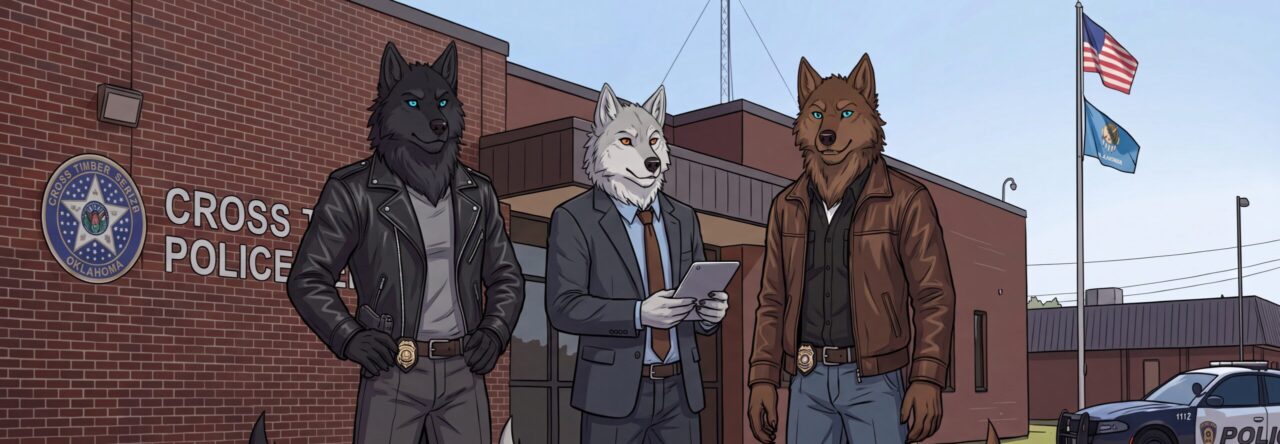
Before dawn, the cabin smelled like coffee, rain, and nerves.
Thane came down the hall to the sound of Gabriel and Mark already arguing in the kitchen.
Gabriel leaned against the counter beside the coffee maker, black fur still sleep-ruffled around his ears. Mark sat at the dining table with a slim binder open in front of him.
It was so much smaller than the first detective-study binder that Thane stopped in the doorway for a second.
Mark noticed.
“It is not comprehensive,” he said.
Gabriel looked over at him.
“You made a two-page binder.”
“It is an outline.”
“You made a two-page outline.”
“It contains the relevant points.”
Gabriel stared at him.
“Mark. You have grown.”
Mark’s ears shifted back.
“I am capable of concise preparation.”
“Somewhere, three filing cabinets just burst into flames.”
Thane crossed into the kitchen and reached for the coffee pot.
Three months ago, he might have taken it without thinking, stepped between them, and made some comment about Mark treating an exam like a military campaign.
Now he paused just long enough to look at the binder first.
“That all you got?” he asked.
Mark slid it toward him.
“Four reminders.”
Gabriel poured coffee into a dark travel mug and set it beside Thane’s hand.
“No motivational speech,” he said. “You hate those.”
“Correct.”
“You are going to do fine.”
Thane looked at him.
Gabriel’s mouth shifted.
Then he corrected himself.
“You are going to do the work. That is better.”
Something tightened in Thane’s chest.
Not panic.
Not shame.
Something steadier.
“Yeah,” he said. “I am.”
Thane opened the binder.
Four lines filled the first page.
State the strongest theory.
State what could prove it wrong.
Preserve evidence that supports and contradicts both.
Do not confuse urgency with certainty.
Thane read them twice.
Then he looked at Mark.
“You made this for me?”
Mark looked down at the binder.
“You do not have to use it.”
“I am using it.”
Mark closed the binder.
“Your retest is not asking whether you can find a suspect.”
“I know.”
“It is asking whether you can keep looking after you find one.”
“I know.”
Gabriel picked up his own coffee.
“Also, if the panel asks anything ridiculous, remember that you are allowed to take a breath before you answer.”
Thane looked at him.
“I know how to take a breath.”
Gabriel smiled.
“You did not always.”
That could have hurt once.
Instead, Thane nodded.
“No,” he said. “I didn’t.”
The rain had stopped by the time they reached the Humvee.
The matte green truck sat under the carport with water beading across the hood, broad and stubborn and entirely Thane’s. He climbed into the driver’s seat. Gabriel settled into the passenger side. Mark took the rear bench with his small binder tucked carefully beside him.
For a few minutes, nobody spoke.
The Humvee rolled down the long gravel drive and through the trees. Early light spread pale across Cross Timber. Houses appeared through the mist. A school bus passed in the opposite direction, yellow against the wet road.
Thane drove steadily.
Not like he was proving he could.
Not like he was holding the wheel together through force.
Just steady.
Gabriel rested one arm on the door.
“You know,” he said, “for a detective exam, you are surprisingly calm.”
Thane glanced at him.
“I am not calm.”
“You smell calmer than last time.”
“That is a low standard.”
Gabriel nodded.
“Fair.”
From the back, Mark said, “It is also measurable.”
Gabriel turned halfway around.
“You are not allowed to make emotional stability into a spreadsheet.”
“I have not.”
“Yet.”
Mark did not answer.
Which was answer enough.
Thane let out a short breath through his nose.
Not quite a laugh.
But close.
The station appeared at the end of the next block.
The same building. Same windows. Same flag moving lightly in the damp morning air.
Thane parked the Humvee in its usual place.
For one second, he sat with both hands on the steering wheel.
Gabriel did not rush him.
Mark did not say anything.
Then Thane opened the door.
“Let’s go.”
Sergeant Hale waited in the briefing room with coffee in one hand and a sealed packet in the other.
The room was smaller than the one used for the original eligibility exam. No line of candidates. No stack of score envelopes. No separate stations with laminated signs.
Just one table.
One chair.
One packet.
And five people who knew exactly why Thane was there.
Mercer stood near the window, silver hair neat, expression unreadable. Priya Shah sat at the table with her aligned pens and a legal pad. Melissa Carver from the district attorney’s office stood beside the file cabinet, arms folded. Lieutenant Fields leaned against the wall with the tired patience of a man who had spent thirty years watching people decide whether they wanted the truth or a victory.
Voss and Rusk stood behind the glass wall separating the room from the adjacent observation area.
Not scoring.
Not intervening.
Watching.
Hale looked at Thane.
“This is not the friendly version.”
Thane nodded.
“I know.”
“Good.” Hale held out the packet. “Then do not come in here trying to prove you deserve it.”
Thane took the envelope.
“Show us how you think.”
He sat.
The chair felt too small beneath him, though everything in the department had long ago been reinforced or widened for the trio. He set the unopened packet on the table and looked at the seal for one breath.
Priya spoke first.
“Officer Thane, your original score established strengths in ethics, testimony, sensory documentation, witness handling, and evidence preservation.”
He nodded.
“Your deficit was not intelligence,” she continued. “It was investigative narrowing. You identified a strong lead and treated it as a conclusion before competing theories received equal consideration.”
“Yes, ma’am.”
“Today, we are evaluating whether you can recognize a strong lead without turning it into a conclusion.”
Thane looked at the sealed packet.
“Yes, ma’am.”
“Begin.”
He opened it.
The fictional case involved a contractor named Ramon Silva.
Ramon had been found unconscious behind the office of his small construction company. The rear door had been locked. A safe had been opened. Cash was missing. His wallet remained in his pocket. His phone had been wiped of several recent messages.
The obvious suspect was Mason Crowley, Ramon’s business partner.
Mason had threatened Ramon over unpaid invoices. He knew the alarm code. His truck had been captured near the office at approximately the right time. He had gambling debts. A witness had heard a man say, You stole from me.
Thane felt the answer arrive.
Mason.
Mason had motive. Access. Opportunity. Anger. Debt.
The old part of him wanted to circle the name.
He could almost feel the pen press down.
Then he looked again.
The safe had been opened with a code, not forced.
The missing cash totaled less than Mason claimed Ramon owed him.
A bookkeeping discrepancy showed Ramon may have been hiding money from the business.
An employee had access to the alarm system and had recently changed shifts.
The witness had heard two voices, but described the second voice as female.
The office camera timeline might have been offset by twelve minutes.
Deleted messages had come from an unknown number.
Thane picked up his pen.
At the top of the page, he wrote:
Primary lead: Mason Crowley.
Then he stopped.
Below it, he wrote:
Required competing theories:
1. Financial fraud or concealed theft by Ramon Silva.
2. Employee-facilitated robbery or access-code misuse.
3. Third-party coercion connected to deleted communications.
He looked at the list.
His chest tightened once.
Not with fear.
With recognition.
The old Thane would have written the other theories below Mason’s name, like footnotes. Things to check after he had squeezed the obvious answer hard enough to make it confess.
This time, he gave each one the same question.
What would prove this wrong?
He began building the plan.
Preserve Ramon’s medical statement if he regained consciousness.
Secure alarm and access-code logs before they could be overwritten.
Preserve the camera system and independently establish whether the clock was wrong.
Request recovery of deleted communications.
Separate Mason, the employee, and Ramon’s financial records.
Protect the safe and office scene for evidence of lawful access, code entry, and handling.
Interview the witness without giving them Mason’s name.
He did not write interview Mason first.
He wrote:
Separate all involved parties before disclosure of competing facts.
Fields watched him from the wall.
Thane could feel the eyes in the room, but he did not look up.
He worked the packet.
Not fast.
Not slow.
Carefully enough that every lead had somewhere to go besides the conclusion he wanted.
When the written portion ended, Mercer stood.
“Walk us through it.”
Thane sat back.
“Mason Crowley is the strongest current lead,” he said.
Mercer nodded.
“Why?”
“Documented conflict over unpaid invoices. Familiarity with the alarm code. Vehicle proximity. Gambling debt. A possible threat statement overheard by a witness.”
“Are you building the case around him?”
“No.”
“Why not?”
“Because the case is not about whether Mason looks guilty. It is about what happened to Ramon Silva.”
Mercer watched him.
“Mason may be part of that answer,” Thane continued. “He may not be.”
Priya opened the file.
“Why preserve financial records before you have ruled out Mason?”
“Because financial records can disappear. Because they may explain the amount missing from the safe. Because they may establish motive for Ramon, Mason, an employee, or a third party.”
“And if Mason is guilty?”
“Then the records still matter.”
“Why?”
“Because evidence that complicates my first theory matters as much as evidence that supports it. If I wait until Mason is cleared to investigate another path, I may lose the truth that clears him. Or the truth that proves him.”
Carver looked at the case packet.
“What is your first investigative action?”
“Preserve Ramon’s initial medical statement if he can provide one.”
“Why not seize Mason’s truck?”
“Because the truck can be secured by patrol while I preserve information more likely to disappear immediately. Ramon’s memory may change. The alarm logs may overwrite. The camera time offset needs independent verification before we assign meaning to the vehicle sighting.”
Fields pushed away from the wall.
“What do you do when your first theory feels obvious?”
The room went quiet.
Thane looked at the case file.
Then at the phrase Mark had written that morning.
Do not confuse urgency with certainty.
He looked back at Fields.
“I write it down,” he said. “Then I work the facts that could prove me wrong.”
No one moved.
“If it survives that, I keep it,” Thane continued. “If it doesn’t, I do not get to want it harder.”
Fields held his gaze.
Then nodded once.
Priya turned a page.
The next questions came harder.
Would he seek an emergency warrant for the deleted-message account?
Yes, if the facts established probable cause and the risk of destruction.
Would he interview Mason before or after reviewing the alarm logs?
After preserving the logs, unless an immediate safety threat required contact sooner.
Would he tell the witness Mason’s name?
No.
Would he treat the female voice as proof of an accomplice?
No. It was an observation requiring corroboration.
Would he treat Mason’s gambling debt as motive?
Possible motive. Not proof.
Would he seek a warrant for the employee’s home?
Not until access records, financial links, or other independent facts created probable cause.
The questions pressed him from every side.
But Thane did not feel trapped.
He felt tested.
There was a difference.
He could say what he knew.
He could say what he did not.
He could name what would change his mind.
For once, being asked to consider another answer did not feel like someone taking strength away from him.
It felt like being trusted with more of the truth.
Then Priya closed the case file.
Her hands rested beside her pen.
“Officer Thane,” she said, “why should this department trust your judgment after your off-duty conduct six months ago?”
The question landed cleanly.
No one looked away.
Not Mercer.
Not Hale.
Not Voss behind the glass.
Not Rusk.
Thane felt the old urge to brace.
To explain the pain first.
The score. The shame. The feeling of being left behind.
But that was not the question.
And it was not the answer.
“It should not trust me because I want it to,” he said.
Priya’s expression did not change.
Thane continued.
“It should trust the record of what I did after.”
He held still in the chair.
“I reported what I did. I accepted the consequences. I got help. I changed how I respond before anger becomes someone else’s danger.”
Behind the glass, Voss did not move.
Rusk’s eyes lowered briefly.
“I cannot erase what I did to Mark and Gabriel,” Thane said. “I cannot make them feel safe because I say I am sorry. I cannot ask them to make it smaller because I am ashamed.”
His throat tightened.
He kept going.
“I can refuse to hide from it. I can refuse to minimize it. I can show, over time, that I do not let pride decide what facts mean. Or what people mean.”
Priya leaned back.
“And if you feel that old anger again?”
“I leave before it becomes someone else’s problem. I name it. I call someone. I do not decide what another person means without asking.”
Mercer spoke from the end of the table.
“What does Alpha mean to you now?”
Thane looked at him.
The answer did not arrive quickly.
That was all right.
“Making sure the people around me feel safe enough to tell me no.”
No one spoke.
Hale’s coffee cup stopped halfway to his mouth.
Then Mercer nodded once.
“Thank you, Officer.”
The retest was over.
Gabriel waited outside the evaluation room with two coffees.
He sat in one of the hard hallway chairs, long legs stretched out, ears angled toward the door. Mark sat beside him with his gold-star notebook open on his knee, though he had not turned a page in several minutes.
When Thane stepped out, Gabriel stood.
He handed him a coffee without asking.
“You look like you argued with a courthouse.”
Thane took the cup.
“Close.”
Mark looked up.
“Did you answer the alternate-theory question?”
Thane looked at him.
“Yes.”
Mark nodded once.
“Good.”
Gabriel watched Thane’s face.
“Did they ask the other question?”
Thane knew what he meant.
“Yes.”
Gabriel’s expression changed.
Not fear.
Not guilt.
Not the old uncertainty.
Just attention.
“What did you say?”
Thane held the coffee in both hands.
“The truth.”
Gabriel nodded.
“Good.”
No one asked for more.
Not there.
Not in the hallway.
They walked out together.
The three of them returned to the Humvee.
Thane drove.
Gabriel sat passenger.
Mark took the back.
The ride home was not quiet because anyone was afraid to speak. It was quiet because nobody knew what came next.
At a stoplight, Gabriel looked over.
“You hungry?”
“Yes.”
Mark glanced up from the notebook.
“You said that too quickly.”
“I have not eaten since before dawn.”
“That is fair.”
Gabriel pointed toward a diner on the corner.
“Breakfast?”
Thane looked at the sign.
Then at the two of them.
“Breakfast.”
They ate in a booth near the back, where the server knew them well enough not to stare and not well enough to stop being faintly impressed every time three full-grown wolves ordered pancakes.
Gabriel ordered eggs, bacon, hash browns, and coffee.
Mark ordered oatmeal, fruit, toast, and coffee.
Thane ordered the breakfast plate that came with enough food to make the server pause.
Gabriel looked at the order ticket.
“Trying to eat your feelings?”
Thane looked at him.
“No.”
Gabriel lifted both hands.
“Good. Because I am not equipped to fight a pancake.”
Mark drank coffee.
“That is not how pancakes work.”
“You have no imagination.”
The server returned with food.
For ten minutes, they talked about nothing important.
A weird call Gabriel had handled the previous week involving a man who believed his neighbor’s leaf blower was broadcasting messages from the federal government.
Mark corrected three details in Gabriel’s retelling.
Gabriel accused him of keeping a secret timeline of all fun.
Thane listened.
And for the first time since the retest began, he did not feel like he was waiting for something to be decided about him.
He was just with them.
That mattered more than he expected.
The result arrived the next afternoon.
Mercer called Thane to the conference room.
No explanation.
No tone in the message.
Just:
Conference room B. 1400 hours.
Mark and Gabriel were already there when Thane arrived.
Voss and Rusk stood near the windows. Hale leaned against the wall with his coffee. Priya sat at the table beside a single envelope.
The room smelled like paper, coffee, nerves, and all the careful things nobody was saying.
Thane took the chair in the middle.
The envelope waited in front of him.
Mercer stood at the head of the table.
“Open it.”
Thane did.
The page inside was simple.
SCORE: 90.0
RESULT: ELIGIBLE
For a second, the words would not settle.
Then they did.
Eligible.
The room remained quiet.
Gabriel’s mouth opened in a smile so bright he had to look away for a second.
Mark’s ears lifted.
Thane read the score again.
Ninety.
Not ninety-six.
Not the top.
Not perfect.
It did not need to be.
His feedback read:
Strengths: Proper weighting of competing theories. Clear investigative priorities. Improved articulation of uncertainty. Strong evidence discipline. Mature judgment and accountability.
Then the final note:
Continue practicing this discipline under live-case pressure.
Thane looked at the sentence.
Then he smiled.
Small.
Real.
Of course there was still an improvement note.
There should be.
Mercer watched him.
“You did not score highest.”
Thane looked up.
“No, sir.”
“You did something more important.”
Thane waited.
“You showed that when an answer feels obvious, you now know to ask what it costs to be wrong.”
The words settled deeper than the score.
“Thank you, sir.”
Mercer nodded once.
Then closed the folder in front of him.
“Eligibility is not an assignment.”
Gabriel’s smile dimmed.
Mark’s posture sharpened.
Thane folded the score paper carefully and set it on the table.
“Yes, sir.”
Mercer looked toward Voss and Rusk.
Voss stepped forward.
“Cross Timber has enough cases that develop after normal business hours to justify an expanded after-hours investigative detail,” she said. “Violent assaults. Missing persons. Suspicious deaths. Major scenes where the first hours matter more than anyone likes to admit.”
Rusk added, “We also have enough detectives who would prefer not to receive calls after ten at night.”
Gabriel nodded solemnly.
“A tragic but understandable problem.”
Rusk looked at him.
“Do not make me regret this in the first ten seconds.”
Gabriel’s ears tilted back.
“Noted.”
Voss ignored both of them.
“We need investigators who understand patrol. Who know what it is to arrive before a scene has become a file. Who can preserve facts, work with responding officers, and think before the trail gets cold.”
She looked at Mark.
“You build cases that hold together.”
Mark did not move.
But his tail shifted once beneath his chair.
Voss looked at Gabriel.
“You get people to tell the truth without giving them the ending.”
Gabriel’s expression went serious.
Then Voss looked at Thane.
“You know what it means to have a strong answer and still keep looking.”
Thane held her gaze.
“Effective at eighteen hundred hours,” Mercer said, “all three of you are assigned to the Investigations Bureau, Night Shift Detail.”
The words seemed to change the air.
Mercer placed three folders on the table.
One in front of Mark.
One in front of Gabriel.
One in front of Thane.
Each folder contained the same assignment memorandum.
CROSS TIMBER POLICE DEPARTMENT
INVESTIGATIONS BUREAU
DETECTIVE I — NIGHT SHIFT DETAIL
SUPERVISION: DETECTIVES VOSS AND RUSK
Thane looked at the page.
His hand did not shake.
But it wanted to.
Mercer continued.
“You are not being assigned because you are a pack.”
Gabriel glanced at Mark.
Mark looked at the memorandum.
“You are being assigned because each of you brings something the other two do not.”
Mercer’s eyes moved between them.
“Thane gets results. Gabriel gets answers. Mark gets cases that hold together.”
Rusk raised one finger.
“And together, apparently, you will be useful.”
Mercer nodded.
“Individually, you will remain accountable.”
That mattered too.
Not a wolf team that could hide inside its own legend.
Not three friends given special treatment because the city liked them.
Three detectives.
Each responsible.
Each necessary.
Each still answerable.
Hale pushed off the wall.
“Congratulations.”
The word sounded strange from him.
Gabriel looked at him.
“Was that pride?”
“No.”
“Was it almost pride?”
“Also no.”
Mark looked down at the folder.
“Thank you, Sergeant.”
Hale’s expression softened by one impossible degree.
“You earned it.”
Thane looked at the assignment memorandum again.
Then at Mark.
Gabriel.
Voss.
Rusk.
The people who had seen him at his worst.
The people who had not let him hide from it.
The people who had not made him stay there either.
“Thank you,” he said.
He meant it.
At seventeen fifty-eight, the Humvee rolled into the station lot.
Thane drove.
Gabriel sat passenger with a detective case bag at his feet.
Mark rode in the back with a second bag, his notebook, and a stack of blank evidence forms that he had somehow acquired before officially reporting for the shift.
Thane parked in the space closest to the side entrance.
Gabriel looked at the clock on the dash.
“You know, as detectives, we should probably start parking less like a military convoy.”
Thane looked at him.
“It fits.”
“Two spaces.”
“It fits in two spaces.”
Mark leaned forward from the back.
“Technically, it occupies portions of three.”
Gabriel turned.
“Do not encourage him.”
Thane shut off the engine.
For a moment, none of them moved.
The station lights shone through the damp evening. The city beyond it was settling into night: restaurants filling, streetlights blinking on, people going home, people leaving home, people beginning the kinds of nights that turned into calls.
Thane looked at his new badge wallet.
The word DETECTIVE had been stamped beneath his name.
It was not heavier than his patrol badge.
It just carried a different kind of responsibility.
They entered together.
Nina Alvarez saw them through the dispatch glass.
Her eyes went first to the badge wallets, then to the folders in their hands.
“About time,” she said.
Gabriel leaned toward the window.
“Were you rooting for us?”
Nina looked at Mark.
“I was rooting for the paperwork.”
Mark nodded.
“That is fair.”
Their new office was down a short hallway behind the detective bullpen.
It had once been an interview room.
Now it contained three desks, a battered metal evidence cabinet, a corkboard, a large wall map of Cross Timber, and a coffee maker that looked as though it had survived at least one homicide.
Gabriel stood in the doorway.
“We have an office.”
Mark walked directly to the storage cabinet.
“We have insufficient storage.”
“We have desks.”
“We have one shared supply drawer.”
Gabriel crossed to the desk closest to the window.
“This one is mine.”
Mark looked at it.
“It receives glare after nineteen hundred.”
“Then it is mine and tragic.”
Thane stepped inside last.
The room smelled like dust, stale coffee, old carpet, and possibility.
Three desks.
Three chairs.
Three names waiting to be added to the small whiteboard by the door.
He looked at the empty map wall.
Soon there would be strings.
Photographs.
Reports.
Victims.
Questions.
The things people did in darkness and the slow work of proving what had happened.
Voss entered carrying a thin case file.
“You have desks for six minutes.”
Gabriel blinked.
Voss handed him the file.
Rusk followed behind her, already holding his keys.
“A woman was found in a locked vehicle at the west trailhead. No obvious cause of death. No phone. Rain due before midnight.”
Mark took the file from Gabriel and opened it.
“Who found her?”
“Trail maintenance worker,” Voss said. “He says the car was not there at sunset.”
“Medical examiner?” Mark asked.
“En route.”
Gabriel looked up.
“Any sign of forced entry?”
“Not yet.”
Thane looked toward the wall map.
“Who is on scene?”
“Patrol has the perimeter,” Voss said. “Bell is holding the first responding unit. He asked for you specifically.”
Thane’s ears shifted.
Not pride.
Something warmer.
Something earned.
Voss looked at all three of them.
“Night Shift,” she said. “You are with me.”
The office vanished behind motion.
Mark grabbed his case bag, notebook, and an evidence kit without needing to be told. Gabriel clipped his badge wallet into place and checked the batteries in his recorder. Thane picked up his own bag, then paused long enough to look back at the three desks.
At Mark’s notebook.
At Gabriel’s grin.
At the badge wallet in his hand.
The city had spent two years teaching them how to survive the night.
Now it was time to find out what the night had been hiding.