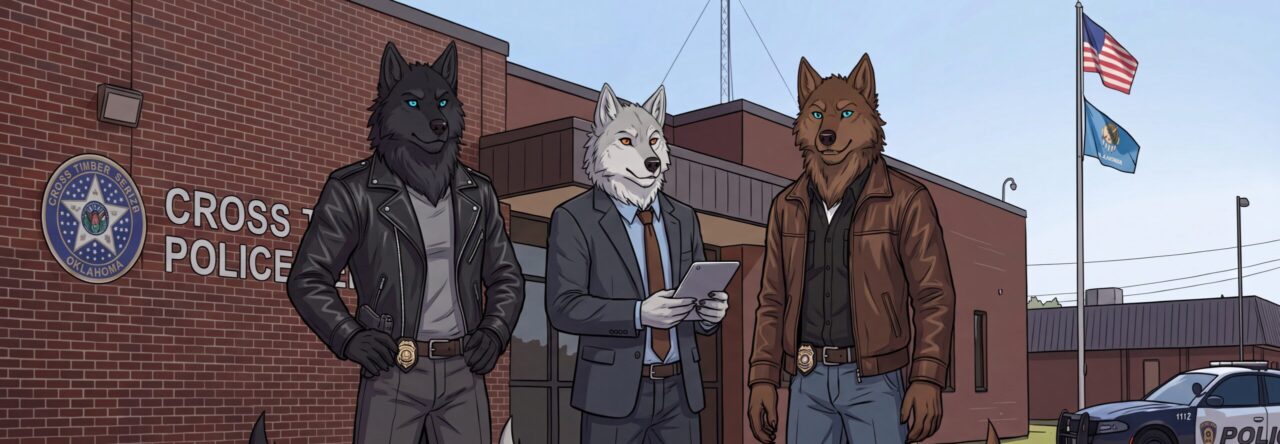
Author: Thane Page 13 of 17

Chapter 43 — The Work of Looking

The next few days were ordinary.

Not empty.

Not uneventful in the way people outside the department used the word.

There were reports to finish, evidence logs to update, and the steady procession of smaller calls that reminded Night Shift why routine mattered. A welfare check became a diabetic emergency before it became a tragedy. A loud argument outside a bar stayed an argument because patrol arrived early. A lost teenager got home. A stolen bicycle turned up behind a detached garage because Mark found a marketplace listing that did not fit the seller’s story.

The city kept moving.

Night Shift kept pace with it.

Kessler returned to his normal day-shift routine.

He did not suddenly become easygoing. He did not walk into the office every morning trying to prove he had changed. He simply did the work in front of him, spoke when he had something useful to say, and stopped looking at Thane, Gabriel, and Mark as if their existence was an insult he had to answer.

On Wednesday morning, while Night Shift was wrapping up a stack of reports before heading home, Kessler passed their office door with a file tucked under one arm.

“Morning,” he said.

“Morning,” Thane answered.

Kessler paused.

“The property-crimes team confirmed the third catalytic converter. Your Subaru idiots cleared all three thefts.”

Gabriel looked pleased.

“Professionally lucky.”

Kessler’s mouth shifted.

“Professionally lucky.”

Then he continued down the hall.

That was enough.

By Friday evening, Cross Timber had settled into the familiar end-of-week rhythm.

Traffic thickened along the restaurant corridor. The movie theater was filling. The brewery district was bright with patio lights and people trying to decide whether they wanted a quiet evening, a loud evening, or an evening they would regret by morning.

At 17:56, Thane, Gabriel, and Mark came through the side entrance together.

The Investigations Bureau felt different before anyone said a word.

Voss stood beside the case board with a legal pad in one hand.

Rusk sat at the conference table, coffee untouched beside him.

The room was quieter than it should have been for a Friday evening.

Mark noticed the new card first.

It had been placed at the center of the board.

Not in the usual corner reserved for developing calls.

Not beneath property crimes.

Not under welfare checks.

Center.

Written in dark blue marker:

LEAH MORENO — SEXUAL ASSAULT — PRIORITY

Gabriel stopped moving.

Thane felt something in his chest settle into place.

Mark’s notebook was already open.

Voss waited until they were seated.

Then she spoke.

“Yesterday afternoon, at approximately fifteen-fifteen, Leah Moreno left a coworker’s event at the Hawthorne Arts Center.”

No one interrupted.

“She parked in the Cedar Plaza garage behind the building. The garage serves the arts center, a law office, and several restaurant tenants. It is partially public, partially permit access. Leah had parked on the second level.”

Voss looked down at her notes.

“Her coworkers saw her leave alone. Her vehicle was found in the garage shortly after sixteen hundred. Her purse was inside. Her phone was missing.”

Rusk took over.

“A security employee located Leah near the lower stairwell at sixteen-twenty-three. She was disoriented, injured, and unable to give a full account of what happened. EMS transported her to Mercy. She consented to a forensic medical exam and has given an initial statement.”

The room stayed quiet.

Voss’s jaw tightened.

“Leah has reported that she was sexually assaulted.”

She said it plainly.

No euphemism.

No distance.

Then, after a beat:

“She remembers telling the man no.”

The scent in the room changed.

Thane caught it immediately.

Not surprise.

Not the ordinary anger Voss carried into difficult cases.

Something older.

Something that had been carefully buried and had surfaced anyway.

Her coffee sat untouched beside the board. Her posture remained exactly the same. Her voice stayed calm.

But beneath all of it, Thane caught the sharp edge of fear remembered too clearly.

Gabriel’s ears shifted once.

Almost imperceptibly.

Mark did not look up from his notes.

Voss continued.

“She cannot provide a reliable face. She remembers a man’s voice. She remembers a dark jacket. She remembers a chemical-cleaner scent, possibly citrus or industrial degreaser. She remembers being pulled toward the service corridor near the stairwell.”

Rusk pushed a printed garage layout toward Mark.

“Cameras cover the main entrances, vehicle lanes, and public stairwells. The service corridor has a camera. It went offline at fifteen-oh-seven and came back online at fifteen-thirty-one.”

“Maintenance outage?” Mark asked.

“Unknown,” Rusk said. “The property manager says there was no scheduled maintenance event.”

Voss set down her legal pad.

“Kessler spent the day on preservation requests. Garage owner. Camera vendor. Arts center. Restaurants and businesses with exterior views of the vehicle exits and surrounding streets. He uploaded the files and his notes before he left at seventeen-thirty.”

Mark nodded.

“Any usable footage?”

“Not yet,” Voss said. “There are vehicles entering and leaving during the relevant window. Plate glare. shadows. Different camera systems. Different clock settings.”

Rusk gave a tired look toward the garage map.

“One camera is four minutes slow. One is almost six minutes fast. The garage system is probably wrong in a different direction.”

Gabriel leaned back slightly.

“Of course it is.”

Voss rested both hands on the conference table.

“Leah is safe. She is with family. She has been clear that she wants this investigated.”

Her voice stayed steady.

The scent beneath it did not.

“We will do that.”

Nobody spoke.

Then Voss looked directly at Thane, Gabriel, and Mark.

“This is the priority case. Day shift is handling formal interviews, medical coordination, warrants, and the camera preservation work. Night Shift will support the scene familiarity, late-hour canvass, patrol visibility, and any time-sensitive lead that comes in after daylight hours.”

Thane nodded once.

“Understood.”

Voss’s eyes moved across all three of them.

“This case is not an excuse to hunt for someone you want to be guilty.”

“No,” Thane said.

“It is not an excuse to turn instinct into conclusion.”

“No,” Mark said.

“It is not an excuse to make Leah repeat herself because we want a cleaner story.”

Gabriel’s expression sharpened.

“No.”

Voss nodded.

“Good.”

Rusk pushed the garage map closer to Mark.

“Start by learning the place. Vehicle access. Foot traffic. Service corridors. Nearby businesses. What the property manager calls normal. What is actually normal.”

Mark took the map.

“Got it.”

Voss closed the case file.

“Night Shift takes the board at eighteen hundred. Check Hawthorne. Check the garage perimeter. Keep patrol informed. And keep your reports clean.”

Thane stood.

“We will.”

Voss gathered her legal pad.

“Rusk and I will see you at zero-six-thirty.”

Rusk looked at the three wolves.

“Do not solve this by midnight.”

Gabriel blinked.

“We were not planning to.”

“Good,” Rusk said. “Because nothing about it will be that simple.”

They left.

The room remained quiet after the conference-room door closed.

Mark studied the garage map.

Gabriel stared at Leah Moreno’s name on the board.

Thane waited.

It was Gabriel who spoke first.

“That hit her.”

Mark’s pen stopped.

Thane nodded slowly.

“Yeah.”

Gabriel looked toward the hallway where Voss had disappeared.

“I do not know what happened to her. I am not going to pretend I do.”

“Good,” Mark said quietly.

“But when she said Leah told him no…” Gabriel swallowed. “Voss smelled like old fear. Not fear of this case. Fear from somewhere else.”

Thane’s hands rested on the edge of the conference table.

“I caught it too.”

Mark closed his notebook.

“That is not proof of anything.”

“No,” Gabriel said. “It is not.”

“It might be personal history,” Thane said. “Or someone she cared about. Or an old case. We do not know.”

Gabriel looked at him.

“I think she was raped.”

Mark’s eyes lifted.

“Gabriel.”

“Not as a fact,” Gabriel said quickly. “Not as a rumor. I am not saying we tell anyone. I am saying I think this case touched something she knows too personally.”

Thane looked down at the dark blue case card.

“Maybe.”

The word held heavier than it should have.

Mark’s voice remained careful.

“Then we do not ask.”

“No,” Thane said.

“We do not speculate out loud.”

“No.”

Gabriel leaned back in his chair.

“We just do the work.”

Thane looked at Leah Moreno’s name.

“Yeah.”

They did.


The Hawthorne Arts Center sat on the edge of downtown Cross Timber, a restored brick building with tall windows, a black-box theater, community gallery space, and enough exposed beams to make every event flyer look expensive.

The Cedar Plaza garage stood behind it.

Four levels of concrete, steel rails, and fluorescent lights.

At night, it looked less like a building than a stack of shadows.

Thane parked the Humvee on the public street across from the garage entrance.

The evening was still young. Restaurant traffic moved through the surrounding blocks. A couple argued softly beside a parking meter. A server hurried toward a compact sedan with her apron folded under one arm. Somewhere nearby, a bass line pulsed behind the walls of a bar.

Mark opened the garage plans on his tablet.

“Main vehicle entrance here. Pedestrian entrance to the arts center here. Public stairwell at the northwest corner. Service corridor runs behind the maintenance office and connects to the lower stairwell.”

Gabriel looked through the windshield.

“Camera outage was there?”

“Service corridor camera. Fifteen-oh-seven to fifteen-thirty-one.”

Thane watched people entering and leaving.

“What is normal?”

Mark looked at the map.

“That is what we are here to learn.”

They walked the public areas first.

No shortcuts.

No closed doors.

No stepping over boundaries because they wanted an answer quickly.

The garage smelled like every garage.

Hot concrete.

Oil.

Old exhaust.

Cleaning product.

Metal railings warmed all day and now cooling into the evening.

The faint electrical bite of fluorescent fixtures.

Cars moved in and out at uneven intervals.

A family with two children returned to a minivan on the first level. A man in office clothes crossed toward the elevators. A restaurant employee pushed a wheeled bin toward the service alley.

Thane listened.

Gabriel watched people.

Mark counted cameras.

By the time they reached the second level, Mark had already noted three places where someone could stand out of direct camera view without being hidden from every angle.

“That corner,” he said, indicating a recess between the elevator landing and the service door. “Camera Two sees the main lane but not the inset wall.”

Gabriel looked at the concrete alcove.

“Good place to wait.”

“Or good place to stand while waiting for a ride,” Mark said.

“Both can be true.”

Thane moved closer to the service door but stayed on the public side of the boundary.

The metal door carried a sharp citrus-cleaner scent.

Not uniquely.

Not enough to build a case.

But there.

Fresh over older layers.

A stronger concentration near the hinge and lower handle.

He looked at Mark.

“Same cleaner note. Stronger here.”

Mark nodded but did not write a conclusion.

“Observed odor consistent with industrial citrus cleaner near service door. We need to determine whether that is standard for the garage.”

Gabriel looked through the narrow wired-glass window into the corridor beyond.

“Can we ask?”

“Not tonight,” Mark said. “Kessler’s notes say the property manager is meeting Voss and Rusk in the morning. They will request a controlled walk-through and maintenance records.”

Thane nodded.

They continued.

The lower stairwell had been reopened after Crime Scene finished its initial work, but yellow evidence markers remained near the far wall. The camera overhead had a temporary status light blinking red.

Out of service.

Gabriel stood beside the stairwell entrance and listened to the building.

The elevator cables.

The hum of a ventilation fan.

Footsteps on a level above.

The distant clang of a restaurant dumpster lid.

Nothing else.

He looked at Thane.

“Nothing fresh.”

“Not now,” Thane said.

“No,” Gabriel agreed. “But it was quiet enough here.”

Mark looked at the stairwell.

“Quiet is not privacy. That matters.”

Gabriel glanced at him.

“Meaning?”

“Meaning somebody may have heard something and assumed it was normal. A door. A raised voice. A struggle. The question is not only who was here. It is who heard something and did not know what they were hearing.”

Thane looked down the public walkway toward the restaurants.

“Night staff.”

“Restaurant staff. Delivery drivers. Garage attendants. People smoking outside. Anyone who used the stairs.”

Mark’s eyes moved across his map.

“Tomorrow, day shift builds the canvass list. Tonight, we identify who is actually here after dark and what traffic patterns change.”

The three of them stood in the stairwell for another moment.

Then Thane turned away.

“Let’s not make her scene into a shrine.”

Gabriel looked at him.

“No.”

They walked out.


At 20:31, Dispatch interrupted their second perimeter pass.

“Night Shift, Patrol Three-One is requesting assistance on a traffic stop at Eastbound Seventy-Four and Brookfield. Officer reports known narcotics subject, lawful equipment stop, and requests sensory assistance. No K-9 available.”

Gabriel turned in his seat.

“Did Dispatch just call us the next best thing?”

Mark was already checking the location.

“Six minutes.”

Thane turned the Humvee toward the highway.

“Then let’s be useful.”

The stop sat on a broad shoulder just past the Brookfield exit.

Officer Morris’s patrol unit was behind a dark gray sedan with a failed rear tag light. The sedan’s driver-side window was down. Traffic hissed past in the far lane, headlights throwing quick flashes across the scene.

Morris stood near the rear quarter of his unit when the Humvee rolled in behind him.

He gave them a short nod as they stepped out.

“Appreciate you coming,” he said. “Driver is Damon Reddick. Known dealer. I stopped him for the tag light and a rolling stop at the ramp. He has been nervous since I walked up, but nervous is not a search.”

“Agreed,” Mark said.

Morris glanced toward the sedan.

“I asked for consent. He said no.”

“Also his right,” Gabriel said.

“Yep.”

Morris lowered his voice.

“There is no K-9 available. You all were nearby. I figured I would ask.”

Thane looked toward the sedan.

He had not moved more than ten feet from the Humvee.

He did not need to.

The scent came hard through the open driver-side window.

Sharp.

Chemical.

A bitter, contaminated mix of methamphetamine, stale sweat, plastic packaging, and the faint burnt note of something recently handled.

Gabriel’s nose wrinkled.

Mark’s ears tipped forward.

All three of them looked at one another.

Morris saw it.

“What?”

Thane motioned him back toward the Humvee.

“Come here.”

Morris stepped closer.

Thane kept his voice low.

“There is meth in that car. A lot of it”

Morris’s eyes shifted toward the sedan.

“You sure?”

“Yes,” Thane said.

Gabriel nodded.

“Strongly.”

Mark spoke with the calm precision he brought to every report.

“Distinct odor consistent with methamphetamine and associated packaging is coming from the open driver-side window. All three of us detected it independently.”

Morris looked at them.

“Can you articulate that?”

“Yes,” Thane said. “We will document it. You should notify your sergeant. We are not asking you to take our word like magic. We are telling you what we observed.”

Morris nodded and keyed his shoulder mic.

“Three-One to Sergeant. I have independent narcotics-odor observations from Night Shift at an open driver window. Requesting confirmation for probable-cause vehicle search.”

The response came back after a short pause.

“Copy. Confirm your observations and proceed consistent with policy. I am en route.”

Morris lowered the radio.

“Okay.”

Thane looked at the sedan.

“Let’s make it clear.”

They approached together.

Not rushing.

Not surrounding the driver like a threat.

Morris took the lead.

The driver watched them come in his mirror.

Damon Reddick was in his thirties, thin-faced, wearing a black hoodie despite the warmth. His hands stayed on the wheel, but his eyes had begun moving too fast.

He looked at Thane.

Then Gabriel.

Then Mark.

His face changed.

Not guilt exactly.

Recognition.

The particular, sinking look of someone realizing the plan had just become impossible.

Morris stopped at the open window.

“Mr. Reddick, step out of the vehicle.”

Reddick shook his head.

“For a tag light?”

“For the traffic stop and the probable cause we have developed.”

“What probable cause?”

Gabriel leaned slightly toward the window.

“You know.”

Reddick’s jaw tightened.

“You cannot smell anything.”

Gabriel smiled without warmth.

“We can.”

Thane caught the stronger source now.

Back seat.

Black backpack behind the passenger seat.

The scent was concentrated enough to make the rest of the interior seem washed out around it.

He looked at Morris.

“Back seat. Black backpack.”

Morris’s expression stayed neutral.

“Step out of the vehicle, Mr. Reddick.”

Reddick looked toward the backpack.

That was enough.

Morris opened the driver’s door carefully and guided him out.

Reddick started talking immediately.

“You cannot search my car because some dog people say—”

“We are not dogs,” Gabriel said.

Mark looked at him.

“Do not say anything else.”

Gabriel closed his mouth.

Morris cuffed Reddick and placed him in the rear of the patrol unit.

Then he, his arriving sergeant, and a second patrol officer began the vehicle search.

Night Shift stayed where they were supposed to be.

Close enough to assist.

Far enough not to turn a patrol case into a performance.

The backpack contained several sealed bags of suspected methamphetamine, a digital scale, cash, and packaging materials.

Morris looked over at them after the evidence had been photographed.

“Good call.”

Thane nodded.

“Write it clean.”

Morris smiled slightly.

“I will.”

Gabriel watched Reddick sitting in the back of the patrol car.

“You know, I hate when people call us the K-9 unit.”

Thane looked at him.

“No one called us that.”

“They were thinking it.”

Mark slipped his tablet back into his bag.

“It is a poor comparison.”

Gabriel looked relieved.

“Thank you.”

Mark continued.

“Dogs receive treats after successful alerts.”

Gabriel stared at him.

Thane’s mouth twitched.

Morris heard it and laughed despite himself.

“Coffee shop is two miles up the road,” he said. “I can get you all a pup cup.”

Gabriel looked offended.

“Now you are doing it on purpose.”

The sergeant sealed the evidence bag.

“Go back to work, detectives.”

They did.


Twenty minutes later, the city gave them a different kind of call.

Not through Dispatch.

Just through the windshield.

The diner sat at the corner of Harlan and Sixth, one of those old roadside places with a neon sign, faded booths, and a breakfast menu that never entirely disappeared even at night.

Several people stood outside its front entrance.

Not in a line.

Not casually.

Uncomfortably.

A thin man in a dirty gray jacket stood near the doorway, speaking too loudly to a couple trying to leave.

“Come on, man. I just need something to eat. I am not asking for a car. I am asking for a sandwich.”

The couple looked trapped between irritation and guilt.

The man took one step closer.

Not enough to touch them.

Enough to make them move backward.

Thane slowed the Humvee.

Gabriel looked through the passenger window.

“That is not going well.”

“No,” Thane said.

Mark had already checked the street.

“No weapons visible. No active fight. He is agitated but not currently assaultive.”

Thane parked.

The man saw the Humvee.

His posture changed immediately.

His hands came up.

“I’m leaving,” he said. “I’m leaving.”

Thane, Gabriel, and Mark approached without rushing.

The couple stepped aside.

“Name?” Thane asked.

The man looked at him.

“Ray.”

“Ray,” Thane said. “Are you hurt?”

“No.”

“Are you carrying anything that can hurt someone else?”

“No.”

“Have you been drinking?”

Ray shook his head quickly.

“No. I just—” He looked toward the diner. “I have not eaten in two days.”

Gabriel watched him carefully.

There was no alcohol on him.

No fresh chemical scent.

No immediate danger.

Just hunger.

Exhaustion.

Embarrassment arriving too late to protect him from the fact that other people had seen him desperate.

Ray looked down at the sidewalk.

“I did not mean to be pushy. I just asked the guy and he acted like I was going to rob him. I am sorry.”

The couple looked uncomfortable.

The woman gave a small nod.

“He did not touch us.”

Thane looked at Ray.

“You cannot crowd people like that.”

“I know.”

“You cannot make them feel like they cannot leave.”

“I know.”

Ray swallowed.

“I will go.”

Gabriel stepped close enough to Thane that his voice would not carry.

“We should buy him dinner.”

Thane looked at him.

Gabriel’s expression stayed soft.

Not joking.

Not now.

Thane nodded once.

“Yeah.”

He looked back at Ray.

“Go inside.”

Ray blinked.

“What?”

“Go inside the diner.”

Ray’s face tightened.

“I said I am sorry. I will apologize.”

“You can apologize if you want,” Thane said. “Then sit in a booth.”

Ray stared at him.

Mark stepped toward the entrance and opened the door.

“Come on.”

Ray looked like he expected a trick.

Like the three wolves were bringing him inside so he could be scolded in private.

He moved slowly through the door.

The diner went quiet.

A waitress paused near the counter with a coffee pot in her hand.

The booths were half full. A pair of truck drivers looked over from the corner. A woman in scrubs held a fork halfway to her mouth.

And, of course, phones appeared.

Not everyone.

But enough.

Thane felt the irritation rise.

Not at Ray.

At the screens.

At the instinct people had to turn every unexpected kindness into content before they had even decided whether it was kind.

He kept it off his face.

Mostly.

Ray stood just inside the door, uncertain.

“Sit,” Thane said, pointing toward an empty booth by the window.

Ray sat.

The waitress looked at Thane.

“Everything okay?”

Thane nodded.

“This man could really use a good meal.”

The waitress glanced toward Ray.

Then back at Thane.

Thane reached for his wallet.

“Would you bring him whatever he wants tonight? It is on us.”

Ray looked up sharply.

“You do not have to—”

“Yes,” Thane said.

Gabriel slid into the booth across from Ray for a moment, not sitting fully, just leaning one hand on the table.

“Order food, Ray.”

Ray’s eyes had gone wet.

“I do not want to take advantage.”

Gabriel smiled gently.

“You are not. Eat.”

Mark placed a small folded card beside the menu.

It listed the overnight shelter, a community meal site, and a number for a local outreach worker.

“After dinner,” he said, “the diner closes at midnight. This place has beds available and a late intake window. You do not have to use it. But you should know where it is.”

Ray touched the card like it might disappear.

“Thank you.”

Thane handed him the menu.

“Everything and anything you want.”

Ray looked down at it.

Then back up.

“Really?”

“Really.”

The nearest phone was still pointed at them.

Thane turned toward it.

The person holding it—a young man in a branded delivery jacket—froze.

Thane’s stare was not angry.

It was steady.

“Look,” he said, loud enough for the room to hear. “Sometimes people just need a helping hand.”

The phone lowered slightly.

Thane continued.

“You do not have to turn every decent thing into a show. Let the man eat.”

The delivery driver’s face went red.

He put the phone away.

A few other phones lowered too.

The diner seemed to exhale.

Ray looked at Thane.

“Why?”

Thane considered the question.

Then he held out his hand.

Ray looked at it before taking it.

His grip was thin, rough, and shaking.

“Because somebody should,” Thane said.

Ray’s hand tightened once.

Then he let go.

Gabriel stood.

“Get the pie too,” he said. “You look like a pie person.”

Ray gave a wet, disbelieving laugh.

“I do like pie.”

“See?” Gabriel said. “Detective work.”

Mark looked at him.

“That is not detective work.”

“It was an accurate inference.”

Thane headed toward the door.

“Let him eat.”

They stepped back outside.

The night air felt cooler than it had a minute earlier.

Gabriel walked beside Thane toward the Humvee.

“You did good.”

Thane unlocked the driver’s door.

“We did good.”

Mark climbed into the back.

“Ray also has an outreach option for later. That matters.”

Gabriel settled into the passenger seat.

“See? We are all emotionally responsible.”

Thane started the engine.

“Don’t ruin it.”

Gabriel smiled.

“Would not dream of it.”


They returned to the Hawthorne district just after midnight.

Not because a miracle lead had appeared.

Because the work of looking required repetition.

The garage was quieter now.

Restaurant traffic had thinned. The arts center had gone dark. The fluorescent lights inside the garage hummed over mostly empty levels.

Mark pulled up a secure case-folder upload.

“Kessler got this in before he left,” he said. “Time-stamped seventeen-forty-two.”

Gabriel looked over.

“Restaurant camera?”

“Original file. Not the compressed version. He also got the garage vendor to admit their clocks have not been synchronized since a software update in March.”

Thane parked in a legal space near the garage exit.

“What does the clip show?”

Mark watched it twice.

Then once more.

“Maybe something.”

Gabriel leaned closer.

“Maybe?”

“A dark SUV exits the garage at fifteen-twenty-seven according to the restaurant camera. The plate is unreadable because of glare. Rear left taillight appears damaged.”

Thane looked toward the exit lane.

“Can we connect it to Leah?”

“No,” Mark said. “Not yet.”

“Can we identify it?”

“Maybe. If we align camera clocks, obtain the garage entrance footage, and locate additional cameras along the likely outbound route.”

Gabriel nodded slowly.

“One car.”

“Not enough,” Mark said.

“No,” Thane agreed. “But it is a direction.”

They stayed another hour.

They documented which entrance lights reflected on the pavement.

Which lane camera pointed toward the exit.

How long it took a vehicle to travel from the second level down to the street.

The route a dark SUV would likely use if it wanted to avoid the busiest intersection.

They did not solve the case.

They made the next question sharper.

At 01:36, Gabriel stopped near the service-door corridor and listened.

A restaurant employee pushed a trash bin through the alley.

A rideshare driver pulled in, waited two minutes, then left.

A man in a dark jacket walked through the garage with his phone in one hand and a takeout bag in the other.

Gabriel followed him with his eyes until he reached a parked car, opened it, and drove away.

“Nothing,” Gabriel said.

“Nothing is still useful,” Mark said.

Gabriel looked at him.

“Only you would say that.”

“It is true.”

Thane stood near the garage entrance, watching the shadows between parked vehicles.

“This place feels different after midnight.”

Mark glanced toward him.

“How?”

“Less traffic. Fewer witnesses. More sound carries.”

Gabriel nodded.

“And everyone who is here has a reason to be.”

“Maybe,” Mark said. “Or they have a reason to look like they have one.”

Thane looked down the service lane.

“Either way, we learn it.”

By 03:08, they were back at the station.

Mark built a timeline on the case-board screen.

15:07 — SERVICE CAMERA OFFLINE
15:15 — LEAH LEAVES EVENT
15:23 — SECURITY EMPLOYEE REPORTS ELEVATOR MALFUNCTION
15:27 — DARK SUV EXITS GARAGE / DAMAGED LEFT TAILLIGHT
15:31 — SERVICE CAMERA RETURNS
16:23 — LEAH LOCATED BY SECURITY

Gabriel stood behind him.

“That is a lot of space for something bad to happen.”

Mark nodded.

“Too much.”

Thane looked at the timeline.

“Can we prove the SUV is involved?”

“No,” Mark said. “Not yet.”

“Can we identify it?”

“Maybe. If we align camera clocks, obtain entry footage, and check nearby cameras for the damaged taillight.”

Gabriel looked toward Leah Moreno’s case card.

“Then that is where we start.”

Thane nodded.

“Monday.”

The rest of the night stayed quiet.

They made two more passes through the Hawthorne district.

Checked the hospital lot.

Responded with patrol to a burglar alarm at a small accounting office that turned out to be an HVAC sensor reacting to a loose vent panel.

At 04:17, a patrol officer asked them to assist with a confused elderly woman who had wandered from an assisted-living facility and was found sitting safely at a bus stop two blocks away.

Gabriel sat with her until staff arrived.

Mark found her emergency-contact card tucked into her purse.

Thane stood nearby, keeping the early morning traffic from getting too close.

It was not glamorous.

It was not central to Leah Moreno’s case.

It was still the job.

At 06:23, the first day-shift lights came on in the bureau.

At 06:30 exactly, Voss and Rusk came through the door.

Kessler followed a few steps behind them with a travel mug and a slim laptop case.

He glanced at the new timeline on the board, then at Night Shift.

“You got something from the restaurant camera.”

Mark nodded.

“Dark SUV. Damaged left taillight. No plate yet.”

Kessler set his mug down and moved closer to the screen.

“Good. I have the raw garage footage request approved. The vendor says we should have the entry feed by late morning.”

Voss set down her coffee.

“Morning handoff.”

The room changed.

Mark began.

“Timeline and evidence status. We completed two public-area passes through the Cedar Plaza garage and surrounding Hawthorne district. No new incidents. No new forced-entry indicators. We documented public traffic patterns, camera coverage, probable blind areas, and the route from the second-level parking area to the garage exit.”

He indicated the map.

“Observed a stronger industrial citrus-cleaner odor near the service door. This is consistent with Leah’s initial description but not yet distinctive. We need maintenance-product records before drawing meaning from it.”

Voss nodded.

“Good.”

Mark continued.

“Restaurant camera footage, preserved by Kessler before day shift ended yesterday, shows a dark SUV exiting the garage at fifteen-twenty-seven. Rear left taillight appears damaged. Plate unreadable. Camera-clock alignment remains unresolved.”

Kessler took a note.

“I will work the offset chart and compare it to the garage’s entry logs as soon as we have the raw files.”

Gabriel took over.

“Witness and interview issues. We identified likely late-hour witnesses for day-shift canvass: restaurant staff, delivery drivers, garage attendants, rideshare drivers, employees using the stairwell, and people smoking in the service alley. The stairwell is quiet enough that a person might hear a raised voice or movement without recognizing what they are hearing.”

Rusk nodded.

“That is useful.”

Gabriel continued.

“Nothing overnight suggests Leah’s case was public enough to draw immediate attention. That does not mean nobody saw anything. It means we need to ask better questions than ‘did you see an assault?’”

Voss looked at him.

“Exactly.”

Thane finished.

“Scene actions and active leads. We stayed within public access areas, learned the route geometry, and confirmed that after midnight, the garage is much quieter. A person moving through the service corridor or lower stairwell would have fewer people nearby and more sound carry. The dark SUV is our strongest current vehicle lead, but we cannot place it with Leah or the assault yet.”

Voss looked at the board.

Then at all three of them.

“You did what I asked. You learned the place without inventing a story about it.”

Thane nodded.

“We will keep looking.”

Voss met his eyes.

“Yes,” she said. “We will.”

Kessler picked up his laptop case.

“I will send the clock-comparison worksheet once I have the footage. Mark, I need your notes on the travel time from second level to the exit.”

“Already in the case folder,” Mark said.

Kessler blinked once.

Then nodded.

“Of course they are.”

Gabriel smiled.

“He anticipated the request.”

Rusk picked up the Hawthorne folder.

“Dark SUV, damaged taillight, missing phone, camera outage. Nothing easy.”

“No,” Gabriel said. “Not easy.”

Voss gathered the reports.

“Go home. Sleep. Come back Monday night ready to work the next thing we can prove.”

The three wolves stood.

The shift was over.

But Leah Moreno’s case stayed on the board.

Dark blue marker.

Centered.

Waiting.

Outside, dawn was beginning to lighten the streets of Cross Timber.

The city woke around a crime it did not yet understand.

And somewhere inside it, someone had gone home believing the afternoon had hidden them.

Night Shift knew better.

The city always left something behind.

You just had to keep looking.

Chapter 42 — What You Carry

The evening handoff began at 18:02 with Voss standing beside the board and looking like she had already decided nobody in the room was allowed to make her day harder.

That was not an unusual expression for Voss.

It was simply more pronounced tonight.

Rusk sat at the conference table with coffee in one hand and a thin folder open beneath the other. The folder held Dana Keeler’s protective-order case. The blue Ford Ranger had been added to the vehicle bulletin in red marker.

TRAVIS HELLER — BLUE 2012 FORD RANGER — ACTIVE PROTECTIVE ORDER

Thane read it from across the room.

Gabriel leaned against the wall beside him. Mark stood at the table with his notebook open, already writing before anyone had said a word.

Voss tapped the folder.

“Day shift located no new address for Heller. His phone remains off. His employer says he did not report today. His landlord still has not seen him. Family members have stopped answering follow-up calls.”

“That is not great,” Gabriel said.

“No,” Voss replied. “It is not.”

Rusk flipped a page.

“Dana remains at her aunt’s house. Her family has been briefed. Patrol has the address flagged. The order prohibits Heller from coming within five hundred feet of Dana, her residence, her workplace, or the temporary residence where she is staying.”

Mark’s pen paused.

“Temporary residence is specifically included?”

“Yes,” Voss said. “The judge amended it this afternoon after the initial report.”

Thane nodded once.

“Good.”

“Do not mistake that for a reason to hunt him,” Voss said. “Your assignment remains what it has been. Visibility checks. Patrol coordination. Keep Dana’s locations safe. If Heller appears, call it in and let patrol make the primary contact unless someone is in immediate danger.”

“Understood,” Thane said.

Voss moved to the rest of the board.

The apartment-complex break-ins had not developed further. The converter-theft warrants were moving through property crimes. The pharmacy burglary suspects remained in custody and had both lawyered up hard enough that nobody expected an easy confession.

The usual overnight clutter filled the remaining spaces.

An overdue welfare check.

A commercial-alarm location with repeat false trips.

A late shift at the hospital that had requested increased patrol visibility in its employee lot after two staff members reported being followed to their cars.

Nothing that required a dramatic entrance.

Nothing that needed a wolf detective vaulting a fence.

Gabriel lifted one finger.

“Can we make that an official policy?”

Voss looked at him.

“No.”

“Only because Thane needs structure.”

“I do not need structure,” Thane said.

Mark looked up from his notebook.

“You absolutely need structure.”

Gabriel nodded solemnly.

“See? The paperwork wolf has spoken.”

Voss stared at all three of them.

“Go work.”

They did.


The first pass through Dana’s old neighborhood was quiet.

The Humvee moved down the narrow residential street at an unhurried pace, its engine low beneath the soft sounds of television sets, sprinklers, and distant dogs barking behind fences.

Dana’s former home sat dark except for a lamp glowing near the front window.

No blue Ranger.

No unfamiliar vehicle parked nearby.

No trace of Travis Heller’s scent near the curb, the mailbox, or the driveway.

Thane checked without making it obvious.

The windows were cracked enough to let the night air in. He caught wet grass, old mulch, a neighbor’s grill cooling from dinner, laundry detergent, and the lingering scent of Dana’s old routines around the front walk.

Nothing fresh.

Nothing wrong.

“Clear,” he said.

Mark logged the time.

“Patrol checked thirty-two minutes before us. Same result.”

Gabriel watched the house disappear in the passenger-side mirror.

“One down.”

“Two locations,” Thane said.

“You know what I mean.”

“Yes.”

The aunt’s neighborhood was only a few minutes away.

A little quieter.

A little older.

The kind of neighborhood where porch lights came on before dark and stayed on until somebody finally remembered to turn them off in the morning.

The house sat at the end of a shallow curve.

Its kitchen light was on.

A television flickered in the front room.

Dana’s gray sedan sat beside her aunt’s older SUV.

Thane slowed.

Then stopped breathing for half a second.

Across the street, beneath the shadow of a large oak, a blue Ford Ranger sat parked against the curb.

Its lights were off.

The engine was running.

The driver was still inside.

Mark looked up from his tablet.

“What?”

Thane’s eyes stayed on the truck.

“Blue Ranger. Across from Dana’s aunt’s house.”

Gabriel leaned forward.

The truck sat just far enough from the streetlamp to make the driver hard to see through the windshield.

But the plate was visible.

Mark lifted his tablet.

“Partial matches the bulletin.”

“Not partial,” Thane said. “That is him.”

The wind shifted.

The smell reached him through the open window.

Beer.

Sweat.

Old cigarette smoke.

Anger that had been sitting too long inside a closed vehicle.

And Travis Heller.

Gabriel’s voice changed.

“Dana?”

“Inside,” Thane said. “No sign she knows he is here.”

Mark was already on the radio.

“Night Shift to Dispatch. Confirmed visual on Travis Heller’s blue Ford Ranger. He is parked across from Dana Keeler’s temporary residence, vehicle occupied, engine running. We are maintaining observation from one block south. Request two patrol units, discreet response.”

Dispatch answered immediately.

“Copy, Night Shift. Patrol units are responding. Keep the location.”

Thane eased the Humvee forward and stopped at the corner where the truck remained visible through a gap between houses.

Not close enough to provoke.

Close enough to move if something changed.

Gabriel watched the Ranger.

“Heller knows the order was amended?”

“Served electronically,” Mark said. “There is a return in the system. He opened it.”

“So he knows exactly where he is not supposed to be.”

“Yes.”

Thane watched the truck.

Heller’s silhouette moved once behind the windshield.

A hand came up.

Maybe a phone.

Maybe a bottle.

Then lowered again.

“He is drunk,” Thane said.

Gabriel looked at him.

“You can tell?”

“Beer. More than one. And he is sitting in a running truck outside the house of the person he is prohibited from approaching.”

“That last part did not require wolf senses.”

“No.”

The first patrol unit appeared at the far end of the street without lights or siren.

A second came in from the opposite direction.

They positioned cleanly.

One behind the Ranger.

One angled ahead, leaving no easy path forward.

Only then did their emergency lights come on.

Blue and red flashed across the quiet houses.

The driver’s door opened.

Travis Heller stepped out.

He was taller than average, broad through the middle, wearing jeans, work boots, and a faded hoodie despite the warmth. His movement had the loose, imprecise rhythm of someone whose body had stopped fully cooperating with the choices his mind was making.

Officer Darnell approached from the driver’s side.

Officer Patel covered from the rear quarter of the Ranger.

“Heller,” Darnell called. “Keep your hands where I can see them.”

Heller looked around at the patrol cars.

Then across the street toward Dana’s aunt’s house.

Then at the Humvee waiting at the corner.

His gaze landed on Thane through the windshield.

Something ugly passed over his face.

“I am not doing anything,” he shouted.

Darnell kept his voice even.

“You are within the exclusion zone of an active protective order. You need to step away from the truck and put your hands behind your back.”

“I am on a public street.”

“You are five hundred feet from the protected person’s temporary residence.”

“I am not even on the same damn side of the street.”

Patel stepped closer.

“Heller, hands behind your back.”

He laughed once.

A short, bitter sound.

“You people got the wolves out here because I parked my truck?”

Thane watched him from the corner.

Gabriel’s ears flattened.

Mark did not react outwardly, but his eyes had gone very still.

Darnell said, “This is not about the detectives. This is about you violating a court order.”

“I did not touch her.”

“No one said you did.”

“She ruined my life.”

“Hands behind your back.”

Heller’s shoulders rose.

His fists clenched.

For one bad second, Thane thought he might try to get back into the truck.

Instead, Heller took a step toward the house.

Patel closed distance immediately.

“Stop.”

Heller stopped.

Not because he wanted to.

Because there was nowhere left to go.

Darnell cuffed him.

The metal clicked around Heller’s wrists.

He swore loudly enough that the aunt’s porch curtain moved.

Thane’s jaw tightened.

Gabriel saw it.

“Dana is still inside,” he murmured.

“I know.”

Patel opened the rear door of her patrol unit.

“Watch your head.”

Heller twisted away.

“Get off me.”

“Do not pull away.”

“I said get off—”

He jerked hard.

Darnell had one hand on his upper arm, guiding him toward the back seat. Heller twisted again, caught Darnell off balance for just a fraction of a second, and tore free.

Still cuffed.

Still drunk.

Still stupid enough to think running would improve anything.

He ran down the street.

Toward the corner.

Toward the Humvee.

Toward Thane.

Gabriel was already moving.

Mark’s hand had gone toward his radio.

Thane stepped out from beside the Humvee before either of them had to do anything.

He did not rush.

He did not charge.

He simply moved into the middle of the sidewalk, broad shoulders squared beneath his plainclothes jacket, blue eyes fixed on the fleeing man.

Heller saw him.

Thane let the growl rise from deep in his chest.

Low.

Controlled.

Not loud.

It did not need to be.

“Stop.”

Heller stopped so fast his boots skidded on the pavement.

His breath caught.

For a second, he stood there with his cuffed hands behind his back and his whole body shaking.

Thane did not touch him.

Did not step closer.

Did not bare his teeth.

He just held Heller’s gaze.

“You are done running,” Thane said.

Officer Darnell reached him a moment later, took Heller’s arm, and guided him back toward the patrol unit.

This time, Heller did not resist.

Darnell glanced at Thane as he passed.

“Thank you.”

Thane nodded once.

“Get him out of here.”

Patel called for a tow truck for the Ranger.

Across the street, the curtain in Dana’s aunt’s front window shifted again.

Then stayed still.

The patrol unit pulled away with Heller secured in the back.

The second unit remained to wait for the tow truck and complete the arrest paperwork.

Only when the red-and-blue lights had faded down the street did the neighborhood begin to breathe again.

Gabriel leaned against the Humvee’s front fender.

“That was scary.”

Thane looked at him.

“He was drunk and running in cuffs.”

“No. You.”

Mark closed the vehicle bulletin on his tablet.

“It was an effective deterrent to a suspect’s escape.”

Gabriel looked over his shoulder.

“See? Mark agrees you were scary.”

“I said effective.”

“That is emotionally the same thing.”

“It is not.”

Thane opened the driver’s door.

“He stopped.”

“Yes,” Mark said. “That was the intended outcome.”

Gabriel climbed into the passenger seat.

“I am just saying, if I ever run from you, remind me not to do it toward you.”

Thane started the engine.

“You are not running from me.”

Gabriel looked at him.

“That was surprisingly sweet.”

“Do not make it weird.”

Mark settled into the rear seat.

“Please drive.”


The rest of the evening felt quieter after Heller’s arrest.

Not because the city had changed.

Because one part of the tension on the board had finally loosened.

Dana was safe.

Her aunt’s house was safe.

The blue Ranger was headed to impound.

Heller was in custody.

There would still be reports. Prosecutor contact. Bond conditions. A hearing. Maybe arguments from defense counsel. Maybe more fear before Dana trusted a quiet street again.

But tonight, he was not across from her house.

Tonight, he was not watching her windows.

Night Shift drove the hospital employee lot next.

The staff exit sat behind the main building, near an overflow parking area bordered by a drainage ditch and a line of low trees. Several hospital employees had reported a dark sedan idling nearby over the last two nights.

The lot was bright, busy, and ordinary.

Nurses in scrubs walked in pairs toward their cars.

A respiratory therapist stood beside a silver sedan talking on her phone.

A security officer made a slow loop in a marked golf cart.

No dark sedan.

No suspicious scent.

No vehicle idling in the tree line.

Mark compared the camera positions to the prior reports.

“Coverage is better than the employees think,” he said. “Two cameras overlap the south lot. The blind spot is closer to the loading dock.”

Gabriel looked toward the loading dock.

“Could be someone waiting there.”

“Could be,” Mark said.

“Could be is not enough to write down.”

“It is enough to remember.”

They stayed for twenty minutes, made their presence visible, then moved on.

At the apartment complex, the vehicle-break-in pattern had gone quiet too.

The covered stalls were still dim.

The rear lot still had no cameras.

But tonight, more residents had turned on porch lights. Someone had started parking a security cart near the back building. A handwritten sign hung beside the mailboxes reminding people to lock their vehicles.

It would not solve everything.

But it was something.

Thane drove slowly through the lanes.

Nothing moved between the cars.

Nothing waited in the shadows.

Gabriel looked out his window.

“People really do sleep better when somebody looks like they are paying attention.”

Thane nodded.

“Yeah.”

Mark made a note.

“Visible patrol presence appears to be changing behavior.”

Gabriel turned around.

“Were you born taking notes?”

“No.”

“Are you sure?”

“Yes.”

“Because I feel like you probably came out with a clipboard.”

Mark looked at him.

“That does not make biological sense.”

Gabriel smiled.

“Neither do we, technically.”

Thane sighed.

“Please stop before Mark explains genetics.”

Mark opened his mouth.

Then closed it.

Gabriel looked delighted.

“Ha.”

At 22:46, they returned to the station.

The lobby was quiet. The night desk officer sat behind the front counter with a small radio playing softly beneath the dispatch traffic.

The hallway outside Investigations was dim.

The bullpen lights were on.

Their office door stood open.

Thane smelled alcohol before he reached it.

Not much.

Not enough to fill the hall.

But enough.

Beer.

A little sweat.

Old stress.

And Detective Evan Kessler.

Gabriel stopped beside Thane.

Mark’s ears lifted.

No one said anything.

They entered together.

Kessler sat in the chair opposite Thane’s desk.

He wore jeans, hiking boots, and a dark jacket over a plain T-shirt. His badge was not visible. His weapon was not visible either. A half-empty bottle of water sat on the desk beside him.

He looked up as they came in.

For a moment, he tried for the same hard expression he had worn in the bullpen.

The effort did not last.

Gabriel leaned slightly toward Mark.

“Is he armed?”

Kessler heard him.

“No.”

Mark’s eyes stayed on him.

“How did you get here?”

“Ride-share.”

“Your vehicle?”

“At home.”

“Your sidearm?”

“Locked in my safe.”

Mark nodded once.

The answer did not make the tension vanish.

But it gave it edges.

Kessler looked at Thane.

“I asked the desk officer if I could wait here. She said she would let Lieutenant Crowe know.”

“Crowe knows?” Thane asked.

Kessler nodded.

“She said I could sit and wait as long as I did not make another bad decision.”

Gabriel looked at him.

“That is a useful rule.”

Kessler gave a short breath that might have been a laugh.

Then it disappeared.

“I had a beer,” he said. “Maybe two.”

Mark’s expression tightened.

Kessler held up one hand.

“I know. I should not have come here after drinking anything. I did not drive. I am not carrying. I just…” He looked down at the water bottle. “I did not know where else to put this.”

Thane remained standing beside the door.

Gabriel and Mark stood with him.

Kessler looked at the three of them.

“I came to apologize.”

Nobody answered immediately.

Kessler rubbed both hands over his face.

Then tried again.

“I was an asshole.”

Gabriel tilted his head.

“That is technically accurate.”

“Gabriel,” Thane said.

“What? It is.”

Kessler nodded.

“It is.”

He looked directly at Thane.

“I picked you because you were there. That is the ugly version.”

Thane said nothing.

Kessler swallowed.

“My wife told me three days ago she has been seeing someone.”

Gabriel’s expression changed.

The humor went away.

Kessler continued before anyone could respond.

“He is some gym guy. Bodybuilder type. Built like a truck. I found out because she stopped trying to hide it. I saw the messages. I saw the pictures. I stood there in my own kitchen feeling like the smallest man in the world.”

His eyes went distant.

“When I came in the next day, everybody was talking about you. The wolves. The videos. The department attention. How you all got your own detail. How you solved two cases in one stop. How people liked you.”

He looked at Thane.

“And I saw you. Big. Strong. Everybody watching. Everybody impressed.”

His mouth twisted.

“And somehow, in my head, you became him.”

The room stayed quiet.

“I thought if I could knock you down,” Kessler said, “or get you mad, or make you look stupid in front of everybody, I would feel less stupid.”

He looked at the floor.

“That is pathetic.”

Thane moved slowly to his desk and sat down.

Not because he was relaxing.

Because sitting made the room less like a confrontation.

Gabriel took the corner of the desk. Mark remained standing near the filing cabinet, close enough to Thane without crowding him.

Kessler looked up.

“I am sorry,” he said. “For what I did. For trying to hurt you. For making your office feel unsafe.”

Thane looked at him for a long moment.

When he finally spoke, his voice was calm.

“You were angry.”

Kessler gave a hollow laugh.

“Yeah.”

“You were ashamed.”

“Yeah.”

“You were jealous.”

Kessler looked at him.

“Yes.”

Thane nodded once.

“I know those feelings.”

Kessler’s brow pulled together.

Thane looked at Gabriel.

Then Mark.

“I failed the first try at the detective exam.”

Kessler knew that part, probably. Most of the department did.

But he did not interrupt.

“Mark passed,” Thane continued. “Gabriel passed. I did not.”

Gabriel’s eyes softened.

Mark’s tail shifted once behind him.

“I said I was happy for them,” Thane said. “And I was. I wanted them to succeed. But I also felt left behind. I felt like I had failed the pack. I felt stupid. Small.”

Kessler looked at him.

“You?”

“Yeah,” Thane said. “Me.”

The room seemed to get smaller.

Not claustrophobic.

Just honest.

“Gabriel made a joke,” Thane said. “It was not even a cruel joke. It was the kind of joke Gabriel makes when he thinks humor can make a hard thing easier.”

Gabriel looked down.

“I should have stopped when Mark told me to,” he said quietly.

Thane shook his head.

“You made a joke. I chose what I did next.”

Gabriel looked at him.

Thane continued.

“I grabbed Gabriel by the throat and pinned him to the wall.”

Kessler went still.

“I threw Mark when he tried to stop me.”

Mark’s eyes closed briefly.

Gabriel’s jaw tightened.

Neither of them said anything.

Thane did not look away from Kessler.

“I scared them. I hurt them. I used the thing I am strongest at to make the people I loved feel unsafe.”

Kessler’s face had gone pale.

Thane rested both hands on the desk.

“Then I reported myself.”

“You what?”

“I went to Lieutenant Crowe. Told her everything. Took the leave. Went to Dr. Price. Went to therapy. Let the department decide whether I should come back.”

Kessler stared at him.

“And they let you?”

“Yes,” Thane said. “Not because I asked them to. Because I changed what I did after.”

Gabriel wiped quickly at one eye with the back of his wrist, then immediately looked annoyed that anyone might have seen it.

Mark adjusted the papers on the filing cabinet with too much care.

Thane saw both of them.

His voice softened.

“I did not earn their trust back by being sorry. I earned it by becoming predictable in the ways that matter.”

Kessler looked at Gabriel.

Then Mark.

Mark met his eyes.

“It took time,” Mark said.

Gabriel added, “And work.”

Kessler nodded slowly.

“I do not know if I can fix what I did.”

“You cannot undo it,” Thane said. “Neither could I.”

Kessler looked at him.

“But you can decide what happens next.”

Thane leaned back slightly.

“You do not get to put your pain on someone else because it is easier than sitting with it. You do not get to make your shame somebody else’s problem.”

Kessler’s eyes shone now.

“I know.”

“You need to talk to your supervisor. You need to talk to wellness. You need to get help if you need it.”

“I will.”

“And you need to understand that if you ever put hands on someone at this department again, there may not be a second chance.”

Kessler nodded.

“I understand.”

Gabriel finally spoke.

“For the record, we do not charge extra for emotional advice.”

Kessler blinked.

Gabriel continued.

“But the coffee is terrible, the furniture is worse, and Mark will absolutely make you fill out paperwork.”

Mark looked at him.

“That is not how employee wellness works.”

Gabriel held up a hand.

“I am trying to lower the emotional temperature.”

Kessler gave a small, surprised laugh.

It was the first one that did not sound broken.

Then he looked back at Thane.

“I am sorry,” he said again. “I mean it.”

Thane nodded.

“I believe you mean it.”

Kessler’s expression shifted.

Hopeful.

Not forgiven exactly.

But no longer trapped inside the worst thing he had done.

Thane continued.

“That does not mean you are finished. It means you start.”

Kessler nodded again.

“Okay.”

Mark looked toward the bottle of water.

“Do you have a ride home?”

“Yeah. I can call one.”

Gabriel stepped aside from the desk.

“Also, for the record, don’t fight a werewolf in front of the copier.”

Kessler looked at him.

Gabriel gave him a small, solemn nod.

“It is bad for morale.”

Mark closed his eyes.

Thane’s mouth twitched.

Kessler actually smiled.

Small.

Tired.

Real.

“I’ll remember that.”

“Good,” Gabriel said. “Because we all will.”

Kessler stood.

He hesitated at the doorway.

Then looked back at the three of them.

“Thank you.”

Thane nodded once.

“Go home.”

Kessler left.

The office stayed quiet after the door closed.

Gabriel sat down slowly in the chair beside Thane’s desk.

Mark remained by the filing cabinet for a moment longer.

Finally, Gabriel looked at Thane.

“You told him the whole story.”

“Yeah.”

“That was hard.”

“Yeah.”

Mark moved back to his desk.

“It was necessary.”

Thane looked at both of them.

“I did not want him thinking pain gave him permission.”

Gabriel nodded.

“It does not.”

“No.”

Mark opened a report folder, then stopped.

“For what it is worth,” he said, still looking down at the papers, “you told it right.”

Thane’s ears lowered a little.

“Thank you.”

Gabriel looked at Mark.

“That was almost sweet.”

Mark glanced over.

“Don’t make it weird.”

Thane leaned back in his chair.

For a few minutes, nobody said anything.

The station hummed around them.

Dispatch traffic moved through the walls.

A door opened and closed somewhere down the hall.

Outside, a patrol car pulled into the lot, then rolled on toward the rear entrance.

The city kept being a city.

Gabriel eventually reached for the coffee pot.

“Do we think Kessler will be okay?”

Thane looked toward the office door.

“I don’t know.”

Mark answered before anyone could pretend otherwise.

“He has an opportunity to be okay.”

Gabriel nodded.

“That is probably all anybody gets.”

Thane looked at them.

“Yeah.”


The rest of the night stayed ordinary.

They made a visibility pass through the hospital lot just before midnight and spoke briefly with the security officer, who said the dark sedan had not returned.

They drove the apartment complex once more.

The rear lot was empty.

Cars were locked.

Porch lights burned.

A resident walking a dog waved at the Humvee and then nearly dropped the leash when she realized who was inside.

Gabriel waved back.

“See? We are community engagement.”

Mark did not look up from his tablet.

“You are waving from a military vehicle.”

“It is friendly waving.”

Thane drove on.

At 01:37, Dispatch sent them to assist patrol with a welfare check at a small duplex near the edge of town.

An elderly man had not answered his daughter’s calls all evening.

The front door was locked.

The porch light was on.

His car was in the drive.

Thane listened at the door.

A television murmured inside.

A kettle clicked softly on a stove.

Then, farther back in the house, the slow, uneven sound of someone breathing.

Not unconscious.

Not comfortable.

He looked at Officer Grant.

“He is inside. He is alive. Maybe hurt.”

Grant called for fire and EMS.

The daughter, who had arrived just after patrol, gave consent for entry.

Thane checked the door frame, found the weak point, and used one careful shoulder to force the latch without splintering more wood than necessary.

Inside, they found the man sitting on the bathroom floor with a badly twisted ankle and a dead cordless phone beside him.

He had slipped earlier that evening.

Could not stand.

Could not reach the landline.

Gabriel sat with him while EMS arrived, keeping his voice easy and warm.

Mark found the man’s medication list on the kitchen counter and handed it to the paramedics.

Thane stayed near the door after the entry team came in, making space.

No one turned it into more than it was.

A man needed help.

They got there.

At 03:10, they returned to the station.

The office felt softer than it had earlier.

Not because anything had changed physically.

Because something had been said aloud.

Thane wrote the welfare-check report.

Mark completed the protective-order update.

Gabriel sat on the corner of Mark’s desk, somehow managing to be both in the way and helpful.

“You know,” Gabriel said, “we could add ‘relationship advice’ to the Night Shift services list.”

“No,” Mark said.

“Emergency cat recovery, quiet counseling, fence evaluation—”

“No.”

“Werewolf intimidation as a lawful escape deterrent.”

Thane looked up.

“Do not call it that.”

“It worked.”

“It was not intimidation. It was a command presence.”

Gabriel smiled.

“Oh, that is worse.”

Mark looked at Thane.

“Technically, it was both.”

Thane stared at him.

Mark returned to typing.

“I am being accurate.”

Gabriel pointed at him.

“See? You are funnier than you think.”

“No.”

By 05:45, the first gray light had begun creeping into the eastern sky.

At 06:25, Voss and Rusk came through the bureau door.

Rusk had a breakfast sandwich.

Voss had coffee.

The routine felt almost sacred now.

They looked at the board.

Then at the three wolves.

Rusk pointed at Dana Keeler’s card.

“Heller?”

“Arrested,” Thane said.

Rusk stopped.

“Already?”

Gabriel smiled.

“He parked directly across from Dana’s aunt’s house.”

Voss set down her coffee.

“Tell me.”

Mark gave the clean version.

Confirmed blue Ranger.

Heller seated in the running vehicle within the exclusion zone.

Patrol requested.

Order violation confirmed.

Heller detained.

Brief escape attempt.

Re-secured.

Vehicle impounded.

No contact with Dana.

No injuries.

Voss listened without interruption.

When Mark finished, she looked at Thane.

“You intervened during the escape?”

“He ran toward us,” Thane said. “I gave him a command. He stopped.”

Rusk looked at Gabriel.

“What did he do?”

Gabriel considered it.

“Growled professionally.”

Thane looked at him.

“That is not a thing.”

“It should be.”

Voss did not smile.

But she came close.

“Effective?”

“Very,” Mark said.

Voss nodded.

“Good.”

The rest of the handoff went quickly.

Hospital lot clear.

Apartment complex clear.

Welfare check completed.

Elderly resident transported for evaluation.

No new activity connected to the converter thefts or pharmacy burglary.

Rusk looked over the packet.

“This was almost a normal night.”

Gabriel leaned back.

“We are getting better at those.”

Voss gathered the paperwork.

Then looked at Thane.

“Kessler contacted me after he left.”

Thane’s ears shifted.

“He did?”

“He said he apologized. He said he is taking leave for the next few days. He also said you told him something he needed to hear.”

Thane looked at the table.

“I told him the truth.”

Voss studied him.

“That is usually the useful thing.”

Rusk finished his sandwich.

“You handled a lot tonight without making any of it about being the biggest person in the room.”

Thane looked up.

Rusk shrugged.

“Progress.”

Gabriel smiled.

“That was praise-adjacent.”

Rusk pointed the wrapper at him.

“Don’t ruin it.”

The three wolves stood.

The shift was over.

Outside, Cross Timber was waking again.

Morning traffic moved through the streets. Porch lights clicked off. Coffee shops opened. The city began the ordinary work of daylight.

Thane walked out with Gabriel and Mark on either side of him.

No one said much until they reached the Humvee.

Gabriel opened the passenger door.

“So,” he said, “breakfast?”

Mark got into the back seat.

“Breakfast.”

Thane climbed behind the wheel.

“No pancakes.”

Gabriel stared at him.

“You have become a tyrant.”

“I have become wise.”

Mark buckled in.

“Those are not mutually exclusive.”

Gabriel looked over his shoulder.

“Why do you encourage him?”

Mark looked out the window.

“Because someone has to.”

The Humvee rolled out of the lot.

Behind them, the station disappeared into morning traffic.

Ahead of them, the cabin waited.

And for one more night, the city had made it through.

Chapter 41 — The Quiet Part

At 17:48, the Cross Timber Police Department was still carrying the last noise of day shift.

Phones rang behind cubicle walls. A printer churned somewhere near Records. Patrol officers filtered through the lobby in pairs, carrying coffee, duty bags, and the tired expressions of people who knew their shift had not technically started but had already begun.

The Humvee sat in its usual place at the far end of the employee lot.

Too large for the lines.

Too green for the rest of the cars.

Too familiar now for anyone to pretend it did not belong there.

Thane, Gabriel, and Mark came through the side entrance together.

They had barely reached the hallway outside Investigations when a voice cut across the room.

“Well.”

The bullpen quieted.

Thane stopped.

Detective Evan Kessler stood near the copier with a file tucked beneath one arm. He was human, early forties, broad through the shoulders, and usually known around the building for being competent, blunt, and not especially interested in anybody else’s business.

Tonight, he looked like he had been waiting.

His tie was loose. His eyes were tired. His mouth had the hard set of someone who had been replaying an argument alone for too long.

“There he is,” Kessler said. “The department mascot.”

A few heads turned.

Gabriel’s ears shifted, but he did not move.

Mark stopped beside the case-board wall, expression neutral.

Thane looked at Kessler.

“Do you need something?”

Kessler gave a short laugh.

“That’s good. Real calm. You practicing that for the cameras?”

Thane’s face did not change.

“There are no cameras.”

“Oh, please.” Kessler gestured toward the three of them. “Everything is cameras with you people. The park. The cat. The officer in Edmond. The damn fence jump. Every time you walk out the door, somebody has a phone pointed at you.”

Gabriel’s mouth tightened.

Thane kept his voice level.

“We do not control that.”

“No,” Kessler said. “You just happen to be the story every time.”

The room had gone very still.

A patrol officer near the lockers looked down at his coffee.

A civilian analyst stood halfway through opening a file cabinet and quietly closed it again.

Kessler took a step closer.

“You three get your own detail. Your own office. Your own special rules. Private armored clown car out in the lot. People bring you pie. Kids ask you to jump fences.”

Gabriel’s ears flattened.

Mark’s eyes narrowed slightly.

Thane did neither.

“You have a problem with our work?” he asked.

Kessler’s laugh came out sharper this time.

“Your work?” He jabbed a finger toward Thane’s chest. “You got your detective slot because people love a story. I have been here eleven years. I have done homicide scenes nobody wanted. Child-abuse cases that never made a headline. I have written reports until my hands cramped. And then three wolves show up, everybody claps, and suddenly you’re the future of the department.”

Thane looked at him for a long moment.

“I did not take anything from you.”

Kessler stepped closer.

“You took attention.”

“No,” Thane said. “We got attention. That is not the same thing.”

“Easy for you to say.”

“It is.”

Kessler’s face tightened.

“You think you are better than everybody.”

“No.”

“Then why are you standing there like this is beneath you?”

Thane’s ears lowered a fraction.

“Because I do not want to fight you.”

That made Kessler smile without humor.

“Of course you do not. You would break me.”

The words were ugly.

Not because they were entirely wrong.

Because of how badly Kessler wanted them to be an accusation.

Thane’s eyes stayed on him.

“I do not want to hurt you.”

“Then stop acting like you are above me.”

Kessler shoved him.

It was not a careful shove.

Both hands, chest-level, full frustration behind it.

Thane did not move.

The impact barely shifted the fabric of his shirt.

Kessler stumbled half a step forward from the lack of resistance.

Someone near the lockers let out a startled laugh before swallowing it.

Kessler heard it.

His face went red.

Gabriel and Mark stayed where they were.

Not because they were unconcerned.

Thane could smell the change in both of them: Gabriel’s attention sharpening, Mark’s weight shifting subtly onto the balls of his feet.

Ready.

But not intervening.

Not unless Thane needed them to.

Thane spoke quietly.

“Walk away, Kessler.”

Kessler swung.

A wide, angry right hand.

Thane lifted one open palm and caught the man’s wrist before the punch reached his face.

No dramatic snap.

No crushing grip.

Just a firm stop.

Kessler’s arm halted in the air.

Thane lowered it.

“Do not do that again.”

Kessler jerked free.

“You think this is funny?”

“No.”

He threw a kick at Thane’s leg.

Thane shifted one foot back.

The kick passed through empty air.

Kessler lost balance for half a second, caught himself against the copier, and heard another involuntary burst of laughter from somewhere in the bullpen.

That made it worse.

He came in again.

A quick jab.

Thane caught it with two fingers against the back of Kessler’s hand and guided it harmlessly away.

Kessler tried to shove him again.

Thane took one step sideways.

The force carried Kessler forward into nothing.

He caught himself before he hit the wall.

Gabriel made a small sound.

Not laughter exactly.

More like disbelief trying very hard to be polite.

Mark’s expression did not change.

But his tail had gone completely still.

“Kessler,” Thane said.

The detective turned.

His breathing was hard now.

His anger had gone past the point where it made sense.

“Stop.”

Kessler did not.

He lunged again, this time reaching for Thane’s collar with one hand and throwing another punch with the other.

Thane moved.

Fast enough that Kessler never understood exactly what happened.

One moment he was coming forward.

The next, Thane had his wrist in one hand and his upper arm in the other, turning him just enough to take away his balance.

Thane guided him two steps toward the wall.

Not slammed.

Not thrown.

Simply redirected.

Kessler ended up facing the wall with his arm folded safely behind him and Thane standing close enough that the detective could not turn without permission.

The entire bullpen could have gone silent enough to hear a paperclip fall.

Thane’s voice was low beside Kessler’s ear.

“You are angry.”

Kessler’s chest rose and fell.

“You are embarrassed.”

Kessler did not answer.

Thane loosened his hold but did not let go.

“Do not make this worse.”

For one second, Kessler went still.

Then his shoulders sagged.

Not much.

Enough.

Thane released him immediately and stepped back.

Kessler turned around.

His face was bright red.

His eyes flicked across the room—at the patrol officers pretending very badly not to watch, at the analysts, at Gabriel and Mark, at the scattered expressions of shock and disbelief.

Nobody looked triumphant.

That almost made it harder.

Kessler grabbed his file from the copier tray.

“This is bullshit,” he muttered.

Then he walked out.

Not quickly.

Not gracefully.

Just fast enough to make it clear he did not trust himself to stay.

The bullpen stayed quiet for three full seconds.

Then Officer Patel, standing near the lockers, said, “Did he just try to fight a werewolf?”

Gabriel looked at him.

“Several times.”

A few people laughed.

Not cruelly.

Not even loudly.

The stunned kind of laugh that came when somebody had made such an obviously bad decision that the room did not know what else to do with it.

Thane let out a breath through his nose.

Gabriel walked over.

“You know,” he said, “I have seen people make bad choices around you.”

Thane looked at him.

“That was not a helpful sentence.”

“But I have never seen someone try to punch you like they were mad at a vending machine.”

Mark joined them, notebook still tucked under one arm.

“Vending machines occasionally retaliate.”

Gabriel looked at him.

“Thank you, Mark.”

“It is relevant.”

Thane rubbed one hand across the back of his neck.

“He is having a bad night.”

Gabriel’s humor faded.

“He tried to hit you.”

“I know.”

“He tried three times.”

“I know.”

Mark looked toward the hallway where Kessler had disappeared.

“He was not trying to hurt you because he thought he could.”

Thane looked at him.

“No.”

“He was trying to make himself feel less small.”

The words landed.

Thane glanced toward Gabriel.

Then back to Mark.

“Yeah.”

Before anyone could say more, Voss came through the bullpen doorway with Rusk close behind her.

She took one look at the room.

At Thane.

At Gabriel and Mark.

At the copier with a stack of crooked papers beside it.

Then she looked toward the hallway.

“What happened?”

No one spoke immediately.

Officer Patel looked at Thane.

Thane nodded once.

“Detective Kessler got upset.”

Rusk’s eyes narrowed.

“Upset how?”

“He took a swing at me,” Thane said.

Voss’s expression hardened.

“Did he make contact?”

“No.”

“Did you?”

“No.”

Gabriel raised one hand.

“He made several attempts.”

Voss looked at him.

“Several?”

“Technically four,” Mark said.

Gabriel nodded.

“Three punches and a kick.”

Rusk looked at Thane.

“You want to press charges?”

The room quieted again.

Thane did not answer immediately.

He looked toward the hall.

Then at Gabriel and Mark.

When he spoke, his voice was calm.

“Hell no.”

Rusk studied him.

“Thane.”

“He couldn’t have hurt me if he tried.”

“That is not the point.”

“I know.”

Voss folded her arms.

“Then tell me the point.”

Thane looked at Gabriel first.

Then Mark.

“I know what it feels like,” he said.

Neither of them moved.

“I know what it is to be angry and jealous and ashamed all at the same time. I know what it is to look at somebody else getting something you wanted and decide the feeling is their fault.”

Gabriel’s expression softened.

Mark lowered his eyes for a moment.

Thane continued.

“I know it makes people do bad things.”

The words were quiet.

“But I also know that does not make it okay.”

Voss waited.

Thane looked at her.

“Don’t pretend it did not happen. Don’t tell him it was fine. But don’t turn one bad moment into the only thing anyone remembers about him either.”

Rusk’s expression shifted.

Not approval exactly.

Understanding.

Thane nodded once toward Gabriel and Mark.

“I did enough of that to them.”

Gabriel’s ears lowered.

Mark’s tail moved once behind him.

Thane went on.

“I don’t want him punished because I am angry. I am not angry. I do not want him written off because he had a bad moment. He was angry. He was jealous. He forgot himself.”

Gabriel spoke gently.

“You can have compassion and still tell the truth.”

Thane looked at him.

“I want both.”

Voss’s face remained serious.

“You do not get to decide whether the department ignores an assault on a fellow officer.”

“I am not asking you to ignore it.”

“Good.”

“We document it,” Thane said. “You talk to him. Make sure he is okay. Make sure he doesn’t do it again. But do not make this a spectacle.”

Rusk looked at Voss.

Voss looked at Rusk.

Then she nodded once.

“He is off the floor for tonight.”

Thane started to speak.

“That is not punishment,” Voss said. “That is a safety decision.”

Thane stopped.

Voss continued.

“He will speak with his supervisor. He will speak with employee wellness. He will have the opportunity to explain himself. And he will understand that the department cannot have detectives taking swings at each other in the bullpen.”

“Fair,” Thane said.

Rusk looked at him.

“You handled that well.”

Thane’s ears angled back.

“I didn’t do much.”

“You did enough,” Rusk said.

Gabriel leaned closer to Thane.

“For the record, catching his punch like a fly was a little dramatic.”

“I did not catch it like a fly.”

“You caught it with two fingers.”

“I was trying not to hurt him.”

Gabriel’s mouth shifted.

“I know.”

Voss picked up the crooked stack of copier pages, tapped them square against the counter, and handed them to a records clerk.

“Night briefing,” she said. “Before anyone else decides to turn a workplace grievance into a martial-arts demonstration.”


The case board was light.

That did not mean empty.

Dana Keeler remained with her aunt. Travis Heller’s blue Ranger had not been located. He had not contacted Dana, her family, or any known friends. His phone remained off.

The lack of information sat on the board like a shadow.

Not enough to justify panic.

Enough to justify attention.

The pharmacy burglary and catalytic-converter cases had moved forward under day shift. The suspects’ attorneys had been notified. The property-crimes warrant team had located a storage unit connected to one of the Subaru suspects.

The day shift had found additional converter tools, stolen vehicle parts, and paperwork tying the pair to a buyer outside the city.

Voss tapped the relevant case card.

“Your work gave them the road,” she said. “Property Crimes walked it.”

Mark nodded.

“That is how it should work.”

Gabriel looked at him.

“You are getting very mature.”

Mark looked back.

“Do not make it weird.”

Thane studied the protective-order file.

“Anything new on Heller?”

Rusk shook his head.

“Nothing useful. His employer says he has not been in. His landlord says the apartment looks untouched from outside. We have no reason to force entry. His Ranger could be anywhere between here and the state line.”

“Family?” Gabriel asked.

“Still no contact.”

Voss closed the file.

“Same instructions. Drive Dana’s aunt’s area. Check the old residence. Keep patrol aware. Do not turn a protective order into a dragnet.”

“Understood,” Thane said.

Rusk slid another thin folder across the table.

“Other than that, normal night.”

Gabriel looked at him.

“You keep saying that like it is a threat.”

“It is a prayer.”

The folder held a few routine items.

A string of vehicle break-ins at an apartment complex with no clear pattern.

A late-night construction-site alarm that had been tripping intermittently.

A welfare check request from a nursing home after a resident wandered out during a shift change, then returned on his own.

Nothing glamorous.

Nothing that needed three detectives immediately.

But each thing had been written down.

Each had a location.

Each could matter if it changed.

Night Shift took the board.


They drove Dana’s route first.

The Humvee moved through quiet streets under a dark, clear sky. Porch lights burned over front steps. A sprinkler clicked somewhere behind a fence. Television light flickered behind blinds.

Dana’s old house remained dark.

No blue Ranger.

No unfamiliar scent at the mailbox, driveway, or curb.

Her aunt’s home glowed warmer.

Kitchen lights.

A television.

The settled, layered scents of a family trying to give someone a safe place to sleep.

No Travis.

No fresh trail.

No vehicle waiting at the end of the street.

Gabriel watched the house through the passenger window.

“Still clear?”

“Clear enough,” Thane said.

Mark logged the pass.

“Patrol checked forty minutes ago. Same result.”

They moved on.

The apartment complex break-ins had happened in a cluster of covered parking stalls behind a row of older two-story buildings. Someone had entered unlocked cars, taken loose cash, a wallet, and one pair of expensive sunglasses.

No broken windows.

No forced entry.

Just opportunity.

Thane drove the lanes slowly.

The complex smelled of laundry soap, wet concrete, old cooking grease, car exhaust, cigarette smoke, and the faint sweet odor of a nearby dumpster.

Nothing fresh moved between the parked cars.

No hidden figure.

No nervous scent.

No sound besides a television somewhere upstairs and a couple arguing softly behind a closed balcony door.

Mark watched the layout.

“Cameras?”

“One at the entrance,” Thane said. “Nothing behind the buildings.”

“Management said the same,” Mark said. “No coverage in the rear lot.”

Gabriel looked at the rows of cars.

“People leave them unlocked because they think their building is safe.”

“People leave them unlocked because they are tired,” Thane said.

Mark added a note.

“Patrol visibility pass recommended between midnight and zero-three-hundred.”

Gabriel looked at him.

“You are going to send that to the watch commander?”

“Yes.”

“Good.”

They drove on.

At 21:13, Dispatch called.

“Night Shift, Officer Grant requests assistance at the Riverbend Greenway. Possible missing juvenile. Thirteen-year-old male left home after an argument approximately forty minutes ago. Last seen walking toward the trail entrance near Oak Street. Patrol has the family at the residence and is beginning a canvas.”

Gabriel turned in his seat.

“Normal night.”

Thane was already turning the Humvee.

“Normal enough.”

The greenway entrance sat behind a small neighborhood park where the trail followed a shallow creek through cottonwoods and low brush. At night, the path was mostly dark except for a few scattered lamps and the pale wash of moonlight on the pavement.

Officer Grant stood near the entrance with a flashlight and a worried woman in a cardigan.

The woman saw the Humvee and came forward quickly.

“That’s them?” she asked.

Grant nodded.

“Night Shift.”

The woman looked at Thane, Gabriel, and Mark.

“My son is not—he is not usually like this,” she said. “We had an argument about school. I took his phone. He got mad and left. He has not been gone long, but he knows not to go down the trail at night.”

“What is his name?” Gabriel asked.

“Milo.”

“Any friends nearby?” Mark asked.

“One. Tyler. We called. He is not there.”

“Any place he goes when he is upset?” Thane asked.

The woman looked toward the trail.

“The basketball court. The old footbridge. Sometimes he sits by the creek because he says it is quiet.”

Thane listened.

The greenway held a hundred quiet sounds.

Wind in the leaves.

Water moving over stones.

A rabbit in the brush.

A bicycle chain somewhere farther down the path.

And under it all—

Fresh young male scent.

Sweat.

Laundry soap.

The faint artificial fruit smell of cheap body spray.

Moving away from the entrance.

Not running.

Walking hard.

Thane looked at Grant.

“I have a fresh trail on the public path. We will take the trail. Keep a unit at Oak Street and one at the footbridge.”

Grant nodded immediately.

“Copy.”

Thane looked at Milo’s mother.

“We are going to find him.”

She pressed a hand to her mouth.

“Thank you.”

They moved down the path.

Thane took point, not moving too quickly. Gabriel walked beside him. Mark stayed half a step behind, watching the route and updating Grant over the radio.

The trail curved through trees.

Milo’s scent was easy to follow at first.

Fresh sneakers on damp pavement.

A hand brushing a low branch.

The brief pause where he had stopped near a bench.

Then onward.

“He is not running,” Thane said.

Gabriel listened.

“Not crying either.”

“Not yet,” Thane said.

They passed the basketball court.

Empty.

The old footbridge stood another quarter mile ahead, its weathered boards catching pale light.

Milo’s scent reached it.

Stopped.

Then turned toward the creek bank.

Thane slowed.

“There.”

Gabriel lifted one ear.

A faint sound came from below the bridge.

Not crying.

A phone video playing quietly.

Someone trying very hard not to be heard.

Gabriel called out.

“Milo?”

The sound stopped.

They waited.

Mark kept his voice low into the radio.

“Possible location below the old footbridge. No sign of injury. Hold units off the trail until we confirm.”

A voice answered from under the bridge.

“I am not coming home.”

Gabriel crouched near the railing.

“You do not have to decide that right now.”

“Mom sent you.”

“Your mom called because she was worried.”

“She took my phone.”

“Probably because she was worried.”

“That is stupid.”

Gabriel nodded though Milo could not see him.

“Maybe. But it is also a thing worried parents do.”

Thane stayed back.

Not looming.

Not trying to use his size to make the child feel cornered.

Mark moved toward the side path leading down beneath the bridge, but waited for Gabriel’s cue.

Milo spoke again.

“She thinks I am failing everything.”

Gabriel’s voice softened.

“She thinks you are struggling.”

“It is the same thing.”

“No,” Gabriel said. “It is not.”

The silence under the bridge stretched.

Then Gabriel added, “You are not in trouble with us.”

Milo gave a small, skeptical laugh.

“Yeah?”

“Yeah.”

“You are detectives.”

“Off duty, I have also been a cat-rescue assistant and an accidental fence commentator.”

Thane looked at him.

Gabriel smiled slightly.

Milo’s silence shifted.

Not gone.

Less hard.

Mark spoke from the path.

“Your mother is waiting at the trail entrance. Officer Grant is with her. You can walk back with us, or we can have her come here. Your choice.”

Another pause.

Then, quietly, “I do not want her to come here.”

“Okay,” Mark said. “Then we walk.”

Milo emerged from beneath the bridge slowly.

He was skinny, dark-haired, and trying very hard to look more angry than scared. A backpack hung from one shoulder. His sneakers were wet from the creek bank.

He looked at Thane first.

Then Gabriel.

Then Mark.

“You are really the wolf detectives.”

Gabriel nodded.

“Unfortunately.”

Milo looked at Thane.

“Did you jump that fence?”

Thane sighed.

“Yes.”

Gabriel smiled.

“He did.”

Milo’s mouth twitched.

“Cool.”

Thane looked at him.

“Your mother is scared.”

Milo’s expression fell.

“I know.”

“Then let’s get you home.”

They walked back together.

No cuffs.

No lecture.

No grand speech.

Just a boy between three wolves and a path back toward the people waiting for him.

At the trailhead, Milo’s mother saw him and started crying before she reached him.

Milo froze.

Then stepped into her arms.

“Sorry,” he muttered.

She held him tight.

“I am sorry too.”

Officer Grant watched the reunion from a respectful distance.

Gabriel gave her a small nod.

Grant returned it.

Thane looked at Milo.

“Next time you need quiet, tell somebody where you are going.”

Milo nodded.

“I will.”

Mark added, “And take a jacket.”

Milo looked down at his damp sweatshirt.

“Yeah.”

As they walked back toward the Humvee, Gabriel looked at Thane.

“Normal night.”

Thane opened the driver’s door.

“Normal enough.”


The rest of the shift stayed quiet.

They checked the construction-site alarm at 23:40 and found a loose plastic tarp slapping against an exterior motion sensor.

They drove the industrial corridor again and found nothing new except the same rusted hinge, the same flickering security light, and the same loose HVAC panel tapping in the wind.

They made another pass through Dana Keeler’s aunt’s neighborhood.

Still clear.

At 01:18, a patrol officer called them to the apartment complex with the vehicle break-ins.

A security guard had spotted someone moving between the covered parking stalls.

Night Shift arrived in time to find a man in a reflective vest carrying a clipboard and checking apartment-unit numbers.

Thane caught the scent of paint, drywall dust, and fresh plaster on him before the man even turned around.

Maintenance.

Not a thief.

The man was working an emergency leak in Building C and had been sent to identify which resident’s ceiling had started dripping.

Mark confirmed his work order with management.

Gabriel apologized for the brief scare.

The maintenance worker looked from the Humvee to the three wolves.

“Honestly,” he said, “it is kind of a good scare.”

Gabriel smiled.

“That is the nicest thing anyone has said to us tonight.”

“Do not encourage him,” Mark said.

At 02:30, they returned to the station.

Not because the city had run out of trouble.

Because patrol had the active areas covered, the calls were routine, and the pack had reports to finish.

The office felt calm.

Thane worked through the juvenile welfare-assist note.

Mark updated the protective-order watch log and sent a patrol-visibility recommendation to the apartment-complex watch supervisor.

Gabriel sat at the window desk with a cup of bad station coffee and watched the parking lot.

For fifteen minutes, he said nothing.

Thane eventually looked up.

“You okay?”

Gabriel turned in his chair.

“Yeah.”

“That was a long quiet.”

“I was thinking.”

Mark did not look up from his computer.

“Mostly staring.”

Gabriel pointed at him.

“You do not get to use that against me.”

“I did not invent the phrase.”

Thane leaned back.

“About Kessler?”

Gabriel’s expression changed.

A little less joking.

“Partly.”

Mark paused his typing.

Gabriel looked between them.

“You handled it well.”

Thane nodded once.

“I did not want to hurt him.”

“I know.”

“He was trying to make me mad.”

“I know.”

Thane looked down at his hands.

“He almost did.”

The room went quiet.

Not tense.

Honest.

Mark spoke first.

“But you did not let that decide what happened next.”

Thane looked at him.

Gabriel nodded.

“You saw what he was doing. You saw what he wanted. And you did not give him either thing.”

Thane’s ears shifted back.

“I did not want him to feel like I did.”

Gabriel’s eyes softened.

“I know.”

Mark closed the laptop.

“That does not mean he gets to do it again.”

“No,” Thane said. “It does not.”

“And it does not mean you have to be the one who fixes him.”

Thane considered that.

“Also true.”

Gabriel leaned back in his chair.

“Still. You catching his punch with two fingers? Deeply annoying.”

Thane looked at him.

“I was trying to be careful.”

“You could have used three.”

Mark made a quiet sound.

That time, it was definitely laughter.

Thane smiled.

“Go write your report.”

Gabriel stood.

“Yes, Detective.”

At 05:40, the office lights in the day-shift wing began coming on.

Voss arrived first, coffee in hand.

Rusk followed several minutes later with a breakfast sandwich and the same permanently skeptical expression he seemed to wear before sunrise.

He looked at the board.

Then at the three wolves.

“No bodies?”

Gabriel looked offended.

“Good morning to you too.”

“No fires?”

“No.”

“No armed suspects?”

“No.”

Rusk sat down.

“Wonderful.”

Voss set her coffee beside the conference table.

“Morning handoff.”

Mark opened his notebook.

“Dana Keeler protective-order watch: four public-roadway checks between nineteen-ten and zero-four-fifty. No sighting of Travis Heller or his blue Ranger. No new contact reported. Patrol was updated after each check.”

Voss nodded.

“Good.”

Thane continued.

“Apartment-complex vehicle break-ins: no suspect contact. We completed visibility passes and responded to one suspicious-person call. Verified as emergency maintenance. Management confirmed work order. We recommended patrol visibility between midnight and zero-three-hundred because of no rear camera coverage.”

Rusk nodded.

“Useful.”

Gabriel took the next item.

“Missing juvenile near Riverbend Greenway. Thirteen-year-old male, Milo Grady, left home after an argument. Located safely below the old footbridge. Returned to mother. No injury, no criminal issue, no further action needed beyond the patrol report.”

Voss looked at him.

“Good work.”

Gabriel smiled faintly.

“Thank you.”

Mark added, “Construction-site alarm was environmental. Apartment call was environmental. Industrial corridor remained normal.”

Rusk took a bite of his sandwich.

“So this was normal.”

Gabriel leaned back.

“We keep hearing that.”

Voss looked at the reports.

“This is a normal night. Visibility. Welfare checks. False alarms. A frightened kid who needed help getting home. Patrol support. Nothing dramatic because nothing needed to become dramatic.”

Thane nodded.

“That is good.”

Rusk looked at him.

“It is very good.”

Voss gathered the reports into a single stack.

“Kessler is home. His supervisor will handle the follow-up. Employee wellness has been offered. You will not be pulled into it unless he requests a mediated conversation or the department needs your statement.”

Thane nodded once.

“Okay.”

Voss watched him.

“You did not make the situation worse.”

“I know.”

“You made it safer.”

Thane’s ears lifted slightly.

“Thank you.”

Rusk stood, collecting the active-case folder.

“Night Shift, go sleep.”

Gabriel stretched.

“Breakfast?”

Mark closed his notebook.

“Breakfast.”

Thane picked up his badge wallet.

“No pancakes.”

Gabriel stared at him.

“That has become a tyranny.”

“It is a health policy.”

“It is not.”

Mark slung his bag over his shoulder.

“I support it.”

Gabriel looked between them.

“You are both deeply unfunny.”

Thane headed for the door.

“And yet you keep riding with us.”

Gabriel smiled.

“Unfortunately.”

The three wolves walked out together.

Beyond the station windows, morning had begun to spread across Cross Timber.

The city looked ordinary in daylight.

Schools opening.

Coffee shops filling.

Cars moving toward work.

People carrying the quiet, unseen weight of their own lives.

Night Shift had not solved a murder.

They had not arrested anyone.

They had not found a body, a gun, a stolen car, or a criminal too careless to hide the evidence.

They had simply kept the night from becoming worse.

For now, that was enough.

Chapter 40 — A Normal Night

At 17:46, the Humvee rolled into the Cross Timber Police Department lot with the same deep mechanical growl it had made every night since Night Shift officially became a real thing.

It had not become less conspicuous with time.

If anything, the department had gotten used to it enough that people now treated the oversized green vehicle as part of the building’s personality.

A patrol officer walking toward briefing glanced at it, then at Thane easing it into the far end of the employee row.

“You taking up three spaces again?” he called.

“Two and a half,” Thane said.

The officer looked at the Humvee.

“Optimistic.”

Gabriel opened the passenger door.

“He has a complicated relationship with measurements.”

Mark climbed out of the back with his duty bag over one shoulder.

“Technically, the vehicle is within the marked boundaries of two spaces and partially overlaps a third.”

Gabriel looked at him.

“You are not helping.”

“I am clarifying.”

Thane shut the driver’s door.

“It fits.”

“It does not,” Mark said.

“It fits enough.”

Gabriel’s grin widened.

“Ah. The official Night Shift motto.”

They crossed the lot together under the low orange light of the poles.

The evening was warm but not hot, the kind of Oklahoma night that still held daylight in the pavement. Patrol cars came and went from the far side of the building. Dispatch windows glowed behind the front glass. Somewhere inside, a printer ran continuously with the stubborn, irritated sound of paperwork being born.

They had barely reached the Investigations Bureau door when Voss stepped out of the hall carrying a coffee and a thin stack of files.

She stopped.

Looked past them toward the lot.

Then looked at Thane.

“Are you driving your personal Humvee on shift?”

Thane did not hesitate.

“Yes.”

Voss’s expression did not change.

“Department regulations require detectives to use assigned department vehicles for routine duty operations.”

Gabriel made a very small sound beside Thane.

It might have been a cough.

It might have been laughter trying not to survive.

Thane looked at Voss.

“It is the only vehicle that comfortably carries all three of us.”

Behind him, Gabriel went very still.

Mark’s ears shifted once.

Voss looked from Thane to Gabriel, then Mark.

The Xterra technically held all three of them.

Tightly.

Very tightly.

The three had once tried to ride in it in full duty gear after a training event. Gabriel had spent most of the drive folded halfway into the center console while Mark complained that the rear seat had been “designed by someone who did not respect vertebrae.”

It had been possible.

Comfortable was another word entirely.

Voss studied Thane for a long moment.

“You have access to assigned vehicles.”

“Yes.”

“You have access to a patrol SUV if needed.”

“Yes.”

“You have an Xterra.”

Gabriel’s mouth twitched.

Thane kept his face straight.

“Yes.”

“And yet you are telling me the military vehicle is the only one that works.”

“It is the only one that works comfortably.”

Gabriel made another sound.

This one was definitely laughter.

Voss glanced at him.

“Something funny, Detective?”

Gabriel’s expression became professionally blank.

“No, ma’am.”

Mark looked at the floor.

Thane said nothing.

Voss sighed through her nose.

“Temporary operational exception,” she said. “For Night Shift transportation. Until Fleet gives me a department vehicle that can safely and practically carry three werewolves in duty equipment.”

Gabriel’s ears lifted.

Thane nodded once.

“Thank you.”

Voss pointed a finger at him.

“This is not permission to treat it like a tactical assault vehicle.”

Thane looked almost offended.

“I do not.”

Gabriel looked at her.

“He absolutely does.”

“I do not.”

“You call speed bumps terrain.”

“They are terrain.”

Mark added, “He has referred to a parking curb as a ‘minor obstacle.’”

Voss closed her eyes for a second.

“Do not make me rescind the exception on the first night.”

Gabriel smiled brightly.

“We will be very responsible.”

“That sentence has never reassured me.”

She turned toward the conference room.

“Night handoff. Move.”


The briefing board looked quieter than it had the morning before.

That was a relief.

The Westfield Pharmacy burglary had moved from active emergency to active follow-up. The black Subaru was in evidence processing. The medication inventory count had been matched against the pharmacy’s missing-stock list. The firearms unit had confirmed the recovered handgun had been reported stolen six months earlier out of Oklahoma City.

The catalytic-converter thefts had not been fully closed, but the three recovered converters had been matched to two fleet vans and one landscaping truck in the industrial corridor.

Three thefts solved.

Possibly more to come.

The suspects had not talked.

Not yet.

Voss stood by the board with Rusk beside her, both of them holding fresh coffee.

Rusk looked at Night Shift.

“Good evening, professional lottery winners.”

Gabriel looked pleased.

“Thank you.”

“That was not praise.”

“It had praise-adjacent energy.”

Rusk looked at Voss.

“I hate that he knows that phrase now.”

“You taught him,” Voss said.

“I regret many things.”

Mark opened his notebook.

“Day-shift status?”

Voss pointed to the pharmacy file.

“Both suspects invoked counsel. Priya is coordinating with the county prosecutor. The medication has been verified. Nineteen bottles came directly from Westfield inventory. One was a patient-dispensing bottle from another pharmacy robbery in Oklahoma County.”

Gabriel’s expression sharpened.

“So the Subaru may connect beyond us.”

“Possibly,” Voss said. “Oklahoma County has been notified. That part is out of your hands unless they request a joint follow-up.”

Rusk tapped the converter-theft card.

“Property Crimes got two positive inventory matches and one probable. They are working warrants for storage locations associated with the suspects. Again, not yours unless it turns into something larger.”

Thane nodded.

“Good.”

Voss moved to the final open card.

“Dana Keeler.”

The room quieted.

“Day shift spoke with her this afternoon. No new contact. Her aunt’s family is still keeping her there. Her ex—Travis Heller—did not report to work today. His employer says he called in sick. His phone is off.”

Gabriel leaned forward.

“That is not great.”

“No,” Voss said. “It is not.”

Mark wrote the update down.

“Vehicle?”

“His blue Ford Ranger is not at his apartment complex. Patrol checked from the public roadway. He has no active warrants yet, but the protective order remains in effect. Any sighting near Dana or her aunt’s address is a priority call.”

Thane looked at the map.

“Any family or friends we know of?”

“Two,” Rusk said. “One in Guthrie, one in eastern Oklahoma City. Day shift reached both. Neither has seen him. Both said he has been angry.”

“Angry is not a location,” Gabriel said.

“No,” Rusk replied. “But it is what we have.”

Voss closed the file.

“Night Shift, your job is not to hunt a man because he is upset. Keep eyes on Dana’s locations. Keep patrol informed. If he shows up, you contain, protect, and make the arrest lawful.”

Thane nodded once.

“Understood.”

“Other than that,” Voss continued, “this is a normal night. Stay visible around the active areas. Drive the industrial corridor. Check the pharmacy district. Assist patrol when they need you. Do not manufacture work because last shift was busy.”

Gabriel put one hand to his chest.

“We would never.”

Rusk looked at him.

“You absolutely would.”

“Only a little.”

“Go patrol your city.”

They did.


The night began quietly.

Not boring.

Quiet.

The difference mattered.

Thane drove through Dana Keeler’s neighborhood first.

The same porch lights glowed. The same trimmed lawns sloped toward sidewalks. A dog barked once from behind a fence, then stopped when it recognized the sound of the Humvee passing.

Dana’s old house sat dark except for one lamp in the front room.

Her gray sedan was gone.

Her aunt’s address was brighter.

The family had left the kitchen light on. A television glowed in the den. Dana’s sedan sat in the driveway beside the older SUV.

No blue Ranger.

No unfamiliar vehicle at the curb.

No scent of Travis Heller near the sidewalk, the mailbox, the driveway, or the narrow strip of grass along the street.

Thane drove past without slowing too much.

Gabriel watched the house through the passenger window.

“Still clear?”

“Clear enough,” Thane said.

Mark looked down at his tablet.

“Patrol logged a pass twenty minutes before ours. Same result.”

“Good,” Gabriel said.

Thane turned toward the industrial corridor.

The streets widened.

The houses gave way to repair shops, warehouses, fenced yards, self-storage lots, and businesses with large signs that looked more tired at night than they did in daylight.

The catalytic-converter theft corridor felt different now that they knew it.

Not haunted.

Not dangerous in the dramatic way television liked danger.

Just full of places where someone could disappear if no one knew what normal looked like.

The tire shop’s front security light still glared across the empty lot.

The rear lane remained dark past the pallet yard.

The rusted hinge on the utility-access gate was still rusted.

The loose HVAC panel still tapped against the warehouse wall in the wind.

Gabriel listened to it for a moment.

“Still there.”

Mark looked up from the map.

“Of course it is still there.”

“Things change.”

“Not usually loose panels.”

Thane drove the full corridor again.

He did not find a suspicious vehicle.

No fresh scent of cutting tools.

No engine idling too long in the wrong place.

No new tire tracks in the gravel behind the fleet lot.

Nothing out of place.

That was good.

It was also the work.

The city did not always give them a body in a locked car or a Subaru full of evidence. Sometimes it gave them a map, a dark road, and the responsibility to remember what had been there the night before.

At 20:37, Dispatch broke into the Humvee’s quiet.

“Night Shift, Patrol Two-Seven is requesting your assistance at 419 Meadowlark Drive. Caller reports a cat stuck in a tree. Officer on scene advises animal is above ladder range and owner is distressed.”

Gabriel turned slowly toward Thane.

“A cat.”

Thane looked at the radio.

“A cat.”

Mark checked the location.

“Four minutes away.”

Gabriel smiled.

“Detective work is glamorous.”

Thane turned the Humvee around.

“Do not start.”

“I have not started.”

“You are smiling.”

“I am emotionally supporting the cat.”

“You do not know the cat.”

“I support all cats in crisis.”

Mark looked up from his tablet.

“Most cats would not appreciate your support.”

Gabriel looked offended.

“Animals love me.”

“Animals tolerate you.”

“They love me.”

Thane pulled onto Meadowlark.

The house sat beneath a large old oak, its porch light spilling across a front lawn that had been carefully edged and recently watered. A patrol car waited at the curb, emergency lights off. A woman in a lavender nightgown stood beneath the tree with both hands clasped at her chest.

Somewhere high above them, a cat wailed.

Not angrily.

Desperately.

The owner saw the Humvee and looked almost relieved enough to cry.

Officer Patel met them near the sidewalk.

“Sorry to pull you off what you were working on,” he said. “He has been up there nearly an hour. I called Fire, but they are tied up on a medical call. Ms. Whitaker says he is scared of strangers and will scratch anybody who gets close.”

Thane looked up.

The cat was orange and white, wedged on a thick branch about twenty feet above the ground. It had backed itself into a fork of limbs and did not appear to know how to reverse the decision.

The cat saw Thane looking.

It yowled again.

Gabriel leaned close to Mark.

“That is a mood.”

Mark looked up.

“Do not encourage it.”

The woman stepped toward Thane.

“His name is Biscuit,” she said. “He is not usually like this. He got out when the delivery man came, and then a dog barked, and he just—” Her voice caught. “He is old. He is not supposed to be climbing trees.”

Thane looked at the branch.

The bark was rough. The lower limbs offered a clean route up. The angle was easy for him.

“Is he hurt?”

“I do not think so. He just will not come down.”

Thane nodded.

“I will get him.”

Ms. Whitaker looked at him.

“You can?”

Gabriel looked up at the tree.

“Oh, absolutely.”

Thane glanced at him.

“Gabriel.”

“What? You can.”

Officer Patel stepped back to clear space.

Thane removed his holster carefully, handed it to Mark, then unclipped his badge wallet and passed that over too.

Mark took both without comment.

“Two minutes,” Thane said.

Gabriel looked at the cat.

“Biscuit, your rescue team has arrived.”

The cat hissed.

Gabriel’s ears went back.

“Rude.”

Thane planted one clawed foot against the trunk.

Then the other.

The bark gave him purchase immediately.

His claws sank in just enough to hold without tearing into the tree. He climbed quickly but not recklessly, shifting his weight from branch to branch, using the trunk and thicker limbs for support.

Below, Ms. Whitaker made a small sound.

“Please be careful.”

Thane looked down once.

“I am.”

The cat watched him approach with wide green eyes.

“Hey, Biscuit,” Thane said.

The cat flattened itself against the branch.

Thane stopped several feet away.

No sudden movement.

No reaching.

Just a low voice.

“You had a big night?”

Biscuit hissed again.

“Yeah. That is fair.”

Thane shifted to sit on a thicker limb, one arm around the trunk for balance.

The cat’s scent was all fear and damp fur and the sharp, nervous smell of an animal that had been trapped too long above the ground.

“You do not have to like me,” Thane said. “You just have to let me get you down.”

The cat stared.

Thane held out one hand.

Biscuit looked at it.

Then at the ground.

Then at Thane again.

Below, Gabriel had gone quiet.

Mark stood beside Officer Patel with Thane’s duty gear secured against his chest.

The cat inched forward.

One paw.

Then another.

Thane did not move.

Biscuit sniffed his clawed fingers.

Then, very suddenly, climbed into his arms.

Thane caught him against his chest.

The cat immediately buried its face beneath Thane’s chin and held on with all four paws.

Gabriel’s smile softened.

“Got him.”

Thane began the climb down.

It was harder with a cat wrapped around him, but not much. He used one hand and both feet, claws biting into bark, moving slowly enough that Biscuit never had reason to panic again.

When he reached the ground, Ms. Whitaker hurried forward.

“Biscuit.”

The cat lifted its head.

Then launched from Thane’s arms into hers.

Ms. Whitaker held the orange-and-white body close and began crying into its fur.

“Thank you,” she said. “Thank you so much.”

Thane smiled.

“You are welcome.”

Then she hugged him.

Hard.

Thane froze for half a breath, then hugged her carefully back with one arm.

Biscuit watched from her shoulder with the suspicious expression of a cat who believed this had all been someone else’s fault.

Gabriel stepped beside Thane.

“Biscuit is clearly very grateful.”

The cat hissed at him.

Gabriel nodded.

“Deeply grateful.”

Officer Patel laughed.

“Thank you, detectives.”

Mark handed Thane his badge and holster.

“Duty gear secure.”

Thane clipped both back into place.

Ms. Whitaker wiped at her face.

“You boys are wonderful.”

Gabriel gave a small bow.

“Please tell Biscuit we accept repayment in silence.”

Biscuit hissed one final time.

Gabriel looked at Mark.

“I think he said thank you.”

“He did not.”

“Emotionally, he did.”

Thane looked up at the tree.

“Maybe keep him inside tonight.”

Ms. Whitaker nodded quickly.

“Oh, he is never leaving the house again.”

Biscuit looked offended.

Thane smiled.

“Good night, Biscuit.”

The cat stared at him from the safety of Ms. Whitaker’s arms.

Then blinked slowly.

Gabriel saw it.

“Ha. He likes you.”

Thane headed back toward the Humvee.

“He likes being on the ground.”


The rest of the early night stayed quiet.

They drove the pharmacy district once more.

The businesses were closed, their alarms set, their parking lots empty except for a delivery van at the far end of the strip center. Thane caught no scent of fresh forced entry, no suspicious movement behind the stores, no engine idling where it did not belong.

They checked Dana’s aunt’s street again.

Still clear.

Then, at 22:11, Dispatch called Night Shift directly.

“Night Shift, Officer Grant is requesting assistance at the Rosewood Self-Storage facility. Silent alarm. Two patrol units on scene. They have cleared the office exterior but want assistance checking the interior rows before they reset.”

Gabriel looked at Thane.

“One more?”

“One more,” Thane said.

The storage facility sat on the edge of the commercial district, fenced in by chain link and lit by harsh white security lamps. Rows of metal doors stretched away into narrow lanes, each one reflecting light in dull silver strips.

Officer Grant met them at the gate.

She was young—maybe mid-twenties—with a calm face and a patrol uniform that still looked new enough to hold its creases.

“Appreciate you coming,” she said. “Alarm company shows motion near Row D. Cameras have a blind spot behind the climate-controlled building.”

“Any signs of entry?” Mark asked.

“Nothing obvious. Gate was locked. Office door is secure. Could be a sensor issue, but we have not cleared the back rows yet.”

Thane looked down the narrow lanes.

The scent inside the facility was layered but quiet.

Dust.

Metal.

Old cardboard.

Rubber tires.

Stored furniture.

Mildew from one unit with a bad seal.

No fresh human scent moving through the rows.

No fear.

No sweat.

No cigarette smoke.

No new oil.

No blood.

No gun oil.

Just one thing.

A small animal.

Thane lifted his head.

Gabriel listened.

“There,” he said.

A faint scratching sound came from near the climate-controlled building.

Officer Grant looked toward them.

“You hear something?”

“Small,” Gabriel said. “Back side of Row D.”

They moved carefully down the lane.

Not rushing.

Not making a big show of it.

Thane led, Mark behind him, Gabriel opposite Officer Grant.

At the far end of the row, a narrow maintenance door stood slightly open.

Behind it, a raccoon stared out from the shadow beneath an HVAC unit.

It blinked.

Then bolted sideways through a gap in the fence line.

Officer Grant stared after it.

Gabriel looked at Thane.

“Another animal case.”

Thane looked at him.

“Do not.”

“I did not say anything.”

“You are thinking something.”

“I am thinking this is becoming a theme.”

Mark checked the maintenance door.

“The latch did not engage fully. Wind likely moved it enough to trigger the sensor.”

Officer Grant exhaled.

“Raccoon.”

“Raccoon,” Mark confirmed.

She looked at the three wolves.

“You all drove out here for a raccoon.”

“We drove out here for a silent alarm,” Thane said. “The raccoon was the answer.”

Officer Grant smiled.

“That is a detective answer.”

Gabriel leaned toward her.

“Do not encourage him. He gets dramatic.”

Thane looked at Gabriel.

“I said one sentence.”

“Exactly.”

The storage facility was reset.

The maintenance door was secured.

Officer Grant thanked them again.

Night Shift returned to the Humvee.

By 23:00, the city had settled into the long middle stretch of night.

The part where the restaurants had closed, the bars had thinned, and the streets belonged mostly to delivery drivers, hospital workers, patrol cars, and people who had reasons to be awake.

They made another slow pass through the active case areas.

Dana’s aunt’s house remained quiet.

The industrial corridor remained normal.

The pharmacy district remained dark.

Nothing followed them.

Nothing waited.

Nothing broke.

At midnight, Thane turned the Humvee back toward the station.

Gabriel looked over.

“Going in early?”

“Reports are done. Active areas are clear. Patrol has the locations. We can work inside.”

Mark nodded.

“That is reasonable.”

Gabriel looked suspicious.

“You both agree too fast sometimes.”

“You are welcome to keep driving alone,” Thane said.

Gabriel immediately leaned back.

“No, thank you.”


The Night Shift office was quieter than it had been in days.

No piles of fresh evidence requests.

No wet crime-scene gear.

No warrant packet waiting for signatures.

Just the low hum of computers, the old coffee maker on the counter, and the soft sounds of the station breathing around them.

Mark claimed his desk and began updating the converter-theft area map with the notes from their baseline sweep.

Gabriel took the window desk, opened a case file, and stared at it for three full minutes without turning a page.

Thane sat at the third desk, reviewing the protective-order notes.

“Are you working?” Mark asked Gabriel.

Gabriel did not look up.

“I am thinking.”

“You are staring.”

“Thinking is mostly staring with better branding.”

Thane looked over the top of his file.

“You tired?”

Gabriel leaned back.

“A little.”

“Then sleep.”

“I am at work.”

“Close your eyes for ten minutes.”

Mark looked horrified.

“Do not tell him that.”

“Why?”

“Because he will take it as authorization.”

Gabriel smiled.

“I already did.”

Thane shook his head.

“You are both impossible.”

The door opened.

Officer Grant stood there with a cup of vending-machine coffee in one hand and a small bag of chips in the other.

She hesitated in the doorway.

“Hey.”

Gabriel looked up.

“Officer Raccoon.”

Grant’s face went pink.

“Maybe we could please not make that my nickname.”

“No promises.”

Mark pointed to an empty chair.

“Come in.”

Grant stepped inside.

“I am on break,” she said. “And I had a question.”

Gabriel leaned back.

“That is how every interesting conversation begins.”

Grant looked at the three of them.

She seemed nervous now.

Not frightened.

Just careful.

“I have seen the videos,” she said. “The park ones. The fence one. The one where you got the cat out of the tree just now.”

Gabriel looked at Thane.

“Biscuit is already famous.”

“Do not start.”

Grant smiled, then looked down at her coffee.

“I know this is personal. You do not have to answer. But… what is it actually like?”

Mark tilted his head.

“To be werewolves?”

Grant nodded.

“Yeah.”

The office went quiet.

Not awkward.

Just thoughtful.

Thane looked at Gabriel.

Gabriel looked at Mark.

For once, no one made a joke immediately.

Grant rushed to explain.

“I do not mean the police part. Or the viral-video part. I mean…” She shrugged. “You are all so sure of yourselves. You know what you are. You look like you belong in your own skin.”

Thane’s expression softened.

“That took work.”

Grant looked at him.

Gabriel nodded.

“More than people think.”

Mark folded his hands over his notebook.

“Being a werewolf is not one feeling.”

Grant listened.

“It can be good,” Mark said. “Strong senses. Fast healing. Physical capability. The pack bond. But it can also mean that people notice you before they know you. They make assumptions. Some are afraid. Some want something from you. Some think they understand your whole life because they saw a video.”

Grant nodded slowly.

Gabriel looked at her.

“And some days, you still just want breakfast without someone asking whether you sleep in a cave.”

Grant laughed.

“Do you?”

“No,” Gabriel said. “We have a very large cabin. It is much nicer.”

Mark looked at him.

“That answer will make the rumor worse.”

“It is technically true.”

Thane leaned back in his chair.

“It’s not really better than being human… well, maybe a little,” he smiled. “It’s definitely not worse. It’s just what we are.”

Grant’s eyes stayed on him.

“But you have to learn what to do with it.”

“Yeah,” Thane said. “You do.”

She looked between them again.

“I think I would want it.”

Gabriel’s smile softened.

“Maybe. But wanting the good parts is easy.”

Grant looked down at the coffee cup in her hands.

“What are the hard parts?”

Mark answered first.

“Control.”

Thane nodded.

“People trusting you.”

Gabriel’s voice was quieter.

“Trusting yourself when you are angry.”

Grant absorbed that.

No one rushed to fill the silence.

Finally, she smiled a little.

“You all make it look good.”

Thane glanced at Gabriel and Mark.

“That is because they make it look good.”

Gabriel put one hand over his heart.

“Thane, that was almost sweet.”

“Don’t make it weird.”

Grant laughed.

Then she stood.

“Thank you. Seriously.”

Mark nodded.

“Anytime.”

Gabriel pointed at the bag of chips.

“You are not going to share?”

Grant held it protectively.

“Absolutely not.”

Gabriel watched her leave.

“I respect that.”

The office settled again.

Thane returned to the protective-order file.

Mark went back to his maps.

Gabriel opened his report and finally turned a page.

At 02:15, a patrol unit called Night Shift for a quick scene consult on a suspicious vehicle parked near the industrial corridor.

The vehicle turned out to belong to a night-shift plumber sleeping between emergency calls.

At 03:40, Dispatch asked whether they could check the pharmacy district again after a motion sensor tripped near the rear door of a neighboring business.

It was a delivery driver backing into the wrong loading bay.

At 04:50, Dana Keeler’s aunt called the non-emergency line to report a truck slowing near the house.

Patrol responded.

The truck belonged to a newspaper delivery contractor who had missed the address and turned around in the cul-de-sac.

No blue Ranger.

No Travis Heller.

No violation.

Each time, Night Shift checked the details.

Each time, the answer was ordinary.

That did not make the calls pointless.

It made them successful.

By 05:30, the sky outside the station windows had begun to lighten.

The city looked gray-blue and sleepy. The streetlights still burned, but daylight had started pushing at the edges of them.

Mark printed the updated active-area notes.

Gabriel made coffee strong enough to count as a workplace hazard.

Thane organized the night’s patrol-assist summaries into a clean handoff packet.

At 06:22, Voss and Rusk came through the bureau door.

Rusk looked at the board.

Then at the three wolves.

Then at the small stack of reports.

“That is all?” he asked.

Gabriel looked offended.

“We rescued a cat.”

Rusk blinked.

“What?”

“Biscuit,” Gabriel said. “Orange. Opinionated. A little ungrateful.”

Voss set down her coffee.

“Morning handoff.”

Mark opened his notebook.

“Dana Keeler protective-order watch: multiple public-roadway passes and patrol checks. No contact. No blue Ford Ranger. One report of a suspicious truck was verified as a newspaper delivery contractor. Dana remains at her aunt’s address.”

Voss nodded.

“Good.”

Thane continued.

“Industrial corridor: no new theft activity. We completed a second baseline pass. No fresh cutting residue, no suspicious vehicles, no fresh tracks or signs of staging.”

Rusk looked at him.

“Pharmacy district?”

“Two alarm-related checks,” Thane said. “No forced entry. One delivery error. No suspicious activity.”

Gabriel leaned back in his chair.

“Rosewood Self-Storage had a raccoon.”

Rusk stared at him.

“A raccoon.”

“Silent alarm. Maintenance latch failed. Raccoon entered the HVAC access corridor.”

Voss looked at Mark.

“Accurate?”

“Accurate.”

Rusk put one hand over his face.

“So this was normal.”

Gabriel smiled.

“Very normal.”

Voss picked up the handoff packet.

“This is what normal looks like,” she said. “Quiet patrol visibility. Follow-up on active areas. Support when patrol asks. No one manufacturing drama because the last shift had a busy night.”

Thane nodded.

“Exactly.”

Rusk looked at the reports again.

“Usually, night shift is quiet.”

Gabriel raised an eyebrow.

“Usually?”

Rusk looked at him.

“Until it is not.”

The words settled into the room.

Not ominous.

Just true.

Voss gathered the case packet.

“Good work. Go home.”

Gabriel stood and stretched.

“Breakfast?”

Mark closed his notebook.

“Breakfast.”

Thane picked up his badge wallet, then paused.

“No pancakes.”

Gabriel looked wounded.

“Why?”

“Because you have had enough pancakes this weekend.”

“That is not a real rule.”

“It is now.”

Mark slung his bag over one shoulder.

“I support this rule.”

Gabriel looked between them.

“You are both tyrants.”

“Affectionate tyrants,” Thane said.

Gabriel pointed at him.

“You are learning.”

They left the station together.

Outside, the morning air was cool and damp. The Humvee waited at the far end of the lot, enormous and patient beneath the fading lot lights.

Thane climbed behind the wheel.

Gabriel settled into the passenger seat.

Mark took the back.

No one argued about space.

Not yet.

The city woke around them.

Night Shift went home.

And Cross Timber held one more ordinary night behind it.

Chapter 39 — Give Me the Night

The rest of the shift did not ask much of them.

That was not the same thing as being quiet.

Night Shift still took a noise complaint that turned out to be two roommates arguing over a broken air conditioner. They reviewed a minor hit-and-run report from patrol, helped Dispatch narrow the location of a stranded motorist whose phone battery was nearly dead, and spent twenty minutes confirming that a warehouse alarm had been caused by a loose loading-bay door in the wind.

Nothing bled.

Nothing ran.

Nothing caught fire.

By four in the morning, Gabriel had declared the night “suspiciously cooperative.”

By four-thirty, Mark had corrected the phrasing.

“A cooperative night is not suspicious.”

“It is if we are working it,” Gabriel said.

Thane looked up from his report.

“Do not say that like the city hates us.”

“The city loves us,” Gabriel said. “The city also keeps handing us people with knives.”

Mark did not look away from his laptop.

“One person with a knife.”

“Tonight.”

“One person tonight.”

“That is still too many.”

Thane went back to typing.

On the whiteboard behind them, two active case cards had changed.

WESTFIELD PHARMACY BURGLARY now carried the black Subaru’s plate number, two suspects’ names, a note for the recovered medication, and an evidence-request line that stretched halfway across the board.

Beside it, INDUSTRIAL CORRIDOR CONVERTER THEFTS had new markings: the three recovered converters, the likely vehicle, the tools, and a pending inventory comparison from the tire shop and landscaping company.

Neither case was finished.

Not legally.

Not yet.

The pharmacy medications still needed to be verified by inventory. The cash had to be counted and sourced. The firearm needed a serial-number return, a trace request, and ballistic review. The false identification card needed to be matched to its owner and connected to the driver.

The converters needed lab confirmation and victim identification.

The suspects needed to be interviewed.

Search warrants might still be necessary.

But the road existed now.

And the road was solid.

At five-thirty, Mark finished the evidence-status sheet for the third time.

Gabriel watched him from across the desk.

“You know it is not going to get more correct because you stare at it.”

Mark did not look up.

“It may become more readable.”

“It is a table.”

“It has six evidence categories.”

“It has color coding.”

“The color coding is useful.”

Gabriel looked at Thane.

“Is it?”

Thane read the page over Mark’s shoulder.

“Yes.”

Gabriel leaned back in his chair.

“You are both terrible.”

Mark clicked the final file into the shared case folder.

“Westfield summary is complete. Converter-theft summary is complete. Dana Keeler’s welfare-pass notation is complete. Evidence status is current as of zero-five-thirty-eight.”

Thane glanced at the clock.

“Day shift gets here in less than an hour.”

Gabriel stood and stretched until his back gave a soft series of pops.

“Good. I am ready to hand somebody else the paperwork.”

“You are still doing your supplemental narrative,” Mark said.

Gabriel froze halfway through the stretch.

“I thought I was done.”

“You have not completed your statement regarding the knife.”

Gabriel looked at his palm.

The wound had closed completely now. Only a faint dark line remained beneath the fur where the blade had entered.

“I caught the knife.”

“You did.”

“Then Officer Darnell cuffed the driver.”

“Yes.”

Gabriel sat down again.

“That is the whole narrative.”

Mark pushed a blank report form toward him.

“Write it down.”

Gabriel stared at the form.

“You have become the enemy.”

“I have always been the enemy.”

Thane’s mouth shifted.

“That is not a healthy self-description.”

Mark looked at him.

“It is accurate in this context.”

Outside, the first hint of daylight began to soften the eastern windows.

Cross Timber looked different before sunrise.

The streets quieted. The last overnight traffic thinned. Porch lights clicked off one at a time. Bakeries and coffee shops began warming their ovens. Delivery trucks moved through the industrial district while most of the city still slept.

At six-twenty, Voss came through the Investigations Bureau door with coffee in one hand and a legal pad tucked beneath her arm.

Rusk followed her, carrying two coffees, a breakfast sandwich, and the expression of a man who had not yet decided whether the day was worth participating in.

He stopped in the doorway.

Looked at the whiteboard.

Looked at the evidence-status sheet on Mark’s desk.

Looked at the stack of reports.

Then looked at the three wolves.

“What did you do?” he asked.

Gabriel leaned back in his chair.

“We had a productive night.”

Rusk stared at the board.

“You were supposed to be doing a quiet patrol-support shift.”

“We did patrol support,” Gabriel said. “Very successfully.”

Voss set her coffee down near the conference table.

“Morning handoff.”

The room changed.

Gabriel straightened.

Mark opened his notebook.

Thane stood and carried the main case file to the table.

It was not a performance.

That mattered.

No one had to impress anyone.

The work spoke for itself.

Voss took the chair at the end of the table. Rusk dropped into the one beside her, took a bite of his sandwich, and held out a hand.

“Give me the night.”

Mark began.

“First item: Dana Keeler protective-order watch.”

He slid a printed map across the table.

“Night Shift conducted public-roadway welfare passes at Dana’s residence and her aunt’s residence between nineteen-fifteen and nineteen-thirty. No observed contact. No suspicious vehicles. No fresh indicators of the respondent near either location. Patrol completed two additional checks after midnight. Same result.”

Voss nodded.

“Dana?”

“No direct contact from us,” Mark said. “No reason to disturb her. Her family was present. Patrol has the active location and knows the history.”

“Good,” Voss said. “It stays active. Day shift can make a non-emergency follow-up later.”

Rusk pointed with his sandwich.

“Anything from the masked numbers?”

“Nothing overnight,” Mark said.

“Fine. Next.”

Mark turned the page.

“Catalytic-converter theft corridor. We conducted a baseline sweep across the theft locations and probable access routes. We identified likely staging areas, blind camera zones, rear service lanes, lighting gaps, and normal overnight noise patterns.”

Rusk looked at Thane.

“You drove three miles of industrial road to learn what a loose HVAC panel sounds like?”

Gabriel raised one finger.

“It is a very specific loose HVAC panel.”

Mark ignored him.

“The sweep established the probable offender approach routes. That became relevant later.”

Voss’s eyes moved to the black Subaru photos clipped behind the pharmacy paperwork.

“Later,” she said.

Thane took over.

“After the corridor sweep, we moved toward Westfield Pharmacy. Mark observed a black Subaru with a partial plate consistent with the burglary bulletin. Two occupants. Vehicle was circling closed commercial lots near the pharmacy, then moved north through the area.”

Rusk stopped chewing.

“Did you initiate?”

“No,” Thane said. “We followed at distance and notified patrol on tactical. Unit Two-Fourteen initiated the stop.”

“Good.”

“During the stop, the driver provided identification that did not match his appearance. Officer Darnell asked him to step out. Passenger exited against commands.”

Voss looked at Thane.

“And?”

Thane’s expression stayed matter-of-fact.

“I observed a concealed handgun at the passenger’s waistband. I removed the firearm and secured the passenger before he could access it.”

Rusk looked at the arrest report.

“Then the driver produced a knife.”

“Correct,” Gabriel said.

Voss turned toward him.

“Your hand.”

Gabriel held it up.

“It is fine.”

“I know it is fine now.”

“He lunged at Officer Darnell,” Gabriel said. “I caught the blade before it got to him. Darnell took the driver into custody.”

Rusk stared at Gabriel for a second.

Then took another bite of his sandwich.

“You are all a paperwork nightmare.”

Gabriel smiled.

“Thank you.”

“That was not praise.”

“It had praise-adjacent energy.”

Mark continued before the exchange could grow.

“Two suspects were separated and transported. Patrol sergeant supervised the vehicle search after we established the visible medication, the false identification, the firearm, and the burglary-vehicle match.”

He laid out the evidence photos in a clean row.

“Twenty suspected controlled-medication bottles. Nine hundred sixty-eight dollars in cash. One compact floor jack. One battery-powered cutting tool. Spare blades. Gloves. Three recovered catalytic converters.”

Voss picked up the photo of the cargo well.

“Three.”

“Three,” Mark said. “One has a visible asset mark consistent with the tire shop’s fleet coding. I notified the property-crimes detective. Confirmation is pending, but the vehicle was operating in the active theft corridor and the tools are consistent with the method.”

Rusk looked from the evidence photos to the board.

“So you found the pharmacy burglary suspects while they were carrying probable evidence from the converter series.”

Gabriel leaned back.

“When you say it like that, it sounds like we planned it.”

“You did not?” Rusk asked.

“No,” Gabriel said. “We mostly drove around and offended the laws of probability.”

Mark looked at him.

“We performed a targeted patrol sweep of active areas, identified a vehicle matching an active bulletin, maintained observation, and coordinated with patrol for a lawful stop.”

Gabriel considered that.

“Your version is less fun.”

“It is more accurate.”

Thane looked at Voss.

“The cases did not fall into our laps. We knew the areas first. The Subaru was out of place because we had just spent hours learning what belonged there.”

Voss watched him for a moment.

Then nodded.

“Good answer.”

The words were quiet.

They landed anyway.

Rusk picked up the photo of the three converters again.

“Day shift will take the follow-up interviews once the suspects have counsel or waive. We will get property crimes on the converter identifications and pharmacy inventory confirmation. Mark, send the baseline map and your access-route notes to Detective Hsu. He will want them.”

“Already uploaded,” Mark said.

Rusk stared at him.

“Of course they are.”

Mark’s ears shifted.

“I anticipated the request.”

Gabriel looked at Thane.

“He is going to be unbearable about this.”

Mark glanced at him.

“I have not said anything.”

“That is how I know.”

Voss flipped through the report packet.

“Officer Darnell’s body camera?”

“Requested and cross-referenced,” Mark said. “Gabriel’s supplemental statement includes the knife intervention. Thane’s firearm-recovery statement is complete. Patrol sergeant has the chain-of-custody documentation.”

“Good.”

Voss set the packet down.

The room went quiet for a second.

Then she looked at the three of them.

“You had a quiet protective-order check, a theft-corridor sweep, and a potential pharmacy-burglary vehicle. You did not rush the stop. You brought patrol in. You identified the firearm before it became a problem. You preserved the scene. You documented the evidence.”

Gabriel tilted his head.

“Are we being complimented?”

Rusk gave him a tired look.

“Do not ruin it.”

Voss’s mouth twitched.

“You had a good night.”

Thane nodded once.

“So did the city.”

Rusk pointed at him with the last corner of his breakfast sandwich.

“That is a much better answer than ‘we got lucky.’”

Gabriel looked offended.

“But we did get lucky.”

“No,” Voss said. “You were prepared when an opportunity appeared. That is not luck.”

Mark looked at the board.

“It is also partly luck.”

Voss looked at him.

Mark considered his wording.

“Preparation created the conditions for recognition. The Subaru’s presence was not random, but encountering it during our patrol interval was not entirely controllable.”

Rusk held up both hands.

“Fine. You were professionally lucky.”

Gabriel brightened.

“I will take that.”

Voss stood.

“Property crimes and the pharmacy case detective have the day. You three go home.”

Gabriel looked around the conference table.

“That is it?”

“That is it.”

“You are not assigning us another case?”

“You are off in ten minutes.”

Gabriel sighed dramatically.

“Cruel leadership.”

Voss picked up her coffee.

“Go sleep before you become a liability.”

Mark closed his notebook.

“Already in progress.”

Rusk rose from his chair and gathered the case packet.

As he passed Thane, he stopped.

“You know what the dangerous part is?”

Thane looked at him.

“What?”

“You are going to start thinking this is normal.”

Gabriel answered before Thane could.

“It is normal.”

Rusk looked at him.

“For you three, maybe.”

Thane smiled faintly.

“Hopefully not every night.”

Rusk nodded.

“That is the correct answer.”

They left the conference room together.

Day shift spread into the bureau behind them, gathering files, opening cases, making phone calls, turning the three wolves’ overnight work into subpoenas, inventory requests, witness follow-ups, and charging packets.

Night Shift had handed off the road.

Now someone else would walk the next part of it.

Outside, the sun had fully cleared the horizon.

Cross Timber looked pale and ordinary in the morning light.

The three wolves crossed the parking lot toward the Humvee, slower now than they had moved all night.

Gabriel climbed into the passenger seat and let his head fall back against the rest.

“Breakfast.”

Mark got into the rear.

“Breakfast.”

Thane settled behind the wheel.

“Where?”

Gabriel opened one eye.

“Somewhere with pancakes.”

Thane looked at him.

“Not IHOP.”

“Why not?”

“You had pancakes yesterday.”

“I had pancakes yesterday afternoon. This is morning.”

Mark buckled in.

“That is not a meaningful distinction.”

“It is a deeply meaningful distinction.”

Thane started the Humvee.

“No cinnamon.”

Gabriel turned toward him.

“Cruel.”

“No cinnamon.”

“You are still holding that against me?”

“I will hold it against you until the end of time.”

Mark looked out the window.

“That seems disproportionate.”

Thane pulled out of the lot.

“You ate them too.”

“I ate one.”

“You ate three.”

“I was gathering evidence.”

Gabriel smiled.

“See? We are detectives. Everything is evidence.”

They found a small diner just off the highway, one of those places that had been open long enough for the booths to remember generations of elbows and coffee mugs.

The waitress took one look at the three exhausted wolves in plain clothes, badges still clipped at their belts, and brought coffee before anyone ordered it.

“Long night?” she asked.

Gabriel looked at the mug like it had personally saved his life.

“Unreasonably productive.”

Thane ordered pancakes.

Soft ones.

Mark ordered eggs, toast, and something with enough protein to qualify as a strategy.

Gabriel ordered pancakes too, then looked at Thane.

“Do you think these bend?”

Thane looked at the menu.

“They better.”

When the food came, they ate without talking for the first few minutes.

Not because anything was wrong.

Because exhaustion had finally settled over them.

The kind that came after adrenaline had been replaced by paperwork, then paperwork by daylight.

Gabriel cut into his pancakes.

The fork sank through easily.

He looked at Thane.

“Soft.”

Thane nodded.

“Acceptable.”

Mark drank his coffee.

“High praise.”

Gabriel leaned back in the booth.

“You know, for a night where we allegedly only drove around and looked at things, we did a lot.”

Thane looked out the window at the morning traffic beginning to build.

“Yeah.”

Mark folded his napkin carefully beside his plate.

“Preparation mattered.”

Gabriel looked at him.

“You are going to put that on a mug.”

“No.”

“You should.”

“No.”

Thane smiled.

“Maybe a shirt.”

Mark looked at both of them.

“Absolutely not.”

Gabriel grinned.

“Night Shift: Preparation Matters.”

Thane added, “And pancakes should bend.”

Mark closed his eyes.

“I need sleep.”

“Agreed,” Thane said.

They paid, left a generous tip, and climbed back into the Humvee.

The city was fully awake now.

School buses moved through intersections. Delivery trucks backed into restaurants. People hurried into offices carrying coffee and phones and all the small concerns of daylight.

Thane drove them home through it all.

The cabin waited beyond the city, quiet beneath the trees.

By the time they turned into the gravel drive, Gabriel had fallen asleep in the passenger seat with his head tilted toward the window. Mark was not asleep, exactly, but his eyes had closed somewhere between the highway and the woods.

Thane parked the Humvee.

For a moment, he sat with both hands resting on the wheel.

The weekend had been loud.

Pancakes. Park videos. An officer in trouble. A morning handoff. A black Subaru full of evidence. The strange, almost dizzying realization that they had spent so much time trying to prove they belonged here—and now the work was simply theirs to do.

Gabriel stirred beside him.

“Home?”

“Home,” Thane said.

Mark opened one eye from the back seat.

“Bed.”

“Bed,” Thane agreed.

They went inside together.

The cabin was quiet.

The daylight stayed outside.

And for a few hours, Night Shift belonged only to sleep.

Chapter 38 — Out of Place

By nineteen hundred, Cross Timber had gone fully dark.

The last light had faded behind low western clouds, leaving the city washed in streetlamp glow, brake lights, and the cold blue rectangles of televisions behind living-room windows. The station had changed with the shift. Day-shift conversations were gone. The front lobby was quiet. Dispatch had settled into its overnight rhythm—fewer voices, sharper tones, every call carrying a little more weight because there were fewer units free to answer.

Night Shift had the board.

Thane stood in their office with one hand braced against the wall map while Mark pulled active locations onto the large monitor at his desk.

“Dana Keeler’s house first,” Mark said. “Then her aunt’s address.”

Gabriel leaned back in his chair with one ankle resting across the opposite knee.

“Romantic.”

“It is a protective-order welfare check.”

“I know what it is.”

“Then stop calling it romantic.”

Gabriel turned toward Thane.

“He gets bossy when he has maps.”

“He gets bossy when he has air,” Thane said.

Mark did not look up.

“I heard that.”

“Good.”

The protective order involving Dana Keeler had not produced a fresh call that evening. That was good. It was also the sort of good that could become dangerous if it made people careless.

Dana’s former boyfriend had not come to her door. Had not sent another message. Had not tried to reach her through a friend or a new number.

Not yet.

But the report carried two prior domestic calls. It carried escalating threats. It carried the particular shape of fear that made a person leave her own home because silence no longer felt safe.

Thane looked at the screen.

“Then industrial district?”

“Catalytic-converter corridor,” Mark said. “We know where the thefts happened. We need to know the area before we come back in a hurry.”

Gabriel stood and clipped his badge wallet into place beside his holster.

“An educational drive.”

“A baseline sweep.”

“Same thing, but less boring.”

Mark gave him a look.

“Facts are not boring.”

“Facts are sometimes very boring.”

Thane looked between them.

“Facts are useful.”

Mark’s mouth shifted almost imperceptibly.

Gabriel pointed at Thane.

“See? He is getting better at detective talk.”

“I have always had detective talk.”

“You once described a suspect as having ‘the smell of bad intentions.’”

“He did.”

“That is not the point.”

The three of them headed out.

The Humvee waited beneath the lot lights, too large and too square and too familiar to look anything but at home among the patrol cars. Thane took the driver’s seat. Gabriel settled into the passenger side. Mark climbed into the rear with his laptop bag, field notebook, and compact evidence kit at his feet.

The engine started with its familiar heavy growl.

Thane pulled out of the lot.

For several minutes, the city passed in quiet layers: late dinner traffic, a couple walking a dog under a porch light, a convenience-store window glaring white into the dark, a teenager on a bicycle cutting through a parking lot with earbuds in.

Gabriel watched the city through his window.

“Do you think anyone will ask you to jump a fence tonight?”

Thane kept his eyes on the road.

“No.”

Mark spoke from the back seat.

“Please do not encourage him.”

“I am not encouraging him. I am asking a question.”

“You ask dangerous questions.”

Gabriel looked at Thane.

“Would you jump a fence if someone asked?”

“No.”

Mark made a quiet sound that was not quite a laugh.

Gabriel turned.

“See? Even Mark does not believe you.”

“I would evaluate the fence,” Thane said.

“That is not a no.”

Thane’s ears angled back.

“You two are exhausting.”

“Night Shift is officially underway,” Gabriel said. “We need to establish a tone.”

“That tone is apparently harassment.”

“Affectionate harassment.”

“Still harassment.”

Mark looked out the side window.

“Dana’s street is next right.”

The joking stopped without anyone announcing it.

The neighborhood sat in a quiet pocket of Cross Timber where modest brick homes lined narrow streets beneath older oaks. Porch lights glowed over trimmed lawns. A pickup sat in one driveway. A minivan in another. Television light flickered blue against curtains.

Dana Keeler’s house stood halfway down the block.

The porch light was on.

A lamp burned in the front room.

Nothing moved near the curb.

No unfamiliar vehicle idled at the corner. No shadow waited between houses. No one stood beneath the streetlamp trying too hard not to look like they belonged there.

Thane slowed the Humvee to a crawl.

The scent of the neighborhood moved through the cracked windows in soft layers—wet grass, laundry soap, old leaves, dog fur, gasoline from a mower stored in a nearby shed.

Dana’s scent lingered around the front walk and driveway.

So did the older, steadier scent of the aunt who owned the house.

Nothing fresh suggested the ex had been close.

Nothing sharp.

Nothing wrong.

Thane drove past without stopping.

Gabriel watched the house disappear behind them.

“Quiet,” he said.

“Quiet is good,” Mark said.

“Quiet can be good,” Thane corrected.

Neither argued.

Dana’s family address was four minutes away in a cul-de-sac near a small church and a fenced playground. A different kind of quiet lived there.

More cars in driveways. More porch decorations. A bright kitchen window. A television on behind the front curtains. A child laughing somewhere inside.

Dana’s gray sedan was there this time, parked beside an older SUV.

The house smelled lived-in. Warm food. Laundry. Multiple adults. A child. No fresh unfamiliar scent near the driveway. No male scent lingering close to the porch that did not belong to the household. No vehicle waiting at the end of the street.

Mark logged the pass-by.

“Both locations clear from public roadway. No observed contact. No suspicious vehicles. No immediate action.”

Gabriel glanced over his shoulder.

“Do we call her?”

“Not unless we have a reason,” Thane said. “She knows patrol is aware. A quiet night is not a reason to make her relive it.”

Mark nodded.

“Agreed.”

Thane turned the Humvee toward the industrial district.

The city changed block by block.

Neighborhood streets widened into four-lane roads. Houses became self-storage facilities, tire shops, fleet yards, industrial warehouses, plumbing suppliers, truck-repair bays, and long stretches of chain-link fence.

The catalytic-converter thefts had occurred across a three-mile corridor over the previous week.

A small commercial fleet company.

A landscaping business.

A municipal utility yard.

Two independent mechanics.

The common thread was not the victims.

It was the access.

Vehicles parked outside.

Cameras with blind spots.

Night shifts ending before dawn.

Lanes wide enough for a thief to work unseen for a few minutes, then disappear before anyone realized what was gone.

Thane drove slowly.

Not suspiciously slowly.

Just slowly enough to look.

Mark had the map open beside him now, theft locations and time windows marked in different colors.

“First hit was here,” he said, pointing toward a tire shop with a bright security light over the front drive and darkness pooled along the rear fence. “Two fleet vans. Time window between 01:10 and 02:00.”

Gabriel looked out.

“Rear access?”

“Unpaved service lane behind the building. No fence on the south side.”

Thane took the next turn and drove the service lane.

The Humvee rolled through old gravel and shallow puddles. The lane ran behind the tire shop, then past a storage yard with stacked pallets, a metal supply warehouse, and a closed loading dock.

Thane’s senses filled in what the map could not.

Old oil.

Warm rubber from trucks that had been parked hours ago.

Diesel.

Cooling metal.

The stale scent of exhaust trapped beneath awnings.

A recent welding smell near one shop.

A stray cat somewhere beneath a dumpster.

Nothing that did not belong.

That was the point.

“Normal?” Gabriel asked.

“Mostly,” Thane said.

“Mostly is not normal.”

“No. Mostly means there is nothing I would write down yet.”

Mark added a note.

“South lane has no lighting past the pallet yard. Utility-access gate is secured, but lower hinge is rusted. Good camera coverage on front lot. Poor coverage from rear service lane.”

Gabriel looked at the hinge.

“You think they are using the same route?”

“I think we do not know yet,” Mark said.

Thane drove on.

They covered the entire corridor that way.

Not hunting.

Learning.

The dark places.

The open places.

The businesses with motion lights.

The businesses with cameras pointed too high.

The spots where a vehicle could wait without looking abandoned.

The places where fresh-cut metal, unfamiliar footwear, odd shadows, a running engine, or a light in the wrong window would stand out.

At the landscaping yard, Thane caught the lingering scent of hot metal from legitimate maintenance work earlier that day and committed it to memory.

At the utility lot, Mark counted camera housings and traced their coverage angles from the road.

At a warehouse with three box trucks backed against a loading dock, Gabriel heard a loose HVAC panel tapping in the wind and made a face.

“That noise could hide someone moving.”

Mark looked up.

“Good point.”

Gabriel looked pleased.

“See? I do detective work too.”

“You do,” Thane said.

Gabriel blinked at him.

“Was that praise?”

“Do not make it weird.”

By the time they cleared the industrial district, Thane could picture the roads with his eyes closed.

He knew where standing water collected.

He knew which lights flickered.

He knew where the rear fences narrowed.

He knew which scent belonged to the tire shop’s service lane and which belonged to the loading dock behind the supply warehouse.

Anything new would stand out.

Mark closed the map.

“Baseline complete.”

Gabriel looked at him.

“You make that sound like we just mapped the moon.”

“We mapped three miles of active theft corridor.”

“The moon would have been easier.”

Thane turned toward Westfield Pharmacy.

The burglary had happened two nights earlier.

The store had been closed. A rear door had been forced. The cash drawer had been emptied, and controlled medication had been taken from a secured cabinet.

Rusk’s handoff had included a few solid details.

Black Subaru.

Partial plate.

Possibly two offenders.

A receipt left at the counter.

No confirmed identity.

No confirmed weapons.

Nothing that justified an immediate stop by itself.

But enough to keep eyes open.

They had just passed the third turnoff toward the pharmacy when Mark leaned forward.

“Thane.”

Thane had already seen it.

A black Subaru sat at the curb across from a closed strip center.

Its headlights were off.

Two people were inside.

The car began moving as the Humvee came into view, easing away from the curb and rolling through the empty lot without turning into any storefront.

It passed the pharmacy.

Then doubled back.

Slowly.

Gabriel leaned toward the windshield.

“That feels wrong.”

Mark had his tablet up.

“Plate is partially obscured by dirt.”

Thane adjusted his speed, staying two vehicles behind.

The Subaru turned onto the access road behind the strip center.

It passed a closed pet-grooming business, a dry cleaner, and a small clinic with dark windows.

Then it turned around again.

Mark narrowed his eyes at the rear plate.

“Black Subaru. Partial plate is consistent with the Westfield Pharmacy burglary bulletin. Same three visible characters, same placement. Two occupants. Vehicle is circling commercial lots near the burglary location.”

Gabriel looked at Thane.

“They are looking for another hit.”

“Maybe.”

“Maybe is enough.”

Thane keyed the encrypted tactical channel.

“Night Shift to patrol. Possible match on the Westfield Pharmacy burglary vehicle. Black Subaru, two occupants, partial plate consistent with bulletin. Currently eastbound behind the Westfield strip center, moving slow and circling lots. We are following at distance.”

Dispatch answered immediately.

“Copy, Night Shift. Units are moving.”

Thane continued behind the Subaru.

Not close enough to crowd it.

Not so far that he lost it.

The city lights moved across the black paint in brief blue-white flashes. The Subaru rolled through one more parking lot, then turned onto a wider road leading north.

“Eastbound on Mayfair,” Thane said into the radio. “Passing the old theater lot. No evasive driving. No visible weapons.”

Gabriel watched the car.

“Driver keeps checking mirrors.”

“Passenger?” Thane asked.

“Head down. Maybe looking at a phone.”

Mark leaned forward between the seats.

“Unit Two-Fourteen is coming from the north. They will have visual in thirty seconds.”

Thane kept pace.

The marked patrol unit appeared ahead at the next intersection.

It turned smoothly behind the Subaru.

Its emergency lights came on.

For one second, Thane thought the driver might run.

The engine revved.

Then the Subaru moved to the shoulder.

“Traffic stop,” Mark said.

Thane pulled the Humvee in behind the patrol unit, leaving enough room for the officer’s rear approach and any additional backup.

“Quiet exit,” Thane said. “Stand by the vehicle until we know what we have.”

Gabriel nodded.

The three of them stepped out into the warm night.

The patrol officer—Officer Darnell—approached the Subaru on the driver’s side.

Traffic hissed past in the nearest lane, headlights sweeping across the scene. A second patrol unit had been called, but was still a few minutes out.

Thane stood near the rear quarter of the Humvee with Gabriel and Mark, quiet and still.

They could hear nearly everything.

The driver rolled down his window.

Officer Darnell spoke in the calm, practiced tone of someone beginning an ordinary traffic stop.

“Evening. I need your driver’s license, registration, and proof of insurance.”

The driver handed over a card.

Darnell looked at it.

Then looked at the driver.

Then at the card again.

The photograph did not match.

Not close.

The man in the photo had a narrow face and a shaved head.

The driver had a heavy beard and a jagged scar along one cheek.

Officer Darnell kept his voice even.

“Step out of the vehicle for me.”

The driver opened his door.

“Why?”

“We will talk about it outside.”

The driver stepped out.

The passenger door opened almost immediately.

A second man climbed out.

Large enough to make Officer Darnell adjust his stance.

“Passenger, stay in the vehicle,” Darnell said.

The passenger kept moving.

“I did not do anything.”

“Get back in the vehicle.”

The passenger did not.

He stood beside the Subaru with his hands low.

Too low.

His shirt had ridden up at the back when he stepped out.

Thane saw the grip of a handgun tucked at the small of his back.

Black polymer.

No holster.

No room for mistakes.

Thane moved.

Not fast enough to make noise.

Just fast enough that the passenger never had time to understand the distance closing behind him.

He came around the rear of the Subaru and reached in one motion.

One hand controlled the passenger’s shoulder.

The other stripped the handgun cleanly from the waistband before the man could turn.

Thane shoved him chest-first against the Subaru.

The metal door boomed under the impact.

The passenger gasped.

Thane held him there with his weight and one broad hand between the shoulder blades.

“Do not move,” he said.

The passenger froze.

Thane secured the handgun in his back pocket, out of the man’s reach.

“Gun on passenger,” he announced. “Passenger secure.”

Officer Darnell’s head snapped toward them.

The driver saw his chance.

His hand came out of his pocket with a folding knife already open.

He lunged toward Darnell.

Gabriel moved before the officer could.

The blade drove into the thick web of Gabriel’s palm as he closed his hand over it.

Blood surfaced bright against black fur.

Gabriel did not even blink.

The driver’s eyes went wide.

Gabriel looked at him with a small, almost amused smile.

“No.”

He locked his other hand around the knife handle, twisted the blade free from the driver’s grip, and stepped backward with it.

Officer Darnell recovered instantly.

“Hands behind your back!”

The driver hesitated.

Then saw Gabriel’s bleeding hand, Thane pinning his armed passenger against the Subaru, and Mark standing steady behind them with camera running and radio in hand.

His hands went up.

Darnell cuffed him.

Gabriel handed the knife over hilt-first.

“Careful,” he said. “It is sharp.”

Darnell looked at Gabriel’s palm.

“You okay?”

Gabriel glanced down.

The wound was already closing.

“Occupational hazard.”

Mark had not moved from his position near the Humvee.

He had documented the entire sequence from a safe angle, then keyed his radio.

“Second unit, expedite. Firearm recovered from passenger. Driver secured. One knife recovered. Officer is okay. Two suspects detained.”

Thane brought the passenger around from the Subaru, keeping him controlled but upright.

The man had gone pale.

Not from pain.

From fear.

Thane had not hurt him beyond what was necessary to stop him.

But the passenger had seen enough.

He did not fight.

“Hands behind your back,” Thane said.

The man obeyed.

Thane cuffed him, checked the restraints, then held him beside the rear bumper while they waited for backup.

Gabriel pressed his palm against his shirt. The blood had already slowed.

Officer Darnell looked from the hand to Gabriel’s face.

“That knife went through your hand.”

Gabriel looked at him.

“It was rude.”

Darnell blinked.

Then looked at Thane.

“You all always show up like this?”

Thane glanced at the Subaru.

“Not usually.”

Mark looked up from his notes.

“Statistically, we are having an unusual weekend.”

Gabriel turned toward him.

“That is the closest thing to a joke you have made all night.”

“I am adapting.”

The second patrol unit arrived with a third close behind it.

The scene expanded quickly.

Extra lights.

More uniforms.

The roadway secured.

The suspects separated.

The driver placed in one unit.

The passenger placed in another.

Thane handed the recovered handgun to a patrol sergeant, giving the location and condition exactly as he had found it.

“Passenger’s waistband, small of back. I removed it after visual confirmation. No discharge. Secured in my back pocket until transfer.”

The sergeant nodded.

“Good.”

Mark provided the camera and location notes.

“Black Subaru. Partial plate consistent with the Westfield burglary bulletin. Officer Darnell initiated the stop after the vehicle was observed circling commercial lots near the pharmacy. Driver presented identification not matching his appearance. Passenger exited against commands. Detective Thane observed a concealed firearm. Driver then produced a knife during detention.”

The sergeant looked at the Subaru.

“That vehicle is going nowhere tonight.”

“No,” Thane said. “It is not.”

The burglary link had become much stronger.

A black Subaru matching the partial plate.

Two men circling the area around the pharmacy.

A false ID.

A concealed gun.

A knife.

Then Mark looked through the rear passenger window.

His ears lifted.

“Thane.”

Thane moved beside him.

A pharmacy stock bottle was visible beneath the front passenger seat.

White plastic.

Orange label.

Westfield Pharmacy inventory sticker.

Another sat in the center console.

A third was shoved into the driver-side door pocket.

None of them were hidden well.

Not really.

The patrol sergeant followed their gaze.

“Probable cause is getting prettier by the second.”

“Photograph everything in place,” Thane said. “Then we process under vehicle-search authority.”

The sergeant nodded and started issuing assignments.

Once the scene was stable and the vehicle search was approved, Night Shift went to work.

Mark documented first.

Always first.

Wide photographs of the Subaru.

The plate.

The exterior.

The windows.

The visible medication bottles.

The positions of the seats.

The scattered wrappers and receipts.

The false identification card lying on the driver-side floor mat.

Gabriel stood beside him, gloves on now, his palm nearly healed.

“Twenty bucks says there is something dumb in the glove box,” he said.

Mark did not look up from the camera.

“Do not gamble at a crime scene.”

“Not gambling. Estimating.”

“Still no.”

Thane opened the rear hatch after Mark finished documenting it.

The Subaru smelled like old fast food, sweat, gun oil, stale cigarette smoke, and the sharp chemical bite of recently handled medication.

Then he caught something else beneath it.

Fresh-cut metal.

Hot exhaust residue.

Oil and road grit worked into the rear cargo carpet.

He looked toward Mark.

“Cargo area.”

Mark moved around with the camera first, documenting the rear hatch, the spare-tire compartment, and the nylon grocery bags before touching anything.

Beneath an old blanket in the cargo well, they found a compact floor jack, a battery-powered cutting tool, spare blades, heavy gloves, and three freshly removed catalytic converters wrapped in contractor bags.

Gabriel stared into the back of the Subaru.

“Well,” he said. “That answers one question.”

Mark photographed the recovered parts from every angle, then leaned close without touching.

One of the converter housings carried a faint etched inventory code.

His eyes narrowed.

“This may be one of the fleet vans from the tire shop.”

“May?” Gabriel asked.

“It needs confirmation. But the code format matches their equipment records.”

Thane looked into the cargo area.

“So these were not only pharmacy burglars.”

Mark glanced from the converters to the medication bottles waiting to be cataloged.

“Likely pharmacy burglars and catalytic-converter thieves.”

Gabriel leaned against the rear bumper.

“They really committed to being bad at crime in several categories.”

“Do not put that in the report,” Mark said.

“I was not going to.”

“You were absolutely going to.”

The first bottle came from the center console.

Then three more from the driver-side door pocket.

Two from a compartment beneath the rear passenger floor mat.

Four more inside a nylon grocery bag shoved beneath the spare-tire cover.

Cash appeared in the center-console compartment, folded in rubber-banded stacks.

More cash in the glove box.

When Mark finished counting, he looked up.

“Nine hundred and sixty-eight dollars in cash.”

Gabriel peered into the cargo area.

“And twenty suspected controlled-medication bottles.”

“Twenty bottles requiring pharmacy verification,” Mark corrected. “Several are marked as Westfield stock. Some may be patient-dispensing bottles.”

Thane looked at the evidence bags forming beside the vehicle.

“Make sure both suspects are advised of their charges. Separate transports. No custodial questioning about the burglary or the thefts until they have been Mirandized.”

The sergeant nodded.

“Understood.”

Officer Darnell stood near the front of his patrol unit, watching evidence bags begin to stack.

“You three were supposed to be doing a burglary follow-up?”

“We were,” Gabriel said.

Darnell looked at the cash, the medication, the gun case, the knife bag, and the contractor bags holding catalytic converters.

“Seems like you found both cases.”

Thane looked at the Subaru.

“We found what did not belong.”

Mark glanced at him.

Then wrote the phrase into his notes.

Gabriel noticed.

“Oh, that is going in the report?”

“No,” Mark said.

“It should.”

“No.”

“It is a good line.”

“It is not evidence.”

“That has never stopped Thane from saying something dramatic.”

Thane looked at Gabriel.

“I am holding a crime scene together.”

“You are standing near a car.”

“Same thing.”

Gabriel smiled.

The suspects were transported one at a time.

The evidence was tagged.

The Subaru was sealed and prepared for tow.

The pharmacy burglary detective on the case was notified, then given the clean version: vehicle match, observed behavior, false identification, firearm, knife, suspected stolen medication, cash, and all scene documentation preserved.

The property-crimes detective handling the converter theft series got the second call.

Three recovered converters.

Cutting equipment.

Floor jack.

A vehicle operating inside the theft corridor.

A likely fleet inventory mark.

By the time the final patrol unit cleared, the roadway had gone quiet again.

The traffic stop had become a tow truck, a few lingering tire marks, and the smell of warm asphalt beneath streetlights.

Thane stood beside the Humvee with Gabriel and Mark.

Gabriel flexed his healed hand.

“How many incidents was that tonight?”

Mark checked his notes.

“Dana Keeler’s protective-order welfare passes. Catalytic-theft corridor baseline. Pharmacy burglary vehicle. Armed stop. Two felony arrests. Suspected controlled-medication recovery. Possible clearance of three converter thefts.”

Gabriel looked at Thane.

“We have been on shift for, what, three hours?”

“About that.”

Gabriel leaned against the passenger door.

“I would like less convenient criminals.”

Mark looked at him.

“You just complained that they were not smarter.”

“I did not say I wanted them smarter. I said I wanted them less conveniently stupid.”

Thane opened the driver’s door.

“I want them to stop robbing pharmacies.”

“That too,” Gabriel said.

Mark climbed into the back seat.

“Dana’s locations remain quiet.”

Thane paused.

“How do you know?”

“Patrol units did two additional checks while we were on the Subaru. No contact. No suspicious vehicle. No violation.”

Thane nodded.

“Good.”

Gabriel settled into the passenger seat.

“See? A productive evening.”

Thane started the engine.

“A weird evening.”

“Normal for us.”

“That is not comforting.”

“It is not supposed to be comforting.”

The Humvee rolled back toward the station.

By the time they reached their office, the evidence notifications had already begun arriving.

The property log.

The vehicle tow confirmation.

The medication count pending pharmacy verification.

The firearm serial check.

The arrest reports.

The burglary detective’s request for supplemental narratives.

The converter-theft detective’s request for images of the etched inventory mark.

Mark claimed the main desk immediately.

Gabriel took the chair beside him and began dictating the sequence of the stop in clipped, clean language while Thane worked through the initial investigative narrative.

No one wrote anything they could not defend.

No one made the story sound cleaner than it had been.

The driver had lunged with a knife.

Gabriel had intervened.

Thane had recovered a concealed firearm from the passenger.

The evidence had been secured.

The suspects had been transported.

The vehicle had been searched lawfully and documented completely.

At 01:43, Gabriel leaned back in his chair and rubbed at his eyes.

“That was too easy.”

Mark did not look up.

“It was not easy.”

“It was easier than it could have been.”

“That is different.”

Thane finished typing a sentence and glanced at both of them.

“I hope the next one is smarter.”

Gabriel looked at him.

“Do not say that out loud.”

“I mean it.”

“No. You do not. You want criminals who are less careless, not smarter.”

Thane considered that.

“Fine. Less careless.”

Mark looked up from the evidence log.

“That is still not a good wish.”

Gabriel grinned.

“You know what he means.”

Thane leaned back in his chair.

“I mean I want a case that makes us work.”

Mark’s expression shifted.

Not disagreement.

Understanding.

“You will get one,” he said.

Outside the windows, Cross Timber held its night.

Patrol cars moved through dark streets.

Porch lights burned.

People slept behind locked doors.

Somewhere, someone made a bad decision.

Somewhere else, someone needed help.

Night Shift had learned the city’s shadows.

Now it had started learning what stood out inside them.

And the shift was not over yet.

Chapter 37 — Back on the Clock

At 17:50, the Humvee rolled into the Cross Timber Police Department lot with the heavy, familiar growl of something that had no business fitting between ordinary parking lines.

Thane eased it into the far end of the employee row, where it took up most of two spaces and a piece of a third.

Gabriel looked out the passenger window.

“You parked almost responsibly.”

“I parked responsibly.”

“You occupied multiple spaces.”

“It is a large vehicle.”

Mark leaned forward from the back seat, looking through the windshield.

“Technically, it occupies portions of three.”

Thane shut off the engine.

“It fits.”

“It does not fit,” Mark said.

“It fits enough.”

Gabriel smiled.

“Back on duty for six seconds and we are already litigating the Humvee.”

Thane opened his door.

“Oh, so you’re riding in back tonight?”

Gabriel’s grin faded.

“Cruel.”

Mark stepped down from the rear seat, adjusting the strap of his duty bag over one shoulder.

“I call window.”

Gabriel looked at him.

“That is worse.”

Thane’s mouth shifted.

“Thought so.”

They crossed the lot together, badges visible, sidearms secure at their belts, the late-day sunlight catching on the glass doors ahead of them.

The station was louder than usual.

Not busy exactly.

But there was a current moving through it.

People looked up as the three wolves entered.

A dispatcher near the front desk stopped mid-sentence and smiled.

A patrol officer coming out of briefing raised both hands in a mock surrender.

“Here come the celebrities.”

Gabriel bowed slightly as he walked.

“Please. We prefer ‘beloved public servants.’”

Mark did not break stride.

“We prefer ‘detectives.’”

Thane looked at the patrol officer.

“What happened?”

The officer laughed.

“You happened.”

He held up his phone.

On the screen, Thane stood frozen in a perfect midair frame over the soccer fence from the day before. The video had paused at the exact moment his arms spread for balance, tail extended, claws out.

Someone had added dramatic music.

Across the top, in bright yellow letters, read:

CROSS TIMBER’S WOLF DETECTIVE HAS NO CHILL

Gabriel leaned over to inspect it.

“That is an excellent angle.”

Mark looked at the phone, then at Thane.

“You did not need to clear the entire fence.”

“It was a safe landing.”

The patrol officer laughed harder.

“That is what the comments say. ‘Safe landing. Ten out of ten. Would let him vault my fence.’”

Thane’s ears angled back.

“I did not ask anyone to post that.”

“No,” Gabriel said. “You just gave them material.”

A records clerk leaned out from behind her cubicle wall.

“My cousin’s kid was there. She has watched the video seventeen times.”

“Seventeen?” Gabriel asked.

“Since lunch.”

Mark muttered, “That explains the view count.”

The clerk pointed at another open video on her monitor. This one showed Gabriel crouched beside the storm-drain grate at the park, listening with theatrical concentration before locating the lost quarter.

The caption read:

WOLF DETECTIVE SOLVES THE CASE OF THE MISSING TWENTY-FIVE CENTS

Gabriel nodded gravely.

“It was a difficult investigation.”

Thane looked at him.

“It rolled into a drain.”

“There were environmental factors.”

Mark passed them.

“The suspect was gravity.”

Gabriel pointed after him.

“See? That is why he is the paperwork wolf. No imagination.”

From farther down the bullpen, a burst of laughter rose.

Someone’s phone played the sound of children cheering.

Then the sharp, wily snarl from the fence video.

Thane stopped.

Gabriel stopped beside him.

Mark, already three steps ahead, closed his eyes.

The phone’s owner—a young evidence technician named Lacey—looked up from her desk and immediately tried to hide the screen.

Too late.

Gabriel walked over.

“Play it again.”

Lacey looked horrified.

“Detective—”

“Please. We are professionals. We need to review the footage for safety concerns.”

Mark turned around.

“No, we do not.”

Thane looked at the phone.

Lacey cautiously hit replay.

The video showed him taking three steps, launching over the fence, and landing in the deep crouch on the far side. The children shrieked. The camera shook with laughter.

Then came Gabriel’s voice, unmistakable from behind the person filming.

“That was entirely unnecessary.”

The bullpen laughed again.

Thane looked at Gabriel.

“They liked it.”

“They did,” Gabriel said. “That has never been the issue.”

Lacey lowered the phone.

“My neighbor was there. She said all the kids spent the rest of the afternoon pretending to be wolves.”

Thane’s expression softened despite himself.

“Did anyone get hurt?”

“No,” Lacey said quickly. “They were just running around and growling at each other.”

Mark nodded once.

“Acceptable.”

Gabriel looked at him.

“You have standards for children pretending to be wolves?”

“Yes.”

“What are they?”

“No climbing anything taller than an adult. No chasing people who do not want to be chased. No jumping near parking lots.”

Gabriel looked at Thane.

“You hear that? You are now subject to Mark’s playground policy.”

Thane moved on before either of them could make the joke worse.

The smiles followed them all the way toward Investigations.

So did the videos.

At one desk, an analyst had the park clip paused beside a spreadsheet. At another, a patrol sergeant was watching the public video from Edmond—a shaky cellphone clip from a passing motorist that began after Thane had already pulled the suspect away from Officer Perez.

It did not show the punches.

It showed the aftermath.

A large man sitting rigidly at the curb.

Thane standing behind him with both hands locked on the man’s shoulders.

Gabriel and Mark kneeling beside the injured Edmond officer.

The video had no audio for the first few seconds.

Then the person filming whispered, “Oh my God, that’s those wolf detectives.”

A different patrol officer looked up from the screen.

“Edmond Watch Commander sent our captain a courtesy memo around noon. Said your statements were clean, your scene handoff was clean, and you saved one of their officers from a bad beating.”

Mark nodded.

“Officer Perez had minor injuries. He was transported for evaluation.”

“Yeah,” the officer said. “I heard.”

Gabriel’s expression lost some of its brightness.

“Good. He deserved a quiet day after that.”

The patrol officer looked at Thane.

“Your timing was good.”

Thane shrugged once.

“We were there.”

“You were there and you did something.”

Thane did not have an answer to that.

Gabriel did.

“He is bad at accepting compliments. You may need to write it down and submit it in triplicate.”

The patrol officer laughed.

Thane gave Gabriel a look.

Gabriel smiled sweetly.

“Off duty behavior is not covered by the same professional standards.”

“It absolutely is,” Mark said.

“Then I am in trouble.”

“You are always in trouble.”

“That is what makes life interesting.”

They reached the Investigations Bureau door.

Inside, the day shift was still present.

Detective Voss stood near the central case board with a coffee in one hand and a file in the other. Detective Rusk sat behind a borrowed desk, reading something on his tablet with the exhausted expression of a man who had already spent nine hours regretting everyone else’s choices.

Deputy Chief Mercer stood near the conference table.

He had both hands in the pockets of his suit pants.

His expression was one of profound, carefully rehearsed disappointment.

Thane stopped.

Gabriel leaned toward Mark.

“Oh, good. We have been summoned before the council.”

Mark looked at Mercer.

“Technically, he is one person.”

Gabriel lowered his voice.

“Then it is a very judgmental council.”

Mercer looked up.

“I can hear you.”

“Of course you can,” Gabriel said. “You are a Deputy Chief.”

Rusk glanced over his tablet.

“Congratulations. You found the secret to management.”

Voss’s mouth shifted.

Barely.

Mercer looked at the three wolves.

“Detectives.”

“Deputy Chief,” Thane said.

Mercer took a slow breath.

“Before you say anything, I want it clearly understood that I am aware of the following facts.”

Gabriel settled one hip against the conference table.

“This sounds promising.”

“I am aware that you were off duty.”

“Yes, sir,” Mark said.

“I am aware that you were traveling through another agency’s jurisdiction.”

“Yes, sir.”

“I am aware that you encountered an Edmond officer under immediate physical assault.”

Thane nodded.

“Yes, sir.”

“I am aware that you stopped, rendered aid, notified the proper agency, did not search the suspect’s vehicle, did not interfere with the jurisdiction’s investigation, remained long enough to provide statements, and left only after Edmond officers assumed control.”

Gabriel looked thoughtful.

“When you say it that way, we sound almost responsible.”

Mercer gave him a look.

“I hate that you are this popular.”

Gabriel’s ears lifted.

“Thank you?”

“I hate that you apparently cannot go to breakfast without becoming a department outreach campaign.”

“That is not our fault,” Thane said.

Mercer pointed at him.

“You jumped a fence in a public park.”

“It was a safe fence.”

“It was a soccer fence.”

“It was clear.”

“It was unnecessary.”

The room fell quiet for half a second.

Gabriel opened his mouth.

Thane spoke first.

“They asked.”

Mercer stared at him.

Rusk made a sound that might have been a laugh disguised as a cough.

Voss lowered her coffee.

Mercer shut his eyes briefly.

“Of course they asked.”

Gabriel leaned forward, smooth as ever.

“For the record, Deputy Chief, we did not post anything. We did not ask anyone to post anything. We were off duty, being kind to people, and apparently the city enjoys watching Thane behave like an overgrown comic-book mascot.”

Thane looked at him.

“Gabriel.”

“What? It is affectionate.”

Mercer held up one hand.

“I am not disciplining you for being kind to the public. I am not disciplining you for lawfully intervening when an officer was in danger.”

His tone sharpened just enough to quiet the room.

“But I am reminding you that popularity is not policy. Viral videos do not change jurisdiction. They do not change use-of-force standards. They do not change the duty to preserve scenes, protect evidence, or hand cases to the agency responsible for them.”

Mark nodded immediately.

“Understood.”

Thane did too.

“Yes, sir.”

Gabriel placed one hand over his chest.

“We will endeavor to remain wildly competent and only accidentally adorable.”

Mercer looked at him.

“Do not say that in any official setting.”

“I will put it in the unofficial notes.”

“Do not create unofficial notes.”

Gabriel smiled.

“Then it will live in my heart.”

Mercer threw both hands up.

“See? This. This is why I hate that you keep ending up on top.”

Voss turned away and took a drink of coffee to hide her smile.

Rusk did not bother.

He laughed quietly into his tablet.

Mercer looked toward them.

“You two are no help.”

Rusk shrugged.

“They are not wrong.”

“They are a policy memo wearing fur.”

Voss said, “A very visible policy memo.”

Mercer gave the three wolves one last long look.

Then his expression eased.

Not much.

But enough.

“Edmond PD sent thanks. I forwarded the memo to your personnel files. Do not make me regret being able to do that.”

Thane nodded.

“We will not.”

Gabriel added, “We will try our best not to.”

Mercer pointed at him again.

“That phrase has never reassured anyone.”

“It reassures me.”

“I am going upstairs.”

As he walked away, Gabriel watched him go.

“He loves us.”

Mark looked at him.

“That is not what that was.”

“He loves us in a complicated, policy-driven way.”

Thane picked up the nearest case file from the table.

“Can we do our job now?”

Rusk leaned back in his chair.

“Please. Before another child asks you to vault city hall.”

Gabriel looked at Thane.

“Would you?”

“No.”

Mark glanced at him.

“Immediately?”

Thane thought for one second too long.

Gabriel grinned.

“Oh, he would.”

Voss set her coffee down and tapped the case board.

“Night Shift handoff.”

The room changed.

Not dramatically.

Just enough.

The jokes remained in the air, but the work stepped forward.

Mark moved to the board with his notebook. Gabriel took the chair closest to Voss. Thane stood near the end of the conference table, arms folded.

Voss pointed to the first card.

“Marin Cole remains in county custody. Priya has the preliminary charging packet. The digital extraction from Alicia Monroe’s phone is in progress. Nothing tonight requires your involvement unless Marin’s attorney makes an unexpected move or the company produces additional evidence.”

“Understood,” Mark said.

Rusk picked up the next folder.

“Westfield Pharmacy burglary. Black Subaru, possibly two suspects. No confirmed identity yet. Patrol has the vehicle description and plate fragment. Do not chase it if it pops up. Call it, contain it, let patrol units set the stop.”

Gabriel nodded.

“Any sign they are armed?”

“Not yet.”

“Any sign they are smart?”

Rusk looked at the report.

“They left a receipt at the counter.”

Gabriel sat back.

“So, no.”

“Correct.”

Voss moved to another card.

“Three catalytic-converter thefts around the industrial district over the last week. Same probable vehicle, same tool marks. Day shift has canvass requests out. If you get an alarm, suspicious vehicle, or patrol call tied to those businesses, treat it as active.”

Mark made a note.

“Likely two offenders?”

“Probably,” Voss said. “Do not assume.”

Thane nodded.

“Got it.”

Rusk slid one final file across the table.

“Protection-order violation. Woman named Dana Keeler. Ex-boyfriend has been sending messages from masked numbers, no direct contact yet. She is staying with family tonight. Patrol knows the address. She knows to call. Nothing says this turns into your case, but I do not want it lost in shift change.”

Gabriel read the first page.

“Any history of violence?”

“Two prior domestic calls. No felony record. That does not mean much.”

“It means enough to stay awake,” Gabriel said.

Voss looked at the three of them.

“That is the night. Routine calls, active patrol support, the open cases you just received. You have the board.”

Thane looked around the office.

The day-shift files.

The empty chairs Voss and Rusk would leave behind.

Their own desks beyond the glass.

Their own phones.

Their own radio traffic.

It felt different this time.

Not because they had been told they were detectives.

Because the room was actually becoming theirs.

Rusk stood and gathered his tablet, jacket, and empty coffee cup.

“If nothing catches fire, bleeds, disappears, or runs from patrol, try to keep it that way.”

Gabriel looked at him.

“That is an aggressively low bar.”

“It is a bar.”

Voss picked up her coffee and case files.

At the door, she paused.

“Morning handoff at zero-six-thirty. Mark, timeline and evidence status. Gabriel, witness and interview issues. Thane, scene actions, active leads, and anything that still does not fit.”

Mark nodded.

“Understood.”

Gabriel gave a lazy salute.

“Bright and early. Or at least technically morning.”

Thane said, “We will have it ready.”

Rusk opened the door.

“Good. Because I like sleep.”

Voss followed him toward the hall.

Then stopped beside Thane.

“Walk with me a second.”

He did.

They moved a few steps away from the others, near the narrow window that looked over the employee lot. The last of the daylight was fading now. The lot lights had clicked on, pale pools against the pavement.

Voss looked at him.

Not stern.

Not loud enough to embarrass him.

Just honest.

“I took a chance on you three,” she said quietly.

Thane’s ears lifted.

Voss glanced toward Gabriel and Mark.

“I’m glad I did.”

For a moment, Thane did not know what to say.

Then he nodded.

“Thank you.”

Voss gave him the smallest hint of a smile.

“Do good work tonight, Detective.”

She turned and left.

Thane stood by the window for another second.

Across the office, Gabriel had heard every word.

Of course he had.

He was leaning against his desk with a quiet smile on his face.

Mark stood beside the case board, one paw resting on the open notebook in front of him.

His expression was calmer.

But proud.

Thane walked back toward them.

Gabriel raised his eyebrows.

“Glad she took a chance on us?”

Thane looked at him.

“Do not make it weird.”

“I would never.”

Mark looked at Gabriel.

“You absolutely would.”

Gabriel smiled.

“Probably.”

The radios woke across the station.

Phones rang.

A patrol unit called out a traffic stop.

Somewhere in Dispatch, a chair rolled back and someone laughed at a video for the last time before getting back to work.

The city outside darkened.

Cross Timber’s day shift went home.

Night Shift took the board.

And the night began.

Chapter 36 — Pancakes

Sunday morning arrived with the kind of clean blue sky that made Oklahoma seem like it had never produced a thunderstorm, a traffic jam, or a bad decision in its life.

The cabin smelled faintly of coffee.

And cinnamon.

Too much cinnamon.

Thane came down the stairs already dressed for town in dark cargo pants and a soft charcoal henley, his badge clipped beside the holster at his belt. The shape of the sidearm was familiar at his hip. Not a burden exactly. Not off duty in the way people imagined off duty.

The badge and gun went with them when they left the property.

Not because they expected trouble.

Because they knew better than to promise the world it would wait until shift change.

Gabriel was already by the front door, wearing a black overshirt with the sleeves rolled to his elbows. His badge sat on his belt opposite his holster, polished enough to catch the morning light. He had sunglasses pushed into the fur above one ear and a grin that usually meant trouble.

Mark stood beside him with a light jacket over one arm, a compact first-aid pouch clipped to his belt beside his own badge and sidearm.

Thane looked at the pouch.

“You bringing medical supplies to breakfast?”

Mark looked back at him.

“We are driving thirty minutes.”

“It is IHOP.”

“It is still thirty minutes.”

Gabriel nodded solemnly.

“Mark is right. Anything can happen in that amount of time.”

Thane looked at him.

“Like what?”

Gabriel’s grin widened.

“You could attempt to make pancakes.”

Thane stared for one beat.

Then smiled despite himself.

“You are still on that?”

Gabriel opened the door.

“Thane, I watched you eat one of my pancakes and describe it as breakfast-adjacent masonry.”

“It was cinnamon drywall.”

“It was a flavor profile.”

Mark stepped past them.

“It was structurally unsound.”

Gabriel pointed at him.

“You had one bite.”

“That was enough to form a professional opinion.”

Thane followed them out toward the Humvee.

“Fine. We are going to IHOP. I am getting pancakes that do not require a permit.”

Gabriel slid into the passenger seat.

“You have no appreciation for culinary risks.”

Thane settled behind the wheel.

“I appreciate food that bends.”

Mark climbed into the rear seat and pulled his seatbelt across his chest.

“Please keep this argument at a conversational volume until we leave the driveway.”

Gabriel turned in his seat.

“That is a very specific request.”

“You both have very specific voices.”

The Humvee engine turned over with its familiar heavy growl.

Thane backed down the gravel drive, sunlight flashing across the windshield, and pointed the nose east toward Edmond.

For the first ten minutes, the morning belonged to the road.

Trees gave way to open pasture. Open pasture gave way to subdivisions, gas stations, small churches, and the gradual sprawl of the city. The Humvee moved steadily through the Sunday traffic, larger than nearly everything around it and impossible to ignore.

Gabriel had his window cracked.

The wind worked through the fur along his ears.

Mark had a navigation map open on his phone even though Thane knew perfectly well how to get to Edmond.

Thane glanced at him in the mirror.

“You know I have been there before.”

“I know.”

“Then why are you looking at the map?”

“Traffic.”

“There is no traffic.”

“There could be traffic.”

Gabriel leaned his head against the window.

“Mark is emotionally prepared for traffic.”

Mark looked at him.

“You are emotionally prepared to be late for your own funeral.”

“That is because I am confident I will make an entrance.”

Thane snorted.

Gabriel smiled.

Then he looked over at him.

“So.”

Thane knew the tone.

He kept his eyes on the road.

“Do not.”

“Detective Ninety.”

“Gabriel.”

“Detective Retest Miracle.”

“Gabriel.”

Gabriel’s smile became innocent.

“I am just saying, you really did turn it around.”

Mark looked up from the navigation.

“Gabriel.”

“No, no. This is sincere. I have grown as a person. I am celebrating Thane’s accomplishments.”

Thane tightened his hands on the wheel.

“Are you?”

“Absolutely.”

Gabriel paused.

Then added, “After that tragic first score.”

Mark closed his eyes.

Thane looked at Gabriel.

Gabriel looked back.

The expression on Thane’s face was not angry.

Not really.

But the slow lift of one brow and the low narrowing of his eyes made Gabriel sit a little straighter.

“Keep it up,” Thane said, “and you’re riding in the back.”

Gabriel blinked.

“With Mark?”

Mark looked up from the navigation.

“I call window.”

Gabriel turned slowly in his seat.

“That is worse.”

Thane’s mouth shifted.

“Thought so.”

The Edmond city-limit sign rose ahead on the right.

Thane slowed with the flow of traffic as the highway widened, commercial buildings replacing the last open stretches of land. A car dealership sat to one side. A strip mall with a breakfast place, pharmacy, and fitness studio sat to the other.

Then Gabriel’s expression changed.

“Thane.”

Thane had already seen it.

A silver Chevrolet Silverado stood crooked on the shoulder just beyond an intersection, driver’s door open. An Edmond patrol car sat behind it with emergency lights flashing, angled badly across the outer lane.

At first glance, it looked like a traffic stop.

At second glance, it was not.

An Edmond officer was on the ground near the front bumper of his unit.

A large man was over him, driving down punches with both hands.

The officer had one arm up over his head. His other hand scrabbled at the pavement, trying to find leverage that was not there.

A yellow taser wire stretched across the concrete beside them.

The cartridge lay in the gutter.

Thane’s stomach dropped.

He steered the Humvee onto the shoulder hard enough that Mark caught himself against the front seat.

“Officer down,” Thane said.

Gabriel was already unbuckling.

“Yeah.”

Thane threw the transmission into park.

“Mark, Gabriel, officer. I have the suspect.”

No one argued.

The three doors opened almost at once.

Thane hit the pavement running.

The world narrowed.

Not to rage.

Not to one of the old sharp places inside him.

To the officer on the ground.

To the suspect’s weight.

To the angle of his shoulders.

To the next punch rising.

Thane reached them in three strides.

He seized the suspect by both shoulders from behind.

The man was huge—broad through the back, thick arms, work boots grinding against the pavement—but Thane’s grip closed over muscle and jacket fabric with enough force to stop the next strike in mid-motion.

The man yelled.

A raw, startled sound.

His fists opened.

Thane pulled him backward off the officer in one hard motion.

“Stop moving,” Thane growled.

The man twisted instinctively.

Thane’s claws pressed through the jacket at the shoulder seams, not breaking skin, but making the message clear.

The suspect froze.

Thane’s voice went lower.

“You are under arrest. Do not move.”

The man looked over one shoulder.

Saw the brown wolf behind him.

Saw the badge at Thane’s belt.

Saw the sidearm.

Saw the claws.

The fight went out of him.

Not all at once.

But enough.

“Sit,” Thane said.

The suspect’s breathing came loud and uneven.

Thane walked him sideways toward the curb, his hands locked around both shoulders, controlling every step without jerking or dragging. The man stumbled once. Thane steadied him, not gently, but not cruelly either.

“Sit down.”

The suspect lowered himself onto the sidewalk.

Thane guided him into a seated position with his back against the curb, still holding his shoulders.

The man’s eyes kept flicking toward the patrol car.

Then toward Thane.

Then away.

“Do not move,” Thane said.

“I’m not moving.”

“Good.”

Behind him, Gabriel and Mark were already with the officer.

The Edmond officer had rolled onto one hip. Blood marked his forehead and cheek where skin had scraped against pavement. His uniform shirt was torn at one shoulder. He looked stunned more than dazed, breathing hard through his nose as Gabriel knelt beside him.

“Hey,” Gabriel said. “Stay with me. Where are you hurt?”

The officer blinked at him.

“What the hell?”

“Excellent question,” Gabriel said. “We will put it on the list. Any pain in your neck?”

“My head.”

“Any dizziness?”

“A little.”

“Okay. Do not stand up yet.”

Mark was already beside Gabriel, his compact first-aid pouch open on the pavement between them.

He handed Gabriel sterile pads and a saline wipe without being asked.

Gabriel opened the first packet and leaned closer to the officer.

“This is going to sting.”

“It already stings.”

“Then I am late to the party.”

Mark crouched beside the officer.

“Officer, I am Detective Mark, Cross Timber. Can you tell me what happened?”

The officer took one slow breath.

“Traffic stop,” he said. “Expired tag. That’s it.”

He looked toward the Silverado.

“I asked for his license.”

“And?”

“He got agitated. Said I did not have the right to stop him. Then he got out.”

Mark’s eyes moved briefly toward the suspect.

“Did he say why?”

“No.” The officer swallowed. “He came at me. I went for the taser. It didn’t—”

His eyes flicked toward the yellow wires on the pavement.

“It didn’t do anything.”

Gabriel pressed a dressing against the scrape at the officer’s hairline.

“Can you move both arms?”

The officer flexed his fingers.

“Yeah.”

“Any sharp pain when you breathe?”

“No.”

“Good. Keep sitting. Fire is coming.”

Mark looked down near the patrol car’s bumper.

A driver’s license lay in the grit, apparently knocked free during the struggle.

He picked it up carefully by the edges and looked at the photograph.

Then at the officer.

“Can I use your MDT?”

The officer nodded.

“Yeah. Yeah, go ahead.”

Mark moved into the driver’s seat of the patrol unit.

The dashboard computer was already awake.

He entered the license information, kept his movements deliberate, and waited.

The return came back quickly.

His ears lifted.

Then flattened.

“Thane,” he called.

Thane did not look away from the man on the sidewalk.

“Talk.”

“Three active warrants for battery. One for bail jumping.”

The suspect’s face changed.

Thane felt the tension surge under his hands.

He tightened his hold just enough to stop the movement before it became anything else.

“Do not,” he said.

The man went still again.

Mark continued.

“Warrants are from Oklahoma County. Confirmed return.”

Gabriel glanced at the officer.

“That explain the sudden interest in violence?”

The officer gave a bitter laugh, then winced.

“Guess so.”

Mark stepped out of the patrol car and looked toward the Silverado.

“No one has touched the truck beyond the original stop?”

The officer shook his head.

“No.”

“Good. We leave it alone for Edmond.”

Thane listened for sirens.

There.

Two units coming fast from different directions.

The first arrived in less than a minute, sliding in behind the original patrol car. The second followed, blocking the outer lane and creating a safer buffer between the scene and passing traffic.

Doors opened.

Officers came out moving quickly, hands near their belts, eyes taking in the large suspect seated at the curb with Thane holding him in place.

One officer stopped short.

“You Cross Timber?”

Thane nodded.

“Detective Thane. Off duty. Your officer was under attack when we came up.”

The officer looked at the suspect.

Then at Thane’s hands on the man’s shoulders.

“Looks like you got him.”

“He is compliant,” Thane said. “Three outstanding battery warrants and one for bail jumping. License return is confirmed on your MDT. Taser was deployed before we arrived with no apparent effect. We have not searched the truck.”

The second Edmond officer moved to take custody of the suspect.

Thane released his grip only after the officer had a solid hold and the cuffs were secure.

The man did not resist.

Not even a little.

He kept his eyes on the pavement.

Mark gave the next officer a clean summary.

“Original stop was for expired tag. Driver became agitated when asked for identification, exited the Silverado, and assaulted Officer Perez. The license fell during the struggle. I ran the return with Perez’s authorization. Gabriel rendered first aid. EMS is en route.”

Gabriel looked up from the officer, who now had gauze taped above one eyebrow and a bandage on his scraped cheek.

“His head took some pavement. He is alert and answering questions. He needs medical evaluation, but I do not see an obvious major injury.”

Officer Perez looked at Thane.

“Thank you.”

Thane nodded once.

“You good enough to talk to your people?”

Perez gave a tired smile.

“Yeah.”

The officer who had taken custody of the suspect looked between the three wolves.

Then his expression shifted.

“Wait.”

Gabriel looked at him.

“That is rarely a good word.”

“You three are the wolf detectives.”

Gabriel’s ears lifted.

“Sometimes.”

The officer looked at Thane.

“You are all over social media right now.”

Mark’s eyes closed briefly.

Gabriel smiled.

“Oh no.”

“My daughter showed me a video last night.” The officer grinned. “You jumped a soccer fence, landed like some kind of superhero, and scared the hell out of half of Cross Timber.”

Thane looked at Gabriel.

Gabriel looked delighted.

“I told you it had reach.”

“It was a safe landing,” Thane said.

The Edmond officer laughed.

“That is what the comments said. ‘Safe landing, ten out of ten.’”

Mark looked at Thane.

“You see? This is exactly why we do not encourage public stunts.”

Thane’s ears angled back.

“I did not call it a stunt.”

Gabriel put one hand over his heart.

“That makes it so much worse.”

A third officer arrived with a supervisor, and the scene began to settle into the ordinary order of police work: statements, photographs, body cameras, ambulance lights, a tow request for the Silverado, traffic redirected around the shoulder.

The supervisor shook each of their hands.

“Appreciate the help. Seriously.”

Thane looked at Officer Perez, now speaking with paramedics.

“We were already there.”

“Still,” the supervisor said. “Most people drive past.”

Gabriel’s humor softened.

“We were not going to.”

The supervisor nodded.

Then looked at the Humvee.

“You heading somewhere?”

Thane glanced toward the strip mall farther down the road.

“IHOP.”

The supervisor blinked.

Gabriel answered for him.

“He has a personal grievance against homemade pancakes.”

“That is not what I said.”

“It is exactly what you said.”

The supervisor laughed.

“Get your breakfast, detectives.”

Thane gave Officer Perez one last nod.

“Take care of yourself.”

Perez lifted one hand from where the paramedic was checking his pulse.

“You too.”

The three wolves walked back toward the Humvee.

Traffic moved around the scene in slow, careful lines. The silver Silverado sat quiet now, driver’s door still open, its expired tag flapping slightly in the wind.

Gabriel climbed into the passenger seat and shut the door.

For a moment, no one said anything.

Thane got behind the wheel.

Mark settled into the back, first-aid pouch still open in his lap. He closed it and clipped it back to his belt.

Gabriel looked at Thane.

“You okay?”

Thane started the engine.

“Yeah.”

“You were very calm.”

“I had a job.”

Mark leaned forward.

“You did.”

Thane pulled carefully back onto the road.

The Humvee rolled past the flashing lights and toward the restaurant district.

For a few minutes, the road was quiet.

Then Gabriel looked at him.

“Still, for the record, Detective Seventy-Eight-Point-Five would have been a great nickname.”

Thane glanced sideways.

Gabriel grinned.

Mark made a tired sound from the back seat.

“Gabriel.”

“What? We are off duty.”

Thane’s mouth shifted.

“I will twist off your head like a furry PEZ dispenser.”

Gabriel leaned back against the seat.

“There he is.”


The IHOP in Edmond was crowded.

Sunday families filled most of the booths. Kids colored on paper placemats. Coffee moved constantly between the kitchen and the tables. The smell of syrup, bacon, butter, and fried potatoes hit Thane the moment they walked through the door.

He stopped.

Closed his eyes.

Gabriel looked at him.

“You are having a moment.”

“This is what pancakes are supposed to smell like.”

Mark looked toward the host stand.

“You have not tasted them yet.”

“I can smell the difference.”

Gabriel pointed at him.

“Food snob.”

“Food survivor.”

The hostess recognized them before she finished gathering menus.

“Oh my goodness,” she said. “You are the wolf detectives.”

Gabriel smiled politely.

“We have been called worse.”

Thane looked at him.

“Have we?”

Gabriel considered.

“Not by nice people.”

They were seated in a booth near the window.

Before the server arrived, a little boy at the next table whispered something urgently to his father, who looked over, smiled, and asked whether it would be okay if the boy said hello.

Thane nodded.

The boy approached with the grave courage of someone entering a dragon’s cave.

“Are you the guys from the video?”

Gabriel leaned toward him.

“Which video?”

“The fence one.”

Mark covered his face with one hand.

Thane looked at the boy.

“Maybe.”

The boy smiled.

“My dad showed me. You jumped really high.”

Gabriel looked at Thane.

“He has been insufferable about it since yesterday.”

“I have not.”

Mark lowered his hand.

“You absolutely have.”

“Can you jump over this booth?”

Mark answered immediately.

“No.”

Gabriel laughed so hard he nearly slid out of his seat.

Thane looked at Mark.

“That was fast.”

“I have learned.”

The boy accepted the answer with more grace than Gabriel had expected.

“Okay,” he said. “Can I get a picture?”

By the time the pancakes arrived, the three wolves had taken two photos, signed a placemat, and accepted a small drawing of Thane jumping over a fence with “WOLF HERO” written above it in purple crayon.

Thane set the drawing beside his plate.

Gabriel looked at the stack of pancakes placed in front of him.

Soft, golden, steaming.

Butter melting down the sides.

Syrup in a little metal pitcher.

Thane cut into them.

The fork went through easily.

He took a bite.

Closed his eyes.

Gabriel watched him.

“Well?”

Thane swallowed.

Then looked at him.

“They bend.”

Mark nodded.

“A strong endorsement.”

Gabriel stabbed at his own pancakes.

“I still think the cinnamon ones were underrated.”

Thane poured syrup over the stack.

“You made breakfast insulation.”

Gabriel pointed his fork at him.

“And yet you ate three.”

“I was hungry.”

“That is an admission.”

“It is not.”

Mark reached for his coffee.

“It is a factual statement.”

Gabriel looked at both of them.

“I cannot believe I chose this pack.”

Thane smiled.

“Yes, you can.”

Gabriel looked at him.

Then at Mark.

Then at the drawing of a brown wolf vaulting a fence in a superhero crouch.

His smile softened.

“Yeah,” he said. “I can.”

Outside the window, Edmond moved through its Sunday morning.

Cars passed.

Families carried shopping bags.

Somewhere behind them, a child laughed too loudly.

The patrol officer was alive.

The suspect was in custody.

The pancakes were soft.

For one more hour, at least, the world did not need anything from them.

And the pack let itself enjoy that.

Chapter 35 — Off duty

Saturday arrived bright enough to make the cabin feel new.

Sunlight poured through the tall windows in long gold bars, warming the old timber floor and catching in the dust motes above the great room. Outside, the woods still held the damp green smell of last night’s rain. Water dripped from cedar branches. Somewhere down the slope, a bird gave the same three-note call over and over until Gabriel threatened to go outside and “have a respectful conversation with it.”

Mark had informed him that birds did not generally respond to respectful conversations.

Gabriel had informed Mark that this was exactly why the birds were so rude.

Thane came downstairs to the smell of coffee, browned butter, and cinnamon.

Too much cinnamon.

He paused at the kitchen entrance.

Gabriel stood at the stove in a black sleeveless shirt and loose lounge pants, tail swaying behind him with the kind of confidence usually reserved for people who had not yet realized they were making a mistake. He had one paw around a spatula and the other hovering above a skillet where three pancakes had merged into a single, misshapen continent.

Mark sat at the dining table with a measuring cup in one hand and the pancake-mix bag in the other. He wore an old gray sweatshirt with the sleeves pushed up around his forearms. A legal pad sat near his elbow, though it had been turned face down under Gabriel’s direct order.

“You are measuring pancake mix now?” Thane asked.

Mark did not look up. “Gabriel used the phrase ‘a heroic amount of cinnamon.’”

“It is a flavor profile,” Gabriel said.

“It smells like a candle store lost a fight.”

Gabriel turned, spatula pointed at Thane.

“You are not allowed to insult breakfast until you have tasted breakfast.”

Thane crossed to the coffee maker and poured himself a mug. “I do not have to taste it. I have a nose.”

“Your nose is biased.”

“My nose is correct.”

Mark held up the measuring cup.

“For reference, the recipe requires one teaspoon.”

Gabriel looked at him.

“And?”

“You used four.”

Gabriel considered that.

“Then it will be four times as memorable.”

Thane took a careful sip of coffee and leaned against the counter.

“You know, when you said you wanted to cook, I thought that meant food.”

Gabriel made an offended sound.

“It is food.”

Mark looked down at the pan.

“It is technically an edible construction material.”

Gabriel stared at both of them for a beat, then pointed the spatula at the skillet.

“Fine. You two can eat toast.”

“Toast sounds good,” Thane said.

Mark nodded. “Toast is a reliable food.”

“You are both joyless.”

Thane looked at him over the rim of his mug.

“You are making cinnamon drywall.”

Gabriel’s ears went back.

“That was a good line. I hate that it was a good line.”

The kitchen settled into the kind of easy chaos that had become normal again.

Mark got up to rescue the batter from Gabriel’s increasingly enthusiastic measurements. Gabriel complained about authoritarian cooking. Thane opened the refrigerator, found bacon, and set it on the counter without asking whether anyone wanted it because everyone in the house wanted bacon.

It was small.

That was what made it matter.

No careful pauses at the doorway.

No wondering whether a joke would land wrong.

No measuring the room before crossing it.

The cabin had returned to its own rhythm.

Not the old rhythm exactly.

Something better built over it.

Gabriel set a lopsided pancake on a plate and slid it toward Thane.

“There. Proof of concept.”

Thane looked at it.

The pancake was dark around the edges and improbably thick in the center.

Mark sat down again, both hands around his coffee.

“I recommend starting with a corner.”

“Why?” Gabriel asked.

Mark glanced at the pancake.

“To preserve structural integrity.”

Gabriel made a low sound of betrayal.

Thane cut off a piece, tasted it, and chewed.

Gabriel watched him with narrowed blue eyes.

“Well?”

Thane considered the question with the gravity of a courtroom witness.

“It tastes like breakfast.”

Gabriel’s ears lifted.

“Ha.”

“It also tastes like a scented candle.”

Gabriel’s ears dropped again.

Mark reached for the syrup.

“Objectively, both can be true.”

For a while they ate in the sunlight.

Gabriel’s pancakes were not good, exactly, but they were edible. Thane had been right about the cinnamon. Mark had been right about everything else, which Gabriel found less charming than he claimed.

The breakfast dishes accumulated in the sink.

A baseball game murmured from the television in the great room.

Outside, the trees moved in a soft spring wind.

It would have been easy to let the morning stay that way.

Easy to call it enough.

Thane knew better.

He had been carrying something for days.

Not guilt alone. He had lived with that long enough to know guilt could become a place to hide if he let it. A private ache. A thing he felt deeply while other people did the actual work of deciding whether they were safe around him.

He had apologized.

More than once.

He had meant every word.

But part of him had also wanted, in those first hard days, for Gabriel and Mark to tell him it was okay quickly enough that he did not have to sit in what he had done.

They had not.

They had stayed.

That was different.

And now, with the detective exam behind him, the administrative review complete, Night Shift real, and the three of them finally moving through the cabin like themselves again, Thane understood he owed them the whole truth.

Not the clean version.

Not the version that made him look wounded but noble.

The whole thing.

He set his fork down.

Gabriel was reaching for more coffee. Mark had just opened his mouth to say something about the syrup bottle being upside down.

“Before we go anywhere today,” Thane said, “I need to say something.”

Both of them stopped.

Gabriel looked at him.

“You bought another vehicle.”

Thane stared.

“No.”

Mark’s ears shifted.

“That was not a denial of considering it.”

“Not helping.”

Gabriel leaned back in his chair.

“You have that face.”

“What face?”

“The one where you either have a deep emotional statement prepared or you are about to reveal you bought a vehicle with an engine visible from space.”

“I did not buy a vehicle.”

“Yet,” Mark said.

Thane exhaled slowly.

“Can you both stop for thirty seconds?”

Gabriel’s expression changed first.

The humor did not disappear. It just stepped aside.

“Yeah,” he said. “Sorry.”

Mark set his coffee down.

Thane looked between them.

Sunlight touched the fur along Gabriel’s cheek. Mark’s hands rested on the table, one over the other. The same table where, months ago, Thane had sat without his duty weapon, without a badge, trying to explain how shame had turned him into something neither of them had known what to do with.

He swallowed once.

“I apologized before,” he said. “I meant it. Every time.”

Neither interrupted.

“But I was ashamed. I was scared. And I think part of me still wanted you to make me feel better about it.”

Gabriel’s eyes lowered.

Mark stayed very still.

“I do not want that now,” Thane said.

The words came harder after that.

Not because he did not know them.

Because he did.

“What I did was wrong. Not because I was angry. Not because Gabriel made a joke. Not because I missed the exam.”

Gabriel’s ears shifted back.

Thane looked at him.

“You made a joke. I chose to hurt you.”

Then he looked at Mark.

“You tried to stop me. I chose to throw you.”

The kitchen stayed quiet.

The refrigerator hummed. A bird called outside. Somewhere down the hall, the old floor settled with a soft pop.

“I used my strength to make the two people I love most afraid of me,” Thane said.

His claws pressed lightly against the edge of the table.

“I will not say I was upset like it explains anything. I will not say I did not mean it. I did. I chose it in that moment. I chose the worst thing I could do to both of you, because I was ashamed and jealous and wanted the room to remember I was stronger.”

Gabriel looked down at the table.

Mark’s eyes did not leave Thane’s face.

Thane took one slow breath.

“I am not asking you to forget it.”

His voice was low now.

“I am not asking you to tell me I am forgiven because enough time has passed. I am not asking you to tell me I am better because I passed the retest or because I helped close a case.”

He looked at both of them.

“I am telling you that I will never put my hands on either of you in anger again.”

The words settled between them.

“Not once. Not for any reason.”

Gabriel’s throat moved.

“If I ever feel that old thing rise in me again, I leave. I call someone. I do whatever I have to do before I make it your problem.”

Thane’s ears lowered.

“You are my pack.”

He paused.

“You are not mine to control.”

No one spoke for a long moment.

Then Gabriel leaned back in his chair and looked at the ceiling.

“Okay,” he said softly.

Thane waited.

Gabriel brought his gaze down again.

“I stayed because I love you.”

The words were simple.

They struck anyway.

“Mark stayed because he loves you,” Gabriel continued. “But we also stayed because you did not make us carry the repair by ourselves.”

Mark’s eyes shifted toward Gabriel.

Gabriel gave a small shrug.

“It is true.”

He looked back at Thane.

“You did the ugly part. You told the truth when it would have been easier to turn it into one bad night and move on. You let us be angry. You let us be scared. You let us say no.”

His voice tightened at the edges.

“I was scared for a while.”

Thane nodded once.

“I know.”

Gabriel held up one hand.

“No. Let me finish.”

Thane lowered his eyes.

Gabriel drew a breath.

“Then I was angry. Then I was scared of not being angry enough because I did not want you to think loving you meant I was okay with what happened.” His mouth twisted. “I was scared that if I forgave you too fast, it would teach you the wrong thing.”

Thane did not move.

“But you listened,” Gabriel said. “That is why we got here. You did not make me reassure you. You did not make Mark forgive you on your timeline. You listened.”

Mark’s tail shifted once beneath the chair.

Then he spoke.

“You did not earn our trust back by being sorry.”

Thane looked at him.

Mark’s voice was steady, exact.

“You earned it by becoming predictable in the ways that matter.”

Gabriel nodded.

Mark continued.

“You told the truth. You accepted consequences. You went to therapy. You listened when we said no. You stopped treating your own pain as a command.”

The sentence hung in the kitchen.

Thane felt it all the way down.

Mark looked toward the window, then back.

“That is why I trust you again.”

Thane’s throat tightened.

“Thank you.”

Mark’s ears shifted.

“I am not done.”

Gabriel’s mouth opened slightly.

Thane almost smiled despite himself.

Mark folded his hands together.

“Alpha is not the wolf who gets the last word.”

Thane went still.

“Alpha is not the wolf who gets obeyed because he is strongest.”

The sun had moved higher. Light fell across the table between them.

“Alpha is the wolf who makes it safe for everyone else to have a word at all.”

No one spoke.

Thane looked at Mark.

He thought about all the versions of himself he had carried for years.

The one who stood in front.

The one who took the hit.

The one who drove too fast, spoke too loudly, acted too quickly, and believed that being strongest gave him a responsibility to decide first.

He thought about the doorway in the cabin.

Gabriel’s fear.

Mark’s hard, quiet boundary.

The way they had stayed but refused to let him call staying the same thing as surrender.

“I want to be that wolf,” Thane said.

Mark’s face softened.

“You are working at it.”

Thane nodded.

“That is fair.”

For a moment, the kitchen was full of nothing but truth.

Not painful truth.

Not anymore.

Just something clean.

Then Gabriel leaned back in his chair, crossed one ankle over the other, and looked at Thane with an expression that should have warned everyone in the room.

“So,” he said.

Mark’s eyes widened.

“Gabriel.”

Gabriel ignored him.

“Detective Seventy-Eight-Point-Five.”

The silence that followed was unsettling.

Gabriel seemed to realize this about half a second after he said it.

Thane turned his head slowly.

Very slowly.

His ears lowered.

The fur along the back of his neck lifted.

His blue eyes narrowed.

He did not bare his teeth much. Just enough.

Gabriel’s confidence evaporated in real time.

“Oh,” he said.

Mark stared at him.

“Oh no.”

Gabriel leaned backward in his chair.

“Okay. That was poorly calibrated.”

Thane rose.

Not quickly.

That was worse.

His full height unfolded above the table. His shoulders squared. His claws clicked once against the floor.

Gabriel looked at Mark.

“Mark.”

Mark did not move.

“You chose this.”

“Mark.”

“I warned you.”

Thane took one step around the table.

Gabriel’s ears flattened.

“Thane.”

Another step.

“Seriously. We had a very good conversation just now.”

Thane’s eyes stayed narrowed.

Gabriel slowly lifted both hands.

“I am prepared to issue a formal apology.”

Thane lunged.

Gabriel made a startled sound and threw his arms up.

Mark shifted forward instinctively, eyes wide.

Then Thane caught Gabriel around the middle in a huge bear hug.

Gabriel yelped as Thane lifted him halfway out of the chair.

“Thane—no—absolutely not—”

Thane squeezed him just enough to make the complaint louder, then leaned down and gave him one long, enthusiastic lick up the side of the cheek.

“I love you so much!”

Gabriel froze.

Then made a noise of pure offended disbelief.

“Your tongue is the size of a—no, no, do not do that again—”

Thane laughed.

Not a careful laugh.

Not a small one.

A full, booming laugh that filled the kitchen and made the windows tremble faintly in their frames.

Gabriel’s eyes were still wide.

Mark’s were wider.

For two seconds, both of them looked exactly as if they had made a terrible mistake and were waiting to discover whether the universe had decided to punish them for it.

Then Thane reached one arm toward Mark.

Mark immediately leaned away.

“No.”

Thane’s hand closed gently around the back of Mark’s sweatshirt and drew him in anyway.

“This is not a reasonable amount of hugging,” Mark said as he was pulled against Thane’s side.

“It is exactly the right amount,” Thane said.

“It is objectively not.”

Gabriel, trapped against Thane’s chest, tried to wipe his cheek with one paw.

“This is a violation of several hygiene policies.”

Thane held both of them close.

The laughter softened.

His voice changed.

Not sad.

Not heavy.

Just honest.

“Thank you,” he said.

Gabriel stopped struggling.

Mark went still.

“Thank you for seeing me at my worst moment and deciding to stay and work through it with me.”

Thane looked down at them.

“I know you did not have to.”

Gabriel’s eyes softened.

Mark’s ears lowered in the way they did when he was trying not to look too affected.

Thane held them one second longer.

Then Gabriel said, “You are still disgusting.”

Thane squeezed him again.

“I love you too.”

“That is not what I said.”

Mark, still caught between them, said, “I would like it noted that I did say it.”

Thane’s smile widened.

“Good. I heard you.”

Gabriel made an exaggerated groan.

“This pack is unbearable.”

Mark looked at him.

“You started it.”

“Honestly, I regret nothing.”

Thane set them down.

Gabriel immediately reached for a napkin and wiped his face with theatrical suffering.

Mark adjusted his sweatshirt.

“Next time,” he said, “give us warning.”

Thane looked at him.

“You just told me to make it safe for everyone else to have a word.”

“I did.”

“And your word is that I need warning before hugs?”

Mark nodded.

“Yes.”

Thane considered it.

“Fair.”

Gabriel stared at him.

“Did we just establish a hug protocol?”

Mark said, “Yes.”

Gabriel looked at Thane.

“Can I add a no-licking clause?”

Thane’s eyes narrowed again.

Gabriel held up both hands.

“I’m sorry. I’m sorry. That was a joke.”

Thane smiled.

“Good.”

The three of them stood there in the kitchen for another moment, sunlight on the floor around their bare clawed feet, breakfast dishes in the sink, coffee cooling on the table.

The dark part of their history did not vanish.

It never would.

But it no longer owned the room.

It had become something they could name.

Something they had survived honestly.

Something that had taught them how to hold one another without confusing love for silence.

Gabriel picked up his coffee.

“So. Lunch?”

Mark looked at the clock.

“It is barely eleven.”

“That is lunch-adjacent.”

“It is breakfast-adjacent.”

“It is Saturday,” Gabriel said. “Time is a social construct.”

Thane picked up the dishes from the table.

“Fine. We go get lunch.”

Gabriel’s ears lifted.

“Really?”

“Really.”

Mark stood.

“Should I bring a jacket?”

Gabriel looked at him.

“We are going to a burger place, not an international summit.”

“There is weather.”

“There is always weather.”

Thane set the dishes in the sink.

“Bring a jacket.”

Mark looked pleased.

Gabriel pointed at both of them.

“You are enabling each other.”

“Yes,” Thane said.

“Constantly,” Mark added.


The Humvee did not fit neatly into the parking lot at Willow & Oak Grill.

It had never fit neatly into any parking lot.

Thane eased it into two spaces near the far end of the lot, where the oversized matte-green frame would inconvenience the fewest people. The engine settled into a heavy quiet as he shut it off.

Gabriel looked out the passenger window.

“You parked almost responsibly.”

“I parked responsibly.”

“You occupied two spaces.”

“It is a large vehicle.”

Mark leaned forward from the back seat.

“Technically, it occupies portions of three.”

Gabriel turned around.

“Do not encourage him.”

Thane opened his door.

“It fits.”

“It does not fit,” Mark said.

“It fits enough.”

Mark looked at Gabriel.

“He is impossible.”

Gabriel smiled.

“Yeah. But he is our impossible.”

The restaurant sat at the edge of the town square, a red-brick building with wide front windows, a patio wrapped in strings of small lights, and a painted wooden sign that had weathered enough Oklahoma summers to look permanently sunstruck.

Inside, the lunch crowd had already begun filling the tables.

The host at the front looked up.

Her mouth opened.

Then she smiled so widely it almost became a laugh.

“Well,” she said. “There they are.”

Gabriel gave her a small bow.

“Please contain your excitement.”

Mark made a sound under his breath.

Thane smiled despite himself.

The host came around the stand before anyone could stop her and hugged Thane around the middle. He froze for one startled second, then returned it carefully.

“You boys have been doing good work,” she said.

“Thank you,” Thane said.

She turned to Gabriel and hugged him too.

Gabriel accepted it as though this were an expected part of restaurant service.

Mark received a handshake.

The host held his hand in both of hers.

“You’re the one who writes everything down.”

Mark blinked.

“Frequently.”

“Good,” she said. “Somebody has to.”

Mark looked genuinely pleased.

Gabriel leaned toward Thane.

“He is going to live on that for weeks.”

“I heard that,” Mark said.

The host led them to a table near the patio windows.

They had barely sat down before a teenage boy at a nearby booth approached with his phone held carefully in both hands.

“Excuse me,” he said. “Are you really the wolf detectives?”

Gabriel leaned back.

“Depends. Are we in trouble?”

The boy laughed nervously.

“My sister said I should ask if I could get a picture.”

His younger sister stood behind him, maybe twelve, clutching a notebook to her chest.

Thane looked at her.

“Sure.”

The girl’s face lit up.

They gathered beside the table.

Gabriel stood in the middle because he insisted he had “better camera energy.” Mark stood to one side with the expression of someone accepting a minor but unavoidable administrative burden. Thane stood behind them both, one hand lifted in a serious thumbs-up.

The boy looked at the photo afterward and started laughing.

“What?” Gabriel asked.

“Thane is doing a thumbs-up behind Mark’s head.”

Mark turned.

Thane’s hand was already down.

Gabriel looked at the photo.

Then at Thane.

“You are twelve.”

“I am off duty.”

“That is not a defense.”

“It is a partial defense,” Mark said.

The girl opened her notebook.

“Can you sign this?”

Gabriel took the notebook first.

“What do you want it to say?”

She thought hard.

“‘To Ava, from the wolf detectives.’”

Gabriel wrote his name in looping black ink.

Mark wrote his more neatly.

Thane took the pen last.

His claws made holding a standard pen awkward, but he had learned. He wrote carefully.

Then, beneath their names, he added:

Be kind. Be brave. Listen to your parents.

Ava read it.

Her face softened.

“Thank you.”

“You’re welcome,” Thane said.

As they ate, more people stopped by.

Not a crowd exactly.

Not enough to make the restaurant feel like a press conference.

But the small, warm interruptions of a town that had decided the three wolves belonged to it.

A construction worker in a dusty work shirt came over and shook all three of their hands.

“You boys have been doing good work.”

“Thank you,” Mark said.

The man looked at Thane.

“My nephew thinks you are the coolest thing in Oklahoma.”

Thane looked briefly uncomfortable.

“Tell him to listen to his parents and stay out of drainage ditches.”

The construction worker laughed.

“Will do.”

An older couple sent over a slice of pie after the server told them the wolves were in the building.

Gabriel objected only long enough to establish that he had tried.

“We cannot let people buy us lunch,” he said.

The server set the pie down.

“They said it is dessert.”

Gabriel looked at Mark.

“Refusing pie would be disrespectful.”

“That is not a real rule.”

“It is now.”

Thane took a bite of the pie.

“It is good.”

Gabriel looked pleased.

“Exactly.”

By the time they left, Thane had shaken at least a dozen hands, Gabriel had taken six selfies, and Mark had answered the same question about whether he could “smell computer problems” three different ways.

“No,” Mark told one man patiently. “I can smell overheated plastic and electrical burning. That does not tell me why your printer will not connect to Wi-Fi.”

The man considered that.

“So… maybe?”

Mark stared at him.

Gabriel patted Mark’s shoulder.

“You did your best.”


Cross Timber City Park was bright with weekend life.

The rain had left the grass vivid green and the walking paths dark with damp. Children climbed across playground structures in packs. A youth soccer game was underway on the far field. A small weekend market had gathered near the bandstand, with local honey, baked goods, handmade candles, and a food truck selling kettle corn.

Families walked dogs along the pond trail.

People sat on benches beneath cottonwoods.

A small boy spotted the trio before they were halfway across the grass.

“The wolf detectives!”

The shout carried.

Three more children turned.

Then six.

Then a cluster of parents looked over and smiled as their children began moving quickly in the wolves’ direction.

Not alone.

Not recklessly.

Parents followed, laughing, phones already coming out.

Gabriel looked at Thane.

“Ready?”

Thane’s ears lifted.

“For what?”

Gabriel gestured toward the incoming group.

“Public service.”

The first child reached them at a run.

He was maybe seven, wearing a red soccer jersey and grass-stained shorts.

“Can you smell a cookie from across the park?”

Gabriel looked very serious.

“Only if it is worth smelling.”

The child looked impressed.

Another girl asked, “Can you hear people whispering?”

“Sometimes,” Gabriel said. “But do not whisper mean things. That is bad manners.”

A boy near the back pointed toward the soccer fence.

“Can you jump over that?”

Mark answered before anyone else could.

“No.”

The boy looked disappointed.

Mark continued, “And no one is jumping over anything near a public walking path.”

Thane looked at the fence.

Then at the open, empty stretch of grass on the other side.

Gabriel saw the thought happen.

“Oh, no,” he said.

Thane took three quick steps, launched cleanly over the fence, and cleared it with room to spare.

He landed on the far side in a deep, dramatic crouch—one hand pressed to the grass, claws spread, shoulders low, tail out for balance.

Then he lifted his head and gave the kids a sharp, wily snarl.

The park exploded.

Children shrieked and cheered. A few adults laughed so hard they had to lower their phones. Even the soccer coach near the sideline clapped once before remembering he was supposed to be supervising something.

Gabriel doubled over laughing.

“That,” he called across the fence, “was entirely unnecessary.”

Thane rose, looking pleased with himself.

“It was a safe landing.”

Mark stared at the fence.

“You just ignored me.”

“I heard you.”

“That is not the same thing as listening.”

Thane vaulted back over the fence, this time landing normally beside them.

Gabriel looked at Mark.

“On the bright side, he did not break anything.”

Mark glanced at Thane.

“Yet.”

The boy in the baseball cap bounced on his toes.

“Can you do it again?”

Thane looked at Mark.

Mark narrowed his eyes.

“Once.”

Gabriel pointed at him.

“You are both enabling this.”

“Yes,” Thane said.

“Constantly,” Mark added.

A little girl stood near her mother, holding tightly to one of her hands.

“Can I touch your fur?” she asked Thane.

Her mother immediately said, “Only if that is okay.”

Thane crouched slowly, bringing himself closer to the girl’s level.

“It is okay,” he said.

The girl reached out carefully and touched the fur on his forearm.

Her face changed.

“It is softer than I thought.”

Thane smiled.

“Thank you.”

“You’re welcome.”

A boy in a baseball cap raised his hand.

“Can you lift a car?”

Gabriel turned toward Thane.

“He can, but he becomes unbearable about it.”

“I am right here.”

“That is how you know it is true.”

Thane looked toward the soccer field.

A ball had rolled beneath one of the heavy wooden park benches, where a maintenance worker was trying unsuccessfully to reach it with a broom handle.

“Need help?” Thane called.

The worker looked up.

Then laughed.

“Sure.”

Thane walked over, crouched beside the bench, and lifted one end just enough for the worker to retrieve the ball.

He set it down gently.

No flourish.

No performance.

The kids watching exploded anyway.

“Do it again!”

Thane looked at the bench.

“No.”

“Why not?”

“Because it is a bench.”

Gabriel called from behind him, “He says that now, but at home he practices with furniture.”

“I do not.”

Mark looked at Gabriel.

“He does not.”

Gabriel pointed between them.

“Traitorous household.”

A few minutes later, one of the children dropped a coin near the storm-drain grate by the walking trail.

It bounced once.

Then rolled through the narrow slots.

The child’s face fell.

“My quarter.”

Gabriel tilted his head.

Everyone went quiet.

The coin had disappeared beneath the grate. Water still moved through the shallow channel below, carrying leaves and bits of grass.

Gabriel listened.

Then moved slowly along the grate.

“There,” he said.

He crouched beside a different section, slid one claw carefully beneath the metal lip, and lifted just enough for the child’s father to reach down with two fingers.

The quarter came out wet and shining.

The child held it up.

“I got it!”

Gabriel bowed.

“Another crime solved.”

Mark shook his head.

“That was not a crime.”

“It was theft by gravity.”

A small group of parents gathered near the soccer field, where someone asked whether the wolves could run fast.

Gabriel looked toward the open stretch of grass between two empty practice areas.

Thane looked at the parents.

“You okay with it?”

One of them laughed.

“As long as nobody gets trampled.”

Mark looked at the field.

“Clear path. No one within the marked area.”

Gabriel stretched dramatically.

“I was born for this.”

“You were born in a hospital,” Mark said.

“That is not the point.”

They lined up at one end of the field.

Children gathered along the sideline, cheering before anyone had moved.

Thane stood in the middle. Gabriel on one side. Mark on the other.

“Ready?” someone called.

Gabriel looked at Thane.

“No cheating.”

“How would I cheat?”

“By having larger legs.”

“That is not cheating.”

“It feels like cheating.”

Mark looked down the field.

“On three.”

“Why do you get to count?” Gabriel asked.

“Because I will count correctly.”

“One,” Mark said.

Gabriel crouched.

“Two.”

Thane’s claws pressed into the grass.

“Three.”

They ran.

The field vanished beneath them.

Thane surged forward first, low and powerful, each stride tearing up little sprays of damp grass behind him. Gabriel matched him for the first several seconds, black fur flashing beside brown. Mark ran with clean, efficient form, less explosive but fast enough that the watching parents made startled sounds anyway.

Thane crossed the far marker first.

Gabriel hit it a fraction later, skidding sideways with an exaggerated complaint.

“Unfair!”

Thane turned.

“I won.”

“Because physics is cruel.”

Mark crossed the line third, barely winded.

“Thane won because he has a longer stride and greater acceleration.”

Gabriel looked at him.

“Thank you for making the loss scientific.”

“You are welcome.”

The children ran toward them, cheering.

Thane bent slightly at the waist, hands on his knees, smiling as a dozen voices demanded to know whether they could race a horse, a motorcycle, a train, the wind, Superman, and “a really fast dog.”

Gabriel answered every question with solemn authority.

“No, maybe, no, definitely not, that is fictional, and we are not discussing dogs today.”

Mark corrected two of those answers.

Thane listened, laughed, and let the bright afternoon happen around them.

An older woman approached later with a cane and a smile.

“I saw you boys on television,” she told them.

Gabriel smiled warmly.

“Hopefully not at the worst possible moment.”

“Oh, I saw that too.” She waved one hand. “The press conference. The nice one. You were all very sweet.”

Thane looked embarrassed.

The woman stepped close enough to shake his hand.

“You keep being careful,” she said. “That matters.”

Thane’s expression changed.

Not dramatically.

But Gabriel saw it.

Mark did too.

“Yes, ma’am,” Thane said.

The woman squeezed his hand.

“Good.”

As the afternoon softened, the little crowd around them thinned.

Families returned to soccer games. The market began packing away a few early items. Dogs tugged their people toward the pond trail. The park settled into the golden slow stretch before evening.

The three wolves walked the trail together.

Thane in the middle without needing to be.

Gabriel talked about the boy who had asked whether they got fleas.

Mark maintained that the question had been medically inappropriate.

Gabriel maintained that it had been hilarious.

Thane said, “You told him we were deeply insulted.”

“I was deeply insulted.”

“You have never had fleas.”

“That does not mean I cannot be insulted by the concept.”

Mark looked at Thane.

“Did you ever have fleas?”

Thane looked offended.

“No.”

“Good.”

Gabriel stopped walking.

“Wait. That was a real concern?”

“It was a factual question.”

“It was not a factual concern.”

“You asked.”

“I asked to make fun of you.”

Mark’s ears shifted.

“Then the answer was still useful.”

Gabriel looked between them.

“I am surrounded by people who cannot have a normal conversation.”

Thane smiled.

“You love us.”

Gabriel pointed at him.

“Unfortunately.”

By the time they reached the Humvee, the park lights had started coming on.

The sky above Cross Timber had gone soft orange behind the trees. The day’s dampness lingered in the grass. Somewhere near the bandstand, a child laughed too loudly and was immediately shushed by a parent who was laughing too.

Thane unlocked the Humvee.

Gabriel climbed into the passenger seat, still scrolling through pictures people had tagged them in online. Mark got into the back, insisting he did not care about the pictures while clearly listening to Gabriel describe every one.

“Here is the one where Thane is holding the park bench.”

“I lifted one end.”

“You are still posing like you rescued a bus.”

“I was not posing.”

“You were absolutely posing.”

Mark leaned forward.

“The bench was approximately two hundred and fifty pounds.”

Gabriel turned.

“Why do you know that?”

“I estimated.”

“Of course you did.”

Thane started the engine but did not pull out.

For a moment, he looked through the windshield at the park.

At the families walking home.

At the kids still pointing toward the Humvee.

At the city that had watched them become officers, then detectives, then something harder to name.

He looked at Gabriel.

Then Mark.

“Today was good.”

Gabriel glanced over.

“You did vault a soccer fence, land in a superhero crouch, and snarl at a group of second graders.”

Thane looked at him.

“They liked it.”

“They absolutely did,” Gabriel said. “That is not the issue.”

Mark leaned forward from the back seat.

“The issue is that you heard me say no and interpreted it as a performance note.”

Thane’s mouth shifted.

“It was a safe landing.”

Mark looked out the window.

“The city survived your dramatic entrance.”

Gabriel smiled.

“Barely.”

Thane started the Humvee rolling.

“Yeah,” he said. “Today was good.”

Mark watched the park lights come on.

“It felt normal.”

Thane thought about that.

All the hard months.

The anger.

The fear.

The work.

The truth.

The way the three of them had rebuilt something that had almost broken under the weight of one terrible night.

“Better than normal,” Thane said.

Mark looked at him.

Gabriel’s smile softened.

No one needed to explain it.

The pack was whole.

The city knew them.

Night Shift waited after dark.

But today belonged to them.

The city had given them its nights.

For one bright Saturday afternoon, the pack gave the city its whole heart.

Chapter 34 — The Missing Hour

By twelve-oh-six, the rain had turned Cross Timber into a city of blurred headlights and shining streets.

Water ran in hard sheets down the station windows. Lightning flashed behind the detective bullpen, turning the glass white for an instant before leaving the room in monitor glow again.

The Night Shift office no longer looked new.

It looked occupied.

Case files covered two desks. Alicia Monroe’s photograph rested beside Mark’s open notebook. A printout of Cedarline’s badge-access log sat under Gabriel’s elbow. Thane stood at the wall map with one claw resting against the eastern edge of town, where red marker lines traced the route from Cedarline Contracting to the trailhead.

Cedarline.

Trailhead.

East Ridge.

Three places. One missing hour.

Mark sat at his desk with a department IT technician on speakerphone and three windows open across his monitor.

“Say that again,” Voss said.

Mark did not look up.

“Marin’s company laptop is not connecting from her home network.”

“Where is it connecting from?” Rusk asked.

Mark’s claws moved precisely over the keyboard.

“Vehicle hotspot.” He clicked through another screen. “The white crossover assigned to her has an active mobile connection. IT can identify the vehicle account, but the telematics feed is delayed.”

“How delayed?” Voss asked.

“Six minutes.”

Gabriel looked at the weather radar on the side monitor.

“Six minutes feels generous tonight.”

Mark’s eyes narrowed at a string of numbers.

“Last ping was east of town. Near East Ridge.”

Rusk swore under his breath.

The East Ridge project had been stalled twice that year—first by financing, then by weather. Half-built model homes sat along muddy graded roads, surrounded by stacks of lumber, wrapped insulation, portable work lights, generators, and unfinished utility trenches. Beyond the development, the ground dropped toward an old low-water crossing and a county road that became unreliable whenever the creek rose.

Thane studied the map.

“If she gets across the crossing before it floods, she has the old equipment yard and the county road.”

Gabriel turned toward him.

“If she does not?”

“She is trapped on the site.”

Voss took the warrant packet from the printer tray and skimmed the first page.

“Patrol gets both exits. Thane, take western containment. Bell and the west-side units are yours. Rusk, you and Gabriel approach the site office and trailer row. Mark, you stay mobile with me until we have a confirmed structure, then you move where the evidence needs you.”

Mark looked up.

“I can work the telematics from the command unit.”

“And when we have a scene?” Voss asked.

“I work the scene.”

“Good.”

Rusk grabbed his keys.

“No one enters alone. No one chases her into an unstable structure without confirming what we have.”

Thane looked at Voss.

“She has Alicia’s phone.”

“She may,” Voss said.

“She is deleting the records.”

“She is.”

“She may destroy both.”

Voss met his eyes.

For one second, the rain seemed to get louder against the windows.

Then Voss said, “You are detectives now. Use what you are.”

Gabriel went still.

Mark’s ears lifted slightly.

Voss continued.

“Find her. Preserve the evidence. Bring her in alive.”

Rusk opened the office door.

“Move.”

The Humvee fought through the storm like a stubborn green animal.

Thane drove with both hands planted on the wheel, windshield wipers slamming back and forth across the glass. Water pooled in the ruts of the access road. Mud sprayed high behind the tires. The headlights cut only a few yards into the rain before the darkness swallowed them.

Gabriel sat in the passenger seat, case bag at his feet, listening to dispatch traffic through one ear.

Mark rode in back with his laptop tethered to a portable hotspot and a charger plugged into the rear power port. The screen reflected pale light across his gray-white muzzle.

“Telematics updated,” he said.

Thane glanced at him through the rearview mirror.

“Where?”

“East Ridge main gate. Eleven fifty-nine.”

“Any movement after?”

“Not yet.”

“Could be delayed,” Gabriel said.

“It is delayed,” Mark answered. “That does not mean it is wrong.”

Thane turned onto the unfinished development’s access road.

The site gate stood open.

Patrol units had already set up at the north exit and the old creek crossing. Red-and-blue light pulsed across rows of unfinished homes. White rain jackets moved between portable floodlights.

The white crossover waited beside the site office trailer.

Empty.

Its engine ticked softly beneath the rain.

A reflective safety vest hung in the rear window.

Gabriel looked at it.

“That’s Eli’s vest.”

“Not his,” Mark said. “The type he saw.”

“Right. That sounded better in my head.”

Thane shut off the Humvee.

The night rushed in around them: rain, wet construction wood, diesel from a portable generator somewhere deeper in the site, soaked earth, fresh-cut lumber, cold metal, and the muddy river smell rising from the creek bed.

Bell was waiting beneath the trailer awning with two patrol officers, rain darkening his uniform shoulders. He saw Thane step out of the Humvee and gave him a short nod.

“Perimeter is locked, Detective. North gate and creek crossing are covered. West team is standing by. What do you need?”

Thane looked toward the white crossover.

“Keep the western access closed. Put one unit at the road cutoff and one on the rear footpath. Nobody approaches the east structure until I know where Marin is.”

“Copy.”

Thane stepped toward the crossover.

The smell hit him before he reached it.

Bleach.

Lavender.

Wet fabric.

Alicia’s blood—not fresh enough to overwhelm the rain, but there, trapped beneath the rear hatch seam and soaked into the cargo mat.

He crouched beside the rear tire.

The red clay in the treads matched the service road behind the trailhead. There was wild mint caught in the narrow grooves of the rubber, green leaves flattened hard against the mud.

Thane looked toward the unfinished homes.

The scent trail left the crossover and cut east.

Not toward the office trailer.

Not toward the north gate.

Toward the lowest row of model homes near the creek.

He followed it only as far as the marked western perimeter, then stopped.

The trail was not clean. Rain fought it. Construction dust, wet drywall, old smoke from a generator, and raw lumber layered over each other.

But Marin’s scent remained beneath the noise.

Lavender detergent.

Floral sanitizer.

The sharp copper edge of panic.

And Alicia’s phone.

Not the device itself, exactly. Electronics had their own smell when warmed by a hand and enclosed in plastic. Oil from fingers. Screen-cleaner residue. The faint warmed-metal scent that lingered in a pocket or bag.

Thane looked at Bell.

“Marin left the crossover on foot,” he said. “She is carrying something handled at the trailhead. Likely Alicia’s phone or evidence from the vehicle.”

Bell looked toward the unfinished homes.

“Direction?”

“East. Toward the model home nearest the creek.”

Bell studied the rain and the narrow route between the structures.

“You want the west side held?”

Thane nodded.

“Hold the west side. Nobody comes out through that rear line.”

“Done.”

Bell turned to the patrol officers.

“You heard Detective Thane. West line. No gaps.”

Mark came around the front of the crossover with an evidence light and a camera hanging from his neck.

“I have a match,” he said.

Voss joined them.

“Talk.”

Mark held up a photo on his phone.

“The reflective safety clip recovered at the trailhead has a torn plastic attachment point. This vest has the matching torn loop on the lower rear strap.”

Gabriel leaned closer.

“So the vest was in both places.”

“Likely,” Mark said. “It still needs lab comparison, but the damage pattern aligns.”

He moved the light toward the rear cargo area without opening it.

“Also, the industrial dust from the service road contains gypsum, red clay, and a fine aggregate consistent with the East Ridge site material. We collected trace transfer from Alicia’s crossover at the trailhead. The same blend is on Marin’s cargo mat.”

Voss looked between Mark and Thane.

“Can we say she transported Alicia?”

“Not yet,” Mark said. “We can say the vehicle likely traveled between the trailhead and this site. We can say the trace material is consistent. We still need to establish timing, content, and contact.”

“Good,” Voss said. “Keep every word of that.”

A gust hit the site hard enough to rattle loose plastic sheeting against the nearest frame.

Thane’s head turned.

There.

Faint beneath the generator hum.

A lighter wheel clicking.

Once.

Twice.

Then the soft crackle of paper catching fire.

Gabriel’s ears rose.

“You hear that?”

Thane nodded.

“Rear room.”

Gabriel tilted his head, listening through rain and the constant fluttering slap of plastic tarps.

“One person,” he said. “Moving slow. Something metal in one hand. Phone in the other, maybe. I hear the screen tapping against something when she shifts.”

Rusk looked toward the nearest unfinished model.

“Which room?”

“Back side,” Gabriel said. “Laundry or utility room. Generator is close.”

Mark glanced at the construction plan taped to the trailer wall.

He traced a finger across it.

“Model Four. Rear utility room opens onto an unfinished mudroom. The generator is outside the back wall. Permanent power is not connected.”

Voss lifted her radio.

“Units hold perimeter. No one approaches the east structure without direction. We have a suspect inside with a possible ignition source and evidence. Fire-rescue stage at the nearest safe point.”

She looked at the trio.

“Night Shift. Show me the room.”

The unfinished model home had no front door.

Just a rough opening beneath a temporary plastic flap that snapped wildly in the wind.

Inside, the structure smelled of wet wood, drywall dust, exposed insulation, and generator fumes. Rain hammered the roof sheathing overhead. Water blew through gaps around the windows, running down bare studs and pooling in pale streaks across the unfinished floor.

Rusk and Gabriel took the front opening.

Thane pointed Bell toward the narrow overhang along the west side.

“Stay with me. Watch the rear opening and keep Gabriel’s exit clear.”

Bell nodded once.

“With you, Detective.”

They moved along the side under the narrow overhang, careful of exposed nails and uneven ground.

Voss and Mark stayed outside the immediate entry path, protected behind a stack of wrapped lumber with a clear view through the open wall framing.

The portable generator chugged near the rear of the house.

Its exhaust mixed with the storm air.

The room beyond it glowed orange.

A metal trash can burned low beside a plastic folding table.

Marin Cole stood near it.

She had shed her rain jacket. Her lavender sweater clung damply to her arms. Her hair had come loose from its careful work knot. Alicia’s phone shone in one hand.

In the other, a cheap silver lighter trembled.

She looked smaller than Thane expected.

That did not make her less dangerous.

The phone was evidence.

The lighter was fire.

The house was unfinished.

The generator was running.

The rain had not made the structure safe. It had made it worse.

Gabriel stepped into the open front room but stopped well short of the rear utility area.

“Marin.”

She turned sharply.

The lighter came up.

Rusk’s hand hovered near his weapon but did not draw.

“My name is Detective Gabriel,” Gabriel said. “I need you to put down the lighter and the phone.”

Marin laughed once.

It was a broken sound.

“You don’t understand.”

Gabriel’s voice stayed low.

“Then help me understand. But do not burn the evidence while you do it.”

“You don’t know what she was doing.”

“We know Alicia found irregular payroll records.”

Marin’s face changed.

The lighter clicked again.

Every part of him wanted to close the distance.

The woman was cornered. The room was unstable. The fire was growing. One movement could turn the entire structure into a trap.

Thane stayed where he was, listening for the next thing that changed.

Marin looked through the half-built room toward the sound of the storm.

“She was going to destroy the company.”

Gabriel did not nod.

He did not soften the words for her.

“She was going to report what she found.”

“She didn’t understand.” Marin’s voice rose. “You think those numbers mean theft? You have no idea what it takes to keep a company afloat.”

“Then tell me,” Gabriel said. “Tell me what happened.”

Marin stared at the phone in her hand.

“She came in with that stupid report.” Her breath shook. “She had screenshots. Notes. She said she was going to take it to the owner on Monday.”

“Did you meet her at Cedarline?”

“Yes.”

“Did you argue?”

“Yes.”

“Did you hurt her?”

Marin’s face crumpled.

“She fell.”

Gabriel did not rush to fill in the space.

Rain slammed against the half-finished roof.

The generator sputtered.

The paper in the trash can crackled louder.

“Tell me what happened,” Gabriel said again.

“She was going to ruin everything.”

“Alicia was going to report theft.”

“It was not theft.” Marin’s eyes flashed. “I was keeping things moving. The projects were bleeding. Vendors wanted money. People needed jobs. I moved funds where they had to go.”

“You used inactive employee accounts.”

“I borrowed from them.”

“You created a vendor that did not exist.”

“I made it work.”

“You took money that was not yours.”

Marin looked at him like he had struck her.

Then she looked toward the rear door.

Thane saw it.

The thought of running.

The ground beyond the door sloped toward the creek. Rainwater was already pouring through the back opening in a widening stream.

The drop beyond the threshold was hidden in darkness.

A person could take three steps and disappear into the drainage cut.

Voss spoke over the radio from outside.

“Thane. Report rear terrain.”

He answered without taking his eyes off Marin.

“Water rising behind the structure. Ground drops past the rear door. Mud is unstable. She cannot see where she would step.”

Voss’s voice came back calm.

“Use it.”

Thane spoke then.

Not loud.

Not threatening.

“Marin.”

She looked at him.

“You are not going to hurt me?” she asked.

The question hung in the unfinished room.

Thane could hear Gabriel breathe.

Could smell Bell’s attention sharpen beside him.

He looked at Marin’s shaking hand around the lighter.

At the phone.

At the fire.

At the water moving behind her.

“No,” he said.

Marin stared.

Thane kept his voice low.

“But you need to put the lighter down and come out. The water is rising behind you. The ground drops past that door. You cannot see where you are stepping.”

“I can get out.”

“Not that way.”

“You don’t know that.”

“I know enough.”

Her eyes flicked toward the rear door again.

The lighter trembled harder.

A gust tore through the exposed framing.

The plastic covering one wall ripped free with a violent crack.

A section of temporary exterior bracing shuddered.

Thane heard the change before anyone else.

Wood under strain.

A long, splitting groan from the side wall nearest the utility room.

“East wall is going,” he said.

Mark’s voice snapped through the radio.

“I see it. The temporary brace is pulling loose from the sill.”

Voss answered at once.

“Thane, you have scene safety. Can you stabilize it without crossing the fire line?”

“Yes.”

“Do it.”

Thane keyed his radio.

“Bell, take the rear exit with Rusk. Keep Gabriel’s path clear. Fire-rescue Lieutenant, I need a shore brace on the east wall now.”

Bell did not hesitate.

“On it, Detective.”

The fire-rescue lieutenant answered through the noise.

“Moving.”

Thane moved.

Not toward Marin.

Toward the wall.

The unfinished exterior frame leaned inward as the wind pressed hard against loose plastic and wet sheathing. One of the diagonal temporary braces had come free at the top. The wall was not about to collapse like a building in a movie, but it was shifting enough to turn the narrow room into a crush point if it gave way.

Thane planted both feet in the mud just outside the open framing.

His claws dug deep.

He put one shoulder beneath the sagging beam and both hands against the wet stud wall.

The wood groaned again.

Then stopped moving.

The force of it drove through his arms and spine, heavy but manageable.

Rain ran down his muzzle.

Mud sucked at his feet.

Behind the wall, Marin stared at him.

The lighter remained in her hand.

Gabriel took one careful step forward.

“Marin,” he said. “Look at him.”

She did.

Thane held the wall in place.

Not looking at her like prey.

Not growling.

Not demanding anything.

Just holding the danger away from everyone in the room.

“You have choices,” Gabriel said. “But burning the phone is not one of them.”

Marin shook her head.

“You don’t understand.”

“Then explain it later,” Gabriel said. “You can tell us what happened. You do not get to decide what it means alone.”

Her eyes filled.

“I did not mean to kill her.”

The room went still.

Even the generator seemed quieter.

Gabriel’s voice softened, but did not forgive.

“Then do not make us guess what happened. Put it down.”

The fire in the trash can flared.

Rusk moved closer with the extinguisher he had taken from the entry station.

Marin looked at the burning papers.

Then at Alicia’s phone.

Then at Thane holding the wall against the storm.

She dropped the lighter.

It struck the wet floor with a small metallic clink.

Gabriel did not move.

“The phone too.”

Marin held it for another second.

Then let it fall.

The phone hit the floor beside the lighter.

Rusk moved first.

He crossed quickly, kicked the trash can away from the wall, and discharged the extinguisher in a short burst. White foam swallowed the fire. He recovered the lighter and phone with evidence gloves from a pouch at his belt.

“Evidence secure,” he said.

“Marin,” Gabriel said. “Walk toward my voice.”

She took one step.

Then another.

Her knees gave out before she reached him.

Bell and Rusk had already cleared the side exit. The fire-rescue lieutenant and another firefighter forced a temporary shore brace into position beneath the shifting frame.

Thane kept the wall steady until the lieutenant looked toward him and raised a hand.

“Brace is holding.”

Thane tested the pressure once, felt the load transfer into the new support, and stepped clear.

Bell called from the side exit, soaked through and breathing hard.

“Clear route, Detective.”

Thane nodded.

“Keep it clear until we have her out.”

The wall held.

He moved into the room only after the path had been cleared.

Marin was on her knees in the wet floor dust, sobbing into both hands.

Thane approached.

“Marin Cole,” he said. “You are under arrest for the murder of Alicia Monroe.”

She looked up at him.

“You said you wouldn’t hurt me.”

“I won’t.”

He guided her hands behind her back.

No pressure beyond what was needed.

No anger.

No performance.

The cuffs clicked.

Thane secured the cuffs, checked their placement, and released Marin’s arm the instant the restraint was complete.

No extra pressure.

No warning squeeze.

No need to prove anything.

Bell remained at the clear exit, directing the transport officer toward the safest route through the mud.

Marin folded forward, crying.

Gabriel crouched several feet away—not touching her, not comforting her, just keeping his voice steady.

“Medical is going to check you,” he said. “Then we are going to talk.”

Marin did not answer.

The storm moved through the open walls around them.

And for the first time that night, the case stopped running.

The first scene at Cedarline told the story better than Marin ever could.

By two in the morning, Voss had a search warrant team at the company office. The building’s security footage was recovered before the storm could knock out the external backup connection.

Mark stood beside Voss in the mobile command SUV as the video played.

The footage was grainy.

Enough.

Alicia entered the office at 7:41 p.m.

Marin met her near the finance wing.

They spoke in the hall.

Neither looked calm.

At 8:03, the two women entered the loading corridor near the rear exit.

The camera angle caught only part of the space. Stacks of wrapped materials blocked the far end.

Alicia raised a hand.

Marin moved closer.

The audio was poor, but the argument was unmistakable.

At 8:10, Alicia turned toward the exit.

Marin stepped in front of her.

Alicia shoved past.

Marin grabbed her arm.

The video shook once as a forklift passed outside.

Then came a hard sound.

Metal against something solid.

When the camera cleared, Alicia was down behind the stack of materials.

Marin stood frozen for two seconds.

Then she looked toward the camera.

Looked at Alicia.

And ran.

She returned six minutes later with a rolling equipment cart.

At 8:24, the cart moved toward the rear exit beneath a tarp.

Alicia’s badge never registered out.

Marin’s did.

Mark watched the timestamp.

Then pulled up the vehicle telematics beside it.

White crossover leaving Cedarline.

White crossover at the trailhead service road.

White crossover at East Ridge.

The path existed now.

Not as a wolf’s certainty.

Not as a hunch.

As facts.

Mark opened the phone recovery report from the digital-forensics technician working across the lot.

“Voss.”

She looked at him.

“The phone log confirms a remote lock at 9:31.”

“From Alicia’s phone?”

“Yes.”

“Meaning?”

Mark looked at the vehicle record.

“Marin left Alicia’s key fob inside the crossover. Then used the companion app on Alicia’s phone to lock the vehicle from outside after she staged the body.”

The locked car had been deliberate.

The phone had not been missing property.

It had been the tool.

And the evidence.

Mark stared at the recovered activity log.

“Marin did not take the phone because it mattered to Alicia,” he said. “She took it because it could lock the car, erase the files, and show where she had been.”

Voss nodded.

“Put that in the warrant supplement.”

Mark’s claws clicked softly against the keyboard.

“It also contains the login record for Alicia’s payroll folder. There is an audio file from the meeting.”

“Can we recover it?”

“Probably.”

“Probably?”

Mark looked up.

“It is enough to work.”

Voss’s mouth shifted.

“Good.”

In the interview room before dawn, Marin gave them pieces.

Not a confession anyone would call clean.

Not a story that spared her.

Just pieces.

Gabriel sat across from her. Priya joined by secure video from home, hair pulled back and expression already alert despite the hour. Rusk stood near the observation window with his arms folded.

Marin looked exhausted now.

Her lavender sweater had been bagged as evidence. She wore a department-issued gray shirt. Her hands rested on the table, cuffed in front.

Gabriel placed a printed still from the Cedarline footage between them.

Alicia in the loading corridor.

Marin facing her.

“You argued,” he said.

Marin stared at the image.

“She was going to ruin everything.”

“Alicia was going to report fraud.”

“It was not fraud.”

Gabriel waited.

Marin’s mouth tightened.

“I took money. I moved money. I paid things that needed to be paid.”

“You used inactive employee accounts.”

“I was going to put it back.”

“You created a vendor that did not exist.”

“I was keeping the projects alive.”

“You were stealing.”

Marin looked at him with something like hatred.

“She did not understand.”

Gabriel’s voice stayed level.

“She understood enough to save the records.”

Marin looked away.

“What happened in the loading corridor?”

“She shoved me.”

“Then what?”

“She fell.”

“Into what?”

“I don’t know.”

“The steel cabinet?”

Silence.

Gabriel did not push the answer into her mouth.

He let it stay there.

Finally, Marin whispered, “She hit her head.”

“Was she alive?”

Marin’s eyes filled again.

“Yes.”

“Did you call for help?”

“No.”

“Why not?”

“She was going to report me.”

“So you put her on a cart.”

Marin covered her face with both hands.

“You drove her to the trailhead.”

No answer.

“You put her in her car.”

No answer.

“You locked the car from outside.”

Marin’s shoulders shook.

“You took her phone.”

No answer.

Gabriel leaned back.

“You can explain your choices later. But every time Alicia needed help, you made another choice.”

Marin lowered her hands.

For the first time, she looked at him.

Not through him.

Not at the room around him.

At him.

“I panicked.”

Gabriel nodded once.

“Panic is not the same thing as an accident.”

No one spoke after that.

There was nothing left to improve by making her cry harder.

The evidence already held.

Mara Monroe came to the station after sunrise.

The rain had passed, leaving Cross Timber washed cold and silver beneath the morning light. Water dripped from every tree along the station lot. The air smelled clean in the way it did only after a hard storm had beaten everything down.

Mara sat in the family interview room with a paper cup of coffee she had not touched.

Voss sat across from her.

Gabriel stood near the window. Mark had a thin folder in his hands. Thane remained by the door, not looming, not distant—just there.

Voss spoke first.

“We have someone in custody for Alicia’s death.”

Mara closed her eyes.

Her breath caught.

“Who?”

“Marin Cole. Finance director at Cedarline.”

Mara stared at her.

“Marin?”

“She and Alicia met at Cedarline last night,” Voss said. “Alicia had uncovered financial fraud involving company payroll records. During the confrontation, Alicia was seriously injured.”

Mara pressed one hand over her mouth.

“Marin did this?”

“Yes.”

“What about Nate?”

Gabriel stepped forward slightly.

“Nate was investigated,” he said. “He had sent threatening messages. He had reason to be angry. But the evidence confirms he was at the sports bar during the time Alicia was transported to the trailhead.”

Mara looked down.

“I thought it was him.”

“A lot of people did,” Gabriel said gently.

“He was awful to her.”

“He may have been,” Gabriel said. “But he did not kill her.”

Mara’s eyes filled again.

Mark opened the folder in his hands.

“Your sister saved records,” he said.

Mara looked at him.

“She documented the irregular payroll payments. She kept notes. She created a file with the information Marin was trying to erase.”

“Did that get her killed?”

The question sat in the room.

Mark did not answer quickly.

“No,” he said. “Marin’s choices got her killed.”

Mara looked down at the untouched coffee.

Thane spoke then.

“She made it hard for someone to erase what they did.”

Mara’s shoulders shook.

This time, when she cried, no one tried to make it better.

There was no better.

Gabriel handed her a tissue box.

Mark set Alicia’s recovered notes folder on the table but did not push it toward her.

Voss explained what came next.

The medical examiner.

The prosecutor.

The evidence process.

The long road through court.

It was not comfort.

But it was truth.

And sometimes that was the only thing detectives could offer.

By sunrise, the Night Shift office looked like it had survived a small war.

Three empty coffee cups sat on Mark’s desk.

Gabriel’s chair was turned sideways, one foot hooked beneath the edge of the evidence cabinet. A half-eaten protein bar had disappeared somewhere under a stack of reports.

Thane stood before the wall map.

A new case card had been pinned beneath a red line running from Cedarline to the trailhead, then east to East Ridge.

ALICIA MONROE
HOMICIDE / FINANCIAL FRAUD
MARIN COLE — IN CUSTODY

Below it, Mark had added another card.

NATE WILCOX — CLEARED / NOT RESPONSIBLE

Gabriel came up beside him, holding a fresh cup of coffee.

“First night as detectives,” he said. “We got a murder, fraud, a rainstorm, and a woman trying to set paperwork on fire.”

Mark looked up from his report.

“Technically, she tried to set paper on fire.”

Gabriel turned toward him.

“You are going to be exhausting in this office.”

“The office is already exhausted.”

Thane looked at the board.

Alicia’s photograph.

Nate’s name moved out of the suspect column.

Marin’s arrest card.

The route between scenes.

The facts that had refused to line up until the team gave them room to be wrong first.

“We almost had the wrong answer,” Thane said.

Mark joined him at the board.

“We had the first answer.”

Gabriel leaned against the desk.

“Then we did the work.”

Voss appeared in the doorway with a fresh stack of overnight reports tucked beneath one arm.

“Good,” she said. “Learn from this one.”

Rusk followed behind her, coat still damp at the shoulders.

“And do not get attached to sleep.”

Gabriel accepted the coffee Voss handed him.

“Detective work is glamorous.”

Rusk looked at the case board.

“It is paperwork with consequences.”

Thane looked at Alicia’s photograph one last time.

He did not feel triumphant.

He felt responsible.

That was better.

Outside, the storm had passed.

The evidence had not.

And Night Shift had its first case.

Page 13 of 17

COPYRIGHT © 2026 · THREE WEREWOLVES LLC